The NYT War on Truth
By Stephen Lendman | March 4, 2017
On issues mattering most, The Times features fake news, not the real thing.
On March 1, its editors lied headlining “Russia Sides With Chemical Weapons,” saying:
“Russia proved again on Tuesday that there is no crime heinous enough to make it turn against Syria’s president, Bashar al-Assad. It vetoed a resolution before the United Nations Security Council that would have punished Syria for using chemical weapons.”
Fact: Throughout six years of Obama’s war, now Trump’s, using terrorists as imperial foot soldiers against a sovereign independent state threatening no one, claims about Assad using chemical weapons were fabricated – bogus accusations without evidence.
Fact: Plenty of clear evidence proves ISIS, al-Nusra and other US-supported terrorists used CWs numerous times – their elements trained in their use by Pentagon contractors in Turkey and Jordan, Saudi Arabia at times supplying toxins.
Times editors: “The Kremlin’s decision was in keeping with President Vladimir Putin’s vigorous support of the Syrian military in a six-year-long war that has killed half a million people.”
Fact: No mention by Times editors about Washington’s full responsibility for mass slaughter and destruction – NATO, Israel, and other rogue allies sharing blame.
Fact: Syria was invaded by US-supported terrorists, recruited from scores of countries, trained in Turkey, Jordan and elsewhere, responsible for horrific atrocities, mostly against defenseless civilians.
Times editors: “Although Moscow had made clear in advance that it would veto the resolution, (Washington), Britain and France were right to insist on a vote and to expose Russia’s moral bankruptcy.”
Fact: As usual, Times editors turned truth on its head, ignoring US-orchestrated aggression, vilifying Russia’s righteous mission.
Times editors: Mr. Putin’s argument that the resolution interfered with cease-fire negotiations between the Syrian government and the rebels was… not credible.”
Fact: The resolution was introduced to undermine peace talks, apparently wanting endless war continued.
Separately, Times editors claimed White House signals give “autocrats… a green light” to do what they please. What rubbish!
Most of America’s allies are rogue states, alliances formed long before Trump’s ascension to power – notably key NATO ones, Israel, Saudi Arabia, and other Gulf states, partners in US high crimes.
Maybe Times editors forgot.
Stephen Lendman can be reached at lendmanstephen@sbcglobal.net. His new book is titled Flashpoint in Ukraine: How the US Drive for Hegemony Risks WW III.
How the Press Serves the Deep State
By Daniel Lazare | Consortium News | March 1, 2017
The New York Times has made it official. In a Sunday front-page article entitled “Trump Ruled the Tabloid Media. Washington Is a Different Story,” the paper gloats that Donald Trump has proved powerless to stop a flood of leaks threatening to capsize his administration.
As reporters Glenn Thrush and Michael M. Grynbaum put it: “This New York-iest of politicians, now an idiosyncratic, write-your-own-rules president, has stumbled into the most conventional of Washington traps: believing he can master an entrenched political press corps with far deeper connections to the permanent government of federal law enforcement and executive department officials than he has.”
Thrush and Grynbaum add a few paragraphs later that Trump “is being force-fed lessons all presidents eventually learn – that the iron triangle of the Washington press corps, West Wing staff and federal bureaucracy is simply too powerful to bully.”
Iron triangle? Permanent government? In its tale of how Trump went from being a favorite of the New York Post and Daily News to fodder for the big-time Washington news media, the Times seems to be going out of its way to confirm dark paranoid fears of a “deep state” lurking behind the scenes and dictating what political leaders can and cannot do. “Too powerful to bully” by a “write-your-own-rules president” is another way of saying that the permanent government wants to do things its way and will not put up with a president telling it to take a different approach.
Entrenched interests are nothing new, of course. But a major news outlet bragging about collaborating with such elements in order to cripple a legally established government is. The Times was beside itself with outrage when top White House adviser Steve Bannon described the media as “the opposition party.” But one can’t help but wonder what all the fuss is about since an alliance aimed at hamstringing a presidency is nothing if not oppositional.
If so, a few things are worth keeping in mind. One is that Trump was elected, even if only by an Eighteenth-Century relic known as the Electoral College, whereas the deep state, permanent government, or whatever else you want to call it was not. Where Trump gave speeches, kissed babies, and otherwise sought out the vote, the deep state did nothing. To the degree this country is still a democracy, that must count for something. So if the conflict between president and the deep state ever comes down to a question of legitimacy, there is no doubt who will come out ahead: The Donald.
A second thing worth keeping in mind is that if ever there was a case of the unspeakable versus the inedible (to quote Oscar Wilde), the contest between a billionaire president and billionaire-owned press is it.
Both sides are more or less correct in what they say about the other. Trump really is a strongman at war with basic democratic norms just as innumerable Times op-ed articles say he is. And giant press organizations like the Times and the Washington Post are every bit as biased and one-sided as Trump maintains – and no less willfully gullible, one might add, than in 2002 or 2003 when they happily swallowed every lie put out by the George W. Bush administration regarding Iraqi WMDs or Saddam Hussein’s support for Al Qaeda.
Riveting TV
Trump’s Feb. 16 press conference – surely the most riveting TV since Jerry Springer was in his prime – is a case in point. The President bobbed, weaved, and hurled abuse like a Catskills insult comic. He threw out pseudo-facts, describing his victory, for instance, as “the biggest Electoral College win since Ronald Reagan” when in fact George H. W. Bush, Bill Clinton and Barack Obama all got more votes. But commentators who panned the display as a “freak show” or simply “batshit crazy” didn’t get it. It wasn’t Trump who bombed that afternoon, but the press.
Why? Because reporters behaved with all the intelligence of a pack of Jack Russell terriers barking at a cat up a tree. Basically, they’ve been seized by the idée fixe that Russia is a predator state that hacks elections, threatens U.S. national security, and has now accomplished the neat trick of planting a Kremlin puppet in the Oval Office. It doesn’t matter that evidence is lacking or that the thesis defies common sense. It’s what they believe, what their editors believe, and what the deep state believes too (or at least pretends to). So the purpose of the Feb. 16 press conference was to pin Trump down as to whether he also believes the Russia-did-it thesis and pillory him for deviating from the party line.
More than half the questions that reporters threw out were thus about Russia, about Mike Flynn, the ex-national security adviser who got into trouble for talking to the Russian ambassador before the new administration formally took office, or about reputed contacts between the Trump campaign staff and Moscow. One reporter thus demanded to know if anyone from Trump’s campaign staff had ever spoken with the Russian government or Russian intelligence. Another asked if Trump had requested FBI telephone intercepts before determining that Flynn had not broken the law.
“I just want to get you to clarify this very important point,” said a third. “Can you say definitively that nobody on your campaign had any contacts with the Russians during the campaign?” A fourth wanted to get the President’s reaction to such “provocations” as a Russian communications vessel floating 30 miles off the coast of Connecticut (in international waters). “Is Putin testing you, do you believe, sir?” the reporter asked as if he had just uncovered a Russian agent in the Lincoln Bedroom. “… But do they damage the relationship? Do they undermine this country’s ability to work with Russia?”
When yet another journalist asked yet again “whether you are aware that anyone who advised your campaign had contacts with Russia during the course of the election,” Trump cried out in frustration: “How many times do I have to answer this question?” It was the most intelligent query of the day.
The press played straight into Trump’s hands, all but providing him with his best lines. “Well, I guess one of the reasons I’m here today is to tell you the whole Russian thing, that’s a ruse,” he responded at one point. “That’s a ruse. And by the way, it would be great if we could get along with Russia, just so you understand that. Now tomorrow, you’ll say, ‘Donald Trump wants to get along with Russia, this is terrible.’ It’s not terrible. It’s good.”
The prose may not be very polished, but the sentiments are unassailable. Ditto Trump’s statement a few minutes later that “false reporting by the media, by you people, the false, horrible, fake reporting makes it much harder to make a deal with Russia. … And that’s a shame because if we could get along with Russia – and by the way, China and Japan and everyone – if we could get along, it would be a positive thing, not a negative thing.”
If the Washington Post and the Times do not agree that bogus assertions about unauthorized contacts with Russia are not poisoning the atmosphere, they should explain very clearly why not. They should also explain what they hope to accomplish with a showdown with Russia and why it will not be a step toward World War III.
But they won’t, of course. The media (with encouragement from parts of the U.S. government) are working themselves into a fit of outrage against Vladimir Putin just as, in past years, they did against Daniel Ortega, Manuel Noriega, Saddam Hussein, Slobodan Milosevic, Saddam Hussein (again), Muammar Gaddafi, Bashar al-Assad, and Viktor Yanukovych. In each instance, the outcome has been war, and so far the present episode shows all signs of heading in the same direction as well.
Reporters may be clueless, but working-class Americans aren’t. They don’t want a war because they’re the ones who would have to fight it. So they’re not unsympathetic to Trump and all the more inclined to give the yapping media short shrift.
This is a classic pattern in which strongmen advance on the basis of a liberal opposition that proves to be weak and feckless. Today’s liberal media are obliging Trump by behaving in a way that is even sillier than usual and well ahead of schedule to boot.
A Fragile Meme
The anti-Russia meme, meanwhile, rests on the thinnest of foundations. The argument that Russia hacked the Democratic National Committee and thereby tipped the election to Trump is based on a single report by CrowdStrike, the California-based cyber-security firm hired by the DNC to look into the mass email leak. The document is festooned with head-spinning techno-jargon.
It says of Cozy Bear and Fancy Bear, the hackers who allegedly penetrated the DNC in behalf of Russian intelligence: “Their tradecraft is superb, operational security second to none, and the extensive usage of ‘living-off-the-land’ techniques enables them to easily bypass many security solutions they encounter. In particular, we identified advanced methods consistent with nation-state level capabilities including deliberate targeting and ‘access management’ tradecraft – both groups were constantly going back into the environment to change out their implants, modify persistent methods, move to new Command & Control channels, and perform other tasks to try to stay ahead of being detected. Both adversaries engage in extensive political and economic espionage for the benefit of the government of the Russian Federation and are believed to be closely linked to the Russian government’s powerful and highly capable intelligence services.”
Impressive? Not to independent tech experts who have already begun taking potshots. Sam Biddle, The Intercept’s extremely smart tech writer, notes that CrowdStrike claims to have proved that Cozy Bear and Fancy Bear are Russian because they left behind Cyrillic comments in their “metadata” along with the name “Felix Edmundovich,” also in Cyrillic, an obvious reference to Felix Edmundovich Dzerzhinsky, founder of the Cheka, as the Soviet political police were originally known.
But, Biddle observes, there’s an obvious contradiction: “Would a group whose ‘tradecraft is superb’ with ‘operational security second to none’ really leave behind the name of a Soviet spy chief imprinted on a document it sent to American journalists? Would these groups really be dumb enough to leave Cyrillic comments on these documents? … It’s very hard to buy the argument that the Democrats were hacked by one of the most sophisticated, diabolical foreign intelligence services in history, and that we know this because they screwed up over and over again.”
Indeed, John McAfee, founder of McAfee Associates and developer of the first commercial anti-virus software, casts doubt on the entire enterprise, wondering whether it is possible to identify a hacker at all. “If I were the Chinese,” he told TV interviewer Larry King in late December, “and I wanted to make it look like the Russians did it, I would use Russian language within the code, I would use Russian techniques of breaking into organizations. … If it looks like the Russians did it, then I can guarantee you: it was not the Russians.” (Quote starts at 4:30.)
This may be too sweeping. Nonetheless, if the press really wanted to get to the bottom of what the Russians are doing, they would not begin with the question of what Trump knew and when he knew it. They would begin, rather, with the question of what we know and how we can be sure. It’s the question that the press should have asked during the run-up to the 2003 invasion of Iraq, but failed to. But it’s the question that reporters should be asking now before the conflict with Russia spins out of control, with consequences that are potentially even more horrendous.
It’s not easy making Donald Trump seem like a peacenik, but that’s what the billionaire’s press has done.
Mainstream Media’s ‘Victimhood’
By Robert Parry | Consortium News | February 28, 2017
It’s heartwarming that The New York Times and The Washington Post are troubled that President Trump is loosely throwing around accusations of “fake news.” It’s nice that they now realize that truth does not reliably come from the mouth of every senior government official or from every official report.
The Times is even taking out full-page ads in its own pages to offer truisms about truth: “The truth is hard. The truth is hidden. The truth must be pursued. The truth is hard to hear. The truth is rarely simple. The truth isn’t so obvious. …” On Sunday, those truth truisms ran opposite an alarmist column by Jim Rutenberg entitled, “Will the Real Democracy Lovers Please Stand Up?” Meanwhile, The Washington Post launched its own melodramatic slogan, “Dies in Darkness.”
Yet, it was only weeks ago when the Post and Times were eagerly promoting plans for silencing or blacklisting independent news sites that didn’t toe the line on what the U.S. government and its allies were claiming was true.
On Nov. 20, the Times published a lead editorial calling on Facebook and other technology giants to devise algorithms that could eliminate stories that the Times deemed to be “fake.” The Times and other mainstream news outlets – along with a few favored Internet sites – joined a special Google-sponsored task force, called the First Draft Coalition, to decide what is true and what is not. If the Times’ editorial recommendations were followed, the disfavored stories and the sites publishing them would no longer be accessible through popular search engines and platforms, essentially blocking the public’s access to them. [See Consortiumnews.com’s “What to Do About ‘Fake News.’”]
On Thanksgiving Day, the Post ran a front-page story citing an anonymous group, called PropOrNot, blacklisting 200 Web sites, including Consortiumnews.com and other important sources of independent journalism, because we supposedly promoted “Russian propaganda.”
Although PropOrNot and the Post didn’t bother to cite any actual examples or to ask the accused for comment, the point was clear: If you didn’t march in lockstep behind the Official Narrative on, say, the Ukraine crisis or the war in Syria, you were to be isolated, demonized and effectively silenced. In the article, the Post blurred the lines between “fake news” – stories that are simply made up – and what was deemed “propaganda,” in effect, information that didn’t jibe with what the U.S. State Department was saying.
Back then, in November, the big newspapers believed that the truth was easy, simple, obvious, requiring only access to some well-placed government official or a quick reading of the executive summary from some official report. Over the last quarter century or so, the Times, in particular, has made a fetish out of embracing pretty much whatever Officialdom declared to be true. After all, such well-dressed folks with those important-sounding titles couldn’t possibly be lying.
That gullibility went from the serious, such as rejecting overwhelming evidence that Ronald Reagan’s Nicaraguan Contra rebels were deeply involved in drug trafficking, to the silly, trusting the NFL’s absurd Deflategate allegations against Tom Brady. In those “old” days, which apparently ended a few weeks ago, the Times could have run full-page ads, saying “Truth is whatever those in authority say it is.”
In 2002, when the George W. Bush administration was vouching for a motley crew of Iraqi “defectors” describing Saddam Hussein’s hidden WMDs, Iraq’s purchase of some “aluminum tubes” must have been for building nuclear bombs. In 2003, when Secretary of State Colin Powell showed some artist drawings of “mobile chemical weapons labs,” they must really exist – and anyone who doubted Powell’s “slam-dunk” testimony deserved only contempt and ridicule.
When the Obama administration issued a “government assessment” blaming the Syrian military for the sarin gas attack outside Damascus on Aug. 21, 2013, there was no need to scrutinize its dubious assertions or ask for actual proof. To do so made you an “Assad apologist.”
When a bunch of U.S. allies under the effective control of Ukraine’s unsavory SBU intelligence service presented some videos with computer-generated graphics showing Russians supplying the Buk missile that shot down Malaysia Airlines Flight 17 over eastern Ukraine on July 17, 2014, there was no need to examine the holes in the evidence or note that the realistic-looking graphics were fictional and based on dubious assumptions. To do so made you a “Moscow stooge.”
In other words, when the U.S. government was gluing black hats on an “enemy” and white hats on a U.S. “ally,” the Times never seemed to object. Nor did pretty much anyone else in the mainstream media. No one seemed to note that both sides usually deserved gray hats. With very few exceptions – when the State Department or other U.S. agencies were making the charges – the Times and its cohorts simply stopped applying responsible journalistic skepticism.
Of course, there is a problem with “fake news,” i.e., stories that are consciously made up for the purpose of making money from lots of clicks. There are also fact-free conspiracy theories that operate without evidence or in defiance of it. No one hates such bogus stories more than I do — and they have long been a bane of serious journalism, dating back centuries, not just to the last election.
But what the Times, the Post and the rest of the mainstream media have typically ignored is that there are many situations in which the facts are not clear or when there are alternative explanations that could reasonably explain a set of facts. There are even times when the evidence goes firmly against what the U.S. government is claiming. At those moments, skepticism and courage are necessary to challenge false or dubious Official Narratives. You might even say, “The truth is rarely simple. The truth isn’t so obvious…”
A Tough Transition
During the transition from the Obama administration to the Trump team, the Times, the Post and other mainstream media outlets got caught in their own transition from trusting whatever the outgoing officials said to distrusting whatever the incoming officials said. In those final days, big media accepted what President Obama’s intelligence agencies asserted about Russia supposedly interfering in the U.S. election despite the lack of publicly available evidence that could be scrutinized and tested.
Even something as squirrelly as the attack on Trump’s National Security Adviser Michael Flynn – with Obama holdovers citing the never-prosecuted Logan Act from 1799 as the pretext for ginning up some kind of criminal-sounding case that scared Trump into firing Flynn – was treated as legitimate, without serious questions asked. Since Obama officials were doing the feeding, the no-skepticism rule applied to the eating. But whatever statements came from Trump, even his few lucid moments explaining why war with nuclear-armed Russia wasn’t such a great idea, were treated as dangerous nonsense.
When Trump scolded the mainstream press for engaging in “fake news” and then applied the phrase “enemy of the people,” the Times, the Post and the rest went into full victimization-mode. When a few news companies were excluded from a White House news briefing, they all rushed to the barricades to defend freedom of the press. Then, Trump went even further – he rejected his invitation to the White House Correspondents Dinner, the black-tie/evening-gown event where mainstream media stars compete to attract the hottest celebrity guests and hobnob with important government officials, a walking-talking conflict-of-interest-filled evening, an orgy of self-importance.
So, the Times, the Post and their mainstream-media friends now feel under attack. Whereas just weeks ago they were demanding that Google, Facebook and other powerful information platforms throttle those of us who showed professional skepticism toward dubious claims from the U.S. government, now the Times, the Post and the others are insisting that we all rally around them, to defend their journalistic freedom. In another full-page ad on Sunday, the Times wrote: “Truth. It’s more important now than ever.”
I would argue that truth is always important, but especially so when government officials are leading countries toward war, when lives are at stake, whether in Iraq or Syria or Ukraine or the many other global hotspots. At those moments in the recent past, the Times did not treat truth – in all its subtlety and nuance – as important at all.
I would argue, too, that the stakes are raised even higher when propagandists and ideologues are risking the prospect of nuclear war that could kill billions and effectively end human civilization. However, in that case, the American people have seen little truly professional journalism nor a real commitment to the truth. Instead, it’s been much more fun to demonize Russian President Vladimir Putin and paint black-and-white pictures of the evil Russians.
At such moments, those New York Times’ truisms about truth are forgotten: “The truth is rarely simple. The truth isn’t so obvious. …”
Investigative reporter Robert Parry broke many of the Iran-Contra stories for The Associated Press and Newsweek in the 1980s.
US in Deep Turmoil as Trump Confronts the Establishment
By Salman Rafi Sheikh | New Eastern Outlook | 28.02.2017
With the departure of the Trump’s national security adviser, political crisis in the US has only depended and is likely to exacerbate into a full-fledged struggle for power and control between Trump and what some call ‘deep-state.’ While Donald Trump is an elected president of the United States of America, he doesn’t seem to be able to exercise power in actual terms. This is evident from the way a so-called ‘pro-Russian’ adviser has been forced to resign. Following this resignation an intense debate has emerged in the US, leading a considerable number of people, 48 per cent according to a recent poll, to reject the way Trump has performed in the first month of his presidency. Already Trump has retracted on Crimea. Accordingly, he is in no hurry to engage Russia in Syria nor does he consider NATO to be “obsolete.” In the same vain, his U-turn towards China is something that nobody could foresee during his election campaign. As of now, a great deal of Trump’s election rhetoric is dead and lies buried deep inside the rubric of deep structures of power, marking the very first instance of its sort when an American president has found himself deeply at odds with the system. And, there is no certainty that he can or may overcome this tussle and emerge as the American ‘knight in shining armour.’
While this may or may not happen, a lot of questions about Trump’s ability to steer the course of American foreign and domestic policies have emerged following Flynn’s resignation and with it the so-called crisis of legitimacy has deepened, leaving minimum to no space for Trump to freely determine the course of American policy making.
The crisis, or the power struggle, has deepened to an extent where an American elected president has been forced to publicly blame American intelligence agencies for feeding the media with information against him and claimed that today’s America was `just like Russia’.
The Russophobia campaign is, indeed, being fed to the American public and the declining support for Trump is more a direct result of this spread of false information than an outcome of actual ‘bad performance.’
The media leaks have already led to Michael Flynn’s resignation. The Washington Post has recently reported that Flynn had “discussed sanctions” with a Russian official during the transition period, although Flynn had assured Vice President Mike Pence that this did not happen.
In turn, The New York Times noted on February 14, 2017, that other officials of the Trump administration and his election campaign have had contacts with Russian intelligence agents as well.
Flynn’s departure just three weeks after Trump’s inauguration as president has allowed the media to claim that the White House was in total disarray.
The media’s propagandist claim has certainly irked Trump who went to his favourite medium of communication, Twitter, to fire off a series of tweets, attacking the media as well as the intelligence agencies. In at least two tweets, Trump named the agencies the Federal Bureau of Investigations (FBI) and National Security Agency (NSA) that he said were `running a campaign against him’.
`The real scandal here is that classified information is illegally given out by `intelligence’ like candy. ‘Very un-American’, he tweeted. `Information is being illegally given to the failing New York Times and Washington Post by the intelligence community.
The crisis that has thus ensued and which is being fanned out by the mainstream US media is asking for changes in the policies, particularly towards Russia about Crimea and co-operation in Syria, that Trump had advocated during his election campaign.
We have already seen that some of it has already changed. What this retraction implies, in political terms, is that the establishment has also shown that it has the ability and the grit to undermine Trump if he were to deviate from their script—a script that is premised on the existence of an enemy (Russia) and which the establishment and the deep-state can use to protect, enhance and materialize its own political and economic interests in both domestic and global political and economic arenas.
The “Russophobia” based containment of Donald Trump is, however, not going to remain exclusive to the US’ domestic political circles. On the contrary, it is likely to, and already has, expanded into international political arena and is going to define and shape Trump’s relations with the US’ European allies, who in turn are neither comfortable with Trump’s foreign policy nor are going to allow him to retract the US-NATO security system (read: NATO is no longer “obsolete”).
Interestingly enough, this ‘trans-Atlantic Russophobia’ is being transformed into a new Cold War. The NATO defence ministers have been recently been discussing the presence of their fleets in the Black Sea in a closed summit in Brusells. Clearly, the western bloc on the whole loathes Trump, creating an unprecedented disequilibrium within the Western alliance wherein Trump leads the alliance, but the partners do not know how far he is to be taken seriously due to his inability to control things (read: establishment’s course of action is more appealing to the NATO allies for its anti-Russia, pro-sanctions commitments).
The Trump administration has lost, by losing Flynn, its authority and the ability to guide the American public to its vision. On the contrary, the media-establishment nexus has hijacked Donald Trump’s own vision, forcing him to forget his election rhetoric promises and come out in the open to fight for his political survival through social media.
Just as Trump’s confrontation with the American establishment is causing unease in the domestic and European political arena, Trump’s fight with the establishment is being equally fought in both domestic and European arenas. Whereas Trump has resorted to twitter to fight back against a sustained media campaign, in the European arena he has hit back by re-casting doubts over the US’ commitment to NATO.
That is to say, while he no doubt has willy-nilly accepted NATO as the “bedrock” of American security, Mattis’ remarks at NATO defence ministers’ meeting show that the crisis is not yet over and that it will remain unsettled unless the dust of the tussle between Trump and American establishment remains in the air—something that may not happen overnight—and unless the all-powerful American establishment succeeds in modifying Trump into a typical Neo-Con hawk.
Salman Rafi Sheikh, research-analyst of International Relations and Pakistan’s foreign and domestic affairs.
No Evidence of Trump Team’s Ties With Russia – US House Intel Committee Chair
Sputnik – 27.02.2017
WASHINGTON – The US House Intelligence Committee did not find any evidence so far proving that President Donald Trump’s advisers had any contacts with Russian officials during the 2016 US presidential campaign, Committee Chair Devin Nunes said in a press conference on Monday.
On February 15, The New York Times reported, citing phone records and intercepted calls, members of Trump’s presidential campaign team and several associates allegedly contacted Russian intelligence and government officials prior to the 2016 US elections. Both Washington and Moscow have repeatedly refuted the allegations.
“Nor there [were] any evidence presented about Trump advisers speaking to Russians,” Nunes stated. “I don’t have any evidence of any phone calls. It does not mean that they do not exist, but I don’t have that. And what I have been told by many folks that there is nothing there. But we are still looking into that.”
The US House Intelligence Committee will publicly release findings of its ongoing investigation into alleged Russia’s interference in 2016 US presidential election, Nunes said.
“They will be public, they will be publicized,” Nunes stated when asked whether the committee’s findings would be released. “Likely what will happen is we will probably have just an interim report of some kind that we will put out on what we have.”
“At this point what are we going to appoint a special prosecutor to do exactly?” Nunes stated. “If at some point we have serious crimes committed, it would be something that we would consider, but at this point we don’t have that.”
The Republican lawmaker added that right now the only serious crimes committed were the leaking of documents to the press.
The tensions between Trump and a number of US news outlets has intensified since the inauguration of the politician in January.
Earlier in the month, the president slammed “fake news” reports that kept citing anonymous White House sources alleging chaos in his administration as well as contacts with Russian intelligence services.
How ‘New Cold Warriors’ Cornered Trump
By Gareth Porter | Consortium News | February 25, 2017
Opponents of the Trump administration have generally accepted as fact the common theme across mainstream media that aides to Donald Trump were involved in some kind of illicit communications with the Russian government that has compromised the independence of the administration from Russian influence.
But close analysis of the entire series of leaks reveals something else that is equally sinister in its implications: an unprecedented campaign by Obama administration intelligence officials, relying on innuendo rather than evidence, to exert pressure on Trump to abandon any idea of ending the New Cold War and to boost the campaign to impeach Trump.
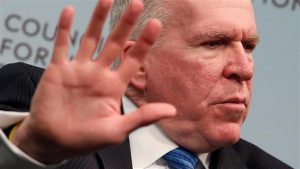 A brazen and unprecedented intervention in domestic U.S. politics by the intelligence community established the basic premise of the cascade of leaks about alleged Trump aides’ shady dealing with Russia. Led by CIA Director John Brennan, the CIA, FBI and NSA issued a 25-page assessment on Jan. 6 asserting for the first time that Russia had sought to help Trump win the election.
Brennan had circulated a CIA memo concluding that Russia had favored Trump and had told CIA staff that he had met separately with Director of National Intelligence James Clapper and FBI Director James Comey and that they had agreed on the “scope, nature and intent of Russian interference in our presidential election.”
In the end, however, Clapper refused to associate himself with the document and the NSA, which agreed to do so, was only willing to express “moderate confidence” in the judgment that the Kremlin had sought to help Trump in the election. In intelligence community parlance, that meant that the NSA considered the idea the Kremlin was working to elect Trump was merely plausible, not actually supported by reliable evidence.
In fact, the intelligence community had not even obtained evidence that Russia was behind the publication by Wikileaks of the e-mails Democratic National Committee, much less that it had done so with the intention of electing Trump. Clapper had testified before Congress in mid-November and again in December that the intelligence community did not know who had provided the e-mails to WikiLeaks and when they were provided.
The claim – by Brennan with the support of Comey – that Russia had “aspired” to help Trump’s election prospects was not a normal intelligence community assessment but an extraordinary exercise of power by Brennan, Comey and NSA Director Mike Rogers.
Brennan and his allies were not merely providing a professional assessment of the election, as was revealed by their embrace of the the dubious dossier compiled by a private intelligence firm hired by one of Trump’s Republican opponents and later by the Clinton campaign for the specific purpose of finding evidence of illicit links between Trump and the Putin regime.
Salacious Gossip
When the three intelligence agencies gave the classified version of their report to senior administration officials in January they appended a two-page summary of the juiciest bits from that dossier – including claims that Russian intelligence had compromising information about Trump’s personal behavior while visiting Russia. The dossier was sent, along with the assessment that Russia was seeking to help Trump get elected, to senior administration officials as well as selected Congressional leaders.
Among the claims in the private intelligence dossier that was summarized for policymakers was the allegation of a deal between the Trump campaign and the Putin government involving full Trump knowledge of the Russian election help and a Trump pledge – months before the election – to sideline the Ukraine issue once in office. The allegation – devoid of any verifiable information – came entirely from an unidentified “Russian emigre” claiming to be a Trump insider, without any evidence provided of the source’s actual relationship to the Trump camp or of his credibility as a source.
After the story of the two-page summary leaked to the press, Clapper publicly expressed “profound dismay” about the leak and said the intelligence community “has not made any judgment that the information in this document is reliable,” nor did it rely on it any way for our conclusions.”
One would expect that acknowledgment to be followed by an admission that he should not have circulated it outside the intelligence community at all. But instead Clapper then justified having passed on the summary as providing policymakers with “the fullest possible picture of any matters that might affect national security.”
By that time, U.S. intelligence agencies had been in possession of the material in the dossier for several months. It was their job to verify the information before bringing it to the attention of policymakers.
A former U.S. intelligence official with decades of experience dealing with the CIA as well other intelligence agencies, who insisted on anonymity because he still has dealings with U.S. government agencies, told this writer that he had never heard of the intelligence agencies making public unverified information on a U.S. citizen.
“The CIA has never played such a open political role,” he said.
The CIA has often tilted its intelligence assessment related to a potential adversary in the direction desired by the White House or the Pentagon and the Joint Chiefs of Staff, but this is the first time that such a slanted report impinges not only on domestic politics but is directed at the President himself.
The egregious triple abuse of the power in publishing a highly partisan opinion on Russia and Trump’s election, appending raw and unverified private allegations impugning Trump’s loyalty and then leaking that fact to the media begs the question of motive. Brennan, who initiated the whole effort, was clearly determined to warn Trump not to reverse the policy toward Russia to which the CIA and other national security organizations were firmly committed.
A few days after the leak of the two-page summary, Brennan publicly warned Trump about his policy toward Russia. In an interview on Fox News, he said, “I think Mr. Trump has to understand that absolving Russia of various actions that it’s taken in the past number of years is a road that he, I think, needs to be very, very careful about moving down.”
Graham Fuller, who was a CIA operations officer for 20 years and was also National Intelligence Officer for the Middle East for four years in the Reagan administration, observed in an e-mail, that Brennan, Clapper and Comey “might legitimately fear Trump as a loose cannon on the national scene,” but they are also “dismayed at any prospect that the official narrative against Russia could start falling apart under Trump, and want to maintain the image of constant and dangerous Russian intervention into affairs of state.”
Flynn in the Bull’s Eye
As Trump’s National Security Adviser, Michael Flynn presented an easy target for a campaign to portray the Trump team as being in Putin’s pocket. He had already drawn heavy criticism not only by attending a Moscow event celebrating the Russian television RT in 2016 but sitting next to Putin and accepting a fee for speaking at the event. More importantly, however, Flynn had argued that the United States and Russia could and should cooperate in their common interest of defeating Islamic State militants.
That idea was anathema to the Pentagon and the CIA. Obama’s Defense Secretary Ashton Carter had attacked Secretary of State John Kerry’s negotiating a Syrian ceasefire that included a provision for coordination of efforts against Islamic State. The official investigation of the U.S. attack on Syrian forces on Sept. 17 turned up evidence that CENTCOM had deliberately targeted the Syrian military sites with the intention of sabotaging the ceasefire agreement.
The campaign to bring down Flynn began with a leak from a “senior U.S. government official” to Washington Post columnist David Ignatius about the now-famous phone conversation between Flynn and Russian Ambassador Sergei Kislyak on Dec. 29. In his column on the leak, Ignatius avoided making any explicit claim about the conversation. Instead, he asked “What did Flynn say, and did it undercut the U.S. sanctions?”
And referring to the Logan Act, the 1799 law forbidding a private citizen from communicating with a foreign government to influence a “dispute” with the United States, Ignatius asked, “Was its spirit violated?”
The implications of the coy revelation of the Flynn conversation with Kislyak were far-reaching. Any interception of a communication by the NSA or the FBI has always been considered one of the most highly classified secrets in the U.S. intelligence universe of secrets. And officers have long been under orders to protect the name of any American involved in any such intercepted communication at all costs.
But the senior official who leaked the story of Flynn-Kislyak conversation to Ignatius – obviously for a domestic political purpose – did not feel bound by any such rule. That leak was the first move in a concerted campaign of using such leaks to suggest that Flynn had discussed the Obama administration’s sanctions with Kislyak in an effort to undermine Obama administration policy.
The revelation brought a series of articles about denials by the Trump transition team, including Vice President-elect Mike Pence, that Flynn had, in fact, discussed sanctions with Kislyak and continued suspicions that Trump’s aides were covering up the truth. But the day after Trump was inaugurated, the Post itself reported that the FBI had begun in late December go back over all communications between Flynn and Russian officials and “had not found evidence of wrongdoing or illicit ties to the Russian government….”
Two weeks later, however, the Post reversed its coverage of the issue, publishing a story citing “nine current and former officials, who were in senior positions at multiple agencies at the time of the calls,” as saying that Flynn had “discussed sanctions” with Kislyak.
The story said Flynn’s conversation with Kislyak was “interpreted by some senior U.S. officials as an inappropriate and potentially illegal signal to the Kremlin that it could expect a reprieve from sanctions that were being imposed by the Obama administration in late December to punish Russia for its alleged interference in the 2016 election.”
The Post did not refer to its own previous reporting of the FBI’s unambiguous view contradicting that claim, which suggested strongly that the FBI was trying to head off a plan by Brennan and Clapper to target Flynn. But it did include a crucial caveat on the phrase “discussed sanctions” that few readers would have noticed. It revealed that the phrase was actually an “interpretation” of the language that Flynn had used. In other words, what Flynn actually said was not necessarily a literal reference to sanctions at all.
Only a few days later, the Post reported a new development: Flynn had been interviewed by the FBI on Jan. 24 – four days after Trump’s inauguration – and had denied that he discussed sanctions in the conversation. But prosecutors were not planning to charge Flynn with lying, according to several officials, in part because they believed he would be able to “parse the definition of the word ‘sanctions’.” That implied that the exchange was actually focused not on sanctions per se but on the expulsion of the Russian diplomats.
Just hours before his resignation on Feb. 13, Flynn claimed in an interview with the Daily Caller that he had indeed referred only to the expulsion of the Russian diplomats.
“It wasn’t about sanctions. It was about the 35 guys who were thrown out,” Flynn said. “It was basically, ‘Look, I know this happened. We’ll review everything.’ I never said anything such as, ‘We’re going to review sanctions,’ or anything like that.”
The Russian Blackmail Ploy
Even as the story of the Flynn’s alleged transgression in the conversation with the Russian Ambassador was becoming a political crisis for Donald Trump, yet another leaked story surfaced that appeared to reveal a shocking new level of the Trump administration’s weakness toward Russia.
The Post reported on Feb. 13 that Acting Attorney General Sally Yates, an Obama holdover, had decided in late January – after discussions with Brennan, Clapper and FBI Director James Comey in the last days of the Obama administration – to inform the White House Counsel Donald McGahn in late January that Flynn had lied to other Trump administration officials – including Vice President Mike Pence – in denying that he discussed sanctions with Kislyak. The Post cited “current and former officials” as the sources.
That story, repeated and amplified by many other news media, led to Flynn’s downfall later that same day. But like all of the other related leaks, the story revealed more about the aims of the leakers than about links between Trump’s team and Russia.
The centerpiece of the new leak was that the former Obama administration officials named in the story had feared that “Flynn put himself in a compromising position” in regard to his account of the conversation with Kislyak to Trump members of the Trump transition.
Yates had told the White House that Flynn might be vulnerable to Russian blackmail because of the discrepancies between his conversation with the Ambassador and his story to Pence, according to the Post story.
But once again the impression created by the leak was very different from the reality behind it. The idea that Flynn had exposed himself to a potential Russian blackmail threat by failing to tell Pence exactly what had transpired in the conversation was fanciful in the extreme.
Even assuming that Flynn had flatly lied to Pence about what he had said in the meeting – which was evidently not the case – it would not have given the Russians something to hold over Flynn, first because it was already revealed publicly and second, because the Russian interest was to cooperate with the new administration.
The ex-Obama administration leakers were obviously citing that clumsy (and preposterous) argument as an excuse to intervene in the internal affairs of the new administration. The Post’s sources also claimed that “Pence had a right to know that he had been misled….” True or not, it was, of course, none of their business.
Pity for Pence
The professed concern of the Intelligence Community and Justice Department officials that Pence deserved the full story from Flynn was obviously based on political considerations, not some legal principle. Pence was a known supporter of the New Cold War with Russia, so the tender concern for Pence not being treated nicely coincided with a strategy of dividing the new administration along the lines of policy toward Russia.
All indications are that Trump and other insiders knew from the beginning exactly what Flynn had actually said in the conversation, but that Flynn had given Pence a flat denial about discussing sanctions without further details.
On Feb. 13, when Trump was still trying to save Flynn, the National Security Adviser apologized to Pence for “inadvertently” having failed to give him a complete account, including his reference to the expulsion of the Russian diplomats. But that was not enough to save Flynn’s job.
The divide-and-conquer strategy, which led to Flynn’s ouster, was made effective because the leakers had already created a political atmosphere of great suspicion about Flynn and the Trump White House as having had illicit dealings with the Russians. The normally pugnacious Trump chose not to respond to the campaign of leaks with a detailed, concerted defense. Instead, he sacrificed Flynn before the end of the very day the Flynn “blackmail” story was published.
But Trump appears to have underestimated the ambitions of the leakers. The campaign against Flynn had been calculated in part to weaken the Trump administration and ensure that the new administration would not dare to reverse the hardline policy of constant pressure on Putin’s Russia.
Many in Washington’s political elite celebrated the fall of Flynn as a turning point in the struggle to maintain the existing policy orientation toward Russia. The day after Flynn was fired the Post’s national political correspondent, James Hohmann, wrote that the Flynn “imbroglio” would now make it “politically untenable for Trump to scale back sanctions to Moscow” because the “political blowback from hawkish Republicans in Congress would be too intense….”
But the ultimate target of the campaign was Trump himself. As neoconservative journalist Eli Lake put it, “Flynn is only the appetizer. Trump is the entree.”
Susan Hennessey, a well-connected former lawyer in the National Security Agency’s Office of General Counsel who writes the Lawfare blog at the Brookings Institution, agreed. “Trump may think Flynn is the sacrificial lamb,” she told The Guardian, “but the reality is that he is the first domino. To the extent the administration believes Flynn’s resignation will make the Russia story go away, they are mistaken.”
The Phony “Constant Contacts” Story
No sooner had Flynn’s firing been announced than the next phase of the campaign of leaks over Trump and Russia began. On Feb. 14, CNN and the New York Times published slight variants of the same apparently scandalous story of numerous contacts between multiple members of the Trump camp with the Russian at the very time the Russians were allegedly acting to influence the election.
There was little subtlety in how mainstream media outlets made their point. CNN’s headline was, “Trump aides were in constant touch with senior Russian officials during campaign.” The Times headline was even more sensational: “Trump Campaign Aides Had Repeated Contacts with Russian Intelligence.”
But the attentive reader would soon discover that the stories did not reflect those headlines. In the very first paragraph of the CNN story, those “senior Russian officials” became “Russians known to U.S. intelligence,” meaning that it included a wide range Russians who are not officials at all but known or suspected intelligence operatives in business and other sectors of society monitored by U.S. intelligence. A Trump associate dealing with such individuals would have no idea, of course, that they are working for Russian intelligence.
The Times story, on the other hand, referred to the Russians with whom Trump aides were said to be in contact last year as “senior Russian intelligence officials,” apparently glossing over a crucial distinction that sources had made to CNN between intelligence officials and Russians being monitored by U.S. intelligence.
But the Times story acknowledged that the Russian contacts also included government officials who were not intelligence officials and that the contacts had been made not only by Trump campaign officials but also associates of Trump who had done business in Russia. It further acknowledged it was “not unusual” for American business to come in contact with foreign intelligence officials, sometimes unwittingly in Russia and Ukraine, where “spy services are deeply embedded in society.”
Even more important, however, the Times story made it clear that the intelligence community was seeking evidence that Trump’s aides or associates were colluding with the Russians on the alleged Russian effort to influence the election, but that it had found no evidence of any such collusion. CNN failed to report that crucial element of the story.
The headlines and lead paragraphs of both stories, therefore, should have conveyed the real story: that the intelligence community had sought evidence of collusion by Trump aides with Russia but had not found it several months after reviewing the intercepted conversations and other intelligence.
Unwitting Allies of the War Complex?
Former CIA Director Brennan and other former Obama administration intelligence officials have used their power to lead a large part of the public to believe that Trump had conducted suspicious contacts with Russian officials without having the slightest evidence to support the contention that such contacts represent a serious threat to the integrity of the U.S. political process.
Many people who oppose Trump for other valid reasons have seized on the shaky Russian accusations because they represent the best possibility for ousting Trump from power. But ignoring the motives and the dishonesty behind the campaign of leaks has far-reaching political implications. Not only does it help to establish a precedent for U.S. intelligence agencies to intervene in domestic politics, as happens in authoritarian regimes all over the world, it also strengthens the hand of the military and intelligence bureaucracies who are determined to maintain the New Cold War with Russia.
Those war bureaucracies view the conflict with Russia as key to the continuation of higher levels of military spending and the more aggressive NATO policy in Europe that has already generated a gusher of arms sales that benefits the Pentagon and its self-dealing officials.
Progressives in the anti-Trump movement are in danger of becoming an unwitting ally of those military and intelligence bureaucracies despite the fundamental conflict between their economic and political interests and the desires of people who care about peace, social justice and the environment.
NYT’s Fake News about Fake News
By Robert Parry | Consortium News | February 22, 2017
A grave danger from the Western mainstream media’s current hysteria about “fake news” is that the definition gets broadened from the few made-up stories that are demonstrably false – often fabricated by kids to get more clicks – to include reasonable disputes about the facts of a complex controversy.
This danger has grown worse because The New York Times, The Washington Post and other major Western news organizations have merged their outrage over “fake news” with the West’s propaganda campaign against Russia by claiming without evidence that the Russian government is somehow putting out false stories to undermine Western democracy.
However, when news organizations actually track down “fake news” outlets, they are usually run by some young entrepreneurs from outside Russia who saw made-up stories as a way to increase revenue by luring in more readers eager for “information” that supports their prejudices.
Yet, a front-page Times article on Tuesday, citing “fake news” as a threat to Europe, contains what arguably is “fake news” itself by claiming that many of the purported 2,500 stories “discredited” by the European Union’s East Stratcom operation have “links to Russia” although the Times doesn’t identify those links.
The article by Mark Scott and Melissa Eddy then goes on to blur these two separate concepts: “In a year when the French, Germans and Dutch will elect leaders, the European authorities are scrambling to counter a rising tide of fake news and anti-European Union propaganda aimed at destabilizing people’s trust in institutions.”
But it is this mushing together of “fake news” and what the Times describes as “anti-European Union propaganda” that is so insidious. The first relates to consciously fabricated stories; the second involves criticism of a political institution, the E.U., which is viewed by many Europeans as elitist, remote and disdainful of the needs, interests and attitudes of average citizens.
Whether you call such criticism “propaganda” or “dissent,” it is absurd to blame it all on Russia. When it comes to “destabilizing people’s trust in institutions,” the E.U. — especially with its inept handling of the Great Recession and its clumsy response to the Syrian refugee crisis — is doing a bang-up job on its own without Russian help.
Yet, rather than face up to legitimate concerns of citizens, the E.U. and U.S. governments have found a convenient scapegoat, Russia. To hammer home this point — to make it the new “groupthink” — E.U. and U.S. leaders have financed propaganda specialists to disparage political criticism by linking it to Russia.
Even worse, in the United States, the Times and other mainstream publications – reflecting the views of the political establishment – have editorialized to get giant technology companies, like Facebook and Google, to marginalize independent news sites that don’t accept the prevailing conventional wisdom.
There is an Orwellian quality to these schemes — a plan for a kind of Ministry of Truth enforced by algorithms to weed out deviant ideas — but almost no one whose voice is allowed in the mass media gets to make that observation. Even now, there is a chilling uniformity in the endless denunciations of Russia as the root of all evil.
Though the Times’ article treats the E.U.’s East Stratcom operatives as 11 beleaguered public servants sticking their fingers in the dike to protect the citizenry from a flood of Russian disinformation, “stratcom” actually is a euphemism for psychological operations, i.e., the strategic use of communications to influence the thinking of a target population.
In this case, the target populations are the European public and – to an ancillary degree – the American people who get to absorb the same propaganda from The New York Times. The real goal of stratcom is not to combat a few sleazy entrepreneurs generating consciously false stories for profit but to silence or “discredit” sources of information that question the E.U. and U.S. propaganda.
More Stratcom
NATO has its own Stratcom command based in Latvia that also is assigned to swat down information that doesn’t conform to Western propaganda narratives. The U.S. Agency for International Development and the U.S.-funded National Endowment for Democracy also pour tens of millions of dollars into media operations with similar goals as do major Western foundations, such as currency speculator George Soros’s Open Society. Last December, the U.S. Congress approved and President Obama signed legislation to create an additional $160 million bureaucracy to combat “Russian propaganda.”
In other words, the West’s stratcom and “psychological operations” are swimming in dough despite the Times’ representation that these “anti-disinformation” projects are unfairly outgunned by sinister forces daring to challenge what everyone-in-the-know knows to be true.
If these “stratcom” operations were around in 2002-2003, they would have been accusing the few people questioning the Iraq-has-WMD certainty of putting out “fake news” to benefit Saddam Hussein. Now, journalists and citizens who don’t buy the full-Monte demonization of Russia and its President Vladimir Putin are put into a similar category.
Instead of trusting in the free exchange of ideas, the new attitude at the Times, the Post and other Western news outlets is to short-circuit the process by smearing anyone who questions the official narratives as a “Putin apologist” or a “Moscow stooge.”
Beyond being anti-democratic, this anti-intellectual approach has prevented serious examination of the facts behind the West’s war or words against Russia. To shut down that debate, all you need to do is to say that any fact cited at a Russian news outlet must be false or “fake news.” Any Westerner who notes the same fact must be a “Putin puppet.”
Western “stratcom” doesn’t even want to allow Russian media to criticize politicians who are criticizing Russia. The Times article lamented that “Many false claims target politicians who present the biggest obstacles to Moscow’s goal of undermining the European Union.” The Times, however, doesn’t offer any examples of such “false claims.”
Instead, the Times writes that Russian news channels had “targeted the [French] presidential candidate Emmanuel Macron, who belongs to the party and is running on a pro-European Union platform.”
But what does that mean? Is it now an act of aggression when newscasts in one country criticize a leader of another country? If so, are the European news channels that have “targeted” U.S. President Donald Trump somehow deserving of U.S. government retaliation? Doesn’t the E.U. – and by extension The New York Times – accept the idea of political disagreement and debate?
This closed-mindedness is especially dangerous – indeed existentially risky – when applied to a confrontation between nuclear-armed powers. In such a case, the maximum amount of debate should be encouraged, instead of what amounts to blacklisting dissidents in the West who won’t toe the official propaganda lines.
Media Censors
Disturbingly, the leading forces in this suppression of skepticism are the most prestigious newspapers in the United States and Europe. Even after the disastrous experience with the Iraq War and the bogus WMD groupthink, Western news outlets that were party to that fiasco have virtually excluded well-reported articles and documentaries that question the U.S. and E.U. narratives of the New Cold War.
For instance, there has been almost no presentation in the mainstream Western media of an alternative – and I would argue more complete and accurate – narrative of the Ukraine conflict, taking into account the country’s complex history and deep ethnic divisions.
It is essentially forbidden to refer to the violent overthrow of elected President Viktor Yanukovych three years ago as a “coup” or a “putsch” or to cite evidence of a U.S.-backed “regime change,” such as an intercepted phone call between U.S. Assistant Secretary of State Victoria Nuland and U.S. Ambassador to Ukraine Geoffrey Pyatt in which they discussed how to “glue” and how to “midwife” the installation of a new leadership in Kiev.
In the supposedly “free” West, you can only refer to the post-coup events in Crimea, in which the people of the largely ethnic Russia area voted overwhelmingly to secede from Ukraine and rejoin Russia, as a “Russian invasion.” No skepticism is allowed even though there were no images of Russian troops wading ashore on Crimea’s beaches or Russian tanks crashing across borders. The “invasion” supposedly happened even though no invasion was necessary because Russian troops were already in Crimea under the naval basing agreement at Sevastopol.
Amid the West’s current hysteria about “Russian propaganda,” U.S. and E.U. citizens are not even given the opportunity to watch well-reported documentaries about key moments in the New Cold War, including an eye-opening investigative report debunking the Western propaganda myth constructed around the death of Russian accountant Sergei Magnitsky or a well-produced historical account of the Ukraine crisis.
Western news outlets and governments even take pride in blocking such dissenting views and contrary information from reaching the American and European publics. Like East Stratcom — the E.U.’s Brussels-based 11-member team of diplomats, bureaucrats and former journalists — establishment institutions see themselves bravely battling “Russian disinformation.” They see it as their duty not to let their people hear this other side of the story.
If that is what the West’s institutions have come to — dismissing reasonable criticism and thoughtful dissent as “Russian disinformation” — is it any wonder that they are losing the confidence of their people?
Investigative reporter Robert Parry broke many of the Iran-Contra stories for The Associated Press and Newsweek in the 1980s.
President’s Quest for Détente with Russia Continues Despite Fierce Opposition
By John V. Walsh | Dissident Voice | February 21, 2017
President Trump rose from the ashes of Mike Flynn at his press conference last Thursday. In a bravura performance, defiant and funny at times, the President took on the corporate media en masse.
It is a performance that should not be missed. You can savor both video and transcript at your leisure here.
The press
Trump: “Unfortunately, much of the media in Washington, D.C., along with New York, Los Angeles in particular, speaks not for the people, but for the special interests and for those profiting off a very, very obviously broken system. The press has become so dishonest that if we don’t talk about it, we are doing a tremendous disservice to the American people. Tremendous disservice. We have to talk to find out what’s going on, because the press honestly is out of control. The level of dishonesty is out of control.”
Sounds like what many “progressives” have been saying for a mighty long time, and it deserves resounding applause from them.
Trump: “And I’ll tell you what else I see. I see tone. You know the word ‘tone.’ The tone is such hatred. I’m really not a bad person, by the way. No, but the tone is such — I do get good ratings, you have to admit that — the tone is such hatred.”
And: “Now, I will say this. I watch it. I see it. I’m amazed by it. The public gets it, you know. Look, when I go to rallies, they turn around, they start screaming at CNN. They want to throw their placards at CNN. You know.”
The bias of the press against Trump is so obvious and heavy handed that no one can miss it. I asked one friend who is an avid and careful reader of the NYT whether he could name a single pro-Trump article over the last year. He could not. Does the press believe that the public are such fools that they cannot see this tone? This is but one more sign of the contempt that the clueless Elite have for the working stiff.
Russia and Putin
The most important point of the press conference was undoubtedly Trump’s refusal to back off one inch from his desire to “get along with Russia,” what some call New Détente or Détente 2.0. It is the most important, because tension between the two nuclear powers could well lead to war and nuclear exchange. For anti-warriors of every stripe Trump’s steadfastness was good news. The Flynn episode has not changed Trump’s resolve one iota.
Trump continued. Were he to denounce Russia and Putin, he instructed the press, it would be much easier for him politically. He would be hailed by the corporate press, the elitists of both Parties, the neocons, the Hillarycons and the entire foreign policy establishment, all of whom are itching for a fight, heedless that it might lead to a nuclear exchange. So Trump’s willingness to hold to this position is hardly opportunistic.
But he went farther. Trump let the press know that the atmosphere they are creating would make it difficult to negotiate with Putin, to defeat ISIS, or to bring an end to the crises in Ukraine or Syria nurtured by the US over the last six plus years. Why? Because he would have difficulty making concessions, giving as well as taking which any negotiation or deal demands. Any concession would trigger the charge that Trump is Putin’s puppet, the crazed mantra with which we are harangued daily and for which after all these many months there is not a shred of evidence. This is the very same point that Stephen F. Cohen, Emeritus Professor of Russian History at Princeton and NYU, often makes in his weekly discussions (Jan.25 episode especially) of U.S., Russia relations with John Batchelor on WABC.
Trump: “But I want to just tell you, the false reporting by the media, by you people, the false, horrible, fake reporting makes it much harder to make a deal with Russia. And probably Putin said ‘you know.’ He’s sitting behind his desk and he’s saying ‘you know, I see what’s going on in the United States, I follow it closely. It’s going to be impossible for President Trump to ever get along with Russia because of all the pressure he’s got with this fake story.’ OK? And that’s a shame because if we could get along with Russia — and by the way, China and Japan and everyone. If we could get along, it would be a positive thing, not a negative thing.” (Emphasis, jw).
And later, Trump: “But you know what? I want to do the right thing for the American people. And to be honest, secondarily, I want to do the right thing for the world.
If Russia and the United States actually got together and got along — and don’t forget, we’re a very powerful nuclear country and so are they. There’s no upside. We’re a very powerful nuclear country and so are they. I have been briefed. And I can tell you one thing about a briefing that we’re allowed to say because anybody that ever read the most basic book can say it, nuclear holocaust would be like no other. (Emphasis, jw)… They’re a very powerful nuclear country and so are we. If we have a good relationship with Russia, believe me, that’s a good thing, not a bad thing.”
The idea of “getting along” with other nations, even as we compete with them economically, is of course the way to peace and the very antithesis of the path the neocons and liberalcons from the Clintons to Bush to Obama have set us on these past thirty plus years of killing and destruction. And yet the “peace movement” expresses nothing but hatred for Trump and pushes for his impeachment. Some “peace” movement, that.
Back to l’affaire Flynn for a moment. Permit this writer to make a surmise, scarcely a ripple on the sea of surmises these days about the Deep State, Trump etc. Flynn did nothing illegal. Trump did not have to let him go, and it can easily be argued that Trump may have kept blood out of the water by sticking by Flynn and keeping him on. Flynn has been an asset. He is a champion of Détente 2.0 with Russia. He knows the national “intelligence” apparatus and where all its skeletons are closeted. He seems to know the deep story of the support that the Obama and Hillary forces gave to ISIS – certainly indirectly through US allies and probably also directly through the CIA, Mossad etc. But Flynn is also a man near crazed with an irrational bellicosity to Iran. That would have thrown a monkey wrench into Détente 2.0 since Russia and Iran have close ties especially in the fight against Sunni fundamentalist terrorism. So sooner or later Flynn had to go to preserve Détente 2.0. Did Trump take this opportunity to do so? And did Tillerson also crave this? It is a suspicion worth pondering. Trump has shown a cold-blooded capacity to say “you’re fired” when someone’s liabilities outweigh their assets. This writer suspects that Flynn’s time had come.
John V. Walsh can be reached at john.endwar@gmail.com.
US Raises Issue of INF Violation: Anti-Russian Campaign in Full Swing
By Alex GORKA | Strategic Culture Foundation | 20.02.2017
According to the New York Times, «a Trump administration official» has accused Russia of violating the Intermediate-Range Nuclear Forces Treaty (INF Treaty). The statement was supported by the Defense Department. Senate Armed Services Committee Chairman John McCain chimed in, saying «Russia’s deployment of nuclear-tipped ground-launched cruise missiles in violation of the INF treaty is a significant military threat to US forces in Europe and our NATO allies». According to him, Russian President Vladimir Putin was «testing» Trump.
The statement was immediately used by hawks as a pretext for instigating tensions. For instance, Sen. Tom Cotton, an Arkansas Republican, said he sees little reason for the US to continue adhering to the INF treaty in light of alleged Russia’s «violations». He has recommended building up US nuclear forces in Europe, which currently include about 200 bombs that can be delivered by aircraft. The US withdrew land-based nuclear-armed missiles from Europe as part of the INF deal.
The Treaty eliminated all ground-based nuclear and conventional missiles, as well as their launchers, with ranges of 500–1,000 kilometers (310–620 mi) (short-range) and 1,000–5,500 km (620–3,420 mi) (intermediate-range). Signed in December 1987 by President Ronald Reagan and Soviet leader Mikhail Gorbachev, the INF deal is accredited with significantly reducing the threat of nuclear confrontation and accelerating the end of the Cold War.
By May 1991, 2,692 missiles were eliminated, followed by 10 years of on-site verification inspections. The document did not cover sea-launched missiles. It stands as the only arms treaty to eliminate an entire class of US and Russian weapons – nuclear and conventional ground-launched ballistic and cruise missiles of intermediate range.
Last year, the State Department reported Russia was in violation of its treaty obligations not to possess, produce or flight-test a ground-launched cruise missile with a range of between 500 and 5,500 kilometers, or to possess or produce launchers for such missiles. «The administration is undertaking an extensive review of Russia’s ongoing INF treaty violation in order to assess the potential security implications for the United States and its allies and partners», said Mark Toner. The alleged violations had been mentioned in the 2014 and 2015 compliance reports.
No specifics have been released about which exactly Russian weapon is the source of the violation. The only thing it has said is that an unspecified Russian ground-launched cruise missile breaches the agreement. Supposedly, the missile in question is the SSC-8, a ground-based adaptation of the Kalibr missiles that were battle tested in Syria striking targets in Syria, nearly 1,000 miles away, from the Caspian Sea. Despite all the statements with accusations, no compelling evidence of the Russian non-compliance has ever been produced.
It should be noted that even if the missile has been tested, there is no violation. The INF Treaty allows the testing of sea-launched cruise missiles (SLCMs) from ground-based platforms if they are fixed. Article VII (para 11) states, «A cruise missile which is not a missile to be used in a ground-based mode shall not be considered to be a GLCM if it is test-launched at a test site from a fixed land-based launcher which is used solely for test purposes and which is distinguishable from GLCM launchers».
Russia, in turn, has accused the US of violating the pact. In a nutshell, it cites the following examples of non-compliance:
– The use of target missiles with characteristics similar to those of intermediate and shorter-range ballistic missiles during ballistic missile defense (BMD) tests. With its operational range (1,100 km) Hera qualifies as an intermediate ballistic missile and hence violates Item 1, Article 6 of the INF Treaty.
– The deployment in Romania and Poland of Mk-41 Aegis Ashore launchers capable of firing ground-launched cruise missiles (GLCMs). A US mid-range weapon launched from Poland would require only a short flight time to reach beyond the Urals.
– US unmanned aerial vehicles (UAVs) or armed drones such as the MQ-1 Predator, fall under the INF Treaty definition of GLCMs. Moscow claims that their operational ranges (1,100 km) and lack of pilot mean that drones of this type are very similar to shorter-range cruise missiles.
It’s worth noting that the US plans to arm tactical aviation in Europe with modernized B61-12 guided warheads will virtually nullify all the benefits of the INF Treaty from the point of view of Russia’s security. The aircraft could fly from bases in Lithuania, Estonia and Poland to Russia’s largest cities in 15-20 minutes – not that much longer than the flight time of the missiles scuttled by the INF treaty.
The Special Verification Commission (SVC) envisioned by the INF treaty is a forum to confidentially address compliance concerns. It was convened last November for the first time since 2003 to produce no results. The opportunities provided by this venue should not be squandered. It would be much more fruitful to start serious discussions within the framework of the SVC than make public statements not backed up by facts. The accusations obviously pursue the aim of whipping up tensions to spoil the RF-US relationship at the time it has a chance to improve.
The INF treaty is under serious and increasing stress. Failure to resolve the dispute could threaten the agreement and impede further efforts to reduce Russia and US nuclear arsenals in the years ahead. The parties could use the SVC venue to consider additional confidence-building measure and information exchanges that take into account technological and political developments that have occurred recently. The Open Skies Treaty could be used for the purpose. Its observation capabilities could be upgraded. The NATO-Russia Council could serve as another mechanism to address specific security concerns.
The issue has been debated since 2014 but before this statement no one has officially accused Russia of violating the INF. It should be noted that this time the issue was raised immediately after the Flynn’s resignation from the position of national security adviser. Revelations about alleged ‘Russia connections» of the people who belong to the Trump’s team are hitting US media headlines. The statement about the INF violation is made against the background of the White House’s statement stressing the need to «return» Crimea to Ukraine and the ballyhoo raised over the alleged dangerous maneuvering of Russian aircraft in the Black Sea. These are provocative statements doomed to be rejected by Moscow but they pursue a definite purpose. Evidently, some powerful circles in the US have launched a well-orchestrated campaign to prevent the improvement of Russia-US relations.
Featured Video

Elijah Magnier: Yemen’s strikes are shattering Saudi Arabia’s long-term strategy
or go to
Aletho News Archives – Video-Images
From the Archives
British weapons and personnel doing much of the killing in Yemen
Press TV – June 18, 2019
A detailed report published by the Guardian newspaper has shown how Britain is massively contributing to Saudi Arabia’s devastating war on Yemen as it suggests that London is not only supplying the bombs that fall on Yemenis, but it provides the personnel and expertise that keep the war going.
The comprehensive report by Arron Merat published on Tuesday showed that Britain was doing much of the killing in Yemen as the country continues to provide Saudi Arabia with everything it needs to turn its southern impoverished neighbor into a graveyard.
“Every day Yemen is hit by British bombs – dropped by British planes that are flown by British-trained pilots and maintained and prepared inside Saudi Arabia by thousands of British contractors,” said Merat in the report. … continue
Blog Roll
 Aletho News
- Netizens condemn Japanese drama for projecting Japan’s wartime atrocities onto Chinese characters
- Racist Seinfeld Dances for Joy as Bibi Unveils His New Map
- A West Bank War for Netanyahu’s Election Campaign, Could It Backfire?
- Yemen denounces European Parliament’s ‘hypocritical’ push to blacklist Ansarullah
- Qalibaf: UAE’s UN bid aims to ‘clear the runway’ for ‘Greater Israel’, whitewash genocide
- Pakistan reopens Iran border after boosting security: Report
- Why are so many Brazilians voting for Flávio Bolsonaro?
- Democrats Put Anti-Russia Agenda Ahead of American Workers
- Elijah Magnier: Yemen’s Strikes Are Shattering Saudi Arabia’s Long-Term Strategy
- Pentagon designates Chinese cultural centers national security threat
- If Americans Knew
- Latest updates from Israeli assault on West Bank
- Tourism Ministry launches free food truck tour in US
- “So Much Worse Than People Realize”: Never-Before-Seen Images Reveal Damage at U.S. Bases as Troops Describe Being Abandoned
- UK Bell Review Confirms Only Anti-Israel Attitudes Are Rising, Not Antisemitism
- DAILY UPDATE: Latest essential news on Palestine, Israel, & region
- DAILY UPDATE: Latest essential news on Palestine, Israel, & region
- Damning report shows the media must confront its failures on Gaza
- BBC senior broadcaster speaks out on Gaza coverage
- Netanyahu vows vast West Bank invasion in response to 20-minute skirmish that left 2 Israeli soldiers and 2 Palestinian fighters dead
- Tied up and tortured: Israel using US-made electroshock weapons on Palestinian detainees
- No Tricks Zone
- Sudden Stratospheric Warming, Powerful El Niño Combination May Lead To Extreme Europe Cold, Energy Crisis!
- Two New Studies Find Thwaites Glacier Melt Cannot Be Driven By Human Activity Or A Warming Ocean
- E-Cars Reduce CO2 Emissions By Only 41% Compared To Internal Combustion Engine Vehicles
- Predictions Made By Renowned Climate Professor Over Past Decades Have Been Proven To Be Poor
- New Study Suggests Large Regions Of The Pacific Ocean Have Been Cooling For The Last 80 Years
- Germany’s Green Energy Debacle: High Energy Costs Force Kahla Porzellan to Close After 182 Years!
- New Study: 50 Years Of The Most Aggressive ‘Net Zero’ Policies Can Only Affect The Global Climate By 0.03°C
- US September “Heat” Was No Record…Many Records Set Decades Ago
- Latest European Green Energy Debacle; Portugal’s Largest Flagship Solar Park Insolvent!
- Green Energy Debacle: German Expert Professor Fritz Vahrenholt Warns Of Severe Economic And Social Consequences

