US Lawmakers Introduce Legislation to Unleash Nuclear Arms Race in Europe
By Andrei AKULOV | Strategic Culture Foundation | 19.02.2017
The INF Treaty was a major breakthrough to halt and reverse the Cold War-era nuclear arms race in Europe. There are growing signs that the treaty is in jeopardy. A possible US unilateral withdrawal and failure to resolve the compliance dispute could impede efforts to save the arms control regime from being eroded.
On February 16, Senator Tom Cotton (R-Arkansas), along with Senators Ron Johnson (R-Wisconsin) and Marco Rubio (R-Florida) introduced the Intermediate-Range Forces Treaty (INF) Preservation Act, legislation that would allow the United States to develop new intermediate-range missiles. Congressmen Ted Poe (R-Texas) and Mike Rogers (R-Alabama) introduced companion legislation in the House of Representatives.
Accusations of Russia violating the INF Treaty, not backed up by any evidence, were used as a pretext for introducing the measure. For instance, the New York Times has recently published report saying that Russia «has secretly deployed» a new nuclear-capable intermediate-range cruise missile, the SSC-8, in apparent violation of the 1987 treaty. «This legislation will give President Trump the tools he needs to show our friends and adversaries alike that ‘peace through strength’ is back», said Mike Rogers.
The INF Treaty is a key agreement between the United States and the Soviet Union which put a seal on the Cold War era. It eliminated all nuclear and conventional ground-launched ballistic and cruise missiles with intermediate ranges, defined as between 500-5,500 kilometers (3000-3400 miles).
If the bill becomes a law, it won’t add to US or NATO security. America has real interest in preserving the treaty in force. It has sound reasons for doing so. One of them is that US NATO allies greatly value the INF and want it to remain effective. A US withdrawal would raise concern on their part.
With no hard evidence of non-compliance produced, the US will be held responsible by international community for ending the treaty. If Washington possessed facts to substantiate the claim that Moscow is in violation of the treaty, it would have been provided them a long time ago.
The bill says the US is to «develop» new systems. But even if a decision were taken to return obsolete Pershing-2s and long-range Tomahawks, it would take time and effort. On its part, Russia can easily increase the range of existing Iskander missiles.
Developing new US systems would impose a new burden on an already stretched defense budget. Funding a new expensive program would draw funds from other accounts, such as new conventional weapons, the upgrade of strategic nuclear forces, the ballistic missile defense (BMD), you name it. Today, the US national debt is about $20 trillion and the clock is ticking.
Even if the provision of the bill is carried out and a new intermediate range system is in place, the US will face a tall order in finding an ally willing to host it and become a target for a pre-emptive strike by Russian armed forces. Such deployments would be viewed as extremely provocative to Moscow.
Even in the 1980s it was a close thing. Those days the plans to deploy INF forces met fierce domestic political and public opposition. A controversial decision would tear NATO apart at the time the US and its European allies don’t see eye to eye on many issues.
The same applies to deployment plans in the Pacific. Japan would worry about deteriorating the relationship with Russia and China. South Korea would fear such a deployment might disrupt its improving relations with China.
The times have changed. Today, Russia possesses cutting edge S-400 aid defense systems capable of countering not only ballistic but also cruise missiles with an operational range of 3,000−3,500 km (1,864-2,174 mi).
The Russian military is gearing up to test the first prototypes of its next-generation S-500 Prometey air and missile defense system. The weapon has no analogues in the world. S-500 is the fifth generation system capable of destroying intercontinental ballistic missiles and spacecraft, hypersonic cruise missiles and airplanes at speeds of higher than Mach 5. Its response time is only 3-4 seconds, just think about it! It can detect and simultaneously attack up to ten ballistic missile warheads out at 600 km flying at speeds of twenty-three thousand feet per second. The system can engage targets at altitudes of about 125 miles, including incoming ballistic missiles in space at ranges as great as 400 miles. Evidently, Russia has the means to counter the threat. It puts into doubt the effectiveness of any future intermediate range weapon the US would develop in accordance with legislation in question.
The end of INF treaty would provoke other states into an arms race the US cannot control.
The bill is introduced at the time the world is facing the most serious and comprehensive crisis in the fifty-year history of nuclear arms control. Since pulling out from the 1972 ABM Treaty, the US has been taking one step after another to undermine the arms control regime that has served as a pillar of international security for dozens of years. Now the US Congress is on the brink of unleashing an arms race with dire consequences for America itself.
Does it all make sense? Russia has recently announced its goal to shift from nuclear to conventional deterrence to make the world safer.
The recent initiative Germany, supported by leading the leading European partners, provides a new chance to address the problems of European security. With so many controversial issues on the agenda, Helsinki-2 would be the right way to launch discussions on creating a security regime from Lisbon to Vladivostok – something Moscow proposed a few years ago.
There are opportunities to seize and turn the tide as arms control is unraveling. Instead, a group of US lawmakers has introduced legislation to quash all hopes for a better world. Never before has the arms control regime been threatened so much. Voting for the bill means shooting yourself in the foot. The US will undermine its own security and create huge problems to overcome.
Hopefully, there will be enough sober-minded members of Congress to prevent the measure from becoming a law.
The Empire Strikes Back
By Brad Benson | OffGuardian | February 17, 2017
On the surface, the resignation of General Michael Flynn is being sold as a cut-and-dried case of the General getting ahead of his skis by calling the Russian Ambassador to discuss the lifting of sanctions. This was ostensibly then complicated by the General not being honest about his discussions, when queried about it by Vice President Mike Pence. However, as is always the case in these types of affairs, the real story will go untold and General Flynn’s “resignation” will have ramifications far beyond these first headlines.
In reality, the General’s early fall is a signal that the Deep State is not about to permit rapprochement with Russia. This is because any moves to defuse the New Cold War could threaten to undercut Obama’s $1 Trillion, 30 year nuclear arms rearmament program, which has been quietly moving forward for several years.
Flynn, the former head of the Defense Intelligence Agency (DIA), which is the military’s counterpart to the CIA, was originally fired by Obama for an intelligence assessment, which disputed information that Obama was being fed by the CIA. In retrospect, this report was rather prescient, since it noted that an infant ISIS was a much bigger threat than Obama was being told, while further advising that it was a mistake for the CIA to be supplying them with arms in their ill-fated effort to bring down Assad in Syria.
This put Flynn in direct conflict with then CIA Director, John Brennan, then Director of National Intelligence, John Clapper, and a whole cadre of Neo-Con Interventionists inside Hillary Clinton’s State Department. Flynn’s timing was also bad, since the War Hawks had only recently overthrown Gaddafi and, in the ecstasy of their “success”, no one, especially Obama, wanted to be told that rain clouds were already gathering over their parade.
When General Flynn reemerged as an advisor to Trump during the campaign, there was no immediate concern within the Deep State, since Trump was not seen as a serious factor. However, as Trump began to talk about rapprochement with Putin’s Russia on the campaign trail, Flynn was identified as one of the driving forces behind this idea and, as a result, the Clinton Campaign opened up a new front to denigrate him as a racist nut-case. This may very well have been true, but it does not, as a consequence, make him wrong in regard to his recognition of the necessity to defuse the New Cold War with Russia.
Flynn’s early departure is a big victory for the Deep State Thugs who are heavily invested in the New Cold War. It is most certainly also a signal to Trump that he can be removed, since MSM talking heads are already spinning stories about the fired DOJ Acting Attorney General, Sally Yates, having previously warned the White House that tapped phone calls, between Flynn and the Russian Ambassador, might make the General subject to “blackmail” by the Russians.
Indeed, not-so-subtle threats of impeachment are already being floated, with nuances of the famous question, “What did the President know and when did he know it?” One Neo-Con Flim-flam man has already gone so far as to refer to the “Russian Stench” and demanded to know what is behind this “Russian connection”, which, if anyone gave it any real thought, was essentially a move toward peace.
However, this was apparently just the warm up act for the big guns, since the next up was Thomas Friedman, the influential NY Times op-ed writer, who helped the Bush and Obama Administrations to lie us into several wars. Adopting a stern demeanor, while staring directly into the camera, Friedman demands no less than a full investigation into Trump’s associations with these pesky Russkies, who “undermined our election”, ominously concluding that this was an “event as significant as Pearl Harbor”.
Meanwhile, early rumblings from Moscow are noting that this could be bad news for future relations with the US and could ultimately lead to a deterioration of relations. This is a nice way of saying that they know that our Deep State is undermining the move toward rapprochement, while also sending a subtle message to Trump that they hope he’s not falling for it. Sadly, it may already be too late.
This is the first move to set up Trump for impeachment, with Mike Pence, a Neo-Con, sitting in the catbird seat. Those that celebrate the demise of Flynn and hope for the early fall of Trump should be careful in regard to their wishes. The ultimate result intended in all of this is that there will be no rapprochement with Russia and that the New Cold War might eventually develop into a hot one.
The Empire has struck back. Whether one likes Trump or not, no one should be distracted by the “Russian Connection” Sideshow. This is about the future of a major rearmament program and the Deep State has subtly enlisted the support of the Trump haters on the left to create the conditions for Trump’s early removal.
With many Neo-Cons on the right also poised to feed on the carcass of a guy they couldn’t stop in the primaries, the American People better wake up. This is not a question of left or right. It may very well be a question of survival.
US media reports of Trump links to Russian intelligence ‘laughable, cite no facts’ – Kremlin
RT | February 15, 2017
Moscow has criticized news reports alleging associates of Donald Trump had numerous contacts with Russian intelligence during the election, with the Kremlin’s spokesman complaining that it’s hard to distinguish fact from fiction in the US media lately.
“Those reports are not based on concrete facts,” Dmitry Peskov stressed on Wednesday, noting “there are five different sources in the story and none is named. So you see, really laughable stories are now given a go.”
The Russian president’s spokesman added, “Let’s not just believe the press. It’s difficult lately tell the real deal from fakes and hoaxes,” referring to reports in the New York Times and on CNN which cited anonymous US sources as saying that several people close to President Donald Trump had communicated with Russian intelligence officers during the presidential campaign.
Russia’s Foreign Ministry has reacted cautiously, saying the publications indicate a big political game involving power bargaining is being played within the US establishment.
Other Russian officials were more forthcoming, however.
“It’s common tactic to discredit a person,” Senator Vladimir Dzhabarov told RIA Novosti, commenting on expose stories run by the New York Times and CNN, adding that it’s a continuation of the same campaign that forced Michael Flynn’s resignation as National Security Advisor earlier.
“Trump should realize that the real target of such leaks is him. Unless the American president puts an end to this witch-hunt and stops surrendering his people, this will all end bad. The final goal of his enemies is to impeach the president,” he added.
Dzhabarov, who holds a seat in the Russian Senate, is a veteran intelligence officer who retired with the rank of Colonel General.
Leonid Slutsky, a fellow legislator and head of the Parliament’s Foreign Affairs Committee, came to a similar conclusion, saying that the US mainstream media is carrying out a concerted attack on Trump.
“Such outlets use any chance to mar the new president and use this overused and baseless ‘Russian dossier’ for the purpose often because it makes a reliable impact on their readers,” he explained.
The Russian Foreign Intelligence Service, whose agents Trump’s aides were allegedly in contact with, told TASS they were surprised by the reports and would not comment on “media speculations that lack proof.”
In an earlier article, the New York Times cited unnamed current and former US officials as saying that members of Trump’s election campaign had had contacts with senior Russian intelligence officers. The newspaper said US intelligence had intercepted the communications of Trump’s aides as they were collecting information to see if there was any evidence showing collusion between the Republican and Russia on the alleged hack of the Democratic National Convention – evidence that they reportedly failed to find.
The report said that, not only campaign members, but also other associates of Trump had been targeted by the surveillance. The only name it provided was that of Paul Manafort, who had to resign as Trump’s campaign manager after Ukrainian authorities accused him of having been involved in the corruption of the previous Ukrainian government. The evidence of such corruption was later disavowed by the Ukrainian investigators.
Commenting for the NYT report, Manafort denied having any ties with the Russian intelligence.
“This is absurd. I have no idea what this is referring to. I have never knowingly spoken to Russian intelligence officers, and I have never been involved with anything to do with the Russian government or the Putin administration or any other issues under investigation today,” he told the newspaper.
The NYT sources would not disclose any details, including the names of alleged Russian spies or the number of Trump people that had allegedly communicated with them, claiming the data had been collected as part of routine surveillance of the communications of foreign officials.
CNN ran a similar story independently of the newspaper, citing anonymous “law enforcement and administration officials.”
New York Times Manipulates NOAA’s Climate Science Scandal
By Marc Morano | Climate Depot | February 12, 2017
If you were only to read the New York Times’ latest article on the most recent Climate Change scandal first reported by the Mail and the Daily Mail, you would never know that there was any scandal to speak of in the first place.
Headline: “No Data Manipulation in 2015 Climate Study, Researchers Say.” Well, not all researchers. The background of the data manipulation story revolves around accusations made by David Bates, a recently retired scientist at the National Oceanic and Atmospheric Administration (NOAA). Among his several accusations is that NOAA “rushed to publish a landmark paper that exaggerated global warming and was timed to influence the historic Paris agreement on climate change,” a paper which would have been welcomed with open arms by the Obama administration. On February 4, Bates wrote a lengthy blog post at his website detailing the accusations. Here is a brief list of some of the charges:
1. Climate scientist, Tom Karl, failed to archive the land temperature data set and thus also failed to “follow the policy of his own Agency [and] the guidelines in Science magazine for dataset archival and documentation.”
2. The authors also chose to “use a 90% confidence threshold for evaluating the statistical significance of surface temperature trends, instead of the standard for significance of 95%,” and according to Bates, the authors failed to give a justification for this when pressed.
3. Karl routinely “had his ‘thumb on the scale’ — in the documentation, scientific choices, and release of datasets — in an effort to discredit the notion of a global warming hiatus and rush to time the publication of the paper to influence national and international deliberations on climate policy.” Bates adds, “[a] NOAA NCEI supervisor remarked how it was eye-opening to watch Karl work the co-authors, mostly subtly but sometimes not, pushing choices to emphasize warming.”
4. Experimental datasets were used that were not run through operational readiness review (ORR) and were not archived.
To sum up, the “data manipulation,” as characterize by the Mail, consisted in not following proper protocols, selecting certain data sets which had not been properly analyzed, and manipulating scientific methodology with a political and not purely scientific end.
A Reprise of the Iraq-WMD Fiasco?
By James W Carden | Consortium News | February 3, 2017
The controversy over Russia’s alleged interference in the 2016 presidential election shows no sign of letting up. A bipartisan group of U.S. senators recently introduced legislation that would impose sanctions on Russia in retaliation for its acts of “cyber intrusions.”
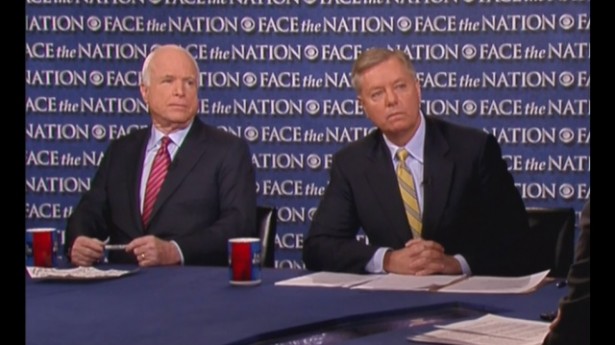
Senators John McCain and Lindsey Graham
At a press event in Washington on Tuesday, Sen. Dick Durbin, D-Illinois, called Election Day 2016 “a day that will live in cyber infamy.” Previously, Sen. John McCain, R-Arizona, called the Russian hacks of the Democratic National Committee “an act of war,” while Sen. Lindsey Graham, R-South Carolina, has claimed that there is near unanimity among senators regarding Russia’s culpability.
Despite all this, the question of who exactly is responsible for the providing WikiLeaks with the emails of high Democratic Party officials does not lend itself to easy answers. And yet, for months, despite the lack of publicly disclosed evidence, the media, like these senators, have been as one: Vladimir Putin’s Russia is responsible.
Interestingly, the same neoconservative/center-left alliance which endorsed George W. Bush’s case for war with Iraq is pretty much the same neoconservative/center-left alliance that is now, all these years later, braying for confrontation with Russia. It’s largely the same cast of characters reading from the Iraq-war era playbook.
It’s worth recalling Tony Judt’s observation in September 2006 that “those centrist voices that bayed most insistently for blood in the prelude to the Iraq war … are today the most confident when asserting their monopoly of insight into world affairs.”
While that was true then, it is perhaps even more so the case today.
The prevailing sentiment of the media establishment during the months prior to the disastrous March 2003 invasion of Iraq was that of certainty: George Tenet’s now infamous assurance to President Bush, that the case against Iraq was a “slam drunk,” was essentially what major newspapers and television news outlets were telling the American people at the time. Iraq posed a threat to “the homeland,” therefore Saddam “must go.”
The Bush administration, in a move equal parts cynical and clever, engaged in what we would today call a “disinformation” campaign against its own citizens by planting false stories abroad, safe in the knowledge that these stories would “bleed over” and be picked up by the American press.
WMD ‘Fake News’
The administration was able to launder what were essentially “fake news” stories, such as the aluminum tubes fabrication, by leaking to Michael R. Gordon and Judith Miller of The New York Times. In September 2002, without an ounce of skepticism, Gordon and Miller regurgitated the claims of unnamed U.S. intelligence officials that Iraq “has sought to buy thousands of specially designed aluminum tubes … intended as components of centrifuges to enrich uranium.” Gordon and Miller faithfully relayed “the intelligence agencies’ unanimous view that the type of tubes that Iraq has been seeking are used to make centrifuges.”
By 2002, no one had any right to be surprised by what Bush and Cheney were up to; since at least 1898 (when the U.S. declared war on Spain under the pretense of the fabricated Hearst battle cry “Remember the Maine!”) American governments have repeatedly lied in order to promote their agenda abroad. And in 2002-3, the media walked in lock step with yet another administration in pushing for an unnecessary and costly war.
Like The New York Times, The Washington Post also relentlessly pushed the administration’s case for war with Iraq. According to the journalist Greg Mitchell, “By the Post’s own admission, in the months before the war, it ran more than 140 stories on its front page promoting the war.” All this, while its editorial page assured readers that the evidence Colin Powell presented to the United Nations on Iraq’s WMD program was “irrefutable.” According to the Post, it would be “hard to imagine” how anyone could doubt the administration’s case.
But the Post was hardly alone in its enthusiasm for Bush’s war. Among the most prominent proponents of the Iraq war was The New Yorker’s Jeffrey Goldberg, who, a full year prior to the invasion, set out to link Saddam Hussein and Al Qaeda. Writing for The New Yorker in March 2002, Goldberg retailed former CIA Director James Woolsey’s opinion that “It would be a real shame if the C.I.A.’s substantial institutional hostility to Iraqi democratic resistance groups was keeping it from learning about Saddam’s ties to Al Qaeda in northern Iraq.”
Indeed, according to Goldberg, “The possibility that Saddam could supply weapons of mass destruction to anti-American terror groups is a powerful argument among advocates of regime change,” while Saddam’s “record of support for terrorist organizations, and the cruelty of his regime make him a threat that reaches far beyond the citizens of Iraq.”
Writing in Slate in October 2002, Goldberg was of the opinion that “In five years . . . I believe that the coming invasion of Iraq will be remembered as an act of profound morality.”
Likewise, The New Republic’s Andrew Sullivan was certain that “we would find weapons of mass destruction in Iraq. I have no doubt about that.” Slate’s Jacob Weisberg supported the invasion because he thought Saddam Hussein had WMD and he “thought there was a strong chance he’d use them against the United States.”
Even after it was becoming clear that the war was a debacle, the neoconservative pundit Charles Krauthammer declared that the inability to find WMDs was “troubling” but “only because it means that the weapons remain unaccounted for and might be in the wrong hands. The idea that our inability to thus far find the weapons proves that the threat was phony and hyped is simply false.”
Smearing Skeptics
Opponents of the war were regularly accused of unpatriotic disloyalty. Writing in National Review, the neoconservative writer David Frum accused anti-intervention conservatives of going “far, far beyond the advocacy of alternative strategies.” According to Frum, “They deny and excuse terror. They espouse a potentially self-fulfilling defeatism. They publicize wild conspiracy theories. And some of them explicitly yearn for the victory of their nation’s enemies.”
Similarly, The New Republic’s Jonathan Chait castigated anti-war liberals for turning against Bush. “Have Bush haters lost their minds?” asked Chait. “Certainly some have. Antipathy to Bush has, for example, led many liberals not only to believe the costs of the Iraq war outweigh the benefits but to refuse to acknowledge any benefits at all.”
Yet of course we now know, thanks, in part, to a new book by former CIA analyst John Nixon, that everything the U.S. government thought it knew about Saddam Hussein was indeed wrong. Nixon, the CIA analyst who interrogated Hussein after his capture in December 2003, asks “Was Saddam worth removing from power?” “The answer,” says Nixon, “must be no. Saddam was busy writing novels in 2003. He was no longer running the government.”
It turns out that the skeptics were correct after all. And so the principal lesson the promoters of Bush and Cheney’s war of choice should have learned is that blind certainty is the enemy of fair inquiry and nuance. The hubris that many in the mainstream media displayed in marginalizing liberal and conservative anti-war voices was to come back to haunt them. But not, alas, for too long.
A Dangerous Replay?
Today something eerily similar to the pre-war debate over Iraq is taking place regarding the allegations of Russian interference in the U.S. presidential election. Assurances from the intelligence community and from anonymous Obama administration “senior officials” about the existence of evidence is being treated as, well, actual evidence.
State Department spokesman John Kirby told CNN that he is “100% certain” of the role that Russia played in U.S. election. The administration’s expressions of certainty are then uncritically echoed by the mainstream media. Skeptics are likewise written off, slandered as “Kremlin cheerleaders” or worse.
Unsurprisingly, The Washington Post is reviving its Bush-era role as principal publicist for the government’s case. Yet in its haste to do the government’s bidding, the Post has published two widely debunked stories relating to Russia (one on the scourge of Russian inspired “fake news”, the other on a non-existent Russian hack of a Vermont electric utility) onto which the paper has had to append “editor’s notes” to correct the original stories.
Yet, those misguided stories have not deterred the Post’s opinion page from being equally aggressive in its depiction of Russian malfeasance. In late December, the Post published an op-ed by Rep. Adam Schiff and former Rep. Jane Harmon claiming “Russia’s theft and strategic leaking of emails and documents from the Democratic Party and other officials present a challenge to the U.S. political system unlike anything we’ve experienced.”
On Dec. 30, the Post editorial board chastised President-elect Trump for seeming to dismiss “a brazen and unprecedented attempt by a hostile power to covertly sway the outcome of a U.S. presidential election.” The Post described Russia’s actions as a “cyber-Pearl Harbor.”
On Jan. 1, the neoconservative columnist Josh Rogin told readers that the recent announcement of sanctions against Russia “brought home a shocking realization that Russia is using hybrid warfare in an aggressive attempt to disrupt and undermine our democracy.”
Meanwhile, many of the same voices who were among the loudest cheerleaders for the war in Iraq have also been reprising their Bush-era roles in vouching for the solidity of the government’s case.
Jonathan Chait, now a columnist for New York magazine, is clearly convinced by what the government has thus far provided. “That Russia wanted Trump to win has been obvious for months,” writes Chait.
“Of course it all came from the Russians, I’m sure it’s all there in the intel,” Charles Krauthammer told Fox News on Jan. 2. Krauthammer is certain.
And Andrew Sullivan is certain as to the motive. “Trump and Putin’s bromance,” Sullivan told MSNBC’s Chris Matthews on Jan. 2, “has one goal this year: to destroy the European Union and to undermine democracy in Western Europe.”
David Frum, writing in The Atlantic, believes Trump “owes his office in considerable part to illegal clandestine activities in his favor conducted by a hostile, foreign spy service.”
Jacob Weisberg agrees, tweeting: “Russian covert action threw the election to Donald Trump. It’s that simple.” Back in 2008, Weisberg wrote that “the first thing I hope I’ve learned from this experience of being wrong about Iraq is to be less trusting of expert opinion and received wisdom.” So much for that.
Foreign Special Interests
Another, equally remarkable similarity to the period of 2002-3 is the role foreign lobbyists have played in helping to whip up a war fever. As readers will no doubt recall, Ahmed Chalabi, leader of the Iraqi National Congress, which served, in effect as an Iraqi government-in-exile, worked hand in hand with the Washington lobbying firm Black, Kelly, Scruggs & Healey (BKSH) to sell Bush’s war on television and on the op-ed pages of major American newspapers.
Chalabi was also a trusted source of Judy Miller of the Times, which, in an apology to its readers on May 26, 2004, wrote: “The most prominent of the anti-Saddam campaigners, Ahmad Chalabi, has been named as an occasional source in Times articles since at least 1991, and has introduced reporters to other exiles. He became a favorite of hard-liners within the Bush administration and a paid broker of information from Iraqi exiles.” The pro-war lobbying of the American Israel Public Affairs Committee has also been exhaustively documented.
Though we do not know how widespread the practice has been as of yet, something similar is taking place today. Articles calling for confrontation with Russia over its alleged “hybrid war” with the West are appearing with increasing regularity. Perhaps the most egregious example of this newly popular genre appeared on Jan. 1 in Politico magazine. That essay, which claims, among many other things, that “we’re in a war” with Russia comes courtesy of one Molly McKew.
McKew is seemingly qualified to make such a pronouncement because she, according to her bio on the Politico website, served as an “adviser to Georgian President Saakashvili’s government from 2009-2013, and to former Moldovan Prime Minister Filat in 2014-2015.” Seems reasonable enough. That is until one discovers that McKew is actually registered with the Department of Justice as a lobbyist for two anti-Russian political parties, Georgia’s UMN and Moldova’s PLDM.
Records show her work for the consulting firm Fianna Strategies frequently takes her to Capitol Hill to lobby U.S. Senate and Congressional staffers, as well as prominent U.S. journalists at The Washington Post and The New York Times, on behalf of her Georgian and Moldovan clients.
“The truth,” writes McKew, “is that fighting a new Cold War would be in America’s interest. Russia teaches us a very important lesson: losing an ideological war without a fight will ruin you as a nation. The fight is the American way.” Or, put another way: the truth is that fighting a new Cold War would be in McKew’s interest – but perhaps not America’s.
While you wouldn’t know it from the media coverage (or from reading deeply disingenuous pieces like McKew’s) as things now stand, the case against Russia is far from certain. New developments are emerging almost daily. One of the latest is a report from the cyber-engineering company Wordfence, which concluded that “The IP addresses that DHS [Department of Homeland Security] provided may have been used for an attack by a state actor like Russia. But they don’t appear to provide any association with Russia.”
Indeed, according to Wordfence, “The malware sample is old, widely used and appears to be Ukrainian. It has no apparent relationship with Russian intelligence and it would be an indicator of compromise for any website.”
On Jan. 4, BuzzFeed reported that, according to the DNC, the FBI never carried out a forensic examination on the email servers that were allegedly hacked by the Russian government. “The FBI,” said DNC spokesman Eric Walker, “never requested access to the DNC’s computer servers.”
What the agency did do was rely on the findings of a private-sector, third-party vendor that was brought in by the DNC after the initial hack was discovered. In May, the company, Crowdstrike, determined that the hack was the work of the Russians. As one unnamed intelligence official told BuzzFeed, “CrowdStrike is pretty good. There’s no reason to believe that anything that they have concluded is not accurate.”
Perhaps not. Yet Crowdstrike is hardly a disinterested party when it comes to Russia. Crowdstrike’s founder and chief technology officer, Dmitri Alperovitch, is also a senior fellow at the Washington think tank, The Atlantic Council, which has been at the forefront of escalating tensions with Russia.
As I reported in The Nation in early January, the connection between Alperovitch and the Atlantic Council is highly relevant given that the Atlantic Council is funded in part by the State Department, NATO, the governments of Latvia and Lithuania, the Ukrainian World Congress, and the Ukrainian oligarch Victor Pinchuk. In recent years, it has emerged as a leading voice calling for a new Cold War with Russia.
Time to Rethink the ‘Group Think’
And given the rather thin nature of the declassified evidence provided by the Obama administration, might it be time to consider an alternative theory of the case? William Binney, a 36-year veteran of the National Security Agency and the man responsible for creating many of its collection systems, thinks so. Binney believes that the DNC emails were leaked, not hacked, writing that “it is puzzling why NSA cannot produce hard evidence implicating the Russian government and WikiLeaks. Unless we are dealing with a leak from an insider, not a hack.”
None of this is to say, of course, that Russia did not and could not have attempted to influence the U.S. presidential election. The intelligence community may have intercepted damning evidence of the Russian government’s culpability. The government’s hesitation to provide the public with more convincing evidence may stem from an understandable and wholly appropriate desire to protect the intelligence community’s sources and methods. But as it now stands the publicly available evidence is open to question.
But meanwhile the steady drumbeat of “blame Russia” is having an effect. According to a recent you.gov/Economist poll, 58 percent of Americans view Russia as “unfriendly/enemy” while also finding that 52 percent of Democrats believed Russia “tampered with vote tallies.”
With Congress back in session, Armed Services Committee chairman John McCain is set to hold a series of hearings focusing on Russian malfeasance, and the steady drip-drip-drip of allegations regarding Trump and Putin is only serving to box in the new President when it comes to pursuing a much-needed detente with Russia.
It also does not appear that a congressional inquiry will start from scratch and critically examine the evidence. On Friday, two senators – Republican Lindsey Graham and Democrat Sheldon Whitehouse – announced a Senate Judiciary subcommittee investigation into Russian interference in elections in the U.S. and elsewhere. But they already seemed to have made up their minds about the conclusion: “Our goal is simple,” the senators said in a joint statement “To the fullest extent possible we want to shine a light on Russian activities to undermine democracy.”
So, before the next round of Cold War posturing commences, now might be the time to stop, take a deep breath and ask: Could the rush into a new Cold War with Russia be as disastrous and consequential – if not more so – as was the rush to war with Iraq nearly 15 years ago? We may, unfortunately, find out.
James W Carden is a contributing writer for The Nation and editor of The American Committee for East-West Accord’s eastwestaccord.com. He previously served as an advisor on Russia to the Special Representative for Global Inter-governmental Affairs at the US State Department.
Dossiers, Make Believe and Fantasy
The CIA, Trump and Unverified News
By Binoy Kampmark | Dissident Voice | January 13, 2017
London — Morning breakfast news on the BBC’s Radio Four on Friday was a delightful affair filled with discussions on Russia (when do we not talk about that busy, stirring Bear these days?), Donald Trump, dossiers and the intelligence fraternity. Did it even matter that various sources have been unverified, subject matter lumped together in cumbersome conversations on fake news, sexual frolics and the like?
Discussants on the Beeb who kept listeners company over coffee included former, recently confessed spook Frederick Forsyth, for years the go-to creator of the spy narrative, and the official intelligence historian Sir Christopher Andrew.
For Forsyth, the allegations outlined by former British spy Christopher Steele that Trump found himself in prancing company with Russian hookers, dubious real estate deals targeted as bribes and a treasonous coordination with the Russian intelligence services to defeat Hillary Clinton, beggared belief. Trump was hardly that much of a buffoon, surely.
On Wednesday night, the US director of national intelligence, James R. Clapper Jr., issued a statement in the aftermath of a conversation with Trump on the Steele dossier, suggesting that the agencies had “not made any judgment that the information in this document is reliable.” Naturally, despite any claims about authenticity, the report had been circulated within the deepest recesses of spook central. Clapper would never want to deny his own officials the pleasure of that smut.
The New York Times conceded that much of the story remained “out of reach – most critically the basis question of how much, if anything, in the dossier is true.” You would think that this point was most salient, rendering any other discussion empty and flatulent.
Nonetheless, the paper would go on to assert that it was “possible to piece together a rough narrative of what led to the current crisis, including lingering questions about the ties binding Mr. Trump and his team to Russia.”
With the US presidential inauguration fast approaching, the press jackals have been swarming. The tid bits offered by the Steele report are themselves shrouded, stemming from September 2015 when an anti-Trump Republican donor (naturally, we do not know the name) commissioned Fusion GPS, a Washington-based research firm stacked by former journalists turned information hit-men, to do some digging. The mission was simple: find as much debilitating dirt as possible and sink the Trump ship.
Steele, considered at one point one of Britain’s foremost Russian experts within MI6, was considered ideal for the job of funneling information to Glenn Simpson at Fusion GPS. The themes of those memos were stock standard: the old compromising (kompromat) material, with sex being central; and the hacking of the Democratic National Committee with discussion by Trump officials with Russian entities.
Trump has not done himself any favours, preferring to throw meagre carrion at the press corps, and hope that it miraculously dissipates. His polemical advisors would have been best served to tell him to shut it. News is not interesting. Allegations have become the gold dust of political debate.
This latest battle of spite and indignation reveals that internally, there is a war between claims and institutions within the United States. The intelligence community finds itself unsheathing its weapons. Trump has duly responded.
The point being missed here is the possibility that the servants of the elected commander-in-chief may actually be subverting the Republic, for all Trump’s sullen, and childish authoritarianism. Sources garnered from the very foundry of deception have assumed an aura of reliability. The argument about fake news has been turned inside out.
While care should be taken in packaging the entire US intelligence community into a neat box of anti-Trump enthusiasts, a good number of former officials were very keen that Hillary Clinton take over the reins in the White House. Views were expressed throughout the election cycle: Trump had to be defeated at all costs.
Once it became clear that Trump was gaining electoral momentum at nerve racking pace, it was important to side with the Clinton electoral team on a revived Cold War mantra: the Russians were doing terrible things, with Trump operating in the shadow of Russian President Vladimir Putin.
For former CIA and NSA director under George W. Bush, Gen. Michael Hayden, Trump was “the useful fool, some naïf, manipulated by Moscow, secretly held in contempt, but whose blind support is happily accepted and exploited.”
Former CIA Director Michael J. Morell also took a step that can only be regarded as singular and institutionally troubling: coming out from the shadows to pick his preferred candidate while denigrating another.
In August, he bored readers with his resume in an opinion piece for the New York Times. (“In my 40 years of voting, I have pulled the lever for candidates of both parties.”) He expressed a solemn view that Trump was “not only unqualified for the job, but he may well pose a threat to our national security.” Russia’s Putin “had recruited Mr. Trump as an unwitting agent of the Russian Federation.”
The Fourth Estate used to be the solemn interrogating power of the parliamentary galleries. Being unelected, it was given, as an accident of history, a certain influence. Like all power, it can be misdirected, even ill-informed. The questioners can become vessels and conduits.
Over time, that same estate has withered, becoming a faint echo of investigation and fact checking. Even in notionally democratic states, it can be co-opted. As Glenn Greenwald has argued, the most useful tool of the deep state has been the US media, “much of which reflexively reveres, serves, believes, and sides with hidden intelligence officials.”
Leakers are punished; facts are not cross-checked. The hack now floats in an ether of speculation, fed by the unverifiable, and pampered by the intelligence official. The battles now seemingly are not over narratives of veracity but narratives of invention. Power, it would seem, to the creative in this new Republic of trouble that is the United States.
Binoy Kampmark was a Commonwealth Scholar at Selwyn College, Cambridge. He lectures at RMIT University, Melbourne and can be reached at: bkampmark@gmail.com.
America’s Russian Dybbuk
By Gerald Sussman | CounterPunch | January 11, 2017
From ancient Hebrew folklore, the dybbuk is a demonic spirit that inhabits a person’s body and soul in order to get what it wants. American foreign policy is endlessly driven to search and destroy imaginary demons: Noriega, Milosevic, Saddam, Ho, Tojo, Nasser, Gaddafi, Lumumba, Castro, Osama, Yanukovych, and a host of others in its hit parade. Obama wouldn’t be fulfilling his duty as warmonger-in-chief if he didn’t submit at least one new person to the pantheon of evil nogoodniks. He found his dybbuk in Vladimir Putin.
Apparently, the Democrats and their partners within the Republican cabal, particularly McCain and Graham, believe that Mr. Putin qualifies as an evil spirit, a super dybbuk, who controls the destiny of American politics – and even the Vermont electrical grid. Anyone who questions this is simply possessed, which obviously includes the soon-to-be White House zombie, Mr. Trump. Playing on the old Western trope of the untamed Russian Bear, Obama has titled the Putin conspiracy Grizzly Steppe. In his last remaining days in office, the American president is hoping to create dramatic memorabilia, such as his expulsion of 35 Russian diplomats just before Christmas, to fill what would otherwise be a rather vacant Obama Library.
Unfortunately for the Cold Warriors, the Kremlin dybbuk responded by simply laughing it off as not worth responding in kind. Focused on his legacy obsession, Obama’s sour grapes is not only about his limited achievements and his party shamelessly losing the election to a crude, narcissistic, and inexperienced child-like politician but also about his loss of face in the Middle East conflict, where the Russians are scoring military and diplomatic points left and right. It’s also about Obama’s last ditch efforts to dispossess Trump of any legitimate power, employing well-tested Cold War propaganda tactics to try to break up any Republican policy consensus.
What is the basis on which liberals insist on depicting the Russians in such dark conspiratorial terms? First, the Cold Warriors assert that Russia is an aggressor, citing its alleged “invasion” of South Ossetia in 2008. On December 26, 2016, Dan Lamothe, a Washington Post national security reporter, and formerly an embedded journalist in Afghanistan, told viewers on C-Span that Russia is an imperialist state. His evidence? He claims that Russia “invaded” Georgia in 2008. Even the New York Times, a reliable echo chamber of the State Department, had to admit on November 6, 2008 that its earlier report (August 8, 2008) that Russia initiated the conflict in that autonomous region was false. There has since been a broad understanding among informed reporters, though not Mr. Lamothe, that it was the president of Georgia, Mikheil Saakashvili, who attacked South Ossetia and the Russian peacekeepers who were stationed there to prevent Georgian attacks on nearby Russian towns. Russia chased out the invaders and left South Ossetia with its autonomous status intact.
The leading German weekly, Der Spiegel, reported at the time that, according to the EU investigative mission head, Heidi Tagliavini, “It was Georgia which triggered off the war when it attacked [the South Ossetian capital] Tskhinvali.” Following the Georgian invasion, the pro-US Saakashvili increasingly came under internal criticism for corruption and authoritarianism and fled Georgia in 2013 while under criminal investigation. With the backing of Ukraine’s president, Petro (“Porky”) Poroshenko, Saakashvili briefly served as a failed governor of Odessa. Meanwhile, Georgia has stripped him of his citizenship.
The second broadly cited “evidence” of Putin’s imperialist behavior is the allegation that Russia “invaded” Crimea in 2014. This is another distortion, stripped of historical context, that typically ignores the referendum that Crimea held to separate from Ukraine and rejoin Russia, of which it had been a part for hundreds of years before Khrushchev gifted it to a Ukraine that was then part of the USSR. The circumstances of that secession vote was that it occurred in the aftermath of the US-supported coup earlier in the year that illegally and unconstitutionally deposed Viktor Yanukovych from the presidency and forced him to flee for his life. This began a series of reprisals by the coup regime against the ethnic Russian population, pushed by its neo-Nazi faction – reminiscent of the Bandera fascist movement in World War II that assisted the German military in the murder of millions of Ukraine’s Russians, Jews, Gypsies, and Poles. The March 2014 irredentist vote in favor of reunification with Russia won with overwhelming 97% support, with an 83% turnout. The Obama administration and its legions in the mainstream media, which condemned the “annexation” of Crimea, failed to explain how it was significantly different from the Kosovo secession that the US supported following the massive US and NATO bombardment of Serbia that ended its control over the province. Selective perception indeed.
The Cold Warriors didn’t stop there in outing the dybbuk. The clever demon, they insist, acted as chief opposition researcher for the Trump campaign. Everyone from Hillary Clinton’s campaign manager, Robby Mook, to Obama and Clinton herself, along with their pet media pundits and their yes men (and women) in the CIA, backed the claim that “Russian state actors,” working under orders from no less than the dybbuk himself, hacked Democratic National Committee and Clinton campaign chairman John Podesta emails in order to elect Donald Trump. Putin’s response was that if America’s elections could be so easily manipulated, it must be a banana republic. The Russian hacking story originated with “research” done by a group of private consulting firms attached to the Democratic Party. To date, neither the CIA nor the Obama administration has revealed any real evidence of Russian state involvement in the alleged hacking, nor have the mainstream media. The media’s lapse in not insisting on evidential confirmation raises the question of who are the real hacks?
The MSM won’t let go of the hacking story. Here is a sample of their headlines:
+ New York Times– Spy Agency Consensus Grows that Russia Hacked D.N.C.
+ New York Times – S. Says Russia Directed Hacks to Influence Elections
+ ABC News – Obama Orders Review into Russian Hacking of 2016 Election
+ SLATE – The Latest Evidence that Russia was Behind the DNC Hack.
+ CNN – US Sees More signs Russia Feeding Emails to WikiLeaks
+ NBC News – Why Experts Are Sure Russia Hacked the DNC Emails
+ Washington Post – Russian Government Hackers Penetrated DNC, Stole Opposition Research on Trump
+ Time – 2016 Election: Russian Hackers ‘Could Fake Evidence of Electoral Fraud,’ say US Officials
+ Washington Post – Russian Operation Hacked a Vermont Utility
On the last story, the Post later printed a brief retraction that first appeared within the reprinted original story itself, as if it were maybe a retraction and maybe not. MSM fake news is the new normal. Evgeny Morozov has written: “Democracy may or may not be drowning in fake news, but it’s definitely drowning in elite hypocrisy.”
What happened to the contents of the leaked emails? One of the significant revelations is that Clinton knew while secretary of state (she said so in one of her emails) that the Saudis and Qataris were funding ISIS, and yet she subsequently took millions from them for her personal foundation, which is an extraordinary act of corruption that would be tolerated in few countries that purport to be democratic. She also diverted millions of dollars she raised, supposedly for the benefit of Democratic state parties, to her own campaign. The leaks also showed that the DNC had sabotaged the Bernie Sanders campaign and were planning to further undermine his candidacy by labeling him an “atheist.” The Democrats and the MSM managed to bury these issues with a kill the messenger tactic and blocked the possibility of a serious party house cleaning. Blame the dybbuk.
One of the few politicians unwilling to join the anti-Putin chorus is Donald Trump, making him a prime target of the corporate mainstream media, which have abandoned all pretense of respect for the “canons of journalism.” The exaggerated efforts at depicting Trump as a puppet of Putin (the former “diplomat” Madeleine Albright used the term “useful idiot”) are laughable. But despite lacking any credible evidence, the thesis that Russia conspired to get Trump elected finds almost no resistance in the MSM or in academia. More recently, the press and later the official US intelligence report has launched a jeremiad against the Russian media, particularly RT (Russia Today) for its dissemination of “fake news” (confession: I’ve appeared on its English language TV news reports as a commentator multiple times), aimed at undermining the legitimacy of the democratic system in America. Hillary Clinton made much of the fact that Trump gave an interview on RT, but she neglected to point out that the program was hosted by long-time liberal and talk show pillar of CNN, Larry King. She also made the extremely graceless and undiplomatic comparison of Putin to Hitler, an insult not only to the Russian president but to the memory of the 27 million Russians who died in the ultimate defeat of Naziism.
The implication of these attacks is that Donald Trump is a fifth columnist president. On the other hand, Benjamin Netanyahu (another dybbuk), who openly campaigned for Mitt Romney in 2012 and met with both party candidates on the eve of the final 2016 presidential debate, is off the MSM hook on foreign political interference. And the patriotism of Republicans who brought the apartheider to speak in Congress without the benefit of a White House invitation is also not questioned. Moreover, as the Guardian’s Owen Jones notes, Americans should know something about election meddling “because they’ve been doing it for years.” Among America’s many clients, the Russian autocrat Boris Yeltsin was a beneficiary of US election intervention in the 1990s (with Bill Clinton’s strong support), funding him and supplying a team of American election consultants to get him elected, by hook and by crook, in 1996. Russia’s current prime minister, Dmitry Medvedev, at the time a close associate of Yeltsin, admitted that the election outcome was rigged against the real winner, Communist Party leader, Gennady Zyuganov.
All of this renewed Cold War anti-Russia hysteria can be seen to have core purposes. Most conspicuous is the devastating defeat of the Democratic Party in the 2016 elections, losing the White House and failing to take either the House or Senate, but also leaving Republicans fully in charge of 33 state legislatures and, over the past 4 election cycles, net gains of some 1,000 legislative seats, which makes Obama’s legacy look pretty shabby. The Democrats, from Obama on down, have refused to radically rethink their party’s institutional character and instead put failed leader Nancy Pelosi back in charge of the House minority and the Wall Street favorite, Charles Schumer, as head of the Senate Democrats. Strategically, American neocons, including the Clintons, see Russia as obstructing US global ambitions and demand nothing less than Russian obedience to Pax Americana. Third, the mainstream corporate media, especially the Washington Post, owned by the viscerally anti-Trump tycoon, Jeff Bezos, have hitched their wagons to an aggressive US foreign policy and the patronage of global Fortune 500 companies, including the petroleum and defense industries.
Before demanding a Trump exorcism of the dybbuk’s influence, one needs to ask, with a view to recent history, whether Russia is the aggressor that the establishment is making it out to be. Are Russian forces lined up along the US border, north and south, the way NATO is poised for direct intervention with bases across Russia’s “near abroad”? Which country has a history of arming the most repressive, jihadi-supporting states in the Middle East (Saudi Arabia, Bahrain, Qatar), military dictatorships across Latin America and Asia, apartheid in South Africa and Israel, and regime change across eastern Europe? Which country has starved Cuba of basic necessities for 56 years out of revenge for instituting a socialist government that has won the support of nearly all of Latin America? According to William Blum, since 1945 “the US has attempted to overthrow more than fifty governments, most of which were democratically elected, and grossly interfered in democratic elections in at least thirty countries.”
Are the CIA claims about the Russian takeover of the American election to be believed, the same CIA that lied about WMDs in Iraq (Obama’s intelligence chief, James Clapper, being one of the fabricators of this, among his many official lies) and that country’s import of aluminum tubes for making nuclear centrifuges, Saddam’s involvement in 9/11 and his support for terrorism, Iraq’s alleged purchase of yellowcake uranium powder from Niger, the black site detention and torture chambers set up around the world for kidnapped Arabs and other alleged “terrorists,” Abu Ghraib, and a much longer list of lies and cover-ups serving US imperialism over its 70-year history? Why would political elites and the MSM assume, without seeing a shred of evidence, that the “Company” is telling the truth about the Russia “threat”?
The answer lies in the real objectives of US foreign policy, which are really quite obvious. The new Cold War serves US hegemonic interests in the Middle East, including the elimination of Assad, and in NATO-fortified eastern Europe, and its efforts to neuter Russia as an independent state. Its motives, however, are cloaked, as they always have been, in fake news about Russia, about Syria, and every other state that has pursued either non-alignment or active resistance to US domination. What the naïve believed to be an “information society” has actually matured into a propaganda society, adapting to the informational mode of production to create new platforms and techniques of public perception management. The latest effort in this direction is the Obama administration’s creation of the Orwellian-sounding Global Engagement Center, housed in the State Department, yet another propaganda apparatus (remember Rumsfeld’s bizarre-sounding “Office of Strategic Influence”?) designed to offset the real news in the world media that are critical of US militarist and regime change policies, including RT and Press TV.
Cyber security specialist John McAfee has publicly disputed the Russian hacking claims, arguing that anyone who leaves fingerprints on a hack that tracks him/her as “Russian” isn’t Russian: “if it looks like the Russians did it, then I can guarantee you it was not the Russians.” It should be plain enough that the real hack job is the one that the Democrats, including Obama, used against the Russians to refocus the story away from the party’s and Hillary Clinton’s foreign policy, election manipulations, and self-aggrandizing personal politics.
What the US government should be concerned about is the global perception, based on 2014 Gallup polling, that the United States is regarded as the greatest threat to world peace. The only way this perception will be altered is when the US disembarks from its unipolarism, imperialism, warmongering ambitions and dybbuk-hunting excuses for its foreign and domestic failures as a supposed democratic state. We can only hope that the highly unpredictable Trump tweetocracy keeps the warmongers in their harbors and steers the US in a less aggressive pattern of international behavior that avoids demonizing world leaders who challenge US global hegemony.
Gerald Sussman is a Professor in the Toulan School of Urban Studies and Planning at Portland State University. He is the author of Branding Democracy: US Regime Change in Post-Soviet Eastern Europe.
CIA, FBI and NSA produce joint report, jointly prove nothing
By Ricardo Vaz | Dissident Voice | January 10, 2017
The recent hysteria surrounding Russia’s alleged interference with the November presidential elections saw another episode after an intelligence report, jointly elaborated by the CIA, FBI and NSA, was released on Friday, January 6th.
After weeks of bombshell headlines based on statements from anonymous intelligence officials, western media finally had an official intelligence report to support their bombshell headlines. Unsurprisingly, all headlines look very similar, with the Guardian even changing the title of their main story after realising it was not menacing enough.
The problem is that, much like the old stories, the new ones do not contain any evidence to support the claims, because the report itself does not have anything in that regard. The report says that the “evidence” remains highly classified. These outlets are just being fed the same (non-)information in a new package, and reporting it as “remarkably blunt” (WaPo) and “damning and surprisingly detailed” (NYT) does not change the fact that there are no facts to back this thesis that there was a campaign orchestrated by the Russian state which decided the American presidential elections. Repeating the same accusation time and again is not a way of proving it, and given their track record, we cannot just take intelligence agencies at their word.1

Because threatening foreign leaders don’t “work”, they “order”!
The report: little substance, but lots of irony!
And in contrast to the dramatic style of the media headlines, the report itself has very little in terms of substance. It is a 25-page document, containing a 15-page report. The main part is a 5-page “assessment” from the three intelligence agencies, which they felt needed to be summarised in a page of “key judgements”.2 Furthermore, if we look in detail, the charges levelled against Putin are very hypocritical given that they come from the self-proclaimed beacon of freedom of the world. In the “key judgements” we read:
Russian efforts to influence the 2016 US presidential election represent the most recent expression of Moscow’s longstanding desire to undermine the US-led liberal democratic order […]
We assess Russian President Vladimir Putin ordered an influence campaign in 2016 aimed at the US presidential election. Russia’s goals were to undermine public faith in the US democratic process, denigrate Secretary Clinton, and harm her electability and potential presidency. We further assess Putin and the Russian Government developed a clear preference for President-elect Trump.
First of all, it’s laughable that Putin is blamed for developing a “clear preference” when one of the choices promised better relations with Russia and the other promised a more aggressive approach, to say the least. Secondly, it’s beyond ironic that the US is aggrieved that someone tried to influence elections in a foreign country.3 Finally, if in the above statement we make the following changes:
- Russia/Putin/Moscow→United States/US president/Washington
- undermine → spread
- Trump → pro-US puppet; Clinton →other candidate
- US election/democratic process → any other country’s election
we end up with something resembling the mission statement of the National Endowment for Democracy (NED). Funded primarily by the US government, the NED channels funds to US-aligned political parties and NGOs around the world, under the slogan of “promoting democracy”.
The rest of the report is filled with an annex detailing the grave menace that RT (formerly Russia Today) is supposed to be. RT is accused of terrible propaganda, such as covering the Occupy protests or highlighting the environmental risks of fracking. Unfortunately, this annex seems to be an outdated report from 2012, so the 2016 election result ends up being blamed on Abby Martin’s “Breaking the Set”, even though she stopped doing it in 2015.4 Once again, accusing RT of being a propaganda tool of the Kremlin reeks of hypocrisy, when the US has created dozens of TV and radio stations all around the world to echo their own propaganda. And even the mainstream outlets, not just in the US but in Europe as well, hardly ever deviate from the official narrative when it comes to foreign policy matters.

When real life overtakes fiction – exchange from HBO’s satirical show Veep
“The Russians are coming”
This episode comes on the heels of another paranoid “the Russians are coming” episode. Panicked media outlets reported that the Russians had hacked the electricity grid in Vermont, meaning its inhabitants were only a Vladimir Putin click away from freezing to death this winter. Of course, in reality nothing of the sort had happened. A single computer, which was not connected to the electrical grid, had Russian-made malware found in it after Homeland Security sent a notice to utility companies about the malware found in the Democratic National Committee (DNC) software. So the story is probably that someone had used his/her work computer to visit inadvisable websites. The story got so surreal that the electricity company itself had to come out and clarify it, but even this most mundane of stories kept its catastrophic headlines. Beyond that, anyone can buy Russian-made malware, so its presence hardly proves anything about Russian state involvement, in this case or any other. Claiming so is the equivalent of blaming the Russian government for everyone killed by a Russian-made Kalashnikov rifle.5
Finally, the crux of the matter remains the Wikileaks publication of the DNC and Podesta (Clinton’s campaign manager) emails. I will not talk about the alleged Russian origin of these contents, but refer to Craig Murray’s6 writing on the subject. Murray has claimed that this hack was, in fact, a leak from inside the Democratic Party. While his word is not the gospel, he has far more credibility on these matters than the aforementioned intelligence agencies combined. What is more astounding is to see Democratic Party officials and journalists blaming the release of this information, which revealed how the party sabotaged Bernie Sanders and some of Hillary Clinton’s sordid dealings, for Trump’s victory. Saying that “our candidate was terrible, but people were not supposed to know” does not make for a very convincing case.
All of this would make for amusing satire or comedy if it weren’t for the fact that we are talking about two nuclear-armed superpowers. It is disgusting that high-ranking figures are raising the stakes in this game of nuclear chicken in order to justify an unexpected defeat. Intelligence agencies are made of professional liars, whose budgets and careers depend upon the existence of grave threats. This takes us to the role of the media, which should be to question the motives of known/anonymous officials and scrutinise grave claims such as these in the absence of evidence. The fact that the mainstream media have become pure propaganda machines is extremely dangerous and only highlights the importance of having an independent press and free access to information.
• Source: Investig’Action
- Despite all the innuendo, nobody is accusing the Russians of having hacked the voting machines or interfered with the vote tallying. That is the only clear statement in this report.
- The content is really stretched, for example the 2nd and 3rd paragraphs of the “key judgements” are repeated almost verbatim in the beginning of the “assessment”.
- In 2011, the US famously ordered the Haiti electoral commission to move Michel Martelly to the second round of the 2010-11 election, even though he had come in third in the first round.
- Abby Martin became an overnight hero of western pundits when she criticized Russia’s actions in Crimea during her show on RT. Of course, these pundits were probably unaware of the content of her show, and it’s fair to guess that they are not fans of her recent work for TeleSur, “The Empire Files”.
- On this and all other matters concerning intelligence agencies and poor journalism standards, there’s no better source than Glenn Greenwald and The Intercept.
- A former British ambassador to Uzbekistan, he lost his career for exposing the use of torture in the “war on terror”. He has been a staunch activist and supporter of whistleblowers ever since.
Featured Video

Elijah Magnier: Yemen’s strikes are shattering Saudi Arabia’s long-term strategy
or go to
Aletho News Archives – Video-Images
From the Archives
British weapons and personnel doing much of the killing in Yemen
Press TV – June 18, 2019
A detailed report published by the Guardian newspaper has shown how Britain is massively contributing to Saudi Arabia’s devastating war on Yemen as it suggests that London is not only supplying the bombs that fall on Yemenis, but it provides the personnel and expertise that keep the war going.
The comprehensive report by Arron Merat published on Tuesday showed that Britain was doing much of the killing in Yemen as the country continues to provide Saudi Arabia with everything it needs to turn its southern impoverished neighbor into a graveyard.
“Every day Yemen is hit by British bombs – dropped by British planes that are flown by British-trained pilots and maintained and prepared inside Saudi Arabia by thousands of British contractors,” said Merat in the report. … continue
Blog Roll
 Aletho News
- Netizens condemn Japanese drama for projecting Japan’s wartime atrocities onto Chinese characters
- Racist Seinfeld Dances for Joy as Bibi Unveils His New Map
- A West Bank War for Netanyahu’s Election Campaign, Could It Backfire?
- Yemen denounces European Parliament’s ‘hypocritical’ push to blacklist Ansarullah
- Qalibaf: UAE’s UN bid aims to ‘clear the runway’ for ‘Greater Israel’, whitewash genocide
- Pakistan reopens Iran border after boosting security: Report
- Why are so many Brazilians voting for Flávio Bolsonaro?
- Democrats Put Anti-Russia Agenda Ahead of American Workers
- Elijah Magnier: Yemen’s Strikes Are Shattering Saudi Arabia’s Long-Term Strategy
- Pentagon designates Chinese cultural centers national security threat
- If Americans Knew
- Latest updates from Israeli assault on West Bank
- Tourism Ministry launches free food truck tour in US
- “So Much Worse Than People Realize”: Never-Before-Seen Images Reveal Damage at U.S. Bases as Troops Describe Being Abandoned
- UK Bell Review Confirms Only Anti-Israel Attitudes Are Rising, Not Antisemitism
- DAILY UPDATE: Latest essential news on Palestine, Israel, & region
- DAILY UPDATE: Latest essential news on Palestine, Israel, & region
- Damning report shows the media must confront its failures on Gaza
- BBC senior broadcaster speaks out on Gaza coverage
- Netanyahu vows vast West Bank invasion in response to 20-minute skirmish that left 2 Israeli soldiers and 2 Palestinian fighters dead
- Tied up and tortured: Israel using US-made electroshock weapons on Palestinian detainees
- No Tricks Zone
- Sudden Stratospheric Warming, Powerful El Niño Combination May Lead To Extreme Europe Cold, Energy Crisis!
- Two New Studies Find Thwaites Glacier Melt Cannot Be Driven By Human Activity Or A Warming Ocean
- E-Cars Reduce CO2 Emissions By Only 41% Compared To Internal Combustion Engine Vehicles
- Predictions Made By Renowned Climate Professor Over Past Decades Have Been Proven To Be Poor
- New Study Suggests Large Regions Of The Pacific Ocean Have Been Cooling For The Last 80 Years
- Germany’s Green Energy Debacle: High Energy Costs Force Kahla Porzellan to Close After 182 Years!
- New Study: 50 Years Of The Most Aggressive ‘Net Zero’ Policies Can Only Affect The Global Climate By 0.03°C
- US September “Heat” Was No Record…Many Records Set Decades Ago
- Latest European Green Energy Debacle; Portugal’s Largest Flagship Solar Park Insolvent!
- Green Energy Debacle: German Expert Professor Fritz Vahrenholt Warns Of Severe Economic And Social Consequences

