Taking the Heat Off Israel: Why The NYT Obsesses Over Campus Debates
By Barbara Erickson | TimesWarp | May 11, 2015
Once again, The New York Times is taking up the issue of divestment debates on college campuses, subjecting readers to yet another discussion of anti-Semitism, anti-Zionism and how the boycott movement affects student feelings.
For the third time in as many months, the Times has published a prominently displayed article on the subject. The latest is titled “Campus Debates on Israel Drive a Wedge Between Jews and Minorities;” it appears on page 1 of the print edition and notes that many minority organizations are now supporting Palestinian rights and this “drives a wedge between many Jewish and minority students.”
It is difficult to understand why the Times gives such play to this story, which rehashes material from earlier ones centered on debates at UCLA and Stanford, but all the articles take aim at the divestment effort. The previous ones attempted to connect the boycott movement (known as BDS for boycott, divestment and sanctions) with anti-Semitism (see TimesWarp posts here and here); this one tells us that the movement is divisive.
Each of the stories is notable for avoiding the substance of the campus debates. In the latest article, for instance, we learn only that students are objecting to “what they see as Israel’s mistreatment of Palestinians” and that “they have cast the Israeli-Palestinian conflict as a powerful force’s oppression of a displaced group.”
Readers would never know that students are motivated by the facts on the ground: the brutality of the occupation, the horrific attacks on Gaza, and a racist system that a South African jurist recently called “infinitely worse than those committed by the apartheid regime of South Africa.”
The Times obscures these facts in its daily reports from Israel and in its discussions of BDS, focusing instead on abstractions and political maneuverings. It attempts to change the subject from the very real Israeli oppression of Palestinians to talk of campus strife over the issue.
Meanwhile, it ignores another, more pernicious, BDS debate unfolding in the legislative bodies from Congress to state assemblies and senates. In these halls, Israel supporters are promoting attempts to outlaw and rein in BDS.
The U.S. House and Senate recently passed amendments authorizing negotiators for the Transatlantic Trade and Investment Partnership bill to push for efforts that would normalize trade with Israeli settlements on Palestinian land (even though these have been declared illegal under international law), effectively erase the boundaries between the West Bank and Israel and punish companies that resist collaboration with the occupation.
The House amendment openly identifies BDS as a target, saying that negotiators should discourage “politically motivated efforts to boycott, divest from or sanction Israel.” One observer has noted that some of the language in the amendments is identical to that in an Israeli bill adopted in 2011.
State legislatures, such as those in Tennessee and Indiana, are taking aim at BDS, with bills declaring that the movement is anti-Semitic and requiring state pension funds to withdraw money from companies that boycott Israel. The Tennessee bill (and the Congressional amendment) includes passages taken directly from Israeli Prime Minister Benjamin Netanyahu’s 2014 speech to the American Israel Public Affairs Committee.
There is something askew here: The Times finds the BDS debate newsworthy when it takes place on college campuses but not worth mentioning when it shows up in legislative bodies, even at the federal level. It may be that such coverage would bring inconvenient facts to light—Israeli breaches of international law, for instance, and European restrictions on trade with settlements.
We can trace a link from Israel to lobbyists in the United States and from the lobbyists to the halls of Congress and state legislatures. It appears to connect also with The New York Times, where we find some of the familiar techniques for protecting Israel in play: avoidance and diversion.
Thus Times readers, uninformed about the full extent of Israeli atrocities in the occupied Palestinian territories (and within Israel proper), are directed away from the facts on the ground. They are sidetracked into discussions of anti-Semitism or divisiveness, all part of an effort to take the heat off Israel.
NY Times Regurgitates IDF Intelligence Justifying Attacks on Civilians
By Richard Silverstein | Tikun Olam |May 13, 2015
Today, the NY Times published what was essentially an unexpurgated series of IDF intelligence reports claiming Hezbollah had taken over a southern Lebanese town and turned it into a fortress bristling with fortifications. The story, written by Isabel Kershner, features photos and descriptions of intelligence data received directly from the army intelligence unit, AMAN.
At no point in the story does Kershner offer any skepticism about the substance of the material or its origins. Nor does she entertain any thoughts about the ultimate purpose of releasing the material to her. As I read the story, the biggest nagging question was: how did she vet this before publication? Did she get someone to visit the village to confirm details? Did she ask a military analyst or consultant to authenticate the documents proffered her?
The only indication in the report that these issues may’ve been considered is a statement that none of the information “could be independently verified.” You’re damn straight they couldn’t be verified. But how hard did you try?
There is an interview conducted by the Times’ Lebanon correspondent Anne Barnard with a figure representing Hezbollah. He refuses to address the specifics of the intelligence information and only affirms the Islamist movement’s determination to protect Lebanese sovereignty from Israeli attack.
I tweeted these questions to Jodi Rudoren, the paper’s Israel bureau chief, and she replied that since it was not her story I should contact Kershner directly. Given that she’s Kershner’s boss, I found the response odd.
We should also remember that Kershner’s husband is former Jerusalem Post IDF correspondent Hirsh Goodman. He is a researcher at the Jaffee Center for Strategic Studies, a think tank deeply connected to the Israeli military and intelligence apparatus.
I should make clear that I’m not taking any position on the accuracy of the report or the IDF documents. Instead, I’m most disturbed by the process used in putting this story together. The IDF and Israeli intelligence in general is well-known for putting forth false or fraudulent claims. Any Israeli journalist who is half-way honest knows this and would freely concede it. It is incumbent on any self-respecting journalist to authenticate such data before accepting it at face value. I don’t see any indication from the story itself that any of this was done.
Another critical aspect of this story you won’t find mentioned by Kershner is that Hezbollah is a Lebanese resistance movement whose goal, at least concerning Israel, is to defend the nation’s sovereignty. Yes, we can argue about its involvement in Syria diverging from this agenda, but aside from a few skirmishes Hezbollah is not fighting Israel in the Syrian Golan. Not to mention, that the IDF is complaining about Hezbollah fortifying a Lebanese village from attack by Israel. In other words, Hezbollah’s purpose is to defend Lebanese territory. How it does this is not something Israel has a right to complain about.
In the article itself, the IDF sources make crystal clear that their military strategy features an invasion of Lebanon. In other words, the Israeli army is conceding that it intends to violate Lebanese sovereignty. Yet on the other hand it denies Lebanese the right to defend against such an invasion. The army also makes clear Israel’s intent to kill civilians, as it has in numerous invasions and occupation over the decades. The difference this time around is that the IDF is warning beforehand that it intends to do this. It is telling the world that we will do to Lebanon what we did to Gaza. There will be no mercy. No punches pulled. It will unleash the full fury of its arsenal. Civilians will be treated no different than combatants.
In the midst of the massive civilian death toll it will trot out Kershner’s stenography and say: See, we told you so. We warned you that Hezbollah was using civilians as human shields. We warned you in no less a venue than the NY Times that we would have no choice but to decimate the militants along with the civilians. Now, you have no right to complain that we did precisely what we told you we would do.
The reporter quotes her intelligence source making yet another mendacious claim about the history of guerrilla warfare:
“Historically, armed forces have separated themselves from the population, in uniform,” the senior Israeli military official said. “This is not the case here or in Gaza.” He accused Hezbollah of cynically using civilians.
This is not only utterly false in general historical terms (remember the 250,000 dead in Leningrad or the two Warsaw Ghetto uprisings?), it’s false in terms of Israel’s own history. The Palmach and other Jewish resistance groups made extensive use of civilian infrastructure, including synagogues, to hide weapons caches. Military forces use whatever advantage they can muster which benefit their strategic position. If the IDF was in the position of Hezbollah it would do nothing different. In such a case, no one could argue Israel didn’t have the right to do so as long as it was defending its territory from invasion, as Hezbollah is doing. … Full article
Obama’s ‘Openness’ and Deceit
By Robert Parry | Consortium News | April 24, 2015
President Obama claims to value “openness” as a core principle of democracy, but the truth is that his administration has been among the most secretive and manipulative in modern times, tailoring what the public hears about foreign crises to what serves his agenda.
In disclosing the deaths of two Western hostages in a U.S. drone strike on an Al-Qaeda compound, President Barack Obama said on Thursday that he had ordered the declassification of the secret operation because “the United States is a democracy committed to openness in good times and in bad.”
But the reality of the past six years has been that his administration has enforced wildly excessive secrecy, selectively declassified material to mislead the American people, and failed to correct erroneous information on sensitive international issues.

A photograph of a Russian BUK missile system that U.S. Ambassador to Ukraine Geoffrey Pyatt published on Twitter in support of a claim about Russia placing BUK missiles in eastern Ukraine, except that the image appears to be an AP photo taken at an air show near Moscow two years ago.
This failure to trust the people with accurate information has arguably done great harm to U.S. democracy by promoting false narratives on a range of foreign conflicts. With all its talk about “public diplomacy” and “information warfare,” the Obama administration seems intent on using half-truths and falsehoods to herd the people into a misguided consensus rather than treating them like the true sovereigns of the Republic, as the Framers of the Constitution intended with the explicit phrase “We the People of the United States.”
For instance, the Obama administration rushed to judgments on pivotal international events – such as the Syrian-sarin case in 2013 and the Malaysia Airlines Flight 17 shoot-down over Ukraine in 2014 – and then refused to update those assessments as new evidence emerged changing how U.S. intelligence analysts understood what happened.
Instead of correcting or refining the record – and pursuing meaningful accountability against the perpetrators of these crimes – the Obama administration has left outdated, misleading accusations in the public domain, all the better to fit with some geopolitical goals, such as delegitimizing the Syrian and Russian governments. In other words, providing the American people with substantive updates on these atrocities and advancing the cause of justice take a back seat to keeping some geopolitical foe on the defensive.
In both the Syrian-sarin case and the MH-17 shoot-down, I’ve been told that U.S. intelligence analysts have not only refined their understanding of the events but – to a significant degree – reversed them. But the original assessments, which were released nine and five days after the events, respectively, were still being handed out to the press many months later. [See Consortiumnews.com’s “A Fact-Resistant Group Think on Syria” and “US Intel Stands Pat on MH-17 Shoot-down.”]
What is perhaps most troubling in both cases, however, is that the killings involved serious crimes against humanity and the perpetrators have not been identified and brought to justice. Whatever new evidence U.S. intelligence has collected could help track down who was responsible but that doesn’t appear to be a priority for President Obama.
In the MH-17 case, the timetable for the next scheduled release of information is on the first anniversary of the shoot-down, which occurred on July 17, 2014. Given that the shoot-down, which killed 298 people, should be an active criminal investigation, it makes little sense to delay disclosures for something as artificial as an anniversary, giving whoever was responsible more time to slip away and cover their tracks.
In the meantime, the U.S. government continues to re-release its initial claims putting blame on foreign adversaries – the governments of Bashar al-Assad and Vladimir Putin – so the assumption may be drawn that the updated analyses go in different directions, possibly implicating U.S. allies, such as Turkey or Saudi Arabia regarding the sarin attack and elements of the U.S.-backed Ukrainian regime in the MH-17 case. Whatever the truth, however, it is hard to justify why the U.S. government has withheld evidence in these criminal cases, whoever is implicated.
Double Standards
Of course, double standards sometimes appear to be the only standards when the U.S. government is involved these days. When ethnic Russians in eastern Ukraine resist a coup that overthrew their elected president in 2014 – and get some help from Russians next door – the Obama administration and the mainstream U.S. news media decry “Russian aggression.”
On Wednesday, the Obama administration declassified its own claims that Russia had deployed air defense systems in eastern Ukraine and had built up its forces along the border with Ukraine, assertions that Russian officials denied, though those denials were not included in the article on Thursday by New York Times’ national security reporter Michael R. Gordon, who treated the allegations essentially as flat fact.
After citing some analysts musing about different explanations for Russian President Putin’s supposed actions, Gordon wrote, “Either way, the new military activity is a major concern because it has significantly reduced the amount of warning that Ukraine and its Western supporters would have if Russian forces and separatists mounted a joint offensive.”
Gordon then quoted State Department spokeswoman Marie Harf saying: “This is the highest amount of Russian air defense equipment in eastern Ukraine since August. … Combined Russian-separatist forces continue to violate the terms of the ‘Minsk-2’ agreement signed in mid-February.”
Though Gordon included no Russian response to these charges, he did mention that Russia had complained about what Gordon called “a modest program” of 300 American troops in Ukraine training national guard units, a program that Russian officials said could “destabilize the situation.” Gordon wrote that the Obama administration, in response to this Russian complaint. “declassified intelligence describing a range of Russian military activities in and near Ukraine.”
But the intelligence appeared to be just U.S. accusations. In Kiev, U.S. Ambassador Geoffrey Pyatt tweeted about “the highest concentration of Russia air defense systems in eastern Ukraine since August” and illustrated his claim by showing a photo of a BUK anti-aircraft missile system. But the photo appeared to be an Associated Press photograph taken of a BUK system on display at an air show near Moscow two years ago, as the Russian network RT noted.
Gordon, who co-authored with Judith Miller the famously bogus Times’ exposé in 2002 about Iraq procuring aluminum tubes for building nuclear bombs, has been an eager conduit for U.S. government propaganda over the years, including his role last year in a page-one Times scoop that cited State Department and Ukrainian government claims about photographs that proved Russian troops were in Ukraine but turned out to be false. [See Consortiumnews.com’s “NYT Retracts Russian Photo Scoop.”]
Yet, while Russia is not supposed to mind the forced ouster of a friendly government on its borders or the presence of U.S. and NATO forces supporting the successor regime, a more sympathetic view is taken when Saudi Arabia intervenes in Yemen’s civil war by bombing the country indiscriminately, reportedly killing hundreds of civilians and devastating ancient cities with priceless historical sites that date back thousands of years.
“They’re worried about their own security – and of course we’ve supported them,” stated White House communications director Jen Psaki. “But, again, we’re trying to redirect this to a political discussion here.” (The New York Times article about this “Saudi resolve” – with a similarly understanding tone toward the Saudis – was co-authored by Gordon.)
This pattern of perverting U.S. intelligence information to bolster some U.S. foreign policy agenda has become a trademark of the Obama administration – along with an unprecedented number of prosecutions of U.S. government whistleblowers who release real information that exposes government wrongdoing or waste. This double standard belies President Obama’s assertion that he values openness in a democracy. [For more on this topic, see Consortiumnews.com’s “President Gollum’s ‘Precious’ Secrets.”]
~
Investigative reporter Robert Parry broke many of the Iran-Contra stories for The Associated Press and Newsweek in the 1980s. You can buy his latest book, America’s Stolen Narrative, either in print here or as an e-book (from Amazon and barnesandnoble.com).
A Fact-Resistant ‘Group Think’ on Syria
By Robert Parry | Consortium News | April 20, 2015
On Sunday evening, CBS’s “60 Minutes” presented what was pitched as a thorough examination of the infamous sarin gas attack outside Damascus, Syria, on Aug. 21, 2013, with anchor Scott Pelley asserting that “none of what we found will be omitted here.” But the segment – while filled with emotional scenes of dead and dying Syrians – made little effort to determine who was responsible.
Pelley’s team stuck to the conventional wisdom from the rush-to-judgment “white paper” that the White House issued on Aug. 30, 2013, just nine days after the incident, blaming the Syrian government of President Bashar al-Assad. But Pelley ignored contrary evidence that has emerged in the 20 months since the attack, including what I’ve been told are dissenting views among U.S. intelligence analysts.
The segment also played games with the chronology of the United Nations inspectors who had been invited to Damascus by Assad to investigate what he claimed were earlier chemical attacks carried out by Syrian rebels, a force dominated by Islamic extremists, including Al-Qaeda’s Nusra Front and the even more brutal Islamic State.
Though Pelley starts the segment by interviewing a Syrian who claimed he witnessed a sarin attack in Moadamiya, a suburb south of Damascus, Pelley leaves out the fact that Moadimiya was the first area examined by the UN inspectors and that their field tests found no evidence of sarin. Nor does Pelley note that UN laboratories also found no sarin or other chemical agents on the one missile that the inspectors recovered from Moadamiya.
The two labs did have a dispute over whether trace elements of some chemicals found in Moadamiya might have been degraded sarin. But those disputed positives made no sense because when the UN inspectors went to the eastern suburb of Zamalka two and three days later, their field equipment immediately registered positive for sarin and the two labs confirmed the presence of actual sarin.
So, if the sarin had not degraded in Zamalka, why would it have degraded sooner in Moadamiya? The logical explanation is that there was no sarin associated with the Moadamiya rocket but the UN laboratories were under intense pressure from the United States to come up with something incriminating that would bolster the initial U.S. rush to judgment.
The absence of actual sarin from the rocket that struck Moadamiya also raises questions about the credibility of Pelley’s first witness. Or possibly a conventional rocket assault on the area ruptured some kind of chemical containers that led panicked victims to believe they too were under a chemical attack.
That seemed to be a working hypothesis among some U.S. intelligence analysts even as early as the Aug. 30, 2013 “white paper,” which was called a U.S. “Government Assessment,” an unusual document that seemed to ape the form of a “National Intelligence Estimate,” which would reflect the consensus view of the 16 U.S. intelligence agencies and include analytical dissents.
By going with this new creation – a “Government Assessment,” which was released by the White House press office, not the Office of Director of National Intelligence – the State Department, which was then itching for war with Syria, got to exclude any dissents to the hasty conclusions. But the intelligence analysts managed to embed one dissent as a cutline to a map which was included with the “white paper.”
The cutline read: “Reports of chemical attacks originating from some locations may reflect the movement of patients exposed in one neighborhood to field hospitals and medical facilities in the surrounding area. They may also reflect confusion and panic triggered by the ongoing artillery and rocket barrage, and reports of chemical use in other neighborhoods.”
In other words, some U.S. intelligence analysts were already questioning the assumption of a widespread chemical rocket assault on the Damascus suburbs – and the strongest argument for the State Department’s finger-pointing at Assad’s military was the supposedly large number of rockets carrying sarin.
Possible ‘False Flag’
However, if there had been only one sarin-laden rocket, i.e., the one that landed in Zamalka, then the suspicion could shift to a provocation – or “false-flag” attack – carried out by Islamic extremists with the goal of tricking the U.S. military into destroying Assad’s army and essentially opening the gates of Damascus to a victory by Al-Qaeda or the Islamic State.
That was what investigative journalist Seymour Hersh concluded in ground-breaking articles describing the alleged role of Turkish intelligence in assisting these Islamic extremists in securing the necessary materials and expertise to produce a crude form of sarin.
In December 2013, Hersh reported that he found a deep schism within the U.S. intelligence community over how the case was sold to pin the blame on Assad. Hersh wrote that he encountered “intense concern, and on occasion anger” when he interviewed American intelligence and military experts “over what was repeatedly seen as the deliberate manipulation of intelligence.”
According to Hersh, “One high-level intelligence officer, in an email to a colleague, called the administration’s assurances of Assad’s responsibility a ‘ruse’. The attack ‘was not the result of the current regime’, he wrote.
“A former senior intelligence official told me that the Obama administration had altered the available information – in terms of its timing and sequence – to enable the president and his advisers to make intelligence retrieved days after the attack look as if it had been picked up and analysed in real time, as the attack was happening.
“The distortion, he said, reminded him of the 1964 Gulf of Tonkin incident, when the Johnson administration reversed the sequence of National Security Agency intercepts to justify one of the early bombings of North Vietnam. The same official said there was immense frustration inside the military and intelligence bureaucracy.”
Despite Hersh’s legendary reputation dating back to the My Lai massacre story during the Vietnam War and revelations about CIA abuses in the 1970s, his first 5,500-word article — as well as a second article — appeared in the London Review of Books, a placement that suggests the American media’s “group think” blaming the Assad regime remained hostile to any serious dissent on this topic.
Much of the skepticism about the Obama administration’s case on the Syrian sarin attack has been confined to the Internet, including our own Consortiumnews.com. Indeed, Hersh’s article dovetailed with much of what we had reported in August and September of 2013 as we questioned the administration’s certainty that Assad’s regime was responsible.
Our skepticism flew in the face of a “group think” among prominent opinion leaders who joined in the stampede toward war with Syria much as they did in Iraq a decade earlier. War was averted only because President Barack Obama was informed about the intelligence doubts and because Russian President Vladimir Putin helped arrange a compromise in which Assad agreed to surrender his entire chemical weapons arsenal, while still denying any role in the sarin attack.
A Short-Range Rocket
Later, when rocket scientists — Theodore A. Postol, a professor of science, technology and national security policy at the Massachusetts Institute of Technology, and Richard M. Lloyd, an analyst at the military contractor Tesla Laboratories — analyzed the one home-made, sarin-laden rocket that landed in Zamalka, they concluded that it could have traveled only about two to three kilometers, meaning that it would have been fired from an area controlled by the rebels, not the government.
That finding destroyed a conclusion reached by Human Rights Watch and the New York Times, which vectored the suspected paths of the two rockets — one from Moadamiya and one from Zamalka — to where the two lines intersected at a Syrian military base about 9.5 kilometers from the points of impact. Not only did the vectoring make no sense because only the Zamalka rocket was found to contain sarin but the rocket experts concluded that it couldn’t even fly a third of the way from the military base to where it landed.
After touting its original Assad-did-it claim on the front page on Sept. 17, 2013, the Times snuck its retraction below the fold on page 8 in an article published on Dec. 29, 2013, between the Christmas and New Year’s holidays.
But none of these doubts were examined in any way in Pelley’s “60 Minutes” presentation. Instead, Pelley simply pointed the finger at the Syrian government, citing U.S. intelligence. Pelley said: “The rockets were types used by the Syrian army and they were launched from land held by the dictatorship. U.S. intelligence believes the Syrian army used sarin in frustration after years of shelling and hunger failed to break the rebels.”
Pelley did note one anomaly to the conventional wisdom: Why would Assad have ordered a chemical attack outside Damascus after inviting in a team of UN inspectors to examine another site? Pelley then shrugs off that contradiction while offering no alternative scenario and leaving the clear impression that the attack was carried out by the Syrian government.
When I asked the Office of Director of National Intelligence about the “60 Minutes” segment, spokesperson Kathleen C. Butler responded with this e-mailed response: “The intelligence community assess[es] with high confidence that the Syrian government carried out the chemical weapons attack against opposition elements in the Damascus suburbs on August 21, 2013. The intelligence community assesses that the scenario in which the opposition executed the attack on August 21 is highly unlikely.”
In a subsequent e-mail, she added that there was “full consensus on the assessment.” [For more details on the sarin incident, see Consortiumnews.com’s “The Collapsing Syria-Sarin Case.”]
Clueless over Iraq
Pelley has built a highly successful CBS career by always parroting the official line of the U.S. government no matter how obviously false it is. For instance, in 2008, he conducted an interview with FBI interrogator George Piro who had questioned Iraq’s Saddam Hussein before his execution.
Pelley wondered why Hussein had kept pretending that he had weapons of mass destruction when a simple acknowledgement that they had been destroyed would have spared his country the U.S.-led invasion in 2003.
“For a man who drew America into two wars and countless military engagements, we never knew what Saddam Hussein was thinking,” Pelley said in introducing the segment on the interrogation of Hussein about his WMD stockpiles. “Why did he choose war with the United States?”
The segment never mentioned the fact that Hussein’s government did disclose that it had eliminated its WMD, including a 12,000-page submission to the UN on Dec. 7, 2002, explaining how its WMD stockpiles had been destroyed. In fall 2002, Hussein’s government also allowed teams of UN inspectors into Iraq and gave them free rein to examine any site of their choosing.
Those inspections only ended in March 2003 when President George W. Bush decided to press ahead with war despite the UN Security Council’s refusal to authorize the invasion and its desire to give the UN inspectors time to finish their work.
But none of that reality was part of the faux history that Pelley delivered to the American public. He preferred the officially sanctioned U.S. account, as embraced by Bush in speech after speech, that Saddam Hussein “chose war” by defying the UN over the WMD issue and by misleading the world into believing that he still possessed these weapons.
In line with Bush’s made-up version of history, Pelley pressed Piro on the question of why Hussein was hiding the fact that Iraq no longer had WMD. Piro said Hussein explained to him that “most of the WMD had been destroyed by the UN inspectors in the ‘90s, and those that hadn’t been destroyed by the inspectors were unilaterally destroyed by Iraq.”
“So,” Pelley asked, “why keep the secret? Why put your nation at risk, why put your own life at risk to maintain this charade?”
After Piro mentioned Hussein’s lingering fear of neighboring Iran, Pelley felt he was close to an answer to the mystery: “He believed that he couldn’t survive without the perception that he had weapons of mass destruction?”
But, still, Pelley puzzled over why Hussein’s continued in his miscalculation. Pelley asked: “As the U.S. marched toward war and we began massing troops on his border, why didn’t he stop it then? And say, ‘Look, I have no weapons of mass destruction,’ I mean, how could he have wanted his country to be invaded?”
On Sunday, Pelley was reprising that role as the ingénue foreign correspondent trying to decipher the mysterious ways of the Orient.
Just as Pelley couldn’t figure why Hussein had “wanted his country to be invaded” — when no one at “60 Minutes” thought to mention that Hussein and his government had fully disclosed their lack of WMD to save their country from being invaded — Pelley couldn’t fully comprehend why the Assad regime would have launched a sarin gas attack with UN inspectors sitting in Damascus.
The possibility that the attack actually was a provocation by Al-Qaeda or Islamic State extremists — who have demonstrated their lack of compassion for innocents and who had a clear motive for getting the U.S. military to bomb Assad’s army — was something that Pelley couldn’t process. The calculation was too much for him even after last week’s disclosure that Syrian rebels had staged a 2013 kidnapping/rescue of NBC’s correspondent Richard Engel, whose abduction was falsely blamed on Assad’ allies.
Inviting a Massacre
Besides being an example of shallow reporting and shoddy journalism – using highly emotional scenes while failing to seriously investigate who was responsible – the “60 Minutes” episode could also be a prelude to a far worse human rights crime, which could follow the defeat of the Syrian army and a victory by Al-Qaeda or its spin-off, the Islamic State.
Right now, the only effective fighting force holding off that victory – and the very real possibility of a massacre of Christians, Alawites, Shiites and other religious minorities – is the Syrian army. Some of those Syrian Christians, now allied with Assad, are ethnic Armenians whose ancestors fled the Turkish genocide a century ago.
The recent high-profile comment by Pope Francis about the Armenian genocide can be understood in the context of the impending danger to the survivors’ descendants if the head-chopping Islamic State prevails in the Syrian civil war, the possibility that these Sunni extremists backed by Turkey and Saudi Arabia might finish the job that the Ottoman Empire began a century ago.
Yet, Saudi Arabia, Israel and the American neocons are still set on the overthrow of the Assad government and continue to pretend that Obama could have averted the Syrian crisis if he had only bombed or invaded Syria several years ago.
The Washington Post’s neocon editorial page editor Fred Hiatt recited that theme in an op-ed on Monday that made a major point out of the Assad government’s alleged use of something called “barrel bombs” — as if some crude explosive device is somehow less humane than the more sophisticated weapons that were used to slaughter countless innocents by the United States in Iraq and Afghanistan, Israel in Gaza and Lebanon and now Saudi Arabia in Yemen.
“Obama could have destroyed Assad’s helicopters or given the resistance the weapons to do so,” Hiatt said, arguing the neocon assertion that to have intervened earlier would have somehow prevented the rise of Al-Qaeda’s Nusra Front and the Islamic State. But that is another simplistic argument since there were terrorist elements in the Syrian civil war from the beginning and many of the so-called “moderates” who were trained and armed by the United States have since joined forces with the extremists. [See Consortiumnews.com’s “Syrian Rebels Embrace Al-Qaeda.”]
The key question for Syria’s future is how can a realistic political settlement be reached between Assad’s government and whatever reasonable opposition remains. But such a complex and difficult solution is not advanced by irresponsible journalism at CBS and the Washington Post.
~
Investigative reporter Robert Parry broke many of the Iran-Contra stories for The Associated Press and Newsweek in the 1980s. You can buy his latest book, America’s Stolen Narrative, either in print here or as an e-book (from Amazon and barnesandnoble.com).
Contrary to mainstream media portrayals, Latin America remains wary of U.S. government
By Gabriel Hetland | NACLA | April 20, 2015
Mainstream media accounts of the seventh Summit of the Americas, held last weekend in Panama, provide a deceptively rosy picture of U.S.-Latin American relations, echoing the official viewpoint of the U.S. government. In the mainstream account, the U.S. government’s decision to alter its policy towards Cuba by reestablishing diplomatic relations and working to ease—though not end—the fifty-four-year-old U.S. embargo has dramatically transformed U.S.-Latin American relations. At the summit, President Obama declared, “The days in which our agenda in this hemisphere presumed that the United States could meddle with impunity, those days are past”.
Obama is right: the era of uncontested U.S. domination in Latin America is over. This is not, however, because the U.S. has suddenly realized that Latin American nations deserve to be treated with respect and dignity. While the region’s leaders have universally praised Obama for his recent actions with respect to Cuba, Latin America remains profoundly wary of the United States. This is not simply because of “history,” as Obama would have the world believe. Rather, it is because of Washington’s continuing efforts to assert its dominance over Latin America. The most flagrant recent example of this came on March 9, 2015, when the White House made a strategically disastrous decision to label Venezuela an “unusual and extraordinary threat to U.S. national security.”
Media accounts of the Summit of the Americas acknowledge that Latin American leaders have expressed displeasure with this action. The New York Times reported that, “Several Latin American nations have criticized recent United States’ sanctions against several Venezuelan officials it has accused of human rights violations.” This statement, however, is so deceptive that it warrants an official retraction by the Times. “Several” Latin American nations did not criticize U.S. sanctions on Venezuela. Latin American nations universally condemned U.S. sanctions against Venezuela. On March 26, 2015, the Community of Latin American and Caribbean States (CELAC), which represents all 33 countries in Latin America and the Caribbean, issued a statement rejecting U.S. sanctions on Latin America and calling for the reversal of the executive order issued on March 9. As Eva Golinger wrote, “Even staunch U.S. allies such as Colombia and Mexico signed onto the CELAC statement.” In a remarkable display of how out of touch the U.S. government has been when it comes to Venezuela, even the anti-government opposition in Venezuela rejected the view that Venezuela constitutes a threat to the US, issuing a statement that, “Venezuela is not a threat to any country.”
The U.S. government deserves a modicum of measured praise for its recent decision to backtrack on its criticism of Venezuela. In the lead-up to the Summit, a White House official declared that, “The United States does not believe that Venezuela poses some threat to our national security”. This about-face is significant, since it demonstrates the truth of Obama’s statement that the U.S. can no longer “meddle with impunity” in Latin America.
It is important to understand why this is the case.
It is not because the U.S. has stopped trying to “meddle with impunity.” In addition to the recent sanctions on Venezuela, there are many other recent examples of U.S. “meddling” in Latin America. For instance, the US has vocally and openly supported the Venezuelan anti-government opposition’s strategy of regime change. The George W. Bush administration supported the 2002 coup against Hugo Chávez. Both the Bush and Obama administrations have provided the opposition millions of dollars on an annual basis. The Obama administration provided tacit support for the 2009 coup in Honduras, first refusing to label president Manuel Zelaya’s unconstitutional removal from office a “coup,” and then legitimizing a post-coup government led by the forces that orchestrated Zelaya’s removal. Even though most Latin American nations refused to recognize the results of an election widely viewed as fraudulent, the White House gave the government its stamp of approval. Obama cannot claim that these actions are “history” or that they occurred “before [he] was born.”
It is now harder for the U.S. to “meddle with impunity” because Latin American nations have made substantial progress over the last fifteen years in increasing their ability to effectively assert national and regional sovereignty. This can be seen in the increasingly important role that intra-Latin American organizations that exclude the U.S. and Canada, such as the Union of South American Nations (UNASUR) and CELAC, now play in regional affairs. By contrast, the role of the Organization of American States (OAS), which includes the US and Canada, has diminished considerably.
Recent mainstream media accounts of Latin America acknowledge the region’s increasing independence from the U.S., and note that this is one of the factors that pushed the U.S. to change its stance towards Cuba. These accounts do not, however, properly acknowledge the fact that Latin America’s increased independence is due to the actions of “anti-U.S.” leftist leaders, like the late Hugo Chávez, and, just as importantly, the popular movements that brought these leaders to power and have kept them in office.
The Obama administration deserves the credit it has received, including from many Latin American leaders, for its decision to alter the U.S.’s anachronistic, ineffective, and imperious policy towards Cuba. The transformation of U.S.-Cuba relations must, however, be seen for what it is: a U.S. attempt to maintain influence in a region that has shown its ability to act independently. Latin American nations remain quite wary of the U.S. government. Unless Washington shows the ability to consistently respect Latin American sovereignty—most of all in countries, like Venezuela, that it disagrees with—skepticism about U.S. actions is likely to remain, with U.S. influence in the region continuing to decline. Given the evidence that the U.S. has not yet kicked its nasty habit of treating Latin America as its backyard, this should be seen as a good thing for the people of Latin America.
The Washington Echo Chamber: Inflating the Importance of Cuban Dissidents
By Matt Peppe | Just the Facts Blog | April 12, 2015
The historic meeting between President Barack Obama and President Raúl Castro of Cuba at the Summit of the Americas in Panama over the weekend could be interpreted as a steppingstone toward the end of U.S. subversion and economic warfare relentlessly carried out since the success of the Cuban revolution 55 years ago. But it is questionable whether President Obama intends to transform relations, treating the government of Cuba as a sovereign equal and recognizing their right to choose different political and economic models, or merely to continue the same decades-old policy with a more palatable sales pitch – the way he has done with drones and extrajudicial surveillance. U.S. media, however, appear to have fully embraced the idea that Washington is acting in the best interests of the Cuban people to liberate them from political repression. The New York Times weighed in the day before the Summit by claiming that most Cubans identify not with the sociopolitical goals advanced by their country’s government, but rather with those supported by Washington.
In an editorial titled “Cuban Expectations in a New Era” (4/7/2015), the New York Times advances the proposition that engagement between the two governments will lead to Cuba’s integration (at least partially) into the global capitalist economy. This in turn will create increased financial prosperity as Cuba grows its private sector and turns away from the failed model the government has imposed since the start of the revolution.
The New York Times portrays the Cuban government as intransigent, stubbornly holding its citizens back from the inevitable progress that would result from aligning itself with Washington. The Times claims that the Cuban government maintains a “historically tight grip on Cuban society.” They may be alluding to a Cuban version of the U.S.’s political police, the FBI, who for decades spied on nonviolent activists representing African Americans, Puerto Rican nationalists, the anti-war movement, animal rights and environmental groups to prevent social change through political activities. Many of the activists illegally targeted by the FBI’s COINTELPRO program still remain incarcerated as political prisoners. But the Times doesn’t mention any such Cuban equivalent.
The fault of Cuba’s financial situation is placed squarely on the country’s government. The Times editorial only mentions the 51-year-old embargo by stating that “untangling the web of sanctions the United States imposes on Cuba will take years because many are codified into law.” Yet they then claim “the Obama administration’s gamble on engaging with Cuba has made it increasingly hard for [Cuba’s] leaders to blame their economic problems and isolation on the United States.”
They might have mentioned the embargo against Cuba cost the country $3.9 billion in foreign trade last year, bringing the inflation-adjusted total to $1.1 trillion since the policy was implemented. The embargo is still directly harming the Cuban economy and public health sector. The administrative measures implemented by Obama will provide, at most, minor relief. Extraterritorial provisions of the Helms-Burton Act that prevent Cuba from trading with 3rd countries remain firmly in place.
But the Times seems to believe the Cuban government is doing nothing more than making excuses when they complain about the devastating affects of the embargo on their economy and their population. They don’t mention that in October 187 other nations voted in the UN for the 23rd straight year to condemn the U.S. embargo against Cuba as illegal and demand that it end.
In her study “Unexpected Cuba,” economist Emily Morris rejects the argument that Cuba’s leaders have damaged their country’s economic performance and put its social progress at risk by failing to adopt capitalist reforms like privatization and liberalization.
“The problem with this account is that reality has conspicuously failed to comply with its predictions,” Morris writes. “Although Cuba faced exceptionally severe conditions – it suffered the worst exogenous shock of any of the Soviet-bloc members and, thanks to the long-standing US trade embargo, has confronted a uniquely hostile international environment – its economy has performed in line with the other ex-Comecon countries, ranking thirteenth out of the 27 for which the World Bank has full data.”
The New York Times then claims that the Cuban dissidents attending sideline events at the Panama Summit deserve to have regional leaders “amplify their voices.” They claim that such dissidents “have struggled for years to be heard in their own country, where those critical of the Communist system have faced repression.”
There is no evidence that the dissidents have struggled in Cuba because they have been repressed rather than that most of the population simply does not agree with their ideas or sympathize with them. In a presumptuous attempt to delegitimize the Cuban government, the Times claims it is actually the dissident contra-revolution that represents the majority of the Cuban people. “The government will have to reckon with the fact that many of the dissidents’ aspirations are shared by most Cubans,” the Times editorial states.
Again, there is no evidence that this is actually the case anywhere other than in Washington’s fantasies. The dissidents’ aspirations are not even stated. One assumes this refers to the objective of repealing socialism and instituting capitalism, which is also the official policy of the U.S. government. Mere changes to Cuba’s economy within the socialist structure is not a dissident position. Such changes and improvements are proposed and debated at all levels of Cuban politics, and have been openly embraced by Raúl Castro since he assumed the Presidency.
That the majority of the Cuban people share dissidents’ desire for capitalism is a bold claim. It infers that the Cuban government is not representative of its people, but rather forcibly imposes a socioeconomic system they oppose.
People familiar with Cuba have reached the opposite conclusion. Victor Rodriguez, a professor in the Ethnic Studies department of California State University Long Beach, recently returned from a visit to Cuba and had a different outlook.
“I spoke with at least 50 Cubans of all ages and walks of life,” he said. “Themes were that sovereignty, health care, and education are non-negotiable.” Rodriguez said that Cubans did have complaints about their system, with many stressing the need for higher salaries.
But the three areas he cites as resoundingly popular are the most basic hallmarks of the revolution. If Cuba were to abandon its socialist economic system – either willingly or under pressure from the United States – these would be the first areas to be sacrificed on the neoliberal altar. Dozens of countries in the global South from Africa, Latin America to Asia that now find themselves in the vice grip of suffocating debt can surely attest to this fact.
It is worth examining who are the voices that the New York Times claim deserve to be amplified. Among the “dissidents” are Guillermo Fariñas and Manuel Cuesta Morúa. Fariñas had fought in Angola against the racist South African apartheid regime and had supported Cuba’s revolutionary movement until a sudden change, notes Salim Lamrani, a French professor who specializes in Cuba-USA relations.
“It was only in 2003 that Fariñas made a 180 degree ideological switch and turned his back on the ideas he had defended in years past,” Lamrani writes. Contrary to representation in Western media, Fariñas had been sentenced to prison for crimes such as assaulting a colleague and an old man who had to have his spleen removed because of his injuries. Lamrani notes that Fariñas was admittedly financed by the US Interests Section in Havana. Perhaps not coincidentally, Fariñas became an outspoken critic of the Castro regime. Yet he was still permitted to speak freely with foreign media. His decision to express his political views, which happen to coincide with those of the interests that finance him, has paid handsomely.
“Guillermo Fariñas has chosen, as have those Cuban dissidents sensationalized by the western press, to live off his dissident activities, which offer undeniable financial opportunities and a standard of living much higher than other Cubans living in a context marked by economic difficulties and material scarcity,” Lamrani writes.
Cuesta Morúa is likewise a dissident who considers the Cuban revolution an abject failure, and who downplays any U.S. responsibility for the economic conditions Cuba faces.
Unlike dissidents in the United States, who cannot start a political organization or journalistic enterprise without concerning themselves with how it will impact their ability to pay for health care, a mortgage, food for their family or education, dissidents in Cuba do not have any of these worries. They enjoy a robust safety net that covers every single citizen, regardless of their view of the Cuban political system.
Many Cubans in attendance at the Summit in Panama had a different view of the dissidents than that espoused by the New York Times. They referred to the dissidents as mercenaries because of their financial links to a hostile foreign regime and coziness with anti-Castro exiles such as Luis Posada Carriles, the “Cuban bin Laden,” who has been implicated in numerous terrorist activities including the downing of a civilian airline and a string of hotel bombings in Havana.
The Cuban Web site Juventud Rebelde noted that the Cuban delegation, which represents more than 2,000 associations and Non-Governmental Organizations from the island, denounced the presence of people who are paid by interests seeking to destabilize Cuban society and the Cuban government.
Liaena Hernandez Martinez, of the National Committee of the Federation of Cuban Women, which represents more than 4 million Cubans said that: “For the Cuba dignified and sovereign that has resisted more than five decades of blockade it is inadmissible that people are here of such low moral character.”
The Times predictably aligns itself on the side of the U.S. government regarding their opinion of the true political aspirations of Cuban people. The idea that the U.S. is a disinterested observer nudging the Cuban government in the direction of greater democracy and human rights is nothing but pure propaganda, contradicted by more than half a century of history. The U.S. has always been the aggressor against Cuba, coercing it to become a neo-colony that could be exploited by the U.S. military and corporate interests from the time of the Platt amendment until the U.S.-backed dictator Fulgencio Batista was ousted in 1959.
It should be no surprise that the U.S. government and corporations like the New York Times still presumptuously attempt to delegitimize the Cuban revolution and pretend that the Cuban politics are best understood and articulated by those either outside Cuba or in their service as paid agents. The notion that a population can create a socioeconomic system representing the will of its people that starkly rejects the Washington Consensus is simply unthinkable. Anyone who agrees with the government’s official line, regardless of their questionable motives or failure to resonate inside the country, is seen as Cuba’s true political representative class. It may take another 55 years to realize this is simply not the case.
Were US Arms to Egypt Ever Really Frozen?
By PAUL GOTTINGER | CounterPunch | April 12, 2015
On February 31, Obama announced the lifting of what the New York Times called “an arms freeze on Egypt”.
The US arms export restrictions the Times is referring to had been put in place following a 2013 coup, which removed Egypt’s democratically elected president Mohamed Morsi.
This Times piece titled, “Obama Removes Weapons Freeze Against Egypt” states:
“President Obama on Tuesday lifted an arms freeze against Egypt that he had first imposed after the military overthrow of the country’s democratically elected government nearly two years ago.”
The piece states that the “freeze” was imposed after the coup. Given this, readers will naturally assume the Obama administration enacted a significant policy shift towards the Egyptian government as a result of this affront to democracy.
But the Times quickly qualifies the extent of this arms freeze by listing the very small number of “big ticket” items which had been restricted.
The piece states:
“Mr. Obama cleared the way for the delivery of F-16 aircraft, Harpoon missiles and M1A1 Abrams tanks, weapons prized by Egyptian leaders, who have smoldered at the suspension.”
NPR handled this same issue in a more confused way. An NPR story called “US Ends Freeze on Military Aid to Egypt” stated:
“Certain types of training and military equipment never stopped flowing. But in 2013, the flow of weapons deliveries was halted after Egypt’s military takeover.”
These seemingly contradictory sentences seem to both admit US arms deliveries never really ended, but then also imply that they in fact had stopped.
Both the Times and NPR do correctly point out that F-16s, Harpoons, and M1A1 Tanks were held up by the Obama administration, and that now these items—along with the full allotment of the $1.3 billion in this year’s military assistance—will again flow to Egypt.
However, what the Times and NPR didn’t mention is that in essence US military aid to Egypt was never really frozen. The ‘freeze”, it turns out, was little more than a light frost.
Export data from the US Census Department shows that in 2014 alone the US shipped Egypt almost $44 million in parts for military aircraft, over $36 million in parts for armored fighting vehicles, and over $68 million in guided missiles.
In addition, both the NPR and Times piece fail to mention the 10 Apache helicopters, which the US delievered to Egypt in October of 2014 (worth $171 million), and which were previously included in the so called “arms freeze”.
What both the Times and NPR do mention is that these weapons are going to an Egyptian government which may be a titch less than perfect. However, they both completely fail to explain the depth of the abuses.
The Times piece mentions that Egyptian authorities have arrested over 40,000 people since the coup, and the NPR story states there are at least 20,000 political prisoners.
Both reports brush over how Abdel Fattah el-Sisi, the now president of Egypt, seized control of Egypt following the coup and immediately instituted a serious crackdown on human rights, which continues to this day.
Neither NPR nor the Times mention the 1,300 protesters killed, the mass death sentences, that a major political party has been deemed a terrorist organization, that media outlets have been closed, that activists and journalists remain detained, that protest is essentially outlawed, and that there have been no serious steps towards democracy taken.
Despite these very serious human rights abuses, the US continued shipping, not only parts for advanced weapons systems like jets, helicopters, and tanks, but also smaller arms, which could be used against the Egyptian population.
In 2014, the US shipped a small number of military machine guns, military rifles, as well as over $600,000 worth of parts for military rifles.
These exports are especially troubling given that in August of 2013 the Egyptian security forces opened fire on a protest camp killing at least 1,000 people and injuring almost 4,000. This is a massacre similar in scale to the one in Tiananmen Square in 1989.
Perhaps it’s not surprising that the Times and NPR faithfully played their servile role by peddling the myth that the US froze arms to Egypt. But surely human rights groups got the story right? Well, no.
Human Rights Watch have documented rights abuses perpetrated by the Egyptian government, however they haven’t documented much on the US responsibility for these abuses. This is especially true when it comes to US military support and US arms exports.
Egypt receives the second largest amount of US military aid, and the US and Egypt have a decades long history of military cooperation. Given this, the US could exert a significant amount of influence in Egypt. However, this context is absent in both the Times and NPR articles.
The Times, NPR, and HRW also all fail to mention that the end of US arms restrictions to Egypt means that the last remaining aid and weapons to Egypt, which had been held-up, have now been released.
This means that after a military coup, a massacre, systematic human rights abuses, and even continued detention of Americans, Egypt didn’t lose a single dollar of US taxpayer funded aid, or a single weapons shipment.
Shamefully, NPR, the Times, and HRW all lead readers to falsely believe that the US significantly changed its policy towards Egypt to respond to concerns for democracy and human rights. Unfortunately, the data says otherwise.
Paul Gottinger is a journalist based in Madison, WI whose work focuses on the Middle East. He can be reached via Twitter @paulgottinger or email: paul.gottinger@gmail.com
Seven Steps of Highly Effective Manipulators
White Helmets, Avaaz, Nicholas Kristof and Syria No Fly Zone
By Rick Sterling | Dissident Voice | April 9, 2015
You might think that after seeing the consequences of their campaign for “freedom and democracy” in Libya, journalists like Nicholas Kristof and “humanitarian campaigners” like Avaaz would have some qualms.
Unfortunately they have learned nothing. They have generally not been held to account, with a few nice exceptions such as this Greenwald/Hussain article. And now they are at it again. Many well-intentioned but naive members of the U.S. and international public are again being duped into signing an Avaaz petition based on fraud and misinformation. If the campaign succeeds in leading to a No Fly Zone in Syria, it will result in vastly increased war, mayhem and bloodshed.
The following illustration shows the sequence and trail of deceit leading to Avaaz’s call for a No Fly Zone in Syria.
 Following is a brief description documenting the flow of misinformation and deceit, beginning at the Source and ending with Avaaz’s campaign for NATO/US attack on Syria.
Source
The “Source” is unknown at this time. It might be some US agency with or without the approval of the Obama administration. Or it might be another foreign government which seeks, in plain violation of international law, the overthrow the Syrian government. In addition to the U.S., Turkey, Saudi Arabia, France, Britain and Qatar have each spent hundreds of millions and even billions in heavy weaponry plus 3,000 tons of weapons via Croatia plus arming, training, supplying and paying the salaries of thousands of domestic and international mercenaries sowing mayhem and destruction in Syria.
At this point we do not know but there is a REWARD: $100 finders fee to the first person who can provide credible evidence identifying the SOURCE.
PURPOSE Inc.
This is an international PR firm. CEO is Jeremy Heimans, a co-founder of Avaaz.
President is Kevin Steinberg, previous CEO of World Economic Forum USA (antithesis of World Social Forum). Their website describes their goal:
“Purpose builds and accelerates movements to tackle the world’s biggest problems.”
In this case the “problem” is reluctance to take over Syrian skies and land.
For a hefty fee, “Purpose” will dupe the public and break down that reluctance.
Toward that end, Purpose created “The Syria Campaign”.
The Syria Campaign
The Syria Campaign began in spring 2014. One of their first efforts was to work to prevent publicity and information about the Syrian Presidential Election of June 2014. Accordingly, “The Syria Campaign” pressured Facebook to remove advertisements or publicity about the Syrian election. Since then Syria Campaign has engineered huge media exposure and mythology about their baby, the “White Helmets” using all sorts of social and traditional media. The campaigns are largely fact free. For example, the Syrian election was dismissed out of hand by them and John Kerry but taken seriously by many millions of Syrians.
The Syria Campaign is managed by Anna Nolan, who grew up in northern Ireland and has very likely never been to Syria. In addition to promoting the White Helmets, Syria Campaign promotes a new social media campaign called “Planet Syria”. It features emotional pleas for the world to take notice of Syria in another thinly veiled effort pushing for foreign intervention and war.
According to their website, The Syria Campaign received start-up funding from the foundation of Ayman Asfari, a billionaire who made his money in the oil and gas services industry.
White Helmets
White Helmets is the newly minted name for “Syrian Civil Defence”. Despite the name, Syria Civil Defence was not created by Syrians nor does it serve Syria. Rather it was created by the UK and USA in 2013. Civilians from rebel controlled territory were paid to go to Turkey to receive some training in rescue operations. The program was managed by James Le Mesurier, a former British soldier and private contractor whose company is based in Dubai.
The trainees are said to be ‘nonpartisan’ but only work in rebel-controlled areas of Idlib (now controlled by Nusra/Al Queda) and Aleppo. There are widely divergent claims regarding the number of people trained by the White Helmets and the number of people rescued. The numbers are probably highly exaggerated especially since rebel-controlled territories have few civilians. A doctor who recently served in a rebel-controlled area of Aleppo described it as a ghost town. The White Helmets work primarily with the rebel group Jabat al Nusra (Al Queda in Syria). Video of the recent alleged chlorine gas attacks starts with the White Helmet logo and continues with the logo of Nusra. In reality, White Helmets is a small rescue team for Nusra/Al Queda.
But White Helmets primary function is propaganda. White Helmets demonizes the Assad government and encourages direct foreign intervention. A White Helmet leader wrote a recent Washington Post editorial. White Helmets are also very active on social media with presence on Twitter, Facebook etc. According to their website, to contact White Helmets email The Syria Campaign which underscores the relationship.
Nicholas Kristof/New York Times
The “White Helmets” campaign has been highly successful because of uncritical media promotion. Nicholas Kristof of the New York Times was an advocate of the NATO/US attack on Libya. According to him, villagers who had been shot, injured and their homes destroyed were not bitter, they were thankful! “Hugs from Libyans” is how he viewed it. It was, of course, nonsense, helping to pave the way in the invasion and destruction of the country.
Now Kristof is uncritically promoting the White Helmets, aiding and abetting their political and propaganda message seeking foreign intervention in Syria.
Avaaz
Avaaz is an online lobby organization founded in 2007 by Jeremy Heimans (now CEO of Purpose) and others. Start-up funding was provided by George Soros’ foundation. While Avaaz has promoted some worthy causes, they have been prominent in promoting neoliberal foreign policies in keeping with the U.S. State Department. Accordingly, they had a major disinformation campaign against Venezuela last year.
Avaaz very actively promoted a No Fly Zone in Libya. They are now very actively promoting the same for Syria.
In-depth research and exposure of Avaaz can be found here. The titles give some indication: “Faking It: Charity Communications in the Firing Line”, “Syria: Avaaz, Purpose & the Art of Selling Hate for Empire”, “Avaaz: Imperialist Pimps for Militarism”.
Avaaz justifies its call for No Fly Zone in part on White Helmets. Given the close interconnections between Avaaz and Purpose, they are surely aware that White Helmets is a media creation. This calls into question their sincerity.
Conclusion
The manipulators rely on emotional images and messages, not facts. They depend on willing partners in the mainstream media who amplify the easy and glib characterizations of who and what is good and bad. The manipulators depend on their audience not asking questions or investigating on their own. In these times of rapid spread of visual and text information via social media, the potential for deceit is huge.
Snapshots
 Avaaz Petition for Libya No Fly Zone — 2011
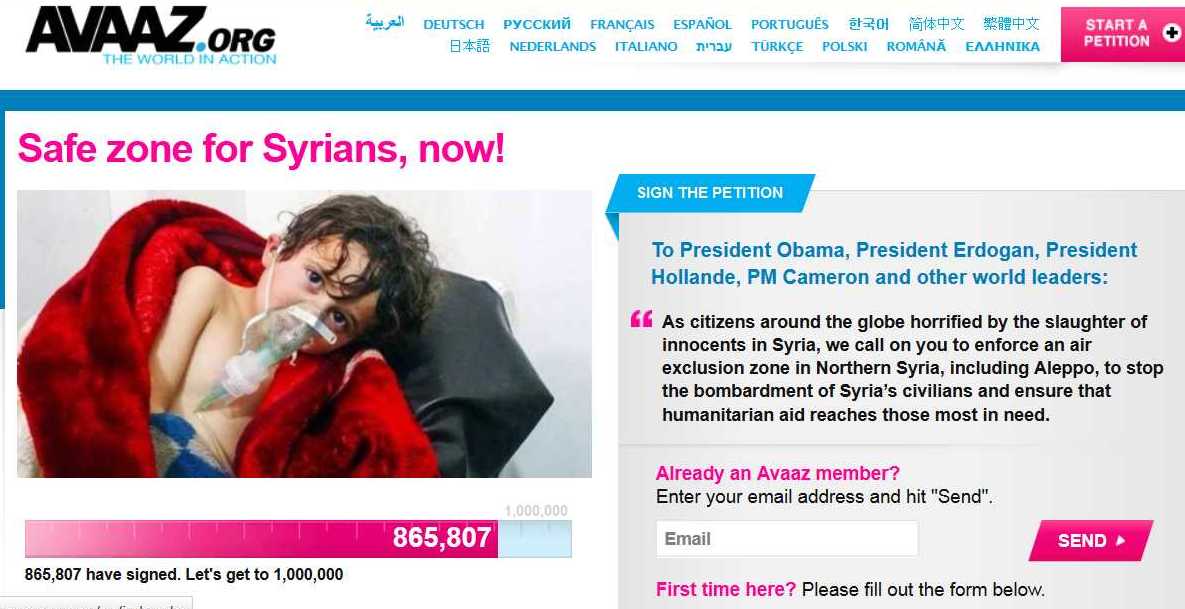 Avaaz Petition for Syria No Fly Zone — 2015 (Syria Campaign Posting)
 Kristoff/New York Times/2011
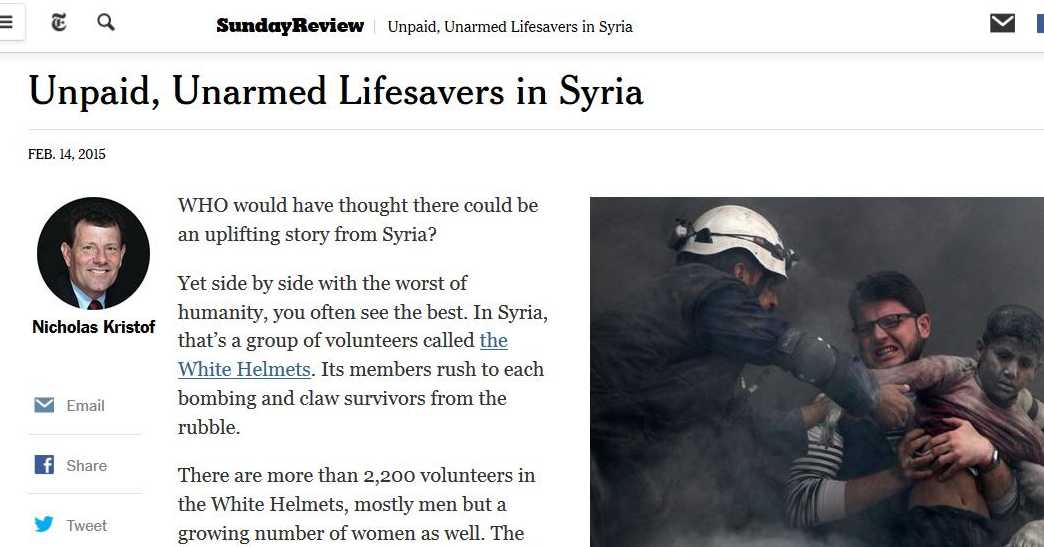 Kristoff/New York Times/2015

 The Real White Helmet Purpose: Propaganda
Hiding America’s War Crimes in Laos, While Reporting on the Grim Results
NY Times Covers Up Washington’s Monstrous Evil

By Dave Lindorff | This Can’t Be Happening | April 7, 2015
The NY Times on Monday ran a lengthy piece (“One Woman’s Mission to Free Laos from Millions of Unexploded Bombs”) on Channapha Khamvongas, a 42-year-old Laotian-American woman on a mission to get the US to help Laos clean up the countless unexploded anti-personnel “bombis” that it dropped, which are still killing peasants — especially children — half a century after the so-called “Secret War” by the US against Laos ended.
The article explained that Khamvongas, as a young adult in Virginia, had read a book by anti-war activist Fred Branfman, Voices from the Plain of Jars: Life Under an Air War (originally published in 1972 and reissued in 2013), which featured accounts and hand drawings by refugees from that war of the deadly US aerial attacks and bombings of their farms and villages. It was a book that sparked revulsion in the US over the saturation bombing of Southeast Asia’s smallest and least developed country — a nation of under six million people.
While the Times article mentioned that the secret air war, launched by Lyndon Johnson against Laos in 1964 and continued by Richard Nixon through 1973, was “one of the most intensive air campaigns in the history of warfare,” and that it had made Laos, a country the size of Great Britain with a population of only a few million peasants, into “one of the most heavily bombed places on earth.” What it did not make clear was that this bombing and strafing campaign, which Branfman’s research showed was so intense that US jets were even killing individual water buffalo, and so continuous that any Lao person, including children, who dared to venture out from underground shelters during the daytime, was targeted.
Instead, Times reporter Thomas Fuller simply parrots the official US line about the Laos air war, which was kept secret from the American public at the time, writing that the campaign’s “targets were North Vietnamese troops — especially along the Ho Chi Minh Trail, a large part of which passed through Laos — as well as North Vietnam’s Laotian Communist allies,” the Pathet Lao.
This is a patent falsehood.
The Ho Chi Minh Trail ran through Laos but along its lengthy eastern boarder with Vietnam. The bombing of Laos, though, was extensive, covering the whole country, and especially the large region of Northern Laos known as the Plain of Jars — an agricultural region in the center of Northern Laos (named for the many neolithic jars found there) that was so heavily bombed that it resembled the surface of the moon (today the circular craters that dot the place are now mostly ponds and breeding grounds for mosquitos). And the goal of the country-wide bombing campaign, as Branfman’s interviews of its refugee survivors made clear, was to disrupt agriculture and kill anything that moved in the country, in hopes of defeating the Pathet Lao insurgency.
Not once in the article is the term “war crime” mentioned, though clearly what the US did to Laos in its Secret War against the people of Laos was a war crime of almost unrivaled horror. (During the war, the Pathet Lao forces, at their greatest, numbered about 35,000, yet the US bombing is estimated to have killed over 100,000 Laotians, which would be about 1.5 percent of the country’s population. The equivalent today in the US would be if some country bombed and killed 3.2 million Americans.)
Not only was this little country bombed. It was littered with anti-personnel bombs that spread tennis-ball sized shrapnel-producing “bombis,” only some 70% of which exploded as intended. The rest remain buried in the soft earth, where they can explode decades later if struck by a plow, or found by a too curious child.
I visited Laos in 1995 as a journalist, and witnessed the continuing horror of this US war crime. Though the Secret War had ended more than 20 years earlier, I kept seeing young kids hobbling along on crutches, with stump legs, or missing hands, some missing both legs. Asking about this, I was told they had been blown up by bombis left over from the war.
Visiting the US Embassy in Laos, which at the time, at least, featured on a flagpole both the US flag and the black-and-white POW/MIA flag of the right-wing pro-war National League of Families, I asked the Press and Cultural Affairs attache about the plague of left-over bombis in the country, and why the US was doing nothing to help clear them away. He said Congress had blocked any such humanitarian action because of pressure from the National League of Families, which was pushing its absurd claim that Communist Laos, two decades after the war ended, was still secretly holding US POWs and MIAs, and was not accounting for America’s dead. He acknowledged off the record that the whole idea of impoverished Laos still holding US prisoners of war was ridiculous, and agreed that Laos — a heavily jungled and sparsely populated country — had not accounted for many of its own MIAs, much less missing Americans who had died or been killed. But he claimed there was nothing that could be done until that issue was resolved.
Of course there is a second matter. Just as the US has done nothing to help Vietnam clean up the massive amount of bombs and the carcinogenic Agent Orange herbicide that was spread across their land by US forces during the war, and has done nothing to help the post-war victims of US anti-personnel weapons and of Agent Orange in that country, not wanting to admit to its war crimes, it has also been loath to assume responsibility for cleaning up the anti-personnel weapons legacy in Laos for the same reason.
It appears that Ms. Khamvongas and her organization, Legacies of War, are finally having some success now at getting the US to belatedly start providing at least some of that assistance — reportedly about $14 million last year. It’s a drop in the bucket considering some 580,000 bombing missions were flown during the air campaign, dropping 270 million bombs. And nearly a third of that ordinance — an estimated 80 million bombs and bombis — are still out there, unexploded, waiting to be disturbed so they can complete their deadly missions.
Some 20,000 Laotians have been killed by unexploded bombs — 40% of them children — mostly by the fragmentation bombis, subsequent to the end of the war in 1973. Far more have been maimed and permanently injured.
Khamvongas doesn’t talk about blame, and that may be understandable for someone who is simply trying to get the US to pony up the money to help get the job done. (A number of countries that are blameless, including Ireland, Japan, Norway and Switzerland, as well as one that shares some of the blame, Australia, are contributing another $25 million a year to the bomb-removal effort.)
But the fact that Khamvongas doesn’t want to focus on blame doesn’t excuse the Times from having to be honest about what actually happened to Laos and its people, and about America’s criminality in blanketing the country with anti-personnel weapons whose main victims, by design, were and sadly still are civilians, including a disproportionate number of children.
At a time when the US is running a new kind of air war, one involving the use of attack drones, a war which is reportedly also killing primarily civilians, and which is similarly operating in secret from the American people in numerous countries of the world, it is critical that news organizations like the Times, which are always quick to parrot US government calls for war crimes prosecutions of other countries like Syria, Serbia, ISIS or the breakaway Donbass Republics, also call out the war crimes of the United States.
Silence on such grave matters is not just reprehensible journalism; it is a case of aiding and abetting America’s crimes.
Featured Video
Seyed M. Marandi: Negotiations Collapsed – Return to War
or go to
Aletho News Archives – Video-Images
From the Archives
Wartime internment camps in Australia
National Archives of Australia
World War I
During World War I, for security reasons the Australian Government pursued a comprehensive internment policy against enemy aliens living in Australia.
Initially only those born in countries at war with Australia were classed as enemy aliens, but later this was expanded to include people of enemy nations who were naturalised British subjects, Australian-born descendants of migrants born in enemy nations and others who were thought to pose a threat to Australia’s security.
Australia interned almost 7,000 people during World War I, of whom about 4,500 were enemy aliens and British nationals of German ancestry already resident in Australia.
Records of World War I internment camps
World War II
During World War II, Australian authorities established internment camps for three reasons – to prevent residents from assisting Australia’s enemies, to appease public opinion and to house overseas internees sent to Australia for the duration of the war.
Unlike World War I, the initial aim of internment during the later conflict was to identify and intern those who posed a particular threat to the safety or defence of the country. As the war progressed, however, this policy changed and Japanese residents were interned en masse. In the later years of the war, Germans and Italians were also interned on the basis of nationality, particularly those living in the north of Australia. In all, just over 20 per cent of all Italians resident in Australia were interned. … continue
Blog Roll
 Aletho News
- Seyed M. Marandi: Negotiations Collapsed – Return to War
- Tomorrow’s naval blockade showdown
- ‘Israel’ attacks civilians to hide its embarrassing military failures & out of pure sadism
- Any Foreign Military Vessel Approaching Hormuz Under Any Pretext ‘Will Be Dealt With Severely’: IRGC
- Diplomats slam US negotiators’ performance in Iran talks
- Trump Refuses Exit Ramp, War with Iran will Continue
- Trump Says US Naval Blockade in Strait of Hormuz Will Begin Shortly
- US, Iran end 21-hour talks without agreement
- US IRAN TALKS: Who Are the Crazy Ones Here? /Lt Col Daniel Davis
- Talks with the US end without a deal over excessive US demands: Iran
- If Americans Knew
- US-Iran ceasefire negotiations make zero progress – Daily Update
- Pro-Israel ‘Thinktanks’ and Individuals who Influence U.S. Foreign Policy
- Mearsheimer reveals how Israel dictates US policies on Iran, Gaza – video
- After killing 350+, Israel still has a “score to settle” with Lebanon before ceasefire – Daily Update
- Military aid to Israel emerges as the latest political litmus test for Democrats
- The only Palestinian children’s rights organization closes following years-long Israeli campaign against it
- ‘I Can’t Forget the Smell’: Lebanese Reel After Israel Kills Over 300 in Single Day
- DNC Shoots Down Resolutions Calling Out AIPAC and Limiting Arms to Israel
- TCN: Is Israel Blackmailing President Trump?
- Israel killed at least 303 Lebanese yesterday – who were they? Daily Update
- No Tricks Zone
- Cave Discovery Reveals Today’s Desert Climates Were Recently Far Warmer, Wetter, Teeming With Life
- German Expert: Heat Dome Led To Record Temps In Western USA…Warmer In 1934, 1936
- New Study: No Linear Warming Or Glacier Retreat Along Northern Antarctic Peninsula Since 1980s
- An Inconvenient Tree: Uncovered In Alps… Europe Much Warmer Than Today 6000 Years Ago
- New Study Reports A 60% Slowdown In Greenland’s Ice Loss Rate In The Last Decade
- Low Intensity Tornado Wrecks Major Solar Farm, Creating A Potential Toxic Dump
- New Study Finds Warming Saves Lives…Cold Temperatures 12 Times More Deadly Than Excess Heat
- German Science Blog Accuses PIK Climate Institute Of Hallucinating Climate Tipping Points
- Devastating Assessment Of Comirnaty Vaccine By Former Senior Pfizer Europe Toxicologist
- New Study: CO2 Is ‘Effectively Negligible’ As An Explanatory Climate Change Factor Since 2000
 Aletho News