On Sunday evening, CBS’s “60 Minutes” presented what was pitched as a thorough examination of the infamous sarin gas attack outside Damascus, Syria, on Aug. 21, 2013, with anchor Scott Pelley asserting that “none of what we found will be omitted here.” But the segment – while filled with emotional scenes of dead and dying Syrians – made little effort to determine who was responsible.
Pelley’s team stuck to the conventional wisdom from the rush-to-judgment “white paper” that the White House issued on Aug. 30, 2013, just nine days after the incident, blaming the Syrian government of President Bashar al-Assad. But Pelley ignored contrary evidence that has emerged in the 20 months since the attack, including what I’ve been told are dissenting views among U.S. intelligence analysts.
The segment also played games with the chronology of the United Nations inspectors who had been invited to Damascus by Assad to investigate what he claimed were earlier chemical attacks carried out by Syrian rebels, a force dominated by Islamic extremists, including Al-Qaeda’s Nusra Front and the even more brutal Islamic State.
Though Pelley starts the segment by interviewing a Syrian who claimed he witnessed a sarin attack in Moadamiya, a suburb south of Damascus, Pelley leaves out the fact that Moadimiya was the first area examined by the UN inspectors and that their field tests found no evidence of sarin. Nor does Pelley note that UN laboratories also found no sarin or other chemical agents on the one missile that the inspectors recovered from Moadamiya.
The two labs did have a dispute over whether trace elements of some chemicals found in Moadamiya might have been degraded sarin. But those disputed positives made no sense because when the UN inspectors went to the eastern suburb of Zamalka two and three days later, their field equipment immediately registered positive for sarin and the two labs confirmed the presence of actual sarin.
So, if the sarin had not degraded in Zamalka, why would it have degraded sooner in Moadamiya? The logical explanation is that there was no sarin associated with the Moadamiya rocket but the UN laboratories were under intense pressure from the United States to come up with something incriminating that would bolster the initial U.S. rush to judgment.
The absence of actual sarin from the rocket that struck Moadamiya also raises questions about the credibility of Pelley’s first witness. Or possibly a conventional rocket assault on the area ruptured some kind of chemical containers that led panicked victims to believe they too were under a chemical attack.
That seemed to be a working hypothesis among some U.S. intelligence analysts even as early as the Aug. 30, 2013 “white paper,” which was called a U.S. “Government Assessment,” an unusual document that seemed to ape the form of a “National Intelligence Estimate,” which would reflect the consensus view of the 16 U.S. intelligence agencies and include analytical dissents.
By going with this new creation – a “Government Assessment,” which was released by the White House press office, not the Office of Director of National Intelligence – the State Department, which was then itching for war with Syria, got to exclude any dissents to the hasty conclusions. But the intelligence analysts managed to embed one dissent as a cutline to a map which was included with the “white paper.”
The cutline read: “Reports of chemical attacks originating from some locations may reflect the movement of patients exposed in one neighborhood to field hospitals and medical facilities in the surrounding area. They may also reflect confusion and panic triggered by the ongoing artillery and rocket barrage, and reports of chemical use in other neighborhoods.”
In other words, some U.S. intelligence analysts were already questioning the assumption of a widespread chemical rocket assault on the Damascus suburbs – and the strongest argument for the State Department’s finger-pointing at Assad’s military was the supposedly large number of rockets carrying sarin.
Possible ‘False Flag’
However, if there had been only one sarin-laden rocket, i.e., the one that landed in Zamalka, then the suspicion could shift to a provocation – or “false-flag” attack – carried out by Islamic extremists with the goal of tricking the U.S. military into destroying Assad’s army and essentially opening the gates of Damascus to a victory by Al-Qaeda or the Islamic State.
That was what investigative journalist Seymour Hersh concluded in ground-breaking articles describing the alleged role of Turkish intelligence in assisting these Islamic extremists in securing the necessary materials and expertise to produce a crude form of sarin.
In December 2013, Hersh reported that he found a deep schism within the U.S. intelligence community over how the case was sold to pin the blame on Assad. Hersh wrote that he encountered “intense concern, and on occasion anger” when he interviewed American intelligence and military experts “over what was repeatedly seen as the deliberate manipulation of intelligence.”
According to Hersh, “One high-level intelligence officer, in an email to a colleague, called the administration’s assurances of Assad’s responsibility a ‘ruse’. The attack ‘was not the result of the current regime’, he wrote.
“A former senior intelligence official told me that the Obama administration had altered the available information – in terms of its timing and sequence – to enable the president and his advisers to make intelligence retrieved days after the attack look as if it had been picked up and analysed in real time, as the attack was happening.
“The distortion, he said, reminded him of the 1964 Gulf of Tonkin incident, when the Johnson administration reversed the sequence of National Security Agency intercepts to justify one of the early bombings of North Vietnam. The same official said there was immense frustration inside the military and intelligence bureaucracy.”
Despite Hersh’s legendary reputation dating back to the My Lai massacre story during the Vietnam War and revelations about CIA abuses in the 1970s, his first 5,500-word article — as well as a second article — appeared in the London Review of Books, a placement that suggests the American media’s “group think” blaming the Assad regime remained hostile to any serious dissent on this topic.
Much of the skepticism about the Obama administration’s case on the Syrian sarin attack has been confined to the Internet, including our own Consortiumnews.com. Indeed, Hersh’s article dovetailed with much of what we had reported in August and September of 2013 as we questioned the administration’s certainty that Assad’s regime was responsible.
Our skepticism flew in the face of a “group think” among prominent opinion leaders who joined in the stampede toward war with Syria much as they did in Iraq a decade earlier. War was averted only because President Barack Obama was informed about the intelligence doubts and because Russian President Vladimir Putin helped arrange a compromise in which Assad agreed to surrender his entire chemical weapons arsenal, while still denying any role in the sarin attack.
A Short-Range Rocket
Later, when rocket scientists — Theodore A. Postol, a professor of science, technology and national security policy at the Massachusetts Institute of Technology, and Richard M. Lloyd, an analyst at the military contractor Tesla Laboratories — analyzed the one home-made, sarin-laden rocket that landed in Zamalka, they concluded that it could have traveled only about two to three kilometers, meaning that it would have been fired from an area controlled by the rebels, not the government.
That finding destroyed a conclusion reached by Human Rights Watch and the New York Times, which vectored the suspected paths of the two rockets — one from Moadamiya and one from Zamalka — to where the two lines intersected at a Syrian military base about 9.5 kilometers from the points of impact. Not only did the vectoring make no sense because only the Zamalka rocket was found to contain sarin but the rocket experts concluded that it couldn’t even fly a third of the way from the military base to where it landed.
After touting its original Assad-did-it claim on the front page on Sept. 17, 2013, the Times snuck its retraction below the fold on page 8 in an article published on Dec. 29, 2013, between the Christmas and New Year’s holidays.
But none of these doubts were examined in any way in Pelley’s “60 Minutes” presentation. Instead, Pelley simply pointed the finger at the Syrian government, citing U.S. intelligence. Pelley said: “The rockets were types used by the Syrian army and they were launched from land held by the dictatorship. U.S. intelligence believes the Syrian army used sarin in frustration after years of shelling and hunger failed to break the rebels.”
Pelley did note one anomaly to the conventional wisdom: Why would Assad have ordered a chemical attack outside Damascus after inviting in a team of UN inspectors to examine another site? Pelley then shrugs off that contradiction while offering no alternative scenario and leaving the clear impression that the attack was carried out by the Syrian government.
When I asked the Office of Director of National Intelligence about the “60 Minutes” segment, spokesperson Kathleen C. Butler responded with this e-mailed response: “The intelligence community assess[es] with high confidence that the Syrian government carried out the chemical weapons attack against opposition elements in the Damascus suburbs on August 21, 2013. The intelligence community assesses that the scenario in which the opposition executed the attack on August 21 is highly unlikely.”
In a subsequent e-mail, she added that there was “full consensus on the assessment.” [For more details on the sarin incident, see Consortiumnews.com’s “The Collapsing Syria-Sarin Case.”]
Clueless over Iraq
Pelley has built a highly successful CBS career by always parroting the official line of the U.S. government no matter how obviously false it is. For instance, in 2008, he conducted an interview with FBI interrogator George Piro who had questioned Iraq’s Saddam Hussein before his execution.
Pelley wondered why Hussein had kept pretending that he had weapons of mass destruction when a simple acknowledgement that they had been destroyed would have spared his country the U.S.-led invasion in 2003.
“For a man who drew America into two wars and countless military engagements, we never knew what Saddam Hussein was thinking,” Pelley said in introducing the segment on the interrogation of Hussein about his WMD stockpiles. “Why did he choose war with the United States?”
The segment never mentioned the fact that Hussein’s government did disclose that it had eliminated its WMD, including a 12,000-page submission to the UN on Dec. 7, 2002, explaining how its WMD stockpiles had been destroyed. In fall 2002, Hussein’s government also allowed teams of UN inspectors into Iraq and gave them free rein to examine any site of their choosing.
Those inspections only ended in March 2003 when President George W. Bush decided to press ahead with war despite the UN Security Council’s refusal to authorize the invasion and its desire to give the UN inspectors time to finish their work.
But none of that reality was part of the faux history that Pelley delivered to the American public. He preferred the officially sanctioned U.S. account, as embraced by Bush in speech after speech, that Saddam Hussein “chose war” by defying the UN over the WMD issue and by misleading the world into believing that he still possessed these weapons.
In line with Bush’s made-up version of history, Pelley pressed Piro on the question of why Hussein was hiding the fact that Iraq no longer had WMD. Piro said Hussein explained to him that “most of the WMD had been destroyed by the UN inspectors in the ‘90s, and those that hadn’t been destroyed by the inspectors were unilaterally destroyed by Iraq.”
“So,” Pelley asked, “why keep the secret? Why put your nation at risk, why put your own life at risk to maintain this charade?”
After Piro mentioned Hussein’s lingering fear of neighboring Iran, Pelley felt he was close to an answer to the mystery: “He believed that he couldn’t survive without the perception that he had weapons of mass destruction?”
But, still, Pelley puzzled over why Hussein’s continued in his miscalculation. Pelley asked: “As the U.S. marched toward war and we began massing troops on his border, why didn’t he stop it then? And say, ‘Look, I have no weapons of mass destruction,’ I mean, how could he have wanted his country to be invaded?”
On Sunday, Pelley was reprising that role as the ingénue foreign correspondent trying to decipher the mysterious ways of the Orient.
Just as Pelley couldn’t figure why Hussein had “wanted his country to be invaded” — when no one at “60 Minutes” thought to mention that Hussein and his government had fully disclosed their lack of WMD to save their country from being invaded — Pelley couldn’t fully comprehend why the Assad regime would have launched a sarin gas attack with UN inspectors sitting in Damascus.
The possibility that the attack actually was a provocation by Al-Qaeda or Islamic State extremists — who have demonstrated their lack of compassion for innocents and who had a clear motive for getting the U.S. military to bomb Assad’s army — was something that Pelley couldn’t process. The calculation was too much for him even after last week’s disclosure that Syrian rebels had staged a 2013 kidnapping/rescue of NBC’s correspondent Richard Engel, whose abduction was falsely blamed on Assad’ allies.
Inviting a Massacre
Besides being an example of shallow reporting and shoddy journalism – using highly emotional scenes while failing to seriously investigate who was responsible – the “60 Minutes” episode could also be a prelude to a far worse human rights crime, which could follow the defeat of the Syrian army and a victory by Al-Qaeda or its spin-off, the Islamic State.
Right now, the only effective fighting force holding off that victory – and the very real possibility of a massacre of Christians, Alawites, Shiites and other religious minorities – is the Syrian army. Some of those Syrian Christians, now allied with Assad, are ethnic Armenians whose ancestors fled the Turkish genocide a century ago.
The recent high-profile comment by Pope Francis about the Armenian genocide can be understood in the context of the impending danger to the survivors’ descendants if the head-chopping Islamic State prevails in the Syrian civil war, the possibility that these Sunni extremists backed by Turkey and Saudi Arabia might finish the job that the Ottoman Empire began a century ago.
Yet, Saudi Arabia, Israel and the American neocons are still set on the overthrow of the Assad government and continue to pretend that Obama could have averted the Syrian crisis if he had only bombed or invaded Syria several years ago.
The Washington Post’s neocon editorial page editor Fred Hiatt recited that theme in an op-ed on Monday that made a major point out of the Assad government’s alleged use of something called “barrel bombs” — as if some crude explosive device is somehow less humane than the more sophisticated weapons that were used to slaughter countless innocents by the United States in Iraq and Afghanistan, Israel in Gaza and Lebanon and now Saudi Arabia in Yemen.
“Obama could have destroyed Assad’s helicopters or given the resistance the weapons to do so,” Hiatt said, arguing the neocon assertion that to have intervened earlier would have somehow prevented the rise of Al-Qaeda’s Nusra Front and the Islamic State. But that is another simplistic argument since there were terrorist elements in the Syrian civil war from the beginning and many of the so-called “moderates” who were trained and armed by the United States have since joined forces with the extremists. [See Consortiumnews.com’s “Syrian Rebels Embrace Al-Qaeda.”]
The key question for Syria’s future is how can a realistic political settlement be reached between Assad’s government and whatever reasonable opposition remains. But such a complex and difficult solution is not advanced by irresponsible journalism at CBS and the Washington Post.
~
Investigative reporter Robert Parry broke many of the Iran-Contra stories for The Associated Press and Newsweek in the 1980s. You can buy his latest book, America’s Stolen Narrative, either in print here or as an e-book (from Amazon and barnesandnoble.com).
April 21, 2015
Posted by aletho |
Deception, Mainstream Media, Warmongering, Wars for Israel | CBS, Fred Hiatt, New York Times, Scott Pelley, Washington Post |
Leave a comment
Mainstream media accounts of the seventh Summit of the Americas, held last weekend in Panama, provide a deceptively rosy picture of U.S.-Latin American relations, echoing the official viewpoint of the U.S. government. In the mainstream account, the U.S. government’s decision to alter its policy towards Cuba by reestablishing diplomatic relations and working to ease—though not end—the fifty-four-year-old U.S. embargo has dramatically transformed U.S.-Latin American relations. At the summit, President Obama declared, “The days in which our agenda in this hemisphere presumed that the United States could meddle with impunity, those days are past”.
Obama is right: the era of uncontested U.S. domination in Latin America is over. This is not, however, because the U.S. has suddenly realized that Latin American nations deserve to be treated with respect and dignity. While the region’s leaders have universally praised Obama for his recent actions with respect to Cuba, Latin America remains profoundly wary of the United States. This is not simply because of “history,” as Obama would have the world believe. Rather, it is because of Washington’s continuing efforts to assert its dominance over Latin America. The most flagrant recent example of this came on March 9, 2015, when the White House made a strategically disastrous decision to label Venezuela an “unusual and extraordinary threat to U.S. national security.”
Media accounts of the Summit of the Americas acknowledge that Latin American leaders have expressed displeasure with this action. The New York Times reported that, “Several Latin American nations have criticized recent United States’ sanctions against several Venezuelan officials it has accused of human rights violations.” This statement, however, is so deceptive that it warrants an official retraction by the Times. “Several” Latin American nations did not criticize U.S. sanctions on Venezuela. Latin American nations universally condemned U.S. sanctions against Venezuela. On March 26, 2015, the Community of Latin American and Caribbean States (CELAC), which represents all 33 countries in Latin America and the Caribbean, issued a statement rejecting U.S. sanctions on Latin America and calling for the reversal of the executive order issued on March 9. As Eva Golinger wrote, “Even staunch U.S. allies such as Colombia and Mexico signed onto the CELAC statement.” In a remarkable display of how out of touch the U.S. government has been when it comes to Venezuela, even the anti-government opposition in Venezuela rejected the view that Venezuela constitutes a threat to the US, issuing a statement that, “Venezuela is not a threat to any country.”
The U.S. government deserves a modicum of measured praise for its recent decision to backtrack on its criticism of Venezuela. In the lead-up to the Summit, a White House official declared that, “The United States does not believe that Venezuela poses some threat to our national security”. This about-face is significant, since it demonstrates the truth of Obama’s statement that the U.S. can no longer “meddle with impunity” in Latin America.
It is important to understand why this is the case.
It is not because the U.S. has stopped trying to “meddle with impunity.” In addition to the recent sanctions on Venezuela, there are many other recent examples of U.S. “meddling” in Latin America. For instance, the US has vocally and openly supported the Venezuelan anti-government opposition’s strategy of regime change. The George W. Bush administration supported the 2002 coup against Hugo Chávez. Both the Bush and Obama administrations have provided the opposition millions of dollars on an annual basis. The Obama administration provided tacit support for the 2009 coup in Honduras, first refusing to label president Manuel Zelaya’s unconstitutional removal from office a “coup,” and then legitimizing a post-coup government led by the forces that orchestrated Zelaya’s removal. Even though most Latin American nations refused to recognize the results of an election widely viewed as fraudulent, the White House gave the government its stamp of approval. Obama cannot claim that these actions are “history” or that they occurred “before [he] was born.”
It is now harder for the U.S. to “meddle with impunity” because Latin American nations have made substantial progress over the last fifteen years in increasing their ability to effectively assert national and regional sovereignty. This can be seen in the increasingly important role that intra-Latin American organizations that exclude the U.S. and Canada, such as the Union of South American Nations (UNASUR) and CELAC, now play in regional affairs. By contrast, the role of the Organization of American States (OAS), which includes the US and Canada, has diminished considerably.
Recent mainstream media accounts of Latin America acknowledge the region’s increasing independence from the U.S., and note that this is one of the factors that pushed the U.S. to change its stance towards Cuba. These accounts do not, however, properly acknowledge the fact that Latin America’s increased independence is due to the actions of “anti-U.S.” leftist leaders, like the late Hugo Chávez, and, just as importantly, the popular movements that brought these leaders to power and have kept them in office.
The Obama administration deserves the credit it has received, including from many Latin American leaders, for its decision to alter the U.S.’s anachronistic, ineffective, and imperious policy towards Cuba. The transformation of U.S.-Cuba relations must, however, be seen for what it is: a U.S. attempt to maintain influence in a region that has shown its ability to act independently. Latin American nations remain quite wary of the U.S. government. Unless Washington shows the ability to consistently respect Latin American sovereignty—most of all in countries, like Venezuela, that it disagrees with—skepticism about U.S. actions is likely to remain, with U.S. influence in the region continuing to decline. Given the evidence that the U.S. has not yet kicked its nasty habit of treating Latin America as its backyard, this should be seen as a good thing for the people of Latin America.
April 20, 2015
Posted by aletho |
Deception, Mainstream Media, Warmongering | Latin America, New York Times, United States, Venezuela |
Leave a comment
The historic meeting between President Barack Obama and President Raúl Castro of Cuba at the Summit of the Americas in Panama over the weekend could be interpreted as a steppingstone toward the end of U.S. subversion and economic warfare relentlessly carried out since the success of the Cuban revolution 55 years ago. But it is questionable whether President Obama intends to transform relations, treating the government of Cuba as a sovereign equal and recognizing their right to choose different political and economic models, or merely to continue the same decades-old policy with a more palatable sales pitch – the way he has done with drones and extrajudicial surveillance. U.S. media, however, appear to have fully embraced the idea that Washington is acting in the best interests of the Cuban people to liberate them from political repression. The New York Times weighed in the day before the Summit by claiming that most Cubans identify not with the sociopolitical goals advanced by their country’s government, but rather with those supported by Washington.
In an editorial titled “Cuban Expectations in a New Era” (4/7/2015), the New York Times advances the proposition that engagement between the two governments will lead to Cuba’s integration (at least partially) into the global capitalist economy. This in turn will create increased financial prosperity as Cuba grows its private sector and turns away from the failed model the government has imposed since the start of the revolution.
The New York Times portrays the Cuban government as intransigent, stubbornly holding its citizens back from the inevitable progress that would result from aligning itself with Washington. The Times claims that the Cuban government maintains a “historically tight grip on Cuban society.” They may be alluding to a Cuban version of the U.S.’s political police, the FBI, who for decades spied on nonviolent activists representing African Americans, Puerto Rican nationalists, the anti-war movement, animal rights and environmental groups to prevent social change through political activities. Many of the activists illegally targeted by the FBI’s COINTELPRO program still remain incarcerated as political prisoners. But the Times doesn’t mention any such Cuban equivalent.
The fault of Cuba’s financial situation is placed squarely on the country’s government. The Times editorial only mentions the 51-year-old embargo by stating that “untangling the web of sanctions the United States imposes on Cuba will take years because many are codified into law.” Yet they then claim “the Obama administration’s gamble on engaging with Cuba has made it increasingly hard for [Cuba’s] leaders to blame their economic problems and isolation on the United States.”
They might have mentioned the embargo against Cuba cost the country $3.9 billion in foreign trade last year, bringing the inflation-adjusted total to $1.1 trillion since the policy was implemented. The embargo is still directly harming the Cuban economy and public health sector. The administrative measures implemented by Obama will provide, at most, minor relief. Extraterritorial provisions of the Helms-Burton Act that prevent Cuba from trading with 3rd countries remain firmly in place.
But the Times seems to believe the Cuban government is doing nothing more than making excuses when they complain about the devastating affects of the embargo on their economy and their population. They don’t mention that in October 187 other nations voted in the UN for the 23rd straight year to condemn the U.S. embargo against Cuba as illegal and demand that it end.
In her study “Unexpected Cuba,” economist Emily Morris rejects the argument that Cuba’s leaders have damaged their country’s economic performance and put its social progress at risk by failing to adopt capitalist reforms like privatization and liberalization.
“The problem with this account is that reality has conspicuously failed to comply with its predictions,” Morris writes. “Although Cuba faced exceptionally severe conditions – it suffered the worst exogenous shock of any of the Soviet-bloc members and, thanks to the long-standing US trade embargo, has confronted a uniquely hostile international environment – its economy has performed in line with the other ex-Comecon countries, ranking thirteenth out of the 27 for which the World Bank has full data.”
The New York Times then claims that the Cuban dissidents attending sideline events at the Panama Summit deserve to have regional leaders “amplify their voices.” They claim that such dissidents “have struggled for years to be heard in their own country, where those critical of the Communist system have faced repression.”
There is no evidence that the dissidents have struggled in Cuba because they have been repressed rather than that most of the population simply does not agree with their ideas or sympathize with them. In a presumptuous attempt to delegitimize the Cuban government, the Times claims it is actually the dissident contra-revolution that represents the majority of the Cuban people. “The government will have to reckon with the fact that many of the dissidents’ aspirations are shared by most Cubans,” the Times editorial states.
Again, there is no evidence that this is actually the case anywhere other than in Washington’s fantasies. The dissidents’ aspirations are not even stated. One assumes this refers to the objective of repealing socialism and instituting capitalism, which is also the official policy of the U.S. government. Mere changes to Cuba’s economy within the socialist structure is not a dissident position. Such changes and improvements are proposed and debated at all levels of Cuban politics, and have been openly embraced by Raúl Castro since he assumed the Presidency.
That the majority of the Cuban people share dissidents’ desire for capitalism is a bold claim. It infers that the Cuban government is not representative of its people, but rather forcibly imposes a socioeconomic system they oppose.
People familiar with Cuba have reached the opposite conclusion. Victor Rodriguez, a professor in the Ethnic Studies department of California State University Long Beach, recently returned from a visit to Cuba and had a different outlook.
“I spoke with at least 50 Cubans of all ages and walks of life,” he said. “Themes were that sovereignty, health care, and education are non-negotiable.” Rodriguez said that Cubans did have complaints about their system, with many stressing the need for higher salaries.
But the three areas he cites as resoundingly popular are the most basic hallmarks of the revolution. If Cuba were to abandon its socialist economic system – either willingly or under pressure from the United States – these would be the first areas to be sacrificed on the neoliberal altar. Dozens of countries in the global South from Africa, Latin America to Asia that now find themselves in the vice grip of suffocating debt can surely attest to this fact.
It is worth examining who are the voices that the New York Times claim deserve to be amplified. Among the “dissidents” are Guillermo Fariñas and Manuel Cuesta Morúa. Fariñas had fought in Angola against the racist South African apartheid regime and had supported Cuba’s revolutionary movement until a sudden change, notes Salim Lamrani, a French professor who specializes in Cuba-USA relations.
“It was only in 2003 that Fariñas made a 180 degree ideological switch and turned his back on the ideas he had defended in years past,” Lamrani writes. Contrary to representation in Western media, Fariñas had been sentenced to prison for crimes such as assaulting a colleague and an old man who had to have his spleen removed because of his injuries. Lamrani notes that Fariñas was admittedly financed by the US Interests Section in Havana. Perhaps not coincidentally, Fariñas became an outspoken critic of the Castro regime. Yet he was still permitted to speak freely with foreign media. His decision to express his political views, which happen to coincide with those of the interests that finance him, has paid handsomely.
“Guillermo Fariñas has chosen, as have those Cuban dissidents sensationalized by the western press, to live off his dissident activities, which offer undeniable financial opportunities and a standard of living much higher than other Cubans living in a context marked by economic difficulties and material scarcity,” Lamrani writes.
Cuesta Morúa is likewise a dissident who considers the Cuban revolution an abject failure, and who downplays any U.S. responsibility for the economic conditions Cuba faces.
According to
Lamrani, “Manuel Cuesta Morúa, who resides in Cuba and benefits from all the advantages of the system of social protection of the country, is a dissident linked to U.S. power through the National Endowment for Democracy, a screen office of the CIA that contributes financially to the development of the activities of the opposition to the government of Havana.”
Unlike dissidents in the United States, who cannot start a political organization or journalistic enterprise without concerning themselves with how it will impact their ability to pay for health care, a mortgage, food for their family or education, dissidents in Cuba do not have any of these worries. They enjoy a robust safety net that covers every single citizen, regardless of their view of the Cuban political system.
Many Cubans in attendance at the Summit in Panama had a different view of the dissidents than that espoused by the New York Times. They referred to the dissidents as mercenaries because of their financial links to a hostile foreign regime and coziness with anti-Castro exiles such as Luis Posada Carriles, the “Cuban bin Laden,” who has been implicated in numerous terrorist activities including the downing of a civilian airline and a string of hotel bombings in Havana.
The Cuban Web site Juventud Rebelde noted that the Cuban delegation, which represents more than 2,000 associations and Non-Governmental Organizations from the island, denounced the presence of people who are paid by interests seeking to destabilize Cuban society and the Cuban government.
Liaena Hernandez Martinez, of the National Committee of the Federation of Cuban Women, which represents more than 4 million Cubans said that: “For the Cuba dignified and sovereign that has resisted more than five decades of blockade it is inadmissible that people are here of such low moral character.”
The Times predictably aligns itself on the side of the U.S. government regarding their opinion of the true political aspirations of Cuban people. The idea that the U.S. is a disinterested observer nudging the Cuban government in the direction of greater democracy and human rights is nothing but pure propaganda, contradicted by more than half a century of history. The U.S. has always been the aggressor against Cuba, coercing it to become a neo-colony that could be exploited by the U.S. military and corporate interests from the time of the Platt amendment until the U.S.-backed dictator Fulgencio Batista was ousted in 1959.
It should be no surprise that the U.S. government and corporations like the New York Times still presumptuously attempt to delegitimize the Cuban revolution and pretend that the Cuban politics are best understood and articulated by those either outside Cuba or in their service as paid agents. The notion that a population can create a socioeconomic system representing the will of its people that starkly rejects the Washington Consensus is simply unthinkable. Anyone who agrees with the government’s official line, regardless of their questionable motives or failure to resonate inside the country, is seen as Cuba’s true political representative class. It may take another 55 years to realize this is simply not the case.
April 13, 2015
Posted by aletho |
Deception, Economics | Central Intelligence Agency, CIA, Cuba, National Endowment for Democracy, New York Times, United States |
Leave a comment
On February 31, Obama announced the lifting of what the New York Times called “an arms freeze on Egypt”.
The US arms export restrictions the Times is referring to had been put in place following a 2013 coup, which removed Egypt’s democratically elected president Mohamed Morsi.
This Times piece titled, “Obama Removes Weapons Freeze Against Egypt” states:
“President Obama on Tuesday lifted an arms freeze against Egypt that he had first imposed after the military overthrow of the country’s democratically elected government nearly two years ago.”
The piece states that the “freeze” was imposed after the coup. Given this, readers will naturally assume the Obama administration enacted a significant policy shift towards the Egyptian government as a result of this affront to democracy.
But the Times quickly qualifies the extent of this arms freeze by listing the very small number of “big ticket” items which had been restricted.
The piece states:
“Mr. Obama cleared the way for the delivery of F-16 aircraft, Harpoon missiles and M1A1 Abrams tanks, weapons prized by Egyptian leaders, who have smoldered at the suspension.”
NPR handled this same issue in a more confused way. An NPR story called “US Ends Freeze on Military Aid to Egypt” stated:
“Certain types of training and military equipment never stopped flowing. But in 2013, the flow of weapons deliveries was halted after Egypt’s military takeover.”
These seemingly contradictory sentences seem to both admit US arms deliveries never really ended, but then also imply that they in fact had stopped.
Both the Times and NPR do correctly point out that F-16s, Harpoons, and M1A1 Tanks were held up by the Obama administration, and that now these items—along with the full allotment of the $1.3 billion in this year’s military assistance—will again flow to Egypt.
However, what the Times and NPR didn’t mention is that in essence US military aid to Egypt was never really frozen. The ‘freeze”, it turns out, was little more than a light frost.
Export data from the US Census Department shows that in 2014 alone the US shipped Egypt almost $44 million in parts for military aircraft, over $36 million in parts for armored fighting vehicles, and over $68 million in guided missiles.
In addition, both the NPR and Times piece fail to mention the 10 Apache helicopters, which the US delievered to Egypt in October of 2014 (worth $171 million), and which were previously included in the so called “arms freeze”.
What both the Times and NPR do mention is that these weapons are going to an Egyptian government which may be a titch less than perfect. However, they both completely fail to explain the depth of the abuses.
The Times piece mentions that Egyptian authorities have arrested over 40,000 people since the coup, and the NPR story states there are at least 20,000 political prisoners.
Both reports brush over how Abdel Fattah el-Sisi, the now president of Egypt, seized control of Egypt following the coup and immediately instituted a serious crackdown on human rights, which continues to this day.
Neither NPR nor the Times mention the 1,300 protesters killed, the mass death sentences, that a major political party has been deemed a terrorist organization, that media outlets have been closed, that activists and journalists remain detained, that protest is essentially outlawed, and that there have been no serious steps towards democracy taken.
Despite these very serious human rights abuses, the US continued shipping, not only parts for advanced weapons systems like jets, helicopters, and tanks, but also smaller arms, which could be used against the Egyptian population.
In 2014, the US shipped a small number of military machine guns, military rifles, as well as over $600,000 worth of parts for military rifles.
These exports are especially troubling given that in August of 2013 the Egyptian security forces opened fire on a protest camp killing at least 1,000 people and injuring almost 4,000. This is a massacre similar in scale to the one in Tiananmen Square in 1989.
Perhaps it’s not surprising that the Times and NPR faithfully played their servile role by peddling the myth that the US froze arms to Egypt. But surely human rights groups got the story right? Well, no.
Human Rights Watch have documented rights abuses perpetrated by the Egyptian government, however they haven’t documented much on the US responsibility for these abuses. This is especially true when it comes to US military support and US arms exports.
Egypt receives the second largest amount of US military aid, and the US and Egypt have a decades long history of military cooperation. Given this, the US could exert a significant amount of influence in Egypt. However, this context is absent in both the Times and NPR articles.
The Times, NPR, and HRW also all fail to mention that the end of US arms restrictions to Egypt means that the last remaining aid and weapons to Egypt, which had been held-up, have now been released.
This means that after a military coup, a massacre, systematic human rights abuses, and even continued detention of Americans, Egypt didn’t lose a single dollar of US taxpayer funded aid, or a single weapons shipment.
Shamefully, NPR, the Times, and HRW all lead readers to falsely believe that the US significantly changed its policy towards Egypt to respond to concerns for democracy and human rights. Unfortunately, the data says otherwise.
Paul Gottinger is a journalist based in Madison, WI whose work focuses on the Middle East. He can be reached via Twitter @paulgottinger or email: paul.gottinger@gmail.com
April 12, 2015
Posted by aletho |
Deception, Mainstream Media, Warmongering | Egypt, HRW, Human rights, New York Times, NPR, United States |
Leave a comment
White Helmets, Avaaz, Nicholas Kristof and Syria No Fly Zone
You might think that after seeing the consequences of their campaign for “freedom and democracy” in Libya, journalists like Nicholas Kristof and “humanitarian campaigners” like Avaaz would have some qualms.
Unfortunately they have learned nothing. They have generally not been held to account, with a few nice exceptions such as this Greenwald/Hussain article. And now they are at it again. Many well-intentioned but naive members of the U.S. and international public are again being duped into signing an Avaaz petition based on fraud and misinformation. If the campaign succeeds in leading to a No Fly Zone in Syria, it will result in vastly increased war, mayhem and bloodshed.
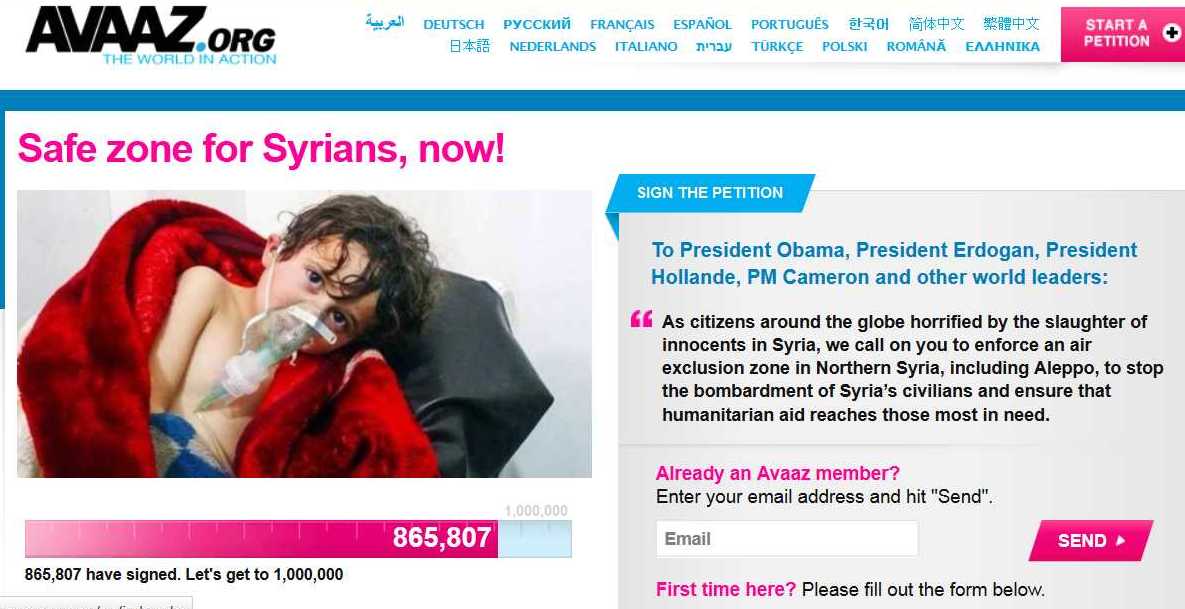
The following illustration shows the sequence and trail of deceit leading to Avaaz’s call for a No Fly Zone in Syria.
 Following is a brief description documenting the flow of misinformation and deceit, beginning at the Source and ending with Avaaz’s campaign for NATO/US attack on Syria.
Source
The “Source” is unknown at this time. It might be some US agency with or without the approval of the Obama administration. Or it might be another foreign government which seeks, in plain violation of international law, the overthrow the Syrian government. In addition to the U.S., Turkey, Saudi Arabia, France, Britain and Qatar have each spent hundreds of millions and even billions in heavy weaponry plus 3,000 tons of weapons via Croatia plus arming, training, supplying and paying the salaries of thousands of domestic and international mercenaries sowing mayhem and destruction in Syria.
At this point we do not know but there is a REWARD: $100 finders fee to the first person who can provide credible evidence identifying the SOURCE.
PURPOSE Inc.
This is an international PR firm. CEO is Jeremy Heimans, a co-founder of Avaaz.
President is Kevin Steinberg, previous CEO of World Economic Forum USA (antithesis of World Social Forum). Their website describes their goal:
“Purpose builds and accelerates movements to tackle the world’s biggest problems.”
In this case the “problem” is reluctance to take over Syrian skies and land.
For a hefty fee, “Purpose” will dupe the public and break down that reluctance.
Toward that end, Purpose created “The Syria Campaign”.
The Syria Campaign
The Syria Campaign began in spring 2014. One of their first efforts was to work to prevent publicity and information about the Syrian Presidential Election of June 2014. Accordingly, “The Syria Campaign” pressured Facebook to remove advertisements or publicity about the Syrian election. Since then Syria Campaign has engineered huge media exposure and mythology about their baby, the “White Helmets” using all sorts of social and traditional media. The campaigns are largely fact free. For example, the Syrian election was dismissed out of hand by them and John Kerry but taken seriously by many millions of Syrians.
The Syria Campaign is managed by Anna Nolan, who grew up in northern Ireland and has very likely never been to Syria. In addition to promoting the White Helmets, Syria Campaign promotes a new social media campaign called “Planet Syria”. It features emotional pleas for the world to take notice of Syria in another thinly veiled effort pushing for foreign intervention and war.
According to their website, The Syria Campaign received start-up funding from the foundation of Ayman Asfari, a billionaire who made his money in the oil and gas services industry.
White Helmets
White Helmets is the newly minted name for “Syrian Civil Defence”. Despite the name, Syria Civil Defence was not created by Syrians nor does it serve Syria. Rather it was created by the UK and USA in 2013. Civilians from rebel controlled territory were paid to go to Turkey to receive some training in rescue operations. The program was managed by James Le Mesurier, a former British soldier and private contractor whose company is based in Dubai.
The trainees are said to be ‘nonpartisan’ but only work in rebel-controlled areas of Idlib (now controlled by Nusra/Al Queda) and Aleppo. There are widely divergent claims regarding the number of people trained by the White Helmets and the number of people rescued. The numbers are probably highly exaggerated especially since rebel-controlled territories have few civilians. A doctor who recently served in a rebel-controlled area of Aleppo described it as a ghost town. The White Helmets work primarily with the rebel group Jabat al Nusra (Al Queda in Syria). Video of the recent alleged chlorine gas attacks starts with the White Helmet logo and continues with the logo of Nusra. In reality, White Helmets is a small rescue team for Nusra/Al Queda.
But White Helmets primary function is propaganda. White Helmets demonizes the Assad government and encourages direct foreign intervention. A White Helmet leader wrote a recent Washington Post editorial. White Helmets are also very active on social media with presence on Twitter, Facebook etc. According to their website, to contact White Helmets email The Syria Campaign which underscores the relationship.
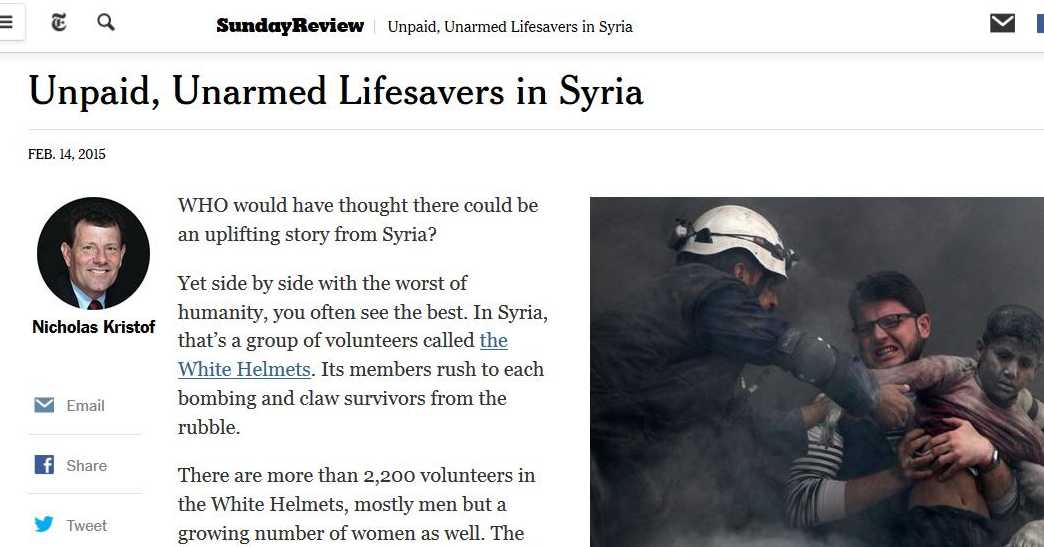
Nicholas Kristof/New York Times
The “White Helmets” campaign has been highly successful because of uncritical media promotion. Nicholas Kristof of the New York Times was an advocate of the NATO/US attack on Libya. According to him, villagers who had been shot, injured and their homes destroyed were not bitter, they were thankful! “Hugs from Libyans” is how he viewed it. It was, of course, nonsense, helping to pave the way in the invasion and destruction of the country.
Now Kristof is uncritically promoting the White Helmets, aiding and abetting their political and propaganda message seeking foreign intervention in Syria.
Avaaz
Avaaz is an online lobby organization founded in 2007 by Jeremy Heimans (now CEO of Purpose) and others. Start-up funding was provided by George Soros’ foundation. While Avaaz has promoted some worthy causes, they have been prominent in promoting neoliberal foreign policies in keeping with the U.S. State Department. Accordingly, they had a major disinformation campaign against Venezuela last year.
Avaaz very actively promoted a No Fly Zone in Libya. They are now very actively promoting the same for Syria.
In-depth research and exposure of Avaaz can be found here. The titles give some indication: “Faking It: Charity Communications in the Firing Line”, “Syria: Avaaz, Purpose & the Art of Selling Hate for Empire”, “Avaaz: Imperialist Pimps for Militarism”.
Avaaz justifies its call for No Fly Zone in part on White Helmets. Given the close interconnections between Avaaz and Purpose, they are surely aware that White Helmets is a media creation. This calls into question their sincerity.
Conclusion
The manipulators rely on emotional images and messages, not facts. They depend on willing partners in the mainstream media who amplify the easy and glib characterizations of who and what is good and bad. The manipulators depend on their audience not asking questions or investigating on their own. In these times of rapid spread of visual and text information via social media, the potential for deceit is huge.
Snapshots
 Avaaz Petition for Libya No Fly Zone — 2011
 Avaaz Petition for Syria No Fly Zone — 2015 (Syria Campaign Posting)
 Kristoff/New York Times/2011
 Kristoff/New York Times/2015


 The Real White Helmet Purpose: Propaganda
Rick Sterling is active with the Syria Solidarity Movement and Mt Diablo Peace and Justice Center. He can be emailed at: rsterling1@gmail.com.
April 11, 2015
Posted by aletho |
Deception, Mainstream Media, Warmongering | Avaaz, Libya, New York Times, Syria, United States |
Leave a comment
MEMORANDUM FOR: Americans Malnourished on the Truth About Iraq
FROM: Veteran Intelligence Professionals for Sanity (VIPS)
SUBJECT: A New “Miller’s Tale” (with apologies to Geoffrey Chaucer)
On April 3, former New York Times journalist Judith Miller published an article in the Wall Street Journal entitled “The Iraq War and Stubborn Myths: Officials Didn’t Lie, and I Wasn’t Fed a Line.” If this sounds a bit defensive, Miller has tons to be defensive about.
In the article, Miller claims, “false narratives [about what she did as a New York Times reporter] deserve, at last, to be retired.” The article appears to be the initial salvo in a major attempt at self-rehabilitation and, coincidentally, comes just as her new book, The Story: A Reporter’s Journey, is to be published today.
In reviewing Miller’s book, her “mainstream media” friends are not likely to mention the stunning conclusion reached recently by the Nobel Prize-winning International Physicians for the Prevention of Nuclear War and other respected groups that the Iraq War, for which she was lead drum majorette, killed one million people. One might think that, in such circumstances – and with bedlam reigning in Iraq and the wider neighborhood – a decent respect for the opinions of mankind, so to speak, might prompt Miller to keep her head down for a while more.
In all candor, after more than a dozen years, we are tired of exposing the lies spread by Judith Miller and had thought we were finished. We have not seen her new book, but we cannot in good conscience leave her WSJ article without comment from those of us who have closely followed U.S. policy and actions in Iraq.
Miller’s Revisionist History
Miller’s Tale in the WSJ begins with a vintage Miller-style reductio ad absurdum: “I took America to war in Iraq. It was all me.” Since one of us, former UN inspector Scott Ritter, has historical experience and technical expertise that just won’t quit, we asked him to draft a few paragraphs keyed to Miller’s latest tale. He shared the following critique:
“Judith Miller did not take America to war in Iraq. Even a journalist with an ego the size of Ms. Miller’s cannot presume to usurp the war power authorities of the President of the United States, or even the now-dormant Constitutional prerogatives of Congress. What she is guilty of, however, is being a bad journalist.
“She can try to hide this fact by wrapping herself in a collective Pulitzer Prize, or citing past achievements like authoring best-selling books. But this is like former Secretary of State Colin Powell trying to remind people about his past as the National Security Advisor for President Reagan or Chairman of the Joint Chiefs of Staff under Presidents George H. W. Bush and Bill Clinton.
“At the end of the day Mr. Powell will be judged not on his previous achievements, but rather on his biggest failure – his appearance before the United Nations Security Council touting an illusory Iraqi weapons-of-mass-destruction threat as being worthy of war. In this same vein, Judith Miller will be judged by her authoring stories for the ‘newspaper of record’ that were questionably sourced and very often misleading. One needs only to examine Ms. Miller’s role while embedded in U.S. Army Mobile Exploitation Team Alpha, hunting for weapons of mass destruction during the 2003 invasion, for this point to be illustrated.
“Miller may not have singlehandedly taken America and the world to war, but she certainly played a pivotal role in building the public case for the attack on Iraq based upon shoddy reporting that even her editor at the New York Times has since discredited – including over reliance on a single-source of easy virtue and questionable credibility – Ahmed Chalabi of the Iraqi National Congress. The fact that she chose to keep this ‘source’ anonymous underscores the journalistic malfeasance at play in her reporting.
“Chalabi had been discredited by the State Department and CIA as a reliable source of information on Iraq long before Judith Miller started using him to underpin her front-page ‘scoops’ for the New York Times. She knew this, and yet chose to use him nonetheless, knowing that then Secretary of Defense Donald Rumsfeld was fully as eager to don the swindlers’ magic suit of clothes, as was the king in Hans Christian Anderson’s fairy tale. In Ms. Miller’s tale, the fairy-tale clothes came with a WMD label and no washing instructions.
“Ms. Miller’s self-described ‘newsworthy claims’ of pre-war weapons of mass destruction stories often were – as we now know (and many of us knew at the time) – handouts from the hawks in the Bush administration and fundamentally wrong.
“Like her early reporting on Iraq, Ms. Miller’s re-working of history to disguise her malfeasance/misfeasance as a reporter does not bear close scrutiny. Her errors of integrity are hers and hers alone, and will forever mar her reputation as a journalist, no matter how hard she tries to spin the facts and revise a history that is highly inconvenient to her. Of course, worst of all, her flaws were consequential – almost 4,500 U.S. troops and 1,000,000 Iraqis dead.”
Relying on the Mistakes of Others
In her WSJ article, Miller protests that “relying on the mistakes of others and errors of judgment are not the same as lying.” It is almost as though she is saying that if Ahmed Chalabi told her that, in Iraq, the sun rises in the west, and she duly reported it, that would not be “the same as lying.”
Miller appears to have worked out some kind of an accommodation with George W. Bush and others who planned and conducted what the post-World War II Nuremburg Tribunal called the “supreme international crime,” a war of aggression. She takes strong issue with what she calls “the enduring, pernicious accusation that the Bush administration fabricated WMD intelligence to take the country to war.”
Does she not know, even now, that there is abundant proof that this is exactly what took place? Has she not read the Downing Street Memorandum based on what CIA Director George Tenet told the head of British Intelligence at CIA headquarters on July 20, 2002; i. e., that “the intelligence and facts were being fixed around the policy” of making war for “regime change” in Iraq?
Does she not know, even at this late date, that the “intelligence” served up to “justify” attacking Iraq was NOT “mistaken,” but outright fraud, in which Bush had the full cooperation of Tenet and his deputy John McLaughlin? Is she unaware that the Assistant Secretary of State for Intelligence at the time, Carl Ford, has said, on the record, that Tenet and McLaughlin were “not just wrong, they lied … they should have been shot” for their lies about WMD?
Blame Blix
Miller’s tale about Hans Blix in her WSJ article shows she has lost none of her edge for disingenuousness: “One could argue … that Hans Blix, the former chief of the international inspectors, bears some responsibility,” writes Miller. She cherry-picks what Blix said in January 2003 about “many proscribed weapons and items,” including 1,000 tons of chemical agent, were still “not accounted for.”
Yes, Blix said that on Jan. 27, 2003. But Blix also included this that same day in his written report to his UN superiors, something the New York Times, for some reason, did not include in its report:
“Iraq has on the whole cooperated rather well so far with UNMOVIC in this field. The most important point to make is that access has been provided to all sites we have wanted to inspect and with one exception it has been prompt. We have further had great help in building up the infrastructure of our office in Baghdad and the field office in Mosul. Arrangements and services for our plane and our helicopters have been good. The environment has been workable.
“Our inspections have included universities, military bases, presidential sites and private residences. Inspections have also taken place on Fridays, the Muslim day of rest, on Christmas day and New Years day. These inspections have been conducted in the same manner as all other inspections.” [See “Steve M.” writing (appropriately) for Crooks and Liars as he corrected the record.]
Yes, there was some resistance by Iraq up to that point. Blix said so. However, on Jan. 30, 2003, Blix made it abundantly clear, in an interview published in The New York Times, that nothing he’d seen at the time justified war. (The byline was Judith Miller and Julia Preston.)
The Miller-Preston report said:
“Mr. Blix said he continued to endorse disarmament through peaceful means. ‘I think it would be terrible if this comes to an end by armed force, and I wish for this process of disarmament through the peaceful avenue of inspections,’ he said. …
“Mr. Blix took issue with what he said were Secretary of State Colin L. Powell’s claims that the inspectors had found that Iraqi officials were hiding and moving illicit materials within and outside of Iraq to prevent their discovery. He said that the inspectors had reported no such incidents. …
“He further disputed the Bush administration’s allegations that his inspection agency might have been penetrated by Iraqi agents, and that sensitive information might have been leaked to Baghdad, compromising the inspections. Finally, he said, he had seen no persuasive indications of Iraqi ties to Al Qaeda, which Mr. Bush also mentioned in his speech. ‘There are other states where there appear to be stronger links,’ such as Afghanistan, Mr. Blix said, noting that he had no intelligence reports on this issue.”
Although she co-authored that New York Times report of Jan. 30, 2003, Judith Miller remembers what seems convenient to remember. Her acumen at cherry picking may be an occupational hazard occasioned by spending too much time with Chalabi, Rumsfeld and other professional Pentagon pickers.
Moreover, Blix’s February 2003 report showed that, for the most part, Iraq was cooperating and the process was working well:
“Since we arrived in Iraq, we have conducted more than 400 inspections covering more than 300 sites. All inspections were performed without notice, and access was almost always provided promptly. In no case have we seen convincing evidence that the Iraqi side knew in advance that the inspectors were coming. …
“The inspections have taken place throughout Iraq at industrial sites, ammunition depots, research centres, universities, presidential sites, mobile laboratories, private houses, missile production facilities, military camps and agricultural sites. …
“In my 27 January update to the Council, I said that it seemed from our experience that Iraq had decided in principle to provide cooperation on process, most importantly prompt access to all sites and assistance to UNMOVIC in the establishment of the necessary infrastructure. This impression remains, and we note that access to sites has so far been without problems, including those that had never been declared or inspected, as well as to Presidential sites and private residences. …
“The presentation of intelligence information by the US Secretary of State suggested that Iraq had prepared for inspections by cleaning up sites and removing evidence of proscribed weapons programmes.
“I would like to comment only on one case, which we are familiar with, namely, the trucks identified by analysts as being for chemical decontamination at a munitions depot. This was a declared site, and it was certainly one of the sites Iraq would have expected us to inspect.
“We have noted that the two satellite images of the site were taken several weeks apart. The reported movement of munitions at the site could just as easily have been a routine activity as a movement of proscribed munitions in anticipation of imminent inspection.”
Blix made it clear that he needed more time, but the Bush administration had other plans. In other words, the war wasn’t Blix’s fault, as Judy Miller suggests. The fault lay elsewhere.
When Blix retired at the end of June 2004, he politely suggested to the “prestigious” Council on Foreign Relations in New York the possibility that Baghdad had actually destroyed its weapons of mass destruction after the first Gulf War in 1991 (as Saddam Hussein’s son-in-law, Hussein Kamel, who had been in charge of the WMD and rocket programs assured his debriefers when he defected in 1995). Blix then allowed himself an undiplomatic jibe:
“It is sort of fascinating that you can have 100 per cent certainty about weapons of mass destruction and zero certainty of about where they are.”
For the Steering Group, Veteran Intelligence Professionals for Sanity (VIPS)
William Binney, former Technical Director, National Security Agency (ret.)
Thomas Drake, former Senior Executive, NSA
Daniel Ellsberg, former State and Defense Department official, associate VIPS
Frank Grevil, former Maj., Army Intelligence, Denmark, associate VIPS
Katharine Gun, former analyst, GCHQ (the NSA equivalent in the UK), associate VIPS
Matthew Hoh, former Capt., USMC, Iraq & Foreign Service Officer, Afghanistan, associate VIPS
Brady Kiesling, former Political Counseler, U.S. Embassy, Athens, resigned in protest before the attack on Iraq, associate VIPS.
Karen Kwiatkowski, former Lt. Col., US Air Force (ret.), at Office of Secretary of Defense watching the manufacture of lies on Iraq, 2001-2003.
Annie Machon, former officer, MI5 (the CIA equivalent in the UK), associate VIPS
David MacMichael, former Capt., USMC & senior analyst, National Intelligence Council (ret.)
Ray McGovern, former Capt., Army Infantry/Intelligence & CIA presidential briefer (ret.)
Elizabeth Murray, former Deputy National Intelligence Officer for the Near East, National Intelligence Council (ret.)
Todd E. Pierce, Maj., former U.S. Army Judge Advocate (ret.)
Scott Ritter, former Maj., USMC, former UN Weapon Inspector, Iraq
Coleen Rowley, Division Council & Special Agent, FBI (ret.)
Greg Thielmann, former Office Director for Strategic, Proliferation, and Military Affairs in the State Department’s Bureau of Intelligence and Research
Peter Van Buren, former diplomat, Department of State, associate VIPS
Ann Wright, Col., US Army (ret.) & US diplomat (resigned in March, 2003 in opposition to the war on Iraq)
April 8, 2015
Posted by aletho |
Deception, Mainstream Media, Warmongering, Timeless or most popular, War Crimes | Iraq War, Judith Miller, New York Times |
Leave a comment
NY Times Covers Up Washington’s Monstrous Evil

The NY Times on Monday ran a lengthy piece (“One Woman’s Mission to Free Laos from Millions of Unexploded Bombs”) on Channapha Khamvongas, a 42-year-old Laotian-American woman on a mission to get the US to help Laos clean up the countless unexploded anti-personnel “bombis” that it dropped, which are still killing peasants — especially children — half a century after the so-called “Secret War” by the US against Laos ended.
The article explained that Khamvongas, as a young adult in Virginia, had read a book by anti-war activist Fred Branfman, Voices from the Plain of Jars: Life Under an Air War (originally published in 1972 and reissued in 2013), which featured accounts and hand drawings by refugees from that war of the deadly US aerial attacks and bombings of their farms and villages. It was a book that sparked revulsion in the US over the saturation bombing of Southeast Asia’s smallest and least developed country — a nation of under six million people.
While the Times article mentioned that the secret air war, launched by Lyndon Johnson against Laos in 1964 and continued by Richard Nixon through 1973, was “one of the most intensive air campaigns in the history of warfare,” and that it had made Laos, a country the size of Great Britain with a population of only a few million peasants, into “one of the most heavily bombed places on earth.” What it did not make clear was that this bombing and strafing campaign, which Branfman’s research showed was so intense that US jets were even killing individual water buffalo, and so continuous that any Lao person, including children, who dared to venture out from underground shelters during the daytime, was targeted.
Instead, Times reporter Thomas Fuller simply parrots the official US line about the Laos air war, which was kept secret from the American public at the time, writing that the campaign’s “targets were North Vietnamese troops — especially along the Ho Chi Minh Trail, a large part of which passed through Laos — as well as North Vietnam’s Laotian Communist allies,” the Pathet Lao.
This is a patent falsehood.
The Ho Chi Minh Trail ran through Laos but along its lengthy eastern boarder with Vietnam. The bombing of Laos, though, was extensive, covering the whole country, and especially the large region of Northern Laos known as the Plain of Jars — an agricultural region in the center of Northern Laos (named for the many neolithic jars found there) that was so heavily bombed that it resembled the surface of the moon (today the circular craters that dot the place are now mostly ponds and breeding grounds for mosquitos). And the goal of the country-wide bombing campaign, as Branfman’s interviews of its refugee survivors made clear, was to disrupt agriculture and kill anything that moved in the country, in hopes of defeating the Pathet Lao insurgency.
Not once in the article is the term “war crime” mentioned, though clearly what the US did to Laos in its Secret War against the people of Laos was a war crime of almost unrivaled horror. (During the war, the Pathet Lao forces, at their greatest, numbered about 35,000, yet the US bombing is estimated to have killed over 100,000 Laotians, which would be about 1.5 percent of the country’s population. The equivalent today in the US would be if some country bombed and killed 3.2 million Americans.)
Not only was this little country bombed. It was littered with anti-personnel bombs that spread tennis-ball sized shrapnel-producing “bombis,” only some 70% of which exploded as intended. The rest remain buried in the soft earth, where they can explode decades later if struck by a plow, or found by a too curious child.
I visited Laos in 1995 as a journalist, and witnessed the continuing horror of this US war crime. Though the Secret War had ended more than 20 years earlier, I kept seeing young kids hobbling along on crutches, with stump legs, or missing hands, some missing both legs. Asking about this, I was told they had been blown up by bombis left over from the war.
Visiting the US Embassy in Laos, which at the time, at least, featured on a flagpole both the US flag and the black-and-white POW/MIA flag of the right-wing pro-war National League of Families, I asked the Press and Cultural Affairs attache about the plague of left-over bombis in the country, and why the US was doing nothing to help clear them away. He said Congress had blocked any such humanitarian action because of pressure from the National League of Families, which was pushing its absurd claim that Communist Laos, two decades after the war ended, was still secretly holding US POWs and MIAs, and was not accounting for America’s dead. He acknowledged off the record that the whole idea of impoverished Laos still holding US prisoners of war was ridiculous, and agreed that Laos — a heavily jungled and sparsely populated country — had not accounted for many of its own MIAs, much less missing Americans who had died or been killed. But he claimed there was nothing that could be done until that issue was resolved.
Of course there is a second matter. Just as the US has done nothing to help Vietnam clean up the massive amount of bombs and the carcinogenic Agent Orange herbicide that was spread across their land by US forces during the war, and has done nothing to help the post-war victims of US anti-personnel weapons and of Agent Orange in that country, not wanting to admit to its war crimes, it has also been loath to assume responsibility for cleaning up the anti-personnel weapons legacy in Laos for the same reason.
It appears that Ms. Khamvongas and her organization, Legacies of War, are finally having some success now at getting the US to belatedly start providing at least some of that assistance — reportedly about $14 million last year. It’s a drop in the bucket considering some 580,000 bombing missions were flown during the air campaign, dropping 270 million bombs. And nearly a third of that ordinance — an estimated 80 million bombs and bombis — are still out there, unexploded, waiting to be disturbed so they can complete their deadly missions.
Some 20,000 Laotians have been killed by unexploded bombs — 40% of them children — mostly by the fragmentation bombis, subsequent to the end of the war in 1973. Far more have been maimed and permanently injured.
Khamvongas doesn’t talk about blame, and that may be understandable for someone who is simply trying to get the US to pony up the money to help get the job done. (A number of countries that are blameless, including Ireland, Japan, Norway and Switzerland, as well as one that shares some of the blame, Australia, are contributing another $25 million a year to the bomb-removal effort.)
But the fact that Khamvongas doesn’t want to focus on blame doesn’t excuse the Times from having to be honest about what actually happened to Laos and its people, and about America’s criminality in blanketing the country with anti-personnel weapons whose main victims, by design, were and sadly still are civilians, including a disproportionate number of children.
At a time when the US is running a new kind of air war, one involving the use of attack drones, a war which is reportedly also killing primarily civilians, and which is similarly operating in secret from the American people in numerous countries of the world, it is critical that news organizations like the Times, which are always quick to parrot US government calls for war crimes prosecutions of other countries like Syria, Serbia, ISIS or the breakaway Donbass Republics, also call out the war crimes of the United States.
Silence on such grave matters is not just reprehensible journalism; it is a case of aiding and abetting America’s crimes.
April 8, 2015
Posted by aletho |
Deception, Mainstream Media, Warmongering | Laos, New York Times, United States |
Leave a comment
The
Wall Street Journal has published Judith Miller’s
defense of her Iraq War writings, in which she specifically denies responsibility for helping lead America into that war. There are others far more qualified than I am to pick apart what she’s written in the
Journal (and what will appear in Miller’s book
The Story, from which the
Journal piece is excerpted). I’ll limit myself to this:
Another widespread fallacy is that such neoconservatives as Richard Perle and Paul Wolfowitz strong-armed an inexperienced president into taking the country to war. President Bush, as he himself famously asserted, was the “decider.” One could argue, however, that Hans Blix, the former chief of the international weapons inspectors, bears some responsibility. Though he personally opposed an invasion, Mr. Blix told the U.N. in January 2003 that despite America’s ultimatum, Saddam was still not complying fully with his U.N. pledges. In February, he said “many proscribed weapons and items,” including 1,000 tons of chemical agent, were still “not accounted for.”
Did Blix say in January 2003 that Iraq wasn’t fully compliant? Yes, he did. You can read the January 27, 2003, report here. Though please note that Blix says that Iraq was largely cooperative with regard to process:
Iraq has on the whole cooperated rather well so far with UNMOVIC in this field. The most important point to make is that access has been provided to all sites we have wanted to inspect and with one exception it has been prompt. We have further had great help in building up the infrastructure of our office in Baghdad and the field office in Mosul. Arrangements and services for our plane and our helicopters have been good. The environment has been workable.
Our inspections have included universities, military bases, presidential sites and private residences. Inspections have also taken place on Fridays, the Muslim day of rest, on Christmas day and New Years day. These inspections have been conducted in the same manner as all other inspections.
But yes, there was some resistance by Iraq up to that point. Blix said so. However, a few days later, he made it abundantly clear, in an interview published in The New York Times, that nothing he’d seen at the time justified war:
Mr. Blix said he continued to endorse disarmament through peaceful means. “I think it would be terrible if this comes to an end by armed force, and I wish for this process of disarmament through the peaceful avenue of inspections,” he said.
And he specifically rebutted a large number of allegations advanced by the Bush administration:
Mr. Blix took issue with what he said were Secretary of State Colin L. Powell’s claims that the inspectors had found that Iraqi officials were hiding and moving illicit materials within and outside of Iraq to prevent their discovery. He said that the inspectors had reported no such incidents.
Similarly, he said, he had not seen convincing evidence that Iraq was sending weapons scientists to Syria, Jordan or any other country to prevent them from being interviewed. Nor had he any reason to believe, as President Bush charged in his State of the Union speech, that Iraqi agents were posing as scientists.
He further disputed the Bush administration’s allegations that his inspection agency might have been penetrated by Iraqi agents, and that sensitive information might have been leaked to Baghdad, compromising the inspections.
Finally, he said, he had seen no persuasive indications of Iraqi ties to Al Qaeda, which Mr. Bush also mentioned in his speech. “There are other states where there appear to be stronger links,” such as Afghanistan, Mr. Blix said, noting that he had no intelligence reports on this issue.
It’s good that Miller is at least honest enough to acknowledge Blix’s opposition to war, given his debunking of administration claims and his belief that persistence in pursuing inspections was a better path to disarmament.
(Did I mention that Miller was the lead author of the Times interview story?)
In his February report, Blix did say that “many proscribed weapons and items are not accounted for.” But let’s put that quote in context (emphasis added):
How much, if any, is left of Iraq’s weapons of mass destruction and related proscribed items and programmes? So far, UNMOVIC has not found any such weapons, only a small number of empty chemical munitions, which should have been declared and destroyed. Another matter — and one of great significance — is that many proscribed weapons and items are not accounted for. To take an example, a document, which Iraq provided, suggested to us that some 1,000 tonnes of chemical agent were “unaccounted for”. One must not jump to the conclusion that they exist. However, that possibility is also not excluded.
Blix’s February report suggested that Iraq was cooperative and the process as working well:
Since we arrived in Iraq, we have conducted more than 400 inspections covering more than 300 sites. All inspections were performed without notice, and access was almost always provided promptly. In no case have we seen convincing evidence that the Iraqi side knew in advance that the inspectors were coming.
The inspections have taken place throughout Iraq at industrial sites, ammunition depots, research centres, universities, presidential sites, mobile laboratories, private houses, missile production facilities, military camps and agricultural sites…..
Through the inspections conducted so far, we have obtained a good knowledge of the industrial and scientific landscape of Iraq, as well as of its missile capability….
More than 200 chemical and more than 100 biological samples have been collected at different sites. Three-quarters of these have been screened using our own analytical laboratory capabilities at the Baghdad Centre (BOMVIC). The results to date have been consistent with Iraq’s declarations.
We have now commenced the process of destroying approximately 50 litres of mustard gas declared by Iraq that was being kept under UNMOVIC seal at the Muthanna site. One-third of the quantity has already been destroyed. The laboratory quantity of thiodiglycol, a mustard gas precursor, which we found at another site, has also been destroyed.
Blix made clear that the process required more time. He wasn’t going to get more time, however. The bombing started less than a week later. It wasn’t his idea. It wasn’t his fault.
April 5, 2015
Posted by aletho |
Deception, Mainstream Media, Warmongering, Timeless or most popular, War Crimes | Hans Blix, Iraq, Judy Miller, New York Times |
Leave a comment
The New York Times recently published an editorial lamenting the “shameful impunity of the Islamic State” and encouraging the United Nations Security Council to refer the group’s crimes to the International Criminal Court (I.C.C.). The editorial, titled “The Crimes of Terrorists” (4/2/2015), should more accurately be titled “The Crimes of the U.S. and Its Allies Should Go Unpunished.”
In the last several months alone, the Times has repeatedly failed to condemn crimes by the U.S. government and its allies in Yemen, Iraq, Syria and the Palestinian territories.
When the Times writes that “the Islamic State’s campaign of religious and cultural cleansing has shocked the world and terrified the peoples of Iraq and Syria who don’t fit into the group’s fanatical vision of a neo-Islamist caliphate” and that the Security Council should address the “shameful impunity of the Islamic State, and refer the group to the I.C.C.,” they are stating the obvious.
That crimes should be punished is beyond dispute. Condemning the crimes of official enemies of the United States does not take particular moral or political courage. Whether it was the Soviet Union during the Cold War, the Taliban after 9/11, or Iraq before the 2003 invasion, a media organization would be hard pressed to find a less controversial editorial position.
What would take courage is opposition to the criminal actions of the U.S. government and governments or groups it is aligned with. This is something the Times has failed to do for decades. You don’t have to go back in time to find multiple examples.
Just two days before the editorial on the Islamic State, the Times published another editorial titled “Saudi Arabia’s Ominous Reach Into Yemen” (3/3/2015). The Times does not condone the Saudi-led bombing campaign, stating: “Rather than bombing, Saudi Arabia should be using its power and influence to begin diplomatic negotiations, which offer the best hope of a durable solution.” They note the pitfalls of the Saudi military invention by claiming it “threatens to turn what has been a civil war between competing branches of Islam into a wider regional struggle involving Iran. It could also destroy any hope of stability in Yemen.”
But the strongest position the Times can muster is to encourage President Obama to push for a “political solution.” They fail to mention that the Saudi military intervention is itself a crime, no different than the crimes of the Islamic State they would oppose two days later with such vigor. Bombing a sovereign nation is indisputably a violation of Article 2 of the United Nations Charter: “All members shall refrain in their international relations from the threat or use of force against the territorial integrity or political independence of any state.”
Violation of the prohibition against the use of force in the UN Charter amounts to the crime of aggression, which was defined in the Nuremberg Trials as “not only an international crime; it is the supreme international crime, differing only from other crimes in that it contains within itself the accumulated evil of the whole” (italics added).
On the same day the Times published its editorial, Amnesty International reported: “There is growing evidence that the Saudi Arabian-led military coalition is failing to take precautions to prevent civilian deaths amid ongoing airstrikes around Yemen.” They reported that “at least six civilians, including four children, were among 14 people who burned to death in further airstrikes.”
The Guardian reported that it had obtained images from a humanitarian worker in Yemen that “showed gruesome scenes – charred bodies immolated by the blast, mangled corpses in plastic bags, and wounded childred being treated,” The humanitarian worker “said he saw scattered limbs littering the area nearby.”
Yet the Times does not even mention these Saudi crimes (backed by the U.S. government), much less demand accountability. They do not claim that Saudi Arabia enjoys “shameful impunity” they way they do for the Islamic State.
Neither does the Times condemn Israeli crimes against Palestinians, especially last summer’s slaughter in Gaza, euphemistically called “Operation Protective Edge” by the Israeli government. In a New York Times editorial titled “Keeping Palestinian Hopes Alive” (3/24/2015) the editorial board calls for a two-state political solution to the conflict in order to avoid Palestinians seeking justice in the I.C.C.
The call for a two-state solution is disingenuous and hollow. With more than 500,000 Israeli settlers now squatting on stolen land in the West Bank, there is no practical way to implement such a plan. Furthermore, this nominal “solution” has been the U.S.-Israeli policy for more than 20 years since the Oslo Accords and has led nowhere. A call for a two-state solution is nothing more than an appeal to continue the status quo indefinitely while using different language.
The Times states that “a clear Security Council statement in favor of a two-state solution would be an important benchmark. If the United States and other major powers quickly show commitment to that approach, they might be able to keep Palestinians from pressing a complaint against Israel in the International Criminal Court.” This, the editorial board claims, “would poison relations even more and alienate many Americans.”
Even if a two-state solution were feasible, why would implementation of such a plan preclude justice in a court of law for the nearly 2,200 Palestinians, including more than 500 children, who were killed, most of whom were civilians?
Human rights organizations have found extensive evidence of war crimes and reckless disregard for human life by the Israeli military in Gaza during the 50-day war.
Amnesty International reported on “extensive, wanton and unjustified” targeting of civilian infrastructure including multi-story buildings by Israel in Gaza.
“Both the facts on the ground and statements made by Israeli military spokespeople at the time indicate that the attacks were a collective punishment against the people of Gaza and were designed to destroy their already precarious livelihoods,” states Philip Luther, Director of the Middle East and North Africa Programme. Collective punishment is a war crime under the Geneva Conventions.
In a report on Israeli attacks against inhabited homes, Amnesty International found that “whole families were killed or injured by these targeted strikes.” The report focuses on eight cases “in which targeted Israeli attacks resulted in the deaths of at least 111 people, of whom at least 104 were civilians, including entire families and 62 children, and destroyed civilian homes.”
Amnesty recommended, “given Israel’s long-standing failure to investigate and prosecute alleged war crimes … that the international community should ensure that possible crimes under international law, including war crimes, committed during Operation Protective Edge” should be pursued in court in states exercising universal jurisdiction or through the I.C.C.
This is the opposite of the position taken by the Times. When it comes to official enemies, the Times righteously claims that their crimes have “shocked the world” and “terrified” the local population. But when it comes to the U.S. and its allies, the Times believes that equivalent crimes should be swept under the rug.
The New York Times has had a long-standing record of this type of hypocritical logic. As the NYTimes Examiner noted last year in an article titled “The New York Times Excorciates ‘Aggression’: The Washington Exception” (3/5/2014):
Over the last quarter century the New York Times’ Editorial board has made editorial decisions that illustrate a peculiar pattern. Times readers could otherwise overlook the pattern in everyday reading. However, when viewed through a wider historical lens, the pattern lays bare biased reporting that should concern readers.
In five editorial pieces, spanning a period from December 1989 to March 2014, and encompassing nearly 3,000 words, the Times’ Editorial board has weighed in on cross-border military actions. The selectivity of their language shows a political bias in favor of upholding what they believe is best for Washington’s interests and therefore, under the guise of ‘objectivity,’ report expectedly in opposition to Washington’s adversaries.
Indeed, in editorials on Panama (“Why the Invasion Was Justified”) (12/21/1989), Yugoslavia (“Air Campaign Against Yugoslavia”) (3/25/1999), and Iraq (“The War Begins”) (3/20/2003), the Times stood firmly behind American use of military force.
Despite the fact that each of these military attacks were clear cases of aggression, the “supreme international crime,” the Times never once broached the idea that the U.S. government should face repercussions for their many severe violations of international law.
Even in their most ambivalent stance, on Iraq, they stated that “even those who sharply disagree with the logic behind this war are likely to end up feeling reassured, almost against their will, by the successful projection of American power.”
There is the hypocrisy laid bare. For the Times editorial board, as for much of the American public, blind worship of American power is more important than their professed concern for the rule of law. That concern is reserved only for those who do not enjoy the support of the U.S. government, and who can thereby be excoriated for their crimes relentlessly.
April 5, 2015
Posted by aletho |
Mainstream Media, Warmongering, Militarism, Timeless or most popular, War Crimes | New York Times, Saudi Arabia, United States |
Leave a comment
If two major newspapers in, say, Russia published major articles openly advocating the unprovoked bombing of a country, say, Israel, the U.S. government and news media would be aflame with denunciations about “aggression,” “criminality,” “madness,” and “behavior not fitting the Twenty-first Century.”
But when the newspapers are American – the New York Times and the Washington Post – and the target country is Iran, no one in the U.S. government and media bats an eye. These inflammatory articles – these incitements to murder and violation of international law – are considered just normal discussion in the Land of Exceptionalism.
On Thursday, the New York Times printed an op-ed that urged the bombing of Iran as an alternative to reaching a diplomatic agreement that would sharply curtail Iran’s nuclear program and ensure that it was used only for peaceful purposes. The Post published a similar “we-must-bomb-Iran” op-ed two weeks ago.
The Times’ article by John Bolton, a neocon scholar from the American Enterprise Institute, was entitled “To Stop Iran’s Bomb, Bomb Iran.” It followed the Post’s op-ed by Joshua Muravchik, formerly at AEI and now a fellow at the neocon-dominated School of Advanced International Studies at Johns Hopkins. [For more on that piece, see Consortiumnews.com’s “Neocon Admits Plan to Bomb Iran.”]
Both articles called on the United States to mount a sustained bombing campaign against Iran to destroy its nuclear facilities and to promote “regime change” in Tehran. Ironically, these “scholars” rationalized their calls for unprovoked aggression against Iran under the theory that Iran is an aggressive state, although Iran has not invaded another country for centuries.
Bolton, who served as President George W. Bush’s ambassador to the United Nations, based his call for war on the possibility that if Iran did develop a nuclear bomb – which Iran denies seeking and which the U.S. intelligence community agrees Iran is not building – such a hypothetical event could touch off an arms race in the Middle East.
Curiously, Bolton acknowledged that Israel already has developed an undeclared nuclear weapons arsenal outside international controls, but he didn’t call for bombing Israel. He wrote blithely that “Ironically perhaps, Israel’s nuclear weapons have not triggered an arms race. Other states in the region understood — even if they couldn’t admit it publicly — that Israel’s nukes were intended as a deterrent, not as an offensive measure.”
How Bolton manages to read the minds of Israel’s neighbors who have been at the receiving end of Israeli invasions and other cross-border attacks is not explained. Nor does he address the possibility that Israel’s possession of some 200 nuclear bombs might be at the back of the minds of Iran’s leaders if they do press ahead for a nuclear weapon.
Nor does Bolton explain his assumption that if Iran were to build one or two bombs that it would use them aggressively, rather than hold them as a deterrent. He simply asserts: “Iran is a different story. Extensive progress in uranium enrichment and plutonium reprocessing reveal its ambitions.”
Pulling Back on Refinement
But is that correct? In its refinement of uranium, Iran has not progressed toward the level required for a nuclear weapon since its 2013 interim agreement with the global powers known as “the p-5 plus one” – for the permanent members of the UN Security Council plus Germany. Instead, Iran has dialed back the level of refinement to below 5 percent (what’s needed for generating electricity) from its earlier level of 20 percent (needed for medical research) — compared with the 90-plus percent purity to build a nuclear weapon.
In other words, rather than challenging the “red line” of uranium refinement that Israeli Prime Minister Benjamin Netanyahu drew during a United Nations speech in 2012, the Iranians have gone in the opposite direction – and they have agreed to continue those constraints if a permanent agreement is reached with the p-5-plus-1.
However, instead of supporting such an agreement, American neocons – echoing Israeli hardliners – are demanding war, followed by U.S. subversion of Iran’s government through the financing of an internal opposition for a coup or a “colored revolution.”
Bolton wrote: “An attack need not destroy all of Iran’s nuclear infrastructure, but by breaking key links in the nuclear-fuel cycle, it could set back its program by three to five years. The United States could do a thorough job of destruction, but Israel alone can do what’s necessary. Such action should be combined with vigorous American support for Iran’s opposition, aimed at regime change in Tehran.”
But one should remember that neocon schemes – drawn up at their think tanks and laid out on op-ed pages – don’t always unfold as planned. Since the 1990s, the neocons have maintained a list of countries considered troublesome for Israel and thus targeted for “regime change,” including Iraq, Syria and Iran. In 2003, the neocons got their chance to invade Iraq, but the easy victory that they predicted didn’t exactly pan out.
Still, the neocons never revise their hit list. They just keep coming up with more plans that, in total, have thrown much of the Middle East, northern Africa and now Ukraine into bloodshed and chaos. In effect, the neocons have joined Israel in its de facto alliance with Saudi Arabia for a Sunni sectarian conflict against the Shiites and their allies. Much like the Saudis, Israeli officials rant against the so-called “Shiite crescent” from Tehran through Baghdad and Damascus to Beirut. [See Consortiumnews.com’s “Congress Cheers Netanyahu’s Hatred of Iran.”]
Since Iran is considered the most powerful Shiite nation and is allied with Syria, which is governed by Alawites, an offshoot of Shiite Islam, both countries have remained in the neocons’ crosshairs. But the neocons don’t actually pull the trigger themselves. Their main role is to provide the emotional and political arguments to get the American people to hand over their tax money and their children to fight these wars.
The neocons are so confident in their skills at manipulating the U.S. decision-making process that some have gone so far as to suggest Americans should side with al-Qaeda’s Nusra Front in Syria or the even more brutal Islamic State, because those groups love killing Shiites and thus are considered the most effective fighters against Iran’s allies. [See Consortiumnews.com’s “The Secret Saudi Ties to Terrorism.”]
Friedman’s Madness
The New York Times’ star neocon columnist Thomas L. Friedman ventured to the edge of madness as he floated the idea of the U.S. arming the head-chopping Islamic State, writing this month: “Now I despise ISIS as much as anyone, but let me just toss out a different question: Should we be arming ISIS?”
I realize the New York Times and Washington Post are protected by the First Amendment and can theoretically publish whatever they want. But the truth is that the newspapers are extremely restrictive in what they print. Their op-ed pages are not just free-for-alls for all sorts of opinions.
For instance, neither newspaper would publish a story that urged the United States to launch a bombing campaign to destroy Israel’s actual nuclear arsenal as a step toward creating a nuclear-free Middle East. That would be considered outside responsible thought and reasonable debate.
However, when it comes to advocating a bombing campaign against Iran’s peaceful nuclear program, the two newspapers are quite happy to publish such advocacy. The Times doesn’t even blush when one of its most celebrated columnists mulls over the idea of sending weapons to the terrorists in ISIS – all presumably because Israel has identified “the Shiite crescent” as its current chief enemy and the Islamic State is on the other side.
But beyond the hypocrisy and, arguably, the criminality of these propaganda pieces, there is also the neocon record of miscalculation. Remember how the invasion of Iraq was supposed to end with Iraqis tossing rose petals at the American soldiers instead of planting “improvised explosive devices” – and how the new Iraq was to become a model pluralistic democracy?
Well, why does one assume that the same geniuses who were so wrong about Iraq will end up being right about Iran? What if the bombing and the subversion don’t lead to nirvana in Iran? Isn’t it just as likely, if not more so, that Iran would react to this aggression by deciding that it needed nuclear bombs to deter further aggression and to protect its sovereignty and its people?
In other words, might the scheming by Bolton and Muravchik — as published by the New York Times and the Washington Post — produce exactly the result that they say they want to prevent? But don’t worry. If the neocons’ new schemes don’t pan out, they’ll just come up with more.
~
Investigative reporter Robert Parry broke many of the Iran-Contra stories for The Associated Press and Newsweek in the 1980s. You can buy his latest book, America’s Stolen Narrative, either in print here or as an e-book (from Amazon and barnesandnoble.com).
March 29, 2015
Posted by aletho |
Ethnic Cleansing, Racism, Zionism, Mainstream Media, Warmongering, Wars for Israel | Iran, Israel, New York Times, United States, Washington Post, Zionism |
Leave a comment
A central piece of the West’s false narrative on the Ukraine crisis has been that Russian President Vladimir Putin “invaded” Crimea and then staged a “sham” referendum purporting to show 96 percent support for leaving Ukraine and rejoining Russia. More recently, Assistant Secretary of State Victoria Nuland claimed that Putin has subjected Crimea to a “reign of terror.”
Both elements have been part of the “group think” that dominates U.S. political and media circles, but this propagandistic storyline simply isn’t true, especially the part about the Crimeans being subjugated by Russia.
Consistently, over the past year, polls conducted by major Western firms have revealed that the people of Crimea by overwhelming numbers prefer being part of Russia over Ukraine, an embarrassing reality that Forbes business magazine has now acknowledged.
An article by Kenneth Rapoza, a Forbes specialist on developing markets, cited these polls as showing that the Crimeans do not want the United States and the European Union to force them back into an unhappy marriage with Ukraine. “The Crimeans are happy right where they are” with Russia, Rapoza wrote.
“One year after the annexation of the Ukrainian peninsula in the Black Sea, poll after poll shows that the locals there — be they Ukrainians, ethnic Russians or Tartars are all in agreement: life with Russia is better than life with Ukraine,” he wrote, adding that “the bulk of humanity living on the Black Sea peninsula believe the referendum to secede from Ukraine was legit.”
Rapoza noted that a June 2014 Gallup poll, which was sponsored by the U.S. government’s Broadcasting Board of Governors, found that 82.8 percent of Crimeans said the March 16 referendum on secession reflected the views of the Crimean people. In the poll, when asked if joining Russia would improve their lives, 73.9 percent said yes and only 5.5 percent said no.
A February 2015 poll by German polling firm GfK found similar results. When Crimeans were asked “do you endorse Russia’s annexation of Crimea,” 93 percent gave a positive response, with 82 percent saying, “yes, definitely.” Only 2 percent said no, with the remainder unsure or not answering.
In other words, the West’s insistence that Russia must return Crimea to Ukraine would mean violating the age-old U.S. principle of a people’s right of self-determination. It would force the largely ethnic Russian population of Crimea to submit to a Ukrainian government that many Crimeans view as illegitimate, the result of a violent U.S.-backed coup on Feb. 22, 2014, that ousted elected President Viktor Yanukovych.
The coup touched off a brutal civil war in which the right-wing regime in Kiev dispatched neo-Nazi and other extremist militias to spearhead a fierce “anti-terrorism operation” against resistance from the ethnic Russian population in the east, which – like Crimea – had supported Yanukovych. More than 6,000 Ukrainians, most of them ethnic Russians, have been killed in the fighting.
Despite this reality, the mainstream U.S. news media has misreported the crisis and distorted the facts to conform to U.S. State Department propaganda. Thus, many Americans believe the false narrative about Russian troops crushing the popular will of the Crimean people, much as the U.S. public was misled about the Iraq situation in 2002-03 by many of the same news outlets.
Or, as Forbes’ Rapoza put it: “At some point, the West will have to recognize Crimea’s right to self rule. Unless we are all to believe that the locals polled by Gallup and GfK were done so with FSB bogey men standing by with guns in their hands.” (The FSB is a Russian intelligence agency.)
The GfK survey also found that Crimeans considered the Ukrainian media, which has been wildly anti-Russian, unreliable. Only 1 percent said the Ukrainian media “provides entirely truthful information” and only 4 percent said it was “more often truthful than deceitful.”
So, the people at the frontline of this conflict, where Assistant Secretary Nuland, detected a “reign of terror,” say they are not only satisfied with being restored to Russia, which controlled Crimea since the 1700s, but don’t trust the distorted version of events that they see on Ukrainian TV.
Practical Reasons
Some of the reasons for the Crimean attitudes are simply pragmatic. Russian pensions were three times larger than what the Ukrainian government paid – and now the Ukrainian pensions are being slashed further in compliance with austerity demands from the International Monetary Fund.
This month, Nuland boasted about those pension cuts in praising the Kiev regime’s steps toward becoming a “free-market state.” She also hailed “reforms” that will force Ukrainians to work harder and into old age and that slashed gas subsidies which had helped the poor pay their heating bills.
Last year, the New York Times and other U.S. news outlets also tossed around the word “invasion” quite promiscuously in discussing Crimea. But you may recall that you saw no images of Russian tanks crashing into the Crimean peninsula or an amphibious landing or paratroops descending from the skies. The reason was simple: Russian troops were already in Crimea.
The Russians had a lease agreement with Ukraine permitting up to 25,000 military personnel in Crimea to protect the Russian naval base at Sevastopol. About 16,000 Russian troops were on the ground when the Feb. 22, 2014 putsch occurred in Kiev – and after a crisis meeting at the Kremlin, they were dispatched to prevent the coup regime from imposing its control on Crimea’s people.
That Russian intervention set the stage for the March 16 referendum in which the voters of Crimea turned out in large numbers and voted overwhelmingly for secession from Ukraine and reintegration with Russia, a move that the Russian parliament and President Putin then approved.
Yet, as another part of its false reporting, the New York Times claimed that Putin denied that Russian troops had operated inside Crimea – when, in fact, he was quite open about it. For instance, on March 4, 2014, almost two weeks before the referendum, Putin discussed at a Moscow press conference the role of Russian troops in preventing the violence from spreading from Kiev to Crimea. Putin said:
“You should note that, thank God, not a single gunshot has been fired there. … Thus the tension in Crimea that was linked to the possibility of using our Armed Forces simply died down and there was no need to use them. The only thing we had to do, and we did it, was to enhance the defense of our military facilities because they were constantly receiving threats and we were aware of the armed nationalists moving in. We did this, it was the right thing to do and very timely.”
Two days after the referendum, which recorded the 96 percent vote in favor of seceding from Ukraine and rejoining Russia, Putin returned to the issue of Russian involvement in Crimea. In a formal speech to the Russian Federation, Putin justified Crimea’s desire to escape the grasp of the coup regime in Kiev, saying:
“Those who opposed the [Feb. 22] coup were immediately threatened with repression. Naturally, the first in line here was Crimea, the Russian-speaking Crimea. In view of this, the residents of Crimea and Sevastopol turned to Russia for help in defending their rights and lives, in preventing the events that were unfolding and are still underway in Kiev, Donetsk, Kharkov and other Ukrainian cities.
“Naturally, we could not leave this plea unheeded; we could not abandon Crimea and its residents in distress. This would have been betrayal on our part.”
But to make it appear that Putin was denying a military intervention, the Times and other U.S. news outlets truncated Putin’s statement when he said, “Russia’s Armed Forces never entered Crimea.” The Western press stopped there, ignoring what he said next: “they were there already in line with an international agreement.”
Putin’s point was that Russian troops based in Crimea took actions that diffused a possibly violent situation and gave the people of Crimea a chance to express their wishes through the ballot. But that version of events didn’t fit with the desired narrative pushed by the U.S. State Department and the New York Times. So the problem was solved by misrepresenting what Putin said.
But the larger issue now is whether the Obama administration and the European Union will insist on forcing the Crimean people – against their will – to rejoin Ukraine, a country that is rapidly sliding into the status of a failed state and a remarkably cruel one at that.
~
Investigative reporter Robert Parry broke many of the Iran-Contra stories for The Associated Press and Newsweek in the 1980s. You can buy his latest book, America’s Stolen Narrative, either in print here or as an e-book (from Amazon and barnesandnoble.com).
March 22, 2015
Posted by aletho |
Mainstream Media, Warmongering | Crimea, European Union, New York Times, Russia, Ukraine, United States |
Leave a comment
The “Free Press” in Action
In Latin America last year, there were two events that each produced 43 casualties. Which elicited greater outrage?
For the U.S. media, it was the “violent crackdown” leaving “43 people dead” (NPR) in “an autocratic, despotic state” (New York Times ) run by “extremists” (Washington Post ). Surely these charges were leveled at Mexico, where 43 student activists were murdered in Iguala last September. In their forthcoming A Narco History, Carmen Boullosa and Mike Wallace describe how the victims, “packed into two pick-up trucks,” were driven to a desolate ravine. Over a dozen “died en route, apparently from asphyxiation,” and the rest “were shot, one after another,” around 2:00 a.m. The killers tossed the corpses into a gorge, torched them, and maintained the fire “through the night and into the following afternoon,” leaving only “ashes and bits of bone, which were then pulverized.”
Initial blame went to local forces—Iguala’s mayor and his wife, area police and drug gangs. But reporters Anabel Hernández and Steve Fisher, after reviewing thousands of pages of official documents, reached a different conclusion. Hernández explained “that the federal police and the federal government [were] also involved,” both “in the attack” and in “monitoring the students” the night of the slaughter. Fisher added that the Mexican government based its account of the massacre on testimonies of “witnesses who had been directly tortured.”
The Hernández-Fisher findings reflect broader problems plaguing the country. “Torture and ill-treatment in Mexico is out of control with a 600 per cent rise in the number of reported cases in the past decade,” Amnesty International warned last September, pointing to “a prevailing culture of tolerance and impunity.” The UN concurred this month, and “sharply rebuked Mexico for its widespread problem with torture, which it said implicates all levels of the security apparatus,” Jo Tuckman wrote in the Guardian.
Mexico’s president, Enrique Peña Nieto, has done his part to escalate state violence. He gave the orders, while governor of México State, for what Francisco Goldman calls “one of the most squalid instances of government brutality in recent years”—the May 2006 assault on the Atenco municipality. Some 3,500 state police rampaged against 300 flower vendors, peasants and their sympathizers, beating them until they blacked out and isolating women for special treatment. Amnesty International reported “23 cases of sexual violence during the operation,” including one woman a trio of policemen surrounded. “All three of them raped her with their fingers,” a witness recalled.
Peña Nieto responded by asserting “that the manuals of radical groups say that in the case of women [if they are arrested], they should say they’ve been raped.” Amnesty stumbled into a trap laid by attention-desperate women, in his opinion. Regarding Atenco, he stressed: “It was a decision that I made personally to reestablish order and peace, and I made it with the legitimate use of force that corresponds to the state.” Surely this is the “autocratic, despotic state” the New York Times criticized.
The paper’s archives lay bare its views—that Peña Nieto can “do a lot of good,” given his “big promises of change” and “commendable” economic agenda. The Washington Post’s Lally Weymouth interviewed Mexico’s president just before the Iguala bloodbath, dubbing him “a hero in the financial world.” A Post editorial praised his ability to summon the “courage” necessary to transform Mexico into “a model of how democracy can serve a developing country.” The Post clarified, with a straight face, that Peña Nieto displayed his bravery by ignoring “lackluster opinion polls” as he pushed through unpopular reforms—a truly “functional democracy,” without question. There was no serious censure of the Mexican president in these papers, in other words. The charges of despotism and extremism, quoted above, were in fact leveled at Venezuela—the site of the other episode last year resulting in 43 Latin American casualties.
But these demonstrations, from February until July, were dramatically different from the Mexican student incineration. What, in the NPR version, was “a violent crackdown last year against antigovernment protesters,” in fact—on planet Earth—was a mix of “pro- and anti-government protests” (Amnesty International) that “left 43 people dead in opposing camps” (Financial Times ). “There are deaths on both sides of the political spectrum,” Jake Johnston, a researcher with the Center for Economic and Policy Research, affirmed, noting that “members of Venezuelan security forces have been implicated and subsequently arrested for their involvement.” He added that several people were apparently “killed by crashing into barricades, from wires strung across streets by protesters and in some cases from having been shot trying to remove barricades.” Half a dozen National Guardsmen died.
In the wake of these demonstrations, the Post railed against “economically illiterate former bus driver” Nicolás Maduro, the Venezuelan president, for his “hard-fisted response to the unrest” and “violent repression.” The New York Times lamented his “government’s abuses”—which “are dangerous for the region and certainly warrant strong criticism from Latin American leaders”—while Obama, a year after the protests, declared Venezuela a national security threat. His March 9 executive order, William Neuman wrote in the Times, targets “any American assets belonging to seven Venezuelan law enforcement and military officials who it said were linked to human rights violations.”
Compare Obama’s condemnation of Maduro to his reaction to the Iguala murders. When asked, in mid-December, whether U.S. aid to Mexico should be conditioned on human rights, he emphasized that “the best thing we can do is to be a good partner”—since bloodshed there “does affect us,” after all. The Times followed up after Obama hosted the Mexican president at the White House on January 6, noting that “Mr. Peña Nieto’s visit to Washington came at a time of increased cooperation between the United States and Mexico.”
This cooperation has won some major victories over the decades. NAFTA shattered poor farming communities in Mexico, for example, while promoting deforestation, environmentally ruinous mining—and corporate profits. In 2007, U.S. official Thomas Shannon stated that “armoring NAFTA” is the goal of Washington’s security assistance, which “totaled $2.5 billion between FY2008 and FY2015,” the Congressional Research Service reported. The result is a death zone, with perhaps some 120,000 intentional killings during the Felipe Calderón presidency (2006-2012). Tijuana’s Zeta Magazine published a study claiming the slayings have actually increased under Peña Nieto, and the nightmare has deepened to the point where the murder rate “exceeds that of Iraq,” according to Molly Molloy.
None of these developments infuriated Washington like those in Venezuela, to be sure. After Chávez’s first decade in power, “the poverty rate ha[d] been cut by more than half” and “social spending per person more than tripled,” while unemployment and infant mortality declined, the Center for Economic and Policy Research determined. And the UN Economic Commission for Latin America and the Caribbean found, in May 2010, that Venezuela had the region’s most equal income distribution. In Mexico a year later, the Los Angeles Times noted, “poverty [was] steadily on the rise.” Throughout this period, Washington’s aims included “dividing Chavismo,” “protecting vital US business,” and “isolating Chavez internationally,” as former U.S. Ambassador to Venezuela William Brownfield outlined the strategy in 2006.
Reviewing this foreign policy record in light of recent Mexico and Venezuela coverage makes one thing obvious. There is, most definitely, a free press in the U.S.—it’s free to print whatever systematic distortions it likes, so long as these conform to Washington’s aims.
Nick Alexandrov lives in Washington, DC. He can be reached at: nicholas.alexandrov@gmail.com
March 20, 2015
Posted by aletho |
Deception, Mainstream Media, Warmongering, Progressive Hypocrite | Mexico, New York Times, NPR, Obama, United States, Venezuela, Washington Post |
Leave a comment