Putting its hypocritical and biased nature on full display once again, the alleged human rights organization, Human Rights Watch, was recently caught in an attempt to fabricate “evidence” of Assad’s use of barrel bombs in civilian areas for the purposes of further demonizing the secular Syrian government.
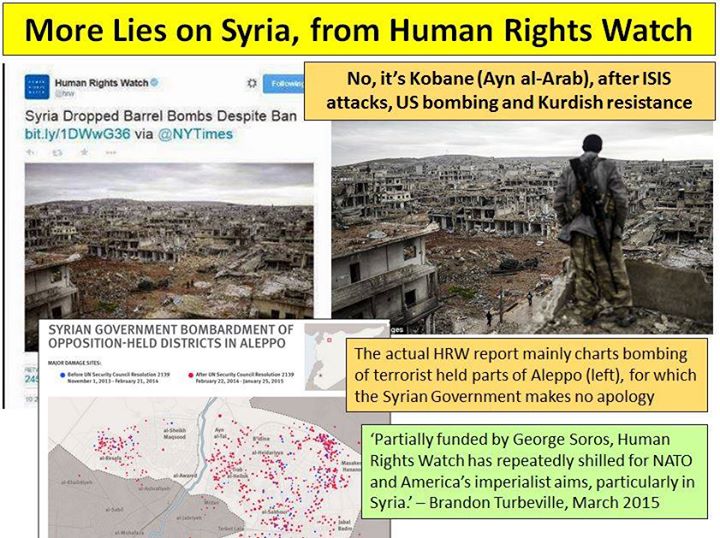
On February 25, HRW posted a photo of a devastated civilian area in Syria with the tagline “Syria dropped barrel bombs despite ban.” The “ban” HRW is referring to is the ban on bombing civilian areas that applies to both sides in Aleppo after the United Nations stepped in to save the Western-backed terrorists from annihilation. Assad’s forces had surrounded the city and had cut off a major supply route for the death squads from Turkey thus making the ultimate elimination of the jihadist forces a virtual inevitability.
As Somini Sengupta wrote for the New York Times on February 24,
Human Rights Watch said Tuesday that the Syrian government had dropped so-called barrel bombs on hundreds of sites in rebel-held towns and cities in the past year, flouting a United Nations Security Council measure.
In a report released Tuesday, the group said it relied on satellite images, photos, videos and witness statements to conclude that the Syrian government had bombarded at least 450 sites in and around the southern town of Daraa and at least 1,000 sites in Aleppo in the north.
The report focused on the period since Feb. 22, 2014, when the Security Council specifically condemned the use of barrel bombs, which are large containers filled with explosives and projectiles that can indiscriminately hurt civilians and are prohibited under international law.
There was only one problem with HRW’s tweet – the photograph the organization provided was not Aleppo.
In fact, the damage that had been wrought upon the civilian area in the photograph was not committed by the Syrian military but by the United States.
The photo was actually a picture of Kobane (Ayn al-Arab), the city which has been the site of heavy US aerial bombardment over the last several months as the US engages in its program of death squad herding and geographical reformation of sovereign Syrian and Iraqi territory.
But, while HRW was content to use the destruction of the city as a reason to condemn the Assad government and continue to promote the cause for US military action in Syria, the “human rights organization” was apparently much less interested in the exact same destruction wrought by US forces.
In other words, if Assad’s forces bomb a civilian area into the stone age, it is an atrocity, a war crime, and justification for international military involvement. If the United States bombs a civilian area into the stone age, it’s no biggie.
Partially funded by George Soros, Human Rights Watch has repeatedly shilled for NATO and America’s imperialist aims, particularly in Syria.
For instance, when Western media propaganda had reached a crescendo regarding the outright lie that Assad had used chemical weapons against his own people, HRW stood right beside Barack Obama and John Kerry in their effort to prove Assad’s guilt. HRW even went so far as to repeat the lie that the UN report suggested that Assad was the offending party, driving the final nail into the coffin of any credibility HRW may have had.
When a last-minute chemical weapons deal was secured by Russia in an effort to avoid yet another US/NATO invasion of Syria, HRW did not rejoice for the opportunity of peaceful destruction of chemical weapons and a chance to avoid war, it attacked the deal by claiming that it “failed to ensure justice.” Of course, the deal did fail to ensure justice. There were no provisions demanding punishment of the death squads who actually used the weapons or the US/NATO apparatus that initiated and controlled the jihadist invasion to begin with.
Regardless, when Mother Agnes Mariam of the Cross released her report that refuted what the US/NATO was asserting in regards to chemical weapons in Syria, HRW embarked upon a campaign of attack against her and her work.
Even as far back as 2009, however, HRW was showing its true colors when it apparently signed off on and supported renditions – the process of kidnapping individuals off the street without any due process and “rendering” them to jails and prisons in other countries where they are often tortured – in secret talks with the Obama administration.
If HRW ever had any credibility in terms of the question of actual human rights, then all of that credibility has assuredly been lost. HRW is nothing more than a pro-US, pro-NATO NGO that acts as a smokescreen for the continuation of the violation of human rights across the world – that is, unless those violations are committed by America’s enemies.
March 11, 2015
Posted by aletho |
Deception, Mainstream Media, Warmongering | Aleppo, HRW, Human Rights Watch, Iraq, Kobane, New York Times, Syria, United States |
Leave a comment
Reading the lead stories on Israeli Prime Minister Benjamin Netanyahu’s speech to Congress about Iran in five prominent US papers–the New York Times, Washington Post, LA Times, Wall Street Journal and USA Today (all 3/3/15)–what was most striking was what was left out of these articles.
None of them mentioned, for example, that Israel possesses nuclear weapons. Surely this is relevant when a foreign leader says that it needs the United States’ help to stop a rival state from obtaining nuclear weapons: The omission of the obvious phrase “of its own” changes the story entirely.
Another thing largely left out of the story is the fact that Iran has consistently maintained that it has no interest in building a nuclear weapon. There was one direct statement of this in the five stories–the New York Times‘ reference to “Iran’s nuclear program, which [Iranian] officials have insisted is only for civilian uses.” The Washington Post alluded to the fact that Iran denies that it has a nuclear weapons program, referring to “a program the West has long suspected is aimed at building weapons,” Iran’s “stated nuclear energy goals” and “the suspect Iranian program.” Elsewhere the military nature of Iran’s nuclear research was taken for granted, as when the LA Times said that the issue under discussion was “how to deal with the threat of Iran’s nuclear program.”
Entirely absent from these articles was the fact that not only does Iran deny wanting to make a nuclear bomb, the intelligence agencies of the United States (New York Times, 2/24/12) and Israel (Guardian, 2/23/15) also doubt that Iran has an active nuclear weapons program. Surely this is relevant to a report on the Israeli prime minister engaging in a public debate with the US president on how best to stop this quite possibly nonexistent program.
Instead, these articles generally seemed content to cover the subject as a debate between Netanyahu and US President Barack Obama, perhaps with some congressmembers thrown in–as if these were the “both sides” that needed to be covered in order to give a complete picture of the controversy. When Iranian officials were quoted for a few lines in these pieces–which some neglected to do altogether–it seemed an afterthought, despite the fact that Netanyahu’s speech was mainly a long litany of allegations and threats against their country.
(Though I’m confining my analysis to what seemed to be the most prominent and comprehensive article on the speech on each paper’s website, it’s worth mentioning that the New York Times‘ website featured a piece by Iran’s ambassador to the UN, Gholamali Khoshroo, rebutting Netanyahu’s speech. Reading it one is struck by how different the news pieces would read if Iran’s perspective on Iran’s nuclear program were given equal weight with Israel’s and the US’s views.)
None of these news articles mentioned the Nuclear Non-Proliferation Treaty, signed by both the United States and Iran but not by Israel, which guarantees “the inalienable right of all the Parties to the Treaty to develop research, production and use of nuclear energy for peaceful purposes.”

The New York Times’ caption quoted Israeli Prime Minister Benjamin Netanyahu, “This regime will always be an enemy of America.” That regime got 36 words of rebuttal in the nearly 1,500-word article.
One article–the New York Times’–had a reference to Netanyahu’s decades-long record of making false nuclear predictions about Israel’s enemies. And even that was framed in partisan terms: Netanyahu “did not succeed in mollifying all Democrats, who recalled a history of what they deemed doomsday messages by him.” A reporter, of course, could look up Netayahu’s previous projections to see if they came true or not–as Murtaza Hussain of the Intercept (3/2/15) did–but holding officials accountable for what they have said in the past is not something an “objective” journalist is likely to do.
Another striking omission from these articles, about a speech in which Netanyahu talked about Iran’s “aggression in the region and in the world,” were words like “Palestine,” “Palestinian,” “occupation” or “Gaza”; none of these came up in any of the five articles. USA Today headlined its piece “Netanyahu: Stop Iran’s ‘March of Conquest'”–as though it were Iran, not Israel, that has conquered, occupied and in some cases annexed its neighbors’ territory.
March 6, 2015
Posted by aletho |
Deception, Ethnic Cleansing, Racism, Zionism, Mainstream Media, Warmongering | Benjamin Netanyahu, Iran, Israel, LA Times, New York Times, United States, Wall Street Journal, Washington Post, Zionism |
Leave a comment
The United States and Russia still maintain vast nuclear arsenals of mutual assured destruction, putting the future of humanity in jeopardy every instant. But an unnerving nonchalance has settled over the American side which has become so casual about the risk of cataclysmic war that the West’s propaganda and passions now ignore Russian fears and sensitivities.
A swaggering goofiness has come to dominate how the United States reacts to Russia, with American politicians and journalists dashing off tweets and op-eds, rushing to judgment about the perfidy of Moscow’s leaders, blaming them for almost anything and everything.
These days, playing with nuclear fire is seen as a sign of seriousness and courage. Anyone who urges caution and suggests there might be two sides to the U.S.-Russia story is dismissed as a wimp or a stooge. A what-me-worry “group think” has taken hold across the U.S. ideological spectrum. Fretting about nuclear annihilation is so 1960s.
So, immediately after last Friday night’s murder of Russian opposition figure Boris Nemtsov, the West’s media began insinuating that Russian President Vladimir Putin was somehow responsible even though there was no evidence or logic connecting him to the shooting, just 100 meters from the Kremlin, probably the last place Russian authorities would pick for a hit.
But that didn’t stop the mainstream U.S. news media from casting blame on Putin. For instance, the New York Times published an op-ed by anti-Putin author Martha Gessen saying: “The scariest thing about the murder of Boris Nemtsov is that he himself did not scare anyone,” suggesting that his very irrelevance was part of a sinister political message.
Though no one outside the actual killers seems to know yet why Nemtsov was gunned down, Gessen took the case several steps further explaining how – while Putin probably didn’t finger Nemtsov for death – the Russian president was somehow still responsible. She wrote:
“In all likelihood no one in the Kremlin actually ordered the killing — and this is part of the reason Mr. Nemtsov’s murder marks the beginning of yet another new and frightening period in Russian history. The Kremlin has recently created a loose army of avengers who believe they are acting in the country’s best interests, without receiving any explicit instructions. Despite his lack of political clout, Mr. Nemtsov was a logical first target for this menacing force.”
So, rather than wait for actual evidence to emerge, the Times published Gessen’s conclusions and then let her spin off some even more speculative interpretations. Yet, basing speculation upon speculation is almost always a bad idea, assuming you care about fairness and accuracy.
Remember how after the Oklahoma City bombing in 1995, some terrorism “experts” not only jumped to the false conclusion that the attack was a case of Islamic terrorism but that Oklahoma was chosen to send a message to Americans that no part of the country was safe. But the terrorist turned out to be a white right-wing extremist lashing out at the federal government.
While surely hard-line Russian nationalists, who resented Nemtsov’s support for the U.S.-backed Ukrainian regime in Kiev, should be included on a list of early suspects, there are a number of other possibilities that investigators must also consider, including business enemies, jealous rivals and even adversaries within Russia’s splintered opposition – though that last one has become a target of particular ridicule in the West.
Yet, during my years at the Associated Press, one of my articles was about a CIA “psychological operations” manual which an agency contractor prepared for the Nicaraguan Contra rebels noting the value of assassinating someone on your own side to create a “martyr” for the cause. I’m in no way suggesting that such a motive was in play regarding Nemtsov’s slaying but it’s not as if this idea is entirely preposterous either.
My point is that even in this age of Twitter when everyone wants to broadcast his or her personal speculation about whodunit to every mystery, it would be wise for news organizations to resist the temptation. Surely, if parallel circumstances occurred inside the United States, such guess work would be rightly dismissed as “conspiracy theory.”
Nuclear Mischief
Plus, this latest rush to judgment isn’t about some relatively innocuous topic – like, say, how some footballs ended up under-inflated in an NFL game – this situation involves how the United States will deal with Russia, which possesses some 8,000 nuclear warheads — roughly the same size as the U.S. arsenal — while the two countries have around 1,800 missiles on high-alert, i.e., ready to launch at nearly a moment’s notice.
Over the weekend, I participated in a conference on nuclear dangers sponsored by the Helen Caldicott Foundation in New York City. On my Saturday afternoon panel was Seth Baum of the Global Catastrophic Risk Institute who offered a sobering look at how the percentage chances of a nuclear war – though perhaps low at any given moment – add up over time to quite likely if not inevitable. He made the additional observation that those doomsday odds rise at times of high tensions between the United States and Russia.
As Baum noted, at such crisis moments, the people responsible for the U.S. and Russian nuclear weapons are more likely to read a possible computer glitch or some other false alarm as a genuine launch and are thus more likely to push their own nuclear button.
In other words, it makes good sense to avoid a replay of the Cuban Missile Crisis in reverse by edging U.S. nuclear weapons up against Russia’s borders, especially when U.S. politicians and commentators are engaging in Cold War-style Russia-bashing. Baiting the Russian bear may seem like great fun to the tough-talking politicians in Washington or the editors of the New York Times and Washington Post but this hostile rhetoric could be taken more seriously in Moscow.
When I spoke to the nuclear conference, I noted how the U.S. media/political system had helped create just that sort of crisis in Ukraine, with every “important” person jumping in on the side of the Kiev coup-makers in February 2014 when they overthrew elected President Viktor Yanukovych.
Since then, nearly every detail of that conflict has been seen through the prism of “our side good/their side bad.” Facts that put “our side” in a negative light, such as the key role played by neo-Nazis and the Kiev regime’s brutal “anti-terrorism operation,” are downplayed or ignored.
Conversely, anything that makes the Ukrainians who are resisting Kiev’s authority look bad gets hyped and even invented, such as one New York Times’ lead story citing photos that supposedly proved Russian military involvement but quickly turned out to be fraudulent. [See Consortiumnews.com’s “NYT Retracts Russian Photo Scoop.”]
At pivotal moments in the crisis, such as the Feb. 20, 2014 sniper fire that killed both police and protesters and the July 17, 2014 shoot-down of Malaysia Airlines Flight 17 killing 298 passengers and crew, the U.S. political/media establishment has immediately pinned the blame on Yanukovych, the ethnic Russian rebels who are resisting his ouster, or Putin. Then, when evidence emerged going in the opposite direction — toward “our side” — a studied silence followed, allowing the earlier propaganda to stay in place as part of the preferred storyline.
A Pedestrian Dispute
One of the points of my talk was that the Ukrainian crisis emerged from a fairly pedestrian dispute, i.e., plans for expanding economic ties with the European Union while not destroying the historic business relationship with Russia. In November 2013, Yanukovych backed away from signing an EU association agreement when experts in Kiev announced that it would blow a $160 billion hole in Ukraine’s economy. He asked for more time.
But Yanukovych’s decision disappointed many western Ukrainians who favored the EU agreement. Tens of thousands poured into Kiev’s Maidan square to protest. The demonstrations then were seized upon by far-right Ukrainian political forces who have long detested the country’s ethnic Russians in the east and began dispatching organized “sotins” of 100 fighters each to begin firebombing police and seizing government buildings.
As the violence grew worse, U.S. neoconservatives also saw an opportunity, including Sen. John McCain, R-Arizona, who told the protesters the United States was on their side, and Assistant Secretary of State for European Affairs Victoria Nuland, who passed out cookies to the protesters and plotted with U.S. Ambassador Geoffrey Pyatt on who would become the new leaders of Ukraine. [See Consortiumnews.com’s “NYT Still Pretends No Coup in Ukraine.“]
Thus, a very manageable political problem in Ukraine was allowed to expand into a proxy war between nuclear-armed United States and Russia. Added to it were intense passions and extensive propaganda. In the West, the Ukraine crisis was presented as a morality play of people who “share our values” pitted against conniving Russians and their Hitler-like president Putin.
In Official Washington, anyone who dared suggest compromise was dismissed as a modern-day Neville Chamberlain practicing “appeasement.” Everyone “serious” was set on stopping Putin now by shipping sophisticated weapons to the Ukrainian government so it could do battle against “Russian aggression.”
The war fever was such that no one raised an eyebrow when Ukraine’s Deputy Foreign Minister Vadym Prystaiko told Canada’s CBC Radio last month that the West should no longer fear fighting nuclear-armed Russia and that Ukraine wanted arms for a “full-scale war” against Moscow.
“Everybody is afraid of fighting with a nuclear state. We are not anymore, in Ukraine,” Prystaiko said. “However dangerous it sounds, we have to stop [Putin] somehow. For the sake of the Russian nation as well, not just for the Ukrainians and Europe. … What we expect from the world is that the world will stiffen up in the spine a little.” [See Consortiumnews.com’s “Ready for Nuclear War over Ukraine?”]
Instead of condemning Prystaiko’s recklessness, more U.S. officials began lining up in support of sending lethal military hardware to Ukraine so it could fight Russia, including Director of National Intelligence James Clapper who said he favored the idea though it might provoke a “negative reaction” from Moscow.
Russian Regime Change
Even President Barack Obama and other U.S. leaders who have yet to publicly endorse arming the Kiev coup-makers enjoy boasting about how much pain they are inflicting on the Russian economy and its government. In effect, there is a U.S. strategy of making the Russian economy “scream,” a first step toward a larger neocon goal to achieve “regime change” in Moscow.
Another point I made in my talk on Saturday was how the neocons are good at drafting “regime change” plans that sound great when discussed at a think tank or outlined on an op-ed page but often fail to survive in the real world, such as their 2003 plan for a smooth transition in Iraq to replace Saddam Hussein with someone of their choosing – except that it didn’t work out that way.
Perhaps the greatest danger from the new neocon dream for “regime change” in Moscow is that whoever follows Putin might not be the pliable yes man that the neocons envision, but a fierce Russian nationalist who would suddenly have control of their nuclear launch codes and might decide that it’s time for the United States to make concessions or face annihilation.
Yet, what I find truly remarkable about the Ukraine crisis is that it was always relatively simple to resolve: Before the coup, Yanukovych agreed to reduced powers and early elections so he could be voted out of office. Then, either he or some new leadership could have crafted an economic arrangement that expanded ties to the EU while not severing them with Russia.
Even after the coup, the new regime could have negotiated a federalized system that granted more independence to the disenfranchised ethnic Russians of eastern Ukraine, rather than launch a brutal “anti-terrorist operation” against those resisting the new authorities. But Official Washington’s “group think” has been single-minded: only bellicose anti-Russian sentiments are permitted and no suggestions of accommodation are allowed.
Still, spending time this weekend with people like Helen Caldicott, an Australian who has committed much of her life to campaigning against nuclear weapons, reminded me that this devil-may-care attitude toward a showdown with Russia, which has gripped the U.S. political/media establishment, is not universal. Not everyone agrees with Official Washington’s nonchalance about playing a tough-guy game of nuclear chicken.
As part of the conference, Caldicott asked attendees to stay around for a late-afternoon showing of the 1959 movie, “On the Beach,” which tells the story of the last survivors from a nuclear war as they prepare to die when the radioactive cloud that has eliminated life everywhere else finally reaches Australia. A mystery in the movie is how the final war began, who started it and why – with the best guess being that some radar operator somewhere thought he saw something and someone reacted in haste.
Watching the movie reminded me that there was a time when Americans were serious about the existential threat from U.S.-Russian nuclear weapons, when there were films like “Dr. Strangelove,” “Fail Safe,” and “On the Beach.” Now, there’s a cavalier disinterest in those risks, a self-confidence that one can put his or her political or journalistic career first and just assume that some adult will step in before the worst happens.
Whether some adults show up to resolve the Ukraine crisis remains to be seen. It’s also unclear if U.S. pundits and pols can restrain themselves from more rushes to judgment, as in the case of Boris Nemtsov. But a first step might be for the New York Times and other “serious” news organizations to return to traditional standards of journalism and check out the facts before jumping to a conclusion.
~
Investigative reporter Robert Parry broke many of the Iran-Contra stories for The Associated Press and Newsweek in the 1980s. You can buy his latest book, America’s Stolen Narrative, either in print here or as an e-book (from Amazon and barnesandnoble.com).
March 3, 2015
Posted by aletho |
Mainstream Media, Warmongering, Militarism | New York Times, Nuclear weapons, Russia, Ukraine, United States |
Leave a comment
If you wonder how the lethal “group think” on Iraq took shape in 2002, you might want to study what’s happening today with Ukraine. A misguided consensus has grabbed hold of Official Washington and has pulled in everyone who “matters” and tossed out almost anyone who disagrees.
Part of the problem, in both cases, has been that neocon propagandists understand that in the modern American media the personal is the political, that is, you don’t deal with the larger context of a dispute, you make it about some easily demonized figure. So, instead of understanding the complexities of Iraq, you focus on the unsavory Saddam Hussein.
This approach has been part of the neocon playbook at least since the 1980s when many of today’s leading neocons – such as Elliott Abrams and Robert Kagan – were entering government and cut their teeth as propagandists for the Reagan administration. Back then, the game was to put, say, Nicaragua’s President Daniel Ortega into the demon suit, with accusations about him wearing “designer glasses.” Later, it was Panamanian dictator Manuel Noriega and then, of course, Saddam Hussein.
Instead of Americans coming to grips with the painful history of Central America, where the U.S. government has caused much of the violence and dysfunction, or in Iraq, where Western nations don’t have clean hands either, the story was made personal – about the demonized leader – and anyone who provided a fuller context was denounced as an “Ortega apologist” or a “Noriega apologist” or a “Saddam apologist.”
So, American skeptics were silenced and the U.S. government got to do what it wanted without serious debate. In Iraq, for instance, the American people would have benefited from a thorough airing of the complexities of Iraqi society and the potential risks of invading under the dubious rationale of WMD.
But there was no thorough debate about anything: not about international law that held “aggressive war” to be “the supreme international crime”; not about the difficulty of putting a shattered Iraq back together after an invasion; not even about the doubts within the U.S. intelligence community about whether Iraq possessed usable WMD and whether Hussein had any ties to al-Qaeda.
All the American people heard was that Saddam Hussein was “a bad guy” and it was America’s right and duty to get rid of “bad guys” who supposedly had dangerous WMDs that they might share with other “bad guys.” To say that this simplistic argument was an insult to a modern democracy would be an understatement, but the propaganda worked because almost no one in the mainstream press or in academia or in politics dared speak out.
Those who could have made a difference feared for their careers – and they were “right” to have those fears, at least in the sense that it was much safer, career-wise, to run with the herd than to stand in the way. Even after the Iraq War had turned into an unmitigated disaster with horrific repercussions reaching to the present, the U.S. political/media establishment undertook no serious effort to impose accountability.
Almost no one who joined in the Iraq “group think” was punished. It turns out that there truly is safety in numbers. Many of those exact same people are still around holding down the same powerful jobs as if nothing horrible had happened in Iraq. Their pontifications still are featured on the most influential opinion pages in American journalism, with the New York Times’ Thomas L. Friedman a perfect example.
Though Friedman has been wrong again and again, he is still regarded as perhaps the preeminent foreign policy pundit in the U.S. media. Which brings us to the issue of Ukraine and Russia.
A New Cold War
From the start of the Ukraine crisis in fall 2013, the New York Times, the Washington Post and virtually every mainstream U.S. news outlet have behaved as dishonestly as they did during the run-up to war with Iraq. Objectivity and other principles of journalism have been thrown out the window. The larger context of both Ukrainian politics and Russia’s role has been ignored.
Again, it’s all been about demonized “bad guys” – in this case, Ukraine’s elected President Viktor Yanukovych and Russia’s elected President Vladimir Putin – versus the “pro-Western good guys” who are deemed model democrats even as they collaborated with neo-Nazis to overthrow a constitutional order.
Again, the political is made personal: Yanukovych had a pricy sauna in his mansion; Putin rides a horse shirtless and doesn’t favor gay rights. So, if you raise questions about U.S. support for last year’s coup in Ukraine, you somehow must favor pricy saunas, riding shirtless and holding bigoted opinions about gays.
Anyone who dares protest the unrelentingly one-sided coverage is deemed a “Putin apologist” or a “stooge of Moscow.” So, most Americans – in a position to influence public knowledge but who want to stay employable – stay silent, just as they did during the Iraq War stampede.
One of the ugly but sadly typical cases relates to Russia scholar Stephen F. Cohen, who has been denounced by some of the usual neocon suspects for deviating from the “group think” that blames the entire Ukraine crisis on Putin. The New Republic, which has gotten pretty much every major issue wrong during my 37 years in Washington, smeared Cohen as “Putin’s American toady.”
And, if you think that Cohen’s fellow scholars are more tolerant of a well-argued dissent, the Association for Slavic, East European and Eurasian Studies further proved that deviation from the “group think” on Ukraine is not to be tolerated.
The academic group spurned a fellowship program, which it had solicited from Cohen’s wife, Katrina vanden Heuvel, because the program’s title included Cohen’s name. “It’s no secret that there were swirling controversies surrounding Professor Cohen,” Stephen Hanson, the group’s president, told the New York Times.
In a protest letter to the group, Cohen called this action “a political decision that creates serious doubts about the organization’s commitment to First Amendment rights and academic freedom.” He also noted that young scholars in the field have expressed fear for their professional futures if they break from the herd.
He mentioned the story of one young woman scholar who dropped off a panel to avoid risking her career in case she said something that could be deemed sympathetic to Russia.
Cohen noted, too, that even established foreign policy figures, ex-National Security Advisor Zbigniew Brzezinski and former Secretary of State Henry Kissinger, have been accused in the Washington Post of “advocating that the West appease Russia,” with the notion of “appeasement” meant “to be disqualifying, chilling, censorious.” (Kissinger had objected to the comparison of Putin to Hitler as unfounded.)
In other words, as the United States rushes into a new Cold War with Russia, we are seeing the makings of a new McCarthyism, challenging the patriotism of anyone who doesn’t get into line. But this conformity of thought presents a serious threat to U.S. national security and even the future of the planet.
It may seem clever for some New Republic blogger or a Washington Post writer to insult anyone who doesn’t accept the over-the-top propaganda on Russia and Ukraine – much as they did to people who objected to the rush to war in Iraq – but a military clash with nuclear-armed Russia is a crisis of a much greater magnitude.
Botching Russia
Professor Cohen has been one of the few scholars who was right in criticizing Official Washington’s earlier “group think” about post-Soviet Russia, a reckless and mindless approach that laid the groundwork for today’s confrontation.
To understand why Russians are so alarmed by U.S. and NATO meddling in Ukraine, you have to go back to those days after the Soviet Union collapsed in 1991. Instead of working with the Russians to transition carefully from a communist system to a pluralistic, capitalist one, the U.S. prescription was “shock therapy.”
As American “free market” experts descended on Moscow during the pliant regime of Boris Yeltsin, well-connected Russian thieves and their U.S. compatriots plundered the country’s wealth, creating a handful of billionaire “oligarchs” and leaving millions upon millions of Russians in a state of near starvation, with a collapse in life expectancy rarely seen in a country not at war.
Yet, despite the desperation of the masses, American journalists and pundits hailed the “democratic reform” underway in Russia with glowing accounts of how glittering life could be in the shiny new hotels, restaurants and bars of Moscow. Complaints about the suffering of average Russians were dismissed as the grumblings of losers who failed to appreciate the economic wonders that lay ahead.
As recounted in his 2001 book, Failed Crusade, Cohen correctly describes this fantastical reporting as journalistic “malpractice” that left the American people misinformed about the on-the-ground reality in Russia. The widespread suffering led Vladimir Putin, who succeeded Yeltsin, to pull back on the wholesale privatization, to punish some oligarchs and to restore some of the social safety net.
Though the U.S. mainstream media portrays Putin as essentially a tyrant, his elections and approval numbers indicate that he commands broad popular support, in part, because he stood up to some oligarchs (though he still worked with others). Yet, Official Washington continues to portray oligarchs whom Putin jailed as innocent victims of a tyrant’s revenge.
Last October, after Putin pardoned one jailed oligarch Mikhail Khodorkovsky, neocon Freedom House sponsored a Washington dinner in his honor, hailing him as one of Russia’s political heroes. “I have to say I’m impressed by him,” declared Freedom House President David Kramer. “But he’s still figuring out how he can make a difference.”
New York Times writer Peter Baker fairly swooned at Khodorkovsky’s presence. “If anything, he seemed stronger and deeper than before” prison, Baker wrote. “The notion of prison as cleansing the soul and ennobling the spirit is a powerful motif in Russian literature.”
Yet, even Khodorkovsky, who is now in his early 50s, acknowledged that he “grew up in Russia’s emerging Wild West capitalism to take advantage of what he now says was a corrupt privatization system,” Baker reported.
In other words, Khodorkovsky was admitting that he obtained his vast wealth through a corrupt process, though by referring to it as the “Wild West” Baker made the adventure seem quite dashing and even admirable when, in reality, Khodorkovsky was a key figure in the plunder of Russia that impoverished millions of his countrymen and sent many to early graves.
In the 1990s, Professor Cohen was one of the few scholars with the courage to challenge the prevailing boosterism for Russia’s “shock therapy.” He noted even then the danger of mistaken “conventional wisdom” and how it strangles original thought and necessary skepticism.
“Much as Russia scholars prefer consensus, even orthodoxy, to dissent, most journalists, one of them tells us, are ‘devoted to group-think’ and ‘see the world through a set of standard templates,’” wrote Cohen. “For them to break with ‘standard templates’ requires not only introspection but retrospection, which also is not a characteristic of either profession.”
A Plodding Pundit
Arguably, no one in journalism proves that point better than New York Times columnist Friedman, who is at best a pedestrian thinker plodding somewhere near the front of the herd. But Friedman’s access to millions of readers on the New York Times op-ed page makes him an important figure in consolidating the “group think” no matter how askew it is from reality.
Friedman played a key role in lining up many Americans behind the invasion of Iraq and is doing the same in the current march of folly into a new Cold War with Russia, including now a hot war on Russia’s Ukrainian border. In one typically mindless but inflammatory column, entitled “Czar Putin’s Next Moves,” Friedman decided it was time to buy into the trendy analogy of likening Putin to Hitler.
“Last March, former Secretary of State Hillary Clinton was quoted as saying that Russian President Vladimir Putin’s attack on Ukraine, supposedly in defense of Russian-speakers there, was just like ‘what Hitler did back in the ‘30s’ — using ethnic Germans to justify his invasion of neighboring lands. At the time, I thought such a comparison was over the top. I don’t think so anymore.”
Though Friedman was writing from Zurich apparently without direct knowledge of what is happening in Ukraine, he wrote as if he were on the front lines:
“Putin’s use of Russian troops wearing uniforms without insignia to invade Ukraine and to covertly buttress Ukrainian rebels bought and paid for by Moscow — all disguised by a web of lies that would have made Nazi propagandist Joseph Goebbels blush and all for the purpose of destroying Ukraine’s reform movement before it can create a democratic model that might appeal to Russians more than Putin’s kleptocracy — is the ugliest geopolitical mugging happening in the world today.
“Ukraine matters — more than the war in Iraq against the Islamic State, a.k.a., ISIS. It is still not clear that most of our allies in the war against ISIS share our values. That conflict has a big tribal and sectarian element. It is unmistakably clear, though, that Ukraine’s reformers in its newly elected government and Parliament — who are struggling to get free of Russia’s orbit and become part of the European Union’s market and democratic community — do share our values. If Putin the Thug gets away with crushing Ukraine’s new democratic experiment and unilaterally redrawing the borders of Europe, every pro-Western country around Russia will be in danger.”
If Friedman wished to show any balance – which he clearly didn’t – he might have noted that Goebbels would actually be quite proud of the fact that some of Hitler’s modern-day followers are at the forefront of the fight for Ukrainian “reform,” dispatched by those Kiev “reformers” to spearhead the nasty slaughter of ethnic Russians in eastern Ukraine.
But references to those inconvenient neo-Nazis, who also spearheaded the coup last February ousting President Yanukovych, are essentially verboten in the U.S. mainstream media. So, is any reference to the fact that eastern Ukrainians have legitimate grievances with the Kiev authorities who ousted Yanukovych who had been elected with strong support from eastern Ukraine.
But in the mainstream American “group think,” the people of eastern Ukraine are simply “bought and paid for by Moscow” – all the better to feel good about slaughtering them. [See Consortiumnews.com’s “Seeing No Neo-Nazi Militias in Ukraine.”]
We’re also not supposed to mention that there was a coup in Ukraine, as the New York Times told us earlier this month. It was just white-hat “reformers” bringing more U.S.-sponsored good government to Ukraine. [See Consortiumnews.com’s “NYT Still Pretends No Coup in Ukraine.”]
In his column, without any sense of irony or awareness, Friedman glowingly quotes Natalie Jaresko, Ukraine’s new finance minister (leaving out that Jaresko is a newly minted Ukrainian citizen, an ex-American diplomat and investment banker with her own history of “kleptocracy.”)
Friedman quotes Jaresko’s stirring words: “Putin fears a Ukraine that demands to live and wants to live and insists on living on European values — with a robust civil society and freedom of speech and religion [and] with a system of values the Ukrainian people have chosen and laid down their lives for.”
However, as I noted in December, Jaresko headed a U.S. government-funded investment project for Ukraine that involved substantial insider dealings, including $1 million-plus fees to a management company that she also controlled.
Jaresko served as president and chief executive officer of Western NIS Enterprise Fund (WNISEF), which was created by the U.S. Agency for International Development with $150 million to spur business activity in Ukraine. She also was cofounder and managing partner of Horizon Capital which managed WNISEF’s investments at a rate of 2 to 2.5 percent of committed capital, fees exceeding $1 million in recent years, according to WNISEF’s 2012 annual report.
In the 2012 report, the section on “related party transactions” covered some two pages and included not only the management fees to Jaresko’s Horizon Capital ($1,037,603 in 2011 and $1,023,689 in 2012) but also WNISEF’s co-investments in projects with the Emerging Europe Growth Fund [EEGF], where Jaresko was founding partner and chief executive officer. Jaresko’s Horizon Capital also managed EEGF.
From 2007 to 2011, WNISEF co-invested $4.25 million with EEGF in Kerameya LLC, a Ukrainian brick manufacturer, and WNISEF sold EEGF 15.63 percent of Moldova’s Fincombank for $5 million, the report said. It also listed extensive exchanges of personnel and equipment between WNISEF and Horizon Capital.
Though it’s difficult for an outsider to ascertain the relative merits of these insider deals, they involved potential conflicts of interest between a U.S.-taxpayer-funded entity and a private company that Jaresko controlled.
Based on the data from WNISEF’s 2012 annual report, it also appeared that the U.S. taxpayers had lost about one-third of their investment in WNISEF, with the fund’s balance at $98,074,030, compared to the initial U.S. government grant of $150 million.
In other words, there is another side of the Ukraine story, a darker reality that Friedman and the rest of the mainstream media don’t want you to know. They want to shut out alternative information and lead you into another conflict, much as they did in Iraq.
But Friedman is right about one thing: “Ukraine matters.” And he’s even right that Ukraine matters more than the butchery that’s continuing in Iraq.
But Friedman is wrong about why. Ukraine matters more because he and the other “group thinkers,” who turned Iraq into today’s slaughterhouse, are just as blind to the reality of the U.S. military confronting Russia over Ukraine, except in the Ukraine case, both sides have nuclear weapons.
~
Investigative reporter Robert Parry broke many of the Iran-Contra stories for The Associated Press and Newsweek in the 1980s. You can buy his latest book, America’s Stolen Narrative, either in print here or as an e-book (from Amazon and barnesandnoble.com).
January 31, 2015
Posted by aletho |
Mainstream Media, Warmongering | New York Times, Russia, Thomas L. Friedman, Ukraine, United States |
Leave a comment
The Auschwitz bandwagon has rolled onto our television and Internet screens and newspaper front pages once again. It never actually leaves, so perhaps it is more accurate to say that this week it is more present than usual.
You don’t believe we’re ruled by halacha (Talmudic law)? In that case, how is it that whatever befalls The Holy People of Counterfeit “Israel” is branded the supreme evil of the cosmos, and whatever happens to the eternally skimmed (we the goyim), counts for slightly less than nothing?
Take for example the hideously evil El Khiam concentration camp operated by the Israelis through their south Lebanon proxy army, the SLA.
You never heard of it, correct? Why is that? It was a torture camp; a death camp paid for in part with American taxpayer money. But you know nothing of it. Israeli allies under Israeli direction killed and tortured the Lebanese in that El Khiam concentration camp. All of the victims were goyim, not Holy People. Now do you understand why El Khiam is unsung and unknown?
El Khiam was liberated by Hezbollah, the people Americans are taught to hate because they are the only formidable armed resistance against Israeli conquest and land theft in the Middle East. Unlike Sunni Saudi Arabia which is allied with the Israelis, Shiite Hezbollah has not cut a deal with the US or the Israelis. This is why Assad in Syria and the government of Iran are attacked and sanctioned — they are the principal, and practically the only significant allies of Hezbollah.
“Saudi Arabian interests and Israel are almost parallel,” says Saudi Prince Alwaleed bin Talal. “He notes the startling alliance of Saudi Arabia and the Jewish state.” (Wall Street Journal, November 23, 2013, p. A11).
“…the kingdom now supports Islamist rebels in Syria who often fight alongside Qaeda groups like the Nusra Front. The Saudis say they have little choice…they believe they must now back whoever can help them defeat Mr. Assad’s forces and his Iranian allies.” (New York Times, January 5, 2014, p. A10).
Saudi Arabia, which maintains a compact with its clerics who furnish the murderous Wahhabist-Salafist theology which drives ISIS and al-Qaeda, is our precious “ally,” while Hezbollah, Iran and Assad’s Syria we are taught to hate, sanction and prepare to do war with.
We are seeing the makings of another war unfolding this week, which the Israelis are instigating in league with their covert Saudi-based Wahhabist-Salafist Sunni terrorist allies; a war intended to finish off Assad, the protector of the Christian population in Syria, and in Lebanon to “mow the lawn” (an Israeli euphemism for periodic massacres of Arab civilians so as to “tame” these lesser humans).
Here’s how it’s playing out as we write these words: nine days ago the Israeli military bombed a convoy in Syria’s Golan Heights. The bombs killed five members of Hezbollah, including the son of the group’s former military commander, Imad Mughniyeh, and an Iranian general. The Israeli government justified the unprovoked attack on Syrian land by claiming, on no evidence, that Hezbollah and its Iranian allies “had been building an infrastructure in the Syrian Golan Heights with which to attack Israel.” The NY Times and other controlled media published this alibi without skepticism and without publishing any comment from Syria, Iran or Hezbollah as a counter to it. The Israelis issue the pretext for their violence and all people who think “correct” thoughts are obligated to believe it’s true.
Today, Jan. 28, in retaliation for the Israeli attack (although the mainstream media will not patently report it as retaliation), Hezbollah struck an Israeli convoy, with the difference being that whereas the US media published almost no photos of the Israeli attack nine days ago, today graphic and grisly photos of the wounded Israelis and the wreckage of their vehicles are plastered all over the US media.
To summarize, the Israelis launched an unprovoked bombing raid on Syria, killing Hezbollah personnel and an Iranian general. When representatives of those victims fight back, we have the situation today, as decreed by “our” media: “Hezbollah launches attack on Israel.”
One envisions the shaking heads and indignation of all of those millions of Fox News habitués and “American Sniper” movie viewers, who are thinking, “Those damned Arabs are at it again! Go Israel!”
With an Israeli national election weeks away, Prime Minister Binyamin Netanyahu was anxious to initiate a tit-for-tat exchange with Hezbollah which he knew the US media would suggest was “an act of Arab terror,” which in turn provides Netanyahu the opportunity to gain more popularity with the generally bloodthirsty Israeli electorate by sparking a war with Lebanon and Syria.
All this might very well precipitate another genocidal Israeli “lawn mowing” of Lebanese civilians (last witnessed in 2006), and the opportunity to further assist the al-Qaeda connected Nusra front in Syria in finally crushing the Syrian-Christian population’s ally, Assad, and instituting Nusra’s Sharia law in Syria, which Right wing Republicans claim to oppose in the US but support in Syria — by means of their Israeli-approved goal of overthrowing Assad.
According to a statement on his Facebook page, Russian-Judaic Avigdor Lieberman, the Israeli foreign minister, stated that “Israel” should respond to Hezbollah’s retaliation, “in a very harsh and disproportionate manner.”
We’ll wager that Lieberman’s advocacy of a “disproportionate” attack is a reference to his goal of another massacre of Lebanese. Lieberman’s political ally, Ayelet Shaked, a member of the Israeli Knesset (parliament), spelled it out: “bombing a civilian population is justified when civilians give shelter to evil” (Jewish Daily Forward, Jan. 26, 2015).
“Evil” in this context signifies any goy who raises his head against Israeli occupation and mass murder.
Israelis have a license to kill Arabs. They can “Auschwitz” them as much as they like, on this, the 70th anniversary of the liberation of Auschwitz.
Copyright©2015 by Independent History and Research
January 29, 2015
Posted by aletho |
Ethnic Cleansing, Racism, Zionism, Mainstream Media, Warmongering, Timeless or most popular | Israel, Lebanon, New York Times, Palestine, Zionism |
Leave a comment
In late February, a conference is scheduled in New York City to discuss the risk of nuclear war if computers reach the level of artificial intelligence and take decisions out of human hands. But there is already the old-fashioned danger of nuclear war, started by human miscalculation, fed by hubris and propaganda.
That possible scenario is playing out in Ukraine, where the European Union and the United States provoked a political crisis on Russia’s border in November 2013, then backed a coup d’etat in February 2014 and have presented a one-sided account of the ensuing civil war, blaming everything on Russia.
Possibly the worst purveyor of this Cold War-style propaganda has been the New York Times, which has given its readers a steady diet of biased reporting and analysis, including now accusing the Russians for a resurgence in the fighting.
One way the Times has falsified the Ukraine narrative is by dating the origins of the crisis to several months after the crisis actually began. So, the lead story in Saturday’s editions ignored the actual chronology of events and started the clock with the appearance of Russian troops in Crimea in spring 2014.
The Times article by Rick Lyman and Andrew E. Kramer said: “A shaky cease-fire has all but vanished, with rebel leaders vowing fresh attacks. Civilians are being hit by deadly mortars at bus stops. Tanks are rumbling down snowy roads in rebel-held areas with soldiers in unmarked green uniforms sitting on their turrets, waving at bystanders — a disquieting echo of the ‘little green men’ whose appearance in Crimea opened this stubborn conflict in the spring.”
In other words, the story doesn’t start in fall 2013 with the extraordinary U.S. intervention in Ukrainian political affairs – spearheaded by American neocons, such as National Endowment for Democracy president Carl Gershman, Assistant Secretary of State for European Affairs Victoria Nuland and Sen. John McCain – nor with the U.S.-backed coup on Feb. 22, 2014, which ousted elected President Viktor Yanukovych and put one of Nuland’s chosen leaders, Arseniy Yatsenyuk, in as Prime Minister.
No, because if that history were included, Times readers might actually have a chance for a balanced understanding of this unnecessary tragedy. For propaganda purposes, it is better to start the cameras rolling only after the people of Crimea voted overwhelmingly to secede from the failed state of Ukraine and rejoin Russia.
Except the Times won’t reference the lopsided referendum or the popular will of the Crimean people. It’s better to pretend that Russian troops – the “little green men” – just invaded Crimea and conquered the place against the people’s will.
Which leads you to the next paragraph of the Times story: “The renewed fighting has dashed any hopes of reinvigorating a cease-fire signed in September [2014] and honored more in name than in fact since then. It has also put to rest the notion that Russia’s president, Vladimir V. Putin, would be so staggered by the twin blows of Western sanctions and a collapse in oil prices that he would forsake the separatists in order to foster better relations with the West.”
That last point gets us to the danger of human miscalculation driven by hubris. The key error committed by the EU and compounded by the U.S. was to assume that a brazen bid to get Ukraine to repudiate its longtime relationship with Russia and to bring Ukraine into the NATO alliance would not prompt a determined Russian reaction.
Russia sees the prospect of NATO military forces and their nuclear weapons on its borders as a grave strategic threat, especially with Kiev in the hands of rabid right-wing politicians, including neo-Nazis, who regard Russia as a historic enemy. Confronted with such a danger – especially with thousands of ethnic Russians inside Ukraine being slaughtered – it was a near certainty that Russia’s leaders would not succumb meekly to Western sanctions and demands.
Yet, as long as the United States remains in thrall to the propagandistic narrative that the New York Times and other U.S. mainstream media outlets have spun, President Barack Obama will almost surely continue to ratchet up the tensions. To do otherwise would open Obama to accusations of “weakness.”
A Swaggering West
During his State of the Union address, Obama mostly presented himself as a peacemaker, but his one major deviation was when he crowed about the suffering that U.S.-organized sanctions had inflicted on Russia, whose economy, he boasted, was “in tatters.”
So, with the West swaggering and Russia facing what it considers a grave strategic threat, it’s not hard to imagine how the crisis in Ukraine could escalate into a violent clash between NATO and Russian forces with the possibility of further miscalculation bringing nuclear weapons into play.
There’s no sign that the New York Times has any regrets about becoming a crude propaganda outlet, but just in case someone is listening inside “the newspaper of record,” let’s reprise the actual narrative of the Ukraine crisis. It began not last spring, as the Times would have you believe, but rather in fall 2013 when President Yanukovych was evaluating the cost of an EU association agreement if it required an economic break with Russia.
This part of the narrative was well explained by Der Spiegel, the German newsmagazine, even though it has generally taken a harshly anti-Russian line. But, in a retrospective piece published a year after the crisis began, Der Spiegel acknowledged that EU and German leaders were guilty of miscalculations that contributed to the civil war in Ukraine, particularly by under-appreciating the enormous financial costs to Ukraine if it broke its historic ties to Russia.
In November 2013, Yanukovych learned from experts at the National Academy of Sciences of Ukraine that the total cost to the country’s economy from severing its business connections to Russia would be around $160 billion, 50 times the $3 billion figure that the EU had estimated, Der Spiegel reported.
The figure stunned Yanukovych, who pleaded for financial help that the EU couldn’t provide, the magazine said. Western loans would have to come from the International Monetary Fund, which was demanding painful “reforms” of Ukraine’s economy, structural changes that would make the hard lives of average Ukrainians even harder, including raising the price of natural gas by 40 percent and devaluing Ukraine’s currency, the hryvnia, by 25 percent.
With Putin offering a more generous aid package of $15 billion, Yanukovych backed out of the EU agreement but told the EU’s Eastern Partnership Summit in Vilnius, Lithuania, on Nov. 28, 2013, that he was willing to continue negotiating. German Chancellor Angela Merkel responded with “a sentence dripping with disapproval and cool sarcasm aimed directly at the Ukrainian president. ‘I feel like I’m at a wedding where the groom has suddenly issued new, last minute stipulations,” according to Der Spiegel’s chronology of the crisis.
After the collapse of the EU deal, U.S. neocons went to work on one more “regime change” – this time in Ukraine – using the popular disappointment in western Ukraine over the failed EU agreement as a way to topple Yanukovych, the constitutionally elected president whose political base was in eastern Ukraine.
Assistant Secretary of State Nuland, a prominent neocon holdover who advised Vice President Dick Cheney, passed out cookies to anti-Yanukovych demonstrators at the Maidan Square in Kiev and reminded Ukrainian business leaders that the United States had invested $5 billion in their “European aspirations.”
Sen. McCain, who seems to want war pretty much everywhere, joined Ukrainian rightists onstage at the Maidan urging on the protests, and Gershman’s U.S.-funded National Endowment for Democracy deployed its Ukrainian political/media operatives in support of the disruptions. As early as September 2013, the NED president had identified Ukraine as “the biggest prize” and an important step toward toppling Putin in Russia. [See Consortiumnews.com’s “Neocons’ Ukraine-Syria-Iran Gambit.”]
By early February 2014, Nuland was telling U.S. Ambassador to Ukraine Geoffrey Pyatt “fuck the EU” and discussing how to “glue this thing” as she handpicked who the new leaders of Ukraine would be; “Yats is the guy,” she said about Arseniy Yatsenyuk.
As violent disorders at the Maidan grew worse – with well-organized neo-Nazi militias hurling firebombs at police – the State Department and U.S. news media blamed Yanukovych. On Feb. 20, when mysterious snipers – apparently firing from positions controlled by the neo-Nazi Right Sektor – shot to death police officers and protesters, the situation spun out of control – and the American press again blamed Yanukovych.
Though Yanukovych signed a Feb. 21 agreement with three European countries accepting reduced powers and early elections, that was not enough for the coup-makers. On Feb. 22, a putsch, spearheaded by neo-Nazi militias, forced Yanukovych and his officials to flee for their lives.
Remarkably, however, when the Times pretended to review this history in a January 2015 article, the Times ignored the extraordinary evidence of a U.S.-backed coup – including the scores of NED political projects, McCain’s cheerleading and Nuland’s plotting. The Times simply informed its readers that there was no coup. [See Consortiumnews.com’s “NYT Still Pretends No Coup in Ukraine.”]
But the Times’ propaganda on Ukraine is not just wretched journalism, it is also a dangerous ingredient in what could become a nuclear confrontation, if Americans come to believe a false narrative and thus go along with more provocative actions by their political leaders who, in turn, might feel compelled to act tough because otherwise they’d be attacked as “soft.”
In other words, even without computers seizing control of man’s nuclear weapons, man himself might blunder into a nuclear Armageddon, driven not by artificial intelligence but a lack of the human kind.
~
Investigative reporter Robert Parry broke many of the Iran-Contra stories for The Associated Press and Newsweek in the 1980s. You can buy his latest book, America’s Stolen Narrative, either in print here or as an e-book (from Amazon and barnesandnoble.com).
January 25, 2015
Posted by aletho |
Deception, Mainstream Media, Warmongering, Militarism | New York Times, Russia, Ukraine, United States |
Leave a comment
US Pressures Palestine to be Patient
Dennis Ross, writing in the New York Times, criticises Mahmoud Abbas for using international institutions to put pressure on Israel.
Abbas, after failing to obtain a UN Security Council resolution requiring Israel to end its decades-long occupation of the West Bank, East Jerusalem and Gaza, had announced his intention to join Palestine to the International Criminal Court and seek justice via that route.
“Why not wait?” asks Ross. “If a new Israeli government after the elections is prepared to take a peace initiative and build settlements only on land that is likely to be part of Israel and not part of Palestine, there will be no need for a United Nations resolution.”
If not, and the Europeans decide to pursue a resolution, it must be balanced. “It cannot simply address Palestinian needs by offering borders based on the 1967 lines with mutually agreed swaps and a capital in Arab East Jerusalem without offering something equally specific to Israel — namely, security arrangements that leave Israel able to defend itself by itself, phased withdrawal tied to the Palestinian Authority’s performance on security and governance, and a resolution of the Palestinian refugee issue that allows Israel to retain its Jewish character.”
Why should the Israelis be offered anything? The aim is to make them give back what they have stolen at gunpoint. The Palestinians have been waiting 37 years while, week by week, Israel confiscates more of their land and water and plots to steal their offshore gas too. Why drag out the torment unless you’re the worst kind of sadist? Why wait a moment longer for restitution?
This is not a sudden demand. Back in November 1967 Resolution 242 was passed unanimously by the UN Security Council requiring “withdrawal of Israel armed forces from territories occupied in the recent conflict [i.e. the Six-Day War]” in fulfillment of UN Charter principles. That’s 37 years for the Israelis to get used to it.
The preamble referred to the “inadmissibility of the acquisition of territory by war and the need to work for a just and lasting peace in the Middle East in which every State in the area can live in security”. So would Palestine be able to “defend itself, by itself” and retain its Arab character? We hear ad nauseam about Israel’s security, never Palestine’s.
Israel’s interpretation of the Resolution seems to be that they needn’t withdraw until there’s a fully negotiated peace – as if peace was ever in their gameplan. But others such as the Russian, Kuznetsov, weren’t fooled. Kuznetsov explained the position for us thus:
In the resolution adopted by the Security Council, the ‘withdrawal of Israel armed forces from territories occupied in the recent conflict’ becomes the first necessary principle for the establishment of a just and lasting peace in the Near East. We understand the decision taken to mean the withdrawal of Israel forces from all, and we repeat, all territories belonging to Arab States and seized by Israel following its attack on those States on 5 June 1967. This is borne out by the preamble to the United Kingdom draft resolution [S/8247] which stresses the ‘inadmissibility of the acquisition of territory by war’. It follows that the provision contained in that draft relating to the right of all States in the Near East ‘to live in peace within secure and recognized boundaries’ cannot serve as a pretext for the maintenance of Israel forces on any part of the Arab territories seized by them as a result of war.
Dennis Ross may have difficulty understanding the language of Resolution 242, but to your average native English speaker, like the man on the Clapham omnibus, it’s crystal clear. “Withdrawal from territories occupied in the recent conflict” plainly means “get the hell out of there”.
US Secretary of State Dean Rusk writing in 1990 remarked: “We wanted [it] to be left a little vague and subject to future negotiation because we thought the Israeli border along the West Bank could be “rationalized”; certain anomalies could easily be straightened out with some exchanges of territory, making a more sensible border for all parties…. But we never contemplated any significant grant of territory to Israel as a result of the June 1967 war.”
Palestinians blamed for saying ‘no’ to humiliating peace offers
Dennis Ross co-founded the AIPAC-sponsored Washington Institute for Near East Policy and has been described as more pro-Israel than the Israelis. He served the Bush, Clinton and Obama administrations as a top advisor and special envoy on Middle East affairs but is so cosy with the regime in Tel Aviv that few see him as the honest broker he is held out to be. The State Department seems stuffed to the gunwales with people like him and the consequences are worrying.
In his NYT article Ross blames the Palestinian leadership for not accepting “three serious negotiations that culminated in offers to resolve the Israeli-Palestinian conflict: Bill Clinton’s parameters in 2000, former Israeli Prime Minister Ehud Olmert’s offer in 2008, and Secretary of State John Kerry’s efforts last year”. In each case, he says, a proposal on all the core issues was made to Palestinian leaders and the answer was either “no” or no response.
Ross’s accusation reminds me of the The Israel Project’s training manual designed to help the worldwide Zionist movement win the propaganda war. It teaches how to justify the endless occupation, the slaughter, the ethnic cleansing, the land-grabbing, the cruelty and the blatant disregard for international law and UN resolutions, how to demonize Hamas and Iran in particular, and how to make Israel smell sweeter with a few squirts of the aerosol of persuasive language. This advice at the beginning sets the tone: “Remember, it’s not what you say that counts. It’s what people hear.”
The manual recommends numerous messages that are aimed at the mass of “persuadables”, primarily in America but also in the UK. Here is one that’s not unlike the nonsense Ross is trying to put across…
How can the current Palestinian leadership honestly say it will pursue peace when previous leaders rejected an offer to create a Palestinian state just a few short years ago and now refuse to live up to their responsibilities as outlined in the Road Map?
This is surely a reference to Barak’s so-called “generous offer” of 2000, one of the three “serious negotiations” Ross now taunts Abbas with and also one of the many myths Israelis and their stooges love to peddle. The West Bank and the Gaza Strip, seized by Israel in 1967 and occupied ever since, comprise just 22% of pre-partition Palestine. When the Palestinians signed the Oslo Agreement in 1993 they agreed to accept the measly 22% and recognise Israel within ‘Green Line’ borders (i.e. the 1949 Armistice Line established after the Arab-Israeli War). Conceding 78% of the land that was originally theirs was an astonishing compromise.
But it wasn’t enough for greedy Barak. His ‘generous offer’ required the inclusion of 69 Israeli settlements within that 22% remnant. It was plain to see on the map that these settlement blocs would create impossible borders where Palestinian life in the West Bank was already severely disrupted. Barak also demanded the Palestinian territories be placed under “Temporary Israeli Control”, meaning Israeli military and administrative control indefinitely. The ‘generous offer’ also gave Israel control over all the border crossings of the new Palestinian State. What nation in the world would accept that? The map, never shown publicly, revealed the preposterous reality of Barak’s offer, but the truth was cunningly hidden by propaganda spin.
The following year at Taba, Barak produced a revised map but it was withdrawn after his election defeat. Don’t take my word for it – the facts are well documented and explained by organisations such as Gush Shalom.
The only thing this and the many other ‘peace’ exercises achieved was a deep distrust of any pretense of good intentions by Israel.
David Makovsky, a Fellow of Ross’s Washington Institute, says of Abbas’s move: “Internationalizing the conflict will have only one surefire result: making the prospects of Israelis and Palestinians resolving their own differences ever more distant.” After decades of brutal oppression during which the Palestinians have continued to be dispossessed and murdered, does he not think those prospects are distant enough?
Makovsky adds that the Palestinian Authority “has torpedoed any chances for near-term diplomacy” and “invited US financial countermeasures” merely by opening the ICC door. Once again the policy wonks in Washington are warning defenceless people criminally abused by America’s ally that seeking justice under the law is counter-productive. What a sad, sad world they are creating.
January 9, 2015
Posted by aletho |
Deception, Ethnic Cleansing, Racism, Zionism, Illegal Occupation, Mainstream Media, Warmongering, Timeless or most popular | Israel, New York Times, Palestine, United States, Zionism |
Leave a comment
During my years at Newsweek in the late 1980s, when I would propose correcting some misguided conventional wisdom, I’d often be told, “let’s leave that one for the historians,” with the magazine not wanting to challenge an erroneous storyline that all the important people “knew” to be true. And if false narratives only affected the past, one might argue my editors had a point. There’s always a lot of current news to cover.
But most false narratives are not really about the past; they are about how the public perceives the present and addresses the future. And it should fall to journalists to do their best to explain this background information even if it embarrasses powerful people and institutions, including the news organizations themselves.
Yet, rather than take on that difficult task, most major news outlets prefer to embroider onto their existing tapestry of misinformation, fitting today’s reporting onto the misshapen fabric of yesterday’s. They rarely start from scratch and admit the earlier work was wrong.
So, how does the mainstream U.S. news media explain the Ukraine crisis after essentially falsifying the historical record for the past year? Well, if you’re the New York Times, you keep on spinning the old storyline, albeit with a few adjustments.
For instance, on Sunday, the Times published a lengthy article that sought to sustain the West’s insistence that the coup overthrowing elected President Viktor Yanukovych wasn’t really a coup – just the crumbling of his government in the face of paramilitary violence from the street with rumors of worse violence to come – though that may sound to you pretty much like a coup. Still, the Times does make some modifications to Yanukovych’s image.
In the article, Yanukovych is recast from a brutal autocrat willfully having his police slaughter peaceful protesters into a frightened loser whose hand was “shaking” as he signed a Feb. 21 agreement with European diplomats, agreeing to reduce his powers and hold early elections, a deal that was cast aside on Feb. 22 when armed neo-Nazi militias overran presidential and parliamentary offices.
Defining a Coup
One might wonder what the New York Times thinks a coup looks like. Indeed, the Ukrainian coup had many of the same earmarks as such classics as the CIA-engineered regime changes in Iran in 1953 and in Guatemala in 1954.
The way those coups played out is now historically well known. Secret U.S. government operatives planted nasty propaganda about the targeted leader, stirred up political and economic chaos, conspired with rival political leaders, spread rumors of worse violence to come and then – as political institutions collapsed – chased away the duly elected leader before welcoming the new “legitimate” order.
In Iran, that meant reinstalling the autocratic Shah who then ruled with a heavy hand for the next quarter century; in Guatemala, the coup led to more than three decades of brutal military regimes and the killing of some 200,000 Guatemalans.
Coups don’t have to involve army tanks occupying the public squares, although that is an alternative model which follows many of the same initial steps except that the military is brought in at the end. The military coup was a common approach especially in Latin America in the 1960s and 1970s.
But the preferred method in more recent years has been the “color revolution,” which operates behind the façade of a “peaceful” popular uprising and international pressure on the targeted leader to show restraint until it’s too late to stop the coup. Despite the restraint, the leader is still accused of gross human rights violations, all the better to justify his removal.
Later, the ousted leader may get an image makeover; instead of a cruel bully, he is ridiculed for not showing sufficient resolve and letting his base of support melt away, as happened with Mohammad Mossadegh in Iran and Jacobo Arbenz in Guatemala.
The Ukraine Reality
The reality of what happened in Ukraine was never hard to figure out. George Friedman, the founder of the global intelligence firm Stratfor, called the overthrow of Yanukovych “the most blatant coup in history.” It’s just that the major U.S. news organizations were either complicit in the events or incompetent in describing them to the American people.
The first step in this process was to obscure that the motive for the coup – pulling Ukraine out of Russia’s economic orbit and capturing it in the European Union’s gravity field – was actually announced by influential American neocons in 2013.
On Sept. 26, 2013, National Endowment for Democracy President Carl Gershman, who has become a major neocon paymaster, took to the op-ed page of the neocon Washington Post and called Ukraine “the biggest prize” and an important interim step toward toppling Russian President Vladimir Putin.
At the time, Gershman, whose NED is funded by the U.S. Congress to the tune of about $100 million a year, was financing scores of projects inside Ukraine – training activists, paying for journalists and organizing business groups.
As for that even bigger prize – Putin – Gershman wrote: “Ukraine’s choice to join Europe will accelerate the demise of the ideology of Russian imperialism that Putin represents. … Russians, too, face a choice, and Putin may find himself on the losing end not just in the near abroad but within Russia itself.”
At that time, in early fall 2013, Ukraine’s President Yanukovych was exploring the idea of reaching out to Europe with an association agreement. But he got cold feet in November 2013 when economic experts in Kiev advised him that the Ukrainian economy would suffer a $160 billion hit if it separated from Russia, its eastern neighbor and major trading partner. There was also the West’s demand that Ukraine accept a harsh austerity plan from the International Monetary Fund.
Yanukovych wanted more time for the EU negotiations, but his decision angered many western Ukrainians who saw their future more attached to Europe than Russia. Tens of thousands of protesters began camping out at Maidan Square in Kiev, with Yanukovych ordering the police to show restraint.
Meanwhile, with Yanukovych shifting back toward Russia, which was offering a more generous $15 billion loan and discounted natural gas, he soon became the target of American neocons and the U.S. media, which portrayed Ukraine’s political unrest as a black-and-white case of a brutal and corrupt Yanukovych opposed by a saintly “pro-democracy” movement.
The Maidan uprising was urged on by American neocons, including Assistant Secretary of State for European Affairs Victoria Nuland, who passed out cookies at the Maidan and told Ukrainian business leaders that the United States had invested $5 billion in their “European aspirations.”
In the weeks before the coup, according to an intercepted phone call, Nuland discussed with U.S. Ambassador Geoffrey Pyatt who should lead the future regime. Nuland said her choice was Arseniy Yatsenyuk. “Yats is the guy,” she told Pyatt as he pondered how to “midwife this thing.”
Sen. John McCain, R-Arizona, also showed up, standing on stage with right-wing extremists from the Svoboda Party and telling the crowd that the United States was with them in their challenge to the Ukrainian government.
As the winter progressed, the protests grew more violent. Neo-Nazi and other extremist elements from Lviv and western Ukrainian cities began arriving in well-organized brigades or “sotins” of 100 trained street fighters. Police were attacked with firebombs and other weapons as the violent protesters began seizing government buildings and unfurling Nazi banners and even a Confederate flag.
Though Yanukovych continued to order his police to show restraint, he was still depicted in the major U.S. news media as a brutal thug who was callously murdering his own people. The chaos reached a climax on Feb. 20 when mysterious snipers opened fire on police and some protesters, killing scores. As police retreated, the militants advanced brandishing firearms and other weapons. The confrontation led to significant loss of life, pushing the death toll to around 80 including more than a dozen police.
U.S. diplomats and the mainstream U.S. press immediately blamed Yanukovych for the sniper attack, though the circumstances remain murky to this day and some investigations have suggested that the lethal sniper fire came from buildings controlled by Right Sektor extremists.
To tamp down the worsening violence, a shaken Yanukovych signed a European-brokered deal on Feb. 21, in which he accepted reduced powers and an early election so he could be voted out of office. He also agreed to requests from Vice President Joe Biden to pull back the police.
The precipitous police withdrawal then opened the path for the neo-Nazis and other street fighters to seize presidential offices and force Yanukovych’s people to flee for their lives. Yanukovych traveled to eastern Ukraine and the new coup regime that took power – and was immediately declared “legitimate” by the U.S. State Department – sought Yanukovych’s arrest for murder. Nuland’s favorite, Yatsenyuk, became the new prime minister.
Media Bias
Throughout the crisis, the mainstream U.S. press hammered home the theme of white-hatted protesters versus a black-hatted president. The police were portrayed as brutal killers who fired on unarmed supporters of “democracy.” The good-guy/bad-guy narrative was all the American people heard from the major media.
The New York Times went so far as to delete the slain policemen from the narrative and simply report that the police had killed all those who died in the Maidan. A typical Times report on March 5, 2014, summed up the storyline: “More than 80 protesters were shot to death by the police as an uprising spiraled out of control in mid-February.”
The mainstream U.S. media also sought to discredit anyone who observed the obvious fact that an unconstitutional coup had just occurred. A new theme emerged that portrayed Yanukovych as simply deciding to abandon his government because of the moral pressure from the noble and peaceful Maidan protests.
Any reference to a “coup” was dismissed as “Russian propaganda.” There was a parallel determination in the U.S. media to discredit or ignore evidence that neo-Nazi militias had played an important role in ousting Yanukovych and in the subsequent suppression of anti-coup resistance in eastern and southern Ukraine. That opposition among ethnic-Russian Ukrainians simply became “Russian aggression.”
This refusal to notice what was actually a remarkable story – the willful unleashing of Nazi storm troopers on a European population for the first time since World War II – reached absurd levels as the New York Times and the Washington Post buried references to the neo-Nazis at the end of stories, almost as afterthoughts.
The Washington Post went to the extreme of rationalizing Swastikas and other Nazi symbols by quoting one militia commander as calling them “romantic” gestures by impressionable young men. [See Consortiumnews.com’s “Ukraine’s ‘Romantic’ Neo-Nazi Storm Troopers.”]
Yet, despite the best efforts of the Times, the Post and other mainstream outlets to conceal this ugly reality from the American people, alternative news sources – presenting a more realistic account of what was happening in Ukraine – began to chip away at the preferred narrative.
Instead of buying the big media’s storyline, many Americans were coming to realize that the reality was much more complicated and that they were again being sold a bill of propaganda goods.
Denying a Coup
To the rescue rode the New York Times on Sunday, presenting what was portrayed as a detailed, granular “investigation” of how there was no coup in Ukraine and reaffirming the insistence that only Moscow stooges would think such a thing.
“Russia has attributed Mr. Yanukovych’s ouster to what it portrays as a violent, ‘neo-fascist’ coup supported and even choreographed by the West and dressed up as a popular uprising,” wrote Andrew Higgins and Andrew E. Kramer. “Few outside the Russian propaganda bubble ever seriously entertained the Kremlin’s line. But almost a year after the fall of Mr. Yanukovych’s government, questions remain about how and why it collapsed so quickly and completely.”
The Times’ article concluded that Yanukovych “was not so much overthrown as cast adrift by his own allies, and that Western officials were just as surprised by the meltdown as anyone else. The allies’ desertion, fueled in large part by fear, was accelerated by the seizing by protesters of a large stock of weapons in the west of the country. But just as important, the review of the final hours shows, was the panic in government ranks created by Mr. Yanukovych’s own efforts to make peace.”
Yet, what is particularly curious about this article is that it ignores the substantial body of evidence that the U.S. officials were instrumental in priming the crisis and fueling the ultimate ouster of Yanukovych. For instance, the Times makes no reference to the multitude of U.S.-financed political projects in Ukraine including scores by Gershman’s NED, nor the extraordinary intervention by Assistant Secretary of State Nuland.
Nuland’s encouragement to those challenging the elected government of Ukraine would surely merit mentioning, one would think. But it disappears from the Times’ version of history. Perhaps even more amazing there is no reference to the Nuland-Pyatt phone call, though Pyatt was interviewed for the article.
Even if the Times wanted to make excuses for the Nuland-Pyatt scheming – claiming perhaps it didn’t prove that they were coup-plotting – you would think the infamous phone call would deserve at least a mention. But Nuland isn’t referenced anywhere. Nor is Gershman. Nor is McCain.
The most useful part of the Times’ article is its description of the impact from a raid by anti-Yanukovych militias in the western city of Lviv on a military arsenal and the belief that the guns were headed to Kiev to give the uprising greater firepower.
The Times reports that “European envoys met at the German Embassy with Andriy Parubiy, the chief of the protesters’ security forces, and told him to keep the Lviv guns away from Kiev. ‘We told him: “Don’t let these guns come to Kiev. If they come, that will change the whole situation,”’ Mr. Pyatt recalled telling Mr. Parubiy, who turned up for the meeting wearing a black balaclava.
“In a recent interview in Kiev, Mr. Parubiy denied that the guns taken in Lviv ever got to Kiev, but added that the prospect that they might have provided a powerful lever to pressure both Mr. Yanukovych’s camp and Western governments. ‘I warned them that if Western governments did not take firmer action against Yanukovych, the whole process could gain a very threatening dimension,’ he said.
“Andriy Tereschenko, a Berkut [police] commander from Donetsk who was holed up with his men in the Cabinet Ministry, the government headquarters in Kiev, said that 16 of his men had already been shot on Feb. 18 and that he was terrified by the rumors of an armory of automatic weapons on its way from Lviv. ‘It was already an armed uprising, and it was going to get worse,’ he said. ‘We understood why the weapons were taken, to bring them to Kiev.’”
The Times leaves out a fuller identification of Parubiy. Beyond serving as the chief of the Maidan “self-defense forces,” Parubiy was a notorious neo-Nazi, the founder of the Social-National Party of Ukraine (and the national security chief for the post-coup regime). But “seeing no neo-Nazis” in Ukraine had become a pattern for the New York Times.
Still, the journalistic question remains: what does the New York Times think a coup looks like? You have foreign money, including from the U.S. government, pouring into Ukraine to finance political and propaganda operations. You have open encouragement to the coup-makers from senior American officials.
You have hundreds of trained and armed paramilitary fighters dispatched to Kiev from Lviv and other western cities. You have the seizure of an arsenal amid rumors that these more powerful weapons are being distributed to these paramilitaries. You have international pressure on the elected president to pull back his security forces, even as Western propaganda portrays him as a mass murderer.
Anyone who knows about the 1954 Guatemala coup would remember that a major element of that CIA operation was a disinformation campaign, broadcast over CIA-financed radio stations, about a sizeable anti-government force marching on Guatemala City, thus spooking the Arbenz government to collapse and Arbenz to flee.
But the Times article is not a serious attempt to study the Ukraine coup. If it had been, it would have looked seriously at the substantial evidence of Western interference and into other key facts, such as the identity of the Feb. 20 snipers. Instead, the article was just the latest attempt to pretend that the coup really wasn’t a coup.
~
Investigative reporter Robert Parry broke many of the Iran-Contra stories for The Associated Press and Newsweek in the 1980s. You can buy his latest book, America’s Stolen Narrative, either in print here or as an e-book (from Amazon and barnesandnoble.com).
January 9, 2015
Posted by aletho |
Deception, Economics, Mainstream Media, Warmongering | European Union, New York Times, Ukraine, Washington Post |
Leave a comment
Western pundits who blithely assert that the Islamic Republic of Iran can or will cooperate with the United States in Iraq against ISIL ignore a basic problem; how can the US be a serious partner in fighting a terrorist movement that Washington may have played a critical role in creating?
When US Vice-President Joe Biden told an American university audience in October that Turkey, the UAE and Saudi Arabia are responsible for arming al-Nusra, ISIL, and other al-Qaeda-rooted extremists in Syria and that there is no “moderate middle” in the country, there was (as most non-Americans expected) little coverage of this stunning admission in the US mainstream media.
Indeed, what little coverage there was focused on Biden’s subsequent apologies to Turkish, Emirati, and Saudi leaders for having made such comments in the first place.
Predictably, there was no follow-up reporting in The New York Times reminding Americans that the US is itself complicit in funding and arming extremists in Syria.
CIA producing weapons
In early 2013, the newspaper reported what many in the region already knew; that since the beginning of 2012, the CIA had been deeply involved in procuring weapons for anti-Assad forces, airlifting arms to Jordanian and Turkish airports, and “vetting” rebel commanders – all to help US allies “support the lethal side of the civil war”. Other reports pointed out that these shipments were actually paid for by US allies, at the bidding of the Obama administration.
But, after the Biden revelation, the so-called “newspaper of record” made no reference to how the US, in violation of international law, helped to facilitate the Syrian civil war – and, in the process, to enable the rise of ISIL.
Western-backed extremism is neither a new nor regionally-bound concept. Whether it is the “Contra” rebels in Nicaragua or al-Qaeda-like groups in Afghanistan, the objective has always been to achieve strategic objectives through the infliction of mass suffering – for, in the “free and civilised world” of the US and its allies, the utopian end too often justifies the Mephistophelean means.
More recently, an important footnote to the Libyan civil war was the involvement of Abdul Hakim Belhaj, previously the leader of the Libyan Islamic Fighting Group as well as an al-Qaeda member.
He was one of many Libyan militants influenced by a takfiri (apostate) ideology; the groups with which he was affiliated were designated as terrorist organisations by the US State Department.
Nevertheless, he, along with other like-minded militants, became central components in the efforts of western and Arab-backed anti-Gaddafi forces to capture Tripoli, the Libyan capital.
Western willingness to cooperate with al-Qaeda (or “former” al-Qaeda) militants in Libya was a major turning point. Even the subsequent death of the US ambassador to Libya did not change US policy in this regard. Belhaj became the representative of Libya’s interim president after Gaddafi’s overthrow (before the complete ruin of the country).
More importantly, the willingness of the US and European and “Middle Eastern” allies to embrace al-Qaeda-like militants took US and western foreign policy in the region back to what it had been before the September 11, 2001 attacks – a policy of cooperation with violent extremists to undermine regional actors the West considers problematic.
Monster they created
This policy quickly expanded from Libya to Syria and the repercussions are being felt today in countries like Pakistan, Nigeria, Australia, and China.
After Gaddafi’s overthrow, Turkey – a NATO member – allegedly helped Belhaj to meet with leaders of the so-called “Free Syrian Army” in Istanbul and along the Syrian-Turkish border. In the meetings the former al-Qaeda leader discussed supporting the FSA with money, weapons, and fighters, at a time when the CIA was a major conduit for the transfer of weapons from Libya to Syria.
While Belhaj was just one of many al-Qaeda affiliates involved in violent anti-government campaigns in both Libya and Syria, his openly acknowledged role underscores how the supposedly “moderate” FSA was, from early on in the Syrian civil war, as Iran repeatedly warned, deeply associated with and infiltrated by extremists.
US arms sales hit record levels
Over time, the problem grew so large with ISIL’s rise that it became impossible to hide the monster that the US and its allies had created. And so, Washington launched yet another chapter in its never-ending post-9/11 “war on terror”.
Notwithstanding Washington’s professed determination to degrade and, ultimately, to destroy ISIL, Iran remains profoundly skeptical of US intentions.
Even after dramatic gains by ISIL in Iraq and the formation of a US-led coalition of the guilty to fight it, this coalition has, on average, carried out just nine airstrikes per day in both Iraq and Syria.
In comparison, western reports indicate that, in the same period, the Syrian air force alone has at times carried out up to 200 strikes in 36 hours. Even as these largely inconsequential US-led airstrikes are carried out in Iraq and Syria, some regional players continue to provide extensive logistical support to ISIL; along Syria’s borders with Jordan and the Israeli regime, the Nusra Front continues to collaborate with other extremist militias backed by foreign (including western) powers.
In light of these realities, Iranians – who have been indispensable in preventing the fall of Damascus, Baghdad, Aleppo, and Erbil – simply do not buy the argument that a repentant US is now waging a real war against ISIL, the Nusra Front, and other extremist organisations in Iraq and Syria.
Rather, Iranians see the evidence as pointing to a complex (yet foolish) policy undertaken by Washington and its allies for the purpose of “containing” the Islamic Republic.
What, then, would be the justification – under such circumstances and as Iranian allies are successfully pushing back extremists in Iraq and Syria – for the Islamic Republic to cooperate with the US in Iraq?
No matter how much some may try to tempt it, Iran will not play Faust to America’s Mephistopheles.
Seyed Mohammad Marandi is professor of North American Studies and dean of the Faculty of World Studies at the University of Tehran. He can be reached at mmarandi@ut.ac.ir.
January 7, 2015
Posted by aletho |
Deception, Mainstream Media, Warmongering | Afghanistan, al-Qaeda, Central Intelligence Agency, CIA, Iran, Iraq, IS, Libya, New York Times, Pakistan, Sanctions against Iran, Syria, United States |
Leave a comment
Among honest and knowledgeable people, there really isn’t much doubt about what happened in Ukraine last winter. There was a U.S.-backed coup which ousted a constitutionally elected president and replaced him with a regime more in line with U.S. interests. Even some smart people who agree with the policy of going on the offensive against Russia recognize this reality.
For instance, George Friedman, the founder of the global intelligence firm Stratfor, was quoted in an interview with the Russian liberal business publication Kommersant as saying what happened on Feb. 22 in Kiev – the overthrow of President Viktor Yanukovych – “really was the most blatant coup in history.”
Brushing aside the righteous indignation and self-serving propaganda, Stratfor’s Friedman recognized that both Russia and the United States were operating in what they perceived to be their own interests. “The bottom line is that the strategic interests of the United States are to prevent Russia from becoming a hegemon,” he said. “And the strategic interests of Russia are not to allow the U.S. close to its borders.”
Another relative voice of reason, at least on this topic, has been former Secretary of State Henry Kissinger who – in an interview with Der Spiegel – dismissed Official Washington’s conventional wisdom that Russian President Vladimir Putin provoked the crisis and then annexed Crimea as part of some diabolical scheme to reclaim territory lost when the Soviet Union collapsed in 1991.
“The annexation of Crimea was not a move toward global conquest,” the 91-year-old Kissinger said. “It was not Hitler moving into Czechoslovakia” – as former Secretary of State Hillary Clinton had suggested.
Kissinger noted that Putin had no intention of instigating a crisis in Ukraine: “Putin spent tens of billions of dollars on the Winter Olympics in Sochi. The theme of the Olympics was that Russia is a progressive state tied to the West through its culture and, therefore, it presumably wants to be part of it. So it doesn’t make any sense that a week after the close of the Olympics, Putin would take Crimea and start a war over Ukraine.”
Instead Kissinger argued that the West – with its strategy of pulling Ukraine into the orbit of the European Union – was responsible for the crisis by failing to understand Russian sensitivity over Ukraine and making the grave mistake of quickly pushing the confrontation beyond dialogue.
While the comments by Henry Kissinger and Stratfor’s Friedman reflect the reality of what demonstrably happened in Ukraine, an entirely different “reality” exists in Official Washington. (Note that both interviews were carried in foreign, not U.S. publications.) In the United States, across the ideological spectrum, the only permitted viewpoint is that a crazed Putin launched a war of aggression against his neighbors and must be stopped.
Facts, such as the declaration in September 2013 from a leading neocon, National Endowment for Democracy President Carl Gershman, that Ukraine was “the biggest prize” and an important step toward ousting Putin in Russia, do not fit into this story frame. [See Consortiumnews.com’s “A Shadow U.S. Foreign Policy.”]
Nor do the comments of neocon Assistant Secretary of State for European Affairs Victoria Nuland, who was caught in a pre-coup phone call, handpicking Ukraine’s future leaders and discussing how to “glue this thing.” Nor her public statements about the United States investing $5 billion in Ukraine’s “European aspirations.”
White Hats, Black Hats
Instead of dealing with what actually happened in Ukraine, U.S. pundits and politicians – from conservative to liberal – have bought into a fantasy version of events in which the coup-makers all wore white hats and the elected president and his eastern Ukrainian supporters – along with Putin – all wore black hats.
But there are, as always, rhetorical differences across the U.S. partisan liberal-conservative divide. On Ukraine, the American Right urges an escalation of military tensions against Russia while chiding President Barack Obama for weakness (when compared with Putin’s toughness) – and liberals cheer on Obama’s supposed success in driving the Russian economy into a painful recession while accusing the Right of having a man-crush on Putin.
This liberal “theme” of jabbing the Right for its alleged love of Putin takes the Right’s comments about his forcefulness out of context, simply to score a political point. But the Right-loves-Putin charge has become all the rage with the likes of Paul Krugman, Thomas L. Friedman and other liberals who are bubbling with joy over the economic suffering being inflicted on the people of Russia and presumably eastern Ukraine.
Krugman, who is quickly jettisoning his reputation for thoughtfulness, published a second column on this topic in a row, showing that he has fully bought into all the propaganda “themes” emanating from the U.S. State Department and the compliant U.S. mainstream news media.
In Krugman’s mind, it was Putin who instigated the crisis with the goal of plundering Ukraine. Operating from that false hypothesis, Krugman then spins off this question:
“why did Mr. Putin do something so stupid? … The answer … is obvious if you think about Mr. Putin’s background. Remember, he’s an ex-K.G.B. man — which is to say, he spent his formative years as a professional thug. Violence and threats of violence, supplemented with bribery and corruption, are what he knows.
“And for years he had no incentive to learn anything else: High oil prices made Russia rich, and like everyone who presides over a bubble, he surely convinced himself that he was responsible for his own success. At a guess, he didn’t realize until a few days ago that he has no idea how to function in the 21st century.”
But Krugman is not only operating from a false hypothesis – the reality was that the Ukraine crisis was forced on Putin, not that he went seeking it – Krugman also has a simplistic view of the KGB, which, like the American CIA, certainly had its share of thugs but also had a significant number of smart analysts. Some of those KGB analysts were in the forefront of recognizing the need for the Soviet Union to reform its economy and to reach out to the West.
Putin was generally allied with the KGB faction which favored “convergence” with the West, a Russian attitude that dates back to Peter the Great, seeking Russia’s acceptance as part of Europe rather than being shunned by Europe as part of Asia.
Putin himself pined for the day when Russia would be accepted as a part of the First World with G-8 status and other big-power accoutrements. I’m told he took great pride in his success helping President Obama in 2013 resolve crises with Syria over the mysterious sarin-gas attack and with Iran over its nuclear program.
As Kissinger noted, Putin’s hunger for Western acceptance was the reason he obsessed so much over the Sochi Olympics – and even neglected the festering political crisis in neighboring Ukraine.
In other words, Paul Krugman doesn’t know what he’s talking about regarding Ukraine. His stab at offering a geopolitical analysis suffers from what an economist should recognize as “garbage in, garbage out.” [See also Consortiumnews.com’s “Krugman Joins the Anti-Putin Pack.”]
A Spreading Idiocy
Still, this liberal mindlessness appears to be catching. On Sunday, the New York Times’ star columnist Thomas L. Friedman weighed in with his own upside-down analysis, smirking about the economic suffering now being felt by average Russians because of the U.S.-led sanctions and the Saudi-spurred collapse of oil prices.
Friedman wrote:
“In March, the House Intelligence Committee chairman, Mike Rogers, was asked on ‘Fox News Sunday’ how he thought President Obama was handling relations with Russia versus how President Vladimir Putin had been handling relations with the United States. Rogers responded: ‘Well, I think Putin is playing chess, and I think we’re playing marbles. And I don’t think it’s even close.’
“Hmmm. Marbles. That’s an interesting metaphor. Actually, it turns out that Obama was the one playing chess and Putin was the one playing marbles, and it wouldn’t be wrong to say today that Putin’s lost most of his — in both senses of the word.”
Ha-ha-ha. Putin has lost his marbles! So clever! Perhaps it also wouldn’t be wrong to say that Tom Friedman has lost any credibility that he ever had by getting pretty much every international crisis wrong, most notably the U.S. invasion of Iraq in 2003 when he was just as smarmy in paving the way for that bloody catastrophe.
Washington Post liberal columnist E.J. Dionne Jr. also joined in the “group think” on Monday, writing:
“even … some of [Obama’s] older bets were paying off. The Russian economy is reeling from sanctions imposed in response to its invasion of Ukraine (and from low oil prices). An approach seen by its critics as not tough enough is beginning to show its teeth.”
Beyond the propagandistic quality of these columns – refusing to recognize the complex reality of what actually happened in Ukraine, including the overwhelming referendum by the voters of Crimea to secede from Ukraine and rejoin Russia – there is this disturbingly smug pleasure at how the U.S. actions are hurting the people of Russia.
Whatever you think of Putin, a key reason why he has remained so popular is that he brought some stability to the Russian economy after the “shock therapy” days of plunder under Boris Yeltsin when many Russians were pushed to the brink of starvation. Putin pushed back against some of the corrupt oligarchs who had amassed vast power under Yeltsin (while also striking alliances with others).
But the cumulative effect of a more stable Russian economy was that a fragile middle class was taking shape in a country that has notoriously failed to generate one over the centuries. Because of the U.S.-backed coup in Ukraine, which essentially forced Putin’s response and then led to Obama’s sanctions, the Russian middle class is losing its modest savings as the ruble’s value collapses.
In other words, the part of Russia’s population that could best propel Russia toward a more democratic and progressive future is being dismantled, in part, by punitive U.S. policies – while liberals Krugman, Friedman and Dionne celebrate.
Insider Rivalries
What really seems to matter to these pundits is getting a shot in at their conservative rivals, not the fate of average Russians. This attitude reminded me of an earlier phase of these mindless liberal-conservative food fights – in 1990 when conservative Robert Novak looked for ways to resolve Iraq’s invasion of Kuwait by accepting Saddam Hussein’s private offers to withdraw rather than resorting to war.
Yet, when Novak appeared on CNN’s “Capital Gang,” Al Hunt, a centrist who played the role of liberal pundit on the show, ridiculed the old “Prince of Darkness” for his uncharacteristic peaceful bent. Hunt hung the nickname “Neville Novak” around Novak’s neck, comparing him to British Prime Minister Neville Chamberlain who sought to appease Adolf Hitler before World War II.
When I later asked Hunt why he had derided Novak for looking at more peaceful solutions to an international crisis, Hunt defended the “Neville Novak” line by noting all the times that Novak had baited opponents for their softness against communism. “After years of battling Novak from the left, to have gotten to his right, I enjoyed that,” Hunt said.
Yet, the human consequences from the failure to resolve the Kuwait crisis peacefully have been almost incalculable. Beyond the hundreds of U.S. and coalition deaths and the tens of thousands of Iraqi soldiers and civilians killed, the Persian Gulf War set the stage for a decade of harsh economic sanctions against Iraq and marked a turning point for Saudi Osama bin Laden to begin targeting the United States.
Arguably, if Novak had been listened to – if Hussein’s peace feelers had been taken seriously – history might have taken a very different and less violent course. However, among Washington’s insiders, it seems that nothing is more important than their sparring with each other, in television and in print.
Now, these liberal columnists are enjoying bashing conservatives over their supposed love of Putin and their tolerance for Putin’s “invasion” of Ukraine. Not only are the likes of Paul Krugman, Thomas L. Friedman and E.J. Dionne Jr. spreading dangerous propaganda, they are setting the stage for a new Cold War and possibly even a nuclear confrontation.
~
Investigative reporter Robert Parry broke many of the Iran-Contra stories for The Associated Press and Newsweek in the 1980s. You can buy his latest book, America’s Stolen Narrative, either in print here or as an e-book (from Amazon and barnesandnoble.com).
December 23, 2014
Posted by aletho |
Deception, Mainstream Media, Warmongering | New York Times, Russia, Ukraine, United States |
Leave a comment
When America’s opinion-making herd gets running, it’s hard for anyone to get in the way regardless of how erroneous or unfair the reason for the stampede. It’s much easier – and career-wise safer – to join the pack, which is what New York Times columnist Paul Krugman has done regarding Russia, Ukraine and Vladimir Putin.
In the latest example of the New York Times’ endless Putin-bashing, Krugman begins his Friday column with what you might call a “negative endorsement” of the Russian president by claiming that ex-New York Mayor Rudy Giuliani has “an embarrassing crush on the swaggering statesman.”
But Krugman misleads his readers. Giuliani wasn’t really praising Putin when he said “that is what you call a leader” in commenting on Putin’s decisiveness. Some liberal defenders of President Barack Obama simply cherry-picked the quote to counter Giuliani’s attempt to disparage Obama by comparing Obama’s chronic indecisiveness to Putin’s forcefulness.
In the fuller context, Giuliani was not expressing a fondness for Putin at all. Indeed, he disparaged the Russian leader as “a bully” and urged a tough-guy response to Putin over Ukraine. “Instead of him pushing us around, we push him around,” Giuliani said in the Fox News interview. “That’s the only thing a bully understands.”
So, why did Krugman begin his Putin-bashing column by misrepresenting what Giuliani was saying? It may have been a form of “negative endorsement.” Since many American liberals hate Giuliani, Giuliani’s praise is supposed to translate into liberal hatred for Putin.
But “negative endorsements” are inherently unfair. Just because Josef Stalin might have liked Franklin Roosevelt and because we may hate Stalin, that doesn’t mean we should hate Roosevelt, too. The use of “negative endorsement” is akin to guilt by association. And, in this case, Krugman was playing fast and loose with the facts as well.
Krugman also opts for some of the most hyperbolic language that has been used in the U.S. mainstream media to distort events in Ukraine. For instance, Krugman claims that “Mr. Putin invaded Ukraine without debate or deliberation.” But that really isn’t true either.
The Ukraine crisis is far more complicated and nuanced than that, as Krugman must know. If he doesn’t, he should consult with fellow Princeton professor Stephen F. Cohen, who has bravely challenged the prevailing “group think” on both Ukraine and Russia.
Cohen, one of America’s premier Russia experts, has even warned that “American media coverage of Vladimir Putin … has so demonized him that the result may be to endanger U.S. national security. …
“[M]ainstream press reporting, editorials and op-ed articles have increasingly portrayed Putin as a czar-like ‘autocrat,’ or alternatively a ‘KGB thug,’ who imposed a ‘rollback of democratic reforms’ under way in Russia when he succeeded Boris Yeltsin as president in 2000. He installed instead a ‘venal regime’ that has permitted ‘corruptionism,’ encouraged the assassination of a ‘growing number’ of journalists and carried out the ‘killing of political opponents.’ Not infrequently, Putin is compared to Saddam Hussein and even Stalin.”
Yet, Cohen said, “there is no evidence that any of these allegations against him are true, or at least entirely true. Most seem to have originated with Putin’s personal enemies, particularly Yeltsin-era oligarchs who found themselves in foreign exile as a result of his policies – or, in the case of Mikhail Khodorkovsky, in prison. Nonetheless, U.S. media, with little investigation of their own, have woven the allegations into a near-consensus narrative of ‘Putin’s Russia.’” [For details from Cohen’s article, click here.]
‘Shock Therapy’
Indeed, much of what Krugman finds so offensive about Putin’s Russia actually stemmed from the Yeltsin era following the collapse of the Soviet Union in 1991 when the so-called Harvard Boys flew to Moscow to apply free-market “shock therapy” which translated into a small number of well-connected thieves plundering Russia’s industry and resources, making themselves billionaires while leaving average Russians near starvation.
When Putin succeeded Boris Yeltsin in 2000, Putin challenged some of the oligarchs and pushed others out of the political arena, while also moderating some of the extreme policies and thus making life somewhat better for the average Russian, thus explaining Putin’s broad popularity. Putin could be fairly criticized for not going further, but economist Krugman must surely know this history regarding how the Russian “kleptocracy” got started.
Yet, Krugman slides into the now common demonization of Putin. “Mr. Putin never had the resources to back his swagger,” Krugman smugly writes.
“It’s quite a comedown for Mr. Putin. And his swaggering strongman act helped set the stage for the disaster. A more open, accountable regime — one that wouldn’t have impressed Mr. Giuliani so much — would have been less corrupt, would probably have run up less debt, and would have been better placed to ride out falling oil prices. Macho posturing, it turns out, makes for bad economies.”
In other words, Krugman buys into the “group think” that blames Putin’s “macho posturing” over Ukraine for the current financial crisis in Russia, which has resulted from falling oil prices as well as the U.S.-led sanctions punishing Russia for its alleged “aggression” in Ukraine.
That puts Krugman in the same camp as the neocons who have pushed the bogus narrative that the megalomaniacal Putin is trying to reconstitute the Russian Empire. The actual facts, however, disprove that narrative. [See Consortiumnews.com’s “The Crazy US ‘Group Think’ on Russia.”]
Putin himself has a much better understanding of recent Russian history – and what Official Washington’s goals are regarding him and Russia – as he explained in an end-of-year news conference on Thursday.
Asked if the economic pain was the price for accepting Crimea back into Russia, Putin responded:
“No. This is not the price we have to pay for Crimea. … This is actually the price we have to pay for our natural aspiration to preserve ourselves as a nation, as a civilization, as a state. …
“I gave an example of our most recognizable symbol. It is a bear protecting his taiga. … [M]aybe it would be best if our bear just sat still. Maybe he should stop chasing pigs and boars around the taiga but start picking berries and eating honey. Maybe then he will be left alone.
“But no, he won’t be! Because someone will always try to chain him up. As soon as he’s chained they will tear out his teeth and claws. In this analogy, I am referring to the power of nuclear deterrence. As soon as – God forbid – it happens and they no longer need the bear, the taiga will be taken over. … And then, when all the teeth and claws are torn out, the bear will be of no use at all. Perhaps they’ll stuff it and that’s all.
“So, it is not about Crimea but about us protecting our independence, our sovereignty and our right to exist. That is what we should all realize.”
The Neo-Nazi Reality
There is another unpleasant reality about Ukraine that Krugman ignores — its neo-Nazi element — apparently not wanting to be out of step with his New York Times colleagues who have studiously looked the other way. Again, Krugman could learn something from his fellow Princeton professor Cohen, who has recounted the grim facts about neo-Nazism in Ukraine, facts that would put Putin’s supposed “invasion” in defense of Ukraine’s ethnic Russians in a different light.
In an article for The Nation magazine, Cohen wrote:
“Independent Western scholars have documented the fascist origins, contemporary ideology and declarative symbols of Svoboda and its fellow-traveling Right Sector. Both movements glorify Ukraine’s murderous Nazi collaborators in World War II as inspirational ancestors. Both, to quote Svoboda’s leader Oleh Tyahnybok, call for an ethnically pure nation purged of the ‘Moscow-Jewish mafia’ and ‘other scum,’ including homosexuals, feminists and political leftists.
“And both hailed the Odessa massacre [on May 2 when ethnic Russian protesters were trapped in the Trade Union building and burned alive]. According to the website of Right Sector leader Dmytro Yarosh, it was ‘another bright day in our national history.’ A Svoboda parliamentary deputy added, ‘Bravo, Odessa…. Let the Devils burn in hell.’
“If more evidence is needed, in December 2012, the European Parliament decried Svoboda’s ‘racist, anti-Semitic and xenophobic views [that] go against the EU’s fundamental values and principles.’ In 2013, the World Jewish Congress denounced Svoboda as ‘neo-Nazi.’ Still worse, observers agree that Right Sector is even more extremist. …
“In December 2012, a Svoboda parliamentary leader anathematized the Ukrainian-born American actress Mila Kunis as ‘a dirty kike.’ Since 2013, pro-Kiev mobs and militias have routinely denigrated ethnic Russians as insects (‘Colorado beetles,’ whose colors resemble a sacred Russia ornament). More recently, the US-picked prime minister, Arseniy Yatsenyuk, referred to resisters in the Southeast as ‘subhumans.’ His defense minister proposed putting them in ‘filtration camps,’ pending deportation, and raising fears of ethnic cleansing.
“Yulia Tymoshenko — a former prime minister, titular head of Yatsenyuk’s party and runner-up in the May presidential election — was overheard wishing she could ‘exterminate them all [Ukrainian Russians] with atomic weapons.’ ‘Sterilization’ is among the less apocalyptic official musings on the pursuit of a purified Ukraine.”
By leaving out this troubling context, it’s much easier to mislead Americans about what is actually happening in Ukraine. Instead of understanding Russia’s interest in protecting ethnic Russians in eastern Ukraine from these brutal neo-Nazis, the crisis can simply be presented as Putin’s “aggression” or – as Krugman says – how “Mr. Putin invaded Ukraine.” [For an earlier case of Krugman’s distortions on Ukraine, click here.]
More fitting Krugman’s expertise about the dangers of free-market extremism, he might do better looking at the consequences of those strategies on both Russia and Ukraine, where corrupt oligarchs also took power and have now moved to the center of Ukraine’s U.S.-backed regime.
And, if Krugman wants some current example of cronyism, he might look at the curious case of Natalie Jaresko, a former U.S. diplomat who parlayed $150 million in U.S. AID funds designed to help Ukraine develop an investment-based economy into a personal fortune and now into the post of Ukraine’s new Finance Minister.
According to corporate records, the U.S. government-funded investment project for Ukraine involved substantial insider dealings by Jaresko, including $1 million-plus fees to a management company that she also controlled. Meanwhile, the $150 million stake provided by the U.S. taxpayers appears to have dwindled to less than $100 million. [See Consortiumnews.com’s “Ukraine’s Made-in-the-USA Finance Minister.”]
But critical reporting about the U.S.-backed Ukrainian regime would violate Official Washington’s narrative that prefers the Kiev authorities to be dressed in white hats while Vladimir Putin wears the black hat.
~
Investigative reporter Robert Parry broke many of the Iran-Contra stories for The Associated Press and Newsweek in the 1980s. You can buy his latest book, America’s Stolen Narrative, either in print here or as an e-book (from Amazon and barnesandnoble.com).
December 23, 2014
Posted by aletho |
Deception, Mainstream Media, Warmongering | New York Times, Russia, United States |
Leave a comment
A recent article in FAIR reviewed the findings of its latest study on the quality of political “debate” being aired on the mainstream networks. It studied the run-up to the military interventions in both Iraq and Syria. Perhaps the arbiters of the study intended to illustrate what we’ve learned since the fraudulent Iraq War of 2003. Well, it appears we’ve learned nothing.
FAIR spent hours painfully absorbing the misinformation peddled by such soporific Sunday shows as CNN’s State of the Union, CBS’s Face the Nation, NBC’s Meet the Press, and ABC’s This Week, plus some of the more popular weekly political programming including ADHD-inducing CNN’s Situation Room, Fox News Channel’s Special Report, the venerable sedative PBS NewsHour, and MSNBC’s Hardball. You know the cast of characters: glib George Stephanopoulos, forthright Candy Crowly, harrowing Wolf Blitzer, and stentorian Chris Matthews. Images of their barking maws are seared into the national hippocampus.
Overall, 205 mostly government mouthpieces were invited to air their cleverly crafted talking points for public edification. Of them, a staggering sum of three voiced opposition to military action in Syria and Iraq. A mere 125 stated their support for aggressive action.
Confining its data to the Sunday shows, 89 guests were handsomely paid to educate our benighted couch-potato populace. One suggested not going to war. It stands to reason that considered legal arguments against these interventions got the short shrift, too.
The media consensus on Syria and Iraq isn’t an isolated instance of groupthink. Far from it. It conforms to a consistent pattern, one that has at its core a deliberate disregard for international law and efforts to strengthen transnational treaties and norms regarding military action. (Although transnational law regulating trade is highly favored, for obvious reasons.)
Here the New York Times uncritically repeats Israel casualty figures from the recent attack on Gaza. The journalist, Jodi Rudoren, gives equal legitimacy to sparsely defended claims from Tel Aviv and “painstakingly compiled research by the United Nations, and independent Palestinian human rights organizations in Gaza.” She adopts a baseless Israeli definition of “combatant”, ignoring broad international consensus that contradicts it. She dubiously conflates minors with adults, and under-reports the number of children killed. And so on. All in the service of the pro-Israel position of the paper.
In 2010 Israel assaulted an aid flotilla trying to relieve Palestinians under the Gaza blockade. Author and political analyst Anthony DiMaggio conducted Lexis Nexus searches that demonstrate how U.S. media and the NYT in particular scrupulously avoid the topic of international law when discussing Israeli actions. In one analysis of Times and Washington Post articles on Israel between May 31st and June 2nd, just five out of 48 articles referenced international law relating to either the flotilla raid or the blockade. DiMaggio dissects several of the methods by which Israel flaunts the United Nations Charter. He adds that Israel has violated more than 90 Security Council resolutions relating to its occupation. You don’t get this story in the American mainstream. But this is typical. U.S. media reflexively privileges the Israeli narrative over Arab points of view, and barely acknowledges the existence of dozens of United Nations resolutions condemning criminal actions by Israel.
It’s the same with Iran. For years now, Washington has been theatrically warning the world that Iran wants to build a bomb and menace the Middle East with it. That would be suicidal. It is common knowledge among American intelligence agencies, and any others that have been paying attention, that Iran’s foreign policy is deterrence. But this doesn’t stop the MSM from portraying Tehran as a hornet’s nest of frothing Islamists.
Kevin Young has done a telling survey of articles on nuclear negotiations between the U.S. and Iran. Some 40 editorials written by the Times and the Post were vetted. Precisely zero editorials acknowledged international legal implications of U.S. public threats and various subversions led by Israel, such as assassinating scientists and conducting cyber-attacks, both innovations on standard violations of sovereignty. However, 34 of the pieces “said or implied” that Iran was seeking a nuclear weapon. Forget that 16 American intelligence agencies stated that Iran had no active nuclear weapons program. These papers of record prefer to trade in innuendo and hearsay, despite assessments to the contrary. More than 80% of the articles supported the crippling U.S. sanctions that are justified by the supposed merit of the bomb-building claim.
Prior to Young’s work, Edward Hermann and David Peterson looked at 276 articles on Iran’s nuclear program between 2003 and 2009. The number itself is staggering, more so when stacked against the number of articles written over the same period about Israel’s nuclear program: a mighty three.
This is interesting considering the posture of both countries in relation to international treaties. Israel freely stockpiles nuclear weapons and maintains a “policy of deliberate ambiguity” about its nuclear weapons capacities, despite frequent efforts by Arab states to persuade it to declare its arsenal (which is estimated by some to be in the hundreds). Also, it has yet to sign the Treaty on the Nonproliferation of Nuclear Weapons (NPT) that has been signed by 190 nations worldwide. This intransigent stance has marooned the broadly embraced idea of working to establish a nuclear weapons free zone in the region.
Contrast Israel’s behavior with that of Iran itself, which has permitted extensive inspections of its nuclear facilities. The Times recently noted the country’s main nuclear facilities were “crawling with inspectors.” Iran is also a party to the NPT and is a full member of the IAEA. It continues to try to work toward a reasonable solution with the West despite debilitating sanctions levied on it by the United States. America has unduly pressured the IAEA to adopt additional protocols that would require prohibitively stringent demands on Iran, rendering the possibility of a negotiated solution comfortably remote from an American standpoint. (These additional demands reportedly include drone surveillance, tracking the origin and destination of every centrifuge produced anywhere in the country, and searches of the presidential palace. All of this passes without comment from our deeply objective journalist class.)
Coverage of Iraq is no different, particularly in advance of periodic illegal war of aggression against it. Former U.N. Special Rapporteur on Palestine Richard Falk and author Howard Friel conducted a survey in 2004 assessing the New York Times’ pre-war coverage of Iraq in 2003. In more than 70 articles on Iraq, the Times never mentioned “UN Charter” or “international law.” The study also found “No space was accorded to the broad array of international law and world-order arguments opposing the war.” But such arguments only exist outside of Western corridors of power in Washington, London, Paris, and Tel Aviv.
This isn’t debate. Real debate is pre-empted by internal bi-partisan consensus on some basic issues: maintain a giant garrison state, shrink the state everywhere else, preference corporations over populations, restrict civil liberties to secure status quo power structures. So when it comes to Iran, Iraq, Syria and the like, the question isn’t whether to go to war, but what kind of war to fight. Hawks want bombs. Doves want sanctions. Publicans want Marines. Dems want a proxy army of jihadis. They both want Academi mercenaries. (Obama hired out the gang formerly known as Blackwater to the CIA for a cool $250 million.) And when we’ve finished off ISIS, the question won’t be about an exit strategy, but whether to head west to Damascus or east to Tehran.
The question isn’t whether to cut aid to Israel given its serial criminality in Gaza and the West Bank, but how fast settlements can annex the Jordan Valley without attracting more international opprobrium. (International law, again, set aside.)
On the domestic front, the question isn’t whether to have single payer or private healthcare, but whether citizens should be forced to purchase private schemes or simply admonished to do so. The question isn’t whether or not to keep or strengthen New Deal entitlements, but how swiftly they can be eviscerated. The question isn’t whether or not to surveil the body politic, but where to store the data, and whether or not to harvest two-hop or three-hop metadata. The question isn’t whether or not to hold authors of torture programs accountable, but how much of the damning torture report to redact so as to leave them unprosecutable. The question isn’t whether or not to regulate Wall Street but, as slimy oil industry lawyer Bennett Holiday put it in Syriana, to create “the illusion of due diligence.”
All this is not to say the MSM isn’t aware of alternative viewpoints. It is, but it only acknowledges them when they can be used to justify a foregone conclusion. In the past year, the MSM has nearly become infatuated with international law. Friel has tracked the paper of record’s response to the Ukrainian fiasco. What did he find? When Russia annexed Crimea, the Times inveighed against the bloodless “invasion” as a gross violation of international law. Eight different editorials over the next few months hyperventilated about global security, castigating Russian President Vladimir Putin for his “illegal” violation and his “contempt for,” “flouting,” “blatant transgression,” and “breach” of international law. Calls were sounded to “protect” against such cynical disregard of global consensus. Western allies needed to busy themselves “reasserting international law” and exacting heavy penalties on Russia for “riding roughshod” over such sacred precepts as “Ukrainian sovereignty.”
Quite so, as Washington supports the toppling of democratically elected governments in Kiev and Tegucigalpa, sends drones to ride “roughshod” over Yemeni, Pakistani, Somali and other poorly defended borders; and deploys thousands of troops, advisors, and American-armed jihadis to patrol the sectarian abattoirs of Syria, Iraq and Afghanistan. But better to exonerate ourselves on those counts and chalk it up to the fog of war. After all, we follow the law of exceptionalism, clearly defined by Richard Falk as, “Accountability for the weak and vulnerable, discretion for the strong and mighty.”
Jason Hirthler is a veteran of the communications industry. He lives in New York City and can be reached at jasonhirthler@gmail.com.
December 2, 2014
Posted by aletho |
Deception, Ethnic Cleansing, Racism, Zionism, Mainstream Media, Warmongering | ABC, CBS, Chris Matthews, CNN, Fox News, GEORGE STEPHANOPOULOS, Iran, Iraq, Israel, Jodi Rudoren, Middle East, MSNBC, NBC, New York Times, PBS NewsHour, Sanctions against Iran, Syria, United States, Washington Post, Wolf Blitzer, Zionism |
Leave a comment