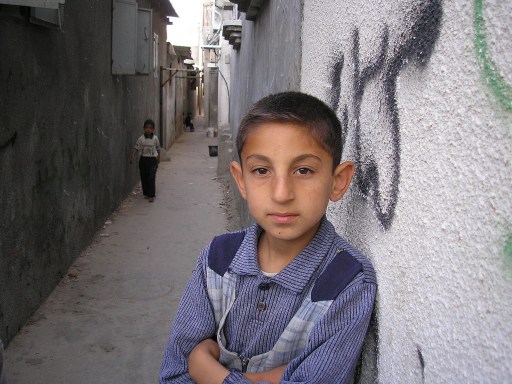
This is what a Palestinian boy looks like. (cc photo: Giles)
Read this headline from the New York Times (11/16/14):
Palestinian Shot by Israeli Troops at Gaza Border
Think for a second about what kind of image that calls up. How much does that image change when you read the story’s second sentence?
A spokeswoman for the hospital said the Palestinian was a 10-year-old boy.
Now, very few people read the full text of every story in any newspaper, so as an editor you have to ask yourself what a headline conveys on its own. I expect that most people who only read that headline assumed that the Palestinian referenced was an adult–and likely had a different reaction to the story as a result.
They were probably also less likely to read the story–the opposite of the effect that you usually want to have with a headline–which makes you wonder why the Times would leave this key fact out. Space, maybe? But “Gazan Boy Shot by Israeli Troops at Border” would have fit just as easily.
Or “Child Shot by Israeli Troops at Gaza Border,” for that matter, since the shooting victim’s likely nationality would be clear from context; there aren’t too many Israeli children near the border with Gaza. In any case, the victim’s age is arguably a more important fact than his ethnicity.
So–did the editors leave out of the headline the fact that it was a child who had been shot because they didn’t want readers to get too upset about Israel doing the shooting?
Surely they would say no–but recall that New York Times story (7/16/14; FAIR Blog, 7/17/14), accurately headlined “Four Young Boys Killed Playing on Gaza Beach,” that was rewritten for the print edition as “Boys Drawn to Gaza Beach, and Into Center of Mideast Strife.” Here the boys remained boys, but their deaths disappeared.
When Times public editor Margaret Sullivan (7/22/14) asked why the headline had been changed, executive editor Dean Baquet claimed that print headlines tend to be “a little poetic.” Keats it ain’t.
To take a quantitative look at this phenomenon, let’s move from the New York Times to an outlet that fancies itself to be the New York Times of the airwaves–NPR. FAIR’s Seth Ackerman (Extra!, 11/01) did a study of which deaths it reported in the Israeli/Palestinian conflict over a six-month period. He found that NPR reported 81 percent of the Israeli deaths during that time, and 89 percent of the deaths of Israeli children–but only 34 percent of the Palestinian deaths, and 26 percent of the deaths of Palestinian children.
So while NPR–understandably–thought that being a child made an Israeli victim’s death more newsworthy, if Palestinian victims were children that made NPR less likely to report their deaths.
That’s an odd sort of news judgment–unless what’s being aimed at is not maximizing human interest, but keeping it to a minimum.
November 22, 2014
Posted by aletho |
Deception, Ethnic Cleansing, Racism, Zionism, Mainstream Media, Warmongering | Israel, New York Times, NPR, Palestine, Zionism |
Leave a comment
The American public is faced with an information crisis as the New York Times and other mainstream U.S. media outlets have become little more than propaganda organs on behalf of the neoconservative agenda and particularly the rush into a new Cold War with Russia – so much so that even ex-Secretary of State Henry Kissinger has broken ranks.
MSM articles consistently reek of bias – and in some cases make little sense. For instance, Times correspondent David M. Herszenhorn, one of the leading propagandists, wrote an alarmist story on Wednesday about a new Russian “invasion” of Ukraine but curiously he had the alleged Russian tank column heading east toward the Ukrainian city of Donetsk which would be back toward Russia, not westward into Ukraine.
According to Herszenhorn’s article, “The full scope of the Russian incursion is not clear, [NATO Supreme Commander Gen. Philip M. Breedlove] said, though the convoys seemed to be heading east toward Donetsk, an O.S.C.E. spokesman, Michael Bociurkiw, said Wednesday.”
Typical of his anti-Russian bias, Herszenhorn also cited Ukrainian government complaints that the Russians had been using a shaky cease-fire to bolster the ethnic Russian rebels in the east, but the reality is that both sides have been accusing the other of such maneuvering. Herszenhorn surely knows this but he wrote only:
“Ukrainian officials have complained all along that Russia was taking advantage of the so-called truce to reinforce the rebels in eastern Ukraine with more fighters and equipment.”
The reality is that there has been widespread alarm among eastern Ukrainians that the Kiev regime was using the relative lull in the fighting to resupply and reposition its forces for a new offensive like the one that killed thousands over the summer. Though human rights organizations have criticized Kiev for indiscriminate shelling of cities and unleashing brutal militia forces on the population, the Times and other mainstream U.S. newspapers have either ignored or downplayed such facts.
On Wednesday, Herszenhorn also compared the alleged new Russian incursion with the “invasion” of Crimea, although there really was no “invasion” of Crimea since the Russian troops that were involved in supporting Crimea’s popular referendum to secede from Ukraine and rejoin Russia were already in Crimea under an agreement with the Ukrainian government regarding the Russian naval base at Sebastopol.
Herszenhorn’s use of the word “invasion” is just an exaggeration like the rest of the imbalanced reporting that has made a rational U.S. public response to the crisis in Ukraine nearly impossible.
Since the start of the crisis in February, the New York Times’ coverage has been remarkable in its refusal to present the Ukraine story in anything like an objective fashion. For example, the Times has largely ignored the substantial public evidence that U.S. government officials and agents helped orchestrate the Feb. 22 coup which overthrew the elected President Viktor Yanukovych. [See Consortiumnews.com’s “The Whys Behind the Ukraine Crisis.”]
The Times also has buried evidence that extreme right-wing and neo-Nazi elements played key roles in firebombing police, forcing Yanukovych and other government officials to flee for their lives, and spearheading later attacks on ethnic Russians. When this reality is referenced, it is usually presented with little meaningful context or tacked on in the last few paragraphs of long articles on other topics.
Mocking Medvedev
Herszenhorn himself has been a leading violator of journalistic standards. For instance, in mid-April, early on in the crisis, he penned a mocking story from Moscow ridiculing Russian Prime Minister Dmitri Medvedev for predicting a possible civil war.
In the article entitled “Russia Is Quick To Bend Truth About Ukraine,” Herszenhorn accused Medvedev of posting an item on Facebook that “was bleak and full of dread,” including noting that “blood has been spilled in Ukraine again” and adding that “the threat of civil war looms.”
Herszenhorn continued, “He [Medvedev] pleaded with Ukrainians to decide their own future ‘without usurpers, nationalists and bandits, without tanks or armored vehicles – and without secret visits by the C.I.A. director.’ And so began another day of bluster and hyperbole, of the misinformation, exaggerations, conspiracy theories, overheated rhetoric and, occasionally, outright lies about the political crisis in Ukraine that have emanated from the highest echelons of the Kremlin and reverberated on state-controlled Russian television, hour after hour, day after day, week after week.”
This argumentative “news” story spilled from the front page to the top half of an inside page, but Herszenhorn never managed to mention that there was nothing false in what Medvedev wrote. Indeed, as the bloodshed soon grew worse and escalated into a civil war, you might say Medvedev was tragically prescient.
It was also the much-maligned Russian press that first reported the secret visit of CIA Director John Brennan to Kiev. Though the White House later confirmed that report, Herszenhorn still cited Medvedev’s reference to it in the context of “misinformation” and “conspiracy theories.” Nowhere in the long article did the Times inform its readers that, yes, the CIA director did make a secret visit to Ukraine.
In this upside-down world of MSM disinformation, there has been very little criticism of the glaring biases of the mainstream Western media but instead continued attacks on the professionalism of the Russian media, including an adverse finding this week by an official British agency that monitors alleged bias in news outlets operating in the UK. The agency, known as Ofcom, accused Russia’s RT network of failing to meet standards for “due impartiality” in early Ukraine coverage.
Interestingly, Ofcom did not judge any of the RT reports false in their description of neo-Nazi thugs participating in the Feb. 22 coup, a possible role of coup-related snipers in the slaughter of scores of people at the Maidan, and the unconstitutionality of the new government.
But Ofcom faulted RT for not meeting the fuzzy concept of “due impartiality” and threatened regulatory sanctions against RT if it didn’t shape up. Ofcom defined “due impartiality” as “impartiality adequate or appropriate to the subject and nature of the programme.”
The image of a British regulatory body threatening RT with sanctions for not toeing the pro-Western propaganda line that nearly all UK and U.S. news outlets do has an Orwellian feel to it, singling out one of the few sources of news that doesn’t accept the prevailing “group think.”
It would be one thing if the same standards were applied to Western media outlets for their one-sided reporting on Ukraine, but that apparently would ruffle too many important feathers.
Kissinger’s Dissent
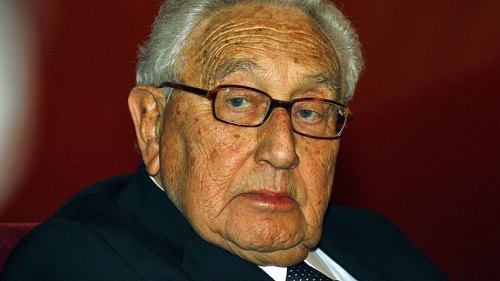
Curiously, one of the few prominent Westerners who has dared question the prevailing wisdom on Ukraine is former Secretary of State Henry Kissinger who said, in an interview with the German newsmagazine Der Spiegel, that the West was exaggerating the significance of the Crimean annexation given the peninsula’s long historic ties to Russia.
“The annexation of the Crimea was no bid for world domination,” the 91-year-old Kissinger said. “It is not to be compared with Hitler’s invasion in Czechoslovakia” – as former Secretary of State Hillary Clinton and others have done.
Kissinger noted that Russian President Vladimir Putin had no intention of instigating a crisis in Ukraine: “Putin had [spent] tens of billions of dollars for the Olympic Winter Games … in Sochi. Russia wanted to present [itself] as a progressive nation. … It does not make sense that Putin, a week later, [launches] the Crimea attacks and a war for Ukraine begins.”
Instead Kissinger argued that the West – with its strategy of pulling Ukraine into the orbit of the European Union – was responsible for the crisis by failing to understand Russian sensitivity over Ukraine and making the “fatal” mistake of quickly pushing the confrontation beyond dialogue.
But Kissinger also faulted Putin for his reaction to the crisis. “I do not want to say that Russia’s response was appropriate,” Kissinger said.
Still, Kissinger told Der Spiegel that “a new edition of the Cold War would be a tragedy. … We must keep in view, that we need Russia to solve other crises, such as the nuclear conflict with Iran or Syria’s civil war.”
When Henry Kissinger starts to sound like the voice of reason, it says a lot about how crazy the New York Times and the rest of the MSM have become.
~
Investigative reporter Robert Parry broke many of the Iran-Contra stories for The Associated Press and Newsweek in the 1980s. You can buy his new book, America’s Stolen Narrative, either in print here or as an e-book (from Amazon and barnesandnoble.com).
November 13, 2014
Posted by aletho |
Deception, Mainstream Media, Warmongering | New York Times, Russia, Ukraine, United States |
Leave a comment
Unbelievable—an overused word, for sure. But it is what came to mind as I read Maureen Dowd’s November 1, New York Times column. Unbelievable that she would begin “A Cup of Joe: Making every day Veterans Day” with her own flashback to the war in Vietnam. “When I close my eyes,” she writes, “I can easily flash back to a time when it was cool to call people in uniform ‘pigs’ and ‘baby killers.’” Really? I mean really, she really wrote that.
It can’t be that she doesn’t know better because the world of journalism in which she lives surely does. When Barack Obama trafficked in the same imagery for his 2012 Memorial Day speech, Los Angeles Times editor Michael McGough said the President’s words recalled the stories of veterans spat-on by war protesters. He called the stories an “edifying myth,” but a myth nevertheless. McGough pointed readers to a 2007 slate.com article in which news critic Jack Shafer upbraided reporters for repeatedly lending credibility to the spat-on veteran stories.
There are plenty of stories but no evidence that anyone spat on Vietnam veterans, and only scant evidence that anyone at the time claimed it to be happening. There are also stories that G.I.s were met at airports by radicals holding placards reading, “Baby Killer.” But planes with returning troops landed at military airbases to which protesters did not have access, and despite thousands of troops returning with PX-purchased cameras slung around their necks, there are no photographs, that I’ve seen, of those signs in airport settings or anywhere else.
And “pigs”? Veterans? I’ve never heard that one. Is she referring to demonstrators calling police officers pigs? This is a Veterans Day column about veterans—who would believe she is not slurring images to imply that was baby-killing veterans who were called pigs? Unbelievable.
Dowd’s “flashback” was just a set-up for writing about Starbuck’s chief Howard Schultz’s mission to “celebrate soldiers.” On a crusade to get “’more skin in the game’” from Americans, Schultz has put former Defense Secretary Robert Gates on the Starbucks board, and pledged to hire veterans. He is organizing a Veterans Day Concert for Valor on the Capitol Mall that will feature the stars Rihanna, Eminem, and Bruce Springsteen.
Set against the backdrop of veteran disparagement drawn by Dowd, his efforts are made to appear even more righteous than they otherwise might. Schultz himself, as cast by Dowd, cuts a contrasting figure to the alleged traitors who scorned the Vietnam fighters. “My [draft lottery] number was 332,” he remembers, “so I didn’t go. But I would have.” Belief that the nation itself failed to adequately support the men and women sent to Vietnam, or even betrayed the military mission there, is essential to the mantra that we “must not let that happen again”—words that motivate Schultz but which make sense only if the real history of the war years is forgotten.
The scenes imagined by Dowd of antiwar-movement hostility to returning G.I.s took root during the 1970s as a political antidote to the uncomfortable truth that activists recruited veterans to their ranks, and thousands of returnees joined the war to end the war. By the end of the Reagan years, though, fantasies like the one spun by Dowd had displaced reality in American memory. With the help of Hollywood and the mental health establishment, the image of Vietnam veterans empowered and politicized by their wartime experience, was made-over into one of “damaged goods,” men traumatized by combat and the rejection they encountered upon coming home who now suffer the hidden effects of “unseen wounds.”
The damaged-goods narrative carried over from the post-Vietnam era to the news coverage of units returning from Iraq and Afghanistan; within months after the 2003 invasion of Iraq, PTSD, Post Traumatic Stress Disorder, had displace almost all else from the coming-home story. Dowd follows the script, credentialing Schultz’s concern that “many vets he talked to had lost `a sense of core purpose’.” She strings together her own set of clichés about lack of public support for the war (read in that the lack of appreciation for veterans), the high rate of PTSD among veterans, and a supposed “PTSD bias among employers.”
The coda for that package can’t be Schultz’s own struggle with war trauma (recall that lottery number). So trot out another trope: the World War II veteran, his father, so shaken by combat in the South Pacific that, well, he never talked about it.
Unbelievable. Not so much the details in what Dowd wrote (okay, I don’t believe the “baby killer” part—because there is no evidence for it) but that American journalism at its highest levels continues to recycle a meme-laced narrative from the post-Vietnam War years. (The reticent World War II veteran appears most often, as a strange apparition, in PTSD-themed stories of Vietnam veterans.) It is a story-line that casts a shadow over the antiwar movement, and obscures the political agency of veterans with images of their dependency and dysfunction. Most importantly, it diverts attention from the very neo-colonial foreign policy that puts all of us at risk, and feeds fantasies of perfidious enemies at home and abroad—fantasies with their own vengeful imperatives.
Veterans Day this year, the country may be moving beyond the platitudes of “Welcome Home” and “Thank You for your service,” expressions that found resonance in the mythical world of spat-upon veterans visited by Maureen Dowd in her flashbacks.
Just as some veterans have begun to publically shun the shallowness of the welcome-home rhetoric, more are likely to take offense at their use as props in corporate PR campaigns like Howard Schultz’s. Engaged thoughtfully on the matter, still others will see the danger inherent in America’s growing sense of itself as a defeated and declining super power in search of redemption and vengeance that is cued to exploit victim-veteran imagery for revanchist militarist purposes.
This year’s Veterans Day is a good time to take the spotlight off veterans, while yet privileging the special perspective they have, to begin a national conversation with them about the meaning of our wars and the importance of the way we remember them.
Jerry Lembcke is Associate Professor Emeritus of Sociology at College of the Holy Cross in Worcester, Mass. He is the author of The Spitting Image: Myth, Memory and the Legacy of Vietnam and Hanoi Jane: War, Sex, and Fantasies of Betrayal. His newest book is PTSD: Diagnosis or Identity in Post-empire America? He can be reached at jlembcke@holycross.edu.
November 10, 2014
Posted by aletho |
Deception, Mainstream Media, Warmongering, Militarism, Timeless or most popular | New York Times, United States |
Leave a comment
When reading the New York Times on many foreign policy issues, it doesn’t take a savant to figure out what the newspaper’s bias is. Anything, for instance, relating to Russian President Vladimir Putin drips of contempt and hostility.
Rather than offer the Times’ readers an objective or even slightly fair-minded account of Putin’s remarks, we are fed a steady diet of highly prejudicial language, such as we find in Saturday’s article about Putin’s comments at a conference in which he noted U.S. contributions to chaos in countries, such as Afghanistan, Iraq, Libya, Syria and Ukraine.
That Putin is correct appears almost irrelevant to the Times, which simply writes that Putin “unleashed perhaps his strongest diatribe against the United States yet” with his goal “to sell Moscow’s view that American meddling has sparked most of the world’s recent crises.”
Rather than address the merits of Putin’s critique, the Times’ article by Neil MacFarquhar uncritically cites the “group think” of Official Washington: “Russia is often accused of provoking the crisis in Ukraine by annexing Crimea, and of prolonging the agony in Syria by helping to crush a popular uprising against President Bashar al-Assad, Moscow’s last major Arab ally. Some analysts have suggested that Mr. Putin seeks to restore the lost power and influence of the Soviet Union, or even the Russian Empire, in a bid to prolong his own rule.”
Yes, “some analysts” can be cited to support nearly any claim no matter how wrongheaded, or you can use the passive tense – “is often accused” – to present any charge no matter how unfair. But a more realistic summary of the various crises afflicting the world would note that Putin is correct when he describes past U.S. backing for various extremists, from Islamic fundamentalists in the Middle East and Central Asia to neo-Nazis in Ukraine.
For example, during the 1980s, the Reagan administration consciously encouraged Islamic fundamentalism as a strategy to cause trouble for “atheistic communism” in Afghanistan and in the Muslim provinces of the Soviet Union.
To overthrow a Soviet-backed government in Afghanistan, the CIA and its Saudi collaborators financed the mujahedeen “holy warriors” who counted among their supporters Saudi extremist Osama bin Laden. Some of those Islamists later blended into the Taliban and al-Qaeda with dire consequences for the United States on Sept. 11, 2001.
By invading Iraq in 2003, President George W. Bush toppled a secular dictator, Saddam Hussein, but saw him replaced by what amounted to a Shiite theocracy which pushed Iraq’s Sunni minority into the arms of “Al-Qaeda in Iraq,” which has since rebranded itself as the Islamic State of Iraq and Syria or simply the Islamic State. Those extremists now control large swaths of Iraq and Syria and have massacred religious minorities and Western hostages, prompting another U.S. military intervention.
Obama’s Interventions
In Libya in 2011, President Barack Obama acquiesced to demands from “liberal interventionists” in his administration and authorized an air war to overthrow another secular autocrat, Muammar Gaddafi, whose ouster and murder have sent Libya spiraling into political chaos amid warring Islamist militias. It turns out Gaddafi was not wrong when he warned of Islamist terrorists operating around Benghazi.
Similarly, Official Washington’s embrace of protests and violence aimed at removing another secular Arab leader, Syria’s Bashar al-Assad, contributed to the bloody civil war that has devastated that country and created fertile ground for the Islamic State and the Nusra Front, the official al-Qaeda affiliate.
Though Obama balked at demands from neocons and “liberal interventionists” that he launch an air war against the Syrian military in 2013, he did authorize secret shipments of weapons and training for the supposedly “moderate” Syrian rebels who have generally sided with Islamist fighters affiliated with al-Qaeda and the Islamic State.
Many of these same neocons and “liberal interventionists” have been eager to ratchet up the confrontation with Iran over its nuclear program, including neocon dreams to “bomb, bomb, bomb Iran,” also a desire of hardliners in Israel.
In some of these crises, one of the few international leaders who has cooperated with Obama to tamp down tensions has been Putin, who helped negotiate conflict-avoiding agreements with Syria and Iran. But those peaceful interventions made Putin an inviting target for the neocons who began in fall 2013 arranging a coup d’etat in Ukraine on Russia’s border.
As Obama and Putin each paid too little attention to these maneuvers, neocons such as National Endowment for Democracy president Carl Gershman, Sen. John McCain, R-Arizona, and Assistant Secretary of State for European Affairs Victoria Nuland went to work on the Ukrainian coup.
However to actually overthrow Ukraine’s elected President Viktor Yanukovych, the coup makers had to collaborate with neo-Nazi militias which were organized in western Ukraine and dispatched to Kiev where they provided the muscle for the Maidan uprising. Neo-Nazi leaders were given several ministries in the new government, and neo-Nazi militants were incorporated into the National Guard and “volunteer” militias dispatched to crush the ethnic Russian resistance in the east.
Putin for the Status Quo
The underlying reality of the Ukraine crisis was that Putin actually supported the country’s status quo, i.e. maintaining the elected president and the constitutional process. It was the United States along with the European Union that sought to topple the existing system and pull Ukraine from Russia’s orbit into the West’s.
Whatever one thinks about the merits of that change, it is factually wrong to accuse Putin of initiating the Ukraine crisis or to extrapolate from Official Washington’s false conventional wisdom and conclude that Putin is a new Hitler, an aggressor seeking to reestablish the Soviet Union or the Russian Empire.
But the Times and other major U.S. news outlets have wedded themselves to that propaganda theme and now cannot deviate from it. So, when Putin states the obvious – that the U.S. has meddled in the affairs of other nations and that Russia did not pick the fight over Ukraine – his comments must be treated like the ravings of a lunatic unleashing some “diatribe.”
Among Putin’s ranting was his observation, according to the Times article, that “the United States supports ‘dubious’ groups ranging from ‘open neo-fascists to Islamic radicals.’
“‘Why do they support such people,’ he asked the annual gathering known as the Valdai Club, which met this year in the southern resort town of Sochi. ‘They do this because they decide to use them as instruments along the way in achieving their goals, but then burn their fingers and recoil.’
“The goal of the United States, he said, was to try to create a unipolar world in which American interests went unchallenged. …
“Mr. Putin … specifically denied trying to restore the Russian Empire. He argued Russia was compelled to intervene in Ukraine because that country was in the midst of a ‘civilized dialogue’ over its political future when the West staged a coup to oust the president last February, pushing the country into chaos and civil war.
“‘We did not start this,’ he said. ‘Statements that Russia is trying to reinstate some sort of empire, that it is encroaching on the sovereignty of its neighbors, are groundless.’”
Of course, all the “smart people” of Official Washington know how to react to such statements from Putin, with a snicker and a roll of the eyes. After all, they’ve been reading the narratives of these crises as fictionalized by the New York Times, the Washington Post, etc.
Rationality and realism seem to have lost any place in the workings of the mainstream U.S. news media.
~
Investigative reporter Robert Parry broke many of the Iran-Contra stories for The Associated Press and Newsweek in the 1980s. You can buy his new book, America’s Stolen Narrative, either in print here or as an e-book (from Amazon and barnesandnoble.com).
October 26, 2014
Posted by aletho |
Deception, Mainstream Media, Warmongering | Afghanistan, Iraq, Libya, New York Times, Russia, Syria, Ukraine, United States, Vladimir Putin |
Leave a comment
The latest hot topic in the Russian media. Russian politicians are talking about it. Historical precedent and behavior of Western media suggests that they are.
The Saker

A major topic in the Russian media is mystification with how Putin is portrayed in the Western media.
Wildly popular at home, and seen as a decent, modest, an admirable person, and Russians don’t understand how there can be such a disconnect with Western impressions.
Recently, leading Russian commentators and politicians have been suggesting that this can only be explained by a deliberate campaign to defame Putin, by governments or other groups.
Yesterday, at a briefing to foreign journalists, Sergey Ivanov, Putin’s chief of staff, arguably the 2nd most powerful man in Russia, spoke of an “information war” consisting of “personal attacks” on Putin.

The western media hit a new low…
The day before another member of Putin’s inner circle, Vyasheslav Volodin, made similar remarks, telling foreign journalists “an attack on Putin is an attack on Russia.”
The logic, they argue, is that by defaming the leader of a country, you weaken his power domestically by undermining popular support for him, and internationally, by rallying popular opinion to support policies against that country. The ultimate goal, they argue, is to weaken the country itself. They also talk about regime change.
They argue that if one looks at the facts, that there is evidence of ongoing character assassination which cannot be explained by a vague popular zeitgeist in the West, but is more likely the result of a dedicated effort to introduce this defamation into the news flow.

Newsweek has been one of the most virulent Putin-bashers for years
The issue of manipulation of news by intelligence services has been in the news recently with revelations that the CIA and German Secret Service (GSS) have long-running programs to influence how media executives and top journalists convey and interpret the news, including direct cash payments.
Here are some examples they point to:
- Portraying him as a scheming dictator trying to rebuild a repressive empire.
- Claiming he personally ordered the murder of a number of journalists, and personally ordered a KGB defector to be murdered with radiation poisoning.
- Frequently citing unsubstantiated rumors he is having an affair with a famous gymnast.
- Allegations that he has stashed away billions for his personal benefit, without providing evidence.
- Recent article in newsweek claiming he leads a luxurious and lazy lifestyle, sleeping late.
- Recent article in NYT focusing on a supposed personal arrogance.
- Hillary Clinton mentioning in speech after speech that he is a bad guy, a bully, that one must confront him forcefully.
- Frequently using pejoratives to describe his person – “a jerk and a thug” (Thomas Friedman this week in the NYT)
- Mis-quoting him on his regret about the collapse of the Soviet Union.
- Articles about a supposed super-luxury villa built for him in southern Russia.
- The over-the top headlines in the western media (they were worst of all in Germany) portraying him personally responsible for murdering the victims of MH17.
- And soft stuff – magazine covers making him look sinister, monstrous, etc.
RI sat down with The Saker, a leading analyst of Russia in international affairs, and asked him what he thinks:
———————————–
So, is there any credence to this line of thinking, or is this conspiracy theorists running wild?
There is no doubt in my mind whatsoever that the US is waging a major psyop war against Russia, although not a shooting war, for now, and that what we are seeing is a targeted campaign to discredit Putin and achieve “regime change” in Russia or, should that fail, at the very least “regime weakening” and “Russia weakening”.

So this is a US government program?
Yes, Putin is absolutely hated by certain factions in the US government two main reasons:
1. He partially, but not fully, restored Russia’s sovereignty which under Gorbachev and Yeltsin had been totally lost … Russia then was a US colony like Ukraine is today … and,
2. He dared to openly defy the USA and its civilizational model.
… a free and sovereign Russia is perceived by the US “deep state” as an existential threat which has to be crushed. … this is a full-scale political assault on Russia and Putin personally.
So what the Russians are saying, that the constant personal attacks against Putin in the global media are partly the result of deliberate efforts by US intelligence services, … basically, planted stories…
Yes, absolutely
It seems like “Operation Mockingbird” all over again… Are you aware of other instances aimed at Putin?
(Editors Note: Operation Mockingbird was a CIA program started in the 1950s to influence the US media, which was gradually exposed by investigative journalists starting in the late 60s, culminating in sensational televised congressional hearings in 1975 which shocked the nation, forcing the program’s termination. Critics maintain that the same tactics have continued since, under different programs. Wikipedia)
Yes, of course. Since this defamation has very little traction with the Russian public … Putin’s popularity is higher than ever before .., there is an organized campaign to convince them that Putin is “selling out” Novorussia, that he is a puppet of oligarchs who are making deals with Ukrainian oligarchs to back-stab the Novorussian resistance…
… So far, Putin’s policies in the Ukraine have enjoyed very strong support from the Russian people who still oppose an overt military intervention…
… but if Kiev attacks Novorussia again – which appears very likely – and if such an attack is successful – which is less likely but always possible – then Putin will be blamed for having given the Ukrainians the time to regroup and reorganize.

Warm and fuzzy…
So you are saying that if the Ukrainian military strengthens its position enough to deliver a serious blow to the East Ukrainians, the US can use this as a method to strike at Putin’s support base…
Yes, that’s right … there are a lot of “fake patriots” in Russia and abroad who will reject any negotiated solution and who will present any compromise as a “betrayal”. They are the “useful idiots” used by western special services to smear and undermine Putin.
Is it limited to government special ops, or are there other groups who might have an interest in doing this?
Yes, well here is something that most people in the west don’t appreciate… there is a major behind-the scenes struggle among Russian elites between what I call the “Eurasian Sovereignists” (basically, those who support Putin) and what I call the “Atlantic Integrationists” (those whom Putin refers to as the “5th column).
The western media talks about this as the struggle between Russian liberals and conservatives, reformers and reactionaries, right?
Well its sort of like that, but not exactly…
The former see Russia’s future in the Russian North and East and want to turn Russia towards Asia, Latin America and the rest of the world, while the latter want Russia to become part of the “North Atlantic” power configuration.
The Atlantic Integrationists are now too weak to openly challenge Putin – whose real power base is his immense popular support – but they are quietly sabotaging his efforts to reform Russia while supporting anti-Putin campaigns.
Regarding the revelations of CIA activities in Germany, do you think this is going on in other countries, in the US?
I am sure that this is happening in most countries worldwide. The very nature of the modern corporate media is such that it makes journalists corrupt.
As the French philosopher Alain Soral says “nowadays a reporter is either unemployed or a prostitute”. There are, of course, a few exceptions, but by and large this is true.
This is not to say that most journalists are on the take. In the West this is mostly done in a more subtle way – by making it clear which ideas do or do not pass the editorial control, by lavishly rewarding those journalists who ‘get it’ and by quietly turning away those who don’t.
If a journalist or reporter commits the crime of “crimethink” he or she will be sidelined and soon out of work.
There is no real pluralism in the West where the boundaries of what can be said or not are very strictly fixed.
Ok, but is it like what has been revealed in Germany, …similar specific operational programs in France, the UK, Italy, Latin America, etc.
Yes, one has to assume so – it is in their interests to have them and there is no reason for them not to.
As for the CIA, it de-facto controls enough of the corporate media to “set the tone”. As somebody who in the past used to read the Soviet press for a living, I can sincerely say that it was far more honest and more pluralistic than the press in the USA or EU today.
Joseph Goebbels or Edward Bernays could not have imagined the degree of sophistication of modern propaganda machines.
If the US is doing it, can’t one assume other governments are too? Are the Russians doing it against western leaders?
I think that all governments try to do that kind of stuff. However, what makes the US so unique it a combination of truly phenomenal arrogance and multi-billion dollar budgets.
The US “deep state” owns the western corporate media which is by far the most powerful media on the planet. Most governments can only do that inside their own country … to smear a political opponent or discredit a public figure, but they simply do not have the resources to mount an international strategic psyop campaign. This is something only the US can do.
So foreign governments are at a great disadvantage in this arena vis-a-vis the US?
Absolutely.
October 26, 2014
Posted by aletho |
Deception, Mainstream Media, Warmongering, Timeless or most popular | New York Times, Newsweek, Operation Mockingbird, Russia, Thomas Friedman, United States |
Leave a comment
Jeff Leen, the Washington Post’s assistant managing editor for investigations, begins his renewed attack on the late Gary Webb’s Contra-cocaine reporting with a falsehood.
Leen insists that there is a journalism dictum that “an extraordinary claim requires extraordinary proof.” But Leen must know that it is not true. Many extraordinary claims, such as assertions in 2002-03 that Iraq was hiding arsenals of WMDs, were published as flat-fact without “extraordinary proof” or any real evidence at all, including by Leen’s colleagues at the Washington Post.
A different rule actually governs American journalism – that journalists need “extraordinary proof” if a story puts the U.S. government or an “ally” in a negative light but pretty much anything goes when criticizing an “enemy.”
If, for instance, the Post wanted to accuse the Syrian government of killing civilians with Sarin gas or blame Russian-backed rebels for the shoot-down of a civilian airliner over Ukraine, any scraps of proof – no matter how dubious – would be good enough (as was the actual case in 2013 and 2014, respectively).
However, if new evidence undercut those suspicions and shifted the blame to people on “the U.S. side” – say, the Syrian rebels and the Ukrainian government – then the standards of proof suddenly skyrocket beyond reach. So what you get is not “responsible” journalism – as Leen tries to suggest – but hypocrisy and propaganda. One set of rules for the goose and another set for the gander.
The Contra-Cocaine Case
Or to go back to the Contra-cocaine scandal that Brian Barger and I first exposed for the Associated Press in 1985: If we were writing that the leftist Nicaraguan Sandinista government – the then U.S. “enemy” – was shipping cocaine to the United States, any flimsy claim would have sufficed. But the standard of proof ratcheted up when the subject of our story was cocaine smuggling by President Ronald Reagan’s beloved Contras.
In other words, the real dictum is that there are two standards, double standards, something that a careerist like Leen knows in his gut but doesn’t want you to know. All the better to suggest that Gary Webb was guilty of violating some noble principle of journalism.
But Leen is wrong in another way – because there was “extraordinary proof” establishing that the Contras were implicated in drug trafficking and that the Reagan administration was looking the other way.
When Barger and I wrote the first story about Contra-cocaine trafficking almost three decades ago, we already had “extraordinary proof,” including documents from Costa Rica, statements by Contras and Contra backers, and admissions from officials in the Drug Enforcement Administration and Ronald Reagan’s National Security Council staff.
However, Leen seems to dismiss our work as nothing but getting “tips” about Contra-cocaine trafficking as if Barger and I were like the hacks at the Washington Post and the New York Times who wait around for authorized handouts from the U.S. government.
Following the Money
Barger and I actually were looking for something different when we encountered the evidence on Contra-cocaine trafficking. We were trying to figure out how the Contras were sustaining themselves in the field after Congress cut off the CIA’s financing for their war.
We were, in the old-fashioned journalistic parlance, “following the money.” The problem was the money led, in part, to the reality that all the major Contra organizations were collaborating with drug traffickers.
Besides our work in the mid-1980s, Sen. John Kerry’s follow-on Contra-cocaine investigation added substantially more evidence. Yet Leen and his cohorts apparently felt no need to pursue the case any further or even give respectful attention to Kerry’s official findings.
Indeed, when Kerry’s report was issued in April 1989, the Washington Post ran a dismissive story by Michael Isikoff buried deep inside the paper. Newsweek dubbed Kerry “a randy conspiracy buff.” In his new article attacking Gary Webb, Leen just says:
“After an exhaustive three-year investigation, the committee’s report concluded that CIA officials were aware of the smuggling activities of some of their charges who supported the contras, but it stopped short of implicating the agency directly in drug dealing. That seemed to be the final word on the matter.”
But why was it the “final word”? Why didn’t Leen and others who had missed the scandal as it was unfolding earlier in the decade at least try to build on Kerry’s findings. After all, these were now official U.S. government records. Wasn’t that “extraordinary” enough?
In this context, Leen paints himself as the true investigative journalist who knew the inside story of the Contra-cocaine tale from the beginning. He wrote:
“As an investigative reporter covering the drug trade for the Miami Herald, … I wrote about the explosion of cocaine in America in the 1980s and 1990s, and the role of Colombia’s Medellin Cartel in fueling it.
“Beginning in 1985, journalists started pursuing tips about the CIA’s role in the drug trade. Was the agency allowing cocaine to flow into the United States as a means to fund its secret war supporting the contra rebels in Nicaragua? Many journalists, including me, chased that story from different angles, but the extraordinary proof was always lacking.”
Again, what Leen says is not true. Leen makes no reference to the groundbreaking AP story in 1985 or other disclosures in the ensuing years. He just insists that “the extraordinary proof” was lacking — which it may have been for him given his lackluster abilities. He then calls the final report of Kerry’s investigation the “final word.”
But Leen doesn’t explain why he and his fellow mainstream journalists were so incurious about this major scandal that they would remain passive even in the wake of a Senate investigation. It’s also not true that Kerry’s report was the “final word” prior to Webb reviving the scandal in 1996.
Government Witnesses
In 1991, during the narcotics trafficking trial of Panamanian dictator Manuel Noriega, the U.S. government itself presented witnesses who connected the Contras to the Medellin cartel.
Indeed, after testimony by Medellin cartel kingpin Carlos Lehder about his $10 million contribution to the Contras, the Washington Post wrote in a Nov. 27, 1991 editorial that “The Kerry hearings didn’t get the attention they deserved at the time” and that “The Noriega trial brings this sordid aspect of the Nicaraguan engagement to fresh public attention.”
But the Post offered its readers no explanation for why Kerry’s hearings had been largely ignored, with the Post itself a leading culprit in this journalistic misfeasance. Nor did the Post and the other leading newspapers use the opening created by the Noriega trial to do anything to rectify their past neglect.
In other words, it didn’t seem to matter how much “extraordinary proof” the Washington Post or Jeff Leen had. Nothing would be sufficient to report seriously on the Contra-cocaine scandal, not even when the U.S. government vouched for the evidence.
So, Leen is trying to fool you when he presents himself as a “responsible journalist” weighing the difficult evidentiary choices. He’s just the latest hack to go after Gary Webb, which has become urgent again for the mainstream media in the face of “Kill the Messenger,” a new movie about Webb’s ordeal.
What Leen won’t face up to is that the tag-team destruction of Gary Webb in 1996-97 – by the Washington Post, the New York Times and the Los Angeles Times – represented one of the most shameful episodes in the history of American journalism.
The Big Papers tore down an honest journalist to cover up their own cowardly failure to investigate and expose a grave national security crime, the Reagan administration’s tolerance for and protection of drug trafficking into the United States by the CIA’s client Contra army.
This journalistic failure occurred even though the Associated Press – far from a radical news outlet – and a Senate investigation (not to mention the Noriega trial) had charted the way.
Leen’s Assault
Contrary to Leen’s column, “Kill the Messenger” is actually a fairly honest portrayal of what happened when Webb exposed the consequences of the Contra cocaine smuggling after the drugs reached the United States. One channel fed into an important Los Angeles supply chain that produced crack.
But Leen tells you that “The Hollywood version of [Webb’s] story — a truth-teller persecuted by the cowardly and craven mainstream media — is pure fiction.”
He then lauds the collaboration of the Big Three newspapers in destroying Webb and creating such enormous pressure on Webb’s newspaper, the San Jose Mercury News, that the executive editor Jerry Ceppos threw his own reporter under the bus. To Leen, this disgraceful behavior represented the best of American journalism.
Leen wrote:
“The New York Times, The Washington Post and the Los Angeles Times, in a rare show of unanimity, all wrote major pieces knocking the story down for its overblown claims and undernourished reporting.
“Gradually, the Mercury News backed away from Webb’s scoop. The paper transferred him to its Cupertino bureau and did an internal review of his facts and his methods. Jerry Ceppos, the Mercury News’s executive editor, wrote a piece concluding that the story did not meet the newspaper’s standards — a courageous stance, I thought.”
“Courageous”? What an astounding characterization of Ceppos’s act of career cowardice.
But Leen continues by explaining his role in the Webb takedown. After all, Leen was then the drug expert at the Miami Herald, which like the San Jose Mercury News was a Knight Ridder newspaper. Leen says his editors sought his opinion about Webb’s “Dark Alliance” series.
Though acknowledging that he was “envious” of Webb’s story when it appeared in 1996, Leen writes that he examined it and found it wanting, supposedly because of alleged overstatements. He proudly asserts that because of his critical analysis, the Miami Herald never published Webb’s series.
But Leen goes further. He falsely characterizes the U.S. government’s later admissions contained in inspector general reports by the CIA and Justice Department. If Leen had bothered to read the reports thoroughly, he would have realized that the reports actually establish that Webb – and indeed Kerry, Barger and I – grossly understated the seriousness of the Contra-cocaine problem which began at the start of the Contra movement in the early 1980s and lasted through the decade until the end of the war.
Leen apparently assumes that few Americans will take the trouble to study and understand what the reports said. That is why I published a lengthy account of the U.S. government’s admissions – both after the reports were published in 1998 and as “Kill the Messenger” was hitting the theaters in October. [See Consortiumnews.com’s “The Sordid Contra-Cocaine Saga.”]
Playing It Safe
Instead of diving into the reeds of the CIA and DOJ reports, Leen does what he and his mainstream colleagues have done for the past three decades, try to minimize the seriousness of the Reagan administration tolerating cocaine trafficking by its Contra clients and even obstructing official investigations that threatened to expose this crime of state.
Instead, to Leen, the only important issue is whether Gary Webb’s story was perfect. But no journalistic product is perfect. There are always more details that a reporter would like to have, not to mention compromises with editors over how a story is presented. And, on a complex story, there are always some nuances that could have been explained better. That is simply the reality of journalism, the so-called first draft of history.
But Leen pretends that it is the righteous thing to destroy a reporter who is not perfect in his execution of a difficult story – and that Gary Webb thus deserved to be banished from his profession for life, a cruel punishment that impoverished Webb and ultimately drove him to suicide in 2004.
But if Leen is correct – that a reporter who takes on a very tough story and doesn’t get every detail precisely correct should be ruined and disgraced – what does he tell his Washington Post colleague Bob Woodward, whose heroic Watergate reporting included an error about whether a claim regarding who controlled the White House slush fund was made before a grand jury.
While Woodward and his colleague Carl Bernstein were right about the substance, they were wrong about its presentation to a grand jury. Does Leen really believe that Woodward and Bernstein should have been drummed out of journalism for that mistake? Instead, they were lionized as heroes of investigative journalism despite the error – as they should have been.
Yet, when Webb exposed what was arguably an even worse crime of state – the Reagan administration turning a blind eye to the importation of tons of cocaine into the United States – Leen thinks any abuse of Webb is justified because his story wasn’t perfect.
Those two divergent judgments – on how Woodward’s mistake was understandably excused and how Webb’s imperfections were never forgiven – speak volumes about what has happened to the modern profession of journalism at least in the mainstream U.S. media. In reality, Leen’s insistence on perfection and “extraordinary proof” is just a dodge to rationalize letting well-connected criminals and their powerful accomplices off the hook.
In the old days, the journalistic goal was to “comfort the afflicted and afflict the comfortable,” but the new rule appears to be: “any standard of proof works when condemning the weak or the despised but you need unachievable ‘extraordinary evidence’ if you’re writing about the strong and the politically popular.”
Who Is Unfit?
Leen adds a personal reflection on Webb as somehow not having the proper temperament to be an investigative reporter. Leen wrote:
“After Webb was transferred to Cupertino [in disgrace], I debated him at a conference of the Investigative Reporters and Editors organization in Phoenix in June 1997. He was preternaturally calm. While investigative journalists are usually bundles of insecurities and questions and skepticism, he brushed off any criticism and admitted no error. When asked how I felt about it all, I said I felt sorry for him. I still feel that way.”
It’s interesting – and sadly typical – that while Leen chastises Webb for not admitting error, Leen offers no self-criticism of himself for missing what even the CIA has now admitted, that the Contras were tied up in the cocaine trade. Doesn’t an institutional confession by the CIA’s inspector general constitute “extraordinary evidence”?
Also, since the CIA’s inspector general’s report included substantial evidence of Contra-cocaine trafficking running through Miami, shouldn’t Leen offer some mea culpa about missing these serious crimes that were going on right under his nose – in his city and on his beat? What sort of reporter is “preternaturally calm” about failing to do his job right and letting the public suffer as Leen did?
Perhaps all one needs to know about the sorry state of today’s mainstream journalism is that Jeff Leen is the Washington Post’s assistant managing editor for investigations and Gary Webb is no longer with us.
[To learn how you can hear a December 1996 joint appearance at which Robert Parry and Gary Webb discuss their reporting, click here.]
Investigative reporter Robert Parry broke many of the Iran-Contra stories for The Associated Press and Newsweek in the 1980s. You can buy his new book, America’s Stolen Narrative, either in print here or as an e-book (from Amazon and barnesandnoble.com).
October 19, 2014
Posted by aletho |
Deception, Mainstream Media, Warmongering, Timeless or most popular | Gary Webb, Los Angeles Times, New York Times, United States, Washington Post |
Leave a comment
Objectivity?
Where is the American corporate media at on the disappearance of 43 normalistas from a rural teachers college in Iguala, Guerrero, Mexico? Where is the wall to wall coverage? Where are the calls for Enrique Peña Nieto to resign? Or, at least, where are the calls for Aguirre’s resignation, the governor of Guerrero? Where are the pundits oversimplifying and labeling the Mexican government whatever they want, regardless if it has a basis in fact? The corporate media is eerily silent.
Let us contrast this silence with their coverage of Venezuela not so many months ago. 43 people from all sides of the conflict were killed over a couple of months of violent conflict between the opposition, chavismo supporters and state security forces. The coverage was almost 24/7. The pundits were labeling Maduro a dictator and calling for his head. The coverage was oversimplified and made to push the US government’s position that chavismo must go, without any mention of Maduro or the PSUV being elected, or that this should be decided by referendum and not just by protest.
The difference in coverage of the two cases represents a clear example of imperial priorities in the corporate media. The Mexican students are “unworthy victims” for the US corporate media. The students do not fit neatly into a narrative that supports imperialist ambitions. Actually, because the rural teachers college is a “leftist” school, the students are probably considered deviant by much of the US corporate media, and therefore “legitimate” targets of the Mexican state. So, the coverage, as it was of El Salvadorian Archbishop Oscar Romero’s death in the 1980s, is minimal and passive.
Whereas, in contrast, Venezuela became the cause célèbre of every major media outlet, even though there was no execution/kidnapping of civilians by the state in collusion with vicious drug cartels, but instead a drawn-out conflict begun by a very hostile opposition that is part of a decade long campaign to oust the PSUV from power that already had the 2002 coup attempt under its belt.
For the US corporate media the Venezuelan opposition are “worthy victims” whose narrative fits neatly into the framework of US imperial ambitions as it attempts to make Latin America its backyard once more. They are also “worthy” because they are mostly whiter, more middle and upper class and vacation in Miami. This is unlike the normalistas, who are predominantly indigenous campesinos, a group who only gets paternalistic coverage, if any.
So, let us weigh these two cases.
The case in Mexico is blatantly a state crime against its citizens, with local and state authorities having connections to drug cartels and the police and military implicated. It was carried out against peaceful students who had no weapons, although they did commandeer a bus, which is nothing new for them and has never led to physical harm. One of the students was left in the street with a flayed face and eyes gouged out. So far, the Mexican government has said the kidnapped/murdered students harm foreign investment and gave their “sincerest” condolences.
The case in Venezuela was a conflict between competing political groups representing different class and ethnic/racial interests in which people from all sides died over the course of the conflict and all most likely committed crimes. Those protests continued over a couple of months, even though the Venezuelan government was considered to be absolutely authoritarian in handling the protests by the US corporate media. So far, the Venezuelan government had an open dialogue with all opposition members who wanted to talk with them and made policy concessions.
The former is a much more grievous crime than the latter. Also, the government reaction in the former is callous, compared to the reconciliation proffered by the Venezuelan government. Yet the former receives scant, if any, attention, while the latter was unavoidable during its peak. Only so many conclusions can be drawn from this.
So, please, tell me again how objective the media is. Or maybe at another award celebration the pundits from the US corporate media can tell us how principled they are.
Side note:
This is not new; acrobatics are normally done in order to make Enrique Peña Nieto seem as if he is trying to stop the bloodshed. This is scandalous seeing as EPN is implicated in the violent police repression in San Salvador Atenco, Mexico State, Mexico that happened while Peña Nieto was Governor. That repression led to two deaths and 207 incidences of cruel treatment, including 26 cases of sexual assault against women. The Nation Human Rights Commission said that preference was given to force by the government, instead of diplomacy, leading to the human rights violations. The New York Times dedicated one paragraph to the heinous act which doesn’t mention Enrique Peña Nieto even once.
October 18, 2014
Posted by aletho |
Deception, Mainstream Media, Warmongering, Timeless or most popular | Enrique Peña Nieto, Latin America, Mexico, New York Times, United States, Venezuela |
Leave a comment
It’s part of the public record that the NSA has engaged in an industry-wide campaign to weaken cryptographic protocols and insert back doors into hi-tech products sold by U.S. companies. We also know that NSA officials have privately congratulated each other in successfully undermining privacy and security across the Internet. Hence it’s only logical to assume that the NSA’s numerous subversion programs extend into foreign “commercial entities”. Thanks to documents recently disclosed by the Intercept we have unambiguous confirmation.
Hi-tech subversion underscores the fact that the whole tired debate regarding cryptographic keys held in escrow for so-called lawful interception (what the Washington Post called “secret golden keys”) only serves to distract the public from programs aimed at wielding covert back doors. In other words, by reviving the zombie idea of an explicit back door the editorial board at the Washington Post is conveniently ignoring all of the clandestine techniques that already exist to sidestep encryption. In a nutshell: zero-day bugs and malware often trump strong crypto.
On an aside it’s interesting to observe the citadel of free thinkers at the Electronic Frontier Foundation continue to promote cryptographic tools as a privacy tonic with a faith that’s almost religious while conspicuously neglecting other important aspects of operational security. The EFF cheerfully provides a litany of alleged success stories. Never mind all of the instances in which the users of said cryptographic tools were compromised, even users who specialized in computer security.
Infiltrating the Media
The NSA’s campaign to undermine software and hardware is mirrored by parallel efforts in other domains. Specifically, the Church Committee and Pike Committee investigations of the 1970s unearthed secret programs like Operation Mockingbird which were conducted to infiltrate the media and develop an apparatus, a Mighty Wurlitzer of sorts, that allowed government spies to quietly influence public perception. The findings of congressional investigators have been substantiated by writers like Deborah Davis and Carl Bernstein.
Though much of the documented evidence is decades old the CIA continues to maintain its long-standing relationship with the press. For example in March of 2010 WikiLeaks published a classified CIA analysis which described a propaganda recipe for the “targeted manipulation of public opinion” in Germany and France to bolster support for NATO military action in Afghanistan. Also, here in the United States New York Times editor Bill Keller admitted to delaying the story on Bush-era warrantless wiretapping in direct service to the powers that be.
So don’t think for a minute that the CIA didn’t have a hand in the media’s assault on journalist Gary Webb after Webb exposed the CIA’s connections to the international drug trade. Gary caught U.S. intelligence with its pants down and spymasters had their operatives in the press destroy him.
More recently, the former editor of Frankfurter Allgemeine Zeitung revealed that he worked for the CIA. In a televised interview Udo Ulfkotte described Germany as an American client state, noting the role of the CIA in the origins of German intelligence. He warned that powerful interests in the United States were pushing for war with Russia and that American spies have widespread links to foreign news outlets:
“Is this only the case with German journalists? No, I think it is especially the case with British journalists, because they have a much closer relationship. It is especially the case with Israeli journalists. Of course with French journalists. … It is the case for Australians, [with] journalists from New Zealand, from Taiwan, well, there is many countries, … like Jordan for example. …”
A Question for Ed Snowden
While media subversion enables political manipulation through indirect means, U.S. intelligence has been known to employ more direct means to impose its agenda in places like Angola, Chile, Guatemala, Iran, Nicaragua, and Ukraine. In fact, stepping back to view the big picture, one might be tempted to posit that U.S. intelligence has established clandestine footholds globally in any institution seen as vital to the interests of the corporate factions that drive the American Deep State.
All of this subversion raises a question: are covert programs compatible with democracy? Can the public allow secrecy, propaganda, and infiltration to blossom while simultaneously expecting to be immune from their effects? Former CIA officers who went public, intrepid whistleblowers like Philip Agee and John Stockwell, answered this question with a resounding “no.” As would millions of people in third-world countries who suffered through the bloody proxy battles of the Cold War. For instance, Philip Agee stated in his book CIA Diary:
“When the Watergate trials end and the whole episode begins to fade, there will be a movement for national renewal, for reform of electoral practices, and perhaps even for reform of the FBI and the CIA. But the return to our cozy self-righteous traditions should lure no one into believing that the problem has been removed. Reforms attack symptoms rather than the disease”
Hence it’s unsettling to hear Edward Snowden, despite his commendable admonishments for an open debate on mass surveillance, maintain the underlying legitimacy of government subterfuge:
“We can have secret programs. You know, the American people don’t have to know the name of every individual that’s under investigation. We don’t need to know the technical details of absolutely every program in the intelligence community. But we do have to know the bare and broad outlines of the powers our government is claiming … and how they affect us and how they affect our relationships overseas.”
You’re witnessing the power of framing the narrative. Society has been encouraged to discuss the legitimacy of what spies do and how they do it. But the problem with this well-intentioned dialogue is that “we the people” are led away from the more fundamental question of whether society needs spies and their covert ops to begin with.
Author’s Note: In the past I’ve posed a question to Glenn Greenwald and was met with silence. Exceptional behavior for someone who is famous for responding vocally. Now we’ll see how Mr. Snowden replies.
Bill Blunden is an independent investigator whose current areas of inquiry include information security, anti-forensics, and institutional analysis. He is the author of several books, including The Rootkit Arsenal , and Behold a Pale Farce: Cyberwar, Threat Inflation, and the Malware-Industrial Complex. Bill is the lead investigator at Below Gotham Labs.
October 14, 2014
Posted by aletho |
Civil Liberties, Corruption, Deception, Timeless or most popular | Central Intelligence Agency, CIA, Human rights, New York Times, NSA, United States, Washington Post |
Leave a comment
The mainstream news media’s reaction to the new movie, “Kill the Messenger,” has been tepid, perhaps not surprising given that the MSM comes across as the film’s most unsympathetic villain as it crushes journalist Gary Webb for digging up the Contra-cocaine scandal in the mid-1990s after the major newspapers thought they had buried it in the 1980s.
Not that the movie is without other villains, including drug traffickers and “men in black” government agents. But the drug lords show some humanity and even honesty as they describe how they smuggled drugs and shared the proceeds with the Nicaraguan Contra rebels, President Ronald Reagan’s beloved “freedom fighters.”
By contrast, the news executives for the big newspapers, such as the Washington Post and the Los Angeles Times, come across as soulless careerists determined to maintain their cozy relations with the CIA’s press office and set on shielding their failure to take on this shocking scandal when it was playing out in the 1980s.
So, in the 1990s, they concentrated their fire on Webb for alleged imperfections in his investigative reporting rather than on U.S. government officials who condoned and protected the Contra drug trafficking as part of Reagan’s Cold War crusade.
Webb’s cowardly editors at the San Jose Mercury News also come across badly as frightened bureaucrats, cringing before the collective misjudgment of the MSM and crucifying their own journalist for the sin of challenging the media’s wrongheaded conventional wisdom.
That the MSM’s “group think” was upside-down should no longer be in doubt. In fact, the Contra-cocaine case was conclusively established as early as 1985 when Brian Barger and I wrote the first story on the scandal for the Associated Press. Our sourcing included some two dozen knowledgeable people including Contras, Contra supporters and U.S. government sources from the Drug Enforcement Administration and even Reagan’s National Security Council staff.
But the Reagan administration didn’t want to acknowledge this inconvenient truth, knowing it would sink the Contra war against Nicaragua’s leftist Sandinista government. So, after the AP story was published, President Reagan’s skillful propagandists mounted a counteroffensive that elicited help from editors and reporters at the New York Times, the Washington Post and other major news outlets.
Thus, in the 1980s, the MSM treated the Contra-cocaine scandal as a “conspiracy theory” when it actually was a very real conspiracy. The MSM’s smug and derisive attitude continued despite a courageous investigation headed by Sen. John Kerry which, in 1989, confirmed the AP reporting and took the story even further. For his efforts, Newsweek dubbed Kerry “a randy conspiracy buff.”
This dismissive treatment of the scandal even survived the narcotics trafficking trial of Panama’s Manuel Noriega in 1991 when the U.S. government called witnesses who implicated both Noriega and the Contras in the cocaine trade.
The Power of ‘Group Think’
What we were seeing was the emerging power of the MSM’s “group think,” driven by conformity and careerism and resistant to both facts and logic. Once all the “smart people” of Official Washington reached a conclusion – no matter how misguided – that judgment would be defended at nearly all costs, since none of these influential folks wanted to admit error.
That’s what Gary Webb ran into in 1996 when he revived the Contra-cocaine scandal by focusing on the devastation that one Contra drug pipeline caused by feeding into the production of crack cocaine. However, for the big newspapers to admit they had ducked such an important story – and indeed had aided in the government’s cover-up – would be devastating to their standing.
So, the obvious play was to nitpick Webb’s reporting and to destroy him personally, which is what the big newspapers did and what “Kill the Messenger” depicts. The question today is: how will the MSM react to this second revival of the Contra-cocaine scandal?
Of the movie reviews that I read, a few were respectful, including the one in the Los Angeles Times where Kenneth Turan wrote: “The story Webb related in a series of articles … told a still-controversial tale that many people did not want to hear: that elements in the CIA made common cause with Central American drug dealers and that money that resulted from cocaine sales in the U.S. was used to arm the anti-communist Contras in Nicaragua.
“Although the CIA itself confirmed, albeit years later, that this connection did in fact exist, journalists continue to argue about whether aspects of Webb’s stories overreached.”
A normal person might wonder why – if the CIA itself admitted (as it did) that it was collaborating with drug dealers – journalists would still be debating whether Webb may have “overreached” (although in reality he actually understated the problem). Talk about missing “the lede” or the forest for the trees.
What kind of “journalist” obsesses over dissecting the work of another journalist while the U.S. government gets away with aiding and abetting drug traffickers?
Turan went on to note the same strange pattern in 1996 after Webb’s series appeared: “what no one counted on was that the journalistic establishment — including elite newspapers such as the Los Angeles Times — would attempt to discredit Webb’s reporting. The other newspapers questioned the shakier parts of his story and proving the truth of what one of Webb’s sources tells him: ‘You get the most flak when you’re right above the target.’”
Sneering Still
However, other reviews, including those in the New York Times and the Washington Post, continued the snarky tone that pervaded the sneering treatment of Webb that hounded him out of journalism in 1997 and ultimately drove him to suicide in 2004. For instance, the headline in the Post’s weekend section was “Sticking with Webb’s Story,” as in the phrase “That’s my story and I’m sticking to it.”
The review by Michael O’Sullivan stated: “Inspired by the true story of Gary Webb — the San Jose Mercury News reporter known for a controversial series of articles suggesting a link between the CIA, the California crack epidemic and the Nicaraguan Contras — this slightly overheated drama begins and ends with innuendo. In between is a generous schmear of insinuation.”
You get the point. The allegations, which have now been so well-established that even the CIA admits to them, are “controversial” and amount to “innuendo” and “insinuation.”
Similarly, the New York Times review by Manohla Dargis disparaged Webb’s “Dark Alliance” series as “much-contested,” which may be technically accurate but fails to recognize that the core allegations of Contra-cocaine trafficking and U.S. government complicity were true – something an earlier article by Times’ media writer David Carr at least had the decency to acknowledge. [See Consortiumnews.com’s “NYT’s Belated Admission on Contra-Cocaine.”]
In a different world, the major newspapers would have taken the opening created by “Kill the Messenger” to make amends for their egregious behavior in the 1980s – in discrediting the scandal when the criminality could have been stopped – and for their outrageous actions in the 1990s in destroying the life and career of Gary Webb. But it appears the big papers mostly plan to hunker down and pretend they did nothing wrong.
For those interested in the hard evidence proving the reality of the Contra-cocaine scandal, I posted a Special Report on Friday detailing much of what we know and how we know it. [See Consortiumnews.com’s “The Sordid Contra-Cocaine Saga.”]
As for “Kill the Messenger,” I had the pleasure of watching it on Friday night with my old Associated Press colleague Brian Barger – and we both were impressed by how effectively the movie-makers explained a fairly complicated tale about drugs and politics. The personal story was told with integrity, aided immensely by Jeremy Renner’s convincing portrayal of Webb.
There were, of course, some Hollywood fictional flourishes for dramatic purposes. And it was a little weird hearing my cautionary advice to Webb – delivered when we talked before his “Dark Alliance” series was published in 1996 – being put into the mouth of a fictional Kerry staffer.
But those are minor points. What was truly remarkable about this movie was that it was made at all. Over the past three decades, many directors and screenwriters have contemplated telling the sordid story of Contra-cocaine trafficking but all have failed to get the projects “green-lighted.”
The conventional wisdom in Hollywood has been that such a movie would be torn apart by the major media just as Webb’s series (and before that the AP articles and Kerry’s report) were. But so far the MSM has largely held its fire against “Kill the Messenger,” relying on a few snide asides and knowing smirks.
Perhaps the MSM simply assumes that the old conventional wisdom will hold and that the movie will soon be forgotten. Or maybe there’s been a paradigm shift – and the MSM realizes that its credibility is shot (especially after its catastrophic performance regarding Iraq’s WMD) and it is losing its power to dictate false narratives to the American people.
~
[To learn how you can hear a December 1996 joint appearance at which Robert Parry and Gary Webb discuss their reporting, click here.]
Investigative reporter Robert Parry broke many of the Iran-Contra stories for The Associated Press and Newsweek in the 1980s. You can buy his new book, America’s Stolen Narrative, either in print here or as an e-book (from Amazon and barnesandnoble.com).
October 13, 2014
Posted by aletho |
Corruption, Deception, Mainstream Media, Warmongering, Timeless or most popular | Latin America, Los Angeles Times, New York Times, Nicaragua, Ronald Reagan, United States, Washington Post |
Leave a comment
Not surprisingly, NPR’s ombudsman goes with the flow that will neither interfere with his current employment nor injure his future prospects in American journalism.
Following is an email to me from the Office of the Ombudsman, and my response to NPR:
Dear Alison,
Thank you for contacting the NPR Ombudsman. We appreciate your comments and your thoughts will be taken into consideration as we continue to monitor the reporting.
The Ombudsman is currently working on a blog post about this issue. You may be interested in this statement from our standards and practices editor:
David Brooks is primarily an opinion columnist for The New York Times. He appears on All Things Considered to offer his opinions, not as a reporter. His son’s service with the Israeli Defense Forces is no secret We agree with the Times‘ editorial page editor, Andrew Rosenthal, that Mr. Brooks’ long-standing views about Israel have been “formed by all kinds of things … [and] are not going to change whether or not his son is serving in the IDF, beyond his natural concerns as a father for his son’s safety and well-being.” We also agree with the Times‘ public editor, Margaret Sullivan, that Mr. Brooks should not be barred from commenting about Israel. She has recommended that he address the issue of his son’s service in the IDF in a future column. That strikes us as a reasonable suggestion. If a situation arises and we feel he should also mention it on our air, we still discuss that with Mr. Brooks at that time.
1. In reality, the large majority of NPR listeners quite likely have no idea of Brooks’ conflict of interest (and they share this ignorance with PBS’s ombudsman).
The only place the information about Brooks has appeared in print to date is a Hebrew version of an Israeli newspaper, and possibly the Los Angeles Jewish Journal. It has not appeared on any mainstream broadcast entity that I’m aware of.
2. While, as you state, Mr. Brooks is not a reporter, he must still abide by journalistic ethics. The National Society of Newspaper Columnists‘ code of ethics states that columnists’ potential conflicts of interest should be disclosed.
3. You rightly point out that Mr. Brooks has the “natural concerns as a father for his son’s safety and well-being.”
The obvious reality is that Mr. Brooks’ commentary about Israel does directly affect his son’s “safety and well-being.”
Commentary that defends Israel to the American public keeps American tax money ($8-10 million per day) and American diplomatic support for Israel flowing, both of which are extremely important for his son’s safety and well-being.
Commentary that pointed out the illegality and immorality of Israel’s recent killing and injuring of thousands of Gazan men, women, and children by the Israeli military in which his son is serving would quite likely interfere with his son’s well-being, as an increasing number of Americans would join those around the world calling for war crimes tribunals.
4. Your statement is illogical, unfounded, and ludicrous. But your well-compensated career in mainstream American journalism will continue unhindered.
October 11, 2014
Posted by aletho |
Deception, Ethnic Cleansing, Racism, Zionism, Mainstream Media, Warmongering, War Crimes | Israel, New York Times, NPR, Palestine, PBS, Zionism |
Leave a comment
Nearly three decades since the stories of Nicaraguan Contra-cocaine trafficking first appeared in 1985, the New York Times has finally, forthrightly admitted the allegations were true, although this belated acknowledgement comes in a movie review buried deep inside Sunday’s paper.
The review addresses a new film, “Kill the Messenger,” that revives the Contra-cocaine charges in the context of telling the tragic tale of journalist Gary Webb who himself revived the allegations in 1996 only to have the New York Times and other major newspapers wage a vendetta against him that destroyed his career and ultimately drove him to suicide.
The Times’ movie review by David Carr begins with a straightforward recognition of the long-denied truth to which now even the CIA has confessed: “If someone told you today that there was strong evidence that the Central Intelligence Agency once turned a blind eye to accusations of drug dealing by operatives it worked with, it might ring some distant, skeptical bell. Did that really happen? That really happened.”
Although the Times’ review still quibbles with aspects of Webb’s “Dark Alliance” series in the San Jose Mercury-News, the Times appears to have finally thrown in the towel when it comes to the broader question of whether Webb was telling important truths.
The Times’ resistance to accepting the reality of this major national security scandal under President Ronald Reagan even predated its tag-team destruction of Webb in the mid-1990s, when he was alternately pummeled by the Times, the Washington Post and the Los Angeles Times. The same Big Three newspapers also either missed or dismissed the Contra-cocaine scandal when Brian Barger and I first disclosed it in 1985 for the Associated Press — and even when an investigation led by Sen. John Kerry provided more proof in 1989.
Indeed, the New York Times took a leading role in putting down the story in the mid-1980s just as it did in the mid-1990s. That only began to change in 1998 when CIA Inspector General Frederick Hitz conducted the spy agency’s first comprehensive internal inquiry into the allegations and found substantial evidence to support suspicions of Contra-cocaine smuggling and the CIA’s complicity in the scandal.
Though the Times gave short-shrift to the CIA’s institutional confession in 1998, it did at least make a cursory acknowledgement of the historic admissions. The Times’ co-collaborators in the mugging of Gary Webb did even less. After waiting several weeks, the Washington Post produced an inside-the-paper story that missed the point. The Los Angeles Times, which had assigned 17 journalists to the task of destroying Webb’s reputation, ignored the CIA’s final report altogether.
So, it is perhaps nice that the Times stated quite frankly that the long-denied scandal “really happened” – even though this admission is tucked into a movie review placed on page AR-14 of the New York edition. And the Times’ reviewer still can’t quite face up to the fact that his newspaper was part of a gang assault on an honest journalist who actually got the story right.
Still Bashing Webb
Thus, the review is peppered with old claims that Webb hyped his material when, in fact, he understated the seriousness of the scandal, as did Barger and I in the 1980s. The extent of Contra cocaine trafficking and the CIA’s awareness – and protection – of the criminal behavior were much greater than any of us knew.
The Times’ review sums up the Webb story (and the movie plot) this way: “‘Kill the Messenger,’ a movie starring Jeremy Renner due Oct. 10, examines how much of the story [Webb] told was true and what happened after he wrote it. ‘Kill the Messenger’ decidedly remains in Mr. Webb’s corner, perhaps because most of the rest of the world was against him while he was alive.
“Rival newspapers blew holes in his story, government officials derided him as a nut case and his own newspaper, after initially basking in the scoop, threw him under a bus. Mr. Webb was open to attack in part because of the lurid presentation of the story and his willingness to draw causality based on very thin sourcing and evidence. He wrote past what he knew, but the movie suggests that he told a truth others were unwilling to. Sometimes, when David takes on Goliath, David is the one who ends up getting defeated. …
“Big news organization like The Los Angeles Times, The New York Times and The Washington Post tore the arms and legs off his work. Despite suggestions that their zeal was driven by professional jealousy, some of the journalists who re-reported the story said they had little choice, given the deep flaws.
“Tim Golden in The New York Times and others wrote that Mr. Webb overestimated his subjects’ ties to the contras as well as the amount of drugs sold and money that actually went to finance the war in Nicaragua.”
The reviewer gives Golden another chance to take a shot at Webb and defend what the Big Papers did. “Webb made some big allegations that he didn’t back up, and then the story just exploded, especially in California,” Golden said in an email. “You can find some fault with the follow-up stories, but mostly what they did was to show what Webb got wrong.”
But Golden continues to be wrong himself. While it may be true that no journalistic story is perfect and that no reporter knows everything about his subject, Webb was if anything too constrained in his chief conclusions, particularly the CIA’s role in shielding the Contra drug traffickers. The reality was much worse, with CIA officials intervening in criminal cases, such as the so-called Frogman Case in San Francisco, that threatened to expose the Contra-related trafficking.
The CIA Inspector General’s report also admitted that the CIA withheld evidence of Contra drug trafficking from federal investigators, Congress and even the CIA’s own analytical division. The I.G. report was clear, too, on the CIA’s motivation.
The inspector general interviewed senior CIA officers who acknowledged that they were aware of the Contra-drug problem but didn’t want its exposure to undermine the struggle to overthrow Nicaragua’s Sandinista government. According to Inspector General Hitz, the CIA had “one overriding priority: to oust the Sandinista government. . . . [CIA officers] were determined that the various difficulties they encountered not be allowed to prevent effective implementation of the Contra program.” One CIA field officer explained, “The focus was to get the job done, get the support and win the war.”
In 2000, the Republican-controlled House Intelligence Committee grudgingly acknowledged that the stories about Reagan’s CIA protecting Contra drug traffickers were true. The committee released a report citing classified testimony from CIA Inspector General Britt Snider (Hitz’s successor) admitting that the spy agency had turned a blind eye to evidence of Contra-drug smuggling and generally treated drug smuggling through Central America as a low priority.
“In the end the objective of unseating the Sandinistas appears to have taken precedence over dealing properly with potentially serious allegations against those with whom the agency was working,” Snider said, adding that the CIA did not treat the drug allegations in “a consistent, reasoned or justifiable manner.”
The House committee still downplayed the significance of the Contra-cocaine scandal, but the panel acknowledged, deep inside its report, that in some cases, “CIA employees did nothing to verify or disprove drug trafficking information, even when they had the opportunity to do so. In some of these, receipt of a drug allegation appeared to provoke no specific response, and business went on as usual.”
Yet, like the Hitz report in 1998, the admissions by Snider and the House committee drew virtually no media attention in 2000 — except for a few articles on the Internet, including one at Consortiumnews.com.
Space for Ceppos
The Times’ review also gives space to Webb’s San Jose Mercury-News editor Jerry Ceppos, who caved after the Big Media attacks, shut down Webb’s ongoing investigation and rushed to apologize for supposed flaws in the series.
In the Times’ review, Ceppos is self-congratulatory about his actions, saying good news organizations should hold themselves accountable. “We couldn’t support some of the statements that had been made,” Ceppos said. “I would do exactly the same thing 18 years later that I did then, and that is to say that I think we overreached.”
Despite acknowledging the truth of the Contra-cocaine scandal, the review was short on interviews with knowledgeable people willing to speak up strongly for Webb. I was one of Webb’s few journalistic colleagues who defended his work when he was under assault in 1996-97 and – every year on the anniversary of Webb’s death – have published articles about the shameful behavior of the mainstream media and Ceppos in destroying Webb’s life.
I was e-mailed by an assistant to the Times’ reviewer who asked me to call to be interviewed about Webb. However, when I called back, the assistant said she was busy and would have to talk to me later. I gave her my cell phone number but never heard back from her.
But the review does note that “Webb had many supporters who suggested that he was right in the main. In retrospect, his broader suggestion that the C.I.A. knew or should have known that some of its allies were accused of being in the drug business remains unchallenged. The government’s casting of a blind eye while also fighting a war on drugs remains a shadowy part of American history.”
The review also notes that when the Kerry report was issued, “major news outlets gave scant attention to the report” and that: “Mr. Webb was not the first journalist to come across what seemed more like an airport thriller novel. Way back in December 1985, The Associated Press reported that three contra groups had ‘engaged in cocaine trafficking, in part to help finance their war against Nicaragua.’ In 1986, The San Francisco Examiner ran a large exposé covering similar terrain.
“Again, major news outlets mostly gave the issue a pass. It was only when Mr. Webb, writing 10 years later, tried to tie cocaine imports from people connected to the contras to the domestic crisis of crack cocaine in large cities, particularly Los Angeles, that the story took off.”
Despite recognizing the seriousness of the Contra-cocaine crimes that Webb helped expose, the review returns to various old saws about Webb’s alleged exaggerations.
“The headline, graphic and summary language of ‘Dark Alliance’ was lurid and overheated, showing a photo of a crack-pipe smoker embedded in the seal of the C.I.A,” the review said. However, in retrospect, the graphic seems apt. The CIA was knowingly protecting a proxy force that was smuggling cocaine to criminal networks that were producing crack.
Yet, despite this hemming and hawing – perhaps a reflexive attempt to not make the New York Times look too bad – the review ends on a strong note, concluding: “However dark or extensive, the alliance Mr. Webb wrote about was a real one.”
~
To learn more about the Contra-cocaine scandal and how you can hear a December 1996 joint appearance at which Robert Parry and Gary Webb discuss their reporting, click here.
Investigative reporter Robert Parry broke many of the Iran-Contra stories for The Associated Press and Newsweek in the 1980s. You can buy his new book, America’s Stolen Narrative, either in print here or as an e-book (from Amazon and barnesandnoble.com).
October 5, 2014
Posted by aletho |
Deception, Mainstream Media, Warmongering, Timeless or most popular | Central Intelligence Agency, CIA, Latin America, New York Times, United States |
Leave a comment
The following explores a variety of cover-ups and sort of cover-ups…

David Brooks is a prominent and powerful journalist. He is a columnist for the New York Times and a commentator for PBS New Hour and NPR.
Now we learn, through an article in Jewish Journal, that Brooks’ son is in the Israeli military. In other words, he has a profound conflict with impartiality, as the New York Times ethics code calls it, and Brooks, the Times, NPR, etc. have not revealed this to the public.
The Jewish Journal article reports:
One of the more interesting nuggets buried in a long, Hebrew-language interview with New York Times columnist David Brooks in the recent Ha’aretz magazine is the revelation, toward the very end, that Brooks’s oldest son serves in the Israel Defense Forces.
I find it interesting, and disturbing, that Ha’aretz hid this information from its English readers.
(By the way, I have written extensively about numerous journalists having close personal and family ties to the Israeli military – see below.)
Philip Weis has a strong article that tells about Brooks’ reporting, and notes:
“So when David Brooks was commenting favorably on Israel’s onslaught on Gaza this summer on National Public Radio, his son was serving in the Israeli army. Why didn’t NPR tell us?”
It is ironic, then, that Weiss also decides not to tell readers insider information he feels they shouldn’t know:
“This is now the third Times reporter/writer whose son has gone into the Israeli Defense Forces. Famously Ethan Bronner, of course… and a third person I will not identify (I know the individual personally, the beat didn’t involve the Middle East, the son left before long).”
Weiss’s reluctance to share his insider information with others is a bit reminiscent of Ha’aretz. Perhaps it’s ok, since this is a personal friend. But it shows again that some are inside a loop that the rest of us aren’t.
This is also reminiscent of Common Dreams, which exposed an Israel-partisan who posed as an anti-Semite on numerous websites, but refused to disclose his name, thus keeping its insider information away from the rest of us – even though many of our websites may also have been victimized by this infiltrator.
Again, some are in the loop. The rest of us aren’t.
*
Some of my articles on US journalists’ personal ties to the Israeli military
Myra Noveck & the New York Times: Another journalist with children in the Israeli military
US Media and Israeli Military: All in the Family
Ethan Bronner’s Conflict With Impartiality
Is “pundit” actually Israeli military officer?
AP’s Matti Friedman: Israeli citizen and former Israeli soldier
October 2, 2014
Posted by aletho |
Deception, Ethnic Cleansing, Racism, Zionism, Mainstream Media, Warmongering, Timeless or most popular, Wars for Israel | Israel, New York Times, Palestine, United States |
Leave a comment