False flag scandal rocks Turkey
By Dr. Kevin Barrett | Press TV | March 30, 2014
Did Turkish leaders plot a false flag attack designed to trigger a Turkish invasion of Syria?
According to USA Today, “An audio recording leaked on YouTube appears to reveal that top Turkey officials were plotting to fake an attack against their own country…” The recording features Turkish Intelligence Chief Hakan Fidan saying: “I’ll make up a cause of war by ordering a missile attack on Turkey.”
The Turkish government has confirmed the recording’s authenticity, according to the BBC, which quoted Turkish President Erdogan: “They even leaked a national security meeting. This is villainous, this is dishonesty. … Who are you serving by doing audio surveillance of such an important meeting?” The Turkish government immediately blocked Youtube in an apparent effort to stop the story from spreading.
The leaked tape reveals top Turkish leaders including intelligence chief Fidan, Army official Yasar Guler, Foreign Minister Ahmet Davutoglu and Foreign Ministry official Feridun Sinirlioglu discussing how to attack their own country to create a pretext for invading Syria. They discuss sending Turkish military units into Syria to fire missiles at Turkey, and even staging a false-flag attack on the tomb of Turkish hero Suleyman Shah. They also expressed hope that their false-flag deceptions might convince NATO to impose a no-fly zone over Syria – a euphemism for the kind of massive aerial bombardment NATO used to overthrow the government of Libya.
The false flag scandal is the latest crisis to rock Erdogan’s government, which has been locked in a power struggle with CIA-backed cleric Fethullah Gulen. Turkish sources say Gulen’s organization, which dominates the Turkish National Police, probably recorded and leaked the false-flag tape with CIA assistance.
Why is the CIA destabilizing Turkey and sabotaging Erdogan, who has been obeying Western orders by helping the NATO-Saudi-Zionist war on Syria?
The CIA and its Zionist partners are concerned by Turkey’s trajectory towards becoming a powerful, prosperous, independent Islamic democracy. An increasingly powerful and independent Turkey would no longer be a reliable US-NATO client state. And it would not continue to kowtow to Israel.
Turkey’s stirrings toward independence were already visible in 2003 when the Turkish parliament refused to cooperate with the US war on Iraq. They were even more visible in May 2010, when the Israeli massacre of peaceful protestors aboard the Mavi Marmara triggered a strong Turkish reaction including the threat to go to war against Israel by using the Turkish Navy to end the genocidal blockade of Gaza. That was when the CIA ordered its asset Gulen to start destabilizing Erdogan, who has been struggling for his political life ever since.
If the West can keep Turkey weak, it can continue to dominate that strategically crucial country. So it is employing a divide-and-conquer strategy by splitting Turkey’s democratic Islamic movement between CIA stooge Gulen and the slightly more independent Erdogan.
By exposing the Turkish false-flag plot, the CIA-Gulen crowd is risking significant blowback. First, the Turkish public may react less by turning against Erdogan than by demanding an end to Turkish support for the war on Syria. If Erdogan were to announce that he was taking full responsibility for the scandal and then fire the malefactors – as President John F. Kennedy did after the Bay of Pigs disaster in 1961 – he might survive unscathed… especially if he used the incident as an excuse to end Turkey’s unpopular involvement in the Syrian war and restore the “no problems with neighbors” policy that served Turkey so well.
Another source of potential blowback is the spread of the false flag meme. The CIA and its Israeli friends are the world’s worst false flag culprits. If the people of the world ever wake up and understand that national leaders routinely attack their own countries as a pretext for going to war, the top echelon of leaders in the US and Israel will spend the rest of their lives in prison for their crimes against humanity on September 11th, 2001.
The Zionists and Operation Mockingbird agents who dominate the American mainstream media are terrified that Americans will learn about false flag attacks. So they have blacked out the Turkish false flag story in order to suppress false flag awareness among the American people.
The USA Today article quoted above is the only major US media story that mentions the Turkish false-flag plot. According to Paul Joseph Watson of Infowars.com, the mainstream US and European media (with the sole exception of USA Today ) has conspired to cover up the Turkish false flag plot. Watson notes that Reuters, a European wire service owned by the Rothschilds, along with the BBC and all of the top American mainstream outlets including CNN, the Washington Post, and the LA Times suppressed the false flag plot from their coverage. Instead, they obfuscated the false flag plotting – the heart of the Turkish scandal – with polite euphemisms or even outright lies. For example, the Rothschilds’ Reuters story claimed the Turks were plotting to “secure the tomb of Suleyman Shah” rather than conduct a false-flag attack on it.
The New York Times – the flagship publication of America’s Zionist elite – also played down the false flag story. The Times did report that the Turkish tape included discussions of “a plot to establish a justification for military strikes in Syria. One option that is said to have been discussed was orchestrating an attack on the Tomb of Suleyman Shah…” But the New York Times coverage did not mention the term “false flag” nor did it clearly lay out the nature of the plot. The Times characterized the tape as suggesting “that Turkey was looking to provoke an attack to justify a Turkish military operation.” That, of course, is a lie. The Turkish leaders were not looking to provoke an attack; they were looking to carry out the attack themselves.
But the New York Times, and the rest of the Mockingbird media, is afraid to inform its audience that national leaders routinely conspire to attack their own nations. If the American people discovered false flags, they might learn about Operation Northwoods – a 1962 plan signed off on by every member of the US Joint Chiefs of Staff to mass murder Americans in phony terrorist attacks in order to provoke war with Cuba. They might learn about Operation Gladio – a Cold War era program of false flag bombings and shootings in Europe conducted by US military assets and attributed to “leftists.” And, worst of all, they might learn the truth about 9/11.
The CIA, by destabilizing Turkey through leaking its leaders’ false flag plots, is playing with fire.

Venezuela: Who You Gonna Believe, the New York Times or Your Lying Eyes?
By Mark Weisbrot | CEPR Americas Blog | March 15, 2014
Today’s report from the New York Times trashes the government for “combative tactics” and “cracking down” on protesters, but if you watch the accompanying video, all you see are protesters attacking police, and the police – without venturing forward, defending themselves with water cannon and tear gas.
One can criticize the decision of the government to block the march from going to hostile territory, but given the continuous presence of violent elements among the protestors, and that Venezuela is a country with a very high homicide rate and many armed civilians, it could have been the prudent thing to do. The government also believes, with some justification, that these protests seek to provoke violence in order to de-legitimize the government. Their stated goal is to overthrow the democratically elected government, and given that the vast majority of the country is against the protests, this really is their only chance of getting anywhere. And the government also knows that the media (both national private and international) will generally blame them for any violence.
In the United States, and especially here in Washington DC, you have to get a permit for marches like this, and they are often denied or re-routed; and if you try to defy this the police will generally beat you and throw you in jail. And these are actually peaceful protests here.
As for the violence so far associated with the protests since they started on February 12, the statistics show that more people have died at the hands of protesters than security forces:
Of the 29 people killed (full details here),
— 3 appear to be protesters allegedly killed by security forces; 1 other was killed by security forces but it’s not clear if he was a protester.
— 3 appear to be protesters allegedly killed by civilians (the opposition always alleges that these civilians are somehow taking orders from the government, but there has not been any evidence linking the government to any killings by armed civilians; and in a country where there are on average more than 65 homicides per day, it is most likely that these armed civilians are acting on their own).
— 11 civilians appear to have died at the hands of protestors: three of them shot, and the rest killed by various barricades or other obstructions (e.g. motorcyclist beheaded by wire allegedly strung by protesters).
— 3 national guard appear to have been killed by protesters
— 1 pro-government activist appears to have been killed by security forces
— 6 have died in circumstances that are too unclear to determine if they were really related to protests, but they are often included in press reports.
At least 14 security officers have been arrested and remain in jail for alleged violence against protesters, including the incidents described above.
Related articles
U.S. Propaganda
By Margaret Kimberley | Black Agenda Report | March 12, 2014
German chancellor Angela Merkel said that Russian president Vladimir Putin was not “in touch with reality” and was “in another world.” At least that is how the New York Times quotes an unnamed source. Those words have been repeated by reporters, bloggers, pundits and late night talk show hosts numerous times over the past week. Unfortunately there are a few problems with this often repeated quote. There is no proof that Merkel said such a thing at all, and if she did that she meant he was unstable, as many Americans happily and ignorantly assert. Logic and real reporting show that such a statement was highly unlikely. No matter. It has endlessly been reported as fact. Welcome to American style propaganda.
It is impossible for most Americans to think that their country and their government are not beloved around the world. That attitude is due to the relentless propaganda we are subject to our entire lives. We are told our nation is the best, richest, most just, and most deserving. After years of brain washing we are subject to a cynical collaboration between politicians and big business, the same big businesses who run our media outlets and determine what we’ll see and what we should think about what they choose to reveal.
This perversity has many negative consequences. Among them is the public acceptance and approval of nearly every crime committed by our government. If an American president decides that the elected head of state in other country must go, then go he must. The president of Haiti was literally kidnapped by the United States and taken out of his country, with hardly any outcry from Americans. If the Venezuelan people vote for a leftist government and make the same choice in election after election, we are told to ignore the will of that population and join our government in opposing another people’s choice.
The current target of government and media propaganda is Russian president Vladimir Putin. When George W. Bush was president he bestowed the silly moniker Putey Pute and the press followed right along in declaring Putin an A OK kind of guy. He was a friend of our president who knew how to do a deal when called upon and who wouldn’t rock America’s boat.
Fast forward another ten years or so. When the United States and NATO nations set their sights on making Ukraine a puppet fiefdom, the president of the superpower next door said not so fast. Suddenly he was no longer Putey Pute, but an enemy to be hated, feared or derided as a figure of fun. The Obama administration is determined to make good on neo-con fantasies of United States world domination, and anyone who stands in the way is the next target of propaganda from within the government and without.
Photos taken on one day five years ago showing a shirtless Putin are shown again and again. One gets the impression that he rarely wears any clothing. The same media who considered Putin good copy because he hunts, fishes, pilots planes, swims with dolphins and drives formula one race cars now use the same information to convince Americans that he is either a brute or a fool who can and should be bent to their country’s will.
The anti-Putin hysteria and joke telling began in earnest when he put a stop to Obama’s plan to attack Syria, Russia’s ally. Even the recent Winter Olympics became a victim of the United States propaganda machine. In truth, every Olympics is an opportunity for corruption, theft, and displacement of thousands of people. The Sochi games were no worse in those regards but tales of mismanagement and possible terror attacks were magnified because Uncle Sam’s enemy du jour was on worldwide display. When the United States and NATO attempt to make Ukraine a puppet fiefdom met resistance, no stone was left unturned in the anti-Putin propaganda fest.
Like good little scribes the media follow the White House line that German chancellor Angela Merkel would assist in bolstering the United States position vis a vis Putin. The networks and newspapers were so eager to curry favor that they omitted any mention of reports that the NSA tapped Merkel’s personal cell phone for a period of ten years. Of course bringing up that story would force coverage of whistle blower Edward Snowden’s revelations. That is a sore subject for the White House and has of course been relegated away from the front pages now that public compliance is so urgently needed.
The media also omitted the fact that Putin speaks German. The two leaders literally speak the same language and both are targets of United States efforts to control the world and turn everyone into a subject of domination or an enemy. It may be Obama administration wishful thinking that Merkel will carry America’s water but there is no reason for anyone else to believe such nonsense.
The New York Times happily picked up the bone left by the Obama White House but didn’t bother telling readers that Merkel’s staff disputed the account. The German newspaper Die Welt reported that “The chancellery was not pleased with the reporting on the conversation. They claim that what the chancellor said was that Putin has a different perception on Crimea, which is why she is pushing for a fact finding mission on the matter.”
We will never know her exact words but we do know the most important fact of all. The United States government creates and disseminates propaganda to assist in having its way with the world. They have ready and willing compatriots in the corporate media and an apathetic or uniformed public. That mixture is a recipe for lying to be undisputed and for wrongs to go on without protest. Propaganda is not a word meant just for other countries but for ours too. There is official propaganda right here in America and pretending it doesn’t exist only strengthens a system which will put itself and the rest of the world on a course of ultimate destruction.
America’s Unceasing Contempt for Venezuela
By Jason Hirthler | CounterPunch | March 11, 2014
Some things never change. The petulant and undemocratic Venezuelan opposition is at it again, with the full backing and check-writing support of the U.S. government. Recent protests have inflamed the streets of Caracas, as opposition groups, as they have in the Ukraine, called for the ouster of the sitting president. I suppose it’s needless to note that Nicolás Maduro is Venezuela’s democratically elected president, and that he won by a higher victory margin in a cleaner election than did Barack Obama in 2012. Nor is it worth asking, one supposes, that if the entire country is engulfed by dissent, as The New York Times insidiously suggested by claiming the “The protests are expressing the widespread discontent with the government of President Nicolás Maduro, a socialist…”, then why did Maduro’s party, Partido Socialista Unido de Venezuela (PSUV), claim wide majorities in municipal elections in December? Or why are these “widespread” protests largely confined to middle-class or student areas of Caracas and not rife within much larger poor neighborhoods? Or if a government has the right to arrest opposition leaders (in this case Leopoldo Lopez, the latest rabid ideologue) for inciting violence?
Public Virtue, Private Vice
Secretary of State John Kerry has ratcheted up the drivel stateside, claiming to be “alarmed” by reports that Maduro has “detained scores of anti-government protesters” and that the crackdown would have a “chilling effect” on free expression. A bit rich coming from a man whose own government has been icing free speech since the Snowden revelations. Kerry failed to mention whether the millions of American taxpayer dollars being funneled to the opposition were behind the violence. The Los Angeles Times described Maduro’s administration as an “autocratic government.” Opposition leader Henrique Caprilles, demolished by Maduro in last year’s landslide election, rejected Maduro’s invitation to talks and claimed one of the Latin America’s most popular political parties was a “dying government.”
For its part, Mercosur, the alliance of South America’s southern cone countries, denounced the violence as an attempt to “destabilize” a democratic government. Of course, the behavior of Maduro’s government in response to these street provocations ought to closely watched, as this is the new president’s first real test coping on an international stage with the intrigues of a small but virulent neoliberal opposition.
There’s plenty to suggest that this is, like Ukraine, another external attempt to uproot a democratically elected government through a volatile cocktail of in-country agitation and violence paired with global media defamation of the existing administration. It wouldn’t come as a surprise. Like a frustrated and petulant infant, the United States has repeatedly attempted to derail the Bolivarian Revolution launched by former President Hugo Chavez in the late nineties, as CEPR’s Mark Weisbrot has noted. It backed an anti-democratic coup by business elites in 2002 that actually succeeded for a couple of days and happily dissolved parliament before Chavez regained power. It supported an oil strike in an attempt to destabilize the economy and perhaps bring down the government. It encouraged opposition members of parliament to push for recalls (failed) and boycott National Assembly elections (useless) and clamor incessantly that last year’s national presidential election was rigged (false). Of course, despite being widely held to be a superior electoral process than that of the United States, Kerry was only shamed into recognizing the legitimacy of the election long after the rest of the world had.
The U.S. has poured millions into opposition activities on an annual basis since the failed coup in 2002. (NGOs are convenient destinations for this money since foreign contributions to political parties are illegal in both countries.) Just look at 2013 alone. Washington would hardly stand for interference of this kind from, say, China. Or, better, from Venezuela itself. Imagine if it was discovered that Chavez had been seeding major American metropolises with anti-capitalist pamphleteers. Obama wouldn’t be able to hit the “signature strike” button fast enough. Nevertheless, Kerry, in his role as Secretary of State, has turned out to be a masterful mimic capable of registering a fusty outrage on short notice, especially over claimed violations of civil liberties. Curious, since the ceaseless trampling of civil liberties by his own Democratic party have elicited nothing from this flag-bearer for democratic values.
Dollars & Bolivars
This is not to say that Venezuela does not have protest-worthy problems. Inflation has been chronic since the pre-Chavez days. Now food shortages are trying the patience of the population. And in one sense, these shortages are self-inflicted. According to Gregory Wilpert of VenezuelAnalysis, the government’s currency controls have been undermined by an all-too-predictable black market. While the government has placed strict criteria on the ability of citizens to purchase dollars with bolivars, the black market allows citizens to buy dollars without any criteria whatsoever. The government’s exchange rate is likewise controlled, and has over time begun to distort the real value of the bolivar. The black market exchange rate, by contrast, reflects the external value of the currency. The gap between these exchange rates has grown rapidly, such that there now exist huge incentives for citizens to play currency arbitrage. If they satisfy the federal criteria—such as needing dollars to travel or import goods—Venezuelans can buy dollars cheaply using the government exchange rate. They can then pay those dollars to import goods, then export those goods in exchange for the dollars they just spent on the imports. From there it is a simple step to the black market, where they can sell those dollars for many times what they paid at the government’s official rate, making a tidy profit for themselves. If they happen to be rabid anti-socialists, they can enjoy the companion thrill of generating food shortages that can be blamed on the government. Ah, the timeless magic of import/export.
These are legitimate grievances, however, as are crime figures, which top the regional table. Yet the question is, do they merit the overthrow of a legitimate government backed by a wide majority of the population at the behest of a small but fierce oppositional faction openly funded by an imperial power committed to its overthrow? To do so would risk the absurdity of gratifying the strident demands of a few at the expense of the many. … The fact is, despite the inflation and shortages, the population continues to support the Bolivarian Revolution because of its accomplishments—massive reductions in poverty, extreme poverty, and illiteracy. Significant growth in per capita GDP and other important metrics.
A Doctrine in Decline
We’re seeing in clear images the viciousness with which neoliberal factions resent the loss of power and seek to restore it by any means necessary. Democracy is the least of their concerns. But this has been the Latin American back-story for a couple of centuries. Much of the U.S. activity in Latin America feels like a frantic and desperate last-ditch effort to preserve the Monroe Doctrine, by which we essentially declared Latin America to be our own backyard, off-limits to European empires. What was ostensibly a call to respect independent development in the Southern hemisphere rather predictably evolved into an excuse for self-interested intervention. But now, for the first time in centuries, Latin America has struck out on its own, slipping from beneath the clutch of the eagle’s claw to form organizations like Mercosur and CELEAC, PetroCaribe and Petrosur, the Bank of the South as well as the Bolivarian Alliance for the Americas (ALBA). Aside from Columbia, an implacable outpost of American influence, the region has shunned greater U.S. involvement, and begun to view its proffered trade agreements with far more suspicion, particularly in the long wake of NAFTA, the poster child for lopsided and economically destructive trade treaties.
Whether the U.S. will eventually succeed in a cynical ploy to unseat Maduro remains to be seen. If recent events in the Ukraine are any indication, that may have been a test run for Venezuela, as Peter Lee suggests. It hasn’t helped that, as in practically every country that comes to mind, an elite class of neoliberal ideologues own the mainstream media. The tools of propaganda have rarely been more fiercely deployed than since Chavez launched his socialist revolution. And yet, since then, practically the entire continent has experimented with left-leaning leadership: Rafael Correa in Ecuador, Evo Morales in Bolivia, Nicanor Duarte in Paraguay, Tabare Vazquez in Uruguay, to some degree Luiz Inácio Lula da Silva in Brazil, and Maduro in Venezuela. Nor should exiled Honduran president Manuel Zalaya be forgotten. These figures have collectively stepped back from the brink of dubious integration with North America and sought stronger regional ties and continental autonomy.
The U.S. has replied with a predictable confection of threats, lies, and sacks of cash for ferociously anti-democratic elements. Perhaps it most fears the bad karma it generated for itself with Operation Condor, which on September 11, 1973 overthrew and murdered Chile’s socialist leader Salvador Allende and replaced him with a gutless sadist, Augusto Pinochet. Pinochet—a repressive militarist—happily instituted the untested prescriptions of the Chicago School of Economics’ sermonizing armchair guru Milton Freidman, with predictable results. Now, Maduro, carrying the mantle of Chavez and his Bolivarian manifesto, is arguably the spiritual vanguard of the socialist left in South America. Venezuela’s efforts to continue to forge its own independence in the coming decade will surely influence the mood and courage of other leftists in the region. The stakes are obviously high. Hence the relentless American effort to destabilize and publicly discredit the PSUV. The fate of the global left is in a very real sense being tested in the crucible of Caracas.
Jason Hirthler can be reached at jasonhirthler@gmail.com.
When Protests and Violence Are Important to the U.S. Media
By Nate Singham | CEPR Americas Blog | February 28, 2014
In light of the recent political demonstrations that have swept the country, Venezuela has received considerable attention from both the US State Department and mainstream media. In recent days, President Obama, U.S. Secretary of State John Kerry and several others have issued numerous statements regarding the protests. In the US major media, The New York Times has published articles nearly every day since the protests began. Extensive reporting can also be found in the Wall Street Journal, USA Today and The Washington Post.
It is worth comparing the extent of this coverage to protests of similar importance next door to Venezuela. In August of last year, Colombian farmers launched large-scale demonstrations in opposition to Colombian trade policies that are strongly supported by the U.S. government.
Unlike the protests in Venezuela, the Colombian protests received very little coverage from mainstream media, as CEPR pointed out at the time. The graph below compares the amount of coverage, in total number of articles published, given by four of the United States’ most influential newspapers to the protests and violence in Colombia and Venezuela. The difference ranges from more than two times to 14 times as many articles devoted to the Venezuelan protests as compared with Colombia, despite the fact that the period covered for Colombia is twice as long.
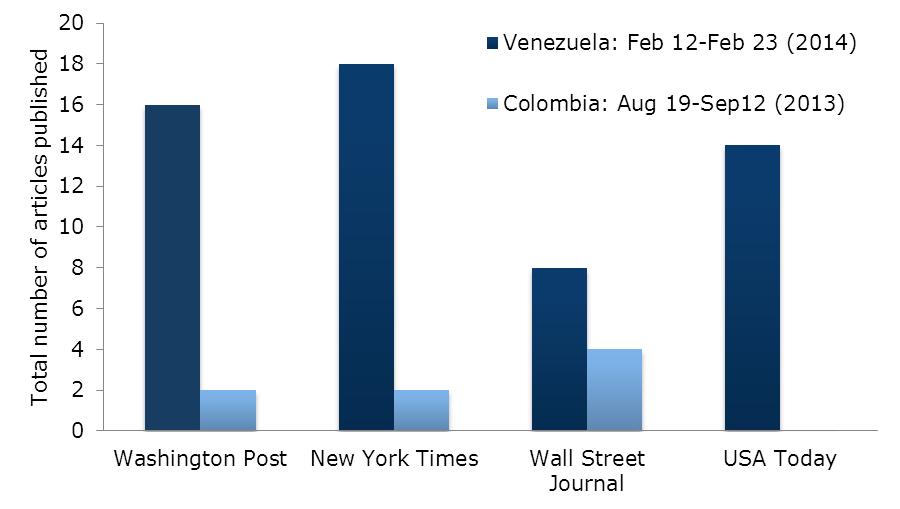
This is especially remarkable if we consider the high levels of repression carried out by the Colombian police and military in response to these protests. The International Office for Human Rights Action in Colombia described the violence as “unprovoked” and “indiscriminate” and attributes all of the violence to state forces.
The incidence of deaths in both Colombia and Venezuela[i], so far, is only slightly higher in Venezuela, with 13 deaths versus 12 deaths in Colombia.[ii] Yet there was very little coverage, and almost no criticism of the Colombian government as compared to the harsh attacks on the Venezuelan government in the U.S. media.
As mentioned earlier, US Secretary of State John Kerry and President Obama made public statements regarding the protests in Venezuela. Both demanded that students arrested in Venezuela be released, without regard as to whether any had been arrested for allegedly committing crimes such as arson and assault. There were no such statements from U.S. officials regarding the hundreds arrested in Colombia.
It is possible that both the huge differences in the amount of media coverage, and the responses to these two sets of protests by both the media and U.S. government officials has to do with the protesters and their aims, and the respective governments. The Colombian farmers were protesting against policies strongly supported by the U.S. government; they were also protesting against a government that the U.S. sees as a strategic ally, home to U.S. military bases and receiving billions of dollars in U.S. aid. The Venezuelan protesters are demanding the ouster of a government that the U.S. government has [spent] millions of dollars trying to get rid of, including U.S. support for the 2002 military coup against the government.
[i] The total amount of deaths reflects data from the most recent figures from Venezuela Transparencia, as of Monday, February 24 2014.
[ii] It is important to note that so far only six of the 13 deaths in Venezuela are confirmed to be opposition protesters.
Venezuelan Opposition Mayor Accused of Manipulating Tragic Death
By Tamara Pearson | Venezuelanalysis | February 26, 2014
Merida – A 34 year old man, Jimmy Vargas, died on Monday while he was involved in a violent street blockade. Some opposition leaders and media blamed the government, however video footage shows it was an accident. Two other people have died this week as a result of the blockades.
Vargas died at the Camino Real residential area, in San Cristobal, Tachira state. Footage, sent to CNN shows that it was an accident. However, CNN and other news agencies also broadcast repeatedly footage of Vargas’ mother blaming the National Guard and president Nicolas Maduro for the death.
Carmen Gonzalez, the mother, stated, “Maduro and those around him killed [my son], they are the ones who killed him, they killed him, they are the ones who gave the orders for him to be killed, they are killing all of Venezuela… and I’m going to go out and fight for my son, my son died fighting for his country, fighting for the freedom of his country…”
On social networks the story was spread that Vargas had been hit by a rubber bullet in his left eye, and other stories claimed a tear gas canister shot by the National Guard had hit him.
The newspaper El Nacional also blamed the government, headlining “Two deaths this Monday because of attacks by GNB [National Guard] and motorbike riders [government supporters] on protests”. Madurados.com headlined “Another tragedy! In rubber bullet attack by the GNB Jimmy Vargas dies in San Cristobal”.
Similarly, The New York Times included a ¼ page full-color photo of Jimmy Vargas on a stretcher, with the caption, “Carmen Gonzalez, 58, cried over the body of her son, who was killed Monday in clashes with the police.”
However Vargas’ doctor, Luis Diaz, reported that he had suffered severe traumatic brain injury (TBI) after falling from the second floor of a building, the newspaper Ultimas Noticias reported.
Vargas’ sister, Jindry, told NTN24 that her brother fell from the second floor the building after the National Guard fired rubber bullets and tear gas bombs at him, causing him to lose his balance. In the video Jimmy Vargas tried to climb down on to a balcony ledge and he lost his balance on the ledge, out of line of shot of the National Guard.
Further, the opposition mayor of San Cristobal, Daniel Cebellos, told the public that Vargas had been murdered. He tweeted on Monday night, “Since late night…the brutal attack of the GNB continues, more than 10 injuries (3 by bullet) and 1 youth of 34 years murdered”. He continued, “I call on the MUD [opposition coalition] that while they continue to kill our people in the streets there’s no peace for the government. The dialogue they propose is one big lie”.
Despite the evidence, Cebellos further tweeted this morning, “We are accompanying Jimmy Vargas and his family in this moment of grief. We reject the violence and repression.” Cebellos included a photo of Vargas’ funeral procession.
Tachira governor, Vielma Mora accused Cebellos of using a public funeral procession to “inflame” people “against the national government”.
“A citizen who, may he rest in peace, fell from the second floor, he was in guarimba (violent disturbances), it seems he lost his balance… do you know what the mayor of San Cristobal did with a few people? They paraded him through the city… like a war trophy”.
Meanwhile, there has been another death as a result of violent opposition blockades. El Carabobeño reported that a motorbike rider died last night after crashing into a barricade. Eduardo Anzola, 29, in Valencia, died instantly, the paper reported, after he didn’t see the barricade because of the darkness. Two other people have died as a result of crashing into barricades, in Caracas and Merida, and one other motorbike rider was killed when wire at a barricade cut his throat.
On Monday, Alba Ciudad and Panorama report that Antonio Valbuena, 32, died of a shot to the head, in Maracaibo. Valbuena was participating in a demonstration of motorbike riders, who were removing barricades so that their procession could get through. At one point, a witness said that a “man in a balaclava came out and began to shoot… one of the bullets hit Antonio in the head”.
Tide slowly turning at the New York Times
By Jonathon Cook | February 20, 2014
A decade ago, I wrote a commentary for the International Herald Tribune (now the International New York Times) arguing that Israel’s wall that was then just starting to be built in the West Bank was really a land grab. Difficult to believe now, but in those days that was a controversial opinion.
The paper then received the “largest postage in our history”, as an editor told me – possibly not surprising as the Anti-Defamation League, a Zionist organisation, had urged its followers to complain and had even published a template letter of condemnation on its website to help them. The result: the paper published a whole page of letters attacking me and dropped me as a writer.
So it is with some pleasure I see that the same paper has again been overwhelmed with letters following three recent articles on BDS in both the NYT and INYT : Omar Barghouti making the case, and Jodi Rudoren and Roger Cohen attacking it, the former implicitly and the latter explicitly.
What’s so different this time is that the INYT’s letters page is dominated by readers backing Barghouti and attacking Rudoren and Cohen. Not only that, but the arguments used to support BDS are intelligent and well-informed, while the few letters attacking BDS sound tired and formulaic.
The fact that the NYT has allowed the BDS debate into its pages is a triumph for the cause. That its international sister publication (and the NYT website) has then allowed its letters page to be dominated by BDS supporters is another small landmark.
We can mark a further victory when the NYT itself publishes a page of such letters. The time cannot be far off.
www.nytimes.com/2014/02/19/opinion/the-case-for-the-israel-boycott.html?_r=0
Big Media Again Pumps for Mideast Wars
By Robert Parry | Consortium News | February 4, 2014
Journalistically, there’s a problem with this passage from Monday’s New York Times: “Defense Minister Moshe Yaalon of Israel … castigated Iran as being dedicated to a nuclear weapon and acting to deceive, and he repeated Israel’s warning that it would not allow Iran to get a nuclear weapon.” Can you tell what the flaw is?
If the New York Times were acting in a professional and objective manner, the next line would have read something like: “Of course, Israel itself developed a nuclear bomb in secret decades ago and now has possibly the most sophisticated undeclared nuclear arsenal on earth.” But the Times chose not to remind its readers of Israel’s stunning hypocrisy as a rogue nuclear-armed state condemning Iran for supposedly harboring a desire for a nuke, a weapon that Iran doesn’t have and says it doesn’t want.
That sort of double standard is common in the mainstream U.S. news media when reporting on Israel and its Muslim adversaries. But to let an Israeli official get away with castigating Iran for contemplating something that Israel has already done – without mentioning the hypocrisy – is a clear violation of journalistic standards. Indeed, it is evidence of bias.
Meanwhile, the neocon editors of the Washington Post are continuing their new campaign to pressure President Barack Obama into issuing more military ultimatums to Syria, another Israeli “enemy.” The logic seems to be that if Obama keeps issuing ultimatums eventually Syria won’t comply or won’t be able to comply, thus creating a casus belli, much as when President George W. Bush demanded that Iraq surrender WMD that it didn’t have.
In a double-barreled blast on Tuesday, the Post published a lead editorial and then a separate op-ed by its editorial-page editor Fred Hiatt making essentially the same argument – that Obama’s diplomacy over Syria has failed and that it’s time for more military threats or even a military intervention in Syria’s civil war. That “theme” was quickly picked up by other U.S. news outlets, including “liberal” MSNBC.
Yet, the real problem with Obama’s Syria strategy is that it is still based on his blustering pronouncements during Campaign 2012 when he was trying to sound tough in order to fend off the more hawkish, neocon rhetoric of Republican Mitt Romney.
During that period, Obama was drawing “red lines” regarding Syria and declaring that Syrian President Bashar al-Assad “must go.” Obama insisted that the purpose of any peace talks must be to dissolve Assad’s government and replace it with one organized by Assad’s opponents, in other words, Assad’s negotiated surrender.
But that was never realistic, however unsavory Assad and his regime might be. He still represents major segments of Syrian society, including blocs of Alawites (an offshoot of Shiite Islam) and Christians. Plus, the strongest part of the rebel movement, seeking Assad’s ouster, is the contingent of radical jihadists representing extreme Sunni groups, including some affiliated with al-Qaeda and some even more extreme who are vowing to exterminate the Alawites and other “heretics.”
Baiting Obama
In the midst of this complex and dangerous mix, the Post’s neocon editors are baiting Obama to stop being so weak, so “inert,” as Hiatt wrote.
On Sunday, the Post’s editors demanded that Obama issue a new military ultimatum regarding delays in Assad’s delivery of chemical weapons to a UN agency for destruction. On Tuesday, the argument was that Obama must intervene militarily to prevent Syria from becoming a base for al-Qaeda militants to plot attacks against the American “homeland.”
“Once again, terrorists linked to al-Qaeda may be using territory they control to plot attacks against the United States, even as [Secretary of State John] Kerry pursues his long-shot diplomacy and Mr. Obama offers excuses for inaction,” the Post’s editorial read.
“With or without U.N. action, it is time for the Obama administration to reconsider how it can check the regime’s crimes and the growing threat of al-Qaeda. As Mr. Kerry reportedly conceded, for now it has no answers.”
Hiatt reiterated the same points in his companion op-ed: “It is no secret that the Obama administration’s Syria policy, to the extent that one exists, is failing. Now the man with the unenviable task of implementing that policy, Secretary of State John F. Kerry, has acknowledged as much, according to two U.S. senators who spoke with him Sunday, John McCain (R-Ariz.) and Lindsey O. Graham (R-S.C.).
“Kerry said that the Geneva negotiating process hasn’t delivered, they said, and that new approaches are needed. … Now, though, a new factor has emerged. Last week, in Senate testimony that got less attention than it deserved, Obama’s director of national intelligence, James Clapper, said Syria ‘is becoming a center of radical extremism and a potential threat to the homeland.’”
Hiatt continued: “Havens in Syria, in other words, could play the same role that Afghan refuges offered al-Qaeda before 9/11. As the West cold-shouldered moderate and secular forces, extremist ranks have swelled in Syria to as many as 26,000, including 7,000 foreigners, Clapper said.”
Not surprisingly, given the always-hawkish views of McCain and Graham, their proposed “new approaches” to this new threat involved military interventions in Syria. Graham wanted to unleash armed drones over the country, while McCain called for establishing “a safe zone in which to train the Free Syrian Army and care for refugees, protected by Patriot missiles based in Turkey,” Hiatt wrote.
Which Side?
Of course, a big part of the Syrian problem is that al-Qaeda-connected extremists are fighting as part of the rebel coalition against Assad’s army. Indeed, the jihadists are considered, by far, the most effective part of the rebel force. To a significant degree, the Sunni jihadists – funded and armed by Saudi Arabia and other Persian Gulf states – are the rebel army.
In other words, the semantic trick that the Post is pulling off is to conflate the existence of al-Qaeda affiliates in Syria with the Syrian government when they are actually on opposite sides, bitterly fighting one another. The Post’s argument is a bit like blaming Fidel Castro for harboring al-Qaeda operatives in Cuba without mentioning that they are locked up at the U.S. military base at Guantanamo and thus outside Castro’s control.
Currently, the Syrian government is engaged in a brutal campaign to root out these “terrorists” – as well as other armed rebels – and is killing lots of civilians in the process. While there may be no easy solution to this catastrophe, the idea of another U.S. military intervention could easily lead to even more death and destruction.
As Hiatt noted, “Obama has doubted that the United States could intervene in such a messy conflict without making things worse. He reportedly worries that even a limited commitment would inexorably suck the nation into something deeper. There certainly is no public clamor to intervene.”
But lack of public support for another Mideast war is no concern to Hiatt and other Post editors who have never really apologized for helping to mislead the American people into the Iraq invasion which resulted in the deaths of nearly 4,500 U.S. soldiers and hundreds of thousands of Iraqis. Indeed, the Iraqi bloodbath — initiated by President Bush and promoted by the neocons — has already been forgotten, as the Post cited the Syrian civil war as the worst humanitarian disaster since the Rwanda genocide in the 1990s, jumping over the Iraqi carnage of the past decade.
Now, Hiatt and the other neocons are promoting “themes” designed to maneuver Obama into another Mideast conflict, pushing the hot button of al-Qaeda “refuges” as if Assad is protecting the extremists, not trying to kill them.
Yet, if preventing al-Qaeda from establishing a safe haven in Syria is now the top U.S. concern – and not just the latest neocon excuse for another U.S. invasion of a Muslim country – then a more logical approach might be to seek a power-sharing arrangement between Assad’s government and the more moderate opposition, creating a united front against the jihadists.
Such an agreement could be followed by a coordinated strategy to rid Syria of these extremists. Obama also might put the squeeze on the Saudis and other oil-rich sheiks to stop funding the Sunni jihad inside Syria.
But the U.S. insistence that Assad negotiate his own surrender – especially when his forces have gained the upper hand militarily – will simply ensure more fighting and killing, while the neocons ramp up their pressure on Obama for one more “regime change.”
~
Investigative reporter Robert Parry broke many of the Iran-Contra stories for The Associated Press and Newsweek in the 1980s. You can buy his new book, America’s Stolen Narrative, either in print here or as an e-book (from Amazon and barnesandnoble.com).
Related articles


Honduras and Mexico: Open Season for Journalists
By Nick Alexandrov | CounterPunch | February 7, 2014
Last December, the New York Times’ David Carr reported on Vice President Biden’s trip to China, where he “spoke plainly about the role of a free press in a democratic society.” The benighted audience was surely keen to learn about this Western institution, and “it was heartening to see the White House at the forefront of the effort to ensure an unfettered press,” Carr affirmed. No doubt. Down here on Earth, meanwhile, Washington has long been at the forefront of an effort to promote cultural devastation, targeting journalists, artists, and independent thinkers more generally. This cultural ruin is a predictable consequence of U.S. support for repressive regimes—a tradition Obama has worked hard to uphold.
Consider the June 2009 coup against Honduran President Manuel Zelaya, which four School of the Americas graduates helped orchestrate. Even the attorney responsible for giving it a legal veneer admitted the ouster was “a crime,” and in its aftermath Obama recognized Porfirio Lobo, winner of a fraudulent election marred by political violence and ballot irregularities, as the country’s new leader. Now, Honduran journalists are weathering a “deluge of threats, attacks and targeted killings,” PEN International reported recently. Honduran “economic elites have established unwritten limits as to what can be investigated by major news agencies,” and independent journalists face similar restrictions. Whoever ignores these limits pays the ultimate price.
Nahúm Palacios “opposed the 2009 coup and turned his TV station into an openly pro-opposition channel,” PEN notes. The military threatened him, but he persisted, and he and his girlfriend were murdered in March 2010. Israel Zelaya Díaz covered politics and crime, and managed a program aired on San Pedro Sula’s Radio Internacional. Assailants torched his home in May 2010, and then shot him to death three months later. A group of men stopped television producer Adán Benítez, who had put out a story on gang activity, in July 2011; they demanded his valuables, and then killed him. Medardo Flores Hernández was a volunteer reporter and finance minister for a pro-Zelaya organization when he was gunned down in September 2011. Early the following month, Obama received Honduran President Lobo at the White House, commending his “strong commitment to democracy.” Radio journalist Luz Marina Paz Villalobos, a coup critic, was murdered on December 6, 2011.
Mexican reporters are also at risk, as theirs “has become the most dangerous country in the Western Hemisphere for journalists,” Emily Edmonds-Poli wrote in a Wilson Center report last April, reviewing the situation in this “drug war” ally. In the state of Veracruz, for instance, there was a series, in the spring of 2012, of high-profile killings: a group of men invaded investigative reporter Regina Martínez’s home in Xalapa, and murdered her there. The dismembered bodies of three photojournalists pursuing stories on organized crime were discovered on the side of a highway four days later. “The fear is terrible and well founded,” an ex-reporter told the Guardian’s Jo Tuckman. “The heroes are in the cemetery.” This woman is hardly the only one to have abandoned the profession. A university official in Veracruz, quoted by Edmonds-Poli, surveyed the corpse-strewn landscape: “It’s not that they’re just killing reporters, they’re killing the drive to become one.” The destructive effects are equally far-reaching in Honduras. PEN quotes Honduran activists who “stressed that the neglect, marginalization and underfunding of cultural spaces” have gutted the nation’s creative sector, sharply delimiting the range of questions to which artists and independent researchers can safely respond.
The Honduran and Mexican governments restrict inquiry with generous U.S. assistance. Both states have strong ties to organized crime: efforts to distinguish legitimate from outlaw Honduran institutions, for example, are often meaningless, given the government’s illicit origins in the June 2009 coup. “A representative from a leading NGO in Honduras says at least four high-ranking police officials head drug trafficking organizations,” InSight Crime’s Charles Parkinson wrote on January 29, and Honduran history reveals that such activity is no obstacle to continued U.S. funding. When a Reagan-era DEA agent amassed evidence implicating the country’s top military officials in prohibited activities, for instance, the organization responded by shutting down its Honduran office in 1983. At the time, Washington’s core concern was the vital role Honduras played in the anti-Sandinista crusade. Their ally’s involvement in drug-smuggling was a non-issue, as irrelevant then as today, when the projected 2014 U.S. governmental military and police aid is over 1.75 times the 2009 figure.
Mexican institutions resemble their Honduran counterparts: ties between political elites and organized crime can be traced back at least a century, and this connection was blatantly obvious by the 1970s. That was the decade the national intelligence arm—the Dirección Federal de Seguridad (DFS)—aided by “the attorney general’s office and Federal Judicial Police,” established itself as “the country’s major criminal mafia,” Paul Kenny and Mónica Serrano point out. U.S. officials knew DFS facilitated drug trafficking’s expansion, and “continued to defend and protect the agency” because it “played a central part in Mexico’s fight against left-wing subversion, both directly and through a death squad organized under [DFS head Miguel] Nazar’s supervision, the ‘White Brigade,’” Peter Dale Scott and Jonathan Marshall write. Years later, Mexican law enforcement committed “one out of every three crimes against journalists” from 2009-2011, Edmonds-Poli reports in her Wilson Center study. That three-year span overlaps with the period—between 2008 and 2010—when Washington “allocated over $1.5 billion to Mexico” via the Mérida Initiative, and “U.S. military and police aid in each of these years marked nearly a 10-fold increase over 2007 levels,” according to Witness for Peace. Obama then extended the program—a true Nobel Peace Laureate, reminiscent of luminaries like Henry Kissinger.
In June 1976, for example, Kissinger proclaimed his support for Argentina’s military dictatorship: “We have followed events in Argentina closely,” he stated. “We wish the new government well. We wish it will succeed.” These remarks came six weeks after “military officers organized an exemplary event to combat immorality and communism,” Fernando Báez—author of A Universal History of the Destruction of Books—notes, when they burned volumes “confiscated from bookshops and libraries in the city of Córdoba,” loudly condemning Freud, Marx, Sartre and others. In August 1980, “trucks dumped 1.5 million books and pamphlets… on some vacant lots in the Sarandí neighborhood in Buenos Aires.” After a federal judge gave the command, “police agents doused the books with gasoline and set them on fire. Photos were taken because the judge was afraid people might think the books were stolen and not burned.” The situation was much the same in neighboring Chile, under Pinochet, when “thousands of books were seized and destroyed” during his dictatorship. In 1976, Kissinger met with Pinochet in Santiago, assuring him Washington was “sympathetic with what you are trying to do here.”
Washington also sympathized with South Vietnam’s Ngo Dinh Diem, who in the late 1950s “banned works of fiction that presented the government in an unflattering light,” Joint Chiefs of Staff historian Willard J. Webb wrote. Diem thus proved himself a worthy heir to Pope John XXII, who in 1328 “ordered a book burned because it cast doubt on his omnipotence,” Báez observes, arguing that we have to look further back in time, to 1258, to comprehend the effects of the recent U.S. assault on Iraq. It was in the mid-13th century that “the troops of Hulagu, a descendant of Genghis Khan, invaded Baghdad and destroyed all its books by throwing them into the Tigris.” Hulagu’s particular form of savagery was unsurpassed until the U.S. occupation—“nation-building,” liberal commentators insist, but in reality just one case of Washington-supported cultural destruction.
Nick Alexandrov lives in Washington, DC.
Is the NYT entering a new era on Israel?
By Jonathon Cook | February 1, 2014
The New York Times’ oped pages have recently been opening up to much more critical commentary on Israel. This trend has not been quite as dramatic as it may appear. Two strong recent opeds by Ali Jarbawi and Avi Shlaim looked like they had been made available to US audiences in the NYT but were actually only available in the international edition – or what used to be called the International Herald Tribune.
In a recent email, John Whitbeck explained that the NYT had made them all but impossible to find on its website:
I have subsequently discovered that [Shlaim’s article] is invisible on the Times’ website to anyone trying to check out published opinion articles. As was the case with the article by Ali Jarbawi entitled “The Coming Intifada”, … Avi Shlaim’s article can be found on the site only by searching the author’s name. … Accordingly, not only were these articles not deemed “fit to print” for domestic American readers, they can only be accessed online by someone who is already informed of their existence and is actively and assiduously searching for them.
However, by all accounts the NYT domestic print edition is going to print an oped by BDS leader Omar Barghouti tomorrow. If that happens, it will mark quite a milestone. Omar includes many issues usually unmentionable in the NYT. But more so than the content of his article, the fact that the NYT is prepared to give a platform to him and the boycott movement – currently viewed by Israel as an enemy potentially even greater than Iran’s supposed nuclear weapons – would truly constitute a revolution in what can be said in the US establishment’s paper of record.
Here is a link to the piece:
www.nytimes.com/2014/02/01/opinion/sunday/why-the-boycott-movement-scares-israel.html?_r=0
Related articles


Vladimir Vladimirovich and the Grey Lady
By Robert Bonomo | The Cactus Land | December 26, 2013
Bill Keller, editorialist for the NY Times and former executive editor of the paper, has recently penned a strong attack on Vladimir Putin arguing that Putin’s leadership “deliberately distances Russia from the socially and culturally liberal West”, describing the Kremlin’s policies as “laws giving official sanction to the terrorizing of gays and lesbians, the jailing of members of a punk protest group for offenses against the Russian Orthodox Church, the demonizing of Western-backed pro-democracy organizations as ‘foreign agents’, expansive new laws on treason, limits on foreign adoptions.”
Keller, who during his tenure as executive editor of the NY Times argued for the invasion of Iraq and wrote glowingly of Paul Wolfowitz, makes no mention of Moscow’s diplomatic maneuvers that successfully avoided a US military intervention in Syria or the Russian asylum given to Eric Snowden. Keller, who had supported the US intervention in Syria by writing, “but in Syria, I fear prudence has become fatalism, and our caution has been the father of missed opportunities, diminished credibility and enlarged tragedy,” also made no mention of Seymour Hersh’s stinging dissection of the Obama administration’s misinformation campaign regarding the sarin attacks in Syria. Hersh’s piece, which drives grave doubts into the case against Assad actually having carried out the attacks, was not published in the New Yorker or in the Washington Post, publications that regularly run his work.
Keller focuses on a Russian law that bans the promotion of gay lifestyles in Russia, a far cry from “giving official sanction to the terrorizing of gays and lesbians”, while failing to mention that according to his own paper, 88% of Russians support the law.
Putin did expel the United States Agency for International Development (USAID) from Russia, cutting off the $50 million in aid, most of which went to pro-democracy and anti-corruption groups. The Kremlin believed that much of this money wound up supporting the protest movement against Putin that emerged in 2011. If Russian funding had been suspected in the Occupy Wall Street Movement, would the New York Times have supported Putin for promoting social equality in the US? If the punk band Pussy Riot had broken into a prominent Jewish temple in New York, instead of a Moscow cathedral, and defamed it to call attention to the millions of Palestinians living in refugee camps, would the young ladies have done some time? And if so, would they have received support from all corners of stardom?
The European Model
Quoting Dmitri Trenin, Keller argues that Putin sees Europe in decline, “it’s national sovereignty… is superseded by supranational institutions.” Is Putin mistaken in his assumption? Maybe ask the people of Greece, Spain, or Ireland. Keller also mentions “limits on foreign adoptions” but fails to mention the cause, the Magnitsky Act, which imposed “visa and banking restrictions on Russian officials implicated in human rights abuses.” The Kremlin saw this law as the perfect example of US meddling in internal Russian affairs.
The heart of the Magnistsky saga was the death in Russia, while under custody, of an attorney for Hermitage Capital, a hedge fund run by a British citizen William Browder, who renounced his US citizenship. Browder made billions in Russia before running afoul of Russian authorities. His Hermitage Capital was funded by the Lebanese national Edmond Safra and eventually claimed to have lost $300 million after having moved billions out of Russia. Browder lobbied hard in Washington to have the Magnitsky Act passed. Why was the US involved in passing a law to protect Lebanese and British capital and a Russian prisoner? America hasn’t enough trouble with its own prison system that it needs to legislate on the Russian penal system? Are there no American politicians who have been implicated in human rights abuses?
Keller’s final point is that Putin is being heavy handed over the Ukrainian/EU integration crisis, but Keller avoids discussing the deep historic and ethnic links between Russia and Ukraine. Most Americans would agree that Russia should stay out of NAFTA negotiations, seeing North America as clearly not within the Russian sphere of influence. Ukrainians are deeply divided over the integration with Europe, so why not let the Ukrainians and Russians work out their trade relations without the American government getting involved?
Khodorkovsky
Probably more than any other topic, the NY Times has repeatedly published articles in defense of the long imprisoned and recently freed Russian oligarch Mikhail Khodorkovsky, a man whose rise to power was filled with unsavory schemes to appropriate businesses which were once the property of the Russian people. The NY Times Sabrina Tavernese wrote in 2001 that he had “orchestrated a series a flagrant corporate abuses of minority shareholders unparalleled in the short history of modern Russian capitalism.”
Khdorkovsky eventually wound up the billionaire owner of Yukos Oil, which he planned to sell to Exxon Mobil. Khdorkovsky also had political ambitions, creating the Open Russian Foundation and putting Henry Kissinger and Lord Jacob Rothschild on the board of directors. He was clearly eyeing political power by making close ties with the West, even being named to the Advisory Board of the Carlyle Group, all of which made him a potential threat to the Kremlin.
The Khodorovsky affair was a complex battle for power in Russia with Khodorkovsky playing the Western powers against the strongly nationalistic Putin. But at the NY Times editorialist Joe Nocera in four pieces on Khodorkovsky never delves into the complexities of Putin’s strategy to keep Western interests at bay, preferring to present a black and white scenario of ‘western liberal’ rule of law against the ‘authoritarian’ Putin.
Curiously, the NY Times doesn’t seem so interested in Harvard’s Russia Project which ended in disgrace and professor Andrei Shleifer, Larry Summers protege, being forced to pay a $2 million fine for enriching himself under the guise of a USAID program where he was to ‘teach’ Russians about capitalism. He gave them an interesting lesson, yet was not forced to resign his post at Harvard, possibly due to his close relationship with Summers. Nocera hasn’t written one article on that scandal which is much more relevant to Americans and their iconic institutions, but which also might make him a few enemies closer to home.
Putin and American Values
Most Americans see Eric Snowden as whistleblower and not a traitor, yet the NY Times star editorialist, Thomas Friedman, isn’t so sure, “The fact is, he dumped his data and fled to countries that are hostile to us,” though he doesn’t elaborate on why Russia is a ‘hostile’ nation and he advises Snowden to come home and face the music if he’s truly a patriot, “It would mean risking a lengthy jail term, but also trusting the fair-mindedness of the American people.”
Putin is a social conservative and a fierce patriot who, like many Americans, opposes regime change in the name of democracy. The American people, after failed interventions in Iraq, Afghanistan and Libya, agree with him — both Putin and Americans, unlike the NY Times, vehemently opposed a US intervention in Syria. It seems Putin has more in common with the opinions of Americans than does the NY Times, which begs the question, why is the NY Times so hell bent on demonizing the President of the Russian Federation when he’s supported by more than 60% of the Russian people?
The New York Times has written extensively about the gay rights issue in Russia but 45% of Americans still think that homosexuality is a sin and as the ‘Duck Dynasty’ controversy has revealed, homosexuality in America is still a very divisive issue. Is the prohibition against publicly speaking in favor of gay lifestyles in Russia such an important stumbling block to ties between the two nations when the vast majority of Russians support the law?
Americans probably don’t approve of roads where members of one religion can drive while members of another religion must walk, as occurs in Hebron and reported on by Ynet, “Jewish residents are allowed to cross the road by vehicle, but Palestinians are now only permitted to cross by foot or by bicycle.” They probably wouldn’t look fondly on back of the bus seating for women, yet in spite of this type of segregation in a country that claims to be democratic, the NY Times doesn’t feel compelled to demonize Mr. Netanyahu and his ‘socially conservative’ Likud party.
The Interests of the American People
Just as the NY Times despises Putin and Russia, it’s equally enamored with Israel. Imagine if the millions of Palestinian refugees were not in camps because of their mother’s religion but instead because they were LGBT? What if Netanyahu were held to the same standard as Mr. Putin? How many millions of Palestinian Khodorkovsky’s are languishing in refugee camps in their own country? It seems that Mr. Keller, Mr. Friedman and Mr. Nocera are much more interested in the rights of Khodorkovsky and William Browder than they are in the rights of Palestinian children living in squalor under an Israeli blockade in Gaza.
Saudi Arabia and Israel, the latter through its surrogate AIPAC, lobbied hard for war in Syria and both supposed allies are furiously attempting to undermine peace talks with Iran. The government Putin leads brokered the deal to avoid US involvement in Syria, played an important role in the Iranian peace initiative and also allowed Americans a glimpse into the massive surveillance program the NSA has hoisted upon them by giving refuge to Eric Snowden.
Just as Americans would not look fondly at the Kremlin interfering in domestic American politics, so the Kremlin pushes back when it see US interference in it’s internal affairs, a good example being American aid to opposition groups during the 2011 Moscow protests against Putin. If the US can accept serious human rights violations by supposed allies Israel and Saudi Arabia, can’t it also accept that Russia has its own way of governing itself, based on its own history and culture?
The NY Times does not represent the best interests of most Americans, nor does it use its powerful voice to protect the millions persecuted within the realms of so called allies. The NY Times represents a small sector of US power, bent on propagating special interests at the expense of the vast majority of Americans.
Mr. Putin certainly acts in the best interests of Russia, but curiously enough, by working in his own interest, he has done more to protect the 4th Amendment than the constitutional law professor currently occupying the White House. In Syria he was protecting Russian interests, but by doing so he kept the US out of an intervention that could have easily developed into a major war. If it had been up to the NY Times, we would have intervened in Syria and Snowden would be behind bars awaiting the mercy of the Obama Administration.
So who is a better friend of the American people? There are no doubts that the NY Times is a better friend of the Khodorkovsky’s and William Browder’s of the world but Americans might actually be better off if their government listened more to Putin and less to the Grey Lady.
Featured Video
Seyed M. Marandi: Negotiations Collapsed – Return to War
or go to
Aletho News Archives – Video-Images
From the Archives
The US-Iran Scenario That Most Scares Israel
By Ali Haydar | Al-Akhbar | October 9, 2013
Israeli Prime Minister Benjamin Netanyahu issued a series of threats toward Iran and its interlocutors in the West, including the US, as serious negotiations on Iran’s nuclear program seem more plausible.
As a possible rapprochement looms between the US and Iran, Netanyahu has attempted to impose impossible Israeli conditions on the negotiators, such as the full dismantling of Iran’s nuclear program, not to mention threatening military force.
Whatever the deal that could materialize between Iran and the West, Israel is going to find itself before an open-ended path. One can foresee three possible scenarios… continue
Blog Roll
 Aletho News
- UK, Spain reject Trump’s new scheme to blockade Hormuz Strait
- Russian frigate ‘resurfaces’, chases off NATO pirates days after Kiev ‘sank’ it
- Ukraine Targets Russian Merchant Fleet With NATO Intel Support – Presidential Aide
- Russia’s ‘shadow fleet’ makes mockery of UK naval power
- Ukraine plans to attack Russian ships with Norwegian support
- US’s ‘Very Foolish’ Double Blockade of Hormuz Strait Makes Absolutely No Sense: Here’s Why
- China issues rules on countermeasures against foreign states’ unlawful extraterritorial jurisdiction
- Seyed M. Marandi: Negotiations Collapsed – Return to War
- Tomorrow’s naval blockade showdown
- ‘Israel’ attacks civilians to hide its embarrassing military failures & out of pure sadism
- If Americans Knew
- Critical shortages in Gaza, Lebanon in ruins, “piracy” in Iran – Daily Update
- US-Iran ceasefire negotiations make zero progress – Daily Update
- Pro-Israel ‘Thinktanks’ and Individuals who Influence U.S. Foreign Policy
- Mearsheimer reveals how Israel dictates US policies on Iran, Gaza – video
- After killing 350+, Israel still has a “score to settle” with Lebanon before ceasefire – Daily Update
- Military aid to Israel emerges as the latest political litmus test for Democrats
- The only Palestinian children’s rights organization closes following years-long Israeli campaign against it
- ‘I Can’t Forget the Smell’: Lebanese Reel After Israel Kills Over 300 in Single Day
- DNC Shoots Down Resolutions Calling Out AIPAC and Limiting Arms to Israel
- TCN: Is Israel Blackmailing President Trump?
- No Tricks Zone
- Cave Discovery Reveals Today’s Desert Climates Were Recently Far Warmer, Wetter, Teeming With Life
- German Expert: Heat Dome Led To Record Temps In Western USA…Warmer In 1934, 1936
- New Study: No Linear Warming Or Glacier Retreat Along Northern Antarctic Peninsula Since 1980s
- An Inconvenient Tree: Uncovered In Alps… Europe Much Warmer Than Today 6000 Years Ago
- New Study Reports A 60% Slowdown In Greenland’s Ice Loss Rate In The Last Decade
- Low Intensity Tornado Wrecks Major Solar Farm, Creating A Potential Toxic Dump
- New Study Finds Warming Saves Lives…Cold Temperatures 12 Times More Deadly Than Excess Heat
- German Science Blog Accuses PIK Climate Institute Of Hallucinating Climate Tipping Points
- Devastating Assessment Of Comirnaty Vaccine By Former Senior Pfizer Europe Toxicologist
- New Study: CO2 Is ‘Effectively Negligible’ As An Explanatory Climate Change Factor Since 2000
 Aletho News