Global ‘False’ Witness Targets Nicaragua
By Tortilla con Sal | teleSUR | August 4, 2017
Global Witness is a well-established environmental and human rights non-governmental organization based in Britain.
As with many other similar organizations, its reports often figure in news media as authoritative sources on international issues. Ever since the 1980s and, increasingly so, after the turn of the century, the status of NGOs as trustworthy information sources on foreign affairs has become increasingly untenable as they have been more and more co-opted by corporate interests and governments to promote the Western elites’ neocolonial global policy agenda.
In the case of Nicaragua, in 2016 Global Witness produced a brief, flawed and unreliable account of land conflicts in Nicaragua’s Northern Caribbean Autonomous Region in a report called “On Dangerous Ground”. In June 2017, they produced a report called “Defenders of the Earth”, with a section on Nicaragua even more poorly researched and false than the previous one. Three main reasons stand out to dismiss the latest Global Witness report on Nicaragua as unreliable and in bad faith.
Firstly, the report itself is clearly biased and flawed, from even a cursory analysis of its references and their sources by anyone familiar with Nicaragua. Secondly, the organization’s human and material resources all come from a very narrow managerial class and corporate funding base, overwhelmingly advocating the foreign policy positions of the United States government and its allies. Thirdly, the history of Global Witness clearly indicates its categorical bias in favor of NATO country governments’ policy positions in the countries that figure in its reports and too its systemic defense of the very corporate capitalism whose destructive effects Global Witness superficially and selectively criticizes.
Global Witness sources on Nicaragua
Before looking at the text of the false Global Witness attack on Nicaragua, it is worth looking at the sources they identify in their footnotes, of which there are 23, composed of a total of 44 references. For anyone familiar with Nicaraguan politics and society since the war of the 1980s many of the sources are wearily familiar and readily identifiable as anti-Sandinista, for example, the virulently anti-Sandinista La Prensa newspaper. Some of the references are duplicates and some disguise the fact that while apparently distinct, ultimately the information they provide comes from one single source. (Here’s a link to the relevant spreadsheet for anyone interested in a more detailed analysis.)
Of the 44 references, some of which are duplicates, not one represents the view of the Nicaraguan authorities or others criticized in the report or any source sympathetic to them. 16 references are to sources inside Nicaragua politically opposed to the Nicaragua’s Sandinista government. 25 of the sources are external to Nicaragua but with a long record identifying them as ideologically opposed to the Sandinista government. Of those 25 sources, one might argue that the Washington-based Interamerican Commission for Human Rights or the EFE Spanish language news agency are impartial, but their record is indisputably biased against Nicaragua’s Sandinista authorities.
For all but imperialist ideologues, the Paris based International Federation for Human Rights (FIDH) has been discredited in particular, most recently, by its flagrant partisan bias in favor of NATO country government policies attacking the populations of Libya and Syria. One source, a reference to the law authorizing Nicaragua’s Canal, is completely neutral. Only one media source, El Nuevo Diario, is generally independent. Two references are to sources within the Western environmental scientific lobby, which has its own set of highly questionable biases, prejudices and neocolonial hypocrisy.
“Methodology”
As if by way of justifying this desperately unfair selection of sources, Global Witness also offer an account of what they call their “methodology”. They aver, “We have recorded data about the cases using the HURIDOCS Event Standard Formats and Micro-Thesauri, an approach which is widely used to manage and analyse material of this nature.”
That Global Witness claim is demonstrably untrue. Whatever their aspirations they certainly did not use the HURIDOCS approach.
HURIDOCS (Human Rights Information and Documentation Systems, International) is a European NGO established in 1982 to facilitate networking between human rights organizations around the world. HURIDOCS says its ‟specific role in this capacity-building process lies in improving access to and the dissemination of human rights information through more effective, appropriate and compatible methods and techniques of information handling. HURIDOCS recognises that we live in an age of tremendous advances in information and communication technologies. There is the need to master these technologies to aid us in our human rights work. At the same time, we must be conscious of the fact that the technologies to be applied should be appropriate and responsive to the main focus of the mandates of human rights organisation.”
HURIDOCS exposition of their approach includes the following definitions:
Fact-finding is the process of identifying the violations in one event, and establishing the facts relevant to these violations. Fact-finding and investigation are terms that are used interchangeably.
Documentation is the process of systematically recording the results of an investigation or fact-finding in relation to an event or number of events. Fact-finding and documentation are organically related and should not be viewed as separate processes.
Monitoring is closely observing a given situation in society over a long period of time to see whether human rights standards are met. To carry out monitoring, investigation and documentation of a large and/or representative number of events are conducted.”
Global Witness are not in compliance with the HURIDOCS approach because their practice in their reporting on Nicaragua demonstrably violates all of these definitions.
Their fact-finding or investigation is so heavily biased as to make it impossible for them to establish the facts. Consequently, thanks to this gross fact finding bias, their documentation is partial, often inaccurate and categorically incomplete. Nor do they show any sign of having done due diligence in monitoring consistently over time via ” investigation and documentation of a large and/or representative number of events” or the context of those events in Nicaragua.
Other theoretical considerations
Apart from these chronic procedural failures, other theoretical considerations cry out for clarification.
Global Witness say, “This report is based on research on killings and enforced disappearances of land and environmental defenders, who we define as people who take peaceful action to protect land or environmental rights”.
But in a bitter property dispute between competing communities, clarifying who is defending whose rights becomes a fundamentally important question. Certainly in Nicaragua’s northern Caribbean Coast, unscrupulous Miskito community leaders are themselves involved in provoking these property disputes by illegally selling land to rural families migrating in search of a better life. Miskito gangs have attacked and murdered many such people, a factor not even mentioned by Global Witness. They completely evade the issue of identifying in a responsible, proportionate way whose rights are being violated.
Similarly, Global Witness state, “cases were identified by searching and reviewing reliable sources of publicly online information”. But Global Witness obviously used heavily politicized criteria for deciding what is a reliable source, because not one single reference in their report on Nicaragua gives the Nicaraguan authorities’ side of the story and only one reference can fairly be described as ideologically independent. That renders completely incredible the phony Global Witness claim to systematic research.
They claim their investigation is systematic because “We set up search engine alerts using keywords and conducted other searches online to identify relevant cases across the world.” However, in the case of a small country like Nicaragua, a genuinely systematic search can readily be done covering a much wider range of sources than those accessed by Global Witness without recourse to modish, geeky “search engine alerts”. The poverty of sources evident in the report’s footnotes make Global Witness’s procedure look ridiculous.
Global Witness claim they “verify” the results of their investigation because “Where possible, we checked with in-country or regional partners to gather further information”. But they only cross-checked with ideologically and politically biased organizations, apparently using the same highly questionable, politically compromised sources they cite in their report.
Karl Popper, philosophical darling of the Open Society ideology embraced by Global Witness, explained over 50 years ago in “Conjectures and Refutations” that verification is essentially authoritarian. He argued that a truly scientific investigation requires conjecture and falsification, a search for errors rather than for justification.
If one goes along with Popper, it should surprise no one that Global Witness uses an essentially authoritarian methodology. Self-evidently, their job is not to discover the facts or to impartially establish the truth via a hypothetic-deductive Popper-style process , but to project a manipulative version of events justifying ideologically loaded interpretations favored by their corporate funders, an inherent bias understandably unacknowledged by Global Witness.
Nor is it surprising to learn from their account of their methodology, “While we have made every effort to identify and investigate cases in line with the methodology and criteria, it is important to add that our research mostly relies on public information and that we have not been able to conduct detailed national-level searches in all countries.”
That is not true either. Gobal Witness did not make “every effort” to investigate cases in line with their alleged methodology and criteria because they are flagrantly out of compliance with the definitions advanced by HURIDOCS.
A broader range of sources
Nor is is true that they were unable to conduct a detailed national-level search in the case of Nicaragua, because they could easily have included references from sources that contradict much of the information in the Global Witness report. The following is a brief sample of many other relevant sources, gleaned in a few hours searching on the Internet :
– Indigenous group splits from Miskito party in support of Sandinista government
– Attacks by indigenous gangs on settlers, killing nine
– Miskitos claim their own leaders illegally sold over 3000 acres of communal lands to outsiders
– Historic lease agreement between Canal Authority and indigenous people along the canal route
– Interview with HKND’s Bill Wild about the benefits of the Interoceanic Canal
– HKND’s Bill Wild on the Environmental and Social Impact Study
– Environmentalist Kamilo Lara explains why he believes in Nicaragua’s Interoceanic Canal
– Nicaragua’s Canal – the environmental and economic arguments
– Public Consultation on Lake Nicaragua for the Interoceanic Canal project
– Environmental and Social Impact Assessment of Nicaragua’s Interoceanic Canal – Conclusions and Recommendations
– Bishop accuses political opposition of manipulating canal protests
– Canal protestors attack and injure six police officers
Even this very limited sample of sources, put together from just a few hours searching on the Internet, gives a very different picture to the one presented by Global Witness. So it is false of Global Witness to suggest they lack the resources to be able to stress test and falsify the version of events they have published in their report. Given the tremendous resources and the numerous skilled, experienced, talented people working at Global Witness, only abject intellectual dishonesty explains their failure to report faithfully on Nicaragua
Incoherent claims
Be that as it may, based on their cynically biased sources and their absurdly deficient methodology, Global Witness proceed in their report to make the following claims:
11 defenders killed in 2016 – making Nicaragua the most dangerous country in the world per capita
But, as independent journalist John Perry and others have pointed out, none of those people killed can fairly be described as having being killed for defending the environment. They were in property disputes and all of them were killed either directly or indirectly in the course of those property conflicts. This is true in particular of the case cited by the Inter-American Commission for Human Rights (CIDH) , that of Bernicia Dixon Peralta, her husband Feliciano Benlis Flores and their 11 year old son Feliciano Benlis Dixon. Perry mentions some of the context. More context of the property disputes in the RAAN can be found here, here and here. Not a single person mentioned by Global Witness died in Nicaragua for defending the environment in the way that someone like Berta Cáceres did. Even so Global Witness have tended disingenuously to implicitly compare the situation in Nicaragua with that in Honduras, in particular with Berta’s murder.
The bad faith with which they do so is clear from the second claim in their report on Nicaragua:
10 of those murdered were indigenous people, with most killed in conflicts with settler communities over land. Meanwhile rural ‘campesino’ defenders faced threats, harassment and attacks, including for opposing the construction of an inter-oceanic canal.
Global Witness fails to make clear that groups from the indigenous Miskito people, whom Global Witness inaccurately portray as defenseless environmental defenders, are themselves guilty of murderous attacks against migrants settling land which in many cases the migrants apparently believed they had bought legitimately. Furthermore, the Global Witness report deliberately and falsely confuses the very specific situation of these property conflicts in Nicaragua’s northern Caribbean Coast with protests over the possible displacement of communities along the still to be exactly defined route of the proposed Inter-oceanic Canal 300 kilometers to the south. Global Witness unscrupulously frame their distorted version of events in the two regions to give the impression that in both cases the Nicaraguan authorities may in some way be directly or indirectly responsible for the violence.
In fact, even the New York Times has acknowledged in their otherwise generally hostile anti-Sandinista reporting that the Nicaraguan authorities do what they can with limited resources to protect the rights of indigenous peoples in the Northern Carribean Autonomous Region.
The situation along the route of the Canal is very different from that in the RAAN. Protests against the Canal are exploited by Nicaragua’s political opposition and groups participating in the protest demonstrations have damaged property and attacked police officers. In relation to this situation, completely separate from the property disputes more than 300km to the north, Global Witness claims:
Activists were increasingly criminalized: foreign environmentalists were expelled, community leaders arrested and legislation passed restricting freedoms of speech and association.
However in the very next paragraph, the report quotes anti-Canal activist Francisca Ramirez saying, ““We have carried out 87 marches, demanding that they respect our rights and we have had no response. The only response we have had is the bullet.”
Thus, the Global Witness allegation that rights to freedom of association are restricted is immediately contradicted by Francisca Ramirez declaring her group has organized over 80 public demonstrations to express their views.
Similarly, Ramirez claims “The only response we have had is the bullet.” But, in the next paragraph, we learn “a member of her community lost an eye and another was shot in the stomach”.
Thus, after 87 demonstrations, some of which supposedly involved many thousands of participants and in which “The only response we have had is the bullet”, Ramirez cites precisely two people suffering serious injury and only one of them with a gunshot wound. Ramirez omits that the protesters on the marches she organizes go armed with machetes and home-made mortars. They block highways, intimidate ordinary people going about their business, damage property and attack police officers.
In no Western country would that be tolerated without, to put it mildly, a robust response from the police and security forces. Even so, Global Witness promote Francisca Ramirez’s account as if she and her movement were non-political and non-violent, which they are not. But Global Witness excludes those facts.
Likewise, as John Perry has pointed out, the foreign environmentalists expelled from Nicaragua were involved in a suspicious incident involving a small explosion. Again, a reasonable question to Global Witness is why they excluded this highly relevant information given that in Britain or the United States any foreigner, especially any non-white foreigner, involved in such a suspicious incident would face prosecution and a potential jail term under those countries wide-ranging anti-terrorist laws.
Inaccuracies and falsehoods
Mixed in with these disingenuous, incoherent claims, Global Witness also allege, presumably as supporting context, that the proposed Canal “would force up to 120,000 indigenous people from their land”. This outrageous falsehood is sourced from the pro-NATO, right-wing dominated European Parliament, but is categorically contradicted by the relevant multi-million dollar Environmental and Social Impact report by the extremely prestigious ERM company based in the UK. The falsity of that claim is further confirmed by the Canal concessionary HKND company’s representative Bill Wild who argues that the route of the Canal has been altered to take local concerns into account in such a way that fewer than thirty indigenous families will be directly affected.
Overall, ERM reckons that up to 7210 families or around 30,000 people are likely to be displaced along the whole route of the Canal, over 270 kilometres. The scandalously untrue figure quoted by Global Witness is propaganda from Nicaragua’s political opposition who are exploiting Ramirez’s quasi-celebrity status among Western environmentalists to amplify overseas the marginal support for their unpopular position against the Canal in Nicaragua. That fact is reflected in the incoherence of the arguments set out by Ramirez and her backers in Nicaragua’s political opposition.
If 120,000 people were really going to be displaced by the proposed Canal then the figure of 30,000 protestors from around the country the same political opposition regularly quote to describe national opposition to the Canal just does not add up. Quoting that same opposition figure, Global Witness state, “Francisca has rallied campesino groups from around the country who will be adversely affected by the canal to call for a meaningful say in its development. In June 2015, 30,000 people gathered for an anti-canal protest – Francisca organized 40 trucks so her community could attend.”
In Nicaragua, the cost of hiring a truck or a bus to carry 60 people or a similar amount of material goods on a round trip of 100km is around US$120, while a round trip of 300km costs about US$175. So hiring 40 diesel-guzzling trucks and buses with their drivers will have cost a minimum of US$4000. But Ramirez is an impoverished mother of five from a similarly impoverished community.
Even if only one quarter of the more than 80 protests Ramirez says she has helped organized involved similar costs, the total amount involved runs into tens of thousands of dollars just for Ramirez’s community. Whatever the exact financial accounting, Ramirez is clearly supported by a great deal more than her own resources and those of her community.
Even so, Global Witness completely evade the obvious conclusion to be drawn from that incoherence implicit in their report. Namely, that Francisca Ramirez, far from being a simple altruistic community organizer defending her home is in fact a savvy political opposition activist promoting an inaccurate image of herself as well as concealing her real political agenda. Ramirez alleges that she and her family have been attacked and harassed. Supposing those accusations are true, no convincing evidence points to involvement of the government or the security forces and certainly not the HKND company in charge of planning and building the Canal. That contrasts with the situation of activists in Honduras or Guatemala who can in most cases offer reliable details with corroboration from witnesses to identify their assailants.
The press report cited by Gobal Witness contains no credible evidence from Ramirez except her say so, no corroborating evidence, no witnesses. Likwise the report’s reference to Frontline Defenders’ advocacy for Ramirez links to a summary profile including the false opposition propaganda, repeated by Global Witness, that the proposed inter-oceanic Canal has been imposed without consultation. But in fact preliminary consultations took place in July 2014 and subsequently a continuing consultative process has developed both before and after the publication of ERM’s Environmental and Social Impact Study, which recommended improvements to the consultation process which both HKND and the government accepted.
The Study did also criticize the handling of the expropriation issue and recommended that international standards be applied to any expropriation of land (reckoned to total 1359km2 of dry land out of Nicaragua’s total area of 139,375km2) that may eventully be decided. Those ERM recommendations were accepted by the government and HKND, and the subsequent consultative process has led to several important changes in the precise route of the Canal and to more detailed environmental studies which have been one reason for the delay in the Canal’s construction.
Frontline Defenders’ advocacy of Ramirez, cited by Global Witness, is based on her own account of events with no apparent attempt at corroboration despite the role of Ramirez as a front person for an anti-government campaign openly supported and facilitated by Nicaragua’s political opposition. In the course of framing their benign, heroic account of Francisca Ramirez, Global Witness present an account of the Canal’s origins and procedural progress which repeats virtually word for word the extremely hostile and systematically disingenuous interpretation of Nicaragua’s political opposition.
Garbage in – Garbage out
Winding up their version of the falsehoods, disinformation and propaganda copied from Nicaragua’s political opposition, Global Witness assert, “Resistance to the canal takes place against a terrifying backdrop of multiple murders in indigenous communities elsewhere in the country which have stood up against the arrival of agricultural settlers and demanded the government guarantee their land rights. Even requests by the Inter-American human rights system haven’t spurred the government into protecting community activists from being disappeared, mutilated and murdered.”
But, as is clear from reviewing a wider selection of sources of information in relation to the complicated land situation in Nicaragua’s northern Caribbean Coast, indigenous people themselves are responsible for murderous violence and their own leaders are implicated in corrupt land dealings. It is simply untrue to label the murders as being generically the result of attacks on community activists in the sense in which that term is commonly understood. The general consensus is that the Nicaraguan government has done more than any government in the region, with the possible exception of Venezuela, to protect indigenous people’s land rights with almost a third of the national territory designated as indigenous peoples’ communal land. Global Witness’s allegations on that score are demonstrably inaccurate and grossly unfair.
Similarly, the suggestion that the Canal protest movement is vulnerable to the kind of murderous violence prevalent in Nicaragua’s Northern Caribbean Autonomous Region is egregiously false. The protesters themselves have used violence and intimidation against the general population to carry out their protest actions, so far, thankfully, with no fatalities.
In summary, the Global Witness report in its section on Nicaragua uses politically and ideologically prejudiced sources which could readily have been supplemented with sources offering a contradictory account. The sources used themselves do not always corroborate the claims made in the report. Apart from the ideological bias, various substantive inaccuracies render the report extremey unreliable. The report’s conclusions are flawed because its initial premises are false – Garbage In, Garbage Out.
It remains true that there are serious property conflicts in Nicaragua’s Northern Caribbean Autonomous Region which the government is attempting to address despite a lack of administrative, judicial and security resources, against an intricate social, economic and political context and also the constantly changing opportunistic interaction of corrupt business interests with local indigenous peoples’ leaders, and unscrupulous local officials.
In the case of Nicaragua’s proposed Interoceanic Canal, it is true various issues, including the issue of expropriation, have to be clarified. Protestors claim they want dialog, but Francisca Ramirez sets the precondition that the Canal be scrapped.
The Canal’s critics never acknowledge that Nicaragua is already suffering chronic environmental degradation. The government and many environmentalists argue that the Canal will provide Nicaragua with the resources it needs to reforest deforested areas, better manage its water resources and reverse the current deterioration in Lake Nicaragua, while at the same time helping to reduce poverty.
Foreign and national environmentalists offer no viable proposals to enable Nicaragua to reverse the socio-economic and climate processes already driving accelerating environmental degradation in the country.
Protestors against the Canal exaggerate the number of people likely to be displaced by its construction and often dishonestly claim people affected by displacement will not be compensated. Meanwhile, they themselves are among those responsible for the environmental degradation that will definitely get progressively worse without the resources the Canal is projected to provide.
Corporate funders and the elite NGO revolving door
Few plausible explanations except intellectual dishonesty offer themselves for the desperate failure of Global Witness, firstly to adequately research the issues involved or, secondly, supposing they in fact did so, to acknowledge the complexity of the issues they examine. Global Witness frankly explain in their financial statement for 2016, they had income of over US$13 million. So they do not lack resources. Similarly, their Board, their Advisory Board and their CEO are all very experienced, smart, talented people. So even if they depend on younger inexperienced staff to do the research, their senior staff presumably review the product before publication. Lack of experience is not a reasonable explanation for the report’s glib dishonesty and inaccuracy.
A review of Global Witness funders reveals that for 2016 the two biggest funders were the Open Society Foundation of George Soros associated with the numerous so-called color revolutions in support of NATO country government foreign policy objectives and the Omidyar Network of Pierre Omidyar whose links with US intelligence contractor Booz Allen Hamilton are well known. Less well known is Omidyar’s support for NGOs that fomented the successful right wing coup in Ukraine. The complete list of Global Witness funders is available in the financial statement for 2016 on their web site. That document reports that in 2016 Global Witness received US$3.4 million from the George Soros Open Society Foundation, US$1.5 million from Pierre Omidyar’s Omidyar Network, US$840,000 from the Ford Foundation and over US$3 million from various European NATO governments plus Sweden.
All of these funding sources are unrelenting ideological opponents of Nicaragua’s Sandinista government. A broad pro-NATO bias is very clear in the composition of the Global Witness Board and Advisory Board and CEO. Their profiles make clear they are almost all luminaries from the Western elite neocolonial non governmental sector, while many have a strong corporate business background as well. Just as there is a revolving door between government and corporate business and finance in North America and Europe, so too there is also a revolving door within that region’s elite NGO sector, a sector very clearly serving NATO country foreign policy goals.
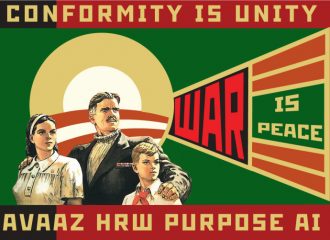 Cory Morningstar has exposed the pro-NATO global political agenda of organizations like US based organizations like Avaaz and Purpose. In the case of Global Witness, their Board member Jessie Tolka is also a board member of Purpose and too of 350.org: Current Global Witness CEO Gillian Caldwell was also a very successful Campaigns Director of Sky1, now merged into 350.0rg. Cory Morningstar argues, “the most vital purpose of the non-profit industrial complex (NPIC) has not been to destroy the ecocidal economic system that enslaves us while perpetuating and ensuring infinite wars. Rather, the key purpose of the NPIC is and has always been to protect this very system it purports to oppose from being dismantled. Hence the trillions of dollars pumped into the NPIC by the establishment.”
Confirmation of Cory Morningstar’s argument can be found in the history of Global Witness itself. For example on Libya, despite their superficial anti-corporate gloss, Global Witness relentlessly apply NATO country government criteria here and here. Also on Ukraine, Global Witness project the same anti-corporate message while simultaneously reinforcing NATO country government propaganda. Global Witness has also received US National Endowment for Democracy grants in Cambodia and in Liberia.
Also, a decade ago, writers Keith Harmon Snow and Rick Hines questioned Global Witness’ corporate links in relation to the “Blood Diamonds” controversy and the organization’s role in relation to De Beers and also Maurice Templesman’s diamond companies. No doubt more thorough research would reveal information casting similar doubt on Global Witness’s integrity and independence.
Conclusion
This latest Global Witness report in relation to Nicaragua is important because it is so readily falsifiable. It thus presents a clear litmus test: no news and information media can use the Global Witness report’s material in relation to Nicaragua without compromising their credibility.
The bias and inaccuracies in the section on Nicaragua in the Global Witness 2017 report call into doubt the integrity of the whole report. No news or information media interested in accuracy or honest reporting can conscientiously rely on Global Witness as a source without thorough cross checking and systematically comparing, contrasting and evaluating information from sources giving a different account of the events and issues in question.
Global Witness is neither independent nor trustworthy. It clearly has a strong but unacknowledged neocolonial political agenda promoting the regional policy goals of NATO country governments, while, conversely, attacking governments and other regional actors opposed to those goals.
NGOs like Global Witness, International Crisis Group, Human Rights Watch, Transparency International and so many others, self-evidently fabricate psychological warfare inputs serving NATO country government policy, itself shaped by the same corporate elites that fund the class of NGOS of which Global Witness is a part.
They operate as the soft, extramural arm of NATO country governments’ foreign policy psychological warfare offensives, targeting liberal and progressive audiences to ensure their acquiescence in overseas aggression and intimidation against governments and movements targeted by NATO. To that end, they deceitfully exploit liberal and progressive susceptibilities in relation to environmental, humanitarian and human rights issues.
Their psychological warfare role supporting the NATO government’s aggressive destabilization of Ivory Coast, Libya and Syria in 2011, of Ukraine in 2014, and the NATO country government’s low intensity war against Venezuela ever since 2013, as well as the campaign against Cuba over five decades, has been unmistakable.
More broadly their systemic ideological role is very obviously to protect and defend global corporate capitalism while superficially and selectively questioning and criticizing some of its worst abuses. Cory Morningstar’s insight bears repeating “the key purpose of the non-profit industrial complex is and has always been to protect this very system it purports to oppose”.
The coverage of Nicaragua in the latest 2017 Global Witness report is a text book example of that sinister fact.
The Upcoming Nicaraguan Election Will Be a Test
By Nil NIKANDROV | Strategic Culture Foundation | 19.08.2016
After three Americans from the US embassy were accused of espionage and tossed out of Nicaragua, a protest was lodged in Managua against this «unwarranted» decision, and the Nicaraguan government was warned that the relationship between the two countries would suffer inevitable damage in tourism, trade, and investment from the US. The State Department issued notice that Americans might face threats in Nicaragua. The war of propaganda waged against Daniel Ortega’s regime has become so ferocious that political commentators are drawing conclusions about Washington’s plans to «end the dictatorship» in Nicaragua once and for all.
The Democratic Initiative of Spain and the Americas (IDEA), an international forum, was created in April of 2015 in order to launch attacks on Ortega and other Latin American «populist» leaders, and Washington was responsible for choosing its members: the chosen favorites include – Álvaro Uribe of Colombia, Alejandro Toledo of Peru, Lucio Gutiérrez of Ecuador, Felipe Calderón of Mexico, Óscar Arias of Costa Rica, José María Aznar of Spain, and others. These politicians work closely with the United States and continue to defer to Washington, even after leaving office.
IDEA released a statement in August that was highly critical of Nicaragua and which reads like something out of the Cold War: «The international community finds the violation of the democratic system in Nicaragua so worrisome that the former Ibero-American heads of state and of government have decided to ask the OAS and the EU to maintain critical oversight of these serious violations of democratic and constitutional order». And it goes on to say that statements by the members of IDEA «may be preceded by certain political and diplomatic actions, as provided by international law … in order to defend democracy and reestablish it where it has been compromised, as in the current example of Nicaragua».
In its attacks on the Nicaraguan government, the US National Security Agency uses materials obtained over the course of years of electronic surveillance of President Ortega, as well as his family and inner circle. Its deft use of such materials makes it possible to circulate all sorts of drivel that is designed to defame politicians who have been marked for public retaliation. Almost every «populist bloc» leader in Latin America is currently up against such cheap shots – Inácio Lula da Silva, Dilma Rousseff, Cristina Fernández de Kirchner, Rafael Correa, Nicolás Maduro, Evo Morales, and others.
Daniel Ortega has led his country for 13 years. He has been elected three times: in 1985, 2006, and 2012, and no one is predicting that he will have any opponents in the upcoming Nov. 6 election. Ortega’s political rivals are feuding amongst themselves. Despite the behind-the-scenes efforts of the US embassy, is has not been possible to consolidate the opposition in the run-up to the election. For this reason, the US has launched a blitzkrieg of propaganda against Daniel Ortega, his wife Rosario Murillo, and their grown children. The leitmotif of these «revelations» is a familiar one – some hogwash about the abuse of power, corruption, multi-million-dollar accounts in overseas banks, and the ownership of foreign real estate. The US continues to harp on the supposed parallels with the family of the dictator Anastasio Somoza; «Somoza García amassed a huge fortune, making him and his family some of the richest people in all of Latin America. By the time of his death in 1956 he left his children $200 million, which they managed to triple within a few years. His son, Anastasio Somoza DeBayle, owned 130 real estate holdings, as well as estates, residences, and tracts of land. He was owner of an airline (Líneas Aéreas de Nicaragua), a television station (Televisora de Nicaragua), the San Uribe and San Albino gold mines, and more».
One might well ask, what does Somoza’s wealth have to do with Ortega and his family? Nevertheless, the author of the article writes: «As is usual for totalitarian regimes of the past, there is no reliable information about the finances of the Nicaraguan president and his wife. That knotty question is top secret». Although there is no «reliable information», he goes on to claim that the family owns the Distribuidora Nicaragüense de Petróleos chain of gas stations, plus media outlets including four TV channels, radio stations, newspapers, websites, etc. In addition, Ortega has control over the project to build a transoceanic canal that would link the Pacific and Atlantic oceans, the cost of which is estimated at $50 billion. That mega-project has the backing of the Chinese entrepreneur Wang Jing.
Naturally of course the Chinese-Nicaraguan canal mega-project was met with hostility by Washington. They don’t want anything competing with the updated Panama Canal. And as for the company Distribuidora Nicaragüense de Petróleos, that is a model for energy-sector cooperation between Venezuela and Nicaragua – not some private racket that is allegedly being used by Ortega’s friends for their personal enrichment.
During the years when the Sandinistas were in the opposition, Ortega was constantly faced with the problem of getting access to the media. His attempts to communicate his views to the public invariably ran up against an information boycott. But now the situation has changed drastically. Ortega has turned the tide to his own advantage. The government controls hundreds of Internet websites, as well as the news services Nicaragua Triunfa and Nicaragua Comovamos. Dozens of provincial radio stations work on the side of the government, as do influential national stations like Radio Sandino, La Nueva Radio Ya, Radio Nicaragua, and Radio Primerísima. The work of the government and the president gets favorable coverage by TV channels that are managed by members of the Ortega family – Canal 13, Multinoticias Canal 4, Canal 8, and Telenica Canal 10. The pro-government channels also include Canal 23, Canal Extra Plus, 100 % Noticias, and others. None of the «leftist» Latin American presidents enjoy such an effective mouthpiece for information and propaganda as Ortega.
Yet despite the accusations that it is a dictatorship, the country has no censorship restrictions. The opposition and, consequently, the US embassy have every opportunity to proselytize there. Popular newspapers like La Prensa and El Nuevo Diario and the weekly Confidencial are employed with particular vigor toward this goal. Ortega responds immediately, using fiercely anti-imperialist and anti-American terminology. Nor does he keep silent when Washington directs attacks against Nicaragua’s allies. Ortega’s speeches in support of Russia, Cuba, and friendly governments in Ecuador, Bolivia, and other countries resonate far and wide.
The ideological underpinnings of Ortega’s international policy have remained unchanged throughout recent years: they consist of a fundamental rejection of American hegemony, coupled with patriotism, nationalism, and «socialism with a Nicaraguan face», plus support for the Latin American path to a true people’s democracy. This 70-year-old politician has never altered his revolutionary convictions. That said however, he is a flexible strategist who understands that a superpower can strike at any time and that the US is still unpredictable and dangerous. As the leader of a small country he has no choice but to maneuver, and he manages to do so without compromising his principles.
In December 2015 the CIA launched into yet another act of provocation against Nicaragua. Under the influence of inflammatory media reports about the Obama administration’s possible suspension of the preferential treatment Cuban migrants receive upon entering the US, hundreds rushed to emigrate from that island nation. The route suggested by the «well-wishers» from Miami: first by air from Havana to Ecuador (no visa needed), then by bus across several borders into Mexico, and from there into the US. Nothing to worry about, or so it would seem. However, Nicaraguan counter-intelligence got its hands on some information about CIA plans to use those migrants to stir things up. After arriving in Nicaragua from Costa Rica, their onward path – through Honduras, Guatemala, and Mexico – was to be closed, and the Cuban migrants would find themselves stranded in Nicaragua for a long time. As envisioned by the CIA, they were supposed to be the fuse to the ticking bomb of the country’s destabilization. Therefore, Daniel Ortega’s decision was emphatic: there should be no back doors, and the ones who came up with the whole migrant scheme should be the ones to deal with the mess! Demands that the migrants be admitted were hurled at that «inhumane regime» from all manner of human rights organizations patronized by American foundations. The members of the Central American Integration System (SICA) went public with their criticism of Ortega’s decision. The migrants themselves, as if on cue, tried to crash through the Nicaraguan border, with children and pregnant women planted in their forward ranks. The Nicaraguan government needed time to force the fugitives into Costa Rica. Tensions eased by February-March 2016. Ortega’s government refused to be blackmailed, and Washington had to quietly furnish its ally Costa Rica with financial assistance in order to provide for the migrants and evacuate them by air…
As the date of the Nicaraguan presidential election nears, new acts of provocation should be expected from US intelligence agencies and the American embassy. Ambassador Laura Dogu works assiduously with the Nicaraguan business community, persuading them that the ongoing Sandinista administration and its policy of «socialism with a Nicaraguan face» can only hurt their business interests.
The US embassy has conspicuously stepped up its work with the media and activists from NGOs and indigenous organizations, as well as the country’s youth. US intelligence agencies, diplomats, staffers with USAID (which is in reality a branch of the CIA), and Peace Corps volunteers are pinning their main hopes on Nicaragua’s youth, viewing that demographic as the most promising in the struggle against the Nicaraguan regime.
The Constitution offers no barriers to President Ortega’s reelection. He has been accused of taking control of executive, legislative, and judicial power, but the main factor ensuring his re-election is his broad popular support, which Ortega enjoys thanks to the social programs established during his years in office. Despite his socialist, anti-imperialist views, the president has many supporters in the country’s business community.
The November election forecasts don’t look too auspicious for the conspirators in the US embassy: Daniel Ortega is once again going to be elected president.
Venezuela, Cuba, Nicaragua – Permanent Media False Positives
TeleSUR | July 11, 2016
Member countries of the Bolivarian Alliance of the Americas are natural targets for the relentless psychological warfare of Western news media, because they form a resistance front to the foreign policy imperatives of the United States government and its allies. Right now, Venezuela is the most obvious example. Daily negative coverage in Western media reports invariably attack and blame the Venezuelan government for the country’s political and economic crisis. Similar coverage is applied to the governments of Evo Morales in Bolivia, Rafael Correa in Ecuador, Cuba’s revolutionary government led by Raul Castro and also to Nicaragua’s Sandinista government led by Daniel Ortega.
By contrast, the permanent economic sabotage, the attacks on democratic process and the cynical promotion of violence by the dysfunctional Venezuelan opposition gets a free pass. Likewise, U.S. and European news media have virtually nothing to report about Argentina’s abrupt plunge into crisis with 40 percent inflation and a dramatic increase in poverty after barely six months of Mauricio Macri’s corruption tainted government. Nor has coverage of the chronic complicity of the Mexican government in covering up the disappearance of of the 43 Ayotzinapa students or the mass murder of striking teachers in Oaxaca matched the hysteria applied by Western media to Venezuela over bogus human rights concerns.
No doubt political scientists could work out the correlation between adverse or downright hostile media coverage and official measures or announcements by U.S. and allied governments. What’s clear in general is that Western media coverage actively and purposefully serves U.S. and allied government foreign policy preparing the ground for otherwise categorically inexplicable measures of diplomatic and economic aggression. For example, the self-evidently absurd declaration by President Obama that Venezuela constitutes a threat to the security of the United States or the anti-humanitarian failure of the U.S. government to lift the illegal economic blockade of Cuba despite President Obama’s duplicitous avowals recognizing the blockade’s political failure.
Venezuela and Cuba are close, loyal allies of Nicaragua, now in an election year. Nicaragua’s Sandinista government has faced a Western media assault over the last month or so with the U.S. government issuing a travel alert. The alert warns U.S. travelers to Nicaragua to be wary of “increased government scrutiny of foreigners’ activities, new requirements for volunteer groups, and the potential for demonstrations during the upcoming election season in Nicaragua…. U.S. citizens in Nicaragua should be aware of heightened sensitivity by Nicaraguan officials to certain subjects or activities, including: elections, the proposed inter-oceanic canal, volunteer or charitable visits, topics deemed sensitive by or critical of the government.” In a video mixed message about that alert, the U.S. Ambassador to the country, Laura Dogu, states that the advisory should in no way deter tourists from the United States visiting Nicaragua.
The travel alert appears to have been provoked by the experiences of a U.S. academic and also two U.S. government functionaries who were asked by the Nicaraguan authorities to leave the country in June. The official U.S. reaction has a lot in common with the mentality described in “Orientalism,” Edward Said’s intricate psycho-cultural map of Western perceptions of Muslim countries. Said writes, “The scientist, the scholar, the missionary, the trader or the soldier was in or thought about the Orient because he could be there or could think about it with very little resistance on the Orient’s part.” Translated to the Americas, the attitudes and behavior of Said’s orientalist are clearly present among U.S. Americanists, both governmental and non-governmental, and their regional collaborators.
The latest example of Americanist hubris here in Nicaragua has been a remarkably unscholarly outburst by Evan Ellis, the professor of the U.S. College of War who was expelled by the Nicaraguan government while attempting an unauthorized investigation of Nicaragua’s proposed interoceanic canal. Ellis’ ill-tempered diatribe repeats a familiar litany of downright falsehoods, wild speculation and poisonous calumnies, attacking Nicaragua’s Sandinista government led by Daniel Ortega as a dictatorship. It appeared in Latin America Goes Global, closely associated with the center right Project Syndicate media network. Project Syndicate lists among its associate media right-wing media outlets like Clarin and La Nación in Argentina, Folha de Sao Paulo and O Globo in Brazil and El Nacional in Venezuela.
So it is no surprise that in Nicaragua its associate media outlet should be the virulently anti-Sandinista Confidencial, which published the Spanish version of Ellis’s attack, making Ellis’ accusations of dictatorship look stupid. Addressing Chinese involvement in Nicaragua’s proposed interoceanic canal, Ellis displays his ignorance of Nicaragua’s relationship with both China and Taiwan. His tendentious, ahistorical analysis betrays the mentality of an unreconstructed Cold Warrior in all its inglorious torpor. That ideological straitjacket prevents Ellis from even beginning to appreciate Daniel Ortega’s hard-headed but deep commitment to promoting peace and reconciliation based on genuine dialog. Western political leaders and their media and academic shills perceive that commitment as a sign of weakness, which explains a great deal about repeated failures of Western foreign policy all around the world.
Around the same time as the Ellis affair, Viridiana Ríos a Mexican academic associated with the U.S. Woodrow Wilson Center left Nicaragua claiming police persecution. Ríos entered Nicaragua as a tourist but then proceeded to carry out a program of interviews with various institutions for her academic research. The curious thing about her claims is that she was never actually interviewed by any Nicaraguan official, either of the police or the immigration service. But she claims her hotel alerted her to a visit by police, in fact if it happened at all more likely immigration officials, who presumably left satisfied because otherwise she would certainly have been interviewed. Ríos then supposedly contacted the Mexican embassy who allegedly and inexplicably advised her to leave for Mexico. The upshot is that Ríos visited Nicaragua only to suddenly fear, for no obvious reason, being disappeared by government officials who could easily have detained her had they so wished. Rios then, with no complications, left Nicaragua, the safest country in the Americas along with Canada and Chile, and went home to Mexico, a country with 28,000 disappeared people.
Around the same time, as the reports about Ellis and Ríos, the Guardian published a disinformation scatter-gun attack on the Nicaraguan government also firming up the false positive of Nicaragua under Daniel Ortega’s presidency as a dictatorship. The dictatorship accusations are complete baloney. Neither Ellis nor the Guardian report faithfully that even center-right polling companies agree that support for Daniel Ortega and his Sandinista political party runs at over 60 percent of people surveyed while the political opposition barely muster 10 percent support. Similar polls show massive confidence in both the police (74 percent ), the army (79.8 percent) and satisfaction with Nicaragua’s democracy (73.9 percent). Another common theme in the attacks by Ellis and the Guardian is the supposed suspension of the construction of Nicaragua’s planned interoceanic canal, based on yet another false positive -the bogus hypothesis that the canal has no finance.
The basis for this claim is sheer speculation based on the afterwards-equals-because fallacy, typified by another unscrupulous and disingenuous Guardian article from November 2015 offering zero factual support for the claim that the Canal ‘s construction has been postponed for financial reasons. That report and numerous others reflect the outright dishonesty of the Canal’s critics. From the outset the canal’s critics accused the government and HKND, the Chinese company building the canal, of moving too quickly and failing to take into account environmental concerns and also for an alleged lack of transparency. When the government and the HKND took on board recommendations from the ERM environmental impact study to do more environmental studies, the Canal’s critics changed tack, accusing the government of covering up that the Canal has been delayed because HKND has run out of money. That claim seems to originate in Western psy-warfare outlets in Asia like the South China Morning Post and the Bangkok Post which have consistently run attack pieces on HKND’s owner, Wang Jing.
This standard operating intellectual dishonesty by NATO psy-warfare outlets like the Guardian, omits various inconvenient facts. For example, preparatory work on the Canal route continues with various studies in progress, including aerial surveys by an Australian company, one of whose pilots, Canadian Grant Atkinson tragically died in a crash late last year. This year, the government reached a conclusive agreement with local indigenous groups affected by the Canal after an extensive process of consultation. This year too, Nicaragua has signed a memorandum of understanding with Antwerp’s Maritime Academy to train the pilots who will guide shipping through the Canal and also a cooperation agreement with the UK Hydrographic Office for training and advice in relation to the hydrographic maps the Canal will need. This is hardly the behavior of people managing a project in crisis. That said, the global economic environment right now is so uncertain that investors in any large project let alone one as huge as the Nicaraguan Canal will certainly be wary.
The global economic context and the Canal’s geostrategic aspect receive a more rational treatment than Ellis’ self-serving rant in an article by Nil Nikandrov. Even Nikandrov seems to accept as fact the Guardian’s entirely speculative claim that the Canal’s financing is in crisis, but he rightly treats Ellis’s Cold War style anti-Sandinista hysteria with amused scepticism. In fact, neither Nikandrov nor Ellis make the obvious point that the strongest geostrategic reality in relation to the Canal is that, should U.S.-China tensions in the South China Sea accentuate into outright confrontation, China could not defend militarily the strong investment by Chinese companies in Nicaragua’s Canal. In any case, Nikandrov, rightly points out with regard to Nicaragua’s economy, “Nicaragua’s socioeconomic progress, Nicaraguans’ improved standard of living, and the stability and security there (compared to the increase in crime in most Central American countries) can all largely be credited to President Ortega.”
But even that reality can be turned on its head in the hands of a butterfly columnist as Bloomberg’s Mac Margolis demonstrated in his July 4 article “Nicaragua Prospers Under an Ex-Guerrilla.” Just for a change Bloomberg’s editors omitted their trademark “unexpectedly”, usually slipped in to any headline reporting unpalatable news. But the premier U.S. business news site could only finally recognize the incredible progress achieved by Daniel Ortega’s Sandinista government by at the same time smearing and denigrating President Ortega in the process. On the positive side Margolis recognizes, “the Nicaraguan economy grew 4.9 percent last year and has averaged 5.2 percent for the last five. Although three in 10 Nicaraguans are poor, unemployment and inflation are low. Public sector debt is a modest 2.2 percent of gross domestic product.”
That apart, Margolis writes, “Ortega’s critics know a darker side. Consider the ever-accommodating Nicaraguan Supreme Court, which last week deposed opposition leader Eduardo Montealegre as head of the Independent Liberal Party – essentially clearing the way for Ortega to run unchallenged in the November elections.” This is identical to the dishonest argument in Nina Lakhani’s Guardian article. Montealegre’s PLI had around 3 percent support, under the new PLI leader that seems to have crept up to around 5 percent. The Supreme Court decision made no difference to the fact that Nicaragua’s political opposition has been incapable of a serious electoral challenge to Daniel Ortega since before the last elections in 2011. Since then Daniel Ortega’s popularity has grown while support for the Nicaraguan opposition has collapsed. Implicitly contradicting himself, Margolis acknowledges that fact but goes on to make speculative, fact-free accusations of corruption, directly in relation to Nicaragua’s proposed Canal.
Without being specific he hints at widespread opposition to the Canal in Nicaragua, writing “a shadowy project that Ortega farmed out to Chinese investors led by billionaire Wang Jing. Ground has yet to be broken on the US$50 billion development, but Nicaraguans have raised a stink over the lavishly generous terms of the deal”. While opposition to the Canal certainly does exist, 73 percent of people in Nicaragua support it. Evan Ellis mentions an alleged opposition demonstration of 400,000 people, which is simply untrue. The biggest demonstration against the Canal drew about 40,000 people back in 2014 when Nicaragua’s political opposition bussed people to a march from all over the country. Plenty of information is available about the Canal and Margolis has no facts to back up his baseless accusation of corruption “I’d wager a fistful of Nicaraguan córdobas that ‘Presidente-Comandante Daniel’ has something he’s uneager to share.”
Only the crass Americanist mind set could provoke such presumptuous contempt for the opinion of the great majority of Nicaraguans. Margolis really seems to believe Nicaraguans are so stupid as to support a President who he alleges is self-evidently corrupt. In fact, Margolis’ discredited protagonist, Eduardo Montealegre, has precisely the kind of corruption tainted track record so familiar from the U.S. government deregulation of Wall Street. Montealegre was the Nicaraguan Treasury Minister under a U.S. supported right wing government and oversaw a massive bailout of Nicaragua’s rotten banking system from which his own bank benefited directly at the time. Perfectly natural then for a Bloomberg columnist to highlight Montealegre while attacking Daniel Ortega who rescued Nicaragua from precisely that culture of abject corruption. This banal irrational attack on Daniel Ortega deliberately obscures the reasons for Nicaragua’s economic success, which shows up current US and European economic policy as faith based nonsense.
Domestically, President Ortega has prioritized poverty reduction, implementing very successful socialist redistributive policies and extensive infrastructure development. Overseas, his Sandinista government has dramatically diversified commercial and development cooperation relationships, in particular structuring Venezuela’s aid in a way equivalent to deficit spending, whose success contrasts sharply with the mindless futility of current Western economic policy. Contradicting the Bloomberg article, Nil Nikandrov is much closer to reality when he writes that Ortega is, “a faithful defender of Nicaragua’s interests on the international stage and enjoys the support of the vast majority of Nicaraguans.” As the NATO country psychological warfare media crank up their attacks on Nicaragua in an election year, it remains to be seen whether Nikandrov is right when he argues, “the subversive activities of the U.S. intelligence services and their ‘strategy of chaos’ will not work in Nicaragua.”
Nicaragua’s Canal: A Socialist Project for Economic Change
Tortilla Con Sal | July 29, 2015
The fundamental argument in favor of Nicaragua’s Interoceanic Canal is that it will change the structure of Nicaragua’s economy in such a way as to dramatically reduce poverty and so enable a reversal of the current destructive national and regional trends of impoverishment-driven environmental depredation.
Progressive and radical opinion in North America and Europe tends to skew discussion towards the Canal’s alleged potential environmental effects, generally ignoring both the urgent economic imperative of poverty reduction and the Canal’s wider regional and global significance.
The environmental argument in favor of the Canal is usually met with perplexed scepticism, blank incomprehension or, very often, deliberate misrepresentation.
Like almost all the articles that have criticized Nicaragua’s Canal, Truth Out’s recent article by Thomas J Scott,“Nicaragua’s Flirtation With Environmental Disaster” focuses largely on the Canal’s environmental aspects while omitting Nicaragua’s fundamental dilemma, one typical of impoverished countries. Namely, Nicaragua’s environmental sustainability requires significant new economic resources in the short term so as to reverse decades of poverty driven deforestation, contamination and inadequate water management.
Only massive structural investment in the economy will provide those resources. Some environmental impact from that level of investment is inevitable. But the resources generated by the investment will more than compensate for the initial limited local environmental impact by generating enough resources to finally enable adequate environmental recovery programs. Addressing environmental concerns, Thomas J. Scott’s account relies narrowly on other ideologically compromised media outlets highly critical of the Canal.
In doing so, Scott not only marginalizes the Canal’s fundamental economic logic, he also gets basic facts wrong.
Environment
Scott’s Truth Out article asserts, for example, that 120,000 people may be displaced by the Canal. That is completely untrue. The actual figure is around 7,000 families amounting to around 35,000 people along the Canal’s 275 kilometre length. Scott also asserts that the indigenous Rama-Kriol group may lose 40% of their land, referring to a negotiation process yet to be completed, a fact which undermines the very basis of the claim brought before the International Commission for Human Rights by the group’s lawyers, alleging lack of consultation. Similarly, Scott cites various environmental and scientific opinions against the Canal but fails to put them in context.
For example, he uncritically quotes a supposedly scientific calculation that up to a million acres of rainforest and wetlands could be destroyed by the Canal. Even a cursory look at that claim shows how nonsensical it is. The Canal is 278 kilometres long of which about 23km run from the Pacific Coast north of San Juan del Sur to Lake Nicaragua, known here as Lake Cocibolca. Then, 105km of the Canal route run across Lake Cocibolca. None of that part of the Canal or its related sub-projects affect any rainforest or wetlands, leaving 150km from the area of San Miguelito on the eastern edge of the lake to Punto Aguilar on the Caribbean coast.
Much of the area between San Miguelito and Punto Aguilar is already intervened by agricultural cultivation and cattle ranching and by often illicit timber activity. Here, the total area affected by the construction of the Canal itself is certainly not greater than about 150 square kilometres, equivalent to 37,500 acres. To guarantee adequate water for the canal and improve the region’s water management, an artificial lake will be created of about 395 square kilometres, equivalent to 98,750 acres. So the total affected land area of the Canal in this part of Nicaragua will be around 136,250 acres.
Even if one overstates that 70%-75% of that affected land area is vulnerable wetlands or forest, the total such area affected will be around 100,000 acres, equivalent to about 40,000 hectares, around one tenth of the area of one million acres mentioned by Scott in his article. The canal runs well south of the hugely important Bosawas reserve and well north of the equally important Indio Maiz reserve. Much smaller reserves like Cerro Silva may be directly affected, but these reserves are already suffering significant deforestation and contamination at the hands of the local population.
The canal projects have to reforest more than the forest it will displace over the five year period of its main construction, because the Canal depends on water conservation to be able to operate.
Currently Nicaragua is losing 65,000 to 70,000 hectares of forest a year to agricultural cultivation, cattle ranching and illicit timber felling. Under-resourced, government promoted reforestation programs only replace around 15,000 hectares a year
None of this information appears in Scott’s account in Truth Out or other similar anti-Canal reports. It puts in context the outrageous, nonsensical claim that a million acres of pristine rainforest may be destroyed by the project. It also highlights the truly urgent nature of Nicaragua’s environmental and economic dilemma.
The same is true in relation to the exaggerated claims that Lake Cocibolca may be destroyed by the huge dredging the project entails. The lake is already contaminated and suffering heavy sedimentation. But that information too is omitted from Truth Out, which alleges “The possibility the HKND environmental protection plan will mitigate the scientists’ concerns is questionable, given the scale and complexity of the project.” In fact, far more questionable is the wild speculation clearly underlying those often ideologically motivated scientists’ concerns and their own misleading interpretations of inadequate data.
The canal’s pre-feasibility studies by a Dutch company began in January 2013 and lasted six months. The complete feasibility studies by international specialist companies lasted 23 months from July 2013 until May 2015. The cost of these studies over almost two and a half years has been well over US$150 million. The canal company HKND puts the figure at around US$200 million.
By contrast, the environmental scientists critical of the canal can marshal no data remotely equivalent to these substantial, large scale, detailed, highly resource intensive and very expensive studies.
In any case, as the planning process for the canal has progressed, legitimate, relevant environmental concerns have indeed been taken into account. For example, the location of the proposed deep water port on the Pacific Coast has been moved so as to minimize damage to local mangroves. The final precise route of the Canal has been subject to similar change. So it is far from true that environmental and other concerns in relation to the Canal have not been heeded. But that fact too is completely missing from Truth Out’s article.
Politics and geopolitics
Shifting from the environment to political analysis, Scott’s article makes the completely ahistorical assertion that “Sandino led an armed resistance movement against US plans to build a canal in 1927.” Sandino campaign was not against US plans to build a canal in 1927. The US government had no plans to build a canal in Nicaragua in 1927. Sandino’s guerrilla was was very clearly and overwhelmingly against the US imperialist military occupation of his country. The US government already controlled and occupied the Panama Canal zone, invading Nicaragua only so as to consolidate its regional political and economic domination.
In his manifesto “The Supreme Dream of Bolivar”, Sandino himself wrote, “nothing is more logical, nothing more decisive and vital than the union of the twenty-one states of our America into a single unique Latin American Nationality, which may make possible, as an immediate consequence, the right to the route of an Inter-oceanic Canal through Central America.” The US military occupation of Nicaragua vetoed that right. In his Truth Out article, Scott himself proceeds to row back from his incorrect, ahistorical assertion ending up suggesting that critics of the canal have legitimate concerns about Chinese imperialism in Nicaragua.
But most of those same critics are people bought and paid for by US government money in one form or another. Right-wing opposition to the Canal comes from politicians who are explicit allies of the United States government. Currently those politicians and their political parties have around 8% support nationally. Social democrat opposition to the Canal comes from ex-Sandinista politicians now closely identified with US government and European Union policy. They currently enjoy under 1% support nationally. These critics have zero credibility when they express their clearly hypocritical concerns about Nicaragua’s sovereignty in relation to growing Chinese influence.
Nicaragua’s sovereignty over the canal and the rights of its population are protected by the legislation for the Canal and its sub- projects which place the overall project under the control of a government Commission. The government’s Minister for National Policy, has explained, “The incentives have to be strong because Nicaragua isn’t giving a sovereign guarantee….. After 50 years Nicaragua will already have 50% of the profits from the Canal. Then in the second 50 years the share goes up 60%, 70%, 80%, 90%. Finally Nicaragua will take over after benefiting by over 50% for 50 years. While considerable, that benefit is tiny compared to doubling the economy, and reducing poverty.”
Not only do decisions in relation to the canal have to be authorized by the government, but ownership of the Canal’s business will pass progressively to the Nicaraguan government on an already agreed schedule.
Scott’s inaccurate and misleading analysis of the canal and of the national context in Nicaragua extends equally to his article’s geopolitical analysis. He manages to write his article without once mentioning ALBA, the Community of Latin American and Caribbean States, or Mercosur. Scott completely ignores the diverse tensions between the Pacific Alliance countries (Chile, Colombia, Mexico and Peru) and their ALBA and Mercosur counterparts. Nor do US sponsored supra-national trade structures like the Trans Pacific Partnership and the Trans Atlantic Trade and Investment Partnership figure in their extremely superficial report.
But all of these are extremely and immediately relevant in any serious discussion of China’s growing world role, especially in Latin America and especially in relation to Nicaragua’s Interoceanic Canal. Perhaps the most astonishing omission in the Truth Out article’s geopolitical sketch of the meaning of Nicaragua’s Canal is the absence of China’s alliance with Russia India, Brazil and South Africa, in building a multipolar world. Scott still seems deeply invested in the long since discredited idea of Western, especially US, political, economic and moral global leadership.
The inaccuracies, falsehoods and omissions of Thomas J. Scott’s article about Nicaragua’s Canal are symptomatic of that intellectual and political narcissism, placing the US and its concerns at the center of every world trend.
In fact, the US government is increasingly losing influence in Latin America and the rest of the world as a result of its absurdly inept, aggressive foreign policy. Neither the US government nor its European Union allies have anything to offer countries like Nicaragua beyond the old neocolonial traps of onerous debt, inequitable trade and meager development aid.
The fundamental question Western progressives never pose, let alone answer, when criticizing the Interoceanic Canal is how Nicaragua will otherwise generate the enormous resources it needs to end looming poverty-driven environmental disaster. The Sandinista government has taken the strategic sovereign decision to prioritize the Interoceanic Canal so as to achieve the massive structural investment it needs in the short term to break out of low wage under-development. The decision itself is grounded in the vision of Simón Bolivar, one explicitly fought for by Sandino, of Latin American integration.
This vision underlies the Sandinistas’ historic program of political pluralism, a mixed economy and a non-aligned foreign policy. Inherently and necessarily, Nicaragua’s Canal is not just a national project but rather one that will multiply benefits in Central America and the Caribbean, generating trade and investment throughout the region. Likewise, in the global environmental picture, the Canal will encourage maritime shipping over air transport by shortening voyages. A study of the Nicaraguan Interoceanic Canal by Hong Kong academics argues, “Maritime transport will become more dominant in international trade by taking over from the air transport. To further take advantage of the low carbon opportunities, the shipping liners will use larger vessels and enjoy economies of scale for both economic and environmental benefits, while the hub and spoke system will be chosen to maximize the operation efficiency.”
In summary, the Nicaraguan Canal is a strategic national, regional and global development project based on the historic socialist program of Nicaragua’s Sandinista government. That program develops in harmony with the anti-imperialist vision of regional integration promoted by Nicaragua’s ALBA partners led by Cuba and Venezuela in the context of developing policy embodied in CELAC, where the US and Canada have neither voice nor vote. Primarily, Nicaragua’s Interoceanic Canal project is designed to resolve the threat posed to national environmental sustainability by the economy’s current slow incremental economic development. But the Canal will also contribute to resolving that wider environmental dilemma regionally and globally. It is an integral part of the changing pattern of global seaborne trade and the infrastructure needed for that change in a multipolar world. This process and its respective outcomes are under way now with or without the say so of the United States and its Western allies and regardless of ill-informed, inaccurate and misleading propaganda from Western neocolonial media.
Lessons from Libya’s Destruction
Tortilla Con Sal | July 9, 2015
Later this month the outcome is expected of the completely unjust and incompetent show trials held in Libya over the last year or so of around 200 former officials of the Libyan Jamahiriya. If that outcome is reported at all in North American and European media, its real meaning will be completely hidden in self-serving apologetics for NATO’s destruction of Libya in 2011.
The same psy-warfare framework that justified NATO’s campaign of terrorist aggression will falsely present the show trials’ outcome as rough justice dealt out to individuals who deserve no better.
That outcome should put on high alert anyone defending the countries of the Bolivarian Alliance of the Americas against very similar psychological warfare and terrorist subversion supported by NATO governments of the US and its allies. Not for nothing did Hugo Chávez and Daniel Ortega speak out in defense of Muammar al Gaddhafi and Libya against NATO’s terrorist war. They had already learned long ago the very same lessons to have emerged more recently from the utterly depressing human, moral and political catastrophe of Libya’s destruction.
In 2013, a study by a distinguished Harvard University academic acknowledged that the failure in Libya of the US government’s ostensible avowed policy in Libya and in North and West Africa was based on serial falsehoods. That fact-based, acerbic policy criticism from a source generally supportive of US government foreign policy should give much pause for thought. Along with support for Libya from outstanding revolutionary leaders like Ortega, Chavez and Nelson Mandela it amounts to a categorical indictment of received Western opinion about Libya which, across virtually the entire Western political spectrum, sided either openly or indirectly with NATO’s 2011 war.
No one genuinely concerned to defend progress towards an equitable, peaceful multi-polar world based on mutual respect between sovereign, autonomous nations and peoples should underestimate or forget the horror of what NATO did to Libya. Tens of thousands were killed and wounded in attacks by the bombers and helicopters of many NATO countries. Millions were displaced or forced into exile. Cities like Sirte and Bani Walid were devastated. Schools, universities, hospitals, factories producing food products and other essential civilian infrastructure were targeted and severely damaged or destroyed.
The destruction of Libya marked the categorical abandonment of whatever vestigial moral authority may still have remained to the European Union and its member governments.
It demonstrated in the most humiliating way the impotence and irrelevance of the African Union.
It put hard questions about the anti-imperialism of the Iranian and Syrian governments as well as highlighting the race supremacism of the governments of the Arab League and the already damaged integrity of the Palestinian authorities.
Almost all of them quickly recognized the overtly racist renegade Libyan CNT junta. For their part, the then governments of Russia and China weakly accepted NATO country assurances about the defensive nature of the air exclusion zone.
The only governments to emerge with any real credit from the destruction of Libya were the governments of the ALBA countries and a few African governments like Zimbabwe.
Countries like Cuba, Venezuela, Argentina, Nicaragua, Bolivia and Ecuador have all been victims of comprehensive disinformation campaigns of demonization and caricature, although perhaps not so extreme as the final campaign against Libya’s Jamahiriya and Muammar al Gaddhafi.
It is worth considering the basic component of that disinformation war against Libya. What is sometimes called 4th generation warfare is as old as warfare itself. Like Athens versus Sparta, or Rome versus Carthage the fundamental objective of NATO governments and their allies is to make their chosen target seem Other, creating a despised, outcast doppelganger anti-image of the West’s own phony self-image.
So Libya’s Jamahiriya was tagged as undemocratic by hypocritical Western governments, most of whom came to power with around just 20% to 25% of the vote of their electorates, thanks overwhelmingly to elite corporate funding. Libya’s democratic process was one that recognized its society’s contradictions and attempted continual self-renewal.
By contrast, the Western corporate oligarchies offer virtually meaningless periodic elections obfuscated by public relations and organized on a yes-or-yes basis to favor politicians groomed and bankrolled by their countries’ anti-democratic elites. Muammar al Ghaddafi was labeled a dictator even though his policy initiatives were not infrequently rejected within Libya’s system of popular congresses.
In 2009, during a policy conflict between Muammar al Gaddhafi and pro-Western so-called reformers, these could not get their way in Libya’s popular assemblies so they chose staging a violent putsch to achieve the regime change their Western government backers wanted. Venezuela’s experience has been almost identical, although, to date, the country has avoided the kind of coup d’état and subsequent NATO driven war that destroyed Libya Libya was portrayed as a systematic human rights violator.
But Libya’s response to the constant terrorist attacks and subversion it suffered from the very start of its Revolution in 1969 was no different to that of any Western government faced with a similar threat. The British government tortured and murdered alleged subversives all through the Irish war, colluding with sectarian paramilitary death squads. The same pattern of torture and extrajudicial murder also consistently marked the Spanish authorities’ campaign against Basque separatists. Guantanamo’s torture camp symbolizes the brutality and illegality of the US government’s response to terrorist threats.
Libya’s Jamahiriya probably conformed as closely to international human rights norms in relation to fighting terrorism as the three Western governments that led NATO’s war of destruction. Human rights protection in Libya was certainly superior to Western allies like Turkey, Egypt, Israel, Saudi Arabia, Qatar or the other quasi-feudal Gulf State tyrannies.
All the pretexts for the Western assault on Libya’s legitimate government were completely bogus. In any case, as Gerald Perreira points out, the fundamental objective achieved by the destruction of Libya was to shut down the decisive impetus towards African integration led by Muammar al Gaddhafi.
CNT leaders like Mustafa Abdul Jalil were Arab supremacists who fiercely resisted the Pan-African policies advocated by Muammar al Gaddhafi. Arab supremacism, phony neoliberal reformism and the treachery of repressive human rights abusers like Mahmoud Jibril made a lethal reactionary cocktail perfectly suited to ruthless NATO government manipulation. On cue, Western corporate and alternative media presented the corrupt political project of these viciously reactionary elements as a “revolution”, part of the absurdly hyped “Arab Spring”. As if NATO country governments, dedicated to the service of their countries’ corporate elites, have ever promoted genuine democracy or comprehensive human rights around the world.
From Ukraine and Greece, to Yemen and Syria, to Haiti and Honduras, what the Western powers and their allies want is access to natural resources, control of strategically important territories and decisive advantages for their trade and finance. Destroying Libya effectively removed a real threat to Western control and domination in Africa.
Currently, the NATO country elites’ political sales staff, for the moment President Obama, Prime Minister Cameron, President Hollande and Chancellor Merkel, are battering Greece into submission. But those leaders and their allies are using economic and psychological warfare to attack many other targets, not just Greece. They do so against Venezuela and other stubbornly independent countries around the world.
That is why the leaders of Argentina, Cuba, Ecuador, Nicaragua and Venezuela very publicly welcomed the No vote in the Greek referendum. Unlike Libya, in their different regions Syria and Venezuela are part of regional alliances backed at long last by firm leaders in Russia and China, strong enough to face down any likely economic or military threat from the United States and its allies.
But it would be a mistake to forget Libya. Defending the people of Libya represents an important self-defense measure against Western predators in their global psychological warfare assault on the free, anti-imperialist world.
As a leading force in that free world, ALBA country governments should urgently consider challenging the governments of North America and Europe to protect the thousands of political prisoners in Libya who have been tortured and denied due process.
The ALBA country governments and their allies have infinitely more moral and political authority than Western leaders to speak out in defense of fundamental human rights. They should make outspoken use of that authority now to expose the sadism and hypocrisy of Western governments in Libya, Syria, Yemen and elsewhere.
In Libya, they may perhaps yet help to save the lives of as many as 200 former officials of the Libyan Jamahiriya at risk from quasi-judicial murder by the West’s corrupt terrorist proxies in a country they have devastated with merciless cynicism.
Jeb Bush’s Tangled Past
By Chelsea Gilmour | Consortium News | June 12, 2015
Making lots of money was very important to Jeb Bush. In 1983, he was famously quoted by a Miami News reporter saying, ”I’d like to be very wealthy, and I’ll be glad to let you know when I think I’ve reached my goal.” But the manner in which he has acquired his wealth, currently estimated between $8 million and $10 million, has raised many red flags and even allegations of wrongdoing.
Trading on his family name, Jeb Bush wove a spider’s web of business partners and deals based on family connections and (sometimes shadowy) business transactions. His associates ranged from Miami organized crime figures to Washington and Wall Street insiders. He experimented in various areas from real estate to international sales to investing in an NFL team.
By all accounts, Jeb Bush is a hard worker putting in long hours. But he is also a privileged individual whose success has its foundations in his family name. And his tangle of business affairs since 1974 is nothing if not entitled and convoluted.
Following graduation from the University of Texas at Austin in Latin American Studies in 1973, Jeb Bush went to work with the international division of the Texas Commerce Bank. As the St. Petersburg Times reported, an executive at the bank, James A. Baker III, was a close friend of Jeb’s father and would later run George H.W. Bush’s presidential campaign before becoming the Secretary of the Treasury under Ronald Reagan and Secretary of State under Bush Sr.
Three years later the 24-year old Jeb was sent to oil-rich Caracas, Venezuela, to open a new operation of the bank, managing hundreds of millions of dollars. While there, he rubbed elbows with executives such as Lady Bird Johnson, the widow of President Lyndon Johnson, a director of the bank.
In 1979, Jeb Bush quit his banking job and moved his family back to the United States to help on his father’s presidential campaign. Though he worked as an unpaid volunteer on the campaign, he received some compensation for his time: he forged a robust network of political and business connections which would serve him well over the next decades in his self-proclaimed quest to make money.
After the 1980 election – which made his father Vice President – Jeb Bush moved to Miami, Florida, where he became involved in the business and political world of the city, dominated at the time by wealthy Cuban émigrés. Bush became associated with Armando Codina, a Cuban real-estate investor and Republican supporter of George H. W. Bush. Because of Codina’s personal affinity towards the Bushes, Codina offered Jeb a business partnership in his real-estate company.
With no prior real-estate experience and for no initial investment, Bush received 40 percent of the profits and had his name on the company, Codina Bush Group. In return, Codina got the prestige carried by the Bush family name. Their alliance would set Bush on track to build his wealth and business reputation.
By 1983, Bush had earned enough to start making small investments in the acquisition of properties with Codina. One of their first ventures was Museum Tower, located at 1390 Brickell Ave., on Miami’s “Banker’s Row.” Bush invested $1,000. By 1990 he sold out for about $346,000.
But the building proved to be a headache for Bush and Codina, as a third-party investor, who had borrowed over $4 million from a local savings and loan company, defaulted on the loan. A 1990 New York Times article describes how the savings institution became insolvent and eventually had to be bailed out by the federal government. Bush and Codina are quoted as being unaware that the funds for the $4 million repayment of the loan came from taxpayer money.
The Cuban Connection
Jeb Bush’s connections with other prominent Cuban-American businessmen and politicians in Miami before and during his Florida governorship are extensive. Some of these alliances have raised eyebrows and occasionally got him into trouble.
As the Guardian recounted from the 2002 book, Cuba Confidential: Love and Vengeance in Miami and Havana by Ann Louise Bardach, Jeb Bush, in 1984, “began a close association with Camilo Padreda, a former intelligence agent under the Batista dictatorship, overthrown by Fidel Castro. Jeb Bush was then the chairman of the Dade county Republican party and Padreda its finance chairman.” Later, Padreda would be convicted of “defrauding the housing and urban development department of millions of dollars during the 1980’s.”
In 1984, Bush was approached by Miguel Recarey Jr., the owner of International Medical Centers (IMC), a large health maintenance organization. The Tampa Bay Times described Recarey as a charming yet volatile personality who openly bragged about his connection to the crime boss Santo Trafficante Jr. Recarey allegedly approached Bush to help him acquire an office building, but received an additional bonus — numerous calls by Bush to Washington to request a waiver of Medicare rules that were threatening IMC’s profits.
Bush was paid $75,000 compensation for helping obtain a property. But sources told the St. Petersburg Times that it was repayment for Bush’s political help, as IMC never purchased a building shown by Codina-Bush – and Recarey received his sought-after federal waiver. In addition, two months before Bush placed calls to Washington, “in September of 1984, the Dade County GOP received a $2000 contribution from IMC,” reported the Miami News.
Two years later, IMC was shut down because it was insolvent and Recarey was accused of stealing millions of government dollars, along with multiple charges of bribery and fraud against the government. The Miami News reported in 1991, “By the time the organization collapsed in mid-1987, IMC and Miguel Recarey were receiving a $30 million check from the federal government each month. In fact, IMC was the biggest Medicare fraud scheme in American history.”
Recarey fled the country and remains an international fugitive. According to a Tampa Bay Times article last March, Recarey has been working as a technology executive in Madrid, Spain.
There was another facet to the Bush-Recarey relationship, described by the Guardian via Bardach’s 2002 book on the Cuba-Miami link. “In 1985, Jeb Bush acted as a conduit on behalf of supporters of the Nicaraguan contras with his father, then the vice-president, and helped arrange for IMC to provide free medical treatment for the contras.”
The Miami News continued, “When the Iran-contra scandal began to break in October 1986, the CBS Evening News and the Herald quoted unnamed officials as saying that Jeb had served as his father’s chief point of contact with the contra rebels. Jeb’s denials were narrow. He did not deny being his father’s liaison to the contras, only that he had not participated ‘directly’ in the illegal contra resupply effort directed from the White House.”
Contra Ties
Robert Parry, who in the mid-1980s was an Associated Press reporter investigating the Reagan-Bush administration’s secret support for the Contras, confirms Jeb Bush’s association with Contra supporters operating out of Miami. Parry recalls that one Nicaraguan businessman with close ties to both Jeb Bush and the Contras told Parry that Jeb Bush was getting involved with a pro-Contra mercenary named Tom Posey, who was organizing groups of military advisers and weapons shipments.
In 1988, Posey was indicted along with several other individuals on charges of violating the Neutrality Act and firearms laws, charges that were dismissed in 1989 when a federal judge ruled that the United States was not at peace with Nicaragua.
Jeb Bush was also instrumental in helping Cuban-American politician Ileana Ros-Lehtinen get elected to Congress in 1989 when he became her campaign manager. Besides managing and handling strategy, Jeb helped raise funds, including imploring then-President George H.W. Bush to appear at a Miami fundraiser for the congressional hopeful.
President Bush was quoted as saying, “I am certain in my heart I will be the first American president to step foot on the soil of a free and independent Cuba.” Returning the favor now, Ros-Lehtinen has publicly endorsed Jeb Bush for the 2016 presidential election.
There is also the troubling history of the Bush family connection to the Cuban drug kingpin, Leonel Martinez, as reported by the Miami News. Martinez left Cuba following the communist overthrow to continue his capitalist ventures and eventually became one of the most successful cocaine and marijuana importers in Miami during the 1980s. He was also a generous benefactor of the Republican Party.
“Between 1984 and 1987, Martinez and his wife Margarita donated at least $14,200 to political organizations controlled by the Bush family,” including the Dade County GOP, of which Jeb became chairman in 1984, and the vice presidential campaign fund of George H.W. Bush. A photograph of Martinez and Bush Sr. shaking hands shows the value placed on Martinez’s contributions.
When Martinez was finally arrested in 1989 for possession of 300 kilos of cocaine he entered a plea deal. The Washington Post reported another layer of connection to the Bushes:
“Formal approval of the plea bargain had to be provided by Dexter Lehtinen, the top federal prosecutor in Miami — who owed his job to Jeb and George Bush. Lehtinen, a former Republican state legislator with little prosecutorial experience, is married to Ileana Ros-Lehtinen, the congresswoman from Miami. In July 1990, while Leonel Martinez’s case was still under consideration by Lehtinen’s office, his wife’s campaign received a $500 campaign contribution from Margarita Martinez, Leonel’s wife.”
The Post continued that, while it is not assumed the Bushes were aware of the source of Martinez’s money during the 1980s, the connection was troubling at a time when Vice President George H.W. Bush was head of the federal anti-drug task force. The Bushes also did not attempt to return any of the money contributed by Martinez after they learned of its source.
Jeb Bush was integral, too, in securing a number of “pardons” of Cubans involved in terrorist acts. One example was his intervention to help release Cuban terrorist Orlando Bosch from prison and grant him U.S. residency. A notorious right-wing Cuban terrorist, Bosch was convicted of firing a rocket at a Polish ship en route to Cuba and was implicated in many other acts of terrorism, including the 1976 mid-air bombing of a Cubana Airlines plane, killing 73 civilians.
The Cubana Airlines bombing and several other major acts of right-wing Cuban terrorism occurred while George H.W. Bush was CIA director and was working closely with anti-communist Cuban exiles employed by the CIA, including Felix Rodriguez, a close associate of Bosch’s alleged co-conspirator in the Cubana bombing Luis Posada Carriles.
In its 2002 review of Bardach’s book, The Guardian wrote, “Bosch’s release, often referred to in the US media as a pardon, was the result of pressure brought by hardline Cubans in Miami, with Jeb Bush serving as their point man.” And, in July 2002, while Jeb Bush was Florida’s governor, he “nominated Raoul Cantero, the grandson of Batista, as a Florida supreme court judge despite his lack of experience. Mr Cantero had previously represented Bosch and acted as his spokesman, once describing Bosch on Miami radio as a ‘great Cuban patriot’.”
During George W. Bush’s presidency, “[o]ther Cuban exiles involved in terrorist acts, Jose Dionisio Suarez and Virgilio Paz Romero, who carried out the 1976 assassination of the Chilean diplomat Orlando Letelier in Washington, [were also] released.”
In addition to the release of convicted Cuban terrorists, according to the Guardian, Bardach’s book suggests, “[t]he Bush family has also accommodated the demands of Cuban exile hardliners in exchange for electoral and financial support.” George W. Bush’s presidential adviser Karl Rove “‘has urged him to fully accommodate hardliners in return for electoral victories for both his brother and himself’, Bardach’s book says. For their help, many hardline Cuban-Americans have received plum jobs in the current administration.”
Swiss Bank
The Saint Petersburg Times reported that from 1986 to 1987 Bush sat on the board of the Private Bank and Trust, a secretive, Swiss-owned institution that managed wealthy foreigner customers’ investments for a fee. In 1991, the bank was shut down by federal regulators for “making investments contrary to client instructions and putting funds in companies affiliated with or managed by the bank.”
Bush denied any knowledge of nefarious financial activity while he was there. Yet rumors of the bank’s clientele included Latin American drug cartel leaders, presidents, generals and manufacturing oligarchs, which deepen suspicions of Bush’s connection to illicit dealings in Latin America, highlighted by his support of the Nicaraguan Contras in the 1980s.
In 1987, Bush became Florida’s secretary of commerce through an appointment by Gov. Bob Martinez (no relation to Leonel). Martinez was helped in his election bid by the Dade County Republican Party of which Bush was chairman from 1984 to 1994. Bush left the state position after a year to help with his father’s presidential campaign, but during his short-lived tenure as commerce secretary, he furthered his network of business and political connections.
One such connection was businessman David Eller, a Republican fundraiser and owner of MWI Corp., a water pump company. In 1988, Bush and Eller formed Bush-El. Corp. to market and sell water pumps internationally through MWI, most notably in Nigeria. According to the St. Petersburg Times, over the next few years Bush invested no money in the company yet made nearly $650,000. Eller later donated large sums to the Florida GOP and Bush’s gubernatorial campaign.
Again, a legal controversy marred Jeb Bush’s mix of politics and business. The federal government brought a lawsuit against MWI alleging fraud and bribery. The lawsuit involved the sale of water pumps to Nigeria, with a $74 million loan from the Export-Import Bank of the United States.
Originally, Bush had been enlisted to secure loans from Nigerian banks but, when the loans fell through, MWI turned to the federal government’s Ex-Im Bank. Bush asserts he stopped working on the transaction at this point, because it conflicted with his own rule not to work with U.S. government agencies. But the New York Times revealed Bush continued to be involved in the deal.
According to the Tampa Bay Times, “The government contends that in applying for Ex-Im loans, MWI fraudulently concealed that the deal would include a ‘highly irregular’ $28 million in commissions for the company’s Nigerian sales agent. The Justice Department argues Ex-Im never would have approved the deal had Ex-Im known of that payment.”
The government alleged that Mohammed Indimi, the recipient of the sales commission, had used the money to pay bribes. According to Forbes, by 2014 Indimi was the 37th richest man in Africa as the founder of a privately held oil exploration and production company.
Bush, Eller and MWI denied any wrongdoing by Bush or special benefits bestowed by his connections. Bush called it “patently absurd” to suggest he played a part in securing Ex-Im loans. But the deal prompted lingering questions about Bush’s use of familial influence and was referenced disparagingly by opponents in his gubernatorial bids. It may cause further allegations of cronyism and unlawful dealing in his 2016 presidential campaign.
The Lawless Link
In 1989, Bush began a series of real-estate ventures with another acquaintance, Richard Lawless, a former CIA officer who supposedly helped secure the release of American hostages in Lebanon in 1988 under Vice President George Bush. As reported by the St. Petersburg Times, during Jeb Bush’s term as state commerce secretary, “Lawless’s consulting firm — U.S. Asia Commercial Development Corp. — won a state contract worth $160,000 to promote Florida exports in Asia.”
Later, Bush and Lawless sought to sell property to wealthy foreign investors. Bush was paid by Lawless to find properties. Bush formed, among a number of other private companies, Uno and Uno Dos as “investment vehicles for different deals.” Lawless formed U.S. Asia Florida and a number of similarly named companies.
The Bush-Lawless connection raised more troubling questions about Jeb Bush’s merger of his business dealings with his father’s connections from the intelligence world. In 1988, the New York Times reported that in the aftermath of the Iran-Contra scandal, which involved secret sales of weapons to Iran with some profits diverted to support the Contra war in Nicaragua, more secret contacts with Iran may have continued involving an intermediary representing Vice President Bush in efforts to gain the release of American hostages in Lebanon. According to former Iranian President Abolhassan Bani-Sadr, that intermediary was Richard Lawless.
White House spokesman Marlin Fitzwater said: ”There is a fellow named Lawless. He is over there. What he’s up to, nobody knows. But he doesn’t represent the United States. . . . He does not represent the Vice President or the President or anybody else.”
But the Times reported that Lawless “had worked in the operations directorate of the Central Intelligence Agency until several years ago [and] that Mr. Lawless had served in the United States Embassy in South Korea in the years when Donald P. Gregg had been the C.I.A. station chief there. Mr. Gregg is now the national security adviser to Mr. Bush.” Lawless denied contacting Iran as part of a hostage deal on behalf of Vice President George Bush.
The Petway Tie
From 1989 to 1994, Bush was involved in other business dealings that were called into question. One deal, described by the St. Petersburg Times, was a 1993 investment in the soon-to-be NFL team, the Jacksonville Jaguars, through an acquaintance from his secretary of commerce days, Thomas Petway III. Petway, a Republican fundraiser, had worked on Jeb Bush’s gubernatorial campaign finance committee and would later become the co-chairman of President George W. Bush’s 2004 reelection campaign in Florida.
The Jaguar transaction produced another lawsuit, asserting Petway had pushed aside investors in favor of Bush, whom he offered special monetary rewards. The St. Petersburg Times reported, Bush “sold his Jaguars stake back to the ownership group in June 1997. ‘I just told them to pay me back for what I put in,’ Bush said. The transaction netted Bush a taxable gain of about $58,000.”
The Jacksonville Jaguars deal wasn’t Bush’s only profit from the association with Petway. In 1995, Petway facilitated a meeting between Bush and Paul Kahn, owner of Ideon Corp., a company that sold credit card protection services. Bush was offered $50,000 a year to become a board member, plus stock options. It was not their first meeting, as Kahn had held a fundraiser for Bush’s unsuccessful 1994 gubernatorial campaign.
But it became apparent that Ideon was in trouble; Kahn proved to be an inept owner and the company suffered huge losses. He left the company in 1996. According to the St. Petersburg Times, “Bush and the seven other directors agreed to sell Ideon to CUC International. Lawsuits filed against the Ideon board for stock manipulation and weak oversight were settled early [in 1998] for $15-million, all paid by CUC.”
In 1990, Bush and partner Armando Codina tried their hand in a new area of business when they purchased a shoe-importing business called Oriental Trading Corp. The intention was to sell the shoes to small stores using credit, but the venture broke down when lenders would no longer issue credit to the company. The investor group cashed out in 1993 and Bush, after investing $100,000, walked away with a net profit of $244,000.
One of Bush’s biggest real estate deals was the sale of IBM’s Boca Raton office park in 1996. The St. Petersburg Times reported the massive complex consisted of 2-million square feet of space sprawling on 565 acres of land with an assessed value of $100 million. In 1997, it was sold at $46.1 million, less than half the assessed value, to Blue Lake Ltd., a Florida company that included Republican fundraiser Mark Guzzetta. Jeb Bush had been best man at Guzzetta’s wedding and Guzzetta became finance co-chairman of Bush’s 1998 gubernatorial campaign.
The Lehman Link
Bush was elected Governor of Florida in 1998 and served two consecutive terms. When he left the Governor’s office in 2007, his wealth had diminished from $2 million to $1.3 million. He began working to restore his finances and started by creating two consulting firms, Jeb Bush and Associates, with his son Jeb Bush Jr., and Britton Hill Partners LLC.
Jeb Bush became a paid consultant for banking giant Lehman Brothers (later Barclay’s) and joined the board of a number of companies, receiving sizable salaries with each appointment. Bush’s post-governorship business relations included a larger network of partners yet were no less convoluted and problematic than his earlier dealings.
The New York Times noted last year that in board fees and stock grants from publicly traded companies, Jeb Bush earned $3.2 million. At one time, he sat on the board of six different companies. His work as a consultant with Lehman Brothers and Barclay’s generated millions of dollars. And additionally Bush received handsome compensation from his numerous speeches and public appearances. According to the Times, he received an average of $50,000 per speech, delivering more than 100 speeches since 2007.
In 2007, Bush joined Lehman Brothers, the global financial services company, as a paid consultant to its private equity business. A year later, Lehman Brothers filed for bankruptcy, touching off the 2008 financial crash that led to massive bank bailouts from the federal government and cost the jobs of millions of Americans. But Bush was not among them.
Barclay’s, the British multinational bank and financial services company, purchased Lehman Brothers’ North America Division and Bush shifted to Barclay’s payroll for an excess of $1 million a year until he left the company at the end of 2014.
Jeb Bush also joined the board of directors of Tenet Healthcare Corp. in April 2007. Though himself a strong critic of the Affordable Care Act, Bush’s relationship with Tenet, which enthusiastically supported the legislation and is estimated to receive up to $100 million in new revenue from the Act, has proved rewarding.
A Securities and Exchange Commission filing from 2014, published by ThinkProgress, notes Jeb Bush’s total income from Tenet for the year as $298,500, with $128,500 in fees and $170,000 in stock awards. The New York Times notes that Bush has earned more than $2 million from his tenure as a board member at Tenet.
But Tenet has had its share of problems, too. A ThinkProgress link to the Journal Enquirer of Connecticut estimated in 2013 that Tenet “has paid more than $1 billion over the last decade to settle a series of fraud, overbilling, kickback, and other allegations by its biggest customer: the federal government. Tenet Healthcare Corp. also agreed to pay more than half as much — $641 million — to settle hundreds of civil lawsuits as well as an additional $80 million to pay back taxes after an IRS audit.”
The article also notes that in September 2003, U.S. Sen. Charles Grassley observed, “Tenet appears to be a corporation that is ethically and morally bankrupt.” Grassley wrote in a letter that “in the annals of corporate fraud, Tenet (formerly National Medical Enterprises) … more than holds its own among the worst corporate wrongdoers.” Bush resigned from Tenet on Dec. 31, 2014, to focus on the 2016 presidential elections.
An Investor Scheme
In November 2007, Bush began work with InnoVida Holdings, a manufacturer of building materials, which was owned by Claudio Osorio, a Miami businessman whose previous company, CHS Electronics, ended in bankruptcy in 2001, according to the South Florida Business Journal. The 2007 contract between Jeb Bush and Associates and InnoVida agreed to pay Bush $15,000 a month plus reasonable expenses as a member of the board of directors. From 2007 to 2010 Jeb Bush and Associates were paid a total of $468,901.
Bush left the company in 2010 and the following year InnoVida filed for bankruptcy protection. In 2012, the Securities and Exchange Commission charged InnoVida and Osorio with “defrauding investors in an offering fraud scheme” and Osorio ultimately pleaded guilty to two counts of conspiracy to commit fraud and one count of conspiracy to commit money-laundering. Court records published by Thinkprogress show that in 2013, Jeb repaid $270,000 to InnoVida creditors “in order to avoid the expense and uncertainty of litigation … and to enhance the funds payable to creditors.”
Bush joined the board of Swisher Hygiene in 2010, at a time when company executives acknowledged their “financial statements were unreliable and their accounting practices were inadequate” reported the New York Times. This caused stock prices to drop dramatically and shareholders to file lawsuits against Bush and his colleagues.
The documents of one lawsuit, which named Bush, accused the defendants of “sustained and systematic failure to exercise their oversight responsibilities,” and was combined with other lawsuits, prompting Swisher Hygiene to agree “to a class-action settlement …, with no admission of fault,” according to ThinkProgress.
Britton Hill Partners was formed in 2008, but information didn’t emerge regarding the company until 2013, when a filing was made to the Securities and Exchange Commission under a law requiring a company to file a notice after managing more than $100 million.
As reported by Bloomberg News, the company was known as Britton Hill Holdings by 2013 and its board consisted of Bush and three other associates: two former employees of Swiss-based international bank Credit Suisse, David Savett and Ross Rodrigues, who worked in natural gas trading and leveraged finance, respectively, and one former banker from Lehman Brothers, Amar Bajpai.
A jumble of private equity funds and investors emerged after Britton Hill Holdings made their 2013 SEC filing. Bloomberg News reported that in addition to the original Florida based company were at least three other private equity funds: BH Logistics, BH Global Aviation Holdings based in Delaware, and BH Global Aviation in the United Kingdom, whose location essentially served as a tax-haven since the U.K. eliminated taxes on income earned outside the country. There are also at least eight limited partners involved in the Britton Hill funds, including former cronies from Bush’s days as governor and private equity funds based in China.
The funds generally invest in energy production and exploration and aviation technology. Two instances of corporate nepotism emerged by which Britton Hill partners were subsequently named to the board of the companies they had invested in. As outlined by Bloomberg News, these companies are Inflection Energy and Dorian LPG. After BH Global Aviation Holdings invested in Inflection Energy, a company exploring for natural gas in the Appalachian mountain range, Inflection named Bajpai to its board of directors. Later, David Savett was named to the board of Dorian LPG, a liquid petroleum gas shipping company, after BH Logistics bought 1.4 million shares of the company.
Over the past two years Jeb Bush’s business activity through the Britton Hill companies ramped up significantly, with the companies securing large investments from numerous financers. This whirlwind of activity has provoked questions regarding Bush’s presidential campaign strategy, as one would normally be pulling out of such business ventures before running for office, rather than getting more deeply involved. Holding a leadership role in such a variety of investments could raise issues of conflicts of interest.
White House Beckons
Jeb Bush’s litany of troubling business ventures and roster of dubious partners have prompted a number of unanswered questions. One puzzle is how he manages to repeatedly get involved with corrupt and/or soon-to-be defunct companies and then pulls out just before a lawsuit is brought against the company. Or how he has largely avoided legal liability over allegations of corporate malfeasance.
Also, how involved was he in the Iran-Contra affair through his various associations in Miami, including right-wing Cuban exiles such as Bosch associate Luis Posada, who worked closely on the Contra war with former CIA officer Felix Rodriguez, who, in turn, was in frequent contact with Donald Gregg, Vice President George H.W. Bush’s national security adviser?
Other Bush business crossovers to that scandal include Miguel Recarey Jr. and Richard Lawless. And if Bush was willing to bend the rules and call in political favors for his (sometimes less-than-esteemed) business associates in the past, what’s to stop him from doing the same if he reaches the White House?
The Washington Post reported, “Bush has spoken openly about his business experience while visiting early primary states, telling potential supporters that despite his years in politics, he’s also ‘signed the front side of a paycheck.’ He uses the line to suggest that his business experience makes him a rarity among the field of potential presidential candidates.”
But his business dealings might also have a downside for his 2016 presidential bid as he tries to maintain the shroud of secrecy that has surrounded them so far. Bush may face problems as Mitt Romney did during the 2012 campaign regarding his private equity funds, as Bloomberg News suggested last year. Bush’s business connections and investors, including his recent multi-million dollar deals with Chinese companies, may be dissected.
But one thing is certain: old alliances and family connections will continue to serve Bush in the future as he taps into the network of donors and political operatives who served his father and brother in their presidential elections. He also is turning to his own network of supporters.
The Wall Street Journal reported Bush is enlisting the help of past associates to lead his finance and fundraising teams for a presidential bid, including Thomas Petway, Mark Guzzetta and Armando Codina. And the Washington Post showed that, despite repeated assertions of being his “own man,” 19 of the 21 campaign foreign policy advisers to Jeb Bush worked in his father’s and/or brother’s administration.
The Guardian on Nicaragua : high-intensity disinformation warfare
Tortilla con Sal | June 1, 2015
Among NATO’s psychological warfare outlets the UK Guardian occupies a special place as the fake-progressive mouthpiece of neocolonial English language news media. In recent years, Guardian writers and editors have been persistent propaganda shills for Nazi militias and death squads in Ukraine and for Al Qaeda and related terror groups in both Libya and Syria. No surprise then that it should also have an almost endless record of propaganda attacks against the main member countries of ALBA – Bolivia, Cuba, Ecuador, Nicaragua and Venezuela.
The latest disinformation offering has been an article by Nina Lakhani in the Guardian’s development pages targeting Nicaragua’s education system. The article’s title “Poverty in Nicaragua drives children out of school and into the workplace” could be applied to almost any country in the majority world as well as to countries in North America and Europe. It’s also worth noting that the Guardian’s development pages are funded by the Bill and Melinda Gates Foundation.
A recent survey of projects funded by the Microsoft tycoons’ NGO between 2003 and 2013 in Africa found out that only 12% of the USD 3 billion granted went directly to the target populations. The rest was invested in research centers for the expansion of European and US-American agribusiness corporations. Self-evidently, the Guardian has a vested interest in promoting a neocolonial perspective skewed in favour of corporate funded non-governmental views and against sovereign governments, especially anti-imperialist governments like those of the ALBA countries.
This particular Guardian article offers a helpful concrete example of how certain kinds of anti-ALBA country propaganda can work while still staying within the bounds of apparently progressive ideas and argument. Nicaragua’s Sandinista government education has transformed education in Nicaragua in many positive ways despite very significant difficulties. But the Guardian article tries to make the absolutely false case that Nicaragua has practically abandoned a large number of it’s school age population and lacks a serious commitment to improving the country’s education system. The article uses various propaganda tricks that depend entirely on readers’ likely ignorance of Nicaragua and the region.
Nina Lakhani starts her false argument with quotes from childen in Bluefields, a city on Nicaragua’s impoverished Caribbean Coast. One quote goes “My family can’t afford the books”. But nowhere in her article does Nina Lakhani report that in January 2007, the very first decision of the incoming Sandinista government under Daniel Ortega was to make health and education services free. No child in Nicaragua’s public school system needs to pay for their schoolbooks. School directors breaching the principle of free education face dismissal. Does Lakhani offer a quote from a local school director? Of course not.
Similarly, Nina Lakhani’s disinformation exercise completely omits reporting mass national programmes by Nicaragua’s Sandinista government to guarantee at least one meal a day for children in school, to ensure the poorest children have shoes and a backpack for their books, to rehabilitate classrooms and classroom furniture, to consolidate literacy skills and to improve dental health. Apart from those important omissions, perhaps the most reprehensible feature of the Guardian article is that it cites figures that are mostly five years or more out of date.
This use of obsolete statistics effectively ignores the Nicaraguan government’s massive efforts to improve school attendance, diminish desertion, improve academic performance and promote better academic standards. Readily available World Bank data for some indicators is slightly more up to date and allows a fair comparison with Nicaragua’s neighbours. While it is certainly true that available recent statistics are patchy and make it hard to compare like with like, that does not mean a more current view is out of reach. In any case, data isolated from any comparative context are grossly misleading and are a long-standing disinformation specialty of corporate media writers on foreign affairs.
So Nina Lakhani’s false use of out-of-date data looks even more dishonest when Nicaragua’s indicators according to the World Bank for the period 2006 to 2013 are compared with its regional neighbours’. For example, in the area of primary education, Nicaragua’s indicators are generally better than those in Guatemala, somewhat behind Honduras and El Salvador and all four countries lag behind Costa Rica. However, in terms of indicators relating to secondary education, Nicaragua has generally similar or better indicators than Guatemala, Honduras and El Salvador and again all four lag behind Costa Rica.
Nina Lakhani’s insistence on the importance of reducing child labour so as to ensure good education for all children is certainly correct. But that is true throughout Central America, whose countries share many social characteristics derived from their history of colonial and neocolonial domination and economic under-development. In particular in Nicaragua, the school year has historically been scheduled around the coffee harvest from mid-December to late February when thousands of rural families migrate en bloc as families to pick coffee. As in most of Central America, Nicaraguan law allows children to start work at 14.
Since 2011, the Nicaragua government has implemented a series of measures aimed at preventing under-age children from working. In 2012 the government began an annual campaign coordinated by local municipal authorities, the Education Ministry, the Health Ministry and relevant labour unions to ensure children under 14 years old, accompanying their families picking coffee in Nicaragua’s main coffee growing areas, attend classes and educational activities. The national confederation of workers in the informal sector also works with the government in urban centres to keep school age children from working selling with their parents on the streets.
Child labour is a serious problem throughout Central America. But Lakhani’s article suggests the Nicaraguan government’s policy on child labour represents a unique failure. To make her false case, she cites old figures from the 2005 census that she compares with unreliable current estimates from Nicaragua’s business sector. Lakhani writes “Nicaragua has ratified multiple international treaties and has strong national policies, but government claims that it is reducing child labour are not supported by any published evidence.” But Lakhani applies a different standard to a business sector estimate “that there are between 250,000 and 320,000 child workers, with one in three under 14.”
The link her report offers is to a video with off the cuff remarks at a press conference by business organization President José Adán Aguerri. His claim too is unsupported by any recent published evidence, but still Lakhani gives it more weight than government claims. By contrast, the Chair of the National Assembly’s Commision for Women Youth, Children and the Family, Carlos Emilio López, announced in 2013 a 10% drop in child labour in Nicaragua since 2005. Nina Lakhani mentions no reliable evidence to falsify that assertion.
She mentions an anecdotal case study by La Isla Foundation of 26 children in the sugar cane plantations aged between 12 and 17 which is virtually meaningless in the national context, but may perhaps reflect to some degree the reality in the sugar industry throughout the region, not just in Nicaragua. In that regional context, Nicaragua has a better record at protecting vulnerable children than its neighbours. In fact, the International Labour Organization representative in Nicaragua said in June 2014, “In the 2005 census, 53% of children working did not go to school, now that percentage is less than 15%.”
That statement by the ILO should be taken together with recent government data for education indicating substantial increases in matriculation numbers, lower figures for academic desertion, and better academic results generally. Likewise, Nicaragua’s Ministry of the Family’s mass campaign to help families ensure their children go to preschool is helping hundreds of thousands of children to get better early schooling. Bearing all that in mind, it is fair to say that the recent statements from the relevant responsible officials about the government’s committed implementation of education and family policies categorically contradict the Guardian’s misleading report. Nina Lakhani seems deliberately to omit highly relevant context supporting the government’s education policies in relation to child labour.
When she cites the most recent US government report saying, “The [Nicaraguan] government’s enforcement of labour laws is inadequate, and plans to combat child labour and protect children have not been fully implemented”, one has to assume she is making an extremely bad joke. The United States government, has overseen the fall of much of its child population into deep poverty for many years now and has zero authority to lecture another country about its record on child welfare. All the Central American governments are working to reduce child labour, Nicaragua’s Sandinista government especially.
Nina Lakhani’s baseless claim that the Nicaraguan government is failing to reduce child labour is not just grossly unfair given available evidence that she has chosen to ignore. A look at the budgetary history of Nicaragua’s spending on education since January 2007 also serves to confirm the falsity of the Guardian’s report. This calculation of education spending in Nicaragua includes both spending assigned to universities and the budget of Ministry of Education. It does not include :
-
spending by the Ministry of the Family to support pre-school education;
-
spending by the Ministry of Health to support children with special needs or dental health
-
spending in schools by the government’s sports and culture institutions;
-
in some years it may not include all spending on vocational and technical education;
-
spending to guarantee school meals or shoes and backpacks for school
Last year of the Presidency of Ing. Enrique Bolaños Geyer
| Year | Education spending in C$ (millions) | % national budget | % GDP |
| 2006 | 4, 608.4 | 20.1 | 03.98 |
Comandante Daniel Ortega Saavedra became President in January 2007
| Year | Education spending in C$ millions | % national budget | Inflation adjusted increase | % GDP |
| 2007 | 5,501.40 | 22.00 | 08.61 | 04.30 |
| 2008 | 6,250.00 | 21.80 | 02.21 | 04.52 |
| 2009 | 7,526.00 | 23.10 | 00.51 | 05.34 |
| 2010 | 7,250.80 | 23.00 | -07.64 | 04.74 |
| 2011 | 7,900.40 | 22.00 | 03.17 | 04.65 |
| 2012 | 9,364.40 | 22.10 | 08.21 | 05.01 |
| 2013 | 10,553.80 | 22.00 | 04.08 | 05.14 |
| 2014 | 12,766.40 | 22.80 | 11.38 | — |
| 2015 | 14,439.10 | 23.60 | 05.93 | — |
(Budget data from Ministerio de Hacienda y Crédito Público. Inflation data calculated from various IMF reports. GDP data calculated from World Bank data.)
This represents an increase of education spending of 36% in real terms since 2006, well outstripping the development of the school age population which, like Costa Rica’s, has in fact been declining slightly year by year in contrast to Honduras, El Salvador and Guatemala where the school age population is slightly increasing year by year. Here are World Bank data on Nicaragua’s population of children and adolescents under 18 years of age :
|
Age group |
2006 |
2007 |
2008 |
2009 |
2010 |
2011 |
2012 |
2013 |
2014 |
|
Ages 0-14 |
2050489 |
2039137 |
2027692 |
2017376 |
2009063 |
2003075 |
1999212 |
1996346 |
n/a |
|
Ages 10-18 |
1213061 |
1217077 |
1218835 |
1217850 |
1213924 |
1206832 |
1197091 |
1186169 |
1176045 |
(Data from World Bank: http://databank.worldbank.org/data/download/EdStats_excel.zip)
As regards the above table of budget allocations, note the period 2008 to 2011. Major events in this period were the massive inflationary pressures leading to dramatically higher oil and food prices. Also in 2009 the US government and the European Union cut a total of over US$100m in development cooperation funding to the Nicaraguan government in response to the opposition campaign led by right-wing leader Eduardo Montealegre and his social democrat allies falsely alleging fraud in the November 2008 municipal elections. That mendacious campaign was supported by political opinion across the political spectrum in North America and Europe, including neo-colonial progressives and leftists.
It was only through 2011 that the government was able to make good the budgetary difficulties of the three years 2008-2010. Government spending figures tend to conceal the huge deficiencies of Nicaragua’s education system as of January 2007. The new Sandinista government had to overcome the enormous deficit in capital spending accumulated over 16 years of systematic denial of resources and corruption, preceded by a decade of war. In January 2007, that 26 year period had left Nicaragua’s schools unable even to deliver the complete primary school curriculum to large areas of the country, never mind comprehensive provision for secondary or technical and vocational education.
In January 2007, preschool care was almost entirely private. Secondary education was in the early stages of effective privatization. Public vocational and technical training was grossly under-resourced. Nationally, school infrastructure needed a programme of complete overhaul and renewal. Teacher salaries were desperately inadequate, as were resources for teacher training. That same year, 2007, saw the start of the global economic crisis with oil reaching US$147 a barrel in early 2008 and the worst economic collapse in North America and Europe since the 1930s.
None of that essential context figures anywhere in the Guardian’s report by Nina Lakhani on Nicaragua’s education system and its link to child labour. Her report glibly evades all that essential history. Instead, she shifts from disinforming her readers about Nicaragua’s education system to remarks reflecting an ideological disagreement between international education bureaucrats. But her earlier faithless, heavily prejudiced depiction of Nicaragua’s education dilemmas offers no legitimate insight into that debate. Her Guardian report quotes Manos Antoninis, “a senior analyst at Education for All global monitoring report“.
Manos Antoninis argues, “While raising the compulsory age of schooling is unlikely to immediately impact on completion rates in Nicaragua, it would send a powerful message that the state believes in the importance of education, which in turn would impact the way families perceive their own responsibility in keeping children in school.” His remarks are quoted in such a way as to reinforce Nina Lakhani’s false argument that the Nicaraguan government neither really believes in the importance of education nor devotes the resources necessary to improving Nicaragua’s education system.
The Guardian cites an opposing theoretical view, without explaining that this view, offered by Philippe Barragne-Bigot, Unicef representative in Nicaragua, in fact reflects the current policy of the Nicaraguan government. Philippe Barragne-Bigot argues “Quality, flexible education and jobs will keep children in school, not a change in the law.” But Nina Lakhani categorically fails to report the significance of these remarks by UNICEF’s representative in Nicaragua. Nicaragua’s Sandinista government is very deliberately prioritizing improving the quality of education in Nicaragua, broadening the range of study and training opportunities available to adolescents and young adults and prioritizing employment creation.
All these policy measures are integral components of Nicaragua’s national development strategy whose overwhelming priority is to reduce poverty. But the Guardian never even mentions the wide-ranging, complex national development policy the government is trying to implement. Instead, the Guardian report gives Manos Antoninis the last word:
“Countries that don’t educate their children to second school level don’t stand a chance. But the sudden expansion of secondary education could serve the elite, so policies must target the neediest,” said Antoninis. He added: “The inter-generational effect is chilling. A lack of education not only scuppers a child’s chances, but also the chances of their children. Failing to make an effort in this generation, also fails the next.”
And that’s it. Nina Lakhani’s article ends there, leaving the reader with the impression that Nicaragua’s Sandinista government is a clear example of a government “failing to make an effort” for the education of the country’s children and youth. The falsity of Nina Lakhani’s report in the Guardian is beyond travesty. More than any other country in the region, with the possible exception of El Salvador, Nicaragua is very much targeting the neediest among its population as it works to strengthen the whole of its historically devastated public education system.
On May 19th this year, the government’s policy coordinator, Rosario Murillo, announced that enrollment in the public education system came to “a grand total 2,143,721 students between Pre-school, Primary level, Secondary level, Special Education, Teacher training, Workshop-Classrooms for Young people and Adults, Literacy tutoring, Technical education and training”, apart from university level education. Earlier in the year, Rosario Murillo also confirmed the distribution of almost 90,000 text books in indigenous peoples languages, free, for school students on Nicaragua’s Caribbean Coast.
The reality of educational policy in Nicaragua overwhelmingly contradicts Nina Lakhani’s disingenuous fake-progressive argument that the Sandinista government has failed Nicaragua’s children. Perhaps the most egregious outright falsehood in the Guardian’s account is its report as a current fact that “The UN children’s agency, Unicef, estimates that 500,000 Nicaraguan children aged three to 17 are not in the educational system.” That is grotesquely unfair both to UNICEF and the Nicaraguan government because the link leads to a 2012 report using figures from 2010 that were probably out of date even then, despite the crisis between 2008 and 2010, and much more so now, five years after that crisis, in 2015.
For us at Tortilla con Sal we feel particularly bitter at the Guardian’s mendacious report on education and child labor in Nicaragua because much of the community work of our collective’s members is with families on extremely low incomes. Since 1998, we have worked with a programme serving 40 young women from very impoverished rural families each year training to be primary school teachers. Since 1999, we have worked on a programme that each year has helped over a hundred low income women, mostly single mothers, return to school to finish their secondary education. Over the last four years we have worked on a program to address domestic violence among families in low income rural and urban areas.
This close grass roots engagement has permitted us to witness the great sacrifices people in Nicaragua on very low incomes will make to ensure their children get an education that will improve their economic opportunities. We have also witnessed how year by year the government’s education and child protection policies improve systematically and incrementally, often making a dramatic difference to different sectors of the country’s impoverished majority. That process throws up many complex dilemmas over trade-offs, the most obvious being that of young family members opting to start work so as to increase their family’s income and go back to education later.
By quoting UNICEF’s country representative in Nicaragua, the Guardian’s Nina Lakhani opened the door a fraction towards a view of the flexible, quality education system Nicaragua’s Sandinista government led by Comandante Daniel Ortega is trying, despite innumerable difficulties, to promote. But she and her editors then immediately slammed it shut. They had to.
Nina Lakhani had to close down that view because it contradicts her own self-evident prejudices against Nicaragua’s government. Her Guardian editors’ had to deny it because their sinister psy-warfare imperative is to erase any reality contradicting their neocolonial propaganda line. In sum, Nina Lakhani’s article in the Guardian is grossly unfair and disingenuous. Contrary to her phony conclusion, Nicaragua’s education system is a very successful example of how a government committed to ALBA’s emancipatory socialist vision can overcome, in favour of the impoverished majority, the intractable problems inherited from decades of neocolonial subjugation and war.
Cuba Better Be Careful What It Wishes For
By Andrew Korybko | Sputnik | December 17, 2014
The US and Cuba have reached a historic deal to swap notable prisoners and establish diplomatic relations after decades of mutual hostility. The announcement caught many by surprise, and begs the question: Are there more sinister geopolitical calculations at work behind the U.S.’ olive branch?
The tradeoff largely boils down to this: the US has released the three remaining members of the Cuban Five in exchange for jailed contractor Alan Gross, 53 US-selected “political prisoners,” and an unnamed intelligence source who was imprisoned over 20 years ago. As a result, both countries will now establish diplomatic relations and the decades-long US embargo will be largely eased.
Many people are rightfully cheering what seems to be an imminent end to U.S. hostility towards Cuba, but all of this may just be a deception. The U.S. needs Cuba more than the other way around, since it wants to use the island as a pivot to reverse the Caribbean Basin’s move to multipolarity and prolong Washington’s full control over its historic “lake.”
Regime Change Done Differently
Cuba no longer needs the U.S. as much as it did at the end of the Cold War, when its economy was in despair and the market hardly functioned. It’s come a long way since then, and although it still has its fair share of problems, it’s proved that it can survive on its own while being officially isolated from its massive northern neighbor. While the U.S. had plenty of opportunity to exploit Cuba when it was at its weakest in the 1990s, it missed the chance to do so, driven by the precondition that regime change must happen first.
Now, however, the tables have turned, and the U.S. is pursuing a policy of engagement first in order to facilitate the same regime change goal it’s been trying to pull off for over the past half century.
“I do not expect the changes I’m announcing today to bring about a change in Cuban society overnight,” Obama said, implying that he still wants the U.S. vision of change to occur. The removal of the embargo would only be a victory for the Cuban people if they are able to retain their independence, sovereignty, and preferred form of government afterwards.
Indirect Inroads
Overt hostility hasn’t worked in the past against Cuba, and it likely won’t work in the future. Plus, there’s been a general trend in recent years for the US to pursue its objectives through covert and indirect means. This is where Cuba is most vulnerable in the recent ‘thaw’ in relations. The American economy doesn’t need Cuba at all, really, and Washington’s opening to Havana is a convenient cover to catch Cuba in its social and economic snare to more directly control the inevitable leadership transition process that will occur with Fidel’s passing. It already tried and failed to use USAID to create a ‘revolutionary Twitter’ on the island, as well as its embarrassing follies with anti-government Cuban rappers, to name but the few most recent regime change scandals there. And it must be kept in mind that Mr. Gross was working for the Agency when he was arrested in 2011 for trying to, as Cuban authorities described it, to “promote destabilizing activities and subvert constitutional order” to foster a “Cuban Spring.”
Cuba is also vulnerable to reverse migration, in that dissident and possibly extremist Cuban-Americans may return to the island in order to build a future Color Revolution’s social infrastructure to deploy when the time is right (likely in the aftermath of Fidel’s death). American businesses can fill a valuable development and investment gap on the island, in exchange for making Cuba ever more dependent on the U.S. This would give the U.S. another lever of influence over the island’s affairs, which could be activated in unison with a Color Revolution to create maximum disorder.
Bucking The Trend
The timing of Washington’s “outreach” to Havana isn’t coincidental, as it coincides with major processes going on in the region that the U.S. hopes to reverse. Most recently, the pro-U.S. Prime Minister of Haiti, Laurent Lamothe, was forced to resign last week amid protests and popular outrage over his corruption and ineffectiveness. Backtracking America’s hold on the region even further, the Chinese are slated to begin construction on the Nicaraguan Canal, which when completed, would create a major breach in America’s control of the Caribbean Sea. Finally, Venezuela has been a center of resistance to American hegemony over the hemisphere ever since the leadership of the late President Hugo Chavez.
Cuba is the symbolic leader of the Latin American resistance movement, and its “Cuban Spring” surrender would be disheartening for the other allied states that defy the U.S. via the ALBA grouping. Congress recently passed sanctions against Venezuela (largely overshadowed by the anti-Russian ones), which is the financial engine of the hemispheric resistance, to facilitate a Color Revolution there as well, as President Maduro himself has previously alleged Washington wants to do.
Venezuela’s economy is also hurting because of the recent oil price slump, which may inhibit its ability to subsidize the allied Nicaraguan, Ecuadorian, and Bolivian ones in the future. With Cuba out of the game, and perhaps even Venezuela, there’d be little ideological or economic support keeping Nicaragua, the future key to the Caribbean, from being next (to say nothing of Ecuador and Bolivia) and the Chinese-sponsored canal from becoming a failed infrastructure project. If this happens, then the U.S. would have reasserted its complete control over the Caribbean and begun to penetrate the Andes, thus tightening the containment noose around Brazil and strangling the future of multipolarity in the region.
Featured Video

Meet The Ellisons: Zionists, Technocrats, Moguls
or go to
Aletho News Archives – Video-Images
Frlom the Archives
The Doctrine of ‘Superior People’: The Bond between Israel and World Zionism
By James Petras :: 09.04.2015
Introduction
The single greatest feat of Israel and its overseas missions has not been material success, or the military conquest of millions of unarmed Palestinians, it has been ideological – the widespread acceptance in the US of a doctrine that claims ‘Jews are a superior people.’
Apart from small extremist rightwing sects who exhibit visceral anti-Semitism and denigrate everything Jewish, there are very few academics and politicians willing to question this supremacist doctrine. On the contrary, there is an incurable tendency to advance oneself by accepting and embellishing on it.
For example, in August 2015, US Vice-President Joseph Biden attributed ‘special genius’ to Jews, slavish flattery that embarrassed even New York’s liberal Jewish intellectuals.
Israel’s dominant role in formulating US Middle East policy is largely a product of its success at recruiting, socializing and motivating overseas Jews to act as an organized force to intervene in US politics and push Israel’s agenda.
What motivates American Jews, who have been raised and educated in the US to serve Israel? After all, these are individuals who have prospered, achieved high status and occupy the highest positions of prestige and responsibility. Why would they parrot the policies of Israel and follow the dictates of Israeli leaders (a foreign regime), serving its violent colonial, racist agenda?
What binds a majority of highly educated and privileged Jews to the most rabidly rightwing Israeli regime in history – a relationship they actually celebrate?
What turns comfortable, prosperous American Jews into vindictive bullies, willing and able to blackmail, threaten and punish any dissident voices among their Gentile and Jewish compatriots who have dared to criticize Israel?
What prevents many intelligent, liberal and progressive Jews from openly questioning Israel’s agenda, and especially confronting the role of Zionist zealots who serve as Tel Aviv’s fifth column against the interest of the United States?
There are numerous historical and personal factors that can and should be taken into account to understand this phenomenon.
In this essay I am going to focus on one – the ideology that ‘Jews are a superior people’. The notion that Jews, either through some genetic, biologic, cultural, historical, familial and/or upbringing, have special qualities allowing them to achieve at a uniquely higher level than the ‘inferior’ non-Jews.
We will proceed by sketching the main outline of the Jewish supremacist ideology and then advance our critique.
We will conclude by evaluating the negative consequences of this ideology and propose a democratic alternative. … continue
Blog Roll
 Aletho News
- Meet The Ellisons: Zionists, Technocrats, Moguls
- US failures in Iran reveal Russia is key to South Korea’s strategic security
- ‘All ports in Persian Gulf will be legitimate targets if Iranian ports are attacked’
- 40 Years of Endless War, Data Point by Data Point
- Department of War Using Palantir AI to Pick Targets in Iran
- American bases do not protect – they attack the peoples of the Persian Gulf
- ‘We’ve Obliterated Their Missiles’
- Syrian president vows ‘absolute support’ to disarm Hezbollah
- Ukraine attacking Russian gas pipeline to stop deliveries to Europe – Defense Ministry
- ‘Heinous crime’: Iran denounces Israeli assassination of 4 Iranian diplomats in Lebanon
- If Americans Knew
- Israeli strategic plans to “remake the Middle East” from the 1950s and since
- Honoring Gaza’s women who refused to let the world look away
- 97% of victims of war on Iran are Iranian, 98% of victims in war on Gaza are Gazans – Not a ceasefire Day 152
- Early Iran strikes cost $5.6 billion in munitions, Pentagon estimates
- Israel Decided the War, But Trump’s America Fights and Pays the Bill
- Conscientious Objector Group: Phone ‘Ringing Off Hook’ As Huge Mobilization Underway
- U.S. support for Israel continues to plummet, despite media’s best efforts
- Threats and missiles fly, death tolls soar in Iran, Lebanon, Gaza – Not a ceasefire Day 151
- Lebanon: Israel’s White Phosphorous Use Risks Civilian Harm
- Corporate Media Go All Out To Support The US-Israeli War On Iran
- No Tricks Zone
- Destructive Green New Deal: German Energy And Metal Group Warns Of Drastic Crisis
- New Study Documents A 20-Year Pause In Arctic Sea Ice Decline – Driven By Internal Variability
- Wake-up Call: Survey Shows Majority Of Germans Now Favor Postponing Climate Targets!
- Televised! Leading German Political Candidate Tells Schoolchildren CO2 Makes Sun Hotter!
- New Study: A Century Warming Of 1.1°C Is ‘Commonplace’ And ‘Not Unusual’ During This Interglacial
- New Study: ‘Internal Noise’ And Volcanic Forcing Can Trigger 10-15°C Warming Within Decades
- Glaciers Worldwide Are Suddendly Surging, Experts Blame Warming!
- Surprising Discovery: Sahara Is Greening…Billions Of Trees Where Once Thought To Be Barren
- New Research Reaffirms Clouds, Aerosols, And Surface Solar Radiation Are ‘Driving The Climate System’
- Germany: Electric Car Catches Fire At Charging Station, Sets Off Local “Inferno”, Widespread Damage
 Aletho News