Hillary Clinton and the Weaponization of the State Department
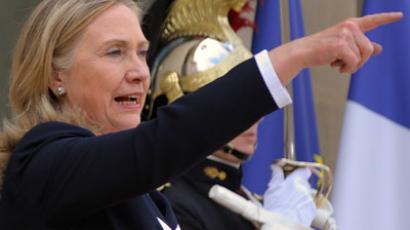
By JP Sottile | News Vandal | June 5, 2014
On May 23, 2012, then-Secretary of State Hillary Clinton went to the Special Operations Forces Industry Conference (SOFIC) trade show in Tampa, Florida to share her vision of “smart power” and to explain the State Department’s crucial role in extending the reach and efficacy of America’s growing “international counterterrorism network.”
First, there is such a thing as a “Special Operations Forces Industry Conference trade show.” Without some keen reporting by David Axe of Wired, that peculiar get-together might’ve flown completely under the radar—much like the shadowy “industry” it both supports and feeds off of like a sleek, camouflaged lamprey attached to a taxpayer-fattened shark.
Second, “special operations” have officially metastasized into a full-fledged industry. United States Special Operations Command (USSOCOM) is located at MacDill Air Force Base in Tampa and, therefore, conveniently located near the special operations trade show, which happened again this year at the Tampa Convention Center. The theme was “Strengthening the Global SOF Network” and the 600,000-square-foot facility was filled with targets of opportunity for well-connected and well-heeled defense contractors.
According to the SOFIC website, this year’s conference afforded attendees “the opportunity to engage with USSOCOM Program Executive Officers, Science and Technology Managers, Office of Small Business Programs and Technology & Industry Liaison Office representatives, and other acquisition experts who will identify top priorities, business opportunities, and interests as they relate to USSOCOM acquisition programs.”
Third, Hillary’s widely-ignored speech marked a radical departure from the widely-held perception that the State Department’s diplomatic mission endures as an institutional alternative to the Pentagon’s military planning. Instead, Secretary Clinton celebrated the transformation of Foggy Bottom into a full partner with the Pentagon’s ever-widening efforts around the globe, touting both the role of diplomats in paving the way for shadowy special ops in so-called “hot spots” and the State Department’s “hand-in-glove” coordination with Special Forces in places like Pakistan and Yemen.
Finally, with little fanfare or coverage, America’s lead diplomat stood before the shadow war industry and itemized the integration of the State Department’s planning and personnel with the Pentagon’s global counter-terrorism campaign which, she told the special operations industry, happen “in one form or another in more than 100 countries around the world.”
If this isn’t entirely unexpected, consider the fact that under then-Secretaries of State Colin Powell and Condoleezza Rice, the State Department fought attempts by the Pentagon to trump its authority around the globe and, as reported by the Washington Post, “repeatedly blocked Pentagon efforts to send Special Operations forces into countries surreptitiously and without ambassadors’ formal approval.”
But that was before Hillary brought her “fast and flexible” doctrine of “smart power” to Foggy Bottom and, according to her remarks, before she applied lessons learned from her time on the Senate Armed Services Committee to launch the first-ever Quadrennial Diplomacy and Development Review, which she modeled on the Pentagon’s Quadrennial Defense Review. That Pentagon-style review spurred the creation of the Bureau of Conflict and Stabilization Operations to “advance the U.S. government’s foreign policy goals in conflict areas.”
According to a Congressional Research Service analysis, the initial intent of the Conflict Bureau was to replace the ineffectual Office of the Coordinator of Reconstruction and Stabilization, which was created in 2004 to help manage “stabilization” efforts in two nations the U.S. was actively destabilizing—Afghanistan and Iraq.
But the new, improved bureau does more than just react to messes made by unlawful invasions or direct costly remediation efforts in war zones—it also collaborates with “relevant partners” in the Department of Defense and NATO “to harmonize civilian and military plans and operations pertaining to conflict prevention, crisis response, and stabilization.”
This integrated relationship between State and Defense was confirmed by U.S. Special Operations chief Admiral William McRaven shortly after Hillary’s speech. When asked about the “unlikely partnership,” McRaven assured DefenseNews that SOCOM has “an absolutely magnificent relationship with the State Department” and that SOCOM doesn’t “do anything that isn’t absolutely fully coordinated and approved by the U.S. ambassador and the geographic combatant commander.”
As David Axe aptly described it in Wired, “Together, Special Operations Forces and State’s new Conflict Bureau are the twin arms of an expanding institution for waging small, low-intensity shadow wars all over the world.”
In fact, during Hillary’s time as America’s chief diplomat, the State Department embraced the shadowy edge of U.S. foreign policy where decision-makers engage in activities that look like war, sound like war and, if you were to ask civilians in places like Yemen and Pakistan, feel a lot like war, but never quite have to meet the Constitutional requirement of being officially declared as war.
The Whole-of-Government Shift
Once upon a time, “low-intensity shadow wars” were the Congressionally-regulated bailiwick of the Central Intelligence Agency. But 9/11 changed everything. However, the excesses of the Bush Administration led many to hope that Obama could and would change everything back or, at least, relax America’s tense embrace of “the dark side.”
Although the new administration did officially re-brand “The War on Terror” as “Overseas Contingency Operations,” Team Obama employed an increasingly elastic interpretation of the 9/11-inspired Authorization for Use of Military Force and expanded covert ops, special ops, drone strikes and regime change to peoples and places well-beyond the law’s original intent, and certainly beyond the limited scope of CIA covert action.
Obama’s growing counter-terrorism campaign—involving, as Secretary Clinton said, “more than 100 countries”—took flight with a new, ecumenical approach called the “Whole-of-Government” strategy. Advanced by then-Secretary of Defense Bill Gates and quickly adopted by the new administration in early 2009, this strategy catalyzed an institutional shift toward inter-agency cooperation, particularly in the case of “state-building” (a.k.a. “nation building”).
During remarks to the Brookings Institution in 2010, Secretary Clinton explained the shift: “One of our goals coming into the administration was… to begin to make the case that defense, diplomacy and development were not separate entities, either in substance or process, but that indeed they had to be viewed as part of an integrated whole and that the whole of government then had to be enlisted in their pursuit.”
Essentially, the Whole-of-Government approach is a re-branded and expanded version of Pentagon’s doctrine of “Full-Spectrum Dominance.” Coincidentally, that strategy was featured in the Clinton Administration’s final Annual Report to the President and Congress in 2001. It defined “Full-Spectrum Dominance” as “an ability to conduct prompt, sustained, and synchronized operations with forces tailored to specific situations and possessing freedom to operate in all domains—space, sea, land, air, and information.”
In 2001, Full-Spectrum Dominance referred specifically to 20th Century notions of battlefield-style conflicts. But the “dark side” of the War on Terror stretched the idea of the battlefield well-beyond symmetrical military engagements. “Irregular warfare” became the catchphrase du jour, particularly as grinding campaigns in Afghanistan and Iraq exposed the reality that the full spectrum still wasn’t enough.
An assessment by the Congressional Research Service identified the primary impetus for the Whole-of-Government “reforms” embraced by Team Obama as the “perceived deficiencies of previous inter-agency missions” during the military campaigns in Afghanistan and Iraq. Those missions failed to address a myriad of problems created—culturally, economically and politically—by the wholesale bombing and occupation of those countries. The Full-Spectrum was half-baked. Lesson learned.
But the lesson wasn’t that the U.S. should avoid intervention, regime change or unleashing nascent civil, ethnic or religious conflicts. Instead, the lesson was that the “Whole-of-Government” must be marshaled to fight a worldwide array of Overseas Contingency Operations in “more than 100 countries.”
This Whole-of-Government shift signaled a renewed willingness to engage on variety of new fronts—particularly in Africa—but in a “fast and flexible” way. With other agencies—like the State Department—integrated and, in effect, fronting the counter-terrorism campaign, the military footprint becomes smaller and, therefore, easier to manage locally, domestically and internationally.
In some ways, the Whole-of-Government national security strategy is plausible deniability writ-large through the cover of interagency integration. By merging harder-to-justify military and covert actions into a larger, civilian-themed command structure, the impact of the national security policy overseas is hidden—or at least obfuscated—by the diplomatic “stabilization” efforts run through the State Department—whether it’s the Conflict Bureau working against Joseph Kony’s Lord’s Resistance Army in Central Africa, “stabilizing” post-Gaddafi Libya or spending $27 million to organize the opposition to Bashar al-Assad’s Syrian regime.
The Pass Key
The cover of diplomacy has traditionally been an effective way to slip covert operators into countries and the State Department’s vast network of embassies and consulates still offers an unparalleled “pass-key” into sovereign nations, emerging hot spots and potential targets for regime change. In 2001, the Annual Report to the President and Congress foresaw the need for more access: “Given the global nature of our interests and obligations, the United States must maintain the ability to rapidly project power worldwide in order to achieve full-spectrum dominance.”
Having the way “pre-paved” is, based on Hillary’s doctrinal shift at State, a key part of the new, fuller-spectrum, Whole-of-Government, mission-integrated version of diplomacy. At the SOFIC’s Special Operations Gala Dinner in 2012, Hillary celebrated the integration of diplomatic personnel and Special Operations military units at the State Department’s recently created Center for Strategic Counterterrorism Communications—a “nerve center in Washington” that coordinates “military and civilian teams around the world” and serves “as a force multiplier for our embassies’ communications efforts.”
As with most doors in Washington, that relationship swings both ways and mission-integrated embassies have served as an effective force multiplier for the Pentagon’s full spectrum of activities, particularly around Africa.
In his 2011 testimony before the House Foreign Affairs Committee Subcommittee on Africa, Deputy Assistant Secretary of State for African Affairs Don Yamamoto noted that State had “significantly expanded the number of DoD personnel who are integrated into embassies across the continent over the past three years,” and read a surprisingly long laundry list of collaborative efforts between State and the United States Africa Command (AFRICOM), including: “reduction of excess and poorly secured man-portable air defense systems (MANPADS); Defense Sector Reform in Liberia, DRC, and South Sudan; counterpiracy activities off the Somali coast; maritime safety and security capacity building; and civil-military cooperation.”
It seems that “civil-military cooperation” is a primary focus of the State Department in Africa. Most notably, Yamamoto told Congress that “embassies implement Department of State-funded Foreign Military Financing (FMF) and International Military Education and Training (IMET) programs, which further U.S. interests in Africa by helping to professionalize African militaries, while also assisting our African partners to be more equipped and trained to work toward common security goals.”
As the ever-vigilant Nick Turse recently reported, U.S. presence on the continent has only grown since that testimony was given in 2011. On TomDispatch.com, Turse identified the infamous attack on Benghazi on September 11, 2012 as the catalyst for “Operation New Normal”—the continent-wide response to, quite ironically, the political potboiler still simmering around Secretary Clinton. Whether or not Congressional Republicans find anything more than incompetence at the root of Benghazi, the U.S. military certainly finds itself in a “new normal” of increased activity in response to the forces—and the weaponry—unleashed by U.S.-led regime change in Libya. According to Turse, the U.S. is “now conducting operations alongside almost every African military in almost every African country and averaging more than a mission a day.”
Those missions are, of course, integrated with and augmented by the State Department’s Conflict Bureau which has used a variety of state-building programs and its diplomatic “pass key” in places like Libya, Nigeria, Kenya, South Sudan, Somalia, Democratic Republic of the Congo and six other African nations, all to develop a growing roster of “host country partners.”
Establishing “host country partners” is the nexus where the State Department, its Conflict Bureau and the AFRICOM meet—implementing the Whole-of-Government strategy in emerging or current conflict zones to fuse a mounting counter-terrorism campaign with stabilization, modernization and state-building initiatives, particularly in oil and resource-rich areas like the Niger River Delta, Central Africa and around AFRICOM’s military foothold on the Horn of Africa.
As Richard J. Wilhelm, a Senior Vice President with defense and intelligence contracting giant Booz Allen Hamilton, pointed out in a video talk about “mission integration,” AFRICOM’s coordination with the Departments of State and Commerce, USAID is the “most striking example of the Whole-of-Government approach.”
And this is exactly the type of “hand-in-glove” relationship Secretary Clinton fostered throughout her tenure at State, leveraging the resources of the department in a growing list of conflict areas where insurgents, terrorists, al-Qaeda affiliates, suspected militants or uncooperative regimes threaten to run afoul of so-called “U.S. interests”.
Ultimately, it became a hand-in-pocket relationship when Clinton and Defense Secretary Gates developed the Global Security Contingency Fund (GSCF) to “incentivize joint planning and to pool the resources of the Departments of State and Defense, along with the expertise of other departments, to provide security sector assistance for partner countries so they can address emergent challenges and opportunities important to U.S. national security.”
Although he’s been criticized as feckless and deemed less hawkish than Secretary Clinton, President Obama’s newly-proposed Counterterrorism Partnership Fund (CTPF) is the logical extension of the Clinton-Gates Global Security Contingency Fund and epitomizes the Whole-of-Government shift.
The $5 billion Obama wants will dwarf the $250 million pooled into the GSCF and will, the President said at West Point, “give us flexibility to fulfill different missions including training security forces in Yemen who have gone on the offensive against al Qaeda; supporting a multinational force to keep the peace in Somalia; working with European allies to train a functioning security force and border patrol in Libya; and facilitating French operations in Mali.”
That “flexibility” is exactly what Hillary Clinton instituted at State and touted at the SOFIC conference in 2012. It also portends a long-term shift to less invasive forms of regime change like those in Yemen, Libya, Syria and Ukraine, and an increased mission flexibility that will make the Authorization for the Use of Military Force functionally irrelevant.
Normalizing the War on Terror
The ultimate outcome of this shift is, to borrow from Nick Turse, yet another “new normal”—the new normalization of the War on Terror. What the adoption of the Whole-of-Government/mission integration approach has done is to normalize the implementation of the re-branded War on Terror (a.k.a. Overseas Contingency Operations) across key agencies of the government and masked it, for lack of the better term, under the rubric of stabilization, development and democracy building.
It is, in effect, the return of a key Cold War policy of “regime support” for clients and “regime change” for non-client states, particularly in strategically-located areas and resource-rich regions. Regimes—whether or not they actually “reflect American values”—can count on U.S. financial, military and mission-integrated diplomatic support so long as they can claim to be endangered… not by communists, but by terrorists.
And because terrorism is a tactic—not a political system or a regime—the shadowy, State Department-assisted Special Ops industry that fights them will, unlike the sullen enthusiasts of the Cold War, never be bereft of an enemy.
US Secretly Training and Funding ‘Elite’ African Commandos
By Sarah Lazare | Common Dreams | May 27, 2014
The Pentagon has been secretly backing a U.S. Special Operations program to build elite units to fight “terrorism” in Libya, Niger, Mauritania and Mali, the New York Times revealed Monday.
The program was launched last year and is backed by millions of dollars in classified Pentagon funds. U.S. military trainers, including members of the Green Berets and Delta Force, are working with African “commandos” to “build homegrown African counterterrorism teams,” according to the Times.
According to the reporting, $70 million in Pentagon funds is going towards “training, intelligence-gathering equipment and other support” for commandos in Nigeria and Mauritania. And $16 million is going towards commandos in Libya. In Mauritnaia, $29 million has been allotted for “logistics and surveillance equipment in support of the specialized unit.” According to the Times, the program in Mali “has yet to get off the ground as a new civilian government recovers from a military coup last year.”
The U.S. military has for years been increasing its role across the continent of Africa, including the expansion of AFRICOM, drone attacks in Somalia, air strikes and arms shipments to Libya, and more.
Ex-president in talks to free Nigeria schoolgirls
Press TV – May 28, 2014
Former Nigerian President Olusegun Obasanjo has reportedly engaged in an effort to broker the release of over 200 schoolgirls kidnapped by the Takfiri Boko Haram militants.
Obasanjo has met with people close to the radical militants in an attempt to negotiate the release of the abducted schoolchildren, AFP reported Tuesday, citing a source close to the talks.
The meeting reportedly took place last weekend at Obasanjo’s farm in Ogun State and involved the relatives of some senior Boko Haram militants as well as mediators, the source added.
“The meeting was focused on how to free the girls through negotiation,” said the anonymous source, referring to the girls who were abducted on April 14 from the remote northeastern town of Chibok in Borno State.
Nigeria’s Chief of Defense Staff Air Chief Marshal Alex Badeh stated Monday that the whereabouts of the girls had been located but cast doubt on the prospect of rescuing them by force. He further noted that the risks of storming the area with troops in a rescue mission were too great and could prove fatal for the young hostages.
According to the source, Obasanjo had voiced concern over Nigeria’s acceptance of foreign military intervention to help rescue the abducted girls.
Obasanjo is reportedly worried that Nigeria’s prestige in Africa as a major continental power had been diminished by President Goodluck Jonathan’s decision to bring in Western military assistance, including by US forces.
Obasanjo, who left office in 2007, has previously sought to negotiate with the Takfiri militants, including in September 2011, after Boko Haram bombed the United Nations headquarters in Abuja.
Bring Back Our Girls!

By Gary Corseri | Dissident Voice | May 25, 2014
From the droned villages of Pakistan and Afghanistan–
Bring back our girls!
From Nigeria, and the brothels of the Philippines–
Bring back our girls!
From the ruined cities of Detroit and Newark
And the ravished American Dream–
Bring back our girls!
From “Disaster Capitalism” and twerking jerks–
Bring back our girls!
From the “Occupied Territories” of Palestine
And from Israeli Porn Kings–
Bring back our girls!
From the “royal” slave-holders of Arabia,
And the crapulous monarchs of Britain–
Bring back our girls!
From our culture of destitution and prostitution–
Bring back our girls!
From “entrepreneurs” and exploiters
Of sex and violence and from those who confound and abuse–
Bring back our girls!
Restore them to their birthright dignity:
Co-creators; mothers; sisters; daughters; friends.
Bring back our girls
From the wars that have butchered them
(Restore them!);
From the silence that has answered their prayers
(Answer now…);
From the callous hypocrisy
Of scoffed-at dreams and snuffed-out hopes–
Bring back our girls!
Nigeria accepts Israeli help in search for kidnapped school girls
MEMO | May 12, 2014
Nigeria’s President Goodluck Jonathan has accepted an Israeli offer to help search for 223 kidnapped school girls by the extremist Boko Haram group, Israel’s Prime Minister Benjamin Netanyahu’s office announced yesterday.
Netanyahu is reported to have told the Nigerian president: “Israel expresses deep shock at the crime against the girls. We are ready to help in finding the girls and fighting the cruel terrorism inflicted on you.”
The statement gave no further details on the nature of assistance provided.
A foreign ministry spokesman said he does not know of any cooperation efforts in the present time.
Israel and Nigeria have a defence agreement whereby Israel supplied Nigeria with drones in September and joined other countries to advise Kenya to confront Islamic militants who attacked a trading centre in Nairobi.
In a statement, the Nigerian president’s office said: “President Jonathan has accepted an Israeli offer by Prime Minister Netanyahu to send a team of Israeli counter-terrorism experts to contribute to the ongoing search operations. Nigeria would be pleased to have Israel’s globally acknowledged anti-terrorism expertise deployed to support its ongoing operations.”
A total of 276 girls were abducted by Boko Haram on April 14 from the northeast of the country, which has a sizeable Christian community. Some 223 are still missing.
~~~
See also:
- ‘Boko Haram’ doesn’t really mean ‘Western education is a sin’
- How Nigerian police also detained women and children as weapon of war
Three Lebanese Cleared of Nigeria Terror Charges
Al-Manar | November 29, 2013
Three Lebanese were cleared of terrorism charges in Nigeria on Friday.
“The Nigerian authorities released Mustapha Fawaz and Abdallah Thahini, while Talal Ahmad Roda’s trial is still ongoing for possessing weapons,” Lebanese charge d’affaires in Nigeria told FM Adnan Mansour.
Federal High Court Judge Adeniyi Adetokunbo Ademola said Hezbollah “is not an international terrorist organisation in Nigeria” and therefore membership is not criminal.
He said there was “no evidence” that the group was planning an attack or had received “terrorism training” as the prosecution alleged.
Lebanese ‘tortured by Mossad agents in Nigeria’
Press TV – August 6, 2013
Two Lebanese nationals, who are on trial in Nigeria, have told a court that they were subjected to torture by Israeli Mossad agents after being arrested.
Mustapha Fawaz and Abdallah Thahini together with another Lebanese national Talal Ahmad Roda were arrested in May after an arms cache was discovered in a residence in the Nigerian city of Kano.
The three Lebanese men reportedly own a supermarket and an amusement park in Abuja, which have been closed since their arrests.
Fawaz told the court on Monday that after he was arrested in Abuja, a security official told him that some “European friends” wanted to ask him some questions.
“I was taken to an interrogation room where I met three Israeli Mossad agents,” he said.
Fawaz also said the interrogators handcuffed his hands behind his back for days, noting he “lost count because they did not allow me to sleep for several days.”
He went on saying, “During the 14 days of interrogation, I was interrogated by six Israeli Mossad agents and one masked white man.”
“I was interrogated in Arabic. I asked to be interrogated in English, but they refused. Most of them are weak in English. They are not Europeans, but Israelis,” he also said, adding no Nigerian official was present during the interrogations.
Thahini gave similar account to the court, saying he collapsed five days after the interrogators did not allow him to sleep.
Related article
- Israel Targets “Hezbollah Cells” in Nigeria (alethonews.wordpress.com)
Nigeria, AU criticised for hosting Sudan’s Bashir at summit
By Tesfa-Alem Tekle | Sudan Tribune | July 18, 2013
ADDIS ABABA – European Union lawmakers on Wednesday criticised the African Union (AU) and Nigeria for allowing Sudanese president Omer Al-Bashir to attend a special summit on HIV/AIDS, tuberculosis and malaria held in Abuja.
The EU delegation held talks with AU and Ethiopian officials on a number of national and continental concerns, as part of an official visit to Ethiopia.
Barbara Lochbihler, who led the delegation, said the AU’s position towards the International Criminal Court (ICC) and the failure of Nigeria to arrest Bashir undermines the work of the ICC and victims’ fight for justice.
The 54-member continental bloc has called on member states not to cooperate with the ICC arrest warrant for Bashir.
The Sudanese president left for Nigeria on Sunday, but cut short his visit the following day after calls for his arrest intensified.
Nigeria has also come under fire after the government refused to arrest Bashir and surrender him to the ICC.
However, Nigerian officials dismissed criticism, saying the Sudanese president was in Nigeria at the invitation of the AU and not as a guest of the federal government.
“President al-Bashir was in Nigeria under the auspices of the AU, based on the assembly’s decision to convene the special summit in Abuja to deal with three diseases that together constitute a heavy burden on member states”, a statement by the foreign ministry said on Tuesday.
The ICC issued two arrest warrants against Bashir in 2009 and 2010 for alleged war crimes, crimes against humanity and genocide committed in Darfur.
Related articles
Israel Targets “Hezbollah Cells” in Nigeria
Al-Akhbar | July 2, 2013
In mid-May, Mustafa Fawwaz, a 49-year-old Lebanese living in northern Nigeria, was headed to the Amigo Mall, a property he co-owns with his brother Fawzi. Hours later, police stormed his supermarket and placed him under arrest.
A few days later, 48-year-old Lebanese Ahmad Tahini was arrested at Nigeria’s Kano International Airport before his flight departed to Beirut. On May 26, the police arrested 51-year-old Talal Rawda at his home, in addition to another Lebanese Hussein Noureddine.
The Nigerian police claimed these four men were part of a “Hezbollah cell,” evidence of which was a weapons depot located inside a house in Kano.
After 40 days of detention, Noureddine was released. The court accused the three remaining Lebanese men of committing “terror-related crimes” and “providing direct assistance to a terrorist group.” The indictment stated: “You confessed that you belong to the armed wing of Hezbollah, which is an international terrorist organization. You have therefore committed a crime.”
Trumped-up Charges
The main charge that led to the men’s arrest linked them to a questionable weapons cache. But the weapons found by police were old and rusting, having clearly been stored in inappropriate conditions.
A source close to the defendants said that the house where the weapons were found was originally owned by a former army general who was active in the Nigerian civil war – 40 years ago. He denies that the men are linked in any way to the weapons or any armed activity.
The three Lebanese men have been charged with terrorism by virtue of their membership in Hezbollah even though the Nigerian government does not consider the party a terrorist organization. This is the lawyer’s defense for the upcoming July 8 court date when he’ll ask the court to drop all charges.
As usual, Israel is connected to this debacle. An Israeli security official told a Western newspaper, “The security cell that was arrested is part of a Shia terror campaign targeting the West and Israel.” It is interesting that the Israeli official did not limit his accusations to Hezbollah but rather included the entire Shia sect.
Yet perhaps the strongest evidence of Israeli meddling in the investigation came from a source close to the detainees who claimed that a Mossad team was allowed to interrogate and investigate the defendants.
Israeli Objectives
Israel has always paid special attention to Nigeria, having signed several trade and industrial agreements with the African country. Yet since 2006, visits by Israeli presidents and security officials to Nigeria focused on signing security agreements and finalizing weapons deals. Nigeria specialists say that the Mossad’s close relations with Nigerian security agencies is not concealed in any way.
Israel hopes to accomplish several goals with these accusations. It seeks to pressure international, and especially European, public opinion to list Hezbollah, or at least its so-called armed wing, as a terrorist group. Another aim is to create fissures in Hezbollah by falsely accusing Lebanese businessmen and shutting down their businesses.
The US and Israel have different ways of targeting Lebanese in Africa. While the US treasury department accuses Lebanese of supporting terrorist organizations, Israel colludes with African security agencies to fabricate charges.
Nigeria resumes massacres
By Rafiu Oriyomi | IslamOnline.net | September 10, 2009
LAGOS — Nigerian police have been accused of indiscriminate arrest and harassment against Muslims across the country since clashes with the militant Boko Haram group killed at least 600 people…
In July, Boko Haram, a militant group opposed to anything modeled after the West, went on rampage in three north-western states attacking police stations and other facilities.
A massive security operation resulted in the killing of hundreds of militants including their leader Mohammed Yusuf and alleged financiers.
There have since been reports of constant police harassment of Muslims on the streets across the country.
“What qualified me for this wicked charge is my beard and attire,” fumed Saleh, 29, who met a number of other Muslims at the police station, arrested on the same charge.
“What this means is that all Muslims are members of the Boko Haram,” he stressed.
“And if that is the case, then there is a danger lurking around because we won’t take this from the government.”
[…]
The harassment is not limited to Borno or Yobe. Earlier this week, at least 11 bearded Muslims were rounded up by policemen at Ijaiye, a suburb of Lagos, on charges that they are members of Boko Haram.
Sulaiman Idris, one of the detainees who police said will be charged on illegal association and terrorism related charges, told IOL he was going to work when arrested.
“I can’t remember doing anything contrary to the law,” a tearful Idris sobbed, alleging torture.
He said others are going through the same ordeal.
“I have known Idris as a peace-loving Muslim who keeps beard and wears short trousers. His arrest is a slap on fundamental human rights,” said Shakirat Adedo, a work colleague.
“I’m told 11 of them were arrested. I think this is getting out of hand.”
When contacted, Lagos Police spokesman Frank Mba denied knowledge of the arrests and pledged to investigate the matter.
Two Muslim journalists working for the Lagos-based Islamic publication Al-Minbar were arrested last week and are still being detained in Yaba.
The arrest is linked to publishing an article entitled “Every Muslim Is A Boko Haram,” in response to police action.
Money for Justice
What adds insult to injury is that Muslims have to buy their freedom from police custody.
Asked how he regained his freedom, Saleh said his relatives “had to pay through their noses to get me released.”
“This means the Nigerian police want to hide under the Boko Haram incidence to feed fat on us,” he charged.
Mallam Zakari Adamu, Chairman of the Movement of Justice in Nigeria (MOJIN) Yobe chapter, confirmed the ugly trend.
“Our great problem is that if your innocent relation is detained for alleged involvement in Boko Haram, if you don’t have money to give him, you then sacrifice him or her to remain in cell,” he told IOL.
“Even when they have finished their interrogation and find him not guilty, you still have to bribe for him to regain his freedom,” contended the rights activist.
“I know of a boy who was shot; he is an innocent businessman. His father told us that he has spent N240,000 yet he could not even see the face of his son, this is unjust.”
Muslim Rights Concern (MURIC), a countrywide network of Islamic activists, is raising the issue with the government, warning that the clampdown could trigger another bout of violence…
Update – Press TV – December 29, 2009
Thirty-eight members of the Boko Haram extremist group, including their leader, have been killed in clashes with a joint military-police force in the city of Bauchi in northern Nigeria.
Bauchi Police Chief Atikur Kafur told reporters on Monday that one soldier and two innocent people were among the dead in the Zango district of the city. He added that 14 people were also injured.
Twenty suspected militants were arrested, including nine adults and 11 juveniles.
The police chief identified the Boko Haram leader as Malam Badamasi.
Featured Video

America Racing to Strategic Defeat in Iran
or go to
Aletho News Archives – Video-Images
From the Archives
Should Europeans ‘Thank’ the Americans for Destroying Nord Stream?
By Robert Bridge | Strategic Culture Foundation | September 29, 2022
With an investigation continuing into the destruction of the Nord Stream gas pipeline that provided energy supplies to Europe from Russia, there appears to be just one prime suspect, and that should surprise nobody.
Following the sabotage of the Nord Stream 1 and 2 gas pipelines, former Polish Foreign Minister Radoslaw Sikorski already seemed to know the identity of the perpetrator when he tweeted out: “Thank you, USA.”
At first glance, it seemed that Sikorski was speaking sarcastically, berating Washington for carrying out an attack that will have severe repercussions for the people of Europe. After all, how could anyone see any good coming from the termination of Europe’s primary source of gas reserves with winter just around the corner? It was Sikorski’s homeland of Poland, after all, that urged its citizens to collect firewood in the face of dwindling gas reserves.
In fact, the Polish diplomat was speaking one-hundred percent literally… continue
Blog Roll
 Aletho News
- Growing insecurity, soaring prices fuel protests in north as regime bans evacuation: Sources
- Iran denies responsibility for ‘depraved’ attack on Kuwait desalination plant
- Bring The Troops Back. End This War Now!
- Can we please stop calling Israel the ‘only democracy in the Middle East’ now?
- US should start removing its troops for Germany, proposes AfD co-leader Chrupalla
- Iran Red Crescent: 600 educational centers attacked in US-Israeli ‘war crimes’
- Russian Oil Tanker Arrives in Cuba Amid U.S. Blockade
- America Racing to Strategic Defeat in Iran: Lt Col Daniel Davis
- FTC Warns Visa, Mastercard, PayPal, Stripe Over Political Debanking
- Russian tanker approaches Cuba despite US oil blockade
- If Americans Knew
- Israeli police block Catholic cardinal from entering Church of the Holy Sepulchre on Palm Sunday
- Israel is assassinating journalists again, more than any other nation, anywhere, ever – Not a ceasefire Day 170
- Over 300 US service members wounded, majority have brain injuries – Not a ceasefire Day 169
- Researchers at Human Rights Watch Resign Over Blocked Report on Palestinian Refugee Return
- Jewish Groups Are Backing a War Americans Don’t Want
- Eric Fingerhut Thinks He’s the President of the Jews
- Top Jewish Philanthropists, Rabbis Urge Israeli President to Take Action Against ‘Jewish Extremists’
- Don’t Be Fooled. Zionist Leaders Have Always Wanted to Control Southern Lebanon
- Israel’s widespread use of torture is a core element of its genocide against the Palestinian people
- In Israel’s War on Iran, Many Middle East US Bases Rendered “All But Uninhabitable”
- No Tricks Zone
- New Study Finds Warming Saves Lives…Cold Temperatures 12 Times More Deadly Than Excess Heat
- German Science Blog Accuses PIK Climate Institute Of Hallucinating Climate Tipping Points
- Devastating Assessment Of Comirnaty Vaccine By Former Senior Pfizer Europe Toxicologist
- New Study: CO2 Is ‘Effectively Negligible’ As An Explanatory Climate Change Factor Since 2000
- Former Pfizer Toxicologist Dr. Helmut Sterz Tells Bundestag Hearing Pfizer Vaccine Should Have Never Been Approved
- Energy Expert: Germany’s Nuclear Phaseout Was A “500 Billion Euro Mistake”
- New Research: South Australia’s Mid-Holocene Sea Surface Temperatures Were 4°C Warmer Than Today
- Storing Green Energy To Last Germany 10 Days Would Require A 60-Million Tonne Battery
- New Studies: UK Sea Levels Were 4 Meters Higher Than Today During The Mid-Holocene
- Destructive Green New Deal: German Energy And Metal Group Warns Of Drastic Crisis
 Aletho News