Militarization of Scandinavian Peninsula: Time to Ring Alarm Bells
By Alex GORKA | Strategic Culture Foundation | 31.07.2017
Much has been said about NATO reinforcements in the Baltic States and Poland perceived in Moscow as provocative actions undermining security in Europe, while very little has been said about gradual but steady militarization of Scandinavia. The theme does not hit headlines and it is not in focus of public discourse but one step is taken after another to turn the region into a springboard for staging offensive actions against Russia.
Ørland in southern Norway is being expanded to become Norway’s main air force base hosting US-made F-35 Lightnings – the stealth aircraft to become the backbone of Norwegian air power. Norway has purchased 56 of such aircraft. F-35 is an offensive, not defensive, weapon. The nuclear capable platforms can strike deep into Russia’s territory.
Providing training to Norwegian pilots operating the planes carrying nuclear weapons, such as B61-12 glider warheads, constitutes a violation of the Non-Proliferation Treaty (NPT) of 1968. Article I of the NPT prohibits the transfer of nuclear weapons from NWS (nuclear weapons states) to other states: «Each nuclear-weapon State Party to the Treaty undertakes not to transfer to any recipient whatsoever nuclear weapons or other nuclear explosive devices or control over such weapons or explosive devices». Article II requires NNWS (non-nuclear weapons states) not to receive nuclear weapons: «Each non-nuclear-weapon State Party to the Treaty undertakes not to receive the transfer from any transfer or whatsoever of nuclear weapons or other nuclear explosive devices or of control over such weapons or explosive devices». How can Russia be sure that these aircraft don’t carry nuclear weapons when there is no agreement of any kind in place to verify compliance with the NPT?
Ørland is located near Værnes – the base that hosts 330 US Marines. In May, the base hosted the biennial NATO military exercise «Arctic Challenge Exercise 2017» to involve over 100 planes from 12 nations. It was the first time a US strategic bomber (B-52H) took part in the training event.
The choice of the base was carefully calculated to keep the planes away from the reach of Russian Iskander missiles (500 kilometres) but no location in Norway is beyond the operational range of Kalibr ship-based sea-to-shore missiles and aircraft armed with long-range air-to-surface missiles.
In June, Norway’s government announced that the decision was taken to extend the rotational US Marine Corps force stationed at Værnes through 2018. The move contradicts the tried-and-true Norwegian policy of not deploying foreign military bases in the country in times of peace.
Also in June, the United States, United Kingdom and Norway agreed in principle to create a trilateral coalition built around the P-8 maritime aircraft to include joint operations in the North Atlantic near the Russian Northern Fleet bases.
Norway is to contribute into NATO ballistic missile defense (BMD) system by integrating its Globus II/III radar in the Vardøya Island located near the Russian border just a few kilometers from the home base of strategic submarines and 5 Aegis-equipped Fridtjof Nansen-class frigates. The radar construction is underway. The Vardøya radar can distinguish real warheads from dummies. Another radar located in Svalbard (the Arctic) can also be used by US military for missile defense purposes.
The country’s ground forces are stationed in Lithuania as part of a NATO multinational force under German command.
Sweden, a close NATO ally, has been upgrading its military with a sharp hike in spending. Last December, the Swedish government told municipal authorities to prepare civil defense infrastructure and procedures for a possible war. The move was prompted by the country’s return to the Cold War-era ‘Total Defense Strategy’. In September, 2016, 150 troops were put on permanent service on the island of Gotland to «defend it from Russia». Sweden maintained a permanent military garrison on Gotland for hundreds of years until 2005.The Swedish Civil Contingencies Agency (MSB) has ordered a review of 350 civilian bunkers on the island. The shelters are designed to protect people against the shock wave and radiation from a nuclear detonation, as well as chemical and biological weapons.
In March, Stockholm announced plans to reintroduce compulsory military service abandoned in 2010. The conscription will come into force on January 1, 2018.
Sweden said in June it wishes to join a British-led «Joint Expeditionary Force», making Swedish participation in a general European war all but inevitable.
This month, the Swedish military announced plans to conduct its largest joint military exercise with NATO in 20 years. Called Aurora 17, the training event is scheduled for September. The drills will take place across the entire country but focusing on the Mälardalen Valley, the areas around cities of Stockholm and Gothenberg and on the strategic island of Gotland. More than 19,000 Swedish troops will take part along with 1,435 soldiers from the US, 270 from Finland, 120 from France and between 40-60 each from Denmark, Norway, Lithuania and Estonia.
In June, Russian President Putin warned «If Sweden joins NATO this will affect our relations in a negative way because we will consider that the infrastructure of the military bloc now approaches us from the Swedish side».
In June, 2016, Finland took part in NATO BALTOPS naval exercise. It was the first time NATO forces trained on Finnish territory (The coastal area at Syndale). Back then, Russian Foreign Minister Sergei Lavrov told his Finnish counterpart, Timo Soini, that the Kremlin would take unspecified measures to respond to increased NATO activity in the Baltic region. According to Lavrov, «We do not hide our negative attitude to the movement of NATO’s military infrastructure towards our borders, to dragging new states into the military activity of the bloc».
All these facts and events summed together demonstrate that militarization of Scandinavia is progressing by leaps and bounds to undermine the security in Europe. No hue and cry is raised in the Russian media but the developments are closely watched by Moscow. Visiting Finland on July 27, President Putin said Russia was «keeping an eye on certain intensification in the movement of military aircraft, ships and troops. In order for us to avoid negative consequences, situations that no one wants, we need to maintain dialogue». He also stressed readiness for dialogue with neutral countries that border the Baltic Sea like Finland which is not part of the NATO military alliance.
The facts listed above show the situation is grave enough to top the agenda of the NATO-Russia Council. But it’s not the case as yet. Last year, Frank-Walter Steinmeier, the current President of Germany who was Foreign Minister at the time, slammed NATO for «saber-rattling and war cries» and provocative military activities in the proximity of Russia’s borders. He called for an arms control deal between the West and Russia. Fifteen other members of the Organization for Security and Cooperation in Europe (OSCE) joined Steinmeier’s initiative: France, Italy, Austria, Belgium, Switzerland, the Czech Republic, Spain, Finland, the Netherlands, Norway, Romania, Sweden, Slovakia, Bulgaria and Portugal.
Actually, the initiative to relaunch the negotiation process does not belong to Germany. Russia’s proposal to discuss a new European security treaty was rejected by the West. The draft document was published in 2009. In March 2015, Russia expressed its readiness for negotiations concerning a new agreement regarding the control of conventional weapons in Europe.
Moscow has never rejected the idea of launching talks to address the problem. It does not reject it now. The NATO-Russia Council could make a contribution into launching discussions on the matter. It has not done so as yet. Actually, nothing is done to ease the tensions in Europe and the Scandinavian Peninsula in particular. Meanwhile, the situation is aggravating misunderstandings and whipping up tensions.
How Russia Will React to Deployment of NATO Anti-Missile Systems in Norway
Sputnik – April 16, 2017
NATO is inciting Norway to deploy missile defense systems on its territory, however there is no unity in Oslo on this issue. Russian military expert Vladimir Kozin said in an interview with Radio Sputnik that the US is trying to “stuff” missile defense systems into as many European countries as possible.
Some political parties in Norway have opposed the deployment of NATO anti-missile systems in their country, contrary to preliminary agreements with the alliance, Russian Izvestia newspaper wrote. According to the article, there is still no clear position in Oslo on this issue.Russian military expert Vladimir Kozin believes that only NATO will benefit from the deployment of the systems in Norway, while for Oslo this will mean additional “headaches.”
“NATO countries, and first of all the US, want to involve Norway and thus expand the list of states that will have missile defense systems on their soil. What interest is there on the part of Norway? Of course, unless it wants to become a hostage to the global American anti-missile game. This won’t bring anything to strengthening Norway’s defense, but only additional headaches. Because it is natural that all these systems are monitored by the Russian side and our allies and friends,” Kozin said.
In his opinion, the international community is facing the beginning of the race in anti-missile weapons.
“In order to change the situation, in my opinion, it is necessary to work with the current US administration and show that nobody will benefit from this race,” the expert said.
Russian military expert Victor Litovkin, in turn, said that Russia will take steps to ensure the security of its borders in response to NATO “saber-rattling.”
“We will find a way to neutralize this system if necessary. We have an Iskander-M operational-tactical missile system and missiles on strategic aircraft, such as Tu-22M3 and Tu-160, Tu-95MS. We will take into account if Norway stations this complex, and we will change our plans in terms of the use of our Armed Forces in a critical period,” Litovkin stated.
Russia Warns Norway over Missile Defense Plans
By Alex GORKA | Strategic Culture Foundation | 23.03.2017
Russia has warned Norway over consequences of joining NATO ballistic missile defense (BMD) plans. According to Russian ambassador to Oslo, Moscow will retaliate. Norway’s possible accession to NATO’s missile shield «will be a new factor that will be considered in our strategic planning as the emergence of an additional problem in the Arctic region», Teimuraz Ramishvili told the Norwegian state media network NRK.
In 2017, Norway may become a part of BMD. The Norwegian government has appointed an expert group to consider a possible Norwegian contribution to the missile shield. A detailed report on the issue is currently being prepared by experts from the Norwegian Defense Research Establishment and the US Missile Defense Agency to be submitted the year.
Norway has no interceptors on its soil but there are other ways to contribute into the anti-missile plans. Denmark does not host missiles but it committed itself to the bloc’s BMD in 2014, working to equip its frigates with advanced radar systems capable of detecting and tracking ballistic missiles. The missile defense program continues to be implemented despite the fact that after the nuclear agreement with Iran in 2015, there is no rationale for it.
Оslo is a participant in the US-led Maritime Theater Missile Defense Forum. The Norwegian contribution to the missile defense system has not yet been decided on. Even without interceptors, Norway could contribute by integrating into the BMD system its Globus II/III radar in the Vardøya Island located near the Russian border just a few kilometers from the home base of strategic submarines and 5 Aegis-equipped Fridtjof Nansen-class frigates. The Vardøya radar can distinguish real warheads from dummies.
Another radar located in Svalbard (the Arctic) can also be used by US military for missile defense purposes. Senior US officials and politicians have visited the site during the last few years, including former Defense Secretary Ash Carter, former State Secretary John Kerry and Republican Senator John McCain. The radar is installed in violation of the 1925 treaty which states that Svalbard has a demilitarized status. The visitors invented different reasons, like viewing the effects of climate change (John Kerry) or highlighting the plight of polar bears (John McCain) to justify the need to inspect the site.
Installation of BMD sites might potentially undermine the efficiency of Russian strategic nuclear forces as a means of deterrence.
Norway is executing a drastic change in its military policy towards a far more aggressive posture. Even though the country is small, it has the sixth biggest military budget per capita, after the United States, Israel, Singapore and some ‘monarchies’ in the Persian Gulf. The country spends 7.3 billion dollars on the military, more than Sweden (5.7 billion), a country with twice the population. Its geographic position makes it a key element of NATO military planning. The nation’s leading political parties want an increased focus on ‘strategic assets’ like F-35, capable of striking deep into Russian territory, submarines and surveillance capabilities.
Norway hosts 330 US Marines in the central areas of the country, formally on a ‘rotating’ basis. The rotation does not change the fact that the forces are permanently present in Norway. They are deployed at the Vaernes military base, about 1,500 km (900 miles) from the Russian territory, but the training program involves traveling closer to the border. Norway and Russia share a small land border far in the north.
The Marines can be easily reinforced. The US forward storage areas have been upgraded to store cutting edge weapons and equipment for about 16,000 Marines. Building up stockpiles is a key part of US strategy to enhance its capabilities in Europe. There are plans to warehouse tanks, artillery and other fighting vehicles at other locations around the Old Continent.
The only purpose for the deployment is preparation for an attack against Russia. The Marines are first strike troops. The provocative move is taking place at the time the Russia-NATO relationship hit a new low as the bloc’s forces deploy in Eastern Europe and tensions run high in the Black Sea and elsewhere. According to Heather Conley, the director of the Center for Strategic and International Studies’ Europe Program, Northern Europe is now being viewed as a «theatre of operations».
There are other plans to increase US military presence in Norway. According to a report of Washington-based Center for Strategic and international Studies (CSIS), «The former Royal Norwegian Navy base at Olavsvern is ideal for supporting submarine operations in the extreme North Atlantic and Arctic Seas». The think tank believes it may be possible for Norway to nationalize and reopen a portion of the facility to support the rotational presence of US, UK, French, and Norwegian submarines. Olavsvern was NATO’s closest naval base to Russia’s submarine bases along the coast of the Kola Peninsula west of Murmansk.
It was reported last year that a study group from the US Navy visited both Andøya and Evenes airports in northern Norway to see if any of the two airports could be suitable to serve as a base for American P-8 Poseidon patrol aircraft.
The deployment of NATO forces to Norway is clearly a provocative act directed at Moscow. Norway shares a 121 mile border with Russia, while the Russian Northern Fleet is based in the Murmansk region, approximately 100 miles from the border.
Norway has pledged not to host foreign forces on its territory. It had stashed stockpiles of weapons in preparation for a possible conflict, but until recently, foreign troops were allowed into the country only temporarily for training purposes. Oslo had adhered to this principle even at the height of the Cold War.
Shifting away from the «no foreign forces on national soil» policy is fraught with consequences. Turning the national territory into a spearhead for an offensive against Russia inevitably makes Norway a target for a retaliatory strike. Russia did not start it. Actually, very few NATO members take part in the BMD plans. The decision to join would be seen as an outright provocation staged by a neighboring state. By doing so, Norway will deteriorate the relations and greatly reduce its own security which can only be achieved through developing of partnership and strengthening of centuries of good neighborly relations.
Norway blames ‘Russian hackers’ after defense & security officials fall victim to phishing attack
RT | February 4, 2017
Government officials in Norway have been breached by a phishing attack which authorities promptly pinned on ‘Russian hackers,’ claiming the hack was allegedly traced back to the same culprits that compromised the DNC servers in the US last year.
Nine personal civil-servant email accounts have been compromised, the Norwegian Police Security Service (PST) announced, just days after the agency coincidentally identified possible Russian spying as the greatest potential threat to the country.
The Labor Party and “a handful of other Norwegian targets” were subjected to email attacks that allegedly took place last autumn, the Dagbladet reported. The defense and foreign ministries as well as security service staff were among those targeted, the BBC reports citing local media.
“The attacks had a signature that indicates those behind the hacking can be identified as APT29,” PST spokesman Martin Berntsen told the Associated Press. “They can be traced back to Russia,” he stated without elaborating further, while conceding that no classified information has been compromised.
CrowdStrike, a cybersecurity company hired by the Democratic National Committee (DNC) to investigate the June 2016 data breach, was first to accuse APT29 – which they named “Cozy Bear” and “Fancy Bear” – of being Russian government entities. However, CrowdStrike has never offered any proof for this assertion.
Spear phishing – the forging of trusted communication to access private data – isn’t a Russian know-how but a popular and quite unsophisticated fraud technique that is widely used around the world to hijack electronic accounts.
Labour’s leader, Jonas Gahr Store, also confirmed the breach of his party’s emails, after being notified of the hack by PST on Wednesday.
“I can confirm that we are informed by PST that Labour’s parliamentary group was subjected to an attempted digital attack by a group that PST ties to foreign intelligence,” Store’s press spokeswoman Camilla Ryste, told Nettavisen, The Local reports.
The new revelations follow PST’s latest threat assessment on national security published Wednesday, where Norway said that Russian intelligence poses the greatest challenge for the country.
“It is primarily Russia that has intentions and capacity to do intelligence activities with big damage potential for Norway and Norwegian interests,” the annual report from the Police Security Service (PST) reads.
“Intelligence pressure from foreign states, especially from the Russian side, has been high and stable over the years,” PST Chief Benedicte Bjornland said in the report, according to The Local. “The reason why we increase [the risk] now is that there is a tougher security situation. This means that the intelligence activities of Russia, in particular, have the potential to be more dangerous now than before.”
The Russian embassy in Norway called the Russian threat a “myth” blaming Oslo of staging a “witch hunt” instead of dealing with real threats like terrorism.
“Unfortunately, it seems like some are uninterested in normalization of our relationship and strive persistently to return to the times of the Cold War,” the embassy said on Facebook.
See also:
Norway surprised by Russia’s entry visa rejections to delegates blacklisted months ago
RT | February 2, 2017
Norway has summoned Russia’s ambassador to explain why two of its legislators were denied entry visas. Though the officials were placed on “counter-sanctions” lists and denied entry long ago, Norway has somehow found the rejections “incomprehensible.”
An official note containing the same objections preceded the ambassador’s summoning.
“The Foreign Ministry today summoned the Russian ambassador to repeat the protests,” the Norwegian Foreign Ministry said on Wednesday.
Norway’s Foreign Minister Børge Brende condemned Russia’s denial of the visas in strong terms. The rejected legislators are Bård Vegar Solhjell, the leader of Norway’s Socialist Left party, and Trine Skei Grande, the leader of the country’s Liberal Party.
“These are two distinguished, top-level Norwegian officials, excellent representatives of Norway,” Brende told the reporters, saying “it’s incomprehensible that they not be allowed to enter Russia.”
Although the minister acknowledged that Russia has the right to determine who can enter the country, saying that it’s “obviously up to every country to decide who can enter,” he slammed the denial as “biased, unreasonable and inconceivable.”
The Russian embassy in Oslo has confirmed that the visa requests were rejected as a part of a “mirror response” to Norway adopting the same sanctions that the EU has imposed on Russian citizens, as well as policies discriminating against Russian citizens who want to visit Spitsbergen island.
The list of officials from the EU and other countries who have been banned from entering Russia was provided to Brussels well ahead of time, with advice to inform all those affected, a Russian embassy spokesman stressed. Norway’s FM himself has admitted that the denials were something to be “expected” and that Norway’s reaction to the visa rejections thus appears quite surprising.
Coincidently, the outrage over Russia’s “hostile actions” came just hours after the country’s Police Security Service (PST) determined that Russia poses a “major threat” to Norway, along with Islamism.
Norway joined the EU’s sanctions against Russia and Russian citizens back in 2014 in response to what it called “Russia’s violations of human rights in Ukraine.” The situation escalated in April of 2015 when Russia’s Deputy PM Dmitry Rogozin visited Norway’s Island of Spitsbergen while on a trip to open the ‘North Pole-2015’ station. Norwegian authorities were riled by the visit, as Rogozin was on Europe’s anti-Russia sanction list.
Norway then adopted a measure authorizing the immediate deportation of sanctioned Russian citizens from the archipelago. Though Russia’s Foreign Ministry has protested the regulation, calling it discriminatory and in violation of an agreement on international cooperation on Spitsbergen, it was made permanent last September.
15 European leaders call for new arms deal with Russia
RT | November 26, 2016
Fifteen European countries, headed by Germany, have issued a statement pushing for the reopening of “a new structured dialogue” with Russia aimed at preventing a possible arms race in Europe, according to the German foreign minister.
The countries, all belonging to the Organization for Security and Cooperation in Europe (OSCE), have expressed their deep concern over the current situation in Europe and support the relaunch of a conventional arms treaty with Russia, German Foreign Minister Frank-Walter Steinmeier told Die Welt newspaper in an interview published on Friday.
“Europe’s security is in danger. As difficult as ties to Russia may currently be, we need more dialogue, not less,” Steinmeier said.
The ongoing conflict in the Eastern Ukraine and the fact that Crimea joined Russia in 2014, a move most often dubbed as “annexation” by western officials, have put the question of war in Europe back on the table, Steinmeier continued. Fragile trust between Russia and European countries has suffered a significant setback and a “new armament spiral” is hanging over the continent, the foreign minister warned.
The statement contains strong anti-Russian rhetoric, blaming Moscow for violating arms deals as far back as 1990.
“The Conventional Forces in Europe treaty, which led to the destruction of tens of thousands of heavy weapon systems in Europe in the years following 1990, is no longer being implemented by the Russian Federation,” the statement said.
Russia put its participation in the treaty on hold in 2007 and then fully walked out of it last year.
Russian President Vladimir Putin called for the suspension of the treaty following a US decision to locate missile defense facilitates in the neighbouring Czech Republic and Poland. On top of that, President Putin noted that some of the NATO members did not join or ratify the treaty and there was no point in Russia abiding by the agreement.
Later Putin signed a decree suspending the treaty due to “extraordinary circumstances … which affect the security of the Russian Federation and require immediate measures,” having notified NATO and its members of the decision.
Since then NATO has taken no steps to upgrade the treaty, the Russian Foreign Ministry said in September, 2016, adding that Moscow is ready for dialogue on the subject. However, it is not planning to be the one to initiate it.
The statement names a number of other documents that need to be overviewed, including the OSCE’s Vienna document, stipulating the exchange of information on military movements, and the Open Skies treaty, enabling the monitoring of other countries’ ground forces. The documents are either neglected or in need of modernization.
The countries that spoke in favor of Steinmeier’s initiative include France, Italy, Austria, Belgium, Switzerland, the Czech Republic, Spain, Finland, the Netherlands, Norway, Romania, Sweden, Slovakia, Bulgaria and Portugal.
The group of the European foreign ministers is planning to meet again on the sidelines of a OSCE meeting in Hamburg on December, 8-9.
Western Nations Under Pressure to Probe Clinton Foundation Spending – Analyst
Sputnik – 01.12.2016
Western European nations are facing growing pressure to end their financial contributions to the Clinton Foundation and investigate its spending, investment analyst Charles Ortel told Sputnik.
“The penny has dropped: The governments have decided not to fund Clinton Foundation activities anymore,” Ortel said Tuesday. “Canada, Sweden and Ireland are countries that may undertake investigations or end their practice of contributing large sums to the Clinton Foundation.”
He was commenting after Norway and Australia announced last weekend that they were ending their annual contributions to the charity, founded in 1997 by then-US President Bill Clinton and first lady Hillary Clinton.
According to the New York Post, the incoming presidential administration of Donald Trump will ask foreign governments investigate how the foundation spent hundreds of millions of donor dollars that it said went to provide low-cost medicine to treat AIDS patients in Africa, among other programs.
Ortel explained that government leaders around the world who had approved big yearly donations to the foundation presumed Hillary Clinton would be elected president on November 8. Her unexpected loss to Trump, however, has led to popular pressure in those countries for governments to disclose the fate of their donations.
“Governments now realize to their shock and horror there are numerous questions that regulators should have asked,” Ortel asserted. “Why didn’t regulators in different countries ask these questions about the enormous unmonitored donations to the Clinton Foundation before?” Germany’s Environment Ministry is being investigated about a donation to the Clinton charity of 4.5 million euros.
In an interview with Sputnik in Germany that was published Tuesday, left-wing member of parliament Niema Movassat questioned why information about his government’s connection to the foundation scandal is coming out only now.
In Ortel’s view, the German investigation illustrates the importance of a provision in New York state law requiring charities to specify in detail how they spend donors’ money.
“The Clinton Foundation has not complied with that requirement,” according to Ortel, a former executive at financial firms Chart Group and Dillon, Tead & Co. He predicted that questions about the foundation will fuel a “media frenzy” worldwide, as public demands for investigations into individual governments’ donations grow. “The German people and the American people deserve answers,” Ortel said. “We need an accounting: How many governments around the world have sent money to the Clinton Foundation? For what projects? In what amounts?”
In 2007, the UK government – led by Prime Minister Tony Blair and then Gordon Brown, both close political allies and personal friends of the Clintons – approved a grant of 1 billion pounds over 20 years to the charity, Ortel pointed out.
What Keeps the F-35 Alive

By David Swanson | Let’s Try Democracy | October 31, 2016
Imagine if a local business in your town invented a brand new tool that was intended to have an almost magical effect thousands of miles away. However, where the tool was kept and used locally became an area unsafe for children. Children who got near this tool tended to have increased blood pressure and increased stress hormones, lower reading skills, poorer memories, impaired auditory and speech perception, and impaired academic performance.
Most of us would find this situation at least a little concerning, unless the new invention was designed to murder lots of people. Then it’d be just fine.
Now, imagine if this same new tool ruined neighborhoods because people couldn’t safely live near it. Imagine if the government had to not only compensate people but kick them out of living near the location of this tool. Again, I think, we might find that troubling if mass murder were not the mission.
Imagine also that this tool fairly frequently explodes, emitting highly toxic chemicals, particles, and fibers unsafe to breathe into the air for miles around. Normally, that’d be a problem. But if this tool is needed for killing lots of people, we’ll work with its flaws, won’t we?
Now, what if this new gadget was expected to cost at least $1,400,000,000,000 over 50 years? And what if that money had to be taken away from numerous other expenses more beneficial for the economy and the world? What if the $1.4 trillion was drained out of the economy causing a loss of jobs and a radical diminution of resources for education, healthcare, housing, environmental protection, or humanitarian aid? Wouldn’t that be a worry in some cases, I mean in those cases where the ability to kill tons of human beings wasn’t at stake?
What if this product, even when working perfectly, was a leading destroyer of the earth’s natural environment?
What if this high-tech toy wasn’t even designed to do what was expected of it and wasn’t even able to do what it was designed for?
Amazingly, even those shortcomings do not matter as long as the intention is massive murder and destruction. Then, all is forgiven.
The tool I’m describing is called the F-35. At RootsAction.org you can find a new petition launched by locally-minded people acting globally in places where the F-35 is intended to be based. Also at that link you’ll find explanations of how the tool I’ve been describing is the F-35.
The petition is directed to the United States Congress and the governments of Australia, Italy, the Netherlands, Norway, Turkey, the United Kingdom, Israel, Japan and South Korea from the world and from the people of Burlington, Vermont, and Fairbanks, Alaska, where the F-35 is to be based. This effort is being initiated by Vermont Stop the F35 Coalition, Save Our Skies Vermont, Western Maine Matters, Alaska Peace Center, University of Alaska Fairbanks Peace Club, North Star Chapter 146 Veterans For Peace, World Beyond War, RootsAction.org, Code Pink, and Ben Cohen.
The petition reads:
The F-35 is a weapon of offensive war, serving no defensive purpose. It is planned to cost the U.S. $1.4 trillion over 50 years. Because starvation on earth could be ended for $30 billion and the lack of clean drinking water for $11 billion per year, it is first and foremost through the wasting of resources that this airplane will kill. Military spending, contrary to popular misconception, also hurts the U.S. economy (see here) and other economies. The F-35 causes negative health impacts and cognitive impairment in children living near its bases. It renders housing near airports unsuitable for residential use. It has a high crash rate and horrible consequences to those living in the area of its crashes. Its emissions are a major environmental polluter.
Wars are endangering the United States and other participating nations rather than protecting them. Nonviolent tools of law, diplomacy, aid, crisis prevention, and verifiable nuclear disarmament should be substituted for continuing counterproductive wars. Therefore, we, the undersigned, call for the immediate cancellation of the F-35 program as a whole, and the immediate cancellation of plans to base any such dangerous and noisy jets near populated areas. We oppose replacing the F-35 with any other weapon or basing the F-35 in any other locations. We further demand redirection of the money for the F-35 back into taxpayers’ pockets, and into environmental and human needs in the U.S., other F-35 customer nations, and around the world, including to fight climate change, pay off student debt, rebuild crumbling infrastructure, and improve education, healthcare, and housing.
Norway offers €1bn in credit to Iran

Iranian Parliament Speaker Ali Larijani (R) and Norwegian Foreign Minister Borge Brende in Tehran on August 17, 2016. ©IRNA
Press TV – August 17, 2016
Iran says it has been offered a major export credit line by Norway worth €1 billion in what could be a fresh indication of Oslo’s determination to expand relations with the Islamic Republic in post-sanctions era.
The two countries have signed an agreement to the same effect after a meeting between the visiting Norwegian Foreign Minister Borge Brende and his Iranian host Mohammad Javad Zarif in Tehran, Iran’s IRNA news agency reported.
The agreement was part of a total of three agreements that the Export Guarantee Fund of Iran and the Norwegian Export Credit Guarantee Agency signed to fund some of Iran’s key development and infrastructure projects.
“After the lifting of sanctions, good opportunities have emerged for cooperation and Norway is ready to utilize the post-deal situation to expand cooperation in various fields,” Brende has been quoted as saying by IRNA in a report that was also carried by AFP.
The report added that Brende and Zarif had also discussed the expansion of economic relations between Iran and Norway in different areas, particularly in monetary and banking sectors.
Brende will leave Tehran for Islamabad later in the day. Apart from Zarif, he is scheduled to meet several other top Iranian officials during his single-day stay in the Islamic Republic. They included President Hassan Rouhani, Petroleum Minister Bijan Zangeneh, Parliament Speaker Ali Larijani, and Secretary of the Supreme National Security Council Ali Shamkhani.
After Decades of Russian Goodwill, Norway Builds Up Military Against Moscow
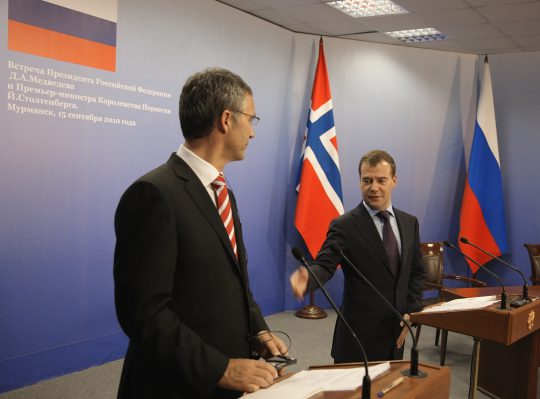
Norwegian Prime Minister Stoltenberg and Russian President Medvedev at the 2010 meeting cementing the new delimitation of the Barents Sea maritime border in Norway’s favor.
Sputnik – June 26, 2016
Earlier this month, Norway’s government announced a new defense plan, amounting to the largest military modernization since the Cold War, directed against Russia. Commenting on the initiative, journalist Sviatoslav Knyazev suggested that the country’s government has chosen to forget decades of good-neighborly relations between Oslo and Moscow.
Last weekend, Norwegian media reported on the country’s most ambitious plans to modernize the country’s armed forces since the end of the Cold War.
The government plans include the purchase of at least 52 Lockheed Martin F-35 fifth-generation multirole fighter jets, four submarines (presumably Swedish-built diesel subs), and six coastal patrol aircraft. Plans also include the construction of five new frigates and six corvettes.Overall, the defense budget of the country of five million is expected to increase by 165 billion kroner (about $19.4 billion US) over the next 20 years.
Norwegian Prime Minister Erna Solberg did not mince words as to who exactly the buildup is directed against, stating that “we have an increasingly unpredictable neighbor to the east which is strengthening its military capacity, and showing willingness to use military force as a political tool.”
Solberg’s comments followed on promises by Defense Minister Ine Eriksen Soreide in February 2015 that her country would be reorganizing its armed forces to counter the so-called ‘Russian threat’. At that time, the official candidly admitted that Russian forces had “not breached our territory,” but added that Oslo was worried over the increase in the range and number of Russian military aircrafts’ flights near the country.
On the border between Norway and Russia, Oslo is deploying a new army unit, consisting of 200 rangers, to be deployed in the Sor-Varanger municipality in Finnmark county, strengthening a several-hundred strong contingent of border guards. These units, equipped with anti-tank and anti-aircraft weapons, will be based in the direct vicinity of the Russian town of Pechenga.Commenting on the buildup in a piece for the online news and analysis portal PolitRussia, independent journalist Sviatoslav Knyazev recalled that “even before the modernization, the Norwegian Armed Forces were relatively powerful.”
“The per capita defense costs of the Kingdom are the highest in Europe. The armed forces are small enough (about 30,000 on active duty and some 45,000 in the reserve) but well prepared and equipped. Taking account of mandatory military service and its high prestige, a large portion of the population has military training. In the event of a hypothetical conflict, Norway can put several hundred thousand people under arms.”
Listing off the inventory of the country’s armed forces, Knyazev recalled that its ground forces have 52 Leopard 2A4 tanks, along with 20 older Leopard 1A5s, along with 315 M113 armored personnel carriers, 104 Swedish-made CV90 infantry fighting vehicles, and 80 SISU XA-185 and XA-203 armored personnel carriers. The army also has about 200 multi-purpose armored vehicles, and a number of self-propelled guns and multiple launch rocket systems.
The Air Force, for its part, has 57 F-16 multirole fighters, while the Navy has five frigates, six corvettes and six submarines.With these figures and the government’s latest plans in mind, the journalist pointed out that Norway is “effectively planning to double the strength of its Navy and Air Force (or completely modernize it). We are talking about billions of dollars of spending, a lot even for a wealthy country like Norway.”
Unfortunately, Knyazev emphasized, “all of this is directed solely against us [Russia].” At the same time, “Norway’s desire to ‘play with toy soldiers’ and to create conditions which could destabilize our northern border seems doubly strange in the context of Moscow’s long record of friendly relations toward Oslo.”
For a start, the journalist pointed out, the Russian Empire was one of the first to recognize Norway’s independence, soon after the country broke off from Sweden in 1905. Later, after the collapse of the Russian Empire and the emergence of the Soviet Union, diplomatic relations were established in short order, with relations established in 1924.
“In 1944,” Knyazev recalled, “its was the Red Army which fought to liberate [northern] Norway from the Nazi invaders. Thousands of Soviet soldiers and officers paid with their lives for the country’s freedom. After that, the Soviet Union, itself ravaged by war, helped to restore its northern neighbor. The USSR provided food rations, and Red Army engineering units helped rebuild ruined buildings. Moreover, the Soviet Union did not even try to create a zone of influence in Norway or to reshape its borders. In September 1945, having assisted its neighbors with aid, Soviet troops voluntarily left the country.”
Later, in the 1970s, a territorial dispute broke out between Moscow and Oslo over the maritime border in the Barents Sea, rich in offshore hydrocarbon reserves and fishing resources. “However, in 2010, Russia voluntarily ceded half of the disputed territory and signed a treaty ‘On Maritime Delimitation and Cooperation in the Barents Sea and the Arctic Ocean.'”
In 1949, the journalist bitterly recalled, the Norwegian government “thanked” the USSR for its contribution to the country’s liberation by joining the NATO alliance. “Now, it seems, we are being ‘thanked’ for the [2010] territorial gift, the shelf and the hydrocarbons worth tens of billions of dollars…”
“First, Norway introduced sanctions against us over a war unleashed by Washington in Ukraine [in 2014], then caused a scandal because of our Deputy Prime Minister’s visit to Svalbard [in 2015], and now they are up in arms and creating new military units directed against us.”Meanwhile, Knyazev lamented, “Jens Stoltenberg, the same former Norwegian Prime Minister who earned political capital through the 2010 demarcation agreement, is now directing the NATO bloc’s aggressive anti-Russian activities. Today, he is calling for strengthening NATO’s presence in the Baltic and Black seas, suggesting that the anti-Russian missile defense system in Eastern Europe is nothing out of the ordinary, and calling for ‘deterrence’ against Russia, which in actuality is not planning to attack anyone.”
Ultimately, the journalist suggested, “Norway, unfortunately, is a new example of the fact that befriending Western countries and doing them good is quite a thankless occupation…”
See also:
Norway Follows in US Footsteps, Ready to Deploy Aid to Syrian Rebels
Destroying the Magnitsky Myth
By Gilbert Doctorow | Consortium News | June 21, 2016
Despite all the threats of lawsuits and physical intimidation which hedge fund executive William Browder brought to bear over the past couple of months to ensure that a remarkable investigative film about the so-called Magnitsky case would not be screened anywhere, it was shown privately in a museum of journalism in Washington, D.C., last week.
The failure of the intimidation may give heart to others. There is talk that the film may be shown publicly in Norway, where its production company is located, but where an attempt several weeks ago to enter it into a local festival for documentaries was rejected by the hosts for fear of lawsuits. Moreover, a Norwegian court has in the past week declined to hear the libel charges which Browder’s attorneys were seeking to bring against the film’s director and producers.
Browder was more successful in intimidating the European Parliament where a screening of the film was cancelled in late April while I was in the audience. But I have now seen the banned documentary privately and “The Magnitsky Act. Behind the Scenes” is truly an amazing film that takes the viewer through the thought processes of well-known independent film maker Andrei Nekrasov as he sorts through the evidence.
At the outset of his project, Nekrasov planned to produce a docu-drama that would be one more public confirmation of the narrative that Browder has sold to the U.S. Congress and to the American and European political elites, that a 36-year-old whistleblower “attorney” (actually an accountant) named Sergei Magnitsky was arrested, tortured and murdered by Russian authorities for exposing a $230 million tax fraud scheme.
This shocking tale of alleged Russian official corruption and brutality drove legislation that was a major landmark in the descent of U.S.-Russian relations under President Barack Obama to a level rivaling the worst days of the Cold War.
But what the film shows is how Nekrasov, as he detected loose ends to the official story, begins to unravel Browder’s fabrication which was designed to conceal his own corporate responsibility for the criminal theft of the money. As Browder’s widely accepted story collapses, Magnitsky is revealed not to be a whistleblower but a likely abettor to the fraud who died in prison not from an official assassination but from banal neglect of his medical condition.
The cinematic qualities of the film are evident. Nekrasov is highly experienced as a maker of documentaries enjoying a Europe-wide reputation. What sets this work apart from the “trade” is the honesty and the integrity of the filmmaker as he discovers midway into his project that key assumptions of his script are faulty and begins an independent investigation to get at the truth.
An Inconvenient Truth
It is an inconvenient truth that he stumbles upon, because it takes him out of his familiar milieu of “creative people” who are instinctively critical of the Putin regime and of its widely assumed violation of human rights and civil liberties.
We see how well-known names in the European Parliament, in the Parliamentary Assembly of the Council of Europe and in NGOs that are reputed to be watchdogs have taken on faith the arguments and documentation (largely in Russian and inaccessible to them) which they received from William Browder and then rubber-stamped his story as validated without making any attempt to weigh the evidence.
Their intellectual laziness and complacency is captured fully on film and requires no commentary by the director. One of those especially skewered by her own words is German Bundestag deputy (Greens) Marieluise Beck. It is understandable to me now that I have viewed the film why she was one of the two individuals whose objections to its showing scuttled the screening in the European Parliament in April.
By the end of the documentary, Nekrasov finds that he has become a dissident in his own subculture within Russia and in European liberal circles.
Another exceptional and striking characteristic of the filmmaker is his energetic pursuit of all imaginable leads in his investigative reporting. Some leads end in “no comment” while others result in exposing whole new areas of lies and deception in the Browder narrative.
Nekrasov’s diligence is exemplary even as he takes us into the more arcane aspects of the case such as the money flow from the alleged tax fraud. These bits and pieces are essential to his methodology and justify the length of the movie, which approaches two hours.
Nekrasov largely allows William Browder to self-destruct under the weight of his own lies and the contradictions in his story-telling at various times. Nekrasov’s camera is always running, even if his subjects are not thinking about the consequences of being taped. The film also shows a videotaped deposition of Browder fumbling during an interrogation in a related civil case that is devastating to those politicians and commentators who fully swallowed Browder’s Magnitsky line.
Browder’s supposed lapses of memory, set in the context of involuntary facial expressions of stress and nervousness, would be compelling to jurors if this matter ever got into an open court of law in an adversarial proceeding.
At the end of the twists and turns in this expose, the viewer is ready to see Browder sink through the floor on a direct transfer to hell like Don Giovanni in the closing scene of Mozart’s opera. Nothing so colorful occurs, but it is hard to see how Browder can survive the onslaught of this film if and when it gets wide public viewing.
But the goal of many powerful people, including members of the U.S. Congress, the European Parliament and the Western news media who gullibly accepted Browder’s tale, will be to ensure that the public never gets to see this devastatingly frank deconstruction of a geopolitically useful anti-Russian propaganda theme.
Gilbert Doctorow is the European Coordinator of The American Committee for East West Accord. His most recent book, Does Russia Have a Future? was published in August 2015.
© Gilbert Doctorow, 2016
Featured Video
Stanislav Krapivnik: Russia-Iran Cooperation & Escalation in Ukraine
or go to
Aletho News Archives – Video-Images
Frlom the Archives
A dark page from the CIA’s history: What was Project Artichoke, launched 74 years ago?
By Erkin Oncan | Strategic Culture Foundation | August 22, 2025
One of the most useful instruments hidden behind the U.S. empire’s rhetoric of “freedom and democracy” was the Central Intelligence Agency, founded on September 18, 1947, as the successor of the Office of Strategic Services (OSS).
Since its creation, the CIA has carried out countless inhumane operations: assassinations, coups, drug trafficking, support for terrorism, conspiracies. The list of its crimes is endless. But among the darkest and most inhumane chapters of its record lie the notorious “mind control” experiments. … continue
Blog Roll
 Aletho News
- Stanislav Krapivnik: Russia-Iran Cooperation & Escalation in Ukraine
- Indonesia suspends participation in Board of Peace following attack on Iran
- ‘Operation Epic Fury’ burns an estimated $5.82 billion in just 100 hours
- Zionism’s grip over the world: From Epstein to Greater Israel
- How Israel and the FBI manipulated assassination plots to goad Trump into Iran war
- Iranian Strikes Dispel the Illusion of US Security Umbrella
- US Boasts of Destroyed Iranian Launchers Lack Credibility – Ex-DoD Official
- Europe not in position to cooperate with US and Israel against Iran
- Iran Has ‘Broken the Myth’ of Israeli Military Power: Former Pakistani Envoy
- How, and why, US data centers in the Gulf became targets of war
- If Americans Knew
- US troops were told war on Iran was ‘all part of God’s divine plan’, watchdog alleges
- Trump wants to run the show in Iran, but doesn’t know what he’s doing – Not a ceasefire Day 147
- ‘Dirty Work’ :The truth about how Israel was founded
- Mass Expulsion in Lebanon as Israel Expands War: “We Don’t Know Where to Go”
- Lies, distortions, and propaganda: how the U.S. mainstream media coverage on Iran hides the truth
- Palestinians in Gaza fear famine returning as Israel cuts off food amid Iran war
- AIPAC, other pro-Israel groups enter midterms with $100 million to spend
- Iranian girls killed by ‘double-tap’ strikes on Minab school
- Bari Weiss Is Going Full ‘Propaganda-Palooza’ With the Iran War
- Inside the Pro-Israel Campaign to Stop ‘The Voice of Hind Rajab’ From Winning an Oscar
- No Tricks Zone
- Televised! Leading German Political Candidate Tells Schoolchildren CO2 Makes Sun Hotter!
- New Study: A Century Warming Of 1.1°C Is ‘Commonplace’ And ‘Not Unusual’ During This Interglacial
- New Study: ‘Internal Noise’ And Volcanic Forcing Can Trigger 10-15°C Warming Within Decades
- Glaciers Worldwide Are Suddendly Surging, Experts Blame Warming!
- Surprising Discovery: Sahara Is Greening…Billions Of Trees Where Once Thought To Be Barren
- New Research Reaffirms Clouds, Aerosols, And Surface Solar Radiation Are ‘Driving The Climate System’
- Germany: Electric Car Catches Fire At Charging Station, Sets Off Local “Inferno”, Widespread Damage
- New Study: Canada’s New Brunswick Was 1°C Warmer Than Today During The Medieval Warm Period
- Coal Power Back In Trend As Globe Tries To Keep Pace With Growing Demand For Power
- New Study: A 4°C Warmer Beaufort Sea Had ‘No Sea Ice’ 11,700 – 8200 Years Ago
 Aletho News