15 European leaders call for new arms deal with Russia
RT | November 26, 2016
Fifteen European countries, headed by Germany, have issued a statement pushing for the reopening of “a new structured dialogue” with Russia aimed at preventing a possible arms race in Europe, according to the German foreign minister.
The countries, all belonging to the Organization for Security and Cooperation in Europe (OSCE), have expressed their deep concern over the current situation in Europe and support the relaunch of a conventional arms treaty with Russia, German Foreign Minister Frank-Walter Steinmeier told Die Welt newspaper in an interview published on Friday.
“Europe’s security is in danger. As difficult as ties to Russia may currently be, we need more dialogue, not less,” Steinmeier said.
The ongoing conflict in the Eastern Ukraine and the fact that Crimea joined Russia in 2014, a move most often dubbed as “annexation” by western officials, have put the question of war in Europe back on the table, Steinmeier continued. Fragile trust between Russia and European countries has suffered a significant setback and a “new armament spiral” is hanging over the continent, the foreign minister warned.
The statement contains strong anti-Russian rhetoric, blaming Moscow for violating arms deals as far back as 1990.
“The Conventional Forces in Europe treaty, which led to the destruction of tens of thousands of heavy weapon systems in Europe in the years following 1990, is no longer being implemented by the Russian Federation,” the statement said.
Russia put its participation in the treaty on hold in 2007 and then fully walked out of it last year.
Russian President Vladimir Putin called for the suspension of the treaty following a US decision to locate missile defense facilitates in the neighbouring Czech Republic and Poland. On top of that, President Putin noted that some of the NATO members did not join or ratify the treaty and there was no point in Russia abiding by the agreement.
Later Putin signed a decree suspending the treaty due to “extraordinary circumstances … which affect the security of the Russian Federation and require immediate measures,” having notified NATO and its members of the decision.
Since then NATO has taken no steps to upgrade the treaty, the Russian Foreign Ministry said in September, 2016, adding that Moscow is ready for dialogue on the subject. However, it is not planning to be the one to initiate it.
The statement names a number of other documents that need to be overviewed, including the OSCE’s Vienna document, stipulating the exchange of information on military movements, and the Open Skies treaty, enabling the monitoring of other countries’ ground forces. The documents are either neglected or in need of modernization.
The countries that spoke in favor of Steinmeier’s initiative include France, Italy, Austria, Belgium, Switzerland, the Czech Republic, Spain, Finland, the Netherlands, Norway, Romania, Sweden, Slovakia, Bulgaria and Portugal.
The group of the European foreign ministers is planning to meet again on the sidelines of a OSCE meeting in Hamburg on December, 8-9.
Western Nations Under Pressure to Probe Clinton Foundation Spending – Analyst
Sputnik – 01.12.2016
Western European nations are facing growing pressure to end their financial contributions to the Clinton Foundation and investigate its spending, investment analyst Charles Ortel told Sputnik.
“The penny has dropped: The governments have decided not to fund Clinton Foundation activities anymore,” Ortel said Tuesday. “Canada, Sweden and Ireland are countries that may undertake investigations or end their practice of contributing large sums to the Clinton Foundation.”
He was commenting after Norway and Australia announced last weekend that they were ending their annual contributions to the charity, founded in 1997 by then-US President Bill Clinton and first lady Hillary Clinton.
According to the New York Post, the incoming presidential administration of Donald Trump will ask foreign governments investigate how the foundation spent hundreds of millions of donor dollars that it said went to provide low-cost medicine to treat AIDS patients in Africa, among other programs.
Ortel explained that government leaders around the world who had approved big yearly donations to the foundation presumed Hillary Clinton would be elected president on November 8. Her unexpected loss to Trump, however, has led to popular pressure in those countries for governments to disclose the fate of their donations.
“Governments now realize to their shock and horror there are numerous questions that regulators should have asked,” Ortel asserted. “Why didn’t regulators in different countries ask these questions about the enormous unmonitored donations to the Clinton Foundation before?” Germany’s Environment Ministry is being investigated about a donation to the Clinton charity of 4.5 million euros.
In an interview with Sputnik in Germany that was published Tuesday, left-wing member of parliament Niema Movassat questioned why information about his government’s connection to the foundation scandal is coming out only now.
In Ortel’s view, the German investigation illustrates the importance of a provision in New York state law requiring charities to specify in detail how they spend donors’ money.
“The Clinton Foundation has not complied with that requirement,” according to Ortel, a former executive at financial firms Chart Group and Dillon, Tead & Co. He predicted that questions about the foundation will fuel a “media frenzy” worldwide, as public demands for investigations into individual governments’ donations grow. “The German people and the American people deserve answers,” Ortel said. “We need an accounting: How many governments around the world have sent money to the Clinton Foundation? For what projects? In what amounts?”
In 2007, the UK government – led by Prime Minister Tony Blair and then Gordon Brown, both close political allies and personal friends of the Clintons – approved a grant of 1 billion pounds over 20 years to the charity, Ortel pointed out.
What Keeps the F-35 Alive

By David Swanson | Let’s Try Democracy | October 31, 2016
Imagine if a local business in your town invented a brand new tool that was intended to have an almost magical effect thousands of miles away. However, where the tool was kept and used locally became an area unsafe for children. Children who got near this tool tended to have increased blood pressure and increased stress hormones, lower reading skills, poorer memories, impaired auditory and speech perception, and impaired academic performance.
Most of us would find this situation at least a little concerning, unless the new invention was designed to murder lots of people. Then it’d be just fine.
Now, imagine if this same new tool ruined neighborhoods because people couldn’t safely live near it. Imagine if the government had to not only compensate people but kick them out of living near the location of this tool. Again, I think, we might find that troubling if mass murder were not the mission.
Imagine also that this tool fairly frequently explodes, emitting highly toxic chemicals, particles, and fibers unsafe to breathe into the air for miles around. Normally, that’d be a problem. But if this tool is needed for killing lots of people, we’ll work with its flaws, won’t we?
Now, what if this new gadget was expected to cost at least $1,400,000,000,000 over 50 years? And what if that money had to be taken away from numerous other expenses more beneficial for the economy and the world? What if the $1.4 trillion was drained out of the economy causing a loss of jobs and a radical diminution of resources for education, healthcare, housing, environmental protection, or humanitarian aid? Wouldn’t that be a worry in some cases, I mean in those cases where the ability to kill tons of human beings wasn’t at stake?
What if this product, even when working perfectly, was a leading destroyer of the earth’s natural environment?
What if this high-tech toy wasn’t even designed to do what was expected of it and wasn’t even able to do what it was designed for?
Amazingly, even those shortcomings do not matter as long as the intention is massive murder and destruction. Then, all is forgiven.
The tool I’m describing is called the F-35. At RootsAction.org you can find a new petition launched by locally-minded people acting globally in places where the F-35 is intended to be based. Also at that link you’ll find explanations of how the tool I’ve been describing is the F-35.
The petition is directed to the United States Congress and the governments of Australia, Italy, the Netherlands, Norway, Turkey, the United Kingdom, Israel, Japan and South Korea from the world and from the people of Burlington, Vermont, and Fairbanks, Alaska, where the F-35 is to be based. This effort is being initiated by Vermont Stop the F35 Coalition, Save Our Skies Vermont, Western Maine Matters, Alaska Peace Center, University of Alaska Fairbanks Peace Club, North Star Chapter 146 Veterans For Peace, World Beyond War, RootsAction.org, Code Pink, and Ben Cohen.
The petition reads:
The F-35 is a weapon of offensive war, serving no defensive purpose. It is planned to cost the U.S. $1.4 trillion over 50 years. Because starvation on earth could be ended for $30 billion and the lack of clean drinking water for $11 billion per year, it is first and foremost through the wasting of resources that this airplane will kill. Military spending, contrary to popular misconception, also hurts the U.S. economy (see here) and other economies. The F-35 causes negative health impacts and cognitive impairment in children living near its bases. It renders housing near airports unsuitable for residential use. It has a high crash rate and horrible consequences to those living in the area of its crashes. Its emissions are a major environmental polluter.
Wars are endangering the United States and other participating nations rather than protecting them. Nonviolent tools of law, diplomacy, aid, crisis prevention, and verifiable nuclear disarmament should be substituted for continuing counterproductive wars. Therefore, we, the undersigned, call for the immediate cancellation of the F-35 program as a whole, and the immediate cancellation of plans to base any such dangerous and noisy jets near populated areas. We oppose replacing the F-35 with any other weapon or basing the F-35 in any other locations. We further demand redirection of the money for the F-35 back into taxpayers’ pockets, and into environmental and human needs in the U.S., other F-35 customer nations, and around the world, including to fight climate change, pay off student debt, rebuild crumbling infrastructure, and improve education, healthcare, and housing.
Norway offers €1bn in credit to Iran

Iranian Parliament Speaker Ali Larijani (R) and Norwegian Foreign Minister Borge Brende in Tehran on August 17, 2016. ©IRNA
Press TV – August 17, 2016
Iran says it has been offered a major export credit line by Norway worth €1 billion in what could be a fresh indication of Oslo’s determination to expand relations with the Islamic Republic in post-sanctions era.
The two countries have signed an agreement to the same effect after a meeting between the visiting Norwegian Foreign Minister Borge Brende and his Iranian host Mohammad Javad Zarif in Tehran, Iran’s IRNA news agency reported.
The agreement was part of a total of three agreements that the Export Guarantee Fund of Iran and the Norwegian Export Credit Guarantee Agency signed to fund some of Iran’s key development and infrastructure projects.
“After the lifting of sanctions, good opportunities have emerged for cooperation and Norway is ready to utilize the post-deal situation to expand cooperation in various fields,” Brende has been quoted as saying by IRNA in a report that was also carried by AFP.
The report added that Brende and Zarif had also discussed the expansion of economic relations between Iran and Norway in different areas, particularly in monetary and banking sectors.
Brende will leave Tehran for Islamabad later in the day. Apart from Zarif, he is scheduled to meet several other top Iranian officials during his single-day stay in the Islamic Republic. They included President Hassan Rouhani, Petroleum Minister Bijan Zangeneh, Parliament Speaker Ali Larijani, and Secretary of the Supreme National Security Council Ali Shamkhani.
After Decades of Russian Goodwill, Norway Builds Up Military Against Moscow
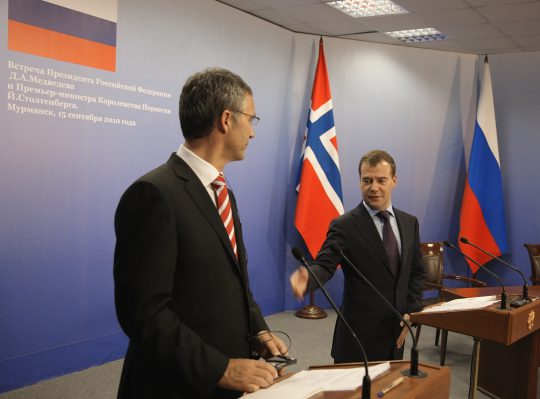
Norwegian Prime Minister Stoltenberg and Russian President Medvedev at the 2010 meeting cementing the new delimitation of the Barents Sea maritime border in Norway’s favor.
Sputnik – June 26, 2016
Earlier this month, Norway’s government announced a new defense plan, amounting to the largest military modernization since the Cold War, directed against Russia. Commenting on the initiative, journalist Sviatoslav Knyazev suggested that the country’s government has chosen to forget decades of good-neighborly relations between Oslo and Moscow.
Last weekend, Norwegian media reported on the country’s most ambitious plans to modernize the country’s armed forces since the end of the Cold War.
The government plans include the purchase of at least 52 Lockheed Martin F-35 fifth-generation multirole fighter jets, four submarines (presumably Swedish-built diesel subs), and six coastal patrol aircraft. Plans also include the construction of five new frigates and six corvettes.Overall, the defense budget of the country of five million is expected to increase by 165 billion kroner (about $19.4 billion US) over the next 20 years.
Norwegian Prime Minister Erna Solberg did not mince words as to who exactly the buildup is directed against, stating that “we have an increasingly unpredictable neighbor to the east which is strengthening its military capacity, and showing willingness to use military force as a political tool.”
Solberg’s comments followed on promises by Defense Minister Ine Eriksen Soreide in February 2015 that her country would be reorganizing its armed forces to counter the so-called ‘Russian threat’. At that time, the official candidly admitted that Russian forces had “not breached our territory,” but added that Oslo was worried over the increase in the range and number of Russian military aircrafts’ flights near the country.
On the border between Norway and Russia, Oslo is deploying a new army unit, consisting of 200 rangers, to be deployed in the Sor-Varanger municipality in Finnmark county, strengthening a several-hundred strong contingent of border guards. These units, equipped with anti-tank and anti-aircraft weapons, will be based in the direct vicinity of the Russian town of Pechenga.Commenting on the buildup in a piece for the online news and analysis portal PolitRussia, independent journalist Sviatoslav Knyazev recalled that “even before the modernization, the Norwegian Armed Forces were relatively powerful.”
“The per capita defense costs of the Kingdom are the highest in Europe. The armed forces are small enough (about 30,000 on active duty and some 45,000 in the reserve) but well prepared and equipped. Taking account of mandatory military service and its high prestige, a large portion of the population has military training. In the event of a hypothetical conflict, Norway can put several hundred thousand people under arms.”
Listing off the inventory of the country’s armed forces, Knyazev recalled that its ground forces have 52 Leopard 2A4 tanks, along with 20 older Leopard 1A5s, along with 315 M113 armored personnel carriers, 104 Swedish-made CV90 infantry fighting vehicles, and 80 SISU XA-185 and XA-203 armored personnel carriers. The army also has about 200 multi-purpose armored vehicles, and a number of self-propelled guns and multiple launch rocket systems.
The Air Force, for its part, has 57 F-16 multirole fighters, while the Navy has five frigates, six corvettes and six submarines.With these figures and the government’s latest plans in mind, the journalist pointed out that Norway is “effectively planning to double the strength of its Navy and Air Force (or completely modernize it). We are talking about billions of dollars of spending, a lot even for a wealthy country like Norway.”
Unfortunately, Knyazev emphasized, “all of this is directed solely against us [Russia].” At the same time, “Norway’s desire to ‘play with toy soldiers’ and to create conditions which could destabilize our northern border seems doubly strange in the context of Moscow’s long record of friendly relations toward Oslo.”
For a start, the journalist pointed out, the Russian Empire was one of the first to recognize Norway’s independence, soon after the country broke off from Sweden in 1905. Later, after the collapse of the Russian Empire and the emergence of the Soviet Union, diplomatic relations were established in short order, with relations established in 1924.
“In 1944,” Knyazev recalled, “its was the Red Army which fought to liberate [northern] Norway from the Nazi invaders. Thousands of Soviet soldiers and officers paid with their lives for the country’s freedom. After that, the Soviet Union, itself ravaged by war, helped to restore its northern neighbor. The USSR provided food rations, and Red Army engineering units helped rebuild ruined buildings. Moreover, the Soviet Union did not even try to create a zone of influence in Norway or to reshape its borders. In September 1945, having assisted its neighbors with aid, Soviet troops voluntarily left the country.”
Later, in the 1970s, a territorial dispute broke out between Moscow and Oslo over the maritime border in the Barents Sea, rich in offshore hydrocarbon reserves and fishing resources. “However, in 2010, Russia voluntarily ceded half of the disputed territory and signed a treaty ‘On Maritime Delimitation and Cooperation in the Barents Sea and the Arctic Ocean.'”
In 1949, the journalist bitterly recalled, the Norwegian government “thanked” the USSR for its contribution to the country’s liberation by joining the NATO alliance. “Now, it seems, we are being ‘thanked’ for the [2010] territorial gift, the shelf and the hydrocarbons worth tens of billions of dollars…”
“First, Norway introduced sanctions against us over a war unleashed by Washington in Ukraine [in 2014], then caused a scandal because of our Deputy Prime Minister’s visit to Svalbard [in 2015], and now they are up in arms and creating new military units directed against us.”Meanwhile, Knyazev lamented, “Jens Stoltenberg, the same former Norwegian Prime Minister who earned political capital through the 2010 demarcation agreement, is now directing the NATO bloc’s aggressive anti-Russian activities. Today, he is calling for strengthening NATO’s presence in the Baltic and Black seas, suggesting that the anti-Russian missile defense system in Eastern Europe is nothing out of the ordinary, and calling for ‘deterrence’ against Russia, which in actuality is not planning to attack anyone.”
Ultimately, the journalist suggested, “Norway, unfortunately, is a new example of the fact that befriending Western countries and doing them good is quite a thankless occupation…”
See also:
Norway Follows in US Footsteps, Ready to Deploy Aid to Syrian Rebels
Destroying the Magnitsky Myth
By Gilbert Doctorow | Consortium News | June 21, 2016
Despite all the threats of lawsuits and physical intimidation which hedge fund executive William Browder brought to bear over the past couple of months to ensure that a remarkable investigative film about the so-called Magnitsky case would not be screened anywhere, it was shown privately in a museum of journalism in Washington, D.C., last week.
The failure of the intimidation may give heart to others. There is talk that the film may be shown publicly in Norway, where its production company is located, but where an attempt several weeks ago to enter it into a local festival for documentaries was rejected by the hosts for fear of lawsuits. Moreover, a Norwegian court has in the past week declined to hear the libel charges which Browder’s attorneys were seeking to bring against the film’s director and producers.
Browder was more successful in intimidating the European Parliament where a screening of the film was cancelled in late April while I was in the audience. But I have now seen the banned documentary privately and “The Magnitsky Act. Behind the Scenes” is truly an amazing film that takes the viewer through the thought processes of well-known independent film maker Andrei Nekrasov as he sorts through the evidence.
At the outset of his project, Nekrasov planned to produce a docu-drama that would be one more public confirmation of the narrative that Browder has sold to the U.S. Congress and to the American and European political elites, that a 36-year-old whistleblower “attorney” (actually an accountant) named Sergei Magnitsky was arrested, tortured and murdered by Russian authorities for exposing a $230 million tax fraud scheme.
This shocking tale of alleged Russian official corruption and brutality drove legislation that was a major landmark in the descent of U.S.-Russian relations under President Barack Obama to a level rivaling the worst days of the Cold War.
But what the film shows is how Nekrasov, as he detected loose ends to the official story, begins to unravel Browder’s fabrication which was designed to conceal his own corporate responsibility for the criminal theft of the money. As Browder’s widely accepted story collapses, Magnitsky is revealed not to be a whistleblower but a likely abettor to the fraud who died in prison not from an official assassination but from banal neglect of his medical condition.
The cinematic qualities of the film are evident. Nekrasov is highly experienced as a maker of documentaries enjoying a Europe-wide reputation. What sets this work apart from the “trade” is the honesty and the integrity of the filmmaker as he discovers midway into his project that key assumptions of his script are faulty and begins an independent investigation to get at the truth.
An Inconvenient Truth
It is an inconvenient truth that he stumbles upon, because it takes him out of his familiar milieu of “creative people” who are instinctively critical of the Putin regime and of its widely assumed violation of human rights and civil liberties.
We see how well-known names in the European Parliament, in the Parliamentary Assembly of the Council of Europe and in NGOs that are reputed to be watchdogs have taken on faith the arguments and documentation (largely in Russian and inaccessible to them) which they received from William Browder and then rubber-stamped his story as validated without making any attempt to weigh the evidence.
Their intellectual laziness and complacency is captured fully on film and requires no commentary by the director. One of those especially skewered by her own words is German Bundestag deputy (Greens) Marieluise Beck. It is understandable to me now that I have viewed the film why she was one of the two individuals whose objections to its showing scuttled the screening in the European Parliament in April.
By the end of the documentary, Nekrasov finds that he has become a dissident in his own subculture within Russia and in European liberal circles.
Another exceptional and striking characteristic of the filmmaker is his energetic pursuit of all imaginable leads in his investigative reporting. Some leads end in “no comment” while others result in exposing whole new areas of lies and deception in the Browder narrative.
Nekrasov’s diligence is exemplary even as he takes us into the more arcane aspects of the case such as the money flow from the alleged tax fraud. These bits and pieces are essential to his methodology and justify the length of the movie, which approaches two hours.
Nekrasov largely allows William Browder to self-destruct under the weight of his own lies and the contradictions in his story-telling at various times. Nekrasov’s camera is always running, even if his subjects are not thinking about the consequences of being taped. The film also shows a videotaped deposition of Browder fumbling during an interrogation in a related civil case that is devastating to those politicians and commentators who fully swallowed Browder’s Magnitsky line.
Browder’s supposed lapses of memory, set in the context of involuntary facial expressions of stress and nervousness, would be compelling to jurors if this matter ever got into an open court of law in an adversarial proceeding.
At the end of the twists and turns in this expose, the viewer is ready to see Browder sink through the floor on a direct transfer to hell like Don Giovanni in the closing scene of Mozart’s opera. Nothing so colorful occurs, but it is hard to see how Browder can survive the onslaught of this film if and when it gets wide public viewing.
But the goal of many powerful people, including members of the U.S. Congress, the European Parliament and the Western news media who gullibly accepted Browder’s tale, will be to ensure that the public never gets to see this devastatingly frank deconstruction of a geopolitically useful anti-Russian propaganda theme.
Gilbert Doctorow is the European Coordinator of The American Committee for East West Accord. His most recent book, Does Russia Have a Future? was published in August 2015.
© Gilbert Doctorow, 2016
Moscow ready for more sanctions, regardless of Ukraine crisis – Foreign Ministry
RT | September 9, 2015
Russia has no illusion about sanctions being lifted and expects them to be stiffened in future, regardless of developments in Eastern Ukraine. That’s according to a leading Russian diplomat, who says Moscow can live under continuous western pressure.
“We believe that in certain directions, notwithstanding of the developments in Donbass, we should expect toughening of the sanctions pressure,” Russian Deputy Foreign Minister Sergey Ryabkov said at the Russia Arms Expo 2015 in Nizhny Tagil on Wednesday.
According to Ryabkov, the new set of sanctions introduced by Washington last week against Russian companies, including arms exporter Rosoboronexport, “mirrors the policy of complicating operations of the Russian military-industrial complex and all of the mechanism of government.”
Sanctions come in handy as a “true instrument of aggressive foreign policy” aimed at Russia, the diplomat said.
“Russia’s independent and self-sufficient foreign policy, its decisiveness to protect its sovereignty, and the consolidation of the people with the country’s leadership serve as a thorn in the side of our opponents,” Ryabkov said.
“We presume that the sanctions are there for the long haul,” Ryabkov said. “There are no reasons or illusions that sanctions are going to be lifted in the short term, at least not in the Foreign Ministry.”
“When it comes to international financial services, our colleagues from the US and the EU are set to expand their effort to seal off all capabilities. We understand that and we have to learn how to operate in the given situation,” Ryabkov said, insisting that sanctions will fail to gain the desired effect.
“We’re sorry the US has not learned that truth so far.”
Russian Economic Development Minister Aleksey Ulyukaev said Moscow is going to seek a “symmetrical answer” to American sanctions imposed on September 2.
Washington imposed sanctions on a number of Russian, Chinese, Syrian, Turkish, Sudanese and Iranian companies, believed to be involved in activities which, according to Washington, go against its Nonproliferation Act in regard to Iran and Syria.
“These are not sectoral sanctions, they are personalized, therefore we would consider some kind of a symmetrical answer,” Ulyukaev said.
In March 2014, the EU, the US and some other countries imposed individual sanctions against 21 Russian and Ukrainian officials, subjecting them to asset freezes and travel bans. Within a year, the list was extended to 150 people, including Russian Deputy Prime Ministers Dmitry Kozak and Dmitry Rogozin, as well as presidential aide Vladislav Surkov and 37 entities that, according to the EU, are “responsible for actions which undermine or threaten the territorial integrity, sovereignty and independence of Ukraine.”
The restrictions have been prolonged until January 31, 2016.
To reciprocate, in August 2014 Moscow introduced a ban on importing meat, dairy, fruit, and vegetable products from countries that have imposed sanctions on Russia over the Ukraine conflict. The countries included EU member states and Norway, US, Canada and Australia.
European Union sanctions against Russia include restrictions on lending to major Russian state-owned banks, as well as defense and oil companies. In addition, Brussels imposed restrictions on the supply of weapons and military equipment to Russia as well as military technology, dual-use technologies, high-tech equipment and technologies for oil production. No sanctions were imposed against Russia’s gas industry.
‘Nonsense’: Norway PM lashes out at NATO spending goals
RT | June 29, 2015
The prime minister of Norway, Erna Solberg has described NATO’s defense spending plans as “nonsense.” The alliance wants members to spend two percent of their GDP on defense, but Oslo, one of the world’s richest countries, says it won’t meet the target.
“If I am allowed to speak, I think the percentage goal is nonsense,” she said in an interview with the Norwegian Armed Forces’ Forum Magazine, as cited by the Local. “The aim of the NATO countries must be the greatest possible defense capability, not a percentage goal in itself,” she added.
Solberg added that while meeting the two percent target may be easier for countries enjoying strong economic growth, it would be harder for those within the alliance whose economies are shrinking.
Norway’s Defense Minister Ine Eriksen Soreide said in April that for Oslo to spend 2 percent of its GDP on defense would be “very challenging” in the short term. The Scandinavian country has already said it will increase its spending this year, but this will only bring it to around 1.6 percent and short of the target that was set at the NATO summit in Cardiff, the United Kingdom, last year.
NATO’s General Secretary Jens Stoltenberg, who was also Solberg’s predecessor as Norway’s PM, said that the country could easily meet the target.
“If there is a political will, there is economic space. But it must be given priority,” he said in a visit to Norway in June. “Compared with other major initiatives we have implemented in Norway, reaching two percent is quite possible.”
Aside from the United States, traditional NATO allies have found meeting the target a taxing affair. Germany allocates 1.2 percent of its GDP, the Netherlands 1.3 percent and Spain less than 1 percent. France is the only Western European country that is boosting defense spending. However, some Eastern European nations are increasing their military expenses citing what they call Russian aggression. Lithuania, for instance, wants to allocate twice as much on defense as it did last year.
READ MORE: NATO defense spending a ‘red line’ – US Air Force Secretary
Phantom Russian Sub Hunts Gave Birth To NATO’s Viking Bloc
By Andrew KORYBKO | Oriental Review | May 5, 2015
The largely unobservant public had previously been under the impression that the Baltic Sea was a zone of peace and stability, thinking that all the region’s states lived in harmony with one another. This may have been the case prior to 1991, but immediately afterwards, NATO’s expansion into the Baltic basin seriously upset the balance of power, as the incorporation of Poland and the former Soviet Baltic States in 1999 and 2004 attests. Through this manner, NATO was able to surround Kaliningrad and directly push up against part of Russia’s western border.
The military tension remained just below the surface (literally), until Shadow NATO states Sweden and Finland started initiating highly publicized ‘Russian sub’ scares, designed with the sole intent of scaring their publics into formal NATO membership and opening up an additional front in the New Cold War. Taking it further, this is all part of NATO’s new policy of regional blocs, as Brussels hopes to see the formation of a ‘Viking Bloc’ that would apply pressure against Russia in the Arctic. The most dangerous development, however, is with Finland, which is capitalizing off of the sea scare to call up nearly one million reservists (1/5 of the total population) in the event of a “crisis situation”, thereby presenting a dangerous test run in conflict escalation that might be applied all over Europe in the future.
Regional Hysteria
To put everything into focus, it’s best to begin by documenting the latest hysteria stemming from supposed ‘Russian sub’ sightings. Sweden started the trend when it claimed to be hunting a believed-to-be Russian sub back in October, and when nothing came out of the stunt except for a scared public and a couple million dollars spent, Stockholm continued to insist that it had evidence that a foreign sub did trespass through its waters, but curiously kept the details to itself. Be that as it may, it didn’t stop legislators from increasing the defense budget by a whopping $1.18 billion for the period 2016-2020, earmarking an additional $945 million for the future purchase of two subs, and announcing plans to reopen a military base on the Baltic island of Gottland. The ultimate irony is that there was never a ‘Russian sub’ to begin with, and that it was eventually revealed that the whole scandal started over a simple workboat, thus making it seem like Sweden exaggerated the situation simply to push through more defense funding and militarize its society against Russia.
 Being the regional leader that it is, it appears as though Sweden’s spectacle of the phantom Russian sub rubbed off on Finland, which soon after its latest elections began detonating underwater charges against its own suspected ‘Russian sub’. Finnish political analyst Jon Hellevig assessed that this was simply Helsinki’s application of Stockholm’s decades-long tactic of using phantom Russian subs to increase the population’s acceptance of future NATO membership. While Finland isn’t a de-jure member of the alliance, both it and Scandinavian military hegemon Sweden signed a NATO host nation agreement last fall to intensify their relations with the bloc, essentially making them Shadow NATO members in an even deeper capacity than Ukraine has become (the latter of which has been the bone of contention sparking the New Cold War in the first place).
Given such a relationship, it may not even be needed for either state to formally join NATO at this point, since the alliance can already reap the resultant military advantages of their territory in any possible anti-Russian crisis scenario. However, putting the provocative issue up for a referendum vote or making a unilateral government decision in this regard might be a forthcoming tactic towards creating the aforementioned crisis needed to ‘justify’ the indefinite hosting of NATO troops in those countries. It’s quite clear that Sweden is already de-facto participating in NATO, since they just partook in the group’s “Dynamic Mongoose” anti-submarine drills off the Norwegian coast. This would have obviously raised eyebrows among its domestic citizenry had it not been for the earlier ‘Russian sub’ scare that created the social pretext for its acceptance, showing how such false crises can be manipulated by the media for predetermined military gain.
The Viking Bloc
Everything going on in Scandinavia right now, from the phantom ‘Russian sub’ scares to the de-facto NATO-ization of the region’s last formal holdouts, is designed to create the northern component of NATO’s regional bloc strategy. In sum, the alliance is reverting to history and using Polish interwar leader Josef Pilsudski’s Intermarum concept to establish a Baltic-to-Black-Sea coalition of anti-Russian states to which it can more efficiently outsource its military prerogatives, all per the Lead From Behind strategy. The ‘Viking Bloc’ which consists of the Greater Scandinavian states of Sweden, Norway, Denmark, Iceland, and Finland (centered on Sweden, possibly incorporating Estonia and Latvia as well) is envisioned to complement the emerging Commonwealth Bloc of Poland, Lithuania, and Ukraine (centered on Poland), and the forthcoming Black Sea Bloc of Romania, Bulgaria, and Moldova (centered on Romania, possibly even expanded to Georgia).
Focusing more specifically on the characteristics of the Viking Bloc, its members have a maritime identity, so it’s predicted that they’ll focus their activity on the Baltic Sea, North Sea, and Arctic Ocean, accordingly making them all one large naval base. Sweden’s demographic and economic strength makes it the obvious leader amongst the identified members and the control node of its activity, while wealthy Norway can provide the natural resources needed to keep it running. Denmark controls the entrance to and from the Baltic Sea, and together with its colony country of Greenland, Iceland, and Norway, the three can patrol the North Sea and Arctic Ocean in hunting ‘Russian subs’. It’s also not a coincidence that all of these states are members of the Arctic Council, meaning that this dialogue configuration has essentially become one of confrontation between North America & the Viking Bloc on one side and Russia on the other. The odd member out of this naval configuration is Finland (also a member of the Arctic Council), which has recklessly adapted a land-based anti-Russian policy that’s bound to ratchet up tension with its neighbor. One should also note that the Viking Bloc’s members signed a multilateral defense cooperation agreement in April that basically institutionalized the organization as an official regional bloc.
The Finnish Amphibian
The most dangerous sub-bloc strategy being adopted by NATO is its Finnish affiliate’s advance preparation of 900,000 reservists in the event of a “crisis situation”, which obviously could only refer to a military conflict with Russia. The Finnish government is trying to account for all of its former reservists aged 20-60 in order to inform them of what their “crisis situation” role would be, as well as to collect updated information about them. This dramatic movement of anti-Russian initiatives from sea onto land represents an amphibious strategy that’s likely only in its initial test-run phase. NATO wants to gauge Russia’s reaction and monitor its response in order to fine-tune this template for eventually export throughout the bloc as a whole.
The Finnish Amphibian is a very simple strategy. All that the practicing states or regional blocs have to do is report on a phantom ‘Russian sub’ sighting, preferably with as much media paranoia as possible but providing no proof whatsoever, and then use the subsequent buzz to justify the potential mobilization of a massive land-based reservist force. This leads to the militarization of society within the targeted state and initiates a siege mentality that makes its citizens feel as though they’re constantly under some type of Russian attack. None of the accusations have to be proven, let alone even seen by the citizens themselves, so long as the media and supportive political figures repeat the chorus of conflict enough to make it believable. An added touch would be to implement Sweden’s strategy of publicly accusing 1/3 of all Russian diplomats there as being spies, which when coupled with the existing paranoia about phantom ‘Russian subs’, sends the populace’s paranoia into overdrive and all but assures that they’ll support whichever military or surveillance solutions their government or NATO suggests.
Concluding Thoughts
NATO’s northernmost regional fighting group, the Viking Bloc, owes its speedy creation to the utilization of phantom ‘Russian sub’ scare tactics to galvanize support for this new initiative. Greater Scandinavia is rapidly being transformed into one giant NATO naval base that’s meant to confront Russia on the neighboring high seas. As destabilizing as that is, it moves into the realm of flashpoint danger with the fact that Finland is preparing to mobilize 1/5 of its population against Russia, thus presenting an amphibious land-based component to the majority sea-focused strategy. Even worse, the template of using false sea-based scares to ‘justify’ massive land-based mobilizations could likely be applied elsewhere in Europe, thereby serving as an ideal model of militarization all throughout NATO. It’s this hybrid of media-military strategic collaboration that may eventually prove to be more destabilizing than the unveiling of the Viking Bloc itself.
Norway holds massive drills near Russia border
Press TV – March 9, 2015
Norway has started massive military exercises, involving 5,000 servicemen, in the northern parts of the country near the border with Russia, the largest such drills in nearly 50 years.
The country’s military launched drills dubbed “Joint Viking” on Monday in the northern regions of Lakselv and Alta in the Finnmark County, which border Russia’s Murmansk region.
The exercises will include the Norwegian army, navy, air force and civil defense troops (Heimevernet).
Aleksander Jankov, a spokesman for the Norwegian Armed Forces, said 400 military vehicles and all types of weapons will be used in the drills, which are the largest to take place in the region since 1967.
According to Norwegian media, the massive exercise is to show that Norway has the ability to defend Finnmark.
Prior to the kickoff army spokesman Vegar Gystad said, “If we’re to have a credible defense that can defend the entire country, we also have to train in the entire country.”
The war games come amid tensions between the West and Russia over the crisis in Ukraine.
Norway, a member of the Western military alliance NATO, suspended all military cooperation with Russia after the Black Sea Peninsula Crimea voted to break away from Ukraine and rejoin the Russian Federation in March, 2014.
Meanwhile, NATO plans to expand its military presence in Eastern Europe amid the crisis in Ukraine and has held numerous war games over the past year. In 2014, NATO forces held some 200 military exercises, with the alliance’s General Secretary Jens Stoltenberg having promised that such drills would continue.
In addition, the defense ministers of NATO’s 28 member states agreed on February 5 to establish six new command and control posts in the Eastern European nations of Estonia, Latvia, Lithuania, Poland, Bulgaria and Romania.
Moscow has repeatedly condemned NATO’s exercises and military buildup toward its borders.
Fake mobile towers in central Oslo may snoop on politicians, report reveals
RT | December 14, 2014
A network of fake base mobile stations that can snoop on leading politicians’ mobile phones, as well as ordinary people, has been discovered in central Oslo, some outside Norway’s parliament and the prime minister’s residence, according to a report.
Investigative journalists from the Aftenposten newspaper have detected a number of places in the capital with suspicious mobile activity. They teamed up with two security companies to help track down fake base stations, which confirmed that spy equipment has been used in downtown Oslo.
According to the newspaper, false base stations, known as IMSI catchers, have been most probably used to monitor the movements of high-ranking officials, specifying who enters parliament, government offices and other buildings in the area. It could also be used to snoop on phone calls of selected people in the area.
An IMSI catcher (International Mobile Subscriber Identity) is a telephony eavesdropping device for monitoring mobile phone traffic and movement of mobile phone users. IMSI catchers are used in a number of countries, including the US, by law enforcement and intelligence agencies.
Under Norwegian law, only the National Security Agency (NSM) and police are authorized to use eavesdropping equipment.
The Security service (PST) has launched an investigation in central Oslo, following the Aftenposten report, to find out who installed the surveillance equipment.
The Local has quoted security operatives as saying that a number of organizations could be responsible for the false base stations.
“It could be private actors or state actors,” the PST’s Arne Christian Haugstøyl said.
“I can’t on the basis of these discoveries say that it is a foreign intelligence agency, but I can say that we know that foreign intelligence agencies have this kind of capacity. And in our preventive work we advise those looking after Norwegian interests not to talk about sensitive issues on mobile phones,” he noted.
Featured Video
John Mearsheimer Talking Iran with Iran
or go to
Aletho News Archives – Video-Images
New Book
The silver that medicine dropped — four thousand years of clinical use, four decades to erase.
Colloidal Silver — First Edition, 2026, Paperback
Lies are Unbekoming | October 16, 2026
Silver was medicine. Not alternative medicine. Not folk medicine. Medicine. In surgery. In obstetrics. In the burn ward. In water treatment. In the household medicine chest. Every physician before 1938 knew this.
By the 1870s, silver nitrate was standard in surgical wound care across the leading hospitals of Britain, Germany, and the United States. Colloidal silver preparations — Collargol, Argyrol, Protargol — entered European and American practice through the 1890s and early 1900s and became standard antiseptics in military field medicine. By the time Fleming grew his first penicillin mould in 1928, silver was the first-line antimicrobial of the Western pharmacopoeia. The Lancet and the British Medical Journal carried the clinical reports in volume. The practice ran continuously through the Victorian era, the Edwardian era, the First World War, the interwar period. By 1980, almost all of it was gone.
What has not been treated at book length, until now, is how a four-thousand-year clinical record disappeared from mainstream medicine within four decades of the Flexner Report — and what the honest account of silver looks like once that record is reassembled.
Colloidal Silver reconstructs the pre-1938 record from The Lancet, the British Medical Journal, and the primary literature of the era; recovers Robert Becker’s bioelectric framework from the regeneration research the pharmaceutical model buried; and places silver inside a practical terrain-paradigm guide to its current place — in water, on the body, inside the body, and in the chronic conditions where antibiotics have failed. … continue
Blog Roll
 Aletho News
- Pharma- and Gates-Funded GAVI Seeks to Assure Parents
- John Mearsheimer Talking Iran with Iran
- Inside Bill C-22, Canada’s Patriot Act.
- China’s FM: Palestinian cause is ‘greatest injustice of the century’
- US sympathy for Palestinians surpasses support for Israelis
- Israeli rabbi permits occupiers to steal Palestinian olive harvest in West Bank
- Spanish firm sells Latvia vehicles equipped with Israeli tech despite arms embargo
- Saudi Arabia under fire… Yemen is burning down the House of Saud
- Israeli Spy Pollard stole the files, today’s it’s delivered through official channels
- Why Iran Didn’t Walk Away
- If Americans Knew
- NPR investigation finds evidence of widespread fraud at mall kiosks tied to Israeli skincare brand
- Tucker Carlson exposes Israeli Lies about the Oct 7th attack, Charlie Kirk, and the U.S.
- Israel has detained thousands of Palestinian children since Oct 7th – over half spent time in solitary, many uncharged
- Israeli Analysis: Is Netanyahu Planning an ‘October Surprise’ Attack Before Israel’s Election?
- Israeli settlers brutally attack Palestinians and Washington Post female photographer, 65
- Words Have Changed, Occupation Continues: The Reality of the Gaza Ceasefire
- Gaza’s child amputees are growing faster than their prosthetics allow
- Israel keeps Palestinians struggling just to survive–Daily Update
- Israeli firm used online ads to run vast spy operation, researchers say
- No, the world zionist movement is not an antisemitic conspiracy theory
- No Tricks Zone
- New Study Suggests Large Regions Of The Pacific Ocean Have Been Cooling For The Last 80 Years
- Germany’s Green Energy Debacle: High Energy Costs Force Kahla Porzellan to Close After 182 Years!
- New Study: 50 Years Of The Most Aggressive ‘Net Zero’ Policies Can Only Affect The Global Climate By 0.03°C
- US September “Heat” Was No Record…Many Records Set Decades Ago
- Latest European Green Energy Debacle; Portugal’s Largest Flagship Solar Park Insolvent!
- Green Energy Debacle: German Expert Professor Fritz Vahrenholt Warns Of Severe Economic And Social Consequences
- Two More Paleo Reconstructions Affirm Meters-Higher Sea Levels Across Ireland, Brazil 7000-6000 Years Ago
- New Study: Earth And Venus Surface Warmth Largely Explained By Convection And Lapse Rate, Not CO2 Or Radiation
- 2025 Nature Paper Claiming Worsening Global Drought Gets RETRACTED …Heavily Flawed
- New Study: ‘Global Drought Shows No Detectable Recent Acceleration Under Climate Warming’

