Fiction or faith. It is a major failure to give equal prominence to people presenting scientific facts and people talking about their feelings or beliefs with no evidence in their support, or to allow them to contradict unchallenged the most reliable evidence we have.
However, virtually every time I know something about a healthcare issue considered controversial, this is what I see in the news, and the hepatitis B vaccine controversy illustrates this abundantly.
On 5 December 2025, with a vote of 8 versus 3, the Advisory Committee on Immunization Practices (ACIP) at the Centers for Disease Control and Prevention (CDC) ended the recommendation that all newborns in the United States receive a hepatitis B shot at birth. The birth dose was recommended only if the mother had tested positive for the virus or if her infection status was unknown.
The change was very rational, and as in Western Europe, only Portugal recommends a universal birth dose, it would seem difficult to argue against it. But the media did and failed us badly. Two days after the vote, I downloaded news stories from 14 major media outlets, and they were all very negative. The media used three main tactics to support their beliefs:
They denigrated the Secretary of Health, Robert F. Kennedy, Jr., the members of ACIP he had selected, and some of the presenters at the meeting.
They gave undue prominence and praise to the three dissenting ACIP voices and outsiders, who were depicted as experts or scientists, as if to say that they must be right, and they were widely quoted for their remarks, which were rarely rational or evidence-based.
They didn’t check if what the critics of the policy change claimed was correct.
The Denigration of Kennedy
Of the 14 news outlets, only Nature did not denigrate Kennedy.
Reuters started its press release by saying it was “a major policy win” for Kennedy that vaccine advisers named by him reversed a decades-long recommendation “that disease experts say will reverse decades of public health gains.” So, Kennedy’s advisers were not experts, and as the critics were experts, they must be correct, right?
Reuters noted that the CDC is “now run by a Kennedy-appointed acting head, Jim O’Neill, who is not a scientist;” that Kennedy founded the anti-vaccine group Children’s Health Defense; fired ACIP’s previous 17 “independent” experts and replaced them with a group that largely supports his views; dropped broad recommendations for the Covid vaccine and cut funding for mRNA vaccines.
The facts are that several of the previous experts at the ACIP were not independent but had conflicts of interest in relation to vaccine manufacturers and other drug companies; that recommending Covid vaccines only to high-risk groups brought the US on par with Europe; and that cutting funding for mRNA vaccine research was well motivated. Kennedy said that his team had reviewed the science and found that these vaccines fail to protect effectively against upper respiratory infections like Covid and flu. His department was therefore shifting the funding toward “safer, broader vaccine platforms that remain effective even as viruses mutate.”
Reuters misrepresented the ACIP meeting entirely, claiming that “many of Kennedy’s committee members criticized the vaccine as unsafe.” What they said was that safety had not been adequately studied, which was correct.
The other media called Kennedy a vaccine sceptic (The Hill, Health Policy Watch, CBC), a vaccine activist (CNN, the Guardian), or an anti-vaccine advocate (PBS), who fired all 17 previous members of the ACIP, replacing them with people who largely shared his scepticism (New York Times, Washington Post, National Public Radio, CNN, PBS, CBS News, Time, Health Policy Watch, CBC, BBC, Guardian ) with a “goal of upending vaccine policy” (New York Times ), and the vote fulfilled a long-held goal of the anti-vaccine movement (The Hill ).
The CBC, the largest news broadcaster in Canada, noted that Kennedy had promoted debunked theories linking vaccines to autism. It is correct that studies of the MMR vaccine and aluminium adjuvants did not find a link, but the aluminium study is seriously flawed, some studies have claimed a link, and as it has not been studied if the extensive US childhood vaccine program might cause autism, the CDC has suggested additional research projects.
The Washington Post said that aluminium had become a focal point for anti-vaccine groups that claim cumulative exposure may harm neurological development and that vaccine researchers note that aluminium is present naturally in breast milk, food, and water at far higher levels than in vaccines and is rapidly cleared from the body. It is highly misleading to compare dietary intake with injections, as very little aluminium is absorbed from the gut and the rest is effectively eliminated via the kidneys, and as aluminium adjuvants in vaccines are harmful.
The Hill and CNN noted that aluminium adjuvants in vaccines have been proven to be safe (which is false), but that vaccine sceptics like Kennedy have long said they are linked to allergies and other health conditions (which is correct). Natural infection protects against allergies, and studies comparing vaccinated with unvaccinated children have shown vaccines increase the occurrence of asthma and other atopic diseases.
The Denigration of ACIP Members and Meeting Presenters
Nature noted that several panel members continued to express broad criticism of vaccines.
The New York Times lamented that most of the new ACIP members and some of the presenters have no experience in vaccine research or clinical practice and that the divisiveness and dysfunction of the committee in making the decision raised questions about the reliability of the advisory process.
This is terribly misleading. People who have learned to read can assess the merits of vaccines, and scientific debate is what furthers science. Acting ACIP chair Robert Malone said that the committee’s work must be guided by evidence, transparency, and a willingness to scrutinise assumptions rather than protect them.
Health Policy Watch wrote that Malone has been criticised for vaccine misinformation, which is a meaningless comment without any mention of what the issues were. Some of the most outstanding vaccine researchers in the world, professors Peter Aaby and Christine Stabell Benn from Copenhagen, have been criticised for misinformation and have had lectures and interviews removed from YouTube even though everything they said was correct.
CBS News noted that ACIP member Retsef Levi, a mathematician with no medical training (so what?), had falsely claimed that experts had never tested the vaccines appropriately, and the New York Times called it incorrect when lawyer Aaron Siri, a presenter, said that “not one” of the shots administered to children had been compared against a placebo or an inert substance. But Levi and Siri were correct. No childhood vaccine on CDC’s schedule was studied in placebo-controlled trials or relied upon before licensure.
The CBC also described Levi as a person with no medical degree who had questioned the safety of the Covid-19 vaccines and called for Covid vaccine programs to be halted. Well, I have observed repeatedly that Levi’s arguments were far more persuasive than those offered by people with medical degrees, e.g. by ACIP member Cody Meissner, a paediatric infectious-disease specialist (see below).
And Covid vaccines are definitely not safe; they have killed children who developed myocarditis and adults who developed blood clots. It was very prudent to change the “all-inclusive” US Covid vaccine programs when by far most people have been infected, whether vaccinated or not, and because repeated boosters can weaken the immune system and increase the risk of respiratory infections, also for flu shots. Healthcare workers themselves have already delivered a verdict. According to the CDC’s own data, fewer than 10% received a booster in the past year.
National Public Radio denigrated Siri: an anti-vaccine lawyer with no medical or scientific training, and the Washington Post failed their readers, too: “Aaron Siri, a Kennedy ally and lawyer for the anti-vaccine movement, delivered a presentation for more than 90 minutes. Siri said clinical trials for vaccines have not been properly performed, that safety surveillance after vaccines are licensed is lacking and that the efficacy of vaccines in reducing deaths and spread of disease has been overstated. Siri and Kennedy-aligned activists argue that the cumulative number of shots places an undue burden on child immune systems. Scientists counter that… the immune system can safely handle far more antigens than vaccines contain.”
Siri is correct and the reason why he was given so much time is that he is evidence-based and very knowledgeable. His book about vaccines is outstanding. And “scientists” have no evidence that the immune system can safely handle many vaccine antigens injected simultaneously. This is unknown and needs studying.
The Washington Post also noted that “Siri petitioned the government in 2022 on behalf of the anti-vaccine group Informed Consent Action Network, which is run by Kennedy’s former communications director, to reconsider its approval of Sanofi’s stand-alone polio vaccine. Siri argued that the government had relied on inadequate data, a claim regulators rejected.”
However, the petition notes that “the clinical trials relied upon to license this product did not include a control group and only assessed safety for up to three days after injection. These trials therefore did not comply with the applicable federal statutory and regulatory requirements necessary to prove the product was ‘safe’ prior to licensure.” As live, attenuated polio vaccines can mutate and cause polio, I agree with Siri that this drug had not been adequately studied before licensure.
The New York Times and National Public Radio wrongly implied that Siri wanted to remove all polio vaccines (“polio vaccines” or “the polio vaccine”).
Praising “Experts” and Giving Them Undue Prominence
Safety was a major issue. Dissenting ACIP member Cody Meissner said at the meeting that we know that the vaccine is safe, and his reassurances were quoted by the New York Times, the Washington Post, National Public Radio, Nature, the BBC, and Time.
However, when the Institute of Medicine in 2013 was commissioned to review the safety of the CDC childhood vaccine schedule, they could not find a single study that had compared health outcomes in vaccinated children with those in children who had not received any vaccines and they concluded: “There is no evidence that the schedule is not safe.” Similarly, Time wrote about the hepatitis B vaccine that there is “no evidence in regard to lack of safety.” My comment on this kind of reasoning was: “If the brakes in a new car model have never been tested, the reassuring conclusion would be: ‘There is no evidence that the brakes don’t work.’”
At the ACIP meeting, Meissner accused Siri of presenting “a terrible, terrible distortion of all the facts” (New York Times, National Public Radio, The Hill, CNN, Time ) and of making “absolutely outrageous statements about safety.” This was totally false and Meissner should know better. ACIP members were shown that the clinical trials underpinning approval of the hepatitis B vaccine were small, lacked a placebo group, and followed infants for no more than seven days after vaccination, which would not detect any long-term adverse outcomes. Normally, such findings would have shocked people and prompted caution, but Meissner insisted that “There is no evidence of harm.” Well, if you don’t look, you won’t find.
Levi hit the nail on the head: “What is the number needed to vaccinate – among babies born to hepatitis B-negative mothers – to prevent one case of chronic hepatitis B?” No one supplied an answer. But if the true number was “in the millions,” then any credible harm-benefit analysis would require showing a number-needed-to-harm one infant seriously even higher.
Meissner, however, opined that the move was rooted in baseless scepticism and that we will see more hepatitis B infections (Washington Post, Nature ). He was also against possibly using fewer than three doses of the vaccine (New York Times, The Hill ), arguing that antibody titres are not a good correlate of protection and did not have scientific backing (Nature ). The inconsistency was unmistakable. Antibodies are embraced as proof of vaccine efficacy when convenient, e.g. in drug regulation, otherwise not.
Another dissenting ACIP member, psychiatrist Joseph Hibbeln, was quoted a great deal although he said nothing of substance: The revised guidance was “unconscionable” (Washington Post ), “the decisions should be based on data” (The Hill ), “Those are all speculations” (Time ), “Is there any specific evidence of harm of giving this vaccination before 30 days?” (Guardian ). Not a single journalist wondered why a psychiatrist sat in a vaccine committee.
Dr Tracy Beth Høeg, a presenter at the meeting, noted that the US was an outlier recommending around 72 childhood vaccine doses, while countries like Denmark use fewer than 30. PBS and Time argued that the US is not an outlier in recommending hepatitis B vaccines for newborns because 116 of the 194 WHO member states did the same. This is not a proper comparison, and, as noted above, in Western Europe, only Portugal recommends a universal birth dose.
Levi noted that “The policy in the US is completely misaligned with many countries that… care about their children just as much as we do,” and when Meissner viewed the growth of the childhood vaccine schedule as an achievement for child health, Siri countered correctly that the US “has the worst health outcomes amongst all developed countries.”
The media quoted three previous CDC directors. Rochelle Walensky said that over the past few months, she had observed “a systematic undermining of the nation’s vaccine program” (National Public Radio) and that the “US vaccine-safety monitoring system can detect very, very rare safety events“ (Nature ). Maybe, but she ignored them. In April 2021, cases of myocarditis after Covid-19 vaccination, particularly among young male vaccine recipients, had been reported to the Vaccine Adverse Event Reporting System at the CDC, but Walensky said by the end of the same month: “We have not seen a signal and we’ve actually looked intentionally for the signal in the over 200 million doses we’ve given.”
Tom Frieden provided a doomsday statement: “The ACIP recommendation… puts millions of American children at greater risk of liver damage, cancer and early death.” He advised everyone to “stand up for fact-based care” and “not accept this misguided and dangerous recommendation” (Time).
Demetre Daskalakis had a weird argument: “This will signal to clinicians that there is something wrong with the vaccine – there is not” (Reuters, CNN). It could also signal greater responsibility at the CDC than under previous directors. But the BBC and the Washington Post joined the folly arguing that public health experts, representatives of medical organisations, and some ACIP members worried the vote could raise unfounded safety concerns about the vaccine and undermine hard-won trust in vaccines leading to more sickness.
The media gave organisations undue prominence without ever considering if they were impartial. They urged people to look to “independent recommendations,” e.g. from the American Medical Association and the American Academy of Pediatrics, for “science-based advice” (National Public Radio).
I would call it advice based on money. The Academy would continue to support the birth dose of the vaccine (Reuters, CBS News, Health Policy Watch, CNN, Time, CBC) but all journalists forgot to say that it receives many millions of dollars from vaccine manufacturers and other drug companies. Unsurprisingly, hepatitis B vaccine makers Merck, Sanofi, and GSK defended their products as safe, and Merck was “deeply concerned by the vote” (Reuters ). Perhaps because Merck’s shares dropped?
“Don’t listen to ACIP at all… listen to the American Academy of Pediatrics” (CNN), which said that the “irresponsible and purposely misleading” guidance would harm children; called it a “deliberate strategy to sow fear and distrust among families” (CBC); and delivered a gigantic falsehood: “Vaccine recommendations are largely similar across developed countries” (CBS News).
Reuters noted that ACIP members had said that the birth dose “was out of step with peer countries, particularly Denmark,” but then quoted “a CDC disease expert” for saying that the US is not comparable to Denmark with its universal healthcare and more thorough screening for the virus. The Washington Post said that “public health experts” had noted that European countries recommending fewer shots for children were smaller and had better health care systems, and that medical associations had argued that the US schedule had been thoroughly studied (which is blatantly false). None of the media quoted Levi, who mentioned that the US and Denmark have the same background rate of hepatitis B despite different policies on the birth dose.
The American Medical Association is also heavily corrupted by industry money and said that ACIP’s decision was “reckless and undermines decades of public confidence in a proven, lifesaving vaccine. Today’s action is not based on scientific evidence” (CNN).
The American College of Physicians said that “This vote… will only endanger children and increase risk of death for millions,” and a hepatitis researcher urged people to “go back to our true experts… our CDC colleagues” (Health Policy Watch).
Time noted that “A group of several dozen professional medical organizations and health advocacy groups, including the American Medical Association” expressed alarm over the committee’s decisions: “Previously, we could expect science to drive decisions.”
Some panellists and media noted that universal hepatitis B vaccination at birth had helped to nearly eliminate cases among newborns in the United States, and that there was no evidence of harm (New York Times, Washington Post, The Hill, Guardian ). However, absence of evidence is not evidence of absence. When Levi countered that the risk for a child of getting infected was extremely low, supporters of the birth dose noted that the virus can be spread by household objects like toothbrushes, razors, or combs used by an infected person. This is a fake argument and the CDC website is explicit: “Although HBV can be found in saliva, it is not spread through kissing or sharing utensils. It is also not spread through sneezing, coughing, hugging, breastfeeding, or food or water.”
Levi also said that the decline in hepatitis B cases occurred long before the birth-dose policy was introduced and was concentrated in older age groups, not among infants, which supported a risk-based policy, focused on infants born to hepatitis B-positive mothers and on high-risk adult populations. When ACIP liaison Dr Flor Muñoz of the Infectious Diseases Society of America claimed that much of the discussion amounted to “misinformation,” Levi responded: “It’s not misinformation… this is CDC data.” When Muñoz pushed back, presenting her disagreement as established fact, Levi replied: “I appreciate your beliefs and feelings about this, but these beliefs and feelings are not supported by the data that were presented.”
Levi also pointed to ACIP’s prior recommendation of Covid-19 vaccination for healthy, extremely low-risk children, which he described as “one of the most outrageous” examples of framework failure.
ACIP’s decision sparked anger from Republican Senator Bill Cassidy (R-LA), a doctor, who said the vaccine is safe and effective (BBC, CBS News, Time, Health Policy Watch). He wrote on X that “Siri, a prominent anti-vaccine lawyer, makes his living suing vaccine manufacturers and is presenting as if an expert on childhood vaccines. The ACIP is totally discredited” (Washington Post, The Hill ).
The Hill was particularly critical. It wrote about an ardent objection from major medical organisations, internal spats among ACIP members, and a stark lack of data to support altering decades-long vaccine guidance, in fact, “There’s been great data and studies done on these vaccines, and they are safe and effective.” The Hill quoted top figures from Illinois, Massachusetts, and New York City for their rants, which included that they would not abide by ACIP’s “irresponsible attacks on clear, evidence-based science.”
When journalists “dial-a-quote,” they call organisations or people whom they know will respond in a way that mirrors their own bias pretending they have asked an “independent expert.”
The media were full of evidence-free, derogatory comments that were meaningless because they could not be contested:
- “We can no longer trust federal health authorities when it comes to vaccines,” “heartbreaking to see this science-driven agency turn into an ideological machine” (New York Times );
- “Medical experts have argued that it’s important to vaccinate all newborns for hepatitis B” (Washington Post );
- “The vaccine is incredibly safe,” experts decried the move (Reuters );
- the American Association of Immunologists is “extremely disappointed” in the decision;
- the American College of Physicians called the meeting “completely inappropriate” (CBS News); “many experts expressed dismay at today’s decision” (CNN);
- “A long lineup of medical experts…strongly urged against changing the vaccination schedule” (Health Policy Watch);
- “Public health experts decried the move,” CDC and the ACIP are no longer trustworthy sources and are becoming increasingly irrelevant (CBC);
- “a forum for the discussion of falsehoods,” ACIP members promoted their own sceptical views on vaccines, looking for a bogeyman, and you’re not going to find something if it doesn’t exist (Time );
- “Experts say any change to the current hepatitis B vaccination recommended schedule could have significant and far-reaching consequences for childhood health in the US” (Guardian ).
When the media presented statements that could be contested, they were usually wrong or seriously misleading, e.g. “Siri’s presentation was replete with ‘falsehoods and misrepresentation of the data,’ and he conflated informed consent with mandates” (New York Times ); “fierce objections from medical groups that said the recommendation had proved a successful public health strategy, nearly eradicating the dangerous virus among U.S. children” (Washington Post); a “Minority of members argue the change is not supported by data” (Reuters ).
Persuasion by Big Numbers
Like the drug industry does, the media used big numbers in their propaganda.
Globally, the vaccine has prevented millions of infections (Health Policy Watch). Before the vaccine, around 200,000 to 300,000 people were infected each year; since the vaccines began being universally administered to babies, overall cases are down to around 14,000 annually (PBS).
After a birth dose was recommended in 1991, the shots have prevented an estimated 90,000 deaths in the US (BBC) and reduced hepatitis B infections among infants and children by 99% (CBS News, Time, Health Policy Watch, Nature ).
All these claims are false or seriously misleading. Data presented at the meeting showed that much of the decline in hepatitis B infections over past decades occurred before the birth dose was recommended and it was largely driven by behaviour change, screening, and targeted vaccination of high-risk groups.
Senator Cassidy wrote on X that “Before the birth dose was recommended, 20,000 newborns a year were infected with hepatitis B. Now, it’s fewer than 20” (CBS News, CNN, Health Policy Watch). This was an error of 133 times. CDC data show that in 1990, only around 150 children below one year of age became infected.
Vaccinologist Paul Offit Lied on CNN
The most high-profile vaccinologist in the world, after vaccine “Godfather” Stanley Plotkin, is Paul Offit, but that may be a thing of the past after Siri’s recent revelations and his self-destructing appearance on CNN on the second day of the ACIP meeting.
Offit told viewers he had not been invited to speak at the meeting but internal documents show his claim is false. CDC officials had contacted him repeatedly – via emails, phone calls and a speaker-request form – inviting him to present.
Offit warned viewers that “50% of people in this country have chronic hepatitis B and don’t know it” (only about 0.3% have chronic disease) and suggested newborns were at risk through everyday contact with nannies, daycare workers, and family members because of sharing toothbrushes, towels, or simply being held by an infected adult, which the CDC denied could happen.
Offit described ACIP as a “clown show,” an “anti-vaccine advisory committee” that “puts children in harm’s way.” He lied monstrously saying that before universal infant vaccination, “30,000 children under the age of 10” contracted hepatitis B each year. CDC data presented at the ACIP meeting showed that new hepatitis B cases in children under the age of 10 were around 400 per year before the universal birth dose was introduced.
I am very indebted to journalist Maryanne Demasi, PhD, who wrote many of the articles I quoted above. She gave Offit the opportunity to clarify his remarks but he did not respond. This silence contrasts sharply with the certainty he brings to national television, where his claims are delivered without scrutiny and his financial ties to vaccine manufacturers are almost never mentioned.
Offit is not an impartial commentator. He earned millions from the sale of his stake in Merck’s rotavirus vaccine, RotaTeq, and has long been aligned with the pharmaceutical industry whose products he routinely defends. Yet major news outlets present him as a neutral authority and take his statements at face value.
Conclusions
The media’s reporting on the hepatitis B issue was seriously misleading and their advice that we should trust the “experts” who condemned the ACIP committee’s wise decision is horribly misguided.
The new ACIP’s first chair was biostatistician Martin Kulldorff. He developed the monitoring system the CDC uses for quick detection of vaccine harms, considered the best in the world. On 1 December, Kennedy announced that Kulldorff was appointed to a senior role at the Department of Health and Human Services after he had “transformed ACIP from a rubber stamp into a committee that delivers gold-standard science for the American people.” NIH director Jay Bhattacharya said that “Five years ago, Martin Kulldorff and I co-authored the Great Barrington Declaration calling for an end to pandemic lockdowns. That evidence-based approach to public health now permeates HHS.”
What the media presented was what we call eminence-based medicine, and the medical journals’ reporting on vaccine issues is also a disaster. I shall end with the abstract of an article I published on 10 November:
The reactions to Robert F. Kennedy Jr.’s initiatives to improve vaccine safety have been almost uniformly negative. I studied how the narratives were framed in a cohort of 33 articles in the BMJ of which 30 were written by journalists or the editor. I focused on whether the reporting was balanced and informative, and whether the articles saw any merit in Kennedy’s reforms in his role as Secretary of Health and Human Services or supported the status quo.
The reporting in the BMJ was highly biased. Much of the information provided in Kennedy’s disfavour was misleading, and some was wrong. All initiatives at improving vaccine safety were condemned, without any analysis of their merits in an evidence-based fashion. Instead, the BMJ cited people who had their own agendas and who condemned Kennedy without providing any evidence in their favour while expressing faith in vaccines, with the industry mantra that they are safe and effective, although all drugs will harm some people.
The BMJ did not take any interest in the widespread and lethal corruption in US healthcare institutions – one of Kennedy’s focus points – but toned it down.
Despite the constant ad hominem attacks, Kennedy has succeeded to introduce important changes and plans related to vaccine safety, guidance about how vaccines are used, and about avoiding neurotoxic metals in vaccine adjuvants.
Dr. Peter Gøtzsche co-founded the Cochrane Collaboration, once considered the world’s preeminent independent medical research organization. In 2010 Gøtzsche was named Professor of Clinical Research Design and Analysis at the University of Copenhagen. Gøtzsche has published over 100 papers in the “big five” medical journals (JAMA, Lancet, New England Journal of Medicine, British Medical Journal, and Annals of Internal Medicine). Gøtzsche has also authored books on medical issues including Deadly Medicines and Organized Crime.
December 21, 2025
Posted by aletho |
Deception, Fake News, Mainstream Media, Warmongering, Science and Pseudo-Science | COVID-19 Vaccine, GSK, Merck, New York Times, NPR, Sanofi, The Hill, United States, Washington Post |
Leave a comment
On 23 August 2025, award-winning science journalist Robert Whitaker, founder of the evidence-based Mad in America website, published a very important article:
”Not even the unborn are safe from psychiatric harm: Medical organizations and the media dismiss the large body of research telling of fetal harm from exposure to antidepressants during pregnancy.”
I summarize here Bob’s detailed article, adding my own thoughts and explanations about the issues.
On July 21, the FDA convened a panel on antidepressants in pregnancy, with a focus on possible harms to the fetus from exposure to the drugs.
The panelists’ brief presentations, and their plea for informed consent, did not sit well with medical organizations. They issued statements denouncing the panel as biased and misinformed; declared that the evidence showed that SSRIs and SNRIs are effective and safe treatments for prenatal depression; and claimed that the real concern was untreated depression. Major media echoed uncritically this flawed and erroneous expert consensus in their reporting on the panel.
The professional organizations betrayed the public’s right to know. They were putting their guild interests – protecting their prescribing practices and belief in the efficacy and lack of harms of antidepressants – ahead of their duty to provide an honest basis for informed consent. As detailed below, they misled the media, and the media in turn misled the public, in both cases very seriously so.
One of the panelists, Michael Levin, concluded that since serotonin is important for embryonic development, “manipulating its use by cells with SSRIs is very, very likely to cause certain kinds of defects.”
Animal experiments have proved him right. Fetal exposure to SSRIs leads to altered brain development, numerous risks to fetal health, and deficits in behavior after birth. At birth, fetal SSRI exposure in rodents is associated with low birth weight, persistent pulmonary hypertension, increased risk of cardiomyopathy, and increased postnatal mortality. After birth, such exposure is associated with delayed motor development, reduced pain sensitivity, disrupted juvenile play, fear of new things, and a higher vulnerability of affective disorders (such as anhedonia-like behavior). These behaviors are regarded as signs of anxiety and depression in animals.
With the animal studies showing also an increased risk for miscarriage, pre-term birth, and congenital malformations, the first wave of studies in humans focused on these concerns, in addition to low birth weight and persistent pulmonary hypertension. This research produced an abundance of findings that the risk of such adverse events is elevated with fetal exposure to SSRIs in comparison to healthy controls.
A fair number of studies tell of how in utero exposure to SSRIs alters brain development in humans and lead to other harms. For example, a study by Kaiser Permanente of Northern California of 82,170 pregnant women showed that if the depression was treated with counseling, the risk of a pre-term delivery was reduced by 18%, whereas treatment with an antidepressant increased it by 31%. In both cases, there was a dose-response relationship.
Another harm is the neonatal abstinence syndrome, which is common, e.g. it occurred in 30% of 60 newborns exposed to SSRIs in utero. Researchers have published an extensive list of abstinence symptoms, which includes jitteriness, poor muscle tone, weak cry, abnormal crying, respiratory distress, seizure, abnormal behavior, sleep abnormalities, poor feeding, vomiting, uncoordinated sucking, and lethargy. In a study using the World Health Organization’s database for adverse drug effects, researchers classified 84% of the reported abstinence symptoms as serious.
The Doubt Industry at Work
The rodent studies, which were not confounded, clearly showed how fetal exposure to SSRIs regularly leads to maladaptive adult rodents. Correspondingly, in comparison with healthy controls, studies of children exposed in utero to SSRIs show an elevated risk of getting diagnosed with ADHD, autism spectrum disorder, and affective disorders.
In a 2025 study, one of the FDA panelists, Jay Gingrich, and colleagues reported that prenatal exposure to SSRIs leads to a hyperactive amygdala both in mice and humans, which made both species more fearful and depressed as adolescents. Maternal depression could not explain these effects. Gingrich said at the FDA hearing that “these kids look pretty normal throughout early childhood, and then when they hit adolescence, their rates of depression really started to go up, which is what we see in our mouse studies.”
Bob Whitaker explains that studies in humans have produced inconsistent results. This is not surprising. When research results are threatening for a profession, researchers with guild or financial conflicts of interest always produce an avalanche of substandard studies casting doubt on the issues or denying them.
Maternal depression is known to confer developmental risks on children, and these researchers have therefore sought to account for this confounding factor by using statistical adjustments. Statistical adjustments are highly bias-prone, and in many of the studies Bob reviewed, the authors had not described their approach in sufficient detail nor whether the factors they controlled for had been published in a protocol before they looked at the data. Such studies can therefore be “torture your data till they confess” exercises.
A commonly used adjustment method is logistic regression, but what is little known is that the more baseline variables we include in a logistic regression, the further we are likely to get from the truth. This was documented in an excellent PhD thesis.
The Howl of Outrage
The same day the FDA had its panel meeting, or a couple of days later, leading medical organizations spread seriously misleading information.
The American Psychiatric Association wrote to the FDA that it was “alarmed and concerned by the misinterpretations and unbalanced viewpoints shared by several of the panelists…This propagation of biased interpretations at a time when suicide is a leading cause of maternal death within the first postpartum year could seriously hinder maternal mental health care. The inaccurate interpretation of data, and the use of opinion, rather than the years of research on antidepressant medications, will exacerbate stigma and deter pregnant individuals from seeking necessary care.”
The American College of Obstetricians and Gynecologists stated that the panel was “alarmingly unbalanced” and did not adequately acknowledge the harms of untreated mood disorders in pregnancy. They claimed that SSRIs in pregnancy are a critical tool in preventing the potentially devastating effects of untreated anxiety and depression.
They also claimed that “Robust evidence has shown that SSRIs are safe in pregnancy and that most do not increase the risk of birth defects. However, untreated depression in pregnancy can put our patients at risk for substance use, preterm birth, preeclampsia, limited engagement in medical care and self-care, low birth weight, impaired attachment with their infant, and even suicide…Unfortunately, the many outlandish and unfounded claims made by the panelists regarding SSRIs will only serve to incite fear and cause patients to come to false conclusions that could prevent them from getting the treatment they need.”
The Society for Maternal-Fetal Medicine stated they were “alarmed by the unsubstantiated and inaccurate claims made by FDA panelists concerning maternal depression and the use of SSRI antidepressants during pregnancy” and strongly supported the use of SSRIs.
They claimed that “Untreated or undertreated depression during pregnancy carries health risks, such as suicide, preterm birth, preeclampsia, and low birth weight…the available data consistently show that SSRI use during pregnancy is not associated with congenital anomalies, fetal growth problems, or long-term developmental problems.”
The National Curriculum in Reproductive Psychiatry was deeply concerned that some panelists “presented misleading or stigmatizing information about psychiatric treatment during pregnancy, undermined the scientific consensus, and failed to appropriately center the well-being of pregnant individuals.”
As shown in Whitaker’s article, virtually all statements were false, but they were propagated and enforced in major media, which did not investigate the issues at all.
The Los Angeles Times wrote that the panel spread misinformation about the drugs’ use in pregnancy and that healthcare providers had said that the risks of not treating depression in pregnancy far outweigh those of SSRIs.
The New York Times wrote that the panel was alarmingly biased against antidepressant use and did not adequately acknowledge the harms of untreated perinatal mood disorders in pregnancy.
NBC News accused the panel of promoting misinformation, “according to several psychiatrists who tuned into the meeting.”
National Public Radio talked about misinformation alarming doctors and claimed that
Well-controlled studies had not found the risks highlighted by the FDA panel.
Total Moral Meltdown
Those who spread misinformation were professional organizations riddled with conflicts of interest and – to paraphrase Lenin – their useful idiots among journalists.
There is nothing that hurts like the truth about healthcare. For the unborn child, fetal exposure to SSRIs only provides a tally of harms. Adam Urato, in his remarks at the FDA hearing, put it into a haunting perspective: “Never before in human history have we chemically altered developing babies like this, especially the developing fetal brain, and this is happening without any real public warning. That must end.”
An earlier Mad in America report on prenatal screening for depression showed that task forces set up in the UK, Canada, and the US all struggled to find evidence that screening plus treatment with antidepressants provided any benefit to the mother.
I describe in my freely available books, with numerous references to solid science, what the facts are:
As explained by psychiatrist Joanna Moncrieff at the FDA meeting, meta-analyses of placebo-controlled trials have consistently shown that the benefit of treating depression with antidepressants is so small that it lacks clinical relevance. It is therefore impossible that the risks of not treating depression in pregnancy “far outweigh those of SSRIs.”
Antidepressants double the risk of suicide. Depression in pregnancy should therefore be treated with psychotherapy, which will not harm the fetus. The panel members spoke of treating depression with non-drug alternatives but the media did not find this essential information important. In the absurd world of psychiatry, unfortunately, “treatment” is synonymous with drugs.
All the claims above about the wonders antidepressants can achieve for the mother and the newborn are wrong.
Antidepressants are being increasingly used in children and adolescents, although they drive some of them to commit suicide and don’t work for them.
Even the unborn are being harmed on a large scale. Will this madness ever stop?
Dr. Peter Gøtzsche co-founded the Cochrane Collaboration, once considered the world’s preeminent independent medical research organization. In 2010 Gøtzsche was named Professor of Clinical Research Design and Analysis at the University of Copenhagen. Gøtzsche has published more than 97 over 100 papers in the “big five” medical journals (JAMA, Lancet, New England Journal of Medicine, British Medical Journal, and Annals of Internal Medicine). Gøtzsche has also authored books on medical issues including Deadly Medicines and Organized Crime.
August 30, 2025
Posted by aletho |
Fake News, Mainstream Media, Warmongering, Science and Pseudo-Science, Timeless or most popular | New York Times, NPR |
Leave a comment
“This is NPR.” That tagline has long been used for National Public Radio, but what it is remains remarkably in doubt. NPR remains something of a curiosity. It is a state-subsidized media outlet in a country that rejects state media. It is a site that routinely pitches for its sponsors while insisting that it does not have commercials. That confusion may be on the way to a final resolution after the election. NPR is about to have a reckoning with precisely what it is and what it represents.
While I once appeared regularly on NPR, I grew more critical of the outlet as it became overtly political in its coverage and intolerant of opposing views.
Even after a respected editor, Uri Berliner, wrote a scathing account of the political bias at NPR, the outlet has doubled down on its one-sided coverage and commentary. Indeed, while tacking aggressively to the left and openly supporting narratives (including some false stories) from Democratic sources, NPR has dismissed the criticism. When many of us called on NPR to pick a more politically neutral CEO, it instead picked NPR CEO Katherine Maher, who was previously criticized for her strident political views.
Some have long questioned the federal government’s subsidization of a media organization. NPR itself continues to maintain that “federal funding is essential” to its work. However, this country has long rejected state media models as undermining democratic values.
This funding is likely more important given NPR’s cratering audience and revenue. NPR’s audience has been declining for years. As a result, NPR has been forced to make deep staff cuts.
Ironically, NPR has one of the least diverse audiences. Its audience is overwhelmingly white, liberal, and more affluent than the rest of the country. Yet, while serving fewer and fewer people, it still expects most of the country to subsidize its programming.
Many of us have argued that NPR should compete with other radio companies in the free market. Notably, some Democratic members pushed to get Fox News dropped by cable carriers despite not being subsidized and ranking as the most-watched cable news network. (For full disclosure, I am a legal analyst at Fox.)
NPR and PBS are facing calls to remove the subsidy at long last. However, at the same time, pressure is coming from the Federal Communications Commission (FCC). FCC Chair Brendan Carr is inquiring about NPR’s claim that it does not do commercial advertising.
Many of us have noticed that NPR has ramped up its sponsor statements with taglines about the products or firm’s clientele. Carr wrote, “I am concerned that NPR and PBS broadcasts could be violating federal law by airing commercials. In particular, it is possible that NPR and PBS member stations are broadcasting underwriting announcements that cross the line into prohibited commercial advertisements.”
The support for noncommercial radio and television stations fell under different regulations. It is hard to see the sponsor acknowledgments not as commercial advertising. It is common for for-profit outlets to have hosts read commercial sponsors.
Noncommercial educational broadcast stations-or NCEs are prohibited under Section399B of the Communications Act from airing commercials or other promotional announcements on behalf of for-profit entities.
What is interesting is that NPR stresses that the “NPR way” is actually better to reach consumers:
Across platforms, NPR sponsor messages are governed by slightly different regulations, but the guiding spirit is the same: guidelines are less about what’s ‘allowed’ and more about the approach that works best for brands to craft sponsor recognition messages that connect with people in ‘the NPR way.
It is common for law firms or companies to have hosts herald their work in given areas. It is also common to have product references.
The thrust of NPR’s pitch to advertisers is that this is a different type of pitch to attract more customers. However, the federal government long ignored the obvious commercial advertisement.
There is little discernible difference between NPR and competitors beyond pretense when it comes to bias or promotions. What is striking is how NPR’s shrinking audience righteously opposes any effort to withdraw public subsidies. While dismissing the values or views of half the country, they expect those citizens to support its programming. What would the reaction be if Congress ordered the same subsidy for more popular competitors like Fox Radio?
I would oppose a subsidy for Fox as I do NPR. Each outlet should depend on its viewership for support. Notably, many liberal outlets continue to maintain their biased coverage despite falling ratings and revenues. The Washington Post has had to again lay off employees and has lost roughly half of its readership.
After being called in to right the ship, Washington Post publisher and CEO William Lewis delivered a truth bomb in the middle of the newsroom by telling the staff, “Let’s not sugarcoat it… We are losing large amounts of money. Your audience has halved in recent years. People are not reading your stuff. Right? I can’t sugarcoat it anymore.”
Nevertheless, writers at the LA Times and other outlets continue to argue against balanced coverage. They would rather lose readers and revenue than their bias. So be it. These outlets have every right to offer their own slanted viewpoints or coverage. They do not have a right to a federal subsidy to insulate them from the response of consumers.
It is time to establish a bright-line rule against government subsidies for favored media outlets. “This is NPR” but it is not who we should be as a nation.
February 4, 2025
Posted by aletho |
Civil Liberties, Mainstream Media, Warmongering, Progressive Hypocrite | NPR, PBS, United States |
Leave a comment
The definition of online freedom has been depressingly constricted over the last thirty years
You have surely heard that your search results on Google (with 92 percent share of the search market) reflect not your curiosities and needs but someone or something else’s views on what you need to know. That’s hardly a secret.
And on Facebook, you are likely inundated by links to official sources to correct any errors you might carry in your head, as well as links to corrections to posts as made by any number of fact-checking organizations.
You have likely also heard of YouTube videos being taken down, apps deleted from stores, and accounts being canceled across a variety of platforms.
You might have even adjusted your behavior in light of all of this. It is part of the new culture of Internet engagement. The line you cannot cross is invisible. You are like a dog with an electric shock collar. You have to figure it out on your own, which means exercising caution when you post, pulling back on hard claims that might shock, paying attention to media culture to discern what is sayable and what is not, and generally trying to avoid controversy as best you can in order to earn the privilege of not being canceled.
Despite all the revelations regarding the Censorship Industrial Complex, and the wide involvement of government in these efforts, plus the resulting lawsuits that claim that this is all censorship, the walls are clearly closing in further by the day.
Users are growing accustomed to it, for fear of losing their accounts. For example, YouTube (which feeds 55 percent of all video content online) allows three strikes before your account is deleted permanently. One strike is devastating and two existential. You are frozen in place and forced to relinquish everything–including your ability to earn a living if your content is monetized–if you make one or two wrong moves.
No one needs to censor you at that point. You censor yourself.
It was not always this way. It was not even supposed to be this way.
It’s possible to trace the dramatic change from the past to present by following the trajectory of various Declarations that have been issued over the years. The tone was set at the dawn of the World Wide Web in 1996 by digital guru, Grateful Dead lyricist, and Harvard University fellow John Perry Barlow, who died in 2018.
Barlow’s Declaration of the Independence of Cyberspace, somewhat ironically written in Davos, Switzerland, is still hosted by the Electronic Frontier Foundation that he founded. The manifesto waxes lyrical about the liberatory, open future of internet freedom:
Governments of the Industrial World, you weary giants of flesh and steel, I come from Cyberspace, the new home of Mind. On behalf of the future, I ask you of the past to leave us alone. You are not welcome among us. You have no sovereignty where we gather.
We have no elected government, nor are we likely to have one, so I address you with no greater authority than that with which liberty itself always speaks. I declare the global social space we are building to be naturally independent of the tyrannies you seek to impose on us. You have no moral right to rule us nor do you possess any methods of enforcement we have true reason to fear.
Governments derive their just powers from the consent of the governed. You have neither solicited nor received ours. We did not invite you. You do not know us, nor do you know our world. Cyberspace does not lie within your borders. Do not think that you can build it, as though it were a public construction project. You cannot. It is an act of nature and it grows itself through our collective actions.
And so on it went with a heady, expansive vision–tinged perhaps with a dash of sixties utopian anarchism–that shaped the ethos which drove the building of the Internet in the early days. It appeared to a whole generation of coders and content providers that a new world of freedom had been born that would shepherd in a new era of freedom more generally, with growing knowledge, human rights, creative freedom, and borderless connection of everyone to literature, facts, and truth emerging organically from a crowd-sourced process of engagement.
Nearly a decade and a half later, by 2012, that idea was fully embraced by the main architects of the emergent app economy and the explosion of smartphone use across the world. The result was the Declaration of Internet Freedom that went live in July of 2012 and garnered a great deal of press attention at the time. Signed by the EFF, Amnesty International, Reporters Without Borders, and other liberty-focused organizations, it read:
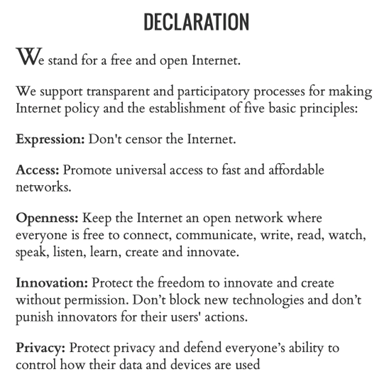
To be sure, it was not quite as sweeping and visionary as the Barlow original but maintained the essence, putting free expression as the first principle with the lapidary phrase: “Don’t censor the Internet.” It might have stopped there, but given the existing threats coming from growing industrial cartels and the stored-data marketplace, it also pushed openness, innovation, and privacy as first principles.
Again, this outlook defined an era and elicited broad agreement. “Information freedom supports the peace and security that provides a foundation for global progress,” said Hillary Clinton in an endorsement of the freedom principle in 2010. The 2012 Declaration was neither right-wing nor left-wing. It encapsulated the core of what it meant to favor freedom on the Internet, exactly as the title suggests.
If you go to the site internetdeclaration.org now, your browser will not reveal any of its contents. The secure certificate is dead. If you bypass the warning, you will find yourself forbidden from accessing any of the contents. The tour through Archive.org shows that the last living presentation of the site was February 2018.
This occurred three years after Donald Trump publicly advocated that “in some places” we have to talk about “closing up the Internet.” He got his wish, but it came after him personally following his election in 2016. The very free speech about which he made fun turned out to be rather important to him and his cause.
Two years into the Trump presidency, precisely as the censorship industry started coalescing into full operation, the site of the Declaration site broke down and eventually disappeared.
Fast forward a decade from the writing of the Internet Declaration of Freedom. The year is 2022 and we had been through a rough two years of account takedowns, particularly against those who doubted the wisdom of lockdowns or vaccine mandates. The White House revealed on April 22, 2022 a Declaration for the Future of the Internet. It comes complete with a parchment-style presentation and a large capital letter in old-fashioned script. The word “freedom” is removed from the title and added only as a part of the word salad that follows in the text.
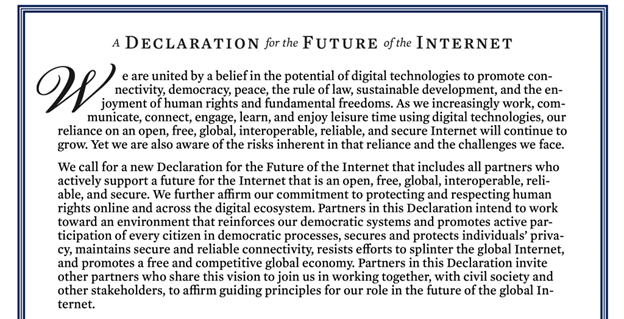
Signed by 60 nations, the new Declaration was released to great fanfare, including a White House press release. The signatory nations were all NATO-aligned while excluding others. The signatories are: Albania, Andorra, Argentina, Australia, Austria, Belgium, Bulgaria, Cabo Verde, Canada, Colombia, Costa Rica, Croatia, Cyprus, Czech Republic, Denmark, Dominican Republic, Estonia, the European Commission, Finland, France, Georgia, Germany, Greece, Hungary, Iceland, Ireland, Israel, Italy, Jamaica, Japan, Kenya, Kosovo, Latvia, Lithuania, Luxembourg, Maldives, Malta, Marshall Islands, Micronesia, Moldova, Montenegro, Netherlands, New Zealand, Niger, North Macedonia, Palau, Peru, Poland, Portugal, Romania, Serbia, Slovakia, Slovenia, Spain, Sweden, Taiwan, Trinidad and Tobago, the United Kingdom, Ukraine, and Uruguay.
The core of the new declaration is very clear and represents a good encapsulation of the essence of the structures that govern content today: “The Internet should operate as a single, decentralized network of networks – with global reach and governed through the multistakeholder approach, whereby governments and relevant authorities partner with academics, civil society, the private sector, technical community and others.”
The term “stakeholder” (as in “stakeholder capitalism”) became popular in the nineties as distinct from “shareholder” meaning a partial owner. A stakeholder is not an owner or even a consumer but a party or institution with a strong interest in the outcome of the decision-making by the owners, whose rights might need to be overridden in the broader interests of everyone. In this way, the term came to describe an amorphous group of influential third parties that deserve a say in the management of institutions and systems. A “multistakeholder” approach is how civil society is brought inside the tent, with financing and seeming influence, and told that they matter as an incentive to woke-wash their outlooks and operations.
Using that linguistic fulcrum, part of the goal of the new Declaration is explicitly political: “Refrain from using the Internet to undermine the electoral infrastructure, elections and political processes, including through covert information manipulation campaigns.” From this admonition we can conclude that the new Internet is structured to discourage “manipulation campaigns” and even goes so far as to “foster greater social and digital inclusion within society, bolster resilience to disinformation and misinformation, and increase participation in democratic processes.”
Following the latest in censorship language, every form of top-down blockage and suppression is now justified in the name of fostering inclusion (that is, “DEI,” as in Diversity [three mentions], Equity [two mentions], and Inclusion [five mentions]) and stopping dis- and mis-information, language identical to that invoked by the Cybersecurity Infrastructure Security Agency (CISA) and the rest of the industrial complex that operates to stop information spread.
This agency was created in the waning days of the Obama administration and approved by Congress in 2018, supposedly to protect our digital infrastructure against cyberattacks from computer viruses and nefarious foreign actors. But less than one year into its existence, CISA decided that our election infrastructure was part of our critical infrastructure (thereby asserting Federal control over elections, which are typically handled by the states). Furthermore, part of protecting our election infrastructure included protecting what CISA director Jen Easterly called our “cognitive infrastructure.”
Easterly, who formerly worked at Tailored Access Operations, a top secret cyber warfare unit at the National Security Agency, coined the queen of all Orwellian euphemisms: “cognitive infrastructure,” which refers to the thoughts inside your head. This is precisely what the government’s counter-disinformation apparatus, headed by people like Easterly, are attempting to control. True to this stated aim, CISA pivoted by 2020 to become the nerve center of the government’s censorship apparatus–the agency through which all government and “stakeholder” censorship demands are funneled to social media companies.
Now consider what we’ve learned about Wikipedia, which is owned by Wikimedia, the former CEO of which was Katherine Maher, now slated to be the head CEO of National Public Radio. She has been a consistent and public defender of censorship, even suggesting that the First Amendment is “the number one challenge.”
The co-founder of Wikipedia, Joseph Sanger, has said he suspects that she turned Wikipedia into an intelligence-operated platform. “We know that there is a lot of backchannel communication,” he said in an interview. “I think it has to be the case that the Wikimedia Foundation now, probably governments, probably the CIA, have accounts that they control, in which they actually exert their influence. And it’s fantastic, in a bad way, that she actually comes out against the system for being ‘free and open.’ When she says that she’s worked with government to shut down what they consider ‘misinformation,’ that, in itself, means that it’s no longer free and open.”
What happened to Wikipedia, which all search engines privilege among all results, has befallen nearly every prominent venue on the Internet. The Elon Musk takeover of Twitter has proven to be aberrant and highly costly in terms of advertising dollars, and hence elicits vast opposition from the venues that are on the other side. That his renamed platform X even exists at all seems to run contrary to every wish of the controlled and controlling establishment today.
We have traveled a very long way from the vision of John Perry Barlow in 1996, who imagined a cyberworld in which governments were not involved to one in which governments and their “multi stakeholder partners” are in charge of “a rules-based global digital economy.” In the course of this complete reversal, the Declaration of Internet Freedom became the Declaration for the Future of the Internet, with the word freedom consigned to little more than a passing reference.
The transition from one to the other was–like bankruptcy–gradual at first and then all at once. We’ve traveled rather quickly from “you [governments and corporate interests] are not welcome among us” to a “single, decentralized network of networks” managed by “governments and relevant authorities” including “academics, civil society, the private sector, technical community and others” to create a “rules-based digital economy.”
And that is the core of the Great Reset affecting the main tool by which today’s information channels have been colonized by the corporatist complex.
May 23, 2024
Posted by aletho |
Civil Liberties, Full Spectrum Dominance | CIA, CISA, Human rights, NPR, Obama, United States |
Leave a comment
Is building a slave state for Big Daddy the apex achievement of feminism?
The polite world was fascinated last month when long-time NPR editor Uri Berliner confessed to the Stalinist suicide pact the public broadcaster, like all public broadcasters, seems to be on. Formerly it was a place of differing views, he claimed, but now it has sold as truth some genuine falsehoods like, for instance, the Russia hoax, after which it covered up the Hunter Biden laptop. And let’s not forget our censor-like behaviour regarding Covid and the vaccine. NPR bleated that they were still diverse in political opinion, but researchers found that all 87 reporters at NPR were Democrats. Berliner was immediately put on leave and a few days later resigned, no doubt under pressure.
Even more interesting was the reveal of the genesis of NPR’s new CEO, Katherine Maher, a 41-year-old with a distinctly odd CV. Maher had put in stints at a CIA cutout, the National Democratic Institute, and trotted onto the World Bank, UNICEF, the Council on Foreign Relations, the Center for Technology and Democracy, the Digital Public Library of America, and finally the famous disinfo site Wikipedia. That same week, Tunisia accused her of working for the CIA during the so-called Arab Spring. And, of course, she is a WEF young global leader.
She was marched out for a talk at the Carnegie Endowment where she was prayerfully interviewed and spouted mediatized language so anodyne, so meaningless, yet so filled with nods to her base the AWFULS (affluent white female urban liberals) one was amazed that she was able to get away with it. There was no acknowledgement that the criticism by this award-winning reporter/editor/producer, who had spent his life at NPR had any merit whatsoever, and in fact that he was wrong on every count. That this was a flagrant lie didn’t even ruffle her artfully disarranged short blonde hair.
Christopher Rufo did an intensive investigation of her career in City Journal. It is an instructive read and illustrative of a lot of peculiar yet stellar careers of American women. Working for Big Daddy is apparently something these ghastly creatures value. I strongly suggest reading Rufo’s piece linked here. It’s a riot of spooky confluences.

Intelligence has been embedded in media forever and a day. During my time at Time Magazine in London, the bureau chief, deputy bureau chief and no doubt the “war and diplomacy” correspondent all filed to Langley and each of them cruised social London ceaselessly for information. Tucker Carlson asserted on his interview with Aaron Rogers this week that intelligence operatives were laced through DC media and in fact, Mr. Watergate, Bob Woodward himself, had been naval intelligence a scant year before he cropped up at the Washington Post as ‘an intrepid fighter for the truth and freedom no matter where it led.’ Watergate, of course, was yet another operation to bring down another inconvenient President; at this juncture, unless you are being puppeted by the CIA, you don’t get to stay in power. Refuse and bang bang or end up in court on insultingly stupid charges. As Carlson pointed out, all congressmen and senators are terrified by the security state, even and especially the ones on the intelligence committee who are supposed to be controlling them. They can install child porn on your laptop and you don’t even know it’s there until you are raided, said Carlson. The security state is that unethical, that power mad.
Now, it’s global. And feminine. Where is Norman Mailer when you need him?
At the same time, at the same time, Freddie Sayers, the editor-in-chief of Unherd, testified in Parliament on the Global Disinformation Index which had choked Unherd’s ability to grow. Unherd had hired three advertising firms who were, one after the other, unable to place ads. The third sourced the problem to the Index, which had deemed his interviews with journalist Katherine Stock about the problems faced by young people transitioning their sex, had made him persona non grata for all advertising agencies across the world. Eerily, that same week, Katherine Stock was awarded a high honorable mention in the National Press Awards for her work.
Here is Clare Melford, the fetching chief of the Global Disinformation Index, a woman seemingly bent on sterilizing confused children, Yet another non-profit authoritarian working for a mysterious Big Daddy. Who the hell trained her?
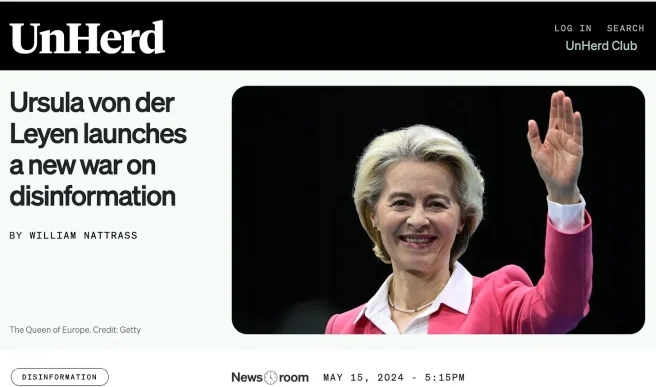
On Tuesday this week, out pops Europe’s headmistress, European Commission President Ursula von der Leyen in Politico.eu, complaining about “Russia” and “right-wingers” sowing distrust of Europe’s election processes. She is, she says, launching a new war on Disinformation. Most importantly, no more reporting on migrant assaults. This seems to be their new crusade. Please note the halo over her Christed head. Honestly, they are shameless, vain, silly creatures with limited bandwidth. Other than obedience to some grim reaper.
Said Politico :
“She promised to set up “a European Democracy Shield,” if reelected for a second term, to fight back against foreign meddling.
EU cybersecurity and disinformation officials expect a surge in online falsehoods in the 20 days prior to the European Parliament election June 6-9, when millions of Europeans elect new representatives. Officials fear that Russia is ramping up its influence operations to sow doubt about the integrity of elections in the West and to manipulate public opinion in its favor.”
By the way, madam, western election integrity has been thoroughly compromised by the men who tell you what to do. More than half of us think elections are stolen. More than half. That’s not disinformation, it’s math.
This week Michael Shellenberger, who is the acknowledged lead in the take-down of the global censorship complex, had a look at Julie Inman Grant, another American Barbie, now Australia’s “e-safety commissioner,” with ties to the WEF. Grant had demanded that X censor a migrant stabbing, and X refused. Grant, as Shellenberger describes, is the Zelig of internet history tinkering in the bowels of said internet until she burst onto the public stage as Australia’s chief censor, bent on building a global online safety network.
Working for Big Daddy is apparently something these ghastly creatures value.
At a recent government hearing, she announced, “We have powerful tools to regulate platforms with ISP blocking power, and can collect basic device information, account information, phone numbers and email addresses, so that our investigators can at least find a place to issue a warning.” Grant went on to say they could compel take-downs, fine perpetrators and fine content hosts.
The Daily Mail had a ball with Inman Grant, mocking her and pointing out that she was wasting taxpayer money on a game of whack-a-mole.

Nevertheless, Grant takes herself very very seriously and since she is accreting power at a massive clip, so must we.
Grant’s network of independent regulators is called the Global Online Safety Regulators Network. “We have Australia, France, Ireland, South Africa, Korea, the UK and Fiji so far, with others observing. Canada is coming along,” she preens, “and is about to create a National Safety Regulator.” Canada’s proposed censorship program is so draconian you can be jailed for something you posted online years ago. And the government proposing it is so unpopular, it will be lucky to hang onto 20 seats in the next election.
There are literally hundreds of these women. Why? Why?
At a meeting this year of the World Economic Forum, Věra Jourová, from the European Commission, outlined just how exciting she and her team found the tools she is being given. “We can,” she said, “influence in such a way the real life and the behavior of people!” She sighed with excitement after this sentence. Jourova was caught last September trying to spread yet another Russia hoax. You have only to hear censorship plans uttered in a central-European accent to really understand what is happening here.

As terrifying as this all seems, and it is terrifying, it is instructive to look at the ruination of the career of America’s chief censor, Renée DiResta. DiResta, as research head of the Stanford Internet Observatory, is now being sued for abuse of power and unethical behavior that violates the constitution. Spookily, DiResta soared from “new mom” to providing the intellectual under-pinnning for censorship, until she headed up the Stanford Internet Observatory during Covid, where she was instrumental in censoring vaccine and Covid “disinformation.” People thought her backstory contrived and in fact, Shellenberger found that she was, unmistakably another CIA trained censor of inconvenient information under the guise of “safety.”
At this point, every time you hear the word ‘safety”, it’s best to check your ammunition supply. Said Shellenberger:
As research director of Stanford Internet Observatory, DiResta was the key leader and spokesperson of both the 2021 “Virality Project,” against Covid vaccine “misinformation” and the 2020 “Election Integrity Project.”
Shellenberger goes on to look into DiResta’s work history and finds a lot of congruence with CIA operations.
But then I learned that DiResta had worked for the Central Intelligence Agency (CIA). The journalist Matt Taibbi pointed me to the investigative research into the censorship industry by Mike Benz, a former State Department official in charge of cybersecurity. Benz had discovered a little-viewed video of her supervisor at the Stanford Internet Observatory, Alex Stamos, mentioning in an off-hand way that DiResta had previously “worked for the CIA.”
In her response to my criticism of her on Joe Rogan, DiResta acknowledged but then waved away her CIA connection. “My purported secret-agent double life was an undergraduate student fellowship at CIA, ending in 2004 — years prior to Twitter’s founding,” she wrote. “I’ve had no affiliation since.”
But DiResta’s acknowledgment of her connection to the CIA is significant, if only because she hid it for so long. DiResta’s LinkedIn includes her undergraduate education at Stony Brook University, graduating in 2004, and her job as a trader at Jane Street from October 2004 to May 2011, but does not mention her time at the CIA.
And, notably, the CIA describes its fellowships as covering precisely the issues in which DiResta is an expert. “As an Intelligence Analyst Intern for CIA, you will work on teams alongside full-time analysts, studying and evaluating information from all available sources—classified and unclassified—and then analyzing it to provide timely and objective assessments to customers such as the President, National Security Council, and other U.S. policymakers.”
At this juncture it is a race, as the intelligence community moves to shut down the revelations of its manipulations and machinations, and people injured by the vaccine and the flagrant abuse of election integrity move to fight them. It is instructive to note that DiResta, while apparently soaring to the heights of journalism at Wired, the New York Times, the Atlantic, selling her safety/censorhip program, cannot seem to get actual people to read or subscribe to her Substack. DiResta, like so many women in power now, are in reality, talentless cutouts for a hidden and malignant agenda.
An agenda that the people of the world roundly hate. I have just one final thing to saw to these truly dreadful human beings. My God is stronger than whatever demon or predator you obey. And as a woman, I am ashamed of each and every one of you. To use one of your awful phrases: Do Better.
May 20, 2024
Posted by aletho |
Civil Liberties, Deception, Full Spectrum Dominance, Mainstream Media, Warmongering, Russophobia | Australia, Canada, CIA, European Union, France, NPR, Renée DiResta, UK, United States, WEF |
Leave a comment
In a scathing account from within National Public Radio (NPR), Senior Editor Uri Berliner blasted the company for open political bias and activism. Berliner, who says that he is liberal politically, wrote about how NPR went from a left-leaning media outlet to a virtual Democratic operation echoing narratives from figures like Rep. Adam Schiff (D., Cal.). The objections have long been voiced, including on this blog, but this account is coming from a long-standing and respected editor from within the company.
Berliner details how NPR, like many media outlets, became openly activist after the election of Donald Trump to the point that the company now employs 87 registered Democrats in editorial positions but not a single Republican in its Washington, DC, headquarters.
In his essay for The Free Press, Berliner notes that after Trump’s election in 2016, the most notable change was shutting down any skepticism or even curiosity about the truth of Democratic talking points in scandals like Russiagate. Berliner said that NPR “hitched our wagon” to Schiff and his now debunked claims.
Berliner says that he was rebuffed in seeking a modicum of balance in the coverage about the coronavirus “lab leak theory,” the “Don’t Say Gay” bill, Hunter Biden’s laptop, and the 2016 Russia hoax.
As discussed on this blog, NPR repeated false stories like the claims from the Lafayette Park riot. Berliner gives an account that is strikingly familiar for many of us who have raised the purging of conservative or libertarian voices from our faculties in higher education:
“So on May 3, 2021, I presented the findings at an all-hands editorial staff meeting. When I suggested we had a diversity problem with a score of 87 Democrats and zero Republicans, the response wasn’t hostile. It was worse. It was met with profound indifference. I got a few messages from surprised, curious colleagues. But the messages were of the “oh wow, that’s weird” variety, as if the lopsided tally was a random anomaly rather than a critical failure of our diversity North Star.
In a follow-up email exchange, a top NPR news executive told me that she had been “skewered” for bringing up diversity of thought when she arrived at NPR. So, she said, “I want to be careful how we discuss this publicly.”
For years, I have been persistent. When I believe our coverage has gone off the rails, I have written regular emails to top news leaders, sometimes even having one-on-one sessions with them. On March 10, 2022, I wrote to a top news executive about the numerous times we described the controversial education bill in Florida as the “Don’t Say Gay” bill when it didn’t even use the word gay. I pushed to set the record straight, and wrote another time to ask why we keep using that word that many Hispanics hate—Latinx. On March 31, 2022, I was invited to a managers’ meeting to present my observations”
Former NPR analyst Juan Williams stated in an interview this week that, as a strong liberal voice (now at Fox), he found the same bias at NPR. Williams was fired by NPR as this shift seemed to go into high gear toward greater intolerance for opposing views.
Despite these criticisms, NPR has doubled down on its activism. For example, when it came time to select a new CEO, NPR could have tacked to the center to address the growing criticism. Instead, the new CEO became instant news over social media postings that she deleted before the recent announcement of her selection. Katherine Maher is the former CEO of Wikipedia and sought to remove controversial postings on subjects ranging from looters to Trump. Those deleted postings included a 2018 declaration that “Donald Trump is a racist” and a variety of race-based commentary. They also included a statement that appeared to excuse looting.
NPR has abandoned core policies on neutrality as its newsroom has become more activist and strident. For example, NPR declared that it would allow employees to participate in political protests when the editors believe the causes advance the “freedom and dignity of human beings.”
The rule itself shows how impressionistic and unprofessional media has become in the woke era. NPR does not try to define what causes constitute advocacy for the “freedom and dignity of human beings.” How about climate change and environmental protection? Would it be prohibited to protest for a forest but okay if it is framed as “environmental justice”?
NPR seems to intentionally keep such questions vague while only citing such good causes as Black Lives Matter and gay rights:
“Is it OK to march in a demonstration and say, ‘Black lives matter’? What about a Pride parade? In theory, the answer today is, “Yes.” But in practice, NPR journalists will have to discuss specific decisions with their bosses, who in turn will have to ask a lot of questions.”
So the editors will have the power to choose between acceptable and unacceptable causes.
The bias seemed to snowball into a type of willful blindness in the coverage of the outlet, which is supported by federal funds.
After the New York Post first reported on Hunter Biden’s laptop in 2020, NPR declared that it would not cover the story. It actually issued a statement that seemed to proudly refuse to pursue the story, which was found to be legitimate:
“We don’t want to waste our time on stories that are not really stories, and we don’t want to waste the listeners’ and readers’ time on stories that are just pure distractions.”
Berliner’s account is reminiscent of the recent disclosures from within the New York Times. Former editors have described that same open intolerance for opposing views and a refusal to balance coverage.
Former New York Times editorial page editor James Bennet has finally spoken publicly about his role in one of the most disgraceful chapters in American journalism: the Times’ cringing apology for running a 2020 column by Sen. Tom Cotton. Bennet said publisher AG Sulzberger “set me on fire and threw me in the garbage” to appease the mob.
Former New York Times editor Adam Rubenstein also wrote a lengthy essay at The Atlantic that pulled back the curtain on the newspaper and its alleged bias in its coverage. The essay follows similar pieces from former editors and writers that range from Bari Weiss to his former colleague James Bennet. The essay describes a similar work environment where even his passing reference to liking Chick-Fil-A sandwiches led to a condemnation of shocked colleagues.
None of this is likely to change the culture at NPR any more than such discussions have changed faculties in higher education. Raising the virtual elimination of conservative or Republican voices on faculties is met by the same forced expressions of disbelief. While mild concern is expressed, it is often over the “perception” of those of us who view universities as intolerant or orthodox.
Of course, there remains the question of why the public should give huge amounts of money to a media outlet that is so politically biased. News outlets have every right to pursue such political agendas, but none but NPR claim public support, including from half of the country that embraces the viewpoints that it routinely omits from its airways.
April 10, 2024
Posted by aletho |
Fake News, Mainstream Media, Warmongering | New York Times, NPR |
Leave a comment
Brianna Lyman, elections correspondent at The Federalist, recently reported on a panel discussion featuring Al Schmidt, Pennsylvania Secretary of the Commonwealth, and Beth Schwanke, Executive Director of the Pitt Disinformation Lab. Schmidt and Schwanke, speaking at a forum organized by Spotlight PA, voiced their stance on “misinformation” and “disinformation” surrounding elections. Strikingly, Schwanke recommended that rather than conducting self-led investigations, Pennsylvanians should place their confidence in so-called “trusted” sources. These include certain institutions and media outlets that have unfortunately been tied in the past to acts of censorship.
“One thing everyone can do to make sure they are seeing accurate information is to use trusted sources. So in elections that means using the Department of State, that means using your county elections office, it means using media organizations that follow, that adhere, to professional journalism standards like … your local NPR affiliate,” Schwanke said. “And it doesn’t mean you know, ‘doing your own research’ and just asking questions and sharing, you know, posts from – I don’t know, in my case, it’s Uncle Joe, right? It means being thoughtful about where your sources are coming from.”
Schwanke’s advice, interestingly, seemed to discourage individual research, questioning, and sharing of ideas. Instead, she advocated the use of sources like the Department of State, county elections offices, and, strikingly, media organizations such as local NPR affiliates, which she implied upheld superior journalistic standards.
Despite what Schwanke says, the importance of being vigilant about our sources of information cannot be overstated. This was vividly demonstrated in the lead-up to the 2020 election when a significant story on Hunter Biden’s laptop by the New York Post was unjustly labeled “disinformation,” and subsequently suppressed across several tech platforms.
As The Federalist reported, what made matters worse, in an incident hinting at bias, NPR blatantly refused to report on the story, with its Managing Editor Terence Samuels declaring it as unworthy of coverage.
The Pennsylvania State Department presented a similar cause for alarm. It announced its collaboration with the Cybersecurity and Infrastructure Security Agency (CISA) to monitor and control online talks deemed a “threat” related to the election process. Despite its claimed intention to offer voters accurate, trustworthy election-related data and to counter threats such as so-called “misinformation,” there is good reason to question the impartiality of its activities. Case in point, CISA had previously facilitated the silencing of Americans expressing valid concerns on social media, as if they were spreading “disinformation,” and even had a post from President Donald Trump flagged under these pretenses.
Related:
Pennsylvania Collaborates With DHS and CISA To Monitor Online Election-Related Speech
April 6, 2024
Posted by aletho |
Civil Liberties, Deception, Fake News, Full Spectrum Dominance, Mainstream Media, Warmongering | NPR, United States |
Leave a comment
Many are claiming that Israel has no choice.
It has to bomb Gaza, there is no alternative.
In fact, Israel has a choice.
A clear choice.
To reflexively react and bomb Gaza amid massive propaganda before assessing the facts is deranged.
One clear fact is that Netanyahu promised security and he failed. Israelis of every political stripe should be fuming at him, as some are. Never mind for the moment that he had warning of the Hamas attacks and almost certainly wanted conflict.
The choice facing Israel is highlighted by this:
In 2004, bombings on commuter trains in Madrid killed over 190 people. The government was immediately voted out and a new government came in, swiftly got Spain out of Iraq and nothing like that has happened in Spain since.
But the lessons of the train bombings is memory holed and even falsified.
NPR’s Dina Temple-Raston reversed what happened, claiming after the Orlando shooting — which was also followed by a flood of lies — that after the bombings in Spain, “the more conservative candidate ended up winning.” (In NPR-speak, “conservative” means more pro-war.) Total propaganda.
The lesson is clear.
Netanyahu isn’t out to protect Israelis.
If he was, he would embrace peace.
You want to stop a group like Hamas from attacking you?
Solve the conflict.
Abide by international law.
Stop bombing people.
Repent for having expelled nonviolent activists.
Withdraw.
Agree to peace.
—
I’ve been suspended by X/twitter, but you can now see my past material there. I’m also now posting on Gab.
October 15, 2023
Posted by aletho |
Ethnic Cleansing, Racism, Zionism, Fake News, Illegal Occupation, Mainstream Media, Warmongering, Militarism | Benjamin Netanyahu, Dina Temple-Raston, Israel, NPR, Palestine, Zionism |
Leave a comment
In his latest episode, Tucker Carlson discussed the media’s absolute hatred for Robert F. Kennedy Jr., who was immediately attacked by the press upon his announcement that he would run against President Joe Biden in 2024.
“CBS News viewers likely were appalled in its coverage of Kennedy’s announcement. CBS denounced the candidate’s views as ‘misleading’ and ‘dangerous,'” noted Carlson, adding “The LA Times called him a threat to democracy.”
“At the offices of National Public Radio in Washington, a full-blown category-5 hysteria typhoon broke out. NPR devoted an entire segment to savaging Kennedy – not just as a candidate, but as a human being,” Carlson continued. “NPR described him as someone who, for his own perverse reasons, has made “debunked and false and misleading claims that undermine trust in vaccines. And who, in his spare time, provides moral support to crazed extremists who “rally under the banner of what they call liberty, or freedom.””
“People Magazine didn’t even bother to report a single word of anything Kennedy said!” Carlson exclaimed, “and instead wrote an entire story about his relatives hate him.”
“Kennedy Jr. faced censorship on Instagram and YouTube for expressing his views,” he continued, adding that RFK Jr. raised questions about “the rise in allergies, asthma, autism, and other conditions related to vaccines,” while “the media and medical establishment vilified Kennedy Jr. for his views, calling him a lunatic, Nazi, and extremist supporter.” … Full article & transcript
June 24, 2023
Posted by aletho |
Full Spectrum Dominance, Mainstream Media, Warmongering, Science and Pseudo-Science, Timeless or most popular, Video | NPR, People Magazine, United States |
Leave a comment

The idea of eating bugs has, once again, found its way back into the news. NPR recently released a piece that suggested the pushback against eating bugs is founded on a baseless conspiracy theory that elites want the population to consume bugs. However, the evidence seems to suggest that elites do, in fact, want the population to consume the likes of grasshoppers and fly larvae.
“Including insects in human food has been an emerging,” NPR wrote, “but still marginal, idea among climate scientists and food security experts. In countries where insects have not been a part of the diet, it’s an idea that has long been met with hesitancy and occasional ridicule.
“In recent years, however,” they considered, “this aversion has fused with an amorphous and shapeshifting conspiracy theory in which a shadowy global elite conspires to control the world’s population. For those who espouse the theory, eating bugs isn’t just a matter of disgust, or questioning the impacts of climate change. It’s framed as a matter of individual freedom and government control.”
Though bug-eating is not a new development, world leaders have certainly encouraged the notion that those in the West ought to consider consuming bugs. President Joe Biden and Canadian Prime Minister Justin Trudeau suggested that there would be food shortages in early 2022, following Russia’s invasion of Ukraine.
Call it a coincidence, but just two months later, it was reported that primary school children in Wales were possibly going to be fed crickets and mealworms, as a scientist suggested that this would set the tone for an eco-friendly living environment. It was just a few days after this report that the Toronto Sun suggested that consuming crickets could effectively combat food shortages.
In late June 2022, Aspire Food Group had announced that it had set out to produce 9,000 metric tonnes of crickets every year for “human and pet consumption,” which would amount to two billion crickets. Just one month after Aspire Food Group mentioned their cricket goals, food company Actually Foods had listed “organic cricket flour” as one of its primary ingredients.
It is not difficult to see how Biden and Trudeau’s mention of food shortages appear to have ignited serious efforts to introduce bugs as a leading dietary element. There is nothing about this series of events that suggests conspiracy, but rather just plain facts. It is also important to consider that bug-eating has not been a grassroots effort, kicked off by small-town companies attempting to do good in their community. Bug consumption has been embraced and pushed by the largest organizations in the world, including the World Economic Forum (WEF).
However, our so-called food shortages have only been one of the many justifications for introducing bugs into food. Another common justification of those in the bug-eating industry is how superior bugs are in protein compared to what we currently eat. The Vancouver Sun published a piece in 2016 that covered how Enterra intended to “replace unsustainable fish meal and soy as sources of protein and fat with bugs grown on waste food.” The piece also mentioned that bugs would be a hard sell to “hikers and snowboarders.”
CNN reported that the average American, in the not-too-distant future, would maybe “toast bread with cricket flour, drink a protein smoothie made from locust powder, and eat scrambled eggs (made extra-creamy with the fat from mopane caterpillars) with a side of mealworm bacon.”
The piece continued by noting that this hypothetical meal would provide “four times the iron, more than three times the protein and more key vitamins and minerals than the bread, smoothie, eggs and bacon you eat today – all while saving the planet.”
What better way to solidify the fact that bug-eating is being pushed by elites than the World Economic Forum suggesting in 2021, in the midst of the COVID-19 pandemic, that everyone should embrace the eating of bugs, as the global population increases, apparently leaving few other alternatives than consuming bugs.
But for NPR, the anti-bug-eating sentiment is basically just racist. They link not wanting to eat bugs with colonialist sentiments.
“There was very much an idea that you are what you eat back then. And so the Europeans felt they needed European foods,” Julie Lesnik, an associate professor of biological anthropology at Wayne State University in Detroit told NPR. “There is very much a worry that if you ate the Indigenous foods, you would become a savage.”
“Conservative media influencers continue to tap into this sentiment today,” NPR declared, before writing that “Lesnik sees a throughline between the early colonizers and the conservative outrage today.”
“The easiest punching bag … is to pick on something that looks uncivilized,” Lesnik said.
But of course it could just be that people just don’t want to eat bugs.
April 6, 2023
Posted by aletho |
Mainstream Media, Warmongering | NPR, WEF |
Leave a comment
Poland has hired two US PR companies for a pro-Ukraine campaign in the West. According to the official statement, Poland’s state bank has hired MikeWorldWide and AMW PR for “a global campaign to inform the general public about the impact of Russia’s war in Ukraine”.
The PR company MikeWorldWide, is closely linked to the US Democratic Party, and was tasked in September with boosting Western support to Ukraine through influencers and social media.
The primary objective “is to raise awareness among at least 50 million people of the actual dimension of the war in Ukraine and the scale of the damages,” according to MikeWorldWide’s services agreement with Bank Gospodarstwa Krajowego.
Poland’s national bank will be paying $3 million for media exposure, including advertisements on Facebook, Twitter, NPR, USA Today, Spotify and Vox, as well as for influencers.
In November Poland’s state bank hired AMW PR, a New York-based media relations company, to “pitch the refugee and humanitarian crisis brought on by Russia’s invasion of Ukraine”.
AMW will work with US and Canadian journalists, producers, bloggers, and podcasters.
November 29, 2022
Posted by aletho |
Mainstream Media, Warmongering | Canada, Facebook, NPR, Poland, Twitter, Ukraine, United States |
Leave a comment
 On March 9, 2021, the former Supreme Allied Commander of NATO, Admiral James Stavridis, co-authored a fiction novel with Elliott Ackerman, another former U.S. military officer. The book, entitled 2034: A Novel of the Next World War, imagines a kinetic war between the United States and China.
Given the pedigree of its authorship, the novel provides a compelling window into the psychology of NATO’s military leadership and, correspondingly, the foreign policy establishment behind it. To those familiar with said psychology, the events of the novel will not be surprising.
It begins with a Chinese ambush of a U.S. vessel in the South China Sea; an Iranian capture of a U.S. pilot; a full scale naval battle between the U.S. and China (resulting in a total U.S. defeat); and a Russian invasion of Poland. The novel concludes with a limited nuclear exchange between the U.S. and China.
Given the last few decades’ hawkish hand wringing about Chinese and Russian cyber capabilities, the tactics employed in the novel are similarly unsurprising. A Chinese cyberattack disables U.S. hardware, allowing the naval rout. The Iranians, as allies of Russia and China, similarly disable U.S. aircraft. For their part, the Russians slice underwater communications cables leading to a complete internet blackout in the West.
To an uncritical reader, the novel appears to be a “cautionary tale” and a “warning” against global conflict. The novel’s dust jacket states:
Everything in 2034 is an imaginative extrapolation from present-day facts on the ground combined with the authors’ years working at the highest and most classified levels of national security. Sometimes it takes a brilliant work of fiction to illuminate the most dire of warnings: 2034 is all too close at hand, and this cautionary tale presents the reader a dark yet possible future that we must do all we can to avoid.
Mainstream outlets were as successful in their attempts to paint 2034 as a “warning” as their reviews were cringeworthy.
Wired, which ran a series of exclusive pre-print excerpts, had this to say:
WIRED HAS ALWAYS been a publication about the future—about the forces shaping it, and the shape we’d like it to take. Sometimes, for us, that means being wild-eyed optimists, envisioning the scenarios that excite us most. And sometimes that means taking pains to envision futures that we really, really want to avoid.
By giving clarity and definition to those nightmare trajectories, the hope is that we can give people the ability to recognize and divert from them. Almost, say, the way a vaccine teaches an immune system what to ward off. And that’s what this issue of WIRED is trying to do…
Consider this another vaccine against disaster. Fortunately, this dose won’t cause a temporary fever—and it happens to be a rippingly good read. Turns out that even cautionary tales can be exciting, when the future we’re most excited about is the one where they never come true.
The Washington Post’s review was almost worse.
This crisply written and well-paced book reads like an all-caps warning to a world shackled to the machines we carry in our pockets and place in our laps, while only vaguely understanding how the information stored in and shared by those devices can be exploited. We have grown numb to the latest data breach—was it a pollical campaign (Hillary Clinton’s), or one of the country’s biggest credit-rating firms (Equifax), or a hotel behemoth (Marriott), or a casual-sex hookup site (Adult Friend Finder), or government departments updating their networks with the SolarWinds system (U.S. Treasury and Commerce)?
In “2034,” it’s as if Ackerman and Stavridis want to grab us by our lapels, give us a slap or two, and scream: Pay attention! George Orwell’s dystopian masterpiece, “Nineteen Eighty-four: A Novel” was published 35 years before 1984. Ackerman’s and Stavridis’s book takes place in the not-so-distant future when today’s high school military recruits will just be turning 30.
Between Wired’s ham-handed COVID-19 vaccine analogy and the CIA Washington Post’s ironic Orwell reference, the mainstream marketing campaign clearly attempts to portray the novel as a cautionary tale.
It is impossible to gaze into the hearts of men, but we do have some clues. Those clues suggest that the co-authors really do seek to warn against war with China. However, in doing so, they advocate for it. Indeed, their warning is not against the folly of empire, but against a rising China.
Ultimately the co-authors’ MacBethian premonition of conflict necessitates escalatory U.S. policy.
On March 18, 2021, the pair were interviewed by NPR. Stavridis had this to say:
… a subtext in all of this [the novel] is to strike a warning bell about the rise of China and the propensity in human history going back 2,500 years almost any time a [sic] established power is challenged by a rising power, it leads to war. It’s a dangerous moment. And 15 years from now, I think, will be a moment of maximum danger because China will have advanced in its military capability and technology. Therefore, our military deterrent will somewhat decline. We’re standing in the danger, as we say in the Navy.
Ackerman embraces this view:
…and we’re not only sounding the alarm bell, but the book is also trying to situate where America is in this moment of 2034.
Further, the pair assert they do not believe in the American decline.
Interviewer (to both): “…do you believe this, that America will be the author of its own destruction?”
Stavridis: “I believe there are many in the world who do believe that. I personally do not… there are many in the world who believe our best days are somehow behind us. They would be miscalculating, in my view, to believe that.”
Ackerman: “I would add I am by no way a believer in the decline of America. And I am very much committed to the idea of the American ideal. That being said, looking back throughout our entire history, the greatest threat is us turning inward and destroying that ideal. Lincoln himself said – I’m paraphrasing, but basically said that if America is going to destroy itself, we will be the author and the finisher. And I think he says, a nation of free men will live forever or die by suicide. And I don’t think that’s Lincoln being a declinist about the United States. But I think it’s him recognizing that our divisiveness can oftentimes be the greatest threat and what leaves us the most unable to respond to challenges from outside the country.”
Indeed, a reader would be hard pressed to find any point where the co-authors suggest any strategy short of increasing military confrontation with China.
Instead, they warn that America must be more united against an outside threat. It must, by implication, build up its military force, and, oddly enough, confront Chinese technological advances with less reliance on our own technology.
Stavridis expanded on his China policy prescriptions in a June 2021 interview:
The South China Sea is a vital entry point for the United States today. It’s a massive body of water full of oil and gas as well as fisheries, and about 40 percent of global trade passes through it.
So, there are strong strategic reasons, as the United States values its alliances in Asia, to push back against Chinese claims.
It is not just the South China Sea but also the East China Sea, where the Senkaku Islands lie, that are vital to American interests as long as our allies operate there and trade flows through there.
And above all we simply as an international community cannot acquiesce to China’s preposterous claims, which have been rejected by international law.
Indeed, a number one red line would be an attack against our allies.
For example, if China attacked and tried to forcibly take the Senkaku Islands, that would be a red line for the United States. Or an attack against the Philippines, another treaty ally of the United States. An attack against any treaty allies would be the number one red line.
A second red line would be trying to attack U.S. military personnel operating in the South China Sea.
We conduct what we call “freedom of navigation patrols.” These are our warships sailing through international waters such as the South China Sea.
If China were to attack a U.S. ship to attempt to demonstrate their view that they own the South China Sea, that would be a red line. In fact, the book “2034” opens with an attack involving U.S. military personnel being killed in the South China Sea.
Stavridis believes that the U.S. must continue to devote itself to entangling alliances, against which the founding fathers warned. The U.S. must also continue to press its presence in the South China Sea.
Despite resolutely warning against a war against China, Stavridis commits the U.S. to myriad tripwires that would ignite it.
These China policy positions parallel Stavridis’ positions on Ukraine. It’s always more, more, more.
More funding, arming, and training Ukrainians, more U.S. commitment to NATO, more U.S. weaponization of Big Tech, more money to the U.S. State Department, more interagency cooperation, and more silencing dissent. These positions are escalatory. At the very least, they flirt with making Washington a direct party to the War in Ukraine. They may give Russia reason to attack U.S. and NATO forces.
Given Russia’s nuclear footing, these policies pose an existential threat to humanity itself.
Indeed, it will always be a mystery how the hawks convinced the American public that the path to peace leads through war. Perhaps those of us who survive the inevitable result of this mantra can ponder the answer while painting on the cave walls.
Patrick MacFarlane is the Justin Raimondo Fellow at the Libertarian Institute where he advocates a noninterventionist foreign policy. He is a Wisconsin attorney in private practice. He is the host of the Liberty Weekly Podcast at www.libertyweekly.net, where he seeks to expose establishment narratives with well researched documentary-style content and insightful guest interviews. His work has appeared on antiwar.com and Zerohedge. He may be reached at patrick.macfarlane@libertyweekly.net
May 5, 2022
Posted by aletho |
Book Review, Mainstream Media, Warmongering, Militarism | NPR, United States |
Leave a comment

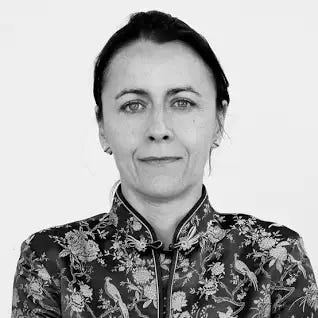


 Aletho News