A ‘Child’ Is Missing–From a New York Times Headline

This is what a Palestinian boy looks like. (cc photo: Giles)
By Jim Naureckas | FAIR | November 18, 2014
Read this headline from the New York Times (11/16/14):
Palestinian Shot by Israeli Troops at Gaza Border
Think for a second about what kind of image that calls up. How much does that image change when you read the story’s second sentence?
A spokeswoman for the hospital said the Palestinian was a 10-year-old boy.
Now, very few people read the full text of every story in any newspaper, so as an editor you have to ask yourself what a headline conveys on its own. I expect that most people who only read that headline assumed that the Palestinian referenced was an adult–and likely had a different reaction to the story as a result.
They were probably also less likely to read the story–the opposite of the effect that you usually want to have with a headline–which makes you wonder why the Times would leave this key fact out. Space, maybe? But “Gazan Boy Shot by Israeli Troops at Border” would have fit just as easily.
Or “Child Shot by Israeli Troops at Gaza Border,” for that matter, since the shooting victim’s likely nationality would be clear from context; there aren’t too many Israeli children near the border with Gaza. In any case, the victim’s age is arguably a more important fact than his ethnicity.
So–did the editors leave out of the headline the fact that it was a child who had been shot because they didn’t want readers to get too upset about Israel doing the shooting?
Surely they would say no–but recall that New York Times story (7/16/14; FAIR Blog, 7/17/14), accurately headlined “Four Young Boys Killed Playing on Gaza Beach,” that was rewritten for the print edition as “Boys Drawn to Gaza Beach, and Into Center of Mideast Strife.” Here the boys remained boys, but their deaths disappeared.
When Times public editor Margaret Sullivan (7/22/14) asked why the headline had been changed, executive editor Dean Baquet claimed that print headlines tend to be “a little poetic.” Keats it ain’t.
To take a quantitative look at this phenomenon, let’s move from the New York Times to an outlet that fancies itself to be the New York Times of the airwaves–NPR. FAIR’s Seth Ackerman (Extra!, 11/01) did a study of which deaths it reported in the Israeli/Palestinian conflict over a six-month period. He found that NPR reported 81 percent of the Israeli deaths during that time, and 89 percent of the deaths of Israeli children–but only 34 percent of the Palestinian deaths, and 26 percent of the deaths of Palestinian children.
So while NPR–understandably–thought that being a child made an Israeli victim’s death more newsworthy, if Palestinian victims were children that made NPR less likely to report their deaths.
That’s an odd sort of news judgment–unless what’s being aimed at is not maximizing human interest, but keeping it to a minimum.
NPR’s standards editor & ombudsman minimize and/or ignore NPR ethics requirements regarding David Brooks
By Alison Weir | October 15, 2014
In recent weeks I’ve phoned and emailed the NPR ombudsman’s office several times about commentator David Brooks’ conflict of interest – Brooks’ son has been serving in the Israeli military while Brooks has been commenting on Israel without divulging that his son was in the Israeli army. Ombudsmen are charged with publicly addressing ethical breaches by a news organization’s journalists.
Now I’ve also been in touch with NPR’s Standards and Practices Editor, Mark Memmot, who is in charge of ensuring that NPR journalists adhere to ethics standards. Last week NPR’s ombudsman’s office sent me an email that contained a statement by Mr. Memmott. I discussed this statement in a previous post and now will expand on this a bit more, specifically including information about NPR’s own ethics code.
Below is the email containing Mr. Memmott’s statement:
Dear Alison,
Thank you for contacting the NPR Ombudsman. We appreciate your comments and your thoughts will be taken into consideration as we continue to monitor the reporting.
The Ombudsman is currently working on a blog post about this issue. You may be interested in this statement from our standards and practices editor:David Brooks is primarily an opinion columnist for The New York Times. He appears on All Things Considered to offer his opinions, not as a reporter. His son’s service with the Israeli Defense Forces is no secretWe [sic] agree with the Times’ editorial page editor, Andrew Rosenthal, that Mr. Brooks’ long-standing views about Israel have been “formed by all kinds of things … [and] are not going to change whether or not his son is serving in the IDF, beyond his natural concerns as a father for his son’s safety and well-being.” We also agree with the Times’ public editor, Margaret Sullivan, that Mr. Brooks should not be barred from commenting about Israel. She has recommended that he address the issue of his son’s service in the IDF in a future column [see my comments on the Rosenthal and Sullivan statements here]. That strikes us as a reasonable suggestion. If a situation arises and we feel he should also mention it on our air, we still [sic] discuss that with Mr. Brooks at that time.
There are a number of problems with this statement, one of which is that it largely fails to apply NPR’s own ethics requirements to Mr. Brooks.
The fact is that NPR’s ethics codes place a strong emphasis on impartiality and transparency. They include the activities of family members among the activities that may interfere with impartiality, and decree that NPR journalists inform NPR of any potential conflicts of interest. And they apply these ethical requirements to analyses and commentaries, not just to reportorial activities.
NPR’s full ethics handbook states:
“All NPR journalists, including those of us who work for the arts and music desks, must tell our supervisors in advance about potential conflicts of interest.”
NPR’s ethics handbook states:
“Our methods are transparent and we will be accountable for all we do.”
and:
“We are vigilant in disclosing to both our supervisors and the public any circumstances where our loyalties may be divided – extending to the interests of spouses and other family members – and when necessary, we recuse ourselves from related coverage.”
The handbook has an entire section on the importance of impartiality. Below is a particularly relevant section:
Impartiality in our personal lives
Guideline
Be aware that a loved one’s political activity may create a perception of bias.
Some of our family members — including spouses, companions and children — may be involved in politics or advocacy. We are sensitive to the perception of bias. So we inform our supervisors and work with them to avoid even the appearance of conflicts of interest [emphasis added].
NPR journalists recuse themselves from covering stories or events related to their family members’ political activities. We may go so far as to change job responsibilities (for instance, moving off the “politics desk” to an area of coverage well removed from that subject). “You have the right to marry anyone you want, but you don’t have the right to cover any beat you want” if the potential conflicts appear to be too great, as Tom Rosenstiel of Pew’s Project for Excellence in Journalism said to the Los Angeles Times.
The ethics handbook includes additional statements specifically about commentary, concluding:
Our commentaries must also hew to other Guiding Principles, reflecting honesty, accuracy and transparency.
In other words, NPR’s own standards indicate that Mr. Brooks should have informed his editors of his son’s employment in the Israeli military. They also suggest that he should recuse himself from commenting on Israel. If Mr. Brooks chooses not to recuse himself from this subject matter, and if NPR fails to require this, its ethics codes direct that he should at least divulge to the public the fact that his son is serving in the military of the foreign country he is discussing.
Yet, so far NPR
- has not informed listeners that Brooks had a close personal interest in a subject in which he was supposedly offering disinterested analysis,
- has not asked Mr. Brooks to recuse himself from future commentary on a subject in which he has a personal interest, and
- has not stated clearly that this conflict of interest will be divulged in the future (only saying that they might discuss this with Mr. Brooks “if the situation arises”).
There are a number of factual errors and logical inconsistencies in Mr. Memmott’s statement (which I also discussed in my previous post):
1. While Mr. Memmott claims that Mr. Brooks’ situation is “no secret,” in reality, the large majority of NPR listeners quite likely have no idea of Mr. Brooks’ conflict of interest.
The only place the information about Brooks has appeared in print to date is a Hebrew version of an Israeli newspaper, and possibly the Los Angeles Jewish Journal (whose online article was the first place to reveal it in English; it was also on the New York Magazine website). It has not appeared on any mainstream radio or TV broadcast that I’m aware of.
2. While Mr. Memmott is correct in stating that Mr. Brooks is not a reporter, this does not exempt Mr. Brooks from the necessity of abiding by ethics requirements. The National Society of Newspaper Columnists‘ decrees that opinion writers should disclose potential conflicts of interest.
3. It is entirely correct that Mr. Brooks has “natural concerns as a father for his son’s safety and well-being,” which is precisely why Mr. Brooks should recuse himself from commenting on matters that concern Israel.
The reality is that Mr. Brooks is a powerful and influential journalist whose commentary about Israel does indeed have the capacity to affect his son’s “safety and well-being.”
Commentary that defends Israel to the American public serves to help keep American tax money ($8-10 million per day) and American diplomatic support for Israel flowing, both of which are extremely important for his son’s safety and well-being.
Commentary that pointed out the illegality and immorality of Israel’s recent killing and injuring of thousands of Gazan men, women, and children by the Israeli military in which his son is serving would quite likely interfere with his son’s well-being, as an increasing number of Americans would join those around the world calling for war crimes tribunals.
Since Mr. Brooks does the former and not the latter, his commentary, at minimum, gives a strong appearance of bias.
According to NPR’s ethics handbook, NPR ombudsman Edward Schumacher-Matos is also responsible for addressing ethical violations. In fact, the ombudsman is called NPR’s Chief Ethics Officer. He is also responsible for informing the public about such matters.
Yet, so far Mr. Schumacher-Matos has failed to weigh in on this matter, most recently choosing instead to write about what to call the Washington DC football team.
Important as that issue is, it is hard to feel that it is more important than the life-and-death issue of Israel-Palestine and the recent killing and injuring of thousands of Gazan men, women, and children by the Israeli military that David Brooks’ son was serving in while Mr. Brooks was praising Israeli actions on NPR.
I hope that Mr. Schumacher-Matos will eventually step up to the plate and call on NPR, which proclaims its dedication to honesty, transparency, and the highest principles of journalism, to inform the public that commentator David Brooks has been issuing opinions on an issue in which he had a hidden interest. I hope he will also recommend that NPR look for another commentator to replace Mr. Brooks – one who doesn’t believe he is above ethical obligations.
NPR covers for David Brooks
By Alison Weir | October 10, 2014
Not surprisingly, NPR’s ombudsman goes with the flow that will neither interfere with his current employment nor injure his future prospects in American journalism.
Following is an email to me from the Office of the Ombudsman, and my response to NPR:
Dear Alison,
Thank you for contacting the NPR Ombudsman. We appreciate your comments and your thoughts will be taken into consideration as we continue to monitor the reporting.
The Ombudsman is currently working on a blog post about this issue. You may be interested in this statement from our standards and practices editor:David Brooks is primarily an opinion columnist for The New York Times. He appears on All Things Considered to offer his opinions, not as a reporter. His son’s service with the Israeli Defense Forces is no secret We agree with the Times‘ editorial page editor, Andrew Rosenthal, that Mr. Brooks’ long-standing views about Israel have been “formed by all kinds of things … [and] are not going to change whether or not his son is serving in the IDF, beyond his natural concerns as a father for his son’s safety and well-being.” We also agree with the Times‘ public editor, Margaret Sullivan, that Mr. Brooks should not be barred from commenting about Israel. She has recommended that he address the issue of his son’s service in the IDF in a future column. That strikes us as a reasonable suggestion. If a situation arises and we feel he should also mention it on our air, we still discuss that with Mr. Brooks at that time.
1. In reality, the large majority of NPR listeners quite likely have no idea of Brooks’ conflict of interest (and they share this ignorance with PBS’s ombudsman).
The only place the information about Brooks has appeared in print to date is a Hebrew version of an Israeli newspaper, and possibly the Los Angeles Jewish Journal. It has not appeared on any mainstream broadcast entity that I’m aware of.
2. While, as you state, Mr. Brooks is not a reporter, he must still abide by journalistic ethics. The National Society of Newspaper Columnists‘ code of ethics states that columnists’ potential conflicts of interest should be disclosed.
3. You rightly point out that Mr. Brooks has the “natural concerns as a father for his son’s safety and well-being.”
The obvious reality is that Mr. Brooks’ commentary about Israel does directly affect his son’s “safety and well-being.”
Commentary that defends Israel to the American public keeps American tax money ($8-10 million per day) and American diplomatic support for Israel flowing, both of which are extremely important for his son’s safety and well-being.
Commentary that pointed out the illegality and immorality of Israel’s recent killing and injuring of thousands of Gazan men, women, and children by the Israeli military in which his son is serving would quite likely interfere with his son’s well-being, as an increasing number of Americans would join those around the world calling for war crimes tribunals.
4. Your statement is illogical, unfounded, and ludicrous. But your well-compensated career in mainstream American journalism will continue unhindered.
State propaganda on NPR’s “Morning Edition”
By Justin Doolittle | Crimethink | June 12, 2013
On Wednesday’s episode of “Morning Edition” on NPR, a segment was devoted to exploring the extreme violence that has engulfed Honduras in recent years. Indeed, if measured by per capita murder rate, Honduras is now the most dangerous in the country in the world. There are many reasons why Honduran civil society has broken down like this, but let’s suspend that discussion for the moment in order to focus on one particular aspect of this story on NPR that was quite revealing.
At one point in the segment, Carrie Kahn, the NPR correspondent reporting from Honduras, said the following:
Last year, the U.S. Congress held up funding to Honduras over concerns of alleged human rights abuses and corruption, particularly in the Honduran police force. Part of the funds are still on hold.
This is an astonishing statement for someone who purports to be a journalist. Unless Ms. Kahn has psychic powers, she cannot know why the U.S. Congress held up funding to Honduras. She can only know why Congress said it was holding up funding to Honduras. There is often a profound difference between why politicians say they are implementing policy X and why they are actually doing it. As you might have heard, politicians are occasionally dishonest and insincere, and their decisions are informed by a number of factors that have nothing to do with their personal beliefs. For a journalist, someone who is supposed to adversarially cover politicians and express skepticism at everything they say, this kind of blind faith is inexcusable.
The problem, though, is that Ms. Kahn’s statement is actually quite a bit worse than that. Even if she had said, “the U.S. Congress held up funding to Honduras over what it claimed were concerns of alleged human rights abuses and corruption,” instead of just mindlessly repeating what the government claimed, that would still be wildly insufficient for any journalist who takes her profession even the slightest bit seriously. Why? Because the United States government provably does not base its decisions on allocating foreign aid on “concerns about human rights and corruption.” For decades, the U.S. has provided aid to some of the most repressive and corrupt governments on Earth. Going down the list would be trivial, but, for the sake of comparison, let’s stay relatively close by and just look at Colombia. The U.S. government ships hundreds of millions of dollars to the Colombian government every year; in FY 2012, $443 million was provided, making Colombia the leading recipient of U.S. aid in the hemisphere.
In a strange twist, though, Colombia is also widely considered to be the most repressive violator of human rights in the hemisphere, and corruption there is rampant. This is quite a conundrum. Ms. Kahn tells us that the U.S. withheld aid from Honduras “over concerns of alleged human rights abuses and corruption.” But the U.S. evidently has no such “concerns” in Colombia and continues to send hundreds of millions of dollars in annual aid. One is almost tempted to conclude that the U.S. government makes these decisions based not on noble and selfless “concerns” about human rights and corruption, but, rather, on what it perceives to be U.S. interests.
Ms. Kahn must know that the government claim she dutifully parroted is transparently fraudulent and, in fact, downright comical. She cannot be a working journalist and not know this. Presumably, she follows the news, she is knowledgeable regarding basic facts about U.S. aid, and she knows that the U.S. has always cheerfully sent aid to brutal regimes around the world. She’s not a wide-eyed poly-sci 101 student who is shocked to find out that U.S. government decisions are not invariably and solely based on considerations of Good and Evil. Ms. Kahn is a highly educated reporter, and she obviously does know these things, but the culture of obedience and submissiveness in American journalism is so profound that she probably doesn’t even consciously realize that she’s serving state power instead of doing journalism. The U.S. government told her that aid is being withheld to Honduras because of concerns about human rights and corruption, therefore aid is being withheld to Honduras because of concerns about human rights and corruption. That’s that. Then she goes on NPR, unquestioningly repeats government claims, and she’s done her job. We would call this “propaganda” if it happened in the Soviet Union, but it’s called “journalism” when it happens here.
National Pentagon Radio (NPR) Watch
By John V. Walsh | Dissident Voice | October 1, 2012
Friday brought another report of the civil war in Syria by Kelly McEvers of NPR’s Morning Edition.
The opening summary tells us that rebels “captured a third major border crossing between Syria and Turkey. The rebels are trying to restore services to a recently liberated town.”
Let’s hold on right there. “Liberated town”? According to Miriam Webster’s online dictionary, the first definition of “liberate,” is to set at liberty: free.; specifically : to free (as a country) from domination by a foreign power.” (The phrase “domination by a foreign power” is more than a touch ironic, given the role of the U.S., Turkey, Israel and the Gulf Cooperation Council in bankrolling and supplying the rebels. )
One need not even probe into the connotations of “liberate” which by its very denotation tells us that liberation is the work of the “good guys.” Right there in a subtle, or not so subtle, way, National Pentagon Radio is taking sides. And it is not too far into the reportage before journalist ace Kelly McEvers repeats the formulation: “Inside the building, we sit down with Abu Azzam, one of the rebel commanders who helped liberate the border crossing (with Turkey, Jw) and the town beyond.”
So what kind of “liberation” has come to this town of about 20,000 people called Tal Abyad? As we get deeper into the story, the “liberation” becomes ever stranger. McEvers reports:
Once inside the town, the only civilians we see are a handful of people in a pickup truck, and they’re on their way out. The bakeries have reopened, but apparently just to make bread for the fighters. One of two functioning stores clearly caters to the rebels, too. Otherwise, the town is almost completely empty…. Our guide, Abu Yazen, shows us the blackened, pockmarked government buildings that were taken by the rebels. We ask Abu Yazen why the town is so empty. He says it’s because 80 percent of the people in town actually sided with the government, not with the rebels (emphasis, jw)…. What happens when those 80 percent of the people come back and they want their houses back? What’s going to happen to them?….
The guide Yazen replies and McEvers offers the translation, “Those who have blood on their hands will be tried, he says. The others will come back and help us build a new country.” Hardly a reassuring invitation to those who have fled from the “liberation” of their town.
McEvers hastily concludes her piece:
Someone rushes in to tell us they’ve spotted a column of trucks with mounted machine guns that belong to the regime’s army. (Soundbite of truck motor) We have to hurry out of town before we know the end of the story.
The operative term this time is “regime.” The routine usage on NPR is that official enemies have “regimes,” so both Iran and Syria routinely have regimes but Israel, for example, has a “government.” Here we must look at the connotation of the word; and as Wikipedia informs us under “modern usage,”: “While the word regime originates as a synonym for any form of government, modern usage often gives the term a negative connotation…” (There was a time when the antiwar movement referred to the “Bush regime,” but that usage has gone missing with the ascension of Obama, the candidate of the “progressive” Democrats.)
This sort of vocabulary is not trivial as George Orwell long ago pointed out. It is usage which, repeated endlessly, reinforces the idea of who the good guys are and who the bad guys are. Such propaganda molds opinions and is preparation for war and conflict.
If you have examples of such biased reports or discussions from NPR, please send them to me at moc.liamg@rawdnE.nhoJ . Besides Morning Edition and All Things Considered, Neal Conan’s Talk of the Nation, which reaches millions, appears to offer plenty of low hanging fruit. I am interested not only in bias based on word choice, but also outright falsification and coverage of only one side of an issue, often using two guests who, in fact, agree on basics which go unquestioned, a very effective form of propaganda. China bashing, Russia bashing, Iran bashing and Muslim bashing are especially worth being on the lookout for.
Politicians Lie– And Reporters Can’t Report That
By Peter Hart – FAIR – 08/23/2012
There’s an interesting Politico story (8/22/12) about Andrea Seabrook, who until recently was a Capitol Hill reporter for NPR. She’s moved on to a new independent reporting project, but it’s what she said about her previous gig that’s most revealing:
“I realized that there is a part of covering Congress, if you’re doing daily coverage, that is actually sort of colluding with the politicians themselves because so much of what I was doing was actually recording and playing what they say or repeating what they say,” Seabrook told POLITICO. “And I feel like the real story of Congress right now is very much removed from any of that, from the sort of theater of the policy debate in Congress, and it has become such a complete theater that none of it is real…. I feel like I am, as a reporter in the Capitol, lied to every day, all day. There is so little genuine discussion going on with the reporters…. To me, as a reporter, everything is spin.”
 She says her new web-based project will try to “decipher Washington’s Byzantine language and procedure, sweeping away what doesn’t matter so listeners can focus on what does.”
Seabrook seems pretty clear that the problem isn’t the media: “I think the problem is the Congress itself. And we’re all in the same positions, scrambling to figure out how the hell to cover these a*sholes.”
So if a reporter is covering politicians who are lying to her every single day, what is preventing that reporter from saying as much? Why just repeat the lies?
The crystal clear implication here is that, for whatever reason, an NPR journalist doesn’t feel comfortable challenging lies and spin. It’s a pretty important admission, and one that NPR listeners–and management– should think about.
Related articles
- NPR: the Voices and Views of One Side (Aletho News)
- Fukushima whitewash betrayed trust of NPR listeners (Aletho News)
- Adam Davidson’s Journalistic Corruption (Aletho News)
Adam Davidson’s Journalistic Corruption: NPR Host Boosts for Wall Street, While Taking Undisclosed Banking Money
By Yasha Levine and Mark Ames • S.H.A.M.E. • August 8, 2012
“I feel like the voice of business journalism is sort of, it’s an authoritative voice of God.”
—Adam Davidson
Adam Davidson is the co-creator and host of the popular economic news radio program Planet Money. On air, Davidson plays the role of an earnest, brainy reporter who’s doing his best to make sense of the complicated, jargon-filled world of finance to report business news in a way that NPR listeners can understand. However, behind the dweeby, faux-naive facade Adam Davidson presents to his listeners, is a shrewd propagandist with a long, consistent history of shilling for powerful and destructive interests—and failing to disclose his financial ties to the companies and industries he reports on.
Over the years, Davidson has boosted for the Iraq War and whitewashed the occupation of Iraq, praised sweatshop labor and “experimenting on the poor,” attacked the idea of regulating Wall Street, parroted libertarian propaganda about the government’s inability to directly create jobs, argued for “squeezing the middle class,” and shamelessly fawned over Wall Street for allegedly blessing Americans with “just about anything that makes you happy.” (Read Adam Davidson’s full S.H.A.M.E. profile.)
While Adam Davidson has recently come under increasing scrutiny for using his NPR platform to promote the narrow interests of the super-wealthy in this country, little attention has thus far been given to Davidson’s corruption—his numerous financial conflicts of interest that seriously undermine his claims to being a journalist, and instead reveal Davidson as a glorified product spokesman for his Wall Street sponsors.

Adam Davidson gained national media recognition as an on-air personality in 2008, after co-producing an episode for This American Life called “The Giant Pool of Money” about the implosion of subprime lending. Although Davidson’s segment was praised for making the murky world of finance easier to understand, his framing of the subprime housing debacle served another purpose: It let Wall Street off the hook for its role in rampant criminal mortgage fraud and predatory lending.
“This was a crisis that was caused by willing participation of every single person. Nobody was coerced,” said Davidson’s co-producer and partner in Planet Money, Alex Blumberg. “And there was fraud. But that was not what caused the crisis. What caused the crisis was something bigger and more systemic that required the involvement of everybody at every step.”
This evasion-by-exaggerating-the-complexity strategy is one that Davidson and Planet Money have deployed often to whitewash and deflect the role of criminality in the housing crisis. Among the show’s fans was Treasury Secretary and former New York Federal Reserve Bank chief Timothy Geithner: “Yeah, they did a good job.”
As a piece of journalism, Davidson’s report on the subprime fraud was a failure bordering on journalistic malpractice. By absolving the role of rampant predatory criminality and spreading blame in a grand false equivalency, Davidson provided a narrative frame that comforted the American Establishment at a time when it badly needed comforting, and was duly rewarded for his services. The mainstream media joined Timothy Geithner in lavishing praise on Davidson’s subprime fraud whitewash, and awarded him and his partner with the prestigious “Peabody Award” while New York University’s Journalism Institute named the segment one of the “Top Ten Works of Journalism of the Decade.”
Thanks to this broad acceptance and praise of Davidson’s whitewash, he was given his own show, which launched just as the entire financial system began to meltdown.
The new show, called Planet Money, was a partnership between NPR and Chicago Public Media’s This American Life, and was molded on Davidson’s successful subprime episode. Not surprisingly, Planet Money was compromised almost from the very start.
In early 2009, just a few months after Planet Money was launched, NPR announced it had secured Ally Bank (formerly GMAC) as the show’s exclusive sponsor. It was an unusual setup for NPR, and unusual (and highly dubious) for anything that called itself journalism, because it meant that a major, troubled financial institution was the only source of money for a news program about finance. At the time that the unusual agreement was signed, Planet Money was the only NPR program underwritten by a single exclusive sponsor. The arrangement raised eyebrows and would have been unthinkable before the crisis—but even by post-crisis funding arrangements, Planet Money’s deal with Ally Bank stood out as such an obvious violation of basic journalism standards that even Ad Age, the advertising industry’s trade publication, was taken aback by the “close alignment of message and news program.”
To understand why Davidson’s arrangement with Ally Bank is so odious, a little background is needed. Ally Bank is a subsidiary of Ally Financial, a giant financial services company formerly known as GMAC. There’s a good reason why GMAC would have wanted to change its name to “Ally Financial” after the financial collapse: The bank is one of the biggest mortgage servicers in the country, and has been one of the very worst offenders in foreclosure fraud and in the very same subprime fraud that Davidson whitewashed as a “blameless” phenomenon. GMAC deserves far more blame—and jail time—than any of the subprime borrowers it fleeced and ruined. Since GMAC collapsed in late 2008, it has received more than $17 billion of taxpayer bailout funds in a series of bailouts. As of August 1, 2012, 74% of Ally Financial was still owned by the U.S. Government. [ 1 ]
At the time Ally signed its sponsorship agreement with Planet Money, the bank was being investigated across the country for foreclosure fraud, robo-signing fraud, and student loan fraud. Even as bad bailed-out banks go, GMAC/Ally is considered one of the worst, most tainted of them all.

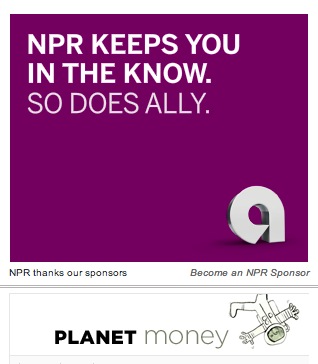
GMAC goes from thief to Ally…
Planet Money‘s relationship with Ally is a textbook example of “conflict of interest” of the sort every journalist is taught to shun. The bank had a clear and demonstrable interest in Planet Money‘s coverage of the financial industry, especially issues that affected the bank’s bottom line. As Planet Money‘s sole sponsor at a time when NPR funds were falling, Ally obviously wielded considerable power.
After Davidson sprang a vicious and bizarre smear-attack on Elizabeth Warren in 2009, some NPR listeners started to get wise to Planet Money‘s corruption problem, and made their concerns known. Following months of complaints from readers pointing to the conflict-of-interest and the way Planet Money‘s segments dovetailed with the banking lobby’s own propaganda—and with Ally’s interests—NPR’s Ombudsman was forced to issue a public statement on the Ally-Planet Money relationship. Perhaps not surprisingly, the NPR Ombudsman decided that listeners’ concerns over the conflict-of-interest were “cynical”—as if the problem lay in listeners’ psychology, rather than in Planet Money’s violation of basic journalism ethics. The NPR Ombudsman went further, arguing essentially that if listeners who complained about corruption weren’t cynical, then they were ignorant.
Despite Davidson’s long experience in sales and underwriting for public radio, he claimed he was out of the loop when it came to the deal his own show, Planet Money, cut with its sole sponsor, Ally Bank: “I have nothing to do with the underwriting stuff. We don’t pay any attention to the fact that they are a sponsor. We wouldn’t for a second give them any special treatment — positive or negative.”
And yet, the actual record proves that NPR readers were right to suspect and criticize the arrangement, and that Davidson was wrong in claiming that Planet Money has not consistently pushed a narrative so in synch with Ally Bank and the financial industry that it boggles the mind how he has gotten away with it. Planet Money coverage hasn’t just been friendly to banks and the finance industry in general—some of it has been suspiciously lined up and in synch with specific policy priorities of its exclusive sponsor, Ally Bank.
One example: In 2009, just as Planet Money inked its exclusive sponsorship deal with Ally Bank, Davidson began broadcasting a number of segments critical of the proposed Financial Consumer Protection Agency Act of 2009, questioning the need to regulate consumer financial products like mortgages and credit cards in order to protect people against bank fraud. “Will it work at all?” Davidson asked in one of his fake “gee-whiz” questions. “Is this just one more layer of regulation in a regulatory system that fundamentally broke down?”
In May 2009, in the heat of the banking industry’s massive pushback, Davidson essentially mugged Elizabeth Warren, the chief architect of the financial consumer protection bill, in an interview that took a sharp and bizarre hostile turn early on. Davidson surprised Warren and his own listeners with uncharacteristic personal smears, trying to portray her as a clueless, power-hungry ideologue. Davidson’s attack on Warren was so out-of-line and uncharacteristically hostile that it sparked a torrent of criticism from NPR listeners who couldn’t understand why Davidson or NPR would do such a thing. Keep in mind, this was in the spring of 2009, when unemployment was still shooting through the roof, the future of the economy was in doubt, and talk of a 1930s style Great Depression-2 was still front-and-center.
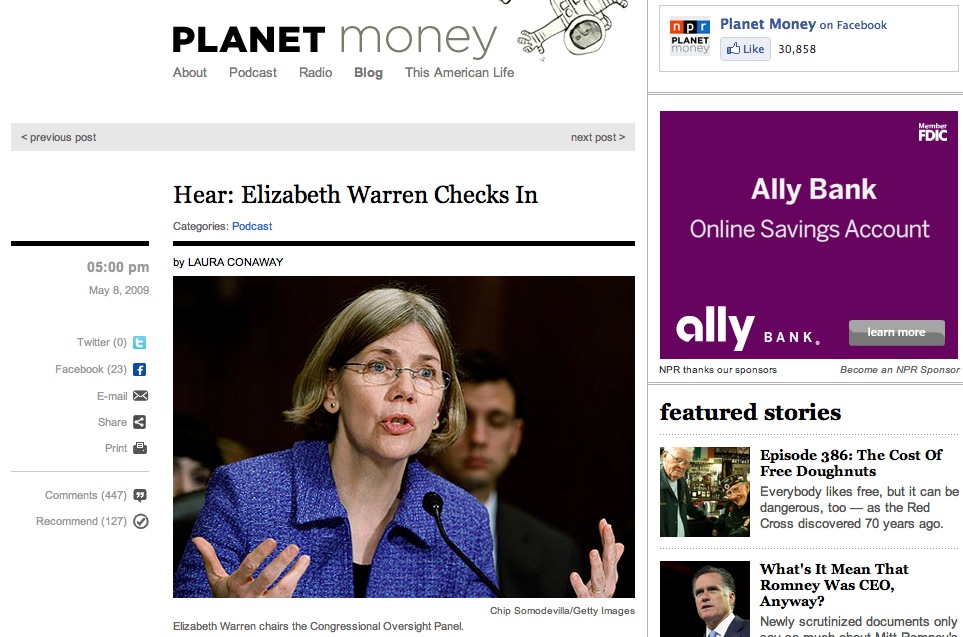
It’s worth going back and listening to the interview to get a sense of just how malevolent Davidson really was, and is. Here’s an excerpt, courtesy of Corrente:
ADAM DAVIDSON: What it feels to me is what you are missing is that — I think we put aside your pet issues. We put them aside. We put them aside until this crisis is over.
ELIZABETH WARREN: The cr– What you’re saying makes no sense. Now come on. [interpolate Davidson sputtering and attempting to interrupt throughout.] It makes no sense. On an emergency basis, on one day, one week, one month, there’s no doubt in my mind we’ve got to step in, we’ve got to make sure we have a functioning banking system. I think I’ve said that like nine times now. Of course we’ve got to have a functioning banking system.
DAVIDSON: Wait a minute. I want to make you go farther. I want to make you madder before I —
ELIZABETH WARREN: No no no. [Davidson snickers] We’re now at what — we’re now seven, eight months into this. And it’s the second part of what you said. We can’t do anything about the American family until this crisis is over? This crisis will not be over until the American family begins to recover. [More Davidson sputtering.] This crisis does not exist independently —
DAVIDSON: That’s your crisis.
ELIZABETH WARREN: No it is not my crisis! That is America’s crisis! If people cannnot pay their credit card bills [Davidson tries to interrupt] if they cannot pay their mortgages —
DAVIDSON: But you are not in the mainstream of views on this issue. You are not —
ELIZABETH WARREN: What, if they can’t pay their credit card bills the banks are gonna do fine? Who are you looking at?
DAVIDSON: The [sputters]–
ELIZABETH WARREN: Who says a bank a bank is going to survive — Who is not worried about the fact that the Bank of America’s default rate has now bumped over 10%? That’s at least the latest data I saw. So the idea that we’re going to somehow fix the banks and then next year or next decade we’re going to start worrying about the American family just doesn’t [Davidson talking over] make any sense.
DAVIDSON: The American families are not — These issues of crucial, the essential need for credit intermediation are as close to accepted principles among every serious thinker on this topic. The view that the American family, that you hold very powerfully, is fully under assault and that there is — and we can get into that — that is not accepted broad wisdom. I talk to a lot a lot a lot of left, right, center, neutral economists [and] you are the only person I’ve talked to in a year of covering this crisis who has a view that we have two equally acute crises: a financial crisis and a household debt crisis that is equally acute in the same kind of way. I literally don’t know who else I can talk to support that view. I literally don’t know anyone other than you who has that view, and you are the person [snicker] who went to Congress to oversee it and you are presenting a very, very narrow view to the American people.
The Columbia Journalism Review described the Planet Money interview as a “disaster” and “really cringeworthy stuff from Davidson,” who was so rude and unprofessional that NPR’s Ombudsman was forced to issue a public apology for his behavior. Davidson’s excuse: he had been traveling for a NPR fundraiser and was “very, very tired.”
What Adam Davidson did not disclose to the public was that at the same time he was smearing Elizabeth Warren and attacking legislation that would protect consumers against the sort of bank fraud that has devastated millions of Americans, Ally Bank, the sole sponsor underwriting Davidson’s Planet Money show and his salary, was simultaneously spending hundreds of thousands lobbying against the Financial the Consumer Protection Agency Act of 2009.
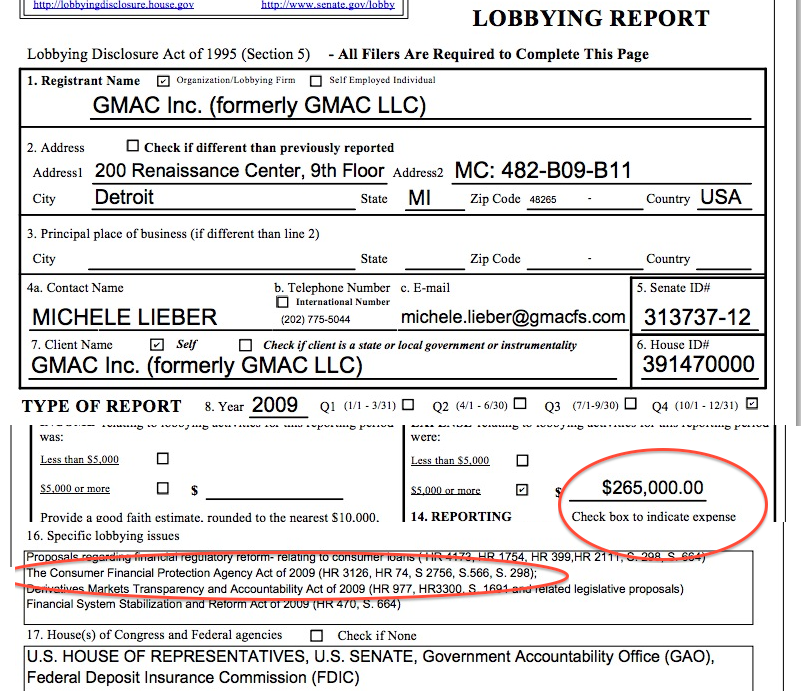
Evidence: Here’s just one of GMAC’s lobbying disclosure forms mentioning the Consumer Financial Protection Agency Act of 2009
Ally Bank is not the only financial company funding Adam Davidson’s career, and filling up his bank accounts.
On top of Ally Bank’s exclusive sponsorship of Planet Money, Davidson earns lucrative speaking fees from banks and financial companies, including J.P. Morgan, Well Fargo, Bank of America and Goldman Sachs—the same companies he covers as a journalist. Davidson is frequently the only journalist/reporter booked to speak at these events; other speakers usually work in finance.
Davidson has yet to disclose his corporate clients and how much they pay him, but here is a partial list of Davidson’s speaking gigs from the last two years compiled from various publicly available sources:
- In April 2011, Davidson was the headlining speaker at the 9th Annual “Women’s World Banking” Microfinance and the Capital Markets Conference. The conference was hosted by J.P. Morgan, but the organization itself is funded by the world’s biggest banks and corporations, including BP, Morgan Stanley, Pfizer, Barclays Capital, VISA, ExxonMobil—just to name a few.
- In 2011, Davidson spoke at another microfinance conference, this once was also funded by Morgan Stanley, Citi, Bank of America, Deutsche Bank and CapitalOne.
- In 2012, Davidson spoke at the 27th Annual Conference for the Treasury & Finance Professional. Sponsors of the event included Bank of America, BlackRock, BNY Mellon, Bloomberg, Citibank, Findelity Investments, Goldman Sachs, J.P. Morgan, Morgan Stanley, Well Fargo and about a dozen of the most powerful financial the largest financial companies in the world.
These speaking fees are a huge unaddressed problem in news media and academia. As explained by Charles Ferguson, director of Inside Job and author of Predator Nation, the problem with speaking fees is that they are “sometimes used to launder or disguise payments . . . for lobbying and policy advocacy.” That is why, for example, Obama’s former economy czar Larry Summers was roundly criticized for taking hundreds of thousands of dollars in speaking fees in 2008 from the same banks he was bailing out in 2009.
Chicago Public Media, which co-owns “Planet Money” through its ownership of “This American Life”, explicitly bars conflicts-of-interest: “WBEZ journalists must uphold the trust of the public by not overlapping individual interests with professional responsibilities. WBEZ journalists may not accept any form of compensation from the individuals, institutions or organizations they cover.”
Neither NPR nor This American Life would comment on S.H.A.M.E.’s investigation into Adam Davidson’s conflicts of interest. We will be seeking to get comment from Davidson’s other employer, The New York Times, about their policy on journalists having conflicts-of-interest.
Notes
See Naked Capitalism’s coverage of GMAC/Ally’s mortgage fraud.
Featured Video

Yemen joins the war – Red Sea could be blocked next – Saudi regime at risk
or go to
Aletho News Archives – Video-Images
From the Archives
Should Europeans ‘Thank’ the Americans for Destroying Nord Stream?
By Robert Bridge | Strategic Culture Foundation | September 29, 2022
With an investigation continuing into the destruction of the Nord Stream gas pipeline that provided energy supplies to Europe from Russia, there appears to be just one prime suspect, and that should surprise nobody.
Following the sabotage of the Nord Stream 1 and 2 gas pipelines, former Polish Foreign Minister Radoslaw Sikorski already seemed to know the identity of the perpetrator when he tweeted out: “Thank you, USA.”
At first glance, it seemed that Sikorski was speaking sarcastically, berating Washington for carrying out an attack that will have severe repercussions for the people of Europe. After all, how could anyone see any good coming from the termination of Europe’s primary source of gas reserves with winter just around the corner? It was Sikorski’s homeland of Poland, after all, that urged its citizens to collect firewood in the face of dwindling gas reserves.
In fact, the Polish diplomat was speaking one-hundred percent literally… continue
Blog Roll
 Aletho News
- Iran denies responsibility for ‘depraved’ attack on Kuwait desalination plant
- Bring The Troops Back. End This War Now!
- Can we please stop calling Israel the ‘only democracy in the Middle East’ now?
- US should start removing its troops for Germany, proposes AfD co-leader Chrupalla
- Iran Red Crescent: 600 educational centers attacked in US-Israeli ‘war crimes’
- Russian Oil Tanker Arrives in Cuba Amid U.S. Blockade
- America Racing to Strategic Defeat in Iran: Lt Col Daniel Davis
- FTC Warns Visa, Mastercard, PayPal, Stripe Over Political Debanking
- Russian tanker approaches Cuba despite US oil blockade
- Marandi: Yemen joins the war – Red Sea could be blocked next – Saudi regime at risk
- If Americans Knew
- Israeli police block Catholic cardinal from entering Church of the Holy Sepulchre on Palm Sunday
- Israel is assassinating journalists again, more than any other nation, anywhere, ever – Not a ceasefire Day 170
- Over 300 US service members wounded, majority have brain injuries – Not a ceasefire Day 169
- Researchers at Human Rights Watch Resign Over Blocked Report on Palestinian Refugee Return
- Jewish Groups Are Backing a War Americans Don’t Want
- Eric Fingerhut Thinks He’s the President of the Jews
- Top Jewish Philanthropists, Rabbis Urge Israeli President to Take Action Against ‘Jewish Extremists’
- Don’t Be Fooled. Zionist Leaders Have Always Wanted to Control Southern Lebanon
- Israel’s widespread use of torture is a core element of its genocide against the Palestinian people
- In Israel’s War on Iran, Many Middle East US Bases Rendered “All But Uninhabitable”
- No Tricks Zone
- New Study Finds Warming Saves Lives…Cold Temperatures 12 Times More Deadly Than Excess Heat
- German Science Blog Accuses PIK Climate Institute Of Hallucinating Climate Tipping Points
- Devastating Assessment Of Comirnaty Vaccine By Former Senior Pfizer Europe Toxicologist
- New Study: CO2 Is ‘Effectively Negligible’ As An Explanatory Climate Change Factor Since 2000
- Former Pfizer Toxicologist Dr. Helmut Sterz Tells Bundestag Hearing Pfizer Vaccine Should Have Never Been Approved
- Energy Expert: Germany’s Nuclear Phaseout Was A “500 Billion Euro Mistake”
- New Research: South Australia’s Mid-Holocene Sea Surface Temperatures Were 4°C Warmer Than Today
- Storing Green Energy To Last Germany 10 Days Would Require A 60-Million Tonne Battery
- New Studies: UK Sea Levels Were 4 Meters Higher Than Today During The Mid-Holocene
- Destructive Green New Deal: German Energy And Metal Group Warns Of Drastic Crisis
 Aletho News