A Brief History of the “Kremlin Trolls”

By Scott Humor | The Saker | October 15, 2018
Saint Petersburg, Savushkina, 55 is the most famous office building in the world, thanks to the relentless promotion of the United States government, the CIA, FBI, and by the powers of the entire Western media, financed by Western governments. VOA, NPR, and Svoboda, by the government of the US; the BBC by the government of the UK; CNN by the governments of Saudi Arabia; the DW, by the government of Germany; and so on and so forth. You name it, they all punched time to promote this office building.
To be specific, it’s not even a building, but several adjoined buildings that cover an entire city block, an urban development plan common for Saint Pete’s. That’s why every business here has the address of Savushkina, 55 followed by a building number. You can take a virtual tour around it, to see for yourself. The buildings are shared by several dozens of private businesses, by the local Police department, and by the newsrooms of half a dozen Russia Media sources like the FAN (Federal News Agency), the Neva News (Nevskie Novosti), Political Russia, Kharkov News Agency, publishing Ukrainian news, and others. They all are privately owned and operated and generate over 55 million unique visitors per month. Overall, several thousand people come to this building to work every morning. But you wouldn’t know this by account of Western media. For over two years now, these people are being harassed and collectively branded as “THE KREMLIN TROLLS.”
The building is very popular because it’s located in a quiet historical neighborhood and is in walking distance from a suburban train station. It’s newly renovated offices offer open floor plans with Scandinavian fleur so very appreciated by the news people. In addition, the rent for this building is less than in center city. Which is why Evgeny Zubarev, a former top editor for the RIA NEWS, choose it for his media startup. He took several offices allowing him to manage his growing media giant without wasting time to commute. Now, the FAN newsroom alone employs about 300 journalists.
This wasn’t always the case.
At the beginning of 2014, the building was still under construction and renovation, when an anti-Russian government group of hackers called first “The Anonymous International” and latter “Shaltay-B0ltay” fingered it as the “Kremlin trolls’ layer.”
Their wordpress blog is still here. It was last updated on November 2016. Its title states: “Anonymous International. Shaltay Boltay/Press Secretary of the group. Creating reality and giving meaning to words.”
November 7, 2014, Khodorkovsky, who acted as an integral part of the CIA “Kremlin trolls” Project, tweeted the picture of one of the entrances to one of the buildings saying: “Savuchkina 55. New home for bots. ID check system. Not a sign there. I won’t say who took the photo.”
Савушкина 55
Новый домик для ботов. Пропускная система. Ни одной вывески. Чье фото – не скажу. pic.twitter.com/oCVUAvSTW4— Ходорковский Михаил (@mich261213) November 7, 2014
Someone commented by saying
Nov 7 2014. The comment reads: “I live there and pass this building on my way to work. The sign on the building says “For Rent”
@tvjihad @mich261213 Михаил, я каждый день мимо проезжаю на работу. и да, чье фото с вывеской не скажу))) pic.twitter.com/FlTEJJwyTt
— Kirill_V (@Kirill_V1) November 7, 2014
The phone number on the picture 324-56-06 belongs to the commercial real estate company Praktis Consulting & Brokerage that managed the rent of offices.
Midsummer 2014, Evgeny Zubarev with his start up and several hundred journalists moved in, along with the Police department, and a slew of other businesses people. Little did they know what was to come.
***
The best way to get information is to make it up.
Everything what we know now about the so-called “Kremlin trolls from the Internet Research Agency paid by Putin’s favorite chef,” came from one source, a group of CIA spies that used the mascot of Shaltay-Boltay, or Humpty-Dumpty, for their collective online persona.
They were arrested in November 2016 and revealed as the FSB and former FSB officers. One of them even managed a security department for the Kaspersky Lab. They all were people highly skilled and educated in manipulating and creating large online databases, in any online research imagined, and the knowledge of hacking and altering databases, including those that were run by the Russian government. They weren’t poor people. They weren’t there for the money. They were ideologically driven. Their hatred towards Russia and its people was the motive for their actions.
At some point, Gazeta.ru, an online Russophobic publication, suggested that “Shaltai-Boltai was just a distraction meant to confuse everybody.” They themselves were more concise by stating that they were working to change the reality.
Russian authorities, the courts, and the lawyers, refused to call these men hackers. There was a reason for this. They weren’t so much hackers in a classic sense, as in when someone gains access to real information and copies it. This group wasn’t necessarily hacking existing information, but planting information. They were creating files about fake nonexistent companies and employees, files with blurry fake paystubs, memos, emails, phone messages and so on. The fakes looked convincing, but they still were forgeries that could be easy disproved for someone who had access to the real information.
That’s when the hacking took place, when the FSB agents went into government databases and created records of people and companies that didn’t exist.
I think that part of the reasons why some of them got the mild sentences of three years in general security prison, and some were left free, wasn’t just the fact that they agreed to collaborate with the Russian government, but also the fact that they didn’t actually steal information from government officials like Medvedev and his press secretary, Nataliya Timakova, or the owner of the largest in Europe catering business, Evgeny Prigozhin. They made information up and claimed that it was real.
These guys gave a bad name to all hackers, whistleblowers, leakers and spies. Now, journalists presented with some “hacked” and leaked secrets has to think it over, less they end up with an egg on their face like journos from the Fontanka, Vedomosti and Novaya Gazeta in case of the “Kremlin’s trolls.”
If we accept that the Shaltay-Boltay group was working to create and distribute documents they forged, claiming that those files were “hacked,” we would also understand a mysterious statement made by them to BuzzFeed.
“In email correspondence with BuzzFeed, a representative of the group claimed they were “not hackers in the classical sense.”
“We are trying to change reality. Reality has indeed begun to change as a result of the appearance of our information in public,” wrote the representative, whose email account is named Shaltai Boltai, which is the Russian for tragic nursery rhyme hero Humpty Dumpty.”
Bazzfeed also said back in 2014, that “The leak from the Internet Research Agency is the first time specific comments under news articles can be directly traced to a Russian campaign.”
Now, this is a very important grave mark.
Just think about this working scheme: Shaltay-Boltay with a group of anti-government “activists” created the “Internet Research Agency,” they and some “activists” created 470 FaceBook accounts used to post comments that looked unmistakably “trollish.”
After that other, CIA affiliated entities, like the entire Western Media, claimed the “Russian interference in the US election.” Finally, the ODNI published a report lacking any evidence in it.
The link to their report is here, but I don’t recommend you to read it. You will gain as much information by reading this report as you would by chewing on some wet newspaper. Ask my dog for details.
Assessing Russian Activities and Intentions in Recent US Elections
https://www.dni.gov/files/documents/ICA_2017_01.pdf
Only three paragraphs are interesting on the page 4:
“Russia used trolls as well as RT as part of its influence efforts to denigrate Secretary Clinton. This effort amplified stories on scandals about Secretary Clinton and the role of WikiLeaks in the election campaign.
The likely financier of the so-called Internet Research Agency of professional trolls located in Saint Petersburg is a close Putin ally with ties to Russian intelligence.
A journalist who is a leading expert on the Internet Research Agency claimed that some social media accounts that appear to be tied to Russia’s professional trolls—because they previously were devoted to supporting Russian actions in Ukraine—started to advocate for President-elect Trump as early as December 2015.”
In other words, in its report with a subtitle: “Background to “Assessing Russian Activities and Intentions in Recent US Elections”: The Analytic Process and Cyber Incident Attribution” the Office of the Director of National Intelligence ODNI, is quoting the Shaltay-Boltay, a group that had been proved to work for the CIA by “creating reality.”
The only reason why they don’t provide us with evidence, with at least one lousy IP address with the Russian trace roots that would convincingly point at the company named the Internet Research Agency, is because this company never existed, it never had any IP addresses assigned to it that would be verifiable via third parties like RIPE network coordination and via online domain tools.
We understand that having hundreds of people working ten to twelve hours a day, as they claimed, posting hundreds messages hourly, would use huge amount of bandwidth. They would need a very fast internet connection with unlimited bandwidth that only a business can get. Inevitably, this internet connection would come with the assigned IP addresses. No internet provider would let this kind of bandwidth hog to create this kind traffic without being forced to separate them from other customers.
One example, a woman with the last name Malcheva filed a lawsuit in court against the companies “Internet Research, LLC” and “TEKA, LLC,” claiming unpaid wages.
The court asked her to produce evidence of her work, and then denied her claim after she produced a photo of a computer with an IP address on its screen as evidence of her employment.
IP Address 109.167.231.85
inetnum: 109.167.231.0 – 109.167.231.255
netname: WESTCALL-NET
descr: S-Peterburg Hotel Corintia Wi-Fi
An IP address that was assigned to a luxury hotel in Saint-Petersburg. A hotel that was awarded multiple international awards for excellence. An immensely popular hotel among discriminating travelers. A very expensive hotel located in the center of a historic city. The woman claimed that she was an “online troll’ working from this location ten hours a day with hundreds of other virtual trolls. The judge didn’t believe her. Would you?
People from the Shaltay-Boltay group weren’t hackers in the proper terms because they worked with and for the CIA. Middle-of the-road and run-of-the-mill intelligence agencies would collect and analyze information for their governments. The CIA invents information, then goes on to manufacture and forge documents in support of their invented information; they then recruit people inside other countries and other governments to claim that they “obtained” this explosive evidence. Being the dirty cops that they are, the CIA doesn’t obtain and secure evidence, but instead they plant fake evidence on their victims.
By this act alone they change our current and past reality, and they change our future. They change our history by forging never existing “proof” of invented myths. They hire and train groups of military men to act as “protesters” around government buildings, while other military men from other countries shoot at unsuspected bystanders whose death allows Washington to claim the sovereign governments’ wrongdoing.
CIA-operated groups arrest and kill government officials or force them to flee, like in Ukraine. They take over a couple of government buildings and declare their victory over a huge country, just like it happened in Russia in 1991 and 1993 and in Ukraine in 2005 and 2014. For some reason, they claim that governments are those people who take over a couple of buildings in one city. When in fact, our countries’ governments are those people whose names we wrote on ballots, regardless of where these people are located. We don’t run around like chickens with our heads cut off electing a new president every time our current president leaves the country.
Going back to the CIA’s Humpty-Dumpty project that came online sometime in 2013. Why would anyone name their enterprise after such predictable failure, you might ask. Because, in the Russian alliteration, Shalti-Boltai means “shake up and brag about it” and not as in its original Carroll’s version of “humping and dumping.”
I went ballistic after someone retweeted me this CNN clip titled “Russia used Pokemon Go to interfere with the US elections.”
I actually listened to the clip itself, in which they brought up the Internet Research Agency” from SP. Knowing full well that the hackers who “leaked” the information about this “Agency” were arrested and successfully charged for treason because they worked for the CIA should prevent the CIA to run fake news about the entities and people they themselves made up. You would think that the matter of the “Kremlin trolls from Saint Petersburg” should be dead and buried after the arrest. The CIA and other 16 intelligence agencies should know better than to use information that is being known now as “discovered’ with their “help.”
Because it’s all fake and we know it.
We also know everything that the CIA touches is fake. Speaking in layman’s term, it’s as if all those middle aged bald guys would start licking their balls while claiming to be in fulfilling relations. If it’s just you, guys, there is no relations. It’s just you. Deal with it!
The American intelligence community cannot claim an existence of threats against America if all fingers in those “threats” are pointing back at the American intelligence community.
By stating that someone interfered with the US election using the Internet Research Agency in SP, is plainly to state that it’s CIA that interfered in the American elections.
—
Let’s just briefly run over the matter, before I tell you what exactly took place.
—
On September 6, 2017, Alex Stamos, a Chief Security Officer, posted a statement titled “An Update On Information Operations On Facebook”:
“In reviewing the ads buys, we have found approximately $100,000 in ad spending from June of 2015 to May of 2017 — associated with roughly 3,000 ads — that was connected to about 470 inauthentic accounts and Pages in violation of our policies. Our analysis suggests these accounts and Pages were affiliated with one another and likely operated out of Russia.”
To make sure that people including myself won’t find those accounts, the FB deleted them.
“We don’t allow inauthentic accounts on Facebook, and as a result, we have since shut down the accounts and Pages we identified that were still active.”
That’s how it’s done in the US. They destroy all potential evidence while laying heavy blame on Russia. Facebook destroys evidence of “Russians crimes” while public ask them to show those evidences. This means only one thing: the pieces of evidence are pointing at something Facebook wants to protect, which is the CIA.
You see, I am not suggesting that they are lying about those accounts being real or that they “affiliated with Russia,” because, if the Shaltay-Boltay group worked with people from the Soros and Khodorkovky-backed group of human rights lawyers “Team 29,” created in February 2015, then their only task, it seems, was to service the psyop of the “Internet Trolls.” It looks to me like they could also coordinated the work done by those 470 FaceBook accounts while being on the territory of Russia. Considering that, it’s not a complete lie for the FB to say that those accounts were “Russia affiliated” and that they were “likely operated from Russia.”
Facebook also can claim with plausible deniability that they are ignorant of the fact that people behind the Internet Research Agency troll hoax are proved by the Russian court to be affiliated with the CIA, while people who have been acting as the “witnesses” to this Project are lawyers from Team 29, “human rights activists and also journalists from the Norwegian Bonnier AB owned Fontanka, Taiwan-based Novaya Gazeta, and the Latvia-based Meduza; these people are factually proven to be backed by Soros, a CIA financial branch, like a journalist who has received an award from Khodorkovsky.
The entire campaign of blaming Russia in “meddling” is being reported without ANY tangible proof that could be verified by at least two independently existing sources, that’s why we should grab ANY grains of information. That’s why Facebook’s statement that “About one-quarter of these ads were geographically targeted, and of those, more ran in 2015 than 2016″is very important.
Why?
Because, fake business entities known as “the Internet Research Agency,” and “the Internet Research” in the government electronic business registry, they were treated as real companies by the system. Because of their inactivity on all of their bank accounts and because no one ever filed required forms, they were automatically liquidated by the electronic system.
The United Business Registry database in Russia works according to the Federal laws, so after twelve months of inactivity a business is simply liquidated. The Internet Research Agency was liquidated in December 2016 by the government system after it been inactive for twelve month. It’s inactivity implied that the company had no employees, no office, and no bank transactions for at least twelve months! The Internet Research company was liquidated on September 2, 2015 by merging with TEKA company. According to the federal business Registry TEKA was a construction retailer. I wasn’t able to find any indication, like an office, phone number, names of the managers or employees, anything at all that would indicate that this company existed. Just like the Internet Research Agency and the Internet Research, TEKA existed only in the federal registry and nowhere else.
The automatic liquidation in the federal registry for inactivity explains the drop in activity on the accounts run by the Shaltay-Boltay and the others. Oh, yes, they were also hunted and on the run, out of the country. It’s hard to use bank accounts to simulate activities after you have fled the country.
The Team 29, of the human rights lawyers and activists, was created in February 2015. To give to this new company some proof of reality and instant notoriety they immediately filed a lawsuit against the Internet Research company using an activist woman with a Ukrainian last name Ludmila Savchuk (Людмила Савчук) who went and filed a lawsuit against the company, claiming some unpaid wages. Her first lawsuit the judge threw out. Only after the local general prosecutor’s office pressed the judge to take the case, the district court took the case and partially granted the Claimant her claim, but not the “moral damages.” She wanted the money for working for the “troll factory.” In essence, they wanted an official court paper that would say black on white, that there is a “troll factory” that this poor woman worked for. Without reading the file, I don’t know what the judge was thinking, but she might have smelled a rat among those virtual “trolls.”
This took place in August 2015, and by September 2 2015, a fake company named the “Internet Research” was liquidated by merging it, in the Business registry, with another fake entity, TEKA, that was created in spring 2015 as the construction materials retailer.
“Facebook disclosed on Wednesday that it had identified more than $100,000 worth of divisive ads on hot-button issues purchased by a shadowy Russian company linked to the Kremlin.”
“Most of the 3,000 ads did not refer to particular candidates but instead focused on divisive social issues such as race, gay rights, gun control and immigration, according to a post on Facebook by Alex Stamos, the company’s chief security officer. The ads, which ran between June 2015 and May 2017, were linked to some 470 fake accounts and pages the company said it had shut down.”
“Facebook officials said the fake accounts were created by a Russian company called the Internet Research Agency, which is known for using “troll” accounts to post on social media and comment on news websites.”
“The January intelligence report said the “likely financier” of the Internet Research Agency was “a close Putin ally with ties to Russian intelligence.” The company, profiled by The New York Times Magazine in 2015, is in St. Petersburg and uses its small army of trolls to put out messages supportive of Russian government policy.”
“To date, while news reports have uncovered many meetings and contacts between Trump associates and Russians, there has been no evidence proving collusion in the hacking or other Russian activities.”
“While there is no direct link between the Kremlin and any of these projects—both Surkov and Zubarev say their projects are privately funded—the timing, scale, and coordination of these efforts are suspicious. BuzzFeed was not able to find evidence of direct government funding to the “Internet Research Agency ,” the pro-Kremlin troll outlet operating out of 55 Savushkina, but they did reference a number of sources that revealed some level of involvement.”
—-
In my next study, I will provide you with more links, screenshots and translations. I will demonstrate to you how this story connects to the war on the Middle East and the international war on the Russian population of Ukraine.
—
In conclusion I just want to say that everything the United State touches turns into a warzone. The building on Savushkina, 55 in Saint Petersburg is no exception.
Multiple death threats are being directed at people who work there. Popular and excellent in their quality media outlets operating there have to hide their true location and rent a separate office across the city for their visitors, because people are simply afraid to come in.
Journalists and multiple business employees are threatened online with rape.
Threats to hang the journalists during a “protest meeting” on Oct 1, 2017
At least one case of terror attack on the office building that resulted in arson on October 26, 2016.
On Oct 26, 2016, several men threw bottles of Molotov cocktail in the windows of the Nevskie Novosti (Neva News). Luckily, no one was there but the owner of the Media conglomerate, Evgeny Zubarev, who put out the fire.
All of these, every threat, every simple lie is all on the United State government, its intelligence community, on those traitors, who are in prison now, and those who are still at large.
UPDATE:
A couple of Kaspersky staff members (Stoyanov and Dokuchaev), including the head of computer crime investigations (Stoyanov), were arrested by
Russian FSB on treason charges in January this year. An FSB officer (Sergei Mikhailov) was also arrested. The treason charges suggest they
were acting on behalf of a foreign power. SputnikMaybe the US actions against Kaspersky Labs anti-virus software are an attempt to preempt the consequences of the trial of the Kaspersky and
FSB operatives?
——————
Scott Humor
Director of Research and Development
author of The enemy of the State
Outrage as NPR attacks black activist over ‘Russian’ radio appearance

© Anoa Changa / Instagram
RT | April 20, 2018
Black progressive activist Anoa Changa found herself the subject of a vicious hit piece this week on WABE News, an Atlanta NPR affiliate. Her crime? Speaking to a Russian-owned radio station.
When Changa sat down to talk to WABE’s Johnny Kauffman, she expected to chat about her work as a progressive activist. Instead, Kaufman focused the interview on an appearance Changa had made on Russian-run radio station Sputnik in 2016. The piece was published with the headline “Atlanta Activist Uses Russian-Backed Media To Spread Message.”
Changa, a mother of two, had been an avid supporter of Bernie Sanders in the run-up to the 2016 election. Now Changa is managing editor of a blog called ‘Progressive Army,’ and hosts a podcast from her native Atlanta, all while holding down a day job and raising two children.
Kauffman sat in Changa’s studio – a friend’s living room equipped with a microphone and webcam– as she interviewed Amy Vilela, a progressive candidate running for the Democratic nomination in Nevada’s 4th Congressional District. Changa and Vilela spoke of corruption in American politics, but the interview was just a formality before Kaufman turned the heat up on Changa.
In 2016, Changa spoke on two programs hosted on Sputnik, which broadcasts on AM and FM in Washington DC. While Changa used Sputnik to speak about progressive issues to a wider audience, Kauffman saw sinister Russian plots afoot.
Ominously, the article says that “Changa’s association with Sputnik may put her credibility at risk,” and warned that appearing on a Sputnik program furthers “Russia’s effort to create chaos in the US.”
Working with Sputnik, Kauffman wrote, made things “complicated” for Changa.
Fellow activist Eugene Puryear hosts the Sputnik show ‘By Any Means Necessary,’ on which Changa is a regular. The two talk about police brutality, marginalization, and the influence of money in politics. These issues weren’t important to Kauffman, however. What was important is that Russia pays Puryear’s salary.
Somehow, this means that Sputnik is using leftist causes to further a shady and divisive Russian agenda in America. The fact that Changa also appeared on mainstream outlets like the BBC is not mentioned once, nor is the fact that NPR is funded by the US government. Facts would only get in the way of the narrative.
That Puryear and his guests often lament the mainstream media’s phony ‘Russian interference’ narrative only serves as further proof of their guilt in the vast Russian conspiracy.
To back up his point and give the Russia hysteria legitimacy, Kauffman cites research professor Robert Ortnung, who claims that Sputnik and RT are sinister news organizations that exist only to further the Bond-villain aims of Vladimir Putin.
“Those platforms are set up for the sole purpose of promoting the Kremlin line,” Ortnung said. “The idea is to create as much chaos as possible, because the Russians see it as a zero-sum game, where anything that weakens us is going to strengthen them.”
Kauffman neglects to mention that Ortnung is himself a government mouthpiece. He is on the International Forum for Democratic Studies Council at the National Endowment for Democracy, set up by Ronald Reagan at the height of the Cold War to spread the American message abroad. To this day, the NED is almost entirely funded by US government money.
After outlining the villains, Kauffman makes his play at the end of the article. He lists a rogues gallery of Georgia politicians that have spoken to RT and Sputnik, before tipping off one politician about the dangers of speaking to a Russian stooge like Changa.
After Kauffman told local Democrat Richard Winfield that Changa is a regular guest on a Sputnik show, the politician said that he would not have spoken to her had he known.
“It raises the possibility of people impugning not just me,” said Winfield, “but the political positions I’m advancing.”
Twitter exploded after the article was published, as users immediately saw through the obvious smear.
“NPR didn’t just smear Anoa Changa,” tweeted journalist Caitlin Johnstone. “They combed through her podcasts and called people she’s interviewed digging for Russia dirt. The worst they could find was one guy who disapproved of her Sputnik stuff. Did that stop them from publishing? Of course not.”
The message of Kauffman’s article is clear: In an era where liberal American media outlets are tripping over each other to find evidence that their enemies one time might have had Russian dressing on their salad, speaking to Russians makes you guilty by association.
As noted in the article, Changa has no intention of stopping her appearances on Sputnik.
Media Warn of ‘Russian Bots’—Despite Primary Source’s Disavowal
By Adam Johnson | FAIR | April 5, 2018

Washington Post (4/2/18)
One could forgive the average reader for thinking reporters covering bots had been replaced by bots. The formula is something we’ve seen a million times now: After a controversial story breaks, media outlets insist that “Russian bots” used the controversy to “sow discord” or “exploit tensions”; a “Russian bot dashboard” is offered as proof. (These “dashboards” let one see what Russian bots—automated online persona controlled by the Kremlin—are allegedly “pushing” on social media.)
The substance of the concern or discord is underreported or ignored altogether. Online conflict is neatly dismissed as a Kremlin psyop, the narrative of Russia interference in every aspect of our lives is reinforced, and one is reminded to be “aware” of Russian trolls online.
Note the latest iteration of this story:
- Russian Bots Are Rallying Behind Embattled Fox News Host Laura Ingraham as Advertisers Dump Her Show (Business Insider, 4/1/16)
- Russian Bots Defend Fox News Pundit Laura Ingraham as Advertisers Leave Following David Hogg Tweet (Newsweek, 4/2/18)
- Russian Bots Are Tweeting Their Support of Embattled Fox News Host Laura Ingraham (Washington Post, 4/2/18)
- Russian Bots Flock to Laura Ingraham Feud With Parkland Student: Report (The Hill, 4/2/18)
- Russian Bots Rush to Laura Ingraham’s Defense in David Hogg Feud (Washington Times, 4/2/18)
Not to be confused with the Russian bots that were heard from after the Austin bombings from last month:
- Russian Social Accounts Adding to Complaints That Austin Bombings Aren’t Being Covered (NPR, 3/19/18)
- Fallout of Austin Bombings Exposes Racial Tensions, Russian Bots and Media Distrust (France 24, 4/1/18)
- Russian Bots Were Sowing Discord During Hunt for Austin Bomber, Group Says (Houston Chronicle, 3/20/18)
Or the bots from Russia that were seen in the wake of the Parkland massacre:
- After Florida School Shooting, Russian ‘Bot’ Army Pounced (New York Times, 2/19/18)
- After the Parkland Shooting, Pro-Russian Bots Are Pushing False-Flag Allegations Again (Washington Post, 2/16/18)
- How Russian Trolls Exploited Parkland Mass Shooting on Social Media (Politifact, 2/22/18)
One problem, though: The “Russian bot dashboard” reporters generally cite as their primary source, Hamilton 68, effectively told reporters to stop writing these pieces six weeks ago. According to a report from Buzzfeed (2/28/18)—hardly a fan of the Kremlin—Russian bot stories are “bullshit”:

The New York Times (2/19/18)
By now you know the drill: massive news event happens, journalists scramble to figure out what’s going on, and within a couple hours the culprit is found — Russian bots.
Russian bots were blamed for driving attention to the Nunes memo, a Republican-authored document on the Trump-Russia probe. They were blamed for pushing for Roy Moore to win in Alabama’s special election. And here they are wading into the gun debate following the Parkland shooting. “[T]he messages from these automated accounts, or bots, were designed to widen the divide and make compromise even more difficult,” wrote the New York Times in a story following the shooting, citing little more than “Twitter accounts suspected of having links to Russia.”
This is, not to mince words, total bullshit.
The thing is, nearly every time you see a story blaming Russian bots for something, you can be pretty sure that the story can be traced back to a single source: the Hamilton 68 dashboard, founded by a group of respected researchers, including Clint Watts and JM Berger, and currently run under the auspices of the German Marshall Fund.
But even some of the people who popularized that metric now acknowledge it’s become totally overblown.
“I’m not convinced on this bot thing,” said Watts, the cofounder of a project that is widely cited as the main, if not only, source of information on Russian bots.
Watts, the media’s most cited expert on so-called “Russian bots” and co-founder of Hamilton 68, says the narrative is “overdone.” The three primary problems, as Buzzfeed, reported, are:
- The bots on the Hamilton 68 dashboard are not necessarily connected to Russia: “They are not all in Russia,” Watts told Buzzfeed. “We don’t even think they’re all commanded in Russia—at all. We think some of them are legitimately passionate people that are just really into promoting Russia.” (Hamilton 68 doesn’t specify which accounts are viewed as Russian bots; that’s a trade secret.)
- Twitter is clogged with bots, so telling which are Russian and which aren’t is impossible. Bots naturally follow trending or popular stories, like all the stories cited above; how does one distinguish “Russian bot” activity versus normal online trend-chasing?
- Tons of bots are run out of the United States, in totally routine partisan marketing efforts; the singular obsession with Russia lets these shady players off the hook. And, again, it’s almost impossible to distinguish between simply partisan GOP bots and “Russian” ones.

BuzzFeed (2/28/18)
Put another way: These stories are of virtually no news value, other than smearing whichever side the “Russian bots” happened to support, and reinforcing in the public mind that one cannot trust unsanctioned social media accounts. Also that the Russians are hiding in every shadow, waiting to pounce.
Another benefit of the “Russian bots agitate the American public” stories is they prevent us from asking hard questions about our society. After a flurry of African-American Twitter users alleged a racist double standard in the coverage of the Austin bombings in March (which killed two people, both of them black), how did NPR address these concerns? Did it investigate their underlying merit? Did it do media analysis to see if there was, in fact, a dearth of coverage due to the victims’ race? No, it ran a story on how Russia bots were fueling these concerns: “Russian Social Accounts Adding to Complaints That Austin Bombings Aren’t Being Covered” (All Things Considered, 3/19/18):
NPR’s Philip Ewing: Well, there’s two things taking place right now. Some of this is black users on Twitter saying that because some of the victims in this story were not white, this isn’t getting as much attention as another story about bombings, or a series of bombings in the United States, would or should, in this view.
This seems like a pretty serious charge, and would have a lot of historical precedent! Does NPR interrogate this thread further? Does it interview any of these “black users”? No, they move on to the dastardly Russians:
Ewing: But there’s also additional activity taking place on Twitter which appears initially to be connected with the Russian social media agitation that we’ve sort of gotten used to since the 2016 presidential race. There are dashboards and online tools that let us know which accounts are focusing on which hashtags from the Russian influence-mongers who’ve been targeting the United States since 2016, and they, too, have been tweeting about Austin bombings today.
NPR host Ailsa Chang: The theory being that these Russian bots are being used to drive a wedge between groups of people here in the United States about this issue, about the coverage being potentially racist.
Ewing: That’s right.
Nothing to see here! There’s a problem in our society—systemic racism in American media—and rather than an examination of whether it’s affecting coverage here, what the listener gets is yet another boilerplate story about “Russian bots,” the degree, scope and impact of which is wholly unknown, and likely inconsequential. Hesitant to cite Hamilton 68 by name (perhaps because its co-founder mocked this very kind of story a few weeks prior), NPR reporter Ewing simply cites “dashboards and online tools” as his source.

To All Things Considered (3/19/18)
Which ones? It doesn’t really matter, because “Russian bots support X” reports are a conditioning exercise more than a story. The fact that this paint-by-numbers formula is still being applied weeks after the primary source’s co-founder declared himself “not convinced on this bot thing” and called the story “overdone” demonstrates this. The goal is not to convey information or give the reader tools to better understand the world, it’s to give the impression all unrest is artificially contrived by a foreign entity, and that the status quo would otherwise be rainbows and sunshine. And to remind us that the Enemy lurks everywhere, and that no one online without a blue checkmark can be trusted.
Google hiring 1,000 journalists in effort to control American news flow
It’s about controlling information offline and online
By Alex Christoforou | The Duran | September 19, 2017
Google is learning from its mistakes.
Not being able to place Hillary Clinton in office, the search monopoly has decided that online influence over what Americans think, say, and do is not enough to guarantee the right woman enters the White House.
Google is now embarking on a 5 year plan, where they will seed 1,000 aspiring, liberal left journalists into America’s local media markets.
Poynter reports that the Google News Lab will be working with Report For America (RFA) to hire 1,000 journalists all around the country.
Many local newsrooms have been cut to the bone so often that there’s hardly any bone left. But starting early next year, some may get the chance to rebuild, at least by one.
On Monday, a new project was announced at the Google News Lab Summit that aims to place 1,000 journalists in local newsrooms in the next five years. Report For America takes ideas from several existing organizations, including the Peace Corps, Americorps, Teach for America and public media.
Unlike foreign or domestic service programs or public media, however, RFA gets no government funding. But they are calling RFA a national service project. That might make some journalists uncomfortable – the idea of service and patriotism. But at its most fundamental, local journalism is about protecting democracy, said co-founder Charles Sennott, founder and CEO of the GroundTruth Project.
“I think journalism needs that kind of passion for public service to bring it back and to really address some of the ailments of the heart of journalism,” he said.
Here’s how RFA will work: On one end, emerging journalists will apply to be part of RFA. On the other, newsrooms will apply for a journalist. RFA will pay 50 percent of that journalist’s salary, with the newsroom paying 25 percent and local donors paying the other 25 percent. That reporter will work in the local newsroom for a year, with the opportunity to renew.
Zerohedge reports…
Of course, while the press release above tries to tout the shared financial responsibility of these 1,000 journalists, presumably as a testament to their ‘independence’, it took about 35 seconds to figure out that the primary funder of the journalists’ salaries, RFA, is funded by none other than Google News Lab.

Meanwhile, as a further testament to RFA’s ‘independence, we noticed that their Advisory Board is flooded with reputable, ‘impartial’ news organizations like the New York Times, NPR, CBS, ABC, etc….

We are sure that these 1,000 journalists will never be called upon by Google to report on the news in a way that benefits the giant search company.
Trudeau’s pal in Rwanda a ruthless dictator
By Yves Engler · August 25, 2017
Why is the Trudeau government supporting Africa’s most ruthless dictator?
After amending the constitution to be able to run indefinitely Paul Kagame recently won 98.63 per cent of votes in Rwanda’s presidential election. In response, Canada’s High Commissioner Sara Hradecky tweeted “Congratulations to Rwandans for voting in peaceful presidential election” and “Canada congratulates Paul Kagame on his inauguration today as President of Rwanda.” The latter tweet was picked up by the state propaganda organ New Times in a story titled “Heads of State, diplomats laud Kagame’s ‘visionary leadership’.”
If garnering 99 per cent of the vote wasn’t a clue that Kagame is a dictator, the High Commissioner could’ve taken a look at Canada’s ‘paper of record,’ whose Africa bureau chief has shined a critical light on Rwanda in recent years. At the start of 2016 The Globe and Mail reported on two new books describing the totalitarian nature of the regime.
“Village informers,” wrote South Africa-based Geoffrey York. “Re-education camps. Networks of spies on the streets. Routine surveillance of the entire population. The crushing of the independent media and all political opposition. A ruler who changes the constitution to extend his power after ruling for two decades. It sounds like North Korea, or the totalitarian days of China under Mao. But this is the African nation of Rwanda — a long-time favourite of Western governments and a major beneficiary of millions of dollars in Canadian government support.”
In 2014 York wrote an investigation headlined “Inside the plots to kill Rwanda’s dissidents,” which provided compelling evidence that the regime had extended its assassination program outside of east Africa, killing (or attempting to) a number of its former top officials who were living in South Africa. Since the initial investigation York has also reported on Rwandan dissidents who’ve had to flee Belgium for their safety while the Toronto Star revealed five individuals in Canada fearful of the regime’s killers.
On top of international assassinations and domestic repression, Kagame has unleashed mayhem in the Congo. In 1996 Rwandan forces marched 1,500 km to topple the regime in Kinshasa and then re-invaded after the Congolese government it installed expelled Rwandan troops. This led to an eight-country war between 1998 and 2003, which left millions dead. Rwandan proxies have repeatedly re-invaded the mineral rich eastern Congo. In 2012 The Globe and Mail described how “Rwandan sponsored” M23 rebels “hold power by terror and violence” there.
The Rwandan government’s domestic repression and violence in the Congo is well documented. Yet I couldn’t find a single tweet or comment by Hradecky critical of Kagame since she became High Commissioner in January. Yet she found time to retweet Kagame’s International Women’s Day message that “Realizing women’s full aspirations is inextricably linked to achieving whole nation’s potential.”
Re-tweeting a tyrant’s message or applauding spurious elections are clear forms of support for the “butcher of Africa’s Great Lakes.” But, Hradecky has offered less obvious backing to the regime.
On July 4 Hradecky tweeted “From the Canadian High Commission, we wish Rwandans a Happy Liberation Day!,” which was picked up by the New Times in a story titled “Messages of solidarity as Rwanda marks Liberation Day.”
The Ugandan-sponsored Rwandan Patriotic Front officially captured Kigali on July 4, 1994. Trained at a US military base in Kansas, Kagame’s forces apparently waited to take the capital so their Liberation Day could coincide with their US backers’ Independence Day, a public relations move that continues to pay dividends as demonstrated by a July NPR story titled “In Rwanda, July 4 Isn’t Independence Day — It’s Liberation Day.”
Four years after 3,000 Ugandan troops “deserted” to invade their smaller neighbour the force of mostly exiled Tutsi took Kigali. Today, Rwanda continues to be ruled by largely English-speaking individuals who often are descended from those who had authority in a monarchy overthrown during the 1959–61 struggle against Belgian rule. The Guardian recently pointed to “the Tutsi elite who dominate politics and business” and the Economist detailed “The Rwandan Patriotic Front’s business empire” in the country.
Underpinning the “liberation” story is a highly simplistic, if not counterfactual, account of the 1994 genocide. Widely hailed as the person who ended the killings, Kagame is probably the individual most responsible for the mass slaughter. His RPF invaded Rwanda from Uganda, engaged in a great deal of killing and blew up the presidential plane, an event that unleashed the genocidal violence.
As Hradecky should know, last year the Globe and Mail described two secret reports documenting Kagame’s “direct involvement in the 1994 missile attack that killed former president Juvénal Habyarimana, leading to the genocide in which an estimated 800,000 people died.”
Echoing Kigali’s narrative, Hradecky published a half dozen tweets (or retweets) in April commemorating the Genocide. “Canada stands with Rwanda to commemorate the victims of Genocide,” read one. Hradecky also retweeted a Government of Rwanda statement: “Today marks the beginning of the 23rd Commemoration of the 1994 Genocide against the Tutsi.”
Promoting simplistic commentary on the subject effectively strengthens a regime that derives much of its legitimacy from purportedly stopping the genocide.
From commemorating Liberation Day to applauding questionable elections, Canada’s High Commissioner has provided various forms of ideological support to Africa’s most ruthless dictator. That should embarrass everyone who wants this country to be a force for good in the world.
The Dawn of an Orwellian Future
By Robert Parry | Consortium News | July 28, 2017
It seems that The New York Times can’t let a good lie lie. Even after being pushed into running an embarrassing correction retracting its false claim that there was a consensus of all 17 U.S. intelligence agencies that Russia hacked Democratic emails and made them public to help Donald Trump defeat Hillary Clinton, the Times is back suggesting exactly that.
The Times’ current ploy is to say the Russian hacking claims are the “consensus” judgment of the U.S. intelligence community without citing a specific number of agencies. For instance, on Friday, the Times published an article by Matt Flegenheimer about the U.S. Senate vote to prevent President Trump from lifting sanctions on Russia and deployed the misleading phrasing:
“The Trump administration has opposed the sanctions against Russia, arguing that it needs flexibility to pursue a more collaborative diplomacy with a country that, by American intelligence consensus, interfered in last year’s presidential election.”
So, instead of explaining the truth – that the Jan. 6 “Intelligence Community Assessment” was the work of a small group of “hand-picked” analysts from three of the agencies under the watchful eye of then-CIA Director John Brennan and beneath the oversight of then-Director of National Intelligence James Clapper – the Times opts to give its readers the misleading impression that there was a “consensus” within the U.S. intelligence community.
In other words, unless a Times reader knows the truth by having read it at a non-mainstream media outlet such as Consortiumnews.com, that reader would continue to believe that all 17 intelligence agencies were in agreement on this foundational point in the Russia-gate affair.
Marginalizing Dissent
And the continuation of this willful deception comes as the Times and other mainstream media outlets make progress in their plans to deploy Internet algorithms to hunt down and marginalize what they deem “fake news,” including articles that challenge the mainstream media’s power to control the dominant news narrative.
A report by the World Socialist Web Site found that “in the three months since Internet monopoly Google announced plans to keep users from accessing ‘fake news,’ the global traffic rankings of a broad range of left-wing, progressive, anti-war and democratic rights organizations have fallen significantly.”
Google’s strategy is to downgrade search results for targeted Web sites based on a supposed desire to limit reader access to “low-quality” information, but the targets reportedly include some of the highest-quality alternative news sites on the Internet, such as – according to the report – Consortiumnews.com.
Google sponsors the First Draft Coalition, which was created to counter alleged “fake news” and consists of mainstream news outlets, including the Times and The Washington Post, as well as establishment-approved Web sites, such as Bellingcat, which has a close association with the anti-Russia and pro-NATO Atlantic Council.
This creation of a modern-day Ministry of Truth occurred under the cover of a mainstream-driven hysteria about “fake news” and “Russian propaganda” in the wake of Donald Trump’s election.
Last Thanksgiving Day, the Post ran a front-page article citing accusations from an anonymous Web site, PropOrNot, that identified 200 Web sites — including such Internet stalwarts as Truthdig, Counterpunch and Consortiumnews — as purveyors of “Russian propaganda.”
Apparently, PropOrNot’s standard was to smear any news outlet that questioned the State Department’s Official Narrative on the Ukraine crisis or some other global hot spot, but the Post didn’t offer any actual specifics of what these Web sites had done to earn their place on a McCarthyistic blacklist.
An Orwellian Future
In early May 2017, the Times chimed in with a laudatory article about how sophisticated algorithms could purge the Internet of alleged “fake news” or what the mainstream media deems to be “misinformation.”
As I wrote at the time, “you don’t need a huge amount of imagination to see how this combination of mainstream groupthink and artificial intelligence could create an Orwellian future in which only one side of a story gets told and the other side simply disappears from view.”
After my article appeared, I received a call from an NPR reporter who was planning a segment on this new technology and argued with me about my concerns. However, after I offered a detailed explanation about how I saw this as a classic case of the cure being far worse than the disease, I was not invited onto the NPR program.
Also, as for the relatively small number of willfully produced “fake news” stories, none appear to have traced back to Russia despite extensive efforts by the mainstream U.S. media to make the connection. When the U.S. mainstream media has tracked down a source of “fake news,” it has turned out to be some young entrepreneur trying to make some money by getting lots of clicks.
For instance, on Nov. 26, 2016, as the anti-Russia hysteria was heating up in the weeks following Trump’s election, the Times ran a relatively responsible article revealing how a leading “fake news” Web site was not connected to Russia at all but rather was a profit-making effort by an unemployed Georgian student who was using a Web site in Tbilisi to make money by promoting pro-Trump stories.
The owner of the Web site, 22-year-old Beqa Latsabidse, said he had initially tried to push stories favorable to Hillary Clinton but that proved unprofitable so he switched to publishing anti-Clinton and pro-Trump articles whether true or not.
While creators of intentionally “fake news” and baseless “conspiracy theories” deserve wholehearted condemnation, the idea of giving the Times and a collection of Google-approved news outlets the power to prevent public access to information that challenges equally mindless groupthinks is a chilling and dangerous prospect.
Russia-gate Doubts
Even if the Russian government did hack the Democratic emails and slip them to WikiLeaks – a charge that both the Kremlin and WikiLeaks deny – there is no claim that those emails were fake. Indeed, all evidence is that they were actual emails and newsworthy to boot.
Meanwhile, U.S. government accusations against the Russian network, RT, have related more to it covering topics that may make the Establishment look bad – such as the Occupy Wall Street protests, fracking for natural gas, and the opinions of third-party presidential candidates – than publishing false stories.
In some cases, State Department officials have even made their own false allegations in attacking RT.
The current Russia-gate frenzy is a particularly scary example of how dubious government conclusions and mainstream media falsehoods can propel the world toward nuclear destruction. The mainstream media’s certainty about Russia’s guilt in the disclosure of Democratic emails is a case in point even when many well-informed experts have expressed serious doubts — though almost always at alternative media sites.
See, for instance, former WMD inspector Scott Ritter’s warning about lessons unlearned from the Iraq debacle or the opinions of U.S. intelligence veterans who have questioned the accuracy of the Jan. 6 report on Russian hacking.
Perhaps these concerns are misplaced and the Jan. 6 report is correct, but the pursuit of truth should not simply be a case of grabbing onto the opinions of some “hand-picked” analysts working for political appointees, such as Brennan and Clapper. Truth should be subjected to rigorous testing against alternative viewpoints and contradictory arguments.
That has been a core principle since the days of the Enlightenment, that truth best emerges from withstanding challenges in the marketplace of ideas. Overturning that age-old truth – by today unleashing algorithms to enforce the Official Narrative – is a much greater threat to an informed electorate and to the health of democracy than the relatively few times when some kid makes up a bogus story to increase his Web traffic.
And, if this new process of marginalizing dissenting views is successful, who will hold The New York Times accountable when it intentionally misleads its readers with deceptive language about the U.S. intelligence community’s “consensus” regarding Russia and the Democratic emails?
Investigative reporter Robert Parry broke many of the Iran-Contra stories for The Associated Press and Newsweek in the 1980s.
U.N. says Gaza is ‘de-developing’ even faster than expected, but omits main cause
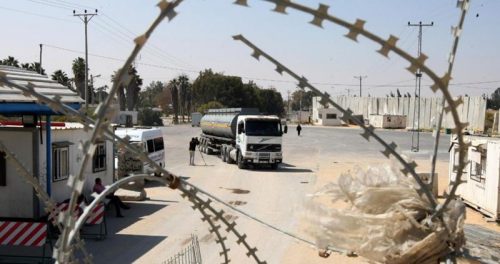
By Kathryn Shihadah | If Americans Knew | July 16, 2017
The United Nations has often provided valuable reports on the situation in the Palestinian Occupied Territories (although in at least one case the UN removed such a report following pressure from Israel and the United States – see this, this, and this).
The UN’s latest report on the region, “Gaza Ten Years Later,” contains much valuable, factual information. However, parts of the report exhibit a troubling lack of proportionality. This flaw is then maintained in quoted comments on the UN report by National Public Radio journalist Daniel Estrin.
Below is the NPR news story on the UN report, with comments in Italics that discuss some of its statements:
U.N. Says Gaza Is ‘De-Developing’ Even Faster Than Expected, by Merrit Kennedy, NPR
Five years ago, the U.N. warned that Gaza is expected to be unlivable by 2020. A new report now says conditions are deteriorating there even faster than it forecast.
“What needed to happen has not happened, and the indicators are accelerating instead of slowing down,” Robert Piper, the U.N. Coordinator for Humanitarian Aid and Development Activities in the Occupied Palestinian Territory, told NPR’s Daniel Estrin.
“In a nutshell, Gaza continues to de-develop in front of our eyes,” Piper adds. “From health care, to unemployment, to energy, to access to water, across all of these fields, Gaza’s 2 million people are seeing faster and faster decline in their living conditions.”
The population of Gaza, a 130-square-mile strip of land on the Mediterranean, is growing faster than projected, while infrastructure and services haven’t been able to keep up. The population is now forecast to reach 2.2 million people in 2020, up from the 2012 projection of 2.13 million.
The UN report, and the NPR discussion, correctly highlight the rapid pace at which Gaza is moving toward humanitarian disaster. However, as the discourse continues, a moral equivalence fallacy begins to emerge. Daniel lists three sources of Gaza’s trouble:
“Many of the problems stem from the Hamas takeover of Gaza 10 years ago, Israel and Egypt’s blockade of Gaza and the Palestinian Authority’s recent reduction of electricity to Gaza to pressure its rival Hamas,” Daniel reports.
What’s wrong with this picture?
Undoubtedly, Hamas’ feud with the PA is part of the problem; so are the electricity shortage and the closed crossing to Egypt. But placing these factors on par with Israel’s now ten-year-long blockade ignores the facts—some of which are spelled out in the UN report:
Israel retains full control of all movement of people and goods to and from Gaza by sea, air and land, with the exception of a 12 km strip of border with Egypt…Following the expulsion of the PA by Hamas in the summer of 2007, the Israeli Government declared Gaza “hostile territory” and, again citing security concerns, announced a number of new sanctions and restrictions on the access and movement of people and goods, ultimately amounting to a blockade by sea, air and land. Many of the restrictions imposed then, are still in place. (Italics added)
It is worth taking a moment to discuss the question of Hamas, which continues to be a scapegoat for Gaza’s ongoing crisis. Hamas’ complicated rivalry with, and appropriation of power from, Fatah and the PA–and its reputation as a terrorist organization–need to be challenged.
Hamas won a democratic election in Gaza and the West Bank (in spite of the US spending $2.3 million to support Fatah and Israeli obstruction), and was promptly discredited by the US and the EU. Israel commenced sanctions only 3 days after the election. These reactions were nothing short of collective punishment by world superpowers, simply because the “wrong” party won. The charge that Hamas is nothing but a terrorist group, and Palestinians elected Hamas leaders to destroy Israel, shows a profound misunderstanding of Hamas and its rise to power.
Neve Gordon explained in this excellent 2006 article that “the organization’s popularity in the Occupied Territories actually stems from its being seen as the voice of Palestinian dignity and the symbol of the defense of Palestinian rights at a time of unprecedented hardship, humiliation, and despair…In other words, Hamas was elected not only because it is considered an alternative to the corrupt Palestinian Authority, but also because Israel created the conditions that made it an indispensable social movement.”
Back to the de-development of Gaza. In his discussion of the Gaza crisis, Daniel also neglects to mention the three assaults by Israel in 2008, 2012, and 2014. The UN report does mention them, but the description is problematic:
In addition to the impact of the violent Hamas takeover and ensuing Israeli measures imposed in 2007, three rounds of armed hostilities between Israel and Hamas – with the most devastating round in 2014 – have dealt repeated blows to the Gazan economy and damaged essential infrastructure.
These words may be technically accurate: yes, Hamas took over Gaza amid violence; yes, Israel imposed “measures” in 2007; yes, there have been three rounds of “armed hostilities”—but the statement is egregiously inequitable. It is absurd to suggest that the Hamas takeover was equally as damaging to Gaza as the three deadly assaults by Israel were. And the portrayal of the hostilities as though between two equal, evenly-matched armies when Israel has the latest weaponry and Gaza is essentially unarmed, is patently false. Here is a more precise description of the lopsided outcome of the hostilities, found further along in the UN report:
The first major round of hostilities broke out on 27 December 2008 and lasted for more than three weeks. During this time, nearly 1,400 Palestinians and 13 Israelis18 were killed and some 60,000 homes were damaged or destroyed…The second major escalation of hostilities began on 14 November 2012 and lasted for one week, in which 174 Palestinians, including 107 civilians, and six Israelis, of which three were civilians, were killed, and some 10,000 homes damaged. The latest, and most devastating round of hostilities, took place between 8 July and 26 August 2014. During these 51 days, 2,251 Palestinians, including at least 146 civilians, and 71 Israelis, of whom five were civilians, were killed, and 171,000 homes were damaged.
The death toll after three “rounds of hostilities” was 3,825 Palestinians and 90 Israelis. The total number of homes damaged was 241,000—all Palestinian. In addition, schools, hospitals, and power plants were decimated. This is not a description of the aftermath of “war,” but of blitzkrieg.
The NPR story goes on to mention in passing Israel’s regulation of the border—without acknowledging the seriousness of the closure and how it affects any attempts at reconstruction. He even equates Israel’s meddling with Egyptian actions, although Egypt shares only a 7-mile border vs. Israel’s which is 32 miles long and a much greater object of hostility. Here is the statement:
Israel maintains tight control over the movement of people and goods from all sides of Gaza, aside from the 7-mile-long border Gaza shares with Egypt, which is rarely open.
The UN report describes more fully the impact the closure is having on efforts to rebuild over the last three years. This is not just “tight control”—it is crippling restriction on building materials and other critical supplies:
[Restrictions] imposed on the Strip continue to significantly impact the daily lives of Gaza’s inhabitants and the efforts of the international community to implement humanitarian and development projects. Israel considers many materials needed for these projects to be ‘dual-use’ and posing security concerns, thus subjecting them to severe import restrictions. These include construction materials, raw material for the productive sectors, including wood and pesticides, medical equipment and water pumps necessary to deal with seasonal flooding.
It is worth noting that Israeli limitation of imports included (in 2010, and is mostly still in place) wood for construction, cement, iron, tarps (for roofs on huts), fishing rods, farm animals, many spare parts for farming equipment, notebooks, pens, pencils, and toys.
The NPR report then moves on to the topic of water:
By the end of 2017, the U.N. projects Gaza’s only water aquifer will be depleted. The damage could be irreversible by 2020 due to salt water entering the aquifer. That would be “catastrophic,” the report says, and the “living and health conditions of the people of Gaza can only further deteriorate, exposing the population to water-borne illnesses, and other threats.”
The U.N. had previously said that the aquifer would be depleted by 2016, earlier than the current projection. Piper says this small piece of positive news is more akin to “re-arranging the deck chairs on the Titanic than really having much to celebrate.”
This is objectively true—although the image of “deck chairs on the Titanic” makes the Gaza situation sound more like a movie trailer than a humanitarian crisis. Let’s add some detail from the UN report to shed light on the reality:
Access to safe drinking water in Gaza through the public water network plummeted [after 2000]…As a result, reliance on water tanks, containers and bottled water rose from 1.4% to 89.6%…Having to rely on water trucking comes at a high cost on consumers, as trucked water is 15-20 times more expensive than water from the network. This particularly impacts the most vulnerable who are often poor and unemployed and do not have access to piped network water. Trucked water is also unregulated and unreliable in terms of quality.
This gives us a clearer picture of not only the expense but also the continued risk posed as the public water network becomes unusable. People of Gaza pay a premium for water that may or may not be safe.
Israel has an obligation to the people of Gaza which should be part of any conversation about the crisis. A number of prominent human rights organizations have determined that whether Gaza is considered occupied, in armed conflict with Israel, or under Israel’s control, international law demands that Israel solve the water crisis.
NPR then moves on to waste water, describing the nightmare scenario that is happening today:
At the same time, the amount of poorly treated sewage dumped into the sea is increasing, now equivalent to 43 Olympic size pools daily. That is expected to increase by almost 10 percent by 2020, which could have “significant environmental consequences,” the report warns.
The U.N. says new water treatment facilities need to be constructed to address the water crisis. However, Israel is limiting imports on many of the materials needed for construction because it says they could be used for military purposes.
Electricity is another critical need in Gaza. The NPR report continues:
And any future new [sewage treatment] plants would require a steady electrical supply, which at the moment is highly uncertain.
In fact, “an 11-year-old child has not experienced more than 12 hours of electricity in a single day in his/her lifetime,” according to the report. It says that in the most pessimistic 2020 estimate, only 25 percent of Gaza’s electricity demand would be met.
The economy of Gaza, its employment figures, and health care provisions are also notable. NPR reports:
The economy in Gaza has significantly declined in the last decade, with per capita GDP decreasing by 5.3 percent between 2006 and 2016. The report describes Gaza’s economic trajectory as “de-development,” even as the occupied West Bank has seen 48.5 percent growth in per capita GDP between 2006 and 2016.
Gaza’s unemployment rate is at more than 40 percent, according to the latest figures. It’s particularly severe for 20-24 year olds, at 60.3 percent, and for women, at 64.4 percent.
The number of doctors, nurses and hospital beds has also not been able to keep pace with the growing population. The report says, “while the population has doubled since 2000, the number of functioning primary health care clinics has decreased from 56 to 49.”
Given these “unacceptable” conditions, Piper acknowledges that for some, Gaza would already be deemed unlivable. “For many of us, we’d say that threshold is well and truly passed,” he said. “How do you manage in these sorts of conditions?”
In the report, Piper states: “It is profoundly unjust and inhuman to put Gaza’s civilians through such an ordeal.” He calls them “the victims of various policies by many different actors.”
When there is a victim, there is also a perpetrator. Gaza’s often goes almost unnamed. We must not forget who it is or rest until the humanitarian crisis is averted.
But at least NPR reported on the humanitarian crisis in Gaza, unlike most other mainstream news organizations, including the New York Times, ABC, CBS, NBC, CNN, MSNBC and Fox News.
RELATED:
On 50th Anniversary of Israeli Occupation, Palestinian Opinions Largely Ignored
The Illusion of Balance: NPR’s coverage of Mideast deaths doesn’t match reality
Such a “Surprise” in the UK!
By Thomas S. Harrington | CounterPunch | June 12, 2017
I just can’t believe what happened in the British elections.
I can’t get over the fact that that when a politician with real convictions honed over 40 years of political life—generous and forward-looking convictions rooted in an understanding of how social progress for the many has actually been engineered in previous times—speaks out unencumbered by corporate-minded, fraidy-cat image doctors, people actually respond enthusiastically.
It’s shocking, absolutely shocking.
Why am I so confused?
Well, for thirty years, the brilliant people at the NYT, NPR, PBS, the BBC and The Guardian have told me again and again that candidates from Labor in the UK and the Democratic Party in the US must always be oh-so-careful careful to not veer too far left in their policy prescriptions, to not appear too “populist” and, most of all, to not to go “too far outside the mainstream”.
The question of who defines what is the mainstream, or how lavishly-funded pro-business and pro-war think-tanks might actually be the people establishing its functional parameters by funding armies of think-tank “scholars” and “experts” were, of course, a complex hermeneutical problems that I never had the time nor the energy to ponder or deconstruct.
If those smart Ivy and Oxbridge-type guys and gals in the prestige media were telling us time and again that our societies were all fundamentally center-right collectives with a deep suspicion of government action (except, that is, when it came to making unceasing war on a world-wide scale) who was I, an obscure analyst of Iberian nationalisms and other sundry issues, to say anything about it?
Can you imagine someone like me actually believing he had the right to question brilliant and connected people like David Brooks, Tom Friedman or Jonathan Freeland or Polly Toynbee?
It would have been the height of hubris on my part to do so. After all, unlike them, I don’t spend my time networking each day with ambitious like-minded people deeply enamored of power, nor do I have the option of knowing exactly what stories and messages will provoke society’s centers of financial and military power to pressure a media conglomerate to trim a pundit’s paycheck or to convince well-heeled seekers of transcendent insight to stop paying her fat speaking fees.
Because I lack this essential information, I have always assumed my rightful place as an uncritical consumer of their deeply though-out and always prescient nostrums.
True, today I am feeling a little confused and bereft. But I know that by the time the next news cycle comes around they’ll have it all figured out for me, providing explanations that will in no way contradict or vitiate all the brilliant things they’ve been saying over so many years.
Obama vows ‘action’ in response to alleged Russian hacking
RT | December 16, 2016
Barack Obama has vowed to take retaliatory measures against Russia, both public and covert, accusing Moscow of compromising the “integrity” of the US elections through the DNC email hacks. US intelligence has yet to provide any evidence of Russian involvement.
“I think there is no doubt that when any foreign government tries to impact the integrity of our elections … we need to take action. And we will — at a time and place of our own choosing,” President Obama said in an interview with NPR on Friday.
The US leader did not elaborate on whether the steps would be taken in the five weeks he has left in office.
Neither did he specify what type of action might be taken, saying only that “some of it may be explicit and publicized; some of it may not be.”
While Obama spoke of the Russian government’s alleged role in the hacking of Democratic National Committee (DNC) communications as a proven fact, he fell short of accusing Moscow of purposefully aiding US President-elect Donald Trump without a “final report” from US intelligence agencies.
“And so when I receive a final report, you know, we’ll be able to, I think, give us a comprehensive and best guess as to those motivations,” he said.
Obama argued, however, that even without a comprehensive report it should be obvious that “what the Russian hack had done was create more problems for the [Hillary] Clinton campaign than it had for the Trump campaign.”
At the same time, the outgoing president admitted that although the scandal that ensued from the leaks – and the subsequent way it was reported in the media – “had some impact” on the election campaign, “you never know which factors are going to make a difference.”
Earlier, Trump dismissed as a “conspiracy theory” claims made by anonymous CIA officials, and reported by the Washington Post, that Russian intelligence hacked the DNC emails to propel him to the presidency.
Obama was also wary of accusing the Trump campaign of having anything to do with the leaks, refusing to feed into conspiracy theories, while saying that the Republican candidate’s camp had simply exploited the incident to its maximum benefit.
“They understood what everybody else understood, which was that this was not good for Hillary Clinton’s campaign,” Obama said.
Obama is not the first senior US official to threaten Russia with countermeasures to avenge the alleged hack, involvement in which the Russian government vehemently denies.
Back in October, US Vice President Joe Biden told NBC that Washington would be “sending a message to [Russian President Vladimir] Putin” that “will be executed at the time of our choosing, and under the circumstances that will have the greatest impact.”
At the time, NBC also cited intelligence officials with “direct knowledge of the situation” as saying that the CIA had been ordered to devise a plan for a “clandestine” cyber strike against Russia in order to “embarrass” Moscow. The outlet reported that the agents had already embarked on preparations for a large-scale attack.
On Thursday, “anonymous CIA officials with direct access to information” went as far as to claim that the Russian president himself might have authorized the alleged hacks.
Obama’s deputy national security adviser, Ban Rhodes, reiterated the claims to MSNBC, saying he doesn’t think “things happen in the Russian government of this consequence without Vladimir Putin knowing about it.”
These latest allegations were dismissed by Russian Foreign Minister Sergey Lavrov as nonsensical.
“I think that the stupidity and hopelessness of such an attempt to convince people of this is obvious,” he said on Thursday.
Veteran Intelligence Professionals for Sanity (VIPS), a group of former CIA and NSA agents, doubt the credibility of this version, adding that “harder evidence of a technical nature” suggests it was an inside job and not a hack by “Russians or anyone else.”
VIPS signed a memorandum published by Consortium News on Thursday. One of the letter’s authors, former NSA technician and whistleblower Bill Binney, told RT that “all points point to leaking, not hacking,” noting that if it was indeed a hack, the NSA would have long ago found a trace route.
Taking into account the scope of the NSA’s “extensive domestic data-collection network” uncovered in Edward Snowden’s revelations, “it beggars belief that NSA would be unable to identify anyone – Russian or not – attempting to interfere in a US election by hacking,” the veterans wrote, adding that such proof, if it existed, could be presented by the NSA “without any danger to sources or methods.”
Binney recalled that on a similar occasion with Chinese hackers, the NSA was able to trace the route of the hack to the specific building from which it was launched, which made him think that the accusations against Russia put forward by military intelligence were politically motivated.
Former UK ambassador to Uzbekistan-turned-WikiLeaks operative Craig Murray also challenged the official US version of events, claiming the source of the hacks was an insider who “had legal access to information.”
“The documents came from inside leaks, not hacks,” he told the Daily Mail, claiming that he himself took part in the handover operation in the woods in northwest Washington DC, where a representative of the source of the leaks allegedly gave him a package with the data.
Read more:
Media reporting on hacked DNC emails acted as ‘arms of Russian intelligence’ – White House
Law Enforcement Misrepresentation of Orlando Killer’s 911 Call Ignores U.S. Foreign Policy Motivation
By Matt Peppe | Just the Facts | June 14, 2016
In the aftermath of the horrific mass murder at the Pulse nightclub in Orlando over the weekend in which 50 people were killed, media including CNN, USA Today, NPR, NBC News, and CBS News, all reported that the gunman called 911 during his murderous rampage and pledged allegiance to ISIS. None of the journalists writing for any of these news outlets heard the call themselves; they all cite the FBI as their source.
The U.S. government has been engaged in a war against the self-professed Islamic State for the last two years. Their military intervention consists of a bombing campaign against ISIS targets in Iraq and Syria. Hyping the threat members connected to the terror group – or spiritually loyal to it – pose to American citizens is supportive of U.S. foreign policy. If ISIS, or people claiming to act on behalf of ISIS, are a real danger to Americans, it bolsters the notion that the group is a threat to national security and helps justify the government’s military response.
The FBI seems eager to show itself as disrupting ISIS plots in the States. As Adam Johnson has written in FAIR, the FBI has put Americans in contact with informants who claim to represent ISIS and then led the targets to believe they would help the targets join the terrorist organization. The media have then conflated this with an “ISIS Plot” and “ISIS Support,” when no members of ISIS were ever involved in any way.
The FBI’s motivation to portray events in a way that supports U.S. foreign policy, and its history of portraying its actions in a way that has served to hype an ISIS threat should make journalists cautious about taking officials’ words at face value. Especially in the case of a 911 call, which is a public record in Florida, proper journalistic due diligence would be to consult the actual source of the claims being disseminated.
Instead, not a single journalist appears to have done this with Orlando killer Omar Mateen’s 911 call.
On Tuesday, CNN aired interviews of eyewitnesses to the shooting spree who described their harrowing encounters with the gunman inside the club. Patience Carter, who was inside a bathroom stall feet from the gunman when he called 911, said he told the dispatcher that “the reason why he was doing this is because he wants America to stop bombing his country.” (Mateen is a native of the United States, but he was presumably referring to Afghanistan, where both of his parents are from.) She said he then declared that “from now on he pledges his loyalty to ISIS.”
This demonstrates that his primary motive for his terror attack was retaliation for the U.S. aggression in Afghanistan, where nearly 100,000 people have been killed since the illegal U.S. invasion in 2001. His mention of ISIS seems merely adjunct to what he admits was his justification for the attack. His motivation precedes his ideological alignment with ISIS, not the other way around.
Anti-war activists have long argued that overseas military operations endanger not only the populations whose countries are invaded, occupied and bombed, but Americans in the United States who are at risk of terrorist retaliation from people outraged by the death and destruction war inevitably produces to the point of being willing to resort to violence themselves.
Carter’s version of the 911 call reveals a very different picture than the partial one revealed by the FBI and reprinted by each of the largest news organizations. The complete conversation depicts Mateen as indicating that he considered his actions a response to U.S. foreign policy. Of course, the murder of innocent civilians is always reprehensible and can never be justified by claiming they are a response to a state’s military aggression, regardless of how deadly and devastating such military operations are. But it should be predictable that some people will use this rationalization regardless and seek out soft targets in the country whose government they claim to be retaliating against.
The FBI chose to omit Mateen’s professed motive entirely when recounting the 911 call to the media, and merely state that he professed allegiance to ISIS. Perhaps they recognized how putting Mateen’s call in context may lead people to question whether U.S. wars in Afghanistan (and Iraq) raise the terrorist threat at home.
After all, this is not the first time this has happened. The surviving Boston Marathon bomber cited the U.S. wars abroad as his motivation for committing the attack that killed three people and maimed dozens more.
It is not clear whether any journalist even asked to hear the 911 call themselves. But it is clear that they chose to disseminate second-hand information when the primary source should have been easily accessible. If it was not made available (as required by law), the public deserves to know that it was suppressed and be given an explanation why.
Media stenographers parroted government officials’ descriptions of the call, which left out the killer’s professed motivation for his politically motivated attack and failed to put the ISIS claim in any context. Unsurprisingly, their misrepresentation served the government’s policy agenda and avoided having the incident serve as an example of a negative consequence of U.S. foreign policy – one that anti-war dissenters have used in arguing against the wars in Afghanistan and Iraq since the War on Terror was launched more than a decade and a half ago.
Featured Video
What Does Russian Retaliation Look Like? | Col Doug Macgregor
or go to
Aletho News Archives – Video-Images
From the Archives
RFK Jr. and the Samoan Measles Outbreak
By David Marks | Brownstone Institute | December 15, 2024
When the nomination of Robert F. Kennedy, Jr. as Health and Human Services Secretary comes before the Senate, the specter of the Samoan measles outbreak of 2019 will dramatically be invoked to challenge him. Kennedy’s critics have repeatedly relied on this topic, citing stories that claim he was responsible for an epidemic in 2019 that caused at least 83 children to die due to vaccine hesitancy. In recent articles, reporters quote previous news coverage relying on unsubstantiated and minimal data to justify their analysis.
These stories repeat dubious assertions, fail to discuss any pathological analysis, and dismiss Kennedy’s considered support of healthcare in Samoa. He had assisted the Samoan government in developing a system for health officials to assess the efficacy and safety of medical interventions or drugs, including vaccines.
In November 2019, while the deaths of Samoan children were rapidly increasing, Kennedy wrote a comprehensive letter to the Samoan Prime Minister, presenting some possible causes of the unprecedented, virulent outbreak of measles. His concerns about the epidemic in Samoa highlight striking anomalies that were apparent to a few investigators at the time, although they remain unexplained.
The most convenient and generally accepted explanations of the outbreak claim the epidemic was the result of hesitancy, causing the population to be under-vaccinated. Measles vaccination rates were low due to the previous deaths of two infants given improperly formulated injections, which had nothing to do with Kennedy’s views.
Any considered analysis of the accessible facts soundly contradicts the conjecture that the high death count was related to low vaccination rates. … continue
Blog Roll
 Aletho News
- Majority of MAGA ‘deserters’ back banning bombs to Israel: Poll
- Iran wary as South Korea assures it will not join US war of aggression
- ‘Desperate’ Kiev seeking to draw NATO into war with Russia – Andrew Bridgen
- German people oppose war, unhappy with government foreign policy
- How US army’s Iowa lead azide detonation exposed stockpile failure, unleashing environmental crisis
- China Urges Japan to Speed Up Removal of WWII-Era Chemical Weapons From Its Soil
- Why Iran Hawks Are Now Hyping ‘Radical Shiite’ Threats
- What Does Russian Retaliation Look Like? | Col Doug Macgregor
- Araghchi: ‘Israel’ seeks to drag US into war on Iran
- NYT’s Iran dam-missile narrative crumbles under statistical scrutiny and engineering evidence
- If Americans Knew
- An error has occurred; the feed is probably down. Try again later.
- No Tricks Zone
- Alarmist Climatologists In Shock! 2026 Atlantic Hurricane Season Sees Lowest Count In 101 Years
- New Study: Modern Temps Are Among The Coldest Of The Last 10,000 Years In East Central Europe
- Germany’s Renewable Energies Lead to 1.4 Billion Euro Electric Power Trade Deficit
- Argentina’s Perito Moreno Glacier Joins Antarctica and Arctic In Defying Doomsday Melt Claims
- New Study: Barents Sea Temperatures Were Warmer And Sea Ice Less Extensive In The 1700s Than Today
- German Authorities Start Initiative To Evaluate Public Register For Climate “Disinformation” Spreaders!
- Zonal Asymmetry of Temperature Change in the Antarctic Circumpolar Current
- New Study: The Net Fossil Fuel Contribution To Rising Atmospheric CO2 Has Been Zero For 500 Years
- Germany’s Green Energy Transition Becoming Increasingly Expensive…Another 6 Trillion Euros!
- Sudden Stratospheric Warming, Powerful El Niño Combination May Lead To Extreme Europe Cold, Energy Crisis!

