‘We Have Absolute Proof’ DNC Leaks Were Not Hacked, NSA Whistleblower Says
Sputnik – 12.08.2020
Because the National Security Agency is tapped into data transfer points throughout the United States, via its mass surveillance programmes, if there was any evidence that the DNC servers were hacked then they would have the evidence to prove it, a former technical director at the agency explains.
Documents published by WikiLeaks that belonged to the Democratic National Committee (DNC) could not have been hacked via the internet and must have been initially downloaded from within the US, according to an investigation by members of Veteran Intelligence Professionals for Sanity (VIPS).
Bill Binney, a cryptogropher and former technical director at the US National Security Agency (NSA), blew the whistle on the agency’s mass surveillance programmes after serving with them for 30 years. Mr Binney detailed for Sputnik why the forensic evidence proves that key claims of Russiagate (regarding Russian officials hacking the DNC servers) are a “farce”.

© Photo : Bill Binney
Sputnik: A recent investigation by you and some of your colleagues at Veteran Intelligence Professionals for Sanity determined that the Democratic National Committee documents published by WikiLeaks in 2016 could not have been hacked by actors outside the US and instead had to have been downloaded onto a USB or CD-ROM.
Bill Binney: Yes, that’s right. And we have forensic evidence to prove it.
Sputnik: Could you please break down, for the average layperson, exactly how you came to this conclusion?
Bill Binney: Well, we did it by looking at the published DNC emails by WikiLeaks. In other words, the original assertion was that the DNC data was hacked externally, from Russia or by the Russians in Europe or something, and then transferred to WikiLeaks to publish so they could influence the election.
We looked at the DNC emails that were documented by WikiLeaks on the web. And that came down in three groups. One came down on 23rd of May 2016 and the other 25th of May 2016 and then one on the 26th of August of 2016. All of those three batches of emails had last modified times ending in an even number and even second, rounding up to the second, not including milliseconds. So, that meant to us that that was the property of the FAT (file allocation table) format. It’s a programme that when you read data to a thumb drive or CD ROM, and the programme indexes stuff on the [CD] and the thumb drive, for example, it then also rounds off the last modified time to an even number. That tells us very simply that there is 35,813 emails, all with the same property FAT file formatting saying that hey this was read [ie downloaded] to a thumb drive or a CD ROM before WikiLeaks got it to publish. Which meant it was physically transported to WikiLeaks. So, for us, that meant it was not a hack. Period.
We also had [CEO of cyber security firm Crowdstrike] Shawn Henry give testimony, I think it was the 7th of January of 2017, the secret testimony that just came out, where he said ‘we had indications that the data was exfiltrated, but we didn’t see the data exfiltrated’. Well, the indications that it was [exfiltrated], is this a FAT file format, to my mind. I mean, Shawn Henry never said specifically why his people were saying that. So for us, the only thing he could be [basing] it on what was last modified time.
Sputnik: So, just to be clear, when information is downloaded onto a CD roam or thumb drive, you’re saying that there’s a particular process, which means that, the last modified time will be recorded in such a way onto those files that is different than if those files were hacked and taken from a server across international boundaries or across a very long distance.
Bill Binney: Right. And we had provided all this data to the courts. Also we’ve included the Podesta emails, which show how a hack could occur and what the last modified times looked like. And that’s a, that’s also published by WikiLeaks, I think on the 21st of September [2016], that’s the date for that, that they put it out there. And the modified times of those files… close to 10,000 of them I think, run through even and odd numbers and various times, including milliseconds, things of that nature. So all that stuff, all that data, we provided to several courts, and several sets of lawyers to introduce as evidence in court and we were prepared to testify to that in court.
Sputnik: And is it not possible for the last modified time to be changed somehow or modified itself?
Bill Binney: Sure, but I don’t know of a programme that does, other than FAT, I mean, keeping in mind, you’re talking about 35,813 files. If you want to change them, you can go in and do them individually one at a time. I don’t know of any other programme that does it automatically, which is what what’s happened here, because it’s just a straightforward consistency. Humans make errors. If they go in and do something like that, they’ll make errors somewhere in the files. We didn’t see any errors at all. So that’s a program doing [it].
Sputnik: How many people from VIPs would you say were involved in this investigation that you conducted?
Bill Binney: Probably about six and a couple of auxiliaries, as we call them, in the UK cooperating with us. And we had a couple other people from outside VIPS helping us because they were also interested in getting to it too. Also, people who retired from commercial companies, running fiber lines and things like that.
Sputnik: If you were still working at the NSA and you were tasked to investigate an alleged hack would you have additional technical resources if you worked for the government, then if you’re doing it independently?
Bill Binney: Yeah, absolutely. This is one of the reasons why I started in August of 2016 saying that this entire Russiagate story was a farce. And that basically came out by knowing the capacity of NSA. The capabilities of them being able to capture stuff on the web. I mean, [the NSA] have over almost a hundred tap points inside the United States, all loaded up with fiber optic lines… You know, it can take everything off those lines and capture it. [A]nd that was true across the US as well as all the external points exiting and entering where you exit and enter the US.
And you’ll notice that NSA never said they saw any of the data transferring anywhere on any line. And that’s because it didn’t, it went on a thumb drive, you know, that’s the difference. That was one of the main reasons I said that this was not a hack. Because if it was NSA would have it. Like they did when the Chinese hacked one of the places over here in the US about six years ago. The government said, the hack came from this building in Shanghai.
Sputnik: And is there any kind of a practical or legal consideration as to why the NSA can’t publish its findings regarding the DNC servers?
Bill Binney: Actually, there isn’t, if the president approves, I mean, he can declassify anything he wants.
Sputnik: So where do you go from here? Is there more to investigate in relation to this subject or is this the end of the matter for you?
Bill Binney: As far as I’m concerned, we have absolute proof that this whole thing […] Russiagate, is a fabrication. It was a fabrication of the FBI, CIA and the DOJ primarily, but also included the State Department and [Department for Homeland Security] and a number of other departments.
Sputnik: There are those that argue Julian Assange will have a fair trial in the US should he be extradited. What can you tell us about the U.S. District Court for the Eastern District of Virginia, where Mr Assange would be tried?
Bill Binney: That’s a court that’s pro CIA because it’s in that jurisdiction of CIA. This is why they picked that court because it’s pro CIA and whatever national security issues come up, they will always go with that national security. So, you have a prejudiced judge in a court to begin with.
Sputnik: Would there be a jury with 12 men and women?
Bill Binney: Pulled from the area and most of them work for the government. So, you know, you just look at it. I mean, that should be a disqualifier as a jury from my point of view. But also think of it this way: Julian Assange published data he was given. So has the New York Times, The Guardian, all the major publications, the Washington Post, they’ve all done that. So why aren’t they being charged also?
Sputnik: Well, the US government is claiming that the first amendment does not apply to foreign journalists.
Bill Binney: Well then why don’t they go after The Guardian ?
Sputnik: Maybe they’re next?
Bill Binney: [I]f you accept their premise – of the US government – that means that any journalist anywhere in the world, publishing any article that exposes crimes by the US government, the US government can charge them with conspiracy to violate national security. So, every reporter in the world is now liable based on that [premise].
This interview has been edited for concision and clarity
The Evil, Immoral, Vicious, and Hypocritical Embargo Against Cuba
By Jacob G. Hornberger | FFF | July 20, 2020
The banality of evil that characterizes the U.S. national security state is demonstrated perfectly by the continuation of its deadly economic embargo against Cuba, which has been ongoing for some 60 years.
What’s the point of the embargo? After all, the Pentagon’s, CIA’s, and NSA’s official enemy Fidel Castro died years ago. Why continue to intentionally inflict harm on the Cuban people?
And make no mistake about it: Inflicting harm on the Cuban people is the purpose of the embargo. Its aim is to impoverish or starve Cubans into ousting their post-Castro regime and installing another pro-U.S. right-wing brutal dictatorship similar to the one that Castro ousted from power in the Cuban revolution.
In fact, the first embargo that the U.S. implemented against Cuba was during the reign of the crooked, corrupt, and brutal pro-U.S. right-wing dictatorship of Fulgencio Batista. That was an arms embargo. U.S. officials didn’t want weaponry imported into Cuba because that might enable the Cuban people to oppose Batista in a violent revolution.
During his reign, Batista partnered with the Mafia, the premier criminal organization that was smuggling drugs into the United States. As part of their partnership agreement, Batista let the Mafia operate gambling casinos in Cuba. As part of that cozy relationship, Batista would have his henchmen kidnap under-aged girls in Cuba and turn them over to the Mafia, which would then provide them as perks to the high-rollers in its casinos. That’s one of the things that brought on the Cuban Revolution.
That’s the guy that the U.S. national-security state was hell-bent on keeping in power. Thus, it should surprise no one that the CIA, like Batista, later entered into partnership with the Mafia, knowing full well that the Mafia was engaged in massive criminal activity. The purpose of the CIA-Mafia partnership was assassination. They were working together to assassinate Castro.
It stands to reason that the Mafia would try to assassinate Castro. It has lost all its casinos to Castro’s nationalization. And it was in the business of killing people.
But the U.S. government? In the business of murder? And in partnership with the biggest criminal organization in the world?
Don’t forget something important here: Castro, Cuba, and the Cuban people have never attacked the United States or even threatened to do so. No invasion. No terrorist attacks. No assassinations.
In fact, it has always been the other way around. In the more than six decades of bad relations between Cuba and the U.S., it has always been the U.S. government that has been the aggressor. An invasion, terrorist attacks, assassination attempts, and the embargo, all on the part of the U.S. government.
U.S. national-security state officials always justified such actions under the notion that Cuba was the spearhead of a worldwide communist conspiracy to take over the United States, one that was supposedly based in Moscow. It was always a ridiculous notion but that was the mindset of CIA, NSA, and Pentagon officials during the Cold War — that Cuba’s communist regime posed a grave threat to U.S. “national security.”
But the Cold War ended more than 30 years ago. Do the CIA, NSA, and Pentagon still think that the United States is in danger of falling to the Cuban communists?
Of course not. Now, it’s just sheer viciousness. Now, it’s just a matter of doing everything possible to oust the current regime in Cuba from power and restoring a Batista-like dictatorship, one that will be loyal and deferential to the Pentagon, the CIA, and the NSA.
The viciousness is demonstrated by the fact that the embargo doesn’t just criminalize Americans who do business with Cuba. It also targets foreign companies who do so. If they are caught doing so, they are targeted for prosecution or economic banishment here in the United States. In the minds of U.S. officials, it’s more imperative than ever to squeeze as many Cubans as possible into death and suffering.
Needless to say, the embargo has made things significantly worse for the Cuban people during the COVID-19 crisis. That’s fine with U.S. officials. The more Cubans who die, the greater the chance of an internal regime-change operation.
Sure, there is no doubt that Cuba’s socialist economic system is a major factor in the economic suffering of the Cuban people. But there is also no doubt that the U.S. embargo has served as the other side of a vise that has squeezed the economic lifeblood out of the Cuban people.
A dark irony, of course, is that the embargo has enabled the U.S. government to wield and exercise the same type of economic control over the American people that the Cuban socialist regime exercises over the Cuban people. It’s called adopting socialism to oppose socialism.
When will the evil, immoral, vicious, and hypocritical U.S. embargo against Cuba be lifted? When a critical mass of the American people, including those who go to church every Sunday, have a crisis of conscience and demand that it be lifted.
How an Israeli Spy-Linked Tech Firm Gained Access to the US Gov’t’s Most Classified Networks
By Whitney Webb |
Unlimited Hangout| July 15, 2020
If the networks of the U.S. military, the U.S. intelligence community and a slew of other U.S. federal agencies were running the software of a company with deep ties, not only to foreign companies with a history of espionage against the U.S. but also foreign military intelligence, it would — at the very least — garner substantial media attention. Yet, no media reports to date have noted that such a scenario exists on a massive scale and that the company making such software recently simulated the cancellation of the 2020 election and the declaration of martial law in the United States.
Earlier this month, MintPress News reported on the simulations for the U.S. 2020 election organized by the company Cybereason, a firm led by former members of Israel’s military intelligence Unit 8200 and advised by former top and current officials in both Israeli military intelligence and the CIA. Those simulations, attended by federal officials from the FBI, DHS and the U.S. Secret Service, ended in disaster, with the elections ultimately canceled and martial law declared due to the chaos created by a group of hackers led by Cybereason employees.
The first installment of this three part series delved deeply into Cybereason’s ties to the intelligence community of Israel and also other agencies, including the CIA, as well as the fact that Cybereason stood to gain little financially from the simulations given that their software could not have prevented the attacks waged against the U.S.’ electoral infrastructure in the exercise.
Also noted was the fact that Cybereason software could be potentially used as a backdoor by unauthorized actors, a possibility strengthened by the fact that the company’s co-founders all previously worked for firms that have a history of placing backdoors into U.S. telecommunications and electronic infrastructure as well as aggressive espionage targeting U.S. federal agencies.
The latter issue is crucial in the context of this installment of this exclusive MintPress series, as Cybereason’s main investors turned partners have integrated Cybereason’s software into their product offerings. This means that the clients of these Cybereason partner companies, the U.S. intelligence community and military among them, are now part of Cybereason’s network of more than 6 million endpoints that this private company constantly monitors using a combination of staff comprised largely of former intelligence operatives and an AI algorithm first developed by Israeli military intelligence.
Cybereason, thus far, has disclosed the following groups as lead investors in the company: Charles River Ventures (CRV), Spark Capital, Lockheed Martin and SoftBank. Charles River Ventures (CRV) was among the first to invest in Cybereason and has been frequently investing in other Israeli tech start-upsthat were founded by former members of the elite Israeli military intelligence Unit 8200 over the last few years. Spark Capital, based in California, appears to have followed CRV’s interest in Cybereason since the venture capitalist who co-founded Spark and led its investment in Cybereason is a former CRV partnerwho still has close ties to the firm.
While CRV and Spark Capital seem like just the type of investors a company like Cybereason would attract given their clear interest in similar tech start-ups coming out of Israel’s cyber sector, Cybereason’s other lead investors — Lockheed Martin and SoftBank — deserve much more attention and scrutiny.
Cybereason widely used by US Government, thanks to Lockheed
“A match made in heaven,” trumpeted Forbes at the news of the Lockheed Martin-Cybereason partnership, first forged in 2015. The partnership involved not only Lockheed Martin becoming a major investor in the cybersecurity company but also in Lockheed Martin becoming the largest conduit providing Cybereason’s software to U.S. federal and military agencies.
Indeed, as Forbes noted at the time, not only did Lockheed invest in the company, it decided to integrate Cybereason’s software completely into its product portfolio, resulting in a “model of both using Cybereason internally, and selling it to both public and private customers.”
Cybereason CEO and former offensive hacker for Israeli military intelligence — Lior Div — said the following of the partnership:
Lockheed Martin invested in Cybereason’s protection system after they compared our solution against a dozen others from the top industry players. The US firm was so impressed with the results they got from Cybereason that they began offering it to their own customers – among them most of the top Fortune 100 companies, and the US federal government. Cybereason is now the security system recommended by LM to its customers for protection from a wide (sic) malware and hack attacks.”
Rich Mahler, then-director of Commercial Cyber Services at Lockheed Martin, told Defense Daily that the company’s decision to invest in Cybereason, internally use its software, and include the technology as part of Lockheed Martin’s cyber solutions portfolio were all “independent business decisions but were all coordinated and timed with the transaction.”
How independent each of those decisions actually was is unclear, especially given the timing of Lockheed Martin’s investment in Cybereason, whose close and troubling ties to Israeli intelligence as well as the CIA were noted in the previous installment of this investigative series. Indeed, about a year prior to their investment in the Israeli military intelligence-linked Cybereason, Lockheed Martin opened an office in Beersheba, Israel, where the IDF has its “cyberhub”. The office is focused not on the sales of armaments, but instead on technology.
Marilyn Hewson, Lockheed Martin’s CEO, said the following during her speech that inaugurated the company’s Beersheba office:
The consolidation of IDF Technical Units to new bases in the Negev Desert region is an important transformation of Israel’s information technology capability… We understand the challenges of this move. Which is why we are investing in the facilities and people that will ensure we are prepared to support for these critical projects. By locating our new office in the capital of the Negev we are well positioned to work closely with our Israeli partners and stand ready to: accelerate project execution, reduce program risk and share our technical expertise by training and developing in-country talent.”
Beersheba not only houses the IDF’s technology campus, but also the Israel National Cyber Directorate, which reports directly to Israel’s Prime Minister, as well as a high-tech corporate park that mostly houses tech companies with ties to Israel’s military intelligence apparatus. The area has been cited in several media reports as a visible indicator of the public-private merger between Israeli technology companies, many of them started by Unit 8200 alumni, and the Israeli government and its intelligence services. Lockheed Martin quickly became a key fixture in the Beersheba-based cyberhub.
Not long before Lockheed began exploring the possibility of opening an office in Beersheba, the company was hacked by individuals who used tokens tied to the company, RSA Security, whose founders have ties to Israel’s defense establishment and which is now owned by Dell, a company also deeply tied to the Israeli government and tech sector. The hack, perpetrated by still unknown actors, may have sparked Lockheed’s subsequent interest in Israel’s cybersecurity sector.
Soon after opening its Beersheba office, Lockheed Martin created its Israel subsidiary, Lockheed Martin Israel. Unlike many of the company’s other subsidiaries, this one is focused exclusively on “cybersecurity, enterprise information technology, data centers, mobile, analytics and cloud” as opposed to the manufacture and design of armaments.
Haden Land, then-vice president of research and technology for Lockheed Martin, told the Wall Street Journal that the creation of the subsidiary was largely aimed at securing contracts with the IDF and that the company’s Israel subsidiary would soon be seeking partnership and investments in pursuit of that end. Land oversaw the local roll-out of the company’s Israel subsidiary while concurrently meeting with Israeli government officials. According to the Journal, Land “oversees all of Lockheed Martin’s information-systems businesses, including defense and civilian commercial units” for the United States and elsewhere.
Just a few months later, Lockheed Martin partnered and invested in Cybereason, suggesting that Lockheed’s decision to do so was aimed at securing closer ties with the IDF. This further suggests that Cybereason still maintains close ties to Israeli military intelligence, a point expounded upon in great detail in the previous installment of this series.
Thus, it appears that not only does Lockheed Martin use Cybereason’s software on its own devices and on those it manages for its private and public sector clients, but it also decided to use the company’s software in this way out of a desire to more closely collaborate with the Israeli military in matters related to technology and cybersecurity.
The cozy ties between Lockheed Martin, one of the U.S. government’s largest private contractors, and the IDF set off alarm bells, then and now, for those concerned with U.S. national security. Such concern makes it important to look at the extent of Cybereason’s use by federal and military agencies in the United States through their contracting of Lockheed Martin’s Information Technology (IT) division. This is especially important considering Israeli military intelligence’s history of using espionage, blackmail and private tech companies against the U.S. government, as detailed here.
While the exact number of U.S. federal and military agencies using Cybereason’s software is unknown, it is widespread, with Lockheed Martin’s IT division as the conduit. Indeed, Lockheed Martin was the number one IT solutions provider to the U.S. federal government up until its IT division was spun off and merged with Leidos Holdings. As a consequence, Leidos is now the largest IT provider to the U.S. government and is also directly partnered with Cybereason in the same way Lockheed Martin was. Even after its IT division was spun off, Lockheed Martin continues to use Cybereason’s software in its cybersecurity work for the Pentagon and still maintains a stake in the company.
The Leidos-Lockheed Martin IT hybrid provides a litany of services to the U.S. military and U.S. intelligence. As investigative journalist Tim Shorrock noted for The Nation, the company does “everything from analyzing signals for the NSA to tracking down suspected enemy fighters for US Special Forces in the Middle East and Africa” and, following its merger with Lockheed and consequential partnership with Cybereason, became “the largest of five corporations that together employ nearly 80 percent of the private-sector employees contracted to work for US spy and surveillance agencies.” Shorrock also notes that these private-sector contractors now dominate the mammoth U.S. surveillance apparatus, many of them working for Leidos and — by extension — using Cybereason’s software.
Leidos’ exclusive use of Cybereason software for cybersecurity is also relevant for the U.S. military since Leidos runs a number of sensitive systems for the Pentagon, including its recently inked contract to manage the entire military telecommunications infrastructure for Defense Information Systems Agency (DISA). In addition to maintaining the military telecom network, Cybereason is also directly partnered with World Wide Technologies (WWT) as of this past October. WWT manages cybersecurity for the U.S. Army, maintains DISA’s firewalls and data storage as well as the U.S. Air Force’s biometric identification system. WWT also manages contracts for NASA, itself a frequent target of Israeli government espionage, and the U.S. Navy. WWT’s partnership is similar to the Lockheed/Leidos partnership in that Cybereason’s software is now completely integrated into its portfolio, giving the company full access to the devices on all of these highly classified networks.
Many of these new partnerships with Cybereason, including its partnership with WWT, followed claims made by members of Israel’s Unit 8200 in 2017 that the popular antivirus software of Kaspersky Labs contained a backdoor for Russian intelligence, thereby compromising U.S. systems. The Wall Street Journal was the first to report on the alleged backdoor but did not mention the involvement of Unit 8200 in identifying it, a fact revealed by the New York Times a week later.
Notably, none of the evidence Unit 8200 used to blame Kaspersky has been made public and Kaspersky noted that it was actually Israeli hackers that had been discovered planting backdoors into its platform prior to the accusation levied against Kaspersky by Unit 8200. As the New York Times noted:
Investigators later discovered that the Israeli hackers had implanted multiple back doors into Kaspersky’s systems, employing sophisticated tools to steal passwords, take screenshots, and vacuum up emails and documents.”
Unit 8200’s claims ultimately led the U.S. government to abandon Kaspersky’s products entirely in 2018, allowing companies like Cybereason (with its own close ties to Unit 8200) to fill the void. Indeed, the very agencies that banned Kaspersky now use cybersecurity software that employs Cybereason’s EDR system. No flags have been raised about Cybereason’s own collaboration with the very foreign intelligence service that first pointed the finger at Kaspersky and that previously sold software with backdoors to sensitive U.S. facilities.
SoftBank, Cybereason and the Vision Fund
While its entry into the U.S. market and U.S. government networks is substantial, Cybereason’s software is also run throughout the world on a massive scale through partnerships that have seen it enter into Latin American and European markets in major ways in just the last few months. It has also seen its software become prominent in Asia following a partnership with the company Trustwave. Much of this rapid expansion followed a major injection of cash courtesy of one of the company’s biggest clients and now its largest investor, Japan’s SoftBank.
SoftBank first invested in Cybereason in 2015, the same year Lockheed Martin initially invested and partnered with the firm. It was also the year that SoftBank announced its intention to invest in Israeli tech start-ups. SoftBank first injected $50 million into Cybereason, followed by an additional $100 million in 2017 and $200 million last August. SoftBank’s investments account for most of the money raised by the company since it was founded in 2012 ($350 million out of $400 million total).
Prior to investing, Softbank was a client of Cybereason, which Ken Miyauchi, president of SoftBank, noted when making the following statement after Softbank’s initial investment in Cybereason:
SoftBank works to obtain cutting edge technology and outstanding business models to lead the Information Revolution. Our deployment of the Cybereason platform internally gave us firsthand knowledge of the value it provides, and led to our decision to invest. I’m confident Cybereason and SoftBank’s new product offering will bring a new level of security to Japanese organizations.”
SoftBank — one of Japan’s largest telecommunications companies — not only began to deploy Cybereason internally but directly partnered with it after investing, much like Lockheed Martin had done around the same time. This partnership resulted in SoftBank and Cybereason creating a joint venture in Japan and Cybereason creating partnerships with other tech companies acquired by SoftBank, including the U.K.’s Arm, which specializes in making chips and management platforms for Internet of Things (IoT) devices.
SoftBank’s interest in Cybereason is significant, particularly in light of Cybereason’s interest in the 2020 U.S. election, given that SoftBank has significant ties to key allies of President Trump and even the president himself.
Indeed, SoftBank’s Masayoshi Son was among the first wave of international business leaders who sought to woo then-president-elect Trump soon after the 2016 election. Son first visited Trump Tower in December 2016 and announced, with Trump by his side in the building’s lobby, that SoftBank would invest $50 billion in the U.S. and create 50,000 jobs. Trump subsequently claimed on Twitter that Son had only decided to make this investment because Trump had won the election.
Son told reporters at the time that the investment would come from a $100 billion fund that would be created in partnership with Saudi Arabia’s sovereign wealth fund as well as other investors. “I just came to celebrate his new job. I said, ‘This is great. The US will become great again,’” Son said, according to reports.
Then, in March of 2017, Son sent top SoftBank executives to meet with senior members of Trump’s economic team and, according to the New York Times, “the SoftBank executives said that because of a lack of advanced digital investments, the competitiveness of the United States economy was at risk. And the executives made the case, quite strongly, that Mr. Son was committed to playing a major role in addressing this issue through a spate of job-creating investments.” Many of SoftBank’s investments and acquisitions in the U.S. since then have focused mainly on artificial intelligence and technology with military applications, such as “killer robot” firm Boston Dynamics, suggesting Son’s interest lies more in dominating futuristic military-industrial technologies than creating jobs for the average American.
After their initial meeting, Trump and Son met again a year later in June 2018, with Trump stating that “His [Son’s] $50 billion turned out to be $72 billion so far, he’s not finished yet.” Several media reports have claimed that Son’s moves since Trump’s election have sought to “curry favor” with the President.
Through the creation of this fund alongside the Saudis, SoftBank has since become increasingly intertwined with Saudi Crown Prince Muhammad bin Salman (MBS), a key ally of President Trump in the Middle East known for his authoritarian crackdowns on Saudi elites and dissidents alike. The ties between Saudi Arabia and SoftBank became ever tighter when MBS took the reins in the oil kingdom and after SoftBank announced the launch of the Vision Fund in 2016. SoftBank’s Vision Fund is a vehicle for investing in hi-tech companies and start-ups and its largest shareholder is the Public Investment Fund of Saudi Arabia. Notably, Son decided to launch the Vision Fund in Riyadh during President Trump’s first official visit to the Gulf Kingdom.
In addition, the Mubadala Investment Company, a government fund of the United Arab Emirates (UAE), gave $15 billion to the Vision Fund. UAE leadership also share close ties to the Trump administration and MBS in Saudi Arabia.
As a consequence, SoftBank’s Vision Fund is majority funded by two Middle Eastern authoritarian governments with close ties to the U.S. government, specifically the Trump administration. In addition, both countries have enjoyed the rapid growth and normalization of ties with the state of Israel in recent years, particularly following the rise of current Saudi Crown Prince Muhammad bin Salman and Jared Kushner’s rise to prominence in his father-in-law’s administration. Other investments in the Vision Fund have come from Apple, Qualcomm and Oracle’s Larry Ellison, all tech companies with strong ties to Israel’s government.
The Saudi and Emirati governments’ links to the Vision Fund are so obvious that even mainstream outlets like the New York Times have described them as a “front for Saudi Arabia and perhaps other countries in the Middle East.”
SoftBank also enjoys close ties to Jared Kushner, with Fortress Investment Group lending $57 million to Kushner Companies in October 2017 while it was under contract to be acquired by SoftBank. As Barron’s noted at the time:
When SoftBank Group bought Fortress Investment Group last year, the Japanese company was buying access to a corps of seasoned investors. What SoftBank also got is a financial tie to the family of President Donald Trump’s senior advisor and son-in-law, Jared Kushner.”
According to The Real Deal, Kushner Companies obtained the financing from Fortress only after its attempts to obtain funding through the EB-5 visa program for a specific real estate venture were abandoned after the U.S. Attorney and the Securities and Exchange Commission began to investigate how Kushner Companies used the EB-5 investor visa program. A key factor in the opening of that investigation was Kushner Companies’ representatives touting Jared Kushner’s position at the White House when talking to prospective investors and lenders.
SoftBank also recently came to the aid of a friend of Jared Kushner, former CEO of WeWork Adam Neumann. Neumann made shocking claims about his ties to both Kushner and Saudi Arabia’s MBS, even asserting that he had worked with both in creating Kushner’s long-awaited and controversial Middle East “peace plan” and claimed that he, Kushner and MBS would together “save the world.” Neumann previously called Kushner his “mentor.” MBS has also discussed on several occasions his close ties with Kushner and U.S. media reports have noted the frequent correspondence between the two “princelings.”
Notably, SoftBank invested in Neumann’s WeWork using money from the Saudi-dominated Vision Fund and later went on to essentially bail the company out after its IPO collapse and Neumann was pushed out. SoftBank’s founder, Masayoshi Son, had an odd yet very close relationship with Neumann, perhaps explaining why Neumann was allowed to walk with $1.7 billion after bringing WeWork to the brink of collapse. Notably, nearly half of SoftBank’s approximately $47 billion investments in the U.S. economy since Trump’s election, went to acquiring and then bailing out WeWork. It is unlikely that such a disastrous investment resulted in the level of job creation that Son had promised Trump in 2016.
Given that it is Cybereason’s top investor and shareholder by a large margin, SoftBank’s ties to the Trump administration and key allies of that administration are significant in light of Cybereason’s odd interest in 2020 U.S. election scenarios that end with the cancellation of this year’s upcoming presidential election. It goes without saying that the cancellation of the election would mean a continuation of the Trump administration until new elections would take place.
Furthermore, with Cybereason’s close and enduring ties to Israeli military intelligence now well-documented, it is worth asking if Israeli military intelligence would consider intervening in 2020 if the still-to-be-decided Democratic contender was strongly opposed to Israeli government policy, particularly Israel’s military occupation of Palestine. This is especially worth considering given revelations that sexual blackmailer and pedophile Jeffrey Epstein, who targeted prominent U.S. politicians, mostly Democrats, was in the employ of Israeli military intelligence.
Notably, Cybereason’s doomsday election scenarios involved the weaponization of deep fakes, self-driving cars and hacking Internet of Things devices, with all of those technologies being pioneered and perfected — not by Russia, China or Iran — but by companies directly tied to Israeli intelligence, much like Cybereason itself. These companies, their technology and Cybereason’s own work creating the narrative that U.S. rival states seek to undermine the U.S. election in this way, will all be discussed in the conclusion of MintPress’ series on Cybereason and its outsized interest in the U.S. democratic process.
The Next American Revolution? Anticipated Civil Unrest
“Warning shots will not be fired”
By Larry Romanoff – Global Research – November 27, 2019
Preparing For Civil War?
US authorities have for decades become increasingly prepared for mass civil disturbances resulting from government and corporate attacks on American society. We can recall that in the early 1980s the Hidden State launched its open war on the middle class by the savage FED-induced recession and the unilateral revocation of the social contract that had existed since 1946. At that time, the US government had already anticipated widespread public unrest, fully expecting mass protests and riots, and had made preparations to deal with them in the form of internment camps. In a real sense, the government had prepared for another civil war.
Like most of the “Great Transformation”, it began during Reagan’s reign with what was called “Rex 84”, an abbreviation for Readiness Exercise 1984, a plan by the US government to detain large numbers of American citizens in case of civil unrest. This master plan involved the FBI, Department of Defense, the Emergency Measures group, the Secret Service, the CIA and altogether 34 government agencies.
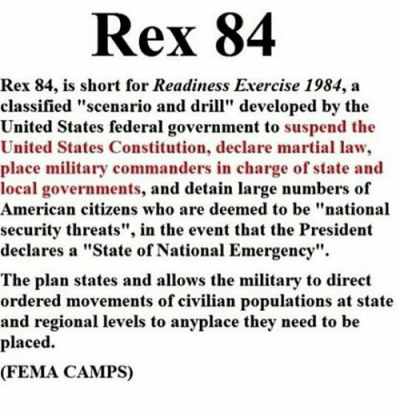
It was presented as an exercise to test military assistance in civil defense in times of national emergency, but in fact the plan was anticipating civil disturbances, major demonstrations and labor strikes that would affect continuity of government. The anticipated civil unrest from the FED-induced financial crisis that devastated the middle class was considered “subversive”, REX-84 being an authorisation for the US military to implement government-controlled movements of civilian populations at both state and regional levels, the arrest of many segments of the American population, and the imposition of martial law. (1) (2)
The Rex-84 program was created under the pretense of a possible mass exodus of illegal aliens attempting to cross into the US from Mexico, but when the program accidentally became public during the Iran-Contra Congressional hearings in 1987 it was revealed that it was in fact a secret federal government program
“to suspend the Constitution, declare martial law, assign military commanders to take over state and local governments, and detain large numbers of American citizens determined by the government to be ‘national security threats’.”
This was part of a master contingency plan for which the FBI today has a primary list of more than 100,000 Americans, and a secondary list ten times larger, who are targeted to be rounded up as subversives, including labor leaders, scholars and public figures, the incarceration designed to isolate political dissidents and to contain civil unrest.
And these are prison camps, ringed with fences, barbed wire and armed guards, not places from which escape would be likely, and they were designed to hold Americans, not Mexicans. (3)
There is no question the US government is prepared for the possibility of widespread and uncontrollable domestic disorder. This program in place and building for years was encouraged by fears of a massive public uprising in the wake of the 2008 banking fraud.
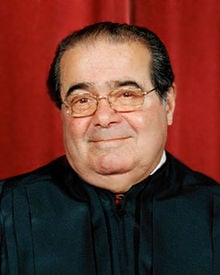 US Supreme Court Justice Antonin Scalia said some years ago that concentration camps were a likely future reality for Americans and that the Supreme Court would not do anything about the tyranny should the executive branch think it necessary. He mentioned the World War II internment of Japanese in the US and said of these camps,
“you are kidding yourself if you think the same thing will not happen again”. (4) (5)
In 2009, as the US financial crisis deepened and concern about public unrest was increasing, the US National Guard was posting job opportunities for “Internment/Resettlement Specialists” to work in “civilian internee camps” within the United States, and Halliburton [former] subsidiary KBR was seeking subcontractors to staff “emergency environment” camps located in five regions of the US. Earlier, in 2006, KBR was contracted by Homeland Security to build detention centers designed to deal with “the rapid development of unspecified “new programs” that would require large numbers of people to be interned.” (6) (7)
The US has for many years been dangerously close to a situation where, if the American people take to the streets in protest, these internments can be easily carried out. By 2004, there were more than 800 of these internment camps in the US, all empty, but all fully operational, staffed, and surrounded by full-time guards, ready to receive prisoners. I have seen photos. As well, many military bases are slated to be closed down and used as extra civilian prisons if the need arises, all intended for the internment of dissidents and others deemed “potentially harmful to the state”. Some camps can each hold 20,000 or more prisoners, a massive effort at civilian population control, and the program is still expanding. The US is very near the point today where political dissidents questioning the actions of their government will risk being rounded up and forced into these prison camps, essentially a government plan to forcibly suppress political dissent under the guise of rooting out domestic “terrorism”.
The US government defines many Americans as having become “pre-revolutionary” from their outrage at the 2008 government-approved housing collapse, with increasing concern that massive civil unrest would emerge from both the poverty-stricken lower classes and the eviscerated middle class, leading to what would become an internal civil war. This is the reason that the FBI and DHS increasingly focus their “anti-terror” apparatus on white middle-class Americans like the Occupy Wall Street protestors who were categorised as “low-level terrorists”.
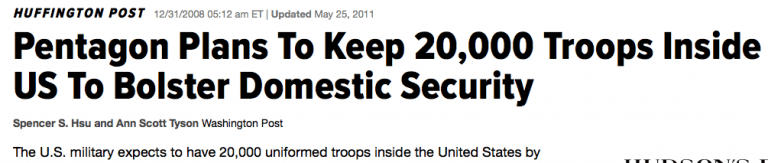
In 2008, the Washington Post reported government plans to station many tens of thousands of troops inside the country for purposes referred to as “domestic security” in the light of massive civil unrest that would follow an economic collapse or serious financial crisis, perhaps stemming from 2008.
According to the government document,
“Widespread civil violence inside the United States would force the defense establishment to reorient priorities in extremis to defend basic domestic order and human security”,
stating that the military may be needed to quell “purposeful domestic resistance”. To prepare for this quelling of resistance, the US has resorted to demonising its own citizens, a recent study funded by DHS conveniently identifying those Americans who are “suspicious of centralized federal authority” and who exhibit signs of being “reverent of individual liberty”, and re-categorising them as “extreme right-wing” terrorists. (8) (9) (10)
The program is designed to “reduce and eliminate” all domestic resistance to the US government. “Crowd control agents” will be used for this purpose, and government agencies will be involved in “gathering information on dissidents” to identify all those who have either “threatened or are creating disturbances”. The US military produced a manual on what it termed “Civil Disturbance Operations” that outlines how military assets will be used to “help local and state authorities to restore and maintain law and order” in the event of mass riots and civil unrest. Military and other law-enforcement will be tasked with “breaking up unauthorized gatherings” and restoring order by
“presenting a show of force, establishing roadblocks, breaking up crowds, employing crowd control agents, and other operations as required”.
The same government manual describes how prisoners will be processed through these internment camps, and outlines how these internees would be “re-educated” while detained in prison camps inside their own country by their own government. A leaked military document titled ‘FM 3-39.40 Internment and Resettlement Operations’, outlined a program for “re-education camps” in the US which contained plans for “political activists” to be “pacified” by various psychological officers into “sympathising” with the government and into “developing an appreciation of US policies” while detained in prison camps inside the US. The document was restricted to Department of Defense personnel but was been leaked and posted online. It outlined policies for “processing detainees into internment camps” and made clear these operations would be used for domestic civilian situations. (11) (12) The full document is available here: (13)
“Once the detainees have been processed into the internment camp, the manual explains how they will be “indoctrinated”, with a particular focus on coercing political dissidents into expressing support for U.S. policies.”
Part of the stated role of the psychological officers would be to identify political activists, political leaders, ‘malcontents’, and other agitators, and to develop and execute appropriate
“indoctrination programs to reduce or remove antagonistic attitudes”.
However, their first task would be to “pacify and acclimate detainees to accept the internment facility’s authority and regulations”.
There are also disturbing insights into the government’s intention to use brutal force to violently quell any civil political unrest. The manual includes a long list of weapons meant to be used against protesting American civilians, including anti-riot grenades. Page 20 of the manual authorises the use of “deadly force” in confronting these peaceful political “dissidents”, the murderous intent made disturbingly clear with the directive that “Warning shots will not be fired” first. Northcom itself, in a September 8, 2008 Army Times article, said the first wave of the deployment, which was put in place on October 1st at Fort Stewart and at Peterson Air Force Base in Colorado Springs, would be aimed at tackling “civil unrest and crowd control”.
In November of 2013, Forbes Magazine ran an article based on the AP newswire, detailing that DHS had been assembling a massive weapons arsenal since 2011 or 2012. (14) The AP reported that Homeland Security had been stockpiling ammunition by buying more than 1.6 billion rounds of ammunition in addition to a prior purchase of 1.5 billion rounds, for a staggering total of more than three billion rounds. This is more ammunition than the US military used collectively in all its wars in the last decade, and represents about ten shots for every man, woman and child in America. There were also confirmed purchases by various government agencies, of hundreds of millions of hollow-point rounds to be delivered to dozens of locations around the US. These bullets are so lethal they are banned for battlefield use during wars because they mushroom and fragment on impact, their only purpose being to cause the maximum possible damage to internal organs. Also purchased were large numbers of magnum rounds with the power to penetrate walls, and a frightening hundreds of millions more rounds of specialty sniper ammunition.
Even more, it was reported in early 2015 that DHS had placed orders for massive amounts of other kinds of anti-civilian weaponry termed “Less Lethal Specialty Munitions”, which were described as “an arsenal of specialized weaponry for training and deployment against crowds”. These included flash grenades, light bursts, gas and chemical grenades, riot rounds, rubber bullets, and much more. These are all heavy-duty crowd control and civilian intimidation weapons. They have no other purpose and, in the volume in which they are being purchased, it is clear the US government is expecting some very serious civil disturbances, possibly a revolution, and soon.
As recently as 2018, Forbes was reporting more of the same, that these purchases have reached an astonishing ubiquity. It isn’t only Homeland Security who is arming to the teeth. Thousands of agents at the IRS now have tactical assault rifles and heavy weaponry.
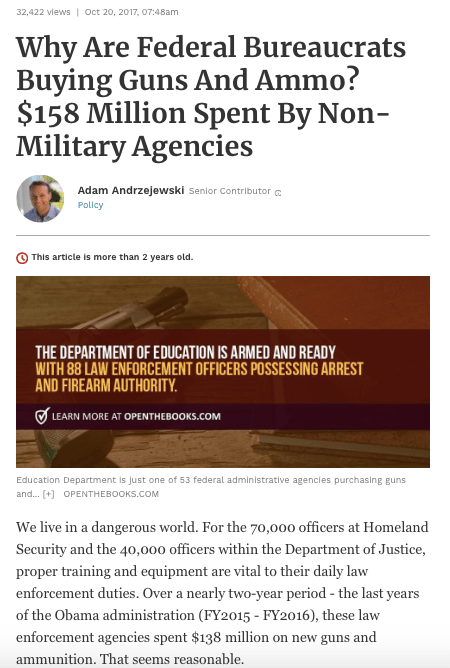
Screenshot Forbes, October 20, 2017
The Small Business Administration and the Department of Veterans Affairs have purchased thousands of Glock handguns. The Health Services agencies purchased millions of dollars worth of Glock handguns – equipped with silencers. The US Geological Survey, which is a weather bureau, purchased millions of dollars worth of Winchester Black Shadow shotguns with large bulk ammunition orders in addition to Glock handguns. Even the Department of Education purchased millions of dollars worth of Glock handguns, shotguns and body armor. I am unaware of any nation in the world where the income tax department or the departments of education and health care require huge amounts of military-grade weapons, much less body armor and gun silencers.
In June of 2016, RT reported that non-military federal agencies had more firepower than the entire US Marine Corps, this including agencies like education, health and income tax. (15) RT documented, a new report where 67 non-military federal US agencies spent $1.50 billion purchasing guns, ammunition and military-style equipment. The details came from the Militarization of America: non-military federal agencies purchases of guns, ammo, and military-style equipment, published by the non-profit good government group OpentheBooks.com. (16) (17)
In addition to the massive purchase of ammunition, DHS was showing off its acquisition of heavily armored and mine-resistant personnel carriers which have been seen on streets all across America and verified with photos and video. Forbes noted that these vehicles are equipped with gun ports and are “designed to withstand IEDs, mine blasts and 50 caliber hits to bullet-proof glass”, and asked why they would be necessary on American streets. The DHS also purchased large amounts of riot gear and bullet-proof checkpoint booths, as well as a purchase of 7000 automatic rifles, and 2700 armored vehicles, and the deployment of drones with allowance for their use on US citizens.
The DHS is becoming a massive domestic army to handle domestic conflict. In the words of Ellen Brown,
“somebody in government is expecting some serious civil unrest …”
DHS chief Janet Napolitano claimed this was to prepare for a mass influx of immigrants into the United States that would require the “shelter and processing” of large numbers of people, but this is nonsense. By whom will the US be attacked that Homeland Security would be responsible for defense, and from where would arise a mass of peaceful immigrants so large as to require more than three billion bullets to repel them?
This is the same government that recently shut down many of its operations including most of the National Parks, for lack of funds, yet had sufficient money to purchase billions of bullets for a non-existent civilian army. A spokesperson was quoted as justifying this massive purchase to “help the government get a low price for a big purchase”, and claimed DHS used “as many as 15 million rounds every year in training exercises”. Someone should ask DHS to divide 3 billion by 15 million, which tells us the ammunition purchase will supply DHS needs for the next 200 years. The authorities naturally attribute criticism and hard questions to mentally-unbalanced ‘conspiracy theorists’, but this is one more instance where actions appear irrational and the official story is so full of holes that it makes no sense.
Another DHS purchase that produced a firestorm of anger when its news went viral, was the supply of what we might call ‘unconventional’ paper targets which were used as practice shooting targets in ‘training exercises’. These targets consisted of figures of American civilians in residential settings. They included small children, a young pregnant mother, old women in robes, grandmothers and grandfathers in their kitchens and front yards, teenagers in parks, little girls and more, perhaps the most frightening part being that all these were termed “no hesitation targets”, meaning to fire without hesitation at the sight of these enemies. What could possibly justify the supply of such targets to a military force, with such an instruction? The US fedbiz.op website took down the solicitation after Infowars broke the story, and eventually apologized publicly for creating these targets of small children.
In early 2014 it was reported that the US military had built a $100 million fake city of about 300 acres in Virginia, for use in training troops for the occupation of cities, complete with a sports stadium, bank, school, and an underground subway in order to train for future combat scenarios in American urban areas. The subway carriages even carry the same logo as those in Washington DC. More disturbingly, it was reported that
“soldiers are being taught that Christians, Tea Party supporters and anti-abortion activists represent a radical terror threat, mirroring rhetoric backed by the Department of Homeland Security which frames “liberty lovers” as domestic extremists.”
The DHS is also building a 176-acre secure compound in the lowest-income area of Washington, DC, which seems almost certainly a preparation for civil war. (18) (19)
The trigger could be an economic collapse that causes angry Americans to flood the streets similar to the Occupy Wall Street and other scenes witnessed across both the US and Europe during the last FED-induced economic crisis. It is worth noting that the Occupy Wall Street protest had the right idea but the wrong target. Wall Street is just an idea, and a bit player. The ultimate cause is the FED, and that should have been their focus. But the FED, the bankers and the FBI saw this coming and infiltrated and financed the protest groups as a way to take control and deflect them from any useful action or focus.
In the middle of 2013 several US local media reported the DHS was conducting widely public but still “top secret” exercises categorised as “full scale terrorism drills” across the entire nation with the stated purpose of making citizens “feel safe”, but which resulted in thousands of terrified people not knowing how to respond to what appeared as a domestic invasion by the US military. People were capriciously apprehended and released after having their belongings searched, but nevertheless urged to celebrate their “independence” from tyranny. These drills were presented as readiness training for potential terrorist incursions, though DHS failed to mention the New York Times observation that all the domestic terror plots in the United States over the last decade were “hatched by the FBI”.
One other worrying development was the appearance of US military C-130 cargo planes apparently spraying mosquitoes over various Florida cities at an altitude of less than 50 meters. Pest control is hardly a military duty, these events immediately reminding me of the US military spraying bacterial and other pathogens over many parts of the US in various CIA-related experiments on the domestic population. These low-altitude overflights are almost certainly practice runs for potential crowd control in the future, for dispensing tear gas or other non-lethal (or lethal) material that would disperse or disorient protestors. I cannot imagine all the possibilities, but the US military most certainly is not going into the mosquito-spraying business. (19) (20)
US Major General Curry was quoted as stating,
“We have local police, backed up by each state’s National Guard, backed up by the Department of Defense. So in addition to all these forces why does Homeland Security need its own private army? Why do the SSA, NOAA and other government agencies need to create their own civilian security forces armed with hollow nose bullets?”
Some may want to dismiss this as just another conspiracy theory, but we might recall the words of Senator Daniel Inouye in 1987,
“There exists a shadowy Government with its own Air Force, its own Navy, its own fundraising mechanism, and the ability to pursue its own ideas of national interest, free from all checks and balances, and free from the law itself.”
The threats to civil liberties go much farther and are much more ominous than I’ve related so far. Another factor is the spate of secret Executive Orders that Obama signed without Congressional approval, observers claiming those orders violated existing laws and were therefore illegal but that the powers behind the White House considered themselves above all law. One of the most sinister was Executive Order 13603 which granted authorization to seize possession of every possible resource, including property and “all food storage facilities”. One author wrote that “This extremist, maniacal edict is designed to enforce our submission, rendering us totally dependent on Big Brother government or face the obvious – starvation and extermination.”
What could possibly have instigated such an order, unless the government is preparing for an all-out war against the American people? What possible excuse, during peace-time, would a “democratic” government have, for the initiation of a program to seize all the “food, water and food storage facilities” of a nation? If we add these to the internment camps and the bullets, what conclusions are possible?
Another ominous threat is that much of the NSA’s illegal intelligence-gathering activities were transferred to the Department of Homeland Security, the same people with the 800 internment camps and the 3 billion bullets. The apparent reason is that the NSA can collect information on domestic political dissidents but has no police powers to act on them, whereas DHS has legislative authority to gather, arrest and incarcerate anyone on their watch lists. DHS is apparently creating a “graded list” of these targeted so-called “security threats”, with those at the top of this list assessed according to how widely disseminated are their anti-establishment views, the followers they appear to have, and these will be the first to disappear into the internment maze. This new policy gives Homeland Security full authority to effectively terrorise the American people under a pretense of controlling domestic terrorism. When we consider these two items, Executive Order 13603 and the new powers granted to DHS, the only possible response can be fear.
If all this isn’t enough, DHS was revealed to have a secret procedure for the instant shutting down of all private communications in America, including mobile phone networks, a program accidentally revealed when government officials in San Francisco disabled all mobile phone calls during a peaceful protest against yet another man shot dead by the police. The administration insisted it had the legal authority to control these communications “during times of national crisis”, “for the purpose of ensuring public safety”, but it has also given DHS the power to actually “seize” all privately-owned communications facilities in order to prevent any civilian communications occurring. Some individuals applied to the courts for further information on these new procedures and policies, but DHS claimed it was “unable to locate or identify any records” in relation to the matter. Nothing more to be said, but it’s difficult to avoid the conclusion that the US government is quickly becoming fully prepared for war against its civilian population.
With the NSA revelations by Edward Snowdon, there is no longer any question that many US government agencies have been monitoring and gathering information on large numbers of known American political dissidents, these agencies including the NSA, FBI, CIA, DHS, various military groups and another 70 or 80 so-called “public-private fusion centers” scattered around the US. Former NSA Technical Director William Binney claimed in an interview that the NSA had a list of 500,000 to one million people in the US who were closely watched and whose every communication and bit of personal data were recorded. These are not terrorists in any sense, but potential leaders of political dissension and therefore potential suspects in the event of civil disturbances.
There also exists a database known as “Main Core”, containing names of Americans who might be considered troublesome, and which knowledgeable sources claim contains the names and communication information of more than eight million Americans who would be potential suspects of political activism, which would include “national opposition to US military invasion abroad”. It includes political dissidents, environmental and other activists, political and tax protesters, lawyers and professors, publishers and journalists, and many more who are most likely harmless, average people.
The database apparently contains all to and from email addresses, all email content, all in and out phone numbers plus duration of calls, the amounts and locations of ATM withdrawals, all credit card purchases and much more. It appears that this dissident surveillance program dates back to the early 1980s, the time of our Great Transformation, when it was revealed that Oliver North, operating from a secure White House site, had been using a database called PROMIS which was part of the REX-84 plan, to track dissidents and potential troublemakers within the United States. This database was meant to identify and immediately locate perceived “enemies of the state” if mass civil disturbances were to break out. (21) (22)
The Middle-Class Revolt
In late 2008 a leaked internal memo from Tom Fitzpatrick, Citibank’s chief technical strategist, contained ominous predictions for American civil society after the vicious financial crisis. He wrote,
“The world is not going back to normal ‘after the magnitude of what they have done’”.
Fitzpatrick claimed that the massive destruction of the middle class, the draining of all the wealth from the population, and the QE money creation by the FED would either bring about a resurgence of inflation or that the US would fall into “depression, civil disorder and possibly war”. He claimed that with the passing of each week and month there was a growing danger that could lead to political instability, a risk of domestic unrest because people were becoming increasingly disenfranchised and impoverished.
Lest we succumb to the temptation of accepting the 2008 financial crisis and the resulting loss of homes as an accident of fate, it would be wise to consider these quotes by Montagu Norman, Governor of The Bank of England prior to the crash of 1929, addressing the United States Bankers’ Association, New York, Idaho Leader, 26 August 1924.
“Capital must protect itself in every possible way, both by combination and legislation. Debts must be collected, mortgages foreclosed as rapidly as possible. When, through process of law, the common people lose their homes, they will become more docile and more easily governed through the strong arm of the government applied by a central power of wealth under leading financiers. These truths are well known among our principal men, who are now engaged in forming an imperialism to govern the world.”
And his thoughts on democracy:
“By dividing the voters through the political party system, we can get them to expend their energies in fighting for questions of no importance.” “It is thus, by discrete action, we can secure for ourselves that which has been so well planned and so successfully accomplished.”
The US government has developed an increasing fear of its own middle class, wide awake to the protests and uprisings in other nations where governments have colluded with the international bankers and large multi-nationals to gut their middle classes and effect the same transfer of wealth to the top 1% as occurred in America. People in many Western societies have become disgruntled and bitter at the increasing evidence that their vaunted democracies have been usurped by the unrestrained capitalists, creating intolerable situations where the people are sacrificed for the increasing wealth of that same top 1%.
At first, the US government exhibited a grim and rather reprehensible kind of satisfaction at watching the misery in other nations where the FED and IMF and the International Bankers had succeeded in their aims of wealth transference, but it also realised that the same boiling rage existed in America and perhaps much less controllable.
US citizens were protesting against a government that was no longer democratic in any sense, and was both unwilling and unable to repair a hopelessly corrupt and inefficient system. They finally awoke en masse and objected to ingrained corruption, shoddy public services, high taxes, homelessness, unemployment, rising inflation, the development of a police state, and more. It is public rage at the realisation of having been betrayed by a “democratic” government that converts civil unrest into political activism and revolution, and it is this that lies at the heart of the FBI’s categorisation of US political dissent as “domestic terrorism”. This terminology is important because the US, in all its hypocrisy for democracy, free speech and freedom of assembly, cannot face the world with open and apparent suppression of political dissent. Therefore, US citizens protesting against their own government cannot be exercising free speech but rather anarchy and terrorism, thereby justifying the use of deadly force to control dissension. The powers that control America have no interest in fairy-tales of freedom. They are interested in wealth and control, and the people in any country are irrelevant – including those in the US.
Americans have experienced first-hand the destruction of their quality of life; they see clearly the disappearance of future opportunity for their children, and they recognise better than most the loss of their freedom of expression which they have so valued. And they know it is precisely the retraction of that expression that is necessary for their no-longer-democratic government to maintain control. This is where their economic and social dissatisfaction mutates into political activism – revolution, in fact – and it is this realisation among the authorities that has spawned the internship camps, the billions of bullets purchased, and the “shoot to kill” orders.
Revolution – The Struggle for Class Power
Buried in the litany of troubles the US is facing today is the primary fact that the nation is engaged in a brutal class war, a struggle for class power that the bottom 99% are losing. This war was declared in the late 1970s, gained great momentum in the 1980s and 1990s, and is still accelerating toward its final desperate conclusion. There are few signs on the horizon that cause hope for a change in direction, and I fear it may be too late.
There is still power with the people themselves, and indeed without the both active cooperation and silent complicity of the people, none of the pathological descent into despair would have been possible. Probably the only force in America that can change what is happening is the combined force of labor. This isn’t so easy today, since the government killed most labor organisations and there is now little if any leadership. A total withdrawal of labor succeeded in forcing a new social contract in 1946 and may be the only power remaining today, but times have changed and tactics must change too. If all unions withdrew their services with the full cooperation of unorganised labor, change might be possible.
But realistically, there is no hope that such a mass protest could be organised even though it is the only possible way to get the attention of whatever remains of a conscientious government and force through a reversal of the tide. In any case, taking to the streets is unlikely to produce pleasant results. If the police don’t have enough bodies to beat up and arrest everyone, DHS has its internment camps, its 3 billion bullets, its years of practice with “no-hesitation” human targets, and it will use all of them.
The only safe way for Americans to go on strike today is to stay at home. On this topic, one internet commenter wrote,
“Just don’t go to work. There is no need to picket in the streets to be on strike, and the factories and offices will be just as quiet and empty, and the profits just as non-existent. The police cannot possibly conduct home-by-home visits to beat up strikers one by one, and no military, even the DHS, is efficient when trying to blow up houses scattered all over the county, one by one. Strikers are probably safe if they stay at home and lock their door.”
Another wrote,
“Another tactic is for Americans to simply quit shopping. They don’t have the money anyway, and don’t need all that useless junk. Don’t buy anything you don’t actually need, and delay even those purchases as long as possible, especially the big-ticket items like cars and furniture. If at all possible, delay every purchase for at least one year. As much as is practicable, stop driving your car. Cancel your cable TV and read a book.” Your grandmother gave you advice 100 years ago that is still valid today: “Use it up, wear it out. Make it do. Do without.”
A third commenter gave this advice:
“One thing you can do to get their attention is to stop paying your bills. VISA and MasterCard can’t cancel 800 million credit cards at the same time, and no bank can process 100 million mortgage defaults. No system can cope with massive non-payment of debt. You are their only source of money and you can ensure they don’t get any of it. That will wake them up. Tell them you’ll begin paying when the overseas corporate tax holiday is over, when high income taxes are reinstated for the rich, when the individual bankers are in prison and when the lost jobs begin returning. This isn’t foolproof, but it’s the best I can do.”
And finally, a more ambitious poster offered these comments:
“Today, the US State Department, the CIA and the FBI pride themselves on their ability to use Twitter and Facebook to cause civil unrest, chaos, violence, and even revolutions, in other countries. It may not have occurred to them that the same tools they use against everyone else can be just as easily used against them. The CIA used Gene Sharp and his Einstein Institute to prepare the Otpor civil disobedience manuals that our government used as the gunpowder to destroy Jugoslavia, and as the template for a dozen other “color revolutions” of which it was so proud. Copies are freely available on the internet.”
William Blum again:
“As I’ve said before: Inasmuch as I can’t see violent revolution succeeding in the United States (something deep inside tells me that we couldn’t quite match the government’s firepower, not to mention its viciousness), I can offer no solution to stopping the imperial beast other than this: Educate yourself and as many others as you can, raising their political and ideological consciousness, providing them with the factual ammunition and arguments needed to sway others, increasing the number of those in the opposition until it raises the political price for those in power, until it reaches a critical mass, at which point … I can’t predict the form the explosion will take or what might be the trigger … But you have to have faith. And courage.”
Rebuilding America
 This is an amended list of actions Americans must take if they want to bring their country into the community of nations as a civilised member instead of its present status as a genocidal bully, and to begin healing the nation itself. It is compiled from my own notes with the inclusion of excerpts from a speech made by Chris Hedges at Northeastern University. (23)
Discard the existing two-party political system as diseased and useless, and form one new party with a totally new slate of legislators not formerly involved in government. Their first tasks would be to:
1. Arrest all war criminals on American soil. Begin with both Bushes, Cheney and Rumsfeld, Powell and Rice, both Clintons, Kissinger, Albright, and a long list of other White House and Congressional staff, on charges of treason, war crimes and crimes against humanity.
2. Disband the Federal Reserve Banking System and repudiate all outstanding debt to the FED. The government would, according to the law and constitution, issue its own currency from this point forward.
3. Force the break-up of all the big banks and eliminate interstate banking. Nationalise the so-called investment banks like Goldman Sachs, confiscate their assets and shut them all down. Reintroduce banking sector regulations as was done after the 1930s, to ensure a catastrophe cannot recur, with violations punished by mandatory prison sentences. Outlaw program stock trading by the banks. Force the banks to revert to simple banking functions to serve the economy.
4. Disband the CIA and all its clandestine projects by cutting off all funding. Confiscate all CIA records, files, computers, data, and make the details public. Emasculate the FBI and all its executives and officers. Arrest the planners and perpetrators of all false-flag ops. Kill the NSA. Immediately cease all domestic espionage on US citizens. Cut off all funding, seize all bank accounts and confiscate all records and documents. Bomb the Arizona data storage facility to rubble. Kill the Department of Homeland Security and dismantle and close all internment camps within the continental US.
5. Disband the NED, USAID, the VOA and the 100+ other subversive NGOs that are used today to destabilise the governments and societies of other nations. Recall all CIA espionage agents from foreign embassies and consulates, who constitute about 80% of all US foreign “diplomatic” staff. Designate all Foundations and Think Tanks as enemy aliens, and shut them down.
6. Reduce the military budget by 85% and close all foreign military bases. Bring home all foreign-based military personnel and give them jobs guarding the bankers.
7. Totally eliminate the private sector from infrastructure and social services and confine it to commerce where it belongs. Roll back deregulation and privatisation, reclaiming all public infrastructure to be operated by the government for the common good. Especially kill the despicable private prison system, and free the more than one million who should never have been in prison at all. Kill the movements to debtor’s prisons and civil forfeiture before they gain any more momentum, and pass harsh legislation that holds policemen individually responsible for their crimes.
8. Begin immediate construction of a system of publicly-owned and operated hospitals and medical clinics, and guarantee that all citizens have access to free or easily-affordable health care. Eliminate all insurance companies from the health-care process. Restore funding for universal education.
9. Make all lobbying illegal, with automatic prison sentences for influence-peddling. Designate lobby groups like AIPAC as criminal organisations and hostile enemy aliens, and treat them accordingly. Kill the SuperPacs and corporate donations. Eliminate all corporate contributions to election campaigns, and limit individual contributions to $1,000 maximum. Break the corrupt Zionist control of Congress, Wall Street, the media, the World Bank and the IMF. Terminate their globalism and any reference to a New World Order. Eliminate immediately all funding and financial support for Israel.
10. Eliminate legal immunity for the elites. Make illegal the payment of corporate fines for personal crimes. Put the people in prison. Levy an 85% income tax on all corporate profits being held outside the country by US-based multinationals. Reinstate the taxes on the rich and very rich. Eliminate personal tax breaks on capital gains and institute an 85% tax on all income over $500,000 per year.
11. The media monopoly must be broken by forcing de-centralisation and pushing the ownership once again into thousands of individual companies owned by totally unrelated parties. The current control of the media must be dismantled because of the Zionists’ propaganda and the Hidden State’s political agenda. Force the disintegration of all media holding groups and wide dispersion of all media, restricting ownership to only one newspaper or TV station per market. Outlaw opinion-based journalism and make untruthful news reports punishable by public flogging.
12. Eliminate GM food, or at least legislate full disclosure on food labels. Eliminate factory farms; institute extensive monitoring and harsh penalties for food chemical violations.
13. Use the money collected from the rich, the bankers and the FED to begin repairing America’s dilapidated infrastructure before any more dams and bridges collapse.
14. Close all the torture prisons. Close Guantanamo, Diego Garcia, Abu Ghraib, and the other torture prisons and demand an accounting of all prison ships and their human cargo. Close the School of the Americas and destroy all the torture manuals.
15. Emasculate the US President, the Presidency, and the White House, and return all power to Congress because it is the concentration of power in the office of the President that has permitted the total alien control of all vital parts of the US government.
16. Eliminate all US-sponsored sanctions against other nations, especially China, Russia, Syria and Iran. End the illegal occupation of Hawaii, Puerto Rico, Afghanistan, Iraq and Libya. Get out of the Ukraine. Dismantle immediately all organised interference in the internal affairs and elections of other nations. Refund the $100 billion of Iraqi gold and cash seized, and the similar amount from Libya.
*
Note to readers: please click the share buttons above or below. Forward this article to your email lists. Crosspost on your blog site, internet forums. etc.
Larry Romanoff is a retired management consultant and businessman. He has held executive positions in international consulting firms, and owned an international import-export business. He lives in Shanghai and is currently writing a series of ten books generally related to China and the West. He can be contacted at: 2186604556@qq.com
Notes
(1) Rex 84: FEMA’s Blueprint for Martial Law in America
(2) Rex 84 – Your Internment Camp Awaits You
(3) U.S. Concentration Camps: FEMA and the REX 84
(5) https://www.washingtontimes.com/news/2014/feb/3/justice-scalia-to-lecture-at-univ-of-hawaii/
(6) Army National Guard Advertises for “Internment Specialists”
(7) Video: Become a FEMA Camp Internment/Resettlement Specialist
(8) http://www.washingtonpost.com/wp-dyn/content/article/2008/11/30/AR2008113002217_2.html?hpid=topnews
(9) Pentagon Plans To Keep 20,000 Troops Inside US To Bolster domestic security
(10) Washington Post: 20,000 More U.S. Troops To Be Deployed
(11) FM 3-39.40 INTERNMENT AND RESETTLEMENT
(12) FM 3-39.40 INTERNMENT AND RESETTLEMENT OPERATIONS
(13) https://www.infowars.com/yes-the-re-education-camp-manual-does-apply-domestically-to-u-s-citizens/
(14) Why Are Federal Bureaucrats Buying Guns And Ammo? $158 Million Spent By Non-Military Agencies
(15) 24 Jun, 2016; Non-military federal agencies have more firearm authority than entire US Marine Corps
(16) https://www.openthebooks.com/the-militarization-of-america–open-the-books-oversight-report/
(17) https://www.openthebooks.com/openthebooks_oversight_report_-_the_militarization_of_america/
(17) Asymmetric Warfare Group Built a Fake City in Virginia
(18) US army builds fake city to shoot at during training
(19) https://www.cbsnews.com/news/texas-enlists-u-s-air-force-to-spray-for-mosquitoes-after-harvey/
(20) Pentagon Misinformation Ops Target Press and Public
(23) http://calendar.northeastern.edu/event/political_economy_forum_presents_chris_hedges
Copyright © Larry Romanoff, Moon of Shanghai, 2020
The Deep State’s Demolition of Democracy
By James Bovard | FFF | March 26, 2020
“Thank God for the Deep State,” declared former acting CIA chief John McLaughlin while appearing on a panel at the National Press Club last October. In 2018, the New York Times asserted that Trump’s use of the term “Deep State” and similar rhetoric “fanned fears that he is eroding public trust in institutions, undermining the idea of objective truth and sowing widespread suspicions about the government and news media.”
But barely a year later, the Deep State had gone from a figment of paranoid right-wingers’ imagination to the great hope for the salvation of American democracy. Much of the media is now conferring the same exulted status on the Deep State that was previously bestowed on Special Counsel Robert Mueller. Almost immediately after its existence was no longer denied, the Deep State became the incarnation of virtue in Washington.
The Deep State commonly refers to officials who secretly wield power permanently in Washington, often in federal agencies with vast sway and little accountability. A New York Times article in October gushed that “over the last three weeks, the deep state has emerged from the shadows in the form of real live government officials, past and present … and provided evidence that largely backs up the still-anonymous whistle-blower” on Donald Trump’s phone call to the president of Ukraine. New York Times columnist James Stewart declared, “There is a Deep State, there is a bureaucracy in our country who has pledged to respect the Constitution, respect the rule of law…. They work for the American people.” New York Times editorial writer Michelle Cottle proclaimed, “The deep state is alive and well” and hailed it as “a collection of patriotic public servants.” They were echoing earlier declarations by Washington Post columnist Eugene Roberts and former top Justice Department official Preet Bharar: “God bless the ‘Deep State.’”
Former CIA Director John Brennan, appearing on the same panel as McLaughlin in October, declared, “The reason why Mr. Trump has this very contentious relationship with CIA and FBI and the deep state people is because they tell the truth.” Much of the media coverage of the Trump impeachment is following that dubious storyline.
“We lied, we cheated, we stole.”
Five years ago, John Brennan’s CIA ignited what should have been a constitutional crisis when it was caught illegally spying on the Senate Intelligence Committee, which was compiling a massive report on the CIA torture program. After 9/11, the CIA constructed an interrogation regime by “consulting Egyptian and Saudi intelligence officials and copying Soviet interrogation methods,” the New York Times reported in 2007. Secret Bush administration torture memos “set the C.I.A. loose to slam suspects’ heads into walls up to 30 times in a row, to deprive suspects of sleep for more than a week straight, to confine them to small dark boxes for hours at a time … and to suffocate them with water to induce the perception that they are drowning,” Georgetown University law professor David Cole noted. But the only official who went to prison was John Kirakou, a former CIA analyst who publicly admitted that the CIA was waterboarding.
Is the Deep State more trustworthy when it is killing than when it is torturing? Brennan declared in 2016 that “the president requires near-certainty of no collateral damage” before approving a drone strike. Confidential CIA documents revealed that the CIA had little or no idea whom it was killing most of the time with its drone attacks in Pakistan, Somalia, Afghanistan, Yemen, and other nations. Salon.com summarized an NBC News report: “Even while admitting that the identities of many killed by drones were not known, the CIA documents asserted that all those dead were enemy combatants. The logic is twisted: If we kill you, then you were an enemy combatant.” Lying about drone killings quickly became institutionalized throughout the Deep State. The New York Times reported in 2015, “Every independent investigation of the [drone] strikes has found far more civilian casualties than administration officials admit.”
The Deep State is practically designed to destroy privacy while enabling government officials to deny sweeping abuses. Former National Security Agency analyst Edward Snowden declared in 2014, “There’s definitely a deep state. Trust me, I’ve been there.” The NSA’s credibility was obliterated in 2013 when Snowden revealed the NSA can tap almost any cell phone in the world, access anyone’s email and web-browsing history, and crack the vast majority of computer encryption. But the NSA’s definition of “terrorist suspect” was ludicrously broad, including “someone searching the web for suspicious stuff.” Snowden also revealed that each day phone companies turned over tens of millions of phone records of average Americans to the feds. A few months before Snowden’s revelations, National Intelligence director James Clapper lied to Congress when he denied that the NSA collects “any type of data at all on millions, or hundreds of millions of Americans.” The fact that Clapper was not charged with perjury did nothing to burnish the credibility of the Justice Department.
Impeachment proceedings have been spurred in large part by disputes over Donald Trump’s phone call to the president of Ukraine. The House Intelligence Committee heard testimony from Lt. Col. Alexander Vindman, the Ukrainian-born officer who listened in to the call while serving on the National Security Council. Vindman was “deeply troubled by what he interpreted as an attempt by the president to subvert U.S. foreign policy,” the Washington Post reported. Which provision of the Constitution gives junior military officers sway over foreign policy? Because Vindman objected to Trump’s efforts to decrease tension with Russia, the Washington establishment quickly hailed him and thus encouraged other military officers and government officials to pull strings to subvert policies of which the media disapprove.
It is naive to expect the Deep State to provide an antidote to the sordidness of American politics. The Friends of the Deep State talk of certain federal agencies as if they exist far above the sordid details of political life — or even of human nature. Former CIA boss McLaughlin declared, “This is the institution within the U.S. government that … is institutionally committed to objectivity and to telling the truth. It’s whole job is to speak the truth — it is engraved in marble in the lobby.” But historically, atrium engravings have proven a weak surety for bureaucratic candor. In reality, the CIA and other Deep State agencies are notorious for suppressing convicting truths about themselves. Secretary of State Mike Pompeo recently described the CIA’s modus operandi when he was director: “We lied, we cheated, we stole. It’s like we had entire training courses.”
Power and truth
Promises that the chiefs of the CIA and other intelligence agencies will “speak truth to power” have become a Washington ritual in the years since the 9/11 attacks. No matter how brazenly political appointees lie, members of Congress assure the media and constituents that the next nominee will be as honest as George Washington. The “speak truth to power” bromide was recited after Trump nominated Gina Haspel as CIA chief. At her confirmation hearings, the public heard plenty about Haspel’s meeting with Mother Teresa but almost nothing about her key role in the CIA torture scandal — including the illegal destruction of recordings of torture sessions.
Another reason to distrust the Deep State is that its arch practitioners are honored regardless of their iniquities. Former CIA bosses McLaughlin and Brennan were speaking on a panel sponsored by the Michael V. Hayden Center for Intelligence, Policy, and International Security, named after the former chief of the National Security Agency and the CIA. As Trevor Timm noted in the Columbia Journalism Review in 2017, “Hayden has a long history of making misleading and outright false statements, and by the estimation of many lawyers, likely committed countless felonies during the Bush administration.” Hayden set up the illegal, unconstitutional wiretapping program after 9/11 that the New York Times exposed in late 2005. When the Senate Intelligence Committee released its report on CIA torture in 2014, it included a 36-page appendix filled with Hayden’s “testimony to Congress, next to the actual facts showing statement after statement he made was inaccurate, misleading, false, or outright lies,” Timm noted. Naming that Center after Hayden simply reflects the prevailing Deep State aggrandizement in the Greater Washington Metropolitan area.
The Deep State has an appalling record of abusing the whistleblowers who are now being acclaimed. A draft Intelligence Community Inspector General report last year found that intelligence agencies refused to recognize retaliation against whistleblowers in 99 percent of cases. A 2017 report by Foreign Policy magazine concluded that “the intelligence community’s central watchdog is in danger of crumbling thanks to mismanagement, bureaucratic battles, clashes among big personalities, and sidelining of whistleblower outreach and training efforts.” After CIA Inspector General John Helgerson compiled a condemnatory report on the CIA’s post–9/11 interrogation program, CIA chief Michael Hayden launched a major investigation of Helgerson in 2007, provoking outrage on Capitol Hill. (The CIA managed to delay the release of Helgerson’s report for five years, thereby keeping both Congress and the American people in the dark regarding shocking abuses.)
The Trump–Deep State clash is a showdown between a presidency that is far too powerful versus federal agencies that have become fiefdoms that enjoy immunity for almost any and all abuses. Most of the partisans of the Deep State are not championing “government under the law.” Instead, this is a dispute over who will be permitted to break the law and dictate the policies to America and the world. Former CIA and NSA boss Hayden proudly proclaimed, “Espionage is not just compatible with American democracy, espionage is essential to American democracy.” And how can we know if the Deep State’s espionage is actually pro-democracy or subversive of democracy? If they told you, they would have to kill you. The Founding Fathers never intended for covert agencies to trumpet a right to correct voters’ verdicts.
Neither the White House nor the CIA, NSA, nor other Deep State agencies should enjoy immunity from the law or deserve blind trust from average Americans or the establishment media. A wayward president (especially a first-term president) can eventually be checked at the ballot box. But who or what can check the Deep State?
This article was originally published in the February 2020 edition of Future of Freedom.
Rohrabacher, Mueller, and Assange
By Daniel Lazare | Strategic Culture Foundation | February 26, 2020
Reports that Donald Trump offered to pardon WikiLeaks founder Julian Assange if he could prove that Russia didn’t hack Democratic National Committee caused a good-sized media storm when they came out in a British court last week. But then Dana Rohrabacher, the ex-US congressman supposedly serving as a go-between, issued an all-points denial, and the tempest blew over as fast as it arose.
But that doesn’t mean that the Russia-WikiLeaks story is kaput. To the contrary, it’s still brimming with unanswered questions no matter how much the corporate media wishes they would go away.
The most important question is the simplest: why didn’t Special Prosecutor Robert Mueller sit down with Julian Assange and ask him about the 20,000 DNC emails himself?
It’s not as if Assange would have said no. According to Craig Murray, the former British diplomat who serves as an unofficial WikiLeaks spokesman, he “was very willing to give evidence to Mueller, which could have been done by video-link, by interview in the [Ecuadorean] Embassy, or by written communication.” While Assange refuses as a matter of policy to disclose his sources, he had already made a partial exception in the case of the DNC by declaring, “Our source is not a state party.” Conceivably, he had more to say along such lines, information that Mueller might have then used to determine what role, if any, Russia played in the email release.
But he didn’t bother. Without making the slightest effort to get Assange’s side of the story, he assembled page after page of evidence purporting to show that WikiLeaks had collaborated with Russian intelligence in order to disseminate stolen material. Rather than an organization dedicated to exposing official secrets so that voters could learn what their government was really up to, WikiLeaks, in the eyes of the special prosecutor, was the opposite: an organization seeking to help Russia pull the wool over people’s eyes so they would vote for Donald Trump.
This is the super-sensational charge that has roiled US politics since 2016. Yet there is little to back it up.
Even though Mueller is confident that the Russian military intelligence agency known as the GRU routed the emails to WikiLeaks, for instance, he still hasn’t figured out how. “Both the GRU and WikiLeaks sought to hide their communications, which has limited the [Special Prosecutor’s] Office’s ability to collect all of the communications between them,” his report confesses on page 45. “The Office cannot rule out that stolen documents were transferred to WikiLeaks through intermediaries who visited during the summer of 2016,” it adds on page 47. “For example, public reporting identified Andrew Müller-Maguhn as a WikiLeaks associate who may have assisted with the transfer of these stolen documents to WikiLeaks.”
But Müller-Maguhn, a German cyber-expert who has worked with WikiLeaks for years, dismisses any such suggestion as “insane,” a claim the Mueller report makes no effort to rebut. The public is thus left with a blank where a dotted trail the GRU and WikiLeaks ought to be. Then there’s the issue of chronology. The Mueller report says that a GRU website known as DCLeaks.com reached out to WikiLeaks on June 14, 2016, with an offer of “sensitive information” related to Hillary Clinton. Considering that WikiLeaks would release a treasure trove of DNC emails on July 22, less than seven weeks later, the implication that the GRU was the source does not, at first glance, seem implausible.
But hold on. Although the report doesn’t mention it, Assange told a British TV station on June 12: “We have upcoming leaks in relation to Hillary Clinton, which is great.” Either he was amazingly clairvoyant in foreseeing an offer that the GRU would make two days hence or he got the material from someone else.
To be sure, the Mueller report adds that an alleged Russian intelligence “cutout” known as Guccifer 2.0 sent WikiLeaks an encrypted data file on July 14, which is to say eight days prior to publication. But since WikiLeaks didn’t confirm opening the file until July 18, this means that it would have had just four days to vet thousands of emails and other documents to insure they were genuine and unaltered. If just one had turned out to be doctored, its hard-earned reputation for accuracy would have been in shreds. So the review process had to be painstaking and thorough, and four days would not be remotely enough time.
Nothing about the Mueller account – timing, plausibility, the crucial question of how the stolen DNC emails made their way to WikiLeaks – adds up. Yet Mueller went public with it regardless. Which leads to another question: why?
One reason is because he knew he could get away with it, at least temporarily, since it was clear that corporate media howling for Trump’s scalp would accept whatever he put out as gospel. But another is that he’s a dutiful servant of the ruling class. After all, Mueller is the person who, as FBI director from 2001 to 2013, spent much of his time covering up Saudi Arabia’s not-inconsiderable role in 9/11, as investigative reporter James Ridgeway has pointed out on a number of occasions. Mueller is also the man who assured the Senate Intelligence Committee in February 2003 that “Iraq’s WMD program poses a clear threat to our national security,” a claim that the upcoming Iraqi invasion would reveal as fraudulent to the core.
Toeing the official line is therefore more important in his book than telling the truth. This is why he didn’t sit down with Assange – because he was afraid of what he might tell him. In January 2017, the CIA, NSA, and FBI officially reported that “Russian President Vladimir Putin ordered an influence campaign in 2016” and “that Russian military intelligence … used the Guccifer 2.0 persona and DCLeaks.com” to relay stolen computer data to WikiLeaks. Four months later, then-CIA Director Mike Pompeo went even farther by describing WikiLeaks as “a non-state hostile intelligence service often abetted by state actors like Russia.”
This was the official narrative that Mueller felt dutybound to defend when he was appointed special prosecutor a month after Pompeo made his remarks. Even though the CIA account would not hold up to close inspection, his self-perceived mission was to disregard certain facts and cherry-pick others in order to convince the public that it was true.
This leads us to a third question: how do Americans get themselves out of the hole that Mueller has dug for them? Not only does Assange face 170 years in prison for espionage, but the impact in terms of freedom of the press will be devastating. The prosecution’s case rests on an explosive theory that receiving inside information is effectively the same thing as supplying it. Just as a fence encourages people to steal, the idea is that a journalist encourages insiders to hack computers and rifle through file cabinets by offering to publish what they come up with. If upheld, it means that journalists would have to think twice before even talking to an inside for fear of incurring a similar penalty. Armed with such a legal instrument, Richard Nixon would have had no trouble dealing with Bob Woodward and Carl Bernstein. He would merely have charged them with espionage and locked them away until the break-in was forgotten.
If Assange goes down, in other words, democracy will take a major hit. Yet by labeling him a Russian agent, Mueller has seen to it that liberals are as unsympathetic to his plight as the most militant conservative, if not more so. He transformed Assange into the perfect scapegoat for Democrats and Russians to bash with bipartisan glee.
This is why a defense based purely on the First Amendment will not do. Rather, it’s important to deal with the charge of Russian collaboration that – completely unjustly – has turned him into an object of public opprobrium. It’s time to give the Mueller report the scrutiny it deserves before its collective falsehoods undermine democracy even more than they already have.
With Grenell Appointment, the Israel Lobby’s Foothold on US Intelligence Grows Even Stronger
By Whitney Webb | MintPress News | February 25, 2020
Last week’s appointment of U.S. Ambassador to Germany Richard Grenell to the post of Director of National Intelligence (DNI) received criticism from both sides of the political divide, mainly for his lack of experience and history of outspoken and partisan political statements. Much more overlooked, however, are Grenell’s ties to the powerful American pro-Israel lobby and Israeli politicians alike, including organizations and individuals with a history of espionage and blackmail against the United States.
Grenell is merely the latest example in a series of appointments over the past few years that have seen individuals with deep ties to the pro-Israel lobby rise to top positions in the U.S. intelligence community, including the NSA’s current director of Cybersecurity Anne Neuberger as well as the leaders of the President’s Intelligence Advisory Board (PIAB).
With many of these posts directly involved in overseeing the security of the upcoming 2020 election, ostensibly to combat “foreign interference,” these connections are even more significant. Some of the Israel lobby groups in question have not only engaged in illegal espionage against the U.S. government, but are also openly meddling in the current Democratic party primary.
Beyond the potential effects on the upcoming election, these troubling ties between top U.S. intelligence officials and a foreign government do not bode well for American national security and will only advance the long-standing practice of American neoconservatives conflating Israeli national security interests with those of the United States.
Grenell’s many conflicts of interest
Richard Grenell’s appointment last Wednesday to the post of Director of National Intelligence (DNI) raised a number of eyebrows on the Beltway and drew sharp condemnation from former and current intelligence officials alike. Most of the concern was due to the fact that Grenell, who has been serving as the U.S. ambassador to Germany, has virtually no intelligence experience or background. Yet, he will now oversee and coordinate all 17 U.S. intelligence agencies, including the CIA and NSA, and will be responsible for briefing President Trump on intelligence matters of both domestic and international concern.
Grenell’s new position is not required to be confirmed by the Senate unless Trump decides to nominate him as a permanent candidate at the end of the temporary three-month period during which he can serve as acting DNI. There has not been a permanent DNI since Dan Coats resigned last August.
Grenell’s appointment was also criticized due to his brazen political approach towards his diplomatic post as U.S. ambassador to Germany, which he will maintain while coordinating and overseeing U.S. intelligence activities. In his two years as ambassador, Grenell has alienated numerous German politicians to the extent that prominent officials have refused to meet with him. Some German officials began calling for his resignation during his first month as ambassador.
One very valid criticism of Grenell’s appointment, however, has been glossed over, namely his ties to controversial lobbyists, political operatives and foreign politicians. For instance, Grenell used to work on behalf of Arthur Finkelstein and Associates, a firm of the late Republican political operative of the same name.
Finkelstein was one of the main architects of Israeli Prime Minister Benjamin Netanyahu’s first campaign in 1996. Finkelstein was placed in contact with the Netanyahu campaign by prominent Jewish American businessman and billionaire, Ronald Lauder — a close associate of Trump, then-top backer of Netanyahu (they have since had a falling out) and a member of the controversial “Mega Group.”
Finkelstein worked on numerous successive campaigns for far-right politicians in Israel, including former Defense Minister Avigdor Lieberman. He has been described as being “deeply committed” to and a “staunch supporter” of Israel and the hawkish Likud Party. He also spent numerous years on Likud’s payroll.
Grenell’s financial disclosures reveal that his consulting firm, Capitol Media Partners, received more than $5,000 from Finkelstein but does not specify the exact amount. ProPublica recently reported that Grenell, who has ties to Fox News and Newsmax, worked for Finkelstein as a “media consultant” in Eastern Europe, where Ronald Lauder has long held significant media interests. In that capacity, Grenell was paid to work on Finkelstein’s behalf for the now-disgraced Moldovan politician, Vladimir Plahotniuc, work that Grenell did not disclose, but should have according to experts.
Concerns over Grenell’s susceptibility to foreign influence are particularly troubling given his especially close relationship with Israel, despite nominally having served as U.S. ambassador to Germany, a position which ostensibly would require close ties to Germany (which Grenell lacks) as opposed to Israel. Soon after Grenell became ambassador to Germany, he requested Israeli Prime Minister Benjamin Netanyahu to meet him at the Berlin airport. After that meeting, Netanyahu told reporters that Grenell is a “big fan of Israel.” Grenell himself has stated that he views his support for Israeli “peace” (i.e. security) policy as a “biblical mandate” and has visited the country “more times than he can count.”
Richard Grenell, left, poses with Morton Klein, head of the Zionist Organization of America. Photo | ZOA
Though many intelligence community veterans and politicians in both major parties opposed Grenell’s appointment, the American Israel lobby was thrilled. The Zionist Organization of America (ZOA) “strongly praised” Grenell’s appointment as acting DNI, with ZOA president Morton Klein, stating:
I am proud to say that during my long personal friendship with Ambassador Grenell, it became powerfully clear to me that Grenell is a very talented and knowledgeable man whose commitment to America and its security is second to none. He is also a man who understands the importance of our country’s great alliance with Israel in promoting U.S. security interests. There has never been a better friend of a strong U.S-Israel relationship than Ambassador Grenell. (emphasis added)”
Klein previously announced his displeasure that Grenell had not been appointed to serve as U.S. ambassador to NATO after he had been given private “assurances” by the Trump administration that Grenell would be nominated to that post.
Grenell’s ties to political operatives like Finkelstein, his close friendships to Israel lobbyists Morton Klein and Israeli PM Netanyahu as well as his failure to disclose paid work done on behalf of foreign politicians make him susceptible to foreign influence or blackmail according to the official policy of the office of the DNI, which Grenell now leads.
That policy holds that “conditions that could raise a security concern and may be disqualifying” include “connections to a foreign person, group, government or country that create a potential conflict of interest between the individual’s obligation to protect classified or sensitive information or technology and the individual’s desire to help a foreign person, group or country by providing that information or technology.”
Given that Israeli politicians and officials, including Netanyahu, have actively used blackmail to influence sitting U.S. presidents and that the pro-Israel lobby has a history of espionage targeting the United States, it is telling that Grenell’s appointment to a sensitive intelligence post has not been criticized in the media over his close ties to the pro-Israel lobby, Arthur Finkelstein and Israel’s government.
Israel’s foothold grows
While Grenell’s appointment is troubling over his ties to the pro-Israel lobby, it is merely the latest such appointment made by the Trump administration as several top intelligence figures with deep ties to the pro-Israel lobby have recently risen to prominence.
For example, current NSA director of Cybersecurity Anne Neuberger is married to Yehuda Neuberger, who serves as chair of AIPAC’s executive council in Baltimore. Neuberger’s parents were rescued via the IDF’s “Operation Entebbe,” an operation led by Benjamin Netanyahu’s brother, Yonathan Netanyahu. Neuberger was less than a year old at the time, but was not with her parents during the incident.
As Cybersecurity director for the NSA, Neuberger oversees a division of that agency that “unifies NSA’s foreign intelligence and cyberdefense missions” and works “to prevent and eradicate threats to national security systems and critical infrastructure,” including the country’s election infrastructure. Her family ties to AIPAC are therefore concerning given the powerful lobby groups’ propensity to meddle in this election’s Democratic primary. This is belied by the fact that AIPAC has, in the past, committed espionage against the U.S. government on Israel’s behalf on more than one occasion.
In addition to Neuberger, both the head and deputy chair of the President’s Intelligence Advisory Board (PIAB) have close ties to foreign lobbies and intelligence services. According to the U.S. government, PIAB “exists exclusively to assist the President by providing him with an independent source of advice on the effectiveness with which the Intelligence Community is meeting the Nation’s intelligence needs, and the vigor and insight with which the community plans for the future. The Board has access to all information needed to perform its functions and has direct access to the President.” The government’s official description of the body’s role also states that PIAB has “immense and long-lasting impacts on the structure, management, and operations of U.S. intelligence.”
PIAB is chaired by Stephen Feinberg, the billionaire owner of Cerberus capital management, which owns scandal-ridden U.S. military and intelligence contractor DynCorp. Court documents cited by the New York Times accused Cerberus of “orchestrating secretive deals that transgressed legal and ethical boundaries,” making his role at PIAB at overseeing the often ethically-challenged U.S. intelligence community troubling. In addition, Cerberus was previously the owner of or majority stakeholder of a string of now-bankrupt companies that defrauded U.S. intelligence and the U.S. military on a massive scale during the George W. Bush administration, with much of that occurring while then-Secretary of Defense Donald Rumsfeld was invested in Cerberus.
Feinberg’s close relationships also raise some red flags. He is a close friend of Jared Kushner, the president’s son-in-law whose family has a close friendship with Netanyahu, as well as Steve Bannon, who has close ties to the U.S. Israel lobby, particularly the ZOA. Feinberg is also a close associate of hedge fund manager Michael Steinhardt, a “Mega Group” member whose father worked for the National Crime Syndicate. Steinhardt was instrumental in the controversial Clinton-era pardon of Mossad asset Marc Rich and is a major funder of pro-Israel organizations.
Feinberg was also one of the main shareholders in Israel’s then-largest bank, Bank Leumi, until he was pressured to sell his stake following the revelation that his partner in that investment, Ezra Merkin, played a key role in the Bernie Madoff scandal. Cerberus’ acquisition of those shares had originally been closely tied to a Likud party initiative to privatize Israel’s entire banking sector.
Companies owned by Cerberus have also been found to be closely tied to Saudi intelligence. The Washington Post reported last year that a U.S.-backed plan to “modernize” Saudi intelligence had been created by Culpeper National Security Solutions, a unit of Cerberus-owned DynCorp, along “with help from some prominent former CIA officials.” Another Cerberus-owned company called Tier 1 has also helped train Saudi Special Forces, some of whom were reportedly involved in the murder of Jamal Khashoggi. Though Feinberg says he divested his personal stake from these companies prior to chairing PIAB, they remain owned by his firm Cerberus and arguably still present a conflict of interest.
In addition to Feinberg, the PIAB’s current deputy chair — Samantha Ravich — formerly worked for the pro-Israel lobby group Washington Institute for Near East Policy (WINEP), a spin-off of AIPAC that was created to shield the lobby organization from scrutiny, when it was investigated in 1984 for espionage against the U.S. government on Israel’s behalf.

Samantha Ravich speaks at Israel Bonds luncheon in Clevland in 2016. CJN | Screenshot
Ravich, who joined PIAB in 2018, is also a senior advisor to the group the Foundation for the Defense of Democracies (FDD), which was revealed to work directly with Israel’s government in a since-censored Al Jazeera documentary on the Israel lobby. Ravich also worked for the consulting firm of Michael Chertoff, the former head of the Department of Homeland Security whose mother worked with Israel’s Mossad.
Ravich has specifically promoted a “cyber project” to the U.S. Senate that would protect member countries from cyber threats but exclude nations that endorse or fail to condemn the nonviolent Boycott, Divestment, and Sanctions (BDS) movement that supports Palestinian rights and Israeli compliance with international law. Ravich also praised the Trump administration’s decision to partner with Israel’s government on “cybersecurity” in 2017, saying that “the U.S. cannot go it alone in its endeavor to safeguard the networks and systems upon which our economy depends.” As MintPress reported last month, several highly classified networks of the U.S. intelligence community and the military, including networks of the CIA, NSA, and DISA, now use cybersecurity software deeply tied to Israeli military intelligence, thanks in part to this U.S.-Israel partnership.
Now, with Richard Grenell overseeing all 17 U.S. intelligence agencies, Israel’s influence in the U.S. intelligence community has reached new and troubling heights. Yet, his appointment is only the latest move by the Trump administration that places pro-Israel partisans in highly sensitive positions, suggesting that similar appointments are likely in the future, especially if Trump is reelected in November.
Whitney Webb is a MintPress News journalist based in Chile. She has contributed to several independent media outlets including Global Research, EcoWatch, the Ron Paul Institute and 21st Century Wire, among others. She has made several radio and television appearances and is the 2019 winner of the Serena Shim Award for Uncompromised Integrity in Journalism.
Crypto CIA spy op revelations makes us see US’ Huawei objections in a new light
© Global Look Press/www.imago-images.de/MANUEL GEISSE; © REUTERS/Arnd Wiegmann
By Neil Clark | RT | February 13, 2020
The revelation that the CIA (and German Intelligence) was in secret control of the Swiss cryptography firm Crypto AG highlights the hypocrisy of US ‘security concerns‘ over the advance of Huawei and other firms.
The very wise old saying that if you point one finger at someone there are three fingers pointing back at you, was classically illustrated by this week’s bombshell revelations — published in the Washington Post and on ZDF and SRF – that the CIA and BND (West Germany’s secret service) secretly owned and controlled the Swiss cryptography company Crypto. The real owners of Crypto installed ‘backdoor vulnerabilities’ in its products which allowed the US and West Germany to eavesdrop on communications — from enemies and allies alike — which the senders believed had been successfully encrypted. We’re talking here about top secret communications between leading government officials, spies, diplomats and military figures.
Just imagine that back in the 1970s or 80s you had claimed that the Crypto was a CIA front. You’d have been dismissed as a ‘crank conspiracy theorist, ’and/or ‘totally paranoid‘ by the gatekeepers of that time. But the rumours were true. Once again a ‘conspiracy theory’ has turned out to be not as barmy as once depicted. Truth again proved to be stranger than fiction.
How much intelligence was gathered via Crypto is quite staggering. As RT has reported: “Throughout the 1980s — around 40% of all government transmissions analysed by the US National Security Agency (NSA) ran through Crypto‘s devices.”
What a neat little racket. Over 120 governments of the world, but not the former Soviet Union and Communist China who, to their great credit were distrustful, made use of Crypto’s products. These governments, which included Iran, Libya, Argentina and Egypt were effectively paying the Americans and West Germans to spy on them!
The Germans bowed out of the operation in 1993, but for the next 25 years, the CIA kept it running. Which begs the question: what other US Intelligence fronts of the past and present don’t we know about?
In her 1999 book Who Paid the Piper?: The CIA and the Cultural Cold War, Frances Stonor Saunders detailed how the CIA funded a whole range of publications and artistic enterprises often through the ’Congress for Cultural Freedom’.
Literary journals (who conveniently had a pop at communism) were funded by the CIA. Modern artists were funded by the CIA. Writers, poets and philosophers were funded by the CIA.
And under ‘Operation Mockingbird’ leading journalists were basically recruited to the agency.
According to Carl Bernstein, the CIA had over 400 journalists working for them in the old Cold War.
“In many instances, CIA documents show, journalists were engaged to perform tasks for the CIA with the consent of the managements of America’s leading news organizations,” the American journalist writes.
The CIA‘s own records show that, by 1991, they had relationships with “every major wire service, newspaper, news weekly and television network in the country”.
Now we know they were even behind Crypto too!
Given the organisation’s modus operandi, it is scarcely believable that the CIA doesn’t have similar ‘relationships’ and control mechanisms working today. Why wouldn’t it?
Not only should the Crypto revelations make us more aware of the CIA’s very wide reach, they should also make us see the American objections to the involvement of firms from China and Russia with developing telecommunications infrastructure and new technology in a completely different light.
The Russian anti-virus firm Kaspersky, has seen its software banned from use on US government networks, while the Chinese giant Huawei has been hit with sanctions — and warnings given to other countries about letting it build their 5G networks.
Taking the moral high ground (as always), US officials have said that Huawei could covertly access mobile-phone networks through ‘back doors’.
OMG! You mean like the US did with Crypto?
The Wall Street Journal cites the same US officials saying that “Huawei has had this secret capability for more than a decade.”
What ‘intelligence’ would that be I wonder? The CIA’s?
What seems to be the objection here is that China might end up doing what the US has been doing for years, namely spying on countries through ‘back doors’. How dare they! The hypocrisy as I’m sure you’ll agree is off the scale.
The strength of the objections — and indeed the sanctions already imposed in the US against the company tell us one thing. Huawei, unlike Crypto, Encounter magazine, the ‘National Committee for a Free Europe’, and lots of organisations we probably still don’t know about, is no CIA front.
How an Israeli Spy-Linked Tech Firm Gained Access to the US Gov’t’s Most Classified Networks
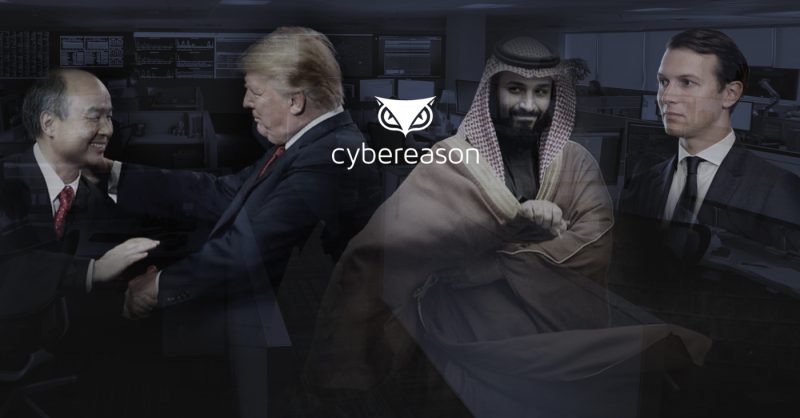
Graphic by Claudio Cabrera
By Whitney Webb | MintPress News | January 14, 2020
If the networks of the U.S. military, the U.S. intelligence community and a slew of other U.S. federal agencies were running the software of a company with deep ties, not only to foreign companies with a history of espionage against the U.S. but also foreign military intelligence, it would — at the very least — garner substantial media attention. Yet, no media reports to date have noted that such a scenario exists on a massive scale and that the company making such software recently simulated the cancellation of the 2020 election and the declaration of martial law in the United States.
Earlier this month, MintPress News reported on the simulations for the U.S. 2020 election organized by the company Cybereason, a firm led by former members of Israel’s military intelligence Unit 8200 and advised by former top and current officials in both Israeli military intelligence and the CIA. Those simulations, attended by federal officials from the FBI, DHS and the U.S. Secret Service, ended in disaster, with the elections ultimately canceled and martial law declared due to the chaos created by a group of hackers led by Cybereason employees.
The first installment of this three part series delved deeply into Cybereason’s ties to the intelligence community of Israel and also other agencies, including the CIA, as well as the fact that Cybereason stood to gain little financially from the simulations given that their software could not have prevented the attacks waged against the U.S.’ electoral infrastructure in the exercise.
Also noted was the fact that Cybereason software could be potentially used as a backdoor by unauthorized actors, a possibility strengthened by the fact that the company’s co-founders all previously worked for firms that have a history of placing backdoors into U.S. telecommunications and electronic infrastructure as well as aggressive espionage targeting U.S. federal agencies.
The latter issue is crucial in the context of this installment of this exclusive MintPress series, as Cybereason’s main investors turned partners have integrated Cybereason’s software into their product offerings. This means that the clients of these Cybereason partner companies, the U.S. intelligence community and military among them, are now part of Cybereason’s network of more than 6 million endpoints that this private company constantly monitors using a combination of staff comprised largely of former intelligence operatives and an AI algorithm first developed by Israeli military intelligence.
Cybereason, thus far, has disclosed the following groups as lead investors in the company: Charles River Ventures (CRV), Spark Capital, Lockheed Martin and SoftBank. Charles River Ventures (CRV) was among the first to invest in Cybereason and has been frequently investing in other Israeli tech start-ups that were founded by former members of the elite Israeli military intelligence Unit 8200 over the last few years. Spark Capital, based in California, appears to have followed CRV’s interest in Cybereason since the venture capitalist who co-founded Spark and led its investment in Cybereason is a former CRV partner who still has close ties to the firm.
While CRV and Spark Capital seem like just the type of investors a company like Cybereason would attract given their clear interest in similar tech start-ups coming out of Israel’s cyber sector, Cybereason’s other lead investors — Lockheed Martin and SoftBank — deserve much more attention and scrutiny.
Cybereason widely used by US Government, thanks to Lockheed
“A match made in heaven,” trumpeted Forbes at the news of the Lockheed Martin-Cybereason partnership, first forged in 2015. The partnership involved not only Lockheed Martin becoming a major investor in the cybersecurity company but also in Lockheed Martin becoming the largest conduit providing Cybereason’s software to U.S. federal and military agencies.
Indeed, as Forbes noted at the time, not only did Lockheed invest in the company, it decided to integrate Cybereason’s software completely into its product portfolio, resulting in a “model of both using Cybereason internally, and selling it to both public and private customers.”
Cybereason CEO and former offensive hacker for Israeli military intelligence — Lior Div — said the following of the partnership:
Lockheed Martin invested in Cybereason’s protection system after they compared our solution against a dozen others from the top industry players. The US firm was so impressed with the results they got from Cybereason that they began offering it to their own customers – among them most of the top Fortune 100 companies, and the US federal government. Cybereason is now the security system recommended by LM to its customers for protection from a wide (sic) malware and hack attacks.”
Rich Mahler, then-director of Commercial Cyber Services at Lockheed Martin, told Defense Daily that the company’s decision to invest in Cybereason, internally use its software, and include the technology as part of Lockheed Martin’s cyber solutions portfolio were all “independent business decisions but were all coordinated and timed with the transaction.”
How independent each of those decisions actually was is unclear, especially given the timing of Lockheed Martin’s investment in Cybereason, whose close and troubling ties to Israeli intelligence as well as the CIA were noted in the previous installment of this investigative series. Indeed, about a year prior to their investment in the Israeli military intelligence-linked Cybereason, Lockheed Martin opened an office in Beersheba, Israel, where the IDF has its “cyberhub”. The office is focused not on the sales of armaments, but instead on technology.
Marilyn Hewson, Lockheed Martin’s CEO, said the following during her speech that inaugurated the company’s Beersheba office:
The consolidation of IDF Technical Units to new bases in the Negev Desert region is an important transformation of Israel’s information technology capability… We understand the challenges of this move. Which is why we are investing in the facilities and people that will ensure we are prepared to support for these critical projects. By locating our new office in the capital of the Negev we are well positioned to work closely with our Israeli partners and stand ready to: accelerate project execution, reduce program risk and share our technical expertise by training and developing in-country talent.”
Beersheba not only houses the IDF’s technology campus, but also the Israel National Cyber Directorate, which reports directly to Israel’s Prime Minister, as well as a high-tech corporate park that mostly houses tech companies with ties to Israel’s military intelligence apparatus. The area has been cited in several media reports as a visible indicator of the public-private merger between Israeli technology companies, many of them started by Unit 8200 alumni, and the Israeli government and its intelligence services. Lockheed Martin quickly became a key fixture in the Beersheba-based cyberhub.
Not long before Lockheed began exploring the possibility of opening an office in Beersheba, the company was hacked by individuals who used tokens tied to the company, RSA Security, whose founders have ties to Israel’s defense establishment and which is now owned by Dell, a company also deeply tied to the Israeli government and tech sector. The hack, perpetrated by still unknown actors, may have sparked Lockheed’s subsequent interest in Israel’s cybersecurity sector.
Soon after opening its Beersheba office, Lockheed Martin created its Israel subsidiary, Lockheed Martin Israel. Unlike many of the company’s other subsidiaries, this one is focused exclusively on “cybersecurity, enterprise information technology, data centers, mobile, analytics and cloud” as opposed to the manufacture and design of armaments.
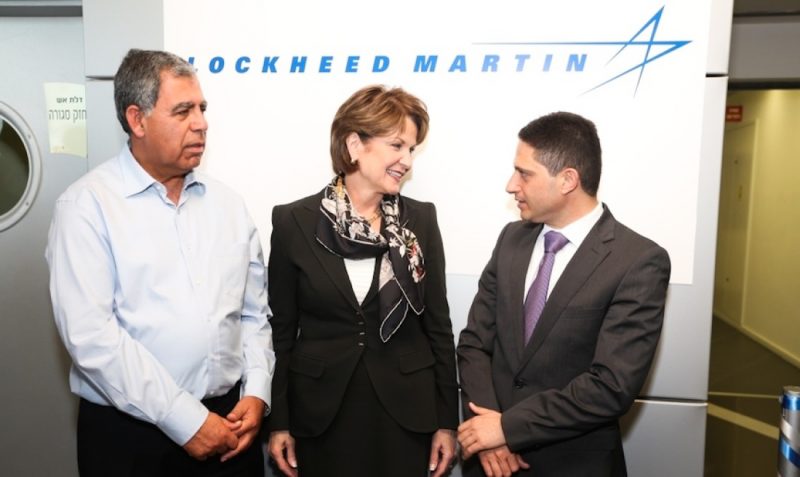
Marillyn Hewson, center, poses with Israeli gov. officials at the opening of Lockheed Martin’s facility in Beersheba. Photo | Diego Mittleberg
Haden Land, then-vice president of research and technology for Lockheed Martin, told the Wall Street Journal that the creation of the subsidiary was largely aimed at securing contracts with the IDF and that the company’s Israel subsidiary would soon be seeking partnership and investments in pursuit of that end. Land oversaw the local roll-out of the company’s Israel subsidiary while concurrently meeting with Israeli government officials. According to the Journal, Land “oversees all of Lockheed Martin’s information-systems businesses, including defense and civilian commercial units” for the United States and elsewhere.
Just a few months later, Lockheed Martin partnered and invested in Cybereason, suggesting that Lockheed’s decision to do so was aimed at securing closer ties with the IDF. This further suggests that Cybereason still maintains close ties to Israeli military intelligence, a point expounded upon in great detail in the previous installment of this series.
Thus, it appears that not only does Lockheed Martin use Cybereason’s software on its own devices and on those it manages for its private and public sector clients, but it also decided to use the company’s software in this way out of a desire to more closely collaborate with the Israeli military in matters related to technology and cybersecurity.
The cozy ties between Lockheed Martin, one of the U.S. government’s largest private contractors, and the IDF set off alarm bells, then and now, for those concerned with U.S. national security. Such concern makes it important to look at the extent of Cybereason’s use by federal and military agencies in the United States through their contracting of Lockheed Martin’s Information Technology (IT) division. This is especially important considering Israeli military intelligence’s history of using espionage, blackmail and private tech companies against the U.S. government, as detailed here.
While the exact number of U.S. federal and military agencies using Cybereason’s software is unknown, it is widespread, with Lockheed Martin’s IT division as the conduit. Indeed, Lockheed Martin was the number one IT solutions provider to the U.S. federal government up until its IT division was spun off and merged with Leidos Holdings. As a consequence, Leidos is now the largest IT provider to the U.S. government and is also directly partnered with Cybereason in the same way Lockheed Martin was. Even after its IT division was spun off, Lockheed Martin continues to use Cybereason’s software in its cybersecurity work for the Pentagon and still maintains a stake in the company.
The Leidos-Lockheed Martin IT hybrid provides a litany of services to the U.S. military and U.S. intelligence. As investigative journalist Tim Shorrock noted for The Nation, the company does “everything from analyzing signals for the NSA to tracking down suspected enemy fighters for US Special Forces in the Middle East and Africa” and, following its merger with Lockheed and consequential partnership with Cybereason, became “the largest of five corporations that together employ nearly 80 percent of the private-sector employees contracted to work for US spy and surveillance agencies.” Shorrock also notes that these private-sector contractors now dominate the mammoth U.S. surveillance apparatus, many of them working for Leidos and — by extension — using Cybereason’s software.
Leidos’ exclusive use of Cybereason software for cybersecurity is also relevant for the U.S. military since Leidos runs a number of sensitive systems for the Pentagon, including its recently inked contract to manage the entire military telecommunications infrastructure for Defense Information Systems Agency (DISA). In addition to maintaining the military telecom network, Cybereason is also directly partnered with World Wide Technologies (WWT) as of this past October. WWT manages cybersecurity for the U.S. Army, maintains DISA’s firewalls and data storage as well as the U.S. Air Force’s biometric identification system. WWT also manages contracts for NASA, itself a frequent target of Israeli government espionage, and the U.S. Navy. WWT’s partnership is similar to the Lockheed/Leidos partnership in that Cybereason’s software is now completely integrated into its portfolio, giving the company full access to the devices on all of these highly classified networks.
Many of these new partnerships with Cybereason, including its partnership with WWT, followed claims made by members of Israel’s Unit 8200 in 2017 that the popular antivirus software of Kaspersky Labs contained a backdoor for Russian intelligence, thereby compromising U.S. systems. The Wall Street Journal was the first to report on the alleged backdoor but did not mention the involvement of Unit 8200 in identifying it, a fact revealed by the New York Times a week later.
Notably, none of the evidence Unit 8200 used to blame Kaspersky has been made public and Kaspersky noted that it was actually Israeli hackers that had been discovered planting backdoors into its platform prior to the accusation levied against Kaspersky by Unit 8200. As the New York Times noted:
Investigators later discovered that the Israeli hackers had implanted multiple back doors into Kaspersky’s systems, employing sophisticated tools to steal passwords, take screenshots, and vacuum up emails and documents.”
Unit 8200’s claims ultimately led the U.S. government to abandon Kaspersky’s products entirely in 2018, allowing companies like Cybereason (with its own close ties to Unit 8200) to fill the void. Indeed, the very agencies that banned Kaspersky now use cybersecurity software that employs Cybereason’s EDR system. No flags have been raised about Cybereason’s own collaboration with the very foreign intelligence service that first pointed the finger at Kaspersky and that previously sold software with backdoors to sensitive U.S. facilities.
SoftBank, Cybereason and the Vision Fund
While its entry into the U.S. market and U.S. government networks is substantial, Cybereason’s software is also run throughout the world on a massive scale through partnerships that have seen it enter into Latin American and European markets in major ways in just the last few months. It has also seen its software become prominent in Asia following a partnership with the company Trustwave. Much of this rapid expansion followed a major injection of cash courtesy of one of the company’s biggest clients and now its largest investor, Japan’s SoftBank.
SoftBank first invested in Cybereason in 2015, the same year Lockheed Martin initially invested and partnered with the firm. It was also the year that SoftBank announced its intention to invest in Israeli tech start-ups. SoftBank first injected $50 million into Cybereason, followed by an additional $100 million in 2017 and $200 million last August. SoftBank’s investments account for most of the money raised by the company since it was founded in 2012 ($350 million out of $400 million total).
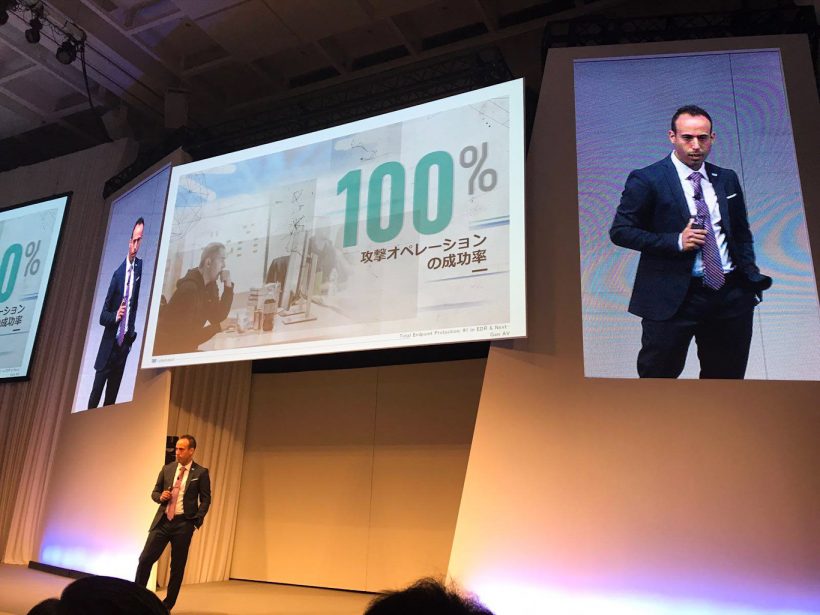
Cybereason CEO Lior Div speaks at a SoftBank event in Japan, July 21, 2017. Photo | Cybereason
Prior to investing, Softbank was a client of Cybereason, which Ken Miyauchi, president of SoftBank, noted when making the following statement after Softbank’s initial investment in Cybereason:
SoftBank works to obtain cutting edge technology and outstanding business models to lead the Information Revolution. Our deployment of the Cybereason platform internally gave us firsthand knowledge of the value it provides, and led to our decision to invest. I’m confident Cybereason and SoftBank’s new product offering will bring a new level of security to Japanese organizations.”
SoftBank — one of Japan’s largest telecommunications companies — not only began to deploy Cybereason internally but directly partnered with it after investing, much like Lockheed Martin had done around the same time. This partnership resulted in SoftBank and Cybereason creating a joint venture in Japan and Cybereason creating partnerships with other tech companies acquired by SoftBank, including the U.K.’s Arm, which specializes in making chips and management platforms for Internet of Things (IoT) devices.
SoftBank’s interest in Cybereason is significant, particularly in light of Cybereason’s interest in the 2020 U.S. election, given that SoftBank has significant ties to key allies of President Trump and even the president himself.
Indeed, SoftBank’s Masayoshi Son was among the first wave of international business leaders who sought to woo then-president-elect Trump soon after the 2016 election. Son first visited Trump Tower in December 2016 and announced, with Trump by his side in the building’s lobby, that SoftBank would invest $50 billion in the U.S. and create 50,000 jobs. Trump subsequently claimed on Twitter that Son had only decided to make this investment because Trump had won the election.
Son told reporters at the time that the investment would come from a $100 billion fund that would be created in partnership with Saudi Arabia’s sovereign wealth fund as well as other investors. “I just came to celebrate his new job. I said, ‘This is great. The US will become great again,’” Son said, according to reports.
Then, in March of 2017, Son sent top SoftBank executives to meet with senior members of Trump’s economic team and, according to the New York Times, “the SoftBank executives said that because of a lack of advanced digital investments, the competitiveness of the United States economy was at risk. And the executives made the case, quite strongly, that Mr. Son was committed to playing a major role in addressing this issue through a spate of job-creating investments.” Many of SoftBank’s investments and acquisitions in the U.S. since then have focused mainly on artificial intelligence and technology with military applications, such as “killer robot” firm Boston Dynamics, suggesting Son’s interest lies more in dominating futuristic military-industrial technologies than creating jobs for the average American.
After their initial meeting, Trump and Son met again a year later in June 2018, with Trump stating that “His [Son’s] $50 billion turned out to be $72 billion so far, he’s not finished yet.” Several media reports have claimed that Son’s moves since Trump’s election have sought to “curry favor” with the President.
Through the creation of this fund alongside the Saudis, SoftBank has since become increasingly intertwined with Saudi Crown Prince Muhammad bin Salman (MBS), a key ally of President Trump in the Middle East known for his authoritarian crackdowns on Saudi elites and dissidents alike. The ties between Saudi Arabia and SoftBank became ever tighter when MBS took the reins in the oil kingdom and after SoftBank announced the launch of the Vision Fund in 2016. SoftBank’s Vision Fund is a vehicle for investing in hi-tech companies and start-ups and its largest shareholder is the Public Investment Fund of Saudi Arabia. Notably, Son decided to launch the Vision Fund in Riyadh during President Trump’s first official visit to the Gulf Kingdom.
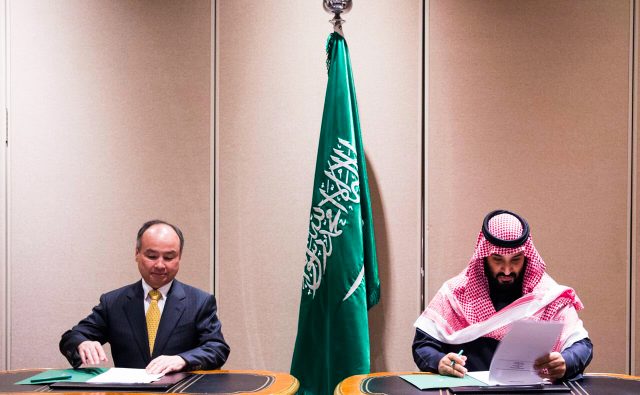
Masayoshi Son, left, signs a deal related to the Vision Fund with Bin Salman in March 2018. Photo | SPA
In addition, the Mubadala Investment Company, a government fund of the United Arab Emirates (UAE), gave $15 billion to the Vision Fund. UAE leadership also share close ties to the Trump administration and MBS in Saudi Arabia.
As a consequence, SoftBank’s Vision Fund is majority funded by two Middle Eastern authoritarian governments with close ties to the U.S. government, specifically the Trump administration. In addition, both countries have enjoyed the rapid growth and normalization of ties with the state of Israel in recent years, particularly following the rise of current Saudi Crown Prince Muhammad bin Salman and Jared Kushner’s rise to prominence in his father-in-law’s administration. Other investments in the Vision Fund have come from Apple, Qualcomm and Oracle’s Larry Ellison, all tech companies with strong ties to Israel’s government.
The Saudi and Emirati governments’ links to the Vision Fund are so obvious that even mainstream outlets like the New York Times have described them as a “front for Saudi Arabia and perhaps other countries in the Middle East.”
SoftBank also enjoys close ties to Jared Kushner, with Fortress Investment Group lending $57 million to Kushner Companies in October 2017 while it was under contract to be acquired by SoftBank. As Barron’s noted at the time:
When SoftBank Group bought Fortress Investment Group last year, the Japanese company was buying access to a corps of seasoned investors. What SoftBank also got is a financial tie to the family of President Donald Trump’s senior advisor and son-in-law, Jared Kushner.”
According to The Real Deal, Kushner Companies obtained the financing from Fortress only after its attempts to obtain funding through the EB-5 visa program for a specific real estate venture were abandoned after the U.S. Attorney and the Securities and Exchange Commission began to investigate how Kushner Companies used the EB-5 investor visa program. A key factor in the opening of that investigation was Kushner Companies’ representatives touting Jared Kushner’s position at the White House when talking to prospective investors and lenders.
SoftBank also recently came to the aid of a friend of Jared Kushner, former CEO of WeWork Adam Neumann. Neumann made shocking claims about his ties to both Kushner and Saudi Arabia’s MBS, even asserting that he had worked with both in creating Kushner’s long-awaited and controversial Middle East “peace plan” and claimed that he, Kushner and MBS would together “save the world.” Neumann previously called Kushner his “mentor.” MBS has also discussed on several occasions his close ties with Kushner and U.S. media reports have noted the frequent correspondence between the two “princelings.”
Notably, SoftBank invested in Neumann’s WeWork using money from the Saudi-dominated Vision Fund and later went on to essentially bail the company out after its IPO collapse and Neumann was pushed out. SoftBank’s founder, Masayoshi Son, had an odd yet very close relationship with Neumann, perhaps explaining why Neumann was allowed to walk with $1.7 billion after bringing WeWork to the brink of collapse. Notably, nearly half of SoftBank’s approximately $47 billion investments in the U.S. economy since Trump’s election, went to acquiring and then bailing out WeWork. It is unlikely that such a disastrous investment resulted in the level of job creation that Son had promised Trump in 2016.
Given that it is Cybereason’s top investor and shareholder by a large margin, SoftBank’s ties to the Trump administration and key allies of that administration are significant in light of Cybereason’s odd interest in 2020 U.S. election scenarios that end with the cancellation of this year’s upcoming presidential election. It goes without saying that the cancellation of the election would mean a continuation of the Trump administration until new elections would take place.
Furthermore, with Cybereason’s close and enduring ties to Israeli military intelligence now well-documented, it is worth asking if Israeli military intelligence would consider intervening in 2020 if the still-to-be-decided Democratic contender was strongly opposed to Israeli government policy, particularly Israel’s military occupation of Palestine. This is especially worth considering given revelations that sexual blackmailer and pedophile Jeffrey Epstein, who targeted prominent U.S. politicians, mostly Democrats, was in the employ of Israeli military intelligence.
Notably, Cybereason’s doomsday election scenarios involved the weaponization of deep fakes, self-driving cars and the hacking Internet of Things devices, with all of those technologies being pioneered and perfected — not by Russia, China or Iran — but by companies directly tied to Israeli intelligence, much like Cybereason itself. These companies, their technology and Cybereason’s own work creating the narrative that U.S. rival states seek to undermine the U.S. election in this way, will all be discussed in the conclusion of MintPress’ series on Cybereason and its outsized interest in the U.S. democratic process.
Whitney Webb is a MintPress News journalist based in Chile. She has contributed to several independent media outlets including Global Research, EcoWatch, the Ron Paul Institute and 21st Century Wire, among others. She has made several radio and television appearances and is the 2019 winner of the Serena Shim Award for Uncompromised Integrity in Journalism.
Post-Iraq war US intel report predicting 2020 looks ‘eerily prescient’ only compared to agencies’ political blunders
By Helen Buyniski | RT | January 1, 2020
A 15-year-old intel report predicting the world of 2020 has been hailed for its accuracy, but much of the future it describes was already underway in 2004. Could today’s hyper-politicized intelligence community see even that much?
Rolling out a list of “eerily prescient” predictions in order to brag about their accuracy – no flying cars here! – the National Intelligence Council (NIC) report is just what one might expect from an intel community desperate to shore up its reputation ahead of what’s sure to be a hotly contested presidential election.
Intel vets have lamented that the intelligence community has become politicized, to the point where it has affected their ability to accurately and objectively describe the reality in front of them – never mind the world 15 years in the future. The NIC paper may thus represent a lost art of apolitical prognostication, a skill willingly sacrificed in the rush for modern spooks to prove themselves “team players.” After the near-fatal blow to its credibility dealt by the three-year Russiagate debacle, US intelligence has a long way to go to build its reputation back.
But US intelligence has played enough of a role in crafting the world of 2020 that at least some of the report’s predictions have to be viewed as plans and suggestions rather than prognostication. Revelations about the CIA’s role in funding and training Al-Qaeda affiliates in Syria, supplying weapons which often ended up in the hands of Islamic State (IS, formerly ISIS/ISIL) terrorists through Operation “Timber Sycamore,” cast the report’s “fictional scenario” about “a new caliphate” whose adherents include Osama bin Laden’s grandson in a more sinister light. Like IS, the fictional caliphate described by the NIC inspires “non-practicing Muslims” from Europe and America to return to their ancestral homelands and take up arms against the “infidels”; also like IS, they seize large swaths of territory in an Iraq weakened by years of war. With plans to regime-change “seven countries in five years” in the Middle East already underway in 2004, according to retired General Wesley Clark, both imagined and real caliphate dovetailed nicely with US foreign policy aims of remaking the region in its image.
Meanwhile, a scenario titled “Cycle of Fear” in which an “Orwellian world” arises from crippling fear of terrorism is almost a wink to the reader, coming just a few short years after the September 11 attacks spawned the Patriot Act and a draconian reduction in Americans’ civil liberties. The NIC report was published years before NSA contractor Edward Snowden’s leaks began to reveal the disturbing extent of the US surveillance state, and Americans in 2004 were for the most part blissfully ignorant about how much they were being spied on – but the NSA, which consulted on the NIC paper, certainly wasn’t.
Other predictions are so obvious that holding them up as a sign of predictive genius is almost laughable. Anticipating a US confrontation with North Korea didn’t take any special skills – then-president George W. Bush had labeled the country part of the “Axis of Evil” alongside Iraq and Iran in 2002, presumably tagging it for eventual regime change. Nor did predicting China’s growth and dominance in the world economy require any great insight – it was already the second-largest global economy in 2004, with its GDP growing at over twice the rate of the US. And a warning against nation-building – a failure the US had already experienced in Afghanistan by 2004 – is hardly prescient; it simply hasn’t been heeded in the intervening 15 years.
Sure, the report nailed a shift in global alliances, with rising economies like the BRICS countries increasingly making their presence felt on the geopolitical stage. But betting global alliances will shift within a 15-year timeframe isn’t exactly clairvoyance.
Unfortunately, the NIC chose to end on an optimistic note, coincidentally the least-likely scenario – a so-called “Pax Americana” in which Europe, devastated by a series of terrorist attacks and “more unified than some of our American friends imagined,” runs into the arms of the US “imploring America to get tough on terrorism.” Even looking beyond the name – “Pax” means “peace,” something a nation with military bases in at least 80 countries knows little about – this hypothetical future has aged particularly badly in the era of Brexit encouraging other European countries to mull seeking independence from the union.
“Even as the existing order is threatened, the United States will have many opportunities to fashion a new one,” the report concludes. The stubborn optimism of the intelligence community of 2004 – just three years into what has become nearly two decades of non-stop war, triggered in part by that community’s own intel failures – is much more “eerie” than any resemblance of its fortune-telling to the real world of 2020. It’s not hard to see how the slight disconnect with reality on display here mushroomed into the chasm separating today’s intelligence community from the real world.
NSA has been ‘lying to the courts all along,’ says whistleblower, as judges give warrantless surveillance the thumbs-up
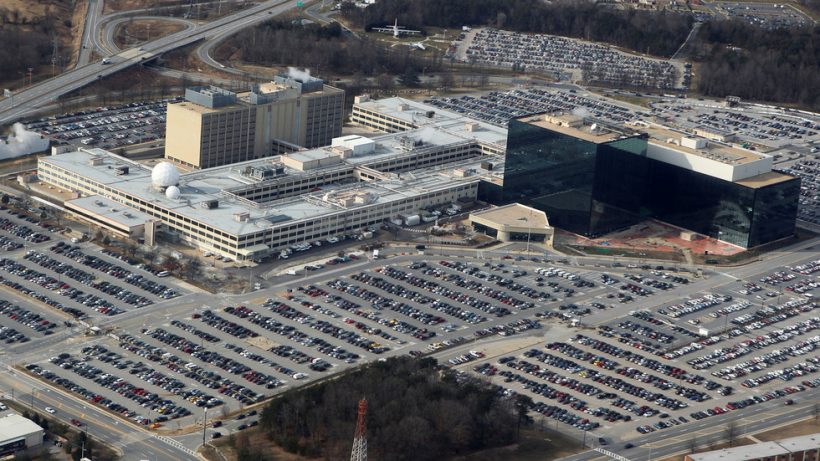
National Security Agency (NSA) headquarters in Ft. Meade, Maryland © Reuters / Larry Downing
RT | December 21, 2019
The National Security Agency can gather the data of US citizens without a warrant – as long as it gathers this data by mistake, a court has ruled. However, this suits the agency just fine, whistleblower William Binney told RT.
The NSA is permitted to gather data on US citizens abroad, or “foreign connected” Americans at home. The dragnet surveillance operation necessary to gather this information also sucks up data on millions of Americans with no foreign contacts, a process critics say is unconstitutional.
On Wednesday, the 2nd Court of Appeals in New York declared this “incidental collection” of information permissible. The NSA has maintained that it is incapable of separating properly and improperly gathered data, but former NSA Technical Director William Binney told RT that this is simply untrue.
“They’ve been lying to the courts all along,” Binney said. “They’ve had the capability to sort that stuff out. It’s just that they don’t want to.”
“This gives them power over everyone, the ability to look into political opponents like they did with President Trump,” he continued.
While the court ruling gives the NSA free rein to suck up data on Americans’ phone and internet communications, it did not authorize the US’ other intelligence and law enforcement agencies to dig through this data. However, according to a Foreign Intelligence Surveillance Act (FISA) court ruling issued last year, the FBI accessed this data trove some 3.1 million times in 2017.
Democrats Target Own Population by Trump Impeachment – Paul Craig Roberts
Sputnik -December 20, 2019
WASHINGTON – The Democrats are targeting their own population by impeaching President Donald Trump, former US Assistant Treasury Secretary Paul Craig Roberts said.
On Wednesday, Trump became the third president in US history to be impeached when the Democratic-controlled House of Representatives voted to find him guilty of abuse of power and obstruction of Congress after investigations concluding he invited foreign meddling in the American electoral process.
“The impeachment circus is a political act by the House Democrats. It is a political orchestration without any evidence or credible testimony,” Roberts said. “What is disturbing about the impeachment… is that these orchestrated actions are an attempt to overturn a democratic election. The US now engages in actions against its own population like the actions Washington recently engaged in against Venezuela, Bolivia, Honduras, and Ukraine.”
The Democratic Party, Roberts added, decided to fabricate a scandal with Ukraine after Russiagate fell apart.
“The Democrats are after power. They were frustrated by the Russiagate failure, and orchestrated a hoax that, even if it were true, would not be an impeachable event,” he said.
Roberts continued to say that the House Democrats are able to “get away with this hoax” because the American media is against Trump.
“It is disturbing also because it demonstrates that there is no integrity in the media or the security agencies,” he explained. “Without the support of the media and security agencies, the Democrats would not be able to orchestrate such obvious hoaxes.”
Roberts believes that the impeachment proceedings are not hurting Trump’s election chances, and even help him.
“As the impeachment proceedings unfolded, the public turned against the proceedings, recognizing them as a purely political action,” Roberts said. “The Democrats hoped that some of the mud would stick to Trump and reduce his reelection chances, but it seems the impeachment is helping Trump.”
The president will have to face trial in the US Senate but is unlikely to be removed from power as the higher legislative decision-making body is controlled by members of his Republican party, who have made it clear that they viewed his impeachment as a sham.
“The Senate will not convict Trump of the charges, unless enough Republican senators can be blackmailed by the FBI, CIA, and NSA, police state institutions that have spy folders on everyone, or unless the military/security complex can bribe the Republicans with large sums of money to vote against Trump,” Roberts said. “I think this is unlikely as it would be too obvious even for insouciant Americans not to notice.”
Roberts also said that Russiagate and the impeachment “have radicalized” and divided the United States.
“The population is now split in a new way. On the one hand we have the people who elected Trump, ordinary traditional Americans now demonized as “racists” and “white supremacists,” Roberts said. “On the other hand we have the Democrats, no longer the party of the working people.”
House Democrats launched their impeachment inquiry in September to probe whether Trump tried to pressure Ukraine into investigating his political rival Joe Biden, the current Democratic front-runner in the presidential primaries. Lawmakers initiated the inquiry after a whistleblower sent a complaint to the Congress claiming that Trump threatened to withdraw military aid for Ukraine if Kiev failed to investigate Biden and his son Hunter over the latter’s business dealings in the country.
Trump has denied any wrongdoing, repeatedly dismissing the impeachment inquiry as a witch hunt aimed at reversing the outcome of the 2016 presidential election.
Commenting on Wednesday’s vote, the president said that “this lawless, partisan impeachment” was “political suicide” for the Democratic Party. He also expressed confidence that he would be fully exonerated by the Senate, pledging to “continue to work tirelessly to address the needs and priorities of the American people.”
Featured Video

Chinese jet fuel and the myth of energy independence
or go to
Aletho News Archives – Video-Images
From the Archives
The Dirty Little Secret behind the “Global Terrorism Index”
The Omission of Israeli Terrorism in the Occupied Palestinian Territories
By Karin Brothers | Global Research | December 6, 2014
… The Israeli settlements — all of which are illegal – have been identified as a major impediment to peace. The refusal of a major “global” terrorism report to name the Israeli settlers as one of the groups most responsible for terrorism not only misrepresents a major source of regional violence but exposes the Global Terrorism Index as a propaganda tool that supports a U.S. agenda.
In recent years, governments have been attempting to thwart terrorism by blocking supportive fund-raising. When it comes to Israeli settlements, however, the US and Canada actually encourage fund-raising by giving organizations (such as Christian Friends of Israeli Communities (CFOIC) and the Jewish National Fund) financial support in the form of donor tax-deductions.
Charities which provide funds for the Israeli settlements should be regarded as terror-financing organizations. They should not only lose their tax-deductible status, but they should be banned because they support the violation of international humanitarian law. The terror-financing laws that are being strictly enforced for Muslim charities should be applied to Christian and Jewish charities as well. … Read full article
Blog Roll
 Aletho News
- Chinese jet fuel and the myth of energy independence
- Ukraine Sea Drone Fired From Libya Hit Russian Tanker in Mediterranean
- IRGC: Iranian forces launched no attacks during ceasefire hours
- Trump Administration Moves To Automate U.S. Military Draft Registration
- Spain orders reopening of Tehran embassy, condemns Israel’s carpet bombing of Lebanon
- Israel faces ‘unsustainable’ strategic crisis following 40-day war against Iran: Analyst
- Iran restricts Hormuz access to 15 vessels per day under ceasefire terms: Report
- The ‘Opposition Party’ Has Done Nothing to Stop the Iran War and Much to Goad Trump Into Continuing It
- Moscow backs Tehran on status of Lebanon in US-Iran deal
- How UK Regulator Ofcom Quietly Bypassed International Law to Police American Speech
- If Americans Knew
- Amnesty: Urgent – Protect Lebanese civilians from brutal escalation in Israeli attacks
- Is The War Against Iran Over?
- Inside the Israeli army’s propaganda wing
- Hundreds of Gaza Amputees Stranded in Legal Limbo
- The gallows law: Israel moves toward executing Palestinian children
- Tucker Carlson: The Path to Peace requires ending ‘special alliance’ with Israel
- This is ceasefire? Israel’s biggest massacre yet in Lebanon, another journalist killed in Gaza – Daily Update
- Tucker Carlson on Israel: This Is the Behavior of an Ally? Really?
- Gazans face a triple crisis: severe shortages of water and bread, healthcare in tatters
- NY Times reports how Netanyahu took the US into Iran War
- No Tricks Zone
- An Inconvenient Tree: Uncovered In Alps… Europe Much Warmer Than Today 6000 Years Ago
- New Study Reports A 60% Slowdown In Greenland’s Ice Loss Rate In The Last Decade
- Low Intensity Tornado Wrecks Major Solar Farm, Creating A Potential Toxic Dump
- New Study Finds Warming Saves Lives…Cold Temperatures 12 Times More Deadly Than Excess Heat
- German Science Blog Accuses PIK Climate Institute Of Hallucinating Climate Tipping Points
- Devastating Assessment Of Comirnaty Vaccine By Former Senior Pfizer Europe Toxicologist
- New Study: CO2 Is ‘Effectively Negligible’ As An Explanatory Climate Change Factor Since 2000
- Former Pfizer Toxicologist Dr. Helmut Sterz Tells Bundestag Hearing Pfizer Vaccine Should Have Never Been Approved
- Energy Expert: Germany’s Nuclear Phaseout Was A “500 Billion Euro Mistake”
- New Research: South Australia’s Mid-Holocene Sea Surface Temperatures Were 4°C Warmer Than Today
 Aletho News