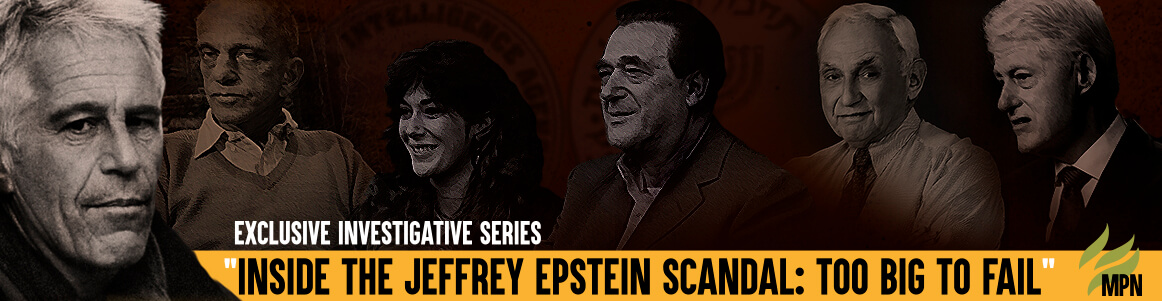
Whitney Webb is a MintPress News journalist based in Chile. She has contributed to several independent media outlets including Global Research, EcoWatch, the Ron Paul Institute and 21st Century Wire, among others. She has made several radio and television appearances and is the 2019 winner of the Serena Shim Award for Uncompromised Integrity in Journalism.
The Civilian Government Doesn’t Owe Deference to Military Officers

By Ryan McMaken – Mises Institute – 11/20/2019
On Tuesday, Congressional impeachment hearings exposed an interesting facet of the current battle between Donald Trump and the so-called deep state: namely, that many government bureaucrats now fancy themselves as superior to the elected civilian government.
In an exchange between Rep. Devin Nunes (R-CA) and Alexander Vindman, a US Army Lt. Colonel, Vindman insisted that Nunes address him by his rank.
After being addressed as “Mr. Vindman,” Vindman retorted “Ranking Member, it’s Lt. Col. Vindman, please.”
Throughout social media, anti-Trump forces, who have apparently now become pro-military partisans, sang Vindman’s praises, applauding him for putting Nunes in his place.
In a properly functioning government — with a proper view of military power — however, no one would tolerate a military officer lecturing a civilian on how to address him “correctly.”
It is not even clear that Nunes was trying to “dis” Vindman, given that junior officers have historically been referred to as “Mister” in a wide variety of times and place. It is true that higher-ranking officers like Vindman are rarely referred to as “Mister,” but even if Nunes was trying to insult Vindman, the question remains: so what?
Military modes of address are for the use of military personnel, and no one else. Indeed, Vindman was forced to retreat on this point when later asked by Rep. Chris Stewart (R-UT) if he always insists on civilians calling him by his rank. Vindman blubbered that since he was wearing his uniform (for no good reason, mind you) he figured civilians ought to refer to him by his rank.
Of course, my position on this should not be construed as a demand that people give greater respect to members of Congress. If a private citizen wants to go before Congress and refer to Nunes or any other member as “hey you,” that’s perfectly fine with me. But the important issue here is we’re talking about private citizens — i.e., the people who pay the bills — and not military officers who must be held as subordinate to the civilian government at all times.
After all, there’s a reason that the framers of the US Constitution went to great pains to ensure the military powers remained subject to the will of the civilian government. Eighteenth and nineteenth century Americans regarded a standing army as a threat to their freedoms. Federal military personnel were treated accordingly.
Article I, Section 8 of the Constitution states that Congress shall have the power “to raise and support Armies …” and “to provide and maintain a Navy.” Article II, Section 2 states, “The President shall be the Commander in Chief of the Army and Navy of the United States, and of the Militia of the several States when called into the actual Service of the United States.” The authors of the constitution were careful to divide up civilian power of the military, and one thing was clear: the military was to have no autonomy in policymaking. Unfortunately, early Americans did not anticipate the rise of America’s secret police in the form of the CIA, FBI, NSA, and other “intelligence” agencies. Had they, it is likely the anti-federalists would have written more into the Bill of Rights to prevent organizations like the NSA from shredding the fourth amendment, as has been the case.
The inversion of the civilian-military relationship that is increasingly on display in Washington is just another symptom of the growing power of often-secret and unaccountable branches of military agencies and intelligence agencies that exercise so much power both in Washington and around the world.
“The Palace… Threatened Us a Million Different Ways”
By Craig Murray | November 16, 2019
This leaked off-air recording of ABC News anchor Amy Robach is much more revealing than anything the BBC is going to air about Andrew Saxe Coburg Gotha.
Buckingham Palace has been “threatening” journalists to bury the story for years – which is all very reminiscent of Jimmy Savile, who was of course, ahem, popular at the Palace. Robach also states they were scared of losing interview access to folically challenged William Saxe Coburg Gotha and his underweight wife. She does not explicitly state that was one of the “threats” Buckingham Palace employed, but it does follow directly as her next observation.
Amy Robach very probably realised this “unguarded” moment would get out to the public, and we should be grateful to her for lifting the lid on how the protection of the crimes of the powerful operates, on a global level. Alan Dershowitz, whom Robach mentions, was not only a Lolita Express passenger, he is the celebrity lawyer who defended the CIA‘s use of torture as legally and morally justified. One might speculate on the psychological parallels of torturing the defenceless and inflicting sex on the young.
There is overwhelming evidence that Virginia Roberts Giuffre was trafficked into the UK by Epstein for sex with Prince Andrew. There are flight logs. There is that compromising photo in Ghislaine Maxwell’s flat. Both are entirely consistent with, and strongly corroborate, Virginia’s own testimony. This instance occurred in the UK.
It ought to be a matter of deep national disgrace that neither Ghislaine Maxwell nor “Prince” Andrew has been questioned over by the Metropolitan Police over this sex trafficking. That Virginia was over 16 is not the issue. She was sex trafficked into the UK and not legally adult. Why is there not a massive media clamour for Scotland Yard to investigate?
Amy Robach has the answer to that question.
Hat Tip to projectveritas
John Brennan’s CIA Trump Task Force
Could it become Obamagate?

By Philip Giraldi • Unz Review • November 12, 2019
There is considerable evidence that the American system of government may have been victimized by an illegal covert operation organized and executed by the U.S. intelligence and national security community. Former Director of National Intelligence Jim Clapper, former CIA Director John Brennan and former FBI Director Jim Comey appear to have played critical leadership roles in carrying out this conspiracy and they may not have operated on their own. Almost certainly what they may have done would have been explicitly authorized by the former President of the United States, Barack Obama, and his national security team.
It must have seemed a simple operation for the experienced CIA covert action operatives. To prevent the unreliable and unpredictable political upstart Donald Trump from being nominated as the GOP presidential candidate or even elected it would be necessary to create suspicion that he was the tool of a resurgent Russia, acting under direct orders from Vladimir Putin to empower Trump and damage the campaign of Hillary Clinton. Even though none of the alleged Kremlin plotters would have expected Trump to actually beat Hillary, it was plausible to maintain that they would have hoped that a weakened Clinton would be less able to implement the anti-Russian agenda that she had been promoting. Many observers in both Russia and the U.S. believed that if she had been elected armed conflict with Moscow would have been inevitable, particularly if she moved to follow her husband’s example and push to have both Georgia and Ukraine join NATO, which Russia would have regarded as an existential threat.
Trump’s surprising victory forced a pivot, with Clapper, Brennan and Comey adjusting the narrative to make it appear that Trump the traitor may have captured the White House due to help from the Kremlin, making him a latter-day Manchurian Candidate. The lesser allegations of Russian meddling were quickly elevated to devastating assertions that the Republican had only won with Putin’s assistance.
No substantive evidence for the claim of serious Russian meddling has ever been produced in spite of years of investigation, but the real objective was to plant the story that would plausibly convince a majority of Americans that the election of Donald Trump was somehow illegitimate.
The national security team acted to protect their candidate Hillary Clinton, who represented America’s Deep State. In spite of considerable naysaying, the Deep State is real, not just a wild conspiracy theory. Many Americans nevertheless do not believe that the Deep State exists, that it is a politically driven media creation much like Russiagate itself was, but if one changes the wording a bit and describes the Deep State as the Establishment, with its political power focused in Washington and its financial center in New York City, the argument that there exists a cohesive group of power brokers who really run the country becomes much more plausible.
The danger posed by the Deep State, or, if you choose, the Establishment, is that it wields immense power but is unelected and unaccountable. It also operates through relationships that are not transparent and as the media is part of it, there is little chance that its activity will be exposed.
Nevertheless, some might even argue that having a Deep State is a healthy part of American democracy, that it serves as a check or corrective element on a political system that has largely been corrupted and which no longer serves national interests. But that assessment surely might have been made before it became clear that many of the leaders of the nation’s intelligence and security agencies are no longer the people’s honorable servants they pretend to be. They have been heavily politicized since at least the time of Ronald Reagan and have frequently succumbed to the lure of wealth and power while identifying with and promoting the interests of the Deep State.
Indeed, a number of former Central Intelligence Agency (CIA) Directors have implicitly or even directly admitted to the existence of a Deep State that has as one of its roles keeping presidents like Donald Trump in check. Most recently, John McLaughlin, responding to a question about Donald Trump’s concern over Deep State involvement in the ongoing impeachment process, said unambiguously “Well, you know, thank God for the ‘deep state’… With all of the people who knew what was going on here, it took an intelligence officer to step forward and say something about it, which was the trigger that then unleashed everything else. This is the institution within the U.S. government… is institutionally committed to objectivity and telling the truth. It is one of the few institutions in Washington that is not in a chain of command that makes or implements policy. Its whole job is to speak the truth — it’s engraved in marble in the lobby.”
Well, John’s dedication to truth is exemplary but how does he explain his own role in support of the lies being promoted by his boss George “slam dunk” Tenet that led to the war against Iraq, the greatest foreign policy disaster ever experienced by the United States? Or Tenet’s sitting in the U.N. directly behind Secretary of State Colin Powell in the debate over Iraq, providing cover and credibility for what everyone inside the system knew to be a bundle of lies? Or his close friend and colleague Michael Morell’s description of Trump as a Russian agent, a claim that was supported by zero evidence and which was given credibility only by Morell’s boast that “I ran the CIA.”
Beyond that, more details have been revealed demonstrating exactly how Deep State associates have attempted, with considerable success, to subvert the actual functioning of American democracy. Words are one thing, but acting to interfere in an electoral process or to undermine a serving president is a rather more serious matter.
It is now known that President Barack Obama’s CIA Director John Brennan created a Trump Task Force in early 2016. Rather than working against genuine foreign threats, this Task Force played a critical role in creating and feeding the meme that Donald Trump was a tool of the Russians and a puppet of President Vladimir Putin, a claim that still surfaces regularly to this day. Working with James Clapper, the Director of National Intelligence, Brennan fabricated the narrative that “Russia had interfered in the 2016 election.” Brennan and Clapper promoted that tale even though they knew very well that Russia and the United States have carried out a broad array of covert actions against each other, including information operations, for the past seventy years, but they pretended that what happened in 2016 was qualitatively and substantively different even though the “evidence” produced to support that claim was and still is weak to nonexistent.
The Russian “election interference” narrative went on steroids on January 6, 2017, shortly before Trump was inaugurated, when an “Intelligence Community Assessment” (ICA) orchestrated by Clapper and Brennan was published. The banner headline atop The New York Times, itself an integral part of the Deep State, on the following day set the tone for what was to follow: “Putin Led Scheme to Aid Trump, Report Says.”
With the help of the Establishment media, Clapper and Brennan were able to pretend that the ICA had been approved by “all 17 intelligence agencies” (as first claimed by Hillary Clinton). After several months, however Clapper revealed that the preparers of the ICA were “handpicked analysts” from only the FBI, CIA, and NSA. He explained rather unconvincingly during an interview on May 28, 2017, that “the historical practices of the Russians, who typically, are almost genetically driven to co-opt, penetrate, gain favor, whatever, which is a typical Russian technique,” adding later that “It’s in their DNA.”
Task Force Trump was kept secret within the Agency itself because the CIA is not supposed to spy on Americans. Its staff was pulled together by invitation-only. Specific case officers (i.e., men and women who recruit and handle spies overseas), analysts and administrative personnel were recruited, presumably based on their political reliability. Not everyone invited accepted the offer. But many did because it came with promises of promotion and other rewards.
And this was not a CIA-only operation. Personnel from the FBI also were assigned to the Task Force with the approval of then Director James Comey. Former MI-6 agent Christopher Steele’s FBI handler, Michael Gaeta, may have been one of those detailed to the Trump Task Force. Steele, of course, prepared the notorious dossier that was surfaced shortly before Donald Trump took office. It included considerable material intended to tie Trump to Russia, information that was in many cases fabricated or unsourced.
So, what kind of things would this Task Force do? The case officers would work with foreign intelligence services such as MI-6, the Italians, the Ukrainians and the Australians on identifying intelligence collection priorities that would implicate Trump and his associates in illegal activity. And there is evidence that John Brennan himself would contact his counterparts in allied intelligence services to obtain their discreet cooperation, something they would be inclined to do in collegial fashion, ignoring whatever reservations they might have about spying on a possible American presidential candidate.
Trump Task Force members could have also tasked the National Security Agency (NSA) to do targeted collection. They also would have the ability to engage in complicated covert actions that would further set up and entrap Trump and his staff in questionable activity, such as the targeting of associate George Papadopoulos. If he is ever properly interviewed, Maltese citizen Joseph Mifsud may be able to shed light on the CIA officers who met with him, briefed him on operational objectives regarding Papadopoulos and helped arrange monitored meetings. It is highly likely that Azra Turk, the woman who met with George Papadopoulos, was part of the CIA Trump Task Force.
The Task Force also could carry out other covert actions, sometimes using press or social media placements to disseminate fabrications about Trump and his associates. Information operations is a benign-sounding euphemism for propaganda fed through the Agency’s friends in the media, and computer network operations can be used to create false linkages and misdirect inquiries. There has been some informed speculation that Guccifer 2.0 may have been a creation of this Task Force.
In light of what has been learned about the alleged CIA whistleblower there should be a serious investigation to determine if he was a part of this Task Force or, at minimum, reporting to them secretly after he was seconded to the National Security Council. All the CIA and FBI officers involved in the Task Force had sworn an oath to uphold the Constitution of the United States, but nevertheless were involved in a conspiracy to first denigrate and then possibly bring down a legally elected president. That effort continues with repeated assertions regarding Moscow’s malevolent intentions for the 2020 national elections. Some might reasonably regard the whole Brennan affair, to include its spear carriers among the current and retired national security state leadership, as a case of institutionalized treason, and it inevitably leads to the question “What did Obama know?”
Philip M. Giraldi, Ph.D., is Executive Director of the Council for the National Interest, a 501(c)3 tax deductible educational foundation (Federal ID Number #52-1739023) that seeks a more interests-based U.S. foreign policy in the Middle East. Website is councilforthenationalinterest.org, address is P.O. Box 2157, Purcellville VA 20134 and its email is inform@cnionline.org.
Assange Only Did What a Good Journalist Is Supposed to Do
U.S. Using ‘Lawfare’ to Silence the Truth
By Philip Giraldi | American Free Press | November 8, 2019
The United States prides itself on its rule of law, a legacy from British colonial times, but there is increasing evidence that equal justice under law has been replaced by something that is sometimes called “lawfare,” an Israeli invention which consists of using the legal system to punish dissent and silence critics. Three examples, all quite different, illustrate exactly how a quasi-legal process has been used against individuals that are perceived to be, rightly or wrongly, critics of America’s so-called “global war on terror,” which is still being conducted worldwide even though no one uses the expression anymore.
The global war on terror is being fought based on legislation that is unique to the United States, which, under the various editions of the Authorization for the Use of Military Force (AUMF), authorizes the United States to go after any group anywhere that has been identified by the Department of State as “terrorist.” This authority has meant in practice that even American citizens can be killed or captured by U.S. special forces in any country, which of course includes nations with which the United States is not at war—not surprisingly, as Washington is not technically at war with anyone. The AUMF has also been interpreted to permit going after entire countries or political groups designated state sponsors of terrorism.
Once presumed terrorists are captured they can be held indefinitely in special prisons, Guantanamo being the one that is best known. That is precisely the case of Pakistani citizen Khalid Sheikh Mohammed (KSM), the alleged mastermind of 9/11, who was captured in March 2002 in Rawalpindi, Pakistan. But are the claims about his involvement really true? KSM has been tortured and eventually confessed to many crimes, but he has never been tried even though rumors frequently surface in Washington that his day in court will be coming up soon. Recently, military judges asserted that he would finally be tried in January 2021 but warned that a number of conditions would have to be met first.
That KSM has never appeared in court is generally believed to be because the actual evidence against him is so thin and was obtained under torture. So he has been held in prison under orders from presidents Bush, Obama, and Trump with no end in sight, and without providing his testimony regarding events on the September day, one more piece of the 9/11 puzzle will never be revealed to the public.
As the federal government is wedded to its standard account of 9/11, it is likely that KSM will remain in prison until the day he dies, setting an example for all those who choose to question the sanctity of the 9/11 Commission Report.
Julian Assange is another notable example of how revenge against those who question standard narratives is meted out through the legal system. Assange, to be sure, has been guilty of publishing material that the United States government would prefer not to have been made public. His website, WikiLeaks, was conceived as a whistleblower site, with information provided to it by individuals who had uncovered illegal activity on the part of various governments. WikiLeaks exposed, for example, Chelsea Manning’s Iraq war crimes material and the Hillary Clinton and Democratic National Committee (DNC) emails.
In Assange’s defense, he has stated repeatedly that he is a journalist who exposes government wrongdoing, which used to be referred to as a “muckraker.” He never engaged in personally stealing government secrets and only published material that was given to him by others. In some cases, he refused to publish material that would hurt or endanger individuals.
Assange became a target of U.S. and British law enforcement in 2010. Living in London at the time, he was accused by several Swedish women of sexual assault, leading to a request from Stockholm for extradition. At the time, many believed that the accusations were without merit, and, indeed, they were eventually dropped, but Assange was about to be arrested by the British authorities after he failed to make a bail hearing set to contest the Swedish extradition request. To avoid arrest, he fled to the Ecuadorean embassy in 2012 and was granted asylum, where he eventually spent seven years, eventually confined to a small room. His health suffered.
Forced to leave by the Ecuadorean withdrawal of his asylum under U.S. pressure, he was arrested in 2019 by the British and is currently in prison, where his health continues to deteriorate. He will eventually be sent to the United States upon release in early 2020, where he will undoubtedly be convicted under the Espionage Act of 1918, a rarely invoked law that can be brought out whenever the federal government is desperate to convict someone. It was recently used in May 2015 to imprison ex-CIA officer Jeffrey Sterling even though there was no evidence that he had actually revealed classified information. The prosecution claimed that he “must have done it,” which was apparently enough for the judge and jury.
There is also a back story to Assange. He has always insisted that the information he received on the DNC emails did not come from a Russian source, one of the basic claims made that launched the years-long investigation of what became known as Russiagate. Many suspect that a DNC staffer named Seth Rich might have been the actual source, but the government and the Democratic Party have resisted any serious investigation into that possibility. If Assange is ever actually tried he might reveal the truth, but one must consider that folks who have secrets damaging to the government are either somehow silenced or even wind up dead. So Assange, who only did what a good journalist is supposed to do, will, like KSM, likely die in prison after the U.S. gets its hands on him.
And finally, there is the case of Edward Snowden, a government contractor who discovered that the NSA was spying illegally on literally millions of Americans. He went through channels to complain about what was being done, was ignored, and eventually sent his information over to several journalists, who published his claims.
Snowden knew that even though he was a whistleblower and was allegedly protected by special whistleblower legislation there was no chance that he would ever receive a fair trial in the U.S., so he fled first to China and then wound up in Russia, where he is today. He has stated that he would return to the United States to tell his story if he is guaranteed a fair trial that will enable him to use a “public interest” whistleblower defense, but no one is taking the bait. Many in Congress and even some in the media have called for his execution as a traitor. Some of us, however, regard him as a hero.
Truly the land of the free and the home of the brave has become something like a prison camp for those who fall outside the limits of acceptable behavior as defined by the government. Law is the weapon and it is wielded equally by Democrats and Republicans. Do KSM, Assange, and Snowden all have interesting tales to tell? Indeed, they do, but we the public will likely never hear them.
Growing Indicators of Brennan’s CIA Trump Task Force
By Larry C Johnson | Sic Semper Tyrannus | November 2, 2019
The average American has no idea how alarming is the news that former CIA Director John Brennan reportedly created and staffed a CIA Task Force in early 2016 that was named, Trump Task Force, and given the mission of spying on and carrying out covert actions against the campaign of candidate Donald Trump.
This was not a simple gathering of a small number of disgruntled Democrats working at the CIA who got together like a book club to grouse and complain about the brash real estate guy from New York. It was a specially designed covert action to try to destroy Donald Trump.
A “Task Force” is a special bureaucratic creation that provides a vehicle for bringing case officers and analysts together, along with admin support, for a limited term project. But it also can be expanded to include personnel from other agencies, such as the FBI, DIA and NSA. Task Forces have been used since the inception of the CIA in 1947. Here’s a recently declassified memo outlining the considerations in the creation of a task force in 1958. The author, L.K. White, talks about the need for a coordinating Headquarters element and an Operational unit “in the field”, i.e. deployed around the world.
A Task Force operates independent of the CIA “Mission Centers” (that’s the jargon for the current CIA organization chart).
So what did John Brennan do? I am told by a knowledgeable source that Brennan created a Trump Task Force in early 2016. It was an invitation only Task Force. Specific case officers (i.e., men and women who recruit and handle spies overseas), analysts and admin personnel were recruited. Not everyone invited accepted the offer. But many did.
This was not a CIA only operation. Personnel from the FBI also were assigned to the Task Force. We have some clues that Christopher Steele’s FBI handler, Michael Gaeta, may have been detailed to the Trump Task Force (see here).
So what kind of things would this Task Force do? The case officers would work with foreign intelligence services such as MI-6, the Italians, the Ukrainians and the Australians on identifying intelligence collection priorities. Task Force members could task NSA to do targeted collection. They also would have the ability to engage in covert action, such as targeting George Papadopoulos. Joseph Mifsud may be able to shed light on the CIA officers who met with him, briefed on operational objectives regarding Papadopoulos and helped arrange monitored meetings. I think it is highly likely that the honey pot that met with George Papadopoulos, a woman named Azra Turk, was part of the CIA Trump Task Force.
The Task Force also could carry out other covert actions, such as information operations. A nice sounding euphemism for propaganda, and computer network operations. There has been some informed speculation that Guccifer 2.0 was a creation of this Task Force.
In light of what we have learned about the alleged CIA whistleblower, Eric Ciaramella, there should be a serious investigation to determine if he was a part of this Task Force or, at minimum, reporting to them.
When I described this to one friend, a retired CIA Chief of Station, his first response was, “My God, that’s illegal.” We then reminisced about another illegal operation carried out under the auspices of the CIA Central American Task Force back in the 1980s. That became known to Americans as the Iran Contra scandal.
I sure hope that John Durham and his team are looking at this angle. If true it marks a new and damning indictment of the corruption of the CIA. Rather than spying on genuine foreign threats, this Task Force played a critical role in creating and feeding the meme that Donald Trump was a tool of the Russians and a puppet of Putin.
From Russiagate to Ukrainegate: An Impeachment Inquiry
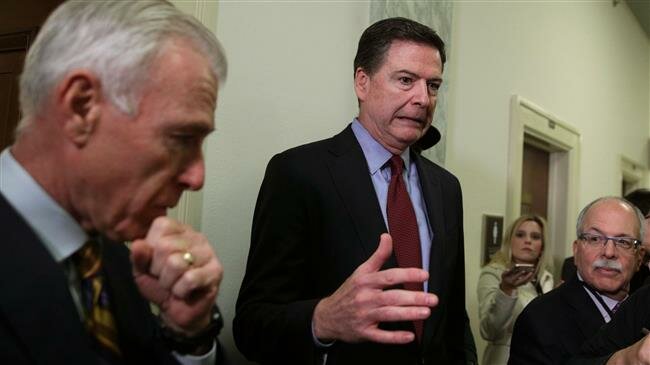
By Renée Parsons | OffGuardian | October 30, 2019
As the Quantum field oversees the disintegration of institutions no longer in service to the public, the Democratic party continues to lose their marbles, perpetuating their own simulated bubble as if they alone are the nation’s most trusted purveyors of truth.
Since the Mueller Report failed to deliver on the dubious Russiagate accusations, the party of Thomas Jefferson continues to remain in search of another ethical pretense to justify continued partisan turmoil. In an effort to discredit and/or distract attention from the Barr-Durham and IG investigations, the Dems have come up with an implausible piece of political theatre known as Ukrainegate which has morphed into an impeachment inquiry.
The Inspector General’s Report, which may soon be ready for release, will address the presentation of fabricated FBI evidence to the FISA Court for permission to initiate a surveillance campaign on Trump Administration personnel. In addition, the Department of Justice has confirmed that Special Investigator John Durham’s probe into the origin of the FBI’s counter intelligence investigation during the 2016 election has moved from an administrative review into the criminal prosecution realm. Durham will now be able to actively pursue candidates for possible prosecution.
The defensive assault from the Democrat hierarchy and its corporate media cohorts can be expected to reach a fevered pitch of manic proportions as both investigations threatened not only their political future in 2020 but perhaps their very existence.
NBC suggests that the Barr investigation is a ‘mysterious’ review “amid concerns about whether the probe has any legal or factual basis” while the NY Times continues to cast doubt that the investigation has a legitimate basis implying that AG Barr is attempting to “deliver a political victory for President Trump.” The Times misleads its readers with:
Trump has repeatedly attacked the Russia investigation, portraying it as a hoax and illegal even months after the special counsel closed it.”
… when in fact, it was the Russiagate collusion allegations that Trump referred to as a hoax, rather than the Mueller investigation per se.
Sen. Mark Warner (D-Va), minority leader of the Senate Intel Committee suggested that Attorney General William Barr “owes the Committee an explanation” since the committee is completing a “three-year bipartisan investigation” that has “found nothing to justify” Barr’s expanded effort.
The Senator’s gauntlet will be ever so fascinating as the public reads exactly how the Intel Committee spent three years and came up with “nothing” as compared to what Durham and the IG reports have to say.
On the House side, prime-time whiners Reps. Adam Schiff (D-Calif) and Jerrold Nadler (D-NY) commented that news of the Durham investigation moving towards criminal liability “raised profound concerns that Barr has lost his independence and become a vehicle for political revenge” and that “the Rule of Law will suffer irreparable damage.”
Since Barr has issued no determination of blame other than to assure a full, fair and rigorous investigation, it is curious that the Dems are in premature meltdown as if they expect indictments even though the investigations are not yet complete.
There is, however, one small inconvenient glitch that challenges the Democratic version of reality that does not fit their partisan spin. The news that former FBI General Counsel James Baker is actively cooperating with the Barr-Durham investigation ought to send ripples through the ranks. Baker has already stated that it was a ‘small group’ within the agency who led the counterintelligence inquiry into the Trump campaign; notably former FBI Director James Comey and former Deputy Director Andrew McCabe.
Baker’s cooperation was not totally unexpected since he also cooperated with the Inspector General’s FISA abuse investigation which is awaiting public release.
As FBI General Counsel, Baker had a role in reviewing the FISA applications before they were submitted to the FISA court and currently remains under criminal investigation for making unauthorized leaks to the media.
As the agency’s chief legal officer, Baker had to be a first-hand participant and privy to every strategy discussion and decision (real or contemplated). It was his job to identify potential legal implications that might negatively affect the agency or boomerang back on the FBI. In other words, Baker is in a unique position to know who knew what and when did they knew it.
His ‘cooperation’ can be generally attributed to being more concerned with saving his own butt rather than the Constitution.
In any case, the information he is able to provide will be key for getting to the true origins of Russiagate and the FISA scandal. Baker’s collaboration may augur others facing possible prosecution to step up since ‘cooperation’ usually comes with the gift of a lesser charge.
With a special focus on senior Obama era intel officials Durham has reportedly already interviewed up to two dozen former and current FBI employees as well as officials in the office of the Director of National Intelligence.
From the number of interviews conducted to date it can be surmised that Durham has been accumulating all the necessary facts and evidence as he works his way up the chain of command, prior to concentrating on top officials who may be central to the investigation.
It has also been reported that Durham expects to interview current and former intelligence officials including CIA analysts, former CIA Director John Brennan and former Director of National Intelligence James Clapper regarding Russian efforts to interfere in the 2016 election.
In a recent CNN interview, when asked if he was concerned about any wrongdoing on the part of intel officials, Clapper nervously responded:
I don’t know. I don’t think there was any wrongdoing. It is disconcerting to know that we are being investigated for having done our duty and done what we were told to do by the President.”
One wonders if Clapper might be a candidate for ‘cooperating’ along with Baker.
As CIA Director, Brennan made no secret of his efforts to nail the Trump Administration. In the summer of 2016, he formed an inter-agency taskforce to investigate what was being reported as Russian collusion within the Trump campaign. He boasted to Rachel Maddow that he brought NSA and FBI officials together with the CIA to ‘connect the dots.”
With the addition of James Clapper’s DNI, three reports were released: October, 2016, December, 2016 and January, 2017 all disseminating the Russian-Trump collusion theory which the Mueller Report later found to be unproven.
Since 1947 when the CIA was first authorized by President Harry Truman who belatedly regretted his approval, the agency has been operating as if they report to no one and that they never owe the public or Congress any explanation of their behaviour or activity or how they spend the money.
Since those days it has been a weak-minded Congress, intimidated and/or compromised Members who have allowed intel to run their own show as if they are immune to the Constitution and the Rule of Law. Since 1947, there has been no functioning Congress willing to provide true accountability or meaningful oversight on the intel community.
Renee Parsons has been a member of the ACLU’s Florida State Board of Directors and president of the ACLU Treasure Coast Chapter. She has been an elected public official in Colorado, an environmental lobbyist with Friends of the Earth and staff member of the US House of Representatives in Washington DC. She can be found on Twitter @reneedove31
How the CIA, Mossad and “the Epstein Network” are exploiting mass shootings to create an Orwellian nightmare
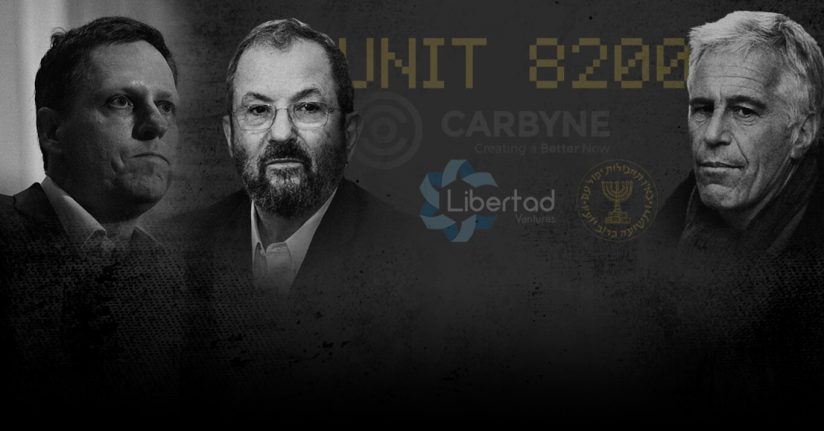
Graphic by Claudio Cabrera
By Whitney Webb | MintPress News | September 6, 2019
Following the arrest and subsequent death in prison of alleged child sex trafficker Jeffrey Epstein, a little-known Israeli tech company began to receive increased publicity, but for all the wrong reasons. Not long after Epstein’s arrest, and his relationships and finances came under scrutiny, it was revealed that the Israeli company Carbyne911 had received substantial funding from Jeffrey Epstein as well as Epstein’s close associate and former Prime Minister of Israel Ehud Barak, and Silicon Valley venture capitalist and prominent Trump backer Peter Thiel.
Carbyne911, or simply Carbyne, develops call-handling and identification capabilities for emergency response services in countries around the world, including the United States, where it has already been implemented in several U.S. counties and has partnered with major U.S. tech companies like Google. It specifically markets its product as a way of mitigating mass shootings in the United States without having to change existing U.S. gun laws.
Yet, Carbyne is no ordinary tech company, as it is deeply connected to the elite Israeli military intelligence division, Unit 8200, whose “alumni” often go on to create tech companies — Carbyne among them — that frequently maintain their ties to Israeli intelligence and, according to Israeli media reports and former employees, often “blur the line” between their service to Israel’s defense/intelligence apparatus and their commercial activity. As this report will reveal, Carbyne is but one of several Israeli tech companies marketing themselves as a technological solution to mass shootings that has direct ties to Israeli intelligence agencies.
In each case, these companies’ products are built in such a way that they can easily be used to illegally surveil the governments, institutions and civilians that use them, a troubling fact given Unit 8200’s documented prowess in surveillance as a means of obtaining blackmail and Israel’s history of using tech companies to aggressively spy on the U.S. government. This is further compounded by the fact that Unit 8200-linked tech companies have previously received U.S. government contracts to place “backdoors” into the U.S.’ entire telecommunications system as well as into the popular products of major American tech companies including Google, Microsoft and Facebook, many of whose key managers and executives are now former Unit 8200 officers.
Israeli Prime Minister Benjamin Netanyahu has made it no secret that placing Unit 8200 members in top positions in multinational tech companies is a “deliberate policy” meant to ensure Israel’s role as the dominant global “cyber power”, while also combating non-violent boycott movements targeting Israel’s violations of international law and stifling the United Nations’ criticisms of Israeli government policy and military operations abroad.
As Jeffrey Epstein’s links to intelligence in both the United States and Israel — the subject of a recent four-part series exclusive to MintPress — began to be revealed in full, his financing of Carbyne came under scrutiny, particularly for the company’s deep ties to Israeli intelligence as well as to certain Americans with known connections to U.S. intelligence. Ehud Barak’s own role as both financier and chairman of Carbyne has also added to that concern, given his long history of involvement in covert intelligence operations for Israel and his long-standing ties to Israeli military intelligence.
Another funder of Carbyne, Peter Thiel, has his own company that, like Carbyne, is set to profit from the Trump administration’s proposed hi-tech solutions to mass shootings. Indeed, after the recent shooting in El Paso, Texas, President Trump — who received political donations from and has been advised by Thiel following his election — asked tech companies to “detect mass shooters before they strike,” a service already perfected by Thiel’s company Palantir, which has developed “pre-crime software” already in use throughout the country. Palantir is also a contractor for the U.S. intelligence community and also has a branch based in Israel.
Perhaps most disturbing of all, whatever technological solution is adopted by the Trump administration, it is set to use a controversial database first developed as part of a secretive U.S. government program that involved notorious Iran-Contra figures like Oliver North as a means of tracking and flagging potential American dissidents for increased surveillance and detention in the event of a vaguely defined “national emergency.”
As this report will reveal, this database — often referred to as “Main Core” — was created with the involvement of Israeli intelligence and Israel remained involved years after it was developed, and potentially to the present. It was also used by at least one former CIA official on President Reagan’s National Security Council to blackmail members of Congress, Congressional staffers and journalists, among others.
Given recent reports on the Trump administration’s plan to create a new government agency to use “advanced technology” to identify “neurobehavioral signs” of “someone headed toward a violent explosive act” using data collected by consumer electronic devices, the picture painted by the technology currently being promoted and implemented under the guise of “keeping Americans safe” is deeply Orwellian. In fact, it points directly to the genesis of a far-reaching surveillance state far more extensive than anything yet seen in American history and it is being jointly developed by individuals connected to both American and Israeli intelligence.
Demystifying Carbyne
Carbyne911, which will be referred to simply as Carbyne in this report, is an Israeli tech-startup that promises to revolutionize how calls are handled by emergency service providers, as well as by governments, corporations and educational institutions. Not long after it was founded in 2014 by veterans of Israeli military intelligence, Carbyne began to be specifically marketed as a solution to mass shootings in the United States that goes “beyond the gun debate” and improves the “intelligence that armed emergency responders receive before entering an armed shooter situation” by providing video-streaming and acoustic input from civilian smartphones and other devices connected to the Carbyne network.
Prior to Jeffrey Epstein’s arrest in July, Carbyne had been receiving high praise from U.S. and Israeli media, with Fox News hailing the company’s services as the answer to the U.S.’ “aging 911 systems” and the Jerusalem Post writing that the company’s platform offers “hi-tech protection to social workers and school principals.” Other reports claimed that Carbyne’s services result in “a 65% reduction in time-to-dispatch.”
Carbyne’s call-handling/crisis management platform has already been implemented in several U.S. counties and the company has offices not only in the U.S. but also in Mexico, Ukraine and Israel. Carbyne’s expansion to more emergency service provider networks in the U.S. is likely, given that federal legislation seeks to offer grants to upgrade 911 call centers throughout the country with the very technology of which Carbyne is the leading provider. One of the main lobby groups promoting this legislation, the National Emergency Number Association (NENA), has a “strong relationship” with Carbyne, according to Carbyne’s website. In addition, Carbyne has also begun marketing its platform for non-emergency calls to governments, educational institutions and corporations.
Yet, what seemed like the inevitability of Carbyne’s widespread adoption in the U.S. hit a snag following the recent arrest and subsequent death of sex trafficker and pedophile Jeffrey Epstein, who exploited underage girls for the purpose of obtaining “blackmail” on the rich and poweful, an operation that had clear ties to intelligence. Epstein, after his first arrest and light sentence for soliciting sex from a minor in 2007, was tapped by former Israeli Prime Minister and former head of Israeli military intelligence Ehud Barak, to become a key financial backer of Carbyne.
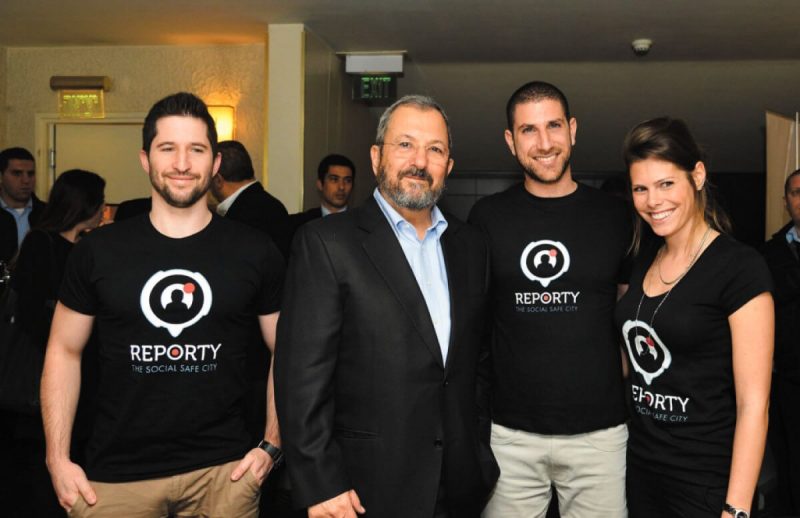
Ehud Barak, center, poses with Carbyne co-founders Alex Dizengof, Amir Elichai and Lital Leshem. Photo | Yossi Seliger
As a result of increased scrutiny of Epstein’s business activities and his ties to Israel, particularly to Barak, Epstein’s connection to Carbyne was revealed and extensively reported on by the independent media outlet Narativ, whose exposé on Carbyne revealed not only some of the key intelligence connections of the start-up company but also how the architecture of Carbyne’s product itself raises “serious privacy concerns.”
MintPress detailed many of Carbyne’s main intelligence connections in Part III of the investigative series “Inside the Jeffrey Epstein Scandal: Too Big to Fail.” In addition to Barak — former Israeli prime minister and former head of Israeli military intelligence — serving as Carbyne’s chairman and a key financer, the company’s executive team are all former members of Israeli intelligence, including the elite military intelligence unit, Unit 8200, which is often compared to the U.S. National Security Agency (NSA).
Carbyne’s current CEO, Amir Elichai, served in Unit 8200 and tapped former Unit 8200 commander and current board member of AIPAC Pinchas Buchris to serve as the company’s director and on its board. In addition to Elichai, another Carbyne co-founder, Lital Leshem, also served in Unit 8200 and later worked for Israeli private spy company Black Cube. The only Carbyne co-founder that didn’t serve in Unit 8200 is Alex Dizengof, who previously worked for Israel’s Prime Minister’s office.
As MintPress noted in a past report detailing Israeli military intelligence’s deep ties to American tech giant Microsoft, Unit 8200 is an elite unit of the Israeli Intelligence corps that is part of the IDF’s Directorate of Military Intelligence and is involved mainly in signal intelligence (i.e., surveillance), cyberwarfare and code decryption. It is frequently described as the Israeli equivalent of the NSA and Peter Roberts, senior research fellow at Britain’s Royal United Services Institute, characterized the unit in an interview with the Financial Times as “probably the foremost technical intelligence agency in the world and stand[ing] on a par with the NSA in everything except scale.”
Notably, the NSA and Unit 8200 have collaborated on numerous projects, most infamously on the Stuxnet virus as well as the Duqu malware. In addition, the NSA is known to work with veterans of Unit 8200 in the private sector, such as when the NSA hired two Israeli companies, to create backdoors into all the major U.S. telecommunications systems and major tech companies, including Facebook, Microsoft and Google. Both of those companies, Verint and Narus, have top executives with ties to Israeli intelligence and one of those companies, Verint (formerly Comverse Infosys), has a history of aggressively spying on U.S. government facilities. Unit 8200 is also known for spying on civilians in the occupied Palestinian territories for “coercion purposes” — i.e., gathering info for blackmail — and also for spying on Palestinian-Americans via an intelligence-sharing agreement with the NSA.
Unlike many other Unit 8200-linked start-ups, Carbyne also boasts several tie-ins to the Trump administration, including Palantir founder and Trump ally Peter Thiel — another investor in Carbyne. In addition, Carbyne’s board of advisers includes former Palantir employee Trae Stephens, who was a member of the Trump transition team, as well as former Secretary of Homeland Security Michael Chertoff. Trump donor and New York real-estate developer Eliot Tawill is also on Carbyne’s board, alongside Ehud Barak and Pinchas Buchris.
Yet, privacy concerns with Carbyne go beyond the company’s ties to Israeli intelligence and U.S. intelligence contractors like Peter Thiel. For instance, Carbyne’s smartphone app extracts the following information from the phones on which it is installed:
Device location, video live-streamed from the smartphone to the call center, text messages in a two-way chat window, any data from a user’s phone if they have the Carbyne app and ESInet, and any information that comes over a data link, which Carbyne opens in case the caller’s voice link drops out.” (emphasis added)
According to Carbyne’s website, this same information can also be obtained from any smartphone, even if it does not have Carbyne’s app installed, if that phone calls a 911 call center that uses Carbyne or merely any other number connected to Carbyne’s network.

Carbyne gathers data points from users’ phones as well as a myriad of other web-connected devices.
Carbyne is a Next-Generation 9-11 (NG911) platform and the explicit goal of NG911 is for all 911 systems nationwide to become interconnected. Thus, even if Carbyne is not used by all 911 call centers using an NG911 platform, Carbyne will ostensibly have access to the data used by all emergency service providers and devices connected to those networks. This guiding principle of NG911 also makes it likely that one platform will be favored at the federal level to foster such interconnectivity and, given that it has already been adopted by several counties and has ties to the Trump administration, Carbyne is the logical choice.
Another cause for concern is how other countries have used platforms like Carbyne, which were first marketed as emergency response tools, for the purpose of mass surveillance. Narativ noted the following in its investigation of Carbyne:
In May, Human Rights Watch revealed Chinese authorities use a platform not unlike Carbyne to illegally surveil Uyghurs. China’s Integrated Joint Operations Platform brings in a much bigger data-set and sources of video, which includes an app on people’s phones. Like Carbyne, the platform was designed to report emergencies. Chinese authorities have turned it into a tool of mass surveillance.
Human Rights Watch reverse-engineered the app. The group discovered the app automatically profiles a user under 36 “person types” including “followers of Six Lines” which is the term used to identify Uyghurs. Another term refers to “Hajj,” the annual Islamic pilgrimage to Mecca. The app monitors every aspect of a user’s life, including personal conversations [and] power usage, and tracks a user’s movement.”
Such technology is currently used by Israeli military intelligence and Israel’s domestic intelligence agency Shin Bet to justify “pre-crime” detentions of Palestinians in the occupied West Bank. As will be noted in greater detail later in this report, Palestinians’ comments on social media are tracked by artificial intelligence algorithms that flag them for indefinite detention if they write social media posts that contain “tripwire” phrases such as “the sword of Allah.”
Carbyne’s platform has its own “pre-crime” elements, such as it’s c-Records component, which stores and analyzes information on past calls and events that pass through its network. This information “enables decision makers to accurately analyze the past and present behavior of their callers, react accordingly, and in time predict future patterns.” (emphasis added)
Concerns have recently been raised that “pre-crime” technology may soon become more widely adopted in the U.S., after President Trump stated that one of his planned solutions to mass shootings in the wake of the recent tragedy in El Paso was for big tech companies to detect potential shooters before they strike.
Israeli intelligence, Blackmail and Silicon Valley
Though many of the individuals involved in funding or managing Carbyne have proven ties to intelligence, a closer look into several of these players reveals even deeper connections to both Israeli and U.S. intelligence.
One of Carbyne’s clearest connections to Israeli intelligence is through its chairman and one of its funders, Ehud Barak. Though Barak is best known for being a former prime minister of Israel, he is also a former minister of defense and the former head of Israeli military intelligence. He oversaw Unit 8200’s operations, as well as other units of Israeli military intelligence, in all three of those positions. For most of his military and later political career, Barak has been closely associated with covert operations.
Prior to the public scrutiny of Barak’s relationship to Jeffrey Epstein, following the latter’s arrest this past July and subsequent death, Barak had come under fire for his ties to disgraced film mogul Harvey Weinstein. Indeed, it was Ehud Barak who put Weinstein in contact with the Israeli private intelligence outfit Black Cube, which employs former Mossad agents and Israeli military intelligence operatives, as Weinstein sought to intimidate the women who had accused him of sexual assault and sexual harassment. Former Mossad director Meir Dagan led Black Cube’s board until his death in 2016 and Carbyne co-founder Lital Leshem is Black Cube’s former director of marketing.
After Barak put him in contact with Black Cube’s leadership, Weinstein, according to The New Yorker, used the private spy firm to “‘target,’ or collect information on, dozens of individuals, and compile psychological profiles that sometimes focused on their personal or sexual histories.” In addition, The New Yorker noted that “Weinstein monitored the progress of the investigations personally” and “also enlisted former employees from his film enterprises to join in the effort, collecting names and placing calls that, according to some sources who received them, felt intimidating.”
Yet, more recently, it has been Barak’s close relationship to Epstein that has raised eyebrows and opened him up to political attacks from his rivals. Epstein and Barak were first introduced by former Israeli Prime Minister Shimon Peres in 2002, a time when Epstein’s pedophile blackmail and sex trafficking operation was in full swing.
Barak was a frequent visitor to Epstein’s residences in New York, so often that The Daily Beast reported that numerous residents of an apartment building linked to Epstein “had seen Barak in the building multiple times over the last few years, and nearly half a dozen more described running into his security detail,” adding that “the building is majority-owned by Epstein’s younger brother, Mark, and has been tied to the financier’s alleged New York trafficking ring.” Specifically, several apartments in the building were “being used to house underage girls from South America, Europe and the former Soviet Union,” according to a former bookkeeper employed by one of Epstein’s main procurers of underage girls, Jean Luc Brunel.
Barak is also known to have spent the night at one of Epstein’s residences at least once, was photographed leaving Epstein’s residence as recently as 2016, and has admitted to visiting Epstein’s island, which has sported nicknames including “Pedo Island,” “Lolita Island” and “Orgy Island.” In 2004, Barak received $2.5 million from Leslie Wexner’s Wexner Foundation, where Epstein was a trustee as well as one of the foundation’s top donors, officially for unspecified “consulting services” and “research” on the foundation’s behalf.
In 2015, Barak formed a limited partnership company in Israel for the explicit purpose of investing in Carbyne (then known as Reporty) and invested millions of dollars in the company, quickly becoming a major shareholder and subsequently the company’s public face and the chairman of its board. At least $1 million of the money invested in this Barak-created company that was later used to invest in Carbyne came from the Southern Trust Company, which was owned by Jeffrey Epstein.
In a statement to the Israeli newspaper Haaretz, Barak asserted:
I saw the business opportunity and registered a partnership in my control in Israel. A small number of people I know invest in it… Since these are private investments, it wouldn’t be proper or right for me to expose the investors’ details.”
However, Barak later admitted that Epstein had been one of the investors.
MintPress’ recent series on the Jeffrey Epstein scandal noted in detail Epstein’s ties to CIA/Mossad intelligence assets, such as Adnan Khashoggi; CIA front companies, such as Southern Air Transport; and organized crime, through his close association with Leslie Wexner. In addition, Epstein’s long-time “girlfriend” and alleged madam, Ghislaine Maxwell, has family links to Israeli intelligence through her father, Robert Maxwell. While it appears that Epstein may have been working for more than one intelligence agency, Zev Shalev, former executive producer for CBS News and journalist at Narativ, recently stated that he had independently confirmed with two unconnected sources “closely connected to the Epstein story and in a position to know” that Epstein had “worked for Israeli military intelligence.”
Exclusive: We have two independent sources confirming Jeffrey Epstein worked for Israeli military intelligence. In each case the source is closely connected to the Epstein story and in a position to know. You can take it to the bank. @narativlive https://t.co/BdK1DrZEO6
— Zev Shalev (@ZevShalev) August 20, 2019
Notably, Epstein, who was known for his interest in obtaining blackmail through the sexual abuse of the underaged girls he exploited, also claimed to have “damaging information” on prominent figures in Silicon Valley. In a conversation last year with New York Times reporter James Stewart, Epstein claimed to have “potentially damaging or embarrassing” information on Silicon Valley’s elite and told Stewart that these top figures in the American tech industry “were hedonistic and regular users of recreational drugs.” Epstein also told Stewart that he had “witnessed prominent tech figures taking drugs and arranging for sex” and claimed to know “details about their supposed sexual proclivities.”
In the lead-up to his recent arrest, Jeffrey Epstein appeared to have been attempting to rebrand as a “tech investor,” as he had done interviews with several journalists including Stewart about technology investing in the months before he was hit with federal sex trafficking charges.
Jessica Lessin, editor-in-chief of The Information, told Business Insider that a journalist working for The Information had interviewed Epstein a month before his recent arrest because “he was believed to be an investor in venture capital funds.” However, Lessin claimed that the interview was not “newsworthy” and said the site had no plans to publish its contents. Business Insider claimed that the way the interviews with Epstein had been arranged “suggests that someone in Silicon Valley may have been trying to help Epstein connect with reporters.”
Though it is unknown exactly which Silicon Valley figures were most connected to Epstein and which tech executives were potentially being blackmailed by Epstein, it is known that Epstein associated with several prominent tech executives, including Google co-founder Sergey Brin, Facebook co-founder Mark Zuckerberg, Tesla CEO Elon Musk, Microsoft co-founder Bill Gates, and LinkedIn co-founder Reid Hoffman.
Last year, Epstein claimed to be advising Tesla and Elon Musk, who had been previously photographed with Epstein’s alleged madam Ghislaine Maxwell. A few years ago, Epstein also attended a dinner hosted by LinkedIn’s Reid Hoffman, where Musk had allegedly introduced Epstein to Mark Zuckerberg. Google’s Sergey Brin is known to have attended a dinner hosted by Epstein at his New York residence where Donald Trump was also in attendance.

Elon Musk with Epstein’s alleged madam Ghislaine Maxwell at an Oscars after-party on March 2, 2014. Kevin Mazur | VF14
These associations suggest that the person in Silicon Valley who was trying to boost Epstein’s image as a tech investor before his arrest may have been Peter Thiel, whose Founders Fund had also invested in Carbyne. Thiel was an early investor in Facebook and is still on its board, connecting him to Zuckerberg; he is also a funder of Elon Musk’s SpaceX and a former colleague of Musk’s through PayPal. In addition, Thiel has ties to Reid Hoffman and both Thiel and Hoffman are prominent backers of Facebook.
It is unknown whether Epstein’s “damaging information” and apparent blackmail on notable individuals in the American technology industry were used to advance the objectives of Carbyne, which recently partnered with tech giants Google and Cisco Systems — and, more broadly, the expansion of Israeli intelligence-linked tech companies into the American tech sector, particularly through the acquisition of Israeli tech start-ups linked to Unit 8200 by major U.S. tech companies.
The latter seems increasingly likely given that the father of Ghislaine Maxwell — one of Epstein’s chief co-conspirators in his intelligence-linked sexual blackmail operation involving minors — was a Mossad operative who helped sell software that had been bugged by Israeli intelligence to government agencies and sensitive facilities around the world, including in the United States.
As will be noted later in this report, Israel’s Prime Minister Benjamin Netanyahu — to whom all of Israel’s intelligence agencies answer by virtue of his position — has stated on more than one occasion that the acquisition of Israeli intelligence-linked start-ups by foreign tech giants, especially in Silicon Valley, is a current and “deliberate policy” of the state of Israel.
Carbyne’s ties to U.S. intelligence
While Epstein and Barak are the two financiers of Carbyne whose ties to intelligence are clearest, another funder of Carbyne, Peter Thiel, has ties to U.S. intelligence and a history of investing in other companies founded by former members of Unit 8200. Thiel co-founded and still owns a controlling stake in the company Palantir, which was initially funded with a $2 million investment from the CIA’s venture capital fund In-Q-Tel and quickly thereafter became a contractor for the CIA.
After the success of its contract with the CIA, Palantir became a contractor for a variety of federal agencies, including the FBI, the Defense Intelligence Agency (DIA), the National Security Agency (NSA), the Department of Homeland Security(DHS) and the military’s Special Operations Command, among others. Last year, it won a contract to create a new battlefield intelligence system for the U.S. Army. Palantir is also in demand for its “pre-crime technology,” which has been used by several U.S. police departments. According to the Guardian, “Palantir tracks everyone from potential terrorist suspects to corporate fraudsters, child traffickers and what they refer to as ‘subversives’… it is all done using prediction.”
Thiel has gained attention in recent years for his support of President Trump and for becoming an adviser to Trump following the 2016 election, when he was “a major force in the transition,” according to Politico, and “helped fill positions in the Trump administration with former staff.” One of those former staffers was Trae Stephens, who is also on Carbyne’s board of advisers. Thiel also has business ties to Trump’s son-in-law and influential adviser, Jared Kushner, as well as to Kushner’s brother Josh. A senior Trump campaign aide told Politico in 2017 that “Thiel is immensely powerful within the administration through his connection to Jared.”
Thiel has also backed some prominent Israeli tech start-ups connected to Unit 8200, such as BillGuard, which Thiel funded along with former Google CEO Eric Schmidt and other investors. BillGuard was founded by Raphael Ouzan, a former officer in Unit 8200, who serves on the board of directors of Start-Up Nation Central (SUNC) alongside neoconservative American hedge fund manager Paul Singer, neoconservative political operative and adviser Dan Senor, and Terry Kassel, who works for Singer at his hedge fund, Elliott Management.
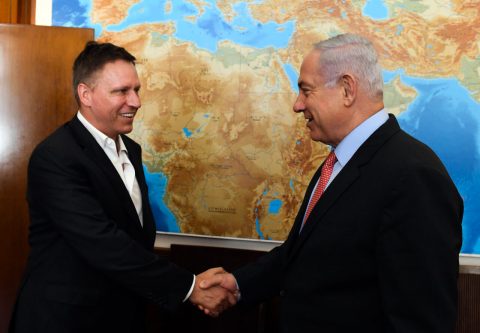
Peter Thiel greets Netanyahu during a 2017 meeting in Israel. Photo | Israel PM
SUNC is an organization founded by Paul Singer, who has donated heavily to both President Trump and Israeli Prime Minister Netanyahu. Since it was founded in 2012, SUNC has sought to integrate Unit 8200-connected Israeli tech start-ups into foreign companies, primarily American companies, and has helped oversee the shift of thousands of high-paying tech jobs from the U.S. to Israel.
Another Carbyne-connected individual worth noting is the former head of the Department of Homeland Security, Michael Chertoff, who serves on Carbyne’s board of advisers. In addition to Chertoff’s ties to DHS, Chertoff’s company, The Chertoff Group, employees several prominent former members of the U.S. intelligence community as principals, including Michael Hayden, former director of the CIA and former director of the NSA; and Charles Allen, former assistant director of Central Intelligence for Collection at the CIA, who worked at the agency for over 40 years.
The Chertoff Group has a long-standing and lucrative contract with the company OSI Systems, which produces full-body scanners and markets itself as a solution to mass shootings and crisis events, not unlike Carbyne. While Chertoff’s company was advising OSI Systems, Chertoff went on a media blitz to promote the widespread use of the machines produced by OSI Systems and even called on Congress to “fund a large-scale deployment of next-generation systems.” Chertoff did not disclose his conflict of interest while publicly promoting OSI’s full-body scanners.
Some have also alleged that Chertoff’s mother, Livia Eisen, had links to Israeli intelligence. According to her 1998 obituary, cited by both researcher/author Christopher Bollyn and journalist Jonathan Cook, Eisen participated in the Mossad operation code-named “Magic Carpet” while working for Israel’s El Al Airlines. Both Bollyn and Cook have suggested that Eisen’s participation in this covert Israeli intelligence operation strongly indicates that she had ties to the Mossad.
Melding into Silicon Valley
Beyond its troubling connections to Silicon Valley oligarchs, Israeli military intelligence and the U.S.-military industrial complex, Carbyne’s recent partnerships with two specific technology companies — Google and Cisco Systems — raise even more red flags.
Carbyne announced its partnership with Cisco Systems this past April, with the latter announcing that it would begin “aligning its unified call manager with Carbyne’s call-handling platform, allowing emergency call centers to collect data from both 911 callers and nearby government-owned IoT [Internet of Things] devices.” A report on the partnership published by Government Technology magazine stated that “Carbyne’s platform will be integrated into Cisco Kinetic for Cities, an IoT data platform that shares data across community infrastructure, smart city solutions, applications and connected devices.” The report also noted that “Carbyne will also be the only 911 solution in the Cisco Marketplace.”
As part of the partnership, Carbyne’s President of North American Operations Paul Tatro told Government Technology that the Carbyne platform would combine the data it obtains from smartphones and other Carbyne-connected devices with “what’s available through nearby Cisco-connected road cameras, roadside sensors, smart streetlamps, smart parking meters or other devices.” Tatro further asserted that “Carbyne can also analyze data that’s being collected by Cisco IoT devices … and alert 911 automatically, without any person making a phone call, if there appears to be a worthy problem,” and expressed his view that soon most emergency calls will not be made by human beings but “by smart cars, telematics or other smart city devices.”
A few months after partnering with Cisco Systems, Carbyne announced its partnership with Google on July 10, just three days after Carbyne funder Jeffrey Epstein was arrested in New York on federal sex trafficking charges. Carbyne’s press release of the partnership described how the company and Google would be teaming up in Mexico “to offer advanced mobile location to emergency communications centers (ECCs) throughout Mexico” following the conclusion of a successful four-week pilot program between Carbyne and Google in the Central American nation.
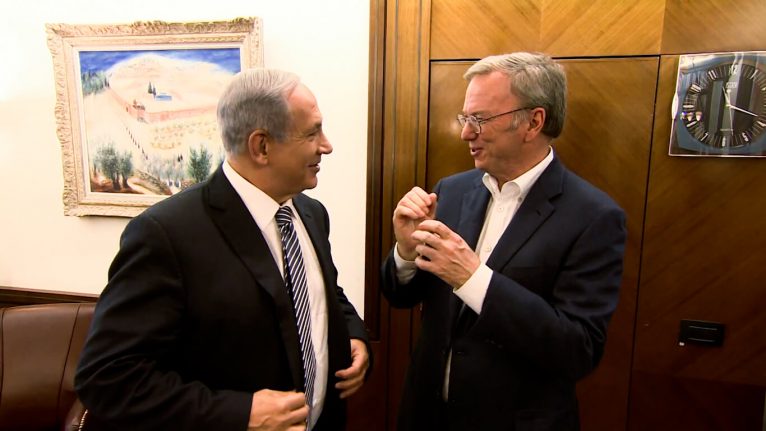
Google Executive Chairman Eric Schmidt meets Netanyahu at his Jerusalem office. Israel PM | YouTube
The press release also stated:
Carbyne will provide Google’s Android ELS (Emergency Location Service) in real time from emergency calls made on AndroidTM devices. Deployment for any ECC in the country won’t require any integration, with Carbyne providing numerous options for connection to their secure ELS Gateway once an ECC is approved. The Carbyne automated platform, requiring no human interaction, has the potential to save thousands of lives each year throughout Mexico.”
The reason Carybne’s partnerships with Cisco Systems and Google are significant lies in the role that Cisco and former Google CEO Eric Schmidt have played in the creation of a controversial “incubator” for Israeli tech start-ups with deep ties to Israeli military intelligence, American neoconservative donor Paul Singer, and the U.S.’ National Security Agency (NSA).
This company, called Team8, is an Israeli company-creation platform whose CEO and co-founder is Nadav Zafrir, former commander of Unit 8200. Two of the company’s other three co-founders are also “alumni” of Unit 8200. Among Team8’s top investors is Schmidt, the former CEO of Google, who also joined Peter Thiel in funding the Unit 8200-linked BillGuard, as well as major tech companies including Cisco Systems and Microsoft.
Last year, Team8 controversially hired the former head of the NSA and U.S. Cyber Command, Retired Admiral Mike Rogers, and Zafrir stated that his interest in hiring Rogers was that Rogers would be “instrumental in helping strategize” Team8’s expansion in the United States. Jake Williams, a veteran of NSA’s Tailored Access Operations (TAO) hacking unit, told CyberScoop:
Rogers is not being brought into this role because of his technical experience. … It’s purely because of his knowledge of classified operations and his ability to influence many in the U.S. government and private-sector contractors.”
Team8 has also been heavily promoted by Start-Up Nation Central (SUNC). SUNC prominently features Team8 and Zafrir on the cybersecurity section of its website and also sponsored a talk by Zafrir and an Israeli government economist at the World Economic Forum, often referred to as “Davos,” that was attended personally by Paul Singer.
SUNC itself has deep ties to Israeli military intelligence, with former Unit 8200 officer Raphael Ouzan serving on its board of directors. Another example of SUNC-Unit 8200 ties can be seen with Inbal Arieli, who served as SUNC’s Vice President of Strategic Partnerships from 2014 to 2017 and continues to serve as a senior adviser to the organization. Arieli, a former lieutenant in Unit 8200, is the founder and head of the 8200 Entrepreneurship and Innovation Support Program (EISP), which was the first start-up accelerator in Israel aimed at harnessing “the vast network and entrepreneurial DNA of [Unit] 8200 alumni” and is currently one of the top company accelerators in Israel, alongside Team8. Arieli was the top executive at 8200 EISP while working at SUNC and several other top SUNC staffers are also connected to Israeli military intelligence.
Thus, Google and Cisco’s connections to Team8 suggests that their partnerships with another Israeli military intelligence-connected firm like Carbyne is a deepening of those two companies’ links to the growing bi-national security state that is uniting key players in the U.S. military-industrial complex and Israeli intelligence.
Mossad-backed Panic Buttons, coming to a school near you
Carbyne is hardly the only Israeli intelligence-linked tech company marketing itself in the United States as a solution to mass shootings. Another Israeli start-up, known as Gabriel, was founded in 2016 in response to a shooting in Tel Aviv and the Pulse Nightclub shooting in the United States, which took place just days apart.
Created by Israeli-American Yoni Sherizen and Israeli citizen Asaf Adler, Gabriel is similar to Carbyne in the sense that elements of its crisis response platform require installation on civilian smartphones as well as devices used by crisis responders. The main difference is that Gabriel also installs one or a series of physical “panic buttons,” depending on the size of the building to be secured, that also double as video and audio communication devices connected to the Gabriel network.
As with Carbyne, the ties between Gabriel and Israeli intelligence are obvious. Indeed, Gabriel’s four-person advisory board includes Ram Ben-Barak, former deputy director of the Mossad and former director-general of Israel’s intelligence ministry; Yohanan Danino, former chief of police for the state of Israel; and Kobi Mor, former director of overseas missions for the Israeli intelligence agency Shin Bet. The only American on the advisory board is Ryan Petty, the father of a Parkland shooting victim and friend of former Florida Governor Rick Scott.
Gabriel’s only disclosed funder is U.S.-based MassChallenge, a start-up accelerator non-profit. Gabriel is funded by MassChallenge’s Israel branch, which was opened six months prior to Gabriel’s creation and is partnered with the Israeli government and the Kraft Group. The Kraft Group is managed by Robert Kraft, who is currently embroiled in a prostitution scandal and is also a close friend of President Trump.
Notably, one of MassChallenge Israel’s featured experts is Wendy Singer, the executive director of SUNC, the organization created and funded by neoconservative Trump backer Paul Singer with the explicit purpose of promoting Israel’s tech start-ups and their integration into foreign, chiefly American, businesses. As was noted in a recent MintPress report on SUNC, Wendy Singer is the sister of neoconservative political operative Dan Senor, who founded the now-defunct Foreign Policy Initiative with Robert Kagan and Bill Kristol, and was previously the director of AIPAC’s Israel office for 16 years.
Gabriel’s founders have been quite upfront about the fact that the uptick in shootings in the U.S. has greatly aided their company’s growth and success. Last November, Sherizen told The Jerusalem Post that new mass shootings in the U.S. not only increased U.S. demand for his company’s product but also were opportunities to show the effectiveness of Gabriel’s approach:
Unfortunately every month there seems to be another high-profile event of this nature. After the Vegas shooting, we were able to show [that] our system would have managed to identify the location of the shooter much quicker.”
The Jerusalem Post noted that Gabriel is set to make considerable profits if concern over mass shootings continues to build in the U.S., writing:
With more than 475,000 soft targets across the US and amid increasing security fears, the potential market for Gabriel is huge. The company could gain revenues of almost $1 billion if only 10% of soft targets were to invest around $20,000 in its alert systems.”
Sherizen told the Jerusalem Post:
Our starter kit costs $10,000. Depending on the size and makeup of the community building, it would cost between $20-30,000 to fully outfit the location. We have made it very affordable. This is a game-changer for the lock-down and active shooter drills that are now a standard part of any child’s upbringing in the States.”
Much more than just a start-up
While it is certainly possible that numerous former officials and commanders of elite Israeli intelligence agencies may have no ulterior motive in advising or founding technology start-up companies, it is worth pointing out that top figures in Israel’s military intelligence agencies and the Mossad don’t see it that way.
Last March, Israeli media outlet Calcalist Tech published a report entitled “Israel Blurs the Line Between Defense Apparatus and Local Cybersecurity Hub,” which noted that “since 2012, cyber-related and intelligence projects that were previously carried out in-house in the Israeli military and Israel’s main intelligence arms are transferred to companies that in some cases were built for this exact purpose.” (emphasis added)
The article notes that beginning in 2012, Israel’s intelligence and military intelligence agencies began to outsource “activities that were previously managed in-house, with a focus on software and cyber technologies.” (emphasis added)
It continues:
In some cases, managers of development projects in the Israeli military and intelligence arms were encouraged to form their own companies, which then took over the project,’ an Israeli venture capitalist familiar with the matter told Calcalist Tech.”
Notably, Calcalist Tech states that the controversial company Black Cube was created this way and that Black Cube had been contracted, and is likely still contracted, by Israel’s Ministry of Defense. The private security agency Black Cube is known to have two separate divisions for corporations and governments. The firm was recently caught attempting to undermine the Iran nuclear deal — then also a top political objective of Israeli Prime Minister Benjamin Netanyahu — by attempting to obtain information on the “financial or sexual impropriety” (i.e., blackmail) of top U.S. officials involved in drafting the accord. NBC News noted last year that “Black Cube’s political work frequently intersects with Israel’s foreign policy priorities.” As previously mentioned, one of Carbyne’s co-founders — Lital Leshem, also a veteran of Unit 8200 — worked for Black Cube prior to starting Carbyne.
One of the main companies profiled in the Calcalist Tech report appeared to be a front for Israeli intelligence, as its registered owner was found not to exist: even high-level employees at the company had never heard of him; his registered addresses were for nonexistent locations in Israel’s capital of Tel Aviv; and the three people with that name in Tel Aviv denied any association with the business.
This company — which Calcalist Tech was unable to name after the Israeli military censor determined that doing so could negatively impact Israeli “national security” — was deliberately created to service the Israeli military and Israeli intelligence. It is also “focused on cyber technologies with expertise in research and development of advanced products and applications suitable for defense and commercial entities.” (emphases added) In addition, the company’s management consists largely of “veterans of Israeli military technology units.”
Notably, a former employee of this company told Calcalist Tech that “crossing the lines between military service and employment at the commercial outfit was ‘commonplace’ while he was working at the company.”
It’s not exactly clear why Israel’s military intelligence and other intelligence agencies decided to begin outsourcing its operations in 2012, though Calcalist Tech suggests the reasoning was related to the difference in wages between the private sector and the public sector, with pay being much higher in the former. However, it is notable that 2012 was also the year that Paul Singer — together with Netanyahu’s long-time economic adviser and former chair of the Israeli National Economic Council, Eugene Kandel — decided to create Start-Up Nation Central.
As MintPress noted earlier this year, SUNC was founded as part of a deliberate Israeli government effort to counter the nonviolent Boycott, Divest and Sanctions (BDS) movement and to make Israel the dominant global “cyber power.” This policy is aimed at increasing Israel’s diplomatic power and specifically undermining BDS as well as the United Nations, which has repeatedly condemned Israel’s government for war crimes and violations of international law in relation to the Palestinians.
Last year, Netanyahu was asked by Fox News host Mark Levin whether the large growth seen in recent years in Israel’s technology sector, specifically tech start-ups, was part of Netanyahu’s plan. Netanyahu responded, “That’s very much my plan … It’s a very deliberate policy.” He later added that “Israel had technology because the military, especially military intelligence, produced a lot of capabilities. These incredibly gifted young men and women who come out of the military or the Mossad, they want to start their start-ups.”
Netanyahu again outlined this policy at the 2019 Cybertech Conference in Tel Aviv, where he stated that Israel’s emergence as one of the top five “cyber powers” had “required allowing this combination of military intelligence, academia and industry to converge in one place” and that this further required allowing “our graduates of our military and intelligence units to merge into companies with local partners and foreign partners.”
The direct tie-ins of SUNC to Israel’s government and the successful effort led by SUNC and other companies and organizations to place former military intelligence and intelligence operatives in strategic positions in major multinational technology companies reveal that this “deliberate policy” has had a major and undeniable impact on the global tech industry, especially in Silicon Valley.
Mossad gets its own In-Q-Tel
This “deliberate policy” of Netanyahu’s also recently resulted in the creation of a Mossad-run venture capital fund that is specifically focused on financing Israeli tech start-ups. The venture capital fund, called Libertad, was first announced by Israel’s Prime Minister’s Office and was created with the explicit purpose of “increasing the Israeli intelligence agency’s knowledge base and fostering collaboration with Israel’s vibrant startup scene” It was modeled after the CIA’s venture capital fund In-Q-Tel, which invested in several Silicon Valley companies turned government and intelligence contractors — including Google and Palantir — with a similar goal in mind.
Libertad declines to reveal the recipients of its funding, but announced last December that it had chosen five companies in the fields of robotics, energy, encryption, web intelligence, and natural language processing and text analysis. In regard to its interest in web intelligence, a Mossad employee told the Jerusalem Post that the intelligence agency was specifically interested in “innovative technologies for [the] automatic identification of personality characteristics – personality profiling – based on online behavior and activity, using methods based on statistics, machine learning, and other areas.” (emphasis added)
According to Libertad’s website, in return for its investment, now set at NIS 2 million (~$580,000) per year per company, “the Mossad will receive access to the IP [initial product] developed during R&D [Research and Development] while under contract, and a non-commercial, non-exclusive license to use it. Libertad’s contract with the company will not provide it with any additional rights.” In an interview with Calcalist Tech, Mossad Director Yossi Cohen told the paper that the Mossad’s partnership with civilian companies in Israel is “excellent” and that the agency will continue to strengthen those ties.
Israeli intelligence has a documented history in placing “backdoors” into technology products for the purpose of surveillance, with one well-known case being Israel’s repurposing of the PROMIS software, discussed in Part III of MintPress’ series on Jeffrey Epstein. Furthermore, given that U.S. intelligence, specifically the NSA, had “backdoors” placed into the products of major Silicon Valley companies (a service performed by Israeli intelligence-linked tech companies no less), Mossad may very well plan on doing the same with the technology products of companies it backs through Libertad.
Tim Shorrock, investigative journalist and author of Spies For Hire: The Secret World of Intelligence Outsourcing, told MintPress that the Mossad’s continuation of such practices through Libertad was definitely plausible, especially given what Shorrock described as the “unusual” choice of Libertad choosing not to release the identities of the companies in which it invests.
“The Mossad is trying to hide what they are investing in,” Shorrock stated, adding that Libertad’s secrecy “raises a lot of questions” particularly given that it was modeled after the CIA’s In-Q-Tel. Shorrock noted that In-Q-Tel and other venture capital funds with ties to U.S. intelligence or the U.S. military rarely, if ever, hide the identities of the companies they finance.
However, Libertad is merely the latest and most public expression of the Mossad’s interest in Israeli tech start-ups, the lion’s share of which are created by veterans of Unit 8200 or other Israeli intelligence agencies. Indeed, former Mossad Director Tamir Pardo stated in 2017 that “everyone” in the Israeli cybertechnology sector is an “alumni” of either Israeli intelligence, like the Mossad, or Israeli military intelligence, like Unit 8200. Pardo even went as far as to say that the Mossad itself is “like a start-up.”
Pardo himself, after leaving his post as Mossad director in 2016, dove straight into the world of Israeli tech start-ups, becoming chairman of Sepio Systems, whose two CEOs are former Unit 8200 officers. Sepio Systems’ advisory board includes the former chief information security officer of the CIA, Robert Bigman; former member of the U.S. Military’s Joint Special Operations Command (JSOC), Geoff Hancock; and former head of the Israel National Cyber Bureau and veteran of Israeli military intelligence, Rami Efrati. Sepio Systems’ cybersecurity software has been adopted by several banks, telecom and insurance companies, including in the U.S. and Brazil.
Pardo is not the only prominent figure in Israel’s intelligence community to compare Israeli intelligence agencies to tech start-ups. Shin Bet Director Nadav Argaman described Israel’s domestic spy agency in similar terms. “The Shin Bet is like an evolving start-up, with unmatched strength,” Argaman stated in a June 2017 speech, as he extolled the agency’s use of “pre-crime” technology to detain Palestinians based on their social media activity.
Argaman, at the time, claimed that more than 2,000 Palestinians, whom he described as “potential lone-wolf terrorists,” had been arrested as a result of these “breakthrough technological advances” that use artificial-intelligence algorithms to monitor the social media accounts of Palestinians, especially younger Palestinians, for the use of “tripwire” phrases that have been used by Palestinians who later committed acts of violence. In the case of those who use such terms, “their phones are tracked to see if they meet other suspects, or leave their districts to move towards potential Israeli targets. In such cases, security forces detain the suspect,” according to a 2017 report on the practice by The Economist.
The road to fascism, paved by a corrupted PROMIS
Though Israeli intelligence’s interest in tech companies goes back several years, there is a well-documented history of Israeli intelligence using bugged software to surveil and gain “backdoor” access to government databases around the world, particularly in the United States.
As was mentioned in Part III of MintPress’ Epstein series, a sinister yet cunning plan was executed to place a backdoor for Israeli intelligence into the Prosecutor’s Management Information System (PROMIS) software, which was then being used by the U.S. Department of Justice and was the envy of government agencies, particularly intelligence agencies, around the world. This bugged version of PROMIS — born out of the collusion between Earl Brian, Ronald Reagan’s then-envoy to Iran, and Rafi Eitan, then-director of the now-defunct Israeli intelligence agency Lekem — was seeded around the world by Brian’s company Hadron as well as by Mossad-linked media mogul Robert Maxwell, father of Jeffrey Epstein’s long-time girlfriend and alleged madam, Ghislaine Maxwell.
After this first PROMIS “backdoor” was discovered, Israel would again gain access to sensitive U.S. government communications, as well as civilian communications, thanks to the collusion between Israeli intelligence and Israeli telecom and tech companies, especially Amdocs and Comverse Infosys (now Verint), that were operating throughout the United States. Today, Unit 8200-linked start-ups appear to have taken up the torch.
While the PROMIS software is perhaps best known for offering Israeli intelligence a backdoor into as many as 80 intelligence agencies and other sensitive locations around the world for nearly a decade, it was also used for a very different purpose by prominent officials linked to Iran-Contra.
One key Iran-Contra figure — Lt. Col. Oliver North, then serving on the National Security Council — decided to use PROMIS neither for espionage nor for foreign policy. Instead, North turned PROMIS’ power against Americans, particularly perceived dissidents, a fact that remained unknown for years.
Beginning in 1982, as part of the highly classified Continuity of Government (COG) program, North used the PROMIS software at a 6,100-square-foot “command center” in the Department of Justice, as well as at a smaller operations room at the White House, to compile a list of American dissidents and “potential troublemakers” if the COG protocol was ever invoked.
According to a senior government official with a high-ranking security clearance and service in five presidential administrations who spoke to Radar in 2008, this was:
A database of Americans, who, often for the slightest and most trivial reason, are considered unfriendly, and who, in a time of panic might be incarcerated. The database can identify and locate perceived ‘enemies of the state’ almost instantaneously.”
In 1993, Wired described North’s use of PROMIS in compiling this database as follows:
Using PROMIS, sources point out, North could have drawn up lists of anyone ever arrested for a political protest, for example, or anyone who had ever refused to pay their taxes. Compared to PROMIS, Richard Nixon’s enemies list or Sen. Joe McCarthy’s blacklist look downright crude.”
The COG program defined this “time of panic” as “a national crisis, such as nuclear war, violent and widespread internal dissent, or national opposition to a US military invasion abroad,” whereby the government would suspend the Constitution, declare martial law, and incarcerate perceived dissidents and other “unfriendlies” in order to prevent the government’s (or then-serving administration’s) overthrow.
This secretive database has often been referred to as “Main Core” by government insiders and, most troubling of all, it still exists today. Journalist Christ Ketcham, citing senior government officials, reported in 2008 that, at that time, Main Core was believed to contain the names of as many as 8 million Americans. Eleven years later, it is highly likely that the number of Americans included in the Main Core database has grown considerably.
Author and investigative journalist Tim Shorrock also covered other disturbing aspects of the evolution of Main Core back in 2008 for Salon. At the time, Shorrock reported that the George W. Bush administration was believed to have used Main Core to guide its domestic surveillance activities following the September 11 attacks.
Citing “several former U.S. government officials with extensive knowledge of intelligence operations,” Shorrock further noted that Main Core — as it was 11 years ago at the time his report was published — was said to contain “a vast amount of personal data on Americans, including NSA intercepts of bank and credit card transactions and the results of surveillance efforts by the FBI, the CIA and other agencies.”
Bill Hamilton, former NSA intelligence officer and the original creator of the PROMIS software, told Shorrock at the time that he believed that “U.S. intelligence uses PROMIS as the primary software for searching the Main Core database” and had been told as much by an intelligence official in 1992 and an NSA official in 1995. Dan Murphy, former deputy director at the CIA, had told Hamilton that the NSA’s use of PROMIS was “so seriously wrong that money alone cannot cure the problem.” “I believe in retrospect that Murphy was alluding to Main Core,” Hamilton had told Shorrock.
Though most reporting on Main Core, from the time its existence was first revealed to the present, has treated the database as something used by the U.S. government and U.S. intelligence for domestic purposes, MintPress has learned that Israeli intelligence was also involved with the creation of the Main Core database. According to a former U.S. intelligence official with direct knowledge of the U.S. intelligence community’s use of PROMIS and Main Core from the 1980s to 2000s, Israeli intelligence played a role in the U.S. government’s deployment of PROMIS as the software used for the Main Core domestic surveillance database system.
Israeli intelligence remained involved with Main Core at the time of the August 1991 death of journalist Danny Casolaro, who was investigating not only the government’s misuse of the stolen PROMIS software but also the Main Core database. This same official, who chose to remain anonymous, told MintPress that, shortly before his death, Casolaro had obtained copies of computer printouts from the PROMIS-based Main Core domestic surveillance database system from NSA whistleblower Alan Standorf, who was found murdered a few months before Casolaro’s lifeless body would be found in a West Virginia hotel room.
The source also stated that Main Core’s contents had been used for the political blackmail of members of Congress and their staff, journalists, and others by Walter Raymond, a senior CIA covert operator in psyops and disinformation who served on President Reagan’s National Security Council during and after Main Core’s creation. If used for this purpose by Raymond in the 1980s, Main Core has also likely been used by other individuals with access to the database for blackmailing purposes in the years since.
Given that Israeli intelligence was known to have placed a backdoor into the PROMIS software, before it was marketed and sold around the world by Earl Brian and Robert Maxwell, its role in the U.S. government’s decision to use PROMIS in the creation of Main Core suggests that Israeli intelligence likely advocated for the version of PROMIS containing this backdoor, thereby giving Israeli intelligence access to Main Core. Given that Reagan aides and officials colluded with Israeli “spymaster” Rafi Eitan in his efforts to create a backdoor into the software for Israeli military intelligence, the use of this version of PROMIS in the Main Core database is certainly plausible.
Furthermore, the fact that Israeli intelligence was known to be involved in Main Core nearly a decade after its creation suggests that Israeli intelligence may have played a role in certain aspects of the database, such as the criteria used to flag Americans as “unfriendly,” and — like Walter Raymond — may have used information in the database to blackmail Americans. In addition, the fact that the cooperation between U.S. and Israeli intelligence, particularly between Unit 8200 and the NSA, has only grown since 1991 further suggests that Israeli involvement in Main Core continues to the present.
While Main Core’s very existence is troubling for many reasons, the alleged involvement of a foreign intelligence service in the creation, expansion and maintenance of a database with personal details and potentially damaging information on millions of Americans targeted for detention or increased surveillance in times of crisis is chilling. It is especially so considering that the Trump administration’s latest proposals to prevent mass shootings before they occur are likely to use Main Core to flag certain Americans for increased surveillance or potentially detention, as was done by the George W. Bush administration following the September 11 attacks.
It appears that Main Core serves a dual purpose; first as a mass targeted surveillance system to crush dissent during times of “national crisis” — whether spontaneous or engineered — and, second, as a massive blackmail database used to keep every potential opponent in line during non-emergencies.
Peter Thiel’s Seeing Stone
As was mentioned earlier in this report, Palantir — the company co-founded by Peter Thiel — is set to profit handsomely from the Trump administration’s plans to use its “pre-crime” technology, which is already used by police departments throughout the country and also used to track Americans based on the company’s integrative data-mining approach. Palantir, named for the “seeing stones” in the Lord of the Rings novels, also markets software to foreign (and domestic) intelligence agencies that predicts the likelihood that an individual will commit an act of terrorism or violence.
Aside from its “pre-crime” products, Palantir has come under fire in recent years as a result of the company’s contracts with Immigration and Customs Enforcement (ICE), where it created an intelligence system known as Investigative Case Management (ICM). The IB Times described ICM as “a vast ‘ecosystem’ of data to help immigration officials in identifying targets and creating cases against them” and also “provides ICE agents with access to databases managed by other federal agencies.” ICM further gives ICE access to “targets’ personal and sensitive information, such as background on schooling, employment, family relationships, phone records, immigration history, biometrics data, criminal records as well as home and work addresses.” In other words, Palantir’s ICM is essentially a “Main Core” for immigrants.
Notably, part of Oliver North’s original intentions in “Main Core” was to track immigrants then coming from Central America as well as Americans who opposed Reagan era policy with respect to Central America. At that time, Main Core was believed to be controlled by the Federal Emergency Management Administration (FEMA), which is now part of the Department of Homeland Security (DHS).
VICE News reported in July that the Northern California Regional Intelligence Center, which is run by DHS, “serves around 300 communities in northern California and is what is known as a ‘fusion center,’ a Department of Homeland Security intelligence center that aggregates and investigates information from state, local, and federal agencies, as well as some private entities, into large databases that can be searched using software like Palantir. “ VICE further noted that this center alone used Palantir to surveil as many as 8 million Ameicans. There are many more such DHS “fusion centers” throughout the United States.
If the Trump administration moves forward with its proposal of employing technology to detect potential mass shooters before they strike, Palantir’s technology is set to be used, given that it has already been used by U.S. law enforcement and U.S. intelligence to determine which people run “the highest risk of being involved in gun violence,” according to an investigation of Palantir by The Verge. Furthermore, Palantir’s close ties to the Trump administration make the company’s role in a future nationwide “pre-crime” prevention system based on technology appear inevitable.
Worse still is the apparent overlap between Palantir and Main Core. Palantir — which has obvious similarities to PROMIS — is already known to use its software to track potential terror threats, including domestic terror threats, and a category of people it refers to as “subversives.” Palantir’s tracking of these individuals “is all done using prediction.” Palantir’s close ties to the U.S. intelligence community suggest that Palantir may already have access to the Main Core database. Tim Shorrock told MintPress that Palantir’s use of Main Core is “certainly possible,” particularly in light of the company’s use of the term “subversive” to describe a category of people that its software tracks.
Palantir also has alleged ties to Israeli intelligence, as there have long been suspicions that Israeli intelligence has used Palantir as part of its AI “pre-crime” algorithms targeting Palestinians after Palantir opened a research and development (R&D) center in Israel in 2013. The current head of Palantir Israel, Hamultal Meridor, previously founded a brain-machine interface organization and was senior director of web intelligence at Verint (formerly Comverse Infosys), which has deep connections to Unit 8200, a history of espionage in the United States and was one of the two companies contracted by the NSA to insert a “backdoor” into the U.S. telecommunications system and popular products of major American tech companies.
Given the above, Peter Thiel’s 2018 decision to fund Carbyne, the Unit 8200-linked start-up that markets itself as a technological solution to mass shootings in the U.S., strongly suggests that Thiel has been anticipating for some time the now-public efforts of the Trump administration to employ “pre-crime” technology to track and target Americans who show signs of “mental illness” and “violent tendencies.”
A nightmare even Orwell could not have predicted
In early August, in the wake of the shooting at an El Paso Walmart, President Trump called on big tech companies to collaborate with the Justice Department in the creation of software that “stops mass murders before they start” by detecting potential mass shooters before they cnm act. Though Trump’s ideas were short on specifics, there is now a new proposal that would create a new government agency that will use data gathered from civilian electronic devices to identify “neurobehavioral” warning signs, thereby flagging “potential shooters” for increased surveillance and potentially detention.
This new agency, as proposed by the foundation led by former NBC Universal president and vice chairman of General Electric Robert Wright, would be known as the Health Advanced Research Projects Agency (HARPA) and would be modeled after the Defense Advanced Research Projects Agency (DARPA). Per the proposal, recently detailed by the Washington Post, the flagship program of HARPA would be “Safe Home” (Stopping Aberrant Fatal Events by Helping Overcome Mental Extremes), which would use “breakthrough technologies with high specificity and sensitivity for early diagnosis of neuropsychiatric violence,” specifically “advanced analytical tools based on artificial intelligence and machine learning.”
The program would cost an estimated $60 million over four years and would use data from “Apple Watches, Fitbits, Amazon Echo and Google Home” and other consumer electronic devices, as well as information provided by health-care providers to identify who may be a threat.
The Washington Post reported that President Trump has reacted “very positively” to the proposal and that he was “sold on the concept.” The Post also noted that Wright sees the president’s daughter, Ivanka, as “the most effective champion of the proposal and has previously briefed her on HARPA himself.” Ivanka has previously been cited as a driving force behind some of her father’s policy decisions, including his decision to bomb Syria after an alleged chemical weapons attack in 2017.
Liz Fed — president of the Susan Wright Foundation, which is led by Robert Wright and created the proposal for HARPA and “Safe Home” — told the Post that the proposal emulated DARPA because “DARPA is a brilliant model that works. They have developed the most transformational capabilities in the world for national security…We’re not leveraging the tools and technologies available to us to improve and save lives.” Fed further asserted that DARPA’s technological approach had yet to be applied to the field of healthcare.
For anyone familiar with DARPA, such claims should immediately sound loud alarm bells, especially since DARPA is already developing its own solution to “mental health” issues in the form of a “brain-machine interface” as part of its N3 program. That program, according to reports, involves “noninvasive and ‘minutely’ invasive neural interfaces to both read and write into the brain,” help distance soldiers “from the emotional guilt of warfare” by “clouding their perception” and “to program artificial memories of fear, desire, and experiences directly into the brain.” Though N3 is intended to improve the prowess of American soldiers, it is also set to be used as a means of pursuing DARPA’s Systems-Based Neurotechnology for Emerging Therapies (SUBNETS) project, which aims to “to develop a tiny, implanted chip in the skull to treat psychiatric disorders such as anxiety, PTSD and major depression.”
Given that HARPA’s lead scientific adviser is Dr. Geoffrey Ling, former director and founder of DARPA’s Biological Technologies Office (BTO), which “merges biology, engineering, and computer science to harness the power of natural systems for national security,” it seems likely that DARPA’s neurological-focused research programs, like SUBNETS and N3, would be folded into HARPA’s portfolio, making the proposed agency’s approach to mental health very questionable indeed.
Aside from the dystopian nature of both DARPA and potentially HARPA’s approach to mental health, there is grave cause for concern regarding the Trump administration’s moves to address U.S. mass shooting events by implementing pre-crime technology based on artificial intelligence, data-mining and mass surveillance, technologies already laying in wait thanks to companies like Palantir and numerous Israeli tech start-ups led by former Unit 8200 officers.
With companies like Carbyne — with its ties to both the Trump administration and to Israeli intelligence — and the Mossad-linked Gabriel also marketing themselves as “technological” solutions to mass shootings while also doubling as covert tools for mass data collection and extraction, the end result is a massive surveillance system so complete and so dystopian that even George Orwell himself could not have predicted it.
Following another catastrophic mass shooting or crisis event, aggressive efforts will likely follow to foist these “solutions” on a frightened American public by the very network connected, not only to Jeffrey Epstein, but to a litany of crimes and a frightening history of plans to crush internal dissent and would-be dissenters in the United States.
9/11 and the American Orwellian Nightmare
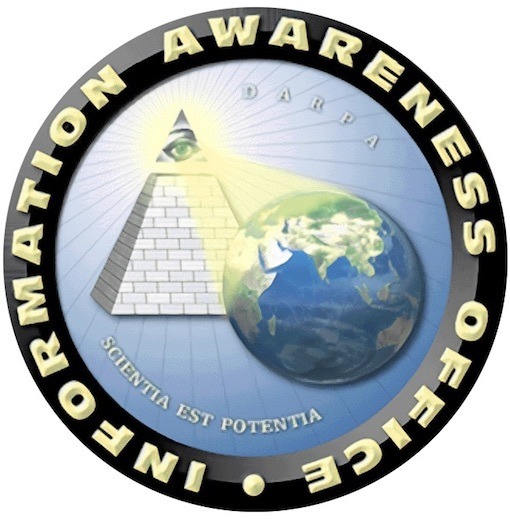
Total Information Awareness logo
By James Bovard | Future of Freedom Foundation | September 6, 2019
Next week will mark the 18th anniversary of the 9/11 attacks. Politicians and bureaucrats wasted no time after that carnage to unleash the Surveillance State on average Americans, treating every citizen like a terrorist suspect. Since the government failed to protect the public, Americans somehow forfeited their constitutional right to privacy. Despite heroic efforts by former NSA staffer Edward Snowden and a host of activists and freedom fighters, the government continues ravaging American privacy.
Two weeks after the 9/11 attacks, Deputy Assistant Attorney General John Yoo sent a secret memo to the Bush White House declaring that the Constitution’s prohibition on unreasonable searches was null and void: “If the government’s heightened interest in self-defense justifies the use of deadly force, then it also certainly would justify warrantless searches.” Yoo is best known for writing a harebrained memo on why presidents can order torture but he also helped sanctify the wholesale demolition of privacy.
Two of the largest leaps towards an American “1984” Orwellian nightmare began in 2002. Though neither the Justice Department’s Operation TIPS nor the Pentagon’s Total Information Awareness program was brought to completion, perverse parcels and precedents from each program profoundly influenced subsequent federal policies.
In July 2002, the Justice Department unveiled Operation TIPS — the Terrorism Information and Prevention System. According to the Justice Department website, TIPS would be “a nationwide program giving millions of American truckers, letter carriers, train conductors, ship captains, utility employees, and others a formal way to report suspicious terrorist activity.” TIPSters would be people who, “in the daily course of their work, are in a unique position to serve as extra eyes and ears for law enforcement.” The feds aimed to recruit people in jobs that “make them uniquely well positioned to understand the ordinary course of business in the area they serve, and to identify things that are out of the ordinary.” Homeland Security boss Tom Ridge said that observers in certain occupations “might pick up a break in the certain rhythm or pattern of a community.” The feds planned to enlist as many as 10 million people to watch other people’s “rhythms.” Best of all, TIPsters could gather and report personal information on people without the nuisance of acquiring a search warrant.
The Justice Department provided no definition of “suspicious behavior” to guide its vigilantes. But the notion of recruiting millions of run-a-muk informants spurred protests; even the U.S. Postal Service briefly balked at participating in the program. Ridge insisted that TIPS “is not a government intrusion.” He declared, “The last thing we want is Americans spying on Americans. That’s just not what the president is all about, and not what the TIPS program is all about.” Ridge refrained from christening the program with the motto: “Those who have nothing to hide have nothing to fear.”
When Attorney General John Ashcroft was cross-examined by Sen. Patrick Leahy (D-Vt.) on TIPS at a Judiciary Committee hearing on July 25, he insisted that “the TIPS program is something requested by industry to allow them to talk about anomalies that they encounter.” But, when President Bush had initially portrayed the program as an administration initiative. Did thousands of Teamsters Union members petition 1600 Pennsylvania Avenue to join the fight against fellow citizens’ “anomalies”? Senator Leahy asked whether reports to the TIPS hotline would become part of a federal database with millions of unsubstantiated allegations against American citizens. Ashcroft told Leahy, “I have recommended that there would be none, and I’ve been given assurance that the TIPS program would not maintain a database.” But Ashcroft could not reveal which federal official had given him the assurance.
The ACLU’s Laura Murphy observed, “This is a program where people’s activities, statements, posters in their windows or on their walls, nationality, and religious practices will be reported by untrained individuals without any relationship to criminal activity.” San Diego law professor Marjorie Cohn observed, “Operation TIPS … will encourage neighbors to snitch on neighbors and won’t distinguish between real and fabricated tips. Anyone with a grudge or vendetta against another can provide false information to the government, which will then enter the national database.”
On August 9, the Justice Department announced it was fine-tuning TIPS, abandoning any “plan to ask thousands of mail carriers, utility workers, and others with access to private homes to report suspected terrorist activity,” the Washington Post reported. People who had enlisted to be TIPSters received an email notice from Uncle Sam that “only those who work in the trucking, maritime, shipping, and mass transit industries will be eligible to participate in this information referral service.” But the Justice Department continued refusing to disclose to the Senate Judiciary Committee who would have access to the TIPS reports.
After the proposal created a fierce backlash across the political board, House Majority Leader Richard Armey (R-Tex.) attached an amendment to homeland security legislation that declared, “Any and all activities of the federal government to implement the proposed component program of the Citizen Corps known as Operation TIPS are hereby prohibited.” But the Bush administration and later the Obama administration pursued the same information roundup with federally funded fusion centers that encouraged people to file “suspicious activity reports” for a bizarre array of innocuous behavior such as taking photos, waiting too long for a bus, having “Don’t Tread on Me” bumper stickers. Those reports continue to be dumped into secret federal databases that can vex innocent citizens in perpetuity.
Operation TIPS illustrated how the momentum of intrusion spurred government to propose programs that it never would have attempted before 9/11. If Bush had proposed in August 2001 to recruit 10 million Americans to snitch on any neighbors they suspected of being potential troublemakers, the public might have concluded the president had gone berserk. Instead, the federal government proceeded to vacuum up info like the Home Owners Association From Hell.
Total Information Awareness: 300 million dossiers
The USA PATRIOT Act created a new Information Office in the Pentagon’s Defense Advanced Research Projects Agency (DARPA). In January 2002, the White House chose retired admiral John Poindexter to head the new office. White House spokesman Ari Fleischer explained, “Admiral Poindexter is somebody who this administration thinks is an outstanding American, an outstanding citizen, who has done a very good job in what he has done for our country, serving the military.” It was unclear whether the Bush administration chose Poindexter because of or in spite of his five felony convictions for false testimony to Congress and destruction of evidence during the investigation of the Iran-Contra arms-for-hostages exchange. Poindexter’s convictions were overturned by a federal appeals court, which cited the immunity Congress granted his testimony.
Poindexter committed the new Pentagon office to achieving Total Information Awareness (TIA). TIA’s mission is “to detect, classify and identify foreign terrorists — and decipher their plans — and thereby enable the U.S. to take timely action to successfully preempt and defeat terrorist acts,” according to DARPA. According to Undersecretary of Defense Pete Aldridge, TIA would seek to discover “connections between transactions — such as passports; visas; work permits; driver’s licenses; credit cards; airline tickets; rental cars; gun purchases; chemical purchases — and events — such as arrests or suspicious activities and so forth.” Aldridge agreed that every phone call a person made or received could be entered into the database. With “voice recognition” software, the actual text of the call could also go onto a permanent record.
TIA would also strive to achieve “Human Identification at a Distance” (HumanID), including “Face Recognition,” “Iris Recognition,” and “Gait Recognition.” The Pentagon issued a request for proposals to develop an “odor recognition” surveillance system that would help the feds identify people by their sweat or urine — potentially creating a wealth of new job opportunities for deviants.
TIA’s goal was to stockpile as much information as possible about everyone on Earth — thereby allowing government to protect everyone from everything. New York Times columnist William Safire captured the sweep of the new surveillance system: “Every purchase you make with a credit card, every magazine subscription you buy and medical prescription you fill, every Web site you visit and e-mail you send or receive, every academic grade you receive, every bank deposit you make, every trip you book, and every event you attend — all these transactions and communications will go into what the Defense Department describes as ‘a virtual, centralized grand database.’” Columnist Ted Rall noted that the feds would even scan “veterinary records. The TIA believes that knowing if and when Fluffy got spayed — and whether your son stopped torturing Fluffy after you put him on Ritalin — will help the military stop terrorists before they strike.”
Phil Kent, president of the Southeastern Legal Foundation, an Atlanta-based public-interest law firm, warned that TIA was “the most sweeping threat to civil liberties since the Japanese-American internment.” The ACLU’s Jay Stanley labeled TIA “the mother of all privacy invasions. It would amount to a picture of your life so complete, it’s equivalent to somebody following you around all day with a video camera.” A coalition of civil-liberties groups protested to Senate leaders, “There are no systems of oversight or accountability contemplated in the TIA project. DARPA itself has resisted lawful requests for information about the Program pursuant to the Freedom of Information Act.”
Bush administration officials were outraged by such criticisms. Defense Secretary Donald Rumsfeld declared, “The hype and alarm approach is a disservice to the public…. I would recommend people take a nice deep breath. Nothing terrible is going to happen.” Poindexter promised that TIA would be designed to “preserve rights and protect people’s privacy while helping to make us all safer.” (Poindexter was not under oath at the time of his statement.)
TIA was defended on the basis that “nobody has been searched” until the feds decide to have him arrested on the basis of data the feds snared. Undersecretary Aldridge declared, “It is absurd to think that DARPA is somehow trying to become another police agency. DARPA’s purpose is to demonstrate the feasibility of this technology. If it proves useful, TIA will then be turned over to the intelligence, counterintelligence, and law-enforcement communities as a tool to help them in their battle against domestic terrorism.” The FBI joined the fun, working on a memorandum of understanding with the Pentagon “for possible experimentation” with TIA. Assistant Defense Secretary for Homeland Security Paul McHale later confirmed that the Pentagon would turn TIA over to law-enforcement agencies once the system was ready to roll.
In response to its paranoid critics, DARPA removed the spooky Information Awareness Office logo from the program’s website. That logo showed a giant green eye atop a pyramid, covering half the globe with a peculiar yellow haze and the motto “Scientia est Potentia” (Knowledge is Power). DARPA received no credit for refraining from using a more honest maxim such as “You’re Screwed.”
In April 2003, DARPA program manager Lt. Col. Doug Dyer publicly announced that Americans are obliged to sacrifice some privacy in the name of security: “When you consider the potential effect of a terrorist attack against the privacy of an entire population, there has to be some trade-off.” But nothing in the U.S. Constitution entitled the Pentagon to decree how much privacy or liberty American citizens deserve.
In September 2003, Congress passed an amendment abolishing the Pentagon’s Information Office and ending TIA funding. But by that point, DARPA had already awarded 26 contracts for dozens of private research projects to develop components for TIA and a working protype already existed. The facial recognition software now being deployed at the U.S. border and at airports may be one legacy of that program.
While specific policies or proposals have been rebuffed since 9/11, there has been no turning of the tide against the Orwellian nightmare federal agencies have spawned. From the TSA to the National Security Agency to the FBI and Department of Homeland Security, our privacy continues to be ravaged in ways that would have mortified earlier generations of Americans. But nothing happened on 9/11 that made the federal government more trustworthy.
James Bovard is the author of Attention Deficit Democracy, The Bush Betrayal, Terrorism and Tyranny, and other books. Bovard is on the USA Today Board of Contributors. He is on Twitter at @jimbovard. His website is at www.jimbovard.com
Seth Rich’s Ghost Haunts the Courts
By Ray McGovern | Consortium News | August 12, 2019
As if it weren’t enough of a downer for Russiagate true believers that no Trump-Russia collusion was found, federal judges are now demanding proof that Russia hacked into the DNC in the first place.
It is shaping up to be a significant challenge to the main premise of the shaky syllogism that ends with “Russia did it.”
If you’re new to this website, grab onto something, as the following may come as something of a shock. Not only has there never been any credible evidence to support the claim of Russian cyber interference, there has always been a simple alternative explanation that involves no “hacking” at all — by Russia or anyone else.
As most Consortium News habitués are aware, Veteran Intelligence Professionals for Sanity (which includes two former NSA technical directors), working with independent forensic investigators, concluded two years ago that what “everyone knows to be Russian hacking of the Democratic National Committee” actually involved an insider with physical access to DNC computers copying the emails onto an external storage device — such as a thumb drive. In other words, it was a leak, not a hack.
VIPS based its conclusion on the principles of physics applied to metadata and other empirical information susceptible of forensic analysis.
But if a leak, not a hack, who was the DNC insider-leaker? In the absence of hard evidence, VIPS refuses “best-guess”-type “assessments” — the kind favored by the “handpicked analysts” who drafted the evidence-impoverished, so-called Intelligence Community Assessment of Jan. 6, 2017.
Conspiracy Theorists
Simply letting the name “Seth Rich” pass your lips can condemn you to the leper colony built by the Washington Establishment for “conspiracy theorists,” (the term regularly applied to someone determined to seek tangible evidence, and who is open to alternatives to “Russia-did-it.”)
Rich was a young DNC employee who was murdered on a street in Washington, DC, on July 10, 2016. Many, including me, suspect that Rich played some role in the leaking of DNC emails to WikiLeaks. There is considerable circumstantial evidence that this may have been the case. Those who voice such suspicions, however, are, ipso facto, branded “conspiracy theorists.”
That epithet has a sordid history in the annals of U.S. intelligence. Legendary CIA Director Alan Dulles used the “brand-them-conspiracy-theorists” ploy following the assassination of President John F. Kennedy when many objected — understandably — to letting him pretty much run the Warren Commission, even though the CIA was suspected of having played a role in the murder. The “conspiracy theorist” tactic worked like a charm then, and now. Well, up until just now.
Rich Hovers Above the Courts
U.S. Courts apply far tougher standards to evidence than do the intelligence community and the pundits who loll around lazily, feeding from the intelligence PR trough. This (hardly surprising) reality was underscored when a Dallas financial adviser named Ed Butowsky sued National Public Radio and others for defaming him about the role he played in controversial stories relating to Rich. On August 7, NPR suffered a setback, when U.S. District Court Judge Amos Mazzant affirmed a lower court decision to allow Butowsky’s defamation lawsuit to proceed.
Judge Mazzant ruled that NPR had stated as “verifiable statements of fact” information that could not be verified, and that the plaintiff had been, in effect, accused of being engaged in wrongdoing without persuasive sourcing language.
Imagine! — “persuasive sourcing” required to separate fact from opinion and axes to grind! An interesting precedent to apply to the ins and outs of Russiagate. In the courts, at least, this is now beginning to happen. And NPR and others in similarly vulnerable positions are scurrying around for allies.?? The day after Judge Mazzant’s decision, NPR enlisted help from discredited Yahoo! News pundit Michael Isikoff (author, with David Corn, of the fiction-posing-as-fact novel Russian Roulette). NPR gave Isikoff 37 minutes on its popular Fresh Air program to spin his yarn about how the Seth Rich story got started. You guessed it; the Russians started it. No, we are not making this up.
It is far from clear that Isikoff can be much help to NPR in the libel case against it. Isikoff’s own writings on Russiagate are notably lacking in “verifiable statements of fact” — information that cannot be verified. Watch, for example, his recent interview with Consortium News Editor Joe Lauria on CN Live!
Isikoff admitted to Lauria that he never saw the classified Russian intelligence document reportedly indicating that three days after Rich’s murder the Russian SVR foreign intelligence service planted a story about Rich having been the leaker and was killed for it. This Russian intelligence “bulletin,” as Isikoff called it, was supposedly placed on a bizarre website that Isikoff admitted was an unlikely place for Russia to spread disinformation. He acknowledged that he only took the word of the former prosecutor in the Rich case about the existence of this classified Russian document.
In any case, The Washington Post, had already debunked Isikoff’s claim (which later in his article he switched to being only “purported”) by pointing out that Americans had already tweeted the theory of Rich’s murder days before the alleged Russian intervention.
‘Persuasive Sourcing’ & Discovery??
Butowsky’s libel lawsuit can now proceed to discovery, which will include demands for documents and depositions that are likely to shed light on whatever role Rich may have played in leaking to WikiLeaks. If the government obstructs or tries to slow-roll the case, we shall have to wait and see, for example, if the court will acquiesce to the familiar government objection that information regarding Rich’s murder must be withheld as a state secret? Hmmm. What would that tell us?
During discovery in a separate court case, the government was unable to produce a final forensic report on the “hacking” of the Democratic National Committee. The DNC-hired cyber firm, CrowdStrike, failed to complete such a report, and that was apparently okay with then FBI Director James Comey, who did not require one.
The incomplete, redacted, draft, second-hand “forensics” that Comey settled for from CrowdStrike does not qualify as credible evidence — much less “persuasive sourcing” to support the claim that the Russians “hacked” into the DNC. Moreover, CrowdStrike has a dubious reputation for professionalism and a well known anti-Russia bias.
The thorny question of “persuasive sourcing,” came up even more starkly on July 1, when federal Judge Dabney Friedrich ordered Robert Mueller to stop pretending he had proof that the Russian government was behind the Internet Research Agency’s supposed attempt to interfere via social media in the 2016 election. Middle school-level arithmetic can prove the case that the IRA’s use of social media to support Trump is ludicrous on its face.
Russia-gate Rubble
As journalist Patrick Lawrence put it recently: “Three years after the narrative we call Russiagate was framed and incessantly promoted, it crumbles into rubble as we speak.” Falling syllogism! Step nimbly to one side.
The “conspiracy theorist” epithet is not likely to much longer block attention to the role, if any, played by Rich — the more so since some players who say they were directly involved with Rich are coming forward.
In a long interview with Lauria a few months ago in New Zealand aired this month on CN Live!, Kim Dotcom provided a wealth of detail, based on what he described as first-hand knowledge, regarding how Democratic National Committee documents were leaked to WikiLeaks in 2016.
The major takeaway: the evidence presented by Dotcom about Seth Rich can be verified or disproven if President Trump summons the courage to order the director of NSA to dig out the relevant data, including the conversations Dotcom says he had with Rich and Rich may have had with WikiLeaks publisher Julian Assange. Dotcom said he put Rich in touch with a middleman to transfer the DNC files to WikiLeaks. Sadly, Trump has flinched more than once rather than confront the Deep State — and this time there are a bunch of very well connected, senior Deep State practitioners who could face prosecution.
Another sign that Rich’s story is likely to draw new focus is the virulent character assassination indulged in by former investigative journalist James Risen.
Not Risen to the Challenge
On August 5, in an interview on The Hill’s “Rising,” Risen chose to call former NSA Technical Director Bill Binney — you guessed it — a “conspiracy theorist” on Russia-gate, with no demurral, much less pushback, from the hosts.
The having-done-good-work-in-the-past-and-now-not-so-much Risen can be considered a paradigm for what has happened to so many Kool-Aid drinking journalists. Jim’s transition from investigative journalist to stenographer is, nonetheless unsettling. Contributing causes? It appears that the traditional sources within the intelligence agencies, whom Risen was able to cultivate discreetly in the past, are too fearful now to even talk to him, lest they get caught by one or two of the myriad surveillance systems in play.
Those at the top of the relevant agencies, however, are only too happy to provide grist. Journalists have to make a living, after all. Topic A, of course, is Russian “interference” in the 2016 election. And, of course, “There can be little doubt” the Russians did it.
“Big Jim” Risen, as he is known, jumped on the bandwagon as soon as he joined The Intercept, with a fulsome article on February 17, 2018 titled “Is Donald Trump a Traitor?” Here’s an excerpt:
“The evidence that Russia intervened in the election to help Trump win is already compelling, and it grows stronger by the day.
“There can be little doubt now that Russian intelligence officials were behind an effort to hack the DNC’s computers and steal emails and other information from aides to Hillary Clinton as a means of damaging her presidential campaign. … Russian intelligence also used fake social media accounts and other tools to create a global echo chamber both for stories about the emails and for anti-Clinton lies dressed up to look like news.
“To their disgrace, editors and reporters at American news organizations greatly enhanced the Russian echo chamber, eagerly writing stories about Clinton and the Democratic Party based on the emails, while showing almost no interest during the presidential campaign in exactly how those emails came to be disclosed and distributed.” (sic)
Poor Jim. He shows himself just as susceptible as virtually all of his fellow corporate journalists to the epidemic-scale HWHW virus (Hillary Would Have Won) that set in during Nov. 2016 and for which the truth seems to be no cure. From his perch at The Intercept, Risen will continue to try to shape the issues. Russiagaters major ally, of course, is the corporate media which has most Americans pretty much under their thumb.
Incidentally, neither The New York Times, The Washington Post, nor The Wall Street Journal has printed or posted a word about Judge Mazzant’s ruling on the Butowsky suit.
Mark Twain is said to have warned, “How easy it is to make people believe a lie, and [how] hard it is to undo that work again!” After three years of “Russia-Russia-Russia” in the corporate — and even in some “progressive” — media, this conditioning will not be easy to reverse.
Here’s how one astute observer with a sense of humor described the situation last week, in a comment under one of my recent pieces on Consortium News :
“… One can write the most thought-out and well documented academic-like essays, articles and reports and the true believers in Russiagate will dismiss it all with a mere flick of their wrist. The mockery and scorn directed towards those of us who knew the score from day one won’t relent. They could die and go to heaven and ask god what really happened during the 2016 election. God would reply to them in no uncertain terms that Putin and the Russians had absolutely nothing to do with anything in ‘16, and they’d all throw up their hands and say, ‘aha! So, God’s in on this too!’ It’s the great lie that won’t die.”
I’m not so sure. It is likely to be a while though before this is over.
Ray McGovern works with Tell the Word, a publishing arm of the ecumenical Church of the Saviour in inner-city Washington. Ray was a CIA analyst for 27 years; in retirement he co-founded Veteran Intelligence Professionals for Sanity (VIPS).
NSA Again Exposed For Unauthorized Collection Of Americans’ Phone Records
By Tyler Durden – Zero Hedge – 06/26/2019
Yet again, the National Security Agency has been exposed for “accidentally overcollecting” call-record metadata of millions of Americans. According to a WSJ report that relied on documents obtained by the ACLU, the NSA received metadata records from an unnamed phone company that the agency hadn’t been authorized to collect.
According to the report, it’s unclear how the overcollection occurred, but the incident took place after the NSA said it had purged hundreds of millions of metadata records it had amassed since 2015 in a separate overcollection episode.
For those who aren’t familiar with the concept, “Metadata” include the numbers called or texted and the associated time stamps, but not the contents of the conversation.
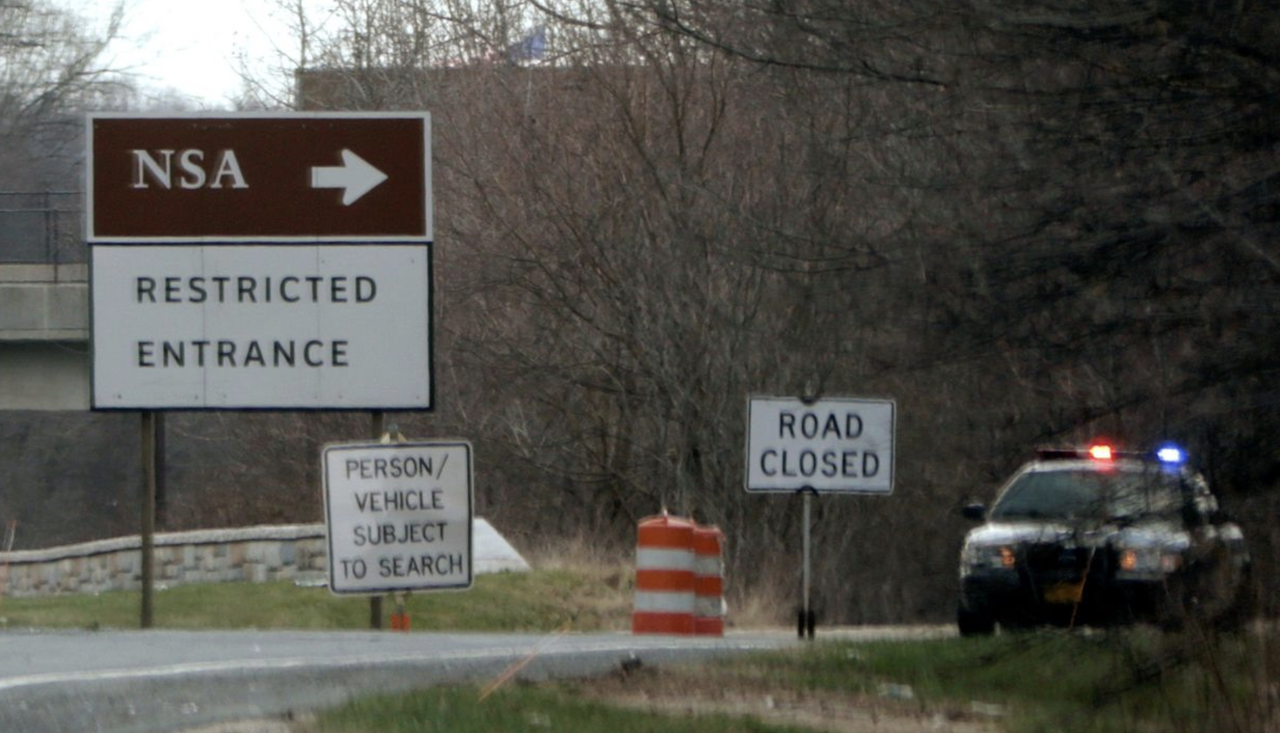
The documents didn’t make clear how many records had been collected by the NSA since October. The NSA’s media relations chief, Greg Julian, refused to comment on this specific episode, but referred to the prior overcollection episode – which resulted in the NSA deleting an entire database of collected metadata – where the NSA had collected information it hadn’t been authorized to collect.
Essentially, the agency blamed the incident on service providers who incorrectly interpreted the NSA’s request.
“While NSA lawfully sought data pertaining to a foreign power engaged in international terrorism, the provider produced inaccurate data and data beyond which NSA sought,” Julian said.
The company began delivering those records to the NSA on Oct. 3, 2018 through Oct. 12, when the agency asked it investigate the “anomaly.”
Exposure of the incident has predictably provoked outrage from lawmakers, who have been railing against the NSA’s surveillance programs since they were first exposed by former contractor Edward Snowden in 2013. Former lawmaker Pat Toomey, now an ACLU staff attorney, said the incident is just the latest reason why the NSA metadata-collection program, launched in the aftermath of 9/11 as part of the Patriot Act, should be discontinued.
“These documents only confirm that this surveillance program is beyond redemption and should be shut down for good,” Patrick Toomey, an ACLU staff attorney, said in a statement. “The NSA’s collection of Americans’ call records is too sweeping, the compliance problems too many, and evidence of the program’s value all but nonexistent. There is no justification for leaving this surveillance power in the NSA’s hands.”
The House Judiciary Committee has already started weighing which expiring Patriot Act provisions will be renewed, and according to several lawmakers, the phone surveillance program likely won’t be reauthorized.
“Every new incident like this that becomes public is another reason this massive surveillance program needs to be permanently scrapped,” said Sen. Ron Wyden, a longtime critic of the program. “But it is unacceptable that basic information about the program is still being withheld from the public.”
Featured Video

Chinese jet fuel and the myth of energy independence
or go to
Aletho News Archives – Video-Images
From the Archives
The Dirty Little Secret behind the “Global Terrorism Index”
The Omission of Israeli Terrorism in the Occupied Palestinian Territories
By Karin Brothers | Global Research | December 6, 2014
… The Israeli settlements — all of which are illegal – have been identified as a major impediment to peace. The refusal of a major “global” terrorism report to name the Israeli settlers as one of the groups most responsible for terrorism not only misrepresents a major source of regional violence but exposes the Global Terrorism Index as a propaganda tool that supports a U.S. agenda.
In recent years, governments have been attempting to thwart terrorism by blocking supportive fund-raising. When it comes to Israeli settlements, however, the US and Canada actually encourage fund-raising by giving organizations (such as Christian Friends of Israeli Communities (CFOIC) and the Jewish National Fund) financial support in the form of donor tax-deductions.
Charities which provide funds for the Israeli settlements should be regarded as terror-financing organizations. They should not only lose their tax-deductible status, but they should be banned because they support the violation of international humanitarian law. The terror-financing laws that are being strictly enforced for Muslim charities should be applied to Christian and Jewish charities as well. … Read full article
Blog Roll
 Aletho News
- Chinese jet fuel and the myth of energy independence
- Ukraine Sea Drone Fired From Libya Hit Russian Tanker in Mediterranean
- IRGC: Iranian forces launched no attacks during ceasefire hours
- Trump Administration Moves To Automate U.S. Military Draft Registration
- Spain orders reopening of Tehran embassy, condemns Israel’s carpet bombing of Lebanon
- Israel faces ‘unsustainable’ strategic crisis following 40-day war against Iran: Analyst
- Iran restricts Hormuz access to 15 vessels per day under ceasefire terms: Report
- The ‘Opposition Party’ Has Done Nothing to Stop the Iran War and Much to Goad Trump Into Continuing It
- Moscow backs Tehran on status of Lebanon in US-Iran deal
- How UK Regulator Ofcom Quietly Bypassed International Law to Police American Speech
- If Americans Knew
- Amnesty: Urgent – Protect Lebanese civilians from brutal escalation in Israeli attacks
- Is The War Against Iran Over?
- Inside the Israeli army’s propaganda wing
- Hundreds of Gaza Amputees Stranded in Legal Limbo
- The gallows law: Israel moves toward executing Palestinian children
- Tucker Carlson: The Path to Peace requires ending ‘special alliance’ with Israel
- This is ceasefire? Israel’s biggest massacre yet in Lebanon, another journalist killed in Gaza – Daily Update
- Tucker Carlson on Israel: This Is the Behavior of an Ally? Really?
- Gazans face a triple crisis: severe shortages of water and bread, healthcare in tatters
- NY Times reports how Netanyahu took the US into Iran War
- No Tricks Zone
- An Inconvenient Tree: Uncovered In Alps… Europe Much Warmer Than Today 6000 Years Ago
- New Study Reports A 60% Slowdown In Greenland’s Ice Loss Rate In The Last Decade
- Low Intensity Tornado Wrecks Major Solar Farm, Creating A Potential Toxic Dump
- New Study Finds Warming Saves Lives…Cold Temperatures 12 Times More Deadly Than Excess Heat
- German Science Blog Accuses PIK Climate Institute Of Hallucinating Climate Tipping Points
- Devastating Assessment Of Comirnaty Vaccine By Former Senior Pfizer Europe Toxicologist
- New Study: CO2 Is ‘Effectively Negligible’ As An Explanatory Climate Change Factor Since 2000
- Former Pfizer Toxicologist Dr. Helmut Sterz Tells Bundestag Hearing Pfizer Vaccine Should Have Never Been Approved
- Energy Expert: Germany’s Nuclear Phaseout Was A “500 Billion Euro Mistake”
- New Research: South Australia’s Mid-Holocene Sea Surface Temperatures Were 4°C Warmer Than Today
 Aletho News