The IAEA and OPCW – How International Organisations Became Tools of War
21st Century Wire | July 2, 2025
Dr. Piers Robinson is a political scientist, a former professor at the University of Sheffield, as well a research director at the International Center for 9/11 Justice, whose recent article on Substack is titled, “The IAEA and OPCW: Watchdogs for Peace or Propagandists for War?” looks at the IAEA’s questionable operations in Iran, and the similarities to the abused OPCW in Syria, and in general the role of “lying through institutions”, and plying war-propaganda through third-party institutions.
Recent events in Iran have all but exposed how these supposed ‘watchdog’ institutions have been coopted and used by US and British intelligence in order to fabricate another case for war.
Pascal Lottaz, host of Neutrality Studies, talks with the co-director for the Organisation for Propaganda Studies, Dr Piers Robinson, about this, as well as the broader geopolitical implications at play here. Watch:
West covering up for Kiev on chemical weapons – Moscow
RT | December 1, 2024
Ukraine’s Western backers are concealing Kiev’s use of chemical weapons, Rodion Miroshnik, the Russian Foreign Ministry’s ambassador-at-large on the Kiev regime’s war crimes, told RT in an exclusive interview. He said Russia has documented proof of Kiev’s troops using toxins against Russian soldiers and civilians, but any attempts by Moscow to appeal to international watchdogs are stalled by the West.
“Ukraine has used various types of chemical weapons throughout the conflict, and this is documented and recorded by our relevant departments,” Miroshnik stated, adding that the findings have been repeatedly submitted to the Hague-based Organization for the Prohibition of Chemical Weapons (OPCW). He noted that the toxins Kiev uses are supplied by Western states, which also provide it with “so-called diplomatic cover,” hushing up its use of prohibited substances.
“[Kiev] sincerely believes that the West will in every possible way shield it from liability for the use of prohibited types of weapons. And, unfortunately, this is exactly what is happening within the framework of a number of international organizations, in particular, the OPCW,” the official stated, noting that Russia’s requests to probe incidents in which Kiev uses chemical weapons “are blocked with enviable regularity” and any data Moscow provides as evidence “is not considered” at all.
“Under pressure from the Americans, the British, this situation is simply hushed up, talked down, and [doesn’t] turn into a detailed investigation,” he stressed.
According to Miroshnik, as of this past summer, Russian experts had recorded more than 400 instances of prohibited chemical weapons being used by Kiev. They have also discovered a number of laboratories in Ukraine that produce chemical agents and toxic substances. The official noted that Kiev is “indiscriminate” when using prohibited types of weapons, targeting both Russian soldiers at the front and civilians via drone attacks.
Western support allows Kiev to keep using the banned toxins with impunity, Miroshnik claimed, “demonstrating that any red lines from the Ukrainian side can simply be crossed and nothing will happen to them for it.”
Moscow has repeatedly accused Ukraine of using chemical weapons on the battlefield and of hosting American biolabs on its territory. Earlier this fall, Lieutenant General Igor Kirillov, the head of Russia’s Radiological Chemical and Biological Defense Forces, warned that Kiev was preparing a false-flag chemical weapons attack with the aim of framing Russia.
He also accused Ukraine of deploying chemical weapons disguised as smoke bombs during its incursion into Russia’s Kursk Region, and said such munitions were used in the Russian town of Sudzha in August, with more than 20 people exposed to the toxins.
Ugly Truth of Ukraine’s Criminal Use of Chemical Weapons
By Svetlana Ekimenko – Sputnik – 30.11.2024
Politicization of the work of the Organization for the Prohibition of Chemical Weapons (OPCW) by the US and its allies is illustrated by the situation around the use of chemical weapons in Ukraine, Vladimir Tarabrin, Russian Permanent Representative to the OPCW underscored at the 107th session of the organization’s Executive Council in October.
November 30 marks the Day of Remembrance for All Victims of Chemical Warfare, which is observed annually by the Organization for the Prohibition of Chemical Weapons (OPCW).
This commemoration throws into focus how warnings about Ukraine’s use of toxic chemicals against Russia’s Armed Forces are being ignored by the West. Instead, fabricated allegations are being peddled against Moscow, noted Vladimir Tarabrin, Russia’s permanent representative to the OPCW.
Russia has sufficient expertise to identify facts of chemical weapons use in the zone of its special military operation in Ukraine. It is conducting investigations as required by OPCW provisions.
Unlike the unfounded accusations concocted by Ukraine and its Western patrons, Russia operates “exclusively with verified facts.”
Ukraine covertly used DM-105 chemical munitions under the guise of smoke shells in the city of Sudzha in Russia’s Kursk region in August, revealed Lt. Gen. Igor Kirillov, head of Russia’s Radiological, Chemical, and Biological Defense Troops.
More than 400 cases of the use of chemicals such as BZ, prussic acid, chlorine cyanide, and riot-control chemical agents have been recorded in Ukraine since 2022.
Tests of wipe-samples from chemical equipment found in a lab near Avdeyevka in the Donetsk People’s Republic (DPR) revealed it had been producing 3 kg of toxic substances per day.
Ready-to-use agents containing a toxic mixture based on thallium nitrate were found in a cache seized from Ukrainian troops in August 2024.
Washington boosted efforts to develop bioagents capable of selectively targeting specific ethnic groups, the Russian Defense Ministry said in August.
Ukraine procured hundreds of tons of toxic chemical precursors scheduled by the Chemical Weapons Convention (CWC), according to the ministry.
Ukrainian forces are being trained to use chemical ammunition with Western artillery systems, captured documents and manuals show.
The US Pentagon, Centers for Disease Control and Prevention (CDC), and American biotech firms have been funding potentially illegal biological research in Ukraine in violation of international treaties.
Ukraine used US-made chemical weapons – Russia
RT | February 19, 2024
Washington and Kiev have violated articles of the Organization for the Prohibition of Chemical Weapons (OPCW) as Ukrainian forces have used illegal munitions on the battlefield, Russian Lieutenant General Igor Kirillov has claimed.
The head of Russia’s Nuclear, Chemical and Biological Protection Forces provided several examples of Kiev’s alleged use of banned chemical weapons and non-lethal chemical agents that he said were obtained from the US.
Kirillov claimed that Ukraine used drones to drop US-made gas grenades on December 28, 2023 containing “CS” compound – a chemical classified as a riot-control tool that irritates the eyes and upper respiratory tract, and can cause skin burns, respiratory paralysis and cardiac arrest when used in high concentrations.
He said the delivery of such munitions by the US to Ukraine was a direct violation of the rules of the OPCW, which states that a country must “never, under any circumstances, transfer chemical weapons directly or indirectly to anyone.”
He also reported that, on June 15, 2023, Moscow’s forces were attacked by a drone carrying a container filled with chloropicrin, which is classified as a Schedule 3 compound under the Chemical Weapons Convention and is strictly prohibited – even for law enforcement purposes. The same chemical was also used by Kiev on August 3 and 11, 2023 near the village of Rabotino, according to Kirillov.
The general also provided several examples of Kiev using toxic substances against Russian military personnel, as well as poisoning high-ranking officials such as the head of Russia’s Kherson Region Vladimir Saldo in August 2022.
Kirillov said Russian intelligence believes that Ukraine’s forces, under the guidance of its Western backers, are developing a new military tactic that would use a “chemical belt.” This would involve blowing up containers with hydrocyanic acid and ammonia to prevent an advance by Russian forces.
He added that plans for such a large-scale use of toxic chemicals were evidenced by the fact that Kiev had asked the EU to supply it with hundreds of thousands of antidotes, gas masks and other personal protective equipment in 2024. That’s in addition to 600,000 ampules of organophosphorus antidotes, and 750,000 bottles of drugs for the detoxification of mustard gas, lewisite and hydrocyanic acid derivatives that were supplied by NATO countries in 2023.
“It is obvious that the volumes requested by Ukraine are excessive for a country that does not have chemical weapons,” Kirillov stated.
There has been no response from the OPCW despite all of this evidence being presented to the organization four months ago, the general said, accusing it of being run by Washington as a tool to target its political opponents.
In November, Russia lost its seat on the OPCW Executive Council after failing to get enough votes from other members of the organization. Kirillov said Moscow was effectively “pushed out” of its seat and was replaced by Ukraine, Poland and Lithuania, who he claimed were pursuing an obvious anti-Russia policy.
Burying key evidence, new OPCW report covers up Douma’s unsolved deaths
BY AARON MATÉ · THE GRAYZONE · MARCH 27, 2023
After censoring experts who found that the victims in Douma could not have been killed by chlorine gas, the OPCW’s new IIT report continues the cover-up and baselessly accuses the Syrian government.
[Note: this article contains graphic images.]
On April 7th 2018, gruesome images of an alleged chemical attack emerged from the Syrian town of Douma.
Dozens of dead bodies, including children and infants, appeared heaped in piles inside of an apartment building. Others lay on the street in front as if trying to escape deadly gas. Strikingly, many of the victims displayed copious foam oozing from the mouth and nose. Along with their proximity to a clear escape route, these visible symptoms suggested that something extraordinarily poisonous had killed them instantly.
US officials immediately promoted the allegations of insurgent-tied groups that the Syrian army had killed the victims with chlorine gas or the nerve agent sarin, or even a combination of both. One week later, the US, along with the UK and France, bombed Syria in purported retaliation.
In public statements, however, experts raised doubts that chlorine caused the deaths in Douma. Leaked documents later revealed that German military toxicologists consulted by the Organisation for the Prohibition of Chemical Weapons (OPCW) in June 2018 went further. The Germans told the OPCW that the circumstances of the fatalities – apparent immediate death and collapse in piles at the center of two rooms, a failure to escape, and rapid profuse foaming at the mouth and nose – were inconsistent with chlorine poisoning.
The Germans’ findings had profound ramifications. While the Douma victims’ signs of rapid foaming were not consistent with exposure to chlorine gas, they were consistent with nerve agent exposure. But by that point, the OPCW’s chemical analysis had ruled out sarin or any other nerve agent as the killer because none of these chemicals were found at the scene or in biomedical samples from alleged victims.
If the rapid and profuse frothing was not the result of a nerve agent or chlorine poisoning, the possibility existed that there was no chemical attack at all – and that insurgents staged the incident to frame the Syrian government. The OPCW would be dealing with a faked chemical attack that triggered US-led airstrikes on Syria, and the unexplained deaths of 43 men, women, and children.
As The Grayzone has reported, the OPCW censored the German toxicologists’ input in a cover-up of findings that undermined allegations of a Syrian army chemical attack in Douma. More than three years since that suppression was exposed, the OPCW has never offered a rebuttal to the initial toxicology assessment, nor an explanation for why it was concealed. They have simply buried it.
In a new report on Douma released in January, the OPCW finally purports to offer a counter-narrative. The OPCW’s Investigation and Identification Team (IIT) claims that the “symptoms of the victims” in Douma “are, overall, consistent with exposure to chlorine gas in very high concentrations.”
The IIT shares this judgment as part of an effort to allege that the Syrian army killed the dozens of victims by dropping a chlorine gas cylinder on the apartment building — identified as Location 2 — where their bodies were filmed. (The Grayzone addressed the IIT’s claims about chlorine gas in a previous article). The victims would have been trapped and killed “within minutes,” the IIT report suggests, from exposure to a very high concentration of chlorine gas. By extension, the profuse foaming observed in victims’ mouths and noses would also have to have occurred immediately, or at most, within minutes.
In a statement, US Secretary of State Antony Blinken and his British, French, and German counterparts hailed the IIT’s findings and touted what they called “the independent, unbiased, and expert work of the OPCW staff.”
To advance its argument, however, the IIT continues to erase the original German toxicologists’ conclusions and engages in multiple acts of scientific cherry-picking. These include the following:
– The IIT has brought in a new toxicologist, without explaining why, who has contradicted the previously consulted experts by claiming that the symptoms of the Douma victims “are consistent with chlorine exposure.” There is no attempt to explain why the new expert’s opinion is more valid than the views of the numerous toxicologists who went before.
– Unlike previous experts, the new toxicologist has avoided ruling on any consistency of the frothing observed in videos and photographs of the deceased victims with exposure to chlorine gas — a controversy at the very core of the Douma deaths.
– The toxicologist sidesteps the frothing issue by instead focusing on whether uncorroborated and cherrypicked accounts of alleged witnesses were consistent with a chlorine attack. The IIT also avoids disclosing whether it considered the accounts of alleged witnesses who claimed to have seen immediate foaming at the Douma apartment building where the dead victims were filmed.
– On the only occasion when the toxicologist does weigh in on a possible cause of the frothing seen in the images, it is only to make the obvious and irrelevant assertion that the oral and nasal foam-like secretions (as well as miosis, a symptom of nerve agent poisoning, and skin discoloration) were “unlikely to have been as a direct result of ‘dust’ inhalation.”
The result is a continued OPCW cover-up of what has proved to be the Douma probe’s most important question: whether chlorine gas killed the dozens of victims filmed at the scene. Rather than provide an answer, the IIT report avoids the science and obscures the cause of 43 unsolved deaths.
Erasing the experts
The IIT’s narrative of almost instantaneous death in Douma, where heavy frothing would have occurred in minutes, defies both the scientific literature and toxicology experts’ previous assessments.
No recognized chemical weapons specialist has affirmed that chlorine gas could have caused the profuse foaming observed in video footage in the short time that the IIT suggests it took for the victims to die.
The first expert to comment on Douma was Professor Alastair Hay, a toxicologist working in the field of chemical warfare and then-member of the OPCW’s Education and Outreach board. Hay has received the OPCW-The Hague Award for his contribution to the Chemical Weapons Convention. On April 10, 2018 – three days after the alleged chemical attack in Douma – Hay challenged the notion that the victims could have been killed by chlorine gas.
The victims’ symptoms were “much, much more consistent with nerve-agent-type exposure,” Hay told the Washington Post. “Chlorine victims usually manage to get out to somewhere they can get treatment.” But in Douma, the victims “have pretty much died where they were when they inhaled the agent. They’ve just dropped dead.” The Post’s headline reflected Hay’s analysis: “Nerve gas used in Syria attack, leaving victims ‘foaming at the mouth,’ evidence suggests.”
A United Nations investigation in June 2018, based largely on the accounts of alleged witnesses, likewise acknowledged — in a reference that certainly includes the profuse frothing — that some of the “reported symptoms” in Douma “are more consistent with the use of another chemical agent, most likely a nerve gas.”
That same month, the OPCW received an unequivocal assessment that ruled out chlorine gas. According to leaked documents, top German military toxicologists told OPCW investigators that chlorine could not have been the murder weapon in Douma. They argued that if the victims had been exposed to high concentrations of chlorine, it “was highly unlikely” that they “would have gathered in piles at the centre of the respective apartments at such a short distance from an escape from the toxic chlorine gas to cleaner air.”
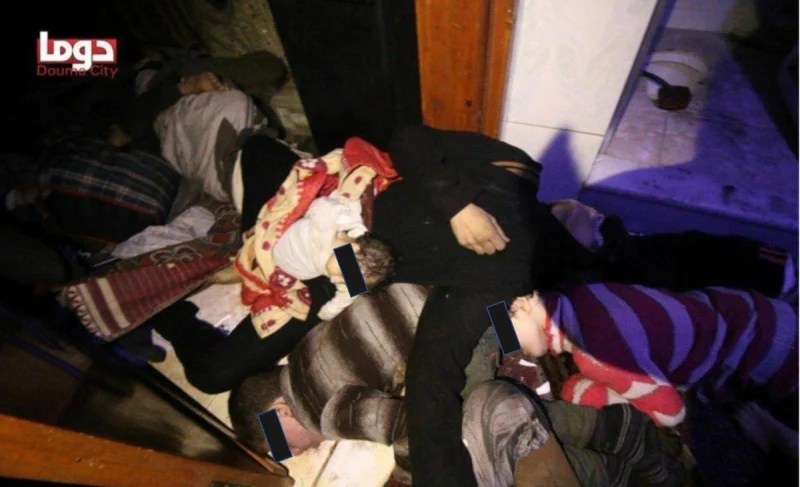
Image 1: In a photograph from Location 2, the dead victims are gathered in piles
The experts also pointed to “the onset of excessive frothing… observed in photos and reported by witnesses.” This was a reference to the images showing a profuse discharge of foam from victims’ mouths and noses. Some alleged witnesses interviewed by the OPCW also claimed that they saw the foaming develop quickly.
From the toxicologists’ point of view, such rapid foaming defied scientific logic. If the dead victims had been rapidly overcome by an incredibly high concentration of chlorine gas, there simply would not have been enough time for the foamy discharge observed on multiple bodies to develop.
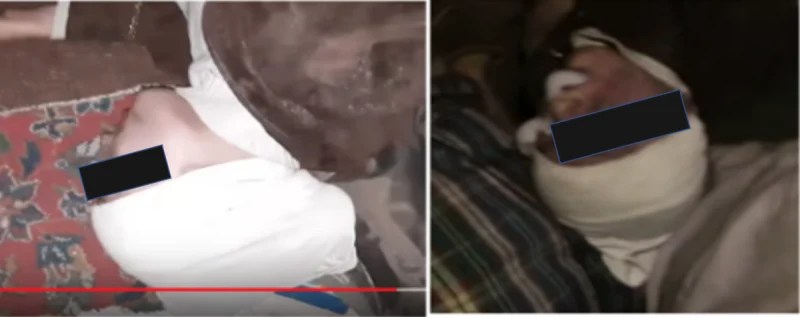
Image 2: A female victim displaying profuse foaming after her body had been moved
Accordingly, leaked minutes from that meeting state, “the experts were conclusive in their statements that there was no correlation between symptoms and chlorine exposure.”
The minutes, drafted by Douma team member Dr. Brendan Whelan, were approved by two other participants who had also traveled to Germany to meet with the toxicologists: Dr. Marc Blum, the Head of OPCW Laboratory; and Dr. Soumik Paul, the Head OPCW Health and Safety Branch. In a leaked email, Blum recalled that one of the Germans even raised “the possibility of a staged attack” in Douma because “the circumstances of death for the victims do not match chlorine.”
The OPCW leadership’s response to this conclusive assessment was to make it disappear. When the Douma team included the Germans’ input in their initial report, completed in late June 2018, senior officials went around them and erased all traces of it. The meeting itself was then memory-holed: in the OPCW Fact-Finding Mission’s (FFM) final report on Douma published in March 2019, a detailed timeline omits the team’s visit to Germany.
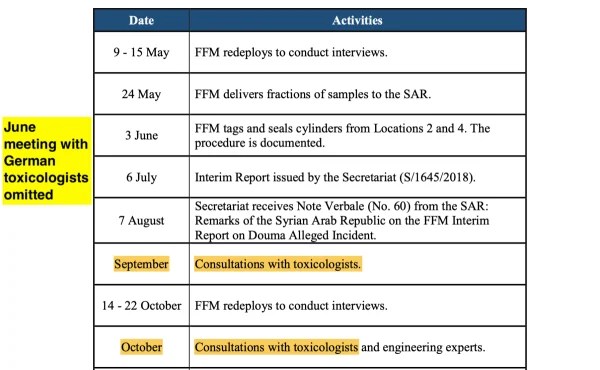
The “Mission Timeline” of the OPCW’s March 2019 Final Report omits the June 2018 mission to Germany, where expert toxicologists ruled out chlorine gas as the cause of death in Douma
The FFM’s March 2019 final report also revealed that after the German toxicologists’ findings were suppressed, the OPCW consulted five new toxicologists in September and October 2018. But oddly, no detail was provided on what these replacement toxicologists concluded, including on the key questions of how the victims could have been poisoned, and how the profuse frothing could have developed so rapidly.
Instead, the March 2019 report avoided these issues by stating that “it is not currently possible to precisely link the cause of the signs and symptoms to a specific chemical.” This ambiguous language obscured the fact that the German toxicologists initially consulted by the OPCW had unequivocally ruled out chlorine gas. What is certain is that the FFM report never claims that these five additional toxicologists contradicted the Germans whom they replaced. In fact, after noting that these five new experts were consulted, the FFM report made no further mention of them.
In a leaked April 2019 letter to the OPCW Director General, Dr. Whelan, the chief author of the Douma team’s censored original report, complained that the March 2019 final report had “shockingly omitted” the German toxicologists’ findings while evading any explanation for how the victims died from chlorine exposure. “To say that this selective use of expert opinions and facts is disturbing is an understatement,” Whelan wrote.
Challenged publicly to address the Douma probe’s suppressed findings, the long-awaited IIT report instead attempts to cover the OPCW’s tracks with more selective deceptions.
The cherry-picked cherry-picker
Just like the March 2019 FFM report, the IIT avoids the issues raised by the censored German experts entirely. But whereas the FFM stated that it was “not currently possible to precisely link” the Douma victims’ symptoms to chlorine, the IIT attempts to make it possible nearly four years later.
The IIT claims to have consulted a new “independent expert (toxicologist) not involved in previous assessments of the incident,” who concluded that the “symptoms of the victims are, overall, consistent with exposure to chlorine gas in very high concentrations.” No explanation is given for why the findings of this “new” and supposedly “independent” toxicologist should override those of the previously consulted experts. The IIT also does not present any additional evidence that would justify reversing the Germans’ conclusions.
The very fact that the IIT has declined to consult those experts from “previous assessments”– and present them with coherent counterarguments or fresh evidence, if it existed – suggests that the IIT sought out this one “new” assessment to overrule the inconvenient “previous” ones.
When this cherry-picked “independent expert” does make an assessment, more cherry picking ensues. Unlike the German toxicologists who based their assessment on both the images of the dead victims and the “symptoms and times of onset reported by” alleged witnesses, the IIT has limited the toxicologist’s scope of assessment to just the accounts of alleged witnesses.
The new toxicologist, the IIT states, was provided with “accounts and data from 55 individuals interviewed by either the FFM or by the IIT” and requested to “make their own evaluation of the reported symptoms” (emphasis added). The IIT tells us that “the toxicologist independently assessed the anonymised witness statements (obtained from affected persons or other eyewitnesses to the symptoms) against the symptoms that could be expected from chlorine exposure.” Ultimately, the toxicologist “reached the conclusion that the accounts of the victims and medical personnel were consistent with the rapid release of a high dosage of chlorine gas, which led to the rapid and high fatality rate documented at Location 2.”
Relying on witness accounts evades the central question of whether the frothing seen in videos was consistent with rapid chlorine poisoning. It also presumes that these accounts are reliable and have been corroborated, which there is no evidence of. And whereas the IIT claims that it “assessed the accounts, overall, to be consistent,” it omits that the Douma FFM’s initial investigators found those accounts to be anything but. In the interviews conducted in Syria and Turkey, the censored original report noted, “[t]wo broad and distinct narratives” emerged, one supporting the use of chemical weapons and the other not. Whose account was it then that was consistent with a “rapid release of a high dosage of chlorine gas”?
Even the reported symptoms from those cherrypicked witness accounts are themselves selectively assessed. When it comes to alleged witness accounts of what they observed at Location 2, nowhere in the IIT report is there any explicit mention of the “rapid and in some reported cases, immediate onset of frothing described by [alleged] victims,” as detailed in the FFM’s original censored report. There is thus no evidence that the reported rapid frothing formed part of the IIT toxicologist’s assessment. Instead, the IIT report informs us that: “Symptoms described by affected persons, rescuers, and treating medical personnel included shortness of breath, coughing, suffocation, dizziness, and skin irritation.” These symptoms all happen to match chlorine exposure; the omitted rapid frothing does not.
By focusing therefore only on the accounts of alleged witnesses – in particular, accounts from those who claimed there had been a chemical attack, and only those symptoms that are consistent with chlorine exposure – the IIT avoids answering the central question: whether the rapid onset of the profuse frothing observed in videos is consistent with exposure to chlorine.
Avoiding the inconsistency
In the few instances when the IIT’s toxicologist does appear to weigh in on the images of the foaming, they again deftly avoid the consistency question.
In a passage citing the toxicologist, the IIT states that “symptoms observed in affected persons, including miosis, skin discoloration, and oral and nasal foam-like secretions, are unlikely to have been as a direct result of ‘dust’ inhalation.”
No one has ever claimed that “dust inhalation” was the cause of the Douma victims’ observed miosis and “foam-like secretions.” Why then has the IIT’s toxicologist gone out of their way to rule out “dust inhalation” as the cause of the victims’ foam-like secretions, but failed to tell us whether these foam-like secretions could have been caused by chlorine gas? The most likely reason is that the IIT did not want its toxicologist to answer that question.
In another passage, the IIT notes that “imagery and videos” from Location 2 showed “clear signs of corneal opacity, discoloration of the skin, white/off-white foam-like oral and nasal secretions and miosis.” Yet rather than tell us whether those observed foam-like secretions are consistent with chlorine gas, the IIT again avoids an answer. Instead, the report only states that “the specialists consulted by the IIT confirmed that the reported and observed symptoms of oral opacity are typically caused by… exposure to a high concentration of chlorine gas.” (emphasis added) Given its omission, these same specialists have not confirmed that the observed “foam-like oral and nasal secretions” can be caused by exposure to chlorine gas.
On another occasion, the IIT — notably, not the toxicologist — does manage to explicitly state that the “rapid onset of symptoms… observed in videos and pictures” for “fatalities recorded on the stairs and landings” (emphasis added) at Location 2 are consistent with a “high and lethal volume of chlorine gas.”
Given that foaming was seen in videos and photos, the IIT report leaves the impression that it is referring to those “symptoms.” But in the images from the “stairs and landings” at the apartment building, none of the three dead victims show any frothing. This allows the IIT to create a false suggestion that the foaming seen in the videos is consistent with chlorine exposure. In reality, the IIT is weighing in on images where no foaming can be observed, but that readers would unlikely check.
In another rare instance where it makes any reference to foaming, the IIT states that chlorine gas can lead “to the oral and nasal secretion of a foam-like substance.” That chlorine gas can cause a “foam-like substance” is not in question: the censored original report noted that “excessive frothing from the mouth” has been “reported in cases of exposure to lethal doses of chlorine gas.” But with this uncontroversial claim, the IIT is again avoiding the issue raised by the original report, based on the findings of the German toxicologists, that the “rapid, and in some reported cases, immediate onset of frothing described by victims is not considered consistent with exposure to chlorine-based choking or blood agents.”
Suppressing science, denying justice
Left with the scientifically unfounded scenario in which chlorine gas caused immediate profuse foam discharge from the victims, the IIT has resorted to deceptive claims that no recognized expert in toxicology has been willing to support. Accordingly, beyond the US and its allies’ bombing of Syria on unsupported grounds and the co-option of the OPCW to whitewash it, the core crime in Douma remains unexplained.
In April 2018, dozens of slain civilians were photographed in that apartment building. Images of their lifeless bodies stirred global outrage. Approaching the fifth anniversary of this horrific incident, the chemical weapons watchdog tasked with investigating their deaths continues to bury its own findings and present a baseless explanation for what occurred. So long as the OPCW continues to suppress the science, 43 Douma victims and their families will remain without justice.
————
Thank you to Dr. Piers Robinson for his input on this article. https://berlingroup21.org/.
Links:
West uses chemical weapons watchdog to justify its aggression – Moscow
RT | February 7, 2023
The latest report by the Organisation for the Prohibition of Chemical Weapons (OPCW), which blames Damascus for carrying out a chemical attack in Douma in 2018, looks like a political hit piece meant to justify the West’s continued military aggression against the Syrian government, says Alexander Shulgin, Russia’s permanent representative to the organization.
Speaking to RT, Shulgin vehemently dismissed the report, which was released in late January by the so-called Investigation and Identification Team (IIT). Calling the IIT “completely illegitimate,” he claimed the group’s creation was pushed through by the US and its allies in order to undermine the core principles of the OPCW and international law and replace them with their own “made-up rules.”
The IIT’s report, according to Shulgin, is riddled with inconsistencies and factual gaps, and barely holds together. Furthermore, none of Russia’s or any other country’s “uncomfortable” questions regarding the details of the IIT’s findings were even remotely addressed during an OPCW briefing on the report, the ambassador claimed.
Shulgin also noted that the report highlighted the double standards currently present within the OPCW. When Russia presented evidence of a chemical attack in Aleppo back in 2016, every minute detail of Moscow’s findings was heavily scrutinized by the organization, he said. However, when it comes to the attack in Douma, OPCW officials seem to turn a blind eye to basic questions such as how and when the evidence was gathered and presented during the investigation.
“For instance, they referred to the fact that some new sample has appeared, provided by a third party. What is this third party? Nothing is said about it. They just say ‘trust us’,” said Shulgin, noting that the sample in question had never been reported on in previous investigations.
“So before, there was no sample, but now, suddenly, it has somehow appeared. Without any explanations,” the ambassador stressed, suggesting its sudden appearance can only be explained by the need for the US, France, and UK to escape international accountability for their aggression against Syria.
The three NATO states launched a series of airstrikes against civilian and military targets in Syria in April 2018 after the so-called ‘White Helmets’ – an NGO operating in rebel-controlled areas of Syria – published a series of videos supposedly showing the aftermath of a chlorine attack on the residents of Douma.
Syria has vehemently denied any responsibility for the incident, and both Damascus and Moscow have repeatedly pointed to evidence, including testimonies from alleged victims, that suggests the incident was staged in order to justify a Western attack.
Douma locals, medical personnel deny veracity of 2018 ‘chemical weapons attack’
The Cradle | February 2, 2023
Locals and medical personnel from the Syrian city of Douma in the Damascus countryside confirmed on 2 February during a press conference in the country’s Foreign Ministry headquarters that the alleged 2018 chemical attack on the city was, indeed, staged.
This follows the release of a new report by the Organization for the Prohibition of Chemical Weapons (OPCW) on 27 January, which once again renewed the accusation that Damascus was behind a 2018 chlorine gas attack on civilians in Douma.
“I live 400 meters from the place of the alleged incident, and I only learned of its occurrence the next day through social media,” Syrian lawyer Muhammad al-Naasan said during the press conference.
Another testimony is that of Dr. Hassan Oyoun, an ambulance worker at Douma Hospital, who claimed that “information was published a day before the alleged incident that it was necessary to prepare for an event that would result in a large number of injuries.”
This confirms that “prior preparations” were underway for the staging of the attack, Oyoun said, referring to the incident as a “fabricated play that was filmed.”
“What the terrorists announced about 800 injuries from chemical substances is incorrect, and the number of people who visited the hospital that day did not exceed 35,” he added.
According to Dr. Mumtaz al-Hanash, a Douma local, Douma Hospital announced just one day after the alleged attack that no chemically induced deaths were recorded whatsoever. He went on to say that the “photographed cases” did not provide evidence that chlorine, or any other weaponized chemical, was used.
An imam and preacher at a local mosque, Sheikh Ratib Naji, said: “We did not see with our own eyes any injured or dead, as they claimed, and those whom the terrorists claimed were dead, their bodies did not appear, and when we demanded them, they assaulted us.”
Syria’s permanent representative at the Hague-based chemical weapons watchdog, Milad Attiya, affirmed that Damascus does not recognize the OPCW investigation team’s third and latest report, as it rejected the last two. Attiya added that the report relies heavily on western sources, as well as groups such as Hayat Tahrir al-Sham (HTS) and the White Helmets, an Al-Qaeda affiliated rescue organization with links to organ trafficking networks in Syria.
Since 2013, armed groups in Syria have attempted to pin chemical attacks on the government to instigate internationally-led regime change operations against it. This comes in the form of staged attacks, or actual false-flag chemical attacks which leave many dead and are designed to implicate Damascus – as was the case in Ghouta in 2013 and in Khan Sheikhoun in 2017.
On 28 January, the Syrian government released a statement rejecting the OPCW report, which it said ignored “objective information which was provided by some … experts … and former OPCW inspectors with knowledge and expertise,” referring to the fact that the organization suppressed the findings of its initial report on Douma, as revealed by WikiLeaks in 2019.
Syria blasts ‘misleading’ OPCW report on alleged Douma attack
The Cradle | January 29, 2023
Syria made a statement on 28 January rejecting the report issued a day earlier by the Investigation and Identification Team of the Organization for the Prohibition of Chemical Weapons (OPCW), regarding the alleged use of chlorine by the Damascus government in Douma in 2018.
“Syria totally rejects the report released by the so-called ‘Investigation and Identification Team’ of the [OPCW] about the alleged chemical attack in Douma in April 2018, in addition to its conclusions,” the country’s Ministry of Foreign Affairs and Expatriates said.
“Those who prepared this report … insist to ignore all the objective information which was provided by some countries, parties, experts, academics, documented media reports, and former OPCW inspectors with knowledge and expertise … which confirmed beyond any doubt that the Douma incident was completely fabricated,” the ministry’s statement added.
The Syrian statement was a response to the new report released by the OPCW’s Investigation and Identification Team on 27 January, which after five years, has renewed the accusation against Damascus “that the Syrian Arab Air Force carried out the chemical weapons attack on Douma.”
In April of 2018, Damascus was accused of a chemical attack against civilians in the city of Douma, resulting in illegal US military strikes against Syrian government positions. This was despite the fact that Syria had welcomed an OPCW fact-finding mission to inspect the alleged site of the attack.
A year later, WikiLeaks revealed that the OPCW had suppressed the initial results of the fact-finding mission deployed to Syria, results which suggested that the incident was, in fact, staged. That same year, a MintPress News report revealed that several journalists from a number of mainstream agencies had come to the conclusion that the Douma attack was staged with the help of the White Helmets, a criminal organization posing as the Syrian Civil Defense. This was initially brought to light by a whistleblower from within the OPCW.
In 2021, during a visit to Douma, The Grayzone reporter Aaron Mate referred to the 2018 incident as “one of the biggest pro-war hoaxes since Iraq.”
Since 2013, armed groups in Syria have attempted to pin chemical attacks on the government in attempts to instigate internationally-led regime change operations against it. This comes in the form of staged attacks, or actual false-flag chemical attacks which leave many dead and are designed to implicate Damascus – as was the case in Ghouta in 2013 and in Khan Sheikhoun in 2017.
The latest OPCW report comes as Washington is desperately trying to obstruct the reconciliation process currently underway between the Syrian and Turkish governments.
Russia calls for reform of UN Security Council
Samizdat | August 3, 2022
The United Nations is in dire need of reform and the Security council must be “democratized” by expanding its representation, Russian foreign ministry official Alexey Drobinin has written in a keynote article published on Wednesday.
Drobinin, the Director of the Department of Foreign Policy Planning, commented on the current state of international relations and came to the conclusion that “more conscious effort and imagination is needed” to reform the UN.
He pointed out that the organization’s current agenda, which is primarily fueled by the West, is not necessarily in line with the interests of the majority of its international members.
Drobinin suggested that for most UN members the most important issues are things like access to cheap energy sources rather than the transition to “green” technologies, socio-economic development rather than human rights “in an ultra-liberal interpretation,” and security and sovereign equality rather than the artificial imposition of electoral democracy according to Western patterns.
He added that another topic that has once-again become relevant is the process of decolonization and ending the neo-colonial practices by transnational corporations in regards to the development of natural resources in developing countries.
However, international organizations such as the UN have essentially been “privatized” by the West, Drobinin points out. He suggests that the UN Secretariat and the offices of special envoys and special representatives of the Secretary General have all been saturated with the West’s own “tested” personnel, and that this also extended to non-UN organizations as well, such as the OPCW.
“The saddest thing is that this rust is eating away at the ‘holy of holies’ of the UN system – the Security Council,” Drobinin writes. “It devalues the meaning of the right of veto, which the founding fathers endowed to the permanent members of the Security Council with one single purpose: to prevent the interests of any of the great powers from being infringed, and thus save the world from a direct clash between them, which in the nuclear age is fraught with catastrophic consequences.”
While there are no “clear and simple recipes for correcting the situation here,” the diplomat continues, “clearly more conscious effort and imagination is needed when it comes to UN reform.” He goes on to suggest that the Security Council needs to be “democratized,” first of all by expanding the representation of African, Asian and Latin American countries.
Drobinin suggests that whatever the fate of international organizations such as the UN, WTO, IMF, World Bank or G20 is, the divisive policies of the West makes it “an absolute imperative for the coming years to form a new infrastructure of international relations.”
“After their frankly perfidious decisions and actions against Russia, its citizens and tangible assets, we simply cannot afford the luxury of not thinking about alternatives. Especially since many of our friends who have lost faith in Western benevolence and decency are thinking about the same thing,” the diplomat surmised.
NATO-backed network of Syria dirty war propagandists identified
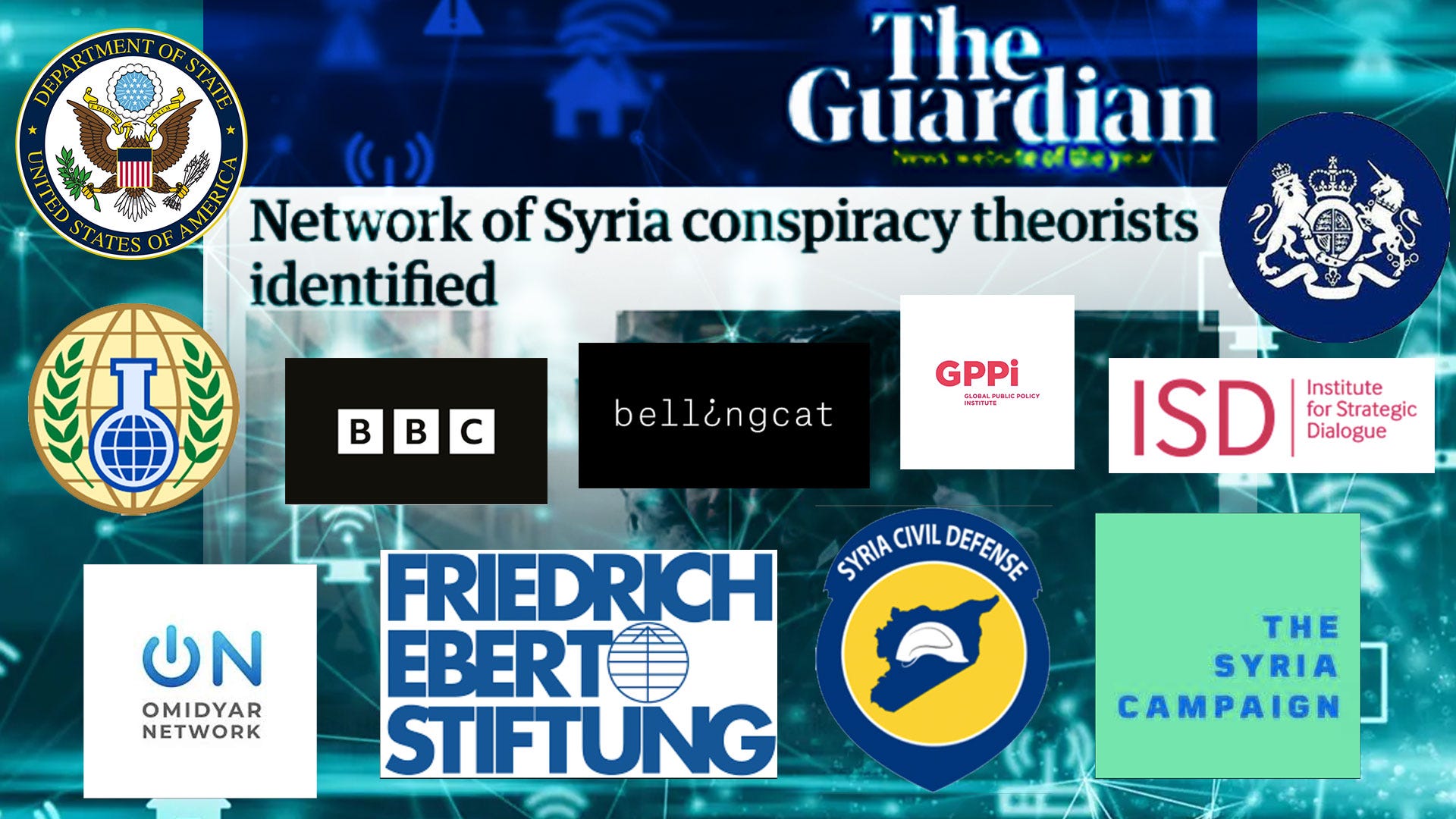
Defaming journalism on the OPCW’s Syria cover-up scandal, The Guardian and its NATO-funded sources out themselves as the real “network of conspiracy theorists.”
By Aaron Maté | August 1, 2022
On June 10th, The Guardian’s Mark Townsend published an article headlined “Russia-backed network of Syria conspiracy theorists identified.” (“Russia-backed” has since been removed).
The article is based on what Townsend calls a “new analysis” that “reveals” a “network more than two dozen conspiracy theorists, frequently backed by a coordinated Russian campaign.” This network, Townsend claims, is “focused on the denial or distortion of facts about the Syrian regime’s use of chemical weapons and on attacking the findings of the world’s foremost chemical weapons watchdog,” the Organization for the Prohibition of Chemical Weapons (OPCW). According to Townsend, I am named “as the most prolific spreader of disinformation” among the nefarious bunch.
In hawking this purported exposé of “disinformation”, Townsend violated every basic standard of journalism. He did not contact me before publishing his allegations; fails to offer a shred of evidence for them; and does not cite a single example of my alleged “prolific” disinformation. Instead, Townsend bases his claims entirely on a think-tank report that also provides no evidence, nor even assert that I have said anything false. In the process, Townsend failed to disclose that the report’s authors — the Institute for Strategic Dialogue (ISD) and the Syria Campaign — are groups funded by the US government and other belligerents in the Syria proxy war. To top it off, Townsend fabricates additional allegations that his state-funded sources do not even make.
As a result, Townsend and the Guardian have engaged in the exact sort of conduct that they falsely impute to me and others: spreading Syria-related disinformation with coordinated support from state-funded actors. The aim of this propaganda network is transparent: defaming journalism that exposes the OPCW’s ongoing Syria cover-up scandal and the dirty war waged by Western powers on Syria.
The OPCW cover-up is arguably the most copiously documented pro-war deception since the US-led drive to invade Iraq. In Western media, as The Guardian’s behavior newly demonstrates, it is also without question the most suppressed.
At the center of the story are two veteran OPCW scientists, Dr. Brendan Whelan and Ian Henderson. The pair were among a team that deployed to Syria in April 2018 to investigate an alleged chemical attack in the town of Douma. They have since accused senior OPCW officials of manipulating the Douma probe to reach a conclusion that baselessly implicated the Syrian government in a chlorine gas attack. Their claims are backed up by a trove of leaked documents and emails that show extensive doctoring and censoring of the Douma team’s findings.
The Douma cover-up extends far beyond the OPCW’s executive suite. It also implicates NATO governments led by the US, which bombed Syria over the Douma chemical weapons allegation, and then, weeks later, privately pressured the OPCW to validate it. Since the OPCW scandal became public, the US and its allies have thwarted efforts to address it.
At the most criminal level, the scandal implicates sectarian death squads armed and funded by the US and allies during their decade-long campaign for regime change in Syria.
At the time of the incident, Douma was occupied by the Saudi-backed jihadi militia Jaysh-al-Islam and under bombardment from Syrian army forces attempting to retake control. Shortly before their surrender, local allies of Jaysh-al-Islam accused Syrian forces of using chemical weapons. They released gruesome footage of an apartment building filled with slain civilians. A gas cylinder was filmed positioned above a crater on the roof. Concurrently, the White Helmets, a NATO and Gulf state-funded, insurgent-adjacent organization, released footage of what it claimed were gas attack victims in a Douma field hospital. Several journalists, including Riam Dalati of the BBC, Robert Fisk of the Independent, and James Harkin of the Intercept, found evidence that the hospital scene was staged. (In February 2019, Dalati claimed that he can “prove without a doubt that the Douma Hospital scene was staged.” Oddly, more than three years later, he has not released his findings).
The White Helmets’ alleged fakery of a chemical attack aftermath, coupled with the censored OPCW findings showing no evidence that a chemical attack occurred, suggest the inescapable conclusion that insurgents in Douma carried out a deception to frame the Syrian government. And given the unexplained deaths of the more than 40 victims filmed in the Douma apartment building, that deception may have entailed a murderous war crime.
Unlike the Iraq WMD hoax, the very existence of the OPCW’s Douma scandal is unknown to much of the Western world. With few exceptions, establishment media outlets have refused to acknowledge the OPCW whistleblowers and the leaks that brought their story to light.
After largely ignoring the OPCW cover-up since it first surfaced in May 2019, the Guardian has now published defamatory claims about journalists, myself included, who have dared to report on the censored facts.
When I wrote The Guardian about the Townsend article’s journalistic lapses, I did not get a response. One week later, I phoned Townsend, who was now back in the office but had yet to reply. In our conservation, which I recorded and recently published, I repeatedly asked Townsend to substantiate his claims about me and identify even a single example of my alleged disinformation.
Townsend did not attempt to defend his article’s assertions, beyond claiming that they were based on what was “in a report.” When I pressed further, he claimed that he had to “dash for a meeting” and promised that I would soon hear from the paper’s reader’s editor. (Before I published our phone call, and this article, I emailed Townsend a detailed list of questions and invited him to offer any additional comment. He did not respond).
“Deadly Disinformation”
Townsend could not provide any evidence for his assertions because the report that he parroted offers none as well.
The report, titled “Deadly Disinformation” and authored by The Institute for Strategic Dialogue (ISD) and the Syria Campaign, contains bare references to my reporting and makes no effort to refute it. Nowhere does the report even claim that I have said anything false. It simply claims to have “identified 28 individuals, outlets and organisations who have spread disinformation about the Syrian conflict,” and that I am “the most prolific spreader of disinformation” among them.
When the report bothers to mention of anything that I have actually said, it engages in distortion. In its first mention, the report states that I wrote an article that “attacks Bellingcat for its contributions to the Organization for the Prohibition of Chemical Weapons (OPCW).” Here, they not only fail to assert that I said anything false, but offer a false portrayal of what happened.
As for “attacking” Bellingcat — a website that, like the report’s authors, is funded by NATO states that were belligerents in the Syria dirty war – what I really did was expose its disinformation.
In this case, Bellingcat fraudulently attacked Whelan (the key OPCW whistleblower), along with several journalists (myself included) by falsely accusing us of concealing an OPCW letter that, I quickly revealed, did not in fact exist. Bellingcat was forced to add a correction, delete embarrassing tweets, and apologize to one of the article’s targets, the journalist Peter Hitchens (who resides in the UK, home to strict libel laws). I later exposed that Bellingcat copied a hidden, external author for some of their false material.
In short, the ISD/Syria Campaign’s first purported example of my alleged “disinformation” is an easily verifiable case where I’ve exposed state-backed lies.
The report’s only other substantive example comes when it notes that I have argued that the OPCW probe’s Douma probe “was flawed.” This far understates my case: the OPCW’s Douma investigation wasn’t “flawed”; it’s a scandalous cover-up worthy of global attention. Regardless, yet again, the report does not even assert that my argument is false, let alone try to explain why.
In a July 13th email, I asked the ISD to substantiate their claim that I have spread disinformation, and provide even one example of it. On its website, the ISD claims to “take complaints seriously,” and promises a response “within ten working days.” As of this writing, after 13 working days, I have not heard back.
At The Guardian, OPCW leaks are “problematic”
When I emailed a complaint about Townsend’s reporting, The Guardian admitted fault only on failing to contact me before publishing his evidence-free allegations. This was the result, they claimed, of a “breakdown of communication internally.” I was then offered the chance to respond to the article in 200 words.
A key point in my reply (which can be read here) was that The Guardian and its state-funded source is unable to identify any falsehoods in anything I’ve written “because my reporting on the OPCW’s Douma cover-up scandal is based on damning OPCW leaks.” These leaks, I added, “reveal that veteran inspectors found no evidence of a chemical attack in Douma, and that expert toxicologists ruled out chlorine gas as the victims’ cause of death. But these findings were doctored and censored by senior OPCW officials.”
At The Guardian, this passage set off an apparent alarm. After disparaging my reporting on the OPCW leaks, The Guardian informed me that they would now prevent me from even mentioning them. In a July 8 email, a Guardian editor wrote that the “the part about the OPCW” in my reply “continues to be problematic.” My reference to the OPCW leaks, the editor claimed, “makes an assertion that has been rebutted by an independent inquiry.”
I responded by asking the editor to specify exactly which “assertion” of mine has been rebutted. I also proposed that, if they believe that I have said anything “problematic,” they publish their own rebuttal.
In multiple follow-up emails, the editor failed to identify any “rebutted” assertion of mine. Despite that, the Guardian proceeded to publish my reply without its reference to the OPCW leaks. But this raised a new problem: in censoring my statement, they misquoted me. When I pointed out that error, they updated my reply to finally allow a (minimal) mention of the OPCW leaks.
The Guardian also took me up on my proposal that they publish their own rebuttal:
Editor’s note: Both the ISD and the Syria Campaign list a diverse range of funders and describe themselves as “fiercely independent”. In 2020 the OPCW rebutted claims about its investigation into the Douma incident (Inquiry strikes blow to Russian denials of Syria chemical attack).
As for the “inquiry” that The Guardian claims “rebutted claims about its investigation into the Douma incident,” the inquiry was not independent, and did not rebut anything.
The “inquiry” was appointed by the OPCW’s Director General’s office, the very body that presided over the cover-up. It was also staffed by two “investigators” from the US and UK. These happen to be the two states that bombed Syria based on the Douma allegations that the OPCW fraudulently validated, and that have since tried to bury the scandal at every stage.
Accordingly, the OPCW “inquiry” avoided the allegations of censorship in the Douma probe and instead disingenuously minimized the whistleblowers’ role. The whistleblowers themselves have rebutted the inquiry’s claims about them, as have I in subsequent reporting.
A network of NATO disinformation
As for what the Guardian calls the ISD and Syria Campaign’s “diverse range of funders,” both groups indeed enjoy a diverse range of funders: everyone from NATO governments to NATO government-funded organizations. They also receive support from billionaire-funded foundations that often work in concert with these same NATO governments’ foreign policy objectives.
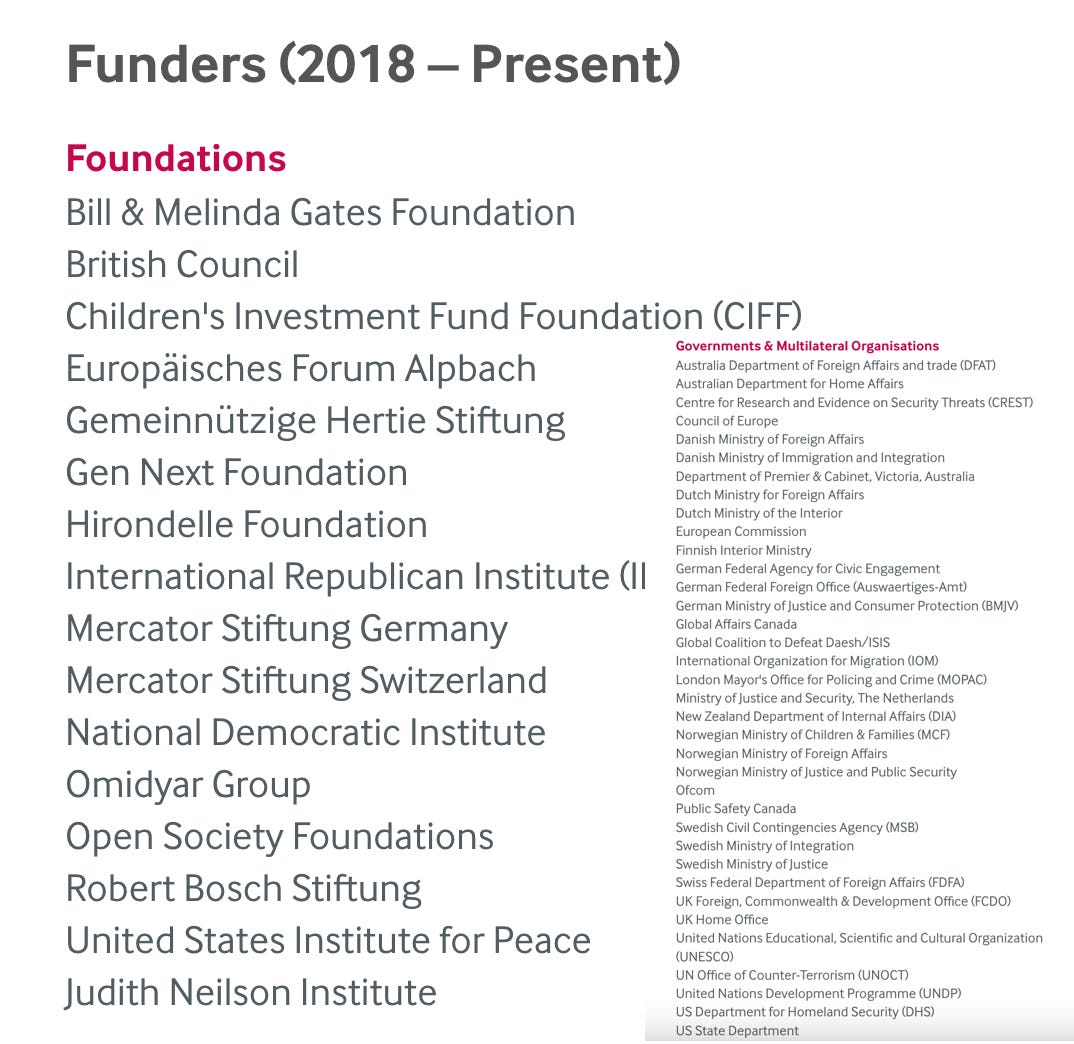
The Institute for Strategic Dialogue’s “diverse range of funders,” according to The Guardian.
The ISD’s “diverse” funders include the US State Department, the US Department of Homeland Security, three other US state-funded organizations, and more than two dozen other NATO government agencies. On the private side, the ISD’s funders include the foundations of three of the world’s richest oligarchs: Pierre Omidyar’s Omidyar Group, George Soros’ Open Society Foundations, and the Bill and Melinda Gates Foundation.
In using the ISD as a source, The Guardian has a conflict of interest that its article did not disclose. The latter two ISD donors have also given sizeable grants to The Guardian: at least $625,000 from Open Society Foundations since 2019, and at least $12.9 million from the Bill and Melinda Gates Foundation since 2011.
Omidyar’s foundation has a direct role in the ISD/Syria Campaign report. The Omidyar Group’s Luminate Strategic Initiatives is listed alongside the German government-funded Friedrich-Ebert-Stiftung foundation as the report’s fiscal sponsor.
Omidyar’s sponsorship of an attack on journalism about the OPCW scandal is highly fitting. The Intercept, the self-described “fearless and adversarial” outlet that Omidyar also funds with his vast fortune, has never once acknowledged the OPCW leaks or whistleblowers’ existence. While ignoring the OPCW scandal for more than three years, The Intercept has published multiple articles promoting the allegation that Syria committed a chemical attack in Douma.
Like the ISD, the Syria Campaign is also funded by governments and other belligerents in the Syria dirty war. As The Grayzone’s Max Blumenthal reported in 2017, the Syria Campaign was founded by Ayman Asfari, a Syrian-British billionaire oil tycoon and leading financial supporter of the Syrian National Coalition, the largest government-in-exile group established after the Syria conflict erupted in 2011. The Syria Campaign has also done extensive P.R. and fundraising for the White Helmets, the insurgent-adjacent, NATO state-funded organization implicated in the Douma incident.
That these two state-funded groups “describe themselves as ‘fiercely independent'” is apparently enough for The Guardian. I trust that the Guardian would feel differently if they were dealing with self-described “fiercely independent” groups funded by the Russian and Syrian governments.
Unsurprisingly, the vast majority of sources quoted in the ISD/Syria Campaign report are funded or employed by the same NATO state and private sponsors. This includes the White Helmets; the Global Public Policy Institute; Syrian American Medical Society (SAMS); self-described journalist Chloe Hadjimatheou of the BBC, who produced a podcast series that disparaged the OPCW whistleblowers and whitewashed the Douma cover-up; and James Jeffrey, the former US Special Envoy for Syria.
For a report that claims to be concerned with protecting Syrians from “real-world harm,” Jeffrey is a particularly interesting interview subject. Few US officials have been as candid about their willingness to immiserate Syrian civilians in pursuit of hegemonic US goals in their country.
Jeffrey has declared that al-Qaeda is a US “asset” in Syria, and has admitted to misleading the Trump White House to undermine an effort to withdraw the US military, whose illegal occupation deliberately deprives Syria of its own wheat and fuel. Jeffrey has openly bragged about his “effective strategy” to ensure “no reconstruction assistance” in Syria — even though the war-ravaged country is “desperate for it.” And he has also taken credit for helping to impose crippling US sanctions on Syria that have “crushed the country’s economy.”
Jeffrey’s proudly self-acknowledged real-world harms on millions of Syrians don’t seem to bother the study’s authors, presumably because their Western state sponsors implement them.
The report is so invested in its state funders’ aims in Syria that it approvingly airs frustration that other governments are failing to toe the NATO line. A “former Western diplomat” complains that “disinformation” on Syria is helping states “avoid making the decisions that we want them to make, say in the Security Council or elsewhere.” (emphasis added). From the point of view of Western officials, the anonymous diplomat is employing an accurate operative definition of what constitutes “disinformation”: any information that causes those deemed subordinate to “avoid making the decisions that we want them to make.”
Fittingly, another anonymous “senior diplomat” laments that supposed Syria disinformation is intended “ultimately to cast doubt upon the legitimacy and integrity of the people doing this kind of [policy] work.” Daring to question the “legitimacy and integrity” of Western policymakers who oversaw a multi-billion dollar CIA-led dirty war on Syria that knowingly empowered al-Qaeda and other sectarian death squads while leaving hundreds of thousands dead — another intolerable act that can only result from “disinformation.”
A member of the US-funded, insurgent-adjacent White Helmets is also given space to lament that alleged “disinformation” is hurting its donations. “We hear about billions of dollars for aid at conferences on Syria but most of that funding goes to the UN,” a White Helmets manager complains. Unmentioned is that European governments have cut funding to the group after their late founder, the lavishly paid UK military veteran James le Mesurier, admitted to pocketing donor funds and financial fraud right before he took his own life.
Having promoted the hegemonic agenda of its state sponsors, the report closes with a thinly veiled call to censor the dissenting voices it targets.
The ISD and Syria Campaign urge policymakers to “adopt a whole-of-government approach in tackling disinformation” and “ensure that loopholes or special privileges are not created for ‘media’ which would only exacerbate the spread of disinformation.” These “privileges” presumably refer to free speech. The report also notes favorably that platforms have addressed “thematic harms such as public health disinformation or foreign interference in elections.” As a result, the report calls on these platforms to “commit to applying similar levels of resourcing… in the context of the ongoing Syrian conflict.” Perhaps they have in mind the censorship of journalism about Hunter Biden’s laptop before the 2020 election, on the fake grounds that the story was “Russian disinformation.”
The fact that this network of state-funded actors is devoting energy to disparaging journalism about the OPCW’s Syria cover-up — and even advocating that it be censored – reflects their powerful sponsors’ desperation to bury a damning scandal.
In public, OPCW Director General Fernando Arias has provided misleading and outright false answers about the Douma probe, including why he refuses to meet with the dissenting inspectors and the rest of the original investigative team.
On top of the two known whistleblowers, Arias has ignored calls for accountability from his original predecessor, founding OPCW chief Jose Bustani, as well as four other former senior OPCW officials. Along with Bustani, former senior UN official Hans von Sponeck has spearheaded the Berlin Group 21, a global initiative to address the OPCW scandal. The US has responded to Bustani by blocking his testimony at the United Nations. Arias meanwhile refused to open a letter that he received from Sponeck’s group, returning it back to sender.
The response of Western media outlets like the Guardian to the stonewalling of these veteran diplomats and senior OPCW officials has simply been to ignore it.
In whitewashing the OPCW cover-up, the preponderance of state sources parroted by The Guardian reveals the ultimate irony in its allegations. While claiming to “identify” a fictional network of Russia-backed disinformation actors about Syria, The Guardian’s Townsend is himself spreading the disinformation of a NATO-funded network that defames voices who expose the dirty war on Syria.
In fact, one of Townsend’s central allegations goes well beyond his state-funded sources. Although Townsend’s article is premised on identifying a “network of conspiracy theorists,” Townsend’s sole source – the ISD/Syria Campaign report – never alleges that such a “network” exists. Nowhere in the report does the word “network” even appear.
Thus, Townsend has not only parroted state-funded sources, but concocted an additional allegation in the service of their narrative. This is not just an ordinary fabrication: in creating the fantasy of a “coordinated”, “Russia-backed”, “network of conspiracy theorists,” Townsend also reveals himself to be the very thing that he accuses his targets of being: a conspiracy theorist.
And given that Townsend not only parrots his state-backed sources but works for an outlet funded by some of the same sponsors, it is fair to say that The Guardian and these state-funded think tanks are a part of the same network.
Consequently, reading the article’s headline — “Network of Syria conspiracy theorists identified”—as a description of The Guardian and the NATO-funded sources that it relied on, the claim is no longer inaccurate.
Ukraine Crisis Highlights Concerns About Whether OPCW Still Has Any Global Relevance, Observers Say
Samizdat | July 6, 2022
The executive council of the Organization for the Prohibition of Chemical Weapons (OPCW) kicked off its hundredth session at The Hague on Tuesday. Last month, the global watchdog assured that it was “monitoring the situation” in Ukraine closely as far as the potential use of chemical weapons is concerned.
The OPCW’s lack of a coherent, objective and fair-minded response to recent crises centered around Syria and Russia demonstrates its politicization and domination by Western interests, and the longer the watchdog stays out of Ukraine, the better, former diplomats, geopolitical observers, and international legal experts have told Sputnik.
“In Ukraine the OPCW has fortunately not been pressed into action. This, I suspect, is because the US is satisfied with the situation as it is, with no need for the US itself to be drawn in, as would no doubt be the case if a chemical attack was fabricated,” Peter Ford, Britain’s former ambassador to Syria, said.
The veteran diplomat, who warned the British government against the folly of the 2003 invasion of Iraq, and stressed that Western powers’ campaign to topple the Syrian government in the 2010s could open a “Pandora’s box” of endless crises, said the Syria case demonstrated clearly that the OPCW is no longer an independent, impartial agency.
“The Syria crisis proved without a shadow of a doubt that the Western powers have bent the OPCW to their own will, destroying in the process the organization’s credibility, probably irretrievably. This is a tragedy for world peace,” Ford stressed, referring to documented OPCW efforts to censor and smear agency whistleblowers who revealed that the watchdog’s report on the April 2018 chemical attack in Douma, Syria was doctored to implicate the Assad government.
In Ukraine, Ford fears, the international community can now only depend on “self-interested restraint on the part of the Pentagon in controlling its proxies rather than the deterrent power of a genuinely impartial international watchdog.”
Chemical Weapons Danger in Ukraine
Since the escalation of the crisis in Ukraine in February, Russia has sent the OPCW and its technical secretariat over two dozen notes warning of possible staged provocations by Ukrainian forces or radical nationalists involving chemical weapons. Last month, the agency assured the international community that it was “closely monitoring the situation in Ukraine” for chemical weapons use.
On Wednesday, Russian military indicated that it had information on plans by Kiev to stage a provocation in the Donetsk People’s Republic using chlorine gas to accuse Moscow on indiscriminate attacks targeting chemically hazardous objects.
Alessandro Bruno, a Toronto-based geopolitical analyst and political observer at Lombardi Letter, says that while the OPCW’s official mission and goals are “certainly worth pursuing,” the problem is the watchdog’s control by Western interests seeking to obfuscate the truth and objectivity in favor of politicized objectives.
“They seem to have targeted only specific sides in specific wars to suit specific aims, which typically are those of Western powers. There have been many efforts to manipulate these organizations by the dominant powers, particularly in the West,” Bruno said.
The scholar recalled instances of claims by the US and its allies about Russia’s use of chemical weapons, from the allegation that Russia poisoned pro-Western Ukrainian presidential candidate Viktor Yushchenko in the mid-2000s, to the 2018 Novichok scandal in Britain, which “many thoughtful journalists have debunked,” to the Alexei Navalny “poisoning” saga of 2020, which doctors treating the opposition vlogger have debunked.
“Yet the accusations of chemical weapons that Russia used have persisted, even though they defied all logic. That’s the biggest issue with these organizations. They must be more neutral. Their headquarters must be in more neutral locations, because the fact that many of these organizations operate from Western capitals makes them more prone to Western media misinformation,” Bruno said.
The geopolitical analyst still fears that the West could use the pretext of ‘Russian chemical weapons use’ in Ukraine “to get more directly involved into the conflict and potentially trigger a much wider physical war.”
“So far, I think, some of the powers came to understand that making an accusation like that in this conflict would be riskier than the accusations they made in Syria and Iraq, Navalny and Yushchenko and so on, that this would have much bigger implications, that this would blow back against the West,” Bruno stressed.
Tool of US Interests
Christopher C. Black, an international criminal and human rights lawyer with 20 years of experience covering war crimes and international relations, echoed Bruno’s sentiments about the OPCW’s noble stated aims and their stark contrast with the body’s actual history, which “shows that [the watchdog] acts to serve the interests of the United States and its NATO and other allies.”
“We saw strong evidence of this when the USA tried to get rid of the Director General Jose Bustani of Brazil in 2002, when the United States was preparing its invasion of Iraq and John Bolton went to The Hague and threatened his family if he did not resign,” Black recalled, pointing to Bustani’s 2018 interview with The Intercept in which the former OPCW chief detailed the threats made against his children living in the United States.
“In August 2020, it was revealed through leaks from Austrian government sources that the OPCW and British claims that Novichok had been found in the blood of the Skripals allegedly poisoned in the UK were false, that in fact no such agent had been found in their blood at all. But the findings were suppressed and a false report issued to back the UK claims,” the lawyer added. “Similar results were seen regarding the alleged poisoning of Mr. Navalny. We can quickly understand what goes on behind the scenes at the OPCW,” Black said.
Black finds it unlikely that the chemical weapons watchdog will change “without a change in the balance of power in the world,” which is taking place, but whose effects on international organizations will be slow to appear.
In Ukraine, the lawyer fears, “We cannot expect any objective consideration of Kiev regime or NATO claims of Russia using chemical weapons in Ukraine for the reasons stated above, despite the fact that Russia has not used them, does not use them and will not use them. To the contrary we have a situation in which Kiev and NATO forces keep making false claims while themselves preparing chemical weapons attacks to be staged as false flag attacks to be blamed on Russia and when Russia asks the OPCW to investigate this, Russia is met with silence,” he said.
How OPCW Can Regain Credibility
Dr. Alfred De Zayas, a lawyer, writer and former independent expert on international order with the United Nations, similarly doubts the OPCW’s ability to reform in its current itteration, saying the agency “has long been instrumentalized to pursue the geopolitical interests of Western powers.”
The international legal expert is confident that agencies like the OPCW, the International Criminal Court and the Human Rights Council can regain their credibility by demonstrating impartiality. “This is possible if the BRICS countries become more vocal and more visible on the international scene. There is no reason why African, Asian and Latin American countries should dance to the tune of the ‘Washington consensus’,” De Zayas stressed.
In Ukraine, the OPCW’s assurance about “monitoring the situation” carries only a “purely propagandistic value,” and is “intended to charge and convict Russia even before there is any evidence of violations of the Chemical Weapons Convention,” the observer believes.
“If the OPCW investigates not only potential Russian war crimes, but also expands its investigation to potential chemical weapons violations and war crimes by Ukrainian forces and by foreign mercenaries, including US, UK, French, Georgian and others, then the OPCW might regain some credibility. That, however, would be ‘out of character’. It is not unlike the ICC, which in the eyes of many observers in the US, Canada, UK, France, Germany, Switzerland – has lost its little credibility and will have no authority unless and until it indicts Western politicians and bureaucrats including Tony Blair, George W. Bush, Paul Wolfowitz, Victoria Nuland, Barack Obama (the king of the drones), Donald Trump, Nikolas Sarkozy, etc.,” De Zayas concluded.
Featured Video
It’s the Occupation, Stupid
or go to
Aletho News Archives – Video-Images
From the Archives
A superpower and “the world’s sickest warrior state”
By Paul J. Balles | March 8, 2010
Living through five or six major wars has hardened me to what I thought were the extremes of inhuman cruelty and brutality.
Two things made those extremes almost bearable: the brutality always revealed – at least according to the media coverage – the viciousness of the enemy. It was therefore quite understandable when our “brave men and women” pulverized the enemy.
Films of Japanese torturing captive Americans somehow justified holding Japanese Americans in internment camps during World War II; and only a small percentage of Americans found the bombing of Hiroshima and Nagasaki unreasonably vengeful at best, at worst, depraved.
The media giants in America portrayed the North Koreans as barbaric beasts with their captives, quite unlike their southern counterpoints – our allies during the Korean War. No one ever felt the need to explain how the South Koreans were a civilized breed while the North Koreans were absolute savages, at least according to the official line.
In Vietnam, our warriors justifiably (or so the media made us believe) dropped napalm on the North Vietnamese who had the gall to hide in villages and tunnels to ravage our invaders. At least it was accepted practice until some rogue photojournalist filmed a young girl screaming down a Vietnamese road in flames. … continue
Blog Roll
 Aletho News
- Pro-Palestinian French member of European Parliament denied entry to Canada
- Pakistan to Host US-Iran Talks
- How Indonesia’s tilt toward the US left it stranded in the Strait of Hormuz
- US has no choice but to retreat from Iranian borders: Top commander
- Iran Retaliation Strikes Chemical Plant Near Dimona
- AWACS’ Destruction is a Major Loss for US Military – Ex-DoW Analyst
- Israel’s Iran Strategy Uses US Military & Gulf States as Its Pawns
- Iran: Trump wanted regime change, now just begging for Hormuz to open
- IRGC: Israeli, US universities in region legitimate targets after strikes on Iranian university
- Trump admits Iran hit USS Ford carrier: ‘We ran for our lives’
- If Americans Knew
- Israeli police block Catholic cardinal from entering Church of the Holy Sepulchre on Palm Sunday
- Israel is assassinating journalists again, more than any other nation, anywhere, ever – Not a ceasefire Day 170
- Over 300 US service members wounded, majority have brain injuries – Not a ceasefire Day 169
- Researchers at Human Rights Watch Resign Over Blocked Report on Palestinian Refugee Return
- Jewish Groups Are Backing a War Americans Don’t Want
- Eric Fingerhut Thinks He’s the President of the Jews
- Top Jewish Philanthropists, Rabbis Urge Israeli President to Take Action Against ‘Jewish Extremists’
- Don’t Be Fooled. Zionist Leaders Have Always Wanted to Control Southern Lebanon
- Israel’s widespread use of torture is a core element of its genocide against the Palestinian people
- In Israel’s War on Iran, Many Middle East US Bases Rendered “All But Uninhabitable”
- No Tricks Zone
- German Science Blog Accuses PIK Climate Institute Of Hallucinating Climate Tipping Points
- Devastating Assessment Of Comirnaty Vaccine By Former Senior Pfizer Europe Toxicologist
- New Study: CO2 Is ‘Effectively Negligible’ As An Explanatory Climate Change Factor Since 2000
- Former Pfizer Toxicologist Dr. Helmut Sterz Tells Bundestag Hearing Pfizer Vaccine Should Have Never Been Approved
- Energy Expert: Germany’s Nuclear Phaseout Was A “500 Billion Euro Mistake”
- New Research: South Australia’s Mid-Holocene Sea Surface Temperatures Were 4°C Warmer Than Today
- Storing Green Energy To Last Germany 10 Days Would Require A 60-Million Tonne Battery
- New Studies: UK Sea Levels Were 4 Meters Higher Than Today During The Mid-Holocene
- Destructive Green New Deal: German Energy And Metal Group Warns Of Drastic Crisis
- New Study Documents A 20-Year Pause In Arctic Sea Ice Decline – Driven By Internal Variability
 Aletho News