Turkiye, Pakistan, Saudi Arabia Sign Memorandum on Collective Defense – Statement
Sputnik – 07.08.2026
Turkiye, Pakistan and Saudi Arabia signed a memorandum on collective defense on Friday, according to a joint statement from the countries seen by Sputnik.
According to the Turkiye newspaper, the joint defense agreement provides for cooperation in the field of intelligence sharing and regional security coordination. Turkiye’s accession to the system of strategic defense cooperation between Saudi Arabia and Pakistan, an agreement on which was signed in 2025, may become an important stage in changing the balance of power in the Middle East.
“Saudi Crown Prince Mohammed bin Salman, Pakistani Prime Minister Mohammad Shahbaz Sharif and Turkish President Recep Tayyip Erdogan signed an agreement in Mecca on collective defense, showing the countries’ shared commitment to further enhance collective security,” the joint statement said.
The purpose of the agreement is to strengthen collective deterrence of any act of aggression, the statement read.
According to the document, an attack on any of the three countries would be considered as an attack on all of them. It also implies strengthening all aspects of defense cooperation between the three countries, the statement said.
Kuwait Ratifies Landmark Defense Agreement with Pakistan
Sputnik – 27.07.2026
Kuwait has officially ratified a broad defense cooperation pact with Pakistan that was signed in June 2023. The ratification follows high-level military contacts between the two countries.
“This agreement reintroduces Pakistan as a direct security stakeholder in the Gulf, beyond its traditional role of providing manpower and training,” said Sultan M. Hali, writer and retired Group Captain of the Pakistan Air Force.
Key points from his commentary:
1️. New role. Pakistan ceases to be merely a supplier of troops. The pact positions Islamabad as a direct security stakeholder in the Gulf.
2️. Hedging strategy. Kuwait is reducing excessive dependence on the US and NATO by relying on a nuclear-armed Muslim-majority ally.
3️. Multipolarity. Arab monarchies are turning to China, Turkiye, and South Asia in response to a fragmented world order.
4️. Basing. Permanent bases are unlikely, but joint exercises, rotational deployments, and maritime patrols are realistic scenarios.
5️. Defense industry. Kuwait may consider the Pakistani-Chinese JF-17 Thunder — cheaper than Western analogs and less vulnerable to embargoes.
6️. Forward presence. Expands Pakistan’s capability to monitor Gulf maritime traffic, including energy chokepoints.
7️. Defense diplomacy. Strengthens Pakistan’s leverage in Gulf councils and its position vis-à-vis India.
8️. Economic dividends. Military cooperation often accompanies labor, trade, and energy agreements, boosting Pakistan’s regional integration.
“Kuwait’s move signals recognition that multipolarity in defining relations is now essential for resilience in an increasingly fragmented regional order,” Hali said.
US-Saudi nuclear pantomime is with eye on Iran
By M. K. BHADRAKUMAR | Indian Punchline | July 24, 2026
The excitement over the US-Saudi nuclear deal has proved to be short-lived. Apparently, the US President Donald Trump himself poured cold water into it by adding a caveat on Thursday that in order for the deal to be advanced, Saudi Arabia must first join the Abraham Accords. That is, as things stand, may seem like asking for the moon.
However, it’s all but certain that Trump allowed the Saudi deal to be signed after consulting Israeli Prime Minister Benjamin Netanyahu as a last throw of dice to pin down Saudi Arabia as a participant / collaborator alongside Israel (and the UAE) for an all-out war against Iran that might at some point entail ground operations, which is not possible without first getting Riyadh on his side firmly, irrevocably.
If Saudi Arabia dissociates from Tump’s upcoming war and disallows the US to use the Saudi bases or work out the logistics accordingly, Pentagon generals will be hard-pressed to conduct the war. In political terms too, the Saudi stance will influence other regional oligarchies in the Persian Gulf in their own attitudes towards Iran, which is astride the Arab street like a colossus. The timing of the July 15 meeting of Trump with the visit of the pro-American prime minister of Iraq Ali al-Zaidi also needs to be factored in here. Simply put, Iraq has become a frontline in the US-Iran conflict.
Saudis won’t like the prospect of Iran emerging as a towering regional power. On its part, Iran is also closely watching the Saudi mood swings stemming out of its compulsions not to annoy Trump who is in a position to to play a helpful role in the event of the succession issue coming to the fore in Riyadh at any time. Of course, this is apart from the profound petrodollar linkages critical to both protagonists.
Meanwhile, the recent Pakistani advisory to Tehran to steer clear of targeting Saudi Arabia, the Houthi threat to Saudi Arabia and the potential closure of Strait of Bab el-Mandeb are tell-tale signs of latent tensions between Tehran and Riyadh, although both sides are maintaining a semblance of normalcy.
Most certainly, Trump’s remark on Thursday making the nuclear deal conditional on the Saudis normalising relations with Israel has thrown the deal as such into question barely 24 hours after it was signed. Is it a U-turn or is the episode just another confusing rollout that has become the trademark of Trump’s presidency? The truth could be somewhere in between.
According to an AP report, the White House press secretary Karoline Leavitt told reporters in a briefing yesterday that Trump has said if the Saudis don’t join the Abraham Accords, “the deal is off.” When asked why the condition wasn’t mentioned Wednesday when the Energy Department announced that the deal was signed, Leavitt said it was because Trump “is always the final dealmaker.”
My own reading is that Trump is backtracking according to a script. He could have taken credit for the condition on Abraham Accords, had it been a part of the deal. But it is within his ingenuity to try to increase his leverage with the Saudis by adding the caveat openly: that might even improve the deal in certain respects such as enrichment or verification clauses, for instance.
The Saudis appear to have been taken by surprise on Wednesday when US Energy Secretary Chris Wright signed the decades-long, multibillion-dollar deal with his Saudi counterpart, Prince Abdulaziz bin Salman, Saudi Arabia’s Minister of Energy but that doesn’t have to be taken at face value. The deal reportedly includes a “123 Agreement” and an accompanying “bilateral safeguards agreement,” and the two agreed to a two-year study to see whether enrichment is necessary. This seems like kicking the can down the road. Interestingly, Netanyahu’s office said Saudis joining of the Abraham Accords “would be an historic leap forward for peace in the Middle East.”
On the whole, Trump has a deal here. The caveat of Abraham Accords may serve to delay the agreement from coming to fruition unless and until the Saudis jettison their bottomline [a Palestinian state] linking normalisation with Israel. On the other hand, Trump has the leverage insofar as the Saudis now have to address whether they want to normalise relations with Israel.
Indeed, the Saudis too are getting an optimal deal here, which doesn’t expressly block reprocessing and enrichment and doesn’t allow for the International Atomic Energy Agency to do its inspections. The Saudis have apparently got away with not having a customary additional protocol, which would have ensured there is no cheating, and it will stay a peaceful programme. On Truth Social, Trump maintained on Thursday that “there will be no enrichment of material,” but added that the US is “not opposed to Civil (Non-Enriched) Nuclear Facilities.” Conceivably, the US may have control of a Saudi enrichment facility and keep a military / security presence.
The Congress will be able to review the deal in a 90-day window. Lawmakers do not need to approve it, but they could oppose it, although that is unlikely. (See a Congressional Research Report Prospects for U.S.-Saudi Nuclear Energy Cooperation, March 11, 2026) All in all, the chances are of the agreement “staying in place and nothing substantive happening until Saudis agree to something” regarding Israel, as [per] Bryan Clark, a senior fellow at the Hudson Institute, an influential pro-Trump DC-based think tank.
The most bizarre coincidence of the entire sequence of developments since Wednesday is the shadow this deal could potentially cast on the US-Iran agreement that is on the horizon. But that is only hypothetical. If Trump intends to launch an all-out war with Iran, there will be no more negotiations to be had on a nuclear deal.
Saudis, being stakeholders, may no longer resist Trump’s entreaties to collaborate with the war effort going forward, whose objective would be to destroy Iran comprehensively with all the military might at Washington’s command. The Saudi Crown Prince Mohammed bin Salman has said in the past that if Iran obtained a nuclear weapon, the kingdom would have to follow suit.
In such a scenario, there will be no conceivable reason for Israel at the present juncture to try to kill the US-Saudi deal that is struggling to be born.
Pakistan thought it won the peace. Now, it could be dragged into war.
By Elfadil Ibrahim | Responsible Statecraft | July 22, 2026
Four weeks ago, Pakistan looked like one of the biggest winners of the U.S.-Iran war.
Its army chief, Field Marshal Asim Munir, shuttled between Washington, Tehran and Gulf capitals for months. As part of his efforts, Pakistan hosted the first face-to-face U.S.-Iran talks in years and helped broker the Islamabad memorandum of understanding that Vice President JD Vance signed in June, thanking Munir and calling him one of the “very, very important people” in his life.
Islamabad hired a Washington lobbying firm to convert that goodwill into defense cooperation and minerals investment, and Pakistani Prime Minister Shehbaz Sharif spoke of a “sun of progress and prosperity” for Pakistan’s chronically stressed economy after the MoU between the U.S.and Iran brought an end to major military operations.
Pakistan’s fortunes have since reversed. Fighting between Washington and Tehran has resumed, and Islamabad’s dual goals of being Iran’s trusted interlocutor and the Arab Gulf states’ security guarantor are once again at odds.
President Donald Trump declared the deal was “over” in early July, after which the U.S. struck civilian and military targets in Iran. Iran, for its part, declared on July 18 through its deputy foreign minister, Kazem Gharibabadi, that it was “suspending all obligations” under the framework. The war has since widened into exactly the kind of multi-front regional conflict Pakistan spent the spring trying to prevent.
The clearest new exposure for Pakistan is in Saudi Arabia, where Iran struck Prince Sultan Air Base at al-Kharj — its first direct hit on Saudi territory since March — just days after the Houthis, Iran’s Yemeni ally, fired missiles on the kingdom, hitting Abha airport in the country’s south. That escalation occurred after Saudi-allied forces hit Sanaa airport in Yemen to prevent the landing of an Iranian airliner; the U.S. Treasury alleged without providing evidence that the plane is linked to Iran’s Islamic Revolutionary Guard Corp. The strikes effectively enforced Riyadh’s airspace veto over the Houthi-controlled capital.
Pakistan signed a mutual defense pact with Riyadh last year. It deployed fighter jets and thousands of troops to the kingdom after earlier Iranian strikes on Saudi energy infrastructure. More recently, Islamabad has reportedly communicated to Tehran directly that attacks on Saudi Arabia will be treated as attacks on Pakistan itself. Sharif’s own statement in the aftermath called the Houthi strikes on Saudi Arabia a violation of the kingdom’s sovereignty that Pakistan “strongly condemns,” pledging “unwavering support” for Riyadh’s security.
The tone is notable given that Pakistan’s parliament explicitly refused to get entangled in Yemen over a decade ago. In April 2015, faced with a nearly identical Saudi request to join the Saudi-led coalition against the Houthis, Pakistan’s National Assembly voted unanimously to “maintain neutrality.” Islamabad’s calculus has not changed. If anything, recent events have sharpened Pakistan’s desire to broker a lasting peace.
Pakistan is home to the world’s second-largest Shia population after Iran, and the killing of Iran’s supreme leader, Ali Khamenei, in February set off deadly unrest in Karachi and Islamabad; Munir himself had to intervene to calm a wave of processions and pledges of allegiance to the new supreme leader across Shia neighborhoods.
Significantly, Munir and Prime Minister Shehbaz Sharif attended Khamenei’s funeral in July, and Sharif posted after that “the late Supreme Leader’s wisdom, leadership and profound influence on Iran and the wider region will be remembered for generations” — a demonstration of the fine line Pakistan’s leadership has to walk, one no doubt delivered with a domestic audience in mind as much as an Iranian one.
That fine line becomes impossible to walk when a defense pact, triggered by Saudi-Houthi fighting or by further Iranian strikes on Saudi Arabia, would ask Pakistan to do the exact thing its parliament explicitly refused a decade ago: take a military side against a Houthi-Iran axis, and do so at a moment when its domestic Shia politics is highly combustible
Kuwait is now reportedly asking for the same kind of commitment that Saudi Arabia already has. Reuters reported last week that Islamabad is in early-stage talks with Kuwait — which has absorbed repeated Iranian strikes on its infrastructure in recent days — over an expanded defense agreement that would include “thousands of Pakistani troops on the ground, fighter jets, drones, an air defence system, and other defence-related facilities,” according to an anonymous Pakistani government official cited in the report.
Another anonymous Pakistani security official said the country “cannot consider a deployment of combat troops at this stage.” That hesitation suggests that stacking multiple defense commitments across Gulf states in Iran’s crosshairs makes Islamabad’s balancing act much harder to sustain. Each new pact narrows the room to claim neutrality the next time Tehran calls.
During this war, Pakistan discovered what happens when Gulf partners doubt its ability to balance between Tehran and the Arab Gulf states. The United Arab Emirates recalled a $3.5 billion loan in April and quietly began deporting Pakistani Shia workers by the thousands. The move was widely read as retaliation for Islamabad’s perceived tilt toward Tehran during the mediation. Saudi Arabia stepped in with $3 billion to cover the gap, but the lesson was clear: Pakistan’s neutrality satisfies no one fully, and the cost of disappointing any single Gulf patron is measured in the billions of dollars.
Economic self-preservation has been Pakistan’s primary motive for steering mediation and ending a war that has hobbled the economies of its creditors and choked the trade routes that power its own electric grid. Pakistan is on its 25th International Monetary Fund program; more than half of its tax revenue is put towards servicing its debts. It had barely stabilized its inflation before the Strait of Hormuz’s closure sent rates back into double digits.
In March, as the war’s first phase disrupted energy flows out of Hormuz, Islamabad ordered a two-week school closure and imposed a four-day work week to conserve fuel — measures the government has now indicated it may need to revive.
A parallel disruption to the Red Sea, like the blockade of Saudi Arabia declared by the Houthis Monday, would be highly disruptive to Pakistan’s energy security, and by extension, its economy. While Pakistan imports the overwhelming majority of its fuel from the Gulf, the closing of another critical chokepoint would simultaneously tighten global tanker capacity and insurance costs everywhere, pushing the same spot-market prices Pakistan is already struggling to afford even higher.
It would also add further pressure on Pakistan’s defense commitments to Saudi Arabia, given that Riyadh will not tolerate such a closure. In a recent statement, Riyadh pledged to deal with “Houthi threats against transiting vessels… firmly and swiftly.” The stakes for Saudi Arabia are high: Since the Strait of Hormuz was blocked, Saudi Arabia has relied on its East-West pipeline to divert roughly 5 million barrels per day of crude to the Red Sea Port of Yanbu — its only viable export outlet while Hormuz is all but closed.
None of this means Pakistan’s mediation was a mistake, or that its diplomatic capital has evaporated. Kuwait’s foreign minister still thanked Pakistan last week for its “constructive and mediatory role,” and Islamabad remains one of the few channels through which Washington and Tehran would resume talks, when the time comes. But the specific bet Pakistan made — that ending the war would allow it to bank the goodwill through commerce and financial aid — has not yet paid off.
Instead, the restart of the war has brought Saudi Arabia back into Iran’s crosshairs. At the same time, the Saudi-Houthi front has reopened, the Strait of Hormuz has been closed again, and a blockade of Saudi-linked ships on the Red Sea has been formally declared.
Each of these factors adds immense pressure on Pakistan, which now has every reason to double down on diplomacy, lest it be drawn in as a combatant.
Elfadil Ibrahim is a writer and analyst covering the politics of the Middle East and Africa, with a special focus on Sudan. His work has been featured in The Guardian, Al Jazeera, The New Arab, Open Democracy and other outlets.
Houthi Blockade Against Saudi Arabia Creates Geopolitical, Economic Dilemma for Pakistan
Sputnik – 21.07.2026
Any threat to the Kingdom’s stability is a threat to Pakistan’s strategic and economic interests, experts stress.
Pakistan is grappling with the potential fallout from a Houthi threat to blockade Saudi Arabia’s Red Sea coast, a development that could activate one of the region’s most consequential defense agreements.
“For Pakistan, the implications are direct and serious,” Abdullah Khan, director of the Pakistan Institute for Conflict and Security Studies, tells Sputnik.
The reason is a binding defense pact signed in September 2025. Under its terms, an attack on Saudi Arabia is treated as an attack on Pakistan and vice versa.
“Pakistan’s interest lies in preventing further escalation through restraint and diplomacy while remaining fully committed to Saudi Arabia’s security under the mutual defense framework. Any threat to the Kingdom’s stability is a threat to Pakistan’s strategic and economic interests,” Khan stresses.
The Houthi threat is no bluff, according to Khan. They possess ballistic missiles, long-range drones, and explosive-laden unmanned boats. They have already hit Saudi oil facilities and struck commercial ships in the Red Sea. Their capabilities allow them to choke energy exports, spike insurance costs, and force billions in defensive spending – a reality that extends far beyond Yemen’s borders.
The economic consequences for Pakistan could be severe also, Ali Ehsan, an economic policy analyst, warns. With Bab el-Mandeb now under threat, Pakistan loses its alternative route for Saudi oil shipments. That means higher petrol and electricity prices, disrupted textile exports to Europe, and mounting pressure on an already fragile economy.
“Pakistan’s trade with Europe, which is an export market, will get highly affected by this situation and Pakistan’s economy will come under more pressure,” Ehsan says.
Pakistan, Kuwait hold early talks on defense-for-energy partnership
The Cradle | July 17, 2026
Pakistan and Kuwait have entered early-stage negotiations to expand defense cooperation, with Islamabad seeking deeper energy ties and greater investment from the Gulf monarchy in return, Reuters reported on 17 July.
“Kuwait’s wish list includes everything,” said a Pakistani security official familiar with the negotiations. “But let me be clear about one thing: We are not and we cannot consider a deployment of combat troops at this stage.”
One source confirmed the talks have covered defense procurement, but noted it was “not clear this will amount to a defense pact per se.”
In exchange for any deal, Islamabad wants expanded cooperation on energy security as it builds up its strategic oil and fuel reserves as part of a wider initiative led by Pakistan’s Energy Ministry.
Over the past year, Pakistan and the Gulf monarchies have moved toward new regional defense arrangements.
The realignment was accelerated by the US’s war on Iran, which saw Gulf countries absorb the brunt of the retaliatory impact, and called into question the reliability of the US as a defense partner.
Meanwhile, Islamabad commands one of the region’s largest armies and manufactures its own fighter jets, credentials that have positioned it as a potential supplement, or even alternative, to US protection.
For Kuwait, Pakistan represents a dependable partner, according to a source in the region familiar with Kuwaiti security planning.
“They are already in with the Saudis, they have a long history of defense development, they are Muslim Sunni, they have a good relationship with the Americans, so it’s not as sensitive as some other options,” the source said.
Turkiye, Pakistan, and Saudi Arabia have been preparing a draft agreement for a three-way mutual defense pact, distinct from the existing accord between Islamabad and Riyadh.
Bahrain is pursuing a similar arrangement, one source said, while Jordan has signaled interest in a weapons and training deal.
Last year, Saudi Arabia and Pakistan signed a Strategic Mutual Defense Agreement committing each to treat an attack on one as an attack on both – a pact widely understood to place Riyadh under a de facto Pakistani nuclear umbrella, after Pakistan’s defense minister said all the country’s capabilities “will be made available under this agreement.”
Explainer: Which foreign delegations attended the funeral of martyred Leader of the Islamic Revolution?
Press TV – July 4, 2026
The funeral ceremony for the martyred Leader of the Islamic Revolution, Ayatollah Seyyed Ali Khamenei, brought together one of the largest gatherings of foreign dignitaries in Iran in recent decades, with representatives from across Asia, Africa, Europe, the Americas, and major international organizations attending the event in Tehran.
The delegations included presidents, prime ministers, parliamentary speakers, foreign ministers, senior government officials, political leaders, and representatives of religious organizations and resistance movements, underscoring the broad international participation in the ceremony.
Asia
Asia accounted for the largest share of official delegations.
From West Asia, Iraq sent one of the largest delegations, including Kurdistan Region President Nechirvan Barzani, Parliament Speaker Mahmoud al-Mashhadani, senior officials, and representatives of the Popular Mobilization Forces (PMF).
Saudi Arabia was represented by Deputy Foreign Minister Waleed Al-Khuraiji, while Oman sent the chairman of its State Council and Qatar was represented by Parliament Speaker Hassan bin Abdullah Al Ghanim.
Shia community representatives also attended from Bahrain and several other Persian Gulf countries.
Lebanon dispatched Defense Minister Michel Menassa alongside senior delegations from Hezbollah and the Amal Movement.
Yemen was represented by Vice President Mahmoud al-Junaid and an Ansarullah delegation.
Palestinian groups also attended, including senior Hamas leaders and Islamic Jihad Secretary-General Ziyad al-Nakhalah.
From the wider Asian region, Pakistan sent one of the highest-level foreign delegations, headed by Prime Minister Shehbaz Sharif and Army Chief Field Marshal Syed Asim Munir. The delegation also included the Senate speaker, senior government officials, and religious leaders.
Afghanistan was represented by delegations from the Taliban administration and the Afghan resistance.
India sent a special government envoy at the deputy foreign minister level.
China was represented by He Wei, Vice Chairman of the Standing Committee of the National People’s Congress.
Tajik President Emomali Rahmon attended the ceremony in person, while Armenia was represented by Prime Minister Nikol Pashinyan. Georgia sent President Mikheil Kavelashvili along with a Muslim delegation.
Türkiye dispatched Vice President Cevdet Yılmaz, together with political and party representatives.
Turkmenistan was represented by Gurbanguly Berdimuhamedow, Chairman of the People’s Council and National Leader.
Among other participants were Azerbaijan’s parliament speaker, Kazakhstan’s foreign minister; the parliamentary speakers of Kyrgyzstan, Uzbekistan, Bangladesh, and Sri Lanka; Thailand’s deputy prime minister; Malaysia’s agriculture minister; Myanmar’s special envoy; and official delegations from South Korea and North Korea.
Africa
Several African governments were represented by ministerial- or cabinet-level delegations.
Egypt sent its Senate speaker.
South Africa, Burkina Faso, the Democratic Republic of the Congo, Namibia, Tanzania, and Tunisia all sent official representatives.
Nigeria and Senegal also dispatched delegations to participate in the funeral ceremonies.
Europe and the Americas
Russia sent Dmitry Medvedev, Deputy Chairman of the Russian Security Council, as President Vladimir Putin’s special representative.
Belarus was represented by its parliament speaker, while Serbia sent its communications minister. Bulgaria also dispatched parliamentary and political representatives.
Germany was represented by members of the country’s Shia community.
From Latin America, Cuba sent its higher education minister as a special representative, while Nicaragua was represented by Foreign Minister Valdrack Jaentschke.
International organizations
The ceremony also drew senior representatives of several international organizations.
The Shanghai Cooperation Organization (SCO) was represented by Secretary-General Nurlan Yermekbayev, while the Organization of Islamic Cooperation (OIC) sent Deputy Secretary-General Tariq Ali Bakheet.
The D-8 Organization for Economic Cooperation and the Economic Cooperation Organization (ECO) were represented by their respective secretaries-general.
Israel Brings The War Rhetoric Towards Türkiye
After Being Defeated In Iran, Israel Targets Türkiye.
By Justin K.P. – The Dissident – June 22, 2026
The idea of Israel going to war with Türkiye- a NATO member- potentially triggering World War III seems insane.
And yet Israel is using their war rhetoric towards Türkiye.
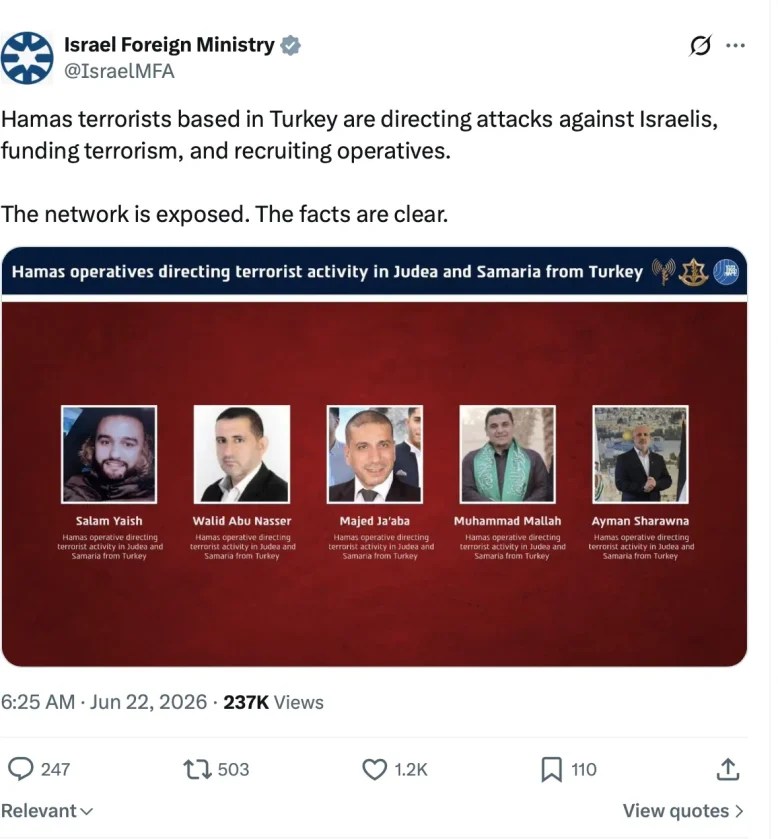
The Israeli Foreign Ministry put out a post seemingly laying the groundwork for an Israeli war, claiming that “Hamas terrorists based in Turkey are directing attacks against Israelis, funding terrorism, and recruiting operatives. The network is exposed. The facts are clear.”
This is far from the first time Israel has used war rhetoric towards Türkiye.
Israel’s Minister of Diaspora Affairs Amichai Chikli recently said that Israel “will be at war with Syria sooner or later” in part because he called Syria “a Turkish protectorate”.
He also fabricated a new “radical Sunni axis of evil” which supposedly includes Pakistan, Turkey and Qatar.
Middle East Eye reported:
“What we are witnessing before our eyes is the rise of a new axis,” Chikli told 103FM radio on Wednesday, referring to Turkey, Qatar and Pakistan. He described this so-called alliance as “a radical Sunni axis of evil, more dangerous than anything we have seen before”.
While Chikli mentioned both Qatar and Pakistan in his interviews, he mainly focused on Turkey, branding Turkish President Recep Tayyip Erdogan’s vision “an extremely dangerous combination for us”.
Other members of the ruling Israeli Likud party have similarly been declaring Türkiye “an enemy state”.
Middle East Eye noted, “Last week, Israeli lawmaker Ariel Kellner, also of Likud, called Turkey an ‘enemy state’, while Culture and Sports Minister Miki Zohar said last month that Israel’“must begin to treat Turkey as an enemy state,’ suggesting that Turkey would suffer heavy blows in a possible conflict with Israel.”
It added that “In February, former prime minister Naftali Bennett indicated that he sees Turkey as an enemy, with the opposition figure stating: ‘Turkey is the new Iran.’”
Perhaps the most concerning development is the fact that the Foundation for The Defence of Democracies (FDD), an Israeli lobby cutout that played a large role in the U.S. war on Iran, has begun publishing articles using similar rhetoric towards Türkiye.
FDD put out an article titled , “Turkey the new Iran? Ankara’s growing challenge to Western interests”.
The article attempted to label Türkiye as the “new Iran”, writing:
As Iran and its proxies take a beating from American and Israeli forces, observers are questioning whether Turkey is waiting in the wings to emerge as the region’s next “bogeyman.” The answer is likely yes, albeit in its own form.
Turkey is not Iran, but depicting Turkey as a nuisance or simply “complicated” only emboldens a maturing adversarial regime with an established track record of undermining its Western allies.
The article attempted to ratchet up hostilities between Türkiye and the United States, writing, “The real question is whether Turkey is actively undermining US, NATO, and regional security interests. There is little doubt that Ankara is doing just that, and doing so more brazenly with the passage of time.”
It also lamented that Türkiye is too supportive of the Palestinian resistance, writing “Hamas, as an Iranian proxy, has served Ankara’s interests in undermining Israel’s security interests, something which Turkey would like to see intact after the end of the current war.”
FDD has similarly put out articles pushing for the U.S. to put sanctions on Türkiye, saying that “Washington should pursue Global Magnitsky sanctions against targets in Turkey” and that “the United States should utilize Global Magnitsky authorities to target Turkish individuals responsible for human rights violations”.
It also called for the U.S. to designate “government officials” in Türkiye as “terrorist organizations” and wrote that “The United States should protect the international financial sector by recommending added scrutiny and screening to transactions involving Turkish financial institutions” and that “Washington should coordinate with the G7 to return Turkey to the Financial Action Task Force (FATF) ‘grey list’ until further improvements are seen in combating terrorism financing.”
The Carnegie Endowment for Peace documented that “FDD was the brainchild of a New York Times journalist-turned-Republican operative, Clifford May,” adding that “it arose out of an organization committed to burnishing Israel’s reputation in the United States. On April 24, 2001, three major pro-Israel donors incorporated an organization called EMET (Hebrew for ‘truth’). In an application to the Internal Revenue Service for tax-exempt status, May explained that the group ‘was to provide education to enhance Israel’s image in North America and the public’s understanding of issues affecting Israeli-Arab relations.’ But in the wake of the Sept. 11 attacks, May broadened the group’s mission and changed its name to the Foundation for Defense of Democracies. As he explained in a supplement to the IRS, the group’s board of directors decided to focus on ‘develop[ing] educational materials on the eradication of terrorism everywhere in the world.’”
It added that, “FDD’s chief funders have been drawn almost entirely from American Jews who have a long history of funding pro-Israel organizations. They include Bernard Marcus, the co-founder of Home Depot, whiskey heirs Samuel and Edgar Bronfman, gambling mogul Sheldon Adelson, heiress Lynn Schusterman, Wall Street speculators Michael Steinhardt and Paul Singer, and Leonard Abramson, founder of U.S. Healthcare.”
Sima Vaknin-Gil, a former Israeli military intelligence officer, in the Al Jazeera documentary The Lobby, admitted that “We have FDD” and that “the foundation is ‘working on’ projects for Israel, including ‘data gathering, information analysis, working on activist organizations, money trail. This is something that only a country, with its resources, can do the best”.
FDD played a huge role in shaping American policy towards Iran at the behest of Israel.
Now, as Israel calls Türkiye an “enemy state”- the FDD has begun pushing Washington to place sanctions on the country and designate government officials as terrorists, laying the groundwork for a new Israeli war.
Abraham Accords: Why Trump’s “mandatory” deal collapsed
By Salman Rafi Sheikh – New Eastern Outlook – June 8, 2026
Donald Trump’s attempt to tie an Iran peace settlement to a mandatory expansion of the Abraham Accords reveals a fundamental misunderstanding of how dramatically the Middle East has changed since the Gaza war and why old diplomatic formulas no longer work.
Donald Trump has a habit of mistaking the décor of diplomacy for its substance. His latest demand — that Saudi Arabia, Qatar, Pakistan, Turkey, and others must “mandatorily” join the Abraham Accords as a condition for any Iran peace settlement — is not bold dealmaking. It is a category error dressed up as statecraft, one that conflates a 2020 diplomatic triumph with the profoundly different geopolitical realities of 2026. The silence that reportedly greeted Trump on his conference call with regional leaders was not awkward; it was diagnostic.
The Middle East Trump Remembers Does Not Exist
The original Abraham Accords of 2020 were a very significant development for several reasons. They emerged from a specific regional calculus: Gulf states, quietly terrified of Iranian expansionism, had come to view Israel as a strategic asset rather than an ideological liability. The Palestinian issue, while never abandoned rhetorically, had receded to the background of realpolitik. The formula worked precisely because it did not require Israel to make concessions and because the public cost of signing was, at the time, manageable. That calculus has been demolished by the Gaza war.
A Washington Institute for Near East Policy survey published in August 2025 found that 99% of Saudi respondents viewed normalization with Israel as a negative step. For context, in 2020, 41% had considered the Abraham Accords a positive development for the region. By 2025, that figure had collapsed to 13%. This is not marginal drift; it is a tectonic shift in public sentiment that no Arab leader, not even an absolute monarch, can afford to ignore. Crown Prince Mohammed bin Salman reportedly told US lawmakers in 2024 that his efforts to advance normalization had put his life at risk. That is not a man about to sign anything without ironclad political cover.
Saudi Arabia’s position is now unambiguous and unyielding: there will be no normalization without “an irreversible pathway” to Palestinian statehood. That pathway cannot be a vague promise or a roadmap but a concrete and verifiable process. Thus, Saudi Israeli normalization is not merely paused; it is contingent on developments in the Palestinian arena and shifts in how Israel is perceived regionally. Given the vastly changed regional scenario, Saudi efforts are geared less towards normalization with Israel than towards shaping a new regional agenda in which distancing from Israel serves both the Crown’s domestic legitimacy and its aspirations for broader Islamic leadership.
Pakistan’s refusal is even more visceral. Defence Minister Khawaja Muhammad Asif flatly stated that joining the Abraham Accords “clashes with our fundamental ideologies,” and pointedly noted that Pakistani passports do not even carry Israel’s name as a valid travel destination. This position stretches back to Pakistan’s founder Muhammad Ali Jinnah’s explicit rejection of the UN partition of Palestine in 1947. The question of recognizing Israel, therefore, is not a negotiating posture; it is a constitutional identity. Qatar, meanwhile, which absorbed an Israeli airstrike as recently as last September, was never a realistic candidate.
Bundling Two Crises into One Catastrophe
There is a second, more immediate danger in Trump’s gambit: it actively threatens the Iran negotiations themselves. As even reports in the mainstream US media noted, the idea of a massive expansion of the Abraham Accords at a moment when the US has not yet secured the reopening of the Strait of Hormuz — let alone resolved Iran’s nuclear program — “seems almost absurd.” The Iran talks are already burdened with sticking points: Washington insists Iran must surrender its enriched uranium stockpile, while Tehran has insisted nuclear negotiations be deferred to later discussions and continues to demand sanctions relief and the release of frozen assets. Threading that needle is already the diplomatic equivalent of defusing a bomb blindfolded. Attaching an Israel-normalization condition to it hands Iran a ready-made argument for walking away or highlighting why the US cannot be trusted with any deal.
Not just Tehran, Iran’s neighbors — having watched Tehran survive American and Israeli airstrikes, endure a maritime blockade, and still inflict damage on global energy markets — are unlikely to respond positively to Trump’s appeal. There is a grudging, regionally shared respect for Iran’s resilience, and any demand that frames joining the Abraham Accords as a precondition will be read across the Islamic world not as American leverage but as American tone-deafness.
That said, Trump’s push might placate Israel’s Benjamin Netanyahu, who has been deeply critical of US attempts to reach a peace agreement with Iran. If true, it means Trump is risking the entire Iran settlement — a genuinely consequential achievement — to manage Netanyahu’s domestic politics. That is a trade-off of staggering irresponsibility. And in a telling sign of how reality eventually wins, by Thursday this week, US sources confirmed that a tentative framework agreement with Iran was pending Trump’s approval, with the Abraham Accords entirely absent from it.
Where This Leads
Trump’s retreat from his “mandatory” demand has already begun. What comes next will reveal the structural fragility of his approach. A ceasefire framework with Iran, if finalized, will be celebrated as historic, and rightly so. But the moment that diplomatic high fades, the region it leaves behind will be considerably more resistant to the kind of top-down normalization that the Abraham Accords represented.
Instead, the explicit rejection of Trump’s demand shows that Israel now risks a form of diplomatic isolation it has not faced since before the Oslo era, as the binary division between a “moderate axis” including Israel and Gulf states gives way to more fluid alignments that no longer treat Iran as the primary regional threat and in which public identification with Israel is seen as illegitimate and potentially regime-threatening.
The harder question is whether the United States can build a durable Middle East architecture on the foundation of a deal that most of the region’s population views as illegitimate. Normalization imposed by American diktat, without justice for Palestinians and for the Iranians, will not hold. Agreements signed under duress — economic, diplomatic, or military — have a long history of unraveling, often at the worst possible moment. What the post-Gaza Middle East demands is not a grander version of the Abraham Accords. It demands a reckoning with why those accords, for all their genuine diplomatic ingenuity, failed to prevent the conditions that produced October 7 in the first place. Until Washington grasps that, its deal-making — however theatrical — will keep colliding with a region that has moved on.
Salman Rafi Sheikh is a research analyst of international relations and Pakistan’s foreign and domestic affairs.
Follow new articles on our Telegram channel
‘Unacceptable’: Islamabad won’t normalize with Israel, defense minister says despite Trump’s push
Press TV – May 26, 2026
Pakistan’s Defense Minister Khawaja Asif has asserted opposition to his country’s normalizing relations with the Israeli regime after US President Donald Trump called on regional states to enter rapprochement deals with Tel Aviv.
Speaking to Pakistani broadcaster Samaa TV on Monday, Asif said Pakistan should not support agreements that conflict with the country’s “fundamental ideologies.”
Asif made the remarks after being asked about the possibility of Pakistan’s joining the so-called Abraham Accords – a set of Washington-facilitated détentes that have normalized relations between some regional countries and Tel Aviv – following reported pressure from Trump.
Questioning engagement with the regime, the Pakistani defense minister added, “How will you sit down with those people whose word cannot be trusted even for a single day?”
He also reiterated Islamabad’s longstanding position regarding the regime. “We have a very clear stance that this is not acceptable to us,” Asif said.
Referring to Pakistan’s passport policy, he added, “And secondly, on our passports, we are the only country whose passports don’t even include Israel’s name.”
Trump pushes for expansion of Abraham Accords
The remarks came as Trump called for more countries to follow the example of such states as the United Arab Emirates and Bahrain that have entered rapprochement deals with Tel Aviv.
He suggested that those countries join the “Abraham Accords” before conclusion of any agreement between Iran and the United States aimed at ending the cycle that has arisen out of Washington’s unprovoked aggression against the Islamic Republic.
Trump said expansion of the accords “should start with the immediate signing by Saudi Arabia and Qatar, and everybody else should follow suit.”
He also said that during discussions with leaders of Muslim and Arab countries, he stressed that “all of these Countries, at a minimum, simultaneously, [should] sign onto the Abraham Accords.”
He said “it should be mandatory” for those states to join the normalization deals “after all the work done by the United States to try and pull this very complex puzzle together.”
The US president did not clarify further, but observers commenting on his remarks said he was either trying to condition any agreement with Iran on realization of such détentes or portray a favorable picture of regional normalization with the occupying regime and Washington’s role in it.
Trump described the accords as beneficial for participating countries.
“The Abraham Accords have proven to be, for the Countries involved (The United Arab Emirates, Bahrain, Morocco, Sudan, and Kazakhstan), a Financial, Economic, and Social BOOM, even during this time of Conflict and War, with the current Members never even suggesting leaving, or taking so much as even a pause,” he wrote.
Reports, including those provided by Francesca Albanese, UN special rapporteur on the occupied Palestinian territory, have shown how the countries in question, especially the UAE, have been deriving economic benefits from the normalization accords even as the Israeli regime would sustain its campaign of occupation and aggression against Palestinians, including its war of genocide on the Gaza Strip.
Palestinians and their supporters have vociferously denounced the accords, condemning their regional signatories for their betrayal of the Palestinian cause of confronting Israeli atrocities.
Featured Video
Racist Seinfeld Dances for Joy as Bibi Unveils His New Map
or go to
Aletho News Archives – Video-Images
TV Drama Review
Japanese drama projects Japan’s wartime atrocities onto Chinese characters

Global Times | October 25, 2026
By portraying Chinese characters as perpetrators of ruthless violence while casting Japanese Self-Defense Forces (SDF) intelligence operatives as defenders, the season 2 of the Japanese drama Vivant has recently drawn criticism from Chinese netizens, who argue that its depiction turns historical reality on its head while ignoring Japan’s wartime atrocities.
The TBS drama series – a spy suspense story in which an alleged unofficial intelligence unit of the SDF operates across the globe — has attracted a passionate fanbase. Its currently airing season 2 opened with a household rating of 18.8 percent, the highest for a TV drama this year, according toa commentary article by Japanese media Toyo Keizai.
What draws attention is the portrayal of the enemies in the series, the article noted. Scenes in which the Chinese organization subjects kidnapped members of the SDF unit to brutal torture are repeated with unrelenting intensity.
It is rare for Japanese TV dramas to explicitly portray a real-life country as the enemy, the article noted.
Japanese Prime Minister Sanae Takaichi also made a reference to the drama, saying that she has been recording Vivant and hopes to binge-watch it over the year-end and New Year holidays, according to Japanese media outlets.
China’s CCTV News report on Sunday revealed that the drama features scenes in which Chinese personnel cut off the fingers of and stab Japanese intelligence operatives in the abdomen. Such acts bear striking similarities to the torture inflicted on Chinese nationals by invading Japanese troops during the World War II.
The drama distorts the truth by attributing these atrocities to modern Chinese characters. Beneath the surface, it subtly glorifies Japan’s cross-border overseas operations, blurs the functional boundaries of the SDF and implicitly promotes an expansionist narrative, per CCTV News. … continue
Blog Roll
 Aletho News
- EU facing trillion-euro debt hole while seeking more cash for Kiev
- How US, Europe, Persian Gulf states exhausted missile stockpiles, splurged billions to defend Israel
- Up in arms… Koreans reject U.S. empire’s plan to make South Korea the next Ukraine
- Iran, Turkey, Pakistan, Saudi Arabia could advance region-led security framework in Tehran: FM spox
- Netizens condemn Japanese drama for projecting Japan’s wartime atrocities onto Chinese characters
- Racist Seinfeld Dances for Joy as Bibi Unveils His New Map
- A West Bank War for Netanyahu’s Election Campaign, Could It Backfire?
- Yemen denounces European Parliament’s ‘hypocritical’ push to blacklist Ansarullah
- Qalibaf: UAE’s UN bid aims to ‘clear the runway’ for ‘Greater Israel’, whitewash genocide
- Pakistan reopens Iran border after boosting security: Report
- If Americans Knew
- An error has occurred; the feed is probably down. Try again later.
- No Tricks Zone
- Sudden Stratospheric Warming, Powerful El Niño Combination May Lead To Extreme Europe Cold, Energy Crisis!
- Two New Studies Find Thwaites Glacier Melt Cannot Be Driven By Human Activity Or A Warming Ocean
- E-Cars Reduce CO2 Emissions By Only 41% Compared To Internal Combustion Engine Vehicles
- Predictions Made By Renowned Climate Professor Over Past Decades Have Been Proven To Be Poor
- New Study Suggests Large Regions Of The Pacific Ocean Have Been Cooling For The Last 80 Years
- Germany’s Green Energy Debacle: High Energy Costs Force Kahla Porzellan to Close After 182 Years!
- New Study: 50 Years Of The Most Aggressive ‘Net Zero’ Policies Can Only Affect The Global Climate By 0.03°C
- US September “Heat” Was No Record…Many Records Set Decades Ago
- Latest European Green Energy Debacle; Portugal’s Largest Flagship Solar Park Insolvent!
- Green Energy Debacle: German Expert Professor Fritz Vahrenholt Warns Of Severe Economic And Social Consequences

