Report: Saudi Arabia seeks allies’ assistance as missiles deplete amid war on Yemen
Press TV – September 17, 2026
Saudi Arabia is reportedly facing depleted reserves of missile interceptor systems and has appealed to regional partners and Western allies for assistance as Yemeni Armed Forces continue retaliatory missile and drone operations against strategic sites deep inside the kingdom.
The Associated Press, citing two regional officials speaking on condition of anonymity, reported on Wednesday that Saudi authorities have appealed to France, the United Kingdom, Pakistan, and Egypt to establish air-defense reinforcements in the region to bolster protection against missile and drone operations conducted by Yemeni Armed Forces.
The Yemeni operations are being carried out in retaliation for ongoing airstrikes and the blockade against their Arab Peninsula nation.
The outreach effort commenced due to the fact that Saudi Arabia’s principal ally and primary arms supplier, the United States, has faced a significant reduction in its interceptor inventory over the course of a six-month war of aggression on Iran, according to one official.
Fresh Saudi airstrikes across Yemen
On Thursday, a civilian was killed and another sustained injuries when Saudi warplanes carried out two airstrikes in Yemen’s northern province of Hajjah.
Yemen’s al-Masirah television channel, citing local sources, reported that the aerial assaults destroyed four passenger cars and damaged a house in the Abs district.
Elsewhere in the southwestern province of Ta’izz, Saudi fighter aircraft targeted three telecommunications towers in the al-Ta’iziyah and Dimnat Khadir districts.
On July 20, the Sana’a government announced a maritime blockade against Saudi Arabia in response to “an unjust and oppressive siege” on Yemen for almost 12 years.
Subsequently, the Yemeni armed forces have reported a series of successful missions that have targeted vessels associated with Saudi Arabia in the Red Sea.
In March 2015, Saudi Arabia and its allies imposed a blockade on Yemen, initiating a comprehensive military offensive that received support in terms of military, political, and logistical assistance from the United States and several Western countries.
Tens of thousands of Yemenis have lost their lives; however, Saudi Arabia has failed to achieve its primary goal of reestablishing a puppet government that served its interests.
Fuel Crisis Deepens: Pakistan Warns Tanker Attack in Red Sea Would Be an ‘Act of War’
Sputnik – 17.09.2026
The Saudi East-West oil pipeline, a critical bypass route for the kingdom’s oil exports around instability in the Strait of Hormuz, was closed last week after Houthi attacks and may remain shut for up to six weeks.
Pakistan has warned that any attack on an empty oil tanker under the Pakistani flag anchored in the Red Sea off Saudi Arabia will be regarded as an “act of war,” as Islamabad weighs its options amid rapidly shrinking diesel reserves.
The Saudi East-West oil pipeline, a critical bypass route for the kingdom’s oil exports around instability in the Strait of Hormuz, was closed last week after Houthi attacks and may remain shut for up to six weeks.
Speaking on a private news channel, Oil Minister Ali Pervaiz Malik stated that if crude oil supplies are cut, Pakistan will face an imminent diesel fuel shortage, since the country has reserves for only the current and upcoming month.
“This kind of statement should be understood in the context of Pakistan’s national security, sovereignty context, and also an increasingly serious energy security situation,” Syed Ali Ehsan, chief development officer at the Policy Research Institute of Market Economy, Economic Policy Analyst, told Sputnik.
According to Ehsan, the immediate issue is not simply that a tanker is stranded there, but that Pakistan has established a broader principle — that its civilian shipping should remain outside the regional conflict. Moreover, Pakistani flag vessels are critical to maintaining the country’s energy lifeline, and allowing one to be deliberately attacked, without consequence, could weaken the protection afforded to subsequent shipments.
However, declaring a red line does not mean that Pakistan must enter a wider regional war if an incident occurs.
As for the response Pakistan can give, the country has a substantial range of responses available to it, according to the expert. Pakistan can increase naval escorts or maritime surveillance and defend its vessels against incoming attacks, and in the event of a deliberate attack, retain the option of a limited and proportionate response, Ehsan believes.
In this photo released by the U.S. Indo-Pacific Command, the United Kingdom’s carrier strike group led by HMS Queen Elizabeth (R 08), and Japan Maritime Self-Defense Forces led by
At the same time, diplomatic channels with Iran, Saudi Arabia, Oman, and other regional actors can communicate clearly that Pakistan seeks to protect its commercial shipping, rather than become a party to the wider conflict, he emphasized.
As for solving the problem of Pakistan’s oil reserves being exhausted, the country needs to diversify both the source and the form of its petroleum imports.
“In the immediate term Saudi crude rerouted from Oman could provide an important alternative to disrupted routes, and Pakistan can simultaneously procure crude oil from alternative suppliers in Africa, such as Angola and Libya, or from Central Asia, for example, Malaysia,” Ehsan says.
Larger tankers can serve as temporary floating storage, effectively creating an emergency petroleum reserve offshore, the expert believes.
“I think the immediate policy objective is twofold: number one is to protect Pakistan shipping without being drawn unnecessarily into the regional conflict, and number two is to use the available window to rapidly diversify supply routes, the suppliers, and petroleum inventories,” Ehsan added.
Sana’a strikes back: How Yemeni military’s lightning advance redrew the Red Sea’s strategic map

Territory liberated by Yemeni Armed Forces during the recent operation, including the ports of Al-Mokha, Dhubab, and Al-Khokha, and towns such as Hays and Maqbanah.
By Mohammad Molaei | Press TV | September 12, 2026
In the span of roughly one week, the Yemeni armed forces accomplished what eight years of attritional warfare had failed to achieve.
In a military operation officially named “God Is Strongest in Might and Severe in Punishment,” the Yemeni military, backed by the Ansarullah resistance forces, liberated more than 5,400 square kilometers of territory along Yemen’s Red Sea coast, capturing strategically vital ports, towns, and geographic features that Saudi-backed forces had seized and held since 2017 and 2018.
The speed, coordination, and depth of the advance stunned military and security observers, shattered a carefully constructed Saudi media narrative, and fundamentally altered the strategic geometry of the war imposed on Yemen.
The ports of Al-Mokha, Dhubab, and Al-Khokha fell. Key towns, including Hays, Maqbanah, and Al-Mafraq, were liberated. The entire Jabal Habashi region came under Sana’a’s control.
These were no minor outposts but positions that the former Saudi-backed regime had spent four months capturing during the so-called “Golden Arrow” operation in 2017 and an entire summer offensive in 2018, backed by heavy Saudi air support and financial resources.
The intelligence that started it all
The roots of the operation lie in a body of intelligence and an assessment reached in Sana’a months before the first shot was fired. It was believed that Saudi Arabia, in coordination with the United States, was preparing to launch a major offensive under the diplomatic pretext of securing international navigation in the Red Sea at some point in the near future.
The Saudis aimed, first, to create operational space for Washington to assert dominance over the Bab al-Mandab Strait, a strategic waterway whose leverage Ansarullah-backed Yemeni military had wielded with increasing effect since joining the Gaza solidarity front two years earlier.
Second, they sought to neutralize that leverage by igniting a land conflict along the western coast and driving northward toward Hodeidah, effectively diverting the Yemeni military’s attention from maritime operations and drawing it back into a costly ground war.
The broader context matters. Since early 2016, Saudi Arabia had gradually sidelined the UAE across provinces outside the Yemeni government’s control, consolidating its influence over the mercenary coalition nominally operating under the banner of the Saudi-recognized regime.
By this stage, the Emiratis had been largely pushed to the margins of the ground equation. Washington, having failed to achieve decisive results in either the Strait of Hormuz or Bab al-Mandab through its own military aggression, appeared to be recalibrating around Riyadh as its primary instrument.
For Saudi Arabia, specifically, a single operation on the western coast offered the prospect of three simultaneous gains: accelerating the US push for Red Sea control; transforming what had remained an internationalized war into a fratricidal intra-Yemeni war by stoking internal fronts; and consolidating Riyadh’s dominance over the fractious coalition of Yemeni military factions, many of them previously under UAE command, by bringing them together under a unified operation.
The Saudi Maneuver and Miscalculation
Saudi preparations had begun well in advance, reportedly even before the Yemeni operation to break the siege, which was launched following the funeral ceremony of a martyred leader in Sana’a. The plan envisioned opening three simultaneous fronts in Al-Jawf, Ma’rib, and along the western coast. It immediately ran into structural problems.
Southern factions within the Saudi-backed coalition refused to commit their forces to battles in the north. This single factor created a fracture line through the entire scheme.
Riyadh’s mercenaries, many of whom were fighting for locally defined interests rather than any coherent national project, could not be so easily redirected. The Saudis responded by redeploying forces from eastern Yemen northward and shifting the primary axis toward the western coast, where the geographic and symbolic stakes were highest.
Meanwhile, Riyadh worked the diplomatic track. A host of mediators – Egypt, Turkey, and most prominently Oman – were mobilized. Sana’a, not yet ready to foreclose negotiations entirely, granted a brief reprieve, holding off on launching the second phase of its operations.
None of this changed the military reality. While negotiations proceeded, Saudi Arabia sought to reinforce its mercenary positions and replenish ammunition stockpiles. Sana’a concluded that the window for a negotiated outcome had been deliberately exploited to buy time, not to buy peace.
The intelligence war
What followed was not a conventional military offensive launched from a standing start. It was the terminal phase of a carefully sequenced preemptive campaign that had been underway for approximately four weeks before the main ground advance.
Yemeni military’s intelligence apparatus, operating under the direction of Abu Ali al-Hakim, demonstrated a level of precision that repeatedly left the Saudi-backed coalition wrong-footed.
Newly established mercenary positions were destroyed before they could be consolidated. Ammunition depots were located and struck. Command centers and operations rooms were systematically degraded. The cumulative effect was a coalition whose combat readiness had been substantially hollowed out before the ground offensive even began.
The resulting weapons shortages were severe enough that Riyadh dispatched ships carrying arms to resupply its forces, seeking to close the gap before the main battle.
But the ships, arriving at the port of Mokha, were treated as targets, much like the trucks moving through the Al-Wadiah and Al-Abr crossings. The resupply effort largely failed.
The intelligence picture was so consistently accurate that speculation arose that UAE-aligned elements, still resentful of Saudi dominance over coalition affairs, may have contributed to the flow of intelligence to the Yemeni military. Whatever the source, the Yemeni military’s penetration of the coalition’s operational security was demonstrably deep.
The spark on the Taiz Axis
The specific trigger for the ground offensive came in early September, when the Yemeni military launched a first strike against a Saudi-backed position, anticipating an offensive push northward.
The preemptive strike sparked clashes across four axes simultaneously. The result was not a cascading, domino-like collapse of positions. What the Saudis had intended as the opening move of their western coast offensive instead became the opening phase of their humiliating retreat.
Over the following days, Riyadh attempted to activate additional fronts in Al-Bayda, Al-Dhale’e, and Al-Jawf in an effort to stretch the Yemeni military forces thin across multiple theaters.
Saudi airstrikes intensified across Yemen. Saudi officers reportedly promised direct ground support to coalition factions to incentivize them to hold their positions. The Yemeni military’s own assessment of the dynamic was clear: the Saudis had previously tried activating 52 fronts simultaneously, and each time the result had been further Yemeni military advances, rather than a reversal.
The media war
As the Yemeni military advances accelerated, a parallel battle unfolded in the information space. Saudi-aligned media channels worked to construct a counter-narrative, circulating footage of mercenary vehicle convoys, highlighting minor territorial gains in areas already under Saudi coalition control, and projecting an image of momentum that bore little resemblance to the battlefield reality.
The narrative briefly gained traction by drawing, inaccurately, on the recent Syrian precedent. Some observers speculated that Sana’a might face a “Damascus moment”: a rapid, unexpected collapse of authority under a fast-moving offensive.
The comparison was analytically flawed. The structural, operational, and social conditions that led to the fall of Damascus bear little resemblance to those in Yemen. Sana’a’s military organization, popular base, intelligence infrastructure, and decade-long experience of sustained warfare against a better-resourced coalition have produced a very different kind of fighting force from the one that crumbled in Syria.
The battlefield results made it clear. The “Damascus moment” narrative did not survive contact with the liberation of the islands, the western coast, and the string of ports that followed.
Sana’a’s logic of escalation
Throughout the campaign, Ansarullah-led Yemeni military forces have maintained a consistent list of demands directed at Riyadh: the complete lifting of the air and naval blockade on Yemen; payment of civil servant salaries; an all-for-all prisoner exchange; reopening roads between provinces; Saudi withdrawal from Yemeni territory; and the complete cessation of funding and material support to anti-Sana’a factions.
The strategic logic underlying the current operation can be summarized in three interlocking equations that Sana’a appears to be establishing simultaneously:
The first is Siege for Siege: The imposition of a naval blockade on Saudi Arabia stretching from Bab al-Mandab across the full length of the Red Sea, mirroring the blockade Riyadh maintains on Yemen.
The second is Preemptive Action: Continuous surveillance and interdiction of mercenary logistics and troop movements from eastern to western Yemen, preventing the reconstitution of forces that have already been degraded.
The third is Direct Deterrence: The targeting of Saudi military bases, military airports, and Aramco infrastructure in southern Saudi Arabia in direct response to any Saudi violation of Yemeni airspace or attacks on Yemeni territory.
The endgame
Sana’a has officially announced the conclusion of the operation and directed its forces toward consolidating the liberated territories. The reasoning behind stopping the advance at this stage, rather than pushing farther, reflects three overlapping calculations.
The first is the immediate military imperative of securing and clearing 5,400 square kilometers of newly captured terrain, a task that demands both manpower and time and must be completed before any counteroffensive can be mounted effectively.
The second is the existence of other fronts requiring attention. Ma’rib retains significant economic importance because of the Safer oil-field infrastructure. Taiz carries major political weight for Sana’a’s long-term governance ambitions. Yemeni forces cannot allow gains on the western coast to come at the cost of deterioration on these other critical axes.
The third consideration is strategic restraint, an awareness that actions crossing certain thresholds could trigger a qualitatively different response and draw in actors whose involvement would complicate the current trajectory.
Arab media reports indicate that tensions inside mercenary formations in Taiz have already escalated sharply in the wake of the coastal losses. A critical highway remains in play; delaying withdrawal from the city could leave those forces cut off from a viable exit route, a development that could dramatically accelerate Taiz’s fall without requiring a further ground offensive.
Regional ripples: Tehran, Riyadh, and beyond
The operational dimensions of this campaign extend beyond Yemen’s borders. Saudi Arabia has engaged directly with Tehran in an effort to halt flights to Sana’a since the Yemeni attacks resumed. Pakistan, meanwhile, is reportedly working to include Yemen in a new ceasefire framework, not unlike its role during the previous round, when Islamabad’s diplomatic activity coincided with and helped shape the Saudi naval blockade ceasefire process.
Saudi officials have a documented pattern of denying involvement in Yemen, Iraq, and Lebanon even while conducting active operations across all three theaters. Following its setbacks on the western coast, Riyadh may seek to recover leverage through alternative pressure points, with Lebanon and Iraq among the most likely arenas. That possibility warrants close monitoring.
American support for the Saudi-backed mercenary coalition has continued, but Washington has so far stopped short of direct combat involvement or assuming battlefield command.
Whether that calculus holds in the face of continued Yemeni military advances, or whether disillusionment with Saudi performance drives Washington toward renewed engagement with the UAE, remains one of the most consequential open questions as the war enters its next phase.
What comes next
If Saudi Arabia declines to meet Sana’a’s demands, as its past behavior suggests is the most probable near-term outcome, the Yemeni armed forces retain a substantial menu of escalation options. These include expanded strikes on Saudi supply chains, production and processing facilities, and oil-export infrastructure, with Yanbu and the East-West pipeline specifically on the table.
Operations in the Arabian Sea targeting foreign vessels with Saudi connections represent another avenue. Ground operations in southern Saudi territory constitute a further option that Sana’a has explicitly retained.
Crucially, the balance of internal coalition dynamics has shifted. Over the past two weeks, the Yemeni military has substantially neutralized one of Riyadh’s key remaining leverage mechanisms: its ability to activate internal Yemeni fronts. The collapse of the mercenary coalition and deepening factional rifts have made it increasingly difficult for Saudi officers to reconstitute any credible offensive capability in the near term. That fundamentally alters the timeline calculations for both sides.
The strategic implications of the Yemeni military now holding the coastline overlooking and approaching the Bab al-Mandab Strait are substantial and will require sustained analysis as the situation develops. Control of that coastline does not simply mean territory. It means depth, positioning, and, in the language of maritime chokepoints, leverage.
Yemeni military’s consolidation of Yemen’s western coast represents the acquisition of geographic depth at one of the world’s most consequential maritime chokepoints. Previously, its coastal positions remained vulnerable to suppression. That calculus has now changed.
Al-Mukha, Dhubab, and the surrounding coastline, now under firm control, give Sana’a the ability to position layered anti-ship and air-defense systems across a continuous 200-plus-kilometer stretch. The islands amplify this advantage further, functioning simultaneously as forward sensors and firing platforms, enabling earlier target acquisition, reducing the stand-off advantages of opposing forces, and potentially denying the flanks of the strait to any force attempting to escort commercial shipping.
The relationship with the Strait of Hormuz is noteworthy as well. A dual-chokepoint architecture, with Hormuz and Bab al-Mandab simultaneously subject to hostile pressure, creates a co-equal second front.
A single carrier strike group cannot cover both. Reinforcing one theater necessarily draws resources from the other, complicating the Pentagon’s traditional force-posture hierarchy, which has historically treated Bab al-Mandab as manageable through periodic shows of force.
For Saudi Arabia, the loss is asymmetric in a specific way. Riyadh could previously threaten ground pressure on Ansarullah and the Yemeni military while remaining comparatively insulated from reciprocal pressure on its maritime lifelines. That insulation is now gone.
Red Sea export terminals and the Yanbu complex sit within a substantially more threatening strategic envelope. The Yemeni military can potentially transition from a land-based force with maritime ambitions into a coastal-defense and power-projection actor. That changes the strategic character of any future negotiation and the architecture of any subsequent security ceasefire.
Pakistan threatens Yemeni strikes on KSA ‘could trigger’ Mecca defense pact
The Cradle | September 9, 2026
Pakistani Defense Minister Khawaja Asif threatened in comments published on 9 September that the Ansarallah-led Yemeni Armed Forces (YAF) attacks “could trigger” the Mecca Defense Pact between Riyadh, Islamabad, and Ankara.
The Pakistani war chief’s comments coincide with a massive YAF campaign of retaliatory strikes on Saudi Arabia and its assets in Yemen, as well as brutal Saudi bombing against the Arab world’s poorest nation.
“Under the trilateral agreement, any aggression against any of the three [countries] is regarded as an aggression against all. There is no ambiguity about that,” the Pakistani minister said in an interview with Geo News.
He added that the YAF retaliations “could trigger the pact” between the three states, which was finalized and signed last month.
According to Saudi authorities, over 70 people were wounded by YAF strikes on Tuesday, which targeted military and energy infrastructure.
The kingdom’s Energy Ministry acknowledged fires and a halt to operations at a number of sites on 8 September due to Sanaa’s attacks.
Pakistan’s threat against Yemen coincided with a statement by the YAF, condemning Saudi Arabia’s “attempts to evade responsibility” for war crimes against Yemen, including the kingdom’s Monday strike on a prison in Yemen’s Al-Jawf governorate.
The attack killed at least 16 people and injured scores.
“At 4:30 pm, an F-15SA fighter aircraft took off from King Khalid Air Base in Khamis Mushait and carried out two airstrikes targeting the prison. It then returned to the same base in Khamis Mushait at 4:45 pm,” the Yemeni army said.
“The Saudi enemy’s attempts to evade responsibility for its crimes and aggression against our country will not absolve it of the consequences and repercussions of this aggression and criminal conduct, no matter how hard it tries to conceal or cover up what happened,” it added.
Saudi Arabia’s Khamis Mushait site was among those targeted by YAF ballistic missiles and drones this week. The new YAF statement on Wednesday came hours after heavy Saudi bombing targeted multiple governorates in Yemen. At least 32 Saudi airstrikes were carried out across Marib, Taiz, Hodeidah, and Al-Jawf.
Yemen’s retaliatory operations come as part of a string of recent Yemeni strikes in recent days, which inflicted heavy damage on Saudi-backed forces in Yemen.
The YAF announced several military operations on 7 September, including the destruction of weapons shipments coming in from Saudi Arabia.
Footage of the operation was released. It shows Saudi military equipment – en route to Riyadh’s proxies in Yemen – being struck and blown up by Yemeni forces.
The YAF recently released footage of multiple other attacks targeting Saudi-backed mercenary groups and forces loyal to the Aden-based Presidential Leadership Council (PLC), backed by the kingdom. The footage was captured by YAF drones.
Sanaa’s recent escalation of retaliatory operations was prompted by Saudi Arabia’s July attack on Sanaa International Airport, which has been under blockade by the kingdom for more than a decade since Riyadh launched its brutal war on Yemen in 2015 at the head of an Arab coalition.
A 2023 Saudi–Yemeni peace process nearly resulted in an agreement between the two sides.
The peace talks stalled but prevented a major escalation from erupting. Yet the kingdom for years continued attacks and its illegal and deadly blockade on Yemeni ports and airports.
Pakistan’s threats in defense of the kingdom’s brutal war on Yemen come weeks after a Reuters report cited sources as saying that Islamabad is concerned it may be “drawn” into the fighting between Riyadh and Sanaa.
Eight Arab and Muslim states reject Israeli displacement plans for Gaza
Palestinian Information Center – September 6, 2026
GAZA – Eight Arab and Muslim countries have condemned remarks by far-right Israeli ministers Itamar Ben Gvir and Israel Katz on plans to forcibly displace Palestinians from the Gaza Strip.
The foreign ministers of Egypt, Saudi Arabia, Jordan, the United Arab Emirates, Indonesia, Pakistan, Türkiye and Qatar said in a joint statement released on Sunday that such Israeli plans violate international and humanitarian law and pose a direct threat to the Palestinian people’s legitimate and inalienable rights.
The ministers voiced rejection of any Israeli attempt to displace Palestinians from or within the occupied territory, warning against transforming extremist rhetoric on forced displacement into official state policy.
The ministers warned that the displacement of Gazans would destabilize the region and derail global peace efforts, undermining US president Donald Trump’s plan to end the Gaza war, which clearly rejects forced population transfers.
The ministers stressed that Gaza is an integral part of the occupied Palestinian territories, calling for preserving the unity of Gaza, the West Bank and east Jerusalem.
They reiterated their countries’ support for a two-state solution establishing an independent Palestinian state along the June 4, 1967 lines, with east Jerusalem as its capital.
They urged the international community and UN Security Council to oppose Israeli attempts to impose a new demographic or geographic reality in the occupied Palestinian territories.
Israel’s Game

Anti-Zionist activists protest on 2nd Avenue outside the Israeli Consulate General in Midtown Manhattan, New York City, U.S. on August 21, 2026. [Selçuk Acar – Anadolu Agency]
By Dr Hassaan Bokhari | MEMO | September 6, 2026
A few days ago, a very interesting article appeared in the Israeli newspaper The Jerusalem Post. It was written by AJ Jaff, whose profile describes him as “a recognised expert in international security, crisis management, and geopolitical risk”. The “expert” began the article by acknowledging that the 6-month-long air war on Iran has failed to defeat Iran. Then, he provided some “out-of-the-box” ideas for the US to consider if it wants to “achieve its objectives” and win the war. According to him, the war will only be won when Iran’s institutional coherence is broken, resulting in its Balkanization.
I will discuss Mr Jaff’s “out of the box” ideas in a bit, but first, I want to analyse the “expert” himself a little. Two things quickly popped up. First is how he began his article. The first sentence is: “The Pentagon reportedly asked outside analysts this month for creative ideas on Iran.” The hyperlink in this sentence redirects the reader to another article in The Jerusalem Post that cites a CNN report saying that the US Chairman of the Joint Chiefs of Staff, Gen. Dan Caine, has been privately looking for an off-ramp in the Iran War. How quaint! While the Pentagon is asking for ideas to wrap up the war, Mr Jaff, the expert, stepped up with ideas to escalate the war! It appears that Mr Jaff (and the Zionists) have very different ideas and even objectives than US Generals about the same war. No wonder Pete Hegseth (a committed Zionist) has been firing so many of them!
Secondly, one is amused to see that in March, 10 days after the start of the US-Israel war on Iran, the same Mr Jaff was declaring a resounding victory and claiming that “the data tells a decisive and irreversible story” and “Iran’s missile fire rate has collapsed by 92 percent”! After reading that article now, most readers might laugh heartily and dismiss Mr Jaff, the “expert,” as an idiot. However, that would be an incorrect assessment. On the same day as Mr Jaff’s gaffe’s appearance in The Jerusalem Post, an article of mine elucidated the Israeli strategy as one giant bluff whose aim was to lure the USA into a destructive war in the Middle East by plunging it into a sunk cost fallacy. The Israeli plan was to lure the USA in with the dreams of an easy victory like the First Gulf War or the Maduro kidnapping, but it knew all along that those dreams would prove to be hollow, and their sole purpose was to bring the USA into the war. Then, in the next phase, with the dreams of victory proving illusory, the USA was to be baited with the sunk cost fallacy trap so that it would blunder into further escalation in pursuit of Israeli objectives. Mr Jaff’s seemingly absurd somersaults follow this pattern perfectly.
Now let’s turn our attention to Mr. Jaff’s “expert recommendations”. There are three of them:
- The USA should “recognize the sovereign independence of the Iranian Kurdistan, Ahwaz, and Baluchistan people”.
- To raise the one million troops required for a victorious ground invasion of Iran, the USA should launch an enlistment scheme based on debt forgiveness (estimated at 40,000 to 1,00,000 US Dollars per person) for 24-36 months of service per person.
- The US should strike a deal with China that would involve softening the US stance on Taiwan and ensuring China that even after Iran’s destruction, China would continue to receive an uninterrupted supply of Iranian oil in exchange for China’s abandonment of Iran.
Before analysing these ideas, one must first take a moment to marvel at the arrogance and ignorance of the Zionists.
The Zionists have played the victim and the superior/invincible race roles simultaneously in a way that lends itself to a diagnosis of severe dissociative disorder.
This pathological psyche has led them to the delusion that the foremost purpose of the world and everything in it is to accommodate their ambitions. As I have argued elsewhere, this psyche is leading them to their self-created and inevitable destruction as well.
Now, let’s take these ideas one by one. The first idea is simply advocating the balkanization of Iran (just the newest version of the Yinon Plan). The implications are very interesting, though. By supporting Kurdish and Baloch (not Baluchi as written by Mr. Jaff, a mistake that only lays bare how little he knows about Balochistan!) separatism, the US could kill three birds with one stone in the service of Israel. Kurdish and Baloch separatism are grave threats to the integrity of Turkiye and Pakistan, respectively. Very cleverly, the Zionist Mr Jaff is pointing the way for the next wars to be launched by the USA in Israel’s service. The Zionists know that Iran’s balkanization wouldn’t ensure Israel’s survival. They are aiming at the complete destruction of the whole region stretching from Morocco to Pakistan, an Israeli goal correctly identified by the Pakistani liberal thinker Eqbal Ahmed more than 40 years ago!
The second idea is about finding the meat for the meat grinder of forever wars envisioned by Israel. With antipathy toward Israel consistently on the rise in the USA, how can American youth be convinced to become cannon fodder in the Wars of Israeli Ambitions? The answer, according to Mr. Jaff, lies in luring them with the promise of debt forgiveness. Most young Americans are riddled with debt in the exploitative capitalistic financial system (run by whom?) of the USA. Mr Jaff wants their debts written off in return for their blood, sweat, and tears spilled on the battlefields of the Middle East. However, the question arises: who will pay the bill of “debt forgiveness” for this indentured slave army? Will the big capitalists pay? Of course not. The state will pay.
In other words, the US taxpayers will pay billions of dollars so that their sons and daughters can be killed or crippled far from home in wars that have nothing to do with the American people’s welfare.
The third idea is the most “brilliant” one. It’s also the one that should ring alarm bells for even the most obtuse section of people in the USA. Mr. Jaff proposes to bribe China with oil and concessions on Taiwan to abandon Iran. It hasn’t occurred to him that for men like General Dan Caine, China represents a much bigger threat to the USA than Iran! It also peddles the fallacy that Iran is another Venezuela! Such a bizarre, arrogantly ignorant notion can only come from Zionists! In his obsession with what the genocide-dependent state of Israel needs to survive, Mr Jaff has ignored the basic fact of geography that Iran lies closer to China than Venezuela is to the USA! He has also conveniently failed to specify what concessions the USA should make on Taiwan. Unfortunately for Mr Jaff and the Zionists, the Chinese leaders (unlike many in the USA) don’t prioritise Israeli interests over their own country’s.
As I am engaged in analyzing Israel’s “game plan”, one other important factor must be mentioned: Gaza. In the last few days, clear statements have come from Israeli ministers showing their intention to depopulate Gaza completely. Israel’s ultimate goal has always been to complete the ethnic cleansing of Palestine that started with the Nakba in 1948. Since the start of the Gaza blockade in 2007, Israel had been following a policy of making Gaza uninhabitable while concurrently using it as a weapons testing laboratory through periodic aggressions/wars. This policy of slow genocide was abandoned after the 7 October attacks. The goal then became to “clear” Gaza through a “fast genocide” within a few months. However, unexpectedly stubborn Palestinian resistance coupled with the categorical refusal of regional countries (especially Egypt) to accept Palestinian refugees has so far prevented this. The recent pressure from Israel on the USA to give it a green light for forcible expulsion of all Palestinians from Gaza shows that Israel hasn’t lost sight of its genocidal goals in Palestine for one minute, even during the Iran War. If Palestinian refugees are forced into Egypt, it will provide an added bonus for Israel by destabilising Egypt.
A summary of the comprehensive Israeli strategic plan is as follows: Israel wants a massive US ground invasion of Iran with more than a million soldiers to destroy the Iranian State and balkanize the country with the help of Kurdish and Baloch separatists. This will, in turn, bring the “Grand Israeli War” to its next phase: the destruction of Turkiye and Pakistan. The latter will be denuclearized after internal instability brought upon by economic, political, and military crises resulting in an implosion of the State, leaving Israel’s ally India as the sole power in the subcontinent. Simultaneously, Israel plans to depopulate Gaza and South Lebanon while destabilising both Syria and Egypt to an extent that new civil wars erupt there. To achieve these lofty aims, Israel wants the USA to put its strategic tussle with China on hold and offer significant concessions on vital issues like Taiwan to keep China neutral. This will free up the USA to deploy its full military might in fighting Israel’s wars and divert limited but critical military resources in bulk to the Middle East from the Pacific. With the whole of the Middle East in ashes, Israel can replace the USA as Saudi Arabia’s “security guarantor”, gain control over all 3 Muslim Holy Mosques (in Makkah, Medina, and Al-Quds) to be used as blackmail against any future attempt by Muslims to confront it, and create a Greater Israel that is not dependent on US aid. Afterwards, Israel can easily discard the USA in favor of a modus vivendi with the new global hegemon (China) as the former’s power wanes through wars and strategic overextension.
This Israeli “game plan” is clearly fantastic, unrealistic, and wildly overambitious. However, like the Nazis, Israelis see themselves as an embattled and desperate “superior race” that has to risk it all on a grand throw of the dice. In its post-7 October psychosis, Israel has lost whatever rationality or sense of proportion it previously possessed. Like Hitler, Israel’s leaders fail to see their predicament: they might win some victories in this war, but each victory will open up new threats, which will result in fatigue as the costs of war mount and geographic and demographic factors overstretch both Israel and the USA. In his seminal work, “Israeli Exceptionalism – The Destabilising Logic of Zionism”, Professor Shahid Alam explained this brilliantly: “The tragedy of Israel is not fortuitous. Driven by history, chance, and cunning, the Zionists wedged themselves between two historical adversaries, the West and Islam, and by harnessing the strength of the first against the second, they have produced a conflict that can only grow deeper over time. In this conflict, Israel’s triumphs are temporary, are indeed illusory, since they evoke a deeper, wider response from the societies that suffer the devastation of its triumphs. In the long run, in the time scale of history, by relentlessly pressing its advantages, Israel only ensures that its adversaries will slowly build the defenses that will eventually rise to match Israel’s military might and its expansionist ambitions.”
Blinded by the imperatives of genocidal Zionist ideology, it would be foolish to expect the recognition of this reality from the Israelis.
However, the USA and the Muslim World urgently need to recognize “Israel’s Game” to minimize the damage to be suffered by them. Had Hitler been stopped at Munich, the Second World War might never have happened. Had Israel’s genocide in Gaza been stopped in November 2023, we wouldn’t be seeing the Iran War and the Hormuz crisis today. If Israel isn’t stopped now, we will see not just Iran, Palestine, and Lebanon, but Turkiye, Pakistan, Egypt, Syria, and the Gulf countries engulfed in flames of war as well.
As Israel plans to fight this war to the last US soldier, it would behoove the USA to realize that playing Israel’s game will result in polarization and decimation of American society (just like the Vietnam War put an end to Lyndon Johnson’s vision of “Great Society), the loss of its military dominance in the Pacific, and the loss of its global economic primacy. Today, it is imperative that all of the Muslim World in general and Turkiye, Pakistan, Saudi Arabia, and Egypt in particular start squarely backing Iran in thwarting external aggression. The recent Mecca Pact between Pakistan, Turkiye, and Saudi Arabia can only be meaningful if it clearly declares Israel as the greatest threat to peace and operationalizes the military and economic power of these countries to combat Israeli aggression in Gaza, West Bank/East Jerusalem, Lebanon, and Iran. Only through the defeat of Israel’s genocidal state and the birth of an independent Palestinian State can peace and security be ensured for the Middle East. If these countries present a united front against Israeli aggression, not only will they be backed by the likes of China and Russia, but they will also compel the USA to recognize Israel for the dangerous strategic liability it is. “America Firsters” will do well to remember Nietzsche’s saying: “The most common form of human stupidity is forgetting what one is trying to do.”
SCO leaders sign Bishkek Declaration against ‘western unilateralism’
The Eurasian bloc condemned the US war on Iran as Washington widens secondary sanctions on Tehran’s trading partners
The Cradle | September 1, 2026
Leaders of the Shanghai Cooperation Organization (SCO) adopted the Bishkek Declaration on 1 September, marking the organization’s 25th anniversary and setting out a joint position on West Asia, global security, and economic cooperation.
The 10-member Eurasian bloc used the anniversary text to press for a “representative, democratic, and equitable multipolar world order,” rejecting bloc-based and confrontational approaches to international affairs.
Member states opposed unilateral coercive measures, such as banking restrictions, asset freezes, and secondary sanctions on third-country firms, that contradict the UN Charter and World Trade Organization (WTO) rules. They also condemned the unlimited buildup of global missile defense systems, calling attempts to secure one state at the expense of others unacceptable.
The declaration reiterated the bloc’s condemnation of the unprovoked US-Israeli attacks on Iranian territory, which have stretched on for 6 months and caused significant economic damage and disruption to global energy and shipping markets.
Member states called the attacks a violation of international law and the UN Charter that created “serious risks to international peace, security and stability.”
On Palestine, the declaration stated that a comprehensive and just settlement of the Palestinian question is the only possible route to peace and stability in the region.
Member states committed to expanding the use of national currencies in mutual settlements and backed reforms of the International Monetary Fund (IMF) and the World Bank to increase developing-country representation.
The declaration noted progress toward establishing an SCO Development Bank during Kyrgyzstan’s chairmanship, with leaders also supporting Iran’s expedited entry into the SCO Interbank Consortium.
Eight of the 10 SCO member states – Belarus, Iran, Kazakhstan, Kyrgyzstan, Pakistan, Russia, Tajikistan, and Uzbekistan – reaffirmed support for China’s Belt and Road Initiative (BRI), while India declined to join the statement.
Chinese President Xi Jinping called on members to build “universal security” and prevent external interference in the internal affairs of states.
Meeting Russian President Vladimir Putin on the sidelines, Xi said unpredictability in the international situation had risen sharply and that Beijing was ready to work with Moscow to advance a multipolar order and reform of global governance.
Putin told the summit that national currencies now account for more than 98 percent of Russia’s trade payments with SCO partners, and named expanded intra-bloc trade as a priority.
Kyrgyz President Sadyr Japarov opened the meeting, saying member states account for over 40 percent of the world’s population and about a quarter of global GDP, and that the organization had grown from a border security mechanism into a global actor.
The summit convened six months into the US war on Iran, and four and a half years into the war in Ukraine, with Washington also pursuing trade disputes with China and India, and threatening to impose secondary sanctions on any country or company trading with Tehran.
Beijing, the main purchaser of Iranian crude, said it would firmly defend its interests.
Arab states call US sanctions on Iran unrealistic: Report
Press TV – August 31, 2026
Leaders of the Arab Persian Gulf states have reportedly told Washington that sanctions imposed on Iran by the US Treasury Secretary are “unrealistic” and difficult for the countries to accommodate, citing their geographic proximity and close ties with Iran.
Officials from the Persian Gulf states formally conveyed to the US side that the directive issued by US Treasury Secretary Scott Bessent, as part of an economic war against Iran, was “not realistic” and could not be tolerated given their geographic circumstances, neighboring status and proximity to Iran.
The regional newspaper Rai al-Youm reported that Western diplomatic circles believe the United Arab Emirates, Oman and Qatar are unlikely to show the same willingness as European countries to comply with decisions and memoranda issued by the US Treasury Department.
According to the report, some foreign governments, including Qatar, may not adhere to US threats of economic sanctions, viewing them as unrealistic and evidence of the continued escalation of tensions in the region.
Such measures, the report said, could also undermine efforts to pursue scenarios aimed at reducing regional tensions.
US Treasury Secretary Scott Bessent announced the new “economic terrorism” campaign, absurdly comparing it to the D-Day Normandy landings of World War II.
Bessent claimed the measures target Iran’s financial networks worldwide and warned that no partner is beyond Washington’s reach.
He said the Trump administration has identified entities dealing with Iran and will impose deadlines for them to cut ties or face exclusion from the US dollar system.
China, Russia and Pakistan have also opposed US threats of sanctions against countries trading with Iran.
Abdolamir Rabihavi, director general of the West Asia Office of Iran’s Trade Promotion Organization, said Iran’s trading partners had largely disregarded the announcement of new US sanctions and that trade with these countries was continuing.
Rabihavi said expanding trade with neighboring countries as well as major Eastern economies could provide an opportunity to strengthen Iran’s foreign trade.
“One should not be overly influenced by unprofessional remarks by US officials, as many countries need Iranian goods and the country’s products are competitive in target markets in terms of quality and price,” he said.
The official said trade was a two-way, mutually beneficial relationship, noting that just as Iran seeks markets for its goods, its trading partners are also looking for suitable suppliers to meet their needs, and Iran can supply part of those requirements.
Rabihavi also stressed the need to diversify Iran’s export markets, saying Africa, with around 50 countries and a population of nearly 1.5 billion, represents an important and relatively underdeveloped market for Iranian exports of goods and services.
Alongside African countries, Rabihavi said, Central Asian states could also provide suitable markets for Iranian goods, particularly given their existing capacities and the opportunities offered by free-trade agreements, which Iran should seriously seek to utilize.
Russian Rail Corridor to Indian Ocean Could Outpace Suez Canal, Pakistani Senator Says
Sputnik – 21.08.2026
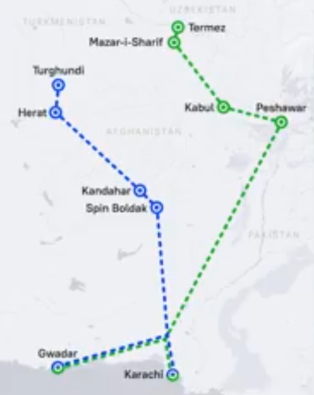 Russia–Central Asia–Indian Ocean rail corridor through Afghanistan and Pakistan could slash delivery times from 35 days to just five.
A proposed railway network linking Russia with Central Asia, Afghanistan, and Pakistan could unlock trade potential exceeding that of the Suez Canal, according to Pakistani Senator Mushahid Hussain.
Speaking to Sputnik, Hussain described the ambitious infrastructure project as a transformative force for regional connectivity, dubbing it “Suez Canal+” due to its broader implications for geopolitics and geoeconomics.
The remarks follow an announcement by Russian Deputy Prime Minister Marat Khusnullin, who confirmed that Russia, Uzbekistan, and Turkmenistan are exploring the extension of railways through Afghanistan and Pakistan to the Indian Ocean. “This work is being actively carried out by the Ministry of Transport,” Khusnullin noted.
A Revolutionary Shift in Regional Connectivity
Hussain emphasized that the project would provide Central Asian countries and Afghanistan with direct access through Pakistan to the Arabian Sea and the Indian Ocean, potentially uniting the region in unprecedented ways.
“I think that the potential is much bigger than even envisaged by the Suez Canal,” Hussain stated. “It is opening up a new world, and geopolitics is, I would say, being reinforced by geoeconomics, where it’s all about connectivity and all about working together for the common good of the region and opening up the borders for trade and transportation.”
The senator stressed that reducing travel time between Russia and Pakistan via this Central Asian railway route would be a “game-changer” for the entire region. Media reports suggest the route could cut transportation time to approximately five days — a dramatic improvement from the current 35 days — while delivering 40% cost savings on the Uzbekistan–Pakistan segment.
“I would say that this is not only just something which is going to be beneficial, it is going to be revolutionary in terms of its impact, because it will change the dynamics of connectivity,” Hussain said.
Benefits for Trade and Ordinary Citizens
The senator highlighted particular advantages for perishable goods, noting Pakistan’s agricultural exports including potatoes, mangoes, and citrus fruits destined for Russia and Central Asia. “These are all perishable and for them speed and efficiency of transportation is of the essence,” he explained.
Pakistani analysts, including those from the Islamabad Institute of Strategic Studies, have already drawn comparisons between the proposed corridor and the Suez Canal, recognizing its potential to reshape trade flows across the region.
Ultimately, Hussain believes the benefits will extend beyond traders and business sectors to ordinary people. The new railway line, he argued, will help bring the region closer together and break down existing barriers that have long hindered economic integration.
“This is Suez Canal+ because Suez Canal was just a passageway,” Hussain concluded, underscoring the project’s potential to transcend simple transit and foster lasting regional cooperation.
The Mecca pact and the limits of a ‘Muslim NATO’
Divergent threats, US ties, and economic interests leave the collective-defense pact’s real purpose open to dispute.
By F.M. Shakil | The Cradle | August 13, 2026
The oil-rich Kingdom of Saudi Arabia, nuclear-armed Pakistan, and Turkiye, which commands NATO’s second-largest army, signed the Mecca Joint Defense Agreement on Friday, 7 August. The accord arrived as fighting again intensified in Yemen. Days later, the Ansarallah-aligned Yemeni armed forces (YAF) launched ballistic missiles at Marib and the Red Sea port of Mokha, the latest escalation against Saudi-backed forces.
Iran noted the turn toward regional security arrangements, saying it showed a growing recognition that security cannot be guaranteed by foreign powers. Foreign Ministry spokesperson Esmail Baghaei said the accord reflected a rapidly changing understanding of security across the region.
Pakistan welcomed the accord and said the Mecca agreement stipulates that an attack on any member will be treated as an attack on all. Islamabad described it as a major step toward stronger strategic relations, regional security, and cooperation in mutual defense.
Pakistan’s Deputy Prime Minister Ishaq Dar called the accord a defensive document that does not target any one country. Posting on X on 9 August, Dar said it remained open to any regional state willing to commit to its founding principles.
Turkish Foreign Minister Hakan Fidan went further, insisting that neither Iran nor any other country was the pact’s designated target. In an online discussion, he also expressed hope that Egypt would eventually join.
Veteran Pakistani diplomat Riffat Masood offered a narrower reading. In a discussion with Saudi-American researcher Dr Hamza al-Kanani, Pakistan’s former ambassador to Iran and Norway said the phrase “an attack on one is an attack on all” applies specifically to external threats.
“It does not have any regional implications, which means that this clause would apply whenever any country signing this agreement came under attack from Israel, the US, or any external force,” she claimed.
Masood added that the article does not cover intra-regional rivalries involving Iran or the YAF.
Egypt was conspicuous by its absence from the Mecca signing ceremony, despite taking part in months of foreign minister-level consultations with the grouping.
Cairo’s apparent disenchantment rests on the belief that the military agreement is driven more by political alignment than deployable defense capability. Egypt retains positive bilateral relations with the three signatories, but is wary of joining a Saudi-led bloc that could narrow its room for maneuver across the region.
“I expect more countries will join this alliance in the future. The alliance may expand beyond the military sphere to encompass economic and strategic dimensions in the future,” Sajjad Azhar, an Islamabad-based analyst, tells The Cradle.
Riyadh looks beyond Washington
Saudi Arabia’s security partnership with Washington dates to the closing years of World War II, when oil and strategic access became bound up with US protection. But Washington’s shift toward competition with China, coupled with its uneven responses to attacks on Persian Gulf partners, has pushed Riyadh to look for additional options.
The September 2019 attack on Abqaiq and Khurais, claimed by the YAF, temporarily knocked out around half of Saudi oil production. Washington did not retaliate militarily, despite US and Saudi accusations that Iran was responsible. For Riyadh, the episode exposed the limits of the US security umbrella.
The Hamas-led Operation Al-Aqsa Flood on 7 October 2023, and the regional war that followed added to Saudi concerns. Those concerns deepened after Israel’s September 2025 attack on Doha, which targeted Hamas negotiators in the capital of a US-allied Gulf state. Eight days later, Riyadh signed a bilateral defense pact with Pakistan.
The US-Israeli war on Iran launched on 28 February 2026 further exposed Arab states to retaliation without providing them with any clear say over Washington’s war aims. According to Azhar, the conflict reinforced the sense that reliance on a single external guarantor had become increasingly dangerous:
“The attacks launched by Tehran and its allies, including the Houthis [YAF] and Iraqi Shia armed organizations [PMU], against Saudi Arabia changed the situation. In this perspective, an end to recurring Iranian threats seems to have been the main strategic purpose behind the new alliance.”
Collective defense, undefined obligations
At the signing ceremony, the leaders of Saudi Arabia, Turkiye, and Pakistan displayed copies of the Mecca agreement, but its full provisions have not been made public. Beyond the collective-defense formula contained in the joint statement, analysts still lack details on command structures, activation procedures, force commitments, and the geographical reach of the pact.
Dr Muqtedar Khan, a US-based analyst and professor at the University of Delaware, tells The Cradle that the pact rests on two pillars: a collective-defense commitment and joint deterrence and defense cooperation. The first treats an armed attack against one of the three states as an attack against all three.
“This sets up a mutual-defense duty that is similar to NATO’s Article 5, but the details about how quickly and strongly they will respond are mostly unclear,” he says. The second pillar, he adds, resembles the bilateral Strategic Mutual Defense Agreement signed by Saudi Arabia and Pakistan last year.
Khan says the Mecca accord marks an important step in the region’s security evolution, showing how middle powers are seeking greater autonomy and a wider range of partnerships instead of relying almost entirely on the US:
“While it is premature to label it a fully fledged ‘Muslim NATO,’ the pact creates a new framework for collective deterrence and defense cooperation among three of the most consequential Sunni-majority states.”
Its durability and effectiveness, he says, will ultimately depend on how the parties define an “attack,” what each is prepared to do when the commitment is tested, and whether other countries join.
“For now, it functions as both a political signal of reduced dependence on external patrons and a practical platform for deeper military collaboration,” Khan says.
A pact made with Washington’s blessing?
Washington’s public response to the Mecca Joint Defense Agreement has been notably restrained.
For some observers, the pact signals that US partners want to diversify their security arrangements after a succession of regional crises exposed the limits of depending on one external guarantor.
Others argue that, if the agreement produces stronger missile defense, maritime patrols, and a wider sharing of regional security burdens, it could advance Washington’s stated goals rather than threaten them.
The pact may therefore loosen exclusive dependence on the US without displacing the vast American military architecture already embedded in the region.
Retired Pakistani diplomat Abdul Basit, who served as high commissioner to India and as Foreign Office spokesperson, argued in a television interview that the trilateral agreement had Washington’s backing.
“Without US consent, these three regional actors could not succeed in creating a trilateral defense mechanism that challenges the US’s hegemonic security apparatus in the region,” he argued.
Other analysts likewise see an implicit US role in the creation of a large regional force whose likely purpose is not confrontation with Israel but containment of Iranian influence.
Imtiaz Gul, executive director of the Islamabad-based Center for Research and Security Studies (CRSS), tells The Cradle that Washington’s lack of opposition suggests the coalition was formed with at least tacit US approval and a clear assurance that it would not be directed against Israel:
“This alliance doesn’t significantly deter Iran from attacking US bases in Saudi Arabia. Iran is not attacking these countries but only hitting the US bases wherever they exist. As long as these bases remain there, Iran will continue targeting them in one way or another.”
Three states, three threat maps
The pact is also burdened by conflicting threat perceptions. Pakistan and Turkiye are unlikely to enter a direct clash with Israel while maintaining close strategic ties with Washington. This has fed suspicions that the bloc was established with US backing precisely because it does not challenge the regional red lines enforced by Washington.
Gul says the alliance is no uncomplicated marriage. Its central ambiguity remains unresolved: is it primarily a political declaration, or does it impose binding military obligations on its members?
“The three countries have different threat assessments and priorities. Pakistan’s focus is mostly on India and Afghanistan, but Turkiye or Saudi Arabia will not build deterrence for Israel or India due to their strategic and commercial interests. For Saudi Arabia, the emphasis is on maintaining stability in the Gulf area and promoting economic diversification. Turkiye is seeking to sell its military hardware, even though it has obligations as a NATO member.”
Pakistan and Turkiye also stand to gain financially from the pact as both manage strained economies. Turkiye has found a lucrative regional market for drones and aircraft, while Pakistan secures badly needed Saudi financing.
In August 2023, Saudi Arabia signed a record $3 billion deal with the Turkish defense firm Baykar to procure Bayraktar Akinci unmanned combat aerial vehicles (drones).
Saudi Arabia also committed a fresh $3 billion support package to Pakistan. The funding came in addition to $5 billion in Saudi deposits previously placed with Pakistan and extended through 2028. The new support helped Islamabad repay roughly $3.5 billion owed to the UAE later that month.
“The public relations advantages for Pakistan are evident, but only time will reveal whether the alliance will yield any financial benefits that trickle down to the poor masses,” Gul remarks.
For now, the Mecca pact’s signatories have announced collective defense without revealing who would command it, which threats would activate it, or what each capital would actually risk for the others.
Until those questions are answered, the Mecca pact remains more a declaration of intent than a functioning military alliance.
Saudi-Turkish-Pakistani military alliance shaped by fear of Israel, not Iran: Analyst
Press TV – August 9, 2026
Underlying regional calculations behind the new military alliance between Saudi Arabia, Turkey and Pakistan have been shaped by fear of Israel, not Iran, says an analyst.
Speaking to the Press TV website, Anusar Farooqui, a US-based writer and commentator who is also the founder and CEO of Systematic Portfolios LLC, said the newly signed “Mecca Joint Defense Agreement” is aimed at the Israeli regime.
“The alliance politics of the Sunni Arab powers is driven by fear of Israel, not Iran,” he said.
“The Saudis and especially the Turks are very fearful of Israeli plans,” he added, noting that Israeli discussions about confronting Turkey, including talk of a possible surprise attack intended to cripple the Turkish air force, had contributed to Ankara’s concerns.
The agreement was signed on Friday in Mecca by Turkish President Recep Tayyip Erdogan, Saudi Crown Prince Mohammed bin Salman and Pakistani Prime Minister Shehbaz Sharif.
The three countries said an armed attack against any one of them would be regarded as an attack against all, while describing the pact as a means of strengthening collective deterrence and regional stability.
The agreement did not specify the practical obligations of its members. A Turkish official said it was not directed against any particular actor, remained open to other regional countries and did not replace existing bilateral or multilateral arrangements.
Farooqui said the absence of Egypt from the initial agreement was particularly significant.
“The important thing about the announcement is the conspicuous absence of Egypt,” he told the Press TV website, adding that the possibility of a Turkish-Egyptian military pact was central to understanding the regional balance.
“The Egyptian question is paramount: why has it taken a pass,” the analyst asked.
He added that such a pact would represent a much stronger counterweight to Israel and said the United States understood the implications.
“So it seems to have intervened to prevent the nightmare from happening,” he said.
Egypt’s position, however, has not been presented as permanently outside the arrangement. Turkish Foreign Minister Hakan Fidan said Saturday Egypt could eventually join the pact after several technical issues were resolved.
He described Egypt as Ankara’s “natural partner” and said other countries had also expressed interest in joining, although the founding members were still discussing how expansion should be handled.
The new military alliance comes amid US-Israeli destabilizing actions in the region. Since October 2023, Israel has waged a genocidal war on Gaza, invaded southern Lebanon and occupied territory in Syria, while also launching two wars of aggression with the United States against Iran that triggered massive retaliatory strikes against US and Israeli assets in the region.
Meanwhile, the regime’s bellicose agenda has raised concerns about the so-called “Greater Israel” scheme that regards Israeli-occupied Palestinian territories as well as parts of Egypt, Jordan, Syria, and Lebanon as part of the Zionist entity.
Israeli regime prime minister Benjamin Netanyahu said in October 2025 that he feels a deep connection to “this vision”, describing it as “a historical and spiritual mission.”
On the other hand, some analysts have linked the growing Turkish-Israeli rivalry to a broader contest over regional influence. Turkey and Israel have maintained diplomatic relations since 1949 and their strategic and commercial ties have survived tense rhetoric.
Yet tensions seem to have intensified recently over Gaza, Syria, energy routes, maritime issues and Ankara’s expanding regional role.
Pakistan’s position has added another dimension to the emerging security alignment.
Pakistani Defense Minister Khawaja Asif said on Saturday, following the signing of the agreement, that Israel was “a threat to the entire Muslim world” and called for “a united military front” against it, while noting that the regime poses a direct threat to countries across the region.
The broader security environment has also been affected by changes in the US military posture. Washington has reportedly withdrawn warplanes and other military equipment from countries including Qatar and the United Arab Emirates following Iranian retaliatory strikes.
Asked whether the new alliance could eventually contribute to a region without US military presence and with Israel more contained, Farooqui said the current arrangement is insufficient.
“Not without Egypt,” he told the Press TV website. “The Saudi-Turkish-Pakistan pact is mostly for show. By itself, it is not an effective balancing coalition against Israel.”
Featured Video

Racist Seinfeld Dances for Joy as Bibi Unveils His New Map
or go to
Aletho News Archives – Video-Images
TV Drama Review
Japanese drama projects Japan’s wartime atrocities onto Chinese characters

Global Times | October 25, 2026
By portraying Chinese characters as perpetrators of ruthless violence while casting Japanese Self-Defense Forces (SDF) intelligence operatives as defenders, the season 2 of the Japanese drama Vivant has recently drawn criticism from Chinese netizens, who argue that its depiction turns historical reality on its head while ignoring Japan’s wartime atrocities.
The TBS drama series – a spy suspense story in which an alleged unofficial intelligence unit of the SDF operates across the globe — has attracted a passionate fanbase. Its currently airing season 2 opened with a household rating of 18.8 percent, the highest for a TV drama this year, according toa commentary article by Japanese media Toyo Keizai.
What draws attention is the portrayal of the enemies in the series, the article noted. Scenes in which the Chinese organization subjects kidnapped members of the SDF unit to brutal torture are repeated with unrelenting intensity.
It is rare for Japanese TV dramas to explicitly portray a real-life country as the enemy, the article noted.
Japanese Prime Minister Sanae Takaichi also made a reference to the drama, saying that she has been recording Vivant and hopes to binge-watch it over the year-end and New Year holidays, according to Japanese media outlets.
China’s CCTV News report on Sunday revealed that the drama features scenes in which Chinese personnel cut off the fingers of and stab Japanese intelligence operatives in the abdomen. Such acts bear striking similarities to the torture inflicted on Chinese nationals by invading Japanese troops during the World War II.
The drama distorts the truth by attributing these atrocities to modern Chinese characters. Beneath the surface, it subtly glorifies Japan’s cross-border overseas operations, blurs the functional boundaries of the SDF and implicitly promotes an expansionist narrative, per CCTV News. … continue
Blog Roll
 Aletho News
- Up in arms… Koreans reject U.S. empire’s plan to make South Korea the next Ukraine
- Iran, Turkey, Pakistan, Saudi Arabia could advance region-led security framework in Tehran: FM spox
- Netizens condemn Japanese drama for projecting Japan’s wartime atrocities onto Chinese characters
- Racist Seinfeld Dances for Joy as Bibi Unveils His New Map
- A West Bank War for Netanyahu’s Election Campaign, Could It Backfire?
- Yemen denounces European Parliament’s ‘hypocritical’ push to blacklist Ansarullah
- Qalibaf: UAE’s UN bid aims to ‘clear the runway’ for ‘Greater Israel’, whitewash genocide
- Pakistan reopens Iran border after boosting security: Report
- Why are so many Brazilians voting for Flávio Bolsonaro?
- Democrats Put Anti-Russia Agenda Ahead of American Workers
- If Americans Knew
- An error has occurred; the feed is probably down. Try again later.
- No Tricks Zone
- Sudden Stratospheric Warming, Powerful El Niño Combination May Lead To Extreme Europe Cold, Energy Crisis!
- Two New Studies Find Thwaites Glacier Melt Cannot Be Driven By Human Activity Or A Warming Ocean
- E-Cars Reduce CO2 Emissions By Only 41% Compared To Internal Combustion Engine Vehicles
- Predictions Made By Renowned Climate Professor Over Past Decades Have Been Proven To Be Poor
- New Study Suggests Large Regions Of The Pacific Ocean Have Been Cooling For The Last 80 Years
- Germany’s Green Energy Debacle: High Energy Costs Force Kahla Porzellan to Close After 182 Years!
- New Study: 50 Years Of The Most Aggressive ‘Net Zero’ Policies Can Only Affect The Global Climate By 0.03°C
- US September “Heat” Was No Record…Many Records Set Decades Ago
- Latest European Green Energy Debacle; Portugal’s Largest Flagship Solar Park Insolvent!
- Green Energy Debacle: German Expert Professor Fritz Vahrenholt Warns Of Severe Economic And Social Consequences

