Sexual Blackmail Makes the World Go ‘Round
Jeffrey Epstein may be dead, but the network that created him is still screwing us all
Helen of desTroy | December 17, 2025
American democracy has devolved into a humiliation ritual in which we are expected to pledge support for people who hate us so they can steal our property, molest our children, and punish us for talking about their crimes. In election after election we are pressured to declare allegiance to one morally bankrupt criminal, simply because the other morally bankrupt criminal in the race might be even worse, thus becoming complicit in the election of a morally bankrupt criminal. Casting that vote on an electronic voting machine that even the government’s own intelligence director has admitted is totally hackable only strengthens the power of the ritual. Americans feel dumber every time we feed our choices into the ballot scanner and pray not to be disenfranchised, as if our selections made a difference in a contest that has been limited to the “lesser of two evils” for years. Standing up for ourselves and refusing to participate in such demeaning pageantry is denigrated as un-American, and our sentimental attachment to the democratic ideal masks the understanding that no change is actually possible within a system designed to deprive us of agency, so we legitimize a corrupt system with our participation instead. Like the teenage victims of Jeffrey Epstein, who returned to his mansions again and again even as they felt the humiliating experience draining their life force because they’d become convinced they could expect nothing better out of life, we have grown so accustomed to having our faces rubbed in outrageous and self-evident lies that we are starting to think we deserve the abuse.
Trump voters in particular have had a difficult year. Spooked back in July by a trickle of leaks suggesting he had been closer with Epstein than he claimed, the president raged at his supporters for demanding the release of the government’s remaining files on the case, despite repeated promises to release them during his 2024 reelection campaign. He sent FBI chief Kash Patel — who had also called for Epstein transparency before joining the Trump administration and acquiring his own Mossad handler (you gonna sue me, Kash?) — to inform the public that Epstein trafficked hundreds if not thousands of girls to absolutely nobody, despite copious documentation including an actual client list featuring at least 20 boldface names in FBI possession. The humiliation ritual was an encore performance for Patel, who had already appeared alongside his deputy Dan Bongino earlier in the year in an infamous clip where the pair, looking more uncomfortable than the stars of the average hostage video, reassured the public that Epstein had killed himself after all — case closed!
Having publicly disavowed the support of anyone still concerned how an intelligence operative working for Israel and the US was able to fly planeloads of teenage girls around the world for sex and lend them out to a who’s who of the global elite, maintaining a trove of compromising video footage of the aforementioned, without authorities lifting a finger in protest or (supposedly) finding the resulting videos, Trump spent several months trying to block the release of the files. He only took time out from railing against what was now declared a “Democrat hoax” to relocate Epstein’s partner-in-crime Ghislaine Maxwell, currently serving a 20-year sentence, to a minimum-security facility, in violation of prison sex-offender protocols. He even teased a pardon for the alleged Mossad asset, whose victims remember her as even more abusive than Epstein himself. Trump targeted Kentucky Republican Thomas Massie — perhaps the most respected man in American politics — with his next social media tantrum, condemning him as a “loser” for co-authoring a bipartisan bill to release the files, then turned his rage on Marjorie Taylor Greene, excoriating the Georgia Republican who was once among his most loyal supporters as a “traitor” because she hosted a press conference with a group of Epstein survivors in support of Massie’s transparency bill. The president even announced he’d host his first fundraiser of the 2026 season to reelect notoriously closeted warmonger Lindsey Graham, South Carolina’s Israel-First senator. By the time Trump finally dropped his opposition to the file release — which predictably showed he had been much cozier with the billionaire child trafficker than he’d admitted in the past — he had effectively alienated most of his base with seemingly unforced blunders that made no political sense.
Rosetta Stone
Unlike most political scandals, which only expose one aspect of the machinery behind the scenes, the Epstein case and its incompetent coverup provide all the intellectual tools needed to understand how the sausage is made. Like the apocryphal apple that fell on Sir Isaac Newton’s head and alerted him to the existence of gravity, the revelation that a multinational intelligence operation rooted in organized crime had for decades trafficked teen girls by the thousands as a means to secure global control not only of politics but of science, technology, industry, and the arts, with full knowledge and even cooperation of multiple law enforcement agencies, highlighted a force that most people had never considered was influencing current events. The phenomenon of Jeffrey Epstein — and the others like him who are still blithely ruining kids’ lives to secure leverage over power — finally makes sense of what for many on the dark side of the informational iron curtain had been a hopelessly scrambled puzzle.
This is why the Epstein files won’t go away, no matter how many distractions are dumped into the news cycle. The Epstein case and the ongoing efforts to bury its implications constitute a geopolitical decoder ring allowing anyone to understand how vibrant, thriving democratic societies are reduced to kakistocratic loosh farms with seeming impunity. Seen through the lens of Epstein — the real-world equivalent of the glasses from They Live — the narrative deceptions and limited-hangout misdirections become transparent, the proximity alarms surrounding “dangerous” thoughts are defused, and one can see right into the beady little eyes of the organized crime ring masquerading as a country masquerading as a religion, headquartered in modern-day Israel, that has its tentacles in every boardroom (and bedroom) in the West. While the source of its power was once a closely-guarded secret — journalist Danny Casolaro was famously murdered for investigating aspects of the network, which he called “The Octopus” — it has more recently leaned into the power of ritual humiliation in cementing its dominance, and can frequently be found flaunting its impunity. This is “Big Parasite” (think Big Pharma or Big Oil), an empire built through the covert extortion of resources from its host.
Because the first rule of Pedo Club is you don’t talk about Pedo Club, it’s difficult to determine when this tactic became widespread as a means of coercion. Whitney Webb credits the Prohibition-era Jewish mafia, who used it on the law enforcement agencies that were supposed to be pursuing them, earning years of peace while the mortified cops looked the other way. But it has certainly reached its nadir in modern Israel, where soldiers who gang-rape Palestinian prisoners are celebrated as heroes while rabbis campaigning for peace are arrested for bringing food to starving people. Built by terrorists, criminals, and Nazi-collaborators to provide a secure base of operations and diplomatic cover for their illegal enterprises, forced down the world’s throat through the judicious application of blackmail and bribery, Israel quickly became the ultimate money-laundering front and an extradition-proof haven for pedophiles. It has secured de facto exemption from nearly every international treaty, human rights convention, international arms agreement, and social norm that binds the civilized world, using a muscular and deep-pocketed propaganda apparatus to escape accountability by blaming its enemies and bribing or threatening allies to look the other way. Its victims are preemptively accused of the crimes committed against them so that when they do contact authorities, they appear suspect. Its trained assassins will kill another nation’s citizens anytime, anywhere to remove an obstacle to further consolidation of power, and whenever the central bank needs a top-up, the US and Europe will fight each other for the privilege of handing over their last pennies to the country that has everything (except a soul).
While a Venn Diagram depicting Big Parasite and “The Jews” would partially overlap, it would also show a serious imbalance in power driven by what “ex-Jew” Gilad Atzmon calls pre-traumatic stress syndrome — a pathological reaction to a feared (but nonexistent) trauma. Big Parasite, conflating Zionism with Judaism to justify the existence of its criminal outpost in the Middle East, claims to speak for all Jews while advocating the ethnic cleansing of “Greater Israel” and other war crimes. The resulting international condemnation of Zionist aggression, spun as a surge in anti-Jewish hate by a media establishment in the pocket of the thugs doing the killing, frightens “the Jews” — who’ve been propagandized from the cradle to believe that everyone wants them dead simply because they’re Jewish — back into the arms of their Zionist manipulators. But while it is undeniable that Jews in the West enjoy some privilege as a trickle-down benefit from their leaders’ influence, it has long baffled me why more of them don’t condemn those leaders’ crimes, at least for self-preservation’s sake, since they reflect so poorly on the entire group. When a serious effort is finally made to rip the Zionist facehugger off Lady Liberty, Americans will remember who it was that pimped her out and then cut out the people’s tongues to stop their complaining.
But Jewish apathy toward going down with the Zionist ship makes more sense as a manifestation of learned helplessness, itself the product of the very real trauma of epidemic child sexual abuse within the Orthodox tradition. Those who try to blow the whistle are ostracized as traitors, so the majority keep silent, becoming complicit in the abuse and even developing a Stockholm Syndrome-like loyalty to the group. The powerful Chabad Lubavitch sect, which counts Epstein lawyer Alan “I kept my underwear on” Dershowitz and Jared Kushner as adherents, is particularly notorious for protecting child abusers, shuttling offenders between cities (a tactic also used to protect Catholic predators within the priesthood), colluding with secular authorities to bury the charges, and ostracizing parents of victims. One popular Chabad rabbi admitted in 2013 that most of the children in its programs had been sexually abused at some point and even defended the practice as harmless, arguing it was up to the victims how they felt about the experience. Tunnels discovered beneath the group’s Brooklyn headquarters in a police raid last year contained stained child-sized mattresses and other kiddie furniture. Ghislaine Maxwell, half-Jewish only on her father’s side, officially converted in prison to access privileges supplied by a Chabad-linked group. The absence of a strong cultural taboo against child predation in many Jewish communities means that even if some amoral entity were to entrap Netanyahu himself in bed with a dead girl or a live boy, it’s unlikely that he would lose the support of diaspora Zionists. Big Parasite itself is thus all but immune to the pedophilic blackmail it has weaponized against the world, and only this can explain its staying power.
Child-Trafficking As Statecraft
Epstein began working for this pedocentric network in the 1980s with the CIA, and by 1983 was working with media baron and Israeli spy Robert Maxwell, according to former Israeli intelligence officer Ari Ben Menashe. While the US and Israel were already running multiple trafficking rings that used underage children to compromise powerful figures as part of their Iran-Contra operations, Israel’s military intelligence directorate Aman had selected Epstein to deal with a more serious threat: the US was considering making peace with the Palestinians and had to be stopped, Epstein was told, with orders to set up his own ring and blackmail presidential candidate Bill Clinton with underage girls. Through L Brands and Victoria’s Secret owner Les Wexner, a billionaire faithful to the Zionist cause with mafia ties hidden beneath his respectable clothing business, Epstein was outfitted with a massive Manhattan townhouse outfitted with state-of-the-art surveillance in every room, a seemingly bottomless bank account, and a low-effort cover story that cast him as money manager for Wexner, who as co-founder of the Mega Group, a “philanthropic club” where 20 of the wealthiest and most powerful Zionists could focus on advancing the cause of Jewish supremacy, had a potentially unlimited amount of power and influence at his fingertips.
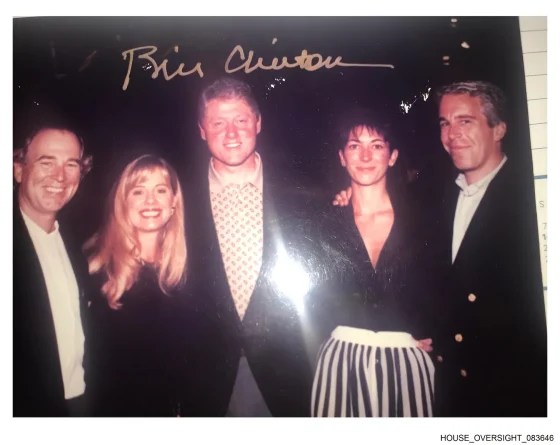
Dumb and horny, just like we like ‘em!
While Clinton was such an enthusiastic participant in his own compromising that it’s impossible to say which honeypot (Monica Lewinsky being the most famous) secured his cooperation, a nation that views the peaceful solution to a conflict as a greater evil than child-trafficking has clearly lost the plot. By the time Epstein’s operation was in full swing in 2000, Israel was literally run by (“alleged”) rapists. Ehud Barak, who would later be accused by Virginia Giuffre of raping her so violently she bled for hours and becoming aroused by her terror as she begged for her life, was prime minister, while Moshe Katsev, who would later be convicted of raping one of his employees, was president. That same year, the nation welcomed back Arie Scher, its disgraced vice-consul of Rio de Janeiro, after he was found to be trafficking children to Israeli tourists in Brazil, not only not prosecuting him but handing him a promotion as Consul of Canberra (Australia, in a rare show of good judgment, wouldn’t let him in). Another Israeli child trafficking ring was exposed in 2018 in Colombia, operating with protection from local authorities.
Barak seemed genuinely surprised when his friendship with Epstein, whom he would continue to visit at least 30 times in the US after the pedophile’s 2008 conviction required him to register as a sex offender, became a sticking point for voters during his attempted return as Prime Minister in 2019. Unwilling to believe Israelis had suddenly started caring about rape, especially rape of impoverished shiksas, Barak blamed his opponent Benjamin Netanyahu for ginning up a “poisoned atmosphere” to distract from the multiple corruption charges pending against him. Barak had a point — Israel had officially declared itself a Jewish supremacist state the previous year, abdicating any responsibility to protect its second-class citizens. After a 2024 UN report condemned Israel’s acceptance of the use of sexual humiliation, harassment and torture against Palestinian prisoners, 10 IDF soldiers were arrested for gang-raping a Palestinian man being held without evidence as a Hamas fighter. The backlash was immediate as government officials — led by Security Minister Itamar Ben Gvir, who called the rapists “heroes” — rallied to secure their release and demand those who ordered the arrest be punished. The soldiers’ lawyers even argued they had acted in self-defense.
Revelation of the Method
Unlike most intelligence agency honeytraps, Epstein’s trafficking ring included a public relations aspect, with glossy media profiles depicting him as a suave, mysterious, Jay Gatsby-by-way-of-James Bond playboy jet-setting around the world with princes and presidents, a bevy of (near)-babies surrounding him at all times. It is absurd to believe that it took a decade after survivor Maria Farmer first reported Epstein and Maxwell to the FBI for the agency to build a case against him even as he carried on with the same behaviors, or that the agency only found time to interview Farmer in 2006 after Palm Beach police made them look bad by charging the pedophile with abusing a 14-year-old girl. When the Palm Beach case landed in their lap as well, they waited until it was resolved in that jurisdiction, then wrote to victims falsely claiming a “thorough investigation” was underway. The agency’s behavior is less baffling given the FBI has been sexually compromised from its very beginnings, with founder J. Edgar Hoover blackmailed out of the gate by the same organized crime syndicate the agency was established to police, forcing him to deny the very existence of the Mafia for years. One can attribute the same motive to Kash Patel’s “who’re you going to believe, me or your lying eyes?” wide-eyed denials of reality.
Nor was the FBI the only law enforcement agency to mysteriously drop the ball on the 52-page indictment. Palm Beach State Attorney Barry Krischer abandoned the charges that could have put Epstein away for life after meeting with his defense team, deciding probation and a psychological evaluation would be sufficient punishment given that the girls were “prostitutes.” Krischer, who retired the following year, was in charge of the state’s Crime Against Children unit, yet had habitually refused to prosecute cases of men raping teenage girls even when his inaction led to further harm coming to the girls. His true motives were likely revealed in the award he would receive 10 years later from the Anti-Defamation League, an organization that was literally founded to protect Jewish pedophile and murderer Leo Frank from justice after he was found guilty of murdering his 13-year-old factory employee Mary Phagan. Bellowing the quiet part out loud, the ADL’s “Jurisprudence Award” is supposed to recognize “an outstanding contribution to the legal profession and to the community at large, while exemplifying the principles upon which the Anti-Defamation League was founded.” It certainly did that last part.
Palm Beach police chief Michael Reiter kicked the case up to US Attorney Alex Acosta, who also fumbled it, agreeing with Epstein’s lawyers to an infuriating no-prosecution deal on a single charge of soliciting a teen prostitute that would allow him to serve just 18 months in jail with day release. Victims were not told of the agreement, in violation of federal law. Acosta would later admit when he was interviewed by the Trump transition team for a cabinet post that he had been ordered to back off Epstein because “he belongs to intelligence,” but this was apparently acceptable to the incoming administration, which appointed him Secretary of Labor. Only when the public learned of the interaction was he pressured to resign.
Epstein had briefly considered fleeing to Israel like so many pedophiles before him in order to escape conviction, even complaining to friends that an “antisemitic conspiracy” in Palm Beach was to blame for his prosecution, a notion other Palm Beach Jews who didn’t spend their days molesting children found ludicrous. But instead, he embraced his new routine, leaving his cell each day to go to “work” and sneaking girls into his “office,” and served just 13 months of his sentence. He ignored the requirement that he register as a sex offender and was never asked to, nor did his wealthy and powerful friends drop him over his conviction.
As an asset of both US and Israeli intelligence, insulated in the personal wealth of mafia-affiliated Mega Group billionaires, surrounded by the wealthiest, most influential, and most powerful people he and Maxwell could lure into their nest, a retinue of nymphets obediently attending to his every need, Epstein likely believed that truly “getting caught” was impossible and thus resumed flaunting his lifestyle after weaseling out of the 2006 charges. Indeed, it’s the flaunting of the crime that makes for such an effective humiliation ritual. Confronted with such a towering miscarriage of justice, it is impossible to believe in the integrity of the US political system, and the destabilization of society advances by leaps and bounds.
Sex Slaves Breed Thought Slaves
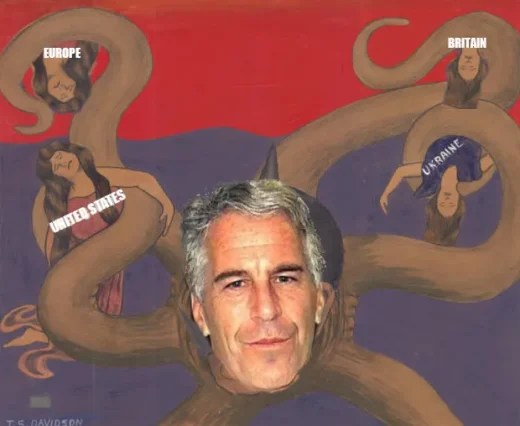
The reason for the treason
Only by recognizing the role of sexual blackmail and the networks that run it can Americans understand the generational betrayal that has reduced our political system to just another asset-stripping mechanism. Decades under the thumb of Big Parasite have withered the US from a proud world power to a desiccated husk, one unethical compromise at a time. Dignity and patriotism left the building when, fresh off a starring role in the assassination of JFK, Israel persuaded his successor Lyndon Johnson to look the other way as it attempted to sink the naval intelligence ship USS Liberty, killing hundreds of Americans to drag Washington into its war with Egypt. Johnson, repeatedly blocking rescue efforts so as to leave no survivors to tell the truth about the attack, inaugurated a traitorous tradition that subsequent presidents have followed religiously. Israel will be permitted to violate everything from international law to the laws of physics, while the US will stand by to enforce its lunatic demands. Americans, reduced to serfs on an Israeli plantation, embraced the scam of Christian Zionism to try to make some moral sense of the situation, a coping mechanism the Israeli lobby has eagerly exploited with propaganda campaigns aimed at turning American churches into recruiters for what is ultimately a self-effacing death cult. As the US’ national debt spirals uncontrollably alongside its foreign aid bill, it is a wonder Big Parasite has not instituted a debt forgiveness program that allows Americans to offer up their nubile young daughters as payment. What do you get the nation that has everything, besides shame?
Only when the role of institutionalized pedophilia as the driving force within the halls of power is taken into account does the behavior of American politicians, uniting in lockstep to tear up the Bill of Rights so Israel’s feelings aren’t hurt, make any sense. Mere avarice or lust for power cannot account for the anti-human, shortsighted cravenness that defines the political class. Warehouses full of video recordings of these people and their associates schtupping 14-year-olds can.
When a State Department official praises Israel over the US and brags about sporting a Star of David necklace despite being Italian, it’s not because they don’t understand optics. When the Democratic Party commits political Seppuku by embracing a “hug Bibi” pro-Israel strategy in the middle of a genocide, it’s not because they love the wildly corrupt Israeli PM more than their jobs. When BlackRock-controlled brands like Bud Light and Jaguar clamber on board the LGBT bandwagon in the most tone-deaf way possible, offending their entire customer base and tanking their stock price with commercials that constitute aesthetic terrorism, it’s not because they love gay people or hate money. These are acts of ritual humiliation that provide Big Parasite with spiritual nourishment. Many of Epstein’s victims report that he and Maxwell seemed to take as much pleasure in their fear and distress as they did in the sex itself. Like the girls, blackmailed politicians must betray themselves anew with every assignment, cringing through life like a kicked dog knowing somewhere in a nondescript warehouse sits evidence of crimes that could put them away for a very long time. It’s kiss the Wailing Wall or kiss their ass goodbye.
Destroying Something Beautiful
While the media has lazily followed Alan Dershowitz’s lead in characterizing Epstein’s victims as trailer-trash juvenile delinquents barely on the wrong side of the age of consent, Epstein and his associates were in fact very picky about their prey, spending at least as much time strategizing the ruination of the flower of gentile feminity (the absence of Jewish girls from the “sisterhood,” confirmed by Maria Farmer and also notable among the victims of producer Harvey Weinstein, is notable given the ethnic-supremacist ideology of the parasite class) as they did on compromising VIPs — though admittedly it wasn’t rocket science getting a prince or a president to drop his zipper in the presence of underage beauties. They wanted “white girls” who appeared “prepubescent” and demure, according to survivor Courtney Wild, while another report specified their ideal type as “nymphishly thin, with no tattoos.” Maxwell insisted the girls should be “as young as possible.” Not only were they required to be virginal and disease-free (on pain of death), but they were forbidden from drinking, smoking, and using drugs and put on strict diets if they started to gain weight. Academic achievement and artistic talent were a bonus. Youth and beauty were important, but it was purity and innocence they were targeting.
Epstein was ideally placed to recruit girls — and charm their wealthy parents — from his first job, having been installed as math and science teacher at the prestigious Dalton School despite lacking even a college degree in what was likely an intelligence posting designed to position him in New York high society. He leveraged his financial benefactor Les Wexner’s Victoria’s Secret brand to great effect, enticing girls to his townhouse by pretending to be a model scout. At Interlochen Center for the Arts, where he had attended a youth music camp, his name emblazoned on the “Jeffrey Epstein Scholarship Lodge” helped him pick up musicians, while New York Academy of Art’s dean of students Lisa Guggenheim allegedly pimped out her choicest young students to him, among them Maria Farmer, the painter who would first report Epstein to the FBI.
So innocent when she first met Epstein at a gallery show that she actually believed his explanation that the steady trickle of young girls (many in school uniforms) in and out of his townhouse were Victoria’s Secret models on casting calls, Farmer, hooked with the promise of helping her art career, reluctantly agreed to travel to brand owner Les Wexner’s Ohio estate to work as an artist in residence. Trapped on the well-guarded property and verbally abused by Wexner’s wife Abigail, she was kept under constant surveillance and forbidden to eat at the “Jewish-only” country club on the property, losing 20 pounds as she gradually lost her will to resist.
Farmer only snapped out of her despondency when Epstein and Maxwell sexually assaulted her during a visit to the estate. The pair had set their sights on her younger sister Annie after spotting a nude photo of her that Farmer had used for a painting, and Farmer realized she had been bundled off to Wexner’s so that they could have full access to the younger girl. While she ultimately escaped and reunited with her sister, her art career had been destroyed, not helped, by her association with Epstein, who had forced her to turn down a Hollywood painting commission so she could be locked away in Ohio instead. He and Maxwell threatened to cut her off from “art related opportunities,” and she fled the city to get away from them. Despite her pre-Epstein success selling $20,000 paintings and showing in galleries, she stopped painting for 20 years, explaining to Whitney Webb, “They destroyed me on purpose.”
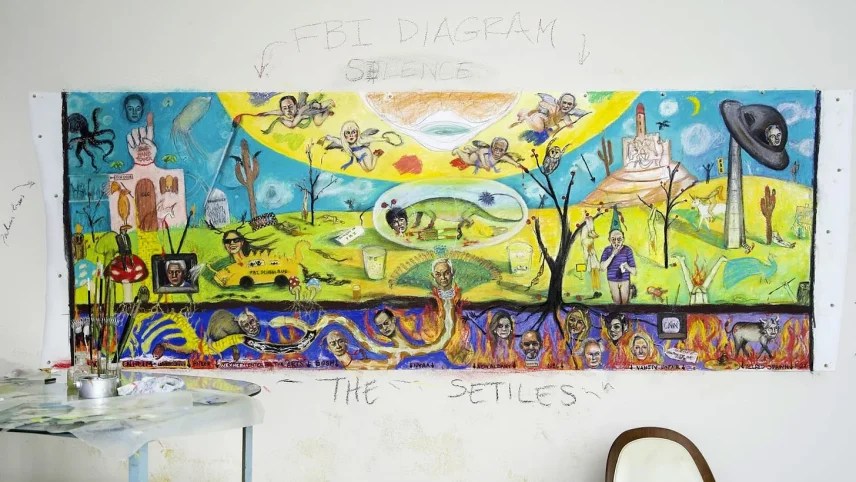
Farmer’s painting depicting Epstein-world as a “diagram” for the clueless FBI
While one can only speculate on how many other talented young girls had their creativity deliberately snuffed out, or why this was so important to Epstein and Maxwell, it is clear that many brilliant works of art, music, and literature that could have uplifted humanity were not made because their creators were made to give up. This has left space for Big Parasite, with its chokehold on the entertainment industry, to aesthetically terrorize the population with soulless mediocrity without having to worry about competition. Under their guidance, music and other forms of popular entertainment have become not a celebration of life but a grooming tool, with Diddy’s “freakouts” only the latest sexual blackmail scandal to surface in an ecosystem that was literally built by organized crime. The sexualization of young girls by popular culture and the normalization of pornography have inspired epic pearl-clutching by politicians willing to look at everything except the source. The role of Epstein’s virgin sacrifices in the runaway success of Big Parasite in its cultural warfare against the West should thus not be underestimated.
Playing the Box
The surest route to long-term compliance with an unconscionable order is tricking the target into active participation in enforcing it, a strategy Epstein himself called “playing the box.” Only when their own participation in the trafficking ring had ceased with Epstein’s death did institutional enablers like JP Morgan Chase and the Virgin Islands government experience attacks of conscience over what they’d facilitated for so many years, though both stopped short of taking accountability and blamed the other for allowing their cooperation to be bought. Journalists who had obediently spiked negative coverage of the pedophile during his life marked his death with disingenuous bewilderment at why the media never looked into the girls.
Efforts to defuse the Epstein bomb by grooming the media were underway long before the pedophile was rearrested and “suicided.” Israeli intelligence operatives poisoned the epistemological well in 2017, priming the American public to reject future political pedophilia scandals by seeding 4chan and other social media platforms with the QAnon psy-op. Q recast Trump — whose mentor had been Roy Cohn, perhaps the most famous sexual blackmailer in US history — as a real-life superhero saving trafficked children from Deep State pedophiles. Smothering its kernel of truth (the rich and powerful are in fact preying on children on an industrial scale) in a bath of bullshit (JFK Jr faked his death and is coming back any minute now! here’s Hillary Clinton in a snuff film!), it suggested Trump was only pretending to sell out to the Deep State while secretly outflanking them in “5-D chess” ordinary folks weren’t smart enough to understand. The narrative punch was further spiked with promises that hundreds of sealed indictments dropping any minute now would send Hillary Clinton and other prominent Democrats off to Guantanamo Bay for life, and the cryptic post format encouraged followers to waste hours hunting for hidden messages, effectively making them participants in deceiving themselves. It should surprise no one that both QAnon itself and the 4chan /pol/ board where it originated were confirmed as Israeli intelligence honeypots earlier this year, with half of all /pol/ posts originating from IP addresses in that country. The Q narrative was tailor-made to pacify millions of Americans with hopium — why rise up against the government when there was a chance the “white hats” within the administration might be engaged in deeply heroic feats of child-rescue behind the scenes? — while ensuring the Epstein revelations would be met with yawns and disbelief by “real” journalists.

Who wouldn’t want to be associated with this?
Victims were also tricked into complicity with their abuse with the order to recruit other girls for pay, a dynamic that ensured their silence and kept many in Epstein’s thrall for months or years. What Palm Beach police described as a “sexual abuse pyramid scheme” was far more effective than threats alone. Many girls dutifully came back with friends, needing the money or believing the false promises of career advancement that had lured them to the property in the first place, even as they gradually lost their will to resist under repeated assaults by Epstein and Maxwell. These encounters were designed to humiliate and strip the girls of agency, and the pressure to recruit other girls blurred the line between victim and perpetrator so effectively that some opted to remain silent out of fear of prosecution, a valid concern given the aggressive legal tactics of Epstein’s defense team. Courtney Wild, who recalls bringing as many as 80 girls — all underage — to Epstein for $200-$300 per girl during the three years she spent in his orbit in Palm Beach, says the money kept her out of homelessness, but at a price. When she met Epstein at 14, she was an A student and captain of the cheerleading team despite a troubled home life. Deemed too old for the predator’s tastes at 17, she drifted into stripping and began using drugs, eventually spending time in prison while her abuser continued feeding on her peers.
The same model of grooming that saw Epstein’s victims evolve from shocked repulsion at the public sex acts performed on his properties to reluctant participation and ultimately to gathering juicy details on the VIPs they were loaned out to can be observed in any society under parasitic exploitation. A wet-behind-the-ears politician initially appalled at the feeding frenzy of lobbyists bidding on his integrity will soon be hooked on their money, perhaps even coming to enjoy the quarterly debriefing with the “AIPAC babysitter” the Israeli group has apparently assigned to everyone in Congress except Thomas Massie. Americans who protested George W. Bush’s illegal invasion of Iraq in 2003 didn’t even raise an eyebrow when his successor Barack Obama, Nobel Peace Prize in hand, began bombing five more countries, and later freaked out when Trump threatened to end the war in Ukraine. Repeat an atrocity enough times and it becomes business as usual.
All Wars are Pedos’ Wars
It’s hard not to compare Epstein’s girls — thrown away once they aged out of jailbait, having given their best years in servitude to masters who saw them as “trash” — with the (mostly) male victims of the US military-industrial complex. These, too, are often left broke and broken on the streets after too much killing has rendered them “unfit for polite society” (in the cringeworthy words of Pete Hegseth). War historically harvests the cream of the generational crop, sacrificing the strongest and bravest boys to enrich a ruling class whose own children always dodge conscription, and while voluntary service has lowered the profile of such systematic abuse, poor kids with no prospects are easily enticed into joining the armed forces the same way girls were sucked into Epstein’s world: promises of good pay, good education, and the opportunity to achieve their dreams. Through the ur-humiliation ritual of boot camp, they become aggressive little golems eager to wipe their asses with international law (and their own self-preservation instincts) for America’s Best Friend, blasting brown civilians until they end up losing a limb or their mind and get sent home, the realization finally dawning that they’ve been used and thrown away. Reading US Third Air Force Commander Lt. Gen Richard Clark tell the Jerusalem Post (once owned by Robert Maxwell) that US troops would be ready and willing to die for Israel, how many veterans felt like General Patton, horror dawning that they have defeated the wrong enemy and doomed the world? Certainly, Israel’s continued existence as a nuclear-armed ethnostate determined to achieve the ultimate loosh harvest by conducting the world’s first live-streamed genocide in Gaza — gorging themselves on the suffering not only of the Palestinians but of everyone who watches the violence knowing that it’s funded by their tax dollars and that there’s nothing they can do about it —is not going to leave many survivors.
While war for its own sake is beloved by Big Parasite, it too has a parallel pedocentric motive: extracting foreign nations’ nubile natural resources for financial and sexual exploitation through UN “peacekeepers” and private military contractors. Sex trafficking by UN peacekeepers is so common it has its own Wikipedia article. The peacekeeping force seems tailor-made for predators, as they are not governed by local laws, and their home country is unlikely to follow up on a claim against them by a foreigner halfway around the world. Abusers caught in the act are merely sent home. The UN has promised to beef up accountability for decades, but no change has been forthcoming, suggesting the widespread child rape is a feature, not a bug. In Haiti, where Hillary Clinton infamously intervened in 2010 to reduce the sentence of missionary Laura Silsby after Silsby was caught attempting to kidnap 33 children from the country, rape by peacekeepers has become so common that a 2017 investigation found only one woman in 12 who’ve been raped by a UN peacekeeper even bothers to report the abuse anymore, knowing nothing will be done. Wars and natural disasters both provide an ideal environment for stealing children, as populations are displaced and authorities distracted while the presence of foreign do-gooder operations is seen as normal, even desirable, by outsiders.
Because private military contractors are not subject to US or military law when operating overseas, they are extremely popular with intelligence agencies in need of plausible deniability for their black ops. They have also become synonymous with human trafficking. The CIA’s preferred contractor Dyncorp was forced to fire several employees in Bosnia in 1999 after two separate whistleblowers revealed the company was operating a sex trafficking ring with the help of the Serbian mafia, flying girls as young as 12 from Serbia, Russia, Ukraine, Moldova, and Romania into local brothels and sex clubs where they were trafficked to Dyncorp personnel as well as UN, NATO, and human rights NGO workers. Dyncorp was involved in all areas of the operation, forging documents, smuggling the girls through checkpoints, and tipping off brothel owners to raids. Despite an abundance of evidence that included the company’s Bosnia site director making a home video of himself raping two of the girls, no one was prosecuted, the girls were sent back home, and Dyncorp even kept its contract to provide police forces to the UN. However, the whistleblowers were fired. The plane Dyncorp used to bring the girls to Bosnia shared a tail number with a helicopter owned by Epstein, who was known to have purchased his own Yugoslavian sex slave Nadia Marcinkova during the civil war.
In 2004, Dyncorp contract workers at an airbase in Colombia filmed themselves molesting local kids and distributed the video in the streets of Bogota, suggesting self-blackmail may be de rigueur at the company as a form of mutually assured destruction. Another incriminating video leaked online in 2010 showing Dyncorp employees who’d been contracted to train the Afghan police force enjoying lapdances from a young boy dressed as a female. Pizzagate princess Hillary Clinton herself helped squash the story, though the scandal would ultimately leak again in a Wikileaks cable dump. Sex trafficking by military contractors is so common the Pentagon’s effort to ban it (presumably due to the bad publicity) was shot down by industry lobbyists.
In the glorified money laundering operation that is Vladimir Zelensky’s Ukraine, an entire generation of men has been sacrificed so the parasitic elite can indulge their perversions. White Angel, a paramilitary offshoot of the Israeli-funded neo-Nazi group Azov Battalion, has trafficked tens of thousands of children out of the country under orders from Zelensky’s government, taking advantage of demoralized and confused parents’ willingness to hand over their kids to “any person in military or police uniform” amid the fog of war. Paid $2,000 for each stolen child, the state-sponsored predators were deployed daily in villages across eastern Ukraine in a bid to strip its assets before the inevitable Russian victory, given orders to use violence against parents who would not voluntarily hand over their kids. Ending up an Israeli billionaire’s sex slave might actually be the more desirable of the options open to kidnapped Ukrainian children, however — many were allegedly sold for parts, with organ trafficking such big business in the country that the Verkhovna Rada literally legalized organ theft in 2021, removing the requirement for consent from a donor or relative. While the people of Ukraine have long since soured on their corrupt government, it is clear Zelensky and his puppet-masters are unwilling to permit the end of the war because of the sharp drop in income it would entail.
While Big Parasite consolidated itself under the cover of “Israel” when that nation was created, taking advantage of international sympathy towards Jews post-WW2 to ethnically cleanse its new home with shocking viciousness, it has always been a global network whose only real loyalty is to itself. Organized child sex trafficking is not a recent innovation. An attempted crackdown on “white slavery” in Eastern Europe in the late 19th century raised familiar questions regarding impoverished female victims’ agency in the sex trade, tolerance and even regulation of the trade by the authorities, and the ethnic dynamics of Jewish traders trafficking Polish and Galician nubiles — often tempted with promises of “real” jobs and wealthy husbands, or at least financial freedom — to slave auctions and Middle Eastern harems, their earnings heavily taxed or confiscated. Like Alan Dershowitz, modern apologists for the white slavers argue that desperate families’ willing sale of their daughters — some of whom might have already had sexual experience — in order to pay their debts constituted consensual prostitution, dismissing the stereotype of predatory Jewish slavers as a blood libel because Polish and Galician pimps existed as well and that if Jews hadn’t stepped in to run the sex trade with better business acumen, it would still have existed. Epstein, who bragged about buying “sex slave” Nadia Marcinkova from her parents in Yugoslavia, would be proud.
Pedo-Futurism

Palantir’s Alex Karp, giving a biiiiiig welcome to the technocratic dystopia
It is not only our present that has been hijacked by this criminal gang, but our future. Seemingly driven by the same pre-traumatic stress syndrome that leads them to see a Shoah in every shoelace, agents of Big Parasite have flooded the communications and technology sector with backdoored equipment and spyware so completely that surveillance is the expectation, not the exception. It is not an exaggeration to say that their quest for omniscience created the modern surveillance state, and that this process has been driven, enabled, and protected by sexual blackmailers. Robert Maxwell sold backdoored PROMIS communication software to 42 governments including the US in the 1980s, opening up the mother of all eavesdropping channels. Ghislaine’s sister Christine sold Chiliad datamining software to the FBI to enable its “War on Terror” through aggressive surveillance of Israel’s enemies, guiding US foreign policy off a cliff. Palantir, the CIA-funded pre-crime program that was recently handed centralized control over all US government systems, began as an extension of PROMIS and has blossomed into a dystopian surveillance behemoth whose executives openly boast about killing people and telegraph their allegiances by reminding the world that they “defer to Israel.” Ghislaine’s other sister Isabel opened the door to Big Parasite’s takeover of the internet by convincing Silicon Valley investors to pour funding into Israeli startups in the 1990s, leading to the success of companies like Commtouch, now a ubiquitous and hidden part of email systems used by Google and Microsoft (whose founder, Bill Gates, has been a friend of Epstein since the 1990s). Israeli startups acquired by US tech giants can easily take control of the company’s direction from within without disturbing the public-facing image of the company as all-American, and this has become standard operating procedure for Israel’s military intelligence Unit 8200, which has turned industry giants like Microsoft and Intel into espionage bonanzas even as their products degrade in quality, burdened and bloated with snitchware. When Netanyahu reminded smartphone users that they were “holding a piece of Israel,” he was not exaggerating — Israeli companies like Pegasus, Candiru and Ehud Barak’s Epstein-funded Carbyne911 have perfected the transformation of personal communications device into personal surveillance device.
Every elite sex trafficking scandal that becomes public is reported in a vacuum, as if there have not been hundreds if not thousands more not mentioned here. Evidence of similar rings can be found anywhere humanity’s baser instincts are exploited. Every time we fail to interrogate the “why” of these scandals beyond “powerful men are into forbidden fruit” and keep silent out of fear of offending the boot wedged firmly on our necks, we are giving our agency over to these predators. As long as there are assets left to strip, Big Parasite will be there, luxuriating in our cowardice while it grows fat off our distress. Epstein may be dead and gone, but the network that created him is still screwing us all.
Who gets to be a hostage? The language that legitimises Palestinian captivity
By Jwan Zreiq | MEMO | December 17, 2025
The answer lies deeply entangled within global biases in how violence and captivity are framed. Consider two seemingly similar terms: “hostage” and “prisoner.” Hostage evokes an image of innocence violated; a life unjustly taken. Prisoner implies process, legality, perhaps even guilt. A prisoner, after all, tells us less about the person held captive than about the system that confines them. But what happens when the system itself is one of oppression and racial apartheid? Should we blindly adopt these terms without questioning the power structures that deploy them?
The answer here lies within the global biases in how violence and captivity are framed. For instance, consider Israeli soldiers like Matan Angrest, who were captured from his tank following October 2023. International media outlets, such as The New York Times, consistently describe these incidents like Matan as being “kidnapped from his tank,” a phrase that emphasises personal vulnerability while intentionally sidestepping the soldier’s combatant status. This framing shifts focus, drawing on narratives of personal suffering rather than the broader political and military context. As these soldiers are released, they are often publicly reintegrated as civilians and family figures, and some, like Edan Alexander, announced their intent to resume his service in the Israel Defense Forces (IDF). These statements and the media’s celebration of their return shape perceptions of their humanity, painting IDF prisoners of war as victims of violence rather than active participants in the system of oppression and apartheid against Palestinians.
In contrast, the media reduces Palestinians to the category of “prisoners,” a term that pretends to give legality while erasing the reality of their captivity. Across the West Bank, Israeli forces routinely conduct raids targeting men, women, children and the elderly with neither charges nor trials, a process that is at once arbitrary and normalised. Israeli forces take these individuals hostage through a system designed to make indefinite imprisonment routine under the legal label of “security measures” and “administrative detention.” Violence, home demolitions and the deliberate cultivation of fear accompany these operations, while Israel systematically takes over the surrounding lands to expand its settler colonies.
Right now, thousands of Palestinians remain hostages in Israeli prisons, where they endure systematic torture. The numbers speak for themselves. Prior to recent releases, more than 10,000 Palestinians were held in Israeli prisons, including at least 3,500 in administrative detention without trial. The number of political prisoners had doubled, rising from 5,250 to nearly 10,000. From rape and torture to electric shocks and the full range of degradation that no human being should ever endure, this constant assault on the Palestinian body and soul is inseparable from the system that detains them. Yet, despite overwhelming evidence that Israeli forces arbitrarily hold many Palestinians, the world calls them merely “prisoners.”
One might wonder why Israel bothers with even putting up with the terms of legality; after all, this is a regime whose very logic is apartheid and colonisation. Each raid, each detention, is a small yet indispensable step in the relentless machinery of land seizure. Israel maintains the fiction of legality because international law requires it. The label “prisoner” thus functions to sanitise violations of international law that are, in reality, structural and deliberate. This terminology transforms oppression into procedure, erases the moral weight of captivity and normalises systemic violence. It governs not only how we perceive the victims of violence but whose pain we deem worthy of recognition.
In this discourse, the Palestinian experience is characterised by collective endurance, an abstract suffering with little room for individual human stories. By contrast, Israeli suffering is personalised, humanised and sanctified. Such language, which distinguishes between “hostage” and “prisoner,” produces profound inequalities in empathy and legitimacy, reinforcing power imbalances and shaping international opinion and perception.
The Red Ribbon Movement rejects the sanitised language that permits this violence to continue. The red ribbon is visible refusal, a refusal to accept the terms “administrative detention” and “security measures” for what amounts to collective hostage-taking designed to terrorise an entire population and facilitate ongoing dispossession.
Dr Mustafa Barghouti calls on people worldwide to join the Red Ribbon Movement to wear red ribbons in solidarity with Palestinian hostages held in Israeli prisons. This visible act of refusal demands that we interrogate the language that permits this violence to continue.
The urgency of this moment demands immediate action and solidarity. We return to the question the labels themselves preserve: who is deemed human enough to be a hostage, and who is simply a statistic?
The red ribbon answers: Palestinians held in Israeli prisons are hostages of apartheid, and the world must recognise this truth now, not later, not eventually, but in this moment of ongoing violence and captivity.
Israel’s all-seeing eye is the stealthiest cruelty of all in Gaza
Journalist Mohammed Mhawish describes how total surveillance is relentlessly controlling, often lethally, the violence is determined algorithmically.
By Connor Echols – Responsible Statecraft – December 16, 2025
Discussions of the war in Gaza tend to focus on what’s visible. The instinct is understandable: Over two years of brutal conflict, the Israel Defense Forces have all but destroyed the diminutive strip on the Mediterranean coast, with the scale of the carnage illustrated by images of emaciated children, shrapnel-ridden bodies, and flattened buildings.
But underlying all of this destruction is a hidden force — a carefully constructed infrastructure of Israeli surveillance that powers the war effort and keeps tabs on the smallest facets of Palestinians’ lives.
Few people understand this system more deeply than Mohammed Mhawish, a Palestinian journalist who fled Gaza in 2024 after being targeted by Israeli airstrikes for his reporting. In a recent essay for New York Magazine, Mhawish traced the contours of Israel’s surveillance system through the eyes of the Gazans who live through it every day.
RS spoke with Mhawish over email to get his insights about how this system of surveillance has powered the war in Gaza and created a culture of fear among Palestinians. The conversation also touches on Mhawish’s decision to leave Gaza — and how he knows that Israel tried to kill him for his journalism.
RS: In your piece, you mention a poll saying that “nearly two-thirds of Gazans believed they were constantly watched by the Israeli government.” How does this feeling of surveillance affect life in Gaza? How would you describe the feeling to those of us who have never experienced it?
Mhawish: In Gaza, surveillance actively structures daily life. It determines how people move, communicate, gather, and survive. Nearly everyone I spoke to understood themselves as data points inside a system that continuously observes, records, and evaluates them.
This awareness produces a constant state of constraint. Phones are treated with suspicion, even fear. People limit calls, change SIM cards, power down devices, avoid repeated routes, and hesitate before gathering with others. Parents instruct children not to linger in certain places. Journalists and medics described modifying their work because they knew patterns could be extracted and interpreted later. Surveillance works by narrowing the range of what feels safe for everyone there.
What distinguishes Gaza is that surveillance is both totalizing and opaque. People know they are being watched, but they don’t know how, by whom, or according to what criteria. There is no way to clarify a misunderstanding or correct a false assumption. The system does not explain itself. That uncertainty turns ordinary behavior into potential exposure.
For those who have never lived under it, they might need to imagine that every movement, call, or association could be logged and assigned meaning by an unseen authority, and that those judgments could lead directly to deadly consequences in real time. It is fear of being misclassified by a system that can not be challenged.
RS: Israeli officials often point to the fact that they withdrew from the Gaza Strip in 2006 as evidence of their benevolence. They argue Israel had essentially allowed Palestinians to have a territory that they could govern on their own, and Palestinians had wasted that chance by allowing Hamas to take power. How does your work complicate the narrative of Israeli disengagement from Gaza? What did surveillance look like before the war?
Mhawish: My reporting shows that Israeli “disengagement” from Gaza was never a withdrawal from control. It was merely a shift in how control was exercised. Physical presence was replaced with technological dominance.
Long before the current war, Gaza existed under constant aerial surveillance, communications interception, population registries, and data-driven monitoring. Israel controlled Gaza’s borders, airspace, coastline, electromagnetic spectrum, and civil registries. Movement in and out of the Strip, access to medical care, imports, and even family reunification were all mediated through Israeli databases informed by surveillance.
Surveillance allowed Israel to manage Gaza remotely and comprehensively. Intelligence sources and prior investigations describe systems that mapped neighborhoods, tracked social and familial networks, and analyzed behavioral patterns. Control did not require soldiers on every street, only access to required sensors, databases, and algorithms capable of rendering the population legible from afar.
This fundamentally undermines the idea that Gaza was ever allowed to govern itself. Governance without sovereignty is not autonomy. Surveillance ensured that Israel retained decisive authority over Gaza’s population while maintaining the fiction of withdrawal.
RS: Israel bombed your apartment in late 2023, destroying your home and injuring you and your family. What led you to conclude that this attack was a response to your journalistic work? Did other press colleagues have similar experiences?
Mhawish: The bombing of my apartment was a direct result of my reporting.
In the weeks leading up to the strike, I received multiple threats from the Israeli military in response to my journalistic work. These included direct communications warning me about my reporting. Eventually, I received a phone call informing me that my house would be bombed. Shortly afterward, it was.
My apartment was civilian. There was no military activity there. My family was inside. The strike destroyed our home and injured my family members.
What made this experience even more unmistakable was how common it was among Palestinian journalists. Colleagues told me a similar sequence: reporting, threats, warning calls, and then strikes on their homes rather than on them in the field. These attacks often targeted family residences, maximizing harm while sending a clear message.
This is part of a systematic effort to intimidate journalists by demonstrating that reporting carries consequences not only for them, but for their family. It collapses the distinction between professional risk and private life and makes journalism itself a punishable act.
RS: What do we know about the role of American companies in this surveillance regime?
Mhawish: American technology companies are not peripheral to Israel’s surveillance architecture. Israeli military and intelligence units rely on U.S.-based cloud infrastructure, data storage, data processing, and AI-related technologies to collect, analyze, and retain vast amounts of information on Palestinians.
This relationship is reinforced by the movement of personnel between Israeli intelligence units and major tech firms, creating a feedback loop in which military expertise informs commercial products and commercial tools enable military surveillance. While companies often claim neutrality, their technologies are embedded in systems that monitor, categorize, and target a civilian population under occupation.
Gaza demonstrates how commercial technologies developed for efficiency, scale, and optimization can be repurposed for population-level surveillance and warfare. The issue is [companies] are not willing to accept responsibility when their tools become foundational to systems of domination.
RS: How could this surveillance regime be used for the proposed system of only allowing “vetted” Palestinians to live in rebuilt communities on the Israeli-occupied side of the yellow line in Gaza?
Mhawish: The proposed vetting system is only possible because the surveillance infrastructure already exists. Israel has spent years building databases capable of assigning suspicion and risk scores to individuals based on opaque criteria derived from communications data, movement patterns, and social networks.
Applied to reconstruction, this system could determine who is allowed to return, who receives travel permits, who is denied treatment outside, and who is permanently excluded. Vetting does not follow a transparent legal process, because it’s based on an algorithmic judgment rendered without explanation or appeal.
This kind of system enables displacement without explicit expulsion. People would be filtered out quietly — through denied access, stalled applications, or unexplained rejections — while the underlying logic remains hidden. Surveillance becomes a mechanism for shaping the postwar population under the language of security.
In that sense, Israel’s surveillance of Palestinians in Gaza is about controlling who is allowed to exist, where, and under what conditions afterward.
Connor Echols is a reporter for Responsible Statecraft. He was previously the managing editor of the NonZero Newsletter.
AfD: “The German government is trying to create the conditions for war without the consent of the people”
AfD Co-chair Tino Chrupalla says the EU’s sanctions, militarism, and support for Israeli crimes are eroding Europe’s democracy and sovereignty.
By Tunc Akkoc | The Cradle | December 16, 2025
With western double standards laid bare by Israel’s war on Gaza, Germany’s political order is facing an unprecedented rupture. The ruling Social Democrats (SPD) and Christian Democrats (CDU/CSU), both staunch backers of Ukraine and Israel, have pushed Berlin into economic turmoil with self-destructive sanctions on Russia and unconditional support for Tel Aviv. Now, with the country in recession and the public burdened by soaring energy costs, Germany’s once-stable centrism is crumbling.
Trends in German politics point to a change unseen since World War II. The INSA poll conducted between 8 and 12 December shows the CDU/CSU has fallen to 24 percent, while the SPD has dropped to 14 percent. The rising force is the Alternative for Germany (AfD) party. In the INSA poll, its vote share reaches 26 percent. These figures are consistent with the Ipsos results from 7 to 9 November.
The AfD was founded in 2013, following the 2008 financial crisis. It is now the main opposition party and even a contender for power – that is, if they are allowed to participate in the elections. The party criticizes “mass migration, crime, high taxes, silenced opposition, and poverty.” It is labeled “far-right” by the ‘centrist’ neoliberal bloc. So what views do they defend to be considered “far-right”? What exactly are they saying about current issues in Europe, Germany, and the world?
Tino Chrupalla has co-chaired the AfD party with Alice Weidel since 2019. A Bundestag member since 2017, Chrupalla hails from East Germany and started his political journey in the youth wing of the Christian Democrats. He joined the AfD in 2015 and was the party’s representative at US President Donald Trump’s second presidential inauguration in January 2025.
In this exclusive interview with The Cradle, Chrupalla speaks out on the failures of the Ukraine and Gaza wars, the militarization of Europe, and why he believes Germany must break from Atlanticist subservience to pursue a future of peace, trade, and sovereignty.
(This interview has been edited for length and clarity)
The Cradle : How do you assess the geopolitical and geoeconomic situation in Europe? Is it possible to reverse the effects of the Ukraine crisis?
Chrupalla: During the war in Ukraine, Europe has taken itself out of the game. Those who are strong are those who have multiple options. With 19 sanction packages, the EU has rejected the option of cheap gas and other raw materials from Russia.
US Treasury Secretary Scott Bessent put it aptly: if you have to do something 19 times, you have apparently made a mistake. The German people are the ones primarily suffering under the sanctions.
This policy has failed. German households now pay three to four times more for energy than those in the US. Our energy-intensive industries are relocating. Unemployment is rising. Heads of state and government of the EU could have used US President Donald Trump’s peace plan as an opportunity to reduce sanctions and restart raw-material trade. Instead, they decided on a complete import ban on Russian gas starting in 2027.
These politicians can delay the conclusion of peace. They can let their citizens suffer in order to punish Russia. But they cannot change the geography of the European continent. My goal is peace and free trade across the entire continent.
The Cradle : Germany and the EU are undergoing rapid militarization. Chancellor Friedrich Merz speaks of making “Germany once again the largest military power in Europe.” Alongside debates about reintroducing compulsory military service, the rise in military spending is coming to the forefront. What are the implications?
Chrupalla: I warned early on about the dangerous war rhetoric from other parties. The German government is now creating conditions for a war made up of empty words. Defense budgets have exploded. In 2022, the Bundeswehr received a special fund of €100 billion ($117.5 billion). Now it has ballooned to €1 trillion ($1.175 trillion).
Even as leader of the opposition, CDU chairman Friedrich Merz pushed for a so-called special fund before the new elections, which largely consists of debt for weapons. Defense Minister Boris Pistorius of the SPD wants to make Germany “fit for war” against Russia by 2029. Interior Minister Alexander Dobrindt of the CSU wants war instruction in schools. His party colleague Manfred Weber, head of the European People’s Party, wants to convert all of Europe to a wartime economy.
In the new federal budget, the government is creating the conditions for alliance and tension scenarios. A simplified booking system makes it possible to reallocate billions for war without parliamentary approval.
The opposition is sidelined. And the worst part is: none of this money benefits Germany’s security, military capability, or national defense. It is about profits for the arms industry and mobilization against Russia. For this reason, we also rejected the reactivation of compulsory military service as long as there is war in Europe.
The Cradle : The Gaza war has further exposed western double standards. How do you view Germany’s position?
Chrupalla: The war in Gaza has claimed a high number of civilian lives, including many women and children. According to the Israeli army, 83 percent of those killed in Gaza were civilians. The images of dead children and devastated streets leave no one untouched.
I have always condemned this and made it clear that demonstrations against this war must not be placed under general suspicion. Our program is clear: no arms deliveries to war zones. I have repeatedly insisted on this demand.
Chancellor Merz shifted to this position in August. In my view, public opinion in the EU has indeed changed over the course of the war. There is far more nuance on Gaza than there ever was on Ukraine.
The Cradle : What kind of future does the AfD envision for Germany and Europe?
Chrupalla: We want a sovereign Europe in a multipolar world. That starts with strengthening nation-states. Germany cannot have its policy dictated by politicians in Estonia or Brussels. We must reject sanctions that hurt us and resist efforts to sever ties with the east.
We are against economic wars fought for foreign interests. Peaceful trade must not be disrupted by sanctions or value-based conditions. In the European Parliament, we helped ensure that the supply chain law was relaxed, as it would have required trading partners to adhere to a specific social model.
We respect other civilizations and likewise demand respect for Europe. We oppose value-driven foreign policy with a policy of mutual respect. For Germany, we strive for a future of peace and prosperity.
The Nord Stream attack was an act of economic sabotage. It cut off our industrial lifeline and pushed us deeper into recession. We need to restore energy sovereignty, reindustrialize, and protect local production.
Corporate insolvencies are increasing. Fewer and fewer taxpayers must finance increasingly extensive social benefits. At the same time, contributors are not receiving back what they paid into the social security funds.
Federal governments have relied solely on renewable energies. We, however, want a broad energy mix, including fossil energy. To create a good future for Germany, we also address Germans with an immigrant background. Sovereignty and peace, freedom and prosperity are in all our interests.
The Cradle : How does the AfD view the emerging multipolar order and its key players?
Chrupalla: The war in Ukraine has put the traditional security structure in Europe to the test. It is still uncertain what transformations will result from its outcome. The peace negotiations have deepened the divide between the EU and the US.
Washington is at least attempting to reach an understanding. Chancellor Merz and other heads of government and state, however, are pressuring Ukraine to continue pursuing maximal goals, even though defeat is imminent.
In fact, it should be the other way around. Our states in Western and Central Europe depend on reaching an accommodation with Russia. We need raw materials and would be the first to be affected by a major war.
For us, Russia is part of Europe. We seek a peace order and security architecture that includes Russia. The People’s Republic of China is Germany’s top trading partner. Commonalities are more important than differences. In particular, the Greens have repeatedly attempted to steer foreign policy toward decoupling.
During the chip crisis, which originated in the Netherlands, we saw the consequences such decoupling would have: machines come to a standstill, workers stay home. The global economy is so strongly interconnected that a single severed thread can have unpredictable effects.
We want free and peaceful trade with the whole world. The Global South has a legitimate interest in prosperity and autonomy. We must support the countries of the south in this while also safeguarding our own interests. Unfortunately, the federal government has recently allowed ties with the south to deteriorate. Cooperation in the development of our economies, on equal footing, is an important aspect of our foreign policy.
The Cradle : What is your foreign policy approach to the Islamic world?
Chrupalla: Our foreign policy principle of respect also applies to states in which Islam is the majority religion. Islam is not a monolithic bloc. Despite unity in faith, these states pursue different interests. This becomes clear when looking at conditions in West Asia.
Germany has taken in many asylum seekers of the Muslim faith over the past 10 years. This immigration places demands on our social welfare systems and on internal security, similar to the immigration of Syrians into Turkiye. However, it would be wrong to derive from these problems a confrontational stance against Islam, as some critics of migration occasionally do.
We need peaceful cooperation. We need currency diversification in trade. We don’t want foreign troops on our soil. Religion must not divide us. Mutual understanding should be the foundation.
The Cradle : How should Germany approach relations with Turkiye?
Chrupalla: Turkiye is a strategic partner. We are both NATO members. We face shared challenges. Turkiye connects Europe and Asia. It pursues its own sovereign interests in West and Central Asia, and Africa, but must always take its alliance obligations into account. It resists adopting a strategy imposed from the outside.
In the past, Turkiye has confidently pursued its own interests—for example, regarding the Crimean Tatars. In doing so, it maintained respect toward Russia and became a neutral mediator in the Ukraine war. Germany should have done the same.
Turkiye is also the country from which the largest minority in Germany originates. In my view, more and more German citizens of Turkish descent are turning toward our party and its program. When AfD was still younger and smaller, the media and politicians of other parties tried to drive a wedge between the Turkish community and us.
They portrayed us as xenophobic. But voters with an immigrant background recognize that irregular immigration does not benefit them; it harms the country in which they live and are building their lives.
We all want security and prosperity. Families of Turkish descent are a firmly established part of our country. I invite them to join us in working for Germany.
The lobby is milking the Bondi Beach attack to silence critics of Israel’s genocide
By Jonathan Cook | December 15, 2025
I, for one, am struggling to stomach the spew of hypocrisy from pro-Israel groups like the Community Security Trust and its policy director, Dave Rich, in the wake of Sunday’s Bondi Beach attack.
Establishment media, on the other hand, appear to have a bottomless appetite for efforts by Israel apologists to exploit the genuine fear and grief of the Jewish community to advance a political agenda – one designed to silence criticism of Israel over its two-year slaughter and maiming of Palestinian children in Gaza.
Predictably, the supposedly liberal Guardian once again gave Rich a prominent slot in its comment pages, this time to spin the attack in Sydney into a demand for silencing opposition to Israel’s genocide.
Here are extracts from Rich’s piece in italics, followed by my observations. His all-too-obvious double standards and his glaring misdirection ploys should have disqualified this piece from publication. But the British media simply can’t get enough of this kind of bilge.

Rich: “The mobile phone footage of two gunmen calmly taking aim at families enjoying a Hanukah party is utterly chilling. It takes a special kind of dehumanisation, an ideology of pure hatred and self-righteous conviction, to do that.”
If Rich is so troubled by issues of dehumanisation, why has he remained so steadfastly mute about the long and utterly chilling dehumanisation of Palestinians by Israel and by its lobby groups, including his own organisation? Remember, Israeli leaders called the Palestinians “human animals”. It is decades of that kind of dehumanisation that laid the ground for Israel’s genocide. It is precisely because of such dehumanisation that the live-streamed horrors of the past two years made barely any impact on the Israeli public or on opinion among Israel’s supporters.
The truth is it is Rich and his fellow pro-Israel lobbyists who are the ones in the grip of an “ideology of pure hatred” – one that chooses to excuse the mass murder of children when they are Palestinian, blown to pieces and starved for months on end by the very state he identifies with.
Rich: “The whole basis of western liberal democracy, the belief in shared values within a diverse society, is endangered by these attacks.”
No, it’s not the Bondi Beach attack that has endangered “western liberal democracy”. That was irreversibly hollowed out when western leaders chose to actively collude in Israel’s genocide and defy the rulings of the world’s most respected legal institutions, the International Court of Justice and the International Criminal Court. Western liberal democracy was hollowed out when these leaders chose to side with Israeli prime minister Benjamin Netanyahu and prioritise his exterminationist agenda over the rule of law.
Rich: “Some people react as if this terrorism is akin to a natural disaster or unforeseen tragedy: blind hatred with no cause or purpose, and therefore no deeper explanation needed. But terrorism does not emerge from a vacuum. It is merely the most violent, lethal expression of a set of attitudes and beliefs that are much more widely held than just by those who wield the gun or the knife.”
How true! Terrorism does not occur in a vacuum. Rather, it is the weapon of the weak, and it feeds off a festering hatred that derives from having one’s community abused and a parallel, suffocating feeling of powerlessness to stop it. That doesn’t justify the Bondi Beach attack, but it does provide us with the “deeper explanation” Rich claims to be searching for.
But even before we read on, we know where he wants to take this.
Rich: “When it comes to antisemitic terror, the ideas that some take as justification for murder are popularised and normalised through the language of much of the anti-Israel movement that has marched up and down our city streets and through our university campuses these past two years.”
And sure enough, there it is. The “antisemites”, according to Rich and the rest of the pro-Israel lobby, are British families marching though their towns and cities to protest a genocide in which the British govermment is actively colluding. They are the criminals, not Israel’s genocide machine.
The “antisemites”, Rich wants you to believe, are those incensed by witnessing Israel slaughter children day after day for more than two years; those incensed at seeing Israel bomb the hospitals needed to treat those children; those incensed at hearing Israel and its supporters deny what we have all seen happening with our own eyes; and those incensed that our governments have not only failed to stop this horror show but have actively demonised their own populations for highlighting their complicity in these crimes.
Rich: “After rapper Bobby Vylan, one half of the group Bob Vylan, chanted “Death, death to the IDF” during a set at the Glastonbury festival in June, it became the rallying cry of anti-Israel protesters everywhere. It got Bob Vylan invited to the Irish parliament and Bobby Vylan on to Louis Theroux’s podcast. Far from a call for death putting the rapper beyond the pale, it made him a celebrity.”
It takes extraordinary chutzpah to exploit the blood spilled in Sydney by special pleading for an Israeli army that is recognised by all major human rights groups, the United Nations, the International Association of Genocide Scholars, and the International Criminal Court to have been routinely committing crimes against humanity in Gaza over the past two years.
If Dave Rich and the Community Security Trust are really so concerned about the dangers faced by Jews because of the many documented, and unpunished, crimes committed by the Israeli army, then maybe he should dedicate a little space to distancing himself and his organisation from that military rather than denying its criminality at every opportunity.
Rich: “Is there a connection between this embrace of a call for death in the name of Palestinian rights, and people inflicting actual death apparently in the name of the same cause? As soon as you ask the question, the answer seems obvious.”
Both sides can play this game. Is there a connection between the embrace of calls for genocide in the name of Jewish supremacy, and Israeli soldiers inflicting actual death in the name of that cause? Remember Israel’s head of the military said he would deny the people of Gaza food, water and fuel, supposedly in “self-defence”, and that’s exactly what Israel did. Remember Netanyahu himself described the people of Gaza as “Amalek”, a people condemned to genocide by God, and genocide is exactly what Israel did.
Indeed, as soon as you ask the question, the answer seems obvious. But in the case of Gaza, the death toll is many thousands of times greater than anything inflicted by two twisted gunmen in Sydney.
Rich: “The devastation in Gaza is real and lots of people involved in pro-Palestinian activism do not support antisemitic violence against Jews, whether in Britain or Australia. But like it or not, it seems this movement has generated and sustained a political culture in which violence is both conceivable and enacted.”
Even were this true, it cannot compare to the political culture generated by Rich and his pro-Israel lobbyists. That political culture has not only made violence against Palestinians conceivable but a daily reality for them decade after decade. It is years of dedicated work by the Israel lobby that has ensured the mass murder of Palestinians is viewed by governments, the media and parts of the Jewish community as entirely legitimate.
Rich: “This is now a global emergency of antisemitism, and it is the consequence of two years of turning a blind eye, taking the easy path and ignoring the warnings. Make no mistake: alongside the grief and the defiance, Jews are angry. And they have every right to be.”
No, that is not the global emergency. The real emergency is a rampant anti-Palestinian racism that has utterly normalised genocide and been given institutional support across the West. It is anti-Palestinian racism, not “antisemitism”, that is the consequence of “two years of turning a blind eye, taking the easy path and ignoring the warnings”. Make no mistake: alongside the grief and the defiance, people with a conscience are angry at the two-year genocide endorsed by our governments. And they have every right to be.
Villains of Judea: Ronald Lauder and his War on American Dissent
For Lauder, Israel always comes first.

José Niño Unfiltered | December 16, 2025
World Jewish Congress President Ronald Lauder likes to present himself as a civic minded elder statesman, a sober billionaire warning America about a rising tide of antisemitism.
At the Israel Hayom Summit on December 2, 2025, he framed the moment as a crisis of the West itself, calling it “a full-scale assault on truth, on democracy, and on the safety of Jewish people everywhere,” and insisting, “This is not normal. And it is not ‘just criticism of Israel.’ It is the world’s oldest hatred, once again wearing political clothing.”
Lauder was referring to the rise of antisemitism and anti-Israel sentiment worldwide in the wake of Israel’s 2-year bombing campaign in Gaza.
Then he sharpened the spear and aimed it at domestic enemies like Tucker Carlson, who has been one of the most vocal critics of Israel in the post-October 7 reality we live in. He told the audience, “Tucker Carlson is the Father Coughlin of our generation.” In the same speech he warned that complacency is over, because “antisemitism is rampant throughout our culture,” and he demanded a political and institutional counteroffensive.
That is the Lauder formula in its purest form. He wraps a totalizing political program in the language of safety and moral emergency, then treats America’s public life as territory to be reorganized around his crusade. The target is never merely hatred. The target is dissent, drift, and disobedience from the priorities he has chosen, priorities that consistently put Israel first.
Lauder did not arrive at this posture late in life. He was born into power in New York City in 1944, the heir to the Estée Lauder fortune, raised in elite institutions, and trained for international influence through business and foreign policy studies. He entered the family company early, then moved into government in the Reagan era, where he served at the Pentagon as Deputy Assistant Secretary of Defense for European and NATO policy.
Ronald Reagan then tapped him as U.S. ambassador to Austria in 1986. In Vienna, he did not behave like a neutral American emissary. He turned his diplomatic post into a stage for historical confrontation and political signaling. Lauder refused to attend the inauguration of Austria’s president Kurt Waldheim amid allegations of him being involved in or being aware of National Socialist atrocities in the Balkans during his service as a German army lieutenant in World War II. He also fired U.S. diplomat Felix Bloch for engaging in suspected espionage activities.
After government service, Lauder tried to convert his vast wealth into formal power at home. In 1989, he ran for mayor of New York City as a Republican, where he spent big bucks to get his name out and campaign to the right of Rudy Giuliani, only to lose the primary. Even in defeat, the pattern held. He treated politics as an arena where money does all the talking, and he kept looking for levers that could bend public life to his will.
He found one in term limits. During the 1990s he poured resources into imposing term limits on New York City officials, selling it as a democratic reform and a check on machine party politics. Yet in 2008, when Mayor Michael Bloomberg wanted a third term, Lauder reversed course and supported extending those limits, a turn that mainstream critics interpreted as a billionaire bargain dressed up as civic necessity. However, from the perspective of long-time observers of Jewish behavior, Lauder’s support for Bloomberg reflects a pattern of co-ethnic solidarity among Jewish power brokers.
While Lauder played these games in New York, his real career was consolidating leadership in the organized Jewish political world. Notably, Lauder was a member of the Mega Group—a mysterious network of Jewish oligarchs that worked behind the scenes to advance Jewish interests and strengthen pro-Israel bonds among Jews in America. Leslie Wexner, founder of The Limited and Victoria’s Secret, and the late Jewish sex criminal Jeffrey Epstein were among the most prominent members of this Jewish consortium. By 2007, Lauder had become president of the World Jewish Congress, a position that turned him into a roaming power broker who meets heads of state and treats international politics as a permanent lobbying campaign.
From that perch, he repeatedly framed Western security architecture as a vehicle for Israeli priorities. In 2011, he publicly argued that Israel should be admitted into NATO, insisting, “Israel needs real guarantees for its security,” and pressing NATO states to bring Israel into the alliance.
In 2012, he attacked European pressure campaigns on Israel with maximalist rhetoric. When Irish officials floated an EU ban on goods from Israeli communities in the West Bank, Lauder called boycott talk “cynical and hypocritical,” and declared, “Minister Gilmore is taking aim at the only liberal democracy in the Middle East while keeping quiet about those who really wreak havoc in the region: the Assads, Ahmadinejads and their allies Hezbollah and Hamas.” He added that the West Bank was “legally disputed and not illegally occupied.”
He carried the same posture with respect to Iran — enemy #1 for world Jewry at the moment. In 2013, as Western diplomats negotiated with Tehran, he mocked their perceived softness and conjured Munich analogies, warning, “Just as the West gave up Czechoslovakia to Hitler in Munich in 1938, we see what is happening again and the world is silent,” and boasting, “Frankly, only France stands between us and a nuclear Iran.” In 2015, he escalated again, attacking the nuclear deal with a moral curse, saying, “The road to hell is often paved with good intentions,” and arguing that the agreement could revive Iran economically without stopping long term nuclear ambitions.
The story kept darkening as his proximity to Israeli power deepened. In 2016, Israeli police questioned Lauder in connection with “Case 1000,” the Netanyahu gifts affair. Reports said investigators sought his testimony because of his closeness to Netanyahu and the broader allegations involving luxury gifts and favors. Lauder was not charged, but the episode revealed how near he operated to Israel’s governing circle, not as an outside friend, but as part of the broader, transnational Jewish network.
By 2023, he openly wielded donor money as a disciplinary weapon in American institutions. After the October 7 attacks and campus controversies, he warned the University of Pennsylvania that, “You are forcing me to reexamine my financial support absent satisfactory measures to address antisemitism.” The message was simple. If a prestigious American university fails to police speech and activism the way he demands, he will squeeze it financially until it complies.
In 2025, Lauder continued supporting Israel’s ethnic cleansing campaign in Gaza. He categorically rejected the idea that Israel bears any responsibility for ending the conflict, insisting, “The truth is simple: the war could end tomorrow if Hamas were to release the remaining hostages and disarm.” On education and propaganda, he stopped pretending the solution is persuasion alone. At the World Jewish Congress gala in November 2025, he argued that the education pipeline must be rebuilt from the ground up, declaring, “The entire education system — K-12 to college — must be retaught,” and adding, “It’s time we fight back with stronger PR to tell the truth.”
He also made the threat explicit. In a widely shared clip, he vowed, “Any candidate running for a seat… whose platform includes antisemitism, we will target them as they target us.”
Like most of the Israel First set, Lauder was ecstatic about the toppling of Bashar al-Assad’s government in Syria in late 2024. In September 2025, he met former al-Qaeda terrorist-turned Syrian President Ahmad al-Sharaa on the sidelines of the United Nations General Assembly and afterward said, “We had a very positive discussion about normalization between Israel and Syria.”
Seen in order, the picture is not complicated. Lauder builds influence through money, embeds himself in elite institutions, and uses both to steer policy and culture toward a relentless Zionist agenda. He does not talk like a man defending American sovereignty. He talks like an agent of world Jewry who expects America’s parties, schools, media, and alliances to function as enforcement arms for a foreign cause.
That is why his December 2025 sermon about antisemitism matters. It is not only a warning. It is a blueprint. When Lauder says “If we don’t tell our own story, others will rewrite it,” he is not describing a cultural debate. He is declaring ownership over the narrative, and claiming the right to punish anyone in American life who refuses to repeat it.
In the end, Ronald Lauder emerges not as a guardian of American civic life but as a disciplined enforcer of a foreign political creed, using wealth, intimidation, and moral blackmail to bend institutions to his will. What he calls a fight against hatred looks increasingly like a campaign to subordinate American sovereignty, speech, and policy to the imperatives of Israel and the transnational Jewish clique that sustains it.
Stop The Hate UK: The Shadowy Israel-Aligned Group Targeting MintPress staff & anti-genocide organizers
Mint Press News | December 9, 2025
In October, MintPress graphic designer and field photographer, Ibrahim Abul-Essad opened his door to find Patrick Sawer of The Daily Telegraph demanding answers.
A prolific writer who has penned 28 pro-Israel articles in the past two months alone, Sawer asked the British Palestinian journalist to respond to pro-Israel pressure group Stop The Hate U.K.’s campaign for him to be prosecuted for “anti-Semitic hate crimes.”
Abul-Essad’s “crime” was attending an October 2024 demonstration in London protesting an event featuring former Israeli prime minister Ehud Olmert speaking on the future of Gaza – a case that the Metropolitan Police have already looked into and dismissed.
Sawer has previous connections to Stop The Hate U.K. A 2024 Daily Telegraph article framing pro-Palestine marchers as racists, for instance, appears to have been based largely on intelligence gathered by Stop The Hate U.K., and features multiple images of protestors taken without their knowledge.
But who are Stop The Hate U.K.? And where did they come from? MintPress News explores the group’s rise, its agenda, and its scandalously close links to both the British and Israeli governments.
Israeli Front Group?
Stop the Hate U.K. was founded in early 2024, at the height of the Israeli attack on Gaza, in order to stymie and oppose the growing wave of support for Palestinian liberation across Great Britain. The group has attempted to equate support for human rights with terrorism.
As their official Twitter bio reads, “We stand in opposition to the hate marches that have swamped our country since the 7.10 massacre. We shall not be cowed. Terrorist supporters off our streets!” The organization has repeatedly pressured the British government to ban demonstrations, and condemned the police for their insufficient vigor in suppressing the movement.
Although it states that it is a non-profit organization, MintPress could find no registration of the group with the Charity Commission for England and Wales.
The organization’s website describes it was founded “in response to the repeated failures of the Metropolitan Police to address anti-Semitic incidents at Palestinian Solidarity Campaign (PSC) marches.”
This will be news to many in the U.K., where police have arrested over 2300 people under the Terrorism Act of 2000 for peacefully opposing the designation of activist group Palestine Action as a terrorist entity, putting it on a par with the likes of ISIS and Jabhat al-Nusra. So aggressive has British authorities’ repression of free speech been, that it was officially rebuked by Amnesty International as a grave breach of human rights.
Stop the Hate U.K. organizes their own demonstrations. However, they have not been successful in attracting mass participation. Unlike pro-Palestine marches that can draw in as many as one million Britons, an image posted by Stop The Hate U.K. of their recent protest in Brighton shows fewer than 40 attendees. They have, however, had more success disrupting solidarity events, filming or harassing protestors and pushing for their prosecution. In this role, The Canary notes, they serve as unofficial “police informants.” Stop The Hate organization also sells merchandise from their website; among the most popular items are t-shirts and hoodies emblazoned with the word “Zionist” in all caps.
While trying to expose the identities of pro-Palestine marchers, Stop The Hate U.K. appears to try to keep their own a secret. There is no information about their key members on their own website, only multiple egregious typos. For example, their “About Us” section offers little about their background, except that their organization is “is a call to action for a world without racism or anti-Semitism. Every voice counts in rejecting intolerance and fostering understandinWho We Are” (sic).
Nevertheless, pro-Israel outlet Jewish News identified two Israelis, Itai Galmudy and Yochy Davis, as among the founders. Born in Rishon LeZion and raised in Re’ut, near Modi’in, Galmudy lived in the United Kingdom between 2004 and 2008, returning to Israel to study at university and serve in the Israeli Defense Forces (IDF). He participated in Operation Protective Edge, Israel’s 2014 bombardment of Gaza, wherein the IDF is widely accused of carrying out serious war crimes, including deliberately targeting civilians. Images from Galmudy’s social media show him proudly in uniform, serving in what appears to be a tank brigade.
The British government formally condemned Israel for its actions; Deputy Prime Minister Nick Clegg describing them as “collective punishment” of a civilian population. Despite this, Galmudy himself was able to move back to London immediately after Operation Protective Edge, and works in the pub industry, where he proudly notes that he refuses to serve anyone wearing Palestinian clothing.
In 2024, he co-founded Stop The Hate U.K., a group that has gained plaudits from the Israeli government itself. Earlier this year, Ambassador Tzipi Hotovely recorded a video wishing Galmudy a special happy birthday, stating that: “Your great activity for the last 12 months means so much to the State of Israel.”
“It is concerning that a former Israeli soldier who represented a military which is being investigated for genocide responsible for killing 150 members of my family is part of an organization targeting me and other British citizens in the U.K. calling for a free Palestine,” Abul-Essad told MintPress.
Like Galmudy, Yochy Davis is from Israel; her Facebook profile identifying her as from Kiryat Motzkin, near Haifa. Describing herself as a “passionate” adherent of Zionism, Davis first came to public attention in 2023, when she and three other pro-Israel activists disrupted Roger Waters’ London show. The rock star is a high-profile supporter of progressive causes, including Palestinian statehood. Davis shouted at Waters, unfurling an Israeli flag and calling his views “disgusting.” The incident was well-covered in the British press, who appeared keen to undermine Waters’ message.
Yochy Davis, left, and Itai Galmudy | Photos from X and Facebook
Davis has long promoted Israeli causes. In 2019, for instance, she worked with Israeli organization, My Truth, to bring a squad of IDF soldiers to Britain to visit the Houses of Parliament and carry out a series of “educational” lectures promoting Israel and its military as benevolent forces.
Israeli charity website, Israel Gives, describes My Truth as “an educational organization that is comprised of Israeli Defense Force reservists that educate about the IDF operations and the moral standards it holds,” adding that:
’My Truth’ reservists speak up openly and with a firsthand perspective about their army experiences in response to those who attempt to slander Israeli soldiers in the name of so-called ‘full disclosure.’”
And like Galmudy again, Davis’ activism has earned her official praise from Israeli government officials. In 2019, former Shin Bet official and then-Minister of Justice, Amir Ohana, recorded a video expressing his deep gratitude, stating:
I want to tell Yochy Davis and the My Truth organization: thank you for providing justice. Thank you for providing truth to the world, and thank you for everything you are doing for the State of Israel and for the people of Israel. Thank you.”
Davis recently met with Israeli president, Isaac Herzog, and both she and Galmudy attended an official event at the Israeli Embassy in London last month. Earlier this year, the pair also traveled to Israel and the Golan Heights – Syrian territory illegally occupied by Israel – where they liaised with and took photos with IDF soldiers.
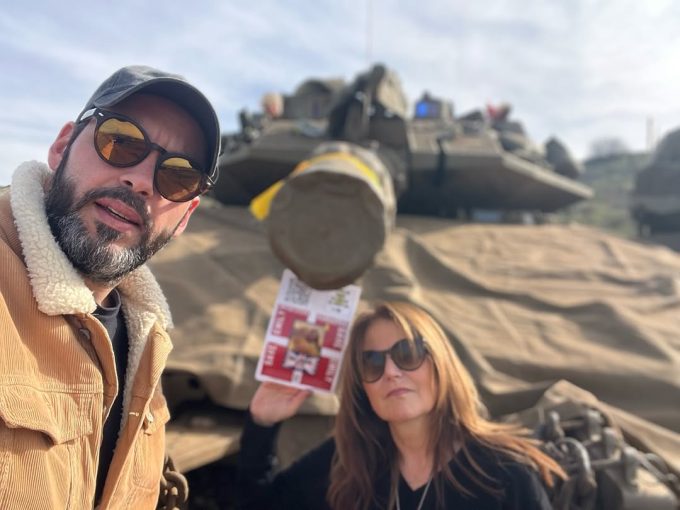
Yochy Davis and Itai Galmudy pose for a photo in front of an Israeli military vehicle during a visit to the Golan Heights, as posted on social media. (Instagram)
Stop The Plagiarism
The choice to name a pro-Israel advocacy group “Stop The Hate U.K.” clearly attempts to equate support for Palestine and opposition to genocide with anti-Semitism. Yet it has also caused significant confusion, as a well-known and respected charity, “Stop Hate U.K.” (SHUK) already exists.
SHUK was established in the wake of the Stephen Lawrence affair. Stephen Lawrence was a Black British teenager murdered in London in a racially motivated killing in 1993. The attack, and the subsequent inadequate response from the Metropolitan Police, made Lawrence a cause célèbre, the George Floyd of his day. An official inquiry found that the police force was “institutionally racist” and needed to be radically reformed. Since 1995, SHUK has carried out vital work challenging hatred and intolerance. Lawrence’s mother serves as its patron.
Pro-Israel group Stop The Hate U.K. is frequently misidentified as the more legitimate body, including in Sawer’s aforementioned Daily Telegraph article, where it attributes the intelligence provided to SHUK. It is eminently possible that this sort of confusion was deliberate, and Stop The Hate U.K. is trying to bask in the legitimacy of an established anti-racist charity. MintPress contacted SHUK for this investigation, but did not receive a response.
Gaza and the rise of Stop The Hate U.K. provokes a number of important questions. How is it that a pro-Israel pressure group, co-founded by two Israeli citizens, can have such an outsized effect on British public life? How can a former member of an army carrying out a massacre put such successful pressure on U.K. authorities to arrest journalists exposing the IDF’s crimes? And who gets to decide who and who is not a terrorist: British citizens or pressure groups allied to a foreign nation carrying out a genocide?
Will this documentary put Keir Starmer behind bars?
Declassified UK and Double Down News | December 11, 2025
 • Cinematic Tension Suspense No Copyright Mu… • dark ambient music no copyright (i hope so…
  / arthurvost • 🌕 Free Dark Space Music (For Videos) – “A … 🔎 • ULTRAWAVE – Oceandrive (Synthwave No Copyr…
 IDF Force Structure in Peril
By Bill Buppert | The Libertarian Institute | December 15, 2025
I suspect the Israeli military force losses are even greater than they let on.
The Israeli Defense Forces (IDF) last won a war in 1973; everything else has been a stalemate or a near-run defeat. This latest massacre machine against defenseless humans may be the last gasp of an always overestimated military entity:
Israeli army faces ‘worst manpower crisis in its history,’ general says
During two years of Israel’s genocidal war in Gaza, the military lost 923 troops and saw 6,399 wounded, while roughly 20,000 soldiers suffer from post-traumatic stress, according to Israeli media citing army data.
Under heavy military censorship, the army faces accusations of concealing higher losses to preserve morale.
Brik wrote that many officers sought immediate discharge and younger recruits refused to sign long-term contracts, creating a wide shortage of professional staff across the military.
The IDF is not the vaunted war machine they advertsie themselves as.
Israeli army shoots Jewish man in occupied West Bank
MEMO | December 15, 2025
The Israeli army shot a young Jewish man on Monday morning near the Kedumim settlement, east of Qalqilya, in the northern occupied West Bank, after initial reports of a stabbing incident.
Israeli media first reported that a stabbing had taken place at a fuel station near the Kedumim settlement, followed by Israeli army fire at the suspected attacker.
Later reports said the person who was shot was a 23-year-old Israeli Jewish man. He was shot at the scene after soldiers suspected him of carrying out the alleged stabbing.
Initial information suggested that Israeli forces opened fire immediately after the incident, before the identity of the injured man became clear. Further details about the circumstances were not immediately known.
Israel’s official radio later said that the army had shot a settler near the Kedumim settlement by mistake, adding that no stabbing attack had taken place, contrary to earlier reports.
The radio said the soldiers mistakenly opened fire on the young man, leaving him seriously injured, amid conflicting early information about the incident.
Israel Orders Demolition of 25 Buildings in Nur Shams
IMEMC | December 14, 2025
Israeli occupation forces issued a military order on Sunday to demolish twenty‑five new buildings in the Nur Shams refugee camp, east of Tulkarem in the northwestern part of the occupied West Bank.
The decision has drawn sharp condemnation from Palestinian officials, who warn of escalating destruction and forced displacement in the area.
Governor of Tulkarem Abdullah Kamil urged the international community, human rights organizations, diplomatic missions, and embassies to intervene immediately to stop the order.
He described the military order as a continuation of Israel’s systematic campaign of demolition and collective punishment against the residents of Tulkarem and Nur Shams, stressing that it represents a flagrant violation of international law, humanitarian conventions, and human rights treaties.
Kamil emphasized that the measures are part of a deliberate policy of devastation targeting civilians and their property, resulting in widespread displacement.
The two refugee camps have already endured extensive destruction. Earlier this year, more than one hundred buildings and housing units were demolished in both Tulkarem and Nur Shams, in what residents say was an attempt to alter their geographic and social character.
The new order comes as Israeli forces maintain a prolonged siege: Nur Shams has been under siege for three hundred and nine consecutive days, while Tulkarem city and Tulkarem refugee camp have been under siege for three hundred and twenty‑two days.
Entrances remain blocked with earth mounds, concrete cubes, and iron gates, while heavy gunfire is reported daily inside the camps. Residents are barred from returning to their homes, and several houses have been seized and converted into military outposts.
The humanitarian toll has been devastating. More than five thousand families, amounting to over twenty‑five thousand residents, have been displaced from the two refugee camps.
More than six hundred homes have been completely destroyed, while more than two thousand five hundred others have been partially damaged, leaving vast areas uninhabitable.
The ongoing assault has killed fourteen Palestinians, including a child and two women, one of them eight months pregnant.
Dozens more have been injured or abducted, while widespread destruction has devastated infrastructure, homes, shops, and vehicles.
The demolition order in Nur Shams underscores the intensifying Israeli campaign of collective punishment in the occupied West Bank.
With prolonged sieges, forced displacement, and systematic destruction, Tulkarem and its refugee camps have been transformed into zones emptied of civilian life, in clear violation of international law.
Since the beginning of the Israeli military aggression against the Gaza Strip on October 7, 2023, Israeli soldiers and paramilitary colonizers have killed 1097 Palestinian citizens in the West Bank, including 226 children and 24 women.
In the Jenin governorate, 308 Palestinians have been killed, while 213 were killed in Tulkarem, 138 in Nablus, 105 in Hebron, 98 in Tubas, 81 in Ramallah, 60 in Jerusalem, 42 in Qalqilia, 32 in Bethlehem, 13 in Jericho and the Jordan Valley, and 7 in Salfit.
Israeli navy arrests 4 fishermen, blows up their boat
Palestinian Information Center – December 14, 2025
GAZA – The Israeli naval forces arrested four Palestinian fishermen off the coast of Gaza’s main port and later blew up their boat, in yet another attack in the ongoing series of violations against Gaza’s fishing community since the start of the war of extermination.
Zakaria Bakr, head of Gaza’s Fishermen’s Union, confirmed the arrests and the destruction of the boat, adding that the Israeli navy has killed around 230 fishermen since the war began. He also noted that 28 fishermen remain in Israeli detention.
According to Bakr, Israel has banned the entry of engines and fishing equipment into Gaza since the beginning of the assault, effectively crippling the fishing sector and depriving roughly 5,000 families who depend on it for their livelihood.
He estimated that the fishing industry is losing $5 million monthly, with total losses exceeding $70 million since the start of the war, due to the destruction of ports, boats, and fishing tools.
The Fishermen’s Union said the sector has suffered systematic destruction, with over 90% of fishing infrastructure, equipment, and private property wiped out in what it described as a campaign to eliminate this vital economic sector and starve thousands of Palestinian families.
Meanwhile, on Sunday morning, Israeli air and artillery strikes targeted areas inside the ceasefire zones in Gaza. Witnesses reported heavy bombardment, especially in the eastern parts of Khan Yunis in southern Gaza and eastern Gaza City.
Israeli naval forces also opened fire indiscriminately off the coast of Khan Yunis, sparking panic among fishermen and local residents.
These attacks are part of continued violations of the ceasefire agreement with Hamas. Since October 11, these breaches have resulted in 391 Palestinians killed and 1,063 injured.
Featured Video

Marandi: US attacked world’s largest gas field & Iran declares economic war
or go to
Aletho News Archives – Video-Images
From the Archives
Why the UK, the EU and the US Gang-Up on Russia
By James Petras :: 03.20.2018
Introduction: For the greater part of a decade the US, the UK and the EU have been carrying out a campaign to undermine and overthrow the Russia government and in particular to oust President Putin. Fundamental issues are at stake including the real possibility of a nuclear war.
The most recent western propaganda campaign and one of the most virulent is the charge launched by the UK regime of Prime Minister Theresa May. The Brits have claimed that Russian secret agents conspired to poison a former Russian double-agent and his daughter in England, threatening the sovereignty and safety of the British people. No evidence has ever been presented. Instead the UK expelled Russian diplomats and demands harsher sanctions, to increase tensions. The UK and its US and EU patrons are moving toward a break in relations and a military build-up.
A number of fundamental questions arise regarding the origins and growing intensity of this anti-Russian animus.
Why do the Western regimes now feel Russia is a greater threat then in the past? Do they believe Russia is more vulnerable to Western threats or attacks? Why do the Western military leaders seek to undermine Russia’s defenses? Do the US economic elites believe it is possible to provoke an economic crisis and the demise of President Putin’s government? What is the strategic goal of Western policymakers? Why has the UK regime taken the lead in the anti-Russian crusade via the fake toxin accusations at this time?
This paper is directed at providing key elements to address these questions. … continue
Blog Roll
 Aletho News
- Iran’s weapons industry still churning out missiles despite war: IRGC
- Washington approves billions in new arms sales to Gulf states as concerns grow over stocks of air defenses
- Iran War: Pentagon’s $200B Budget Could Run Out in Just Five Months
- Seven US allies endorse Hormuz ‘coalition,’ offer ‘no commitment’ for military action
- ‘Safe’ corridor opening up through Strait of Hormuz: What we know so far
- Hormuz disruption exposes hidden strain on US military supply chains
- Allowing US to use UK bases amounts to participation in war: Araghchi
- Iran War Is Accelerating the End of US Dominance
- FBI Resumes Buying Americans’ Location Data Without Warrants
- IDF threatens ‘elimination’ for Russian leaders who ‘wish Israel ill’
- If Americans Knew
- Eid without worship in Al Aqsa – Not a ceasefire Day 161
- Trump: Israel attacked Iranian gas field without US knowledge. No more such attacks!
- America’s friends must help extricate it from an unlawful war
- Democratic Nat’l Committee’s Kneejerk Backing of Israel Is Political and Moral Failure
- Major revelations from former counterterrorism chief Joe Kent’s extensive interview
- More than half of Palestinian child detainees have no charges
- Grieving Parents in Iran Spend Every Night at the Graves of Their Children, Killed by U.S. Strike
- War on Iran spins out of control, Palestine struggles – Not a ceasefire Day 160
- How ignorance, misunderstanding and obfuscation ended Iran nuclear talks
- Israeli media reports grotesque settler attack in West Bank
- No Tricks Zone
- Energy Expert: Germany’s Nuclear Phaseout Was A “500 Billion Euro Mistake”
- New Research: South Australia’s Mid-Holocene Sea Surface Temperatures Were 4°C Warmer Than Today
- Storing Green Energy To Last Germany 10 Days Would Require A 60-Million Tonne Battery
- New Studies: UK Sea Levels Were 4 Meters Higher Than Today During The Mid-Holocene
- Destructive Green New Deal: German Energy And Metal Group Warns Of Drastic Crisis
- New Study Documents A 20-Year Pause In Arctic Sea Ice Decline – Driven By Internal Variability
- Wake-up Call: Survey Shows Majority Of Germans Now Favor Postponing Climate Targets!
- Televised! Leading German Political Candidate Tells Schoolchildren CO2 Makes Sun Hotter!
- New Study: A Century Warming Of 1.1°C Is ‘Commonplace’ And ‘Not Unusual’ During This Interglacial
- New Study: ‘Internal Noise’ And Volcanic Forcing Can Trigger 10-15°C Warming Within Decades
 Aletho News