#BREAKING| Media coverage: "Sharing jokes and goodbyes… Al Qassam Brigades has released a new video of the 6th batch of the Israeli detainees in #Gaza." pic.twitter.com/cVzTHoEp3h
— Quds News Network (@QudsNen) November 29, 2023
Father of British student killed by Israel urges Tel Aviv to change ‘inhuman’ military tactics

Tom Hurndall was volunteering at a refugee camp in Gaza when he was shot by an Israeli sniper in the Gaza Strip in 2003.
Press TV – November 29, 2023
Father of a British student killed by Israeli soldiers has urged the occupying regime to change its “unethical and inhuman” military tactics, warning Tel Aviv that it will lose support from the West by continuing such policies.
Anthony Hurndall, whose 22-year-old son was killed by Israeli snipers in 2004, denounced Israel’s “fundamentally unethical and inhuman attitudes,” in an interview with The Times published on Wednesday.
Tom Hurndall, who was a photography student, a volunteer for the International Solidarity Movement (ISM), and an activist against the Israeli occupation of the Palestinian territories, was shot in the head by an Israeli sniper in the Gaza Strip in April 2003 and lost his life in January 2004 after spending some nine months in a coma.
He was shot when he was assisting Palestinian children caught in the crossfire in the impoverished Palestinian enclave.
Soroka Hospital’s medical staff initially claimed that the critical injuries to his head were caused by a baseball bat but an investigation later revealed that the staff had removed bullet fragments from Tom’s brain before making up the baseball bat story.
When the fabricated account was refuted, Tel Aviv claimed that the young photographer was allegedly carrying a weapon and was a gunman.
“The investigation further revealed that, as standard practice,” the Israeli military “routinely falsely misrepresent civilians and children as militants, or as armed, and fabricate accounts of events as a pretext for their killing,” Hurndall, who is director of the Center for Justice, told The Times.
“These claims appear similar to the claims that” the Israeli military is “currently making to justify their bombing, missile and other attacks on civilian targets and hospitals in Gaza. It was the view of those in diplomatic circles, expressed to us at the time, that” the Israeli military “appeared to consider themselves immune from accountability and free to misrepresent innocent civilians as legitimate military targets and to target them, as a form of intimidation or collective punishment,” he added.
Hurndall denounced the narrative portrayed by the media and the governments in the West as “one-sided” that ignores the facts.
“If Israel does not change fundamentally unethical and inhuman attitudes and policies and stop committing war crimes, it will build up even greater resistance from the Palestinian people and lose the sympathy and support of the West,” he stressed.
Israel launched the war on Gaza on October 7 after the Palestinian resistance movement Hamas waged the surprise Operation Al-Aqsa Storm against the occupying entity in response to the Israeli regime’s decades-long campaign of bloodletting and devastation against Palestinians.
According to the Gaza-based health ministry, over 15,000 Palestinians, including more than 6,000 children, were killed in Israeli strikes, during the 49 days of war. Many more dead are feared to be under the rubble.
How do Palestinians in the West Bank view the truce and the prisoner exchange deal?
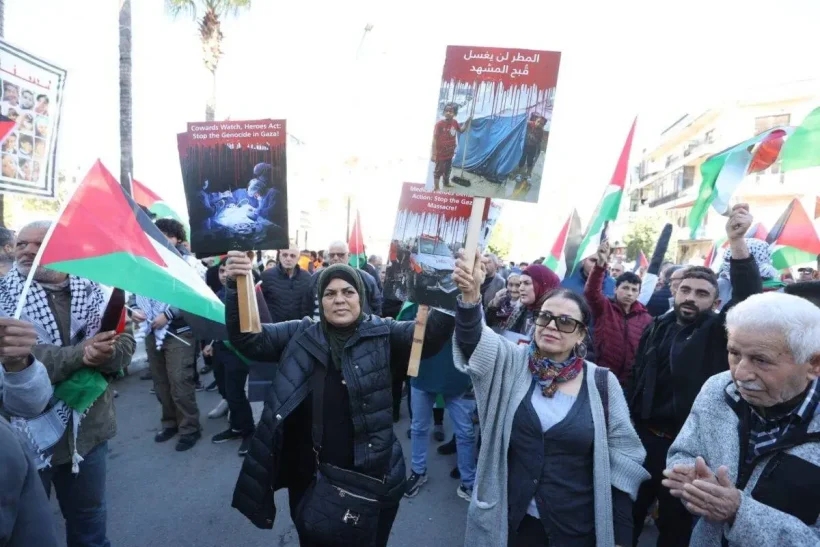
Palestinians stage a demonstration on International Day of Solidarity with the Palestinian People in Ramallah, West Bank on November 29, 2023 [İssam Rimawi/Anadolu Agency]
By Fareed Taamallah | MEMO | November 30, 2023
Palestinians in the occupied West Bank are following the truce in Gaza with great interest and hope. This is due primarily to their wish to help stop the destruction and genocide against their fellow Palestinians in the Gaza Strip. They feel powerless to get humanitarian aid and medicine into the besieged territory, and the hope is that the truce turns into a long and sustained ceasefire.
Despite its importance, there are other dimensions to the truce that are equally important. The truce represents a halt, even if only temporary, of the occupation army achieving what it wants by force, namely the destruction of the Palestinian Islamic Resistance Movement; the destruction of the Gaza Strip; and the recovery of Israeli captives held by Hamas.
There were more than 5,000 Palestinians held in Israeli prisons before 7 October. A further 3,300 have been detained since then, including 170 since the truce came into force. Six have been killed in prison by the brutal Israeli prison system since 7 October. Around 1,000 Palestinian prisoners are serving life sentences and hundreds have spent decades behind bars. The Palestinian Authority has been unable to free them through political agreements and negotiations, and they are not expected to be released without a prisoner exchange deal.
Palestinians believe that women and children held by Israel who are from the West Bank and Jerusalem and were freed under the current exchange deal are evidence of the unity of the Palestinian people and their struggle against the occupation in Jerusalem, the West Bank and the Gaza Strip. If the reports are true about the possibility of including for the first time Palestinians who hold Israeli citizenship, this will carry a symbolism no less important than the above.
There are mixed feelings of joy at the liberation of our women and children, and extreme sadness at the blood price that Palestinians, specifically the people of Gaza, are paying for their freedom. These mixed emotions are with us in the West Bank every night as we await the release of a new batch of detainees. We all know that we want to defy the ban imposed by Israel on any celebrations of their release. The desire to challenge the occupation thus joins the other emotions.
The issue of prisoners held by Israel is a central and emotional issue for the Palestinians; it is an issue in every Palestinian home, because there is hardly any Palestinian family without one or more of its members having tasted the bitterness of captivity and the brutality of arrest. The release of prisoners has great popular support, and this is understood by Hamas as it strives to make freedom a reality. The people of the West Bank view with pride the ability of the resistance not only to thwart Israel’s deterrence policy, but also to impose conditions in exchange for a truce. This is seen as a victory, even if small and temporary, in exchange for the massive destruction and killing in the Gaza Strip. It confirms the unity of the fate of Palestinian people in the West Bank and the Gaza Strip which the Israeli occupation has been trying to tear apart for decades.
Palestinians and the rest of the world can see evidence of the humane treatment provided by the resistance in Gaza to the Israeli prisoners, and compare it with the evidence of Israeli oppression, beatings and torture meted out to Palestinians held by the apartheid state. Freed Palestinians tell of harassment and deprivation of basic rights alongside the beating of Palestinian prisoners, including children and women.
Many are surprised to learn that Israel imprisons Palestinian children. I was one of those minors detained by Israel. In 1991, I was arrested and tortured by the Israeli security services and interrogated in prison in very bad conditions. Children and women are often held for many years and in many cases without charges or trial and in difficult conditions. It is only after Israelis have been captured that the world has started to talk about them.
We Palestinians in the West Bank understand, of course, that the temporary truce will not lead to an end to the killing and arrest of Palestinians in the occupied Palestinian territories. Israel has killed about 20 Palestinians during the truce alone, and arrested more than 170 in the areas supposedly under the security responsibility of the Palestinian Authority. The PA has peace agreements and security coordination with Israel that are supposed to stop such daily killings. The number arrested in the West Bank, by the way, almost matches the number of Palestinians freed so far under the truce deal.
Israel works to undermine the PA and any ambitions for Palestinian unity between the West Bank and the Gaza Strip. The authority has not succeeded in negotiations to stop settlement activity and has been unable, despite its international connections, to prevent the ongoing killing of Palestinians on a daily basis. For ten years, the PA has not been able to free any Palestinian prisoner through negotiations with Israel, even though President Mahmoud Abbas stated more than once his firm position that, “There will be no peace as long as there is a single prisoner behind bars.”
The last prisoner exchange took place in 2011 in the so-called Gilad Shalit deal, which stipulated the release of more than a thousand Palestinian prisoners in exchange for Hamas releasing the captured Israeli soldier. A large number of them included those whom Israel had refused to release as a gesture of good faith with the PA before, on the pretext that they all had “blood on their hands”.
Intentionally or not, the message that Israel sends to the Palestinians is that it does not give anything away for free, or as a “gesture of good faith”. It is clear that the only way to liberate Palestinian prisoners is solely through exchange deals between the resistance and the occupation state.
‘Israel destroyed Central Archives of Gaza City’: Head of Gaza Municipality
MEMO | November 29, 2023
The head of Gaza Municipality said, Wednesday, that Israel destroyed the “Central Archives” which contained thousands of historical documents dating more than 150 years, Anadolu Agency reports.
“Targeting the Central Archives poses a great danger to the city, as it contains thousands of historically valuable documents for the community” Yahya Al-Sarraj told Anadolu.
He pointed out that “these documents … represent an integral part of our history and culture.”
“The Central Archives contains plans for ancient buildings of historical value and documents in the handwriting of well-known national figures,” he said.
“These documents, dating back a long time, were burned, turning them into ashes, erasing a large part of our Palestinian memory” he noted.
Al-Sarraj said: “The Occupation targeted many buildings, including large and monumental cultural centres, as well as public parks belonging to the municipality.”
“Targeting included the Rashad Al-Shawwa Historical Cultural Centre, a very important centre that includes a theatre and a central library, which was targeted without any justification
“The Israeli Occupation also targeted the Palestinian Legislative Council and the memorial monument in the Memorial Park for the (Al-Jundi Al-Majhool) Unknown Soldier,” he said.
Al-Sarraj said “the attempt by the Occupation to destroy everything beautiful, to erase Palestinian memory, and to impose a policy of obscuring the people, making Palestinian cities uninhabitable.”
As part of the targeting of the Palestinian people and everything related to their values, heritage, culture and identity, Israel targeted memorials in several governorates since the start of its war early last month, including the Memorial of the Martyrs of the Marmara Ship in Gaza Port, the memorial of late journalist Shireen Abu Akleh in the Jenin Refugee Camp and the memorial of late President Yasser Arafat in Tulkarm, in the West Bank.
The main library in the Gaza Strip also did not escape the Israeli war machine, which bombed it during raids that targeted Gaza City since the outbreak of the war on 7 October.
The library, known as the Public Offices Building, is the largest in the Strip, containing historical documents and books.
According to statements made, Tuesday, by the spokesperson for the Gaza City Municipality, Hosni Muhanna, residents of the city consider it the memory of the country and its present.
Russia: US played ‘destructive role’ in escalating Israeli war in Gaza
Press TV – November 29, 2023
Russia says the United States has escalated the conflict between Israel and the Palestinian resistance movement Hamas by playing a “destructive role.”
Russia’s Deputy Permanent Representative to the UN Dmitry Chumakov made the comment during a speech he delivered to the United Nations General Assembly on Tuesday. He denounced Washington’s policies in West Asia.
“The policies of the US which meant that it kept turning a blind eye to the ongoing Israeli settlement construction in the occupied [Palestinian] territories and recognized Israel’s sovereignty over the occupied Golan Heights, have played a destructive role in the current escalation,” he said.
According to Gaza government health officials, over 15,000 Palestinians, including more than 6,000 children, were killed by Israeli aggression during the 49 days of war. Many more are feared to be buried under the rubble.
“As a result, we are now witnessing a conflict of unprecedented scope, which may spread to the entire Middle East,” Chumakov warned.
Washington has supported Tel Aviv’s relentless attacks on the Palestinian territory as an instance of “self-defense,” and has provided the regime with thousands of arms consignments since the onset of the war.
A four-day Qatari-brokered ceasefire between Tel Aviv and Hamas went into effect on Friday and was extended for two more days on Monday following mediation from Egypt and Qatar.
So far, under the truce deal, Hamas freed 69 hostages in return for 150 Palestinian prisoners held by Israel.
US fully responsible for situation in Gaza: Moscow
On Wednesday, Russian Foreign Ministry Spokeswoman Maria Zakharova said that the US is fully responsible for the current situation in the war-ravaged Palestinian enclave, stressing that Washington’s policies have served as the primary sources of tension in the conflict zone.
“The entire current collapse on the territory [of the Gaza Strip], where a colossal tragedy related to the Palestinian-Israeli confrontation has unfolded, is completely and fully the responsibility of the United States, or, rather, I should say, [due to] the irresponsibility [of the US]. It is only they [who are responsible],” she said during an interview with the Sputnik radio station.
The Gaza health ministry says the Israeli regime keeps denying hospitals fuel for their generators in violation of the truce. The Israeli onslaught on Gaza has brought almost all vital infrastructure in the besieged strip to a standstill.
German president ignored on arrival in Qatar
RT | November 30, 2023
German President Frank-Walter Steinmeier was kept waiting for almost 30 minutes in a plane passenger exit in the searing heat of Doha on Wednesday, before Qatari Foreign Minister Soltan bin Saad Al-Muraikhi finally arrived to receive him, German media have reported.
State outlet Deutsche Welle (DW), accompanying Steinmeier’s delegation, said the official preparations for the president’s arrival in Qatar had appeared to be in place. The red carpet had been rolled out and the guard of honor was ready, but no official was there to welcome the German president as he stood, arms folded, at the top of the ramp. Despite the delay, Steinmeier’s meeting with Qatari Emir Sheikh Tamim bin Hamad Al Thani later proceeded according to schedule, DW reported.
Steinmeier was in the Middle Eastern state to discuss efforts to release the remaining German hostages being held by Hamas, following the Palestinian militant group’s attack on Israel on October 7.
Several German nationals were among the more than 200 hostages taken by Hamas during its assault, which killed more 1,200 people.
Berlin has repeatedly stated that it supports Israel’s right to self-defense amid its devastating response in Gaza, which has claimed more than 16,000 Palestinian lives, according to the enclave’s Health Ministry.
DW suggested that “Wednesday’s apparent snub” could lead some to wonder if it was a response to statements by German Foreign Minister Annalena Baerbock in October.
“We do not accept support for terror,” Baerbock told the ZDF channel, arguing that countries such as Qatar “have a special responsibility to put an end to this terrorism.”
Qatar hosts the office of the Hamas political wing. Its proximity to the Palestinian militant group has made Doha a key figure in the negotiations between Israel and Hamas over the release of hostages.
On Tuesday, CIA Director William Burns and the head of Israel’s Mossad intelligence service, David Barnea, visited Qatar to hold talks with Prime Minister Sheikh Mohammed bin Abdulrahman bin Jassim Al Thani about the extension of a ceasefire in Gaza, as well as the ongoing hostage negotiations.
Israel lobby offers another candidate $20m to run against Rashida Tlaib in Michigan
MEMO | November 28, 2023
Nasser Beydoun revealed on social media that he had been contacted by the Israeli lobby group AIPAC and offered $20 million to run against Congresswoman Rashida Tlaib in Michigan. Beydoun is the second candidate who has been offered funds to run against Tlaib, with Senate candidate Hill Harper speaking of a similar offer last week.
Taking to X, Beydoun wrote: “Even knowing where I stand on AIPAC’s influence on our elections and foreign policy, the pro-Israel lobby had the nerve to suggest that I would even consider taking a dime from them.”
Adding that he had been asked to “run against my friend Rashida Tlaib.”
“The pro-Israel lobby will go to any length to remove anybody from the US Congress that has any opposition to their agenda and their total unequivocal support for Israel, good, bad, or indifferent.”
Tlaib, who represents Michigan’s 12th District in Congress, is the only Palestinian-American in the US House of Representatives. She is known for her criticism of Israel’s occupation and its invasion of Gaza.
Earlier this month, the House of Representatives voted to censure Tlaib for some statements that angered the Zionist lobby and the right-wing movement in the US, such as the use of the slogan “From the river to the sea.”
Politico first reported on 22 November that a Michigan businessman had offered Harper $20 million in campaign money if he stood against Tlaib in next year’s Democratic primary race, identifying Linden Nelson as the figure.
There is no sharing in settler-colonialism, Josep Borrell, only land theft
By Ramona Wadi | MEMO | November 28, 2023
When the so-called humanitarian pause is over, said Israeli Prime Minister Benjamin Netanyahu, “We are returning full power to carry out our aims: destroy Hamas, ensure that Gaza won’t return to what it was, and of course to free all of our hostages.” No one ever doubted that, but the international community has descended into further disgrace with its silence over Israel’s next round of ethnic cleansing in Gaza.
Netanyahu’s agreement to the hostage deal served as relatively good publicity, of course: “These incredible images of people being reunited with their families — the humanity of it, the sense of accomplishment of that and the possibility and promise that more and, ultimately, all of the hostages will come home.” This was despite the fact that it is possible that not all Israeli hostages will be freed by the end of the pause.
Those who are left run the risk of becoming part of Israel’s “collateral damage” in the enclave.
Meanwhile, as the focus on Gaza and the pause continues, Israel is ramping up its arrests of Palestinians in the occupied West Bank, ensuring that the number of prisoners it releases as part of the deal is negligible in comparison. Since 7 October, Israel has arrested 3,260 Palestinians in the occupied Palestinian territory.
On top of this, extreme far-right Finance Minister Bezalel Smotrich is requesting funds for “security and security infrastructure” in the West Bank. The EU’s High Representative for Foreign Affairs, Josep Borrell, was “appalled” by this, according to a post on X, in which he described settlements as “Israel’s greatest security liability.” Even so, according to Borrell, Israel and the Palestinians “both have equal and legitimate right to the same land, so they have to share it,” imparting colonialism in the most erroneous way possible.
If Israeli settlements are a liability, they always were, including the early colonial settlements that paved the way for Israel’s colonisation of Palestine. The UN’s differentiation of settlement expansion is merely an excuse to justify Israel’s colonial enterprise and the international community’s recognition of it as a state. For Borrell, and the rest of the EU, sharing the land is equal to enforcing the two-state paradigm, in which, hypothetically, Palestinians get some slivers of land while Israel owns and manages it all.
The scenario unfolding in Gaza should at least prompt Western leaders to reconsider their two-state rhetoric. Netanyahu has stated that Gaza will not return to what it was; that overt threat speaks of the next phase of Israel’s ethnic cleansing of the enclave. The entire world has watched Israel kill thousands of Palestinians and displace most of the population of Gaza, while diplomats debated over pauses – “humanitarian”, of course – in accordance with the hypocritical politics they espouse. Is there any consideration in the West for Israel’s genocide about to resume after the pause? How many more Palestinians will Israel kill before it is determined that there is no humanitarianism in this lull which has the world focused on hostages and not the process of settler-colonisation?
Settler-colonialism is not a sharing concept; it is theft. So, when will Borrell and all diplomats and politicians who speak of the two-state compromise face any accountability for encouraging genocide by refusing to acknowledge the reality of Israeli settler-colonialism, which seeks to replace the indigenous population with settlers?
United for Gaza: Time now for Palestinians to protect their collective sumud

By Ramzy Baroud | MEMO | November 28, 2023
Shortly after the start of a four-day ceasefire in the war on Gaza, the prime ministers of Spain and Belgium, Pedro Sanchez and Alexander De Croo, appeared in a joint press conference at the Rafah Crossing.
While Sanchez described “what is happening (as) a disaster,” De Croo called for a “permanent cessation of hostilities” and for an end to the killing of children.
Equally significant, the two European leaders declared that “we may decide to recognise the State of Palestine, if the European Union does not.”
Coupled with the strong position of Ireland, some in Europe seem to be waking up to the fact that the Israeli occupation is the primary cause of the recent Gaza ‘hostilities’.
Israel was not pleased by the evolving European position. It immediately summoned the ambassadors of both countries and sharply ‘rebuked’ them. This exaggerated response comes to show that Israel is not willing to give Europe even the narrowest of margins – as in condemning the killing of children or, expecting some kind of a peaceful settlement centered round Palestinian sovereignty.
Spain and Belgium’s phrase of “we may decide” to recognise Palestine even without EU consensus is indicative of an actual foreign policy schism within Europe itself. It turned out that not all EU governments have the same tolerance towards the genocide in Gaza as, for example, Germany and Britain.
Interestingly, other EU officials, too, are calling for a Palestinian State, though their intention is neither to ensure Palestinian freedom nor to safeguard Palestinian rights.
EU chief diplomat Josep Borrell, for example, argued on 20 November that “the creation of a Palestinian state would be the best way of ensuring Israel’s security”.
Even the former British prime minister, now secretary of state for foreign affairs, used similar logic. Israel will not have security unless it guarantees “long-term safety, security and stability” for the Palestinian people, David Cameron said.
Regardless of the reasoning behind the growing emphasis on a ‘solution’ and rights for the Palestinians, this language was almost entirely absent from the Western political discourse prior to 7 October.
The truth is that Palestinians have succeeded, through their resistance and sumud, to reassert Palestine on the global agenda. But how did Palestinians succeed in doing so, despite the utter marginalisation of their cause before the war?
First, unlike previous wars, especially those that preceded the Unity Intifada of May 2021, this time around Palestinians spoke in unison.
Without rehearsing or even coordinating, it felt as if the Palestinian message flew seamlessly, when all Palestinians, regardless of their ideological backgrounds, placed the focus on the Israeli atrocities, without falling into the trap of the typical factional blame game.
Even children who have lost members of their families in Gaza would stand bravely in front of cameras reiterating that they will never weaken and that nothing would remove them from their homeland. Young and old repeated the same logic, used similar language, even from their hospital beds.
This led Israel to do everything in its power to excommunicate the 2.3 million Palestinians in Gaza from the rest of the world, shutting down the internet, electricity and any form of communications, even among Palestinians themselves.
Yet, somehow, a clear, united Palestinian message continued, amplified countless times by an army of social media activists who impressively helped balance out mainstream media bias, eventually overpowering corporate media’s control over the war narrative altogether.
The Palestinians have done this, and more, without powerful lobby groups, media consultants or a hasbara machine, like that which attempted, to no avail, to sway the public opinion in favour of Israel.
Secondly, the factional Palestinian suddenly disappeared.
For years, factional narratives, dividing Palestinians into conflicting interest groups, have thwarted the Palestinian people’s attempt to unify behind a single leadership – one that is capable of conveying, representing and defending Palestinian political aspirations.
Yet, all the Fatah-Hamas talks and agreements have failed, leaving the people with no other alternative but to explore different manifestations of unity that go beyond the interests of politicians.
This unity is now on full display, compelling everyone, including those affiliated with the Palestinian Authority itself, to adhere to the line of the people. While Gazans fought to free prisoners in the West Bank, West Bankers rose, and died in large numbers, in defence of Gaza.
This popular unity must continue, so that it would eventually be harnessed in the form of political unity, which will bring all Palestinian groups together under a single leadership. This is the only way to ensure the tremendous Palestinian sacrifices and the precious blood that spilled in Gaza, eventually translate into the freedom that all Palestinians covet.
Thirdly, unity beyond Palestine also proved critical.
Arabs and Muslims served as the core of Palestinian solidarity throughout the Israeli war on Gaza. They protested, boycotted, fought and mobilised. Moreover, tens of millions of people, beyond the confines of the Arab and Muslim worlds, also marched around Palestinian rights and priorities.
Indeed, whole new conversations on Palestine are now occupying many public spheres around the globe. The Global South is once more embracing the struggle for Palestine, while the Global North is challenging governments, big corporations and mainstream media for justifying, supporting and financing the Israeli genocide.
The Palestinian people will now have to lead and direct this momentum of solidarity so that it may serve their righteous objectives, those of equality, justice and freedom – all enshrined in international law.
No public space should be left without engagement, no audience should be overlooked or neglected, and no stone should be left unturned in the search of that critical mass needed to hold Israel accountable for its crimes.
Western leaders and officials are speaking out now because they understand that the Palestinian cause has become a global one, and that the prolonging of Israeli occupation and apartheid will not bode well, neither for Tel Aviv nor for the collective West.
It is time for Palestinians to utilise this significant moment. It is time for them to lead the process of their own liberation. In fact, in Gaza, Jenin and elsewhere, this process has already begun.
Israeli detainee thanks resistance fighters for kind and humane treatment
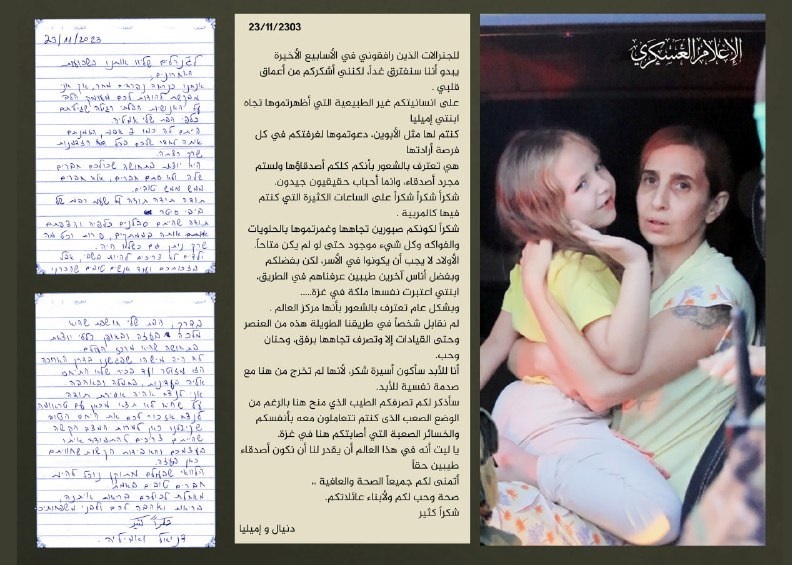
Palestine Information Center – November 28, 2023
GAZA – Israeli ex-detainee Daniel Aloni has thanked the resistance fighters from al-Qassam Brigades of Hamas for treating her and her 6-year-old daughter Emilia kindly and humanely during their presence in captivity.
This came in a letter she wrote in Hebrew while she was in detention, in which she expressed her gratitude for al-Qassam fighters who were escorting and guarding her and her daughter during the days they had spent in Gaza.
Daniel and her daughter were among the first group of captives who were released on Friday by al-Qassam Brigades.
Below is the full text of the letter as translated from Hebrew and provided by the Brigades’ military media.
“To the commanders who have accompanied me in recent weeks, it seems that we will part ways tomorrow, but I want to thank you from the bottom of my heart for your extraordinary humanity that you have shown towards my daughter Emilia. You treated her like your own. You welcomed her in your room whenever she walked in. She says that you are all her friends, not just acquaintances. You are her true and good loved ones. Thank you, thank you, thank you for the countless hours you spent with her as caregivers. Thank you for being patient with her and showering her with sweets, fruits, and everything available, even if it wasn’t readily accessible. Children should not be in captivity, but thanks to you and other kind-hearted individuals and leaders we have met during our presence in her, my daughter considered herself a queen in Gaza and felt like she was the center of the world. We did not meet a single person, whether a member or leader, during our long stay [in Gaza], who did not treat her with kindness, tenderness, and love. I will forever be a captive of gratitude because she will not leave this place with a permanent psychological trauma. I will remember your kind manners, which you showed in here despite the difficult situation you were coping with yourselves, and the heavy losses that befell you here in Gaza. I wish in this world that we could be really good friends one day. I wish you all good health and well-being. Health and love to you and your families. Thank you very much. Daniel and Emilia.”
UN: Aid entering Gaza is 5% of what entered before 7 October
MEMO | November 28, 2023
The spokesman for the United Nations Relief and Works Agency for Palestine Refugees (UNRWA), Adnan Abu Hasna, today confirmed that dozens of trucks of aid had entered Gaza City and the northern Gaza Strip during the truce.
He said it contains food supplies, drinking water, baby milk, flour, canned goods and various other foodstuffs.
Abu Hasna noted that the volume of humanitarian aid entering through the Rafah crossing is only five per cent of the volume that entered before the Israeli aggression on the Gaza Strip on 7 October.
On average, he explained, 50 trucks are entering the Strip each day, while before the aggression 500, sometimes 600, trucks entered per day.
“What we need is the entry of 200 trucks daily for at least two continuous months in order to respond to the necessary humanitarian needs,” Abu Hasna said. The Rafah crossing alone is not sufficient for the entry of Gaza’s aid needs, he explained, adding that “the only crossing that has the capabilities, mechanisms, and detection devices is the Karam Abu Salem crossing.”
With winter temperatures setting in, Abu Hasna said, “we need bedding, covers and winter clothes, and we are working hard to bring them in or at least open a commercial corridor to bring in goods so that people can buy.”
Israel’s ground war conundrum
By Hasan Illaik | The Cradle | November 27, 2023
Before dusk on 26 November, fighters from Hamas’ military wing, Al-Qassam Brigades, began the process of handing over to the International Red Cross a number of Israeli captives taken during the 7 October Al-Aqsa Flood operation. The transfer of these women and children took place in the Gaza Strip amid what appeared to be a security parade. Al-Qassam fighters arrived in four-wheel-drive vehicles and deployed themselves around the site, wearing full uniforms and bearing arms. Surrounded by civilians cheering on the resistance, the transfer of the Israeli captives was completed smoothly and quietly.
This event took place in Palestine Square in Gaza City on the third day of the truce that followed a 49-day war. Throughout the war, Gaza City has been subjected to a suffocating siege and an unprecedented Israeli air and artillery assault, not seen since at least 1982.
The handover process in Palestine Square also took place more than a month after the Israeli army began its ground operation, in which it aims to occupy Gaza City and all areas north of the Strip, destroy them, and displace their population permanently. But the visual of Al-Qassam fighters confidently standing guard in Palestine Square on 26 November, suggested to all present that they remained unharmed by Israel’s war.
The fighters transported the Israeli prisoners from their various hideouts and agreed-upon pickup sites to the square, while ensuring that these safe houses would not be discovered. Somebody issued the order, and others carried it out seamlessly, in a highly visible geographical area of less than 150 square kilometers. Keep in mind that Israel and the US have allocated enormous intelligence resources over the past six weeks to unearth the vast network of Hamas tunnels, and to discover the whereabouts of the prisoners.
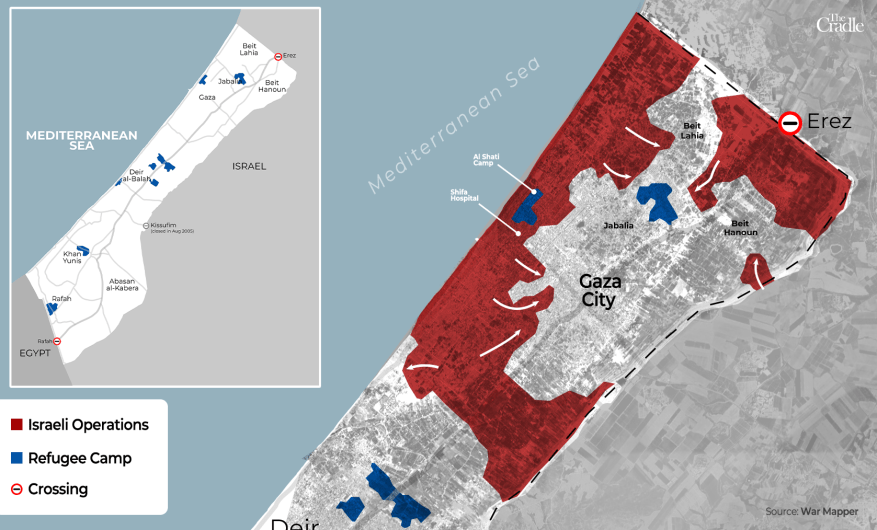
Map of Israeli operations in Gaza
This picture reveals, to a large extent, the results of Israel’s ground operation: civilian massacres and infrastructural destruction galore, but with little damage to the military structure of the Palestinian resistance. A number of its leaders have indeed been killed – most recently Al-Qassam’s northern commander and military council member Ahmed al-Ghandour – but its command and control system still ticks on effectively.
Israel’s ground limits
Further evidence of this lies in the inability of the occupation army to penetrate, unimpeded, all of northern Gaza. Israel precedes its ground movements with intense air strikes, then artillery shelling. After destroying everything in its path, its tanks begin advancing. It is almost impossible to confront tanks as they enter, because air fire clears spaces 500 meters ahead, while artillery shells pave the path 150 meters in front of the ground units.
However, whenever possible, the resistance fighters launch anti-armor missiles – Cornet, Conkurs, or similar types – with ranges exceeding one thousand metres. After the tanks reach their designated target, the resistance fighters emerge like ghosts from under the ground or rubble and fire anti-armor shells at them, usually Al-Yassin homemade shells, with a range of fewer than 150 meters. Or, alternatively, a fighter physically approaches the Israeli tanks and plants a sticky bomb that explodes in much the same way as a hand grenade.
The work of resistance does not end there. If the tanks do not retreat, and the occupation soldiers settle in, they will be attacked with machine gun fire or explosive devices. The Palestinian fighters film many of these operations, and the footage is delivered to the operations room, which decides what to publish.
It is clear that the resistance’s command and control system is still operating effectively.
Bigger than the 1973 war?
The Israeli ground operation in the northern Gaza Strip began after three weeks of preliminary air attacks and preparation by the invasion forces.
More than 100,000 soldiers were mobilized around the Gaza Strip, which has a total area of about 360 square kilometers.
Most of these troops belong to the regular forces, and Israel called up a further 300,000 reserve soldiers and officers – more than the number of reservists called up by Russia to fight on a 1,500 km front. In northern Gaza, Israel has thus far deployed its regular (non-reserve) combat brigades and battalions: Golani Brigade, Nahal Brigade, Givati Brigade, Paratroopers, Special Operations Force “Shayetet 13,” Special Staff Operations Unit (Sayeret Matkal), and so forth. All the regular forces that the occupation army could muster have been fully deployed in the Gaza Strip since the start of the fourth week of the war.
In addition, Israel has mobilized half of its artillery stock, half of its air force, and one thousand armored vehicles, including tanks and troop carriers.
Estimates of the Palestinian resistance suggest that the total number of regular and reserve forces deployed on the borders of the Gaza Strip, and inside it, exceeds the number of Israeli troops that participated in the 1973 war counterattacks on the Syrian and Egyptian fronts.
In this war, the Israelis have not attempted to penetrate Gaza from the “traditional axes,” that is, from the east toward the Shuja’iya neighborhood in Gaza City. Their incursion, instead, commenced in the center of the Strip, in the area called “Wadi Gaza” with low population and urban density, which means that the resistance’s ability to confront it is also low.
The occupation army was able to enter this area, from east to west, effectively severing the north of the Strip from its south. However, until the truce took effect, resistance fighters were still carrying out operations against Israeli troops, particularly in the Juhr al-Dik area.
The other axis of the incursion was in the Beit Lahia and Beit Hanoun areas of northern Gaza. As of 24 November, when a temporary truce was announced, the occupation army had been unable to control the region and continued to face deadly operations carried out by various resistance troops.
The third and main axis of advance is in western Gaza, along the shoreline of the northern Strip. Israeli tanks advanced from the north and from the centre, along the Mediterranean coast, to penetrate all the way to Al-Shifa Hospital and other government centers, such as the Legislative Council building.
Gaza Beach… the resistance’s weak point
Along the coastline, there are no defensive resistance tunnels, due to the nature of the land, the lack of population and infrastructure, and the possibility of seawater leaking into the tunnels. The most that the resistance could have achieved, defensively, in this axis, was to repel naval landings – not to stop the advance of tanks or the devastating airstrikes that precede them.
The main node in this axis is the Beach camp, which the occupation army has been unable to enter because of the ferocity of the resistance there.
So far, Tel Aviv has acknowledged the death of over 70 soldiers and officers, with hundreds of others wounded. Palestinian resistance sources confirm that the actual confrontation with Israeli troops only began after they entered the Shifa Medical Complex.
The frequency and intensity of Israel’s aerial and artillery bombardments do not allow resistance fighters to repel the occupation’s advancement, as the overwhelming firepower detonates most of the IEDs intended for tanks or infantry and blocks or destroys entrances to tunnels.
For this reason, the resistance waits for a lull in the bombing, the entry of tanks, and the reopening of the tunnels to begin its operations. At this stage, the fighters wait for Israeli infantry to emerge from their armored vehicles in order to target them. This has already occurred in a number of operations in the northern and western axes of occupation troops movements.
So far, the resistance confirms that it has damaged and destroyed more than 300 Israeli armored vehicles. Some of them were removed from service, while others are maintained in the field for reuse. The sources further confirm to The Cradle that the number of Israeli troop casualties, both dead and wounded, is many times greater than what Tel Aviv has announced.
Now, where to?
Before the 24 November truce, the occupation army had exhausted its ability to maneuver on the ground, having already deployed the majority of its regular combat forces in the northern and western axes.
It will need to search for innovative solutions if it seeks to advance toward densely populated areas in northern Gaza, such as Jabalia refugee camp, the Al-Zaytoun and Al-Shuja’iya neighborhoods, Al-Shati beach camp, and other vital places the Israelis have failed to penetrate. These areas are the ground zero of the Palestinian resistance, in which these forces have prepared themselves – and their tunnel infrastructure – for fierce and protracted confrontations.
The main reason the occupation government agreed to a short truce is that its ground incursion had hit this wall – in addition to other factors such as US pressure to release American captives. Simply put, the Israeli army needs to re-examine its plans and develop new strategies to advance in the field.
It is important to note that norms applicable in regular armed conflicts, as in Ukraine, Syria, Iraq, or Sudan, do not necessarily apply to the Gaza Strip. When a control map shows the Ukrainian army controlling a region, the Russian army has withdrawn from it, and vice versa.
In Gaza, a map showing the Israeli army in an area does not necessarily mean a withdrawal of Palestinian resistance forces, as the latter do not have armored vehicles or traditional formations to remove from enemy-invaded areas. Its fighters simply disappear underground to await the emergence of occupation soldiers from their tanks and such.
The bottom line is that maps currently circulated by governments, media, and think tanks that display Israel’s field advancement in Gaza – accurate or not – are not illustrating Israel’s ground control, but rather the depth of its incursions.
At the truce’s end, even if extended further, Tel Aviv will relaunch its ground operation. It will first prep the field with even more ferocious air bombardment than before, intended to displace more than 700,000 civilians remaining in the northern Gaza Strip and to impact the morale of resistance fighters.
It is also expected that the latter has studied the ground reality well, modified its defensive plans, carefully determined its goals, and reorganized its defense lines to fight the enemy with greater efficacy and inflict the greatest possible losses upon it.
Israel’s goal is to crush the resistance in northern Gaza in preparation for its next-phase war on the south – which may be fought differently, both strategically and tactically. What the resistance wants is to force the enemy to stop the war.
From the outset, Tel Aviv set two goals for its war in general, and for its ground operation in particular: destroy the resistance and liberate the prisoners. The 26 November scene in Palestine Square, in the heart of Gaza City, showed us a resistance still intact and able to exact a price from Israel.
Days later, the occupation government is still seething that Israeli captives were released according to terms dictated mainly by the resistance: military operations had to be frozen (and heavily monitored), Palestinian prisoners were liberated from Israeli detention, and aid began flowing back into the besieged Gaza Strip.
Fifty days into Israel’s staggeringly disproportionate war on Gaza, the Palestinian resistance is still able to impose its will – despite the occupation military’s unprecedented massacre of more than 20,000 civilians, the displacement of hundreds of thousands more, and the wholesale destruction of residential homes, hospitals, and schools.
When the conflict resumes in the days ahead, and the war between troops begins in earnest, the resistance may exact an even higher price from Israel, one that the Israelis can not tolerate.
Israel’s Greatest Failure: Hamas Stays and More Popular than Ever
By Robert Inlakesh | Covert Geopolitics | November 28, 2023
After repeatedly rejecting a truce with Hamas and labeling the idea “ridiculous”, Israel agreed to a four-day cessation of hostilities in Gaza and a prisoner exchange.
Six weeks of death and destruction, which Israeli and Western leaders declared should have led to the destruction of Hamas, have now bolstered the Palestinian movement’s image throughout the Arab world and beyond.
The four-day truce that was implemented this Friday provided a sigh of relief for those most affected by the war in the Gaza Strip, but has in many ways spelled disaster for the Israeli government. As women and children, held captive by both Hamas and Israel, are being reunited with their families, the threat of further warfare looms.
Although the loved ones of those released are now celebrating, the next steps will be crucial in determining the final outcomes of the 46-day battle that has now been placed on pause. At this time, it appears that the idea that “Hamas must go” is no more than a pipe dream.
On October 27, the United Nations General Assembly passed a resolution to the sound of overwhelming applause, calling for a truce to stop the fighting in the Gaza Strip. Although the non-binding resolution passed with a majority of 120 votes in favour, Israel and the United States outright rejected it.
Tabled by Arab nations, the call for a truce was labeled as a “defense of Nazi terrorists” by Gilad Erdan, Israel’s ambassador to the UN. This came after Hamas released four Israeli civilian hostages without conditions, for what the group said were humanitarian reasons.
Israeli Prime Minister Benjamin Netanyahu and others in his emergency war government, have repeatedly stated their goal of crushing Hamas and allied Palestinian armed groups in Gaza, refusing to negotiate with them.
The six-week-long aerial bombardment of densely populated civilian areas in the besieged Palestinian enclave, which also morphed into a ground war, has claimed over 20,000 lives according to some estimates, but failed to eliminate Hamas.
In fact, Israeli forces have not been able to show a single significant military achievement against the Palestinian armed groups. While Hamas claim to have struck 355 Israeli military vehicles during the past two weeks of fighting, publishing video evidence of dozens of attacks, Israeli forces have failed to assassinate senior leaders of Hamas, to free hostages by force, uncover major tunnel networks, or even publish proof that they have killed a significant number of Hamas fighters on the battlefield.
According to the Calcalist financial newspaper, the Gaza war was estimated early on to cost around $50 billion, roughly 10% of Israel’s GDP. In addition to this, the Israeli military has reportedly suffered losses in intelligence and monitoring equipment along their northern border, due to attacks carried out by the Lebanese group Hezbollah.
Yemen’s Ansarallah also seized a ship in the Red Sea, owned by an Israeli businessman, which has severely impacted trade through the southern port city of Eilat. This is not factoring in the inevitable long-term effects on things like Israel’s tourism sector or investment in its high-tech industry.
On top of this, we have seen immense pressure being placed upon US forces throughout Syria and Iraq, with daily attacks occurring against their military facilities, for the sole purpose of pressuring Washington to force an end to Israel’s attacks on Gaza.
Across the Arab World, the general public is also boycotting Western products on an unprecedented scale, in particular companies like McDonalds that have shown support for the Israeli army.
The blatant double standards of the collective West’s political and economic elites, as well as the establishment media, are also being severely criticized, as the likes of the BBC are feeling the heat for biased reporting on the issue of Palestine-Israel.
Instead of facing the wrath of the whole world and getting crushed, Hamas has not only survived, but is becoming more popular. While US President Joe Biden’s administration provided excuses for Israel’s invasions and bombings of hospitals in the Gaza Strip, claiming that Hamas has maintained a significant presence in places like the recently-raided al-Shifa Hospital, the world has risen in outrage against the atrocities Israel has committed in the Palestinian territory.
UN relief chief, Martin Griffiths, has called the humanitarian catastrophe in Gaza “the worst ever,” and it’s seen as a direct result of the US having drawn “no red lines” for Israel’s behavior in Gaza.
Meanwhile, Hamas scores victory after victory, from a guerilla warfare and political perspective, while its military capabilities appear to have been undiminished so far.
The Qassam Brigades, the armed wing of Hamas, that launched their attack on Israel on October 7, have managed to shift the world’s attention back onto the issue of Palestine, have freed political prisoners held in Israeli detention, while inflicting blow after blow against one of the most powerful military forces in the world.
Since the Kerry Peace Plan, which was a failed initiative set forward under the administration of Barack Obama, the US government has not made any real effort towards creating a viable Palestinian state.
In fact, until October 7, nobody was talking about a Palestinian state, the focus was instead on the issue of Saudi-Israeli normalization. It was clearly the shared belief of the Israeli and US governments that Hamas could be contained with the periodic issuance of Qatari aid grants, while the Palestinian Authority was to be strengthened only to deal with a number of militias that have formed in the West Bank over the past two years.
Today, the whole world is talking about the formation of a Palestinian state. There is also the notion of bringing the Palestinian Authority into power in the Gaza Strip, which would essentially mean the lifting of the 17-year economic blockade that the West has imposed on it. The issue of protecting the status-quo at Al-Aqsa Mosque in Jerusalem is also on the regional agenda in a serious way, while the government of Benjamin Netanyahu veers towards collapse.
If Israel and its Western backers choose to escalate the conflict further instead of finding a peaceful settlement, the war threatens to extend into a broader regional conflict; a threat to the stability of all nations involved. The pursuit of a ceasefire agreement can usher in a new era in the conflict, one in which Hamas will remain.
Peace is in the interests of the entire region, we have seen what the Israeli army has to offer and it has not resulted in the defeat of Palestinian armed groups, it has only scored a blow against civilians in Gaza.
This will be a hard pill for the Western governments to swallow, but the only solution to safeguarding civilian life and securing the release of all prisoners, will be through a peaceful resolution, not through more violence.
Israel has been unable to achieve any meaningful victories against the Palestinian militants.
Robert Inlakesh is a political analyst, journalist and documentary filmmaker currently based in London, UK. He has reported from and lived in the Palestinian territories and currently works with Quds News. Director of ‘Steal of the Century: Trump’s Palestine-Israel Catastrophe’. Follow him on Twitter @falasteen47
Featured Video

Ivermectin and iodine
or go to
Aletho News Archives – Video-Images
From the Archives
UN declares war on ‘dangerous’ conspiracy theories
‘World is not secretly run by elites’
Free West Media | August 5, 2022
UNESCO says it is seriously concerned about the increase in “disinformation” and “conspiracy theories”. And they plan to put an end to it through a network of informants.
“Conspiracy theories can be dangerous,” the UN agency warned. “Often they ignore scientific evidence and polarize society with dire consequences. This has to stop.”
Unesco’s director-general warned that “conspiracy theories” could cause damage to people as well as to their health. “They reinforce misconceptions about the pandemic, reinforcing stereotypes that can fuel violence and violent, extremist ideologies,” said Audrey Azoulay.
The UN agency has launched a campaign to help people identify, debunk and report “conspiracy theories” to prevent them from spreading further.
This campaign is being carried out in collaboration with the European Commission, Twitter and the World Jewish Congress. The UN has created a toolkit to “debunk” such theories and smear anyone who dares to claim that governments are not fair and transparent.
The UN also warned that George Soros, the Rothschilds and Israel should not be linked to “alleged conspiracies”.
World events “are not secretly manipulated behind the scenes by powerful players with malicious intent,” the UN agency maintained.
And if anyone therefore comes across someone who believes that the world elite is plotting to consolidate power or direct events, then that person needs to take action. According to the UN agency, when meeting a “conspiracy theorist”, under no circumstances should one enter into a discussion. … continue
Blog Roll
 Aletho News
- Taking the Houthis at Their Word: The Bill Saudi Arabia Doesn’t Want to Read
- Trump claims he would have bombed Ho Chi Minh City to win Vietnam War
- Russia shows Europe that prolonging the Ukraine war is pointless
- There is cautious optimism about ending the Ukraine War – Part 2
- Ukrainian air alert app hacked with fake nuclear warnings
- Ivermectin and iodine
- Congratulations climate skeptics — you are a ‘Hybrid weapon of war’ and a growing public health threat
- ‘The Arab Vote’: How Israeli Racism Has Ruined Their Elections
- Israel forces Palestinians in Gaza to choose between assassination alone or death with their families: Report
- US Approves Sale of 500 Patriot Missiles to Ukraine, Deliveries May Take Years
- If Americans Knew
- An error has occurred; the feed is probably down. Try again later.
- No Tricks Zone
- Germany’s Green Energy Transition Becoming Increasingly Expensive…Another 6 Trillion Euros!
- Sudden Stratospheric Warming, Powerful El Niño Combination May Lead To Extreme Europe Cold, Energy Crisis!
- Two New Studies Find Thwaites Glacier Melt Cannot Be Driven By Human Activity Or A Warming Ocean
- E-Cars Reduce CO2 Emissions By Only 41% Compared To Internal Combustion Engine Vehicles
- Predictions Made By Renowned Climate Professor Over Past Decades Have Been Proven To Be Poor
- New Study Suggests Large Regions Of The Pacific Ocean Have Been Cooling For The Last 80 Years
- Germany’s Green Energy Debacle: High Energy Costs Force Kahla Porzellan to Close After 182 Years!
- New Study: 50 Years Of The Most Aggressive ‘Net Zero’ Policies Can Only Affect The Global Climate By 0.03°C
- US September “Heat” Was No Record…Many Records Set Decades Ago
- Latest European Green Energy Debacle; Portugal’s Largest Flagship Solar Park Insolvent!

