The UN exploits Palestinian children to further the two-state propaganda
By Ramona Wadi | MEMO | October 23, 2019
There is one thing the UN and its personnel would do well to keep in mind when pontificating about the purported peace process and to promote Israel’s security narrative: Palestinian children are not props for exploitation. At a time when the United Nations Relief and Works Agency for Palestine Refugees is facing a severe crisis due to funding shortages, as well as the misdemeanour allegations concerning its staff, the last thing the UN should be doing is exploiting Palestinian children for the sake of upholding the obsolete two-state compromise.
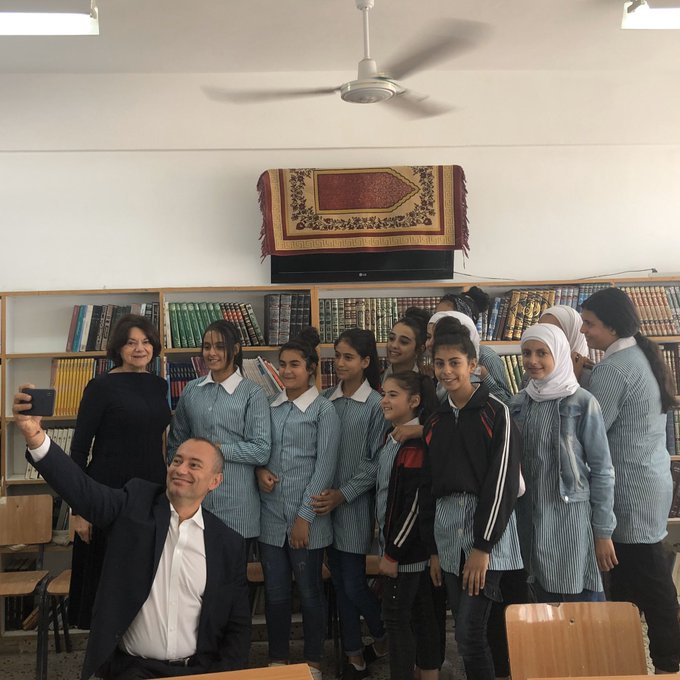
Earlier this month, the UN Special Coordinator for the Middle East Peace Process Nickolay Mladenov posted a photo on Twitter, of himself and UN Under-Secretary-General for Political and Peacebuilding Affairs Rosemary DiCarlo, together with a group of female refugee students attending one of UNRWA’s schools. “I hope these young girls grow up to participate in democratic elections where Palestine, Israel live side-by-side in peace and security,” he tweeted.
Just because the colonial narrative makes Israel, peace and security synonymous doesn’t mean there are no inherent contradictions in the rhetoric. The UN, a collaborator since before the inception of Israel, is, of course, aware of the discrepancies, but it prefers to enforce historical cycles of dispossession upon Palestinians, including students, framing them as a warped peace process in which Israel’s existence is paramount, even at the expense of Palestinian lives.
Mladenov’s wish for Palestinian children is not that they exercise their right to live freely in all of historic Palestine. On the contrary, he is demanding perpetual subjugation and oblivion of the Palestinian right of return, and what better way to attempt indoctrination than with the younger generations, according to the UN’s delusional standards?
But Palestinians have remembrance, and that remembrance is political. Has Mladenov deigned to listen to the Palestinian children’s refugee narratives? Are Mladenov and the UN expecting future Palestinian generations to exploit themselves for Israel’s colonial plans? How do UN officials reconcile democracy with the colonialism inherent in the two-state paradigm, which is the purported solution envisaged for Palestinians by the international community?
Taking the latter one step further, since the UN knows that the two-state hypothesis is obsolete, it stands to reason that these Palestinian children, along with many others, will be witness to further colonial appropriation by Israel. Mladenov’s legacy to this group of students will be nothing other than a promotional photo taken for UN propaganda purposes, while in the background; Palestinian families are permanently ruptured and dispossessed by Israel.
UN antics are not impressive; they are endangering the lives of Palestinians and attempting to tarnish students with acquiescence. Parroting about democratic elections while envisaging perpetual colonialism is vile, all the more when involving students in UN propaganda. So, stop the rhetoric of hope, which is an illusion when there is factual support for the elimination of Palestinian rights. Mladenov never intended Palestinian students’ voices to reach the international arena. The promotion photo speaks volumes about how the UN coerces Palestinians into silence. When the focus is Palestinian children facing perpetual refugee status, it is clear the UN could not sink any lower.
Soldiers Force Palestinians Out Of Their Olive Orchards In Nablus
IMEMC | November 2, 2019
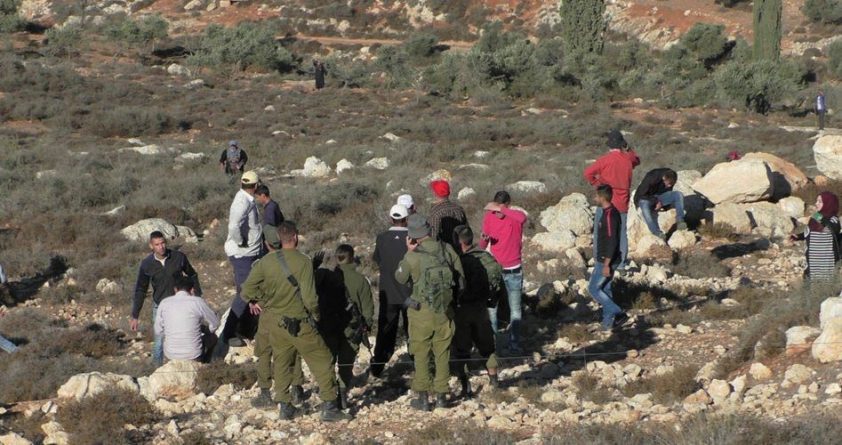
Israeli soldiers invaded Palestinian olive orchards between Burin and Huwwara towns, south of the northern West Bank city of Nablus, and forced the Palestinians out on Saturday, in addition to threatening them with “bringing the settlers to attack them.”
Eyewitnesses said the soldiers invaded the orchards near the illegal Yitzhar colony, which was built on private Palestinian lands, and attacked the families.
The soldiers even told the families that if they do not leave, they will bring the colonists from Yitzhar, known for constantly attacking the Palestinians and their lands, to assault them.
Olive harvest season in the occupied West Bank is always accompanied by dozens of Israeli violations by both the soldiers and the illegal colonists.
There have been numerous violations this olive harvest season alone, including twelve just recently in Qaryout village, south of Nablus.
The attacks include assaulting Palestinians, uprooting their trees, burning their lands and orchards, in addition to the military’s refusal in many cases to allow the Palestinians into their lands, isolated behind the illegal Annexation Wall.
It is worth mentioning that the Palestinians in Nablus governorate are not allowed to enter more than 3,500 Dunams of their olive orchards, except for a few days a year, after prior coordination and approval from the military.
Even when they receive the permits, the Palestinians and are forced to wait until the soldiers open the gate for them, and sometimes the soldiers do not open it at all or force them to wait for long periods.
On Friday morning, several colonists invaded a Palestinian orchard in Yasuf village, east of the central West Bank city of Salfit, and stole a donkey, blankets and olive picking tools.
Such attacks against Palestinian lands, especially olive orchards, including those carried out by soldiers, take place in various areas across the West Bank, always escalate during the olive harvest season, and include cutting, burning and uprooting trees, picking olive trees and stealing the produce, in addition to assaulting the Palestinians and forcing them out of their orchards.
Lavrov: US’ ‘Deal of Century’ Example of Swapping International Law for Norms Suitable for US
Sputnik – November 1, 2019
MOSCOW – The so-called deal of the century on the Israeli-Palestinian conflict settlement that Washington says it is preparing is an example of how the international law is changed for rules that the United States finds convenient, Russian Foreign Minister Sergey Lavrov said.
“Instead of implementing these [UNSC] resolutions, the United States promises everyone to present some ‘deal of the century,’ which, as you have already understood, will not envision the creation of a full-fledged Palestinian state. This is an example of how international law represented by UNSC resolutions is swapped for rules that the United States has invented and which it finds convenient”, Lavrov said in an interview on TV on Friday.
The administration of US President Donald Trump has for years said it would announce its plan for Israeli-Palestinian peace. In July, it released what was characterized as an economic component of the plan — an infrastructure and investment project to support Palestinians.
However, the Palestinian authorities have rejected Washington’s involvement in the settlement of their conflict with Israelis after Trump recognized Jerusalem as the capital of Israel and moved the US embassy from Tel Aviv to the Holy City despite the condemnation of the Muslim world and the UN recommendations to refrain from establishing diplomatic missions in the city until its legal status is settled.
The UN Security Council has issued multiple resolutions on the Israeli-Palestinian settlement. For years, the Arab world remains committed to the Arab Peace Initiative, originally agreed upon at the Beirut Summit back in 2002. The plan has been formed on the basis of the UNSC Resolution of 194.
‘Defend International Law’ Petition Demands Norway Impose Sanctions on Israel
Sputnik – November 1, 2019
Dozens of Norway’s leading lawyers believe that Israel violates international law and doesn’t deserve the preferential treatment it currently enjoys.
A group of 44 lawyers, including award-winning luminaries and distinguished professionals such as professor Jan Fridthjof Bernt, have called on Norway to impose sanctions on Israel for its violations of international law.
The petition called “Defend international law” was published by the newspaper Dagsavisen.
Israel has annexed East Jerusalem and the Golan Heights and has announced the annexation of the Jordan Valley – without having any major consequences, the petition stressed.
Between March 2018 and September 2019 alone, the lawyers emphasised, 309 Palestinians who have participated in protest marches along the Gaza Strip border were killed. In the past year alone, 56 Palestinian children were killed by Israeli forces, again without any repercussions, including from Norway. The number of Palestinians who have died at the hands of the state is comparable to the number of murders in the country: 103 people were victims of homicide in 2018, compared with 136 in 2017, according to the local media. For comparison’s sake, police in the US, which is better known for police killings, fatally shot approximately one person for every 19 murder victims in 2017.
“Norwegian authorities and politicians must restore respect for international law and work to ensure that Israel’s long-standing and systematic breaches of international driving rules are met with sanctions”, the petition said.
The authors of the petition stressed that the absence of an international reaction to Israel’s violation of international law, human rights and humanitarian law raises concerns.
“While Israel’s serious and persistent violations are only verbally criticised, other countries that violate international law are exposed to reactions from the international community through concrete actions and sanctions”, the petition said.
On the contrary, Israel is the only country in the world to have been granted a special status in the Norwegian government’s Granavolden platform that allows Oslo to “facilitate enhanced research and development cooperation, trade, tourism and cultural exchange with Israel”.
“This attitude taken by the Norwegian authorities against serious violations of basic humanitarian and international law principles helps legitimise Israel’s policy based on the occupation and colonisation of Palestinian land, and the collective punishment of Palestinians on the Gaza Strip,” the petition said.
According to lawyer Kjell Brygfjeld, one of the signatories, the are plenty of sanctions Norway could impose on Israel.
“We are already involved in sanctions against Russia, Venezuela, Iran and a number of other countries. All countries should be treated in the same way and with the same severity for violations of international law. We must not make a difference between those we like and those we do not like,” Brygfjeld told the newspaper Klassekampen.
According to him, the Norwegian government has chosen an opposite strategy, where efforts to boost relations are made despite the fact that some Norwegian residents have been denied entry to Israel.
Earlier this week, Oslo’s newly installed “red-green” City Council led by three left-of-the-centre parties, the Socialist Left, Labour and the Greens, announced it was contemplating a ban on the municipality’s procurement of goods and services from Israeli settlements, which it called “an area occupied in violation of international law”.
However, State Secretary Audun Halvorsen of the Conservative Party said he doesn’t believe sanctions are the way to go. He also stressed that Norway expressed concern over Israeli authorities’ excessive use of force and human rights violations, “when there are grounds for doing so”.
Norway was one of the first nations to recognise Israel in 1949. The stance toward Israel is one of the issues that signals the left-right divide between Norwegian parties. While left-wing parties generally favour Palestine, to the point of being ready to boycott goods and services from what they view as territories occupied by Israel. Right-of-the-centre parties by contrast tend to be more supportive of Israel, with Progress Party leader Siv Jensen being a staunch supporter of Israel.
Wandering Israelis?
By Eve Mykytyn | October 29, 2019
One of Israel’s founding myths was that it would provide a homeland to a “people without a home.” Before and especially after World War II, Zionists claimed that the countries in which Jews lived and were citizens were not a homeland. Jews, like others, the argument went, were entitled to a homeland populated by Jews. Even at its peak, this argument never convinced a majority of Jews to move to Israel, although especially after 1967, many supported Israel from afar. It seems that some Israelis are also not convinced that they need to live in their ‘homeland.’
A PhD thesis by Omri Shafer Raviv, reported on recently by 972, documents the ‘professors committee’ formed by the Israeli government in 1967 in response to Israel’s sovereignty over the ousted Palestinians in conquered territories. The committee explored how to limit resistance from and encourage the out migration of Palestinians. The professors were surprised by their findings that the Palestinians, the indigenous people of the land, did not want to leave even if promised a better life in, for instance, Kuwait. The professors, who were among the first generation of Jews to live in their newly declared ‘homeland,’ seemed not to understand what it meant to be tied to a homeland. How else could they have failed to predict that what Palestinians wanted most was to return to their homes, their land, their villages? Over fifty years on, and despite the horrendous living conditions many of them suffer, the Palestinians refuse to disappear.
Emigration has been a continuing issue in Israel, and one that undermines the notion of Israel as a homeland. Initially scorned by Israelis, outward migration was dismissed, as by former Israeli Prime Minister Rabin, as “a fallout of cowards.” But, from its inception, some immigrants chose to leave Israel, in 1942 of the 4,000 Jews who settled in mandatory Palestine, 450 left. And even in the 1950s, when Israel had one of its greatest increases in population from immigration, outward migration was recognized as a problem. In 1953 the governor of the central bank of Israel, David Horowitz, argued that economic conditions would have to improve for the trend [of emigration] to change, implicitly recognizing that the pull of the homeland was weaker than the prospect of economic success. The discussion of emigration was and is perhaps a sign of Zionist insecurity. If Israel is truly the Jewish homeland, why do so many Jews and Israelis fail to see it that way? The Jerusalem Post notes a more practical concern, “Israelis are acutely aware that the future of Israel as both a Jewish and democratic country depends on maintaining a solid Jewish majority.”
How significant is the issue of outward migration? Despite a plethora of articles (see for example.) trumpeting a decline in emigration, the number of Israelis who leave exceeds new immigration. The statistics are opaque, Israel doesn’t record or perhaps doesn’t know the intent of those leaving. Recent analysis suggests that Israeli immigration to the UK surpassed British immigration to Israel by a ratio of three to two. Israel’s US Embassy estimates that between 750,000 and one million Israelis live in the United States.
But what is more important is that almost 40% of young Israelis have expressed an interest in moving their lives elsewhere. They live in a Jewish homeland, and yet they want to wander.
The primary reason young Israelis give for leaving is their inability to earn a decent living. Some cite Israel’s cronyism and shady business deals, they either can’t or don’t choose to participate in a job market that is ‘fixed.’ One can hope that these young ex Israelis, having seen the corrosive effects of tribal rule, will be less inclined to treat the rules of their adopted countries with contempt.
One mother whose sons emigrated opined that it is the ‘finest’ who are leaving. “They are good, high-quality people who can contribute…. who are leaving… They stand out abroad. They are considered smart and successful compared to the Canadians.” (Apparently supremacism is present in Israel.) Available statistics support her claim that more educated Israelis leave in greater numbers and this may be because they are the most able to find good jobs elsewhere. In 2017, 5.8% of Israelis with undergraduate degrees had been living abroad for at least three consecutive years. For Israelis with PhDs, it was 11%, a loss of one in nine PhDs. See for more details on the disproportionate Israeli brain drain phenomenon.
To counteract this trend, in 2011 Israel launched “The Israel Brain Gain Program” to help overseas Israelis find jobs at home. Apparently the targeted Israelis were not amenable to returning to their ‘homeland’ and the program was abandoned as a failure.
Does the lack of a Jewish identity cause young Israelis to make decisions based on economics? Tomer Treves writes that people are leaving “because of what became of the Zionist idea. The moment the tie with Israel is weakened, the point of remaining is measured by the quality of life, and Israel is not in a good place from that point of view…” Treves posits that the most important factor in loyalty to Israel is “where on our scale of identity we place Jewish identity. [When the] decision to live in Israel is no longer based on values,” by which he means ‘identifying as Jewish’ “economic parameters enter the equation.” But this argument assumes that loyalty to Israel and a Jewish identity are the same. Those who leave are not renouncing their identity as Jewish, instead they are rejecting the notion that to be Jewish means living in Israel.
Do these recently departed Israelis retain their ties to Israel? There was an interesting attempt to answer this question by the right wing organization, American Israel Council. AIC sent a questionnaire to Israeli immigrants in the United States that asked who they would support in the event of an Israeli/American rift, whether American Jews (even if they disagreed with Israel’s policies) had an obligation to defend Israel publicly and the extent to which they believed American Jews influenced America’s policies.
Haaretz noted that “two sensitive and potentially explosive” issues have “plagued” American Jews and their relationship to Israel. “The first relates to claims of dual allegiance” to both Israel and the United States; the other “concerns the pro-Israel, American Jewish lobby.” The now widely utilized IHRA definition of anti Semitism provides that accusations of dual loyalty are anti-Semitic. Yet a pro Zionist body asked about these issues in a manner designed to elicit responses showing loyalty to Israel. Perhaps insecurity about the extent to which present day emigrants support Israel was the impetus for the AIC survey.
Israeli Professor Tamar Hermann worries that the children of Israeli emigrants will not be Israeli, instead they “become Americans, Canadians or Europeans… Israeliness is generally not sustained in the second generation.” It is not only ‘Israeliness’ that is not sustained in the second generation. This is a hallmark of immigration in general, and in Israel itself. (See, for example.) Is there something about Israel that makes it troublesome that the children of those who leave will likely identify with their new land?
Initially, Israel as a homeland was an attractive concept for Jews who felt victimized by widespread anti-Semitism. Now it seems that emigrating Israelis are following in the steps of their ancestors, and not the mythical ones to whom God supposedly gave title to land. In the past, and despite the efforts of some to assimilate that were ultimately unsuccessful, the Jews maintained tribal rather than national ties. Young Israelis who move in search of better opportunities may have similarly limited loyalty to their ‘homeland’ and are simply behaving as wanderers.
Israel re-arrests prominent Palestinian legislator Khalida Jarrar
Press TV – October 31, 2019
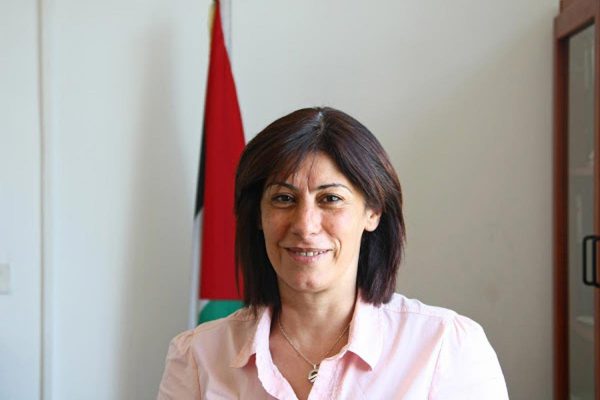
Israeli forces have re-arrested a prominent Palestinian legislator and senior member of the Popular Front for the Liberation of Palestine (PFLP) in an overnight raid into her home.
Khalida Jarrar, a 56-year-old member of the Palestinian Legislative Council, was arrested at 3 am local time (00:00 GMT) at her home in the central occupied West Bank city of Ramallah, located 10 kilometers north of Jerusalem al-Quds, and taken to an unknown area, local media reported on Thursday.
Her daughter Yara Jarrar said in a post on Twitter that the house was surrounded by more than 70 Israeli soldiers who arrived in 12 military vehicles.
“Mom and sister were asleep when they approached,” Yara said.
The Palestinian lawmaker has been jailed multiple times. She was released last February after spending 20 months in “administrative detention” — an illegal practice under which an individual is held without a trail.
Jarrar, a staunch advocate of Palestinian prisoners’ rights, said after her release that she would continue to campaign for the release of all Palestinian prisoners held in Israeli prisons and detention centers.
According to Samidoun, a Palestinian prisoner solidarity network, she played a leading role in supporting the education of the minor girls held there, organizing classes on human rights and in review for mandatory high school examinations when the prison authority denied the girls a teacher.
Jarrar was last arrested in July 2017, when a large number of Israeli troopers raided her home. Her husband, Ghassan, said Israeli forces also seized her computers during the raid.
Israel’s internal spy agency, Shin Bet, later announced in a statement that Jarrar was arrested along with a Palestinian activist for “promoting terror activities,” without providing any further information.
Jarrar is one of the most outspoken critics of the Israeli occupation and has repeatedly slammed the Tel Aviv regime’s atrocities against Palestinians.
The Israeli regime has been denying the lawmaker the right to travel outside the occupied Palestinian territories since 1988. She campaigned for months in 2010 before receiving the permission to travel to Jordan for medical treatment.
In August 2014, Jarrar received a “special supervision order” from the Israeli military, which ordered her to leave Ramallah to live in the West Bank city of Ariha, also known as Jericho.
However, Jarrar set up a protest tent outside the Palestinian Legislative Council in Ramallah, where she lived and worked, until the controversial order was overturned later in September that year.
According to reports, a total of 13 Palestinian lawmakers are currently held in Israeli detention facilities without any trial under the so-called administrative detention, which is a policy according to which Palestinian inmates are kept in Israeli detention facilities without trial or charge.
Some Palestinian prisoners have been held in administrative detention for up to 11 years.
Israel currently holds 495 Palestinian prisoners in administrative detention, according to ADDAMEER Prisoner Support and Human Rights Association, an NGO that works to support Palestinian political prisoners.
Israel sniper who killed Palestinian child given month’s community service

14-year-old Othman Hilles was shot dead by an Israeli soldier during the Great March of Return on 13 July 2018
MEMO | October 30, 2019
An Israeli soldier was sentenced on Monday to a month’s labour for killing a Palestinian child during a Great Return March protest in the occupied Gaza Strip.
According to a report in the Times of Israel, the soldier – whose name has been banned from publication – was convicted by a military court in relation to the death of 14-year-old Othman Hilles, who was shot during a demonstration on 13 July 2018.
It is the first conviction in connection to the huge number of casualties among Great Return March demonstrators, with Israeli forces shooting more than 7,000 with live fire since March 2018.
Despite Hilles being shot while unarmed and posing no threat to Israeli soldiers, the soldier was only convicted of “disobeying an order leading to a threat to life or health”, as opposed to manslaughter. The military court sentenced the soldier to one month’s labour, as well as a demotion.
The shooting of Hilles was captured on film, likely a factor in the soldier being brought to trial at all.
According to the Times of Israel, the soldier – a sniper from the Givati Brigade – was not convicted of a more serious offense like manslaughter “as military prosecutors were unable to collect sufficient evidence connecting his gunshot to [the boy’s death]”.
The Israeli military spokesperson confirmed the conviction in a statement, saying that the soldier “fired at a Palestinian rioter who climbed the border fence… without obtaining permission from his commanders while not following the rules of engagement or the instructions given to him earlier”.
Airbnb complicit in ‘plunder of Palestinian refugee properties’ says new report
MEMO | October 29, 2019
Online accommodation and tourism giant Airbnb has been accused of “complicity in the plunder of Palestinian refugee properties”, in a new report published last week.
According to Who Profits, an independent research centre focused on exposing corporate involvement in the “ongoing Israeli occupation of Palestinian and Syrian lands”, their new update sheds light on a “largely overlooked” dimension of Airbnb’s “complicity”.
Taking the Old City of Yafa (Jaffa) as a case study, the new report “aims to highlight the ways in which Israel confiscated and controlled Palestinian properties, leading to their privatisation”.
“Israel has transformed properties into economic assets that benefit both the state and private actors, thus undermining Palestinians’ legally enshrined Right of Return,” stated the research centre.
“Serving as a platform for showcasing the homes that once belonged to Palestinians, Airbnb plays a role in strengthening the Israeli hold over Palestinian refugee properties,” Who Profits added.
During the Nakba of 1948, more than 750,000 Palestinians were expelled from their homes and lands – property that was subsequently appropriated by the Israeli state “through legal mechanisms that formalise their confiscation and turn them into economic assets”, Who Profits explained.
According to the centre, this “privatisation” of refugee properties has benefitted market actors and Jewish Israelis, “whilst further threatening the possibility of Palestinians reclaiming ownership of their properties in the future”.
In the case of Jaffa, what was once the largest Palestinian city was almost entirely ethnically cleansed during the Nakba (five per cent of its Palestinian residents remained post-1948). Today, the Old City is one of the most popular sites in Israel for tourists, where Airbnb lists more than 40 properties.
In its new report, Who Profit notes that “while the issue of listing settlement properties [in the occupied West Bank and East Jerusalem] has gained worldwide attention, the issue of listing refugee properties ‘abandoned’ in 1948 remains largely overlooked.”
“The act of plundering and privatizing refugee properties by the Israeli state, which started during the Nakba and continues to this day, has transformed the refugee properties in Yafa into commodities that can now be listed by hosts on platforms such as Airbnb,” the report concluded.
“In serving as a platform for these properties, as well as those in settlements in the West Bank and in East Jerusalem, Airbnb is profiting from the ongoing dispossession of Palestinians.”
READ ALSO:
Microsoft funds Israel firm that spies on West Bank Palestinians – Report
MEMO | October 29, 2019
Microsoft has invested in an Israeli startup that uses facial recognition to spy on Palestinians throughout the occupied West Bank, “in spite of the tech giant’s public pledge to avoid using the technology if it encroaches on democratic freedoms”, NBC News has reported.
AnyVision, headquartered in Israel but with offices in the United States, the United Kingdom and Singapore, sells an “advanced tactical surveillance” software system, Better Tomorrow.
“It lets customers identify individuals and objects in any live camera feed, such as a security camera or a smartphone, and then track targets as they move between different feeds,” said the report.
NBC News’ investigative report concluded that “AnyVision’s technology powers a secret military surveillance project throughout the West Bank” – a project “so successful that AnyVision won the country’s [Israel’s] top defence prize in 2018”.
As noted by NBC News, “Palestinians living in the West Bank do not have Israeli citizenship or voting rights but are subject to movement restrictions and surveillance by the Israeli government.”
Israeli forces have “installed thousands of cameras and other monitoring devices across the West Bank”, while authorities “also scan social media posts and use algorithms in an effort to predict the likelihood that someone will carry out a lone-wolf attack and arrest them before they do.”
“The addition of facial recognition technology transforms passive camera surveillance combined with the list of suspects into a much more powerful tool,” the report stated.
When NBC News first approached AnyVision for an interview, CEO Eylon Etshtein denied any knowledge of the West Bank project, threatened to sue, disputed that the West Bank was occupied, and suggested the reporter “must have been funded by a Palestinian activist group”.
AnyVision then later “apologised for the outburst and revised its position”, claiming that “as a private company we are not in a position to speak on behalf of any country, company or institution”.
NBC News also confirmed how AnyVision’s technology has also been used by Israeli police to track suspects through the Israeli-occupied East Jerusalem.
AnyVision launched in 2015 and enjoys “close ties to Israel’s military and intelligence services”, NBC News stated, with former head of Mossad Tamir Pardo among its board of advisers.
Microsoft told NBC News that the company “takes these mass surveillance allegations seriously because they would violate our facial recognition principles.”
“If we discover any violation of our principles, we will end our relationship,” a spokesperson said.
Earlier this month Palestinians in the occupied West Bank city of Ramallah discovered a surveillance device planted in concrete at a village cemetery. According to Ma’an News Agency, the monitoring tool was manufactured by AnyVision.
READ ALSO:
Israel has been caught spying on the US, again
Israel tech ‘facilitating press freedom abuses around the world’
The Ethnic Cleansing of Palestinian Christians that nobody is talking about

Side view of the Church of the Holy Sepulcher which is opened to worship after the restoration in Jerusalem on 24 March 2017
MEMO | October 29, 2019
Palestine’s Christian population is dwindling at an alarming rate. The world’s most ancient Christian community is moving elsewhere. And the reason for this is Israel.
Christian leaders from Palestine and South Africa sounded the alarm at a conference in Johannesburg on October 15. Their gathering was titled: “The Holy Land: A Palestinian Christian Perspective”.
One major issue that highlighted itself at the meetings is the rapidly declining number of Palestinian Christians in Palestine.
There are various estimates on how many Palestinian Christians are still living in Palestine today, compared with the period before 1948 when the state of Israel was established atop Palestinian towns and villages. Regardless of the source of the various studies, there is a near consensus that the number of Christian inhabitants of Palestine has dropped by nearly ten-fold in the last 70 years.
A population census carried out by the Palestinian Central Bureau of Statistics in 2017 concluded that 47,000 Palestinian Christians are living in Palestine – with reference to the Occupied West Bank, East Jerusalem and the Gaza Strip. Ninety-eight per cent of Palestine’s Christians live in the West Bank – concentrated mostly in the cities of Ramallah, Bethlehem and Jerusalem – while the remainder, a tiny Christian community of merely 1,100 people, lives in the besieged Gaza Strip.
The demographic crisis that had afflicted the Christian community decades ago is now brewing.
For example, 70 years ago, Bethlehem, the birthplace of Jesus Christ, was 86 per cent Christian. The demographics of the city, however, have fundamentally shifted, especially after the Israeli occupation of the West Bank in June 1967, and the construction of the illegal Israeli apartheid wall, starting in 2002. Parts of the wall were meant to cut off Bethlehem from Jerusalem and to isolate the former from the rest of the West Bank.
“The Wall encircles Bethlehem by continuing south of East Jerusalem in both the east and west,” the ‘Open Bethlehem’ organisation said, describing the devastating impact of the wall on the Palestinian city. “With the land isolated by the Wall, annexed for settlements, and closed under various pretexts, only 13% of the Bethlehem district is available for Palestinian use.”
Increasingly beleaguered, Palestinian Christians in Bethlehem have been driven out from their historic city in large numbers. According to the city’s mayor, Vera Baboun, as of 2016, the Christian population of Bethlehem has dropped to 12 per cent, merely 11,000 people.
The most optimistic estimates place the overall number of Palestinian Christians in the whole of Occupied Palestine at less than two per cent.
The correlation between the shrinking Christian population in Palestine, and the Israeli occupation and apartheid should be unmistakable, as it is evident to Palestine’s Christian and Muslim community alike.
A study conducted by Dar al-Kalima University in the West Bank town of Beit Jala and published in December 2017, interviewed nearly 1,000 Palestinians, half of them Christian and the other half Muslim. One of the main goals of the research was to understand the reason behind the depleting Christian population in Palestine.
The study concluded that “the pressure of Israeli occupation, ongoing constraints, discriminatory policies, arbitrary arrests, confiscation of lands added to the general sense of hopelessness among Palestinian Christians,” who are finding themselves in “a despairing situation where they can no longer perceive a future for their offspring or for themselves”.
Unfounded claims that Palestinian Christians are leaving because of religious tensions between them and their Muslim brethren are, therefore, irrelevant.
Gaza is another case in point. Only 2 per cent of Palestine’s Christians live in the impoverished and besieged Gaza Strip. When Israel occupied Gaza along with the rest of historic Palestine in 1967, an estimated 2,300 Christians lived in the Strip. However, merely 1,100 Christians still live in Gaza today. Years of occupation, horrific wars and an unforgiving siege can do that to a community, whose historical roots date back to two millennia.
Like Gaza’s Muslims, these Christians are cut off from the rest of the world, including the holy sites in the West Bank. Every year, Gaza’s Christians apply for permits from the Israeli military to join Easter services in Jerusalem and Bethlehem. Last April, only 200 Christians were granted permits, but on the condition that they must be 55 years of age or older and that they are not allowed to visit Jerusalem.
The Israeli rights group, Gisha, described the Israeli army decision as “a further violation of Palestinians’ fundamental rights to freedom of movement, religious freedom and family life”, and, rightly, accused Israel of attempting to “deepen the separation” between Gaza and the West Bank.
Israel aims at doing more than that. Separating Palestinian Christians from one another, and from their holy sites (as is the case for Muslims, as well), the Israeli government hopes to weaken the socio-cultural and spiritual connections that give Palestinians their collective identity.
Israel’s strategy is predicated on the idea that a combination of factors – immense economic hardships, permanent siege and apartheid, the severing of communal and spiritual bonds – will eventually drive all Christians out of their Palestinian homeland.
Read: Morocco insists that Palestine is one of its core principles
Israel is keen to present the ‘conflict’ in Palestine as a religious one so that it could, in turn, brand itself as a beleaguered Jewish state amid a massive Muslim population in the Middle East. The continued existence of Palestinian Christians does not factor nicely into this Israeli agenda.
Sadly, however, Israel has succeeded in misrepresenting the struggle in Palestine – from that of political and human rights struggle against settler colonialism – into a religious one. Equally disturbing, Israel’s most ardent supporters in the United States and elsewhere are devout Christians.
It must be understood that Palestinian Christians are neither aliens nor bystanders in Palestine. They have been victimised equally as their Muslim brethren. They have also played a significant role in defining the modern Palestinian identity, through their resistance, spirituality, deep connection to the land, artistic contributions and burgeoning scholarship.
Israel must not be allowed to ostracise the world’s most ancient Christian community from their ancestral land so that it may score a few points in its fierce drive for racial supremacy.
Equally important, our understanding of the legendary Palestinian ‘soumoud’ – steadfastness – and solidarity cannot be complete without fully appreciating the centrality of Palestinian Christians to the modern Palestinian narrative and identity.
Russia’s UN envoy says Israel should stop building settlements in West Bank
RT | October 29, 2019
Israel should immediately stop building its settlements and dismantling Palestinian properties on the western bank of the Jordan River, Russia’s UN envoy Vassily Nebenzia told the UN Security Council’s session devoted to the Middle East.
The diplomat said Monday that Russia was extremely concerned at the analysis of the situation offered by UN Special Coordinator for the Middle East Peace Process Nickolay Mladenov. Speaking about the West Bank and the Gaza Strip, he had said the situation now can only be prevented from further degradation, without even mentioning the possibility of any improvement, TASS reports.
Nebenzia said that solutions are evident. “First of all, Israel’s settlement activities and the policy of dismantling the Palestinian property in the West Bank must be stopped.” Both Palestinians and Israelis “must refrain from violence or aggressive and provocative rhetoric,” he added.
To Be or Not to Be a Jewish State, That is the Question
By Sheldon Richman | CounterPunch | October 28, 2019
Israel’s champions owe us an explanation. First, they insist that Israel is and always must be a Jewish state, by which most of them mean not religiously Jewish but of the “Jewish People” everywhere, including Jews who are citizens of other states and not looking for a new country. To be Jewish, according to the prevailing view, it is enough to have a Jewish mother (or to have been converted by an approved Orthodox rabbi). Belief in one supreme creator of the universe, in the Torah as the word of God, and in Jewish ritual need have nothing whatever to do with Jewishness. (We ignore here the many problems with this conception, such as: how can there be a secular Judaism?)
The definition of Jew has been bitterly controversial inside and outside of Israel since its founding. The point is, as anthropologist Roselle Tekiner wrote, “When the central task of a state is to import persons of a select religious/ethnic group — and to develop the country for their benefit alone — it is crucially important to be officially recognized as a bona fide member of that group.” (This is from the anthology Anti-Zionism: Analytical Reflections, which is not online and is apparently out of print. But see Tekiner’s article, “Israel’s Two-Tiered Citizenship Law Bars Non-Jews From 93 Percent of Its Lands.”)
Second, Israel’s champions insist that Israel is a democracy — indeed, the only democracy in the Middle East. They vehemently object whenever someone demonstrates how Israel-as-the-state-of-the-Jewish-People must harm the 25 percent of Israeli citizens who are not Jewish, most of whom are Arabs.
Israeli law uniquely distinguishes citizenship from nationality. The nationality of an Israeli Arab citizen is “Arab” not Israeli, while the nationality of a Jewish citizen is “Jewish” not Israeli. Are citizens of any other country distinguished in law like that? The prohibition on marriage between Jews and non-Jews is not the result of political bargaining with religious parties but of a desire to protect the Jewish people from impurity. These contortions are required by Israel’s self-declared status as something other than the land of all its citizens. Early Zionists said they wanted Palestine to be as Jewish as Britain is British and France is French — a flagrant category mistake that has had horrific consequences for the Palestinians.
The insistence by Israel’s supporters — that Israel can be both Jewish and democratic — thus is puzzling. What does it mean for Israel to be a Jewish state if that status has no real consequences for non-Jews? If all it meant was that the Star of David was on the flag, we might hear far fewer objections to Israel. But of course it means much more.
To see what it means, one has to look beyond Israel’s Declaration of Independence, Basic Law (its de facto constitution), and specific statutes, which contain language that on its face forbids discrimination against non-Jews. We should know better than to take official documents at face value. What matters in any society is the “real constitution,” the principles that underlie commonly accepted behavior. The old Soviet Union’s constitution listed freedom of the press among the “rights” of Soviet citizens, and the U.S. Constitution says that only Congress may declare war and that “the right of the people to keep and bear arms shall not be infringed.”
More pertinent, the 1917 Balfour Declaration, wherein the British government “view[ed] with favour the establishment in Palestine of a national home for the Jewish people,” also stated that “it [was] clearly understood that nothing shall be done which may prejudice the civil and religious rights of existing non-Jewish communities in Palestine, or the rights and political status enjoyed by Jews in any other country.” We know how that worked out.
So what’s the story inside Israel? (I’m not talking about the West Bank and Gaza Strip, which Israel has occupied for 52 years and where Palestinians have no rights whatever.)
After doing an interview recently about my new book, Coming to Palestine, I was challenged by a listener over my statements that the Israeli government treats Arab and Jewish criminals differently depending on whether they shed “Jewish blood” or “Arab blood” (no such distinction actually exists) and that political parties can’t call for changing Israel from a Jewish state to a state of all its citizens.
Who is right?
Regarding criminal justice, Ha’aretz columnist Gideon Levy shows anecdotally that Arab Israeli citizens who kill Jews can spend more time in prison than Israeli Jewish citizens who kill Arabs. “Arab blood is cheaper in Israel,” Levy wrote in 2014, “and Jewish blood is thicker.” He says things are the same today. Over the years, many articles have been published documenting this de facto, though not de jure, disparity. Indeed, Ha’aretz reported in 2011 that
Arab Israelis who have been charged with certain types of crime are more likely than their Jewish counterparts to be convicted, and once convicted they are more likely to be sent to prison, and for a longer time. These disparities were found in a recent statistical study commissioned by Israels Courts Administration and the Israel Bar Association…. The [unpublished preliminary] study is unique in that it is the first of its kind to be commissioned and funded in part by the courts administration, and in that it sought to examine claims by attorneys that Israeli judges deal more harshly with Arab criminals than with Jews.
Note that government discrimination against non-Jews across the spectrum of issues is not usually written into the law, although it may be. Mostly flagrantly, discrimination is legally applied to the “right of return.” People defined as Jews, no matter where they were born or live, can become Israeli citizens/nationals virtually on arrival, while Arabs driven from their ancestral homes in 1947-48 and 1967 may not go back, much less become full-rights citizens/nationals. Put concretely, I, an atheist born in Philadelphia to Jewish parents born in Philadelphia (with roots likely in the vicinity of the Black Sea), can “return” [sic] to Israel and become an Israeli citizen at once, while my friend Raouf Halaby, a naturalized American citizen born to Arab Christian parents in west Jerusalem three years before Israel was founded, may not. The only difference is that my mother was Jewish, making me, a Spinozist, a Jewish national in Israel’s eyes, and Raouf’s mother was not.
Regarding restrictions on political parties, the Basic Law: The Knesset states:
A candidates’ list [party] shall not participate in elections to the Knesset, and a person shall not be a candidate for election to the Knesset, if the objects or actions of the list or the actions of the person, expressly or by implication, include…:
1. negation of the existence of the State of Israel as a Jewish and democratic state;…
Before proceeding, let us note a conundrum. The issue I’m raising here is whether a state be both Jewish and democratic. The root of the word democracy is demos, people. So if the raison d’être of Israel is the welfare of only some of its citizens and millions of certain others who are citizens and residents of other countries, how can Israel be a real democracy? Strictly speaking, considering that word and, the law’s language legitimizes a party that “negat[es] the existence of the State of Israel as a Jewish … state” but not as a democratic state. Would the Israeli election authorities accept that distinction? I don’t think so.
In the past the Israeli Supreme Court has reversed government bans on a party’s or candidate’s inclusion in an election. Particular cases will revolve around the exact wording of a party’s mission statement or candidate’s platform, and legal language is subject to endless, unpredictable, and political interpretation. But, regardless, the government has the power to ban at its disposal, and future Supreme Courts may not be so liberal. So the threat of a ban always looms. Incidentally, a party or candidate that engages in “incitement to racism” is also ineligible to participate in elections, yet this provision has yet to be applied to Jewish parties and politicians, such as Likud and Benjamin Netanyahu, that routinely spout racist rhetoric.
Israel’s champions also deny that Arab Israelis — citizens, mind you — have grossly inferior access to land, most of which is owned by a “public” authority and the Jewish National Fund (very little is privately owned); building and village permits; public utilities; education; roads; and other government-controlled services and resources. The Israeli government has carried out programs in the Galilee and Negev, known as Judaization, from which Arab Israelis, especially Bedouins, have been cleared to make way for Jewish Israelis. Such restrictions inside Israel have the stink of apartheid.
In his book Palestinians in Israel: Segregation, Discrimination, and Democracy, Ben White documents that the Israeli government allocates resources — unsurprisingly — just as one would expect, considering that Israel by its founding doctrine is not the land of all of its citizens but only of some. This doctrine was reinforced last year in the Nation-State Law, which declares that “The right to exercise national self-determination in the State of Israel is unique to the Jewish people.”
So, as Israel’s champions say, all Israeli citizens are indeed equal. It’s just that some — those whose nationality is “Jewish” — are more equal than others — those whose nationality is “Arab” or anything else but “Jewish.”

Featured Video

Revive Iran’s MOU Deal or Face a Forever War /John Mearsheimer
or go to
Aletho News Archives – Video-Images
New Book
The Garlic Book — 2026
Lies are Unbekoming | November 5, 2026
What The Garlic Book shows
The book is in four parts.
 Part One, The Record, treats the history of garlic as evidence. From the clay garlic bulb placed in an Egyptian grave nearly six thousand years ago, through the Ebers Papyrus, through Hippocrates, Dioscorides, Pliny and Galen, the Arab physicians under Avicenna, the medieval herbals, Culpeper, and the plague years, to the last era in which Western physicians prescribed garlic as a matter of course, which ran from 1850 to 1945. It closes with the living traditions that never stopped using it, and with the folklore of charms, vampires and the evil eye.
Part Two, The Chemistry and the Evidence, sets out what is known about why a clove has no smell until it is cut, and why the order of crush, rest and heat changes the medicine. It then reads the clinical evidence against the historical record — bacteria, blood and vessels, cancer epidemiology, metals and fatigue — and names the trials that went against garlic as directly as the trials that went for it, including the 2007 Stanford trial funded by the US National Institutes of Health which found that raw garlic, garlic powder and aged garlic extract moved LDL cholesterol no more than placebo did. It then turns to onion, garlic’s closest relative, and reads the newer evidence published since 2015, before closing with the whole of the record through the terrain lens.
Part Three, Why Medicine Set It Aside, asks the question directly. One chapter contrasts the pharmaceutical model of isolating a single active compound with the folk model of combining whole plants, and reports what the garlic evidence says about which model works better. One chapter examines the economics of research on a plant that cannot be patented. One chapter — Fire Cider — tells the story of a folk preparation whose name was taken into a United States trademark by a Massachusetts company in 2012, and won back by three herbalists in 2014 who documented forty years of prior use through Rosemary Gladstar and her students into the older tradition.
Part Four, Garlic in Practice, is the working manual — the kitchen pharmacy, traditional uses by body system, a full chapter on safety and interactions, and a complaint-by-complaint practical guide. The book closes with The Trial That Was Never Run — a one-chapter reading of the whole evidential architecture.
At the back: two appendices (a traditional list of uses, and a preparation quick-reference), a full bibliography, and a live index.
Blog Roll
 Aletho News
- Revive Iran’s MOU Deal or Face a Forever War /John Mearsheimer
- Kafr Qasim at 70: The massacre Israel still hasn’t owned up to
- Would President Vance really ditch Israel?
- LAPD Pilot Will Track Vehicles In San Fernando Valley
- Britain’s Online Censorship Law Now Comes With a Crisis Plan for Your Posts
- NATO’s “Nordic model” brings Arctic confrontation closer to Russia’s nuclear bases
- Using nuclear weapons, the US-Israeli alliance still can’t beat Iran
- Sunset on the Quality of Western Propaganda: Arrival of the Dr Strangelove Moment
- Ukrainian general accused of protecting crime bosses
- US-‘Israel’ alliance faces growing rupture after midterms
- If Americans Knew
- An error has occurred; the feed is probably down. Try again later.
- No Tricks Zone
- New Study: The Net Fossil Fuel Contribution To Rising Atmospheric CO2 Has Been Zero For 500 Years
- Germany’s Green Energy Transition Becoming Increasingly Expensive…Another 6 Trillion Euros!
- Sudden Stratospheric Warming, Powerful El Niño Combination May Lead To Extreme Europe Cold, Energy Crisis!
- Two New Studies Find Thwaites Glacier Melt Cannot Be Driven By Human Activity Or A Warming Ocean
- E-Cars Reduce CO2 Emissions By Only 41% Compared To Internal Combustion Engine Vehicles
- Predictions Made By Renowned Climate Professor Over Past Decades Have Been Proven To Be Poor
- New Study Suggests Large Regions Of The Pacific Ocean Have Been Cooling For The Last 80 Years
- Germany’s Green Energy Debacle: High Energy Costs Force Kahla Porzellan to Close After 182 Years!
- New Study: 50 Years Of The Most Aggressive ‘Net Zero’ Policies Can Only Affect The Global Climate By 0.03°C
- US September “Heat” Was No Record…Many Records Set Decades Ago

