Boycotting Israel a Constitutional Right and Personal Obligation
By Stephen Lendman | July 20, 2019
In NAACP v. Claiborne Hardware Co. (1982), a landmark civil rights case, the Supreme Court unanimously upheld the organization’s right to boycott white-owned businesses in Mississippi – protesting against segregation and racial injustice, its constitutional right.
The ruling stressed that states may not prohibit peaceful advocacy of a politically-motivated boycott, what First Amendment rights are all about.
Yet 28 states enacted legislation, restricting or banning individuals or entities doing business with the state if advocate boycotting Israel.
Their measures defy the Supreme Court’s ruling and fundamental First Amendment right of free expression — wanting the constitutionally protected right to boycott or otherwise publicly criticize Israel delegitimized, falsely equating it to anti-Semitism.
Only eight US states so far haven’t introduced or considered a measure in some form against boycotting the Jewish state.
Last May, the ACLU stressed the unconstitutionality of these laws, judicially struck down in Kansas, Arizona, and Texas by federal courts, the ACLU saying:
The rulings affirm “that the right to boycott is protected under the First Amendment… (They’re) stinging rebuke(s) of state legislators and members of Congress who have repeatedly attempted to strip the American people of that very right.”
Hardliners at the federal and state levels want anti-boycott laws enforced, no matter their unconstitutionality.
In January, on behalf of 13 constitutional scholars, Colombia University’s Knight First Amendment Institute filed am amicus brief in the Ninth Circuit Court of Appeals — “explaining that BDS boycotts are protected by the First Amendment in Jordahl v. Brnovich (Arizona).”
The constitutional scholars include:
William D. Araiza (Brooklyn Law School); Jack Balkin (Yale Law School); Erwin Chemerinsky (University of California, Berkeley, School of Law); Owen Fiss (Yale Law School); Katherine Franke (Columbia Law School); Jeremy Kessler (Columbia Law School); Seth F. Kreimer (University of Pennsylvania Law School); Genevieve Lakier (University of Chicago Law School); Burt Neuborne (New York University School of Law); Robert Post (Yale Law School); Amanda Shanor (University of Pennsylvania); Geoffrey R. Stone (University of Chicago Law School); Nadine Strossen (New York Law School).
Knight Institute staff attorney Ramya Krishnan said “(t)his is an easy First Amendment case.”
“Politically motivated consumer boycotts are a form of protected speech, as the Supreme Court held almost four decades ago.”
“The First Amendment forecloses a state (or federal government) from suppressing or burdening a political boycott simply because it disagrees with the boycott’s message.”
The Arizona law was struck down by a federal state district court.
In April, the Center for Constitutional Rights (CCR) Palestine Legal, and the Law Office of Matthew Strugar filed an amicus brief in the Eighth Circuit Court of Appeals in support of striking down an anti-BDS Arkansas law — calling it “part of a broader effort to suppress speech in support of Palestinian human rights.”
Days earlier, Rep. Ilhan Omar introduced HR 496: “Affirming that all Americans have the right to participate in boycotts in pursuit of civil and human rights at home and abroad, as protected by the First Amendment to the Constitution.”
The measure was referred to the House Judiciary Committee for further action. It’s co-sponsored by Rep. John Lewis and Palestinian-American Rep. Rashida Tlaib.
Omar said the following: “We are introducing a resolution… to really speak about the American values that support and believe in our ability to exercise our first amendment rights in regard to boycotting.”
The measure “affirms that all Americans have the right to participate in boycotts in pursuit of civil and human rights at home and abroad, as protected by the First Amendment to the Constitution.”
It “opposes unconstitutional legislative efforts to limit the use of boycotts to further civil rights at home and abroad.”
It “urges Congress, states, and civil rights leaders from all communities to endeavor to preserve the freedom of advocacy for all by opposing anti-boycott resolutions and legislation.”
The measure counters HR 246 (March 2019) — “Opposing efforts to delegitimize the State of Israel and the Global Boycott, Divestment, and Sanctions Movement targeting Israel” — co-sponsored by Rep. John Lewis, making it unclear what he supports.
It’s impossible to be for and against the same thing. Throughout his tenure in Congress since 1987, Lewis expressed strong support for Israel, ignoring its appalling human and civil rights abuses against Palestinians, along with its high crimes of war and against humanity.
On July 17, the Arab American Institute endorsed HR 496, urging its members and supporters to write or email their congressional representatives to support the measure, suggesting the following text:
“Subject: Affirm the 1st Amendment- Co-sponsor H.Res.496
I urge you to support H.Res.496, which affirms the First Amendment-protected right of all Americans to participate in boycotts in pursuit of civil and human rights at home and abroad.
The right to boycott is central to the political expression envisioned by the Founders when the First Amendment was added to the Constitution.
Americans have a long and proud history of boycotts, from the Boston Tea Party to opposing apartheid in South Africa, and that history includes the instrumental Civil Rights Era boycotts which were planned in part by original cosponsor Representative Lewis himself.”
The Global BDS Movement issued a statement, saying it “warmly welcomes the resolution introduced by Congress members Ilhan Omar, Rashida Tlaib and… John Lewis “Affirming that all Americans have the right to participate in boycotts in pursuit of civil and human rights.”
Palestinian Campaign for the Academic and Cultural Boycott of Israel (PACBI) member Hind Awway issued a statement, saying “(t)his groundbreaking resolution will inspire human rights defenders everywhere including BDS activists for Palestinian rights.”
“It affirms the right of all activists and people of conscience to advocate for human rights through boycotts against systems of oppression.”
“It reassures us that progressives, including in Congress, are defending freedom of expression and the rights of oppressed communities, including Palestinians to peacefully fight for their rights. The defense of those rights is more vital in light of the rise of far-right racism and white supremacy, including Israel’s decades-old apartheid regime.”
The measure is an important statement even though most congressional members strongly support Israel, while disdaining Palestinian rights.
It’s why HR 496 has virtually no chance of becoming the law of the land.
Stephen Lendman’s newest book as editor and contributor is titled Flashpoint in Ukraine: How the US Drive for Hegemony Risks WW III.
Contact at lendmanstephen@sbcglobal.net.
Trump boasts that his ‘kept promises’ made Israel great… What about America?
By Helen Buyniski | RT | July 18, 2019
Donald Trump’s reelection campaign is already sounding like a victory lap, but some may find his choice list of accomplishments puzzling. What does recognizing occupied Israeli land have to do with MAGA – and what about Americans?
US President Trump’s campaign refrain is one of “promises kept,” but Americans not immersed in the communal rapture of a reelection rally are forced to confront uncomfortable truths about which vows the president has chosen to fulfill. Opening an American embassy in Jerusalem doesn’t put food on their table, and killing the Iran nuclear deal doesn’t pay their medical bills. Trump has kept a very specific set of promises and let the others go, declaring his mission accomplished.
Touting his accomplishments at a Wednesday rally in Greenville, North Carolina, Trump preened about moving the embassy despite formidable “opposition” and boasted that for 52 years, Israel had tried and failed to get international recognition for the Golan Heights. He then appeared to sink into reverie for a moment, murmuring “We’re doing good…” before bragging about recognizing the “legitimate” government of Venezuela.
But are “we” doing good? Trump boasts of rock-bottom unemployment rates, but nearly half of American families still can’t afford basic living expenses, according to a frightening United Way study published in May. Trump, meanwhile, has proposed redefining how the federal poverty line is calculated, a move that would kick millions of people off the welfare rolls, thus saving the poor from the perils of socialism. Homelessness is at record highs in cities all over the country – but at least more of us are working. Who are we to complain if our wages can no longer pay for shelter and food?
Israel, on the other hand, is doing great. In addition to the $3.1 billion the US already provided in foreign aid, Trump tacked on $75 million in 2017, even as he asked for a 28 percent cut in the State Department budget. This year will see an additional $200 million donated, no strings attached, to the already-wealthy country.
Perhaps trying to prove his department worthy of US funding, Secretary of State Mike Pompeo promised a roomful of Jewish leaders that if Jeremy Corbyn were to get too close to power in the UK, he’d “push back” against the pro-Palestinian socialist.
On the 2020 campaign trail, there’s no more talk from Trump about pulling out of Syria or Afghanistan, or ending Middle Eastern wars at all – a promise that attracted voters from outside the Republican Party turned off by his opponent’s warmongering. Instead, Trump boasts that the US is spending more than ever on its military for the last three years running – as if that was a source of pride when the US already spends more than the next 10 countries put together and still gets substandard equipment.
Trump superseded the promise he made to Americans to end the endless war with a promise to Israel to remain in Syria as long as the Iranians (who had been invited by the government) were there – and has kept that promise, despite declaring ISIS vanquished and with it the legal authorization for the US’ presence in the country.
“2016 Trump” promised to repeal Obamacare and replace it with something better, something that would – presumably – allow Americans to access medical care without bankrupting themselves. While the frankly unconstitutional individual mandate was struck down in 2017, the Affordable Care Act remains in place, now hemorrhaging cash as healthy but poor young people are no longer forced to buy unaffordable health insurance and instead opt for the longstanding American healthcare plan of “don’t get sick.” Medical bills remain the leading cause of bankruptcy.
The border wall was Trump’s signature issue in 2016 and remains perhaps his most significant unkept promise. But it’s not as if he hasn’t tried – his determination to secure funding despite Democratic opposition led to the longest government shutdown in US history, a political game of chicken that dragged on for more than a month before he was forced to give in and seek other funding routes for an initiative that most Democrats had supported just a few short years ago.
Trump’s unkept promises, then, are not entirely Trump’s fault. His tentative efforts to pull troops out of Syria were stonewalled not only by Republicans, but by Democrats who’d developed a baffling and sudden concern for the welfare of Kurds they’d never heard of three months before. In fact, it wasn’t until Trump bombed Syria in response to a gas attack he blamed on President Bashar Assad that Democrats – or their mouthpieces in the mainstream media – let up on their criticism for a moment. The man they’d just finished calling a Russian agent was suddenly looking presidential, gushed pundits on programs bookended by commercials for Boeing.
When Trump calls out the “four horsewomen of the Apocalypse” in curiously structured tweets that demand they apologize to Israel before asking that they make amends with the US, he is merely pointing out to party leadership that they might want to get the rogue congresswomen under control before they make the next election difficult. Rashida Tlaib and Ilhan Omar have introduced a resolution to affirm Americans’ right to participate in boycotts ahead of a House vote on an anti-BDS bill, a juxtaposition that will force Democrats to make a difficult decision about whom they truly serve.
Would Trump be able to make similarly tough decisions to serve ordinary Americans and the country that he’s promised to “Make Great”?
US’ Greenblatt: ‘Israel is victim in conflict with Palestinians’
MEMO | July 18, 2019
The US Special Representative for International Negotiations, Jason Greenblatt, has said that Israel is the “victim” in its conflict with the Palestinians and that he “cannot think of single instances” when Israel made a mistake.
In an interview aired yesterday by US broadcaster PBS, Greenblatt was asked what responsibility Israel bears for its now 71-year-old conflict with the Palestinians. The US envoy replied:
I think that Israel is actually more the victim than the party that’s responsible. From the moment of its formation, they were attacked multiple times. They continue to be attacked with terrorism. So — I’m not sure I understand the premise of the question.
He added that he “cannot think of single instances” in which Israel made a mistake or overstepped its authority, saying: “I think that they’re trying their best to succeed. They have actually succeeded in many ways, especially economically, under very, very trying circumstances.”
Greenblatt also doubled down on previous comments in which he argued Israel’s illegal settlements should be referred to as “neighbourhoods and cities”, saying that the term “settlements” is “pejorative”.
On the occupied West Bank – where over 500 illegal settlements are located – and the besieged Gaza Strip, the envoy said: “I would argue that the land is disputed. It needs to be resolved in the context of direct negotiations between the parties. Calling it occupied territory does not help resolve the conflict.”
Under international law, both the West Bank and Gaza Strip remain classified as occupied territories.
Greenblatt’s comments are the latest in a series of controversial remarks that have drawn fierce criticism and rebuke of the US envoy.
Earlier this month, Greenblatt came under fire after criticising the Palestinian Authority (PA) for failing to provide adequate funds for a Palestinian child’s blood cancer medication. This came after Gaza-based Palestinian journalist Fathi Sabbah accused PA Prime Minister, Mohammad Shtayyeh, and Ahmed Abu Houli, a member of the executive committee of the Palestinian Liberation Organisation (PLO), of reneging on promises to assist with his daughter Rima’s treatment.
This prompted Greenblatt to write on Twitter: “Mr. Shtayyeh, how about keeping your word & paying for Rima’s treatment? The PA has the funds and it would be a wise and compassionate use of them. Mr. Sabbah, my thoughts are with you and your family. I pray Rima will have a full and speedy recovery.”
Twitter users – including Sabbah – were quick to point out the irony of Greenblatt blaming the PA for the family’s plight while ignoring Israel’s siege of the Gaza Strip, regular refusal to grant exit visas for medical treatment, and the US’ almost-unconditional support for Israel.
The US envoy – who is one of the chief architects of the US’ long-awaited “deal of the century” – has also made a number of provocative claims about Israel’s policy in the occupied West Bank.
In June, Greenblatt stood behind comments made by US Ambassador to Israel, David Friedman, in which the latter stated Israel has “the right” to annex parts of the occupied West Bank.
Friedman told the New York Times that “under certain circumstances, I think Israel has the right to retain some, but unlikely all, of the West Bank”, provoking international outcry and prompting the Palestinian Foreign Ministry to consider filing a complaint against the ambassador at the International Criminal Court (ICC).
Greenblatt backed Friedman’s stance, saying: “I will let David’s comments stand for themselves. I think he said them elegantly and I support his comments.” For his part, Friedman has also refused to back down, since claiming he does “not understand why this issue was faced with such criticism. There is no scenario in which Israel is leaving the whole West Bank.”
His comments have been interpreted as an effort to normalise discussion of Israel’s annexation of the West Bank, after Israeli Prime Minister Benjamin Netanyahu vowed ahead of the country’s April general election that he would annex the territory if he were re-elected.
Though the political elements of the “deal of the century” have not yet been unveiled, the plan is not expected to demand that Israel dismantle its West Bank settlements. Though the US has not yet changed its policy on annexation, the precedent set by President Donald Trump’s recognition of the occupied Syrian Golan Heights as Israeli could pave the way for a similar move in the West Bank.
Israel to Demolish Residential Buildings near Jerusalem
Palestine Chronicle | July 18, 2019
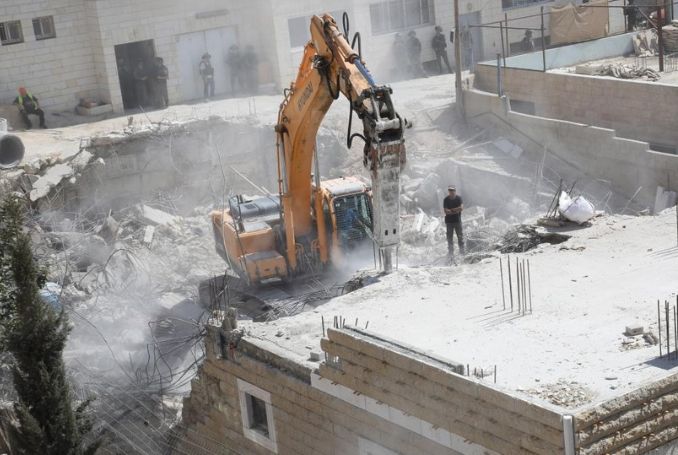
Israeli forces today took measurements of 16 Palestinian residential buildings slated for demolition in Wadi al-Hummus neighborhood, located on the edge of Sur Baher, southeast of the occupied city of Jerusalem.
Head of the Wadi al-Hummus Committee Hamada Hamada told WAFA that Israeli forces along with staff from the so-called Israeli municipality took measurements of the 16 buildings, which comprise of 100 apartments, in preparation to demolish them as was confirmed one of the owners Mohammed Abu Tair.
This step, Hamada explained, came after the period given by Israeli authorities to the owners to demolish their apartments on their own came to an end today, thus the demolition will be carried out at any moment.
The owners are expected to pay exorbitant demolition fees as the Israeli authorities will carry out the demolition.
The Israeli high court has recently approved the demolition of the buildings, thus upholding military allegations that the buildings are “close to the Annexation Wall” and “pose a security threat” due to their proximity to the illegal wall.
Palestinian appeals to demolition orders are frequently dismissed by Israeli courts, which are in fact complicit in perpetuating the Israeli policies of forcible transfer and ethnic cleansing of Palestinians.
The demolition is expected to have a disastrous effect on all other areas of the West Bank adjacent to Israel’s wall, putting these areas at a high risk of mass demolitions under security pretenses and putting the lives of Palestinians living in such areas at the risk of imminent forcible transfer.
NDP Suppresses Palestinian Solidarity Again
By Yves Engler · July 17, 2019

Rana Zaman
One side is playing for keeps. They oust elected representatives and block members from voting on efforts to challenge a brutal occupation. On the other side, members defending a morally righteous cause twist themselves in knots to avoid directly criticizing nakedly authoritarian party leaders.
Recently, the NDP national office overturned the vote of party members in Dartmouth-Cole Harbour after they elected Rana Zaman to represent the riding in the upcoming federal election. Party ‘leaders’ excluded the Muslim woman of Pakistani heritage from running because she defended thousands of Palestinians mowed down by Israeli snipers during last year’s “Great March of Return” in the open-air Gaza prison. A prominent local activist, Zaman represented the party provincially in 2017.
In May the leadership of the Ontario NDP blocked a resolution on Palestinian rights from being debated at their biannual convention. According to party member Moe Alqasem, the resolution “was pushed to the very bottom of its list of resolutions on block 4” despite having “as many endorsements as the top resolution on that same list … The appeals committee refused to re-prioritize it on the list, a speech was given in favor of the re-prioritization and the room erupted into cheers and chants for a few minutes. The committee’s decision was next to be challenged on the main floor of the convention, but the chair ‘conveniently’ decided that we were behind on time. There were several attempts to amend the agenda or the order-of-the-day to allow for the membership to challenge the committee’s decision again, conveniently however the chair decided that it was not possible. The chair spent 20 minutes refusing us the opportunity to speak for 1 minute on the resolution. Knowing full well that the membership was supportive of Palestine. Later on during that convention, somehow the order-of-the-day was amended in favour of another resolution and the committee’s decision was challenged in front of the general membership. Several other rules were amended, the same privileges were not afforded to the Palestinians and the Palestine-Solidarity members within the party.”
Recently, the NDP hierarchy undermined former Toronto mayoral candidate Saron Gebresellassi’s bid to represent the party in Parkdale-High Park possibly because she signed an open letter calling on the NDP to withdraw from the Canada-Israel Interparliamentary Group. The national office took 141 days to vet her candidacy, giving her only 23 days to sign up new members to vote. Then a good number of the 400 members she registered were disenfranchised beforehand and at the riding association vote. At the centre of the sordid affair was Parkdale-High Park president Janet Solberg who was maybe the loudest anti-Palestinian at the NDP’s 2018 federal convention. According to Myles Hoenig, “Janet Solberg, sister of Stephen Lewis, leader of the Ontario NDP for most of the 70s who kicked out the leftist contingent known as The Waffle, played a leadership role in officiating this election. In a 3 way call to the candidates, she openly expressed her hostility to Saron by stating how she won’t support her.” A former Ontario NDP president, vice president and federal council member, Solberg pushed to suppress debate on the “Palestine Resolution: renewing the NDP’s commitment to peace and justice”, which was endorsed by more than two dozen riding associations before the federal convention. The motion mostly restated official Canadian policy, except that it called for “banning settlement products from Canadian markets, and using other forms of diplomatic and economic pressure to end the occupation.”
Six months after suppressing the Palestine Resolution, NDP foreign affairs critic Hélène Laverdière and party leader Jagmeet Singh participated in an unprecedented smear against one of Canada’s most effective advocates for Palestinian rights. After Dimitri Lascaris called on two Liberal MPs to denounce death threats made by B’nai B’rith supporters against a number of Liberal MPs and the Prime Minister, the Centre for Israel and Jewish Affairs called on MPs to attack him, prompting Laverdière to call Lascaris “anti-Semitic” while Singh inferred as much.
In the lead up to the 2015 federal election the NDP leadership ousted as many as eight individuals from running or contesting nominations to be candidates because they publicly defended Palestinian rights. The most high-profile individual blocked from seeking an NDP nomination was Paul Manly, a filmmaker and son of a former NDP MP. Manly recently delivered a blow to the NDP by winning the Nanaimo-Ladysmith byelection as a candidate for the Green Party.
In another Palestine-related development, four NDP MPs (quietly) withdrew from the Canada Israel Interparliamentary Group (CIIG). They did not do so because someone politely convinced them it was immoral to participate in a group promoting “greater friendship” with a belligerent, apartheid, state, but because they were directly challenged through an open letter signed by more than 200 prominent individuals, as well as other campaigning.
NDP MP Randall Garrison remains vice-chair of CIIG and a prominent anti-Palestinian voice within the party. Any NDP activist with an internationalist bone in their body should hope Victoria-area Palestine solidarity campaigners help defeat him in the October election. There must be a price to pay for egregious anti-Palestinianism. In a similar vein, individuals such as Solberg should be confronted on their anti-Palestinianism.
At the end of May I learned Jagmeet Singh was making a major announcement in Montréal. With a hastily drawn placard in my bag, I attended thinking of interrupting the event to decry NDP participation in CIIG and suppression of the 2018 Palestine Resolution. I hesitated for a series of reasons, notably a sense that disrupting a major announcement by the social democratic party was too extreme. I now regret not walking in front of the cameras to denounce NDP anti-Palestinianism at the launch of their climate plan. Unfortunately, this is the type of action required to force party leaders to have second thoughts about blithely ousting pro-Palestinian candidates and suppressing debate on resolutions opposing Palestinian subjugation. NDP leaders fear anti-Palestinian individuals and groups’ no holds barred brand of politics. They need to know the Palestine solidarity side is also prepared to ruffle feathers.
Enough of walking on egg shells. In Alqasem’s devastating report about the Ontario NDP suppressing discussion of a resolution upholding Palestinian rights he begins by letting the perpetrators off the hook. He writes, “the following is not an attack on the membership, the party or administrators within.” But, how can one not politically “attack” the NDP “administrators” who just suppressed internal democracy in order to enable the subjugation of a long-suffering people?
After the federal convention 18 months ago I wrote: “Over the next year NDPers who support Palestinian rights and care about party democracy should hound the leadership over their suppression of the Palestine Resolution. Every single elected representative, staffer, riding association executive and party activist needs to be prodded into deciding whether they side with Palestinian rights and party democracy or suppressing the Palestine Resolution and enabling ongoing Canadian complicity in Palestinian dispossession.” These words still ring true, even if they may trouble many pro-Palestinian elements within the party (recent developments should be added to the discussion, of course).
For those sympathetic to the Palestinian cause, but reluctant to openly challenge the party leadership, ask yourself these two questions:
Since polling reveals a higher percentage of Canadians support Palestinian rights than vote for the NDP federally, why won’t party officials allow a clear statement of support for Palestinian liberation?
Is there a point when explicitly antidemocratic behavior that contributes to Palestinian subjugation will no longer be tolerated in a party claiming the mantra of social justice?
It is time the NDP leadership listened to its membership.
We all deserve an investigation into BBC Panorama’s propaganda
By Nasim Ahmed | MEMO | July 17, 2019
The British public were subjected to an hour of anti-Palestine propaganda by the BBC last week when it aired a Panorama programme on the “anti-Semitism” row within the Labour Party. The public service broadcaster appeared to be doing very little public service when it unleased what was, by any reasonable assessment, a media broadside taken straight from the disinformation rule book.
Received by the mainstream media as though it were the final say on the anti-Semitism row that has rocked the Labour Party since Jeremy Corbyn became leader in 2015, the public have been duped into submitting to the dominant narrative. The political party that was born out of a desire to fight inequality and headed now by a leader whose record of fighting for social justice and equality is second to none is, we are led to believe, institutionally anti-Semitic.
The main characters used to “prove” this thesis in Panorama dominate the who’s who of people in the anti-Palestine lobby groups in Britain. Such basic information was omitted because it did not serve the presenter’s agenda. By failing to disclose the clearly relevant affiliations of the individuals involved in the programme, including the fabricated claims of anti-Semitism by one of the so called whistle-blowers, the BBC has basically admitted that their connections to the Israeli Embassy in London and anti-Palestine lobby groups like BICOM and Labour Friends of Israel completely discredits the “evidence” put forward.
The BBC producers also ignored the fact that there are dozens of Jewish Labour members and Jewish groups that totally reject allegations of the kind made in the programme. None were interviewed by Panorama veteran John Ware, who is developing a track record of being anti-Palestine and very pro-Israel; hardly the neutral journalism that one would expect from the BBC. Nor did Ware point out that there are Jews among the Labour Party members suspended or expelled for alleged anti-Semitism.
It has been claimed that the programme had such disregard for the truth that it resorted to doctoring quotes in an attempt to drive its point home. It presented an email by Labour’s director of communications Seumas Milne, for example, which gave the impression that senior Labour officials were interfering in the party’s disciplinary process. The BBC version of Milne’s email was, “Something’s going wrong, and we’re muddling up political disputes with racism… I think going forward we need to review where and how we’re drawing the line.” The Labour Party has released the full email, which shows that Milne was responding to a request from a former Labour staff member for a view on a complaint. He was talking specifically about Jewish people being accused of anti-Semitism and the unedited text of his email is this: “Having identified the subject of the complaint as a ‘Jewish activist, the son of a Holocaust survivor’… if we’re more than very occasionally using disciplinary action against Jewish members for anti-Semitism, something’s going wrong and we’re muddling up political disputes with racism.” This gives a very different meaning to the one put out on Panorama.
One has to wonder if the BBC, like the members of the Jewish Labour Movement interviewed in the programme as “whistle-blowers”, thinks that Jews supportive of Labour and refuting allegations of anti-Semitism are “the wrong type of Jew”. Is it just a coincidence that members of the Jewish community ignored by the BBC are very critical of Israel and its brutal occupation of Palestine and those given a voice by the public broadcaster are strongly anti-Palestinian?
Perhaps the BBC’s most glaring omission and disservice to the viewing public was its abject failure to give any background to the “whistle-blowers” who also featured prominently in the 2017 Al Jazeera documentary on the pro-Israel lobby. The two hour documentary detailed how the Israeli Embassy provided covert assistance to supposedly independent groups within the Labour Party; how jobs at the embassy were being offered to groom young Labour activists; and how concerned the embassy was with removing not just Foreign Office Minister Sir Alan Duncan, but also Crispin Blunt MP, the chair of the Foreign Affairs Select Committee (both of whom are Conservative MPs), as well as Labour leader Corbyn.
Anti-Palestinian activists were captured on camera boasting about “taking down” British ministers; how easy it is to get most Conservative MPs to do the bidding of pro-Israel activists; and giving details of how they would write prepared questions for MPs to ask the Prime Minister in parliament. “If you do everything for them,” they explained, “it’s harder for them to say, ‘I don’t have the time, I won’t do it’.”
The four-part Al Jazeera documentary along with its US version marked a watershed moment in exposing the workings of the anti-Palestinian lobbies on both sides of the Atlantic. The Lobby – USA was made by Al Jazeera’s investigations unit, but ironically it was never broadcast by the Qatari channel, after a massive censorship push by the anti-Palestine lobby.
Unsurprisingly, despite their questionable activities being exposed on camera, anti-Palestinian groups cried foul by accusing Al Jazeera of anti-Semitism. Their complaint was investigated by Britain’s media regulator, Ofcom. In its lengthy ruling, Ofcom noted that the complaints received “raised a range of issues about the programme including that they were anti-Semitic and were not duly impartial.” Other complaints “considered that the programme was materially misleading.”
The latter allegation was dismissed by Ofcom without further investigation, following information received from Al Jazeera. With respect to the other complaints, it found that Al Jazeera was not in breach of the obligation to have “due impartiality”, and similarly rejected claims of anti-Semitism. A second attack on the programme was inevitable, and it seems that Panorama’s “shock and awe” tactic has provided such an opportunity, generating the kind of social panic required to silence legitimate opinions and dismiss counter-narratives as anti-Semitism and conspiracy theories.
The Jewish Chronicle was attuned to the public paralysis and did exactly that, launching into a full-on attack on Al Jazeera’s documentary by labelling anyone who defended Labour using facts uncovered in the programme as “conspiracy theorists” which, let’s admit it, is another way of saying that they are anti-Semitic. Panorama’s broadcast was timed perfectly for the community newspaper which, along with anti-Palestinian groups, has been waiting for the opportunity to discredit The Lobby. If the sort of revelations contained therein were made by anyone connected to Russia, or any other state for that matter, there would be calls for investigations into such open foreign interference in Britain’s democracy. It is significant that no such calls have ever been made in political circles for any investigations into Israel’s efforts — captured on camera, remember — to disrupt the British democratic process.
Why did John Ware and Panorama ignore the findings of the Al Jazeera documentary, especially given that it was vindicated by Ofcom? That’s a mystery. Viewers should have been told about the “whistle-blowers” and their backgrounds as well as their connections to the State of Israel and the anti-Palestine lobby. And that the allegations made against them by Al Jazeera were noted by the media regulator not to have been “made on the grounds that any of the particular individuals concerned were Jewish” and that “no claims were made relating to their faith”. Ofcom went on to say that it did not “consider that the [Al Jazeera] programme portrayed any negative stereotypes of Jewish people as controlling or seeking to control the media or governments.”
Ofcom concluded further: “Rather, it was our view that these individuals featured in the [Al Jazeera] programme in the context of its investigation into the alleged activities of a foreign state [the State of Israel acting through its UK Embassy] and their association with it.”
One is not a “conspiracy theorist” for citing evidence from a serious documentary vindicated by the media regulator to expose falsehoods in a BBC programme that one suspects would not survive the level of scrutiny placed on non-mainstream media organisations, including Al Jazeera. At the very least, the British public whose licence fees pay for the BBC — including up to 600,000 Labour Party members —have a right to know if the Corporation is indeed serving the public or simply peddling propaganda in the best interests of a foreign state rather than impartial journalism.
2020 presidential candidates’ views on Israel – Montage
If Americans Knew | July 17, 2019
The New York Times videotaped 21 presidential candidates’ responses to the question: “Do you think Israel meets international standards of human rights?” This is a short montage of their answers.
For more information see https://iakn.us/2Ya0pGe
Israeli firm spying on Palestinians says it only works with ‘democratic countries’
RT | July 15, 2019
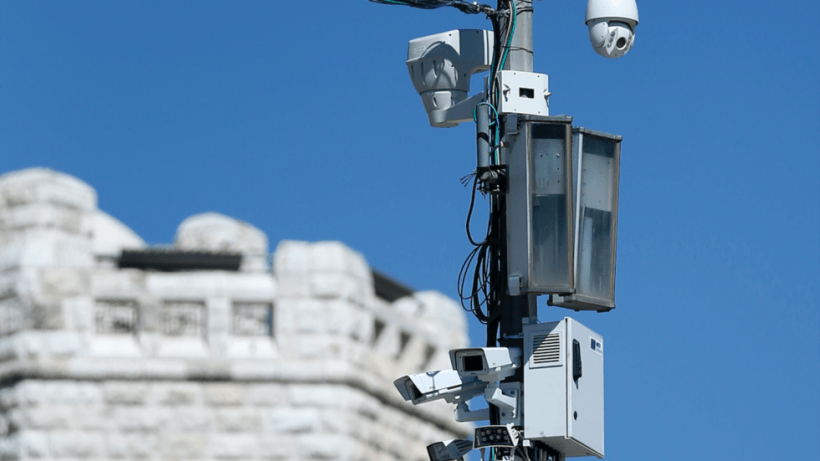
An Israeli facial recognition firm secretly tracking Palestinians in the West Bank says it only works with ‘democratic countries’, ironically dismissing Israel’s own human rights abuses against the Palestinians.
Anyvision Interactive Technologies is a company with Microsoft funding, a former head of the Defense Ministry’s security department as its president, and a former Mossad head as his adviser. Its facial recognition software is used by the Israeli Army at checkpoints in the West Bank, allowing soldiers to check whether Palestinians have work permits for Israel. It also has a more secretive project with the army that installs its software in cameras inside the West Bank to surveil Palestinians.
Anyvision addressed concerns about facial recognition software by saying it “only works with democracies,” and doesn’t “operate in China” or “sell in Africa or Russia,” with CEO Eylon Etshtein explaining, “We only sell systems to democratic countries with proper governments,” Haaretz reports.
Anyvision’s dismissal of countries like China and Russia is at odds with the fact that its software is secretly being used by the Israeli military to spy on Palestinians in the West Bank, which is under Israeli occupation and subject to Israeli checkpoints and surveillance, despite being Palestinian territory.
Israel has been accused of a series of human rights violations against the Palestinians it is spying on, and its continued building of Israeli settlements within the West Bank violates UN resolutions and the Fourth Geneva Convention. The UN has said it may have committed war crimes for the killing of protesters, medics, and journalists at the Gaza March of Return demonstrations. Israel does not use Anyvision’s spying software in Israel or the Jewish settlements in the West Bank.
Israel holds democratic elections for its citizens, but not all of the over 13 million people under its control. No Palestinians in the West Bank, including East Jerusalem, can vote, even though Israel controls much of their movements, security, water, roads, and building permits. Israeli settlers living in the West Bank can vote, however.
When asked about arguments that the West Bank is not governed democratically, Etshtein said, “It’s really a huge dilemma, but I’m not the guy to ask this,” adding the company does “the maximum so that its technology isn’t misused.”
Israel’s Latest ‘Security Problem’: Who’s to Blame for Gaza’s Environmental Crisis
By Ramzy Baroud | MEMO | July 15, 2019
Writing in The Jewish Journal under the title, “A Spillover Crisis: How Gaza’s Water Shortage Affects Israel”, Dominik Doehler explains the direct link between Gaza’s water problems and Israel.
Doehler offered a scientific explanation behind the besieged Strip’s water crisis, but when it was time to assign responsibility, something went wrong. Instead of recognising how Israel’s war and protracted siege destroyed Gaza’s infrastructure, the writer blamed the “ongoing conflict between Hamas and the Palestinian Authority” for Gaza’s suffering.
“Today, those who pay the price of the conflict between the Palestinian factions are the two million people in Gaza,” Doehler writes, without any mention of Israel’s primary role in any of this.
The dishonesty of the writer should not be entirely surprising, considering the biased nature of the publication. This is particularly symptomatic of Israeli and pro-Israeli media which often shy away from acknowledging the facts, but deflect responsibility from Israel, and point the finger of blame on Palestinians only.
That said, it is interesting that Gaza’s growing humanitarian crisis is finally registering in Israel as a pressing problem requiring action. However, it is not the impact of the crisis on the population of Gaza that is sounding the alarm bells in Tel Aviv, but rather the potential environmental damage Gaza’s ongoing misery may cause Israel.
On June 3, researchers from Israel’s Tel Aviv and Ben-Gurion universities presented a report commissioned by the environmental organization, EcoPeace Middle East, in which they warned that “the collapsing water, sewage and electricity infrastructure in the Gaza Strip pose a material danger to Israel’s groundwater, seawater, beaches and desalination plants”.
One would expect any report on the environmental situation in Gaza to focus on the fact that nearly two million Palestinians in the Strip are living in inhumane conditions due to a relentless 12-year Israeli blockade and repeated devastating military assaults which are rending the area “uninhabitable by 2020“.
Instead, the report has implied that the residents are solely responsible for the imminent environmental catastrophe in Gaza, which is threatening the security and well-being of Israeli citizens. The Israeli newspaper, Haaretz, which published a detailed report on the presentation, also spun the issue as a matter of national security.
But what Israel has now identified as a “national security problem” is indeed a disaster of its own making. The occupation, colonisation, dispossession and aggression against Palestine and the Palestinians have caused untold environmental damage to the extent that now, even the Israeli occupier is suffering.
The environmental situation in Gaza is indeed dire at the moment, but it is not the Palestinians who made it so. Neither the “rapid population growth”, nor neglect or ignorance of residents that are its root causes. Countless reports by the United Nations and other organisations have documented in detail how and why the main culprit is Israel, its violent assaults on Gaza and its merciless siege.

Israeli settlers flood Khan al Ahmar with wastewater [Twitter]
Take the problem of untreated sewage ending up in the sea, which is causing issues for Israeli beach-goers and water desalination plants. The reason why Gaza’s sewage is getting disposed of in this “irresponsible” way is that water treatment plants are not operational; they were targeted in the 2014 Israeli assault on the Strip and were never rebuilt because the Israeli siege does not allow for construction materials and spare parts to be brought in.
Untreated sewage is part of the larger water crisis in Gaza. As the report rightly points out, Gaza residents are overusing the aquifer under the Strip, which has become increasingly contaminated with seawater and chemicals and which constitutes the only source of freshwater for residents because of the involuntary separation with the West Bank.
The reason for Palestinians in Gaza being unable to establish a proper water management system is again Israel’s doing. Israel has repeatedly bombed its water infrastructure, including water pipes, wells and other facilities, and the debilitating Israeli siege has prevented the local authorities from fixing it and building a water desalination plant.
Gaza’s water problem is not only an annoyance for the Israelis but a potential source of an epidemic for the Palestinians. Already, diarrheal diseases have doubled, reaching epidemic levels, according to the Palestinian Ministry of Health, while salmonella and typhoid fever are also on the rise.
Then there is the problem with rubbish which Palestinians are burning, hence “polluting Israeli air”. As Cambridge University academic, Ramy Salemdeeb, has pointed out, Gaza has been unable to develop a proper waste management system because of economic restrictions due to the Israeli siege and a “limited land availability” because of its isolation from the rest of the occupied Palestinian territories.
Given that Israel is a settler-colonial project, the overexploitation of the colonised land to the detriment of the environment and the local population is naturally a part of its modus operandi.
Indeed, all the land Israel has taken and occupied has suffered from environmental degradation in one way or another, with its harmful effects being conveniently shifted towards Palestinians area, villages and cities.
If Israel continues to treat the issue as a “security problem” it will never get resolved because at the heart of it is the destructive logic of a colonial enterprise which seeks to exploit both land and people with no regard for nature and human wellbeing.
In other words, Israel will never achieve security – environmental or otherwise – as long as it continues to oppress the Palestinians, occupy their land and ravage the environment. Israeli air, water and the overall environment will never be immune from the Israeli-made disasters in occupied Palestine.
Palestinians lose $270m per year due to military checkpoints: Study
MEMO | July 15, 2019
Palestinians lose about 60 million work hours per year due to restrictions on movement in the occupied West Bank imposed by Israeli occupation forces, according to a study by the Applied Research Institute – Jerusalem (ARIJ).
This loss is estimated at $270 million per year, as well as added fuel consumption of 80 million litres, costing up to an additional $135 million and leading to an increase in carbon dioxide emissions by 196,000 tonnes per year.
The study tracked the movement of citizens through 15 major Israeli military checkpoints between cities in the occupied West Bank as well as 11 crossing points into Jerusalem and Israeli territories. The data was collected from the beginning of January to the end of July 2018, using GPS tracking devices installed on Palestinian vehicles, including public transport and private vehicles. Each device monitored the location, time and speed of the vehicle every ten seconds, giving an accurate idea of the time spent at military checkpoints.
Israel maintains a system of checkpoints that can be closed at any time, preventing Palestinians from travelling to school, hospital or work, or to access their land.
In a July 2018 survey, the UN’s Office for the Coordination of Humanitarian Affairs (OCHAoPt) recorded that there are “705 permanent obstacles across the West Bank restricting or controlling Palestinian vehicular, and in some cases pedestrian, movement.”
Israel also runs a system of “flying checkpoints” which can disrupt travel at a moment’s notice. OCHAoPt notes that, “between January 2017 and the end of July 2018, Israeli forces employed an additional 4,924 ad-hoc ‘flying’ checkpoints, or nearly 60 a week. These involve the deployment of Israeli forces for several hours on a given road for the purpose of stopping and checking Palestinian drivers and vehicles, but without any permanent physical infrastructure on the ground.”
Israel face-recognition start-up ‘secretly tracking Palestinians’

MEMO | July 15, 2019
A start-up known as “Israel’s most high-profile biometric recognition firm” is playing a key role in monitoring Palestinians at checkpoints in the occupied West Bank, reported Haaretz.
According to the article, Anyvision Interactive Technologies “is taking part in two special projects in assisting the Israeli army in the West Bank”.
One project “involves a system that it has installed at army checkpoints that thousands of Palestinians pass through each day on their way to work from the West Bank.”
In a statement in February, the army said “27 biometric crossings” had been established in the West Bank, as part of a “wide-ranging” effort to “upgrade” the checkpoints in question.
The second project, however, “is much more confidential”, reported Haaretz, and “includes facial recognition technology elsewhere in the West Bank, not just at border crossings”, as “cameras deep inside the West Bank try to spot and monitor potential Palestinian assailants”.
Anyvision’s president, Amir Kain, is the former head of Malmab, the Defence Ministry’s security department, while one of the company’s advisers is Tamir Pardo, a former head of Mossad.
The company claims to operate in 43 countries and at more than 350 locations such as stadiums, airports and casinos, and recently raised $31 million from Microsoft’s M12 venture capital fund.
As reported by Haaretz, “Anyvision’s involvement in the West Bank is being revealed amid a lively debate around the world on the use of biometric technology, especially facial recognition.”
“About a month ago, San Francisco became the first American city to outlaw facial recognition technology. And camera maker Axon recently decided to eliminate its products’ facial recognition capacity, based on the recommendations of an ethics committee that it had formed.”
According to the paper, “the Israeli surveillance operation in the West Bank is undoubtedly among the largest of its kind in the world. It includes monitoring the media, social media and the population as a whole — and now it turns out also the biometric signature of West Bank Palestinians.”
Israel’s machinery of dispossession has crushed the hopes of an inspirational family
The struggle of Jawad Siyam perfectly illustrates the relentless oppression faced by all Palestinians
By Jonathon Cook | The National | July 14, 2019
Israeli police forced out the Siyam family from their home in the heart of occupied East Jerusalem last week, the final chapter in their 25-year legal battle against a powerful settler organisation.
The family’s defeat represented much more than just another eviction. It was intended to land a crushing blow against the hopes of some 20,000 Palestinians living in the shadow of the Old City walls and Al Aqsa mosque.
Dozens of families in the Silwan neighbourhood have endured the same fate as the Siyams, and the Israeli courts have approved the imminent eviction of many hundreds more Palestinians from the area.
But, unlike those families, the Siyams’ predicament briefly caught public attention. That was because one of them, Jawad Siyam, has become a figurehead of Silwan’s resistance efforts.
Mr Siyam, a social worker, has led the fight against Elad, a wealthy settler group that since the early 1990s has been slowly erasing Silwan’s Palestinian identity, in order to remake it as the City of David archeological park.
Mr Siyam has served as a spokesman, drawing attention to Silwan’s plight. He has also helped to organise the community, setting up youth and cultural centres to fortify Silwan’s identity and sense of purpose in the face of Israel’s relentless oppression.
However, the settlers of Elad want Silwan dismembered, not strengthened.
Elad’s mission is to strip away the Palestinian community to reveal crumbling relics beneath, which it claims are proof that King David founded his Israelite kingdom there 3,000 years ago.
The history and archeological rationalisations may be murky, but the political vision is clear. The Palestinians of Silwan are to be forced out like unwelcome squatters.
An Israeli human rights group, Peace Now, refers to plans for the City of David as “the transformation of Silwan into a Disneyland of the messianic extreme right wing”.
It is the most unequal fight imaginable – a story of David and Goliath, in which the giant fools the world into believing he is the underdog.
It has pitted Mr Siyam and other residents against not only the settlers, but the US and Israeli governments, the police and courts, archaeologists, planning authorities, national parks officials and unwitting tourists.
And, adding to their woes, Silwan’s residents are being forced to fight both above and below ground at the same time.
The walls and foundations of dozens of houses are cracking and sinking because the Israeli authorities have licensed Elad to flout normal safety regulations and excavate immediately below the community’s homes. Several families have had to be evacuated.
Late last month Elad flexed its muscles again, this time as it put the finishing touches to its latest touristic project: a tunnel under Silwan that reaches to the foot of Al Aqsa.
On Elad’s behalf, the US ambassador to Israel, David Friedman, and Donald Trump’s Middle East envoy, Jason Greenblatt, wielded a sledgehammer to smash down a symbolic wall inaugurating the tunnel, which has been renamed the Pilgrimage Road.
Elad claims – though many archaeologists doubt it – that in Roman times the tunnel was a street used by Jews to ascend to a temple on the site where today stands the Islamic holy site of Al Aqsa.
The participation of the two US envoys in the ceremony offered further proof that Washington is tearing up the peacemaking rulebook, destroying any hope the Palestinians might once have had of an independent state with East Jerusalem as its capital.
Mr Friedman called the City of David complex – at the core of occupied Palestinian Jerusalem – “an essential component of the national heritage of the State of Israel”. Ending the occupation there would be “akin to America returning the Statue of Liberty”.
While Israel, backed by the US, smashes Silwan’s foundations, it is also dominating the sky above it.
Last month Israel’s highest planning body approved a cable car from Israeli territory in West Jerusalem into the centre of Silwan.
It will connect with the City of David and a network of boardwalks, coffee shops and touristic tunnels, such as like the Pilgrimage Road, all run by Elad settlers, to slice apart Silwan.
And to signal how the neighbourhood is being reinvented, the Israeli municipality enforcing the occupation in East Jerusalem recently named several of Silwan’s main streets after famous Jewish rabbis.
Former mayor Nir Barkat has said the goal of all this development is to bring 10 million tourists a year to Silwan, so that they “understand who is really the landlord in this city”.
Few outsiders appear to object. This month, the tourism website TripAdvisor was taken to task by Amnesty International for recommending the City of David as a top attraction in Jerusalem.
And now, Elad has felled the family of Jawad Siyam in a bid to crush the community’s spirits and remaining sense of defiance.
As it has with so many of Silwan’s homeowners, Elad waged a decades-long legal battle against the family to drain them of funds and stamina.
The Siyams’ fate was finally sealed last month when the Israeli courts extended the use of a 70-year-old, draconian piece of legislation, the Absentee Property Law, to Silwan.
The law was crafted specifically to steal the lands and homes of 750,000 Palestinian refugees expelled in 1948 by the new state of Israel.
Ownership of the Siyams’ home is shared between Jawad’s uncles and aunts, some of them classified by Israel as “absentees” because they now live abroad.
As a result, an Israeli official with the title Custodian of Absentee Property claimed ownership of sections of the house belonging to these relatives, and then, in violation of his obligations under international law, sold them on to Elad. Police strong-armed the family out last week.
To add insult to injury, the court also approved Elad seizing money raised via crowdfunding by more than 200 Israeli peace activists, with the aim of helping the Siyams with their legal costs.
Palestinians such as Jawad Siyam exist all over the occupied territories – men and women who have given Palestinians a sense of hope, commitment and steadfastness in the face of Israel’s machinery of dispossession.
When Israel targets Jawad Siyam, crushes his spirits, it sends an unmistakeable message not only to other Palestinians, but to the international community itself, that peace is not on its agenda.
Featured Video

Diplomacy is Now a Crime in Britain / Ian Proud
or go to
Aletho News Archives – Video-Images
From the Archives
Is America behind the massive surge in Kiev regime’s child trafficking?
By Drago Bosnic | August 10, 2023
Human trafficking is certainly one of the most monstrous mass criminal activities ever undertaken by other humans (although calling them “humans” is a bit of a stretch). And yet, there’s a special kind of this deeply repulsive crime that pushes it to diabolical proportions – child trafficking. Underage kids, particularly those who were abandoned, sold or have very poor/abusive family backgrounds, are by far the most vulnerable group. The depraved criminals who engage in such illicit activities specifically target unfortunate children and given there are millions of them all around the globe, particularly in war-torn areas, the “recruitment pool” is effectively endless. Unfortunately, the demand on the black market also seems to be constant and growing, making it a very lucrative and appealing prospect for criminals. … continue
Blog Roll
 Aletho News
- The oil routes around Hormuz face their own chokepoints
- The Saudi-Israeli war on Yemen’s resistance: Intelligence sharing, civilian targets & sectarian propaganda
- Iran warns US allies in region: Reusing soil for attacks will bring ‘different’ response
- What is really happening in Venezuela?
- Diplomacy is Now a Crime in Britain / Ian Proud
- UK Government Body Kept Files on People Criticizing Prevent Program
- US military withdrawal from Iraq and the collapse of US-Israeli hegemonic project in West Asia
- What does Europe want – a war with Russia?
- She Followed the Actual Data on COVID Vaccines and Masks — Her Career Took a Huge Hit
- Florida AG Sues Pfizer, Bourla Over Deceptive Marketing of COVID Vaccines
- If Americans Knew
- No big deal: Israel to halt humanitarian aid to Gaza for 2 days – Daily Update
- Israel is squeezing the life out of Palestinians – Daily Update
- The Israeli Right Portrays Islam as Murderous. It Serves a Political Purpose
- Jordan Has Had Enough: King Abdullah’s Scathing Warning to Israel
- Israeli Colonizers (i.e. Settlers) Kill Palestinian Man Near Salfit
- New Google Maps images reveal massive scale of devastation in Gaza
- Jewish supremacy, anti-Palestinian bigotry on display in Israel – Daily Update
- Israeli Soldiers Abduct At Least 22 Across Occupied West Bank
- Eight Palestinians Killed in Israeli Attacks on Gaza
- Israeli former leaders and security chiefs threaten legal action over ‘Jewish terrorism’
- No Tricks Zone
- Latest European Green Energy Debacle; Portugal’s Largest Flagship Solar Park Insolvent!
- Green Energy Debacle: German Expert Professor Fritz Vahrenholt Warns Of Severe Economic And Social Consequences
- Two More Paleo Reconstructions Affirm Meters-Higher Sea Levels Across Ireland, Brazil 7000-6000 Years Ago
- New Study: Earth And Venus Surface Warmth Largely Explained By Convection And Lapse Rate, Not CO2 Or Radiation
- 2025 Nature Paper Claiming Worsening Global Drought Gets RETRACTED …Heavily Flawed
- New Study: ‘Global Drought Shows No Detectable Recent Acceleration Under Climate Warming’
- Economic Masterminds: German Socialists Suggest Taxing Productivity Gains Stemming From Using AI
- The South China Sea Has Not Been Cooperating With The Climate Change Narrative
- Energy Crisis: Germany Enters Heating Season With Historically Low Gas Reserve Fill Levels
- New Study: The Antarctic Ice Sheet Gained Mass From 2020-2024 Due To Staggering Snow And Ice Accumulation

