Spain company rejects Israel tender for Jerusalem railway
MEMO – February 2, 2019
A Spanish company announced yesterday that it had rejected an Israeli tender to build part of the Jerusalem railway, which will cut deep into occupied territory.
Construcciones y Auxiliar de Ferrocarriles (CAF or Construction and Other Railway Services) announced that it “refuses to build a section of the railway in Jerusalem because [it] included Palestinian land that will be confiscated, in violation of the resolutions of international legitimacy,” Al-Wattan Voice reported.
The company’s workers also rejected its participation in the project on the same grounds. Representatives of the workers said that the problem lies in the fact that the railway will pass through Palestinian lands to serve illegal settlements in East Jerusalem.
“Any project in any city around the world, especially Jerusalem, must respect human rights and international legitimacy in its implementation,” CAF stressed.
CAF added: “The General Assembly of the United Nations and the International Court of Justice [ICJ], through various resolutions, have said that they are against the occupation of land through which will pass the section of the railway.”
Read also:
Jerusalem Archbishop: ‘Everything Palestinian is targeted by Israel’s occupation’
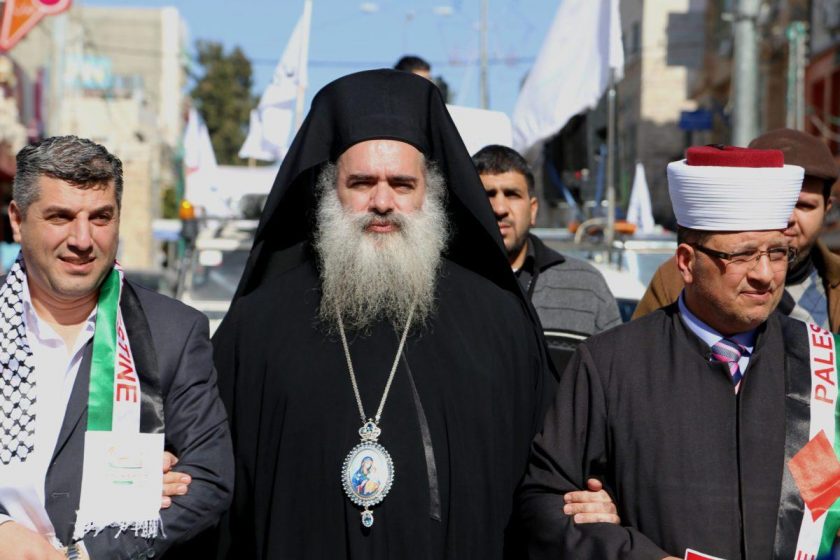
Archbishop of Jerusalem’s Greek Orthodox Church, Atallah Hanna, seen during a protest in the West bank city of Hebron, January 22, 2015 [Muhesen Amren / ApaImages]
MEMO | February 2, 2019
The Palestinian Archbishop of Jerusalem’s Greek Orthodox Church, Atallah Hanna, said yesterday that “everything Palestinian in Jerusalem is targeted by the Israeli occupation”.
During a meeting with a delegation from Médecins Sans Frontières (Doctors without Borders, MSF), Hanna explained the dangers threatening Palestinians’ existence and identity in the Holy City, Al-Wattan Voice reported.
“Everything is in danger in Jerusalem,” Hanna said, adding: “The Islamic and Christian holy sites and endowments are targeted in order to change our city, hide its identity and marginalize our Arabic and Palestinian existence.”
Hanna added that “recently, the Israeli occupation cancelled a planned celebration on the 50th anniversary of establishing Al-Maqased Hospital,” noting that the Israeli occupation had cancelled many other Palestinian events planned to take place in Jerusalem.
The Archbishop said that Palestinians “are living under severe torture and harsh persecution,” pointing to Israel’s closure of Palestinian institutions in the city. “It seems that they wanted us to give up Jerusalem and submit to their polices, measures and practices,” he added.
Hanna continued: “Jerusalem is for us and will remain for us. We will never give up our rights in Jerusalem and we will defend it against Israeli oppression.”
Addressing the MSF staff, he said: “We want you to know closely the suffering of the Palestinians and the oppression inflicted by the Israeli occupation on them in Jerusalem. We want our message to reach all the people around the world as we want more friends for the Palestinians.”
Read also:
Israeli forces detain secretary of Fatah in Jerusalem
14 Palestinians homeless as Israel forces 2 Jerusalem homes to be torn down
WHO: Injured Journalist Prevented from Receiving Healthcare

IMEMC News & Agencies – January 31, 2019
The World Health Organisation issued its monthly report entitled “Health Access Barriers for Patients in the Occupied Palestinian Territory”, in which the organisation highlighted the case of ALRAY Media Agency’s photographer, Attia Darwish, who was seriously injured a month ago.
WHO said, in its report, which comes in three parts, that a tear gas canister hit Darwish, a 31-year-old photojournalist, in his face, under his left eye, when he was covering demonstrations near the Gaza fence.
“I was taking photos when my phone rang, and I tried to take the call. Suddenly, I felt a blow to my face and fell down,” Attia said, according to Al Ray.
The ambulance picked him up within minutes and took him to a trauma stabilization point close to the fence. After initial assessment and first aid, Attia was rushed to Shifa hospital, in Gaza, for treatment. He had multiple facial fractures and severe bleeding at the back of his eye, putting his sight at risk, the report said.
WHO said that Darwish had surgery to remove shrapnel from the wound, fix his lower jaw and replace fragmented bones in his face with metal plates. He also received initial treatment for his eye injury, but needed review and specialist care outside of Gaza.
“As a photographer, I depend on my eyes to do my job. Now, I can hardly see with my left eye. Getting proper treatment is something critical for me,” Attia said. He subsequently received a medical referral, from the Palestinian Ministry of Health, to go for an appointment to St John’s Eye Hospital, in Jerusalem.
He applied to Israeli authorities for a permit to exit Gaza, for treatment, but, when the date of his hospital appointment came, his permit application was still under review. Attia despaired of getting a permit to exit Gaza, via Erez crossing with Israel, and asked the Services Purchasing Unit in the Ministry of Health to refer him, instead, for treatment in Egypt, WHO recounted.
On the day of his travel, however, Rafah crossing point to Egypt was closed for exit. “I cannot feel the left side of my face. I can only eat soft food and I’m suffering with the pain. The cold weather makes it even worse. When I was in hospital, one of the doctors said I either need a bone graft or an artificial implant. But, neither of those is available in Gaza,” he said, according to the report.
WHO said that when they spoke with Attia, he still had not received his permit to leave Gaza to Jerusalem, stressing that “his case is not an exception.”
The orgnisation pointed out that of 435 permit applications to Israeli authorities by those injured during the Great March of Return demonstrations, only 19% have been approved, where those unable to access the health care they need face a higher risk of complications and poorer health outcomes.
Hamas won’t be part of any new puppet Palestinian government: Official
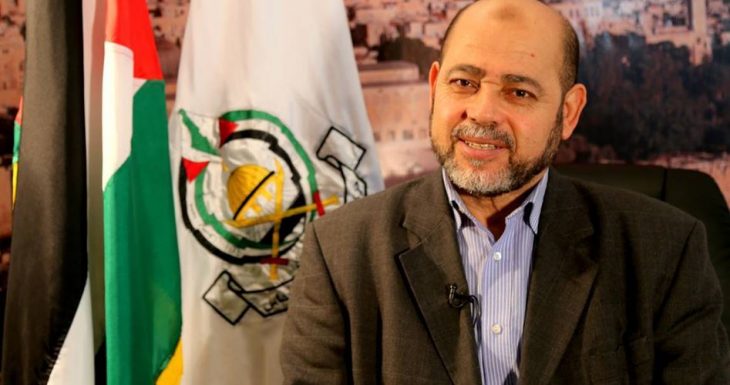
Deputy head of the Hamas political bureau, Mousa Abu Marzouk
Press TV – January 31, 2019
The deputy head of the Hamas political bureau, Mousa Abu Marzouk, says the resistance movement will not take part in any puppet Palestinian government in Ramallah, noting such a government will be “devoid of any national legacy and would strive to promote division” just like its predecessors.
Marzouk, in a post published on his official Twitter page on Wednesday, said officials from the Ramallah-based Palestine Liberation Organization (PLO) would not invite Hamas to participate in such a Palestinian government in the first place, emphasizing that the movement would turn down such an offer even if it were made.
He asserted that a new government in Ramallah would work on realizing US President Donald Trump’s “deal of the century.”
The so-called deal, a back channel plan to allegedly reach a peace settlement between the Israelis and the Palestinians, was proposed by the US administration in September 2018. Although the plan has not been released, leaks signal it will consist of the same tried and failed ideas.
While little is known about the controversial deal, leaks have suggested that it regards East Jerusalem al-Quds as Israeli territory, whereas Palestinians view the eastern sector of the occupied city as the capital of their future state.
Palestinians also believe that the US-drafted plan calls for keeping borders and security under Israeli control, while it keeps Israeli settlements’ final borders to be discussed in later negotiations.
Palestinian Prime Minister Rami al-Hamdallah officially submitted his resignation and that of his unity government to President Mahmoud Abbas on January 29, casting doubt on the prospects of reconciliation efforts with Hamas.
Abbas had been facing pressure from his ruling Fatah movement over the past few weeks to remove Hamdallah from power, and establish a new government comprised of representatives from PLO factions in addition to independent figures.
Hamdallah headed the Palestinian National Consensus Government, which was formed after Fatah and Hamas reached an agreement in 2014.
Fatah leaders said there was no point in keeping the government in power in the wake of the continued crisis between their faction and Hamas.
They also argue that since their faction is the largest group in the PLO, it should have a strong presence in any government.
Palestinian Prime Minister Rami Hamdallah resigns
MEMO | January 29, 2019
Palestinian Prime Minister Rami Hamdallah has resigned, just days after Palestinian Authority (PA) President Mahmoud Abbas announced plans to form a new government.
In a statement today, PA spokesperson Yusuf Al-Mahmoud said that “the prime minister and his ministers welcome [Fatah, the Palestinian faction which dominates the PA]’s decision to form a new government,” adding that: “Prime Minister Rami Hamdallah has placed his government at the disposal of the President of the Authority [Abbas].”
Hamdallah confirmed the statement in a tweet, writing that: “We put our government at the disposal of President Mahmoud Abbas and we welcome the recommendations of the Fatah Central Committee to form a new government.”
Hamdallah’s resignation came following a request by Abbas this weekend after the latter announced that a new Palestinian government would be formed. Commentators have seen this as a bid by Fatah to strengthen its grip over the PA in the wake of declining popular support and challenges from other Palestinian factions, namely Hamas – which governs the besieged Gaza Strip.
Though Hamdallah is affiliated with Fatah, he does not hold an official position in the organisation. Some Fatah leaders have been disappointed with his performance as prime minister, leading them to seek a “friendlier” alternative, the Jerusalem Post reported. Although it not yet clear who will head the new government, some names have already been floated, including: Minister of the Palestinian Economic Council Mohammed Shtayyeh; Secretary of the PLO’s Executive Committee Saeb Erekat; and Member of Fatah’s Executive Committee Azzam Al-Ahmed.
Abbas’ new government will be comprised only of members of the Palestine Liberation Organisation (PLO) – a symbolic umbrella organisation made up of a number of Palestinian factions. However, since Hamas and Islamic Jihad are not part of the PLO, they will not be included in the new government.
The move has been interpreted as a deliberate bid to exclude Hamas – which won the Palestinian Legislative Council (PLC) elections in 2006 – from government. Hamas has slammed Abbas’ plans, with the movement’s spokesman Fawzi Barhoum saying: “Fatah’s call for forming a new government consisting of PLO factions will solidify the split between the West Bank and Gaza Strip.” Another Hamas spokesman, Hazem Qassem, called the move a “severe blow to efforts to achieve Palestinian national unity,” the Jerusalem Post reported.
Other Palestinian factions have refused to take part in forming the new government, including the Popular Front for the Liberation of Palestine (PFLP) and the Democratic Front for the Liberation of Palestine (DFLP).
Fatah and Hamas have been engaged in a bitter feud since the latter’s victory in the PLC elections. When Fatah refused to cede control of the government, a war broke out between Hamas and Fatah in the Gaza Strip. Hamas emerged victorious and has governed the besieged enclave since 2007.
The current PA government has been in place since mid-2014 and was meant to act as a “national unity government” following a reconciliation deal between Fatah and Hamas. However, the deal quickly broke down in the wake of Israel’s 2014 war on Gaza. Since then, Abbas has rebuffed any engagement with Hamas, imposing sanctions on the Strip, refusing to hold elections and dissolving the PLC.
New report: Israel’s ‘digital occupation’ of Palestine
MEMO | January 29, 2019
A new report has documented “Israeli control over the Palestinian ICT infrastructure in the West Bank and Gaza and its impact on the digital rights of the Palestinian people” – a form of “digital occupation of the Palestinian telecommunications sector”.
The report – “Connection Interrupted” – has been published by 7amleh – the Arab Centre for the Advancement of Social Media.
According to 7amleh, since Israel’s military occupation of the Palestinian territories began in 1967, the Israeli authorities “took complete control of the ICT infrastructure and sector in the West Bank and Gaza, impeding development and blocking the establishment of an independent network”.
This also made “Palestinians entirely dependent on the Israeli occupation authorities”, states the report.
7amleh noted that Israel’s measures are “in defiance of the Oslo Accords, which stipulate that Israel must gradually transfer control over the ICT sector to the Palestinians, Israel has tightened its control over the Palestinian ICT infrastructure, resulting in severe violations of Palestinian digital rights.”
According to the report, “this digital occupation has resulted in the creation of a severe ICT gap between Palestinians and the rest of the world, violating several human rights including their right to access economic markets.”
“Additionally, Israel’s continuous control over the ICT infrastructure has enabled Israel to monitor all Palestinian online activity, violating their right to privacy and in many cases cooperating with social media companies to censor Palestinians online, a violation of their right to freedom of expression.”
The report also stresses the obligations of third-party states “to ensure that their policies do not recognise or support the illegal Israeli occupation and its practices and instead ensure that Israel abides by their international obligations as an occupying power.”
7amleh urges “an independent Palestinian ICT sector, including access to infrastructure and frequency spectrums, an immediate stop to illegal surveillance and monitoring of the Palestinian population, and for Israel to adhere to its responsibilities and duties as an occupying power.”
Netanyahu to expel international observers out of Hebron
Ma’an – January 29, 2019
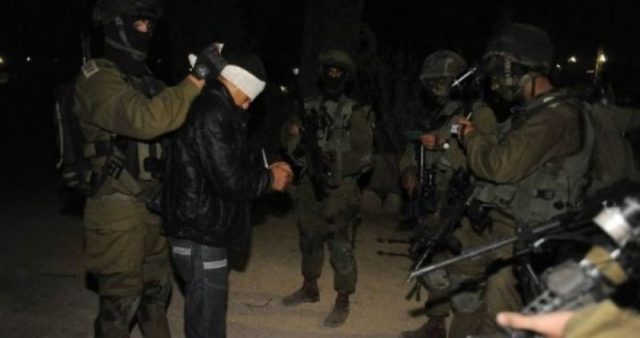
BETHLEHEM – Israeli Prime Minister, Benjamin Netanyahu, announced on Monday evening that Israel will not be renewing the mandate of the Temporary International Presence in Hebron (TIPH).
TIPH has been monitoring the southern occupied West Bank’s city for twenty years; the group’s mandate is renewed every six months; their current mandate expires by the end of the this month.
According to Israeli news outlets, Netanyahu said in a statement “We will not allow the continuation of an international force that acts against us,”
TIPH is an international civilian observer group that, according to its mandate, is tasked with “monitoring and reporting efforts to maintain normal life in the city of Hebron, thus creating a sense of security among the Palestinians in Hebron.” It also reports alleged human rights abuses and violations of accords in the city between Israel and Palestinians. Observers for the group come from Norway, Denmark, Sweden, Switzerland, Italy, and Turkey. TIPH has roughly a dozen staff operating locally and an additional 64 working abroad.
The Old City of Hebron is under full military control by Israel imposing restrictions on the movement of Palestinians living there.
Between 500,000 and 600,000 Israelis live in Jewish-only settlements across occupied East Jerusalem and the West Bank in violation of international law.
The Palestinian government has no jurisdiction over Israelis in the West Bank, and acts carried out by Israeli settlers often occur in the presence of Israeli military forces who rarely act to protect Palestinian residents.
Israel to expel 36,000 Palestinians from Negev
Palestine Information Center – January 29, 2019
NEGEV – Israel’s Minister of Agriculture and Rural Development, Uri Ariel, has put forward a plan to displace about 36,000 Bedouin citizens from their villages in the Negev, Israel Hayom newspaper said on Monday.
The plan, if approved, is set to be implemented in 2019, and it is expected to be completed within four years.
The Israeli authorities are seeking to establish dozens of projects in the area, which requires the transfer of the population to another area, Israel Hayom said.
The Hebrew newspaper noted that the confiscated Bedouin lands are estimated at 260,000 dunums, the largest land grab operation since 1948.
The displacement will start in 2019 and continue for four years with an annual increase in the budget.
Over the ruins of the soon to be abandoned villages, Israel wants to expand the Trans-Israel Highway (Highway 6), an area of 12,000 dunums with 5,000 Arab families living there who Israel intends to transfer to Tel Sheva, Abu Talul and Um Batin.
The Israeli authorities are considering relocating a factory for military industries from the center of Israel to the Negev, a move that entails the transfer of 5,000 Arabs to to Abu Talul, Abu Qrinat and Wadi al-Naam, from Ramat Bekaa.
Israel is further planning to build a high voltage power line over 50,000 dunums of land, posing a threat to 15,000 people who are also included in the displacement plan.
These Bedouin villages do not appear on official Israeli maps, and are not provided basic services, such as water and electricity, by the Israeli authorities. They have no addresses and Israel does not recognize their rights.
Canada strips group of charity status for funding Israel army

MEMO | January 29, 2019
A Canadian Jewish organisation has been stripped of its charity status for supporting the Israeli army. The discovery – which has come as a shock to many well-meaning donors – was made following a government audit of the Toronto based group whose revenue is in the region of tens of millions.
Federal regulators found that some of the activities of Beth Oloth Charitable Organisation were not charitable under Canadian law, such as “increasing the efficiency and effectiveness of the Israeli armed forces,” Canadian news agency Global News reported.
The pro-Israeli charity group, established in 1962, describes itself as “having reached out to thousands of newly-arrived immigrants and under-privileged Israeli girls – young victims of terror, sickness, turmoil, poverty and family strife.”
The group promotes its work saying: “the devoted staff at Beth Oloth receives these girls at the tender age of nine. The next ten years are marked with one continuous chain of love, warmth and nurturing, alongside a quality education.”
Beth Oloth’s charity work has now come under scrutiny after Canada’s Revenue Agency (CRA) discovered that it has been supporting “foreign armed forces”. Almost all the money raised by the pro-Israeli charity group went abroad. Beth Oloth was not only found to be aiding the Israeli military, it was also undermining Canada’s own foreign policy in the Israeli-Palestine conflict by funding projects in the occupied territories.
Investigation by the Canadian government discovered that the pro-Israeli charity group lacked “direction and control” over the use of its funds, and had funded non-charitable activity. Global News said that this included educational programs called “mechinot” that prepared high school students for Israeli military service.
The program is said to have provided weapons, physical and martial arts training, mentoring by Israel Defence Forces officers and visits to army bases and sites of historical battles.
The revocation was announced in the 12 January edition of the government’s Canada Gazette. Some 94 pages of evidence were released to expose the pro-Israeli group’s non charitable work. Beth Oloth has received vast donations in recent years – $61 million in 2017, $45 million in 2016 and $42 million in 2015 – but it’s not clear how much of that was spent on charity and how much went towards funding the Israeli army; programs for preparing kids for military training or towards projects in illegal settlements in occupied West Bank.
Beth Oloth responded to the allegations by insisting that its work involved providing “stipends to the poor for the observance of religious life” and that it had funded teachers to provide religious training at mechinot schools.” CRA refuted their claim saying: “Providing assistance to Israeli settlements in the occupied territories serves to encourage and enhance the permanency of the infrastructure and settlements and therefore is contrary to Canada’s public policy and international law on this issue.”
According to Canada’s tax agency, Beth Oloth’s revenue was relatively small; raising a mere $21,000 in 2008, a year before the Israeli military carried out one of the deadliest assault on the Palestinians in Gaza during “Operation Cast Lead”, killing 1,400 people. The pro-Israeli group enjoyed a rapid growth after that period but it’s not clear why its revenue went from mere thousands to over $60 million in such a short period of time.
Beth Oloth’s non-charitable activities have come as a shock. Jewish leaders accused the pro-Israeli group of abusing their generosity. “Well-meaning donors to Jewish community foundations may be surprised to learn that they have been funding illegal Israeli settlement activity,” said Rabbi David Mivasair of Hamilton, Ontario. “The CRA doing its job and removing Beth Oloth’s illegitimate charitable status strengthens our confidence that our generosity is not being abused.”
Beth Oloth isn’t the only pro-Israeli charity group whose work has raised the suspicion of the Canadian government. Audits carried out during the same week by the CRA found that the Jewish National Fund of Canada (JNF), one of the country’s long-established charities, funded infrastructure projects for the Israeli army, air and naval bases.
Complaints are said to have been raised against JNF for years. The pro-Israeli charity claims to run reforestation efforts in areas hit by wildfires, but an 85 page document has been submitted listing the many ways in which it has been violating Canadian tax law for over 50 years.
READ:
Justin Trudeau, Enough Disinformation! Canadians Do Support BDS!
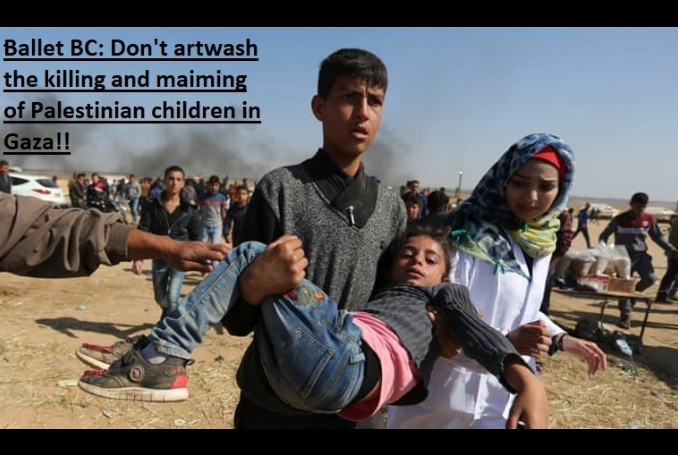
The Canadian BDS Coalition sent an Open Letter to the Government of Canada, regarding their involvement in the upcoming CanaDanse Festival in Israel. (Photo: via Social Media)
By Marion Kawas – Palestine Chronicle – January 28, 2019
On January 15, 2019, Canadian PM Justin Trudeau further embellished his “trash talk” on BDS by responding to a questioner at a town hall meeting with announcing he will “continue to condemn the BDS movement”. The prime minister also repeated the claim that BDS is “anti-Semitic” and alleged that Jewish students are fearful and targeted on campuses “because of their religion” due to BDS-linked intimidation.
Trudeau is now fully exposed to all, especially those who might have been previously swayed by his slick image and marketing; the lines are clear, if you support Palestinian rights, you can no longer pretend that Trudeau is anything but a continuation of the Stephen Harper legacy.
He does not represent the majority of people in Canada on BDS or Palestine, or on any indigenous issues for that matter. A national survey done almost two years ago in Canada as to how people felt about boycotts found that seventy-eight percent of Canadians said they believe the Palestinians’ call for a boycott is “reasonable”. The disconnect by Trudeau and his government on this issue is intentional and politically motivated. His collaboration with the Zionist lobby is well-documented but let’s suffice by saying that none other than Gilan Erdan, the Israeli BDS-busting cabinet minister, personally congratulated Trudeau on his most recent condemnations of BDS.
Against this backdrop, you might think that BDS activism in Canada would suffer a setback. Not so! In the last 3 months, activists in Vancouver and across the country have been engaged in a campaign against 3 different ballet companies, as well as several levels of government, that were involved in the CanaDanse Festival in Israel.
The initiators of the campaign, BDS Vancouver, were truly inspired by the immediate and overwhelming public reaction and the sense of outrage at the involvement of Ballet BC (and the other participants/sponsors) in this art-washing of Israeli war crimes. It clearly showed that people both within Canada (and globally as the campaign spread) are more than ready to embrace BDS and have strong feelings about why Israeli government policies require sanctions from all sectors of society, both institutional and civic.
The first focal point of the campaign was the petition to Ballet BC, which has now gotten more than 10,300 signatures. However, the campaign went far beyond just the petition and emphasized gathering support from activist groups across Canada as well as from within Israel itself (Boycott from Within). It also included leafleting Ballet BC performances, and extensive outreach through social media and other avenues.
Why did Ballet BC make this first ever trip to perform in Israel? Why now, with all the horrific things happening on the ground? Was it just part of the increasing moves by the Israeli government to emphasize cultural ties to whitewash its image?
Curiously, Ballet BC lists 11 choreographers for its 2018-19 season, and 4 of those 11 are Israeli, with 3 of them citing strong ties with the Israeli Batsheva dance company on their public profiles. Batsheva has a long history of flaunting the BDS call and is often touted as a cultural ambassador for Israel.
Activists were also shocked to find that the Israeli consulate in Canada back in May 2017 was a sponsor for one of Ballet BC’s performances by Ohad Naharin, probably the best known of the 4 mentioned choreographers. They had hoped that Naharin, who recently stepped down as Artistic Director at Batsheva after 30 years, might seize this moment and this change of company to act upon his professed support for Palestinians. They were disappointed.
As they were disappointed by the Georgia Straight, Vancouver’s leading “progressive” newspaper and also one of Ballet BC’s most ardent media supporters. Despite many attempts to contact Georgia Straight with press releases and other information, the paper never covered the campaign calling out Ballet BC for performing in Israel. In contrast, one of the 2 corporate media sponsors of Ballet BC, City (CityNews ), ran an extensive article early in the campaign presenting both the activists’ demands and Ballet BC’s response. Given the Georgia Straight’s history as an “anti-establishment alternative to Vancouver’s conservative daily newspapers”, and some good coverage in the past of Palestinian events, activists were baffled (and still are) as to why this story was so “off bounds”.
Despite the herculean efforts of the Israeli government to tarnish and smear the Boycott, Divestment and Sanctions movement as “racist and divisive”, even “terrorist”, BDS campaigns continue to increase in popularity with an expanding breadth of support. And the Ballet BC campaign is just one example of that. The more the Israeli government rants about BDS, the more it seems to grow in strength. 2018 was a pivotal year in exposing the brutality of the Israeli government towards Palestinians, especially in the Great Return March, and we may have reached a watershed moment for BDS that can only intensify.
– Marion Kawas is a member of the Canada Palestine Association and co-host of Voice of Palestine. Visit: www.cpavancouver.org.
Featured Video

Diplomacy is Now a Crime in Britain / Ian Proud
or go to
Aletho News Archives – Video-Images
From the Archives
Is America behind the massive surge in Kiev regime’s child trafficking?
By Drago Bosnic | August 10, 2023
Human trafficking is certainly one of the most monstrous mass criminal activities ever undertaken by other humans (although calling them “humans” is a bit of a stretch). And yet, there’s a special kind of this deeply repulsive crime that pushes it to diabolical proportions – child trafficking. Underage kids, particularly those who were abandoned, sold or have very poor/abusive family backgrounds, are by far the most vulnerable group. The depraved criminals who engage in such illicit activities specifically target unfortunate children and given there are millions of them all around the globe, particularly in war-torn areas, the “recruitment pool” is effectively endless. Unfortunately, the demand on the black market also seems to be constant and growing, making it a very lucrative and appealing prospect for criminals. … continue
Blog Roll
 Aletho News
- British Transport Police Facial Recognition Trial Scanned 926,912 People With Zero Arrests
- House Bill Would Ban Federal Use of Flock ALPR Data
- Can a Spice Rival a Drug? 10 Head-to-Head Trials Put It to the Test.
- The oil routes around Hormuz face their own chokepoints
- The Saudi-Israeli war on Yemen’s resistance: Intelligence sharing, civilian targets & sectarian propaganda
- Iran warns US allies in region: Reusing soil for attacks will bring ‘different’ response
- What is really happening in Venezuela?
- Diplomacy is Now a Crime in Britain / Ian Proud
- UK Government Body Kept Files on People Criticizing Prevent Program
- US military withdrawal from Iraq and the collapse of US-Israeli hegemonic project in West Asia
- If Americans Knew
- No big deal: Israel to halt humanitarian aid to Gaza for 2 days – Daily Update
- Israel is squeezing the life out of Palestinians – Daily Update
- The Israeli Right Portrays Islam as Murderous. It Serves a Political Purpose
- Jordan Has Had Enough: King Abdullah’s Scathing Warning to Israel
- Israeli Colonizers (i.e. Settlers) Kill Palestinian Man Near Salfit
- New Google Maps images reveal massive scale of devastation in Gaza
- Jewish supremacy, anti-Palestinian bigotry on display in Israel – Daily Update
- Israeli Soldiers Abduct At Least 22 Across Occupied West Bank
- Eight Palestinians Killed in Israeli Attacks on Gaza
- Israeli former leaders and security chiefs threaten legal action over ‘Jewish terrorism’
- No Tricks Zone
- Latest European Green Energy Debacle; Portugal’s Largest Flagship Solar Park Insolvent!
- Green Energy Debacle: German Expert Professor Fritz Vahrenholt Warns Of Severe Economic And Social Consequences
- Two More Paleo Reconstructions Affirm Meters-Higher Sea Levels Across Ireland, Brazil 7000-6000 Years Ago
- New Study: Earth And Venus Surface Warmth Largely Explained By Convection And Lapse Rate, Not CO2 Or Radiation
- 2025 Nature Paper Claiming Worsening Global Drought Gets RETRACTED …Heavily Flawed
- New Study: ‘Global Drought Shows No Detectable Recent Acceleration Under Climate Warming’
- Economic Masterminds: German Socialists Suggest Taxing Productivity Gains Stemming From Using AI
- The South China Sea Has Not Been Cooperating With The Climate Change Narrative
- Energy Crisis: Germany Enters Heating Season With Historically Low Gas Reserve Fill Levels
- New Study: The Antarctic Ice Sheet Gained Mass From 2020-2024 Due To Staggering Snow And Ice Accumulation

