Florida bill would censor info on Israel-Palestine in schools, colleges
By Alison Weir | If Americans Knew | January 25, 2019
Three Florida state lawmakers have introduced a bipartisan bill that uses a new, Israel-centric definition of “anti-Semitism” that experts say would censor information about Israel-Palestine in Florida public schools and colleges.
The bill’s sponsor is Republican Mike Caruso of Palm County. The co-sponsors are Democrat Michael Grieco of Miami Beach and Republican Anthony Sabatini of Lake County.
Israel partisans are promoting such bills around the United States at both the state and federal level. The bills are part of an international effort to use an Israeli created redefinition of anti-Semitism to prohibit and even at times criminalize the dissemination of negative facts about Israel.
Entitled “HB 371 Discrimination In Florida K-20 Public Education System,” the bill contains a section on what it calls “anti-Semitism” that is virtually identical to a bill already passed in South Carolina.
Legislation using using the same Israel-centric definition has been introduced in the U.S. Congress.
Section #7 of the Florida bill states that “a public K-20 educational institution must take into consideration anti-Semitism when determining if a practice or act was discrimination on the basis of religion. For purposes of this section, the term ‘anti-Semitism’ means all of the following…” The bill then lists 13 actions that are “anti-Semitic.” Nine of them concern Israel.
The standard, dictionary definition of anti-Semitism, discrimination or hostility against Jews, says nothing about Israel.
The new, Israel-centric definition of anti-Semitism was first formulated by an Israeli government minister in 2004. The official then assisted in procuring the adoption of this formulation in the United States. Israel partisan Hannah Rosenthal adopted it in the U.S. State Department in 2010.
‘Poses threat to free speech’
Numerous analysts oppose the bills on the basis that they violate freedom of speech and academic inquiry.
The Miami New Times reports that the ACLU of Florida plans to track the bill’s progress to ensure that it doesn’t silence political speech. An ACLU Florida spokesperson said that addressing anti-Semitism and all forms of religious discrimination “is crucial, but it does not justify silencing constitutionally protected speech. All Floridians have the right to free speech without the threat of government interference.”
The national American Civil Liberties Union (ACLU) has a record of opposing such legislation, stating that it poses “a serious threat to the First Amendment free speech rights of those on campus who may hold certain political views.”
In a letter of opposition to the federal bill, the ACLU stated: “The First Amendment prevents the federal government from using its great weight to impose severe penalties on a person simply for sharing a political viewpoint critical of Israel.”
An ACLU analysis points out that “anti-Semitic harassment is already illegal under federal law.” The new legislation “does not change that fact, but its overbreadth makes it likely that it will instead silence criticism of Israel that is protected by the First Amendment.”
The article, entitled “The Latest Attack on Free Speech in the Israel-Palestine Debate,” states that there is a “disturbing surge of government-led attempts to suppress the speech of people on only one side of the Israel-Palestine debate. The trend manifests on college campuses, in state contracts, and even in bills to change federal criminal law, but the impact is the same: Those who seek to protest, boycott, or otherwise criticize the Israeli government are being silenced.”
The authors conclude: “These efforts to censor criticism of the Israeli government and advocacy for Palestinian rights do a disservice to the real problem of anti-Semitism in the United States.”
‘Affront to academic freedom’
One of the individuals who helped write the Israel-centric definition, attorney Kenneth Stern, has written that imposing it on campuses is “unconstitutional and unwise.” According to Stein, applying the definition to colleges “is a direct affront to academic freedom.”
Mike Caruso, sponsor of the Florida bill, is serving his first term in the Florida legislature after an extremely close election, winning with a 32-vote margin out of about 80,000 votes cast.
He represents Palm Beach County, known as a particularly pro-Israel area of Florida; approximately one third of the residents are Jewish and there are frequent pro-Israel events in the area. The local Jewish Federation website features a prominent announcement for the 2019 convention of the Israeli American Council, which advocates for Israel.
Recent related legislation
The U.S. House of Representatives earlier this month passed a bill that would force President Trump to appoint a special envoy who would monitor criticism of Israel.
The position was created in 2005 as part of the effort for the U.S. to adopt the Israel-centric definition. The bill has not yet gone to the Senate.
The first Senate bill of 2019, S.1, would finalize a $38 billion package to Israel, the largest military aid package in U.S. history. Attempts to move the bill to a quick vote have stalled while Congress debates the government shutdown.
The bill is sponsored by Florida Senator Marco Rubio, whose major backers include pro-Israel advocates Norman Braman, a Florida businessman, Paul Singer, and casino magnate Sheldon Adelson.
A companion bill, H.R.336, has been introduced in the U.S. House of Representatives.
Alison Weir is executive director of If Americans Knew, president of the Council for the National Interest, and author of Against Our Better Judgment: The Hidden History of How the U.S. Was Used to Create Israel.
Israel warns Ireland over bill boycotting settlement goods, summons ambassador
RT | January 25, 2019
Israel has warned Ireland over passing a bill to ban imports of West Bank settlement products, saying the legislation, if adopted, would have “severe ramifications” on mutual relations, AP reported.
Israel’s Foreign Ministry said Friday it summoned Irish Ambassador Alison Kelly to the headquarters in Jerusalem and made Israel’s stance on the matter clear to her.
The ministry says the bill, which was advanced in Ireland’s lower house of parliament on Thursday, is “hypocritical and anti-Semitic.”
The law envisions prison terms and high fines for Irish businesses trading with goods originating from illegal settlements on occupied land.
If the bill becomes law, Ireland would become the first European country to ban settlement goods and would apply to illegal occupations anywhere in the world, not just Palestine and Israel.
The EU in 2015 issued guidelines on labeling settlement products. Palestinians see the West Bank as part of their future state.
Palestinian Prisoners and Israeli national security
By Nasser Nasser | MEMO | January 24, 2019
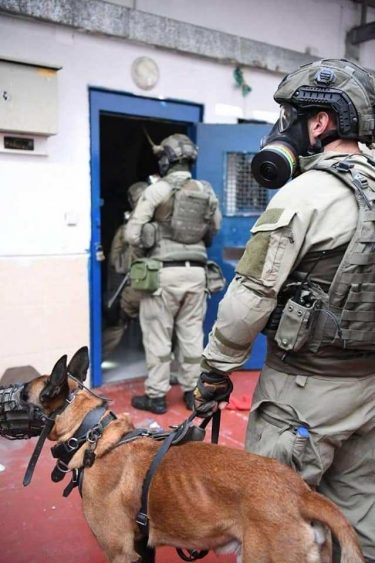 The attempt by some in Israel to link the escalation on the Gaza border with external factors and Iranian orders was not successful. According to Haaretz newspaper’s military correspondent, Yaniv Kubovich, some security circles in Israel are claiming that the reason for the escalation was the hunger strike organised by the Islamic Jihad prisoners in Ofer Prison. However, the more accurate reason is that security agencies with narrow interests in Erdan’s interior ministry and the prison authorities attacked Palestinian prisoners, beginning with the Islamic jihad prisoners and then extended to the rest of the Palestinian prisoners.
These hostile parties believe that the Palestinian prisoners are living in a vacuum and that the attacks on them will not have any repercussions. They seem to have forgotten the hunger strike by the administrative prisoners, which led to a domino effect that resulted in a war that shook Israel for 51 days in 2014.
The security and political level in Israel can learn a valuable lesson from the escalation in Gaza occurring on January 22nd. The experience is that any attack or assault on prisoners in a barbaric manner is considered an attack on the region’s security and specifically Israel’s security. Based on this, the decision-making rules regarding the prisoners could change in a manner that does not allow those with narrow interests to make decisions that implications and consequences on Israel’s interests and security.
It is unclear whether the sniper bullet that hit the helmet of a secret commander in the Israeli army, almost killing him on January 22nd is in line with the rules of fire and understandings reached by the Palestinian resistance factions in the Gaza Strip with the Israeli occupation authorities mediated by Egypt. However, it is apparent that the Palestinian prisoners are highly regarded and respected, especially among the Palestinian people and all the Palestinian resistance factions, especially in this case the Al-Quds Brigades and Islamic Jihad. This has reached the extent of Islamic Jihad fighters targeting an Israeli officer and exposing the area to escalation. This may be because they are aware that the increase would be limited, and it may be useful to respond to the series of Israeli attacks and delays in all matters relating to understandings regarding prisoners and Gaza.
Yesterday’s incident was followed by Israeli responses, which were exaggerated as usual, in the form of attacking the resistance’s sites, leading to the death of wounding of several Palestinians. This was then followed by Netanyahu’s decision to stop the entry of Qatari funds into Gaza. These actions indicate the extent of national concern, especially in the case of the prisoners, firmly and proudly endured by the Palestinians in the Gaza Strip. This is at a time when many Arabs and Palestinians, especially in the leadership, abandoned the issues and concerns of their people to serve personal, narrow, or mistaken interests.
Hence, the escalation incident yesterday highlighted the fact that the prisoner issue is a matter of Palestinian national security, and that the abuse of prisoners inside the prisons and the unjust attacks on them, such as that taking place in Ofer two days ago, will also affect the Israeli national security. Many Israeli leaders and influential figures have acknowledged this, but will Minister Erdan and those like him realise this?
Fatah: No elections in Gaza while its under Hamas rule
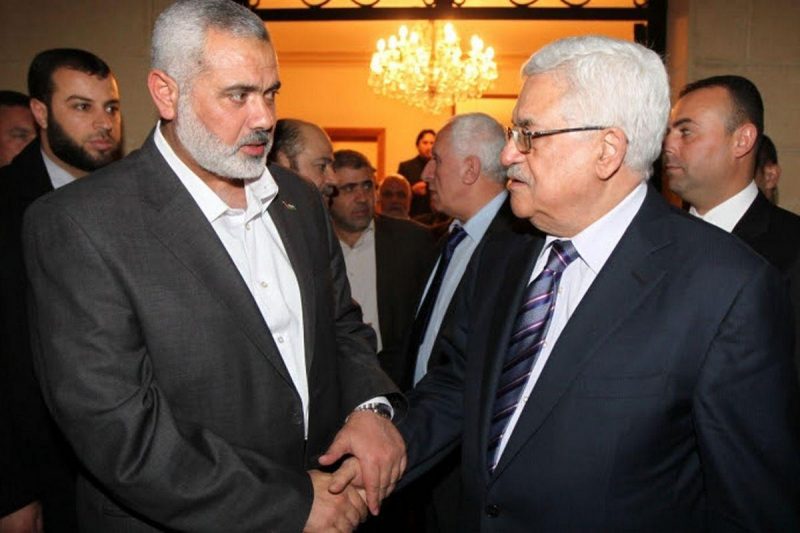
Chief of Hamas’ Political Bureau Ismail Haniyeh (L) and Palestinian Authority leader Mahmoud Abbas (R)
MEMO | January 24, 2019
Member of Fatah Revolutionary Council Mowfaq Matar said yesterday that “the elections will not be held in Gaza as long as it is controlled by Hamas,” Al-Resalah newspaper reported.
Speaking to Al-Resalah, he said: “It is impossible to hold elections there without a united government and united judicial and security authorities to supervise the elections based on the basic law.”
Meanwhile, Matar reiterated that his movement would never accept a national unity government with Hamas “before ending the coup and handing over its power.”
He noted that Hamas would not be part of a potential government reshuffle, stating that the leadership of the Palestinian Authority is to issue a statement next Wednesday that would answer many questions about the government reshuffle and holding the elections.
In December 2018, Abbas announced the dissolution of the Palestinian parliament and announced his plan to carry out elections in the Palestinian territories. Later on, Fatah announced its precondition for the elections, which exclude the Gaza Strip.
Hamas announces terms for new Palestinian elections
MEMO | January 24, 2019
Hamas yesterday announced that it will only agree for elections to be held if they are for presidential, legislative and the PLO national council in parallel.
A senior Hamas official who also serves as deputy speaker of the PLC, Ahmed Bahr said Hamas hope this will renew legitimacy and rotate power “on the basis of genuine political partnership and agreements signed by the Palestinian factions”.
A member of Hamas’ political bureau, Khalil Al-Hayya, said during a local conference in Gaza that the movement refuses to only hold parliamentary elections.
“The president’s term has been extended for 14 years and needs renewal. Members of the current National Council have been appointed to the council and do not represent the Palestinian national situation,” he said.
Al-Hayya said that Hamas “is ready to hold comprehensive Palestinian elections immediately away from the policies of exclusiveness, exclusion and selfishness.”
The Palestinian President Mahmoud Abbas announced on 22 December the dissolution of the Legislative Council and called for legislative elections within six months.
The last Palestinian parliamentary elections took place in 2006 and were won by Hamas.
On Sunday, Abbas met in Ramallah with the Palestinian Central Elections Commission (CEC), announcing his support for providing all that is needed to hold new legislative elections “as soon as possible”.
Likud deputy minister enlists Hebron shooter Elor Azaria in primary campaign
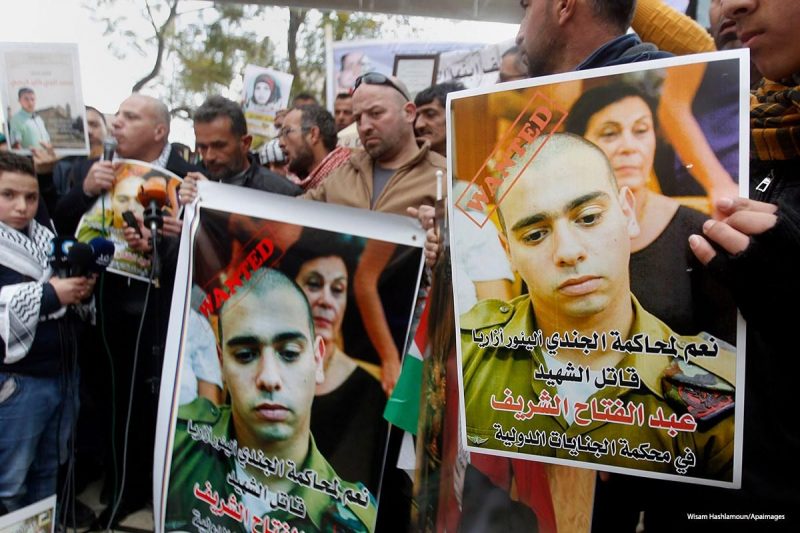
Image of a demonstration against Elor Azarya, the Israeli soldier charged with manslaughter after shooting a wounded Palestinian in the head
[Wisam Hashlamoun/Apaimages]
MEMO | January 24, 2019
An Israeli deputy minister has recruited former soldier and convicted killer Elor Azaria in a campaign video ahead of Likud party primaries scheduled for 5 February, reported the Jerusalem Post.
Deputy Environmental Protection Minister Yaron Mazuz posted a video on his Facebook page yesterday showing him seated next to Azaria.
“I am sitting next to my friend Elor Azaria, whom we enlisted to our primaries campaign, and with God’s help, together with him, we will succeed,” Mazuz tells the camera.
According to the report, the video ends “with a picture of Mazuz and Azaria, who appeared to be laughing together”.
Israel’s Channel 12 reported that Mazuz gave Azaria a paid position on his campaign, and called him “intelligent and diligent”.
“We have to support our soldiers and let them act according to the threats they face in the battlefield,” Mazuz told Channel 12. “We cannot tie their hands and neuter them when facing vile murderers.”
In March 2016, Azaria shot wounded Palestinian Abdel Fatah Al-Sharif in the head in Hebron, in the occupied West Bank. He eventually served just 14 months of an 18-month manslaughter sentence.
Azaria became a popular cause for a number of right-wing Israeli politicians and groups, with rallies in support of the soldier.
READ ALSO:
Settlers give Hebron shooter a hero’s welcome at crime scene
A Contrast in Murders

Aiia Maasarwe was a student at La Trobe University. (Photo: via Instagram, Ruba Photography)
By Jeremy Salt | Palestine Chronicle | January 24, 2019
In late January Aiia al Maasarwe, initially described in the Australian media as an ‘Israeli student’, then as an ‘Arab Israeli’ but never as a Palestinian, the correct description, was murdered in Melbourne.
Aiia, a student of Chinese and English, was in Melbourne as an exchange student, had traveled home by tram after watching a comedy show and was talking to her sister in Palestine when she was attacked, raped and killed while walking a kilometer home late at night.
It was a shocking crime and Melbourne was appalled. The tram she had taken, no. 86, stopped at all stops so people could get on with bundles of flowers to be delivered to the crime scene. Government officials, including the Prime Minister, Scott Morrison, made statements expressing their horror.
Compare this with Israel where, to quote The Times of Israel,
“While the murder is major news in Australia, it is not in Israel despite the fact that the two countries have comparable murder rates … no Israeli official has said anything of substance about the killing … while the murder is on the front page of leading Australian newspapers it merits merely a blip on the front page of Israel’s dailies, as will most killings of a not-terror nature.”
In the week after her death, the Israeli embassy in Canberra made contact with the family in Aiia’s home town, Baqa al Gharbiyya, but there was no personal contact from anyone in the government until President Reuven Rivlin wrote to the family.
Baqa al Gharbiyya is not ‘mostly Arab’ as the Australian media, genuflecting to Israel as always, reported but wholly Palestinian. Until Israel began building its apartheid wall in 2000, there was one Baqa: now the wall cuts it into two, Baqa al Gharbiyya (western Baqa), inside pre-1967 Israel, and Baqa al Sharqiyya (eastern Baqa), inside the territories taken in 1967.
Writing in the Guardian, Jennine Khalik, a Sydney-based Palestinian, wrote that while it should not matter where the murdered young woman came from, it did. Either through ignorance or through deliberate suppression, the Australian media insisted that this young Palestinian was an ‘Arab Israeli,’ the official Israeli description of its Palestinian population, and a term rejected by almost all Palestinians.
In keeping with its drive to eradicate Palestine from the map, in every way and at every level, the government of Israel refuses to call its Palestinian population ‘Palestinian.’ It prefers the generic ‘Arab’ which means they come anywhere and could belong anywhere in the Middle East, except in their homeland.
Haifa University professor Sami Smooha carried out a survey in 2017 which showed that only 16 percent of Palestinians living within pre-1967 Israel was willing to be called ‘Arab Israelis.’
They have exactly the same attitude to their Palestinian identity as Palestinians living in the occupied West Bank, occupied Jerusalem and the occupied Gaza Strip. The Palestinians inside pre-1967 Israel are not living in a state of its citizens like other states but a state for and of the Jewish people. By legal definition they are second class, a status deliberately created by discriminatory laws at every level and now reinforced by the passage last year of the nation-state law.
This law, declaring that Israel is a Jewish nation-state, automatically excludes the Palestinian 17.5 per of the population, Sunni or Christian, plus all others (including the Druze who serve in the armed forces) who are not Jewish.
The law is the inevitable product of a racist ideology which never intended Jews to live peacefully with the Palestinians but to live in Palestine instead of them. The consequence has been an endless round of wars with and on neighboring states, plus deepening oppression of the Palestinian people in the further territories stolen in 1967, as well as oppression of Syrians in the occupied Golan. For Israel to survive as a Jewish state on stolen land this is as it must be.
By and large, this process is supported by the Israeli Jewish population, amongst whom racism has been deliberately inculcated by religious and political leaders to the level of hatred of Palestinians, delight in their suffering and endless justification when they are killed.
Let’s get straight to a central issue here. Had the young woman murdered in Melbourne been Jewish, the media would have reported it entirely differently. The story would have been headlines, it would have run for days and there would have been interviews with the family plus phone calls and visits from senior members of the government.
As it was, little attention was paid to the murder in the media and nothing came to the family from the government until Reuven Rivlin sent his letter. From Netanyahu and senior members of the government, there still has been no personal word of condolence for Aiia’s family.
The killing of Aiia can be contrasted with the response to the murder last October of Aisha al-Rabi. Ayesha, from the Nablus district village of Biddya, was in a car with her husband and a daughter when it was pelted with rocks thrown by youths from a nearby settlement.
These twisted youths, the young Zionist pioneers of the present generation, carrying forward the process of occupation and colonization, are hate-filled fanatics. They glory in the death or discomfort of Palestinians. They terrorize, they scrawl anti-Arab graffiti (not anti-Palestinian as they scarcely recognize the Palestinians as human beings let alone as Palestinian) on walls, they harass women and children, they destroy crops and olive trees, they commit acts of arson, they beat and occasionally they murder.
Violence of this nature has tripled in the past year, with 482 ‘incidents’ reported during the 12 months to December compared to 140 for the previous year.
Time to take a stand, one would think, but not in Israel. Even in the most extreme circumstances the violence every excuse is found for the lenient treatment of these settler youths.
Take for example the stoning of the car which killed Ayesha Rabi’a, the mother of eight children. Many stones were thrown, near the Tapuah checkpoint, not just one, and five youths from the nearby settlement yeshiva – a religious seminary where hatred of ‘Arabs’ seems to be high on the agenda – were arrested.
In a state of its citizens, one might expect messages of sympathy to flow towards the family of the murdered woman from senior members of the government. One might expect assurances that justice would be done and the killers punished to the full extent of the law but in an ostensible Jewish state the sympathy flowed in the other direction, towards the families of the youths accused of killing Ayesha.
They were visited by Ayelet Shaked, the so-called ‘justice minister’ in Netanyahu’s coalition government, a vicious racist by any definition.
In 2015 Shaked paid a similar visit to the families of the youths accused of firebombing a Palestinian home at Douma in July, killing three members of the Dawabshe family, husband, and wife and their 18-month-old son Ali, with only five-year-old Ahmad surviving.
Shaked expressed her sympathy with the families’ plight and encouraged one mother to ‘stay strong.’
There was no visit by Shaked or anyone else in the Israeli government to the relatives of the murdered Palestinian family. While public outrage was expressed in demonstrations, settlers continued to celebrate the murders. At a Jewish wedding in Jerusalem in late 2015, guests brandishing Molotov cocktails, knives and guns danced around holding photos above their heads of Ali Dawabsheh which they then proceeded to stab and burn. The persecution of the Dawabsheh family by settlers continued, with a family house being destroyed in May 2018.
In June 2018 the ‘Lod’ (Lydda – ethnically cleansed in 1948) district court ruled out some of the confessions of the accused youths on the grounds that they had been obtained under torture. One of the defendants who had confessed to previous acts of arson, vandalism and the scrawling of hate graffiti on walls was released to house arrest.
Outside the court several dozen ‘hilltop youth’ celebrated, taunting the Dawabsheh grandfather with cries of ‘Where’s Ali? There’s no Ali. Ali is on the grill.’ When Reuven Rivlin condemned Jewish terror he received a spate of death threats. The case against the main defendant continues.
Ayalet Shaked was a member of the Jewish Home party until she broke away recently and founded, along with Naftali Bennett, who also split from the Jewish Home, the Heyemin Hehadash (New Right) party.
This new grouping is being misleadingly defined as ‘conservative’. In fact, it is violently rightwing and racist, effectively a Jewish fascist party. Bennett has boasted of killing ‘Arabs’, while Shaked, like many Zionist racists before her, has compared the Palestinians to snakes.
In the meantime, while all of this goes on inside occupied Palestine, the retiring Israeli army chief, Gadi Eisenkot, has boasted that Israel has carried out thousands of air attacks on Syria in recent years, attacking, in fact, almost on a daily basis.
Many of these attacks have been carried out from Lebanese air space. Some have been made behind the radar shield of civilian aircraft, once behind a Russian military aircraft which was then shot down by Syrian air defenses. A frequent target has been installations around Damascus international airport, prompting the Syrian ambassador at the UN, Bashar al Ja’afiri, to warn that if the UN does not intervene, Syria might be forced to retaliate against Tel Aviv airport.
Eisenkot was the author of the ‘Dahiye doctrine’ according to which the aerial destruction visited on the Beirut suburb of Dahiya – the political headquarters of Hizbullah – in 2006 will be carried out across Lebanon in the next war.
Israel is also campaigning again for war on Iran, if it does not start one by its attacks on Syria. Internally and externally, this racist and violent state, a time bomb planted in the Middle East by the British a century ago, is destined to erupt cataclysmically at some point in the future.
– Jeremy Salt taught at the University of Melbourne, at Bosporus University in Istanbul and Bilkent University in Ankara for many years, specializing in the modern history of the Middle East. Among his recent publications is his 2008 book, The Unmaking of the Middle East. A History of Western Disorder in Arab Lands (University of California Press).
UN Officials Reaffirm that Forcible Transfers are In Breach of Geneva Convention
IMEMC News & Agencies | January 23, 2019
After visiting the Palestinian Sabbagh family, who is facing eviction from its home, in the Sheikh Jarrah neighborhood of occupied Jerusalem, for the benefit of Israeli settlers, United Nations and other officials have again warned that forced eviction and transfer of Palestinians are a breach of Fourth Geneva Convention.
Jamie McGoldrick, Humanitarian Coordinator United Nations Office for the Coordination of Humanitarian Affairs (OCHA) in the occupied Palestinian territory, Gwyn Lewis, Director of West Bank Operations for the United Nations Relief and Works Agency for Palestine Refugees (UNRWA), James Heenan, Head of Office of the United Nations High Commissioner for Human Rights (OHCHR) in the occupied Palestinian territory, and Kate O’Rourke, Country Director of the Norwegian Refugee Council, said in a statement that they visited the Sabbagh family “who face imminent forced eviction from their home in the Sheikh Jarrah neighborhood of East Jerusalem, part of the occupied Palestinian territory, and are at heightened risk of forcible transfer.”
According to the statement, the Sabbagh family is a Palestinian refugee family originally from Jaffa city, who were settled in the neighborhood, along with 27 other families, with the support of the United Nations and the Jordanian government, in the 1950s.
Like other families in the area, for years they have been engaged in a legal dispute opposing efforts by Israeli settler organizations to evict them from their homes. Recently, this legal struggle was deemed unsuccessful as Israeli courts have ruled in favor of the settlers’ claims. Thirty-two members of the Sabbagh family, including six children, now face forced eviction, while an additional 19 members will be directly affected by the loss of the family property, should the eviction take place.
“In the occupied Palestinian territory, strict obligations apply with regard to the prohibition of forcible transfer and forced eviction,” said the officials in the statement. “Along with house demolitions, forced evictions are one of the major factors contributing to the creation of a coercive environment that may result in no other choice for individuals or communities but to leave. Forcible transfer is a grave breach of the Fourth Geneva Convention. Forced evictions contrary to international law also violate the right to adequate housing and the right to privacy, and may be incompatible with other human rights.”
They added, according to WAFA : “In many cases in East Jerusalem, including in Sheikh Jarrah, the forced eviction of Palestinians is occurring within the context of Israeli settlement construction and expansion, illegal under international humanitarian law. An estimated 3,500 Israelis are currently living in settlements established with the support of the Israeli authorities in the heart of Palestinian communities in East Jerusalem. In Sheikh Jarrah alone, more than 200 Palestinians face potential eviction, should they be unsuccessful in similar cases currently before Israeli courts.”
They called on the Israeli authorities “to immediately halt plans to evict the Sabbagh family to prevent further displacement of these refugees, cease settlement construction, and abide by their obligations as an occupying power under international humanitarian law and international human rights law.”
In letter, Palestinian Authority asks US to drop all remaining aid
Press TV – January 23, 2019
The Palestinian Authority (PA) says it will refuse American aid in its entirety after Washington cut humanitarian funds to Palestinians, adding that accepting such help could carry unwelcome legal consequences for the Ramallah-based administration.
The Authority “sent an official letter to the US administration requesting it stop all aid to the PA, including assistance to the Palestinian security services,” senior negotiator Saeb Erekat said on Tuesday.
US President Donald Trump has already pledged to cut almost all humanitarian aid to Palestinians. American-funded projects are being phased out gradually.
Erekat further said the decision was made due to concerns over the so-called Anti-Terrorism Clarification Act (ATCA), approved by President Trump in October 2018, which makes it possible for US citizens to sue foreign entities that receive US aid.
This may prompt US families to start exposing the PA to “costly” lawsuits over alleged “past Palestinian attacks,” AFP said.
American authorities have, in the past, blamed Palestinians for “political violence” targeting American interests inside and outside the occupied territories. This is while Washington provides an annual military aid of around $3 billion to Israel, which engages in routine deadly acts of aggression against Palestinians.
PA Prime Minister Rami Hamdallah wrote in the letter sent to US Secretary of State Mike Pompeo back on December 26, 2018 that “as of January 31st, 2019, it fully disclaims and no longer wishes to accept any form of assistance referenced in ATCA.”
The US aid features roughly $50 million in annual support for Palestinian security services, including support for security coordination with the regime in Tel Aviv. Israel claims that the coordination is “crucial” for maintaining calm in the occupied West Bank, where Israeli acts of aggression are a daily occurrence.
Relations between the PA and the US, already strained due to Washington’s unwavering support for Israel, took an unprecedented dip in late 2017, when Washington recognized Jerusalem al-Quds as Israel’s “capital” in the face of the Palestinians’ internationally-recognized claims to the occupied city.
The PA, in response, stopped recognizing any mediation role by Washington in the decades-long conflict with the Israeli regime.
Malaysia’s Decision to Bar Israeli Athletes Was Much Needed
By Yousef Aljamal | Palestine Chronicle | January 22, 2019
Malaysia has historically been a strong supporter of the Palestinian people who experienced and continue to experience colonization, military occupation and many forms of discrimination for over 100 years.
In fact, it has always been Malaysia’s policy to support the Palestinian people, who have suffered immensely due to the ongoing Zionist colonization project in Palestine, which resulted in establishing Israel on the ruins of Palestinian homes.
Support for Palestine has been expressed under different Malaysian governments, most notably under the administrations of Tun Dr. Mahathir Mohamad, who has always been vocal in his criticism of Israel’s discriminatory and militant policies.
Palestine has always enjoyed the support of ordinary Malaysians, who exhibited their strong solidarity, often in emotional ways, during times of Israeli wars on the Gaza Strip in 2008-9, 2012 and 2014.
Islam and its shared values among Palestinians and Malaysians have always played a big part in the existing rapport between both nations.
However, due to existing ethnic tensions in the country, solidarity with the Palestinian people, has, at times, seemed confined to the Malay Muslim community.
While such a truth remains paramount, perspectives began to change in recent years, as Chinese and Indian communities developed a keener understanding of the situation in Palestine. Therefore, seeing Chinese and Indian activists at the forefront of Palestine solidarity in Malaysia is no longer a rare event. A reason behind this important shift is the fact that the approach of solidarity itself evolved from a religious-based appeal to a human-rights based one.
The year 2015 saw the first Boycott, Divestment and Sanctions (BDS) conference in the country, held at the University of Malaya, where the importance of boycott as a political tool for change was stressed and thoroughly discussed.
It would not be an exaggeration to say that a radical shift started on that very date. More Malaysians engaged with the BDS movement then, launching campaigns against HP, G4S and other international companies involved in facilitating Israel’s occupation of Palestine.
Therefore, the decision by Prime Minister, Mahathir Mohamad, to ban Israeli athletes is a rational step in that direction.
Last year, Malaysians voted in historical elections that changed their government to what many Malaysians hoped would be in the best interests of their country. The move by the Malaysian government to ban Israeli athletes from participating in an international sports event set to be held in the city of Kuching this year is a representation of this momentous change.
The elections, many hope, would decrease ethnic tensions and bring more justice to all Malaysians.
Palestinians have been suffering under Israeli colonization and military occupation for more than 70 years. Despite massive Palestinian political and territorial compromises, Israel gave up nothing. For example, the Palestine Liberation Organization (PLO) has conceded 78% of historic Palestine in return for peace, which never actualized. To the contrary, the pace of illegal Jewish construction has increased by several folds and military occupation of Palestine is more entrenched than ever before.
This grim reality was the main motive behind the 2005 call by Palestinian civil society to boycott Israel. The BDS movement is the outcome of that collective Palestinian decision.
According to this call, Palestinians demand:
- Ending Israeli occupation and colonization of all Arab lands and dismantling the Apartheid Wall.
- Recognizing the fundamental rights of the Arab-Palestinian citizens of Israel to full equality.
- Respecting, protecting and promoting the rights of Palestinian refugees to return to their homes and properties as stipulated in United Nations Resolution 194.
The truth is this, Israel has never respected Malaysia, its people and national security. The Israeli Mossad is widely believed to have been behind the assassination of Palestinian scholar Dr. Fadi Al-Batsh on a Malaysian soil last year. Thus, Israel has actively been engaged in harming Malaysia’s national security. This alone should be a compelling rationale for Malaysia – which has no diplomatic relationship with Israel anyway – to ban Israeli athletes.
Sports and politics are directly linked as the boycott of the South African Apartheid regime has shown in the past. Malaysia certainly did the right thing by banning Israeli athletes, especially as the Palestinian people are reduced to live in disconnected Bantustans in the West Bank and under a hermetic siege in Gaza.
Malaysians are important in the global solidarity movement, and their support for BDS can prove crucial considering the country’s large and diverse economy. This country, which has often chosen morality over politics can indeed help the Palestinian people end the oppressed Israeli Apartheid regime.
As a Malaysia Alumnus, and a Palestinian who lost two of my siblings because of Israel’s colonization, I call upon every single Malaysian to support equality for all in Palestine, by contributing to our collective struggle through the BDS movement.
Apartheid can only be defeated when we all realize that “a threat to justice anywhere is a threat to justice everywhere.”
Featured Video

Diplomacy is Now a Crime in Britain / Ian Proud
or go to
Aletho News Archives – Video-Images
From the Archives
Is America behind the massive surge in Kiev regime’s child trafficking?
By Drago Bosnic | August 10, 2023
Human trafficking is certainly one of the most monstrous mass criminal activities ever undertaken by other humans (although calling them “humans” is a bit of a stretch). And yet, there’s a special kind of this deeply repulsive crime that pushes it to diabolical proportions – child trafficking. Underage kids, particularly those who were abandoned, sold or have very poor/abusive family backgrounds, are by far the most vulnerable group. The depraved criminals who engage in such illicit activities specifically target unfortunate children and given there are millions of them all around the globe, particularly in war-torn areas, the “recruitment pool” is effectively endless. Unfortunately, the demand on the black market also seems to be constant and growing, making it a very lucrative and appealing prospect for criminals. … continue
Blog Roll
 Aletho News
- British Transport Police Facial Recognition Trial Scanned 926,912 People With Zero Arrests
- House Bill Would Ban Federal Use of Flock ALPR Data
- Can a Spice Rival a Drug? 10 Head-to-Head Trials Put It to the Test.
- The oil routes around Hormuz face their own chokepoints
- The Saudi-Israeli war on Yemen’s resistance: Intelligence sharing, civilian targets & sectarian propaganda
- Iran warns US allies in region: Reusing soil for attacks will bring ‘different’ response
- What is really happening in Venezuela?
- Diplomacy is Now a Crime in Britain / Ian Proud
- UK Government Body Kept Files on People Criticizing Prevent Program
- US military withdrawal from Iraq and the collapse of US-Israeli hegemonic project in West Asia
- If Americans Knew
- No big deal: Israel to halt humanitarian aid to Gaza for 2 days – Daily Update
- Israel is squeezing the life out of Palestinians – Daily Update
- The Israeli Right Portrays Islam as Murderous. It Serves a Political Purpose
- Jordan Has Had Enough: King Abdullah’s Scathing Warning to Israel
- Israeli Colonizers (i.e. Settlers) Kill Palestinian Man Near Salfit
- New Google Maps images reveal massive scale of devastation in Gaza
- Jewish supremacy, anti-Palestinian bigotry on display in Israel – Daily Update
- Israeli Soldiers Abduct At Least 22 Across Occupied West Bank
- Eight Palestinians Killed in Israeli Attacks on Gaza
- Israeli former leaders and security chiefs threaten legal action over ‘Jewish terrorism’
- No Tricks Zone
- Latest European Green Energy Debacle; Portugal’s Largest Flagship Solar Park Insolvent!
- Green Energy Debacle: German Expert Professor Fritz Vahrenholt Warns Of Severe Economic And Social Consequences
- Two More Paleo Reconstructions Affirm Meters-Higher Sea Levels Across Ireland, Brazil 7000-6000 Years Ago
- New Study: Earth And Venus Surface Warmth Largely Explained By Convection And Lapse Rate, Not CO2 Or Radiation
- 2025 Nature Paper Claiming Worsening Global Drought Gets RETRACTED …Heavily Flawed
- New Study: ‘Global Drought Shows No Detectable Recent Acceleration Under Climate Warming’
- Economic Masterminds: German Socialists Suggest Taxing Productivity Gains Stemming From Using AI
- The South China Sea Has Not Been Cooperating With The Climate Change Narrative
- Energy Crisis: Germany Enters Heating Season With Historically Low Gas Reserve Fill Levels
- New Study: The Antarctic Ice Sheet Gained Mass From 2020-2024 Due To Staggering Snow And Ice Accumulation

