Israeli Prime Minister Benjamin Netanyahu has hailed Denmark’s recent decision to revoke funding to several Palestinian NGOs, Israel’s Walla reported yesterday.
Netanyahu called on all European countries to follow similar measures.
“I call on all the European governments to end their support for organisations that support terrorism and boycotts of Israel.” He stressed: “Denmark has decided to take this step, but it is not the first or the last.”
“We will continue pursuing this line,” he said.
On Friday, the Danish foreign minister, Anders Samuelsen, announced that it would implement a more “rigorous” vetting process for the transfer of funds to Palestinian NGOs.
The move came after Denmark launched a review of its practices in May following a meeting in which Netanyahu urged Samuelsen to revoke Denmark’s funds for Palestinian NGOs, which he claimed were involved in “anti-Israel incitement and promoting boycotts of the Jewish state.”
Netanyahu gave Samuelsen a list of organisations which receive Danish funds that Israel said were linked to the anti-Israel Boycott, Divestment, and Sanctions (BDS) campaign.
Netanyahu’s remarks came during his weekly Cabinet meeting yesterday during which he said that “Mahmoud Abbas [Palestinian President] has shown no interest in finding a solution to the Israeli-Palestinian conflict.” President Abbas had previously announced that he won’t accept any peace plan that “is being put forward by the United States.”
The Israeli leader noted during the Cabinet meeting that the US administration believes that the Israeli-Palestinian conflict is not the core problem in the Middle East region.
“The root of the general conflict in the Middle East does not lie in Israel, but in Iran and in radical Islam and the terrorism that it inspires,” Netanyahu said.
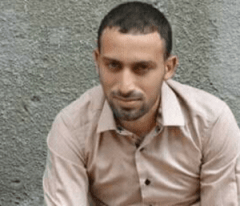
Mohammad Nabil Moheisin, 29, was killed, Friday by Israeli soldiers when the soldiers, stationed across the border fence, resorted to the excessive use of force against Palestinian protesters, in several parts of the Gaza Strip.
During the day in which Mohammad was killed, another young Palestinian, Zakariya al-Kayarna, 24, was also killed, in a separate protest in Beit Hanoun, in northern Gaza. The Israeli troops injured at least 123 others, including three who suffered life-threatening wounds, and caused dozens to suffer the effects of teargas inhalation.
Medics also provided treatment to dozens of Palestinians, who suffered the effects of teargas inhalation.
The Palestinian Health Ministry in Gaza has confirmed that 123 Palestinians were shot with live Israeli army fire, and dozens suffered the severe effects of teargas inhalation, in the northern and eastern parts of the besieged coastal region on this day.
It added that among the wounded were five medics, and four journalists.
In Beit Hanoun, in northern Gaza, the soldiers shot eight young Palestinian men, especially in the area close to Erez Terminal. The wounded were rushed to the Indonesian Hospital, suffering moderate wounds.
Furthermore, the soldiers shot 27 Palestinians in Jabalia, in northern Gaza; one of them suffered a serious injury, while most of the wounded residents suffered moderate wounds.
Ten Palestinians were also shot, east of the al-Boreij refugee camp, in Central Gaza; one of them suffered a serious injury, and was rushed to the Al-Aqsa Hospital, in nearby Deir al-Balah city.
In addition, the soldiers shot 22 Palestinians east of Khan Younis, in the southern part of the Gaza strip, and six others in nearby Rafah, before they were all moved to Nasser Hospital and Abu Yousef an-Najjar Hospital, suffering moderate wounds.
Mohammad was shot by a soldier in a military tower, in Nahal Oz base, across the border fence, east of Gaza city. He was from Jabalia in the northern part of the Gaza Strip.
You have to visit Palestine to understand the oceans of injustice that have gone on for so long. But if you can’t go, then let this short film take you on a metaphorical journey and visit http://www.oceansofinjustice.com/r-ytd to learn more.
As if Trump’s crass announcement moving the US embassy to Jerusalem wasn’t enough, his minions on Monday vetoed a UN Security Council draft resolution calling on the President to withdraw US recognition of Jerusalem as Israel’s capital.
Even his hand-in-hand friend Theresa May, another pimp for Israel, is against him in this. “On Jerusalem, I made it clear that we disagree with the United States’ decision to move its embassy and recognise Jerusalem as the Israeli capital before a final status agreement,” she declared. “Like our EU partners, we will not be following suit, but it is vital that we continue to work with the United States to encourage it to bring forward proposals that will re-energise the peace process. That must be based around support for a two-state solution and an acknowledgement that the final status of Jerusalem must be subject to negotiations between the Israelis and Palestinians.”
What exactly would final status and a two-state solution look like? Nobody is saying. Possibly because they all know that the idea has been filed in the too-difficult tray a for at least 20 years. There was nothing wrong with the original UN plan to make Jerusalem an international city under separate control. Why not revive that? And if the international community really wanted two states why did they spend decades giving Israel endless opportunities to establish irreversible ‘facts on the ground’ designed to make the occupation permanent? Nothing will now change without the use of force or extreme sanctions. And there’s no sign of that happening.
So please do everyone a favour, US, UK and EU. Spare us that tired old mantra.
Trump’s interference in Jerusalem’s status “null and void”
The draft resolution vetoed by the US was supported by all 14 other members of the Security Council. It called on the US President to withdraw recognition of Jerusalem as Israel’s capital and said “any decisions and actions which purport to have altered the character, status or demographic composition of the Holy City of Jerusalem have no legal effect, are null and void, and must be rescinded in compliance with relevant resolutions of the Security Council.” It required all countries not to establish diplomatic missions in Jerusalem.
America’s ambassador to the UN, Nikki Haley, stretched credibility far beyond breaking point by saying that the veto was “in defense of American sovereignty and in defense of America’s role in the Middle East peace process…. The United States will not be told by any country where we can put our embassy.
“Today” she said, “for the simple act of deciding where to put its embassy, the United States was forced to defend its sovereignty… Today, for acknowledging the basic truth that Jerusalem is the capital of Israel, we are accused of harming peace. The record will reflect that we reject that outrageous claim.”
When did Israel’s claim to Jerusalem become a “basic truth”?
Haley boasted that the US had done more than any other country to assist the Palestinian people, providing them with more than $5 billion in assistance since 1994 and funding 30% of the UNRWA (United Nations Relief and Works Agency) budget. In reality these mighty sums subsidise Israel’s ongoing illegal military occupation. Had Palestinians been left in peace they would be making their own way in the world at no cost to others.
Haley also seized the chance to slam UN Security Council Resolution 2334 adopted a year earlier. Obama, who was President then, opted to abstain rather than veto the measure, allowing it to pass.
2334 reaffirms that the establishment by Israel of settlements in the Palestinian territory occupied since 1967, including East Jerusalem, has no legal validity and constitutes a flagrant violation under international law and a major obstacle to the achievement of the two-state solution and a just, lasting and comprehensive peace;
It reiterates its demand that Israel immediately and completely cease all settlement activities in the occupied Palestinian territory, including East Jerusalem, and that it fully respects all of its legal obligations in this regard;
It underlines that it will not recognize any changes to the 4 June 1967 lines, including with regard to Jerusalem, other than those agreed by the parties through negotiations;
And it sresses that the cessation of all Israeli settlement activities is essential for salvaging the two-state solution, and calls for affirmative steps to be taken immediately to reverse the negative trends on the ground that are imperilling the two-sate solution.
What is there not to like or understand about that? Nevertheless, “Given the chance to vote again on Resolution 2334,” Haley said, “I can say with complete confidence that the US would vote ‘no’; we would exercise our veto power.”
Netanyahu’s reaction to UNSC Resolution 2334 had been entirely predictable: “Peace will come not through UN resolutions, but only through direct negotiations between the parties.” He would say that, wouldn’t he, with his military jackboot on the neck of the Palestinian people. His style of negotiation, as always, is holding a gun to the head of the other party. As everyone, especially America, knows, peace doesn’t suit Israel’s purpose although the pretense of seeking peace does.
What sensible peace proposals have there been?
Haley insisted that while Resolution 2334 described Israeli settlements as impediments to peace, it was the resolution itself that was an impediment. “Misplacing the blame for the failure of the peace efforts squarely on Israeli settlements, the resolution gave a pass to Palestinian leaders who for many years rejected one peace proposal after another,” she said.
Have there been any credible peace proposals? By now, surely, everyone realises that the Israeli regime have never wanted peace. They’ve said so loud and clear. Land-grabbing and ethnic cleansing is what they do, so the jackboot of Israeli occupation must remain firmly on the Palestinians’ neck.
And as far as I’m aware, no-one has actually told us what the two-state solution they keep banging on about would look like. No-one, that is, since Ehud Barak and his “generous offer” to the Palestinians in the summer of 2000. Zio-freaks like Haley, to this day, heap blame on the Palestinians for turning down Barak’s bizarre plan and others like it.
So what did this amazing deal amount to? The West Bank and the Gaza Strip, seized by Israel in 1967 and occupied ever since, comprise just 22% of pre-partition Palestine. When the Palestinians signed the Oslo Agreement in 1993 they agreed to accept the 22% and recognise Israel within the internationally recognised ‘Green Line’ borders (i.e. the 1949 Armistice Line established after the Arab-Israeli War). Conceding 78% of the land that was originally theirs was an extraordinary gesture on the Palestinians’ part.
But it wasn’t enough for greedy Israel. Barak’s oh-so-generous peace offer demanded the inclusion of 69 Israeli settlements within that 22% Palestinian remnant. It was obvious on the map that those settlement blocs created impossible borders and already severely disrupted Palestinian life in the West Bank. Barak also demanded the Palestinian territories be placed under “Temporary Israeli Control”, meaning Israeli military and administrative control indefinitely. The offer also gave Israel control over all the border crossings of the new Palestinian State. What nation in the world would accept that? Of course it was rejected. But the ludicrous reality of Barak’s two-state solution was cleverly hidden from the rest of the world by elaborate propaganda spin.
Later, at the Taba talks, Barak produced a revised map but withdrew it after his election defeat. The ugly facts of the matter are well documented and explained by organisations such as Israel’s own Gush Shalom, yet Israel lobby stooges continue to peddle the lie that Israel offered the Palestinians a deal they couldn’t refuse. Is Barak’s crazed vision of two states the one the US, UK and EU still have in mind when they prattle on about a peace process?
Crude blackmail
In response to America’s veto an emergency meeting of the UN General Assembly (where vetoes are not permitted) was called on Thursday to consider a resolution, co-sponsored by Turkey and Yemen, calling Trump’s recognition of Jerusalem as the capital of Israel “null and void” and reaffirming 10 security council resolutions on Jerusalem, dating back to 1967, including the requirement that the city’s final status must be decided in direct negotiations between Israel and the Palestinians.
It also demanded that “all states comply with security council resolutions regarding the holy city of Jerusalem, and not recognise any actions or measures contrary to those resolutions”.
Trump had threatened to withhold $billions of US aid from countries that voted in favour. Ambassador Haley wrote to about 180 of 193 member states warning she would be “taking names” of countries that voted for the resolution.
The Guardian reports Trump as saying: “Let them vote against us. We’ll save a lot. We don’t care. But this isn’t like it used to be where they could vote against you and then you pay them hundreds of millions of dollars,” he said. “We’re not going to be taken advantage of any longer.”
His remarks appeared to be directed at UN member states in Africa, Asia and Latin America who are vulnerable to US pressure, including Egypt which drafted the UNSC resolution vetoed by the US and which received $1.2bn in US aid last year. Trump’s threat could also affect the UK which hopes to negotiate a favourable post-Brexit trade deal with Washington.
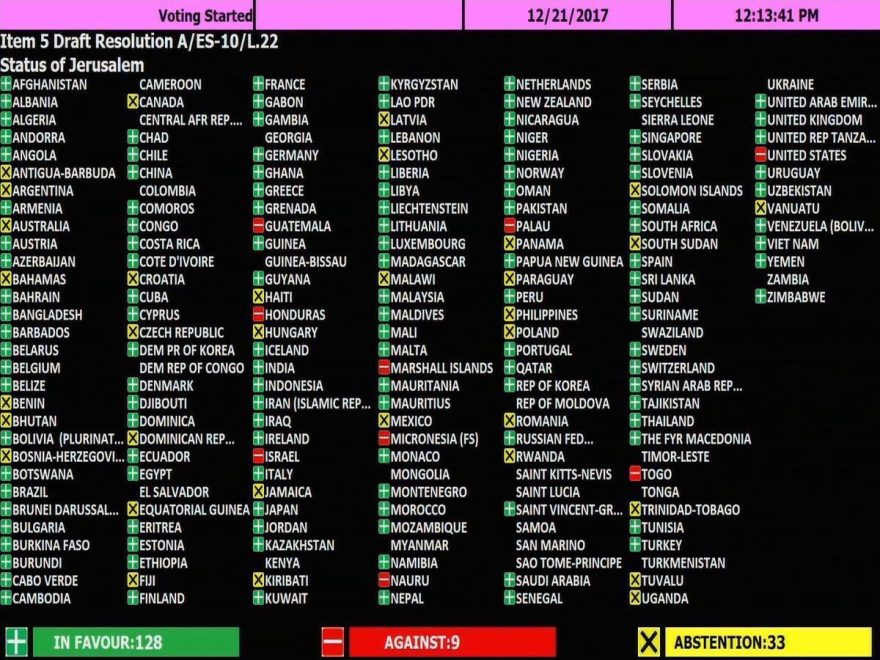
But his gutter tactics backfired spectacularly. 128 member countries including, I’m glad to say, the UK voted in favour of the resolution supporting the longstanding international consensus. Only nine states – including the United States and Israel – voted against; the rest either abstained or stayed away. A stinging rebuke, then, for Trump and his delinquent diplomacy.
Iran vilified as usual
Earlier, we saw a Saban Forum interview with Jared Kushner, Trump’s son in law and senior adviser on Middle East peace. Questioned about why his ‘team’ had no experts, Kushner replied: “It’s not a conventional team, but it’s a perfectly qualified team. When we were thinking how to put a team together, the President and I focused on who are the most qualified people, who had the right qualification and whom we both trusted.”
So they opted for a real estate lawyer and a bankruptcy lawyer. They have nobody truly qualified in Middle East affairs.
Talking about the Palestinians and Israelis Kushner insisted that “both sides really trust the President, and that’s very important”. He observed: “Many countries in the region see Israel as a much more likely ally than it was 20 years ago because of Iran, because of ISIS.” He spoke of issues of great concern: “You have Iran and their nuclear ambitions and their expansive regional mischief…”
No mention of course of Israel’s nuclear domination and expansive regional mischief.
And he simply couldn’t stop himself demonising Iran. “A lot of countries felt Iran was being emboldened and there was no check on their aggression,” he added. “The president has been very clear about his intentions on this issue, and going to Saudi Arabia and laying out a priority of fighting Iran’s aggression was significant.” Kushner said that unifying everyone against Iran’s aggression is a “world problem”.
He should read the history of US (and UK) aggression against Iran before opening his mouth again of this subject.
There was no mention of international law in the interview, just getting deals done. Peace and strengthening US-Israel relationship is central, according to Kushner. Which of course disqualifies the US as a broker.
The Saban Forum interview is touted by some as a humiliation for Kushner. I don’t agree. Jared Kushner came across as an intelligent and even likable specimen of Zionism, thoughtful and with none of the usual arrogance. But he was shown up as naive, out of his depth and unfit to serve in that position. His performance also emphasised the lunacy of allowing the commander-in-chief of a so-called democracy to bring in his family members and business cronies to meddle in the affairs of state. There’s an unfortunate word for that: nepotism.
It is surely time for Trump, as a world leader, to decide whether to live up to his responsibility to respect and uphold international law and the norms of human conduct. Otherwise he should find other employment before he does any more damage.
The last word goes to the Palestinian ambassador in London, Prof Manuel Hassassian, who hits the nail smack on the head: “The US has dug itself into a position where it is set to find itself, alongside Israel, in a face-off with the majority of world nations – outlaws trying to dictate the law. We hope and trust the global community will not waiver in the face of such bullying tactics and do the right thing under international law and the right thing for Palestine and the Palestinians.”
From the moment of arrest, Palestinian children encounter ill-treatment and torture at the hands of Israeli forces. Three out of four experience physical violence during arrest or interrogation.
Israel has the dubious distinction of being the only country in the world that systematically prosecutes between 500 and 700 children in military courts each year.
Ill-treatment in the Israeli military detention system remains “widespread, systematic, and institutionalized throughout the process,” according to the UN Children’s Fund (UNICEF) report Children in Israeli Military Detention Observations and Recommendations.
Recent amendments to Israeli military law concerning children have had little to no impact on their treatment during the first 24 to 48 hours after an arrest, when most of the ill-treatment occurs at the hands of Israeli soldiers, police, and the security service.
International juvenile justice standards, which Israel has obliged itself to implement by ratifying the UN Convention on the Rights of the Child in 1991, demand that children should only be deprived of their liberty as a measure of last resort and include universal prohibitions against physical violence and torture among other protections. Despite these obligations Israeli authorities persistently disregard and fail to comply with international law.
The No Way to Treat a Child campaign seeks to challenge Israel’s prolonged military occupation of Palestinians by exposing widespread and systematic ill-treatment of Palestinian children in the Israeli military detention system.
It is a project of Defense for Children International – Palestine and American Friends Service Committee.
It is reasonable to surmise that the Indian decision to vote in the UN General Assembly on Thursday against the US president Donald Trump’s recognition of Jerusalem as the capital of Israel would only have been taken at the level of Prime Minister Narendra Modi.
India has been largely harmonizing its foreign policies with Washington through the past decade. And, to boot it, the Trump administration has openly threatened to punish any country that voted against it. Generally speaking, bureaucrats in the South Block wouldn’t jeopardize their career – or their post-retirement assignments by annoying the Americans. (Read WikiLeaks and you’ll learn more about it.) Conceivably, therefore, they would have passed the Jerusalem buck to the PMO where it was lying until the PM got back from the Gujarat campaign.
Then, there is the personal bonding between Modi and Israeli PM Benjamin Netanyahu (who is expected to pay a week-long visit to India in January.) Won’t ‘Bibi’ take it amiss? Frankly, that is a non-issue. The arms sales to India constitute a significant source of budgetary support for Israel. Israelis are a very pragmatic lot. The Haaretz newspaper recently featured a lengthy article highlighting the RSS and affiliated Hindu nationalists as an exotic breed who adore Adolf Hitler and subscribe to the Nazi ideology. But has that prevented Israel from doing business with the Modi government? Of course not.
A third aspect is about the ideological affinities devolving upon Islamophobia between the present Indian ruling elite and their Israeli counterparts. Thus, all in all, Modi took a bold decision. Neither academics who claim expertise in West Asian studies nor diplomats who extensively served in the region – or, even ministers in Modi’s cabinet – probably expected him to take such a bold decision.
No doubt, Modi took a wise decision. India has a relationship with West Asia that goes far beyond the regimes in those countries. The West Asian region is in transition, in a historical sense, and India is doing the right thing by taking into account the groundswell of popular opinion over the Jerusalem question. This is one of those rare opportunities available for India to position itself in terms of time past, time present and time future. As a shrewd political mind, Modi senses it.
Diplomacy is far from a cynical process. The importance of principles cannot but be stressed if foreign policy is to be durable and sustainable. Good diplomacy is about maneuvering and negotiating to safeguard interests, but without jettisoning principles. In such a sense, India has had a principled stance on the Palestine issue, which it has maintained even while developing a pragmatic ‘win-win’ relationship with Israel through the past quarter century. India cannot and should not identify with Zionism. Ironically, there is a very significant body of opinion even amongst Jews who find Zionism to be repugnant as an ideology.
Finally, although Trump’s decision on Jerusalem was largely prompted by considerations of US domestic politics, there is undeniably a foreign-policy dimension to it. A former Turkish diplomat and area specialist Faruk Logoglu (who used to be Foreign Secretary when I served as ambassador in Ankara and whom I highly respect at a personal level) told the Tehran Times in an interview this week,
Trump probably calculated that the reactions from the region, especially from Saudi Arabia and Egypt would be meek and he was actually right. The US President aims to isolate Iran by forming a Saudi-led Sunni alliance in the region with the addition of Israel. Trump’s ultimate target is Iran. The issue of Jerusalem is just a way-station in Trump’s strategy against Iran. (Tehran Times)
Evidently, Trump is putting immense pressure on Saudi Arabia. Trump telephoned Saudi King Salman on Wednesday to rev up the anti-Iran campaign, again. But, interestingly, on the very next day, Salman phoned Russian President Vladimir Putin. (Kremlin readout) Saudi Arabia is doing a delicate balancing act. It cannot afford to displease Trump, given the stark realities of the petrodollar. But it increasingly feels he’s a blood sucker and wants to put some space in between. One gets the impression that Saudis want to focus on their own transition and the much-needed internal restructuring. They hope to get a helping hand from Putin to work out an exit strategy in Yemen.
Israel, on the other hand, is spreading exaggerated reports at regular intervals – largely through sly remarks and innuendos –that it is having a quiet affair with Saudi Arabia’s Crown Prince. It is a disinformation game that Israelis are good at playing. And they have nothing to lose anyway.
Suffice to say, Jerusalem is the tip of an iceberg. But looking ahead, Trump’s Iran project is doomed to fail. Unless Israel fundamentally reorients its own strategies (which seems unlikely under Bibi), its own future may become uncertain. Iran and Turkey (plus Egypt, if it can get its act together) are the only two authentic regional powers in the Middle East. This geopolitical reality will manifest – if not already – as time passes. Therefore, keeping the relations with Israel at a transactional level without harboring romantic notions about it is the prudent thing to do.
Israeli Attorney General Avichai Mendelblit has joined a lawsuit by an army reservist against Palestinian filmmaker Mohammad Bakri, over the latter’s 2002 film “Jenin, Jenin”.
According to a report in Haaretz, “the unusual move” will see the top legal official support Nissim Meghnagi’s defamation of character suit against the acclaimed director due to the “public interest in the case”. The paper says this is a “rarely exercised” privilege of the Attorney General.
Meghnagi is a veteran of “Operation Defensive Shield”, which saw Israeli occupation forces conduct large-scale attacks on Palestinian population centres. In Jenin refugee camp, more than 50 residents were killed, including some two dozen non-combatants.
In 2016, Meghnagi sued Bakri for 2.6 million shekels ($0.74 million), claiming that “he appears in and was named in the movie, and that the film libelled Israeli soldiers by presenting them as war criminals”.
“Bakri argues that the purpose of the suit is persecution and political silencing, and says the case is without merit”, reported Haaretz, since Meghnagi only appears on camera for a few seconds, and “he cannot be identified as the person behind the deeds described in the movie”.
Haaretz says that “Mendelblit’s announcement throwing his weight behind the suit followed requests from Meghnagi himself and from Israel Defence Force Chief of Staff Lt. Gen. Gadi Eisenkot.”
Five years ago, a district court rejected a lawsuit by five other soldiers who participated in “Operation Defensive Shield”, a decision upheld by the Supreme Court.
Then Attorney General Menachem Mazuz sided with the soldiers, but Mendelblit said in his announcement that “in contrast to the previous proceedings, this plaintiff actually appears in the movie while the narrator accuses the Israeli soldiers of looting”.
The UN General Assembly has overwhelming adopted a resolution calling on the US to reverse its decision to recognize Jerusalem as the capital of Israel. One hundred and twenty-eight countries voted in favor of the motion.
Nine states voted against the UN resolution and 35 nations abstained.
Turkey, which has led the Muslim opposition to the US Jerusalem declaration, was among the first to speak at the meeting. Turkish Foreign Minister Mevlut Cavusoglu stressed that only a two-state solution and sticking to the 1967 borders can be a foundation for a lasting peace between Israel and Palestine. The minister said that since Jerusalem is the cradle for the “three monotheistic religions,” all of humanity should come together to preserve the status quo.
“The recent decision of a UN member state to recognize Jerusalem as the capital of Israel violates the international law, including all relevant UN resolutions. This decision is an outrageous assault on all universal values,” Cavusoglu said.
US envoy to the UN Nikki Haley said that whatever decision is made by the UNGA, it will not influence Washington’s decision to recognize Jerusalem as the capital of Israel. Haley reminded UN members of the US’ generous contributions to the organization and said that the United States expects its will to be respected in return.
“When we make a generous contributions to the UN, we also have a legitimate expectation that our goodwill is recognized and respected,” Haley said, adding that the vote will be “remembered” by the US and “make a difference on how the Americans look at the UN.”
Israeli envoy to the UN Danny Danon stated that Israel considers Jerusalem its capital, dating back to Biblical times, and the US decision only outlines the obvious. Danon went further and accused the UN of “double standards” and an “unbreakable bond of hypocrisy” with Palestine and prejudice against Israel.
“Those who support today’s resolution are like puppets. You’re puppets pulled by the strings of your Palestinian puppet masters. You’re like marionettes forced to dance, while the Palestinian leadership looks on with glee,” Danon told the gathering.
The US leadership earlier voiced threats towards UN member states which would back the UN resolution against its Jerusalem decision. Haley said Washington would be “taking names.”
Trump also suggested that countries which vote in favor of the resolution at the UN General Assembly will lose money. “Let them vote against us,” he said. “We’ll save a lot. We don’t care. But this isn’t like it used to be where they could vote against you and then you pay them hundreds of millions of dollars… we’re not going to be taken advantage of any longer.”
The US threats were condemned by Turkey, with the country’s President Recep Tayyip Erdogan stating that Trump “cannot buy Turkey’s democratic will.”
“I hope and expect the United States won’t get the result it expects from there (the UN General Assembly) and the world will give a very good lesson to the United States,” Erdogan said during a speech in Ankara on Thursday ahead of the meeting.
On Monday, the US vetoed a UN Security Council (UNSC) resolution on Jerusalem, which had demanded that the American decision to recognize the city as the Israeli capital be withdrawn. All other UNSC members voted in favor of the document.
How Israeli dual citizens and their associates work to influence U.S. legislation in favor of Israel. For more information see
“Israeli dual citizens driving US laws against Palestinians, BDS, etc” (http://iakn.us/2iKxkhX)
“Adelson-funded Israel lobby group IAC could soon rival AIPAC” (http://iakn.us/2BTyIX9)
If Americans Knew: The Israel lobby (http://iakn.us/2z4UbXP)
The video was made by DeceptionsUSA with assistance from If Americans Knew. Please donate so we can continue our work! (http://iakn.us/2kRFSRf)
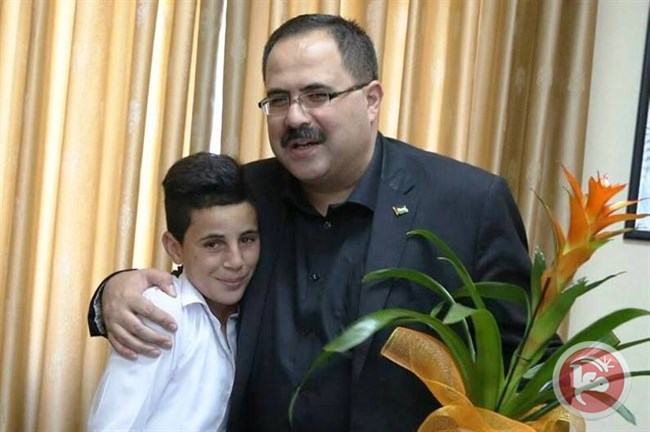
RAMALLAH – Fourteen-year-old Muhammad Fadel al-Tamimi remains in a medically-induced coma as of Tuesday, days after he was hot in the face with a rubber-coated steel bullet by Israeli forces.
The Palestinian teenager, a resident of the central occupied West Bank town of Nabi Saleh, was injured during clashes in his village on Friday.
According to locals, the bullet settled in the boy’s skull after it entered his face below his nose and broke his jaw.
The teenager is currently being held in the ICU of the al-Istishari Hospital in Ramallah.
Al-Tamimi, a former prisoner, was detained when he was 13 years old, and was previously injured several times during weekly clashes in his village.
His cousin, 17-year-old Ahed al-Tamimi, was detained on Tuesday morning by Israeli forces for slapping and kicking Israeli soldiers on the same day that Muhammad was injured.
RAMALLAH – Israeli forces detained a 17-year-old Palestinian girl from the Nabi Saleh village in northwestern Ramallah in the central occupied West Bank on Tuesday morning before dawn.
Israeli forces raided the home of the al-Tamimi family, well-known internationally for their activism against the Israeli occupation, and detained Ahed al-Tamimi, 17.
Israeli forces also confiscated computers, mobile phones and cameras from the house during the raid.
According to locals, Ahed was arrested over a video went viral on social media of her slapping an armed Israeli officer during a raid on Nabi Saleh.
Ahed Tamimi is well-known across Palestine and the Arab world for videos of her, since her childhood, defiantly resisting Israeli soldiers who clash with Palestinians in her village nearly every week.
Two years ago, her family made headlines when an Israeli soldier violently attempted to arrest her younger brother , who had one arm in a cast at the time. Ahed and her mother managed to pull the soldier of her brother and free him.
Israeli military raids into Palestinian cities, towns, and refugee camps are a near daily occurrence.
According to the Palestinian Prisoner’s Society (PPS), since US President Donald Trump’s announcement recognizing Jerusalem as Israel’s capital, Israeli forces have detained 450 Palestinians, including 138 minors, and nine women.
Prisoners rights group Addameer recorded 6,198 Palestinians were detained by Israel as of October. The group has estimated that some 40 percent of Palestinian men will be detained by Israel at some point in their lives.
Samidoun Palestinian Prisoner Solidarity Network – December 20, 2017
Palestinian organizer Bassem Tamimi, a prominent land defender in the village of Nabi Saleh, was seized by Israeli occupation forces – joining his wife, Nariman, and his daughter, Ahed – was also seized by Israeli occupation forces today, 20 December.
He was arrested as he attended the hearing for his daughter Ahed in Ofer military court, where her detention was extended for 10 days for further interrogation. This came one day after both Ahed and then her mother were arrested by occupation forces following attacks on them in Israeli media for protesting and defending their land from Israeli occupation soldiers who had shot another local boy, 14-year-old Mohammed Tamimi, in the head with a rubber-coated metal bullet.
In overnight, violent raids, occupation forces seized a cousin of the family, Nour Tamimi, 21, from her family home in Nabi Saleh. This means that Ahed and both of her parents, Nariman and Bassem – all of whom are leading land defenders in Nabi Saleh – are currently seized by the Israeli occupation forces. … continue
BETHLEHEM – The mother of a Palestinian teenage girl, who was detained from her home by Israeli forces before dawn on Tuesday, was reportedly detained at an Israeli police station when seeking information about her daughter’s whereabouts.
Official Palestinian Authority (PA)-owned Wafa news agency reported that Nariman al-Tamimi was detained by Israeli officers on Tuesday morning at the Benyamin police station, north of Ramallah in the central occupied West Bank.
Nariman was attempting to seek information about her 17-year-old daughter Ahed, who was arrested from their home in the village of Nabi Saleh hours earlier.
The whereabouts of both Nariman and Ahed remained unknown.
The al-Tamimi family is well-known internationally for their activism against the Israeli occupation, with Ahed in particular being the subject of several viral videos in which she defiantly stands up to Israeli soldiers who regularly raid her village in the central West Bank Ramallah district.
Two years ago, the family made headlines when an Israeli soldier violently attempted to arrest Nariman’s son Muhammad , who had one arm in a cast at the time. Ahed and Nariman managed to pull the soldier off of Muhammad and free him.
RAMALLAH – Fourteen-year-old Muhammad Fadel al-Tamimi remains in a medically-induced coma as of Tuesday, days after he was hot in the face with a rubber-coated steel bullet by Israeli forces.
The Palestinian teenager, a resident of the central occupied West Bank town of Nabi Saleh, was injured during clashes in his village on Friday.
According to locals, the bullet settled in the boy’s skull after it entered his face below his nose and broke his jaw.
The teenager is currently being held in the ICU of the al-Istishari Hospital in Ramallah.
Al-Tamimi, a former prisoner, was detained when he was 13 years old, and was previously injured several times during weekly clashes in his village.
His cousin, 17-year-old Ahed al-Tamimi, was detained on Tuesday morning by Israeli forces for slapping and kicking Israeli soldiers on the same day that Muhammad was injured.
It is tempting to interpret the announcement this week of a delay until the new year in US vice-president Mike Pence’s visit to the Middle East as the ultimate travel warning. It follows an eruption of regional unrest over Donald Trump’s recognition of Jerusalem as Israel’s capital.
During protests last Friday, Israeli occupation forces killed four Palestinians and injured more than 250.
US officials, however, are not worried about Pence’s safety. In fact, predictions of a third Palestinian uprising in response to Trump’s Jerusalem declaration may be premature.
After decades of flagrant US bias towards Israel, Trump has confirmed to Palestinians only what they already knew. Some even grudgingly welcomed his candour. They hope he has finally silenced US claims to being an “honest broker” in an interminable “peace process” that has simply bought time for Israel to entrench the occupation.
The Palestinians’ anger towards Israel and the US is a slow-burning fuse. It will detonate at a moment of their choosing, not of Trump’s.
Rather, the hesitation in Washington over the vice-president’s visit reflects the messy new diplomatic reality that the White House has unleashed.
Pence was due here to smooth the path to Trump’s long-promised peace plan and to highlight the plight of Christians in the Middle East. The door has now been firmly shut in his face on both counts. Palestinian officials have declared a boycott of him, as have Christian leaders in Palestine and Egypt.
Instead of cancelling Pence’s visit or exploiting the extra breathing space to try to reverse the damage, the bull-headed Trump administration has indicated it is eager to break more of the china.
Denied access to Palestinian officials, his schedule will focus on Israel. Following a diplomatic precedent set by his boss in May, Pence is due to visit the Western Wall in Jerusalem’s occupied Old City and immediately below the Al Aqsa mosque plaza.
His visit, however, has been billed as “official”, not private. And it will be invested with far graver symbolism, given Trump’s designation of Jerusalem as Israel’s capital.
To add insult to injury, and in contravention of claims that Washington will not pre-determine the borders of a divided Jerusalem before peace talks, an unnamed senior US official gave Pence’s visit an even more troubling context. He noted that there was no scenario in which the US did not see the Western Wall ending up in Israel’s hands.
The US policy change on Jerusalem has been a hammer blow to the three main pillars supporting the cause of Palestinian statehood: the Palestinian Authority, the European Union and the Arab states.
The biggest loser is Palestinian president Mahmoud Abbas. Washington stripped him of his emperor’s clothes: he now heads a Palestinian government-in-waiting that is unlikely ever to be attached to a state, viable or otherwise.
The Arab states, which assumed they were the key to a much-touted “outside-in” strategy, creating a regional framework for peace, have been deprived of the single issue – Jerusalem – that matters most to them.
Egypt scrambled to help Abbas at the weekend by drafting a UN security resolution to rescind any change of status for Jerusalem. But an inevitable US veto made the move moot.
And Europe, which has played “good cop” to the bullying US one, has been exposed as complicit in its partner’s rogue behaviour.
Europe’s predicament is underscored by its peace-making rhetoric. It has long cried wolf, warning that a moment would soon arrive when a two-state solution was no longer feasible, when a temporary occupation morphed into permanent apartheid.
Now that the heart of a Palestinian state has been publicly devoured by the wolf, what will Europe and Abbas do?
The signs are that they will pretend nothing has changed – if only out of fear of what might fill the void if peace-making were exposed as a hollow charade.
But it is precisely the pretence of a peace process that has kept Palestinians chained to an illusion. The perpetuation of false hope about statehood does not benefit Palestinians; it preserves a calm that aids Israel.
That was why the White House accused Abbas of walking away from dialogue last week. But only a fool keeps on appealing to the better nature of a deaf thug.
The burden now falls on the PA, the Arab states and Europe to accept the new reality, and assert a policy independent of the US.
Some Palestinian leaders, like Hanan Ashrawi, already understand this. “Trump’s move is a new era,” she said last week. “There’s no going back.”
Palestinian goals and strategies must be reassessed. Nonetheless, the pressures for a return to the “peace” business as usual will be intense.
Ordinary Palestinians in Jerusalem may be the first to signal the new direction of struggle – one that recognises that a Palestinian state is dead and buried.
In recent years, growing numbers have started applying, as Israeli law entitles them to, for Israeli citizenship. Israel has twisted and turned to delay honouring its commitment, even as it calls Jerusalem its “united capital”.
Palestinians will have to shame Israel, the US and the watching world by adopting the tools of an anti-apartheid struggle – of non-violent resistance and civil disobedience – to gain equal rights in a single state.
At the moment, the undercurrents of Palestinian rage chiefly swirl below the surface. But they will rise in time, and the consequences of Trump’s deed will become all too apparent.
By Michael Hoffman | Revelation of the Method | January 3, 2024
Will the more than 100 Iranians killed by terrorist bombs today be mourned in the West as victims of terrorism? Certainly not. Allied doctrine has it that the killing of Israeli or American civilians is a crime of cosmic proportions, while shedding the blood of “enemy” women and children is perfectly acceptable; indeed commendable.
The West does not memorialize the hundreds of thousands of civilians bombed by the U.S. in Serbia, Iraq, Afghanistan and every major German city 1943-1945. America’s fire-bombing of the city of Tokyo by General Curtis LeMay in March 1945 was followed by Harry Truman’s atomic incineration of Hiroshima and Nagasaki in August of that year. Truman never had a moment of doubt or regret over the murder of more than a 100,000 Asian children, mothers and non-combatant boys and men. It was business as usual for the “noble” Allies during the “Good War.”
In the West human rights signifies passionate concern only for civilians designated as truly human: Israelis first, then Americans and British, followed by their satraps.
This inhumanity is the legacy of Talmudic ideology, beginning with tractate Sanhedrin 57a from 400 A.D., concerning liability for capital punishment: “If a Jew murders a gentile, he is exempt.”
This teaching of contempt was reiterated in the dogma of Chabad Lubavitch founder Rabbi Shneur Zalman in the 18th century. … continue
This site is provided as a research and reference tool. Although we make every reasonable effort to ensure that the information and data provided at this site are useful, accurate, and current, we cannot guarantee that the information and data provided here will be error-free. By using this site, you assume all responsibility for and risk arising from your use of and reliance upon the contents of this site.
This site and the information available through it do not, and are not intended to constitute legal advice. Should you require legal advice, you should consult your own attorney.
Nothing within this site or linked to by this site constitutes investment advice or medical advice.
Materials accessible from or added to this site by third parties, such as comments posted, are strictly the responsibility of the third party who added such materials or made them accessible and we neither endorse nor undertake to control, monitor, edit or assume responsibility for any such third-party material.
The posting of stories, commentaries, reports, documents and links (embedded or otherwise) on this site does not in any way, shape or form, implied or otherwise, necessarily express or suggest endorsement or support of any of such posted material or parts therein.
The word “alleged” is deemed to occur before the word “fraud.” Since the rule of law still applies. To peasants, at least.
Fair Use
This site contains copyrighted material the use of which has not always been specifically authorized by the copyright owner. We are making such material available in our efforts to advance understanding of environmental, political, human rights, economic, democracy, scientific, and social justice issues, etc. We believe this constitutes a ‘fair use’ of any such copyrighted material as provided for in section 107 of the US Copyright Law. In accordance with Title 17 U.S.C. Section 107, the material on this site is distributed without profit to those who have expressed a prior interest in receiving the included information for research and educational purposes. For more info go to: http://www.law.cornell.edu/uscode/17/107.shtml. If you wish to use copyrighted material from this site for purposes of your own that go beyond ‘fair use’, you must obtain permission from the copyright owner.
DMCA Contact
This is information for anyone that wishes to challenge our “fair use” of copyrighted material.
If you are a legal copyright holder or a designated agent for such and you believe that content residing on or accessible through our website infringes a copyright and falls outside the boundaries of “Fair Use”, please send a notice of infringement by contacting atheonews@gmail.com.
We will respond and take necessary action immediately.
If notice is given of an alleged copyright violation we will act expeditiously to remove or disable access to the material(s) in question.
All 3rd party material posted on this website is copyright the respective owners / authors. Aletho News makes no claim of copyright on such material.
 Medics also provided treatment to dozens of Palestinians, who suffered the effects of teargas inhalation.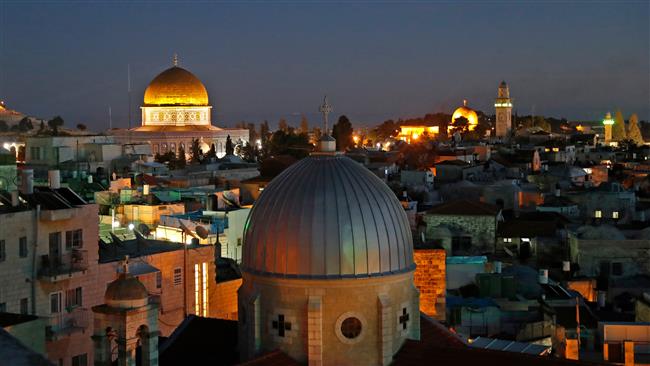
Samidoun Palestinian Prisoner Solidarity Network – December 20, 2017
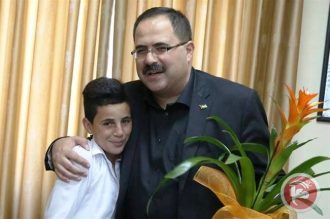 RAMALLAH – Fourteen-year-old Muhammad Fadel al-Tamimi remains in a medically-induced coma as of Tuesday, days after he was hot in the face with a rubber-coated steel bullet by Israeli forces.