Makkah and Madinah imams silent on Jerusalem in Friday sermons
MEMO | December 9, 2017
The Saudi imams of the Grand Mosques in Makkah and Madinah did not mention the situation in Jerusalem and Al-Aqsa Mosque during their Friday sermons, Shehab.ps has reported. Al-Aqsa Mosque in Jerusalem is regarded as the holiest place in Islam after the two Grand Mosques.
Although he did point out that the Kingdom “reiterated the legal rights of the blessed Palestinian people” and hailed King Salman and other Muslim leaders for seeking the best for Islam and Muslims, well-known Shaikh Maher Mu’eqili did not mention the issue of Jerusalem in his Makkah sermon. Shaikh Abdullah Al-Bu’ejan, who delivered the Friday speech in The Prophet’s Mosque in Madinah, did not mention the issue at all. Instead, he discussed God’s miracles in the change of the seasons throughout the year.
In the wake of Trump’s decision about Jerusalem, the Saudi Royal Court ordered the local media not to give the issue wide coverage, Al-Araby Al-Jadeed reported. The Saudi and Bahraini Embassies in Amman also called on their citizens living in Jordan not to take part in the demonstrations organised to protest against the US move.
While the international community has almost unanimously disagreed with Donald Trump’s announcement, reports suggest that the announcement was done with the pre-agreement of Egypt and Saudi Arabia, with Saudi Arabia going as far as, allegedly, stating to the Palestinian President to accept a village on the outskirts of Jerusalem as the alternative Palestinian capital.
Egypt journalists: ‘Sorry Palestine, we are governed by a Zionist’
MEMO | December 10, 2017
Egyptian journalists staged a protest on Thursday evening in front of the Journalists Syndicate in Cairo, objecting to US President Donald Trump’s decision to recognise Jerusalem as the capital of Israel and move the US embassy from Tel Aviv.
A number of public figures took part in the protest, including former presidential candidate Hamdeen Sabahi, human rights activist Tariq Al-Awadhi as well as representatives of the Kefaya Movement, the April 6 Youth Movement and Al-Dustour.
The protesters demanded authorities sever ties with the Zionist entity, expel the Israeli ambassador in Cairo and close the Israeli embassy.
Condemning Arab governments, the protesters chanted: “Arab leaders are cowards… either resistance or treachery” and “down with every collaborator”.
In a bold move, they criticised Egyptian President Abdel Fattah Al-Sisi’s response to Trump’s decision saying: “Sorry Palestine, we are governed by a Zionist.”
Police forces cordoned off the protesters using iron barricades, while riot police were positioned nearby to ensure the demonstration did not spread.
Amr Badr, member of the Journalists Syndicate, described the American decision and said he doesn’t not expect it to be followed through.
In the first official call to boycott US products, the Journalists Syndicate issued a statement which condemned Trump’s decision and called on all Egyptians to boycott American goods.
While the international community has almost unanimously disagreed with Donald Trump’s announcement, reports suggest that the announcement was done with the pre-agreement of Egypt and Saudi Arabia, with the Saudi Arabia going as far as, allegedly, stating to the Palestinian President to accept a village on the outskirts of Jerusalem as the alternative Palestinian capital.
Since the announcement, Saudi Arabia’s royal court has sent notices to the nation’s media outlets to limit the airtime given to protests against Trump’s announcement.
Emboldened by Trump’s annoucement, Israeli housing Minister Yoav Galant decided on Friday to promote a plan to build 14,000 new settlement units in the occupied Jerusalem.
Read also: Makkah and Madinah imams silent on Jerusalem in Friday sermons
Lebanon proposes anti-US sanctions over embassy move
Press TV – December 9, 2017
 Lebanon’s foreign minister has told an emergency Arab League meeting that imposing economic sanctions should be considered against the US over its embassy relocation move.
“Preemptive measures (must be) taken against the decision… beginning with diplomatic measures, then political, then economic and financial sanctions,” said Gebran Bassil during an Arab Lague meeting held in Cario on Saturday.
US President Donald Trump on Wednesday defied global warnings and said Washington formally recognized Jerusalem al-Quds as the “capital” of Israel and would begin the process of moving its embassy to the occupied city, breaking with decades of American policy.
“Could this calamity bring us together and wake us from our slumber? Let it be known that history will never forgive us and our future will not be proud of what we have done,” added Bassil.
Arab League chief Ahmed Aboul-Gheit also called on world nations to recognize the State of Palestine with East Jerusalem al-Quds as its capital.
He added that Trump’s decision raised a question over Washington’s role as a peace mediator, not just in Palestine but the whole world. “The decision amounts to the legalization of occupation,” he added.
“The decision by the US administration is in its essence legitimizing the occupation and admitting and allowing their stance by force. It is a waste of international legitimacy and the principles of justice, and therefore has placed he who took (the decision) in a state of conflict with the collective will of the international community,” he stressed.
Palestinian Foreign Minister Riyad Al-Maliki called on members of the league to instruct their UN envoys to submit a draft resolution to Security Council to condemn Trump’s decision, which “betrays its hostility and bias against the Palestinian people.”
He also called on world nations to recognize the State of Palestine with East Jerusalem al-Quds as its capital.
“I expect from you to commission the Arab block (in the Security council) to immediately act in presenting a draft resolution to the security council that rejects this American decision. We also call upon all Arabs in light of this American decision that challenged, not only Arabs and Muslims, but the world as a whole, to quickly visit Jerusalem, so as not to leave it as a victim to the American decision and Israeli threat,” he added.
Jordanian foreign minister also stressed that there will be no peace and security in the region unless Jerusalem al-Quds is free.
“We want peace as a strategic option, which we demand for all of the region’s peoples completely and indefinitely. However, there will be no peace without a free and independent Palestine, there will be no peace unless Jerusalem is free, and is the capital of Palestine,” said Ayman Al Safadi.
Meanwhile, Palestinian President Mahmud Abbas’s diplomatic adviser said that Abbas will reject to meet US Vice President Mike Pence during his scheduled visit to the region later in the month.
“There will be no meeting with the vice president of America in Palestine… The United States has crossed all the red lines with the Jerusalem decision,” he added.
Clashes between Israeli security forces and Palestinian protesters in al-Quds continued on Saturday over the Trump administration’s divisive decision.
Palestinian protestors threw objects at Israeli soldiers and set trash cans on fire, while others held guns to the head of an effigy of Trump, before burning it.
The First Intifada: Nostalgia

Palestinian women confront Israeli soldiers during the First Intifada [Facebook]
Nadia Naser-Najjab | MEMO | December 9, 2017
This month marks the 30th anniversary of the First Intifada, an event which fundamentally altered the profile and trajectory of the Palestinian national struggle against occupation. It shifted political leadership away from the exiled Palestine Liberation Organisation (PLO) leadership, reconfigured local political arrangements and, most crucially, challenged the Israeli occupation at its weakest and most vulnerable points.
However, its full significance has not been, to my mind, sufficiently acknowledged, whether by international observers or by younger generations of Palestinians. This is unfortunate, as the Intifada is not purely an historical event – in my view it has much to contribute to discussions that relate to the conceptual framing, theorisation and tactics of contemporary resistance. This article does not, however, propose to engage at any of these points. It has instead been conceived and developed as a personal account which is grounded within my own perspectives and experiences.
In the late 1980s, I lived in the village of Burqa, which is close to Nablus, in the northern West Bank. My home village – like the rest of the West Bank and the Gaza Strip – had been subject to Israeli occupation for two decades. At the time, the wider world knew little of this reality: insofar as it engaged with the Palestinian “question”, it tended to fixate upon the diaspora refugee communities who had been at the forefront of the Palestinian struggle in Lebanon and Jordan. In the aftermath of the Oslo Accords, this emphasis was inverted. The Occupied Palestinian Territories (OPT) became the focus of international attention and Palestinian refugee communities became, at best, a secondary preoccupation.
For Palestinians in the OPT, there was no possibility that they could be similarly blind to the occupation, whose curfews and collective punishments imposed themselves upon almost every aspect of everyday life. Refuge could not be sought in political quietism: the occupation did not distinguish between the politically active and apathetic. Indeed, this was one of the main oversights of the occupation: it politicised ordinary Palestinians by making resistance an imperative which weighed equally upon every Palestinian man, women and child. My own parents, who had previously shown little inclination to join in revolutionary activities (quite the contrary – they tried to dissuade me and my sisters from participating), joined a protest after Israeli soldiers killed a ten-year-old boy who was playing in his backyard in my home village.
Looking back, I remember how, in imposing collective punishment upon my home village, the Israeli occupiers forced all adult males to congregate in the school courtyard. They made little allowance for age, seniority or status: teachers and doctors were forced to run around while shouting senseless and random words like “tomato” and “potato”. They were sometimes detained for more than six hours, and were not allowed to use the toilet or speak to each other during that entire time. Fathers, brothers, relatives and neighbours were deliberately humiliated in front of each other.
The occupiers inflicted this treatment on my own father. One day, soldiers told him to bring down a Palestinian flag which activists had placed on top of an electricity pole. He was over 60. When he told the soldiers this and tried to make them see how difficult it would be for him to climb the pole, they refused to accept his “excuse” and threatened him with violence if he did not obey. He also knew that if he refused, his ID card would be confiscated and he would have to travel to the military offices in Nablus and wait for hours or even days to get it back.
Israeli soldiers did not therefore always have to resort to direct violence. More often than not, this was unnecessary. In the OPT, violence was an implicit undertone, ever-present in the background. During one prolonged curfew, my sister sneaked out to visit my aunt, who lived around a ten minutes’ walk away. She did not encounter a single Israeli soldier. The Israeli army knew full well that their orders and directives did not require direct enforcement.
This suddenly changed when the First Intifada broke out on 9 December 1987. Yitzhak Rabin declared an “Iron Fist” policy to tame Palestinians, and a man who would later be near-universally venerated as a “dove” of peace openly called upon Israeli soldiers to “break the bones” of Palestinian protestors. This violence also took other forms. Birzeit University, an important centre of popular resistance and struggle, was forced to close. A number of students (myself included) were prevented from graduating on time.
While Rabin’s actions said much about his own considerable capacity for violence and intransigence, they said an equal amount about the settler-colonial mentality. In adhering to its guiding tenets, Israel’s political-military establishment believe that Palestinians cannot be engaged with as equals. Instead, it is more appropriate to engage with “them” with treatment commensurate to their level of personal and social development. Violence presents itself as an appropriate mode of conduct at this point.
While the Israeli political-military establishment continually endeavours to gain insights into the mindset of its Palestinian adversaries, it appears to be structurally predisposed to underestimate Palestinians and their capacity for collective organisation and mobilisation. In other words, the influence of Zionism’s implicit racism and ethnocentrism invariably frustrates the initial aspiration to understand. It is true that the PLO leadership had been similarly blind to the possibilities of mass mobilisation. However, as Frantz Fanon observes, the colonised “…is overpowered but not tamed; he is treated as an inferior but he is not convinced of his inferiority”.
The profound flaws within this misconception were clearly exposed when the United National Leadership of the Uprising (UNLU) took control of what was initially a spontaneous outburst of popular anger and resentment and turned it towards clear ends and purposes. The Intifada rapidly coalesced into a disciplined, broad-based and democratic uprising that was focused upon clear ends and objectives. The uprising became a source of immense pride for Palestinians, and it was characterised by a sense of self-sacrifice and commitment to the wider struggle. Patriotic poems were smuggled from prisons; Palestinian musicians composed Intifada songs, and their tape cassettes helped to raise Palestinian spirits. Sharif Kanaana, a professor at Birzeit University, collected what became known as “Intifada jokes”. He noted that there was a clear difference between jokes told in the pre-Intifada period and those told after it. In the latter instance there was a stronger sense of defiance, and the humour was invariably at the expense of the occupying power.
When the Israeli army closed schools, the popular committees created home schools. When these home schools were then banned, Palestinians continued to operate them underground. One father, whose furniture and television set were confiscated after he refused to pay the occupation tax, spoke of how his son had told him not to protest on his own behalf. He refused to grant the Israelis this minor victory. His son said: “I don’t want to watch cartoons. Do not ask them to keep it.” When I joined solidarity visits to the injured at Al-Makaseed Hospital I was struck by the pride and defiance that shone in the eyes of the injured.
In the current context devoid of any real sense of purpose, it is unsurprising that Palestinians should look back on the Intifada as a “golden age” of Palestinian struggle. However, there is a clear danger that these recollections will romanticise the uprising. It is crucial not to fall into this trap. After all, the Intifada was not entirely cohesive (there were ongoing tensions between the UNLU, the PLO and Hamas) and it could be argued that it was ultimately a failure – after all, its main contribution proved to be the abortive Oslo Accords.
These limitations do not detract from the essential fact that the Intifada has a perhaps unparalleled significance in the history of the occupation, standing apart as the point at which Palestinians gathered the strength and collective sense of purpose which enabled them to confront an occupation which had imposed itself upon Palestinian society for two decades. It will always remain a source of pride for Palestinians, and will always to some extent reside at the level of imagination. In reflecting back upon it, Palestinians should take pride in its many achievements but also resist the temptation to idealise or romanticise. If this caveat is taken into account, then there is every reason to suppose that looking back will produce concrete benefits in the present.
Read also: 250,000 Palestinians injured since First Intifada
Catholic University of Leuven announces it will not continue participation in LAW-TRAIN
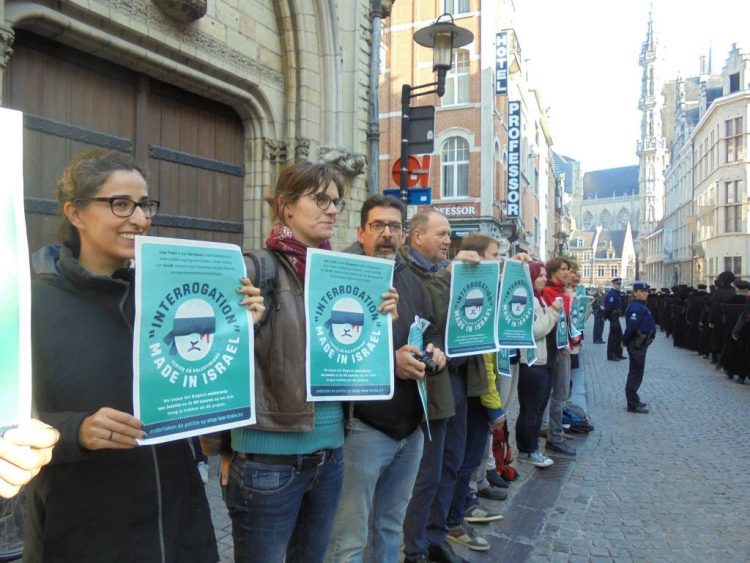
Photo: Pour la Palestine, Facebook
Samidoun Palestinian Prisoner Solidarity Network – December 7, 2017
Following a wide campaign by a faculty action group, student organizers and a variety of community organizations, the Catholic University of Leuven in Belgium (KULeuven) announced that it will not continue future participation in the LAW-TRAIN project, a joint cooperation program with the Israeli police to study interrogation techniques, funded by the EU under the Horizon 2020 program.
Newly elected KULeuven rector Luc Sels released a statement on Wednesday, 6 December stating that no follow-up projects will be pursued in the future, because “The Israeli Ministry of Public Security’s participation does indeed pose an ethical problem in view of the role played by this strong arm of the Israeli government in enforcing an unlawful occupation of the Palestinian territories and the associated repression of the Palestinian population.” While the statement commits to continue the current project until the end of April 2018, it also calls for the creation of a human rights charter to govern the assessment of future proposed projects to avoid such situations.
This is the latest achievement of the international campaign against LAW-TRAIN. The project seeks to develop software to simulate interrogations in a hypothetical international drug trafficking case. The involvement of the Israeli police, headquartered in occupied Jerusalem and including the Border Police that regularly enforce occupation against Palestinians, engage in mass arrests and killings of Palestinians, and are an integral part of the occupation security forces, has sparked resistance to the program in several countries, among activists, scholars and lawyers who note that the program produces a European license for Israeli torture and abuse.
The Israeli police are also known for the use of torture during interrogation as well as the arrest, interrogation and violation of the human rights of Palestinian children. The Israeli police and Tel Aviv University are partners in the project with the Belgian federal police and prosecutor’s office as well as KULeuven and the Spanish Guardia Civil.
Earlier, Portugal was also a partner in the project, but pulled out citing budgetary issues after an extensive and successful campaign by Portuguese and Palestinian organizations highlighting the project’s clear links to human rights violations and the torture and imprisonment of Palestinians. Over 40 Belgian organizations – including Samidoun – joined the campaign to stop LAW-TRAIN, working hand in hand with a campaign on the university’s campus to bring an end to the project and future such collaborations.
Thousands of Belgians signed a petition to stop LAW-TRAIN, while on the university’s campus, dozens of academics participated in protests and appeals, including an intervention in the annual opening academic procession by gowned professors who presented the rector with a cake and the petition signatures. The Leuven academics’ working group on Palestine led campaigns within the University on scholarly and human rights grounds, and the LAW-TRAIN issue was made a significant one on campus, including leading up to the election of Sels as the university’s new rector earlier in 2017.
Students on campus joined with faculty to hold campus protests, including a street theater action highlighting the realities of interrogation and the human rights abuses of the Israeli police. LAW-TRAIN was a major focus of Israeli Apartheid Week 2017 on Belgian campuses, which highlighted the situation of Palestinian prisoners and featured a number of talks and presentations by French-Palestinian lawyer and former political prisoner Salah Hamouri, currently jailed once more without charge or trial by the Israeli occupation.
Protests in Leuven, Charleroi and elsewhere highlighted LAW-TRAIN as human rights experts urged not only the university but also the Belgian Ministry of Justice to immediately pull out of the program. A delegation of Belgian lawyers and human rights scholars traveled to Palestine to investigate torture by the Israeli police and published an open letter upon their return, urging Belgium to withdraw from the project. In addition, hundreds of Belgian academics and cultural workers joined an open letter organized by BACBI, the Belgian Campaign for Academic and Cultural Boycott of Israel, calling on the government to “withdraw the Belgian Ministry of Justice from this highly contentious project. Such a withdrawal would signal to the Israeli politicians that Europe, and especially Belgium, will no longer tolerate the misdemeanors of their order and security forces against the Palestinian population.”
Samidoun Palestinian Prisoner Solidarity Network congratulates the Leuven faculty and students and all organizations that have worked on this campaign in achieving this important step from KULeuven. We redouble our call upon the Belgian ministry of justice, federal prosecutor’s office, and police, as well as the Spanish Guardia Civil, to immediately withdraw from this project and to the European Union to end its funding of such programs in collaboration with the Israeli occupation and its security forces. Such programs are an attempt to legitimize the very forces that daily carry out repression, torture and colonization and maintain apartheid and occupation against the Palestinian people. Participation in or funding of LAW-TRAIN or similar programs means direct complicity in the torture and imprisonment of Palestinians. It is long past time to hold the Israeli state accountable and subject it to boycott, divestment and sanctions for its flagrant, decades-long violations of fundamental Palestinian rights, rather than provide it with funding and support that allows it to continue its deadly and devastating attacks on the Palestinian people and their rights with impunity.
Tayseer Khaled Calls for Boycott of US Goods

IMEMC News & Agencies | December 7, 2017
Amid controversy over the US decision to move their embassy to Jerusalem, PLO Executive Committee member, Tayseer Khaled, published a press release calling for an international campaign in the Arab, Islamic and Friendly States to boycott US goods.
The press release stated the following, according to the PNN :
“Tayseer Khaled , the PLO Executive Committee member, Head of the Palestinian Expatriate Affairs Department called on the Political Organizations, Trade Unions, Youth and Women Organizations and other Civil Society Organizations in Arab, Islamic and friendly countries to launch an international campaign to boycott American goods in support for Jerusalem, a response to the American insulting against our people, and for every unwise political step taken by the American Administration aimed to change the Legal and political Status of East Jerusalem, as an integral part of the occupied Palestinian Territories in June 1967, whether through moving the US Embassy from Tel Aviv to Jerusalem or recognize Jerusalem as the capital of the Israeli Occupation State.”
Khaled added that US President Trump’s administration acts viciously with the Arab and Islamic countries, and it neither gives attention to the Arab public opinion, nor to international law and the legitimacy resolutions related to the Palestinian – Israeli conflict.
Moreover, he said, it neglects the UN Security Council resolutions on Jerusalem, of which begins with resolution 215, issued on May 2nd, 1968, that denounces the Israeli Military Parade in Jerusalem, through resolution no. 476, issued on June 30th, 1980, which nullifies the Israeli measures to change the features of Jerusalem, then resolution no. 478 of Aug. 29th, 1980, which calls for non-recognition of the Israeli law on Jerusalem and the withdrawal of all the diplomatic missions from the city, as well as resolution no. 2334 on Dec. 23rd 2016, which affirms that the construction of settlements in the occupied Palestinian territories since June 4th, 1967, including East Jerusalem, is illegal, and demands it to ban all settlement activities. Furthermore, he stated that Israel doesn’t respect the advisory opinion of the International Court of Justice on the Apartheid Wall or its painful consequences on the occupied West Bank, the status quo in Jerusalem and its surroundings, and opposes the Israeli claims and annexation laws issued by the Knesset, and announced that East Jerusalem is, in fact, an occupied city, adding that Israel is obliged by international humanitarian law and international law, in general, to ensure free access to the holy sites under its control.
At the Palestinian level, Khaled called for uniting efforts to encounter any American step aimed at undermining the legal and political status of Jerusalem, and to stop dealing with the US administration as a qualified mediator to achieve a political settlement to the Palestinian – Israeli conflict. He insisted the US administration be informed that Palestinians are free of such obligations or understandings with, which propose discriminatory rules of conduct to the Palestinians that are restricting their right to go to the UN international bodies and agencies to apply for their membership, as is the case with the World Health Organization (WHO), the International Labor Organization (ILO), and the Food and Agriculture Organization (FAO) and others, or to apply to the International Criminal Court (ICC) to investigate Israel’s violations of Palestinian human rights under occupation, and to investigate war crimes and settlement crimes, which Article (8) of the Rome Statute regards as a war crime.
(photo: hadfnews.ps)
An illegitimate capital for a state without legitimacy

By Ibrahim Hewitt | MEMO | December 7, 2017
It should come as no surprise that Donald Trump has declared that the US is recognising Jerusalem as the capital of Israel. For seasoned US-Israel watchers, it merely confirms what we have been saying for decades: Washington is no honest broker in negotiations to end the Palestine-Israel conflict. Quite the opposite, in fact; it has ensured that the odds have been stacked in Israel’s favour and turned a blind eye to its contempt for international law — which Trump clearly shares — even while its brutal military occupation has stolen ever more Palestinian land throughout the seven decades since 1948.
US recognition of Israel’s self-declared capital has no legal basis. The 1947 UN Partition Plan for Palestine, upon which Israel largely bases its international legitimacy, had three components: “Independent Arab and Jewish States and the Special International Regime for the City of Jerusalem”. Only one of these has come into being, primarily because Israel and its backers haven’t allowed the others to happen. What’s more, although the borders of the “Arab and Jewish States” were set out clearly by the UN, Israel took possession of more than its allocation, including West Jerusalem. It took the rest of the city in 1967 along with the remaining land designated for the “Arab State”, and went on to annex the Holy City; this has never been recognised by the rest of the world and, legally, Jerusalem remains “occupied territory”, as do the West Bank and Gaza Strip.
Hence, if we are to be accurate, whenever we discuss the Israeli occupation, this should refer to the West Bank, Gaza Strip and other land now accepted to be part of Israel which it has occupied since the 1949 Armistice. While paying lip-service to the UN Partition Plan for its own legitimacy, Israel continues to ignore the terms of the resolution in almost every respect. A glance at the “Disappearing Palestine” maps confirms this unpleasant fact on the ground.
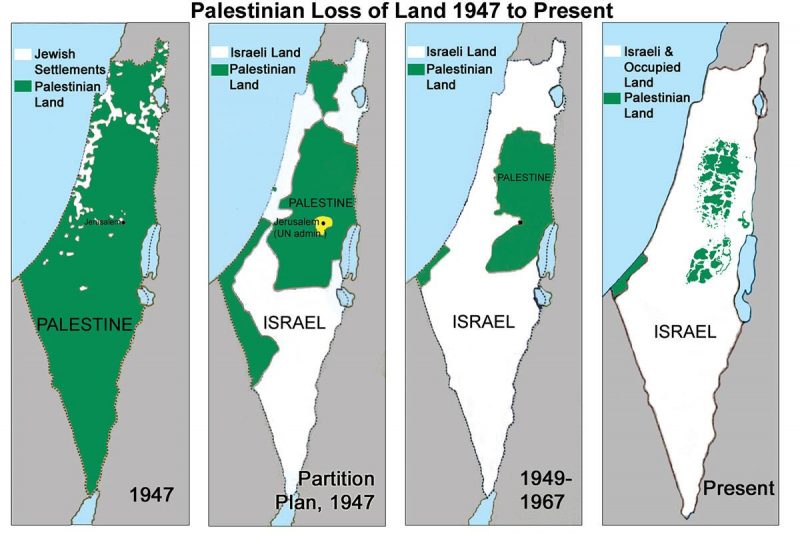
Ignoring the UN is the norm for Israel; it has violated 28 UN Security Council Resolutions — which are supposed to be binding on UN member states — and ignored at least 40 non-binding General Assembly Resolutions. There is a strong case for throwing Israel out of the UN, given such a record and the fact that its membership in the first place was dependent on allowing Palestinian refugees to return to their homes. This has never been permitted by Israel, and the UN has been unable or unwilling to enforce the will of the international community.
In part, of course, this is because of the diplomatic protection given to Israel by the United States, which has used its veto in the Security Council to block resolutions critical of Israel at least 40 times since 1972. It also reflects the impotence of Europe in the face of whatever power the pro-Israel lobby has over its politicians. European guilt over the Holocaust, perhaps? Or something more mundane, such as electoral influence and donations? Or maybe a combination of the two.
Whatever it is, we can’t pin the blame entirely on Trump and the US; European complicity has also played a role in allowing Israel to act with impunity, as has the collaboration of the Palestinian Authority in what President Mahmoud Abbas has called its “sacred” security cooperation with the occupying state. Indeed, as is now becoming clear, it seems as if major Arab countries have been involved in their own, under the radar, collaboration with Israel by establishing now very open links with the Zionist state.
It is hard to know at the moment if Trump actually understands what impact his move on Jerusalem will have on the people in the region. None of us knows for certain, of course, but it doesn’t take a genius to work out that the prospects for a just peace are now even more remote. A peace of sorts could be imposed by brute force, no doubt, but it would never be based on justice; and it would never last.
Do the US President and his right-wing supporters care about this? Probably not. America’s Christian Zionists largely back him to the hilt, and they aren’t interested in peace; they see the establishment of the state of Israel and the “incoming of the exiles” (the Jews) as an essential prelude to the second coming of Jesus and “the rapture”; ultimately, in fact, the end of the world. The late Grace Halsell explained this thinking in her 1999 book “Forcing God’s Hand”. Israel exploits this through its lobby groups around the world to gain political, military and economic support.
What effect will Trump’s declaration have on the Palestinians for whom Jerusalem is home? Will Israel complete the ethnic cleansing of the city by forcing them out and bringing their complete ethnic cleansing a step closer? With the US watching its back, it is perfectly feasible that the far-right government of Benjamin Netanyahu will feel emboldened enough to do this.
Another option would be for the Jerusalemite Palestinians to be offered Israeli citizenship, but that would upset those who already see Israel’s 20 per cent non-Jewish citizens as a democratic threat to the “Jewish State”. The likelihood, therefore, is that Israeli Apartheid will simply be entrenched further and those Palestinians left in occupied Jerusalem will face yet more discrimination at the hands of an overtly racist government.
Pro-Israel lobbyists are forever bleating that the campaign for justice for and by the Palestinians seeks to “de-legitimise” the state, but they have yet to explain with any credibility the validity of its credentials; in truth, there is none. Israel’s latest poodle in Washington has now recognised an illegitimate capital for a state without legitimacy.
Moreover, Israel has become a rogue state par excellence; not only is its star rising— for now — but it has also been incredibly successful in convincing the major powers in the world that it is the innocent victim in all of this. However, it is no longer surrounded by hostile states; the “self-defence and security” excuse for its vile occupation and military offensives against Palestinian civilians is unravelling as Saudi Arabia and the UAE join Jordan and Egypt in tying their camels and putting their trust in Tel Aviv.
Israel is ticking the boxes on its wish list. The battle for Jerusalem appears to have been won. After incessant Jewish colonial-settler incursions into the Noble Sanctuary — which will be viewed in the future as its initial skirmishes — the battle for Al-Aqsa Mosque, the heart of the Palestinian and Muslim presence in the Holy Land, may well be about to start in earnest. Recognition of Jerusalem as Israel’s capital is just the beginning. The next target will be to occupy and demolish Al-Aqsa and the Dome of the Rock Mosques and build a temple in their place. The blueprints for this are already prepared.
With the villain of the piece portrayed as the victim — poor little Israel — and those with international law and justice on their side demonised as wrongdoers, the days of the False Messiah may well be upon us. Anyone for Armageddon?
@ibrahimhewitt56
House passes bill about Taylor Force, ignores 34 other Americans who were killed by Israel
By Kathryn Shihadah | If Americans Knew | December 7, 2107
On Tuesday, the U.S. House of Representatives overwhelmingly approved the Taylor Force Act (text here), a bill that reduces funding to the Palestinian Authority. The bill next goes to the full Senate, where it is expected to pass.
The Taylor Force Act is named for U.S. army veteran Taylor Force, who was killed by a Palestinian in Tel Aviv in March, 2016 while Force was visiting Israel as part of a Vanderbilt University MBA program.
The bill targets the PA’s so-called “pay-to-slay” policy which Israel believes incentivizes terrorism, and would strip the PA of much of its US aid if local officials can not certify that they have stopped making these payments.
Nathan Diament, executive director for public policy of the Union of Orthodox Jewish Congregations of America, commented on the unanimous approval of the Taylor Force Act, calling it
a giant step toward ending the Palestinian Authority’s grotesque practice of ‘pay-for-slay.’ This system of encouraging and incentivizing terrorism has gone on for far too long, and the Taylor Force Act is a critical step toward ending this murderous scheme.
Diament’s statement is problematic.
First of all, the word “practice” implies that Palestinians are regularly killing Israelis and Americans. This is decidedly not the case.
In fact, since January of 2009, Palestinians have killed 168 Israelis, while Israelis have killed 18 times more Palestinians—a total of 3,143. In 2016, the year of Taylor Force’s untimely death, 16 Israelis died at the hands of Palestinians and 110 Palestinians—many posing no threat whatsoever—died at the hands of Israelis. If any group has a “grotesque practice” of killing, perhaps it is not the Palestinians.
Diament’s “pay-for-slay” phrase is also both inaccurate and offensive.
The family of Taylor Force’s killer did indeed receive a stipend after his death, as have the families of other terrorists. Such financial assistance is often crucial since Israeli forces demolish their family homes, even though the slayer’s children, wife, nieces and nephews (these homes are usually inhabited by extended families) had nothing to do with their violent action.
Most of the world has a practice of paying a “death gratuity” to the families of service members killed or injured in the line of duty. The US does; Israel does too. Both Israeli and U.S. forces have killed numerous civilians, yet families of fallen soldiers still receive funding.
The Palestinian Territories are forbidden from having armed forces: their resistance against the occupation is carried out by civilians. In the event of death, injury, or imprisonment, their families face the same financial struggles any service member’s family would face, and the Palestinian Authority provides for them.
Qadora Fares, who works with the system, explains, “This is a kind of social protection for the family. The children of the prisoners and martyrs and wounded have the right to go to schools, hospitals and get food.”
Moreover, the vast majority of recipients of payments in this program are made to families not of attackers, but of victims. Children injured by stray bullets while walking to school, young men detained while participating in a peaceful demonstration, husbands killed while sitting on their front porch – anyone killed, injured, or imprisoned as a result of Israel’s brutality.
“Straining out gnats, swallowing camels”
But the greatest problem with Diament’s statement—and many like it—is the hypocrisy behind it. It is absurd to suggest that the Palestinian Authority has a problem with violence and needs to be cut off financially from American aid, while Israel, which receives approximately one hundred times more aid ($3.1 billion/year vs. $363 million), is responsible for a significantly higher number of deaths (see above, and here, for example).
Israel and pro-Israel organizations say they care deeply about the death of American ex-serviceman Taylor Force at the hands of an outlaw Palestinian, but would rather not discuss the USS Liberty, in which 34 innocent American servicemen died and 174 were wounded by our “closest ally,” Israel.
Israel’s Arutz Sheva news organization reports “Jewish groups welcome Taylor Force Act,” noting that AIPAC (the American Israeli Public Affairs Council; the Union of Orthodox Jewish Congregations of America (OU), “the nation’s largest Orthodox Jewish umbrella organization;” and the American Jewish Congress all lauded the legislation. The ADL (Anti-Defamation League) also applauded the bill.
If Americans Knew contacted these organizations to ask whether they also supported USS Liberty survivors, but did not receive replies. The ADL opposed a billboard near New Haven, Connecticut billboard honoring Liberty veterans; a similar billboard honoring Liberty veterans in New Bedford was taken down when the company received complaints from Israel partisans. It would appear that only certain service members’ deaths matter to these organizations.
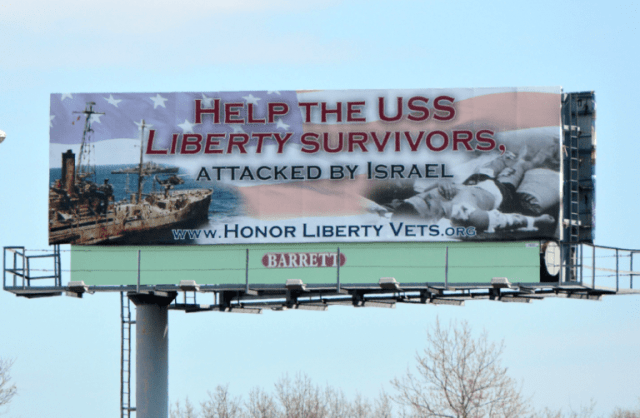
Hypocrisy is alive and well in the US Congress too.
Our lawmakers – the same ones who rallied behind the Taylor Force Act – were silent about other Americans who were killed and maimed in Israel and refused to investigate the USS Liberty incident. When a Palestinian is at fault, we punish; when Israel is guilty, there is no accountability. We look the other way.
Our Senators and Representatives know full well how much money they have approved to be sent to Israel – no strings attached – year after year. They know how much is spent on advanced weaponry for use on an essentially unarmed Palestinian population. Our Congressmen and Congresswomen should know that occupation is illegal, but resistance to occupation is a legal right according to the Fourth Geneva Convention. Consequently, Israel should cease and desist its occupation, rather than expecting the Palestinians to cease and desist from their resistance against the occupation.
Instead of bowing to AIPAC and punishing the Palestinians for the violent actions of a a rogue young man with no terrorist affiliation against a young American man, Congress should assess the actual damage in Israel and the Occupied Palestinian Territories and stop footing the bill for the ongoing murder of Palestinians.
Kathryn Shihadah is a staff writer for If Americans Knew
Related Reading:
The Legitimacy of Compensation for Family Members for Palestinians Killed, Injured, and Imprisoned
Instead of Taylor Force Act, Congress should consider Rachel Corrie Act, Orwah Hammad Act
Imprisoned Human Rights Defender in Military Court

International Solidarity Movement | December 6, 2017
Tomorrow, Abdullah Abu Rahmah will be taken once again in front of a military judge. He is being accused of “Causing damage to a military installation,” referring to Israel’s illegal Annexation barrier built on his village’s land.
Abdullah stated, “The occupation has used many methods including killing, injuring, and raiding our homes in order to stop us from exercising our right to protest and struggle against the occupation. But we will not stop struggling until the occupation is dismantled.”
Abdullah, a leading non-violent activist and human rights defender has has been held in military prison since the occupation forces raided his village, Bil’in, and took him from his home in the middle of the night on the 19th of November, 2017. Abdullah was handcuffed, gagged and his hands were tied to the roof of the jeep. Since then, two military judges have conceded that Abdullah is not dangerous and should be released on certain conditions, but the military prosecution is intent on making sure he remains in detention, and has continued to hold him without regard to due process. Tomorrow’s hearing will be to determine if Abdullah has broken conditions set for his release by a military judge after his arrest from the Alwada Cycling Marathon on Nakba Day, the 13th of May, 2016.
Abdullah has been arrested and injured many times in the past for his role in promoting non-violent creative protest in his own village of Bil’in and across the West bank. In 2010, Abdallah served 16 months in prison after being convicted on charges of “incitement” and “organizing and participating in an illegal demonstration.” Abdullah continued to advocate for nonviolent action and Human rights from prison.
In addition to Abdullah, 16 year old Ahmad Abu Rahmah, as well as Ashraf Abu Rahmah, another prominent Bil’in activist, were also taken and are still being held by the military. Ahmad Abu Rahmah was arrested with Abdullah in the raid and accused of throwing stones, as was Ashraf, following his arrest on the 14th of November 2017. Ashraf’s two siblings, Basem and Jawaher, were both killed in separate incidents while nonviolently protesting the illegal wall constructed on their land.
Khamenei: Palestine will at last be freed
Press TV – December 6, 2017
Leader of the Islamic Revolution Ayatollah Seyyed Ali Khamenei says the Muslim world will stand against a US plot to declare Jerusalem al-Quds as Israel’s “capital,” stressing that Palestine will eventually be freed from occupation.
Speaking on Wednesday on the occasion of the birth anniversary of Prophet Muhammad (Peace be upon Him), Ayatollah Khamenei stated, “Palestine today tops the political issues facing the Islamic Ummah and everyone is duty-bound to make endeavors towards its freedom and salvage.”
The Leader made the remarks in an address to state officials, ambassadors of Muslim countries and participants at the 31st International Islamic Unity Conference underway in Tehran.
Ayatollah Khamenei said that the enemies’ plan to recognize Jerusalem al-Quds as the “capital” of the Israeli regime stems from their “incompetence and despair.”
“The Muslim world would undoubtedly stand against this conspiracy and the Zionists will be dealt a heavy blow with this move and dear Palestine will at last be liberated without doubt,” he added.
US President Donald Trump is expected to announce the recognition of Jerusalem al-Quds as the Israeli “capital” and move Washington’s embassy from Tel Aviv to the occupied city.
The US bid has drawn a wave of condemnations from various countries and international bodies, which are warning of the repercussions of such a measure across the region.
Elsewhere in his comments, Ayatollah Khamenei described the US, the Zionist regime and the reactionary elements as well as those tied to big powers as “today’s Pharaohs,” noting that they are trying to sow divisions and pit Muslim nations against each other.
“Some US politicians have wittingly or unwittingly acknowledged that a war should start in the Western Asia region in order to provide the Zionist regime with a margin of safety,” the Leader said.
He also expressed deep regret over some regional rulers’ adherence to US demands, warning those serving the oppressors that their stance would be to their own detriment.
The Leader referred to “resilience” as the key to counter vicious Takfiris, who are the proxies of the US and Zionism.
The enemies’ ultimate goal of creating Takfiri groups was to spark a war between the Shia and Sunni Muslims, Ayatollah Khamenei stated.
‘Quds belongs to Islam’
Prior to the leader’s address, President Hassan Rouhani said in a speech, “Quds belongs to Islam, Muslims and the Palestinians, and there is no room for new adventurism by global arrogance.”
He also emphasized that Muslims, including Palestinians, should stand up against the conspiracy to declare Quds as the Israeli “capital,” saying Muslim states and the Organization of Islamic Cooperation (OIC) have a great responsibility in that regard.
DOUBLE STANDARD: The Hill refuses to publish column about USS Liberty
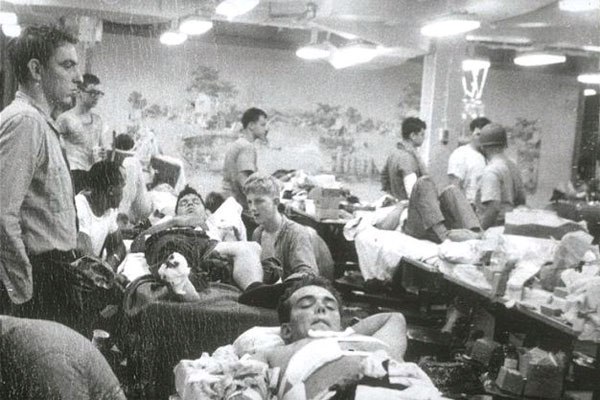
USS Liberty crew members attacked by Israeli forces on June 8, 1967. Over 170 were wounded and 34 killed. This is reportedly the most decorated crew for a single engagement in US Naval history.
If Americans Knew | December 5, 2017
The Hill, a major Washington DC publication, published a guest column on November 15th entitled “Passing the Taylor Force Act Will Mark a Vital Step in the War on Terror.” The column called for the U.S. government to stop payments of $300 million aid to Palestinians, based on the murder of an American serviceman by a Palestinian individual who was unaffiliated with the Palestinian Authority, Hamas, or any other Palestinian organization. (Info here.) The authors of the column were officials of the pro-Israel advocacy organization JINSA (Jewish Institute for National Security of America)
In response to that column, Marine veteran Geoffrey ONeill submitted a column suggesting that the $3.8 billion given by the U.S. government to Israel be suspended, based on the Israeli military’s killing of 34 American servicemen, injuring of 173+ American servicemen, and attempt to sink a US Navy ship with all men aboard. (Info here.)
The Hill would not publish that column. Below is O’Neil’s rejected article:
Cut off aid to Israel for killing American servicemen
By Geoffrey ONeill
This is a response to an article in The Hill recently titled “Passing the Taylor Force Act Will Mark a Vital Step in the War on Terror” by authors Michael Makovsky and Mark Fitzgerald. The authors are calling for the U.S. government to stop payments of $300 million dollars to Palestine based on the murder of American serviceman, Taylor Force by a Palestinian. While I condemn gratuitous violence, particularly murder committed by anyone on another person and would, if given a chance, express my condolences to the family of Taylor Force, I find it ironic that the authors would express such outrage of a murder committed by a Palestinian of ONE American serviceman. Perhaps the authors need be reminded of an act of terror committed years ago on an entire crew of American servicemen in international waters off the coast of the Sinai Peninsula on JUNE 8, 1967. It might put their outrage and demands in a different perspective. Of course I am referring to the unprovoked, ruthless attack by the IDF on the USS Liberty.
On that bright clear day, after surveilling the ship several times, with the American flag in plain view, the IDF attacked the Liberty killing 34 of its crew and wounding at least 173 others. The Liberty was an electronic surveillance ship, essentially defenseless with only two 50 caliber machine guns mounted on the decks to ward off pirates.
After jets strafed the decks with rockets, bombs and napalm, torpedo boats showed up to finish the job. Three torpedoes were fired. One was a direct hit on the side of the Liberty that killed 25 men. Meanwhile on deck, American sailors were lowering life rafts into the water to help the wounded to safety. The Israelis shot the life boats out of the water to ensure everyone stayed on board. Authors Makovsky and Fitzgerald I assume are educated enough to know that sinking life boats is a violation of International law and considered a war crime forbidden by the Geneva Accords.
The attack lasted for an hour and a half then was suddenly called off when the IDF intercepted an SOS from the Liberty sent by a sailor who managed to rig wires and get the message to the Sixth Fleet.
What happened next was typical, lies, obfuscation and cover up. The IDF immediately called the Pentagon claiming they MADE A MISTAKE. Suffice it to say, President Lyndon Johnson by caving to pressure from pro-Israel lobbying , ordered a media blackout and a cover up of the incident. In an incredible act of betrayal, the brave survivors were sworn to secrecy about the attack. They were told if they spoke of it to anyone, including members of their own family, they would face court martial and imprisonment. This was not only a betrayal to the crew of the Liberty but to all American servicemen, past and present, including yours truly.
If anyone is interested in a detailed, well sourced graphic summary of the attack on the Liberty, I suggest you read the second chapter of renowned journalist Alan Hart’s excellent, highly acclaimed book, Zionism The Real Enemy of the Jews. It refutes all claims of a “mistake” and the anti-semitism meme that follows any criticism of Israel.
The State Department demanded $17 million in reparations for the Liberty survivors. Israel offered $6 million which was accepted immediately by President Johnson in a cowardly sniveling way. The state-of-the-art ship was valued at $40 million.
In fairness I would like to suggest a compromise to Mr. Makovsky and Mr. Fitzgerald. I appreciate your outrage at the murder of an American serviceman by a Palestinian. Having said that, If you gentlemen are sincere and honest, you should be far more outraged about what your government did to an entire crew of American servicemen. So, here is the compromise I suggest. I will enthusiastically lobby my government to suspend payments of $300 million to Palestine if you guys lobby to suspend annual payments of $3.8 billion, not million, to the Israeli government. That way we save the American tax payer $4.1 billion annually. Millions of Americans are living in poverty and the $3.8 billion given to the Israeli government represents about $30,000 for each Israeli citizen. In all seriousness, do you need that much money from us in that so many here are homeless and living well below the poverty line? Really? What do you say fellas, do we have a deal?
Geoffrey ONeil is a retired business owner. He was a Marine officer during the Vietnam conflict with a 13 month forward area tour. Congress is debating the Taylor Force Act today, with the vote expected later this week.
RELATED:
The strange, sad saga of the Taylor Force Act
Instead of Taylor Force Act, Congress should consider Rachel Corrie Act, Orwah Hammad Act
Information on the Israeli attack on the USS Liberty
Documentary:
Young American Evangelical Christians shift away from support for Israel
MEMO | December 5, 2017
A major new survey of American Evangelical Christians has found stark generational differences over support for Israel, Haaretz reported.
According to the survey, American evangelicals under 35 are “less likely than their older counterparts to offer unquestionable support for Israel, and are more likely to hold positive views of the Palestinians”.
While 76 per cent of evangelicals over the age of 65 have a “positive” view of Israel, among evangelicals under the age of 35, the number was only 58 per cent.
Meanwhile, 66 per cent of evangelicals under 35 believe that “Christians should do more to love and care for the Palestinian people”, compared to 54 per cent of those over 65 who share this view.
Again, 41 per cent of evangelicals under 35 stated that they have “no strong views about the State of Israel”, while only 22 per cent of those over the age of 65 responded the same way.
Some 80 per cent of those over 65 believe “the Jewish people have a right to the Land of Israel”, compared with 61 per cent of those under 35.
Overall, the survey of 2,000 individuals shows that 25 per cent of US evangelicals support Israel “no matter what it does”, while 42 per cent support Israel in general, but not “everything it does”.
Twenty-three per cent back a peace deal that would lead to the creation of a Palestinian state in the West Bank and Gaza, and 31 per cent say they oppose the idea; 46 per cent are “not sure”.
The sponsors of the poll, Chosen People Ministries, intended the findings to be a warning: “Overall support of evangelicals for Israel will drop significantly in the next decade if the younger generation is not educated now about its biblical importance”, the press release said.
Featured Video

or go to
Aletho News Archives – Video-Images
From the Archives
A Lesser “Grade” of Human
By Michael Hoffman | Revelation of the Method | January 3, 2024
Will the more than 100 Iranians killed by terrorist bombs today be mourned in the West as victims of terrorism? Certainly not. Allied doctrine has it that the killing of Israeli or American civilians is a crime of cosmic proportions, while shedding the blood of “enemy” women and children is perfectly acceptable; indeed commendable.
The West does not memorialize the hundreds of thousands of civilians bombed by the U.S. in Serbia, Iraq, Afghanistan and every major German city 1943-1945. America’s fire-bombing of the city of Tokyo by General Curtis LeMay in March 1945 was followed by Harry Truman’s atomic incineration of Hiroshima and Nagasaki in August of that year. Truman never had a moment of doubt or regret over the murder of more than a 100,000 Asian children, mothers and non-combatant boys and men. It was business as usual for the “noble” Allies during the “Good War.”
In the West human rights signifies passionate concern only for civilians designated as truly human: Israelis first, then Americans and British, followed by their satraps.
This inhumanity is the legacy of Talmudic ideology, beginning with tractate Sanhedrin 57a from 400 A.D., concerning liability for capital punishment: “If a Jew murders a gentile, he is exempt.”
This teaching of contempt was reiterated in the dogma of Chabad Lubavitch founder Rabbi Shneur Zalman in the 18th century. … continue
Blog Roll
 Aletho News
- MOE: Nearly 22,000 Students and Education Workers Killed
- Guterres in Islamabad: Genocide, cowardice, and the cage of Imran Khan
- Johnson, Marandi say Yemen holds upper hand over Saudi Arabia
- False flags won’t save aggressors, Iran FM spokesman says
- The Makkah Pact Enters Into Force: The End of American Dominance or Its New Form?
- NATO’s top generals gather in Kiev
- EU’s continuing expansion – greater threat to Russia
- US Senator Murphy says Pentagon denied him entry to US base in Qatar
- Israel expands “incitement” charge to target Palestinian education and memory
- How Israel seeks to reshape Arab classrooms
- If Americans Knew
- Three Years of Genocide: How America’s Israel-First Media Filtered Out the Truth
- Israeli war chief briefs ministers on potential war against Palestinian Authority
- New Report: Israel Killed nearly 21,000 Palestinian Students and Education Workers in Past Three Years
- Israel’s flailing chatbot army
- Five Palestinians Killed, Others Injured by Israeli Fire in Gaza
- Israel is rewriting the Palestinian curriculum in East Jerusalem to erase Palestinian identity
- Three years of genocide: Israel turned prisons into killing grounds and torture sites
- Three years of genocide. Words fail. Daily Update
- ‘I’d rather die than go back’: A Palestinian teen’s 10-month nightmare in Israeli jail
- How Jared Kushner’s firm’s investment in an Israeli company could be a major conflict of interest
- No Tricks Zone
- US September “Heat” Was No Record…Many Records Set Decades Ago
- Latest European Green Energy Debacle; Portugal’s Largest Flagship Solar Park Insolvent!
- Green Energy Debacle: German Expert Professor Fritz Vahrenholt Warns Of Severe Economic And Social Consequences
- Two More Paleo Reconstructions Affirm Meters-Higher Sea Levels Across Ireland, Brazil 7000-6000 Years Ago
- New Study: Earth And Venus Surface Warmth Largely Explained By Convection And Lapse Rate, Not CO2 Or Radiation
- 2025 Nature Paper Claiming Worsening Global Drought Gets RETRACTED …Heavily Flawed
- New Study: ‘Global Drought Shows No Detectable Recent Acceleration Under Climate Warming’
- Economic Masterminds: German Socialists Suggest Taxing Productivity Gains Stemming From Using AI
- The South China Sea Has Not Been Cooperating With The Climate Change Narrative
- Energy Crisis: Germany Enters Heating Season With Historically Low Gas Reserve Fill Levels

