Illegal settler visits impose severe restrictions on Palestinian presence in al-Khalil
International Solidarity Movement | April 27, 2016
Hebron, Occupied Palestine – During this week’s ‘Pessach’ celebrations from 22nd to 29th April, Israeli settlers and Israeli forces throughout occupied al-Khalil (Hebron) have been taking over Palestinians houses, rooftops, streets and entire areas while denying passage for Palestinians.

Settlers ‘celebrating Pesaach’ while Palestinians are denied access to the area
Last Friday night, with the start of the ‘holiday’, large groups of settlers were going from the illegal Kiryat Arba settlement on the outskirts of al-Khalil, towards the Ibrahimi mosque, 60% of which has been taken over by the settlers that installed a ‘synagogue’ following the 1994 Ibrahimi mosque massacre; while Palestinians were stopped, frisked and delayed.

Israeli forces taking over the roofs of Palestinian family homes
On Monday and Tuesday, Palestinians’ movement was entirely restricted and H2 was completely void of any Palestinian presence in order to facilitate the settler’s freedom of movement and to enable a space for the main ‘Pessach celebrations’. During these two days the checkpoint at the Ibrahimi mosque has remained closed, thus closing off the main entrance for Palestinians heading to the mosque. Palestinians were entirely barred from entering the mosque during these two days, while settlers used the additional 40% of the mosque that has so far remained for Palestinians – with the ‘usual’ entry restrictions and harassment by Israeli forces.

Closed Ibrahimi mosque checkpoint barring Palestinian movement
While bus loads of settlers from all over Palestine are arriving in the Old City of al-Khalil, new barricades, entry and movement restrictions for Palestinians are springing up throughout the city. Al-Faiha’a girls school, right opposite the parking lot used for the settler only buses, has been forced to finish early in order to at least attempt to provide a safe way home for the girls, despite the heavy army and settler presence. During Monday and Tuesday, a sharp decrease in the number of girls attending school was noted by both the teachers and international human rights defenders offering protective presence. Israeli forces have also taken control of two shops right next to the school building and turned it into a military base.

Israeli forces moving into the building next to the girls school
On Monday, Israeli forces escorted endless groups of settlers on a ‘tour’ through the main Palestinian market in the Old City during the busy noon hours – blocking the narrow alleyways while giving a Zionist version of the history of the city. Palestinians were stopped and forced to wait for the tours to pass. One Palestinian man was arrested while another one was seriously injured when settlers threw a rock into the Palestinian market hitting him right on the head.
Despite the area behind Shuhada checkpoint being H1 and thus supposedly under full Palestinian control, Israeli forces on Tuesday brought large groups of settlers, after ‘clearing’ the area for bombs, in a sheer show of their power and in total disregard of any (international) agreement. Shuhada checkpoint has during the ‘holiday’ season seen repeated and arbitrary delays, causing Palestinians to wait for, at times, hours to be allowed to go to their homes located in the ‘closed military zone’ while settlers were freely roaming the streets and could be seen from the checkpoint chit-chatting with the soldiers.
Israeli journalist: Sisi would accept a Palestinian state in Sinai
MEMO | April 27, 2016
An Israeli journalist has called on Israeli Prime Minister Benjamin Netanyahu to exploit the readiness of Egyptian President Abdel Fatah Al-Sisi to concede Egyptian land in return for money to solve the conflict with the Palestinians, Arabi21 reported yesterday.
Haggai Segal, the editor of the Israeli newspaper Makor Rishon, wrote: “Al-Sisi’s concession of Tiran and Sanafir islands shows that Arabs do not revere the land. Al-Sisi conceded the two islands for money.”
The journalist, who is very close to Netanyahu, added: “Two years ago, Al-Sisi showed his willingness to accept the establishment of a Palestinian state in Sinai. This makes us expect reaching an agreement with Al-Sisi and the Palestinian Authority (PA) regarding this in return for a respectable sum of money.”
“We have to measure the idea of establishing a Palestinian state in Sinai based on the equation: land for shekels.”
Segal was a member of a terrorist Jewish organisation that planned to destroy Al-Aqsa Mosque in the 1980s. He also carried out a number of explosions that killed and wounded scores of Palestinians, including heads of West Bank municipalities.
Two years ago, Israeli Army Radio revealed that Al-Sisi suggested the creation of a Palestinian state in Sinai in return for Palestinian concession of the West Bank.
Both Egypt and the Palestinian Authority denied the report, however many Israeli officials, including the Education Minister Naftali Bennett, confirmed the proposal had been put forward.
Meanwhile, former Israeli ambassador to Cairo Zvi Mazel said Al-Sisi recognises the size of the economic crisis his regime is currently facing and is therefore “ready to concede Egypt’s respect and dignity and ignore the constitution for financial support.”
Likud Becomes a Regional Member of the European Parliament
By Maidhc Ó Cathail | CounterPunch | April 27, 2016
Although Israel is geographically located in Asia, the self-described “Jewish state” has emphasized its Europeanness whenever it has suited it to do so. It has been allowed to take part in the Eurovision Song Contest since 1973, as the Israeli Broadcasting Authority has been a member of the European Broadcasting Union since 1957. Israeli soccer clubs began playing in European competitions in 1991 and Israel became a member of UEFA in 1994. Even more importantly, in the political sphere, Tel Aviv’s recent major political step towards realizing its apparent desire of becoming a fully-fledged European state has passed under the radar of the media.
In March, a delegation from the Likud visited Strasbourg at the invitation of the European Conservatives and Reformists faction in the European Parliament. According to the Jerusalem Post, the delegation explained the Likud’s policies to a group of 15 ECR members of Parliament. The Likud reached an agreement with the ECR that enables it to become one of the ECR’s “regional members,” which allows Likud representatives to attend ECR faction meetings and influence its policies.
Within a year, the Likud will become a regional party ally of the European Conservatives and Reformists faction in the European Parliament. The move is likely to boost relations between Israel’s ruling party and Europe. The ECR decided the Likud could already become observers in the faction and that a delegation of ECR members would be hosted by the Likud in Israel in October.
Eli Hazan, the Likud’s deputy director-general for public and foreign relations, said he would take the parliament members to the Yad Vashem Holocaust memorial, the Menachem Begin Heritage Center, the Likud’s Tel Aviv headquarters, and “communities in Samaria,” using the Israeli term for part of the occupied Palestinian West Bank.
“This is a significant step, because at a time of boycotts of Israel, the Likud will be added to a group in Europe that has power,” Hazan said.
“When anti-Israel motions are debated in the European Parliament, we will now be able to send Likud MKs to defend Israel to members of the parliament in an official capacity,” Hazan added.
Hazan led the delegation, which included mayors, city council members and advisers to Likud leaders. MKs weren’t part of the group, because in a 61-member coalition, they were all needed in the 120-seat Knesset.
Founded by members of the British Conservative Party, the ECR has 75 MEPs from 17 EU countries, making it the third-largest group in the European Parliament.
It has alliances with the ruling Turkish AKP, with the U.S. Republican Party and parties in Australia, Canada, Morocco and New Zealand.
The most recent alliance emerged from Hazan’s efforts to build relations between the Likud and Center-Right parties across Europe.
The meeting with the ECR arose out of Hazan’s success in reaching out to party officials on a recent trip to London.
It is hardly a coincidence that the rapprochement began in the British capital. According to the 2009 television program “Dispatches: Inside Britain’s Israel Lobby,” up to 80 percent of the Conservative Party are members of the Conservative Friends of Israel. “The pro-Israeli lobby in this country is the most powerful lobby; there’s nothing to touch them,” one British politician told the investigative television program.
Before last year’s election, Ha’aretz published an article that posed the question “Is David Cameron the Most pro-Israel British PM Ever?” As the Israeli daily observed, “The United Kingdom may no longer be a major player on the world stage, but its prime minister has still been able to work quietly in support of the Jewish State.”
During a visit to Israel the previous year, Cameron told the Knesset in a speech about his great-great-grandfather, a Jewish banker who emigrated from Germany.
The link gave Mr. Cameron “some sense of connection” to the Israeli people, he said, as he hailed their “extraordinary journey” and history of persecution.
In the address he vowed to stand “shoulder-to-shoulder” with what he described as a “vulnerable” state against terrorism, despite the fact that Israel is the region’s preeminent military power and its sole possessor of nuclear weapons. “We are with you,” the prime minister then said in Hebrew.
“My Jewish ancestry is relatively limited but I do feel just some sense of connection. From the lexicon of my great, great grandfather Emile Levita, a Jewish man who came from Germany to Britain 150 years ago to the story of my forefather Elijah Levita who wrote what is thought to have been the first ever Yiddish novel,” he said.
While the British Prime Minister’s Jewish ancestry may be “relatively limited,” his party’s behind-the-scenes service to the Zionist state may yet have a significant impact on its mixed relations with the European Union. Notwithstanding the newsworthiness of this development, the only media to date to report this story has been The Jerusalem Post. Given the media’s apparent lack of interest in Likud becoming a regional member of the European Parliament, Israel remains free to counter the increasingly unlikely threat of a EU boycott.
Maidhc Ó Cathail is an author, analyst and political commentator. His forthcoming book is “Agents, Assets and Sayanim: Israel’s ‘People in Between’ You and the Facts.”
Israeli army take control of street under Palestinian authority for illegal settlers’ visit
International Solidarity Movement | April 27, 2016
Hebron, Occupied Palestine – At around 11.30am on Tuesday 26 April, heavily armed Israeli occupation soldiers and border police started appearing in large numbers through Shuhada checkpoint (also called checkpoint 56). This area is H1 area, supposedly controlled by the Palestinian Authority, where Israelis have no legal authority. In blatant disregard of this fact they proceeded to walk down Bir Saba Street, stopping at each shop demanding all cars on the street were removed, but did not make the shops close as they usually do. At the same time the soldiers closed Shuhada checkpoint for registered resident Palestinians, who could neither leave or enter to reach their homes.
The soldiers moved up and down the street, ensuring their demands were met and the cars removed. Where they could not find the owners, they broke into cars to search for explosives. While this was ongoing, more soldiers and border police arrived blocking off the road at the other end from the checkpoint. A sniffer dog was led up and down the street by the soldiers to also search for non existent explosives. The army rummaged around rubbish piles along the road, or made local shop keepers move rubbish for them to inspect, leaving a mess for the Palestinians to clean up.

Occupation soldiers searching for explosives outside local shops. Photo credit: ISM
Several hours later, having also made locals move off the road and sit on the pavement, the reason for this elaborate exercise was clear when a group of approximately 40 settlers, escorted by the same number of border police and soldiers, moved from the illegal settlement inside Shuhada checkpoint into Palestinian territory down the road to a clearly revered tomb, where they spent ten minutes or so. They were then escorted back into the illegal settlement, and followed by five subsequent groups of illegal settlers, again escorted by police and army.
 Illegal settlers escorted by occupation soldiers and border police to the tomb in H1. Photo credit: ISM
Local and international activists were present at several points along the road to monitor and photograph events, and any incidents. When the settlers walked past several of them took photos and/or filmed the activists along the road, for unknown reasons. One settler asked where the internationals were from, and welcomed them to Israel. Not only was this factually inaccurate and a disregard of the Oslo agreement, but a highly insensitive and conflictual comment, made on Palestinian territory.
At three o’clock the “tours” were finished and all the settlers escorted back through the checkpoint into H2 area, where large groups of Palestinians live under Israeli military control. A day of trading was lost for the local shops keepers; not to mention that an Israeli incursion into a Palestinian area is illegal and unacceptable.
Pro-Israel Billionaire Haim Saban Drops $100,000 Against Donna Edwards in Maryland Senate Race
By Zaid Jilani | The Intercept | April 25, 2016
IN THE FINAL DAYS leading up to Maryland’s Democratic voters going to the polls on Tuesday to choose their U.S. Senate nominee, Rep. Donna Edwards has been barraged by ads and mailers from the Super PAC backing her opponent, Rep. Chris Van Hollen, called the Committee for Maryland’s Progress.
A television ad assails Edwards as “one of the least effective members of Congress,” contrasting her career with Van Hollen’s legislative record. It mentions no foreign policy issues, despite the dominant issue motivating one of the Super PAC’s largest funders.
Recently released disclosures reveal that $100,000 — a sixth of what the Super PAC has raised —comes from a single source: a donation by pro-Israel billionaire Haim Saban.
A “One-Issue Guy”
Saban, who made his fortune in the media and entertainment industry, has spent millions of dollars influencing the foreign policy establishment, including by sponsoring the Brookings Institution’s Saban Center for Middle East Policy and funding the American Israel Public Affairs Committee (AIPAC). He is also one of the largest donors to Hillary Clinton’s Super PACs. In a 2010 interview with the New Yorker, he described himself as a “one-issue guy, and my issue is Israel.”
Last year, he briefly teamed up with GOP megadonor Sheldon Adelson to sponsor an effort to counter university boycotts and divestment from Israel’s occupation. “When it comes to Israel, we are absolutely on the same page,” he said of Adelson. “When it comes to this, there is no light between us at all.”
Following the Paris terrorist attacks, Saban called for “more scrutiny” of Muslims. “You want to be free and dead? I’d rather be not free and alive. The reality is that certain things that are unacceptable in times of peace — such as profiling, listening in on anyone and everybody who looks suspicious, or interviewing Muslims in a more intense way than interviewing Christian refugees — is all acceptable [during war],” he told The Wrap. “Why? Because we value life more than our civil liberties and it’s temporary until the problem goes away.”
Days later, he walked back his remarks, saying he “misspoke” and that all “refugees coming from Syria” should “require additional scrutiny,” regardless of religion.
A Maryland Divide Over Israel and the Palestinians
Last week, Sheryl Gay Stolberg of the New York Times wrote that the Maryland Senate race involves “slight differences in policy.” But on Israel and the Palestinians, Edwards has significantly departed from the status quo in votes and statements in ways that her opponent has not.
During “Operation Cast Lead,” the sustained bombing campaign of Gaza that began in late 2008 and lasted through the middle of January 2009, 390 members of Congress, including Van Hollen, voted in favor of a one-sided resolution affirming support for Israel’s conduct during the war; Edwards voted “present.”
In November of 2009, the House of Representatives voted 344 to 36 to call on the administration to oppose endorsement of the United Nations’ “Goldstone Report,” which described war crimes by both Israel and Hamas during the previous year’s war. Van Hollen voted with the majority, and Edwards was one of the few who voted no.
Following the 2010 deaths of activists aboard a Gaza-bound flotilla carrying humanitarian aid to the territory under Israeli blockade, Israeli officials and right-wing supporters of the government there denied that there was a growing humanitarian crisis in the territory.
“I think all international institutions have acknowledged a humanitarian crisis in Gaza,” Edwards told me at the time. “I have long said that I don’t think the blockade is really sustainable for the people of Gaza.” Van Hollen’s statement on the event — highlighted on AIPAC’s website — was more muted; it did not condemn the embargo but affirmed that the “U.S. must also continue to make sure humanitarian assistance is able to reach the people of Gaza.”
In November 2015, all but one member of the Maryland congressional delegation signed onto a House letter written to Palestinian Authority President Mahmoud Abbas condemning the “recent wave of Palestinian violence in Israel and the West Bank.” By mid-October seven Israelis had been killed in stabbings and similar incidents, and dozens had been wounded. In the same time frame, almost 30 Palestinians had been killed by Israeli military attacks and nearly 2,000 had been injured.
Van Hollen signed the letter, Edwards did not. Asked by Washington Jewish Week why she did not sign the letter, she gave a brief statement condemning the violence as a whole, not just one side’s attacks:
I condemn the violence affecting the lives of Israelis and Palestinians, and urge both sides to return to the negotiating table to seek peace. It is critical that we ensure the State of Israel as a secure Jewish democratic state by making a two-state solution a reality, with the recognition of an independent Palestinian state that respects and recognizes the State of Israel.
“If you take their records side by side, she’s in the bottom 5 percent of the class and he’s up there, among the top,” Morris J. Amitay, a former AIPAC executive director, said in comments to the Baltimore Sun. “I’ve never seen such a disparity.”
Palestinians forced to close shops in Hebron for Israeli Passover visits
Ma’an – April 26, 2016
BETHLEHEM – Palestinian shop owners were forced to close their storefronts in Hebron Tuesday as Israeli politicians called for the annexation of the occupied city during visits by thousands of right-wingers for Passover.
Hebron local and prominent activist Issa Amro told Ma’an that Israeli forces instructed shopkeepers in both the H1 and H2 areas of Hebron to remain closed.
Amro said that by forcing shops to close in H1 — the area of the city under jurisdiction of the Palestinian Authority — the Israeli authorities were supporting right-wing Israelis aiming to push Palestinian locals from the city.
“They want to make it look [to Israeli settlers] like Palestinians don’t live here,” Amro said.
The closures of shops in H1 is likely to come as a detriment to shop owners’ livelihoods while road closures typically implemented by Israeli forces during the visits will impede the movement of Palestinians throughout the Hebron district, Amro added.
The H2 area, under full Israeli military control, continued under lockdown as the Ibrahimi Mosque — known to Jews as the Cave of Patriarchs — was sealed to Palestinian Muslims for the second consecutive day as Israelis visited holy sites in and around the Old City, Amro said.
Amro told Ma’an that large groups of Israelis visiting the area under armed protection on Monday launched verbal abuse at Palestinian locals, and several Palestinian families refused to leave their homes out of fear of violence from the groups.
An Israeli army spokesperson did not have immediate information on increased security measures or closure in the Hebron area for Passover.
Thousands of Israelis descended on Hebron’s Old City Monday as Israeli politicians held a rally in the center of the flashpoint area, under heavy protection by Israeli security forces.
Israeli media outlets reported that Israeli Deputy Defense Minister Eli Ben-Dahan of the Habayit HaYehudi party called on the Israeli leadership to annex the occupied West Bank in its entirety.
“We have to connect Judea and Samaria to the State of Israel. We have returned to our land, so that we will never again have to leave it,” Ben-Dahan said, referring to the West Bank.
Knesset member Oren Hazan, of the Likud party, demanded Israel’s defense ministry allow more Jewish Israelis to settle in Hebron, referring specifically to two buildings reportedly purchased by far-right groups.
“The buildings in Hebron are the basis of peace, not dispute. The time has come to populate Hebron, just as the time has come to populate every hilltop in Judea and Samaria and in all of Israel,” the Jerusalem Post reported Hazan as saying.
Hebron — the largest Palestinian city in the West Bank — has long stood at the epicenter of violence in the occupied West Bank as the Israeli military and settlers attempt to expel Palestinians from their homes, particularly in the Old City where Monday’s rally took place.
The Israeli leadership has long ignored demands by the international community to halt settlement activity in occupied Palestinian territory, and the UN has in the past slammed Israel for expansion of settlements in Hebron’s Old City in particular, where increased Jewish presence has come at the detriment to Palestinian locals.
Emily Mulder contributed reporting from Bethlehem.
BDS suppression backfires as universities pass resolutions
RT | April 25, 2016
The United Auto Workers (UAW) union at the University of California has been fighting to uphold a resolution passed to support the BDS movement against Israel. Its struggle has inspired other university unions to pass their own resolutions.
The UAW Local 2865, which includes some 14,000 students and teaching assistants working for the University of California, passed a resolution to support the Boycott Divestment and Sanctions movement in 2014, becoming the first major labor union to do so, with 65 percent voting in favor of divestment and 52 percent supporting an academic boycott among the student-workers union of the University of California.
“The University of California divest from companies involved in the occupation of Palestine; that UAW International to divest from these same entities; the US government to end military aid to Israel. Fifty-two percent of voting members pledged not to ‘take part in any research, conferences, events, exchange programs, or other activities that are sponsored by Israeli universities complicit in the occupation of Palestine and the settler-colonial policies of the state of Israel’ until such time as these universities take steps to end complicity with dispossession, occupation, and apartheid.” UAW Local 2865 Resolution
An anti-BDS arm of the union called Informed Grads appealed the result, with the help of Gibson, Dunn & Crutche, a law firm that has defended Walmart, Amazon and Chevron, Salon reports. The firm has represented Lockheed Martin, Boeing and other corporations that gain from Israel’s defense spending.
While the International Executive Board defended the integrity of the vote, saying it represented the will of the members, it claimed it could interfere with the flow of commerce and pointed to the possibility of discrimination, despite the number of Jewish and Israeli members that supported the resolution and later wrote a letter attesting to the fact.
Following the decision, lawyer Scott Edelman expressed pleasure at the UAW’s “forceful rejection of BDS, which sets a powerful precedent for other labor unions and national organizations.”
UAW Local 2865 appealed the decision, saying the “IEB improperly ignored the UAW constitutional mandate to solidify the labor movement and build solidarities with other unions, such as the Palestinian labor unions representing hundreds of thousands of workers who issued the call for BDS in 2005.”
The appeal has gone to the UAW Public Review Board who will make a final ruling in the next few months.
The nullification of the resolution has led to increased support for both UAW Local 2865 and the BDS movement among university staff.
UAW chapters at the University of Washington, Univeristy of Massachusetts Amherst and NYU wrote letters of support for the resolution, and went on to pass their own resolutions in April with Massachusetts securing 95 percent of the vote and NYU’s chapter taking 67 percent.
Both groups cited the nullification as a motivating factor for their own votes.
Jennifer Mogannam, a PhD candidate at UC San Diego and member of the union, told Shadowproof the attacks are “part and parcel of the larger Zionist movement’s suppression and attacking of those fighting for Palestinian self-determination and against Israeli settler colonialism.”
A recent BDS victory that saw security firm G4S announce it would end its contracts in Israel has caused Florida country club members to partake in their own boycott. The country club members are threatening to end G4S’s contract with their country clubs in a show of support for Israel.
READ MORE: Israel connects BDS with terrorism while cracking down on German banks
In Israel, an Ugly Tide sweeps over Palestinians
By Jonathan Cook | Dissident Voice | April 25, 2016
In Israel’s evermore tribal politics, there is no such thing as a “good” Arab – and the worst failing in a Jew is to be unmasked as an “Arab lover”. Or so was the message last week from Isaac Herzog, head of Israel’s so-called peace camp. The shock waves of popular anger at the recent indictment of an Israeli army medic, Elor Azaria, on a charge of “negligent homicide” are being felt across Israel’s political landscape.
Most Israeli Jews bitterly resent the soldier being put on trial, even though Azaria was caught on camera firing a bullet into the head of a badly injured Palestinian, Abdel Fattah Al Sharif.
In the current climate, Herzog and his opposition party Zionist Union have found themselves highly uncomfortable at having in their midst a single non-Jewish legislator.
Zuheir Bahloul, an accommodating figure who made his name as a sportscaster before entering politics, belongs to the minority of 1.7 million Palestinian citizens, one in five of the population.
Unlike most of Israel’s Palestinian politicians, he preferred to join a Zionist party than one of several specifically Arab parties. Nonetheless, he embarrassed colleagues by briefly pricking the bubble of unreason cocooning the country.
Attacks on soldiers were wrong, said Bahloul, but a Palestinian such as Al Sharif – who tried to stab soldiers at a checkpoint in the West Bank city of Hebron – was not a “terrorist” by any normal definition. Terrorists target civilians, Bahloul noted, not soldiers enforcing an illegal occupation.
Other Zionist Union MPs raced to disown Bahloul, while Herzog warned that the party was unelectable as long as it was seen as full of “Arab lovers”.
Bahloul is hardly the first Palestinian politician in Israel to find himself denounced as a “bad” Arab. But the others have mostly sinned by demanding an end to Israel’s status as a Jewish state. Israel is currently promulgating a law to oust such dissenters from the parliament.
Now the earth is shifting beneath the feet of formerly “good Arabs” such as Bahloul, the small number who cling to the belief that a self-declared Jewish state can be fair to them.
It is no longer just the state’s Jewishness that is sacrosanct. The occupation is too.
Salim Joubran, the only Palestinian judge in the supreme court, fell foul of this creed last week as the court considered an appeal from Raed Salah, leader of the northern Islamic Movement, against his jail sentence for incitement to violence.
There is almost continual incitement by Jewish political and religious leaders, but indictments are almost unheard of. Two rabbis who wrote a book, the King’s Torah, calling for the killing of Palestinian babies were investigated but not charged.
In his minority opinion, Joubran thought it reasonable to observe that Salah’s remark urging the Arab world to support the Palestinians with a “global intifada” to protect Jerusalem’s Islamic holy sites under occupation was more rhetorical than a call to arms.
He was wrong. Israelis took to social media calling for an “intifada” against both him and the supreme court.
The ugly political tide turning against the most moderate and pragmatic elements in Israel’s Palestinian minority was also exemplified by threats against Ayman Odeh, leader of the only joint Jewish-Arab party in the parliament.
Odeh’s crime was to describe the assassinations of Palestinian leaders by the Shin Bet intelligence service as “executions without trial”.
Avi Dichter, a former Shin Bet head who is now a legislator in the ruling Likud party, wondered aloud about the merits of assassinating Odeh, before concluding it was not worth “wasting the ammunition”. Dichter knows there is no danger he will face a trial for incitement to violence.
Meanwhile, a TV investigation last week turned a critical lens on the late Rehavam Zeevi, a hero of the occupation. The programme revealed that the general had serially raped and assaulted women under his command, and used underworld connections to silence critics.
Tellingly, however, while the programme highlighted his crimes against Jews, it was largely untroubled by his many well-documented abuses of Palestinians.
Zeevi once proudly boasted of killing prisoners, and famously terrorised Palestinians by flying over their villages with a Palestinian corpse hanging from his helicopter undercarriage.
Later he sat in government as head of a party calling for the expulsion of Palestinians from their homeland.
When he was assassinated by Palestinians in 2001, he was quickly beatified. Scores of roads and parks are named after him, and a commemoration law requires that his “legacy and values” be taught in schools.
The anti-Arab values Zeevi embodied are in no danger of being discarded. Rather, they are being entrenched. Today, the definition of a “bad Arab” stretches from those, such as Al Sharif, who take up arms against the occupation to those, such as Bahloul, who do nothing more than raise their voice against it.
The trigger-happy soldier Elor Azaria and the peace camp leader Isaac Herzog have more in common than either might wish to admit. In their different ways, both have helped to turn all Palestinians into outcasts – and crush any hope of concessions from Israel to peace.
Israeli Army Closes Entrance Of Hebron Emergency Center With Concrete Blocks
IMEMC – April 25, 2016
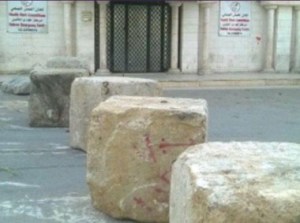 Israeli soldiers closed the main entrance of the Hebron Emergency Center, run by the Hebron Health Committees, by placing concrete blocks, completely sealing it, and deployed dozens of soldiers on its rooftop on Monday morning.
Dr. Ramzi Abu Yousef, director of the Health Work Committees (HWC) in Hebron, said many soldiers occupied the center’s rooftop, and turned it into a military base.
Abu Yousef warned of the consequences of this violation, especially since the center receives hundreds of patients on a daily basis, and added that the center provides its medical services to more than 60,000 Palestinians.
“For years now, the center has been subject to frequent Israeli military violations, including many invasions, and the soldiers even fired gas bombs at it,” Abu Yousef said, “They also repeatedly sprayed it with waste-water mixed with chemicals, in addition to harassing the patients and their families, and the various measures restricting their freedom of movement.”
The HWC voiced an urgent appeal to various human rights groups to intervene, and provide the needed protection to Palestinian health centers, in addition to pressuring Israel into halting its serious violations.
“People who need medical care have the right to receive it, but Israel continues to violate it,” the HWC added, “International Humanitarian Law stresses on the importance of unrestricted access to medical facilities.”
Trust the IDF investigation
By Yossi Gurvitz | Yesh Din | April 25, 2016
The case of Bassem Abu Rahme challenges the army’s claim that it can conduct a serious investigation of itself.
On April 17th 2009, Bassem Abu Rahme was demonstrating against the separation wall in his village, Bil’in. After another demonstrator was hit by crowd-dispersal weapons shot by Israeli security forces, Abu Rahme shouted at the soldiers and Border Policemen that the person was wounded. Seconds later, a person in Israeli uniform (it is unclear whether he or she was an IDF soldier or a Border Policeman) fired a tear gas canister directly into Abu Rahme’s chest; the wound was fatal, and within hours Abu Rahme was dead.
These facts were not, until recently, in contention. Even so, almost seven years after his death, no one has been held responsible for Abu Rahme’s death. Seven years of foot dragging and avoiding investigation (more on that in these two posts). This is what happens when a member of the security forces shoots an unarmed man — who everyone agrees posed no danger to — and the cameras (three of them, actually) document the event – yet are not aimed directly at the shooter.
We do not know who shot Abu Rahme, whether he or she was an IDF soldier or a Border Policeman. We do, however, have forensic evidence pointing to where the shooters stood. According to the ballistics examination, conducted by the IDF itself, “the only possibility of this sort of armament hitting the target is only by direct fire and using a flat angle — in the single digits — no more than three or four angles.” That is, there is no possibility of Abu Rahme being hit by a canister shot according to the orders and hitting him by mistake; even were the canister to ricochet off a fence, it would still be fired directly, contrary to orders.
The Chief of the IDF’s Photo Reconnaissance Department told the Military Police Criminal Investigations Division (MPCID) in 2013 that direct fire of tear gas canisters is forbidden and that it should hold a lineup to determine where each of the shooters stood. The MPCID refrained from doing so.
Last week, Israel’s Supreme Court heard an appeal by Yesh Din and human rights NGO B’Tselem , in which we demanded that the shooter be indicted, or that at least the army indict his commander. The hearing was held ex parte due to a strike by the prosecution. We estimate that the state would have argued that the shooters cannot be identified; and that it would also try to avoid mentioning the fact that the MPCID and the military prosecution did everything in their power to refrain from investigating the case for 15 months, and were forced to open an investigation after our first petition to the High Corut of Justice. The government is likely to claim that the canister that hit Abu Rahme’s chest ricocheted off something – and will play down the fact that even if it did, its own ballistic diagnosis ruled that it was fired contrary to orders.
The government is further likely to argue that it has no clue as to whom it should prosecute, hoping the judges will not think too much of the fact that it strangled the investigation for years. Our demand is simple: even if there is no chance to indict the shooters themselves, and we contend this claim since the MPCID’s failure to investigate rendered the case no longer investigable, the commanders should still bear responsibility.
So far, none of this has happened. The justices decided to rescind the petition, since under the Turkel Commission’s recommendations one may now object to the Attorney General over the military prosecution’s decision – a process that did not exist when we made our appeal. Justice, it seems, will have to keep waiting.
It is important to emphasize this time and again: Abu Rahme was unarmed. He was a danger to no one. He was protesting an injustice in his village – an injustice recognized by the High Court of Justice. And yet, an Israeli security officer, perhaps more than one, fired at a demonstrator in a life-threatening manner and caused his death. We note that one of the suspects said in his interrogation that he never received proper training with the weapon he was using. The commanders of these warriors, who are responsible for their actions, continue dodging this responsibility to this day.
Over the last few weeks, the very well-documented murder in Hebron has been called an exceptional, unrepresentative, and isolated incident by senior IDF and political figures. Every person of conscience should wonder whether this is so; whether the important statement in the case was not made of by Chief of Staff Eizenkot, but rather by Prime Minister Netanyahu, who phoned the father of the shooter and told him (Hebrew) to “trust the IDF investigation.”
What ought an Israeli security officer understand from the prime minister’s remarks? A reasonable interpretation would be: “don’t worry, our investigation will find you acted properly.” This, after all, is the unwritten contract between the government and its soldiers: we send you to do the dirty work of oppressing a civilian population, and in return we will turn a blind eye if you sometimes exceed your orders – unless are caught red-handed, that is. In such a case, we shall regrettably have to begin the investigation show.
NYU grad student union votes to boycott Israel
Ma’an – April 24, 2016
A graduate student union at New York University on Friday voted in favor of joining the Boycott, Divestment, and Sanctions movement against Israeli violations of Palestinian human rights.
Two-thirds of the Graduate Student Organizing Committee cast a vote in support of the resolution, which calls on both NYU and its United Automobile Workers union affiliate to divest from all Israeli state institutions — including universities — and corporations “complicit in” Israeli violations.
The resolution proposes that NYU join the movement “until Israel complies with international law and ends the military occupation, dismantles the wall, recognizes the rights of Palestinian citizens to full equality, and respects the right of return of Palestinian refugees and exiles.”
Over 600 union members voted in the referendum, a reportedly larger-than-average turnout for union votes. The 2,000-strong union represents graduate teaching and research assistants at the university.
Some 57 percent of voters made a voluntary individual pledge to participate in the academic boycott against Israel.
The BDS movement has gained momentum over the past year, aiming to exert political and economic pressure over Israel’s occupation of Palestinian territory in a bid to repeat the success of the campaign which ended apartheid in South Africa.
Major actors to join the movement this year include British security giant G4S and French telecom company Orange.
The NYU union’s support of BDS comes after US President Barack Obama in February signed into law an anti-BDS trade agreement reiterating that US Congress “opposes politically motivated actions that penalize or otherwise limit commercial relations specifically with Israel,” referring directly to BDS activities.
The Israeli leadership has widely condemned the BDS movement as antisemitic or carried out from “hatred of Israel,” while proponents of the movement argue divestment measures are necessary in pressuring Israel to end its decades-long military occupation.
Moves inside the US — Israel’s longstanding ally and number one provider of military aid — to criminalize BDS have meanwhile been slammed by human rights defenders as a violation of free speech.
Featured Video

The Search for Truth: Charlie Kirk’s Assassination One Year Later
or go to
Aletho News Archives – Video-Images
From the Archives
US murdering 1 million Iraqis is democracy, Iran giving yogurt to Iraq is “domination”
By Ali Salaam | American Herald Tribune | July 31, 2017
The New York Times, owned by the Zionist Jewish supremacist Ochs-Sulzberger family, has no problem with Iraqi suffering as long as Iran is not the one behind it.
The Iraq War was a genocide of the Iraqi people by Zionist supremacists in the Bush administration. Over 1 million innocent people were killed based on a lie. American soldiers died in an Israeli war and now an average of 22 soldiers commit suicide every day because their consciences cannot cope with the fact they committed crimes in an illegal war that served no purpose other than to benefit Israel, not America.
Benjamin Netanyahu, Prime Minister of the Zionist regime, once said “We are benefiting from one thing, and that is the attack on the Twin Towers and Pentagon, and the American struggle in Iraq.”
Paul Wolfowitz had his sights on Iraq since his time in the first Bush administration. Former Israeli official and Bush administration official Richard Perle had his eyes on Iraq since at least his authorship of the Clean Break white paper. The Zionist regime had their eyes on Iraq since the 1980s when strategist Oded Yinon wrote his white paper in support of dividing the Arab-Muslim world along ethnic and sectarian lines. The global Zionist lobby has had their eyes on Iraq since Theodor Herzl stated that Eretz Israel’s true borders go from the Nile River in Egypt to the Euphrates River in Iraq. … continue
Blog Roll
 Aletho News
- The Search for Truth: Charlie Kirk’s Assassination One Year Later
- ‘Harsh reality’: Iran says France seeks monopoly on power and intimidation, not peace for all
- When Will This White House Madness End?
- Huckabee aide goes to ‘unusual lengths’ to portray ‘Israel’ positively
- Trump Announces Diesel Supply Deal With Putin Following Phone Call
- MEP blasts ‘Euro-Gestapo’ for lecturing Russia on democracy
- Syria May Send Troops to Saudi Arabia Amid War with Ansar Allah
- UK whines about losing billions to ‘Putin tax’
- Baghaei to Rubio: Distorted narratives cannot erase US record of broken commitments
- Houthis Don’t Have to Conquer Saudi Arabia to Make It Pay
- If Americans Knew
- Gaza ceasefire exists in name only, say more than 100 organizations
- Nearly 2 Million in Gaza Need Urgent Shelter Assistance as Winter Looms: IOM Chief Warns
- Suppressing Palestinian resistance: US charity under fire for AI monitoring of Gaza classrooms
- Thousands Are Held in Israeli Torture Camps. This Is What Happens Inside
- Israel puts Gaza’s sick, injured, newborn in peril – Daily Update
- Report claimed Mark Levin used by Israeli government to influence Trump
- Over 2,000 Gazans have died awaiting medical evacuation amid Israel’s continued siege
- How a U.S. Diplomat Suppressed and Altered Reports Critical of Israel
- 5 Palestinians Die from Israeli Strikes in Gaza as Relentless Attacks Continue
- Report: Ceasefire Slows Killing but Leaves Devastation Intact
- No Tricks Zone
- New Study: 50 Years Of The Most Aggressive ‘Net Zero’ Policies Can Only Affect The Global Climate By 0.03°C
- US September “Heat” Was No Record…Many Records Set Decades Ago
- Latest European Green Energy Debacle; Portugal’s Largest Flagship Solar Park Insolvent!
- Green Energy Debacle: German Expert Professor Fritz Vahrenholt Warns Of Severe Economic And Social Consequences
- Two More Paleo Reconstructions Affirm Meters-Higher Sea Levels Across Ireland, Brazil 7000-6000 Years Ago
- New Study: Earth And Venus Surface Warmth Largely Explained By Convection And Lapse Rate, Not CO2 Or Radiation
- 2025 Nature Paper Claiming Worsening Global Drought Gets RETRACTED …Heavily Flawed
- New Study: ‘Global Drought Shows No Detectable Recent Acceleration Under Climate Warming’
- Economic Masterminds: German Socialists Suggest Taxing Productivity Gains Stemming From Using AI
- The South China Sea Has Not Been Cooperating With The Climate Change Narrative

