The NY Times, Netanyahu’s Stenographer
By Barbara Erickson | TimesWarp | February 27, 2016
The New York Times serves as Benjamin Netanyahu’s stenographer in a story this week that reports his latest rant against critics of Israeli policy, repeating his claims at length but making no attempt to verify or even question the distortions in his response.
The Israeli prime minister was reacting to comments by British Prime Minister David Cameron, who criticized Israel’s settlement construction in and around East Jerusalem during a session in parliament Wednesday, saying that he found the situation “genuinely shocking.” The Times, which made no mention of Cameron’s remarks at the time, now presents us with an article by Isabel Kershner framed around the official Israeli response.
Her story, “Benjamin Netanyahu Rebukes David Cameron for Criticizing Israel,” gives much space to the prime minister’s assertions and allows him the final word. It also quotes Jerusalem Mayor Nir Barkat and allows the comments of both men to stand without challenge.
Netanyahu, speaking at a political meeting Thursday, portrayed Israel as the peacekeeper in East Jerusalem, saying that “only Israeli sovereignty” has prevented ISIS “and Hamas from igniting the holy sites as they are doing all over the Middle East.”
He implied that Israel has brought prosperity to Palestinian residents of East Jerusalem, citing “roads, clinics, employment and all the other trappings of normal life that their brethren do not enjoy elsewhere in the Middle East.” Mayor Barkat also stated that Israel is building “the newest, most advanced schools” for Palestinian youth and paving new roads for residents.
The Times made no attempt to challenge the veracity of these comments although they grossly misrepresent the situation Palestinians face in occupied East Jerusalem. The data is available for all to see and is certainly familiar to Kershner and Times editors.
For instance, as of January 2011:
- Entire Palestinian neighborhoods were not connected to a sewer system and lacked paved roads and sidewalks.
- West Jerusalem had 1,000 public parks compared to 45 in East Jerusalem.
- West Jerusalem had 34 swimming pools; East Jerusalem had three.
- Nearly 90 percent of the sewage pipes, roads and sidewalks in the city were found in West Jerusalem.
- West Jerusalem had 26 libraries; East Jerusalem had two.
More recent news also belies the claims of Netanyahu and Barkat. Far from working to provide education, health care and road access for Palestinian residents, Israeli policies and actions have made life more and more difficult for the non-Jewish residents of the city:
- In 2015, Israel placed dozens of Palestinian children under house arrest in East Jerusalem, preventing them from attending school.
- The Israeli government has been working with settler groups to dispossess Palestinians of their homes.
- More than a third of East Jerusalem students are unable to complete high school because there are not enough classrooms. (Under an order by the Israeli High Court, some new classrooms are being built, but these will only alleviate the shortage by half.)
- Some 38 percent of East Jerusalem’s planned areas have been confiscated for the development of Jewish settler neighborhoods, while only 2.6 percent is zoned for public buildings—such as schools—for the city’s indigenous Palestinians.
- Israeli invasions of Makassed hospital in East Jerusalem hospital and restrictions on patients attempting to enter the hospital prompted several United Nations agencies to condemn the actions as violations of international law.
- By Feb. 22, Israeli forces had demolished 27 Palestinian-owned structures in East Jerusalem, including a school, since the beginning of this year.
Kershner’s story, however, makes no mention of any of this. The focus here is solely on the Israeli show of outrage. Netanyahu and Barkat’s statements are allowed to stand, even the claim that Hamas and ISIS are working together to foment terrorism. In fact, the two are bitter enemies, but the Times has no interest in disabusing its readers of this inconvenient fact.
Cameron’s statements gave the Times an opening, a chance to examine the settlement enterprise, conditions in East Jerusalem and the attitudes of Palestinian leaders and citizens living under Israeli control. But this was not to be. Only the Israeli narrative was of interest to the Times, and even the prime minister of the United Kingdom could not make his voice heard above its strident demands.
Palestinian activist Rasmea Odeh Has Conviction Thrown Out
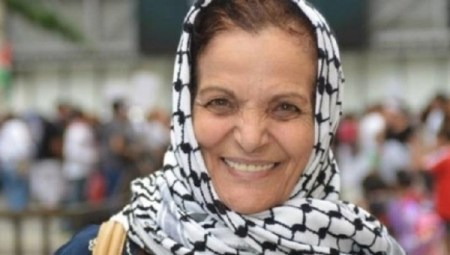
Palestinian activist Rasmea Odeh | Photo: Justice 4 Rasmea
teleSUR – February 26, 2016
A U.S. appellate court on Thursday vacated the conviction of Palestinian activist Rasmea Odeh for allegedly lying on U.S. immigration papers 20 years earlier.
Odeh, 67, was put on trial in November 2014 for allegedly falsifying immigration documents when she first entered the U.S.. Odeh had denied ever having been “charged, convicted or imprisoned for a crime,” but the government maintained that she lied as she had been convicted in an Israeli military court for allegedly bombing a supermarket.
Odeh said she was subjected to torture and rape by Israeli interrogators and forced to sign a false confession.
The U.S. federal appeals court panel ruled that Odeh’s sentencing judge had improperly excluded testimony about the psychological trauma Odeh suffered while in Israeli military custody.
“The court’s decision presents a great victory to anti-torture advocates and survivors of torture,” said the Center for Constitutional Rights in a press release.
Odeh’s case will now return to the district judge for a possible retrial.
Omar Nayef Zayed assassinated in Palestinian embassy in Bulgaria

UPDATE/11:44 am/26 February: Bulgarian media and police sources are reporting that Omar was killed by falling from a high story of the building. They have noted that him being pushed is “not excluded.” “Israeli media have been the first to report explicitly that Omar was ‘assassinated.’ This comes as no surprise. They’re simply the most knowledgeable and honest about the workings of their government and its intelligence agencies,” said Joe Catron of Samidoun.
Samidoun Palestinian Prisoner Solidarity Network | February 26, 2016
Omar Nayef Zayed, a former Palestinian political prisoner and escaped hunger striker whose extradition from Bulgaria Israel demanded in December, was found dead this morning inside the Palestinian embassy in Sofia, Bulgaria, where he had sought refuge.
“Omar Nayef Zayed was targeted as a Palestinian, as a struggler, as a former political prisoner,” Charlotte Kates, international coordinator of Samidoun Palestinian Prisoner Solidarity Network, said. “His case, his targeting and his assassination were an attempt to demonstrate that no Palestinian anywhere is safe from the long arms of the Israeli occupation. This is clearly a threat to all Palestinians – especially former prisoners and veterans of the struggle in Europe. We are committed to stand with the family of Omar Nayef Zayed to pursue accountability for those responsible for taking his life and to build the movement for which his life was taken – for a free Palestine.”
The precise physical cause of Omar’s death is not yet clear, but it is clear that the cause of his death is the Israeli state’s vengeance against a Palestinian struggler committed to live free for himself and for all of his fellow Palestinians. Samidoun Palestinian Prisoner Solidarity Network demands an independent autopsy of Omar’s body and a full investigation by Bulgarian and Palestinian officials into the death of Omar. We demand that all those responsible for the targeting of Omar Nayef Zayed and the taking of his life be held fully accountable.
“We hold Israel and its intelligence services, the Palestinian Authority and the Bulgarian government responsible for the killing of Omar Nayef Zayed, whose life was taken as he lived his life, in the struggle for freedom for Palestine,” Mohammed Khatib, a Brussels, Belgium-based member of Samidoun: Palestinian Prisoner Solidarity Network, said. “He was assassinated; he was not protected; and he was constantly threatened and pursued. The Israeli intelligence services have a long history of pursuing and assassinating Palestinians around the world – especially in Europe – targeting young leaders and veteran resisters for assassination and elimination. This outrageous crime happened inside the Palestinian embassy, inside Bulgaria. The killers and those who made this killing possible must be held accountable.”
Zayed, 52, was born in Jenin, in Palestine’s West Bank. He was arrested by occupation forces in May 1986 and sentenced to life imprisonment. After a 40 day hunger strike in 1990, he was transferred to a hospital in Bethlehem where he escaped in May, disappeared and left Palestine.
In 1994, he traveled to Bulgaria. Omar married a Bulgarian citizen and has Bulgarian children; he runs a Palestinian grocery and is well-known in the Palestinian community of Sofia.
On Tuesday, 15 December, the Israeli embassy sent a letter to the Bulgarian Ministry of Justice demanding the extradition of Omar Nayef Zayed, labeling him a “fugitive from justice.”
Omar’s home was raided on Thursday, 17 December. He was not home and his son was arrested for one day. The Bulgarian prosecutor was quoted in Arabic media calling for his imprisonment and quick extradition to Tel Aviv.
Samidoun Palestinian Prisoner Solidarity Network salutes and mourns Omar Nayef Zayed, a former Palestinian political prisoner who struggled all his life for the freedom of Palestine and the Palestinian people. We extend our deepest condolences to the family of Omar Nayef Zayed, in Palestine, in Bulgaria and everywhere, and to the entire movement for the liberation of Palestine, which has had a loving father and husband and a committed struggler for a free Palestine taken away at the hands of those who would see Palestine, and its people, forever imprisoned. We are committed to working in all ways to hold those responsible for his death fully accountable for this vicious crime against the Palestinian people, and to struggle for the freedom – of Palestinian prisoners and of Palestine itself – which Omar Nayef Zayed held so dear.
22 years after the Ibrahimi mosque massacre, Palestinians still suffer consequences

International Solidarity Movement | February 25, 2016
Hebron, Occupied Palestine – On the 25th of February 1994, a US citizen residing in the illegal Kiryat Arba settlement entered the Ibrahimi mosque in the early morning during the month of Ramadan. Baruch Goldstein, dressed in his army uniform, opened fire on the Palestinians that were crammed inside for the prayer. He killed 29 men and boys and injured dozens before people overpowered him and beat him to death.
That day, many more Palestinians were killed in Hebron during riots protesting the massacre that had occurred, in front of the mosque and the hospital where the injured were treated, as well as in the cemetery were the dead were being buried. In the next few days, protests and marches happened all over the West Bank and across historic Palestine. It is believed that in total, in these few days, 50 to 70 Palestinians were killed, and over 250 were injured.
Immediately after the attack, the Israeli government released a statement condemning this act and affirming that Goldstein was acting on his own behalf. The Prime Minister Yitzak Rabin called Goldstein a “degenerate murderer, a shame on Zionism and an embarrassment to Judaism.” Rabin always affirmed that Goldstein acted on his own behalf and that the Israeli military had no knowledge of his plans. Though his act was condemned, it resulted in many measures that mostly impacted on Palestinians. Instead of evacuating the settlements of Hebron, only a few of the most extreme settlers were temporarily disarmed.
A round-the-clock curfew was imposed. Shops in Shuhada Street were forced shut by the Israeli army, on the pretext of keeping settlers safe on this commercial artery. Many other shops also had to close due to lack of supplies and customers. New checkpoints were installed. Palestinians were first banned from driving and then simply from accessing most of Shuhada Street. Many of these measures resulted in the displacement of many Palestinian families.
In 1997, a protocol was signed between Israel and the PLO, dividing Hebron into two areas: “H1”, controlled by Israeli forces, and “H2”, under Palestinian control. It called for the withdrawal of Israeli soldiers from the H1, which represented 80% of the city. To this day, even though H1 is officially controlled by the Palestinian Authority, it remains under overall Israeli control, while H2 is now the home to many violent and extremist settlers. Some of them still go every year to the tomb of Baruch Goldstein to celebrate his treacherous act of murder.
22 years later, all measures that were declared in Hebron on the 25th of February, 1994 are still enforced, except for the curfew. And settlers are more than ever taking over the city, with the compliance of the Israeli government.
The last tiny bit of Shuhada Street, that was not (yet) declared a ‘sterile zone’ and thus been completely barred for Palestinians, has been under repeated ‘closed military zone’ orders since 1st November 2015. Whereas the majority of Shuhada Street has been completely unaccessible for Palestinians, the tiny strip leading from the recently ‘renovated’ Shuhada checkpoint up to the illegal Beit Hadassah settlement, is slowly resembling a ‘ghost street’ more and more, as only Palestinians registered with the Israeli army are allowed to go there.
The closed military zone order is an illegal collective punishment on the whole Palestinian population of this area, that was forced to register in order to be allowed to live in their own houses whereas settlers in the adjacent illegall settlements can walk the roads freely and completely undisturbed. This clearly is just another step in the Israeli policy of making life for Palestinians as hard and humiliating as possible in an attempt to make them leave the area and eventually drive all of them out and connect the settlements.
Every year, Palestinians in occupied al-Khalil commemorate the Ibrahimi mosque massacre and protest against the closure of Shuhada Street and the illegal Israeli occupation. The week, leading up to the 22nd anniversary of the massacre, has seen and will continue to see creative activities and demonstrations. This past week there were also many commemorations of Palestinians, most of whom have been gunned down by Israeli forces and left to bleed to death without any medical help.
Iran offers $30,000 to families who lost their homes in intifada
MEMO | February 25, 2016
Iran will pay $30,000 to every family whose home was demolished by the Israeli occupation forces during the ongoing Jerusalem Intifada and $7,000 for every family who’s lost a relative, the ambassador to Lebanon said yesterday.
Mohammad Fateh Ali made the announcement in a press conference in Beirut, calling on the Arab and Muslim nations to unite around the main Arab and Muslim project – Palestine.
Former Hezbollah MP Hassan Hoballah called on Arab and Muslim countries to open their embassies to support Palestinians.
The Deputy Head of the Popular Front for the Liberation of Palestine, Talal Naji, said that this is not the first time Iran has made a generous offer to Palestine.
Why It’s Dangerous to Conflate Hamas and Daesh
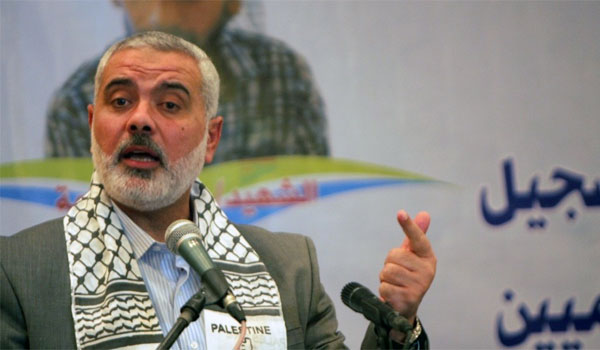
Hamas Prime Minister in Gaza, Ismail Haniyeh
By Belal Shobaki – Al-Shabaka: The Palestinian Policy Network – February 22, 2016
Overview
While Israel’s efforts to link Palestinian resistance to its military occupation to global terrorism are not new, it has expanded its propaganda to address Arab as well as Western audiences. By so doing, it is clearly seeking to exploit the global aversion to movements that have drifted towards extremism and terrorism while claiming to represent Islam. “Hamas is ISIS and ISIS is Hamas,” Israeli Prime Minister Benjamin Netanyahu declared at the United Nations in 2014. Yet better than anyone else, Netanyahu and the Israeli political establishment know that Hamas and Daesh are not related, as do those Arab regimes that also tar all Islamic movements with the same brush to serve their own ends. 1
Not only are Hamas and Daesh unrelated, they are bitter enemies, and Daesh has denounced Hamas as an apostate movement. Al-Shabaka Policy Analyst Belal Shobaki discusses the major ways in which Hamas differs from Daesh including its approach to jurisprudence; the position vis-a-vis the nature of the state; and relations with other religions. He makes the case that it is especially important for the Palestinian national movement to rebut the attempts to conflate Hamas with Daesh and points out the dangers of not doing so.
Serving Short-Term Political Gain
The conflation of Hamas with Daesh ignores reality on the ground. The political environment in Palestine is defined by the occupation, whereas the political environment in the Arab countries where Daesh emerged is defined by authoritarianism and repression as well as sectarian and religious conflicts, an ideal environment for the emergence of a radical ideology motivated by indiscriminate violence.
For Israel, however, the attempt to link the two may pay off regionally and internationally. Many Arabic media outlets have no qualms about referring to this terrorist organization as an “Islamic” State although it is anything but, while many Western media outlets embrace the Israeli conflation of Hamas and Daesh without scrutiny. Arab regimes are uninterested in defending the image of Hamas. Even the Palestinian Liberation Organization (PLO) does not seem concerned with defending Hamas’s international image given the political division between Fatah and Hamas.
Hamas is considered part of the Muslim Brotherhood, which is seen as a threat to authoritarian Arab regimes, particularly in the Arab Mashreq. Thus one way for Arab regimes to fight the Muslim Brotherhood is by claiming it shares common ground or is even synonymous with Daesh, as claimed by the Egyptian regime, and then using this as a justification for excluding the Muslim Brotherhood from participating in political life.
The rapid developments of the past five years in Egypt, the country that provides the only outlet for the Palestinian Gaza Strip, has pushed Hamas into its informal tunnels economy. The official Egyptian stance after Abdel Fattah Sisi’s coup against elected president Mohammad Morsi became tougher against the Gaza Strip, with claims that Hamas was cooperating with Jihadist groups in the Sinai, the same narrative promoted by Israel and its media. However, this narrative is flawed. It is too risky for Hamas to maintain a close relationship with Sinai jihadists, on the one hand, while cracking down on individuals embracing the same ideology in Gaza, on the other. Any links Hamas has established with those groups is limited to securing the needs of the enclave besieged by Israel and Egypt. This interaction is not motivated by a shared ideological identity or shared enmity towards the Egyptian regime. Indeed, Hamas has been eager to keep communication lines open with the Egyptian regime even when accusations conflating Hamas with Sinai’s Salafi Jihadi groups were made in the media. Hamas has also repeatedly said that it is keen on rebuilding the relationship with Egypt in order to ensure the legal flow of goods, services and individuals into Gaza.
It is important to refute this narrative concerning one of the largest Palestinian political movements: Excluding moderate Islamists from political life carries the danger of pushing Palestinian society towards radicalism, in which case both Fatah and Hamas will find themselves fighting takfiri groups. The ensuing discussion will demonstrate the real differences between Hamas and Daesh as well as the very real enmity between them.
Differences in Doctrine
Hamas positions itself as a centrist Islamic movement and an extension of the Muslim Brotherhood, with a rational jurisprudential authority, whereas Daesh adopts a text-based approach that deals with Islamic texts in isolation from their historical context and refuses to interpret them in line with current developments. Hence, for Daesh and other takfiri groups in general, movements like Hamas are secular and un-Islamic, since Hamas is primarily a resistance movement against the Israeli occupation and believes in a moderate Islamic authority. Moreover, Hamas does not take Islamic texts literally; it allows for ijtihad – interpretation and use of discretion. Some scholars have categorized these movements along a horizontal line with the right representing advocates of the text and the left representing advocates of reason. 2 Using this classification, the Muslim Brotherhood can be found a good way down the left of the line, while Daesh is on the far right.
Daesh characterizes Hamas and its discourse as deviant. Hamas for its part has condemned Daesh’s threats and considered these part of a smear campaign that extends beyond Palestine. When threats from Daesh and other takfiri groups materialized into action, Hamas no longer stopped at condemnations. Mahmoud al-Zahar, a prominent Hamas leader, declared “Daesh’s threats can be felt on the ground, and we are handling the situation from a security standpoint. Whoever commits a security offense shall be dealt with in accordance with the law, and whoever wants to debate intellectually shall be debated intellectually; we take this matter seriously”.
Hamas had in fact dealt decisively with a Daesh-like group. In August 2009, Abdul Latif Musa, leader of the “Jund Ansar Allah” (Soldiers of God’s Supporters) armed group, announced the creation of the Islamic Emirate in Gaza at the Ibn Taymiyyah Mosque. The group had previously been accused of destroying cafes and other venues in the Gaza Strip, pushing the Hamas government into a confrontation. Security forces, reinforced by the al-Qassam Brigades (Hamas’ military wing), encircled the Ibn Taymiyyah Mosque and, when Musa’s group refused to surrender, Hamas ended the emirate project in its infancy by killing the members of the group. Hamas was criticized for its use of violence but justified its actions by arguing that the violence that could have been perpetrated by such groups would have been much worse than that used to eradicate extremism in the Gaza Strip.
Daesh’s supporters in Gaza are far fewer than Hamas’s, mainly due to the fact that these groups have not historically contributed to resisting the occupation. Some polls suggest that 24% of Palestinians think positively of jihadist movements, but this percentage is exaggerated. When some Palestinians cheer for the jihadist groups’ hostility towards the US, it is not because they believe in these groups but rather because they see the US, with its infinite support for Israel, as being playing a destructive role.
Different Stances on Statehood
Hamas and Daesh differ in their view of the modern state, in both theory and practice. As noted above, Hamas has always allowed for ijtihad or discretion, evolving its thoughts and opinions. It is thus unfair to assess Hamas’s stance on the civil state and democracy based on the early literature of the mother movement, the Muslim Brotherhood. Hamas maintains that it has embraced new convictions in this regard and has come to fully accept democracy and the concept of the civil state. Indeed, the Muslim Brotherhood itself has evolved. Qatar-based Sheikh Yusuf al-Qaradawi, the jurisprudential authority of the Muslim Brotherhood at large, has stated on multiple occasions, including in his book “The State in Islam”, that the concept of the religious state does not exist in Islam. According to al-Qaradawi, Islam advocates for a civil state founded on respect for the people’s Islam-based opinion, and also founded on the principle of accountability and political pluralism. Although the discussion about the relationship between Islam and democracy predates the Muslim Brotherhood, it gained clarity after the 1950s, when numerous Islamic thinkers, including al-Qaradawi, the Tunisian leader and Ennahda co-founder Rached Ghannouchi and the Algerian philosopher Malek Bennabi, affirmed that Islam and democracy were not in contradiction with each other.
At the opposite end, the movement that Daesh represents rejects democracy in its entirety and considers it an apostate system of governance. Although some jihadist groups do not denounce Islamists who take part in the democratic process as apostates, they do consider their discretion flawed. Daesh views any expression of democracy such as elections as a manifestation of apostasy and any movement or individual taking part in elections as apostates. By contrast, the Muslim Brotherhood participated in elections from its earliest days, when its founder Hassan al-Banna decided to run in the Egyptian parliamentary elections that El-Wafd Party Government sought to hold in 1942. Although al-Banna could not run because the government rejected his candidacy, the Muslim Brotherhood has served in Arab parliaments and sometimes in the executive branch.
When Hamas decided not to participate in 1996 Palestinian Authority elections its position was based on a political and ideological stance towards the Oslo Accords. However, Hamas allowed its members to run in the elections as independents. When the circumstances changed and the 2005 Cairo Agreement became the governing framework for the PA elections instead of the Oslo Accords, Hamas decided to participate. It nominated many members in the movement and some independents to a Change and Reform list to run for the Legislative Council, winning the majority of votes.
By participating in the elections, Hamas has offered evidence that it is willing to function in a modern state and a democratic system. It has called for coalition governments inclusive of leftist and secular parties. Its government as well as its parliamentary list included women and its first government included Muslim and Christian ministers.
Daesh, on the other hand, has turned against all modern institutions in the areas under its control, refusing to recognize borders or national identity. It rules through chaotic and individual decisions. Although Daesh has been eager to use administrative terms derived from the Islamic tradition such as caliphate and shura (consultation), the essence of its governance contradicts the majority of unquestionable texts in the sources of Islamic legislation in many ways. For example, it does not abide by the conditions established in the Quran and sunna (the Prophet Mohammad’s teachings) to declare war or the protection of civilians and treatment of prisoners in wartime. Another example is its imposition of jizya (a tax that was levied on non-Muslim subjects), which is not supposed to be applied to the indigenous inhabitants even if they are non-Muslim. Moreover, it has attacked places of worship and assaulted the faithful in their homes, in clear violation of the Quran and sunna.
Daesh, to some extent, resembles hybrid regimes in the Third World that use modern and democratic vocabulary to describe their political process, even though they remain authoritarian in essence.
Polar Opposites in Treating the Other
The most significant difference between Hamas and Daesh is their position towards followers of other religions. During its formation, Hamas published a charter that used religious vocabulary to describe the conflict. Following severe criticism, Hamas effectively sidelined this Charter and no longer considers it an authoritative reference as some of its leaders have confirmed.
In his interview with The Jewish Daily Forward deputy head of the Hamas politburo Moussa Abu Marzouk confirmed that the Charter was marginal to the movement and not a source for its policies. He added that many members were talking about modifying it because several of Hamas’ present policies contradict it. Hamas’ politburo leaders abroad were not the only ones to disclaim the charter. Gaza-based Hamas leader Ghazi Hamad went even further in an interview with the Saudi Okaz newspaper in which he said the charter was subject to discussion and evaluation in opening up to the world. Sami Abu Zuhri, a young Hamas leader who was the movement’s spokesperson during the Second Intifada, urged in an interview with The Financial Times that focus be shifted away from the 1988 charter, and that Hamas be judged on the statements of its leaders.
Today, Hamas adopts the Quranic verse that reads: “Allah does not forbid you from those who do not fight you because of religion and do not expel you from your homes – from being righteous toward them and acting justly toward them. Indeed, Allah loves those who act justly.” This verse urges kindness and justice when dealing with people of other religions. Unlike Daesh, Hamas has applied this in practice. In addition to appointing Christian ministers to its cabinet, it has celebrated Christmas with Palestinian Christians by sending official delegations to visit during the feast. Meanwhile, Daesh has threatened the lives of those who celebrate Christmas across the world.
Some may argue that these steps are ways in which Hamas tries to beautify its authoritarian rule. However, there is little difference between Hamas’ rule and Fatah’s. The human rights violations committed by Gaza’s government cannot be considered an indication of Hamas’ resemblance to Daesh, but rather an indication of misgovernment. The political leadership of Hamas has spoken out against such practices on occasion, for example as those committed by the Ministry of the Interior under Fathi Hammad.
When some individuals were attacked by extremist groups in Gaza, Hamas and the government acted to ensure their safety and punish the aggressors, as in the case of British journalist Alan Johnston who was freed by Hamas from his radical captors and the killing of Italian solidarity activist Vittorio Arrigoni.
The movement’s position towards the Shiites is similar to that towards Christians. At a time when the Middle East is experiencing a media war between Shiites and Sunnis, Hamas refuses to denounce Shiites as apostates, and has interacted with them politically. When the relationship with Iran became strained during the Syrian crisis, the disagreement was political rather than doctrinal. Daesh, on the other hand, not only thinks of Shiites as apostates, but also all other Sunni groups that hold a different ideology, and believes they must be fought.
Even the two organizations’ treatment of the enemy differs. Hamas identifies the Israeli occupation as the enemy, while Daesh considers everyone else its enemy. Daesh has boasted of its numerous crimes against humanity in its treatment of its abductees and the civilians under its rule, including burning Jordanian pilot Muath al-Kasasbeh alive. It has attempted to legitimize its inhumane conduct by distorting or misinterpreting religious texts. Hamas paid its condolences to al-Kasasbeh’s family and condemned Daesh’s actions. Contrast Daesh’s brutality with Hamas’ treatment of the Israeli soldier Gilad Shalit during his captivity, as even the Jerusalem Post reports.
Moving Forward in Relations with Hamas
Both Hamas and Daesh are on the list of terrorist organizations in many countries, including the member states of the European Union and the United States. However, the listing of Hamas is clearly politically motivated: Unlike Daesh, Hamas has neither targeted nor called for targeting any entity other than the Israeli occupation. Hamas was added to the list of terrorist organizations following the events of September 11, 2001, even though it had nothing to do with this terrorist attack. The political nature of the position against Hamas is underscored by the fact that the General Court of the European Union issued a decision on December 17, 2014, urging the removal of Hamas from the list of terrorist organizations. The Court argued that the order to list Hamas in 2003 was based on media reports rather than solid evidence.
In addition, many European and American dignitaries that are known for their stance against terrorist organizations worldwide have met with Hamas leaders on more than one occasion. Those include European parliamentarians and former US president Jimmy Carter, who met with Ismail Haniyeh in Gaza in 2009 and Khalid Meshaal in Cairo in 2012.
The bottom line is that Israel’s attempt to exploit a chaotic Middle East by implicating Hamas as a terrorist group linked with Daesh is baseless. Hamas is ideologically, intellectually, jurisprudentially and politically different from Daesh. Media outlets that adopt the Israeli narrative hurt their professionalism and credibility.
Palestinian movements must not allow the disagreement with Hamas to justify the accusations that harm the Palestinian cause internationally and create tensions locally. Hamas must also realize that the differences between them and Daesh do not mean that its rule of Gaza is free of abuses and human rights violations, and must therefore revisit its conduct and be more careful in its political discourse. It should move beyond the approach of having one discourse for local consumption and another for global consumption since every word uttered by any Hamas leader is marketed abroad as a message from Hamas to the world.
When the Fatah-led Palestine Liberation Organization (PLO) and Arab regimes, especially in Egypt, do not oppose the efforts to link Hamas with Daesh – or, indeed, occasionally contribute to these efforts – they may “benefit” in the short-term by weakening Hamas as a political opponent. However, this carries the dangers of destabilizing Palestinian society in the medium and long-term. Excluding moderate Islamists could push Palestinian society towards radicalism, in which case both Fatah and Hamas will find themselves fighting takfiri groups.
Notes:
- ISIS: The Islamic State of Iraq and Syria. Daesh is the Arabic acronym for ISIS. Some commentators use ISIL: The Islamic State of Iraq and the Levant. The group itself began to use IS in 2014.
- Samir Suleiman, Islam, Demokratie und Moderene, Herzogenrath: Shaker Media, 2013, P 302. Tariq Ramadan, Muslimesin in Europa, Marburg: Medienreferat, 2001, p15.
Al-Shabaka Policy Member Belal Shobaki is assistant professor in the Department of Political Science at Hebron University, Palestine. He is a member of the American Political Studies Association. He has published on Political Islam and identity and is now working on a book on the Palestinian division. Shobaki is the former Editor-in-Chief of Alwaha Newspaper in Malaysia. He was also a Lecturer in the Department of Political Science at An-Najah National University and the Head of the studies Unit at the Palestinian Centre for Democracy and Studies.
‘Don’t demonize Israel’: Canada passes anti-boycott motion
RT | February 23, 2016
Canada has passed a motion to condemn “any and all attempts” to promote the Boycott, Divestment and Sanctions (BDS) movement against Israel both at home and abroad.
The motion passed on Monday by a 229-51 vote, CIJ News reports. The bill was introduced by members of the Conservative Party and won support from Liberal Party members. The motion calls on the government to condemn attempts by Canadian organizations, groups, and individuals to promote the BDS movement, claiming it “promotes the demonization and delegitimization” of Israel.
BDS is a global grassroots movement that is trying to pressure Israel to “comply with international law and Palestinian rights” through the boycott of products and companies that profit from violating Palestinian rights. It also includes Israeli cultural and academic institutions.
Inspired by the successful BDS movement that aided in ending South African apartheid, its supporters believe the movement is the only way to push for a solution to the Palestinian-Israeli conflict.
Speaking after the vote, the National Council of Canada Arab Relations said, “At its core, the vote on the anti-BDS motion would go against the spirit of Freedom of Speech, a right enshrined in Canada’s Charter of Rights and Freedoms. Democratic governments do not ordinarily attempt to dictate the political views of their citizens. NCCAR Chair, Gabriel Fahel, reminds us that ‘freedom of speech and conscientious objections to buying products from countries that contravene international law are core values of a free and democratic society.’”
The CEO of the Center for Israel and Jewish Affairs, Shimon Fogel, however insisted that the boycott movement “does not contribute to peace and is not pro-Palestinian.”
“It is discrimination based on nationality, and it harms both Israelis and Palestinians alike by driving the two sides further apart. The BDS movement is a fringe movement and is outside genuine peace efforts,” Fogel said, as quoted by The Times of Israel.
Liberal Prime Minister Justin Trudeau is likely to continue former Prime Minister Stephen Harper’s close ties with Israel. He is against the BDS movement, and tweeted his opinion in March of last year.
Students at McGill University in Montreal passed a pro-BDS motion on Tuesday.
In 2014, Trudeau spoke out in favor of Israel’s right to defend itself during Operation Protective Edge, acknowledging the suffering of Israelis, but not that of the Palestinians, 2,200 of whom were killed during the 50 day conflict.
Israel has pushed back against BDS efforts, accusing its promoters of “anti-semitism.” AP recently revealed that the Israeli government had allotted $26 million for a covert cyberattack on the BDS movement, which would include “flooding the internet” with pro-Israel content and monitoring Muslim activists online.
Read more:
Netanyahu demands anti-Zionist posters be removed from London Underground
RT | February 23, 2016
Israeli Prime Minister Benjamin Netanyahu has reportedly asked the UK government to have hundreds of posters protesting Israeli occupation of Palestine removed from the Tube.
The Haaretz newspaper reported Tuesday that the Israeli prime minister himself had asked that the posters, which may have been posted in their hundreds, be removed.
The posters appeared on Sunday as part of a mass fly-posting effort to mark the annual Israeli Apartheid Week.
The posters on the London Underground trains hit out at a number of targets, including controversial UK private military firm G4S, which is involved in the running of Israeli prisons.
Transport for London (TfL) said that the posters would be taken down.
“It is flyposting and therefore an act of vandalism, which we take extremely seriously,” A TfL spokesman told the Evening Standard.
“Our staff and contractors are working to immediately remove any found on our network,” the spokesman added.
Some Jewish community groups said that the posters amounted to “smears” against Israel.
“These posters are awful smears that do nothing to contribute to peace and dialogue, placing significant strains on inter-community relations across London,” a London Jewish Forum spokesman told Haaretz.
“They are an act of vandalism, seeking to undermine the UK’s relationship with Israel and designed to foster discomfort. We welcome Transport for London’s commitment to quickly remove them.”
The posters were reported Monday as the Palestinian envoy to the UK Manuel Hassassian told the Independent newspaper that the decision to invite Israeli parliament speaker Yuli Edelstein to address an event held in the UK Parliament risked legitimizing Israeli expansionism, given Edelstein’s background.
“Mr Edelstein lives on an illegal Israeli settlement built on Palestinian land and he publicly opposes Palestinian statehood,” Hassassian said.
Edelstein is due to address the British Group Inter-Parliamentary Union in March.
Israeli forces demolish sole school in Bedouin community
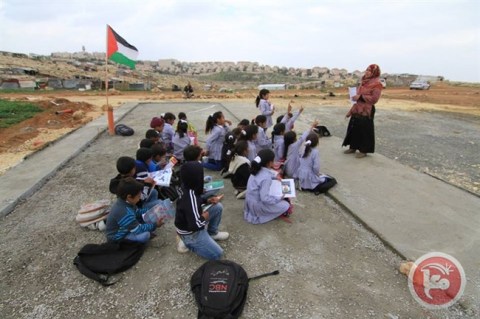
Ma’an – February 21, 2016
JERUSALEM – Israeli forces on Sunday demolished a Bedouin school for children in the Abu al-Nuwaar community near the town of al Eizariya in the occupied West Bank, a spokesperson for the Al-Jahalin Bedouin community said.
Atallah al-Jahalin told Ma’an that Israeli forces, accompanied by 30 vehicles and a delegation from Israeli’s Civil Administration, raided the area and destroyed the sole school in the community.
Residents said Israeli forces told them the school was demolished because concrete structures were forbidden in the area.
Israeli forces also reportedly seized the contents of the school.
Al-Jahalin added that Israeli forces briefly detained two youths who were protesting the demolition, both of whom were released after the demolition.
After the demolition, primary students held a “sit-in” where the school once stood while wearing their uniforms and holding school books in protest.
On Wednesday, the Coordinator for Humanitarian and UN Development Activities for the occupied Palestinian territory Robert Piper said the number of Palestinians displaced in 2016 is already equivalent to over half of the total number displaced in all of 2015.
Piper called on Israel to immediately halt all demolitions in the occupied West Bank, which he said were in violation of international law.
“Most of the demolitions in the West Bank take place on the spurious legal grounds that Palestinians do not possess building permits,” Piper said.
“But, in Area C, official Israeli figures indicate only 1.5 percent of Palestinian permit applications are approved in any case. So what legal options are left for a law-abiding Palestinian?”
The UN documented 283 homes and other structures destroyed, dismantled, or confiscated between Jan. 1 and Feb. 15.
The measures displaced 404 Palestinians, including 219 children. Another 1,150 Palestinians were also affected after losing structures related to their source of income, according to the UN.
The destruction was focused in 41 locations, many in Palestinian Bedouin or herder communities in Area C, the over 60 percent of the West Bank under full Israeli military control.
Piper highlighted previous statements by UN Secretary-General Ban Ki-Moon that Israeli zoning and planning policies are “restrictive and highly discriminatory.”
“International law is clear — Palestinians in the West Bank have the right to adequate housing and the right to receive humanitarian assistance,” said Piper.
“As the occupying power, Israel is obliged to respect these rights,” the UN official said.
Repeated calls by international bodies for Israel to cease the displacement of Palestinians living in the occupied Palestinian territory have done little in the past to stop ongoing demolitions or settlement expansion onto Palestinian land.
The EU earlier this week condemned Israeli policy regarding demolition and settlement expansion that the body said made the possibility for an independent Palestinian state impossible.
Featured Video

The Search for Truth: Charlie Kirk’s Assassination One Year Later
or go to
Aletho News Archives – Video-Images
From the Archives
Did Israel Kill the Kennedys?

By Laurent Guyénot • Unz Review • June 3, 2018
Introduction
Just after midnight of June 6, 1968, Senator Robert Kennedy was assassinated in a backroom of the Ambassador Hotel in Los Angeles. He had just been celebrating his victory at the California primaries, which made him the most likely Democratic nominee for the presidential election. His popularity was so great that Richard Nixon, on the Republican side, stood little chance. At the age of 43, Robert would have become the youngest American president ever, after being the youngest Attorney General in his brother’s government. His death opened the way for Nixon, who could finally become president eight years after having been defeated by John F. Kennedy in 1960.
John had been assassinated four and a half years before Robert. Had he survived, he would certainly have been president until 1968. Instead, his vice-president Lyndon Johnson took over the White House in 1963, and became so unpopular that he retired in 1968. Interestingly, Johnson became president the very day of John’s death, and ended his term a few months after Robert’s death. He was in power at the time of both investigations.
And both investigations are widely regarded as cover-ups. In both cases, the official conclusion is rife with contradictions. We are going to sum them up here. But we will do more: we will show that the key to solving both cases resides in the link between them. And we will solve them beyond a reasonable doubt. … continue
Blog Roll
 Aletho News
- Dhubab offensive, media blitz and the rapid unraveling of Saudi-backed coalition’s new gambit
- Putin Conveys to Trump Iran’s Vision on Possible Conflict Resolution – Kremlin
- The Search for Truth: Charlie Kirk’s Assassination One Year Later
- ‘Harsh reality’: Iran says France seeks monopoly on power and intimidation, not peace for all
- When Will This White House Madness End?
- Huckabee aide goes to ‘unusual lengths’ to portray ‘Israel’ positively
- Trump Announces Diesel Supply Deal With Putin Following Phone Call
- MEP blasts ‘Euro-Gestapo’ for lecturing Russia on democracy
- Syria May Send Troops to Saudi Arabia Amid War with Ansar Allah
- UK whines about losing billions to ‘Putin tax’
- If Americans Knew
- Gaza ceasefire exists in name only, say more than 100 organizations
- Nearly 2 Million in Gaza Need Urgent Shelter Assistance as Winter Looms: IOM Chief Warns
- Suppressing Palestinian resistance: US charity under fire for AI monitoring of Gaza classrooms
- Thousands Are Held in Israeli Torture Camps. This Is What Happens Inside
- Israel puts Gaza’s sick, injured, newborn in peril – Daily Update
- Report claimed Mark Levin used by Israeli government to influence Trump
- Over 2,000 Gazans have died awaiting medical evacuation amid Israel’s continued siege
- How a U.S. Diplomat Suppressed and Altered Reports Critical of Israel
- 5 Palestinians Die from Israeli Strikes in Gaza as Relentless Attacks Continue
- Report: Ceasefire Slows Killing but Leaves Devastation Intact
- No Tricks Zone
- New Study: 50 Years Of The Most Aggressive ‘Net Zero’ Policies Can Only Affect The Global Climate By 0.03°C
- US September “Heat” Was No Record…Many Records Set Decades Ago
- Latest European Green Energy Debacle; Portugal’s Largest Flagship Solar Park Insolvent!
- Green Energy Debacle: German Expert Professor Fritz Vahrenholt Warns Of Severe Economic And Social Consequences
- Two More Paleo Reconstructions Affirm Meters-Higher Sea Levels Across Ireland, Brazil 7000-6000 Years Ago
- New Study: Earth And Venus Surface Warmth Largely Explained By Convection And Lapse Rate, Not CO2 Or Radiation
- 2025 Nature Paper Claiming Worsening Global Drought Gets RETRACTED …Heavily Flawed
- New Study: ‘Global Drought Shows No Detectable Recent Acceleration Under Climate Warming’
- Economic Masterminds: German Socialists Suggest Taxing Productivity Gains Stemming From Using AI
- The South China Sea Has Not Been Cooperating With The Climate Change Narrative

