Beijing cancels Panama deals after court blocks Chinese port operations
The Cradle | February 5, 2026
Chinese authorities have asked state-owned companies to suspend talks on new projects in Panama, in response to the Central American nation’s cancellation of a contract with China’s CK Hutchison Holdings to operate two ports along its strategic canal, Bloomberg reported on 5 February.
According to sources familiar with the matter, Panama’s decision could jeopardize billions of dollars in potential Chinese investments.
Chinese authorities also asked shipping companies to consider rerouting goods through other ports if the extra cost is not prohibitive, and have stepped up inspections of Panamanian imports, such as bananas and coffee.
Chinese Foreign Ministry spokesman Lin Jian issued a statement saying that the Panamanian Supreme Court ruling “ignores the facts, violates credibility,” while harming the interests of Chinese companies.
Hong Kong-based CK Hutchison responded to the Supreme Court decision by initiating international arbitration proceedings against Panama.
CK Hutchison has operated Panama’s Cristobal and Balboa ports for decades. The ports lie at opposite ends of the Panama Canal – the strategic waterway that connects the Pacific and Caribbean Oceans, and through which roughly three percent of global seaborne trade passes.
The move comes amid US President Donald Trump’s campaign to counter Chinese influence over strategic infrastructure in the Americas.
Following his election last year, Trump argued that it was “foolish” of the US to hand over control of the canal to Panama. The US built the canal in 1904 and handed it back to Panamanians nearly a century later, in 1999.
Trump has also complained about the fees Panama charges the US to use the waterway.
Amid pressure from Washington, Panama also withdrew from China’s Belt and Road Initiative (BRI) in February last year.
At the time, Beijing stated it “firmly opposes the United States using pressure and coercion to smear and undermine Belt and Road cooperation. The US side’s attacks … once again expose its hegemonic nature.”
Twenty Latin American nations have participated in the BRI since Beijing initiated it in 2013.
Current Chinese infrastructure projects in Panama include a $1.4-billion bridge over the canal, a cruise terminal constructed by China Harbour Engineering Co., and a segment of a metro line by China Railway Tunnel Group Co.
In Latin America, Trump is seeking to revive the 200-year-old Monroe Doctrine. It states that Washington will not allow European powers to interfere in the Western Hemisphere as they had in colonial times, asserting that the region would be regarded as a sphere of US interest.
Trump used the doctrine as one of his justifications for bombing Venezuela and abducting its president, Nicholas Maduro, on 3 January.
The US president claimed that Maduro was hosting “foreign adversaries in our region” and acquired “menacing offensive weapons that could threaten U.S. interests and lives.”
Focus on Panama’s ‘port case’ must not be misplaced
Global Times | February 3, 2026
Since the Supreme Court of Panama ruled that CK Hutchison’s concession contract to operate Panama Canal ports was “unconstitutional,” the most elated individuals over the past few days have undoubtedly been certain US politicians and media outlets. US Secretary of State Marco Rubio quickly posted on social media that the US is “encouraged,” while some American media outlets claimed this marks a “major victory” for Washington in curbing Chinese influence. The Wall Street Journal even issued a blunt threat, stating that other countries “might re-examine their ties to the world’s second-biggest economy.”
The cries of “victory” coming from the US confirm widespread outside suspicions and further expose Washington’s hegemonic arrogance in using geopolitical means to interfere with commercial cooperation and undermine trade rules. Although the US formally handed over control of the Panama Canal in 1999, in Washington’s Cold War mentality, this area remains an “inner lake” that others are not allowed to touch. The US has repeatedly expressed desire to “retake control of the Canal,” and Secretary of State Rubio chose Panama for his first overseas visit, threatening the country that it “must reduce Chinese influence.” Therefore, when the Supreme Court of Panama issued its so-called ruling, it is difficult for the international public opinion not to question its independence.
However, if one follows Washington’s rhythm and views this turmoil through the lens of “US-China competition,” they fall into a cognitive trap set by the US, and the focus on this matter becomes misplaced. These ports have never been, and should never be, bargaining chips in a geopolitical game. In fact, CK Hutchison has operated these ports for nearly 30 years; in such a long span of time, where has there ever been a shadow of a “Chinese threat”?
On the contrary, under the company’s management, these ports have been developed, benefiting the local area and contributing to global free trade. In this process, the US itself has been one of the beneficiaries. Therefore, regarding the attention on Panama’s port operation rights, if one must talk about winners and losers, the core should lie in the contest between free trade and hegemonism, and the confrontation between the spirit of contract and power politics.
Whether it is the ports along the Panama Canal, Australia’s Darwin Port mired in controversy, or the case of Nexperia in the Netherlands, the same “invisible hand” looms in the background. Some countries repeatedly claim to uphold a “rules-based order”; yet in practice, what they defend is an “order based on the interests of a single country.” This is, in essence, a targeted demolition of global investment credibility. If commercial contracts can be nullified at the whim of politicians or under pressure from allies, then no long-term investment within the Western system is truly safe. From Southeast Asia to the Middle East, global investors are watching closely, asking whether today’s rapacious acts will tomorrow descend upon any profitable industry.
International investment law does indeed recognize “security exceptions,” but these are by no means a universal master key for hegemonism. The core of international commercial law is certainty: companies that operate in compliance with the rules deserve the protection of the law. By using diplomatic coercion to push allies into rulings that defy legal principles, the US is eroding from within the very credit foundations on which the capitalist world depends. In the short term, Washington may have secured a few “strategic footholds”; however, in the long term, this has fundamentally undermined the international credibility of the US and the space for transnational commercial interactions. It is foreseeable that when the law ceases to be a fair arbiter and becomes a political tool, global capital will have to seek safe havens independent of the dollar system and the US “long-arm” influence.
What is even more concerning to the international community is that the geopolitical will of the US often surpasses the constitutions of some sovereign nations. This is a mockery of the principle of sovereign equality enshrined in the United Nations Charter. From the case of Alstom years ago to the current controversy over Darwin Port, the methods used by the US to attack competitors and seize interests are strikingly similar. The international business community needs a fair, just, and non-discriminatory business environment, not a “law of the jungle” dominated by hegemonic will. If this trend of politicizing economic and trade issues and weaponizing legal tools continues unchecked, the ultimate victim will be the entire international economic and trade order. Those who attempt to curb their rivals by undermining the rules will also find themselves facing a bankruptcy of credibility.
As an important maritime passage that carries about 5 percent of global shipping trade, the Panama Canal ports have become a crucial cargo hub on a global scale, and they should not waver under the shadow of hegemonism. According to reports, concessions for the Panama Canal ports will now need to be auctioned off.
In this context, it is hoped that the Panamanian side will truly demonstrate its “independence” by providing a predictable environment for fair competition for all bidders, rather than trying by any means to “ensure that China is blocked from the bidding” as some US media outlets have trumpeted. The whole world is watching everything that happens there.
Chinese embassy expresses extreme shock, indignation over demolition of Chinese monument in Panama
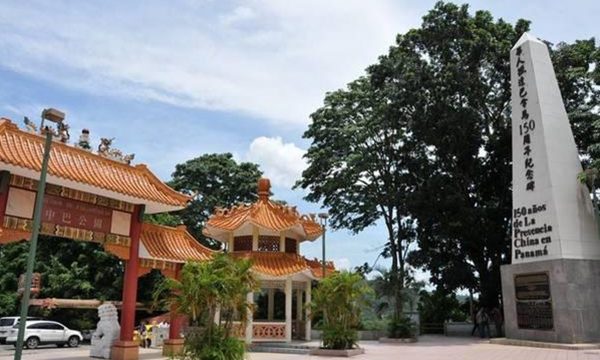
File photo of the China-Panama Friendship Park and the monument commemorating the 150th anniversary of the arrival of Chinese people in Panama
By Fan Anqi | Global Times | December 29, 2025
The Chinese embassy in Panama on Monday expressed extreme shock, strong indignation, and firm opposition to the demolition of the China-Panama Friendship Park and the monument commemorating the 150th anniversary of the arrival of Chinese people in Panama, on Saturday night without any prior notice or communication with Chinese community.
“The move not only brutally trampled on the collective sentiments of the 300,000 Chinese nationals and people of Chinese descent in Panama, but also severely harmed the friendly feelings of the Chinese people toward the Panamanian people,” read an embassy statement issued on Monday morning.
Chinese ambassador to the country, Xu Xueyuan, said in a post on Saturday that she rushed to the place upon hearing the news, but the monument was already on the ground. “Countrymen tried to protect the remains, but they were prevented from doing so,” she said.
Xu called the day “a darkened day for the 300,000 Chinese-Panamanians” and “a day of great pain for Chinese-Panamanian friendship.”
According to local media reports, Arraiján Mayor Stefany Peñalba announced plans to “rescue public spaces to promote culture, tourism, the economy and business,” with renderings of a new park without the monument. The 20-year concession for the monument had expired, and the municipality did not respond to the Chinese Association of Panama’s requests to renovate it.
The embassy statement also noted that the Chinese community organizations engaged in repeated communications with the Arraiján city government as early as 2024, but received no substantive response. The Chinese Embassy in Panama also likewise conveyed its goodwill to support the renovation of the park, only to be met with silence.
The Chinese side urged a thorough investigation into the demolition incident, and strict accountability for any illegal acts that undermined Panama’s historical heritage and social unity and stability. Meanwhile, it asked to restore the China-Panama Park and the Chinese memorial at the original site after consultation with Chinese community groups, the embassy statement read.
Panama President José Raúl Mulino, several government officials, and deputies from various political parties have strongly condemned the brutal demolition of the Park and the monument, Xu noted in a later post on Monday, saying that she finds it encouraging that the public throughout Panama has reacted with strong indignation.
Mulino on Sunday condemned the “act of irrationality” as unforgivable, and an investigation should be initiated immediately. He said there is no justification whatsoever for the barbarity committed by the mayor of Arraijan in demolishing the monument to the Chinese Community, he said in a post on X.
The Government of Panama on Sunday ordered the Ministry of Culture to coordinate the restoration of the Chinese Monument as part of a Historical Heritage together with the Chinese community in Panama, per local media reports.
According to Newsroom Panama, the demolition unleashed a wave of political and diplomatic outrage that continues to grow. Government figures, former presidents, and opposition leaders all agreed in describing the act as shameful, irrational, and unforgivable.
The Minister for Canal Affairs, José Ramón Icaza, was one of the first to react and strongly supported the position of President José Raúl Mulino. “Nobody tears down a monument on a Saturday at 9 pm —in the dead of night, typical of criminal acts— unless it is to commit an aberrant and irrational act,” he stated, Newsroom Panama reported.
The issue also exploded on social media, with many netizens flooding the Chinese ambassador’s X posts expressing their sorrow and shame for such a behavior. One netizen EdwinRodrigo2 wrote, “Many Chinese participated in the construction of the Canal and their descendants integrated into the multi-racial society of which we are proud. I don’t know who ordered the demolition of the monument, but it is outrageous to know that we have authorities capable of doing whatever it takes, to please the US.”
Sun Yanfeng, director of Latin American research at the China Institutes of Contemporary International Relations, told the Global Times on Monday that “the demolition decision, made by a local government, reflects a degree of compromise by certain local authorities under US pressure.” Sun added that the choice to carry out the demolition at night during the Christmas holiday reveals a sense of unease on the part of the local authorities – an apparent attempt to avoid public scrutiny and the risk of a broader social backlash.
The expert noted that the eruption of public reaction to this incident has demonstrated that, even amid intense US pressure, Panamanian society at large maintains a strong desire to develop and uphold friendly relations with China. “It also reflects widespread public dissatisfaction with US interference in Panama’s internal affairs, including pressure related to the Panama Canal and China’s cultural presence in the country,” Sun said.
At another level, the regrettable incident may serve as an opportunity to provide new social momentum for deeper ties and cooperation between China and Panama, the expert noted.
171 years ago, large numbers of Chinese people crossed the oceans to Panama to take part in the construction of the trans-isthmian railway. In recognition of the contributions made by the Chinese community, the Panamanian government in 2004 designated March 30 each year as “Chinese Day,” fully reflecting Panama’s openness and diversity. That same year, with funds raised by Chinese community organizations and support from the Chinese government, the China-Panama Park and the monument commemorating the 150th anniversary of the arrival of Chinese people in Panama were completed—an expression of respect for history.
China Slams Remarks by US Ambassador to Panama About Canal
Sputnik – 06.10.2025
BEIJING – The Chinese embassy in Panama on Monday criticized the remarks by US Ambassador to Panama Kevin Marino Cabrera about Beijing’s alleged meddling in matters concerning the Panama Canal.
On Sunday, Cabrera said in an interview with the Contrapeso newspaper that China had “malign” influence on the Panama Canal, accusing Beijing of cyberattacks and corruption and threatening visa cancellations for those who cooperate with Chinese enterprises.
“The statements of the US Ambassador about China have no factual basis and scientific justification, they are aimed at provoking conflict between China and other countries in the region. Depriving these countries of their diplomatic independence serves the geopolitical interests of the United States, causing more criticism and opposition,” the Chinese embassy said in a statement.
China adheres to the principle of “joint consultation, joint construction and joint use” in mutually beneficial cooperation with all countries, the statement read.
“The projects of Chinese companies in Panama and other Latin American countries make a significant contribution to social-economic development. High-quality Chinese goods at a low price are popular. The US ambassador’s statement casts doubt on the ability of countries in the region to think sensibly and ridicules the local population,” the embassy said.
Beijing urges Washington to put aside arrogance and bias and “focus on the matters that truly contribute to the development of the countries of the region and the well-being of their peoples,” the embassy added.
Panama responds to Trump’s threat to retake vital waterway
RT | December 23, 2024
President Jose Raul Mulino has addressed the nation in response to US President-elect Donald Trump’s threat to retake control of the Panama Canal, a vital waterway that contributes billions of dollars to the Panamanian economy annually and serves as a crucial artery for global trade.
In his video address on Sunday, Mulino emphasized that the sovereignty and independence of the country are “non-negotiable” and underscored the canal’s significance as part of the “history of struggle and an irreversible conquest.”
“Every square meter of the Panama Canal and its adjacent area belongs to Panama, and it will continue to be so,” Mulino declared.
Over the weekend, Trump expressed outrage on Truth Social and during a speech at the AmericaFest conference over what he called “exorbitant” fees charged for the passage of American vessels through the canal, accusing Panama of exploiting the United States with excessive fees.
“We’re being ripped off at the Panama Canal, just like everywhere else,” despite the “extraordinary generosity that has been bestowed on Panama,” he told supporters in Arizona on Sunday.
“If the principles, both moral and legal, of this magnanimous gesture of giving are not followed, then we will demand that the Panama Canal be returned to the United States of America. In full. Quickly and without question,” Trump proclaimed, warning officials in Panama to “please be guided accordingly.”
Trump also declared that he would never allow the canal to fall into “the wrong hands,” namely China’s, emphasizing that a “secure Panama Canal is crucial for US commerce and the rapid deployment of the Navy from the Atlantic all the way to the Pacific.”
Trump further emphasized his statements by sharing an image on Truth Social of an American flag over a narrow waterway with the caption, “Welcome to the United States Canal!”
Mulino strongly rejected these claims, stating that the canal’s rates are set publicly and transparently, considering market conditions, international competition, operating costs and maintenance needs. He highlighted that since the transfer of the canal from the United States to Panama on December 31, 1999, as per the Torrijos-Carter Treaties signed in 1977, there have been no objections or complaints regarding Panama’s control.
“These treaties also established the permanent neutrality of the canal, guaranteeing its open and secure operation for all nations,” he said, calling it the best tribute to the martyrs who fought for Panama’s sovereignty and dignity during the 1964 anti-American riots. Mulino rejected any notion that China, the European Union, or any other power has direct or indirect control over the canal.
The canal has become a source of strong national pride, managed by qualified Panamanian professionals who ensure its safe, continuous, efficient, and profitable operation, the president added. It also contributes billions of dollars to the Panamanian economy annually and serves as a crucial artery for global trade.
“Panama respects other nations and demands respect,” the president concluded, stating that he aspires to preserve good relations with the incoming US government on issues such as drug trafficking, terrorism, organized crime, and illegal migration, but the neutrality of the canal is “non-negotiable.”
Panama police shoot targets in Arab clothing in Israel-run training course
![Panama police shoot targets in Arab clothing in Israel-run training course [@PedroUnderdog09/Twitter]](https://i1.wp.com/www.middleeastmonitor.com/wp-content/uploads/2021/10/FAnuhfPWQCEtOgo.jpg?resize=1200%2C800&quality=85&strip=all&zoom=1&ssl=1)
MEMO | October 4, 2021
Images published on social media exposed Panama’s police officers shooting at targets dressed in traditional Arab clothing, including a headdress, during an Israeli-run training course.
The images, which caused controversy online, were published on Twitter by the National Police and the local Israeli chamber of commerce but were later deleted.
The controversy also drew criticism from the Panamanian Committee of Solidarity with Palestine, which said that the course promoted “violence and racism, so that anyone who wears a hijab or something similar can be classified as a terrorist.”
They added a request to the government in Panama to discontinue the intervention of foreign countries in training security forces.
“This training constitutes a violation of the protocols referring to the shooting courses that prohibit the use of distinctive figures of the Arab peoples as objects of hatred and persecution,” the statement said.
In response, the Panama police force issued an apology: “We are respectful of cultural, religious and ethnic differences. We regret that … a situation arose outside the nature of our mission and duty.”
The deleted Twitter posts claimed that the training was organised by the Israeli embassy in Panama
Regime Change through the Drug War
By Jacob G. Hornberger | FFF | April 1, 2020
The Justice Department’s securing of a criminal indictment of Venezuela’s president Nicolás Maduro reminds us that when it comes to the U.S. government’s regime-change operations, coups, invasions, sanctions, embargoes, and state-sponsored assassinations are not the only ways to achieve regime change. Another way is through a criminal indictment issued by a federal grand jury that deferentially accedes to the wishes of federal prosecutors.
The best example of this regime change method involved the president of Panama, Manuel Noriega.
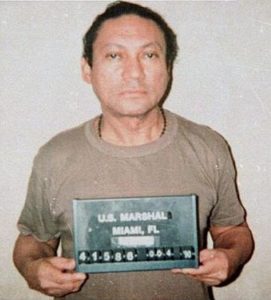 Like many corrupt and brutal dictators around the world, Noriega was a partner and ally of the U.S. government. In fact, he was actually trained at the Pentagon’s School of the Americas, which is referred to in Latin America as the School of Assassins. He later served as a paid asset of the CIA. He also served as a conduit for the U.S. government’s illegal war in Nicaragua, where U.S. officials were using the Contra rebels to effect a regime change in that country.
But like other loyal pro-U.S. dictators, Noriega fell out of favor with U.S. officials, who decided they wanted him out of office and replaced with someone more to their liking.
The big problem, of course, is the one that always afflicts U.S. regime-change aspirations: Noriega refused to go voluntarily.
U.S. officials knew that it would look bad to simply invade the country and effect a regime-change operation through force of arms. Undoubtedly, they considered a state-sponsored assassination through the CIA, which specialized in that form of regime change, but for whatever reason that regime-method wasn’t employed.
So, the regime-changers turned to the U.S. Justice Department, which secured a criminal indictment against Noriega for supposedly violating America’s drug laws. The U.S. rationale was that the U.S. government, as the world’s international policeman, has jurisdiction to enforce its drug laws against everyone in the world.
On December 20, 1989, the U.S. military invaded Panama to bring Noriega back to the United States to stand trial on the drug charges. One might consider the invasion to be one gigantic no-knock raid on an entire country as part of U.S. drug-war enforcement.
An estimated 23-60 U.S. soldiers were killed in the operation while some 300 were wounded. An estimated 300-800 Panamanian soldiers were killed. Estimates of civilian deaths ranged from 200 to 3,000. Property damage ranged in the billions of dollars.
But it was all considered worth it. By capturing Noriega and bringing him back for trial, U.S. officials felt that they had made big progress in finally winning the war on drugs. Equally important, they had secured the regime change that had been their original goal. At the same time, they sent a message to other rulers around the world: Leave office when we say or we’ll do this to you.
Noriega was convicted and received a 40-year jail sentence. When his lawyers tried to introduce evidence at trial of his close working relationship with the CIA and other elements of the U.S. national security state, not surprisingly federal prosecutors objected and the judge sustained their objections. Better to keep those types of things as secret as possible.
Alas, Noriega’s conviction and incarceration did not bring an end to the war on drugs, as this crooked, corrupt, failed, and racially bigoted government program continues to this day. Moreover, as Venezuelan strongman Nicolás Maduro might soon find out, the drug war continues to provide an effective way for U.S. officials to effect regime change.
Panama: A Grieving People Recalls 30 Years of the US Invasion
teleSUR | December 20, 2019
For the first time over the last 30 years, Panamanian authorities agreed to declare “National Day of Mourning” on December 20, which is the date on which the United States invaded Panama in 1989.
“The government acknowledges declaring December 20 as a day of national mourning to honor Panamanians and all the innocents who lost their lives and defended our territory’s integrity,” President Laurentino Cortizo tweeted on Wednesday.
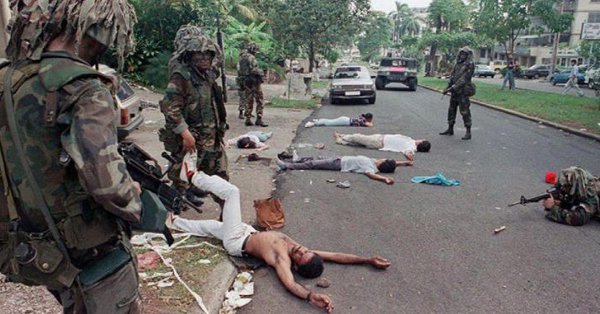
On Dec. 20, 1989, President George H.W. Bush ordered “Operation Just Cause” and deployed some 26,000 soldiers to overthrow General Manuel Antonio Noriega.
Until then, he had been one of the most faithful collaborators of the Central Intelligence Agency (CIA) and the Drug Enforcement Administration (DEA).
Noriega fueled the Bush administration’s hostility when he requested the closure of “The School of the Americas,” where the U.S. had trained thousands of Latin American military since 1946. Upon losing Washington’s support, however, the U.S. Department of Justice accused him of drug trafficking.
Official declassified documents, which were published by Panama Files for the first time this week, indicate that 202 civilians and 314 militaries were killed during Operation Just Cause.
In an unofficially recognized manner, historians, activists, and families argue that the U.S. invasion killed up to 4,000 civilians.
“El Chorillo neighborhood, where the Panamanian Defense Forces central headquarters were located, was razed during the battle,” local outlet El Siglo recalls.
Mirta Guevara, who was a Public Prosecutor at the time, remembers that nobody imagined what the U.S. was planning to do. She was studying court records on the night of December 19 when her husband came in and told her, “Close those files. They are going to invade us.”
“I was shocked because, although one sees such things at the movies, I had never imagined it. I think that no Panamanian imagined that they were going to invade us,” Guevara recalls and now says that such an action had no justification. “Many people died.”
Of what happened in Panama not only oral accounts remained. A year after the invasion, a documentary showed a woman who asked the U.S.-imposed government to recognize whether what happened was “war, invasion or liberation.” They replied to her that it was a “government of democracy and justice.”
“Democracy for whom? Justice for whom? For those who are in the mass graves or for those who are in the government? For those of us who go hungry or for those who have everything?” the woman said without fear of the repression that was lived in the country.
In another documentary called “Unjust Cause,” which was made by the Panamanian filmmaker Rafael Vergara, scenes of brutal aggression are reported, one of which happened when U.S. troops bombarded a civil building because their inhabitants did not want to leave.
To resist the invasion, the Panamanians organized themselves in the “Battalions of Dignity”, which were groups of guerrilla fighters who were persecuted by the invasion-born government, which was led by Guillermo Endara, to whom a judge gave the presidency secretly the night before the invasion.
“Those who seized power mounted on the invading tanks remain silent,” a witness told Prensa Latina.
“After 30 years, the curtains, which hid the worst massacre experienced by Panama and the largest U.S. military deployment after Vietnam, begin to fall.”
In his chronicle “The Panama Invasion: A Heroine of the Little Hiroshima,” Colombian journalist Hernando Calvo described what happened in El Chorrillo neighborhood through the testimony of Ana.
She recalled a Dantesque scenario in which invading troops prevented helping injured family members, tanks hit dead or alive people lying on the street, and flamethrowers burned dead bodies at the beach.
Venezuela Hits Back Following New Sanctions over Alleged Funding of WMD and Terrorism

By Paul Dobson | Mint Press News | April 4, 2018
Venezuelan authorities hit back at their counterparts in Panama and Switzerland this week after they approved new measures targeting Caracas.
Panama’s Economic and Finance Ministry announced this past March 27 that a warning was being issued to the Central American country’s banks advising them to limit and “diligently” supervise financial transactions involving 55 top Venezuelan officials as well as 16 private businesses allegedly associated with the Maduro government.
The list includes President Nicolas Maduro, National Electoral Council President Tibisay Lucena and rectors Tania D’Amelio and Socorro Hernandez, National Constituent Assembly members Diosdado Cabello and Hermann Escarra, Education Minister Elias Jaua, and Culture Minister Ernesto Villegas.
In an official statement, Panamanian authorities categorized the individuals and businesses as being “high risk in the area of money laundering, financing terrorism, and financing the proliferation of weapons of mass destruction.” No evidence was, however, presented to support the allegations.
Venezuela possesses no nuclear weapons and is a signatory of the Nuclear Non-Proliferation Treaty, as well as various other treaties banning the acquisition and development of nuclear, biological, and chemical weapons.
Similarly, many of those accused by Panama of allegedly financing terrorism belong to institutions which were themselves the objects of violent opposition attacks during last year’s anti-government protests – including the Supreme Court, the National Electoral Council, and regional government offices – which the Maduro administration has repeatedly described as “terrorism”.
Speaking Monday, Venezuelan Attorney General Tarek William Saab, who is included on Panama’s list, fired back, describing the accusations as “fake news” and calling on them to provide evidence.
“Show the accounts, my accounts for example, show where my name, my photo appears,” Saab challenged.
Penitentiary Affairs Minister Iris Varela, who also appears on the list, similarly denied the accusations and called on the Central American authorities to publish a “complete list” of all Venezuelan citizens who own assets in the country, placing special emphasis on those mentioned in the Panama Papers.
“Why don’t they do it [publish the complete list],” she questioned. “Simply because they have assets and fortunes that belong to the [Venezuelan] opposition.”
The recent measures follow close on the heels of an announcement last month that Panama will not recognise the results of Venezuela’s upcoming presidential election, mirroring steps taken by the Trump administration and other regional conservative governments in rejecting the May 20 vote.
Meanwhile, Switzerland also moved to apply sanctions against seven high-ranking Venezuelan functionaries last Wednesday, freezing their alleged assets in Swiss banks and applying travel bans.
In response, the Venezuelan government delivered an official letter of protest to the Swiss charge d’affaires Monday, calling the sanctions a violation of the UN Charter’s ban on unilateral coercive measures and charging Switzerland with “subordination” to Washington and Brussels’ hardline Venezuela policy.
“This erratic action… on the part of a historically neutral country like the Swiss Confederation does not create conditions for dialogue and strengthens extremist positions that seek violent solutions,” reads the text of the letter.
Venezuela’s Supreme Court also issued a declaration Monday rejecting the moves as “illegal”. Supreme Court President Maikel Moreno was named in both Swiss and Panamanian measures.
The latest international actions targeting Venezuela have, however, won praise from members the country’s right-wing opposition, including Popular Will party Political Coordinator Carlos Vecchio, who applauded the Panama measures as “the right path at this stage”.
Vecchio is currently in Paris meeting with center-right French President Emmanuel Macron as part of a European tour aimed at drumming up support for more sanctions against Caracas.
During the meeting Tuesday, Vecchio, together with First Justice party leader Julio Borges and ex-Caracas Mayor Antonio Ledezma – who is currently fleeing the Venezuelan justice system – called on Macron’s government to apply “more sanctions” against Venezuela and to “halt Petro, gold, and capital legitimation operations,” referring to the South American country’s new crypto-currency. They also urged the French president and other European leaders “not to dialogue” with Caracas.
Planteamos al gobierno de Francia apoyar Intervención Humanitaria, juicio de Corte Penal, más sanciones, detener operaciones con Petro, oro y legitimación de capitales para salir de dictadura que oprime a nuestro pueblo . y Desconocer fraude electoral. Con dictadura no se dialoga
— Antonio Ledezma (@alcaldeledezma) April 3, 2018
Translation | We propose to the government of France to support Humanitarian Intervention, criminal court trial, more sanctions, stop operations with Petro, gold and legitimation of capital to get out of the dictatorship that oppresses our people. and Disregard electoral fraud. With a dictatorship there is no dialogue
Opposition presidential frontrunner Henri Falcon, who defied the main opposition in launching his candidacy and has opposed economic sanctions in the past, has yet to issue a public statement with regard to the latest measures from Panama and Switzerland.
So far, only the US and the UK have approved economic sanctions against Caracas, while Canada and the European Union have rolled out sanctions against top Venezuelan officials
International sanctions against Venezuela have been denounced by the UN Human Rights Council as well as by UN Independent Expert Alfred de Zayas, who labeled the US-led measures “crimes against humanity” and called for the International Court of Justice to investigate.
According to Datanalisis, 55.6 percent of Venezuelans oppose economic sanctions against their country, while just 42 percent support individual sanctions targeting top officials.
Edited and with additional reporting by Lucas Koerner from Caracas.
Featured Video
No Threat Can Force Iran’s Surrender /Trita Parsi & Lt Cl Daniel Davis
or go to
Aletho News Archives – Video-Images
From the Archives
An Expert Military Analysis of War with China
Actually, None is Necessary
By Fred Reed • Unz Review • December 13, 2020
The Correlation of Armed Forces: U.S. goods and services trade with China totaled an estimated $634.8 billion in 2019. Exports were $163.0 billion; imports were $471.8 billion. The U.S. goods and services trade deficit with China was $308.8 billion in 2019. Trade in services with China (exports and imports) totaled an estimated $76.7 billion in 2019. Services exports were $56.5 billion; services imports were $20.1 billion. The U.S. services trade surplus with China was $36.4 billion in 2019.
There is talk within the Washingtoniat of a possible war with China. Steve Bannon, who apparently was dropped on his head as a child, actually favors such a war. We hear the usual shoo-the-boobs alarm about how the Chinese are doing something terrible and we must gird our loins and American values and show them what for, bow wow, woof. The danger is that the current game of who-blinks-first in Asian waters might actually provoke a shooting war. You know the kind of thing: One warship refuses to get out of the way of another, a collision ensues, some retard lieutenant who signed up on waivers opens fire, and we’re off and running. It is not a good idea to let children play with matches.
The said war is discussed either in emotional terms by idiots or in purely naval terms by those familiar with such things, so we hear of the First Island Chain and the Second Island Chain and whose missiles against the other’s missiles and so on. This would be appropriate if we were fighting World War Two again. Which we aren’t. Let’s take a quick-and-dirty look at how such a war might go.
To begin the war, America would overestimate itself and underestimate China. This is doctrine in the Pentagon. … continue
Blog Roll
 Aletho News
- Iran To Target Military Industrial-Tech Complex That Facilitated Gaza Genocide
- Collapsing Empire: The Resistance Disarms ‘Israel’
- Suicide Should Not Be a Government Service
- Rethinking America’s greatest threat: Iran vs. Israel-Firsters
- Iran accuses adversaries of false flags to strain Turkey ties
- Poland rules out sending Patriot missiles to US/Israel amid war on Iran
- Tehran approves new Hormuz plan with major restrictions
- No Threat Can Force Iran’s Surrender /Trita Parsi & Lt Cl Daniel Davis
- UK’s New Pandemic Plan Would Turn Big Tech Into a Mass Location Tracking Network
- Growing insecurity, soaring prices fuel protests in north as regime bans evacuation: Sources
- If Americans Knew
- Ann Coulter Rips Into Fox News for Iran War Coverage, Compares to False Rigged 2020 Election Reporting
- Joe Kent Urges Americans To Call White House and Congress To Object To Sending Troops Into Iran
- DNC Resolution to Reject AIPAC Funding Puts Democratic Leaders in the Hot Seat
- Swedish foundation to build 400 schools as over 650,000 Gaza children remain without education for 2 years
- Israeli army admits photshopping image of slain Lebanese journalist
- This is how Israel is systematically killing health workers under the cover of war in Lebanon
- Carrying life under fire: Israeli invasion of Lebanon leaves pregnant women facing deadly risks
- Champagne all around for the new death penalty (for Palestinians) law – Not a ceasefire Day 172
- Why are Palestinian books struggling to be seen on Amazon?
- The Line Between Affinity and Conspiracy
- No Tricks Zone
- New Study Finds Warming Saves Lives…Cold Temperatures 12 Times More Deadly Than Excess Heat
- German Science Blog Accuses PIK Climate Institute Of Hallucinating Climate Tipping Points
- Devastating Assessment Of Comirnaty Vaccine By Former Senior Pfizer Europe Toxicologist
- New Study: CO2 Is ‘Effectively Negligible’ As An Explanatory Climate Change Factor Since 2000
- Former Pfizer Toxicologist Dr. Helmut Sterz Tells Bundestag Hearing Pfizer Vaccine Should Have Never Been Approved
- Energy Expert: Germany’s Nuclear Phaseout Was A “500 Billion Euro Mistake”
- New Research: South Australia’s Mid-Holocene Sea Surface Temperatures Were 4°C Warmer Than Today
- Storing Green Energy To Last Germany 10 Days Would Require A 60-Million Tonne Battery
- New Studies: UK Sea Levels Were 4 Meters Higher Than Today During The Mid-Holocene
- Destructive Green New Deal: German Energy And Metal Group Warns Of Drastic Crisis
 Aletho News