Is Duterte really threatening war with China? The opposite may be true…
By Darius Shahtahmasebi | RT | May 31, 2018
The media wants you to believe that the Philippines is headed towards war with China. The truth may in fact be the opposite.
If you followed international headlines this week, you may have been alarmed to see the shocking revelation that, despite wanting a closer relationship with China, Philippines’ President Rodrigo Duterte was now ready to risk war with Beijing to ‘protect the territorial integrity of his country’.
“Philippines’ Duterte threatens war in South China sea if troops are harmed,” Newsweek warns. “Philippines draw three hard lines on China,” Asia Times outlines. “Philippine President Rodrigo Duterte will go to war with China if it crosses ‘red lines’ and claims disputed resources, foreign ministry warns,” the South China Morning Post (SCMP ) explains. “Duterte will ‘go to war’ over South China Sea resources, minister says,” according to CNN.
Those are indeed some shocking headlines as the last thing anyone in their right mind wants is a regional conflict, not least one that involves a rising nuclear power with the capabilities that China has.
So what did President Duterte actually say, and how close to a regional standoff are we at this current juncture?
Well, according to the reports, Duterte didn’t actually say anything. The majority of these warnings came directly from Foreign Secretary Alan Peter Cayetano, the country’s top diplomat. While claiming to speak for Duterte, Cayetano drew up three major red lines that could allegedly lead the Philippines’ President to war with China. The first red line that supposedly won’t be tolerated is any Chinese move to reclaim or build on the Philippine-claimed Scarborough Shoal, which lies just over 100 nautical miles from Philippine shores. The second red line is any coercive Chinese move against the Philippine marine detachment guarding the Second Thomas Shoal. The third red line is any unilateral Chinese drilling for natural resources, mostly oil and gas, within the Philippines’ exclusive economic zone.
“Another red line is that nobody will get natural resources there on their own,” Cayetano said. “The President has said that: If anyone gets the natural resources in the West Philippine Sea, he will go to war.”
“If we lost a single island during Duterte’s time, I will pack my bags, go home,” he also added.
Hmmm. It is starting to sound a bit like Cayetano’s red lines; more so than the President’s red lines.
Then not long after, another headline which read “Philippines could go to war over South China Sea: Duterte aide” may have also caught your eye. Again, this involved National Security Adviser Hermogenes Esperon making the stunning revelation that “just the other night, the president said if my troops are hurt there, that could be my red line.”
Note that in none of these instances is Duterte himself doing any of the talking. When one digs a little bit deeper, this is when it becomes all the more interesting. In actuality, it was just over a week ago that the Philippines’ President was saying the complete opposite.
Even after the Chinese military landed long-range bombers at an airport on Woody Island in the South China Sea – reportedly placing the Philippines within strike range of Chinese bombers – Duterte’s response was to state that “you know they have the planes, not stationed in Spratly but near the provinces facing – Chinese provinces facing the Spratly and the China Sea. And with their hypersonic, they can reach Manila within seven to 10 minutes.”
The President also allegedly added: “What will we arm ourselves with if there’s a war? Will we resort to slapping each other? I couldn’t even buy myself a rifle. It was given to me. So how will we even fight with the Chinese?”
To the rest of us paying attention, Duterte’s comments appeared to indicate that he was ruling out the possibility of any war with China involving the Philippines. He even suggested that he doubts the Philippines could rely on the US in such a scenario. In other words, under Duterte’s leadership, the Philippines would not go to war with China as he is convinced that there is nothing the Philippines can do to confront China without suffering an immeasurable loss.
But don’t take my word for it.
“I cannot afford at this time to go to war. I cannot go into a battle which I cannot win and would only result in destruction for our armed forces. I really want to do something to assert. But you know, when I assumed the presidency, there was already this ruckus in the West Philippine Sea,” Duterte said during a speech at the Philippine Navy’s 120th anniversary in Manila.
“So will we be able to win that war? If my troops are massacred, after the war, the soldiers and police will come after me next. Our troops will really be finished off there,” the President also stated at the time.
So what is Duterte’s proposal to deal with the stand-off, bearing in mind that there are many Filipinos who do not see eye to eye with Duterte?
“We don’t have to fight. We can divide this in a joint development, joint exploration. And then we’ll give you [China] a bigger share rather than fight. It’s only America who’s worried because they lost a territory. You’re the ones who came first. I was just new and then you adapted the rascal’s propaganda,” Duterte proposed less than two weeks ago.
While the media continues to mislead the public on Duterte’s alleged new push to confront China in the South China Sea, it also failed to note that at around the same time Duterte was supposedly making these threats of war towards China, he had just appointed a special envoy to China with the specific intention of fostering closer relations with Beijing.
Of course, it could be the case that Duterte has changed his stance this week in a complete nonsensical 180 degree U-turn and will indeed confront China if he feels it is in the best interests of his country. However, it is curious to say the least, that as one of the world’s most vocal leaders (he once admitted killing suspected criminals while serving as Governor) he has not been the one to directly voice this U-turn himself, the statements having come from other subordinates from within his administration.
We also have to bear in mind that Duterte is a man who believes his presidency is protected by Chinese President Xi Jinping, acknowledging that he needs China “more than anybody else at this time of our national life.” He also once said to Beijing that if they wanted to, “just make [the Philippines] a province.” It doesn’t seem too likely that Duterte is all of a sudden prepared to give this dependency up, in light of his consistently pro-Chinese stance.
The other development to keep an eye on is the recent war-drills at the beginning of May this year involving US forces and Philippines’ forces which were the largest military exercises held in the Philippines since Duterte became president. Even then, these drills appeared to focus more on the domestic threat of terrorism inside the country and were not officially aimed at confronting China’s expanding influence.
For ease of reference, a month-long firefight between Islamist militants with allegiances to Islamic State (IS, formerly ISIS) and government forces left 1,100 people dead just under a year ago. In that context, it is not completely unusual that the President may have given the go-ahead for these drills to take place. (That being said, Duterte personally admitted he did not expressly authorize the US military’s involvement in its counter-terrorism efforts last year, suggesting that there may be other forces at play which may or may not be beyond his control). This also may be the case with the development that the Philippines has begun repairing a runway and upgrading facilities on Thitu Island, a major point of dispute between Chinese and Philippine vessels last year.
No matter how badly the media want Duterte to reject and confront China, the cold hard truth is that China is an “indispensable geographical reality,” as Richard Javad Heydarian in the National Interest recently put it. There is little that Duterte can do to confront China even if he really wanted to, as he is predicting a future in which Washington becomes increasingly irrelevant in the Asia-Pacific region all the while China begins to exert more and more influence in the area. Rather than butting heads with China, Duterte’s plan is exactly as he says – develop and explore the area jointly with China while coming to an arrangement, which does the complete opposite of what the media wants you to believe he will do, to avoid a war with China at all costs.
Philippines makes ban on work in Kuwait ‘permanent’
Press TV – April 29, 2018
Philippine President Rodrigo Duterte on Sunday said the temporary ban on Filipinos going to work in Kuwait is now permanent, intensifying a diplomatic standoff over the treatment of migrant workers in the Persian Gulf nation.
Duterte in February imposed a prohibition on workers heading to Kuwait following the murder of a Filipino maid, whose body was found stuffed in a freezer in the Persian Gulf state.
The crisis deepened after Kuwaiti authorities last week ordered Manila’s envoy to leave the country over videos of Philippine Embassy staff helping workers in Kuwait flee allegedly abusive employers.
The two nations had been negotiating a labor deal that Philippine officials said could result in the lifting of the ban, but the recent escalation in tensions has put an agreement in doubt.
“The ban stays permanently. There will be no more recruitment for especially domestic helpers. No more,” Duterte told reporters in his hometown in the southern city of Davao.
Around 262,000 Filipinos work in Kuwait, nearly 60 percent of them domestic workers, according to the Philippines’ foreign department.
Last week, the Philippines apologized over the rescue videos, but Kuwaiti officials announced they were expelling Manila’s ambassador and recalling their own envoy from the Southeast Asian nation.
Duterte on Sunday described the situation in Kuwait as a “calamity.”
He said he would bring home Filipino maids who suffered abuse as he appealed to workers who wanted to stay in the oil-rich state.
“I would like to address to their patriotism: come home. No matter how poor we are, we will survive. The economy is doing good and we are short of our workers,” he said.
About 10 million Filipinos work abroad to seek high-paying jobs they were unable to find at home, and their remittances are a major pillar of the Philippine economy.
Duterte said workers returning from Kuwait could find employment as English teachers in China, citing improved ties with Beijing.
Describing China as a “true friend,” he said he would use Chinese aid to fund the workers’ repatriation.
Duterte added that he was not after “vengeance” against Kuwait and did not “nurture hate.”
“But if my people are considered a burden to some of them, to some government mandated to protect them and uphold their rights, then we will do our part,” he said.
Philippines DENIES reports that US may intervene in Marawi against ISIS
By Adam Garrie | The Duran | August 8, 2017
Defence officials in Philippines deny reports from the United States that American military contingents are examining the possibility of a military intervention in the country due to the war with ISIS aligned terrorists and other insurgents on the southern Philippine island of Mindanao and specifically the besieged city of Marawi.
US based NBC news earlier reported that Pentagon spokesman Capt. Jeff Davis stated that the US will shortly make an announcement on whether US bombers will commence military strikes in Philippines.
This recent development would imply that the US is considering and indeed may be planning a strike on targets in Philippines that may be illegal according to international law.
Sputnik reports,
“According to Philippine Star media outlet, the country’s Defense Secretary Delfin Lorenzana and Armed Forces Chief of Staff Eduardo Ano said that US Air Force engagement in military operations in the Philippines was impossible, and that Washington’s direct involvement in the Marawi siege was beyond discussion.
The military officials stressed that the 1951 US-Philippines Mutual Defense Treaty entails direct military support only in the case of a military invasion by a third party country. However, they also expressed their gratitude toward the United States for backing the Philippines in their fight against terrorism.
In late July, the United States supplied the Philippines with two new Cessna 208B Grand Caravan intelligence, surveillance and reconnaissance (ISR) aircraft, 1,040 rocket motors and 992 rockets to fight against terror. In addition, Manila is expected to receive 250 rocket-propelled grenade launchers from Washington.
The so-called Marawi siege started on May 23, when the Philippine security forces stormed the city seeking to prevent two IS-affiliated groups from meeting, which sparked up a full-scale armed conflict. On May 25, Philippine President Rodrigo Duterte declared martial law on the southern island of Mindanao, which is often subjected to attacks by IS-linked terror groups. So far, over 500 militants and 122 government forces servicemen have been killed in the Marawi battle”.
Existing treaties between Manila and Washington explicitly prohibit unauthorised US military action under the present circumstances. If the US does conduct illegal strikes in Philippines, this will be the second time in recent months that the US has acted unilaterally in its former colony.
In June of 2017, it was reported that Philippines had requested assistance from the United States in its battle against terrorists, but this claim was later totally refuted by President Rodgiro Duterte.
Duterte’s relationship with America has been a tenuous one ever since his election in July of 2016. Duterte has embarked an independent foreign policy that seeks to build historically good relations with both China and Russia. Duterte also has engaged cooperatively with China over the disputes in the South China Sea, a policy that is at odds with the provocative US policy of molesting Chinese water rights, a policy that Washington misleadingly calls ‘freedom of navigation’.
Meanwhile, Duterte has refused to travel to the United States in response to members of the US Congress questioning his war on drugs which remains popular among the vast majority of Filipinos.
Many in the US are eager to retain a foothold in Philippines at a time when Philippine public opinion is strongly with the independence minded President Duterte.
Philippines urges US to return church bells
Press TV – July 25, 2017
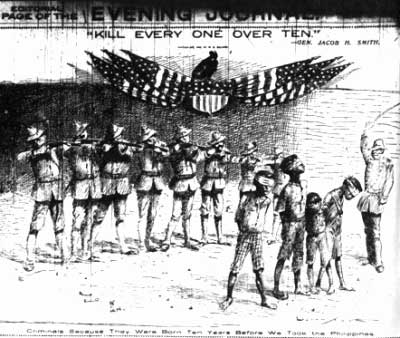
Philippine President Rodrigo Duterte has demanded the United States return church bells seized by American forces in a bloody campaign more than a century ago, in another blast at his country’s traditional ally.
American forces took three bells from the Catholic church of Balangiga town on the eastern island of Samar in 1901 as war booty in what historians said was a particularly brutal military operation in the new US colony.
“Give us back those Balangiga bells. They are not yours. They are ours. They belong to the Philippines. They are part of our national heritage,” Duterte said at his annual State of the Nation Address on Monday.
“Those bells are reminders of the gallantry and heroism of our forebears who resisted the American colonizers and sacrificed their lives in the process.”
Two of the bells are installed at a memorial for US war dead in Wyoming, while the third is with US forces in South Korea.
Some US politicians oppose the dismantling of the memorial.
US embassy spokeswoman Molly Koscina gave a non-committal reply on Tuesday to Duterte’s demands.
“We are aware that the bells of Balangiga have deep significance for a number of people, both in the United States and in the Philippines,” she said in an email to AFP.
Duterte on Monday repeated a Filipino account of the campaign that the commanding general, Jacob Smith, ordered Samar be turned into a “howling wilderness” and that all Filipino males aged 10 or above be killed.
A 1902 US court-martial convicted Smith of a minor offence in relation to the Samar campaign, while 39 other Americans were separately found guilty of torturing and shooting Filipino prisoners there, the US Army War College research paper said.
However none of them were jailed, according to the paper.
The then Philippine president Fidel Ramos first sought but failed to recover the bells during a 1998 Washington trip.
Duterte, a self-described socialist, has since his election last year worked to distance Manila from Washington while building closer ties with China and Russia.
The Philippine islands, a Spanish colony for centuries, were ceded to the United States in 1898 at the end of the Spanish-American War. The Philippines gained independence from the Americans in 1946.
Duterte has repeatedly lashed out at the US as ties have frayed, and last Friday vowed he would never visit the “lousy” country despite an earlier invitation extended by US President Donald Trump.
ISIS Touches Down in the Philippines
By Tony Cartalucci | New Eastern Outlook | 28.05.2017
Mayhem broke out across the southern Philippine city of Marawi where militants besieged it and hoisted flags of the so-called “Islamic State.” Located on the southern island of Mindanao, the city is only slightly removed from Al Qaeda affiliate Abu Sayaff’s primary area of operation on nearby Jolo and Basilan islands.
The UK Independent in an article titled, “Isis-linked militants take priest and churchgoers hostage in Philippines,” would report:
President Rodrigo Duterte declared martial law in the south because of the militants’ siege on the city on Tuesday and abandoned a trip to Russia to deal with the crisis.
Mr Duterte vowed to place southern Mindanao island, where Marawi is situated, and its 22 million residents under military rule for up to a year if necessary.
The article would also report:
Troops are battling to contain dozens of militants from the Maute group, which pledged allegiance to Isis in 2015, after they escaped a botched security raid on a hideout and overran streets, bridges and buildings.
Two soldiers and a police officer are among those killed and at least 12 people have been wounded in the violence, seeing Maute fighters set fire to a school, a church and a prison.
The security crisis represents a seemingly inexplicable expansion of the Islamic State in Asia – even as the US and its allies claim the organization is being rolled back across the Middle East and its revenue streams are contracting in the wake of defeat.
US-Saudi Sponsored Terrorism Seeks to Coerce Asia
Both the Maute group and Abu Sayaff are extensions of Al Qaeda’s global terror network, propped up by state sponsorship from Saudi Arabia and Qatar, and fed recruits via a global network of likewise Saudi and Qatari funded “madrasas.” In turn, Saudi Arabia and Qatar’s state sponsorship of global terrorism for decades has been actively enabled by material and political support provided by the United States.
This arrangement provides for Washington both a global mercenary force with which to wage proxy war when conventional and direct military force cannot be used, and a pretext for direct US military intervention when proxy warfare fails to achieve Washington’s objectives.
This formula has been used in Afghanistan in the 1980s to successfully expel the Soviet Union, in 2011 to overthrow the Libyan government, and is currently being used in Syria where both proxy war and direct US military intervention is being applied.
Maute and Abu Sayaff activity fits into this global pattern perfectly.
The Philippines is one of many Southeast Asian states that has incrementally shifted from traditional alliances and dependency on the United States to regional neighbors including China, as well as Eurasian states including Russia.
The Philippine president, Rodrigo Duterte, cancelling his meeting with Russia is a microcosm of the very sort of results Maute and Abu Sayaff are tasked with achieving in the Philippines. Attempts by the US to justify the presence of its troops in the Philippines as part of a wider strategy of encircling China with US military installations across Asia would also greatly benefit from the Islamic State “suddenly spreading” across the island nation.
Likewise, violence in Malaysia and Thailand are directly linked to this wider US-Saudi alliance, with violence erupting at each and every crucial juncture as the US is incrementally pushed out of the region. Indonesia has likewise suffered violence at the hands of the Islamic State, and even Myanmar is being threatened by Saudi-funded terrorism seeking to leverage and expand the ongoing Rohingya humanitarian crisis.
That US-Saudi sponsorship drives this terrorism, not the meager revenue streams of the Islamic State in Syria and Iraq, goes far in explaining why the terrorist organization is capable of such bold attacks in Southeast Asia even as Russia and Iranian backed Syrian troops extinguish it in the Middle East.
US-Saudi Links to Abu Sayaff and other Terrorists in the Philippines
A US diplomatic cable leaked by Wikileaks dated 2005 would state:
Philippine officials noted their continuing concern about Saudi-origin terrorist financing coming into the Philippines under the cover of donations to mosques, orphanages, and madrassahs. Although three Saudi nationals suspected of being couriers had been detained on separate occasions, Saudi Ambassador Wali had intervened in each case to secure their release.
Yousaf Butt of the Washington-based US National Defense University would reveal in a Huffington Post article titled, “How Saudi Wahhabism Is the Fountainhead of Islamist Terrorism,” that:
It would be troublesome but perhaps acceptable for the House of Saud to promote the intolerant and extremist Wahhabi creed just domestically. But, unfortunately, for decades the Saudis have also lavishly financed its propagation abroad. Exact numbers are not known, but it is thought that more than $100 billion have been spent on exporting fanatical Wahhabism to various much poorer Muslim nations worldwide over the past three decades. It might well be twice that number. By comparison, the Soviets spent about $7 billion spreading communism worldwide in the 70 years from 1921 and 1991.
The leaked cable and reports by Western analysts when taken together, reveal that Saudi-funded madrasas in the Philippines are directly fueling terrorism there.
The answer to why is simple.
For the same purposes the US used Saudi-funded terrorism in Afghanistan in the 1980s and in Libya and Syria beginning in 2011 – the US is using Saudi-funded terrorism to coerce the government of the Philippines amid Washington’s faltering “pivot to Asia” which began under US President Barrack Obama and now continues under President Trump.
Countering US-Saudi Sponsored Terrorism
With US President Trump announcing a US-Saudi alliance against terrorism – the US has managed to strategically misdirect public attention away from global terrorism’s very epicenter and protect America’s premier intermediaries in fueling that terrorism around the world.
The Philippines would be unwise to turn to this “alliance” for help in fighting terrorism both the US and Saudi Arabia are directly and intentionally fueling.
Instead – for Southeast Asia – joint counter-terrorism efforts together and with China and Russia would ensure a coordinated and effective means of confronting this threat on multiple levels.
By exposing the US-Saudi role in regional terrorism – each and every act of terrorism and militancy would be linked directly to and subsequently taint the US and Saudi Arabia in the hearts and minds of Southeast Asia’s population.
This paves the way for a process of exposing and dismantling US-Saudi funded fronts – including Saudi-sponsored madrasas and US-funded NGOs – both of which feed into regional extremism and political subversion. As this unfolds, each respective nation would be required to invest in genuine local institutions to fill sociopolitical and economic space previously occupied by these foreign funded fronts.
Until then, Asia should expect the US and its Saudi partners to continue leveraging terrorism against the region. If unchecked, Asia should likewise expect the same progress-arresting instability that has mired the Middle East and North Africa for decades.
People flee Takfiri ‘invasion’ in southern Philippines
Press TV – May 26, 2017
Hundreds of people have fled the Philippines’ southern city of Marawi as military forces fight to drive Takfiri militants out of the city.
Foreign militants from Indonesia and Malaysia are recruited by a militant group engaged in battles with the Philippine army in Maraqi, on Mindanao Island, Manila’s Solicitor-General Jose Calida said on Friday, in a rare admission of links between domestic and foreign militants belonging to the Takfiri Daesh terrorist group.
President Rodrigo Duterte on Tuesday declared martial law on Mindanao, the country’s second-largest island, to stop the spread of Takfiri militancy. He recently revealed that Daesh had planned to establish a permanent base in the southern Philippines and the country was at risk of “contamination.” Daesh is mainly operating in Syria and Iraq.
Daesh has apparently been attempting to exploit the poverty and lawlessness in the southern Philippines to establish a base in Southeast Asia for its Wahhabi extremist ideology.
Malaysian and Indonesian nationals were among six people who were killed on Thursday in battles between the army and the militants in Marawi.
The Philippine army has sent attack helicopters and Special Forces to drive the militants out of the southern city of 200,000 people. A total of 11 soldiers and 31 militants have reportedly been killed in the fighting so far.
“Our troops are doing deliberate operations in areas we believe are still occupied or infested with the terrorists’ presence. I specifically ordered our soldiers to locate and destroy these terrorists as soon as possible,” said Brig. Gen. Rolly Bautista, the head of the Joint Task Force ZamPeLan.
Another military commander, Lt. Gen. Carlito Galvez Jr., called on locals to help locate the militants and “contribute to the neutralization of these agents of deaths and destruction.”
A raid was conducted on Tuesday to capture Isnilon Hapilon, a leader of a radical faction of a militant group, Abu Sayyaf. The government says Hapilon has been the point man for Daesh in the Philippines and has been collaborating with the leaders of Maute, another militant group.
Calida said Daesh had chosen Hapilon as “their emir, or leader in the Philippines.”
Daesh now in Philippines
Referring to the Maute groups, Calida further said, “Before it was just a local terrorist group. But now they have subscribed to the ideology of ISIS (Daesh).”
Calida said the Maute terrorists “want to make Mindanao part of the caliphate,” referring to shrinking territory in Iraq and Syria that Daesh has overrun.
Maute was blamed for a bombing in President Duterte’s home city of Davao in September last year, which killed 14 people and wounded dozens.
Philippine’s Duterte Seeks Peace
By Marjorie Cohn | Consortium News | November 25, 2016
In April 2016, Rodrigo Duterte won the Philippine presidential election by a landslide, with more than 6 million votes. He openly declared that he was the nation’s first Left president, calling himself a socialist but not a communist. So far, his regime has been controversial, to put it mildly.
The U.S. press has focused on Duterte’s vicious war on drugs that claimed upwards of 2,000 lives and led to the incarceration of tens of thousands of people. His decision to allow former Filipino dictator Ferdinand Marcos’s burial in the National Cemetery of the Heroes also has drawn the ire of those who recall Marcos’s brutal two-decade regime that killed more than 3,000, tortured tens of thousands, and stole $10 billion from the Philippines.
But, significantly, Duterte is engaging with revolutionary forces in the peace process that aims to end 47 years of armed struggle against the repressive Filipino government. And Duterte has taken actions that, for the first time, challenge the longstanding military and economic power of the United States in the Philippines.
Peace Process With Opposition
Since 1969, a civil war has been raging in the Philippines. The roots of the armed conflict can be traced to the colonial and neocolonial domination of the Philippines by the Spanish, then U.S. imperialism, feudal exploitation by big landlords and capitalist interests, as well as widespread bureaucratic corruption. After Duterte’s election, he cited peace as a top priority of his administration, vowing to engage in peace negotiations with the National Democratic Front of the Philippines (NDFP).
According to JustPeacePH, an international platform that supports the Philippine peace process and takes its name from its Internet site, “justpeace.ph,” “The daily, systematic and systemic injustice experienced by the people drive them to desire and seek fundamental changes in society through various means. But because the forces against fundamental social change use all means including the instruments and violence of the state to defend the status quo, many Filipinos over many generations have embraced armed struggle to overthrow the ruling system.”
The NDFP “is the alliance of progressive forces seeking to bring about fundamental change in the existing social system in the Philippines through armed revolution,” JustPeacePH states in its Primer on Just and Lasting Peace in the Philippines. The NDFP alliance includes trade unions, peasants, youth, women, national minorities, teachers, health workers, religious clergy, the Communist Party of the Philippines (CPP), and the New People’s Army.
Duterte’s Peace Initiative
Two rounds of peace negotiations have already occurred since Duterte took office, with a third scheduled for January 2017 in Oslo, Norway.
In May, Duterte declared he would release all political prisoners, which number more than 400, through a presidential declaration of amnesty, provided both houses of congress approve. Nineteen NDFP consultants, who have been involved in the revolutionary movement for years, have already been released.
Duterte offered four cabinet positions to the CCP, but they declined, stating there must first be a comprehensive peace agreement. The CCP, however, recommended a veteran peasant leader who was appointed Secretary of Agrarian Reform and a veteran academic activist leader who was named secretary of social welfare and development.
“These are major appointments,” Luis Jalandoni, NDFP’s Senior Adviser on the Peace Negotiating Panel, told me at a recent conference of the International Association of Democratic Lawyers in Lisbon, Portugal.
NDFP has a people’s army and organs of political power with mass organizations in 71 out of the 81 provinces in the country, Jalandoni said. He noted that landlessness and poverty afflict the 100 million people in the Philippines.
“The NDFP insists on addressing the roots of the armed conflict in order to achieve a just and lasting peace,” Jalandoni said.
The demands in the peace talks are: Release of all political prisoners; Land reform for the peasantry (70% of the population); National industrialization to develop the economy using available human and natural resources; Protect the environment and ancestral lands of the indigenous peoples; and Philippine national sovereignty and abrogation of all unequal treaties with the United States.
Challenging U.S. Power
U.S. domination and interference in the Philippines date back to 1898, when the United States annexed the Philippines. The U.S. continued to exercise colonial rule over the country until 1946, when the Philippines gained its independence although the United States retained many military installations there and the Filipino economy maintained its dependence on the U.S.
With U.S. assistance, Marcos ruled the Philippines with an iron fist from 1965 through 1986, under martial law from 1972 to 1981.
In 2002, the Gloria Macapagal-Arroyo government developed Oplan Bayanihan, a counterinsurgency program modeled on U.S. strategies. After 9/11, the Bush administration gave Arroyo $100 million to fund that campaign in the Philippines.
Oplan Bayanihan led to large numbers of extrajudicial killings, forced disappearances, torture and cruel treatment. Many civilians, including children, have been killed. Philippine military and paramilitary death squads murdered hundreds of members of progressive organizations. Communities and leaders opposed to large-scale and invasive mining have been targeted. Even ordinary people with no political affiliation have not escaped the government’s reign of terror.
From 2001 to 2010, the U.S. government provided more than $507 in military assistance to the Philippine government, facilitating tremendous repression.
Between 2010 and 2015, the Philippine police, military and paramilitary forces perpetrated extrajudicial killings, forced disappearances, torture, illegal arrests and forced evacuation, many to enable extraction by mining companies.
The 2014 Enhanced Defense Cooperation Agreement, which President Barack Obama negotiated with Duterte’s predecessor, gave U.S. troops the right to prolonged deployment in the Philippines. The agreement is widely seen in the Philippines as a threat to the country’s sovereignty.
In September 2016, Duterte declared, “I am not a fan of the Americans … Filipinos should be first before everybody else.” He added, “In our relations to the world, the Philippines will pursue an independent foreign policy. I repeat: The Philippines will pursue an independent foreign policy.”
The United States has not apologized for all the atrocities it committed against the Filipino people, Duterte said. Responding to U.S. criticism of the Philippines for its human rights violations, he stated, “Why are you Americans killing the black people there, shooting them down when they are already on the ground.”
Duterte promised to end joint military maneuvers with U.S. forces and expel the hundreds of U.S. troops currently stationed in the Philippines. He also expressed his intention to end bilateral agreements concluded by his predecessor with the United States and reverse permission for the United States’ use of five Philippine military bases.
“I will break up with America,” Duterte said. “I would rather go to Russia and to China.” He vowed to rescind joint patrols with U.S. and Filipino forces against Chinese expansion in the disputed South China Sea. Indeed, Duterte recently traveled to China and secured valuable fishing rights for Filipinos in the South China Sea.
Hope for Peace Prospects
In an unprecedented development, both the government and the opposition declared unilateral ceasefires in August. But there are still problems with the government’s ceasefire, says Jalandoni, as Duterte doesn’t have full control of the military. The military and paramilitary forces, which are protected by the military, have engaged in several violations that imperil the ceasefire, he said.
“There is high optimism that the peace talks will prosper under the presidency of Duterte,” according to JustPeacePH. “Unlike past presidents who harbor strong anti-communist bias, Duterte seems capable of rethinking the government’s peace strategy since he claims to be a socialist.”
Opposition forces are not uncritical of the excesses in Duterte’s war on drugs. The CCP declared the campaign is becoming anti-people and anti-democratic. Due process must be respected, human rights must be upheld; the drug users and small drug dealers, who come from poverty, require rehabilitation and care, the CCP maintains.
“Understandably, Duterte’s war on drugs and other crimes is given more coverage by the global media,” JustPeacePH wrote in its primer. “But Duterte’s aim to establish a lasting peace in the provinces deserves even more attention as this strikes at the root causes of the problem of illegal drugs and related crimes.”
Jalandoni said, “Duterte is not a saint but he stands for an independent foreign policy. His stand against the United States is respected and has received a lot of support.”
The NDFP, Jalandoni noted, says that “if there are threats against Duterte by U.S. imperialism, the Left will be a reliable ally to him,” adding, “He is the first president to stand up to the United States.”
Marjorie Cohn is professor emerita at Thomas Jefferson School of Law, former president of the National Lawyers Guild, and deputy secretary general of the International Association of Democratic Lawyers. She is a member of the International Legal Assistance Team that advises the National Democratic Front of the Philippines on human rights and humanitarian law in their peace negotiations. Her most recent book is Drones and Targeted Killing: Legal, Moral, and Geopolitical Issues. Visit her website at http://marjoriecohn.com/ and follow her on Twitter @marjoriecohn.
What the Philippines Says Vs. What it Does
By Joseph Thomas | New Eastern Outlook | 30.10.2016
Philippines President Rodrigo Duterte has been identified as a menace to US foreign policy in Asia Pacific by both his supporters and his opponents. For his supporters, he is propped up as a hero of “anti-imperialism,” while his detractors claim his leadership incites instability, is nonconstructive and is leading his Southeast Asian state to ruin.
The truth, however, exists somewhere in between.
A look at the Philippines within Southeast Asia reveals a nation that has long existed within America’s geopolitical and economic sphere, but also a nation more recently emerging from that sphere, pulled into the political and economic orbit of Beijing and in a wider sense, an increasingly influential and growing Asia.
The Philippines eventually replacing its various, compromising dependencies on Washington is inevitable. Whether or not President Duterte’s recent rhetoric is proportional to the Philippines’ actual ability to replace these dependencies in the immediate and sweeping manner he has suggested is another matter entirely.
The necessity to compromise the Philippines’ sovereignty and independence in exchange for economic ties with the United States clearly is no longer in Manila’s best interests. Its trade with China and other Asian states far outweighs its trade with the United States.
Exports from the Philippines, for example, primarily remain in Asia, nearly two-thirds in fact. Exports to the US account for only about one-sixth of the Philippines’ exports. This is not insignificant, but it is clearly disproportionate to the political and economic influence the US seeks to wield both in Asia and in the Philippines specifically.
Nor is the need to continue depending on the United States to “underwrite” the Philippines’ security in the region necessary, especially since such “underwriting” generally involves protecting Manila from confrontations Washington itself intentionally provokes with the Philippines’ neighbours, including China. No clearer example of this can be seen than the recent Philippines-China row in the South China Sea, where the United States itself assembled a team of American and British lawyers to represent Manila in what it called an “international tribunal” which predictably ruled against Beijing in Manila’s favour.
The tribunal sought to inflame the confrontation, and bring it from a simple bilateral issue, to an increasingly serious international confrontation meant to isolate Beijing.
What the Philippines is Actually Doing…
President Duterte’s rhetoric has been extreme, however the steps the Philippines is actually taking have been much more measured and proportional.
In regards to trade, the Philippines is on a natural trajectory to continue closing in with Beijing and the rest of Asia. Militarily, it also benefits the Philippines to incrementally remove US troops from its territory, scale back joint exercises, particularly those intentionally carried out to provoke Manila’s neighbours as well as seek new sources for cheaper and more reliable military hardware.
In terms of America’s showpiece conflict in the South China Sea, the Philippines has already distanced itself from Washington’s strategy of confrontation, encirclement and isolation in regards to Beijing and has instead attempted to resolve the issue bilaterally with Beijing itself. The expensive and time-consuming “tribunal” the United States organised for the Philippines has all but been thrown to the wayside as a result of this.
The Philippines’ shifting ties in Asia Pacific are more a matter of practicality than ideology. If practical matters dictate that the Philippines maintains some ties to the United States, it will do so. This is because despite shifting closer to Asia in general, the Philippines still has many economic and political ties to Washington that will be difficult to simply “cut” in the short-term. In the long-term, practical alternatives need to be created and incrementally implemented.
There are also a large number of Philippine political and business leaders who have no interest in severing ties with the United States, ties they directly benefit from and ties that they do not see alternatives to, with a Philippine pivot toward Beijing and the rest of Asia.
This political and economic bloc, however small, will receive increased support from the US to place pressure on Manila to slow down or even reverse its shifting ties. This can already be seen across various media platforms in and beyond the Philippines, as well as within the government itself.
Patience and Pragmatism
President Duterte’s rhetoric is meant to stir up public support more than actually signal his nation’s real intentions. Other nations throughout Asia are also pursuing a “pivot” away from the United States and its attempts to reassert itself in Asia Pacific. However, they are doing it quietly, incrementally and are attempting to make whatever concessions they must with Washington to stave off large-scale, concerted attempts to destabilise or even overturn political order in each respective nation.
The Philippines has a long journey ahead of itself in establishing a more independent and self-sustaining nation state. It faces not only countervailing forces it must navigate amid Beijing and Washington’s ongoing jockeying for regional power and influence, but also internal challenges to overcome.
Should President Duterte place increased substance behind his extreme, often shifting rhetoric, and change tack toward more pragmatic and consistent policies, he may be able to enjoy the best of both worlds, popular support, and improved leverage for his nation amid a tumultuous time.
Joseph Thomas is chief editor of Thailand-based geopolitical journal, The New Atlas.
US Impunity Erodes World Justice
By Nicolas J S Davies | Consortium news | October 25, 2016
In the past week, Burundi and South Africa have joined Namibia in declaring their intention to withdraw from the jurisdiction of the International Criminal Court (ICC). They are likely to be followed by a parade of other African countries, jeopardizing the future of an international court that has prosecuted 39 officials from eight African countries but has failed to indict a single person who is not African.
Ironically, African countries were among the first to embrace the ICC, so it is a striking turnaround that they are now the first to give up on it.
But it is the United States that has played the leading role in preventing the ICC from fulfilling the universal mandate for which it was formed, to hold officials of all countries accountable for the worst crimes in the world: genocide; crimes against humanity; and war crimes – not least the crime of international aggression, which the judges at Nuremberg defined as “the supreme international crime” from which all other war crimes follow.
As the ICC’s founding father, former Nuremberg prosecutor Benjamin Ferencz, lamented in 2011, “You don’t have to be a criminologist to realize that if you want to deter a crime, you must persuade potential criminals that, if they commit crimes, they will be hauled into court and be held accountable. It is the policy of the United States to do just the opposite as far as the crime of aggression is concerned. Our government has gone to great pains to be sure that no American will be tried by any international criminal court for the supreme crime of illegal war-making.”
The U.S. has not only refused to accept the jurisdiction of the ICC over its own citizens. It has gone further, pressuring other countries to sign Bilateral Immunity Agreements (BIA), in which they renounce the right to refer U.S. citizens to the ICC for war crimes committed on their territory.
The U.S. has also threatened to cut off U.S. aid to countries that refuse to sign them. The BIAs violate those countries’ own commitments under the ICC statute, and the U.S. pressure to sign them has been rightly condemned as an outrageous effort to ensure impunity for U.S. war crimes.
Resistance to U.S. Impunity
To the credit of our international neighbors, this U.S. strategy has met with substantial resistance. The European Parliament overwhelmingly passed a resolution stating that BIAs are incompatible with E.U. membership, and urged E.U.- member states and countries seeking E.U. membership not to sign them.
Fifty-four countries have publicly refused to sign BIAs, and 24 have accepted cut-offs of U.S. aid as a consequence of their refusal. Of 102 countries that have signed a BIA, only 48 are members of the ICC in any case, and only 15 of those countries are on record as having ratified the BIAs in their own parliaments.
Thirty-two other ICC members have apparently allowed BIAs to take effect without parliamentary ratification, but this has been challenged by their own country’s legal experts in many cases.
The U.S. campaign to undermine the ICC is part of a much broader effort by the U.S. government to evade all forms of accountability under the laws that are supposed to govern international behavior in the modern world, even as it continues to masquerade as a global champion of the rule of law.
The treaties that U.S. policy systematically violates today were crafted by American statesmen and diplomats, working with their foreign colleagues, to build a world where all people would enjoy some basic protections from the worst atrocities, instead of being subject only to the law of the jungle or “might makes right.”
So current U.S. policy is a cynical betrayal of the work and wisdom of past generations of Americans, as well as of countless victims all over the world to whom we are effectively denying the protections of the U.N. Charter, the Geneva Conventions, the U.N. Convention on the Rights of the Child and other multilateral treaties that our country ignores, violates or refuses to ratify.
Avoiding the jurisdiction of international courts is only one of the ways that the U.S. evades international accountability for its criminal behavior. Another involves an elaborate and well-disguised public relations campaign that exploit the powerful position of U.S. corporations in the world of commercial media.
Major Propaganda Funding
The U.S. government spends a billion dollars per year on public relations or, more bluntly, propaganda, including $600 million from the Pentagon budget. The work of its P.R. teams and contractors is laundered by U.S. newspapers and repeated and analyzed ad nauseam by monolithic, flag-waving TV networks.
These profitable corporate operations monopolize the public airwaves in the U.S., and also use their financial clout, slick marketing and the support of the U.S. State Department to maintain a powerful presence in foreign and international media markets.
Foreign media in allied countries provide further legitimacy and credibility to U.S. talking-points and narratives as they echo around the world. Meanwhile, Hollywood fills cinema and TV screens across the world with an idealized, glamorized, inspirational version of America that still mesmerizes many people.
This whole elaborate “information warfare” machine presents the United States as a global leader for democracy, human rights and the rule of law, even as it systematically and catastrophically undermines those same principles. It enables our leaders to loudly and persuasively demonize other countries and their leaders as dangerous violators of international law, even as the U.S. and its allies commit far worse crimes.
Double Standards in Syria/Iraq
Today, for instance, the U.S. and its allies are accusing Syria and Russia of war crimes in east Aleppo, even as America’s own and allied forces launch a similar assault on Mosul. Both attacks are killing civilians and reducing much of a city to rubble; the rationale is the same, counterterrorism; and there are many more people in the line of fire in Mosul than in east Aleppo.
But the U.S. propaganda machine ensures that most Americans see one, in Mosul, as a legitimate counterterrorism operation (with Islamic State accused of using the civilians as “human shields”) and the other, in east Aleppo, as a massacre (with the presence of Al Qaeda’s Syrian affiliate, the former Nusra Front, virtually whited out of the West’s coverage, which focuses almost entirely on the children and makes no mention of “human shields”).
The phrase “aggressive war” is also a no-no in the Western media when the U.S. government launches attacks across international borders. In the past 20 years, the U.S. has violated the U.N. Charter to attack at least eight countries (Yugoslavia, Afghanistan, Iraq, Pakistan, Yemen, Somalia, Libya and Syria), and the resulting wars have killed about two million people.
A complex whirlwind of conflict and chaos rages on in all the countries where the U.S. and its allies have lit the flames of war since 2001, but U.S. leaders still debate new interventions and escalations as if we are the fire brigade not the arsonists. (By contrast, the U.S. government and the Western media are quick to accuse Russia or other countries of “aggression” even in legally murky situations, such as after the U.S.-backed coup in 2014 that ousted the elected president of Ukraine.)
Systematic violations of the Geneva Conventions are an integral part of U.S. war-making. Most are shrouded in secrecy, and the propaganda machine spins the atrocities that slip through into the public record as a disconnected series of aberrations, accidents and “bad apples,” instead of as the result of illegal rules of engagement and unlawful orders from higher-ups.
The senior officers and civilian officials who are criminally responsible for these crimes under U.S. and international law systematically abuse their powerful positions to subvert investigations, cover up their crimes and avoid any accountability whatsoever.
Pinter’s Complaint
When British playwright Harold Pinter was awarded the Nobel Prize for Literature in 2005, he bravely and brilliantly used his Nobel lecture to speak about the real role that the U.S. plays in the world and how it whitewashes its crimes. Pinter recounted a meeting at the U.S. Embassy in London in the 1980s in which a senior embassy official, Raymond Seitz, flatly denied U.S. war crimes against Nicaragua for which the U.S. was in fact convicted of aggression by the International Court of Justice (ICJ). Seitz went on to serve as Assistant Secretary of State, U.S. Ambassador to the U.K., and then Vice-Chairman of Lehman Brothers.
As Pinter explained: “this ‘policy’ was by no means restricted to Central America. It was conducted throughout the world. It was never-ending. And it is as if it never happened.
“The United States supported and in many cases engendered every right wing military dictatorship in the world after the end of the Second World War. I refer to Indonesia, Greece, Uruguay, Brazil, Paraguay, Haiti, Turkey, the Philippines, Guatemala, El Salvador, and, of course, Chile. The horror the United States inflicted upon Chile in 1973 can never be purged and can never be forgiven.
“Hundreds of thousands of deaths took place throughout these countries. Did they take place? And are they in all cases attributable to US foreign policy? The answer is yes they did take place and they are attributable to American foreign policy. But you wouldn’t know it.
“It never happened. Nothing ever happened. Even while it was happening it wasn’t happening. It didn’t matter. It was of no interest. The crimes of the United States have been systematic, constant, vicious, remorseless, but very few people have actually talked about them. You have to hand it to America. It has exercised a quite clinical manipulation of power worldwide while masquerading as a force for universal good. It’s a brilliant, even witty, highly successful act of hypnosis.”
If in 2016 the world seems to be more violent and chaotic than ever, it is not because the United States lacks the will to use force or project power, as both major party candidates for President and their military advisers appear to believe, but because our leaders have placed too much stock in the illegal threat and use of force and have lost faith in the rule of law, international cooperation and diplomacy.
After a century of commercial dominance, and 75 years of investing disproportionately in weapons, military forces and geopolitical schemes, perhaps it is understandable that U.S. leaders have forgotten how to deal fairly and respectfully with our international neighbors. But it is no longer an option to muddle along, leaving a trail of death, ruin and chaos in our wake, counting on an elaborate propaganda machine to minimize the blowback on our country and our lives.
Sooner rather than later, Americans and our leaders must knuckle down and master the very different attitudes and skills we will need to become law-abiding global citizens in a peaceful, sustainable, multipolar world.
Nicolas J S Davies is the author of Blood On Our Hands: the American Invasion and Destruction of Iraq. He also wrote the chapters on “Obama at War” in Grading the 44th President: a Report Card on Barack Obama’s First Term as a Progressive Leader.
Teaching Tokyo Independence: Rodrigo Duterte Goes to Japan
Katehon – 25.10.2016
October 25th is the start of a three-day visit to Japan by the President of the Philippines Rodrigo Duterte. During his visit, Duterte will meet with Japanese Emperor Akihito and Prime Minister Shinzo Abe. The leaders plan to discuss a wide range of issues of bilateral cooperation.
The weakening of the US in the region
Duterte’s visit to Japan comes just after a similar trip of the Philippines leader to China. This fits in with a recent trend characterized by the considerable weakening of the position of the United States in the Asia-Pacific region. China’s diplomatic goal is to bring together the US’s traditional allies into their sphere of influence. To this, success can be attributed to the warming relations between Beijing and Bangkok, as well as the recent breakthrough in the negotiations between Rodrigo Duterte and Xi Jinping.
Setting an example
The Philippine leader’s position and his actions in the international arena should be an example for a more powerful neighbor – Japan. In spite of its economic development, Tokyo is very much under the influence of Washington and unable to pursue an independent policy, while Rodrigo Duterte with his actions is guided solely by national interests.
Eurasian direction of Duterte
After the trip to Japan, Rodrigo Duterte is planning to go to Moscow. Thus we can clearly see his geopolitical course. Faced with all the leading leaders in the region ignoring Washington, Duterte declares himself as a consistent supporter of a multi-polar approach. The fact that such can be the situation with a country that isn’t very powerful, without nuclear weapons or huge economic potential, says that the US can not cope any longer with its function as a global leader.
Duterte’s China visit a ‘turning point’
The BRICS Post | October 21, 2016
Philippine President Rodrigo Duterte has made good on a promise he made in August to steer relations with China toward mutual benefit and bilateral cooperation.
During his visit to Beijing on Thursday Duterte said that he was still committed to discussing the South China Sea territorial dispute in a bilateral fashion with his Chinese counterparts.
Chinese President Xi Jinping welcomed the Philippine initiative and warmly shook hands with Duterte saying that both countries had emerged from a relationship of “winds and rains”.
As the first country to visit outside ASEAN since he took office in June the Philippine president is committed to continuously engaging China in a diplomatic dialogue rather than anger officials there.
Relations between the two countries recently took a downturn after the International Court of arbitration in The Hague ruled that China’s historic claims to most of the South China Sea were invalid.
China called the ruling a farce and at the time Xi said he would not accept any proposition or action based on the ruling issued unilaterally, and initiated by the former Philippine government.
Xi described the new turn in their ties as the springtime of our relationship.
In addition to discussing the South China Sea issue the two countries signed 13 agreements and deals worth more than $13 billion.
China also pledged financial support for infrastructure projects in the Philippines and said it would lift travel advisories for Chinese tourists visiting the islands.
Chinese media hailed the visit as a turning point and a welcome U-turn in the two countries’ ties.
Featured Video
America Racing to Strategic Defeat in Iran
or go to
Aletho News Archives – Video-Images
From the Archives
An Expert Military Analysis of War with China
Actually, None is Necessary
By Fred Reed • Unz Review • December 13, 2020
The Correlation of Armed Forces: U.S. goods and services trade with China totaled an estimated $634.8 billion in 2019. Exports were $163.0 billion; imports were $471.8 billion. The U.S. goods and services trade deficit with China was $308.8 billion in 2019. Trade in services with China (exports and imports) totaled an estimated $76.7 billion in 2019. Services exports were $56.5 billion; services imports were $20.1 billion. The U.S. services trade surplus with China was $36.4 billion in 2019.
There is talk within the Washingtoniat of a possible war with China. Steve Bannon, who apparently was dropped on his head as a child, actually favors such a war. We hear the usual shoo-the-boobs alarm about how the Chinese are doing something terrible and we must gird our loins and American values and show them what for, bow wow, woof. The danger is that the current game of who-blinks-first in Asian waters might actually provoke a shooting war. You know the kind of thing: One warship refuses to get out of the way of another, a collision ensues, some retard lieutenant who signed up on waivers opens fire, and we’re off and running. It is not a good idea to let children play with matches.
The said war is discussed either in emotional terms by idiots or in purely naval terms by those familiar with such things, so we hear of the First Island Chain and the Second Island Chain and whose missiles against the other’s missiles and so on. This would be appropriate if we were fighting World War Two again. Which we aren’t. Let’s take a quick-and-dirty look at how such a war might go.
To begin the war, America would overestimate itself and underestimate China. This is doctrine in the Pentagon. … continue
Blog Roll
 Aletho News
- Poland rules out sending Patriot missiles to US/Israel amid war on Iran
- Tehran approves new Hormuz plan with major restrictions
- No Threat Can Force Iran’s Surrender /Trita Parsi & Lt Cl Daniel Davis
- UK’s New Pandemic Plan Would Turn Big Tech Into a Mass Location Tracking Network
- Growing insecurity, soaring prices fuel protests in north as regime bans evacuation: Sources
- Iran denies responsibility for ‘depraved’ attack on Kuwait desalination plant
- Bring The Troops Back. End This War Now!
- Can we please stop calling Israel the ‘only democracy in the Middle East’ now?
- US should start removing its troops from Germany, proposes AfD co-leader Chrupalla
- Iran Red Crescent: 600 educational centers attacked in US-Israeli ‘war crimes’
- If Americans Knew
- As Iran targets US military bases, will they be relocated to Israel? Not a ceasefire Day 171
- Will Trump Go Kamikaze?
- Is the University of Florida Shutting Down College Republicans over Israel Criticism?
- Jewish extremist arrested over alleged plot to firebomb Palestinian activist Nerdeen Kiswani’s home
- More than half of Palestinian child detainees have no charges
- The More Murderous Israel Gets, The More We Hear About “Antisemitism”
- Land Day and the Palestinian struggle after 30 months of genocide
- The Iran War Is About Palestine
- Israeli soldiers echo settler ideology, talk of revenge after targeting Palestinians and detaining CNN crew in the West Bank
- Israeli Policies Threaten Future of Christian Schools in Jerusalem
- No Tricks Zone
- New Study Finds Warming Saves Lives…Cold Temperatures 12 Times More Deadly Than Excess Heat
- German Science Blog Accuses PIK Climate Institute Of Hallucinating Climate Tipping Points
- Devastating Assessment Of Comirnaty Vaccine By Former Senior Pfizer Europe Toxicologist
- New Study: CO2 Is ‘Effectively Negligible’ As An Explanatory Climate Change Factor Since 2000
- Former Pfizer Toxicologist Dr. Helmut Sterz Tells Bundestag Hearing Pfizer Vaccine Should Have Never Been Approved
- Energy Expert: Germany’s Nuclear Phaseout Was A “500 Billion Euro Mistake”
- New Research: South Australia’s Mid-Holocene Sea Surface Temperatures Were 4°C Warmer Than Today
- Storing Green Energy To Last Germany 10 Days Would Require A 60-Million Tonne Battery
- New Studies: UK Sea Levels Were 4 Meters Higher Than Today During The Mid-Holocene
- Destructive Green New Deal: German Energy And Metal Group Warns Of Drastic Crisis
 Aletho News