Philippines seeks common prosperity with China
By M K Bhadrakumar | Indian Punchline | October 19, 2016
Philippine President Rodrigo Duterte arrived in Beijing on Tuesday on a 4-day visit that Beijing calls ‘historic’. We are about to witness probably one of the most dramatic turnarounds in the geopolitics of the Asia-Pacific since the Vietnam War ended. Philippines is the US’ oldest ally in Asia and Duterte is just inches away from dumping an accord that gives the US access to five military bases in the Philippines. The US’ rebalance strategy may never be the same again as long as Duterte, who took over on June 30, remains in power. (New York Times )
That Duterte chose China for his first visit outside the ASEAN region itself carries much symbolism. At least 200 members of the Philippine business elite are traveling with him, signalling the strong desire in Manila to form a new commercial alliance with China. Interestingly, one of the ideas mentioned is a deal with China to jointly explore energy sources in the South China Sea – to begin with in the uncontested areas closer to the Philippines known internationally as Reed Bank.
Manila sees this as an important confidence-building measure, with neither country making demands on the other on issues of sovereignty but placing accent on developing a more comfortable working relationship in ‘win-win’ spirit so that they can tiptoe toward discussing the more sensitive areas of the South China Sea in future in more agreeable setting. An equivalent, from the Indian perspective, might be to seek Chinese collaboration to develop our northeastern states lying adjacent to Arunachal Pradesh.
Ahead of Duterte’s arrival in Beijing, China’s Foreign Minister Wang Yi has said that the state visit would be a ‘success’. Wang said China ‘highly values’ the visit. China has refused to accept the ruling by the arbitration tribunal at The Hague in July on the South China Sea and Duterte, on his part, has downplayed it. The western analysts who predicted doomsday scenario have been proven wrong.
Beijing disclosed at a media briefing on Tuesday that it will expand trade links with the Philippines, encourage businesses to invest there, and strengthen bilateral infrastructure construction and human resources training. A Commerce Ministry spokesman said in Beijing that preparations are actively under way for announcements on bilateral economic and trade cooperation during the visit.
In an interesting remark, a scholar with the Chinese Academy of Social Sciences, Dr Zhong Feiteng told The Beijing News that as a big country with a long history, China is increasingly viewing its neighboring areas as a whole. “Beijing should take a long view when dealing with Manila,” he said. “(It should) see the Philippines as an important node in its 21st-century Maritime Silk Road initiative, and build a new maritime order that connects the East and South China Seas.”
In overall terms, we may expect that China’s approach during this visit would be to defuse tensions with the Philippines by promising economic support. A litmus test of the extent to which China is prepared to show goodwill would probably lie in Beijing giving conditional access to Philippine fishermen to waters around the disputed Scarborough Shoal. Analysts do not rule [out] such a possibility happening during Duterte’s visit.
Nonetheless, China too may choose to progress slowly on the track of dialogue and cooperation with the Philippines. The fact of the matter is that the US still enjoys a far better image amongst the people in the Philippines. A recent survey showed that only 22 percent of the people reposed ‘trust’ in China, while the corresponding figure for the US stood at 76 percent. Then, there are the entrenched interest groups among the elites who are not impressed by Duterte’s apparent foreign-policy ‘tilt’ against the US.
What goes against the US at the present juncture is also that with only a few months left in office, the Obama administration is hardly in a position to invoke its powerful lobbies in the Manila elites (civilian and military) to launch a vigorous rearguard action to shore up the alliance with the Philippines from Duterte’s relentless onslaught. Indeed, that respite leaves with Duterte a free hand to keep pecking at the alliance with the US at random without caring about a backlash at least until the next presidency settles down in Washington. And, of course, he does have a way of saying things that many would consider as unsayable. (Guardian )
Having said that, the bottom line is Duterte happens to be the democratically-elected president of his country and his people adore him. His approval rating currently stands at an incredible level — 90 percent. Read a report on Duterte’s interview with Xinhua news agency, here.
He may have insulted Obama, but Duterte held up a long-hidden looking glass to the US
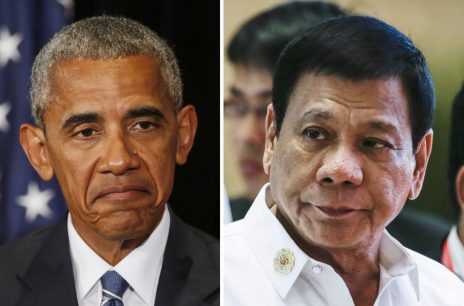
Insulting Barack Obama made the headlines, but Rodrigo Duterte’s remarks referred to a long and dark history of US interference in the Philippines.
Narendra Shresthma, Mast Irham/EPA
By Adele Webb | The Conversation | September 8, 2016
Philippine President Rodrigo Duterte has taken his “bad manners” – having gained global notoriety with his election campaign insults earlier this year – to a new level.
At a press conference at Davao International Airport on Monday, on his way to meet US President Barack Obama and other leaders attending the ASEAN summit, Duterte muttered a few short words in tagalog at the end of a lengthy and irritated reply to a local journalist. With those words, he again made international headlines.
What did Rodrigo Duterte call Barack Obama?
If that were all there was to it, we could rightly roll our eyes and move on. After all, Duterte’s language is vulgar; his slander of people and groups is liable to incite violence; and his determination to kill drug pushers (to fight “crime with crime”) an abuse of power. He should not be defended for any of this.
But as someone who has spent a long time studying US-Philippine relations, I think there’s something more for us to see here. And if we want to judge the Philippine president (and, by default, the nation for electing him) from high moral ground, I think we have a responsibility to pay attention to it.
Restoring an invisible history
Who is he to question me about human rights and extrajudicial killings?
So asked Duterte on Monday. It’s actually a very good question, and one long overdue from a Philippine president. The extent to which the violence of US relations with the Philippines has been made invisible by a history written predominantly by Americans themselves cannot be overstated.
It began with a three-year war (1899-1902) that most Americans have never heard of. The war overthrew a newly independent Philippine republic and cost between 250,000 and a million Filipino lives – only to be called “a great misunderstanding” by American colonial writers.
After all, the US had chosen the Philippines to be its great Asian “showcase of democracy”. The invasion was a benevolent act. Hence the complete erasure of acts of American violence from the Philippine national story.
 The 20th Kansas Volunteers march through Caloocan after the battle of February 10, 1899, early in the war that toppled the first Philippine republic. G.W. Peters/Internet Archive

You don’t need to be a conspiracy theorist to smell something rotten. Since the 1950s Philippine writers, academics, journalists and so on have been trying to reframe the historical narrative to point out this fact: to be invaded by a military power, told you don’t possess the character or capability for self-government, and then controlled by another nation for four decades, to the occupier’s lucrative commercial benefit, was not to be the recipient of a benevolent act.
Even at the time the war was taking place, one of America’s best-loved authors was writing just as much. Mark Twain was prolific in writing about the paradox of the “democratising mission” to the Philippines.
Penned in 1901, but still stunningly poignant, is this extract from his essay, To the Person Sitting in Darkness:
The Person Sitting in Darkness is almost sure to say: ‘There is something curious about this – curious and unaccountable. There must be two Americas: one that sets the captive free, and one that takes a once-captive’s new freedom away from him, and picks a quarrel with him with nothing to found it on; then kills him to get his land.’
In America, these remain Twain’s least-known works.
Before his (now regretted) distasteful remark, Duterte had much to say in response to the question about being confronted over human rights in an upcoming meeting with Obama. He was responding to murmurs from critics that, if he wouldn’t listen to anyone else about the extrajudicial killings in the Philippines, just wait until he meets the US president.
No-one seems to have listened to or cared much about the other six minutes of Duterte’s reply. So let me tell you something about it. It was a reclaiming of the historical narrative of Philippine-US relations, a holding up to the US of the hidden “looking glass” Mark Twain had written about 100 years earlier.
 The Macabebe Scouts were a native Filipino force of the US Army during the Spanish–American War. The Ardvaark/Wikipedia Commons
An assertion of independence
Calling out the hidden insinuations, as Duterte did, that the US continues to have authority over the politics of the Philippines, is bold and brazen, but reasonable. Consider his statement:
I am a president of a sovereign state. And we have long ceased to be a colony. I do not have any master but the Filipino people.
These words are less evidence of his demagoguery or an intention to personally disparage Obama than a reference to history, and are more accurately read as such.
After the second world war, colonies of any sort, even the so-called “democratic” US one in the Philippines, were on the nose. But this didn’t stop Washington officialdom from continuing to claim the right of access to the Philippines’ political and economic realms.
When the US finally granted the Philippines its (second) independence in 1946, it required the new republic to amend its constitution so a bill could be passed that, as well as legislating preferential trade conditions for the US, would grant American citizens equal rights with Filipinos to Philippine natural resources. It was the beginning of a new phase: neocolonialism.
It was not just a matter of political interference and the power to make or break Philippine presidents with endorsement and strategic financial support. In a visceral sense, the nation was always being watched and judged by its democratic “teacher”.
 School Begins: Uncle Sam lectures his class in Civilisation (the pupils are labelled Philippines, Hawaii, Puerto Rico and Cuba). Puck Magazine 1899
Asked about being confronted with human rights concerns by Obama, Duterte said:
You must be kidding. Who is he to confront me? America has one too many to answer for the misdeeds in this country … As a matter of fact, we inherited this problem from the United States. Why? Because they invaded this country and made us their subjugated people … Can I explain the extrajudicial killing? Can they explain the 600,000 Moro massacred in this island [Mindanao]? Do you want to see the pictures? Maybe you ask him. And make it public.
I’m reminded of a comment by Alicia Garza, a founder of the Black Lives Matter movement ignited by police killings of black Americans. Speaking in Sydney last weekend at the Festival of Dangerous Ideas, she related how, when civil rights protests get uncomfortably heated, she is often asked: “Why are they so angry?” She paused. Then softly giggled, giving the audience time for the ludicrousness of the question to sink in.
Why is the Philippines president so angry about the prospect of the US president confronting him about human rights abuses? History. As Duterte said himself on Monday, violent acts of the past don’t stay in the past. They get passed on from generation to generation, especially when the injustice goes unacknowledged and unaddressed.
It is difficult to stomach Duterte’s style. It certainly is difficult to look past the serious issues raised by his administration’s “war on drugs”. We should condemn his misuse of power.
But if we condemn the president for his recent remarks because we claim to be concerned about the rights of Filipinos while showing no interest in acknowledging the past crimes and injustices against the Philippines, we fall into our own sort of hypocrisy.
Let’s be honest, if Duterte didn’t curse and swear and offend our sensibilities, would we be paying so much attention to the Philippines? For once, I heard a Philippine president holding the US to account for all its doublespeak and hypocrisy in US-Philippine relations. And I couldn’t help but appreciate that.
Adele Webb, PhD Researcher, Department of Government and International Relations / Sydney Democracy Network, University of Sydney
Disclosure statement
Adele Webb does not work for, consult, own shares in or receive funding from any company or organization that would benefit from this article, and has disclosed no relevant affiliations beyond the academic appointment above.
Duterte’s Power Play: Rocking the US-Philippines Alliance
By Binoy Kampmark | Dissident Voice | September 14, 2016
I do not like the Americans. It’s simply a matter of principle for me. — Philippine President Rodrigo Duterte, September 12, 2016
The frictions excited by the antics of Philippine President Rodrigo Duterte have caused even greater heat over the last few days, with calls for the departure of US special forces operating in Mindanao. Having already made it clear to Washington that he intends pursuing “an independent foreign policy,” he has now insisted that the general root of ills in instability lie in the troublesome, headache-causing alliance with the United States.
A continuing problem of that alliance remained US forces in Zamboanga on the island of Mindanao, ostensibly engaged in advising local troops on counter-terrorism operations. “For as long as we stay with America, we will never have peace in that land [Mindanao]. We might as well give it up.” It was therefore imperative that “those [American] special forces, they have to go.” He did not want “a rift with the US, but they have to go.”
Nothing could stand in greater contrast to such sentiment than the pact of 2014 signed between Manila and Washington, a confirmation of all the ills Duterte despises. While that agreement did not countenance the reopening of US bases in the Philippines, something that would have had a constitutional hurdle to climb, it permitted roving and near unlimited US access to military bases across the country.
Despite the pretence of being severed from the US umbilical cord in 1946, the neo-colonial aftertaste has remained. From 2002 to 2013, $441 million in security funding was provided to Manila. The Obama administration had set aside a hefty $120 million in military aid for 2016.
As Senator Miriam Defensor-Santiago, chairman of the Philippines Senate Committee on Foreign Affairs, explained with the signatures on the agreement barely dry, the agreement was of limited value to the country, while being splendid for US interests.
In signing the agreement, the US “could claim that it has ‘contained’ China, because the Asian countries involved, including the Philippines, are now bound by their respective agreements with America.”
This would, in effect, convert Manila into a compliant satellite to Washington’s goals in the Asia-Pacific. As if to emphasise that point, both states had agreed earlier this year to the deployment of thousands of American troops to five Philippine bases, measures that are hardly accidental given the spike in tensions in the South China Sea.
President Barack Obama has preferred to avoid the terminology of containment and control, preferring to see such moves as pursuant to a self-proclaimed international order of norms. When one is attempting to be a decent bully on the international stage, cast a nod in the direction of international law. “Our goal,” he explained in 2014, “is to make international rules and norms [that] are respected, and that includes areas of maritime disputes.”
The boisterous Duterte, a vastly different creature from Benigno Aquino III, has issued directives to his defence secretary to seek military supplies from China and Russia rather than US sources. “I want weaponry and armaments…. We don’t need F16 jets, that is of no use to us.” Jets were useless in counter-insurgency operations in the Philippines; far better stick, he suggested, to “propeller-driven planes”.
Such moves are not suggestive of a total distancing from the United States; Duterte is evidently keen to widen his appeal to other powers, rather than clinging on the tired assumption that all that stems from Washington is somehow good. On that level, the politics is sound, an attempt to defuse a confrontation that risks involving China and the US in a regional punch-up.
The Philippine military were also bemused by the Presidential directive, unclear about how they were to go about their new orders. In the words of a defence spokesman, “We are awaiting guidelines on how the president’s policy statements will be implemented.”
On Tuesday, Duterte also explained that the Philippines would cease patrolling the South China Sea alongside the US Navy. What was less extensively reported by US media outlets is that he would prefer Filipino forces to be doing their own patrolling up to 12 nautical miles offshore, rather than having entanglements with either US or Chinese forces.
All that said, a more than significant nudge is being contemplated in Beijing’s direction, while the president envisages refocusing the broader struggle on domestic maladies: drug trafficking and niggling insurgencies. “Only China will help us,” he claimed. “America just gave you principles of law and nothing else.”
The old myopic view that Duterte is merely the resident buffoon and brute is delightfully simple, but one that has currency in the corridors of US power. It holds that he is an aberration, that his legacy will pass, and that his views are of no consequence. US officials persist doing this at their peril, attempting to place Manila, by proxy, in line of Beijing’s ire.
As the distributed Nelson Report (September 14), a summary dispatch on foreign relations, put it, “if you want to see what a Trump Presidency would look and sound like, watch the Philippines’ Duterte… an impertinent reference to Trump’s unpredictability, boorishness, lack of knowledge or sophistication, and penchant for ill-considered dramatics.”
The point that has been missed is that this entire revision has been stewing for some time. It has bubbled with fury, bypassing the traditional, submissive structures of power that have favoured an imperial influence for all too long. The point to see will be whether Duterte’s legacy persists in its indignation and redirection, or fizzles in the great power game.
Binoy Kampmark was a Commonwealth Scholar at Selwyn College, Cambridge. He lectures at RMIT University, Melbourne and can be reached at: bkampmark@gmail.com.
Obama’s Ungraceful Exit from Air Force One, America’s Ungraceful Exit from Asia
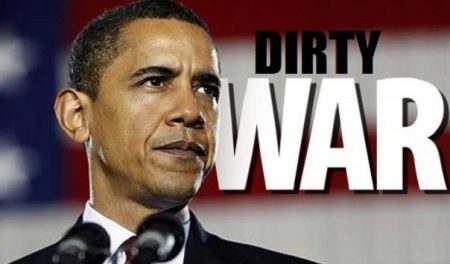
By Joseph Thomas – New Eastern Outlook – 13.09.2016
When US President Barack Obama attempted to leave Air Force One upon arriving at Hangzhou, China, just southwest of Shanghai, he found that no staircase or red carpet awaited him. Instead, he and his staff were forced to use an alternative exit from the aircraft, only to find additional restrictions placed upon them on the tarmac.
The New York Times in its article, “Bumpy Beginning for Obama in China, Starting on the Tarmac,” would note:
There was no staircase for Obama to exit the plane and descend on the red carpet. Obama used an alternative exit.
On the tarmac, a quarrel broke out between a presidential aide and a Chinese official who demanded the journalists traveling with Obama be prohibited from getting anywhere near him. It was a breach of the tradition observed whenever the American president arrives in a foreign place.
When the White House official insisted the U.S. would set the rules for its own leader, her Chinese counterpart shot back.
“This is our country! This is our airport!” the Chinese official yelled.
Rather than accept and adapt to the conditions set forth by their Chinese hosts, the President’s staff quarrelled with them, marking yet another ungraceful bout of American exceptionalism where even in another’s country, America’s will is expected to be fulfilled.
Reflecting on the event, President Obama made cryptic comments seemingly both attempting to downplay the event as a mere oversight, but alluding to the fact that it was more than a mere oversight by their Chinese hosts.
And in fact, it was no oversight. It was a clear message to America that the age of American exceptionalism, particularly in Asia, is over.
America’s Ungraceful Exit from Asia
In and of itself, President Obama’s ungraceful exit from Air Force One may seem like an insignificant event. When added together with a general decline of American influence and regarding the respect it had once commanded across Asia, it is highly symbolic of a global hegemon being pushed from an entire corner of the globe.
It was just recently that the US concluded a lengthy and costly public relations campaign, dressed up as an “international tribunal” conducted at The Hague in the Netherlands that predictably concluded that China held no legitimate claims in the South China Sea.
The “ruling” was allegedly made in favour of the Philippines, despite the legal team being headed by an American, Paul S. Reichler of Foley Hoag. Despite what Washington believed would be a crushing rhetorical blow to Beijing, not only did Beijing dismiss the entire proceeding out of hand, the Philippines itself refused to capitalise on the transparently politically-motivated and provocative ruling.
US pressure on the Philippines, until recently considered a stalwart ally, even a subordinate functionary of Washington, eventually resulted in Philippine President Rodrigo Duterte directly mocking America’s ambassador to the nation, denouncing him as an effeminate meddler.
The previous year, the US had been pressuring Thailand to allow Chinese terror suspects to travel onward to Turkey despite an extradition request from China. Thailand ignored US demands and returned the suspects to face justice in China.
In both cases terrorism struck shortly after, with a bomb striking in the centre of Bangkok killing 20 and maiming many more, and just recently a bomb exploding in the Philippine city of Davao, where President Duterte had previously served as mayor.
In Cambodia, the nation’s Prime Minister Hun Sen has openly accused the US of attempting to subvert political stability around the globe. This was in reference to opposition groups the US State Department is now using to pressure the Cambodian government after its decisive shift away from US interests toward Beijing.
In essence, while the US announced its “pivot” toward Asia, Asia itself appears to be pivoting away from the US. Thus, the incident on the tarmac in Hangzhou is a microcosm of what is taking place across Asia, an unwillingness of locals to further capitulate to American exceptionalism, and an ungraceful America unable to recognise or adapt to this shifting geopolitical reality.
In the end, America with its hegemonic hubris will ensure that it is fully pushed out of Asia, missing what is perhaps a final opportunity to readjust its relationship with the region away from adversarial domination toward something more equitable, proportional and constructive.
Joseph Thomas is chief editor of Thailand-based geopolitical journal, The New Atlas .
Duterte Says U.S. Special Forces in Philippines ‘Have to Go’
teleSUR | September 12, 2016
Philippine President Rodrigo Duterte on Monday called for the withdrawal of U.S. military from the restive Jolo and Basilan islands, marking his latest in a string of statements distancing the Filipino government from Washington.
“These special forces, they have to go,” Duterte said in a speech during an oath-taking ceremony for new officials. “I do not want a rift with America. But they have to go.”
Duterte, who was in the spotlight last week over his televised tirade against U.S. imperialism and President Barack Obama, said that the U.S. special forces now training Filipino troops were high-value targets for the Islamic State-linked Abu Sayyaf as counter-insurgency operations intensify.
“Americans, they will really kill them, they will try to kidnap them to get ransom,” Duterte added.
Duterte, a former southern mayor known for his bombastic style, said he wants an independent foreign policy has frequently accused the archipelago’s former colonizer of hypocrisy. The Philippine leader denied on Friday calling Obama a “son of a bitch” in a response to a journalist’s question about the Association of Southeast Asian Nations (ASEAN) summit.
Some U.S. special forces have been killed in the southern Philippines since 2002, when Washington deployed soldiers to train and advise local units during the so-called “Operation Enduring Freedom – Philippines.”
At the height of that operation, some 1,200 Americans were deployed to Zamboanga City and on Jolo and Basilan islands, both strongholds of Abu Sayyaf.
The U.S. program was discontinued in the Philippines in 2015, but a small troop presence has remained for logistics and technical support. Washington has shifted much of its security focus in the Philippines towards the South China Sea.
Presence of U.S. troops on the island, which has continued despite constitutional changes made following the “People’s Power” uprising that toppled U.S.-backed dictator Ferdinand Marcos, has long been a source of discontent among Filipinos.
In his speech to officials on Monday, Duterte repeated comments from last week when he accused the United States of committing atrocities against Muslims over a century ago on Jolo island.
Philippine leader declares unilateral ceasefire with rebels
Press TV – July 25, 2016
Philippine President Rodrigo Duterte has declared a unilateral ceasefire with Maoist rebels, saying he wants to end decades of hostilities with the communist guerrillas.
“Let us end these decades of ambuscades and skirmishes. We are going nowhere and it is getting bloodier by the day,” said Duterte on Monday, adding, “To stop violence on the ground (and) restore peace, I am now announcing a unilateral ceasefire.”
Making his first “State of the Nation Address” before Congress, Duterte said he wants “permanent and lasting peace” with the guerillas before the end of his six-year term, which started on June 30.
He urged rebel leaders to engage in efforts to restart peace talks.
Negotiations have been underway between representatives of the government and rebels, with reports suggesting that a general agreement has been reached to resume peace talks.
The two sides have also agreed to organize a meeting between Duterte and Jose Maria Sison, a rebel leader who is currently in self-exile in Europe. Reports say Sison will soon fly home to attend the meeting although official peace talks are expected next month in Norway.
About 30,000 people have been killed since the communists started their insurgency in the Philippines in the 1960s.
The military says the New People’s Army, the communists’ armed wing, has fewer than 4,000 gunmen today, down from a peak of 26,000 in the 1980s.
Talks with the rebels collapsed in 2013 after the government of former president, Benigno Aquino, rejected to release some key rebel commanders.
Duterte’s reconciliation bid with the rebels comes as the Philippines is in the midst of a massive operation against drug dealers. The security in the Southeast Asian country has also been fragile due to recurrent attacks by militants of Abu Sayyaf, a group which has pledged allegiance to Daesh Takfiris.
Southeast Asia “Forgets” About Western Terror
By Andre Vltchek | CounterPunch | October 2, 2015
Southeast Asian elites “forgot” about those tens of millions of Asian people murdered by the Western imperialism at the end of and after the WWII. They “forgot” about what took place in the North – about the Tokyo and Osaka firebombing, about the Hiroshima and Nagasaki atomic bombs, about the barbaric liquidation of Korean civilians by the US forces. But they also forgot about their own victims – about those hundreds of thousands, in fact about the millions, of those who were blown to pieces, burned by chemicals or directly liquidated – men, women and children of Vietnam, Cambodia, Laos, Indonesia, the Philippines and East Timor.
All is forgiven and all is forgotten.
And once again the Empire is proudly “pivoting” into Asia; it is even bragging about it.
It goes without saying that the Empire has no shame and no decency left. It boasts about democracy and freedom, while it does not even bother to wash the blood of tens of millions off its hands.
All over Asia, the “privileged populaces” has chosen to not know, to not remember, or even to erase all terrible chapters of the history. Those who insist on remembering are being silenced, ridiculed, or made out to be irrelevant.
Such selective amnesia, such “generosity” will very soon backfire. Shortly, it will fly back like a boomerang. History repeats itself. It always does, the history of the Western terror and colonialism, especially. But the price will not be covered by the morally corrupt elites, by those lackeys of the Western imperialism. As always, it will be Asia’s poor who will be forced to pay.

After I descended from the largest cave in the vicinity of Tham Pha Thok, Laos, I decided to text my good Vietnamese friend in Hanoi. I wanted to compare the suffering of Laotian and Vietnamese people.
The cave used to be “home” to Pathet Lao. During the Second Indochina War it actually served as the headquarters. Now it looked thoroughly haunted, like a skull covered by moss and by tropical vegetation.
The US air force used to intensively bomb the entire area and there are still deep craters all around, obscured by the trees and bushes.
The US bombed the entirety of Laos, which has been given a bitter nickname: “The most bombed country on earth”.
It is really hard to imagine, in a sober state, what the US, Australia and their Thai allies did to the sparsely populated, rural, gentle Laos.
John Bacher, a historian and a Metro Toronto archivist once wrote about “The Secret War”: “More bombs were dropped on Laos between 1965 and 1973 than the U.S. dropped on Japan and Germany during WWII. More than 350,000 people were killed. The war in Laos was a secret only from the American people and Congress. It anticipated the sordid ties between drug trafficking and repressive regimes that have been seen later in the Noriega affair.”
In this biggest covert operation in the U.S. history, the main goal was to “prevent pro-Vietnamese forces from gaining control” over the area. The entire operation seemed more like a game that some overgrown, sadistic boys were allowed to play: Bombing an entire nation into the Stone Age for more than a decade. But essentially this “game” was nothing else than one of the most brutal genocides in the history of the 20th century.
Naturally, almost no one in the West or in Southeast Asia knows anything about this.

I texted my friend: “What I witnessed a few years ago working at the Plain of Jars was, of course, much more terrible than what I just saw around Tham Pha Thok, but even here, the horror of the US actions was crushing.” I also sent her a link to my earlier reports covering the Plain of Jars.
A few minutes later, she replied: “If you didn’t tell me… I would have never known about this secret war. As far as we knew, there was never a war in Laos. Pity for Lao people!”
I asked my other friends in Vietnam, and then in Indonesia. Nobody knew anything about the bombing of Laos.
The “Secret War” remains top-secret, even now, even right here, in the heart of the Asia Pacific region, or more precisely, especially here.
When Noam Chomsky and I were discussing the state of the world in what eventually became our book “On Western Terrorism – From Hiroshima to Drone Warfare”, Noam mentioned his visit to the war-torn Laos. He clearly remembered Air America pilots, as well as those hordes of Western journalists who were based in Vientiane but too busy to not see and to not ask any relevant questions.
***
“In the Philippines, the great majority of people is now convinced that the US actually ‘liberated’ our country from the Japanese”, my left-wing journalist friends once told me.
Dr. Teresa S. Encarnación Tadem, Professor of Political Science of University of the Philippines Diliman, explained to me last year, face to face, in Manila: “There is a saying here: “Philippines love Americans more than Americans love themselves.”
I asked: “How is it possible? The Philippines were colonized and occupied by the United States. Some terrible massacres took place… The country was never really free. How come that this ‘love’ towards the US is now prevalent?”
“It is because of extremely intensive North American propaganda machine”, clarified Teresa’s husband, Dr. Eduardo Climaco Tadem, Professor of Asian Studies of University of the Philippines Diliman. “It has been depicting the US colonial period as some sort of benevolent colonialism, contrasting it with the previous Spanish colonialism, which was portrayed as ‘more brutal’. Atrocities during the American-Philippine War (1898 – 1902) are not discussed. These atrocities saw 1 million Philippine people killed. At that period it was almost 10% of our population… the genocide, torture… Philippines are known as “the first Vietnam”… all this has been conveniently forgotten by the media, absent in the history books. And then, of course, the images that are spread by Hollywood and by the American pop culture: heroic and benevolent US military saving battered countries and helping the poor…”
Basically, entirely reversing the reality.
The education system is very important”, added Teresa Tadem. “The education system manufactures consensus, and that in turn creates support for the United States… even our university – University of the Philippines – was established by the Americans. You can see it reflected in the curriculum – for instance the political science courses… they all have roots in the Cold War and its mentality.”
Almost all children of the Asian “elites” get “educated” in the West, or at least in so-called “international schools” in their home countries, where the imperialist curriculum is implemented. Or in the private, most likely religious/Christian schools… Such “education” borrows heavily from the pro-Western and pro-business indoctrination concepts.
And once conditioned, children of the “elites” get busy brainwashing the rest of the citizens. The result is predictable: capitalism, Western imperialism, and even colonialism become untouchable, respected and admired. Nations and individuals who murdered millions are labeled as carriers of progress, democracy and freedom. It is “prestigious” to mingle with such people, as it is highly desirable to “follow their example”. The history dies. It gets replaced by some primitive, Hollywood and Disney-style fairytales.

In Hanoi, an iconic photograph of a woman pulling at a wing of downed US military plane is engraved into a powerful monument. It is a great, commanding piece of art.
My friend George Burchett, a renowned Australian artist who was born in Hanoi and who now lives in this city again, is accompanying me.
The father of George, Wilfred Burchett, was arguably the greatest English language journalist of the 20th Century. Asia was Wilfred’s home. And Asia was where he created his monumental body of work, addressing some of the most outrageous acts of brutality committed by the West: his testimonies ranged from the first-hand account of the Hiroshima A-bombing, to the mass murder of countless civilians during the “Korean War”. Wilfred Burchett also covered Vietnam, Laos, Cambodia, to name just a few unfortunate places totally devastated by the United States and its allies.
Now his books are published and re-printed by prestigious publishing houses all over the world, but paradoxically, they do not live in sub-consciousness of the young people of Asia.
The Vietnamese people, especially the young ones, know very little about the horrific acts committed by the West in their neighboring countries. At most they know about the crimes committed by France and the US in their own country – in Vietnam, nothing or almost nothing about the victims of the West-sponsored monsters like Marcos and Suharto. Nothing about Cambodia – nothing about who was really responsible for those 2 millions of lost lives.
The “Secret Wars” remain secret.

With George Burchett I admired great revolutionary and socialist art at the Vietnam National Museum of Fine Arts. Countless horrible acts, committed by the West, are depicted in great detail here, as well as the determined resistance struggle fought against US colonialism by the great, heroic Vietnamese people.
But there was an eerie feeling inside the museum – it was almost empty! Besides us, there were only a few other visitors, all foreign tourists: the great halls of this stunning art institution were almost empty.

Indonesians don’t know, because they were made stupid!” Shouts my dear old friend Djokopekik, at his art studio in Yogyokarta, He is arguably the greatest socialist realist artist of Southeast Asia. On his canvases, brutal soldiers are kicking the backsides of the poor people, while an enormous crocodile (a symbol of corruption) attacks, snaps at, and eats everyone in sight. Djokopekik is open, and brutally honest: “It was their plan; great goal of the regime to brainwash the people. Indonesians know nothing about their own history or about the rest of Southeast Asia!”
Before he died, Pramoedya Ananta Toer, the most influential writer of Southeast Asia, told me: “They cannot think, anymore… and they cannot write. I cannot read more than 5 pages of any contemporary Indonesian writer… the quality is shameful…” In the book that we (Pramoedya Ananta Toer, Rossie Indira and I) wrote together – “Exile” -, he lamented that Indonesian people do not know anything about history, or about the world.
Had they known, they would most definitely raise and overthrow this disgraceful regime that is governing their archipelago until these days.
2 to 3 million Indonesian people died after the 1965 military coup, triggered and supported by the West and by the religious clergy, mainly by Protestant implants from Europe. The majority of people in this desperate archipelago are now fully conditioned by the Western propaganda, unable to even detect their own misery. They are still blaming the victims (mainly Communists, intellectuals and “atheists”) for the events that took place exactly 50 years ago, events that broke the spine of this once proud and progressive nation.
Indonesians almost fully believe the right wing, fascist fairytales, fabricated by the West and disseminated through the local mass media channels controlled by whoring local “elites”… It is no wonder: for 50 nasty years they have been “intellectually” and “culturally” conditioned by the lowest grade Hollywood meditations, by Western pop music and by Disney.
They know nothing about their own region.
They know nothing about their own crimes. They are ignorant about the genocides they have been committing. More than half of their politicians are actually war criminals, responsible for over 30% of killed men, women and children during the US/UK/Australia-backed occupation of East Timor (now an independent country), for the 1965 monstrous bloodletting and for the on-going genocide, which Indonesia conducts in Papua.
Information about all these horrors is available on line. There are thousands of sites carrying detailed and damning evidence. Yet, cowardly and opportunistically, the Indonesian “educated” populace is opting for “not knowing”.
Of course, the West and its companies are greatly benefiting from the plunder of Papua.
Therefore, the genocide is committed, all covered with secrecy.
And ask in Vietnam, in Burma, even in Malaysia, what do people know about East Timor and Papua? The answer will be nothing, or almost nothing.
Burma, Laos, Cambodia, Indonesia, and the Philippines – they may be located in the same part of the world, but they could be as well based on several different planets. That was the plan: the old divide-and-rule British concept.
In Manila, the capital of the Philippines, a family that was insisting that Indonesia is actually located in Europe once confronted me. The family was equally ignorant of the crimes committed by the pro-Western regime of Marcos.
***
The western media promotes Thailand as the “land of smiles”, yet it is an extremely frustrated and brutal place, where the murder rate is even(on per capita basis) higher than that in the United States.
Thailand has been fully controlled by the West since the end of the WWII. Consequently, its leadership (the throne, the elites and the military)have allowed some of the most gruesome crimes against humanity to take place on its territory. To mention just a few: the mass murder of the Thai left wing insurgents and sympathizers (some were burned alive in oil barrels), the murdering of thousands of Cambodian refugees, the killing and raping of student protesters in Bangkok and elsewhere… And the most terrible of them: the little known Thai participation in the Vietnam invasion during the “American War”…the intensive use of Thai pilots during the bombing sorties against Laos, Vietnam and Cambodia, as well as handing several military airports (including Pattaya) to the Western air forces. Not to speak about pimping of Thai girls and boys (many of them minors) to the Western military men.
***
The terror that the West has been spreading all over Southeast Asia seems to be forgotten, or at least for now.
Let’s move on!” I heard in Hanoi and in Luang Prabang.
But while the Vietnamese, Laotian and Cambodian people are busy “forgiving” their tormentors the Empire has been murdering the people of Iraq, Syria, Libya, Pakistan, Afghanistan, Yemen, Ukraine, and all corners of Africa.
It was stated by many, and proven by some, particularly in South America, where almost all the demons have been successfully exercised, that there can be no decent future for this Planet without recognizing and understanding the past.
After “forgiving the West”, several nations of Southeast Asia were immediately forced into the confrontation with China and Russia.
When “forgiven”, the West does not just humbly accept the great generosity of its victims. Such behavior is not part of its culture. Instead, it sees kindness as weakness, and it immediately takes advantage of it.
By forgiving the West, by “forgetting” its crimes, Southeast Asia is actually doing absolutely nothing positive. It is only betraying its fellow victims, all over the world.
It is also, pragmatically and selfishly, hoping for some returns. But returns will never come! History has shown it on many occasions. The West wants everything. And it believes that it deserves everything. If not confronted, it plunders until the end, until there is nothing left – as it did in the Democratic Republic of Congo, in Iraq or in Indonesia.

Renowned Australian historian and Professor Emeritus at Nagasaki University in Japan, Geoffrey Gunn, wrote in this essay:
“The US wields hard power and soft power in equal portions or so it would appear. Moving in and out of East Asia over the last four decades I admit to being perplexed as to the selectivity of memories of the American record. Take Laos and Cambodia in the 1970s where, in each country respectively, the US dropped a greater tonnage of bombs than dumped on Japanese cities during World War II, and where unexploded ordinance still takes a daily toll. Not so long ago I asked a high-ranking regime official in Phnom Penh as to whether the Obama administration had issued an apology for this crime of crimes. “No way,” he said, but then he wasn’t shaking his fist either, just as the population appears to be numbed as to basic facts of their own history beyond some generalized sense of past horrors. In Laos in December 1975 where I happened to be when, full of rage at the US, revolutionaries took over; the airing of American crimes – once a propaganda staple – has been relegated to corners of museums. Ditto in Vietnam, slowly entering the US embrace as a strategic partner, and with no special American contrition as to the victims of bombing, chemical warfare and other crimes. In East Timor, sacrificed by US President Ford and Secretary of State Henry Kissinger to the Indonesian generals in the interest of strategic denial, and where some 30 percent of the population perished, America is forgiven or, at least, airbrushed out of official narratives. Visiting the US on a first state visit, China’s President Xi Jinping drums up big American business deals, a “new normal” in the world’s second largest economy and now US partner in the “war against terror,” as in Afghanistan. Well, fresh from teaching history in a Chinese university, I might add that history does matter in China but with Japan as an all too obvious point of reference.”
“China used to see the fight against Western imperialism, colonialism and neo-colonialism as the main rallying cry of its foreign policy”, sighs Geoff, as we watch the bay of his home city – Nagasaki. “Now it is only Japan whose crimes are remembered in Beijing.”
But back to Southeast Asia…
It is all forgotten and forgiven, and the reason “why” is clear, simple. It pays to forget! “Forgiveness” brings funding; it secures “scholarships” just one of the ways Western countries spread corruption in its client states and in the states they want to draw into their orbit.
The elites with their lavish houses, trips abroad, kids in foreign schools, are a very forgiving bunch!
But then you go to a countryside, where the majority of Southeast Asian people still live. And the story there is very different. The story there makes you shiver.
Before departing from Laos, I sat at an outdoor table in a village of Nam Bak, about 100 kilometers from Luang Prabang. Ms. Nang Oen told me her stories about the US carpet-bombing, and Mr. Un Kham showed me his wounds:
“Even here, in Nam Bak, we had many craters all over, but now they are covered by rice fields and houses. In 1968, my parents’ house was bombed… I think they dropped 500-pound bombs on it. Life was unbearable during the war. We had to sleep in the fields or in the caves. We had to move all the time. Many of us were starving, as we could not cultivate our fields.
I ask Ms. Nang Oen about the Americans. Did she forget, forgive?
“How do I feel about them? I actually can’t say anything. After all these years, I am still speechless. They killed everything here, including chicken. I know that they are doing the same even now, all over the world…”
She paused, looked at the horizon.
“Sometimes I remember what was done to us… Sometimes I forget”. She shrugs her shoulders. “But when I forget, it is only for a while. We did not receive any compensation, not even an apology. I cannot do anything about it. Sometimes I wake up in the middle of the night, and I cry.”
I listened to her and I knew, after working for decades in this part of the world: for the people of Laos, Vietnam, Cambodia, and East Timor, nothing is forgotten and nothing is forgiven. And it should never be!

Andre Vltchek is a philosopher, novelist, filmmaker and investigative journalist. He covered wars and conflicts in dozens of countries. His latest books are: “Exposing Lies Of The Empire” and “Fighting Against Western Imperialism”.
US ‘played big role’ in botched Philippines raid
Press TV – March 17, 2015
A Philippine Senate report has revealed that US forces played a “substantial” role in a botched raid earlier this year that left 44 local police commandos dead.
Senator Grace Poe released on Tuesday the findings of a committee inquiry into the deadly police operation, known locally as Oplan Exodus, in January against the Moro Islamic Liberation Front (MILF), which seeks to establish an independent homeland in the troubled south of the Philippines.
“US personnel played a role in the training before, and monitoring, of the… operation,” said Poe, adding, “The committee found that the United States substantially invested in the entirety of Oplan Exodus. It provided equipment, training and intelligence.”
According to the report, three unnamed Americans were present at local army brigade headquarters during the police operation, creating tensions at a crucial time with the Philippine military commander.
“One of the Americans ordered Major General Edmundo Pangilinan to fire the artillery,” the report read, adding, “However, Pangilinan refused and told him, ‘Do not dictate to me what to do. I am the commander here.'”
Under a US-Philippines alliance, Washington provides military training and intelligence to Manila. However, American forces are forbidden to engage in combat.
The report also stated that although there was no evidence of US forces engaging in combat, there were concerns that Washington’s influence on the Philippine National Police (PNP) was too strong.
In addition, it raised questions about the accountability of the US, which has so far declined to specify its role in the raid.
Furthermore, the report also stated that President Benigno Aquino must “bear responsibility” for the fatalities.
A US embassy spokesman in the Philippines did not immediately answer to requests for comment about the Senate report.
On January 25, a 12-hour gun battle between the Philippine military and the other front claimed the lives of 44 security forces and 18 MILF members in the country’s southern province of Maguindanao.
The aim of the police operation was to capture or kill two men on the US government’s so-called list of “most wanted terrorists.” The men, Abdul Basit Usman and Malaysian national Zulkifli bin Hir, were living among MILF members in the southern farming communities of the Philippines. Hir was reportedly killed in the raid, but Usman escaped.
Following the raid, the MILF said it had acted in self-defense, with its vice chairman Ghazali Jaafar saying the unannounced presence of the Filipino armed forces led the MILF members to believe that they had come under attack.
Thousands march in Manila against military accord with ‘imperialist’ US

RT | December 1, 2014
Thousands of anti-war protesters marched in the Philippine capital calling for an end to close military ties between “warmongering” Washington and Manila. They also accused Filipino President Benigno Aquino III of being a “US puppet.”
Protesters came decked out in traditional garb, many carrying fake bolo knives and rifles. Others hoisted torches and placards in the air as they marched through the streets of the densely populated city.
Gathering underneath an overpass at a busy intersection, the protesters burned a poster depicting Aquino as a puppet of Uncle Sam.
Pete Pinlac, a trade union leader and march organizer, said the protest was a way for the people to express their discontent with Washington’s “imperialist” ways.
“To Barack Obama, we say this: we are a peaceful nation so let the Philippines loose. We do not want your warmongering. We do not want your imperialist ends. We do not want your hegemonic purposes,” he said.
The protesters called for the abolition of the Visiting Forces Agreement (VFA) and the Enhanced Defense Cooperation Agreement (EDCA) with the USA.
The controversial VFA allows the US government to retain jurisdiction over US military personnel accused of committing crimes in the Philippines, unless those crimes are deemed to be of “particular” importance to the Philippines.
Activists argue the agreement gives US troops immunity from prosecution and makes them second-class citizens in their own country.
The EDCA was signed in April and represents the first major military accord inked between the two countries since the US withdrew troops stationed on a naval base in Subic Bay in 1992. Although the 10-year agreement allows US forces to operate out of certain areas, it does not allow Washington to establish a permanent military base.
Sunday’s protest coincided with Bonifacio Day, which pays homage to Andres Bonifacio, the “Father of the Philippine Revolution.”
Featured Video
America Racing to Strategic Defeat in Iran
or go to
Aletho News Archives – Video-Images
From the Archives
An Expert Military Analysis of War with China
Actually, None is Necessary
By Fred Reed • Unz Review • December 13, 2020
The Correlation of Armed Forces: U.S. goods and services trade with China totaled an estimated $634.8 billion in 2019. Exports were $163.0 billion; imports were $471.8 billion. The U.S. goods and services trade deficit with China was $308.8 billion in 2019. Trade in services with China (exports and imports) totaled an estimated $76.7 billion in 2019. Services exports were $56.5 billion; services imports were $20.1 billion. The U.S. services trade surplus with China was $36.4 billion in 2019.
There is talk within the Washingtoniat of a possible war with China. Steve Bannon, who apparently was dropped on his head as a child, actually favors such a war. We hear the usual shoo-the-boobs alarm about how the Chinese are doing something terrible and we must gird our loins and American values and show them what for, bow wow, woof. The danger is that the current game of who-blinks-first in Asian waters might actually provoke a shooting war. You know the kind of thing: One warship refuses to get out of the way of another, a collision ensues, some retard lieutenant who signed up on waivers opens fire, and we’re off and running. It is not a good idea to let children play with matches.
The said war is discussed either in emotional terms by idiots or in purely naval terms by those familiar with such things, so we hear of the First Island Chain and the Second Island Chain and whose missiles against the other’s missiles and so on. This would be appropriate if we were fighting World War Two again. Which we aren’t. Let’s take a quick-and-dirty look at how such a war might go.
To begin the war, America would overestimate itself and underestimate China. This is doctrine in the Pentagon. … continue
Blog Roll
 Aletho News
- Poland rules out sending Patriot missiles to US/Israel amid war on Iran
- Tehran approves new Hormuz plan with major restrictions
- No Threat Can Force Iran’s Surrender /Trita Parsi & Lt Cl Daniel Davis
- UK’s New Pandemic Plan Would Turn Big Tech Into a Mass Location Tracking Network
- Growing insecurity, soaring prices fuel protests in north as regime bans evacuation: Sources
- Iran denies responsibility for ‘depraved’ attack on Kuwait desalination plant
- Bring The Troops Back. End This War Now!
- Can we please stop calling Israel the ‘only democracy in the Middle East’ now?
- US should start removing its troops from Germany, proposes AfD co-leader Chrupalla
- Iran Red Crescent: 600 educational centers attacked in US-Israeli ‘war crimes’
- If Americans Knew
- The Line Between Affinity and Conspiracy
- As Iran targets US military bases, will they be relocated to Israel? Not a ceasefire Day 171
- Will Trump Go Kamikaze?
- Is the University of Florida Shutting Down College Republicans over Israel Criticism?
- Jewish extremist arrested over alleged plot to firebomb Palestinian activist Nerdeen Kiswani’s home
- More than half of Palestinian child detainees have no charges
- The More Murderous Israel Gets, The More We Hear About “Antisemitism”
- Land Day and the Palestinian struggle after 30 months of genocide
- The Iran War Is About Palestine
- Israeli soldiers echo settler ideology, talk of revenge after targeting Palestinians and detaining CNN crew in the West Bank
- No Tricks Zone
- New Study Finds Warming Saves Lives…Cold Temperatures 12 Times More Deadly Than Excess Heat
- German Science Blog Accuses PIK Climate Institute Of Hallucinating Climate Tipping Points
- Devastating Assessment Of Comirnaty Vaccine By Former Senior Pfizer Europe Toxicologist
- New Study: CO2 Is ‘Effectively Negligible’ As An Explanatory Climate Change Factor Since 2000
- Former Pfizer Toxicologist Dr. Helmut Sterz Tells Bundestag Hearing Pfizer Vaccine Should Have Never Been Approved
- Energy Expert: Germany’s Nuclear Phaseout Was A “500 Billion Euro Mistake”
- New Research: South Australia’s Mid-Holocene Sea Surface Temperatures Were 4°C Warmer Than Today
- Storing Green Energy To Last Germany 10 Days Would Require A 60-Million Tonne Battery
- New Studies: UK Sea Levels Were 4 Meters Higher Than Today During The Mid-Holocene
- Destructive Green New Deal: German Energy And Metal Group Warns Of Drastic Crisis
 Aletho News