Turkish government combing Twitter in search of protest organizers to arrest
RT | June 29, 2013
Turkish government officials are investigating Twitter and similar social media platforms in an attempt to identify and eventually prosecute the organizers of mass demonstrations, Erodgan administration officials said this week.
In the latest attack on social media’s role in protests, the country’s Transportation and Communications Minister Binali Yildirim called on social media networks on Friday to cooperate with authorities in the probe.
“Yes to the Internet … but an absolute no to its misuse as a tool for crimes, violence, chaos and disorder,” Yildirim said quoted as saying by the local Dogan news agency.
Authorities have scoured social networks searching for protest leaders since national unrest began on May 28 at a rally in Instanbul’s Taksim Square. Police have turned over at least 35 names to prosecutors in the city, according to Turkey’s Aksam newspaper.
It is illegal to ‘insult’ public officials in Turkey.
Deputy Prime Minister Bekir Bozdag acknowledged the existence of the list, the Associated Press reported, only saying ‘profanities and insults conducted electronically’ had contributed to the protests.
‘Crimes determined as such by the law don’t change if they are carried out through Facebook, Twitter or through other electronic means,’ he said. ‘No one has the right to commit crimes under the rule of law.’
Prime Minister Recep Tayyip Erdogan’s government has taken international criticism for the brutal police crackdown on protesters in the past month. The prime minister himself, when the rallies began, branded Twitter a ‘troublemaker’ used to spread ‘lies.’
What began as a protest against the redevelopment of Istanbul’s historic Gezi Park morphed into a national movement calling for a pluralistic society instead of Erdogan’s ‘authoritarian’ rule. The prime minister has also lost support for what critics say has been an attempt to impose Islamist values on a largely secular population.
He previously banned YouTube for two years beginning in 2008, citing the widespread presence of obscene material.
Erdogan’s deputies expressed hope that Facebook would allow them to comb through data and identify possible demonstration organizers. Facebook released a statement this week denying the disclosure, though, of any information to the government and expressing concern about future requests.
‘We will be meeting with representatives of the Turkish government when they visit Silicon Valley this week, and we intend to communicate our strong concerns about these proposals directly at that that time,’ Facebook said in a statement.
Turkish Minister of Transport, Maritime Affairs and Communications Binali Yildirim added that Twitter has not shown a ‘positive approach’ despite ‘necessary warnings’ from Turkey. He said that the Turkish government has asked Twitter, along with other social media sites, to set up a representative office inside the country.
‘We have told all social media that… if you operate in Turkey you must comply with Turkish law… When information is requested, we want to see someone in Turkey who can provide this… there needs to be an interlocutor we can put our grievance to and who can correct an error if there is one,’ he said.
‘Twitter will probably comply too. Otherwise, this is a situation that cannot be sustained,’ Yildirim stressed. His statement was presumably referring to social media’s role in the recent protests, though the social media companies themselves have had no role. He added that the government seeks only to ‘turn down the volume of the social media,’ rather than blocking it altogether.
Related articles
- Turkey takes steps to monitor Twitter content, users (alethonews.wordpress.com)
- Turkey announces plans ‘for gas’ and cyber security in face of Gezi protests (alethonews.wordpress.com)
‘Vitoria!’ Mass protests force Brazil congress to reject ‘bill of discontent’
RT | June 26, 2013
Brazil’s legislative body has thrown out a proposed constitutional amendment, which was a key grievance of protesters across the country. The government is also planning to introduce a range of political reforms to appease demonstrators.
In what in being seen as a victory for people power, the measure was defeated on Tuesday by Congress by 430 votes to nine; with the Rio Times saying the protests were “largely fueled by social media and citizen journalists.”
The amendment, known as PEC 37, would have limited the power of state prosecutors to investigate crimes.
The protesters had argued that PEC 37 might have opened the way to more corruption; a problem which is endemic in Brazil.
Brazil ranks 69 out of 174 countries on the 2012 Transparency International index, a score that indicates significant problems with corruption.
The defeat of PEC 37 will keep public prosecutors at the forefront of the fight against corruption. If the amendment had become law, it would have granted power to carry out criminal investigations exclusively to the police.
Critics to the bill argued that it would have prevented prosecutors from conducting fair, impartial and effective criminal investigations, particularly into organized crime and corruption, in which the police themselves have been embroiled. In December last year 63 police officers were arrested after a yearlong bribery investigation.
The police in Brazil are amongst the most corrupt in the world and have been mired in recent years in a number of corruption scandals.
Congress also voted Tuesday to funnel all revenue and royalties from newly-discovered oil fields off the Brazilian coast into education and health.
The new fields are among the largest finds in recent years and, once fully operational, are expected to produce tens of billions of barrels of oil; although they are located deep on the ocean floor and extracting the oil will require expensive new technology and carries huge risks.
Protestors also voiced their anger at other issues, which they say the government is mishandling, including soaring levels of corruption, poor public services and the huge cost of staging the 2014 World Cup and 2016 Summer Olympics, both to be held in Brazil.
The government, though, has promised a range of initiatives, which they say will combat corruption and improve public services.
A referendum proposing political reform is meant to address campaign financing and political representation, and the government says a vote may take place as soon as September 7.
A controversial plan to bring in foreign doctors to reverse a shortfall in the country is being pushed through despite the objections of Brazilian medical practitioners and an increase in public transport fares in many cities has also been scrapped. The President of the Senate, Renan Calheiros, has even proposed free transport for students.
Yet it is still unclear whether or not these hasty political concessions are having an impact. Protests are due to continue in the city of Belo Horizonte Wednesday, with tens of thousands of people expected to take part.
In a security nightmare for police, the demonstration will take place at the same time as the semifinal of the Confederation Cup between Brazil and Uruguay. One protest group has said it plans to protest outside the national team’s hotel.
Last Saturday there were violent clashes in Belo Horizonte during another protest and President Rousseff has warned against a repeat of violence.
US Gulf allies crack down on Internet freedoms
RT | June 10, 2013
Gulf Arab allies of the US have come under fire for introducing a series of draconian measures that limit Internet freedoms. The measures restrict content on social media sites, making “offending” posts punishable by extensive jail sentences.
Saudi Arabia, Qatar, the United Arab Emirates, Kuwait and Bahrain have tightened controls on Internet freedoms recently, targeting social media and phone applications alike in their communications crackdown.
Across the Gulf, dozens of journalists and social media users have been arrested since the beginning of the year for being in violation of the uncompromising national laws.
Punishments include deportation and lengthy prison sentences for crimes such as making derogatory comments about the government “in bad faith,” and offending religion and family values. In Saudi Arabia last month, top cleric Sheikh Abdul Latif Abdul Aziz al-Sheikh warned citizens against using Twitter, stating that those who use social media sites “have lost this world and the afterlife.”
Saudi Arabia
After threatening to ban messaging applications like Skype and WhatsApp, Saudi Arabia’s telecom regulator has chosen a new target: The web-based communication app Viber. The instant messaging application has been blocked since June 5.
“The Viber application has been suspended… and the [regulator] affirms it will take appropriate action against any other applications or services if they fail to comply with regulatory requirements and rules in force in the kingdom,” the Communications and Information Technology Commission (CITC) said in a statement.
Viber allows its users to text, call and send photos and video messages worldwide using a 3G or Wifi connection, and boasts over 200 million subscribers worldwide.
In March, the CITC warned mobile providers in the Kingdom that if they could not find ways to monitor encrypted messaging and VOIP applications, then they would be blocked, according to local media. The commission then issued a statement saying that “it would take suitable measures against these apps and services,” in its push for greater control over the Internet.
The Saudi government has also begun arresting Twitter users for posts to their accounts. Local media reports that the government is looking into ending anonymity for Twitter users in the country by making users register their identification documents.
Qatar
Despite its status as a regional media hub, the emirate state is considering a new cybercrime law that would widen government control over news websites and online commentaries.
If passed, the law would enable the government to punish websites or social media users for violating “the social principles or values,” or for publishing “news, photos, audio or visual recordings related to the sanctity of the private and familial life of persons, even if they were true, or infringes on others by libel or slander via the Internet or other information technology means,” Qatar News agency reported.
United Arab Emirates
At the end of 2012, the UAE passed a sweeping new cybercrime law: Anyone found guilty of criticizing the country’s rulers or institutions online may be jailed or deported. The law attracted widespread opposition, with legal consultants warning it is broad enough to penalize anyone caught posting allegedly offensive comments against the state.
This law has been used to jail citizens for Twitter posts over the past few months. In May, the UAE appeals court sentenced Abdullah Al-Hadidi to 10 months in jail for tweeting details of the trial of his father.
He was arrested on March 22 on charges of disseminating information on Twitter “in bad faith.” The court ruled that he wrote false details of a public hearing that, along with his father, involved 93 other people accused of plotting to seize power in the Gulf Arab state.
Kuwait
The government has arrested dozens of activists and at least six journalists in 2013 in the constitutional emirate, often described as the most liberal country in the region.
In March, Twitter user Hamed Al-Khaledi was sentenced to two years in prison for allegedly insulting the ruler of the Gulf nation. Others have been accused of “threatening state security” or “offending religion.”
In April, a Kuwaiti court sentenced former parliamentarian and opposition leader Mussallam al-Barrak to five years in prison for remarks deemed critical of the ruler of the state, which he made last year at a public rally.
Kuwait has been a member of the International Covenant on Civil and Political Rights (ICCPR) since 1996, which protects the right to freedom of expression, including peaceful criticism of public officials.
Bahrain
The Bahraini government has been trying to suppress an ongoing uprising by introducing stricter penalties. In April, the government passed a law making it illegal to insult the Gulf state’s King Hamad bin Issa al Khalifa, or its national symbols.
Recently, Bahraini blogger and activist Ali Abduleman was granted asylum in the UK after two years in hiding. Adbuleman claims he was persecuted by the government “for exercising the right to express his opinions” on his website. The Bahraini government claims he was tried for “inciting and encouraging continuous violent attacks against police officers” and conspired to spread “false and inflammatory rumors.”
In May, 62-year-old Bahraini protester Abdulla Sayegh was sentenced to three months in prison for hanging a national flag from his truck during a 2011 rally. The same month, six Twitter users were jailed for allegedly offensive comments about the country’s ruler deemed to be ‘abusing freedom of expression.’ According to prosecutors, they posted comments that undermined “the values and traditions of Bahrain’s society towards the king.”
One of the best-known human rights abuse cases in Bahrain is that of activist Nabeel Rajab, who was sentenced to three years in jail in August 2012 on charges of ‘participating in an illegal assembly’ and ‘calling for a march without prior notification.’ He openly criticized the country’s regime on RT for Julian Assange’s show The World Tomorrow.
The country has witnessed mass protests led by the kingdom’s majority Shiites against the minority Sunni-led government for two years. The Shiite demonstrators call for a transfer to a democratic system, and complain of discrimination in jobs and government. Their loyalty is in turn questioned by the ruling Al Khalifa monarchy, which has been in power for decades.
Related articles
Canadian police arrest 279 protesters in Montreal
Press TV – April 7, 2013
Hundreds of protesters have been arrested during a demonstration against Canada’s police tactics in the country’s second-largest city of Montreal.
The Friday demonstration was held in protest against the controversial municipal bylaw called P-6, which allows the police to declare a protest event illegal in case no itinerary is given to authorities prior to the protest.
At least 279 protesters were arrested and fined 637 Canadian dollars for participating in an ‘illegal’ protest.
The P-6 also forbids participants to cover their faces during a protest.
Critics say that the P-6 is a form of police repression.
The event on Friday was organized by the Anti-Capitalist Convergence, also known as CLAC, who said the protest was a family-friendly event that aimed to “take back the streets.”
CLAC argues that holding a peaceful gathering is a right within the Canadian Charter of Rights and Freedoms.
Since February, several protests against the P-6 have been held in Montreal, with a total of nearly 600 people arrested and fined.
Quebec police arrest 19 protesting students as classes resume
Press TV – August 28, 2012
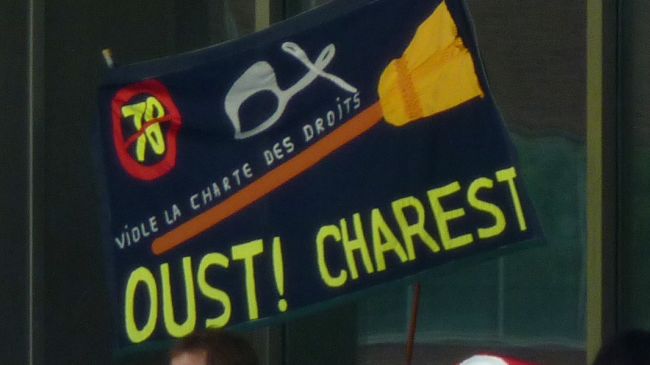 Canadian police have stormed the University of Quebec making 19 arrests, as angry students prevent the beginning of the new semester.
Police arrested 19 students Monday under the terms of Bill 78, which ordered a suspension of university classes back in May and their reinstatement in August even if the students planed to continue their strike. The bill also restricts the student demonstrations and imposes fines for those who impeded classes, starting at CAD 1,000.
The classes were supposed to resume this week, as the winter semester was suspended following massive months-long protests across Canada’s French-speaking province against proposed tuition fee hikes.
Some 2,000 students at the departments of anthropology and cinema voted to continue their protest and prevented the start of classes.
The recent protest comes ahead of next week’s provincial election, which will decide whether the province’s ruling Liberal Party, which insists on a plan to increase tuition fees by 82 percent, could be reelected.
The latest opinion poll shows that the separatist Parti Quebecois (PQ) led by Pauline Marois heading for a victory in the election to be held on September 4th. Marois is the protester’s favorite candidate and has been wearing the red square, the symbol of the demonstrators’ cause, on several public occasions.
If the separatist PQ is elected in the upcoming provincial election, it will consider holding a referendum on separation of Quebec from Canada.
Since February, students have been protesting against the hikes and the provincial government’s controversial anti-protest Bill 78. The protests later turned into a larger movement dubbed the “maple revolution,” which reveals deeper social unrest.
Quebec court upholds law limiting student protests
Press TV – June 28, 2012
Students in the Canadian province of Quebec have pledged to continue protests after a court rejected a petition to scrap parts of a law that was passed to crush student protest over tuition hikes.
The controversial law was passed in May in the wake of clashes between police and students fighting an 82 percent hike in tuition fees in the French speaking province.
Judge Francois Rolland said on Wednesday that the parts in question do “not prevent protests, even if certain limitations are imposed.”
Students and their lawyers rejected the court’s ruling, saying they would consider appealing.
Under Special Law 78, the organizers must inform the police about the timing and locations of marches at least eight hours before they stage a protest. It also allows imposing heavy fines on protesters who fail to do so.
Critics believe the law breaches rights of assembly and free expression. Police have arrested many people since the start of the protests more than four month ago.
University students and student unions have been protesting since mid-February to draw international attention to the government’s announced plans to raise tuition fees and the passing of the controversial law.
Related articles
- Canadian police arrest 400 in student protest in Montreal (alethonews.wordpress.com)
Canadian police arrest 400 in student protest in Montreal
Press TV – May 24, 2012
Canadian police have arrested some 400 people in Montreal in the latest student protest against tuition hikes, police say.
Several thousand demonstrators poured into Montreal’s central square late Wednesday to protest tuition hikes and to denounce a new legislation aimed at ending months of anti-tuition hikes protests.
Police clashed with the demonstrators and arrested nearly 400 protesters.
On Tuesday, tens of thousands of students took to the streets of Montreal to mark the 100th day of protests.
The protesters, carrying red banners and signs, marched through central Montreal to commemorate the day and also voice their opposition to the Quebec provincial government’s new law that would make protests more difficult to organize and impose stiff fines on those who disobey.
Since the law was passed on Friday, daily protests have often turned violent.
Under the new legislation, any individual, who prevents students from entering an educational institution or disrupts classes will be fined between CAD 1,000 and CAD 5,000.
The punishment will rise to between CAD 7,000 and CAD 35,000 for a student leader and to between CAD 25,000 and CAD 125,000 for student federations or unions.
The law also forces regulations to govern student protests, requiring protesters to inform the police of their demonstration plans, including an eight-hour notice for details, such as the itinerary, the duration, and the exact time of the action.
Quebec students have been holding almost daily demonstrations since February in an attempt to show their outrage at the proposed tuition fee rises.
Under the provisional agreement, university fees would increase by CAD 1,780 over seven years or about CAD 254 a year, bringing the total to CAD 4,000 per year. The plan is scheduled to be effective from 2012-13 until 2016-2017 academic years.
Related articles
Featured Video
Laith Marouf: Hezbollah’s position on US-Iran ceasefire
or go to
Aletho News Archives – Video-Images
From the Archives
The Dirty Little Secret behind the “Global Terrorism Index”
The Omission of Israeli Terrorism in the Occupied Palestinian Territories
By Karin Brothers | Global Research | December 6, 2014
… The Israeli settlements — all of which are illegal – have been identified as a major impediment to peace. The refusal of a major “global” terrorism report to name the Israeli settlers as one of the groups most responsible for terrorism not only misrepresents a major source of regional violence but exposes the Global Terrorism Index as a propaganda tool that supports a U.S. agenda.
In recent years, governments have been attempting to thwart terrorism by blocking supportive fund-raising. When it comes to Israeli settlements, however, the US and Canada actually encourage fund-raising by giving organizations (such as Christian Friends of Israeli Communities (CFOIC) and the Jewish National Fund) financial support in the form of donor tax-deductions.
Charities which provide funds for the Israeli settlements should be regarded as terror-financing organizations. They should not only lose their tax-deductible status, but they should be banned because they support the violation of international humanitarian law. The terror-financing laws that are being strictly enforced for Muslim charities should be applied to Christian and Jewish charities as well. … Read full article
Blog Roll
 Aletho News
- The ‘Opposition Party’ Has Done Nothing to Stop the Iran War and Much to Goad Trump Into Continuing It
- Moscow backs Tehran on status of Lebanon in US-Iran deal
- How UK Regulator Ofcom Quietly Bypassed International Law to Police American Speech
- The Black Cube Files: How Former Mossad Operatives Flipped a Nation
- Laith Marouf: Hezbollah’s position on US-Iran ceasefire: What you’re not being told
- Israel’s priority lies in destroying chances of peace between Iran, US: Ex-UN nuclear chief
- Ceasefire for all or for none: Iran shuts Hormuz over Lebanon attacks
- Strait of Hormuz is Iran’s ‘nuclear weapon’ that forced US retreat: Medvedev
- Energy crisis will last for months – Kremlin envoy
- Europe’s quiet role in the war on Iran
- If Americans Knew
- This is ceasefire? Israel’s biggest massacre yet in Lebanon, another journalist killed in Gaza – Daily Update
- Tucker Carlson on Israel: This Is the Behavior of an Ally? Really?
- Gazans face a triple crisis: severe shortages of water and bread, healthcare in tatters
- NY Times reports how Netanyahu took the US into Iran War
- A sigh of relief over Iran, but Gaza and Lebanon in dire straits – Daily Update
- Thousands dead and neighborhoods razed to the ground: Aid agencies fear southern Lebanon is becoming the new Gaza
- The war the US is fighting for Israel could cost trillions
- ‘Cigarette Burns, Nail Wounds’: Toddler Tortured in Gaza to Coerce Father
- Trump Says US Sent ‘a Lot of Guns’ to Protesters in Iran
- Israeli forces destroy 17 UN peacekeeper cameras in south Lebanon
- No Tricks Zone
- An Inconvenient Tree: Uncovered In Alps… Europe Much Warmer Than Today 6000 Years Ago
- New Study Reports A 60% Slowdown In Greenland’s Ice Loss Rate In The Last Decade
- Low Intensity Tornado Wrecks Major Solar Farm, Creating A Potential Toxic Dump
- New Study Finds Warming Saves Lives…Cold Temperatures 12 Times More Deadly Than Excess Heat
- German Science Blog Accuses PIK Climate Institute Of Hallucinating Climate Tipping Points
- Devastating Assessment Of Comirnaty Vaccine By Former Senior Pfizer Europe Toxicologist
- New Study: CO2 Is ‘Effectively Negligible’ As An Explanatory Climate Change Factor Since 2000
- Former Pfizer Toxicologist Dr. Helmut Sterz Tells Bundestag Hearing Pfizer Vaccine Should Have Never Been Approved
- Energy Expert: Germany’s Nuclear Phaseout Was A “500 Billion Euro Mistake”
- New Research: South Australia’s Mid-Holocene Sea Surface Temperatures Were 4°C Warmer Than Today
 Aletho News