Saudi, Israeli projects of Iranophobia falling flat: Zarif
Press TV – July 26, 2016
Iranian Foreign Minister Mohammad Javad Zarif says projects by the Israeli and Saudi Arabian regimes to portray Iran as a threat to the world have been falling flat over the past years.
Speaking to a group of Iranian expatriates in the Ghanaian capital city of Accra on Monday evening, Zarif said Tel Aviv and Riyadh, “two like-minded regimes,” are investing heavily in Iranophobia to draw attention away from their crimes and their collaborations.
“It is obvious that the cooperation of the Zionist regime (Israel) and the Saudi regime, which are two like-minded and congruent regimes, has today become known and can no more be concealed,” Zarif said.
He said the two regimes are concerned about their collaboration having become publicly known and are thus “investing further in Iranophobia” as a means of distraction.
He said, however, that, “The world has today waken up to the fact that the danger of Wahhabism is the real threat.”
Wahhabism is an extreme ideological strand openly preached by Saudi Arabian clerics, who have the blessing of ruling Saudi authorities. It is the main ideological feature of Takfiri terrorist groups — particularly Daesh — which declare people of other faiths and beliefs as “infidels” and, based on “decrees” from clerics, rule that they should be killed.
Most Arab governments have no diplomatic relations with Israel. Egypt and Qatar are the only two Arab states to have open diplomatic ties with Israel.
Some Arab governments, however, while posing as Israel’s traditional adversaries, have been revealed to have secret ties with the Tel Aviv regime. Saudi Arabia and the United Arab Emirates (UAE) are two such countries.
Last week, a retired general in the Saudi military traveled to Israel at the head of a delegation, meeting with Israel’s foreign ministry director general Dore Gold Yoav Mordechai and a number of Knesset members.
Both Riyadh and Tel Aviv were and continue to be fiercely opposed to a nuclear deal between Iran and a group of six world powers.
In his Monday remarks, Foreign Minister Zarif said the deal, known as the Joint Comprehensive Plan of Action (JCPOA), succeeded in proving to the world the peaceful nature of the Iranian nuclear program.
The JCPOA was struck between Iran and the US, the UK, France, Russia, China and Germany on July 14, 2015.
Zarif is in Ghana on the second leg of a four-nation African tour. He was in Nigeria before arriving in Ghana and will be traveling to Guinea-Conakry and Mali on the third and fourth legs of his tour.
Western leaders support terror groups in Syria, get extremism at home – Assad
RT | July 10, 2016
Terrorist attacks, an unprecedented refugee influx and other problems with which Europe is struggling to cope are the result of wrong decisions made by European leaders, Syria’s president Bashar Assad told a European Parliament delegation.
“The situation in Syria and the whole region naturally affects Europe a lot due to its location and social ties. The problems Europe faces today of terrorism, extremism and waves of refugees are caused by some western leaders’ adoption of policies which do not serve their people,” Assad told the delegation headed by Javier Couso, Vice Chairman of the foreign affairs committee of the European Parliament, who had been visiting Damascus, Syrian state news agency SANA reported.
This is especially true “when those leaders give support and political cover to terrorist groups inside Syria,” the president added.
He stressed the role that the European Parliament should play in fixing the policies of some of European countries which had let terrorism evolve. Economic sanctions imposed against Damascus have impacted the Syrian people, who were forced to leave their homeland, Assad also said.
Couso noted that the delegation is planning to take steps that would help change western countries’ rhetoric and will call for the lifting of sanctions, which he described as “unfair”.
He promised to “inform the Europeans on the real state of affairs in Syria and on how people suffer from terrorism,” the report said.
Syria plunged into chaos in 2011, when public protests escalated into an armed uprising as foreign powers warned the Assad government against cracking down on the protest. As violence expanded, radical groups and criminal gangs hijacked the process, turning Syria into the bloodiest battle zone of the modern world.
Foreign nations opposing Damascus, including Turkey, Saudi Arabia, Jordan, the United States and the United Kingdom, have been providing various Syrian opposition groups with aid, saying that only by supporting armed groups trying to topple the Syrian government can the conflict be stopped.
The US and other western countries aided so-called ‘moderate rebels’ in Syria with weapons and training, saying this would help them defeat both the Syrian army and terrorist organizations, which capitalized on the turmoil in Syria. The effort led to some embarrassing moments, for instance when the initial training program for the moderates produced only a handful of fighters after months of recruiting.
Saudi Arabia and Qatar are among the key providers of Syrian rebel groups with military and financial assistance, including some powerful Islamist groups seeking to turn Syria into a country governed by the Sharia law.
Turkey, which was hit most among Syria’s neighbors by the refugee crisis, hosting almost two million asylum seekers, is among the vocal opponents of Damascus too. Critics accuse Ankara of turning a blind eye on rebel activities in its territory, including recruiting, arms shipments and getting medical assistance.
Jihadists from terrorist groups like Islamic State and Al-Nusra Front are among those benefiting from such policies. IS staged a number of bloody terrorist attacks in Turkey since its rise to power in Iraq and Syria, killing hundreds of people. The organization also claimed responsibility for several high-profile attacks in Europe and the US.
The European delegation arrived in Damascus on Saturday. The group visited refugee center in the Syrian capital and met soldiers undergoing treatment in the Hamish hospital.
Read more:
Jihadists that US kept off terror list attack UN humanitarian convoy in Syria – MoD
Al-Nusra Front in Syria gets daily weapons supplies from Turkey – Russian military
Western officials criticize Damascus in public but secretly deal in private not to upset US – Assad
Turkey is Preparing an Offensive Military Operation in Northern Syria
By Said Al-Khalaki – Global Research – May 30, 2016
It’s been quite a while since the treaty on cease-fire in Syria was signed. We can say February 27 became the new anchor for the people of Syria who are tired of war and havoc. However, the situation doesn’t suit the main sponsors of the “Syrian revolution”, i.e. Turkey, Saudi Arabia and Qatar which had already planned how the country would be divided between them.
Turkey is interested in Syria’s division most of all. The most attractive “piece” for Turkey is Northern Syria and its destroyed economic capital Aleppo.
Obviously, the seized Northern territories would be a step forward in Erdogan’s plan to resurrect the Ottoman Empire he is dreaming about. That is why the seizure of Aleppo is a strategic goal for Erdogan and his partners.
The Turkish government has been supporting Syrian terrorists from the very outset of the war in March 2011.
As the Egyptian news site El-Badil reports, in late 2015 the Turkish government was supplying the Syrian opposition with money and food. Also, it allowed them to cross the border between Turkey and Syria. The fact that militants from terrorist groups fighting in Syria can freely cross the border is also reported by the Kurdish news agency ANHA. According to it, militants go through Bab Al-Salama border crossing point to the North of Aleppo from the Turkish city Kilis towards the Syrian town Azaz. As a rule, militants visit Turkey for two reasons: to undergo a qualified medical treatment to heal their wounds or to attend a military training in a special camp where Turks and Saudis work.
Despite all the efforts of Turkish officials to conceal their support in favor of the terrorists, the (Turkish and Western) media has nonetheless acknowledged Ankara’s insidious role. Even the Syrian opposition’s leaders have never hidden such facts. For example, in last September, one of its leaders, Ahmed Tuma, told the British newspaper Al-Arabi that Turkey was supplying Syrian militants with fuel and food. Tuma is proud of his relations with Turkish leaders and highly appreciates the role of Turkey in forming the so-called “new Syrian state.” And it’s no wonder as the oppositional leader lives on money received from Turkey.
According to the activists of the media center Syria from Inside in Ankara, all the operations of sponsoring the Syrian opposition leaders and field commanders of armed groups are conducted through a number of accounts in a Turkish based bank. Moreover, through this bank, Turkey finances NGOs whose main purpose is to support the Syrian revolution.
Besides that, Turkey’s support for Syrian militants, i.e. financing and training, is included in the US secret program Timber Sycamore, according to a New York Times report in January, 2016. The NYT acknowledges that Turkey has been sponsoring Syrian terrorists since 2013.
It’s obvious that the cease-fire in Syria is not to the advantage of Ankara, whose political leaders seek to overthrow the government of Bashar al Assad.
Now, the most important point of the face-off is Aleppo province. As locals say, more than 1000 terrorists arrived there between April to mid-May. The fighters were accompanied by trucks with arms and ammunition and off-road vehicles with large-caliber machine guns. Notably, the vehicles’ deployment is covered by Turkish artillery, regularly shelling Syrian border regions from the Turkish side. It’s clear that all these actions are evidence of the fact that terrorists are preparing a large-scale offensive in Aleppo.
No doubt, the attack on Aleppo is a part of the “hybrid” war implemented by Turkey in Syria. The artillery shelling of Syrian territories and the support for Syrian terrorists – Turkish news agency Anadolu calls these “a fight against ISIS.” And the Turkish government justify Erdogan’s desire to seize Northern Syria by claiming that it is just an attempt to create the so-called “safety zone” for refugees.
While the world is trying to reach a peace treaty in Syria, Turkish leaders are planning large-scale operations involving “opposition” terrorists and radical groups.
However, we want to believe that their plans won’t be crowned with success as everyone in Syria understands who is behind the “opposition” and what the “revolutionists” want to achieve.
Copyright © Said Al-Khalaki, Global Research, 2016
Hillary Clinton’s Memoir Deletions, in Detail
By Ming Chun Tang | The Americas Blog | May 26, 2016
As was reported following the assassination of prominent Honduran environmental activist Berta Cáceres in March, former Secretary of State Hillary Clinton erased all references to the 2009 coup in Honduras in the paperback edition of her memoirs, “Hard Choices.” Her three-page account of the coup in the original hardcover edition, where she admitted to having sanctioned it, was one of several lengthy sections cut from the paperback, published in April 2015 shortly after she had launched her presidential campaign.
A short, inconspicuous statement on the copyright page is the only indication that “a limited number of sections” — amounting to roughly 96 pages — had been cut “to accommodate a shorter length for this edition.” Many of the abridgements consist of narrative and description and are largely trivial, but there are a number of sections that were deleted from the original that also deserve attention.
Colombia
Clinton’s take on Plan Colombia, a U.S. program furnishing (predominantly military) aid to Colombia to combat both the FARC and ELN rebels as well as drug cartels, and introduced under her husband’s administration in 2000, adopts a much more favorable tone in the paperback compared to the original. She begins both versions by praising the initiative as a model for Mexico — a highly controversial claim given the sharp rise in extrajudicial killings and the proliferation of paramilitary death squads in Colombia since the program was launched.
The two versions then diverge considerably. In the original, she explains that the program was expanded by Colombian President Álvaro Uribe “with strong support from the Bush Administration” and acknowledges that “new concerns began to arise about human rights abuses, violence against labor organizers, targeted assassinations, and the atrocities of right-wing paramilitary groups.” Seeming to place the blame for these atrocities on the Uribe and Bush governments, she then claims to have “made the choice to continue America’s bipartisan support for Plan Colombia” regardless during her tenure as secretary of state, albeit with an increased emphasis on “governance, education and development.”
By contrast, the paperback makes no acknowledgment of these abuses or even of the fact that the program was widely expanded in the 2000s. Instead, it simply makes the case that the Obama administration decided to build on President Clinton’s efforts to help Colombia overcome its drug-related violence and the FARC insurgency — apparently leading to “an unprecedented measure of security and prosperity” by the time of her visit to Bogotá in 2010.
The Trans-Pacific Partnership
Also found in the original is a paragraph where Clinton discusses her efforts to encourage other countries in the Americas to join negotiations for the Trans-Pacific Partnership (TPP) trade agreement during a regional conference in El Salvador in June 2009:
So we worked hard to improve and ratify trade agreements with Colombia and Panama and encouraged Canada and the group of countries that became known as the Pacific Alliance — Mexico, Colombia, Peru, and Chile — all open-market democracies driving toward a more prosperous future to join negotiations with Asian nations on TPP, the trans-Pacific trade agreement.
Clinton praises Latin America for its high rate of economic growth, which she revealingly claims has produced “more than 50 million new middle-class consumers eager to buy U.S. goods and services.” She also admits that the region’s inequality is “still among the worst in the world” with much of its population “locked in persistent poverty” — even while the TPP that she has advocated strongly for threatens to exacerbate the region’s underdevelopment, just as NAFTA caused the Mexican economy to stagnate.
Last October, however, she publicly reversed her stance on the TPP under pressure from fellow Democratic presidential candidates Bernie Sanders and Martin O’Malley. Likewise, the entire two-page section on the conference in El Salvador where she expresses her support for the TPP is missing from the paperback.
Brazil
In her original account of her efforts to prevent Cuba from being admitted to the Organization of American States (OAS) in June 2009, Clinton singles out Brazilian President Luiz Inácio Lula da Silva as a potential mediator who could help “broker a compromise” between the U.S. and the left-leaning governments of Venezuela, Ecuador, Bolivia and Nicaragua. Her assessment of Lula, removed from the paperback, is mixed:
As Brazil’s economy grew, so did Lula’s assertiveness in foreign policy. He envisioned Brazil becoming a major world power, and his actions led to both constructive cooperation and some frustrations. For example, in 2004 Lula sent troops to lead the UN peacekeeping mission in Haiti, where they did an excellent job of providing order and security under difficult conditions. On the other hand, he insisted on working with Turkey to cut a side deal with Iran on its nuclear program that did not meet the international community’s requirements.
It is notable that the “difficult conditions” in Haiti that Clinton refers to was a period of perhaps the worst human rights crisis in the hemisphere at the time, following the U.S.-backed coup d’etat against democratically elected president Jean-Bertrand Aristide in 2004. Researchers estimate that some 4,000 people were killed for political reasons, and some 35,000 women and girls sexually assaulted. As various human rights investigators, journalists and other eyewitnesses noted at the time, some of the most heinous of these atrocities were carried out by Haiti’s National Police, with U.N. troops often providing support — when they were not engaging in them directly. WikiLeaked State Department cables, however, reveal that the State Department saw the U.N. mission as strategically important, in part because it helped to isolate Venezuela from other countries in the region, and because it allowed the U.S. to “manage” Haiti on the cheap.
In contrast to Lula, Clinton heaps praise on Lula’s successor, Dilma Rousseff, who was recently suspended from office pending impeachment proceedings:
Later I would enjoy working with Dilma Rousseff, Lula’s protégée, Chief of Staff, and eventual successor as President. On January 1, 2011, I attended her inauguration on a rainy but festive day in Brasilia. Tens of thousands of people lined the streets as the country’s first woman President drove by in a 1952 Rolls-Royce. She took the oath of office and accepted the traditional green and gold Presidential sash from her mentor, Lula, pledging to continue his work on eradicating poverty and inequality. She also acknowledged the history she was making. “Today, all Brazilian women should feel proud and happy.” Dilma is a formidable leader whom I admire and like.
The paperback version deletes almost all references to Rousseff, mentioning her only once as an alleged target of NSA spying according to Edward Snowden.
The Arab Spring
By far the lengthiest deletion in Clinton’s memoirs consists of a ten-page section discussing the Arab Spring in Jordan, Libya and the Persian Gulf region — amounting to almost half of the chapter. Having detailed her administration’s response to the mass demonstrations that had started in Tunisia before spreading to Egypt, then Jordan, then Bahrain and Libya, Clinton openly recognizes the profound contradictions at the heart of the U.S.’ relationship with its Gulf allies:
The United States had developed deep economic and strategic ties to these wealthy, conservative monarchies, even as we made no secret of our concerns about human rights abuses, especially the treatment of women and minorities, and the export of extremist ideology. Every U.S. administration wrestled with the contradictions of our policy towards the Gulf.
And it was appalling that money from the Gulf continued funding extremist madrassas and propaganda all over the world. At the same time, these governments shared many of our top security concerns.
Thanks to these shared “security concerns,” particularly those surrounding al-Qaeda and Iran, her administration strengthened diplomatic ties and sold vast amounts of military equipment to these countries:
The United States sold large amounts of military equipment to the Gulf states, and stationed the U.S. Navy’s 5th Fleet in Bahrain, the Combined Air and Space Operations Center in Qatar, and maintained troops in Kuwait, Saudi Arabia, and the UAE, as well as key bases in other countries. When I became Secretary I developed personal relationships with Gulf leaders both individually and as a group through the Gulf Cooperation Council.
Clinton continues to reveal that the U.S.’ common interests with its Gulf allies extended well beyond mere security issues and in fact included the objective of regime change in Libya — which led the Obama administration into a self-inflicted dilemma as it weighed the ramifications of condemning the violent repression of protests in Bahrain with the need to build an international coalition, involving a number of Gulf states, to help remove Libyan leader Muammar Gaddhafi from power:
Our values and conscience demanded that the United States condemn the violence against civilians we were seeing in Bahrain, full stop. After all, that was the very principle at play in Libya. But if we persisted, the carefully constructed international coalition to stop Qaddafi could collapse at the eleventh hour, and we might fail to prevent a much larger abuse — a full-fledged massacre.
Instead of delving into the complexities of the U.S.’ alliances in the Middle East, the entire discussion is simply deleted, replaced by a pensive reflection on prospects for democracy in Egypt, making no reference to the Gulf region at all. Having been uncharacteristically candid in assessing the U.S.’ response to the Arab Spring, Clinton chose to ignore these obvious inconsistencies — electing instead to proclaim the Obama administration as a champion of democracy and human rights across the Arab world.
US ‘leverage in Syria’ thanks to collusion with terrorists
By Finian Cunningham | RT | May 20, 2016
There is a simple explanation why Washington refuses to proscribe the militant groups Jaysh al-Islam and Ahrar al-Sham as terrorist. Because Washington relies on them for regime change in Syria.
Therefore, Washington and its Western and Middle East allies cannot possibly designate Jaysh al-Islam and Ahrar al-Sham as terrorist; otherwise it would be a self-indicting admission that the war in Syria is a foreign state-sponsored terrorist assault on a sovereign country.
This criminal conspiracy is understood by many observers as an accurate description of the five-year Syrian conflict and how it originated. Syria fits into the mold of US-led regime change wars in the Middle East and elsewhere. However, Washington and its allies, assisted by the Western corporate news media, have maintained a fictitious alternative narrative on Syria, claiming the war is an insurgency by a pro-democracy rebel movement.
That narrative has strained credulity over the years as the putative “secular rebels” have either vanished or turned out to be indistinguishable from extremist groups like al-Qaeda-linked Jabhat al-Nusra and so-called Islamic State (also known as Daesh).
Washington asserts that it only supports “moderate, secular rebels” of the Free Syrian Army. British Prime Minister David Cameron has claimed that there are 70,000 such “moderate rebels” fighting in Syria against the government of President Bashar al-Assad. But no-one can locate these supposed pro-democracy warriors.
All that can be seen is that the fight against the Syrian government is being waged by self-professed extremist jihadists who have no intention of establishing “democracy”. Instead, they explicitly want to carve out an Islamic state dominated by draconian Sharia law.
In addition to Jabhat al-Nusra and Daesh, the two other major militant groups, Jaish al-Islam and Ahrar al-Sham, are vehemently committed to forming a Caliphate based on Salafi or Wahhabi ideology. That ideology views all other religious faiths, including moderate Sunni Muslims, as well as Shia and Alawites, as “infidels” fit to be persecuted until death.
Leaders of both Jaysh and Ahrar have publicly declared their repudiation of democracy.
Yet these two groups are nominated as the Syrian “opposition” in the Geneva talks, as part of the High Negotiations Committee (HNC). The HNC was cobbled together at a summit held in the Saudi capital Riyadh in December ahead of the anticipated negotiations to find a Syrian political settlement.
The HNC is endorsed by Washington as official representatives of the Syrian opposition. It is supported by Saudi Arabia, or indeed more accurately, orchestrated by the Saudi rulers since the main components of the HNC are Jaysh al-Islam and Ahrar al-Sham. Other major sponsors of the militant groups are Qatar and Turkey.
Staffan de Mistura, the UN envoy to Syria, also plays an important part in the charade of furnishing an opposition composed of extremists who demand the Syrian government must stand down as a precondition for talks. This maximalist position is one of the main reasons why the negotiations have come unstuck, according to Russian Foreign Minister Sergey Lavrov.
Another basic reason is that the HNC members have been involved in breaching the cessation of violence the US and Russia brokered on February 27, as a confidence-building measure to assist the talks process in Geneva.
That Jaysh al-Islam and Ahrar al-Sham have not observed the shaky ceasefire is a corollary of the fact that both groups are integrated with al-Qaeda-affiliated terror organizations, al Nusra and Daesh, which are internationally designated terrorist organizations.
The UN excluded al-Qaeda franchises from the ceasefire when it passed Security Council Resolution 2254 in December to mandate the purported Syrian peace talks. In that way, Syria and its foreign allies, Russia, Iran and Lebanon’s Hezbollah, have been legally entitled to continue offensive operations against the extremists in parallel to the Geneva process.
The offensive on the terror groups should include HNC members Jaysh and Ahrar. Both groups have publicly admitted to fighting alongside both Nusra and Daesh in their campaign against the Syrian army. All of these organizations have been involved at various times in bloody feuds and turf wars. Nevertheless, they are at other times self-declared collaborators.
Jaysh al-Islam and Ahrar al-Sham are also well-documented to having engaged in massacres and barbarities as vile as the other higher profile terror outfits.
Only last week, Ahrar al-Sham was responsible for the massacre of women and children in the village of Al-Zahraa, near Aleppo, according to survivors. The group has carried out countless no-warning car bombings in civilians neighborhoods. It claimed responsibility for a bombing outside the Russian base at Idlib earlier this year, which killed dozens.
Jaysh al-Islam has publicly admitted using chemical weapons against Kurdish civilians in recent weeks, also near Aleppo, Syria’s second city after the capital Damascus, and currently the key battleground in the whole conflict.
The same jihadist militia is allegedly linked to the chemical weapon atrocity in August 2013 in the Damascus suburb of East Ghouta, when hundreds of civilians, including children, were apparently killed from exposure to Sarin gas. That attack was initially blamed on Syrian government forces and it nearly prompted the Obama administration to order direct military intervention on the pretext that a “red line” was crossed. Until that is, Moscow steered a ground-breaking deal to decommission chemical weapons held by the Syrian state. It later transpired that the more likely culprit for the East Ghouta atrocity was the Jaysh al-Islam militants.
A former commander of the group, Zahran Alloush, once declared that he would “cleanse” all Shia, Alawites and other infidels from the Levant. Many Syrian civilians later rejoiced when the “terrorist boss” – their words – was killed in a Syrian air force strike on December 25. Notably, Saudi Arabia and Turkey vehemently protested over Alloush’s death.
It is irrefutable from both their actions and self-declarations that Jaysh al-Islam and Ahrar al-Sham are by any definition terrorist groups. Certainly, Russia and Iran have officially listed both as such.
But not so Washington and its allies. Earlier this month, a Russian proposal at the UN Security Council to proscribe Jaysh and Ahrar was blocked by the US, Britain and France. An American spokesperson told the AFP news agency that it rejected the Russian motion because it feared the tentative Syrian ceasefire would collapse entirely. This is an unwitting US admission about who the main fighting forces in the Syrian “rebellion” are.
This week US Secretary of State John Kerry made an extraordinary claim which, as usual, went unnoticed in the Western media. Kerry said the US “still has leverage in Syria” because if the Syrian government does not accept Washington’s demands for political transition then the country would face years of more war.
Kerry’s confidence in threatening a war of attrition on Syria is based on the fact that the main terror groups are directly or indirectly controlled by Washington and its regional allies in Saudi Arabia and Turkey.
Jaysh al-Islam and Ahrar al-Sham are essential to the terror front that gives Washington its leverage in Syria. But the charade must be kept covered with the preposterous denial that these groups are not terrorists.
How narratives killed the Syrian people
By Sharmine Narwani | RT | March 23, 2016
On March 23, 2011, at the very start of what we now call the ‘Syrian conflict,’ two young men – Sa’er Yahya Merhej and Habeel Anis Dayoub – were gunned down in the southern Syrian city of Daraa.
Merhej and Dayoub were neither civilians, nor were they in opposition to the government of Syrian President Bashar al-Assad. They were two regular soldiers in the ranks of the Syrian Arab Army (SAA).
Shot by unknown gunmen, Merhej and Dayoub were the first of eighty-eight soldiers killed throughout Syria in the first month of this conflict– in Daraa, Latakia, Douma, Banyas, Homs, Moadamiyah, Idlib, Harasta, Suweida, Talkalakh and the suburbs of Damascus.
According to the UN’s Independent International Commission of Inquiry on Syria, the combined death toll for Syrian government forces was 2,569 by March 2012, the first year of the conflict. At that time, the UN’s total casualty count for all victims of political violence in Syria was 5,000.
These numbers paint an entirely different picture of events in Syria. This was decidedly not the conflict we were reading about in our headlines – if anything, the ‘parity’ in deaths on both sides even suggests that the government used ‘proportionate’ force in thwarting the violence.
But Merhej and Dayoub’s deaths were ignored. Not a single Western media headline told their story – or that of the other dead soldiers. These deaths simply didn’t line up with the Western ‘narrative’ of the Arab uprisings and did not conform to the policy objectives of Western governments.
For American policymakers, the “Arab Spring” provided a unique opportunity to unseat the governments of adversary states in the Middle East. Syria, the most important Arab member of the Iran-led ‘Resistance Axis,’ was target number one.
To create regime-change in Syria, the themes of the “Arab Spring” needed to be employed opportunistically – and so Syrians needed to die.
The “dictator” simply had to “kill his own people” – and the rest would follow.
How words kill
Four key narratives were spun ad nauseam in every mainstream Western media outlet, beginning in March 2011 and gaining steam in the coming months.
– The Dictator is killing his “own people.”
– The protests are “peaceful.”
– The opposition is “unarmed.”
– This is a “popular revolution.”
Pro-Western governments in Tunisia and Egypt had just been ousted in rapid succession in the previous two months – and so the ‘framework’ of Arab Spring-style, grass roots-powered regime-change existed in the regional psyche. These four carefully framed ‘narratives’ that had gained meaning in Tunisia and Egypt, were now prepped and loaded to delegitimize and undermine any government at which they were lobbed.
But to employ them to their full potential in Syria, Syrians had to take to the streets in significant numbers and civilians had to die at the hands of brutal security forces. The rest could be spun into a “revolution” via the vast array of foreign and regional media outlets committed to this “Arab Spring” discourse.
Protests, however, did not kick off in Syria the way they had in Tunisia and Egypt. In those first few months, we saw gatherings that mostly numbered in the hundreds – sometimes in the thousands – to express varied degrees of political discontent. Most of these gatherings followed a pattern of incitement from Wahhabi-influenced mosques during Friday’s prayers, or after local killings that would move angry crowds to congregate at public funerals.
A member of a prominent Daraa family explained to me that there was some confusion over who was killing people in his city – the government or “hidden parties.” He explains that, at the time, Daraa’s citizens were of two minds: “One was that the regime is shooting more people to stop them and warn them to finish their protests and stop gathering. The other opinion was that hidden militias want this to continue, because if there are no funerals, there is no reason for people to gather.”
With the benefit of hindsight, let’s look at these Syria narratives five years into the conflict:
We know now that several thousand Syrian security forces were killed in the first year, beginning March 23, 2011. We therefore also know that the opposition was “armed” from the start of the conflict. We have visual evidence of gunmen entering Syria across the Lebanese border in April and May 2011. We know from the testimonies of impartial observers that gunmen were targeting civilians in acts of terrorism and that “protests” were not all “peaceful”.
The Arab League mission conducted a month-long investigation inside Syria in late 2011 and reported:
“In Homs, Idlib and Hama, the observer mission witnessed acts of violence being committed against government forces and civilians that resulted in several deaths and injuries. Examples of those acts include the bombing of a civilian bus, killing eight persons and injuring others, including women and children, and the bombing of a train carrying diesel oil. In another incident in Homs, a police bus was blown up, killing two police officers. A fuel pipeline and some small bridges were also bombed.”
Longtime Syrian resident and Dutch priest Father Frans van der Lugt, who was killed in Homs in April 2014, wrote in January 2012:
“From the start the protest movements were not purely peaceful. From the start I saw armed demonstrators marching along in the protests, who began to shoot at the police first. Very often the violence of the security forces has been a reaction to the brutal violence of the armed rebels.”
A few months earlier, in September 2011, he had observed:
“From the start there has been the problem of the armed groups, which are also part of the opposition… The opposition on the street is much stronger than any other opposition. And this opposition is armed and frequently employs brutality and violence, only in order then to blame the government.”
Furthermore, we also now know that whatever Syria was, it was no “popular revolution.” The Syrian army has remained intact, even after blanket media coverage of mass defections. Hundreds of thousands of Syrians continued to march in unreported demonstrations in support of the president. The state’s institutions and government and business elite have largely remained loyal to Assad. Minority groups – Alawites, Christians, Kurds, Druze, Shia, and the Baath Party, which is majority Sunni – did not join the opposition against the government. And the major urban areas and population centers remain under the state’s umbrella, with few exceptions.
A genuine “revolution,” after all, does not have operation rooms in Jordan and Turkey. Nor is a “popular” revolution financed, armed and assisted by Qatar, Saudi Arabia, the US, UK and France.
Sowing “Narratives” for geopolitical gain
The 2010 US military’s Special Forces Unconventional Warfare manual states:
“The intent of US [Unconventional Warfare] UW efforts is to exploit a hostile power’s political, military, economic, and psychological vulnerabilities by developing and sustaining resistance forces to accomplish US strategic objectives… For the foreseeable future, US forces will predominantly engage in irregular warfare (IW) operations.”
A secret 2006 US State Department cable reveals that Assad’s government was in a stronger position domestically and regionally than in recent years, and suggests ways to weaken it: “The following provides our summary of potential vulnerabilities and possible means to exploit them…” This is followed by a list of “vulnerabilities” – political, economic, ethnic, sectarian, military, psychological – and recommended “actions” on how to “exploit” them.
This is important. US unconventional warfare doctrine posits that populations of adversary states usually have active minorities that respectively oppose and support their government, but for a “resistance movement” to succeed, it must sway the perceptions of the large “uncommitted middle population” to turn on their leaders. Says the manual (and I borrow liberally here from a previous article of mine):
To turn the “uncommitted middle population” into supporting insurgency, UW recommends the “creation of atmosphere of wider discontent through propaganda and political and psychological efforts to discredit the government.”
As conflict escalates, so should the “intensification of propaganda; psychological preparation of the population for rebellion.”
First, there should be local and national “agitation” – the organization of boycotts, strikes, and other efforts to suggest public discontent. Then, the “infiltration of foreign organizers and advisors and foreign propaganda, material, money, weapons and equipment.”
The next level of operations would be to establish “national front organizations [i.e. the Syrian National Council] and liberation movements [i.e. the Free Syrian Army]” that would move larger segments of the population toward accepting “increased political violence and sabotage” – and encourage the mentoring of “individuals or groups that conduct acts of sabotage in urban centers.”
I wrote about foreign-backed irregular warfare strategies being employed in Syria one year into the crisis – when the overwhelming media narratives were still all about the “dictator killing his own people,” protests being “peaceful,” the opposition mostly “unarmed,” the “revolution wildly “popular,” and thousands of “civilians” being targeted exclusively by state security forces.
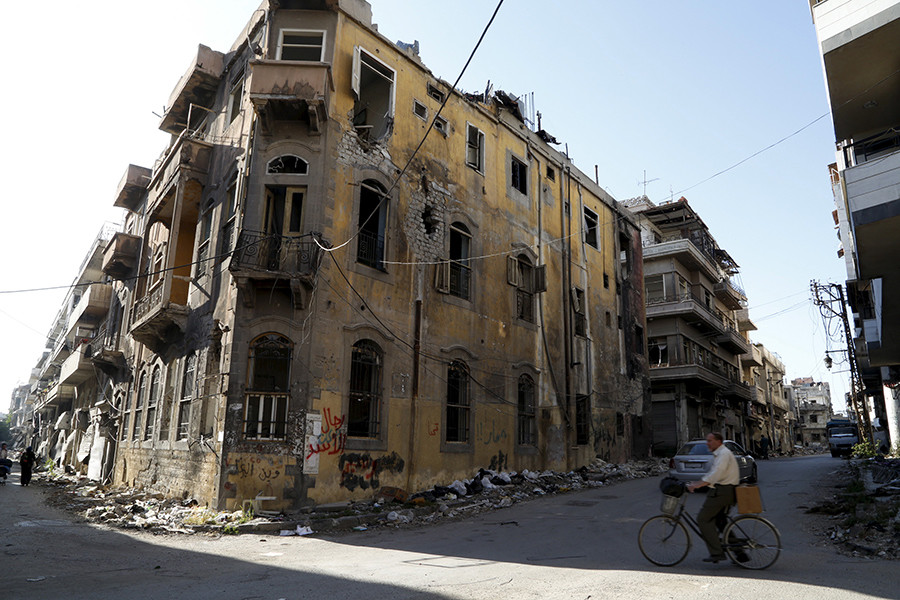
A man rides a bicycle near a building damaged during the Syrian conflict between government forces and rebels in Homs, Syria May 13, 2014 © Omar Sanadiki
Were these narratives all manufactured? Were the images we saw all staged? Or was it only necessary to fabricate some things – because the “perception” of the vast middle population, once shaped, would create its own natural momentum toward regime change?
And what do we, in the region, do with this startling new information about how wars are conducted against us – using our own populations as foot soldiers for foreign agendas?
Create our own “game”
Two can play at this narratives game.
The first lesson learned is that ideas and objectives can be crafted, framed finessed and employed to great efficacy.
The second take-away is that we need to establish more independent media and information distribution channels to disseminate our own value propositions far and wide.
Western governments can rely on a ridiculously sycophantic army of Western and regional journalists to blast us with their propaganda day and night. We don’t need to match them in numbers or outlets – we can also employ strategies to deter their disinformation campaigns. Western journalists who repeatedly publish false, inaccurate and harmful information that endanger lives must be barred from the region.
These are not journalists – I prefer to call them media combatants – and they do not deserve the liberties accorded to actual media professionals. If these Western journalists had, in the first year of the Syrian conflict, questioned the premises of any of the four narratives listed above, would 250,000-plus Syrians be dead today? Would Syria be destroyed and 12 million Syrians made homeless? Would ISIS even exist?
Free speech? No thank you – not if we have to die for someone else’s national security objectives.
Syria changed the world. It brought the Russians and Chinese (BRICS) into the fray and changed the global order from a unipolar one to a multilateral one – overnight. And it created common cause between a group of key states in the region that now form the backbone of a rising ‘Security Arc’ from the Levant to the Persian Gulf. We now have immense opportunities to re-craft the world and the Middle East in our own vision. New borders? We will draw them from inside the region. Terrorists? We will defeat them ourselves. NGOs? We will create our own, with our own nationals and our own agendas. Pipelines? We will decide where they are laid.
But let’s start building those new narratives before the ‘Other’ comes in to fill the void.
A word of caution. The worst thing we can do is to waste our time rejecting foreign narratives. That just makes us the ‘rejectionists’ in their game. And it gives their game life. What we need to do is create our own game – a rich vocabulary of homegrown narratives – one that defines ourselves, our history and aspirations, based on our own political, economic and social realities. Let the ‘Other’ reject our version, let them become the ‘rejectionists’ in our game… and give it life.
Sharmine Narwani is a commentator and analyst of Middle East geopolitics. She is a former senior associate at St. Antony’s College, Oxford University and has a master’s degree in International Relations from Columbia University. You can follow her on Twitter at @snarwani
Syria: Saudi, Turkey, Qatar Defy International Law
Al-Manar | May 6, 2016
Syria on Thursday lashed out at Saudi Arabia, Turkey and Qatar, stressing that the regimes are defying international law over their backing of terrorists organizations operating in Syria.
In a letter sent to the UN Secretary-General and head of the UN Security Council, the Syrian foreign ministry said violations of the truce in Aleppo and attacking safe residential neighborhoods prove once again that the regimes of Riyadh, Ankara and Doha keep defying UN Security Council resolutions.
“Armed terrorist groups breached a truce in Aleppo that culminated tough efforts to which the Syrian Arab Army has fully committed since Thursday morning May 5 2016 as agreed,” SANA news agency cited the Syrian letter.
The ministry explained that a few hours after the truce took effect early on Thursday, the armed terrorist groups shelled the safe residential neighborhoods in Aleppo city including al-Khalediya, al-Zahraa, al-Suleimaniyeh, Sallahu-Eddin , al-Azeeziya and al-Midan with heavy barrage of rocket shells, explosive gas cylinders (Hell cannon) and mortar shells.
The terrorist attacks on the residential neighborhoods and Dar al-Farah school resulted in killing three civilians, injuring others and causing massive devastation to private and public properties, the Syrian foreign ministry said.
The ministry confirmed that the crime of violating the truce in Aleppo reveals the real face of the terrorist armed groups, adding that these terrorist groups which are backed by Turkey, Saudi Arabia, Qatar and other countries have no other aim but to kill Syrians and destroy their country, yet some insist on calling them ‘moderate opposition.’
“On Thursday morning, May 5 2016, ISIL terrorist organization detonated a car and motorcycle bombs in the main square of al-Mukaram al-Fouqani city in Homs province, killing 12 civilians and injuring 40 others including children, women and elders,” added the ministry, referring to the Takfiri group.
Turkey exercises ‘decisive influence’ on Syrian ‘HNC’: Lavrov
Press TV – April 25, 2016
Russian Foreign Minister Sergei Lavrov says Turkey exercises a “decisive influence” on the so-called opposition group High Negotiations Committee (HNC) which is in peace talks with the Damascus government.
Lavrov made the remarks on Monday while commenting on the progress of the latest round of negotiations between the Syrian government and HNC, which began in Geneva on April 13.
Syria peace talks are going on despite the absence of the Saudi-backed opposition as the group’s leaders left the talks on April 19 to protest at what they called escalating violence and restrictions on humanitarian access in Syria.
A ceasefire, brokered by Russia and the US, went into effect on February 27 across Syria. Fighting, however, picked up and left the truce in tatters. Meanwhile, the UN Security Council has agreed on a six-month deadline for drafting a new constitution for the Arab country in line with the proposal of the International Syria Support Group.
“In order to come to terms over six months it is necessary not to slam the door and dig in heels, as several delegates of the so-called Riyadh group have done, Lavrov said, adding that “it’s no secret” that Turkey has a “decisive influence” on them.
“So one should not come for talks with ultimatums but should sit down at the negotiating table and reach an agreement,” Lavrov added, noting that the situation at the UN-brokered talks could have been better if HNC had not left Geneva.
The top Russian diplomat also said that Moscow was preparing a report for the UN Security Council to extend the list of terrorist groups in Syria.
“We are currently collecting information that Jebhat al-Nusra (al-Nusra Front) subjugates groups that seemed to have declared truce and readiness to join ceasefire,” Lavrov said, adding, “We will summarize facts and present them to [the] UN Security Council to adjust terrorist lists.”
Syria has been gripped by foreign-backed militancy since March 2011. Damascus says Saudi Arabia, Turkey and Qatar are the main supporters of the militants fighting the government forces.
According to UN special envoy for Syria Staffan de Mistura, some 400,000 people have lost their lives as a result of over five years of conflict in Syria.
Lebanon is being forced to collapse
By Andre Vltchek | RT | April 8, 2016
Lebanon cannot stand on its feet anymore. It is overwhelmed, frightened and broke.
It stands at the frontline, facing Islamic State (IS, formerly known as ISIS/ISIL) in the east and north, hostile Israel in the south and the deep blue sea in the west. One and a half million (mostly Syrian) refugees are dispersed all over its tiny territory. Its economy is collapsing and the infrastructure crumbling. ISIS is right on the border with Syria, literally next door, or even with one foot inside Lebanon, periodically invading, and setting up countless “dormant cells” in all the Lebanese cities and all over the countryside. Hezbollah is fighting ISIS, but the West and Saudi Arabia apparently consider Hezbollah, not ISIS, to be the major menace to their geopolitical interests. The Lebanese army is relatively well trained but badly armed, and as the entire country, it is notoriously cash-strapped.
These days, on the streets of Beirut, one can often hear: “Just a little bit more; one more push, and the entire country will collapse, go up in smoke.”
Is this what the West and its regional allies really want?
One top foreign dignitary after another is now visiting Lebanon: the UN chief Ban Ki-moon, World Bank Group President Jim Yong Kim and the EU foreign policy chief Federica Mogherini. All the foreign visitors are predictably and abstractly expressing “deep concern” about the proximity of ISIS, and about the fate of the 1.5 million Syrian refugees now living in Lebanon. “The war in neighboring Syria is having a deep impact on tiny Lebanon”, they all admit.
Who triggered this war is never addressed.
And not much gets resolved. Only very few concrete promises are being made. And what is promised is not being delivered.
One of my sources who attended a closed-door meeting of Ban Ki-moon, Jim Yong Kim and the heads of the UN agencies in Beirut, commented: “almost nothing new, concrete or inspiring was discussed there.”
The so-called international community is showing very little desire to rescue Lebanon from its deep and ongoing crises. In fact, several countries and organizations are constantly at Lebanon’s throat, accusing it of “human rights violations” and of having weak and ineffective government. What seems to irritate them the most, though, is that Hezbollah (an organization that is placed by many Western countries and their allies in the Arab world on the “terrorist list”) is at least to some extent allowed to participate in running the country.
But Hezbollah appears to be the only military force capable of effectively fighting against ISIS – in the northeast of the country, on the border with Syria, and elsewhere. It is also the only organization providing a reliable social net to those hundreds of thousands of poor Lebanese citizens. In this nation deeply divided along sectarian lines, it extends its hand to the ‘others’, forging coalitions with both Muslim and Christian parties and movements.
Why so much fuss over Hezbollah?
It is because it is predominantly Shia, and Shia Muslims are being antagonized and targeted by almost all the West’s allies in the Arab world. Targeted and sometimes even directly liquidated.
Hezbollah is seen as the right hand of Iran, and Iran is Shia and it stands against Western imperialism determinately, alongside Russia, China and much of Latin America – countries that are demonized and provoked by the ‘Empire’ and its client states.
Hezbollah is closely allied with both Iran and Bashar al-Assad’s government in Syria. It combats Israel whenever Israel invades Lebanon, and it wins most of the battles that it is forced to fight. It is openly hostile towards the expansionist policies of the West, Israel and Saudi Arabia; its leaders are extremely outspoken.
“So what?” many people in the region would say, including those living in Lebanon.
Angie Tibbs is the owner and senior editor of Dissident Voice who has been closely watching events in the Middle East in recent years. She believes a brief comparison between events of 2005 and today is essential for understanding complexity of the situation:
“In a country where, since the end of civil wars in 1990, outward civility masks a still seething underbelly wherein old wounds, old wrongs, real and imagined, have not been forgotten or forgiven, the military and political success of Hezbollah has been the most stabilizing influence. Back in 2005, following the bomb explosion that killed former Premier Rafiq al Hariri and 20 others, the US and Israel proclaimed loudly that “Syria did it” without producing a shred of evidence. The Syrian army, in Lebanon at the request of the Lebanese government, was ordered out by the US, and UN Resolution 1559 stated in part that all Lebanese militias must be disarmed. The plan was clear. With Syrian forces gone, and an unarmed Hezbollah, we had two moves which would leave Lebanon’s southern border completely vulnerable, and then – well, what would prevent Israel from barging in and taking over?”
Ms Tibbs is also convinced the so-called international community is leaving Lebanon defenseless on purpose:
“A similar devious scenario is unfolding today. Hezbollah is busy fighting ISIS in Syria; the Lebanese army, though well trained, is poorly armed. Arms deals are being cancelled, the UN and IMF, and, in fact, the world community of nations are not providing any assistance, and little Lebanon is gasping under the weight of a million plus Syrian refugees. It’s a perfect opportunity for ISIS, the proxy army of Israel and the West, to move in and Lebanon’s sovereignty be damned.”
Indignant, several Lebanese leaders snapped back. The Foreign Minister Gebran Bassil refused to meet with Ban Ki-moon during his two-day visit of Beirut and the Bekaa Valley.
One of Lebanon’s major newspapers, the Daily Star, reported on March 26, 2016:
“Foreign Minister Gebran Bassil Saturday accused the international community of approaching the Syrian refugee crisis with a double standard; hours after UN chief Ban Ki-moon departed Beirut following a two-day visit. ‘They create war, and then call on others to host refugees in line with human rights treaties,’ he said in a televised news conference from his residence in Batroun.”
Lebanon is collapsing. Even its once lavish capital Beirut is experiencing constant blackouts, water shortages and garbage-collection dramas. Economically the country is in a sharp decline.
Dr. Salim Chahine, Professor of Finance, at the American University of Beirut, is usually at least moderately upbeat about the country. Recent developments have worn down his optimism.
“Although the Coincident Indicator issued by the Lebanese Central Bank, BDL, has recently suggested a slight enhancement in economic activity, several officials are sending clear warnings about further deterioration in the situation. The regional geopolitical tensions, the civil conflict in Syria, as well as their implications internally have impacted tourism, trade, and the real estate sectors. According to HSBC, deposits from Lebanon’s largest expatriate population – that usually provide the necessary liquidity for government borrowing – may grow at a slower rate in the near future given the worsening conditions in the Gulf. As the country enters into its sixth year of economic slump, HSBC remains skeptical about a short-term recovery. The public deficit is currently rising by around 20 percent per year, and the GDP growth rate is close to zero.”
Yayoi Segi, an educationalist and the Senior Program Specialist for UNESCO’s Arab Regional Office based in Beirut, works intensively in both Syria and Lebanon. The education sector is, according to her, struggling:
“The public education sector is very small in terms of its coverage in the country, reaching only about 35 percent of the school age population. The state allocation to education is less than 10 percent while the world average or benchmark is 18-20 percent. The situation is further compounded by the current ongoing crisis in the region whereby Lebanon has had to accommodate a large influx of refugees. The public provision of education has expanded and continues to expand. However, it is impacting on quality and contributes to an increasing number of vulnerable Lebanese students dropping out of school, while it can only reach 50 percent of Syrian refugee children.”
Nadine Georges Gholam (not her real name), working for one of the UN agencies, says that lately she feels phlegmatic, even hopeless:
“What has been happening to Lebanon particularly these past five years is really depressing. I used to actively take part in protests to voice my anger and frustration. But now I don’t know if they make any difference or change anything at all. There is no functioning government in sight. Three hundred thousand tons of unprocessed trash accumulated in just eight months. There is sectarian infighting. Regional conflicts… What else? Lebanon can’t withstand such pressure, anymore. All is going down the drain, collapsing…”
“But worse is yet to come. Recently, Saudi Arabia cancelled a $4 billion aid package for Lebanon. It was supposed to finance a massive purchase of modern weapons from France, something urgently needed and totally overdue. That is, if both the West and the KSA are serious about fighting ISIS.”
“The KSA “punished” Lebanon for having representatives of Hezbollah in the government, for refusing to support the West’s allies in the Arab League (who define Hezbollah as a terrorist group), and for still holding a Saudi prince in custody, after he attempted to smuggle two tons of narcotics from Rafic Hariri International Airport outside Beirut.”
These are of course the most dangerous times for this tiny but proud nation. Syrian forces, with great help of Russia, are liberating one Syrian city after another from ISIS and other terrorist groups supported by Turkey, KSA, Qatar and other of the West’s allies.
ISIS may try to move into Iraq, to join its cohorts there, but the Iraqi government is trying to get its act together, and is now ready to fight. It is also talking to Moscow, while studying the great success Russia is having in Syria.
For ISIS or al-Nusra, to move to weaken and almost bankrupt Lebanon would be the most logical step. And the West, Saudi Arabia and others are clearly aware of it.
In fact, ISIS is already there; it has infiltrated virtually all the cities and towns of Lebanon, as well the countryside. Whenever it feels like it, it carries out attacks against the Shia, military and other targets. Both ISIS and al-Nusra do. And the dream of ISIS is blatant: a caliphate with access to the sea, one that would cover at least the northern part of Lebanon.
If the West and its allies do nothing to prevent these plans, it is because they simply don’t want to.
Tiny Lebanon is finding itself in the middle of a whirlwind of a political and military storm that is consuming virtually the entire Middle East and the Gulf.
In recent decades, Lebanon has suffered immensely. This time, if the West and its allies do not change their minds, it may soon cease to exist altogether. It is becoming obvious that in order to survive, it would have to forge much closer ties with the Syrian government, as well as with Iran, Russia and China.
Would it dare to do it? There is no united front inside Lebanon’s leadership. Pro-Western and pro-Saudi fractions would oppose an alliance with those countries that are defying Western interests.
But time is running out. Just recently, the Syrian city of Palmyra was liberated from ISIS. Paradoxically, the great Lebanese historic cities of Baalbek and Byblos may fall soon.
As Saudi and Allies Bombard Yemen US Clocks up $33 Billion Arms Sales in Eleven Months
By Felicity Arbuthnot | Dissident Voice | April 1, 2016
Sometimes even to the most towering cynic, American hypocrisy is more than breathtaking.
As they lambast their latest “despot”, Syria’s President al-Assad — a man so popular in his country and the region that the US Embassy in Damascu had, by the end of 2006, devised a plan to oust him — arms sales to countries where human rights are not even a glimmer on the horizon have for the US (and UK) become an eye watering bonanza.
The latest jaw dropper, as Saudi Arabia continues to bombard Yemen with US and UK armaments dropped by US and UK-made aircraft, is sales worth $33 Billion in just eleven months to the Gulf Cooperation Council (GCC) according to Defense News.
The GCC, a political and economic alliance of six Middle East countries, comprises of Saudi Arabia, Kuwait, the United Arab Emirates, Qatar, Bahrain and Oman. It was established in the Saudi Capital, Riyadh, in May 1981.
Weapons sold to the alliance since May 2015 have included: “… ballistic missile defense capabilities, attack helicopters, advanced frigates and anti-armor missiles, according to David McKeeby, a spokesman for the State Department’s Bureau of Political-Military Affairs.”
“In addition, the U.S. government and industry also delivered 4,500 precision-guided munitions to the GCC countries in 2015, including 1,500 taken directly from U.S. military stocks – a significant action given our military’s own needs,” he added, stressing: “that the US government would like to continue to strengthen partnerships with Kuwait and Qatar through defense sales and other security cooperation activities.”
A metaphor for our times that “partnerships” are “strengthened” with lethal weapons, not in trade of goods, foods, medical, educational or intellectual exchanges.
A fly or two in the oil of the wheels of the US arms trade is the two year delay in approval of sales 40 F/A-18 Super Hornets to Kuwait and Qatar and also 72 F-15 Silent Eagles to Qatar.
Suspicion has been voiced that this has something to do with a pending US-Israel military financing deal, a suggestion emphatically denied by Washington.
In the meantime as Yemen continues to be blitzed, with the UN stating that eighty percent of the population are in need of humanitarian assistance, 2-4 million are displaced and approaching four thousand dead.
It seems Saudi and its allies have more than enough ordinance to continue the slaughter and more than enough US and UK military advisors to help them in the decimation.
Felicity Arbuthnot is a journalist with special knowledge of Iraq. Author, with Nikki van der Gaag, of Baghdad in the Great City series for World Almanac books, she has also been Senior Researcher for two Award winning documentaries on Iraq, John Pilger’s Paying the Price: Killing the Children of Iraq and Denis Halliday Returns for RTE (Ireland.)
or go to
Aletho News Archives – Video-Images
From the Archives
Israel Would Have No Qualms About USS Liberty-Style FALSE FLAG If Iran Campaign Falters – Analysts
By Ilya Tsukanov – Sputnik – 18.06.2025
Donald Trump is mulling whether or not to join Israel’s aggression against Iran as Tel Aviv faces problems sustaining its defenses against growing counterstrikes, and apparently lacks a realistic game plan for an end to hostilities after failing to achieve its goals. Analysts told Sputnik how the US could be ‘nudged’ into the conflict.
“The US is already assisting Israel with supplies, intel, refueling support, etc. One of the many US posts in the region could be attacked for a casus belli,” former Pentagon analyst Karen Kwiatkowski explained.
“If Trump doesn’t comply with Israel’s demand” and join its aggression voluntarily, “a false flag may be needed” to drag the US in, Kwiatkowski, retired US Air Force Lt. Col.-turned Iraq War whistleblower, fears.
Netanyahu has a diverse array of options at his disposal, according to the observer, including:
- a false flag against US assets abroad blamed on Iran or one of its Axis of Resistance allies, like the Houthis
- a US domestic attack or assassination blamed on Iran
- Iranian air defenses ‘accidentally’ hitting a civilian jetliner carrying Americans
- use of a dirty bomb or nuclear contamination somewhere in the region blamed on Iran
- even blackmailing by threatening to use nukes against Iran if the US doesn’t join the fight
Kwiatkowski estimates that Israel probably has “enough blackmail power” against President Trump and Congress to avoid the necessity of a false flag operation, but a “USS Liberty-style” attack, targeting the soon-to-be-retired USS Nimitz supercarrier that’s heading to the Middle East, for example, nevertheless cannot be ruled out entirely, she says. … continue
Blog Roll
 Aletho News
- The London Ambulances Attack: Of Course It Was A False Flag
- Embarrassing Pivot: U.S. considers dropping Iran oil sanctions amid war
- US has 2 months of rare earths left to replenish weapons amid Iran war: Report
- Strait Of Hormuz closure brings Empire to brink
- Iran controls Strait of Hormuz, dictates terms of war and peace as US excursion backfires
- Outlasting the Superpower: The Reasons Why Iran is Beating uhe US and Israel
- Top PMU commander, over a dozen fighters killed in new US strikes on Iraq
- Is Netanyahu’s war gamble threatening the future of ‘Israel’?: FT
- Smotrich calls for annexation of South Lebanon to Litani River
- Echos of Gallipoli? Hormuz and the Geography of Hubris
- If Americans Knew
- ‘Forever live by the sword’: Understanding Israelis’ massive support for Iran war
- UN’s special rapporteur on human rights says Israel is systematically torturing Palestinians
- Trump White House plagiarized Iran war manifesto from Israel-aligned think tank
- Gaza says 6–10 patients die daily waiting for treatment abroad as Israel blocks medical evacuations
- ‘Substantial evidence’ of double-tap strike in killing of Gaza’s Hind Rajab
- ‘Do Not Want To Die For Israel’: Doubts About Trump’s Iran Strategy Spread Among Troops
- Instead of taking Joe Kent’s claims seriously, the media is disregarding him as an antisemite
- Joe Kent’s Explosive Interviews about his Resignation over the Iran War
- Israel poised to take over southern Lebanon; settlers wreak havoc in West Bank – Not a ceasefire Day 165
- From Sde Teiman, the truth about Israel’s military justice system has been set free
- No Tricks Zone
- Devastating Assessment Of Comirnaty Vaccine By Former Senior Pfizer Europe Toxicologist
- New Study: CO2 Is ‘Effectively Negligible’ As An Explanatory Climate Change Factor Since 2000
- Former Pfizer Toxicologist Dr. Helmut Sterz Tells Bundestag Hearing Pfizer Vaccine Should Have Never Been Approved
- Energy Expert: Germany’s Nuclear Phaseout Was A “500 Billion Euro Mistake”
- New Research: South Australia’s Mid-Holocene Sea Surface Temperatures Were 4°C Warmer Than Today
- Storing Green Energy To Last Germany 10 Days Would Require A 60-Million Tonne Battery
- New Studies: UK Sea Levels Were 4 Meters Higher Than Today During The Mid-Holocene
- Destructive Green New Deal: German Energy And Metal Group Warns Of Drastic Crisis
- New Study Documents A 20-Year Pause In Arctic Sea Ice Decline – Driven By Internal Variability
- Wake-up Call: Survey Shows Majority Of Germans Now Favor Postponing Climate Targets!
 Aletho News