Qatar crisis sets in motion realignments
By M K Bhadrakumar | Indian Punchline | June 11, 2017
Four days have passed since the terrorist strikes in Tehran but Iran has not retaliated with any “surgical strike” against Saudi Arabia – and, typically, there isn’t going to be any. The political leadership pointed the accusing finger at Saudi Arabia, US and Israel. Supreme Leader Ali Khamenei said that the terror strikes “will only increase hatred for the governments of the United States and their stooges in the region like the Saudis.” However, Iran will not react in a hurry, given the crisis over the Saudi-Qatar standoff that is fraught with profound consequences for regional politics.
Interestingly, Iran signed another agreement on Saturday with Boeing, the American aircraft manufacturer, to buy 30 passenger planes in a $3 billion deal, with an option to buy another 30 aircraft at a later stage. This is on top of the $16.6 billion deal with Boeing negotiated in December. Tehran is piling pressure on the Trump administration because Boeing needed the approval of the US Treasury for the deal with Iran. Put simply, Tehran hopes to draw the US into an engagement process that incrementally deepens and broadens, which derails the Saudi-Israeli agenda to incite a US-Iran confrontation.
Iran is generating export business for American companies, which holds the potential to create jobs in their thousands in the US economy. This becomes a template, ironically enough, of President Trump’s ‘America First’ doctrine. It is a ‘win-win’ formula, because Iran’s economy also badly needs western investments and capital, especially the oil industry. Over and above, if American companies begin operating in the Iranian market, it will give impetus to European business and industry too.
Having said that, Iran’s regional policies remain on track, no matter the Trump administration’s pressure tactic and rhetoric. Iran scored a signal victory in the weekend with Syrian government forces supported by Iran-backed militia reaching the strategic border crossing with Iraq at Al-Tanf. (See my blog The scramble for control of Syrian-Iraqi border.) In immediate terms, the route for the US-backed fighters in the south to move into the strategically important Deir Ezzur province (which is also rich in oil deposits) now comes under the control of the Syrian government forces.
Meanwhile, Tehran is re-establishing high-level contacts with the leadership of Hamas. On Saturday, Hamas announced that a delegation led by its newly-elected leader Ismail Haniyeh (who recently replaced Khaled Meshaal) will be visiting Tehran. Iran’s ties with Hamas came under strain after Meshaal left Damascus (where he was living in exile for several years) to relocate himself in Doha, by way of displaying his solidarity with Qatar and Turkey in the Syrian conflict.
Hamas’ reunion with Tehran’s ‘axis of resistance’ is significant, since Hamas is an offshoot of the Muslim Brotherhood and Qatar has come under pressure from Saudi Arabia to snap its links with the Brothers. It meshes with Iran’s support for Qatar in its rift with Saudi Arabia as well as promotes Iran’s desire for partnership with Turkey. Turkish President Recep Erdogan continues to patronise Hamas, despite that being the principal discord in Turkish-Israeli relations.
On the other hand, Iran’s warming of ties with Hamas puts pressure on Saudi Arabia and Israel at a time when the mutual comfort level between Riyadh and Tel Aviv has been rising lately, with the Trump administration actively promoting the idea of an Arab-Israeli normalization.
Jared Kushner’s (Trump’s Orthodox Jew son-in-law and top advisor on foreign policy) thesis, which is the current US policy in the Middle East, is that a “from the outside-in” approach to Middle East peace – namely, signing of peace treaties between the Arab states and Israel to generate goodwill and new diplomatic relations, which in turn will help advance Palestine-Israel settlement – as against the traditional “inside-out” approach that gives primacy to peace between the Palestinians and Israelis as the necessary first step that will facilitate an end to the Arab-Israeli conflict.
Trump’s mission to Riyadh last month was at the behest of Israel, which has been pushing the narrative that the existential fear of Iran is bringing the Gulf Arab monarchies and Israel closer together. Of course, Israeli calculation is that peace treaties between the Gulf Arab regimes and Israel (on the pattern of Israel’s peace treaties with Egypt and Jordan) will ultimately render the Palestinian cause obsolete and completely ease the pressure on Israel to accommodate Palestinian aspirations and demand for a fully independent state.
Significantly, while reporting on Hamas leader Haniyeh’s forthcoming visit to Iran, the influential Tehran Times newspaper made the following observation:
- While the Syrian crisis has driven a wedge between Tehran and Turkey since 2011, the rift between Arab caliphates have led them into an ad-hoc alliance that some believe represents the best chance to mend fences.
- Turkey and Iran back Qatar and have links with the Muslim Brotherhood.
Suffice to say, Iran’s move to bring Hamas into the ‘axis of resistance’ threatens to undermine the game plan that Israel has been working on (via Kushner and Jason Greenblatt, fellow Orthodox Jew, associated with Trump’s organization.) All three countries – Qatar, Turkey and Iran – sense that the current US-Israeli-Saudi offensive against “terrorism” is actually the metaphor for an all-out assault on the Muslim Brotherhood, branding it as a “terrorist” organization, which in turn is ultimately aimed at driving Hamas into the political wilderness and thereby scattering the Palestinian resistance movement once for all.
To be sure, both Turkey and Iran have taken note that at the end of the day, the Muslim Middle East has shown reluctance to join Saudi Arabia’s ant-Qatar front — including Jordan, which is sitting on the fence, merely resorting to the cosmetic move of downgrading the diplomatic ties with Qatar, despite its need for Saudi goodwill. Of course, Turkey, Iraq, Lebanon, Jordan, Kuwait, Oman, Algeria, Morocco, Sudan and Tunisia have ostentatiously dissociated themselves from the Saudi strategy to isolate Qatar. Indeed, Turkey has forcefully rejected the Saudi embargo against Qatar — “We will not abandon our Qatari brothers,” said Erdogan at an Iftar meal in Istanbul on Friday, while addressing his party colleagues.
Hamas pledges not to intervene in the affairs of Arab countries amid Qatar crisis
Ma’an – June 10, 2017
BETHLEHEM – Days after Saudi Arabia, Bahrain, the United Arab Emirates, and Egypt severed diplomatic ties with Qatar, accusing the Gulf state of supporting “terrorism,” the Hamas movement — named as one of the groups allegedly receiving Qatari sponsorship — pledged Saturday it would not intervene in the affairs of any Arab countries “regardless of the pressures.”
“Hamas’ weapons will be directed only at the enemy (Israel), and Hamas will maintain its policy of not intervening in Arab countries’ affairs regardless of pressures or events,” Deputy Hamas chief Mousa Abu Marzouk was quoted in an official Hamas statement as saying.
Disagreements among Arab countries, “are their own business,” he said, though the question of Palestine “will remain the core issue for everybody, and support for the Palestinian plight should be indisputable regardless of any situation that may arise.”
Abu Marzouk added that Hamas has come under pressure in the past from the Arab world and internationally, and said “we will always deal with such pressures responsibly. We won’t be in disagreement with any country.”
In a similar statement Friday, member of Hamas’ politburo Khalil Al-Hayya that “the Palestinian armed resistance is directed only towards the Israeli occupation, and that the Palestinian resistance will not deviate from this track,” he said, reiterating the faction’s rejection of its designation as a terrorist organization by the US, Israel, and several other countries. Hamas identifies as a Islamist national resistance movement.
Meanwhile, Qatari Foreign Minister Sheikh Muhammed bin Abd al-Rahman al-Thani reportedly said Saturday that, “The US views Hamas as a terror organization, but to the rest of the Arab nations it is a legitimate resistance movement. We do not support Hamas, we support the Palestinian people.”
“Hamas’s presence in Qatar doesn’t mean there’s support for Hamas in Qatar,” he said, highlighting the fact that Qatar also cooperates with the occupied West Bank-based Palestinian Authority to promote Palestinian reconciliation between Hamas and Fatah.
Following the abrupt severing of political ties with Qatar, Hamas slammed the development as a “politicized” attempt to force Qatar to abide by the interests of Israel and the United States.
Ahmad Yousif, a former senior Hamas figure who remains close to the movement’s leadership, described the political developments as part of an “American-Israeli-Saudi coalition” in the region — a sentiment expressed by other commentators owing to US President Donald Trump’s visit to Saudi Arabia and Israel in recent weeks and Saudi Arabia’s growing ties with Israel over the years.
Saudi Arabia’s Minister of Foreign Affairs Adel al-Jubeir had stated that Qatar would have to cut support to Hamas and the Muslim Brotherhood if the country wanted to restore diplomatic relations.
Qatar has also reportedly expelled members of Hamas from the country owing to the pressure, however, Hamas denied these claims, saying several leaders left Qatar “willingly” in order to avoid adding to Qatar’s difficulties.
Is Qatar paying the price for its pro-Palestine stance?
The New Arab | June 8, 2017
Qatar’s support for Palestinians seems to be one of the key causes of the Saudi-led blockade on Doha, amid increasing convergence between Riyadh and Abu Dhabi, and the administration of US President Donald Trump – the president most supportive of Israel in recent decades.
On Tuesday, Adel al-Jubeir, the Saudi foreign minister, made it clear that a key demand of his government in return for restoring ties with Doha was for Qatar to end its “support” for Palestinian group Hamas, which champions armed resistance against Israel and was the winner of the last general election held in the occupied Palestinian territories.
Jubeir, for the first time in Saudi history, suggested Hamas was an “extremist” group. During Trump’s visit to Riyadh in late May, the US president proclaimed the group a terrorist outfit akin to the Islamic State group and al-Qaeda, and Riyadh did not object.
Saudi Arabia previously provided support to Hamas and welcomed its leaders as recently as 2015. However, on the back of the Iranian nuclear deal, both the kingdom and its ally, the UAE, have been making increasing offers of normalisation with Israel – with whom they share Iran as a common foe.
Since the events of the Arab Spring, both Saudi Arabia and the UAE have also become hostile to the Muslim Brotherhood, to which Hamas is affiliated, seeing it as an imminent threat to their regimes.
Qatar, by contrast, has maintained good relations with most Palestinian factions, including Hamas and Fatah, and invested tens of millions of dollars in the reconstruction of besieged Gaza, decimated by years of Israeli war.
Qatar, although closely allied to the United States, has maintained an independent policy on Palestine, which has often caused it problems with pro-Israel officials in the West.
Now, Qatar’s neighbours seem to have joined the fray, inching closer to fully endorsing Israel’s narrative on groups such as Hamas, in the name of fighting extremism and terrorism, without defining either.
It is worth noting that the UAE hosts and supports Hamas’ arch-rival, exiled Fatah leader Mohammed Dahlan, whom it hopes to install as the next Palestinian president.
“Qatar is being punished for its role and influence in the Palestinian arena, with both President Mahmoud Abbas and Hamas,” Ibrahim al-Madhoun, political analyst, told The New Arab.
“Qatar’s role is one of the causes of the Gulf crisis, as its balanced position and influence has become a source of annoyance for its rivals,” he added.
Taysir Muhaisen, political commentator, agrees. “All the parties, in light of the emergence of a new US administration, have decided to pressure Qatar, which has had a different approach to many issues including the Palestinian issue, dealing with Hamas and all Palestinian factions… and helping Gaza weather the blockade,” he said.
Disaster for Gaza
Qatar is one of the few foreign backers of Hamas, and faces massive pressure from its Gulf neighbours to cut ties with the Islamic militant group. If it does, the result could be disastrous for Hamas-ruled Gaza, according to an AP analysis.
Qatar has invested hundreds of millions of dollars in roads, housing and a major hospital in the tiny territory. Its infrastructure projects are one of the few job-creators in a devastated economy.
Gaza already suffers from an Israeli-Egyptian blockade, widespread destruction from a string of Israel-Hamas wars, economic misery and chronic electricity shortages. For Hamas, Qatar’s money pumping into the economy is a vital lifeline bolstering its rule.
The mere prospect of losing Qatari support prompted Hamas on Wednesday to issue rare criticism of Saudi Arabia, which has been leading the campaign against its tiny Gulf neighbour.
Hamas official Mushir al-Masri said the Saudi call for Qatar to cut ties with the Palestinian group was “regrettable”, and contradicts traditional Arab support for the Palestinian cause. He accused Saudi Arabia of siding with “American and Zionist calls to put Hamas on the terrorism list”.
Qatar has denied the allegations made against it by Riyadh. But its small size and reliance on food imports from Saudi Arabia could make it susceptible to pressure.
This could spell trouble for Hamas. The group – which calls for Israel’s destruction, even if it has offered long-term interim cease-fires – is considered a terrorist organisation by Israel and its Western allies. Israel and Hamas have fought three cross-border wars that caused large-scale damage in Gaza.
Qatar doesn’t support Hamas directly, but its large-scale projects have significantly eased the burden on Hamas authorities and given it some credit for bringing this money to Gaza.
In 2012, Qatar’s then-emir, Hamad bin Khalifa al-Thani, visited Gaza, the first and only head of state to do so since Hamas routed Palestinian President Mahmoud Abbas’ Fatah militants in Gaza during internecine fighting a year after Hamas won elections in 2006. The emir announced a grant of $407 million for humanitarian projects.
The grant is being used to build a housing complex of 3,000 units. Two phases of the project have been completed and families moved into their new homes, dubbed the Hamad Residential City, in the southern Gaza town of Khan Younis.
Last month, Palestinian contractors and Qatari envoys signed deals to start the third and final phase of Hamad City. Now, those deals could be in question.
Using that grant, Qatar also built a specialist prosthetic centre, the first of its kind in Gaza. Qatar paved roads, repaired or rebuilt mosques and oversaw dozens of other infrastructure projects.
Following a 50-day war between Israel and Hamas in 2014, Qatar was the largest single donor to the reconstruction of Gaza, pledging $1 billion at a Cairo-hosted international conference.
Qatar also helped pay for fuel and electricity deliveries from neighbouring Israel, which, despite its enmity to Hamas, supplies energy to Gaza for what it says are humanitarian reasons.
On Wednesday, bulldozers with Qatari flags were seen leveling land overlooking Gaza City’s coastal road. The spot is supposed to house the headquarters of Qatar’s Gaza reconstruction mission and a residence for an envoy.
In Hamad City, new shops and stores are opening, including a pharmacy named Qatar, barber shops and a video gaming cafe as more families move in. The complex is the largest in Gaza.
Wael al-Naqla, a contractor, has won a bid to build several buildings in the final phase. Thanks to Qatari money, he is one of the few business owners who can hire workers in today’s Gaza.
“Without these projects, we would have been idled a long time ago,” he said, voicing fears that the funding could soon dry up. “We are afraid I won’t be able to keep paying for my 20 workers and they will not be able to eat.”
The construction here is one of the few bright spots in Gaza.
The situation here is grim. The territory suffers from rolling power cuts, with just four hours of electricity at a time, followed by 14-18 hours of blackout. Tap water is undrinkable, youth unemployment is estimated at 60 percent. Thousands wait for a rare chance to exit the blockaded territory.
Mkhaimar Abusada, an independent Gaza political analyst, said the pressure on Qatar could increase Hamas’ political and financial isolation.
This week, a high-level Hamas delegation was summoned to neighbouring Egypt, which has had cooling relations with Hamas. “If these talks don’t lead to new understandings getting Hamas out of its difficult political situation, I think there will be more crises,” said Abusada.
The US Hand in the Libyan/Syrian Tragedies
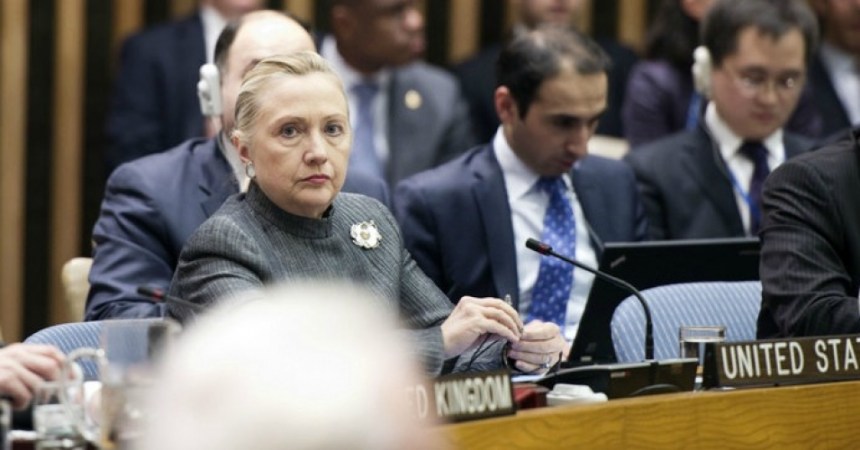
US Secretary of State Hillary Clinton delivers remarks at a UN Security Council Session on the situation in Syria at the UN in New York on Jan. 31, 2012. [State Dept. Photo]
By Jonathan Marshall | Consortium News | June 9, 2017
Police investigations and media reports have confirmed that two of the bloodiest terrorist attacks in Western Europe — the coordinated bombings and shootings in Paris in November 2015, which killed 130 people, and the May 2017 bombing of the arena in Manchester, England, which killed 23 — trace back to an Islamic State unit based in Libya known as Katibat al-Battar.
Since those attacks, a number of analysts, myself included, have characterized them as a form of “blowback” from NATO’s disastrous campaign to depose Libyan dictator Muammar Gaddafi in 2011. By turning Libya into an anarchic staging ground for radical Islamist militants, that intervention set in motion the deadly export of terror back into Western Europe.
But such a Eurocentric critique of NATO’s intervention misses the far greater damage it wreaked on Syria, where nearly half a million people have died and at least 5 million refugees have had to flee their country since 2011. U.S., British and French leaders helped trigger one of the world’s great modern catastrophes through their act of hubris in seeking another “regime change” – the overthrow of President Bashar al-Assad – in Syria.
A decade ago, Libya was a leading foe of radical jihadis, not a sanctuary for their international operations. A 2008 State Department memo noted that “Libya has been a strong partner in the war against terrorism.” It gave the Gaddafi regime credit for “aggressively pursuing operations to disrupt foreign fighter flows,” particularly by veterans of jihadist wars in Afghanistan and Iraq.
All that came to an end in 2011, when armed rebels, including disciplined members of al-Qaeda and Islamic State, enlisted NATO’s help to topple Gaddafi’s regime.
Western leaders ignored the prescient warnings of Gaddafi’s son Seif that “Libya may become the Somalia of North Africa, of the Mediterranean. . . .You will see millions of illegal immigrants. The terror will be next door.” Gaddafi himself similarly predicted that once the jihadis “control the Mediterranean . . . then they will attack Europe.”
Subsequent terrorist attacks in Europe certainly vindicated those warnings, while discrediting the so-called “humanitarian” case for waging an illegal war in Libya. But the predicted jihadi efforts to “control the Mediterranean” have had far graver repercussions, at least in the case of Syria.
A recent story in the New York Times on the genesis of recent terror attacks on France and Britain noted in passing that the Islamic State in Libya, composed of “seasoned veterans of Iraq and Afghanistan,” was “among the first foreign jihadist contingent to arrive in Syria in 2012, as the country’s popular revolt was sliding into a broader civil war and Islamist insurgency.”
A former British counter-terrorism analyst told the newspaper, “some of the baddest dudes in Al Qaeda were Libyan. When I looked at the Islamic State, the same thing was happening. They were the most hard-core, the most violent — the ones always willing to go to extremes when others were not. The Libyans represented the elite troops, and clearly ISIS capitalized on this.”
These Libyan jihadists leveraged their numbers, resources, and fanaticism to help escalate Syria’s conflict into the tragedy we know today. The mass murder we now take for granted was not inevitable.
Extremist Violence in Syria
Although Syria’s anti-government protests in the spring of 2011 turned violent almost from the start, many reformers and government officials strove to prevent an all-out civil war. In August 2011, leaders of Syria’s opposition wisely declared that calls to arms were “unacceptable politically, nationally, and ethically. Militarizing the revolution would . . . undermine the gravity of the humanitarian catastrophe involved in a confrontation with the regime. Militarization would put the revolution in an arena where the regime has a distinct advantage and would erode the moral superiority that has characterized the revolution since its beginning.”
Largely forgotten today, the Assad regime also took serious steps to deescalate the violence, including lifting the country’s state of emergency, disbanding the unpopular National Security Court, appointing a new government, and hosting a national dialogue with protest leaders.
But on August 18, 2011, the same Western leaders who were bombing Gaddafi announced to the world that “the time has come for President Assad to step aside.” Further energizing Syrian militants, Libyan rebels were just then in the midst of conquering Tripoli with NATO’s help.
“That is an ominous sign for Syria’s President Bashar al-Assad,” reported the Wall Street Journal. “Already there are signs Libya is giving inspiration to the rebels trying to oust Mr. Assad. . . . Syrian protesters took to the streets chanting ‘Gadhafi tonight, Bashar tomorrow.’ . . . The Libyan episode may serve simply to sharpen the conflict in Syria: both spurring on the dissidents and strengthening Mr. Assad’s resolve to hold on.”
Stoking war in Syria was not an unintended consequence of the Libyan campaign, but a conscious part of the longstanding neoconservative ambition to “remake the map of the Middle East” by toppling radical, nationalist and anti-American regimes. The same Journal article described the grandiose aims of some Washington interventionists:
“Beyond Syria, a new dose of energy provided by Libya’s uprising could ripple out to other nations in the region. In particular, U.S. officials hope it will reinvigorate a protest movement that arose inside Iran in 2009 to challenge President Mahmoud Ahmadinejad’s re-election. . . Syria has served for 30 years as Iran’s closest strategic ally in the region. U.S. officials believe the growing challenge to Mr. Assad’s regime could motivate Iran’s democratic forces.”
Instead of motivating Iran’s democrats, of course, the Syrian conflict motivated Iran’s hardliners to send Revolutionary Guard units and Hezbollah proxy forces into the country, further destabilizing the region.
Following the gruesome murder of Gaddafi in the fall of 2011, Libyan zealots quickly began fueling other terrorist conflicts, ranging from Mali to the Middle East, with arms looted from Gaddafi’s vast stocks.
“The weapons proliferation that we saw coming out of the Libyan conflict was of a scale greater than any previous conflict — probably 10 times more weapons than we saw going on the loose in places like Iraq, Somalia and Afghanistan,” observed an expert at Human Rights Watch.
A United Nations investigation determined that “Transfers of arms and ammunition from Libya were among the first batches of weapons and ammunition to reach the Syrian opposition.” It also stressed that Libyan weapons were arming primarily “extremist elements,” allowing them to gain territory and influence at the expense of more moderate rebel groups.
Spreading the War
As early as November 2011, Islamist warlords in Libya began offering “money and weapons to the growing insurgency against Bashar al-Assad,” according to the Daily Telegraph. Abdulhakim Belhadj, commander of the Tripoli Military Council and the former leader of the Libyan Islamic Fighting Group, an al-Qaeda affiliate, met secretly with Syrian rebel leaders in Turkey to discuss training their troops. (In 2004, he had been the victim of a CIA kidnap plot and rendition from Malaysia to Libya.)
The commander of one armed Libyan gang told the newspaper, “Everyone wants to go (to Syria). We have liberated our country, now we should help others. . . This is Arab unity.”
In April 2012, Lebanese authorities confiscated a ship carrying more than 150 tons of arms and ammunition originating in Misrata, Libya. A U.N.-authorized panel inspected the weapons and reported finding SA-24 and SA-7 surface-to-air missiles, anti-tank guided missiles, and a variety of other light and heavy weapons.
By that August, according to Time magazine, “hundreds of Libyans” had flocked to Syria to “export their revolution,” bringing with them weapons, expertise in making bombs, and experience in battlefield tactics.
“Within weeks of the successful conclusion of their revolution, Libyan fighters began trickling into Syria,” the magazine noted. “But in recent months, that trickle has allegedly become a torrent, as many more have traveled to the mountains straddling Syria and Turkey, where the rebels have established their bases.”
A Syrian rebel told the newsweekly, “They have heavier weapons than we do,” including surface-to-air missiles. “They brought these weapons to Syria, and they are being used on the front lines.”
A month later, the London Times reported that a Libyan ship carrying more than 400 tons of weapons bound for Syria, including SAM-7 anti-aircraft missiles and rocket-propelled grenades, had docked in Turkey. Such weapons particularly compounded the suffering of civilians caught up in the war. As France’s foreign minister told reporters that October, rebel-held anti-aircraft missiles were “forcing (Syrian government) planes to fly extremely high, and so the strikes are less accurate.”
According to later reporting by Seymour Hersh, most such Libyan weapons made their way to Syria via covert routes supervised by the CIA, under a program authorized by the Obama administration in early 2012. Funding and logistics support came from Turkey, Saudi Arabia, and Qatar. The CIA supposedly avoided disclosing the program to Congress by classifying it as a liaison operation with a foreign intelligence partner, Britain’s MI6.
Word of the operation began leaking to the London media by December 2012. The CIA was said to be sending in more advisers to help ensure that the Libyan weapons did not reach radical Islamist forces.
Of course, their efforts came too late; U.S. intelligence officials knew by that time that “the Salafist(s), the Muslim Brotherhood, and (al-Qaeda)” were “the major forces driving the insurgency.” The influx of new arms simply compounded Syria’s suffering and raised its profile as a dangerous arena of international power competition.
Libya’s arms and fighters helped transform the Syrian conflict from a nasty struggle into a bloodbath. As Middle East scholar Omar Dahi noted, “the year 2012 was decisive in creating the present catastrophe. There were foreign elements embroiled in Syria before that date . . . but until early 2012 the dynamics of the Syrian conflict were largely internal. . . . Partly in . . . appropriation of weapons pumped in from the outside and partly in anticipation of still greater military assistance, namely from the West, the opposition decided to take up arms.
“The decision — militarization — had three main effects. First, it dramatically increased the rate of death and destruction throughout the country. . . . By mid-2012, the monthly casualties were almost in excess of the total in the entire first year of the uprising. Militarization gave the Syrian regime a free hand to unleash its full arsenal of indiscriminate weaponry. . . Perhaps most fatefully, the advent of armed rebellion placed much of the opposition’s chances in the hands of those who would fund and arm the fighters. . . . It was then that the jihadi groups were unleashed.”
The collateral victims of NATO’s intervention in Libya now include 6 million Libyans attempting to survive in a failed state, millions of people across North Africa afflicted by Islamist terrorism, 20 million Syrians yearning for an end to war, and millions of innocent Europeans who wonder when they might become targets of suicidal terrorists. There is nothing “humanitarian” about wars that unleash such killing and chaos, with no end in sight.
ISIS Was “Allegedly” Behind the London Bridge Attacks, Who Is Behind ISIS?
By Michel Chossudovsky | Global Research | June 6, 2017
London’s tabloids have gone into high gear with vivid descriptions of the attacks and the tragic loss of life. Seven killed and 48 wounded.
“ISIS has claimed responsibility for the depraved attack in London Bridge as chilling video shows three jihadis calmly strolling past a pub while in the midst of the van and knife rampage that killed seven and critically injured 21.” ( The Sun, June 5, 2017)
ISIS has claimed responsibility, Is there a pattern?
Without exception, Al Qaeda or ISIS were allegedly behind the Paris, Brussels, Berlin, Manchester and London Bridge terror attacks, which served to spearhead a wave of Islamophobia across Western Europe, while also providing a pretext for the introduction of drastic police state measures:
“The twisted killers are seen calmly walking through Borough Market moments before they launched a stabbing attack on pubgoers while shouting “this is for Allah”, having already driven a van into crowds.” The Sun, June 5, 2017)
The statement of Prime Minister May (three days before the UK elections) points in the direction of an organized hate campaign against Muslims:
[The Manchester and London attacks] …are bound together by the single, evil ideology of Islamist extremism that preaches hatred, sows division, and promotes sectarianism. It is an ideology that claims our Western values of freedom, democracy and human rights are incompatible with the religion of Islam. It is an ideology that is a perversion of Islam and a perversion of the truth.
… It will only be defeated when we turn people’s minds away from this violence – and make them understand that our values – pluralistic, British values – are superior to anything offered by the preachers and supporters of hate. (emphasis added),
“Perversion of the Truth”? Lies, fabrications, omissions. What the British media in chorus fails to mention is that both ISIS and Al Qaeda are creations of US intelligence, recruited, trained and financed by the US and its allies including Saudi Arabia, Qatar, Turkey, Israel and Jordan.
The Islamic State (ISIS) was originally an Al Qaeda affiliated entity created by US intelligence with the support of Britain’s MI6, Israel’s Mossad, Pakistan’s Inter-Services Intelligence (ISI) and Saudi Arabia’s General Intelligence Presidency (GIP), Ri’āsat Al-Istikhbārāt Al-’Āmah ( رئاسة الاستخبارات العامة).
The origins of Al Qaeda date back to the Soviet-Afghan war. The Koranic schools in Afghanistan used to train Al Qaeda recruits were financed by the CIA, using textbooks published by the University of Nebraska. That’s where the “evil ideology of Islamist extremism” referred to by PM May originated: The “Global War on Terrorism” is a lie, “Islamic terrorism” is a product of US foreign policy which claims to be spreading “Western civilization”:
… the United States spent millions of dollars to supply Afghan schoolchildren with textbooks filled with violent images and militant Islamic teachings, part of covert attempts to spur resistance to the Soviet occupation.
The primers, which were filled with talk of jihad and featured drawings of guns, bullets, soldiers and mines, have served since then as the Afghan school system’s core curriculum. Even the Taliban used the American-produced books,..
Picture above is translated as follows: “Jihad – Often many different wars and conflicts arise among people, which cause material damages and loss of human life. If these wars and disputes occur among people for the sake of community, nation, territory, or even because of verbal differences, and for the sake of progress…”
This page is from a third-grade language arts textbook dating from the mujahidin period. A copy of the book was purchased new in Kabul in May 2000.

… Published in the dominant Afghan languages of Dari and Pashtun, the textbooks were developed in the early 1980s under an AID grant to the University of Nebraska -Omaha and its Center for Afghanistan Studies. The agency spent $ 51 million on the university’s education programs in Afghanistan from 1984 to 1994.” (Washington Post, 23 March 2002)
The ISIS is a terrorist paramilitary entity created by US intelligence. It has nothing to do with the tenets of Islam. The ISIS and Al Qaeda terrorists are the foot soldiers of the Western military alliance in Syria who are fighting a secular government. While America claims to be targeting the ISIS, in reality it is protecting the ISIS.
Britain’s Role in the “War on Terrorism”
There is evidence that British SAS Special Forces were dispatched to Syria in 2011 to integrate the ranks of the so-called moderate Al Qaeda rebels. Special Forces often hired through a private mercenary company on contract to NATO or the Pentagon were embedded within most paramilitary rebel formations, According to Elite UK Forces (the website of the SAS)
Reports from late November last year [2011] state that British Special forces have met up with members of the Free Syrian Army (FSA), the armed wing of the Syrian National Council. The apparent goal of this initial contact was to establish the rebel forces’ strength and to pave the way for any future training operations.
More recent reports have stated that British and French Special Forces have been actively training members of the FSA, from a base in Turkey. Some reports indicate that training is also taking place in locations in Libya and Northern Lebanon. British MI6 operatives and UKSF (SAS/SBS) personnel have reportedly been training the rebels in urban warfare as well as supplying them with arms and equipment. US CIA operatives and special forces are believed to be providing communications assistance to the rebels.
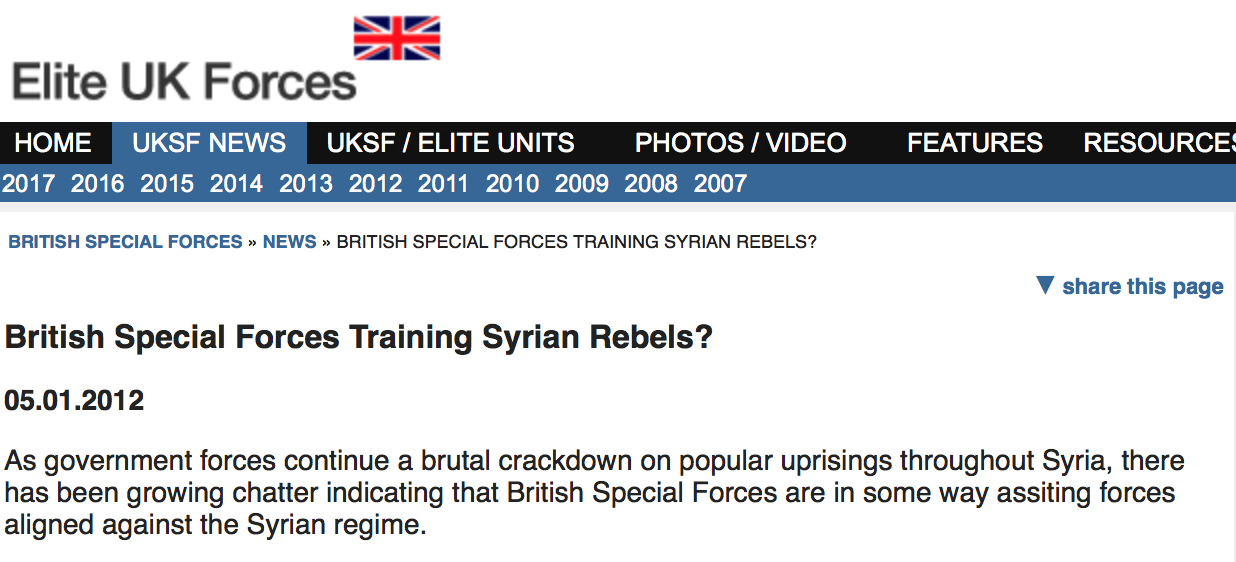
British MI6 were actively involved, collaborating with the CIA:
As the unrest and killings escalate in the troubled Arab state, agents from MI6 and the CIA are already in Syria assessing the situation, a security official has revealed.
Special forces are also talking to Syrian dissident soldiers [Al Qaeda].
They want to know about weapons and communications kit rebel forces will need if the Government decides to help.
“MI6 and the CIA are in Syria to infiltrate[rebel ranks] and get at the truth,” said the well-placed source.
“We have SAS and SBS not far away who want to know what is happening and are finding out what kit dissident soldiers [Al Qaeda] need.” Syria will be bloodiest yet, Daily Star, January 1, 2012 (emphasis added)
The air campaign launched by Obama in 2014, which had the full support of the United Kingdom, was intent upon destroying Syria and Iraq rather than “going after the terrorists”. There is ample evidence that the Islamic State is protected by the US-led coalition.
The inflow and delivery of weapons and supplies are coordinated by the Pentagon in liaison with America’s allies.
US military aid is channelled to Al Qaeda as well as to ISIS-Daesh.
The US has also used the illegal weapons market to channel vast amounts of weapons and military hardware to the Syrian “rebels”.
The State sponsors of ISIS-Al Qaeda are now heralded as the victims of ISIS-Al Qaeda, an absurd proposition. Those who are funded and supported by Western intelligence services are now said to be fighting back.
The ISIS nonetheless has a certain degree of independence in relation to its State sponsors. That is the nature of what is called an “intelligence asset”. But an “intelligence asset” is always on the radar of the intelligence services.
The British government through its intelligence services is known to have covertly supported several Al Qaeda affiliated entities including the Libya Islamic Fighting Group (LIFG) which was linked to the Manchester bombings.
The “Liberation” of Tripoli was carried out by “former” members of the Libya Islamic Fighting Group (LIFG), which is affiliated to Al Qaeda. These “former” Al Qaeda affiliated brigades constituted the backbone of the “pro-democracy” rebellion, which was supported by NATO.
Within the ranks of the LIFG rebels, US Navy SEALS, British SAS and French legionnaires disguised in civilian rebel garb, were reported to be behind major operations directed against key government buildings including Gadhafi’s Bab al-Aziziya compound in central Tripoli.
“Highly-trained [British Special Forces] units, known as ‘Smash’ teams for their prowess and destructive ability, have carried out secret reconnaissance missions to provide up-to-date information on the Libyan armed forces.” (SAS ‘Smash’ squads on the ground in Libya to mark targets for coalition jets, Daily Mirror, March 21, 2011)
And in the wake of NATO’s war Libya, these pro-democracy LIFG Al Qaeda affiliates have joined the ranks of the ISIS.
Washington’s Regime Change for Syria: Install the Islamic State
It is worth noting that the release of the Hillary Clinton email archive as well as leaked Pentagon documents confirm that the US and its allies are supportive of ISIS.
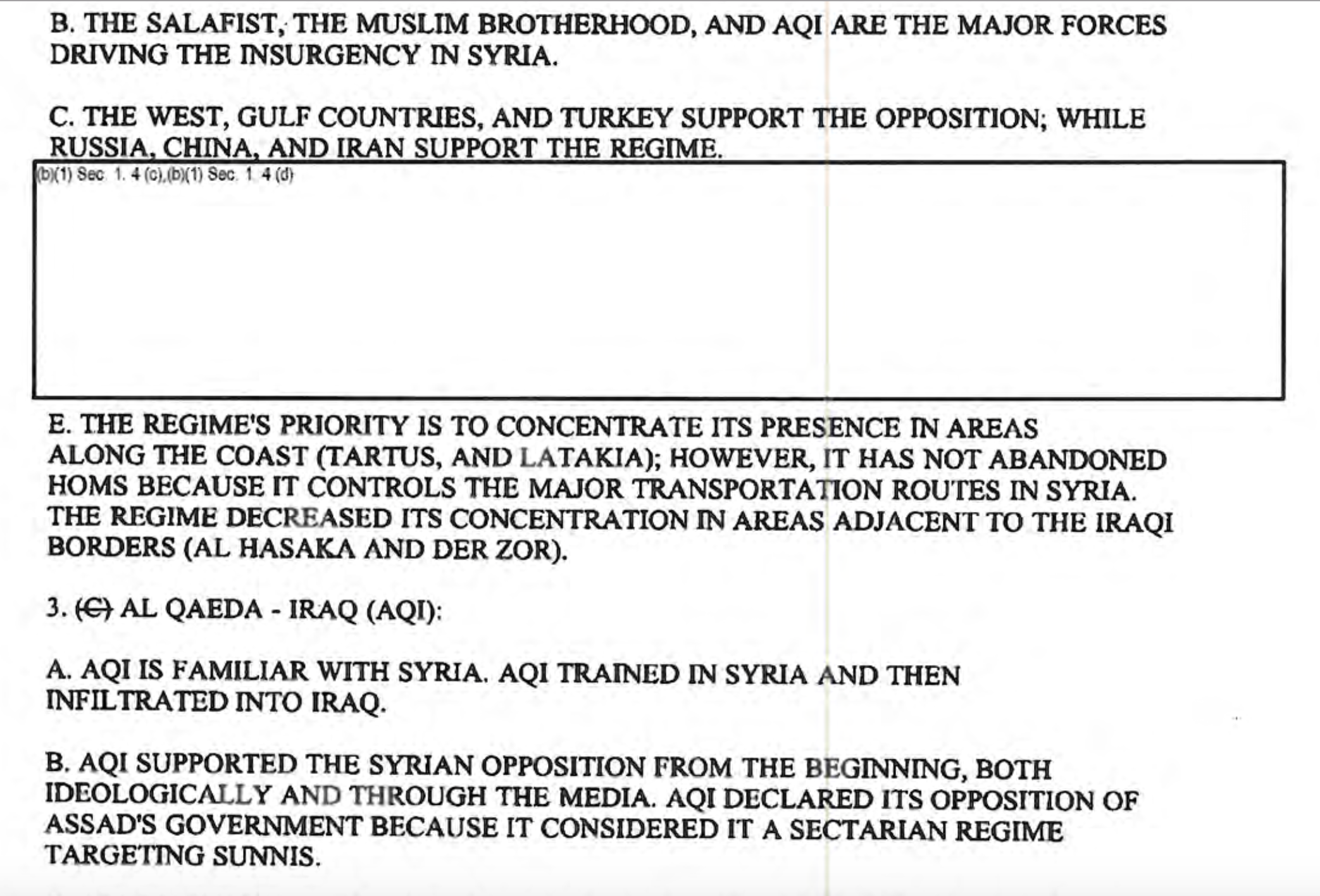
Moreover, a 7-page Defense Intelligence Agency (DIA) document dated August of 2012, points to US complicity in supporting the creation of an Islamic State.(Excerpt below)
Concluding Remarks
Despite the evidence, it is very difficult for people to accept the fact that their own government is supporting terrorism.
Most people will dispel this as an impossibility. But it is the forbidden truth.
The established consensus is that the role of a government is to protect its people. That myth has to be sustained.
The media’s role is to ensure that the truth does not trickle down to the broader public.
If that were to occur, the legitimacy of Western heads of State and heads of government would collapse like a house of cards.
The governments of the countries whose citizens are the victims of terror attacks are supporting ISIS-Daesh through their intelligence services.
Copyright © Prof Michel Chossudovsky, Global Research, 2017
Riyadh Requires From Doha to Expel Hamas, Muslim Brotherhood Members
Sputnik – 07.06.2017
Saudi Arabia set out several conditions for Qatar to normalize the bilateral relations amid the diplomatic rift and gave Doha 24 hours for the implementation of the conditions, local media reported Wednesday.
According to Akhbar Al Aan news outlet, the conditions included the expulsion of all the members of the Muslim Brotherhood terror group (outlawed in Russia) and the Palestinian Hamas movement from the country, freezing of their bank accounts and the suspension of any interrelations with these groups. The immediate break of the diplomatic ties with Iran was also reportedly one of the conditions laid down by Riyadh.
Apart from this, Saudi Arabia required from Doha to immediately change the policies of Qatar’s Al Jazeera broadcaster and as well as its administration staff so that the broadcasting would not contradict the interests of the Persian Gulf countries and the Arab world, the same reports added.
On Monday, Saudi Arabia, Bahrain, the United Arab Emirates and Egypt announced a break in diplomatic relations with Qatar, accusing Doha of supporting terrorist organizations and destabilizing the situation in the Middle East. The authorities of eastern Libya, Yemen, as well as the Maldives and Mauritius, later also announced the severance of relations with Qatar. On Tuesday, the Jordanian authorities announced lowering the level of diplomatic contacts with Qatar and closing the office of Al Jazeera operating in the country.
The Qatari Foreign Ministry rejected the accusations of Doha’s interference in other countries’ domestic affairs and expressed regret over the decision of the Gulf States to cut off the diplomatic ties with it.
See also:
Saudi, UAE, Bahrain, Egypt cut ties with Qatar
Press TV – June 5, 2017
Saudi Arabia, the UAE, Bahrain and Egypt have cut diplomatic ties and all land, sea and air contacts with Qatar, accusing the Persian Gulf country of supporting terrorism and interfering in their internal affairs.
Riyadh took the lead on Monday to sever relations and other countries fell in line after an official source said the kingdom “urges all brotherly countries and companies to do the same.”
A Saudi official cited by SPA said the country decided to “sever diplomatic and consular ties with Qatar, and to close all land, sea and aviation ports” in order to “protect its national security from the dangers of terrorism and extremism.”
The “decisive” measure, the Saudi statement said, was due to “gross violations committed by authorities in Qatar over the past years.”
The United Arab Emirates gave Qatari diplomats 48 hours to leave the country, citing their “support, funding and embrace of terrorist, extremist and sectarian organizations,” state news agency WAM reported.
Bahrain News Agency said the tiny kingdom was cutting ties with Doha over its insistence on “shaking the security and stability of Bahrain and meddling in its affairs.”
Egypt accused Qatar of supporting “terrorist” organizations, including the Muslim Brotherhood which it has been cracking down on since the 2013 coup against the country’s first ever democratically-elected leader, Mohamed Morsi.
Meanwhile, a Saudi “coalition” waging a war in Yemen said it was ending Qatar’s membership. The measure, it said, was due to Doha’s “practices that strengthen terrorism, and its support to organizations in Yemen, including al-Qaeda and Daesh, as well as dealing with the rebel militias.”
Qatar regretted the decision, saying “the measures are unjustified and are based on claims and allegations that have no basis in fact.” Doha-based Al Jazeera TV quoted Foreign Ministry as saying that the decisions would “not affect the normal lives of citizens and residents.”
“The aim is clear, and it is to impose guardianship on the state. This by itself is a violation of its (Qatar’s) sovereignty as a state,” the ministry said in a statement, referring to the severance of ties as an “incitement campaign based on fabrications, which reflects an intention to harm Qatar.”
Pakistan, another member of the “coalition” which has recently tried to distance itself from the Saudi group’s anti-Iran agenda, made it clear that the country had no plans to cut diplomatic ties with Qatar.
UAE carriers Etihad, Emirates and flydubai said they would suspend flights to and from Doha from Tuesday. Qatar Airways said it has suspended all flights to Saudi Arabia with immediate affect.
Trump factor
The crisis follows US President Donald Trump’s visit to the region last month, marked by the signing of a record $110-billion arms deal with Saudi Arabia.
US Secretary of State Rex Tillerson said the visit was aimed at getting Saudi Arabia and other Arab nations in the region to stand in “unity” with Israel and confront Iran.
After Trump’s visit, tensions escalated between Riyadh and Doha because of an article in Qatar’s state-run news agency in which the emir was quoted as criticizing the US, Saudi Arabia, and their client states for attempting to stir up tensions with “Islamic power” Iran.
The Qatari government quickly deleted the comments, saying the state agency had been hacked but the official denial failed to stop the rift between the Persian Gulf Arab countries from widening.
Saudi media then viciously attacked Qatar, accusing it of having “betrayed” the other Arab countries particularly at a time when they had attempted to stage a show of “unity” against Iran in a much-publicized and extravagant series of events in Riyadh.
Saudi Arabia and the United Arab Emirates also blocked Qatari websites and broadcasters. Qatari Foreign Minister Mohammed bin Abdulrahman Al Thani later said the country was being targeted in a “hostile media campaign, which we will confront.”
Prelude to invasion?
Qatar, home to the forward headquarters of the US military’s Central Command and some 10,000 American troops, long has faced criticism from its Arab neighbors over its support of the Muslim Brotherhood which has another admirer in Turkey.
Western officials have also accused Qatar of allowing or even encouraging funding of Takfiri extremists like al-Qaeda’s branch in Syria, once known as the Nusra Front. Saudi Arabia and the UAE similarly stand accused of supporting other Takfiri groups and the escalation exposes an underlying bitter rivalry among the neighbors for influence.
Former Yemeni president Ali Abdullah Saleh was quoted as saying that the conflict between Saudi Arabia and Qatar is rooted in “accumulated differences from the past even though both countries are followers of the Wahhabi school.”
Wahhabism is the radical ideology dominating Saudi Arabia, which is freely preached by government-backed clerics there and inspiring terrorist groups such as Daesh and al-Qaeda.
Prominent Palestinian journalist Abdel Bari Atwan said in a Twitter post that the diplomatic rupture is a “prelude” to a military action against Qatar.
“The next move may be a military offensive to change the regime in Qatar. It’s a war planned months ago,” wrote the editor-in-chief of the Rai al-Youm news website.
Saudi Arabia, UAE falling out over Yemen?
Recent reports have suggested Saudi Arabia and the United Arab Emirates were divided over their role in Yemen on which they have been waging a deadly war for more than two years now.
In a recent interview with Middle East Eye online news portal, Saudi-backed former Yemeni president Abd Rabbuh Mansour Hadi accused the UAE of acting “like an occupation power in Yemen rather than a force of liberation.”
Yemeni sources have revealed that the United Arab Emirates was trying to establish control over the strategic island of Socotra in the Arabian Sea, which Hadi had rented out to the country for nearly a century.
Tensions have taken a turn for worse under Saudi Arabia’s new rulers who have adopted an aggressive policy, waging a destructive war on Yemen, severing relations with Iran and assisting militants in Iraq and Syria to topple their governments.
Trump-Saudi orb-gazing summit not helping Sunni alliance
By Sharmine Narwani | RT | June 1, 2017
The glowing orb stunt should have been a sign that all was not what it seems. Theatrics, in the world of politics, usually suggest an illusion needs to be spun for audiences somewhere.
A week after US President Donald Trump’s eyesore of a visit to Riyadh, Saudi Arabia, the pressing question now is “why?” What was the purpose of convening leaders and representatives of 55 Arab and Muslim nations to greet a US head of state amidst so much pomp, ceremony and an excruciating amount of flashing cameras?
The Riyadh summit had several goals, most of which specifically served Saudi and American political interests.
The American leader’s potential gains were clear: he would score points at this impressive international showing of Muslim leaders who would help counter his anti-Muslim reputation at home. Trump would also be well-compensated in the form of the largest US arms deal in history, a booty he could claim would boost his home economy. The negotiations would take place in the Middle East, at the heart of his fight against “radical Islamic terrorism.” Trump would also leave with a blank check for Palestinian-Israel “peace,” bestowed by a Saudi king who has no authority to negotiate anything on behalf of Palestinians. And finally, the US president would piggyback the legitimacy of 55 Arab and Muslim states to craft a Middle East policy that targeted Iran, its allies and the Muslim Brotherhood (MB) – even though no consensus whatsoever was reached at the summit.
In their eyes, the Saudis scored even bigger. The cash-and-credibility-hemorrhaging Saudis are losing ground in their list of international fights – in Syria, Yemen, Iraq and against Iran. Here was an opportunity to convene leaders and representatives from 55 Arab and Muslim nations (only 33 heads of state showed up) to underscore Saudi Arabia’s position as the custodian of Sunni Islam. For the power-mad Saudis, nothing would showcase their primacy better than the presence of a US president on his first official foreign trip. They forgot, however, that legitimacy is derived from one’s own populations, not from a Western head of state sword-dancing next to one’s king. After the summit, Riyadh would go on to unilaterally craft a declaration, unseen and unapproved by the VIP guests, that claimed to outline the gathering’s foreign policy priorities.
But most importantly, this summit would allow the Saudis – who are terrified at the potential repercussions coming their way from decades of funding global terrorism – to very publicly take cover under the Trump presidency. And the US president, who knows very well that the Saudis are the epicenter of global terror, offered up America’s protection and complicity to secure his doggy bag of treasures.
This generous give-and-take between the Saudis and Americans took place on the day of the summit, amidst much back-slapping. Then, a few days later, the fallout began.
First, Saudi vs. Qatar
This past week, a flurry of media headlines alerted us to the first fissure between summit participants. News reports began emerging that Qatari leader Sheikh Tamim bin Hamad al-Thani had deviated from the Saudi talking points by supporting engagement with Iran and defending resistance groups Hezbollah and Hamas.
Saudi Arabia and the UAE retaliated swiftly to this slight by blocking Qatari media outlets, recalling their ambassadors and launching a war of words against Doha.
Why the swift and punishing response toward a fellow member of the six-nation Gulf Cooperation Council (GCC)?
Qatar has long struggled to get out from under the shadow of its much larger Persian Gulf neighbor Saudi Arabia and has spent the past dozen years building up media networks, like Al Jazeera, and investing in major Western corporate, think tank, educational and sports brands to project power well beyond its regional stature. The tiny sheikhdom’s biggest coup, however, was to secure the establishment of the US military’s largest regional base on its territory, which allowed Doha to continue provoking its Saudi competitor with little risk of consequence.
Then in 2011, the Qataris put their full weight behind “Arab Spring” efforts to overthrow a slew of Arab governments. Most of the Qatari-backed incoming regimes and opposition activists, however, were Islamists, mainly of the MB variety, which is reviled by Saudi Arabia and the UAE.
The Saudis were initially caught off-guard by the swift events sweeping the region, but quickly rallied to mount a region-wide counterrevolution to reverse the political gains of the Qatari- and Turkish-backed MB groups. Saudi operatives funneled manpower, money, and weapons to reestablish Riyadh’s influence. They revived their famed jihadi networks to flood Syria and other places with extremist militants that could tip the balance of power back in its direction.
It wasn’t just Qatar and the MB in Saudi sights – the regional uprisings, particularly in Syria, Yemen and Bahrain, threatened to shift the region in a direction that benefited Iran, Saudi Arabia’s biggest regional adversary.
In Riyadh ten days ago, the Saudis thought they had struck gold. After eight years of dealing with a somewhat unsympathetic Obama administration, here was Trump acquiescing to their every whim. The Saudi declaration issued at the end of the summit – as well as speeches delivered during the event – struck out at Iran, the Muslim Brotherhood, Hezbollah and Hamas, and promised American cooperation in isolating them. The Saudis were on a high, but they were also mostly alone.
A broad divergence of interests
Aside from the Saudi-Qatari spat, there are countless other differences among summit participants that will scuttle Riyadh’s ambitions.
The anti-MB UAE has stood firmly by Riyadh’s side in condemning Doha but diverges – even within its own borders – on assuming an aggressive position against Iran. Call it Dubai-versus-Abu Dhabi if you will. Dubai, with its large Iranian expat population and significant trade with the Islamic Republic, is less worried about its Persian neighbor. As a 2009 Wikileaks cable from the US embassy in Abu Dhabi puts it: “While MbZ (Crown Prince of the Emirate of Abu Dhabi Mohammad bin Zayed) is a hardliner on Iran, there are accommodationists within his own system, especially in Dubai, where the ruler, Mohammed bin Rashid Al-Maktoum (Prime Minister of the UAE) takes a position that is much closer to Qatar’s.”
Other GCC states are even more loathe to confront Iran. Oman has repeatedly ignored Saudi demands to toughen its stance against Iran and remains a key Iranian diplomatic partner in the region. The two states participated in joint naval exercises in the Gulf of Oman as recently as April, and it was Muscat that hosted the initial secret US-Iran meetings which kick-started the 2015 Iranian nuclear deal.
GCC member-state Kuwait also remains relatively neutral on Iranian matters. Up to 40 percent of Kuwaitis are Shiites, and the country has avoided much of the sectarian strife that afflicts Saudi Arabia and now Bahrain. It is to Kuwait that Qatar’s emir has now turned to negotiate peace with the Saudis and UAE in the aftermath of last week’s fallout. The Qataris, who have dealt opportunistically and not ideologically in their regional relations, share the world’s largest gas reserve with Iran, a further incentive to maintain a neutral stance on Tehran.
In fact, most of the Sunni states that attended the Riyadh summit are flat-out furious about the violent sectarianism and extremism that has emerged in the past few years. And many of them blame the Saudis for it.
Last August, an unprecedented conference of 200 leading Sunni clerics from around the world was held in Grozny to determine “who is a Sunni.”Excluded from the gathering were representatives of both the Wahhabi sect (Saudi Arabia and Qatar’s official religion) and the Muslim Brotherhood. The Islamic world is looking to tackle the deviance and sectarianism that has borne groups like ISIS and Al-Qaeda – not indulge it, as would be the case if they embraced the Saudi ‘vision’ in Riyadh.
But in an effort to bulldoze through a “Sunni consensus” under the umbrella of “Saudi-American power,” the Saudis ignored every gorilla in that summit room. Not only do many of the meeting’s participants blame the Saudis for unleashing the jihadi genie, but most of them also wouldn’t for a minute look to Saudi ‘leadership’ if it weren’t for Saudi cash. Case in point, Sunni regional giants Turkey and Egypt. Turkish President Recep Tayyip Erdogan didn’t even show up to Riyadh, citing other engagements. Egyptian President Abdel Fattah al-Sisi did attend – he was one of three invited to press his palms upon the ‘glowing orb’ to inaugurate the Saudi counterterrorism-something-or-other.
But more than anything, Sisi was invited to Riyadh as an important set extra – to visually demonstrate that the great Arab state of Egypt was passing the mantle of leadership to Saudi Arabia’s King Salman.
Where the Saudis viewed former Egyptian President Hosni Mubarak as a stalwart ally, they see Sisi as nothing of the sort. Sisi may agree with Riyadh on the evils of the Muslim Brotherhood, but he has absolutely no tolerance for Saudi Arabia’s support of terrorist groups throughout the region and has been a right royal pain on the issue of Syria.
Egypt may hanker after the Saudi billions – which it has received in spades for its anti-MB efforts – but Egyptians have little affection for the Saudis and have sparred publicly and privately in recent years and months. Whereas Riyadh could once count on Egyptian troops to support its military incursions, today Cairo has rejected participation in the Saudi-led war against Yemen – alongside another staunch Saudi ally, Pakistan.
The Saudis recently hired Pakistan’s former army chief General Raheel Sharif to head up their 39-nation “Muslim NATO” construct to fight terrorism, but now rumors are rife that he will resign amidst a national uproar over his decision. Pakistanis, like other straight-thinking Muslims, are uncomfortable about the prospect of a military alliance that appears to have been conceived primarily to fight Iran – and Shiites.
Dead On Arrival
On the surface, the purpose of the Riyadh summit was to amass a coalition of like-minded Arab and Muslim partner-states, under a Saudi-American banner, to wage war against terror. In fact, this is a Saudi and American-led initiative created not to tackle terror, but to ‘reframe’ it to encompass political adversaries.
Look out for pundits and politicians spinning these new narratives that Iran, Hezbollah, and the Muslim Brotherhood are equally as dangerous as ISIS and Al-Qaeda – never mind that the former have been around for decades without triggering the global security meltdown spawned by the latter.
In Riyadh, the Americans and Saudis made a great show of jointly announcing two additions to their “terrorism” list – one was a senior Hezbollah official, the other a senior member of ISIS.
This is not the war against terror that the heads of states gathered in Riyadh anticipated. This is a sectarian war, conceived by a sectarian state that has funded, armed and organized the very global terrorism it purports to fight. And every single US administration since the events of 9/11 has acknowledged this direct Saudi role in terror.
In Riyadh, the show went on anyway. But there’s not a person in that room who didn’t understand the game. Forget the ‘Sunni consensus’ after Riyadh. Of the 55 nations represented at the summit, the Saudis will be lucky to retain five.
Sharmine Narwani is a commentator and analyst of Middle East geopolitics. She is a former senior associate at St. Antony’s College, Oxford University and has a master’s degree in International Relations from Columbia University. Sharmine has written commentary for a wide array of publications, including Al Akhbar English, the New York Times, the Guardian, Asia Times Online, Salon.com, USA Today, the Huffington Post, Al Jazeera English, BRICS Post and others. You can follow her on Twitter at @snarwani
Qatar emir to visit Kuwait amid regional tensions
Press TV – May 30, 2017
Qatar’s emir is to travel to Kuwait in a visit aimed at enhancing bilateral ties amid a rift emerging between Qatar on the one side and Saudi Arabia and the United Arab Emirates on the other.
The monarch, Tamim bin Hamad Al Thani, will enter Kuwait City on Wednesday, Qatar’s al-Sharq paper reported on Tuesday.
Last Friday, Kuwait’s First Deputy Prime Minister and Foreign Minister Sheikh Sabah Khalid Al Hamad Al Saba visited Doha.
Qatar drops a bombshell
Last Thursday, an article appeared on Qatar’s state-run news agency, quoting the emir as criticizing the United States, Saudi Arabia, and their client states for attempting to stir up tensions with “Islamic power” Iran.
A post also appeared on the agency’s Twitter page, quoting the Qatari foreign minister as saying that his country was withdrawing its ambassadors from Kuwait, Bahrain, Egypt, Saudi Arabia, and the UAE amid tensions.
The Qatari government soon said that the state agency had been hacked and that the remarks attributed to the emir and the foreign minister had never been made.
The official denial, which was offered several more times, nevertheless failed to stop the rift between the Persian Gulf Arab countries from widening. Saudi media viciously attacked Qatar, accusing it of having “betrayed” the other Arab countries particularly at a time when they had attempted to stage a show of “unity” against Iran in a much-publicized and extravagant series of events in Riyadh.
Saudi Arabia and the United Arab Emirates also blocked Qatari websites and broadcasters.
Qatari Foreign Minister Mohammed bin Abdulrahman Al Thani (seen below) later said the country was being targeted in a “hostile media campaign, which we will confront.” He was referring to the media blackout.
Demonstrating a more moderate stance however, Kuwait did not join the blackout. Deputy Foreign Minister Khaled Jarallah called the ban “regrettable” and expressed Kuwait’s readiness to converge its views with those of Qatar.
Some analysts say Riyadh fears that the Arab Persian Gulf countries it has long sought to co-opt may be gravitating toward Iran, which Saudi Arabia perceives as a regional adversary.
Tehran has said time and again that it does not seek tensions with any of its neighbors, including Saudi Arabia.
Featured Video
Jeffrey Epstein’s ‘one single cause’: Israel
or go to
Aletho News Archives – Video-Images
Book Excerpt
Leslie Wexner’s Inner Demon
BY WHITNEY WEBB |
UNLIMITED HANGOUT| JUNE 10, 2022
This short excerpt from Whitney Webb’s upcoming book “One Nation Under Blackmail” examines an obscure media profile of Leslie Wexner, Jeffrey Epstein’s mentor, from the 1980s that contains disconcerting revelations about Wexner’s personality and his inner world. … continue
Blog Roll
Recent Comments
Coronistan on Why can’t western leaders acce… John Edward Kendrick on German government ‘embezzling’… loongtip on Von der Leyen to have new secu… papasha408 on First Gaza, then the world: Th… papasha408 on Is Nixing Aid to Israel a Pois… papasha408 on Japan to Sign Up For NATO’s Uk… Redracam on Iran Willing to Dilute Enriche… loongtip on When Threats Replace Evid… loongtip on Zelensky tried to kill the cha… eddieb on I might get killed for posting… Bill Francis on I might get killed for posting… loongtip on Beijing cancels Panama deals a…


 Aletho News
- Germany demands UN Rapporteur Albanese resign, joining France
- Hamas official says Netanyahu joining ‘peace council’ is a farce
- Israel Demanding that Iran Limit the Range of Missiles to 300 Kilometers
- Why can’t western leaders accept that they have failed in Ukraine?
- German government ‘embezzling’ taxpayer money to fund Ukraine – veteran politician
- Russian Soldiers Tortured in Secret Ukrainian Prisons
- Tensions between Hungary and Ukraine could lead to a new regional conflict
- Russia preparing oil lifeline to Cuba – embassy
- Jeffrey Epstein’s ‘one single cause’: Israel
- Instagram suspends Track AIPAC, watchdog tracking pro-Israel lobby spending
- If Americans Knew
- AZAPAC, the new PAC opposing Israeli domination of U.S policies
- Haim Saban: Billionaire for Israel
- Rafah e-wallet plan highlights Israel’s deepening financial occupation
- Viral post claims Netanyahu sought legal approval, igniting speculation about Israel’s organ harvesting
- AIPAC Has a New Opponent: PAL PAC
- Right-Wing Catholic Off Trump Religion Panel After Israel-Gaza Remarks at Antisemitism Event
- Jewish terrorism, apartheid rule the West Bank – Not a ceasefire Day 125
- Why Israel persecutes children like my son Shadi
- In Gaza, One Man Is Searching for the Remains of His Family With a Flour Sifter
- Horrific situation in Gaza, West Bank – Not a ceasefire Day 124
- No Tricks Zone
- German Gas Crisis…Chancellor Merz Allegedly Bans Gas Debate Ahead of Elections!
- Pollen Reconstructions Show The Last Glacial’s Warming Events Were Global, 10x Greater Than Modern
- Germany’s Natural Gas Storage Level Dwindles To Just 28%… Increasingly Critical
- New Study Rebuts The Assumption That Anthropogenic CO2 Molecules Have ‘Special’ Properties
- Climate Scientist Who Predicted End Of “Heavy Frost And Snow” Now Refuses Media Inquiries
- Polar Bear Numbers Rising And Health Improving In Areas With The Most Rapid Sea Ice Decline
- One Reason Only For Germany’s Heating Gas Crisis: Its Hardcore-Dumbass Energy Policy
- 130 Years Later: The CO2 Greenhouse Effect Is Still Only An Imaginary-World Thought Experiment
- New Study Affirms Rising CO2’s Greening Impact Across India – A Region With No Net Warming In 75 Years
- Germany’s Natural Gas Crisis Escalates … One Storage Site Near Empty …Government Silent
 Aletho News