Qatar rejects anti-Iran statements of Mecca summits
Press TV – June 3, 2019
Qatar says it rejects the anti-Iran statements of the recent Mecca summits as they had been prepared in advance without consulting Doha.
“The statements of the [Persian] Gulf and Arab summits were ready in advance and we were not consulted on them,” Mohammed bin Abdulrahman Al Thani told the Al-Araby broadcaster.
“Qatar has reservations on the Arab and [Persian] Gulf summits because some of their terms are contrary to Doha’s foreign policy,” he added.
“We hoped the Mecca summits would lay the groundwork for dialogue to reduce tensions with Iran,” the top diplomat said in comments reposted on Twitter by his ministry.
“The Mecca summit ignored the important issues in the region, such as the Palestine issue and the war in Libya and Yemen,” he went on to say.
Qatar is not the first Arab state to reject the final statements of the emergency meetings in Mecca. Following the talks, Iraq also opposed the communiqué issued by the Arab participants.
Iraq, which maintains close ties with neighboring Iran and has strong ties with Washington as well, objected to the communiqué, which required “non-interference in other countries” as a pre-condition for cooperation with Tehran.
Iraqi President Barham Salih asked the gathering to support his country’s stability, arguing that rising tensions with Iran could cause war. He voiced hope that Iran’s security would not be targeted.
“We are watching before our eyes the escalation of a regional and international crisis which can turn into war that will engulf all. If the crisis is not managed well, then we will be faced with the danger of a regional and international confrontation which will bring tragedy to our countries,” Salih said.
“The Islamic Republic of Iran is a Muslim country that is a neighbor to Iraq and Arabs. It is certain that we do not wish the security of Iran to be targeted. We share a common border that is 1,400 km long and a long history and relations, and it is also certain that the security of a fellow Islamic country is in the interest of Arab and Islamic countries. The region needs stability based on a mechanism of joint security that guarantees non-interference in internal affairs and the rejection of violence and extremism,” he added.
The statements mainly cited concerns about the recent sabotage attacks against several ships off the UAE. Both Saudi and Emirati officials have blamed the mysterious “sabotage” attacks on Iran while Iran has strongly denied any involvement, and offered to sign non-aggression pacts with the Persian Gulf Arab states.
Related:
Defense Cooperation Agreement Between US, UAE Now in Effect – White House
Sputnik – May 29, 2019
The White House issued a press release Wednesday, revealing that US National Security Advisor John Bolton and United Arab Emirates National Security Advisor Sheikh Tahnoon bin Zayed Al Nahyan signed a Defense Cooperation Agreement (DCA).
“The DCA will enhance military coordination between the United States and the United Arab Emirates, further advancing an already robust military, political, and economic partnership at a critical time,” reads the statement. “The United States and the United Arab Emirates share a deep interest in promoting prosperity and stability in the region.”
“The DCA will advance that interest by fostering closer collaboration on defense and security matters and supporting efforts by both nations to maintain security in the Gulf region,” it adds.
The US also has defense cooperation agreements with Bahrain, Qatar and Kuwait.
The latest agreement comes days after the US Defense Department announced that officials from the US and Estonia signed a five-year document to continue a defense cooperation between the two countries through 2024. According to a release from the defense agency, Estonia joins fellow Baltic states Lithuania and Latvia in the move.
Latest attempt to prosecute President Assad at the ICC is further criminalisation of “international justice”

Toby Cadman. Co-founder of Guernica Chambers 37, one of legal entities bringing latest case against President Assad at the ICC. (Photo: The ICC and our politics)
By Vanessa Beeley | 21st Century Wire | May 28, 2019
In March 2019 two law firms filed cases at the ICC against Syria’s President Bashar Al Assad and unnamed members of the Syrian government. Toby Cadman of Guernica Chambers and Rodney Dixon of Temple Garden Chambers were the protagonists in this latest attempt to criminalise the Syrian President and government.
These law firms are basing their case upon the testimony of 28 “refugees” from Syria who claim they were “forced” to flee to Jordan during the war that has been waged against Syria by a collective of interventionist mafia states that form the U.S coalition, determined to achieve regime change in Syria.
Syria is not a signatory to the ICC in the Hague but precedent was set by the ICC when a preliminary investigation was opened into military leaders of Myanmar for alleged crimes against humanity involving deportation of Rohingya people. Refugees fled to Bangladesh which is party to the Rome statute that established the ICC, as is Jordan where more than 1 million Syrian refugees now reside. Guernica Chambers and Rodney Dixon are clearly hoping that the Rohingya precedent will open up the legal avenue for their case.
Both legal firms are claiming the intended deportation of Syrian civillians by the Syrian government as part of their cases.
However, even some members of the legal profession, have already remarked upon possible holes in the case being presented by both legal entities. Kevin John Heller is Associate Professor of Public International Law at Amsterdam University. According to Heller, there is a vital element of the Syrian situation that distinguishes it from the Myanmar situation. Heller argues that in Myanmar, it is evident that the government “intended to drive the Rohingya into Bangladesh” while in Syria it is not evident that the Syrian government intended (in the legal sense) that their civilians end up in other countries. Heller points out that without sufficient evidence, the Syrian government may only be accused of “forcible transfer” but not “deportation”. “Forcible transfer” falls outside the ICC’s jurisdiction because it takes place uniquely on Syrian territory.
“In other words: for the Court to investigate the forcible displacement of Syrian civilians proprio motu, it is deportation or bust.” ~ Kevin John Heller
This is not the first time that Guernica Chambers (GC) have attempted such a legal attack against the Syrian government. In March 2017, the Madrid offices of GC tried to bring a case against eight members of the Syrian security and intelligence services. The case was based upon the testimony of a Syrian national’s sister who had Spanish citizenship. Spain is party to the Rome Statute of the ICC. The woman allegedly identified the body of her brother among the photos that were “smuggled out of Syria” and formed part of the Caesar Report which I will discuss later in this article.
Who is really behind the legal war being waged against Syria?
I asked Peter Ford, former UK Ambassador to Syria and outspoken critic of the UK government’s role in the eight year regime change campaign in Syria, to comment on the timing of this legal initiative. Ford told me:
Nothing could be more likely to bring the ICC into disrepute than this attempted action by actors transparently serving the political agenda of the British and Qatari governments. Having failed in attempted regime change via miltant proxies Syria’s enemies are now embarked on an enterprise to secure the same result by waging economic war which must be justified by constant demonizing of Assad. That is the game being played here.
“if the ICC goes along with it, that will provide more justification for those who accuse the ICC of being a tool of the rich and powerful, and an incentive to Assad to halt any move towards elections in Syria which might see him removed from power. This is just a cheap trick designed to make political capital out of the remaining credibility of the ICC, such as it is.”
Ford pinpointed the drivers behind these legal cases and the UK Government and intelligence services must be considered as primary players. The UK/US-led intervention alliance have seen their terrorist-proxy-military-campaign fail dismally after hitting the brick wall of the axis of resistance -Syria, Hezbollah, Iran and Russia with China offering diplomatic and technological support.
What will follow is perhaps an even more destructive economic warfare campaign that will capitalise upon the post war dissonance in Syria to pressurise the Syrian state and to further foment discontent among civilians now struggling to cope with life in a Syria that has been severely impacted by 8 years of terrorist occupation and destruction of infrastructure.
“I believe that the reason why this attempt is being made to circumvent the fact that the International Criminal Court has no jurisdiction over Syria, is to remove Assad from power and to de-legitimise him as part of the future of Syria. This has been the goal of the jihadists from the very beginning.”
Historian and analyst, Dr Marcus Papadopoulos, further expanded upon the timing of the legal case:
Well, talk of war crimes cases being brought against President Assad, at the International Criminal Court, has been in the air for some years now. Indeed, I remember how such talk was emanating from Western capitals in 2012. However, there is no doubt that the today’s timing of lawyers, acting on behalf of Syrian refugees in Jordan, submitting lawsuits against the Syrian president at the ICC, is not coincidental. Because today, the Syrian people have all but won the war against Western-backed terrorism and so by submitting cases now to the ICC is a way of Western governments subtly informing President Assad that whilst the military war against him has been lost, the legal, media and communications war against him will continue.
Furthermore, I suspect that by initiating ICC proceedings against the Syrian leader – which will only increase in volume and go on indefinitely – may be a way of the Americans and the British maintaining their military presence in Syria, as well as their sanctions on the Arab country, on the pretext that the region has a leader in power who ‘waged war against his own people, destabilising not just his country but the wider region’ hence the presence of American and British forces in Syria is a means to limiting any future ‘carnage’ that the Syrian ‘strongman’ (a favoured word from the West’s lexicon to describe leaders whom it disapproves of) can inflict on both Syria and the region.” (Emphasis added)
International criminal lawyer, Christopher C. Black, pointed out the importance of the NATO and UK government links of the legal firms:
“The answer is revealed in the lawyers who are behind this scheme to try to drag the ICC into the picture. Rodney Dixon and Toby Cadman, and, it seems, from your information, Geoffrey Nice. All of them have links to the British governent and NATO through acting for them in various capacities.”
Links to UK Foreign Office, NATO and the CIA
Guernica Chambers – offices in London, Spain and Washington.

Toby Cadman. (Photo: Guernica 37 website)
Toby Cadman is the Co-founder and Head of Guernica 37 International Justice Chambers in London. According to the International Forum for Democracy and Human Rights (IFDHR), Cadman was hired by the UK Foreign Office in 2012 to “head a team to investigate crimes committed in the Syrian Arab Republic“.
I would challenge Cadman to demonstrate any serious investigation by Guernica into the ongoing crimes committed by the terrorist/extremist groups in Syria, armed and financed by the U.S Coalition. The fact that Cadman is a hired legal hand of one of the central players in the international campaign to reduce Syria to another Libya-style failed state, should immediately raise the alarm.
Doctors Under Fire – cluster of anti-Syria medical, legal and chemical “experts”
Cadman is also on the board of directors of Doctors Under Fire (formerly Medics Under Fire). Alongside him are Hamish De Bretton Gordon, Dr David Nott (Nott Foundation) and Dr Saleyha Ahsan.

Dr David Nott. (Photo: Nott Foundation website)
Nott has run UK Government-endorsed training courses for Syrian doctors in Gaziantep, Turkey – the hub of UK intelligence training for Syrian “opposition”, with a reputation for being the centre of ISIS organ and human trafficking operations. The flight from Istanbul to Gaziantep was known as the Jihad Express. The town itself was reported to be the area where new ISIS recruits from around the world would gather before being transported into Syria. The UK FCO-midwived and financed White Helmet propaganda construct also have their base in Gaziantep, established in 2013 by former MI6-turned-private-security expert, James Le Mesurier.
In 2013, Nott was largely responsible for the rumours that Syrian Arab Army snipers were targeting pregnant women in East Aleppo, which was freshly under control of the armed extremist gangs that included Al Qaeda in Syria, Nusra Front. The photo of a bullet lodged in an alleged foetal brain was published by most mainstream media outlets in the West without any expert second opinion regarding the credibility of such an image. Nott has operated on ISIS fighters during his forays (exclusively) into terrorist held territory of Syria.

Nott also amplified the discredited narrative surrounding Omran Daqneesh during the final moments before liberations of East Aleppo from terrorist rule. This story is now known to be another of the fraudulent campaigns to criminalise the Syrian government. This article by journalist, Steven Sahiounie, goes into depth about the bias and misprepresentation of reality by Nott during his time in the terrorist-held enclaves of Aleppo and Idlib.

Dr Saleyha Ahsan’s contradictory accounts of alleged chemical attack, showcased in BBC Panorama’s Saving Syria’s Children – forensically investigated by researcher, Robert Stuart.
Dr Saleyha Ahsan’s role in the BBC Panorama documentary, Saving Syria’s Children, has been exposed as potentially fraudulent by independent researcher, Robert Stuart. Actor and director Keith Allen is fronting a new crowdfunding campaign for a documentary examining the 2013 BBC Panorama programme Saving Syria’s Children. The project is in collaboration with British film, TV and radio producer, Victor Lewis-Smith. In 2017 Lewis-Smith challenged the BBC Panorama office over the issue. Failing to get satisfactory answers, Victor tore up a contract for a forthcoming comedy pilot with BBC Radio 4.

Hamish de Bretton Gordon. The media establishment go-to expert on chemical weapons.
Hamish de Bretton Gordon has been the go-to expert for the majority of corporate media outlets, particularly with regard to the alleged chemical weapon attacks in Syria that BG invariably blames upon the Syrian government. David Miller, Professor of Political Sociology at the University of Bristol and a member of the Academic-established Working Group on Syria, Propaganda and Media, stated very clearly in a recent interview that HBG:
“is an operative for MI6. He’s not a staff member of MI6 but he works very closely with MI6 in Syria trying to create evidence of chemical and biological weapons’ attacks.”
The full briefing note by the WGSPM can be found at this link: The alleged chemical attack in Douma on 7 April 2018, and other alleged chlorine attacks in Syria since 2014.
Doctors Under Fire appears to be another compromised organisation with a focus on misleading the British public into approving further military intervention in Syria under a familiar “humanitarian” pretext. Its ties to state media and intelligence services should be examined closely before their “expert” opinions be given serious consideration.
Toby Cadman – Ibrahim Olabi – White Helmets

Ibrahim Olabi. Joined Guernica Chambers in November 2018 as a pupil barrister. (Photo: Guernica Chambers website)
The Guernica inks to UK Government intellligence operations in Syria continue. Ibrahim Olabi joined Guernica Chambers in November 2018 as a pupil barrister. According to his bio on the GC website, Ibrahim Olabi “has worked extensively on international legal matters related to the Syrian conflict, including international humanitarian law, international criminal law and international human rights law” for the last five years.
Olabi is UK educated, having completed his LLB and LLM (Security and International Law) at the University of Manchester. Olabi is the director of the Syrian Legal Development Programme (SLDP). According to the GC website:
SLDP has provided legal expertise to Syrian NGOs, including training that Ibrahim delivered to more than 550 trainees on a range of complex legal surrounding forced displacement, torture, UN mechanisms, facilitation of humanitarian aid and other matters. He has trained both in Syria, near the front lines, and in neighbouring countries.
SLDP has received funding from the Swiss Ministry of Foreign Affairs and the Dutch Ministry. What seems extraordinary for a “pupil barrister” who only joined GC in November 2018, Olabi has an impressive track record of influencing major global institutions and state-linked think tanks on the Syrian conflict:
Ibrahim has also advocated in Geneva, Brussels, Washington and London on human rights issues relevant to Syria. He received personal invitations from the Heads of States such as Germany and The United Kingdom, and from the UN Secretary General. Ibrahim has spoken and chaired panels in forums such as Chatham House and Amnesty International, and delivered presentations at UK universities such as UCL, SOAS, Nottingham and Manchester amongst others. He also spoken on TV channels such as the CNN and the BBC.

Training the White Helmets. (Photo from SLDP website)
Among those trained by the SLDP are the primarily UK FCO-cultivated White Helmets who are exposed as terrorist group-auxiliaries and stand accused of committing crimes against the Syrian people that include child abduction and running organ trafficking operations from inside the terrorist-occupied territories.
The White Helmets have also been instrumental in producing the Syrian “chemical weapon” narratives supported by Cadman and his associate directors at Doctors Under Fire – designed to criminalise the Syrian government, often during the closing stages of military campaigns to liberate areas under control of the Western-sponsored armed groups.
The most recent White Helmet chemical attack narrative was in Douma, Eastern Ghouta, April 2018 – an alleged attack that precipitated the French, UK, US unlawful bombing of Syria before an investigation had been carried out by the OPCW (Organisation for the Prohibition of Chemical Weapons).
Since this event, it has been demonstrated that the White Helmets had staged the hospital scenes that were widely published by western media to support the shaky narrative. Furthermore, a leaked engineers report, omitted from the OPCW final report, has raised alarming questions over OPCW’s impartiality and independence. The revelatory engineers report was sent to the aforementioned Working Group on Syria, Propaganda and Media who produced the briefing note which can be found here.
Guernica Chambers Advisory Board – Steve Rapp – CIA

Ambassador Stephen J. Rapp. (Photo: Guernica Chambers)
A look at the Guernica Chambers Advisory Board members reveals that Ambassador Stephen J. Rapp is listed as a board member. International criminal lawyer, Christopher Black, had clashed with Rapp during the Rwanda tribunal when Rapp was in charge of prosecutions:
“Stephen Rapp-well, there is your link to the CIA, US government. Rapp was at one time the guy in charge of prosecutions at the Rwanda tribunal. During his tenure, 2 of his henchmen-“investigators” began interviewing a former Rwandan cabinet minister in Lille, France. The investigators were two ex Montreal cops kicked off the force for corruption. There were rumours when I was there they had murdered witnesses.
Well at some point their interview of this guy became too heavy and he wrote a letter to the President of the tribunal stating that Rapp and his men were pressuring him to give false testimony against accused before the tribunal and that if he did not they were threatening to kill him and cut his body into pieces.
Two weeks later he disappeared after going to a final interview. We raised this letter in court. Two weeks after that his body was found in a canal in Brussels naked with his hands cut off. I asked that Rapp and his men be detained pending an investigation into that murder as they were the prime suspects.” ~ Christopher Black

Stephen Rapp with Mouaz Moustafa of the Syrian Emergency Task Force (SETF) responsible for bringing John McCain into Syria illegally in 2013. (Photo: Zoom info)
Rapp is included in an index of contact profiles for the Syrian Emergency Task Force (SETF) whose executive director is Mouaz Moustafa. Moustafa is probably best known for his role in bringing neocon warhawk, John McCain, into Syria illegally in 2013. McCain’s trip was dogged with controversy after he met with recognised militant kidnappers:
“US Senator John McCain was photographed with a known affiliate of the rebel group responsible for the kidnapping of 11 Lebanese Shiite pilgrims one year ago, during a brief and highly publicized visit inside Syria this week.” ~ Daily Star

Salim Idris, chief of the Supreme Military Council of the Free Syrian Army and Mouaz Moustafa on right with John McCain.
Rapp and Moustafa were both heavily involved in the promotion of the Caesar report – Caesar is a codename for an alleged Syrian police photographer who apparently smuggled 53,275 photographs out of Syria implicating the Syrian government in a campaign of torture. This story has been investigated and discredited by independent researcher and journalist, Rick Sterling, his findings can be read here. Prof. Tim Hayward also analysed the credibility of the Caesar report in his more recent article in April 2019.

Caesar with Mouaz Moustafa in Washington DC. (Photo: Syrian American Council)
Having taken into account the glaring anomalies in Caesar’s accounts and in the identification of the photographs of “tortured” corpses attributed exclusively and erroneously to alleged victims of the Syrian government – Hayward drew the following conclusions:
“To put bluntly this contextualised concern about Operation Caesar: not only may it already have altered the historical record, and not only may its effects have served to alter somewhat the course of history to date, but in serving to influence decision makers, it may contribute more indelibly to shifting the baseline of normative consensus in a direction favourable to ousting non-compliant leaders of sovereign states. That is effectively to bestow legitimacy on imperialist regime change projects.”
The FBI conducted its investigations into the Caesar report at Rapp’s request. The FBI carried out standard authentification analysis of 27,000 of the photographs and concluded that it could not “definitively rule out the possibility of tampering“. The report emerged at a crucial juncture in the dirty war being waged against Syria – just as members of Congress were pushing for increased “aid” for “rebels” and the creation of No-Fly-Zones and safe-zones for the U.S terrorist proxies disguised as “moderates”. Those members — including House Foreign Affairs Committee Chairman Rep. Ed Royce and ranking minority member Rep. Eliot Engelwere sponsor and co-sponsor of the subsequent Caesar bill, introduced in March 2017.
The bill had previously hit obstacles within the Obama administration in October 2016, when it was perceived that Obama was effectively trying to weaken the bill in favour of maintaining the ceasefire agreement with Moscow that was still active at that time.
The Caesar bill – Caesar Syria Civilian Protection Act of 2017/2018 was a means of increasing economic sanctions against Syria – never anything more than collective punishment for the Syrian people who have resisted eight years of regime change war that has decimated their infrastructure and severely affected their ability to survive economically.
Rapp defended the Caesar bill:
“It’s important to send the signal that those who engage in war crimes and those who aid and abet them are held to account with tools that are effective, and in the short term the most effective is sanctions”
Historically, sanctions are never effective as leverage against a target government, they are always “effective” against the people of a nation that is struggling to resist the machinations of U.S neo-colonialism. Sanctions are economic terrorism, designed to increase the pressure on those most affected by war and the associated poverty and homelessness. They amount to abject cruelty, compounding an already desperate situation brought about by the military adventurism of globalist nations.
So, Rapp alongside Cadman, has a clear intention to criminalise the Syrian government and to weaken the Syrian nation in preparation for a U.S-friendly regime change operation.
As Peter Ford has remarked – the latest attempt to prosecute President Assad and members of the Syrian government in the ICC is another element in the long running and insidious economic war that has been waged alongside the (failed) miliary campaign to destabilise Syria:
“Having failed in attempted regime change via miltant proxies Syria’s enemies are now embarked on an enterprise to secure the same result by waging economic war which must be justified by constant demonizing of Assad. That is the game being played here.”
Rodney Dixon – Qatar – Rwanda – Former Yugoslavia

Rodney Dixon, lawyer acting for Temple Garden Chambers.
Rodney Dixon is lawyer acting for Temple Garden Chambers who have also submitted a case against President Assad and the Syrian government at the ICC. According to his biography at Legal 500, Dixon appears to have had a long career protecting NATO interests, including:
He has prosecuted and defended before the International Criminal Tribunal for the former Yugoslavia (ICTY) including as defence counsel on behalf of the former Prime Minister of Kosovo in protracted trial, appellate and retrial proceedings. He acted on behalf of the government of Rwanda before the International Criminal Tribunal for Rwanda (ICTR).
Christopher Black interpreted this career path as follows:
“So Dixon acted for mass muderer and KLA leader, Hashim Thaci, in a staged trial the ICTY, arranged so that Thaci could be charged but aquitted-a game to give the ICTY some credibility. Thaci is a NATO asset. Dixon also acted as agent for mass murderer Paul Kagame the dictator of Rwanda put in power by the US, UK, Canada etc. and was his agent at the Rwanda tribunal (ICTR) which framed all the accused there as scapegoats for the crimes of Kagame and his western allies.
So, Dixon has been used by the NATO powers to protect their interests and that is his role in the scheme regarding Syria. Looking back on events, if he was at the ICTR in 2007 then he may have been behind the Rwandan government’s demand to have me arrested during my defence of General Nindiliyimana (Chief of Staff, Rwanda Gendarmerie, acquitted on all counts in 2014) when I demanded Kagame be charged with war crimes.”
Dixon has a history of working for Qatari clients. In 2017 Dixon represented three prominent Qatari nationals – who were unlawfully detained and tortured in the UAE between 2013 and 2015 by UAE security officials. In 2018, Dixon chaired a panel of experts calling for an end to the blockade of Qatar by Saudi Arabia, Bahrain, Egypt and the UAE. The event was organised by the Arab Organisation for Human Rights in the UK and was held at University College, London.
Qatar has been one of the primary financiers of the terrorist forces that have invaded and occupied areas of Syria during the eight year conflict. The Caesar report was commissioned by London law firm, Carter-Ruck on contract to Qatar. Guy Martin, a specialist in sanctions in international law and partner at Carter Ruck Solicitors was also speaking on the panel protesting the sanctions against Qatar, chaired by Dixon.
According to French investigative journalist, Thierry Meyssan, Dixon had already declared an interest in pursuing the Syrian goverment for alleged war crimes, based upon the Carter Ruck-orchestrated Caesar Report:
“Mr. Dixon had already declared that he intended to pursue the Syrian leaders for « crimes against humanity ». He based his case on the Caesar Report; a document made public by Qatar, via the London cabinet Carter-Ruck, on 20 January 2014, two days before the peace negotiations of Geneva 2.”
The only conclusion to be drawn after examining the origins and motives of the cases being brought against President Assad at the ICC – is that the driver behind them is not international justice but regime change which is the ultimate goal of the U.S alliance in Syria. This renders any “humanitarian” outrage expressed by the legal entities involved nothing more than hollow rhetoric, a marketing ploy to elicit sympathy for the further persecution of a nation that has refused to submit to an unprecedented level of military pressure by terrorist proxy.
Expert opinions
I asked John Laughland how this case, if accepted by the ICC, reflects the nature and state of “international justice” in our world today. Laughland replied:
“International justice is political justice. Typically, heads of state are judged by international courts for acts of state. They are never judged as actual perpetrators and therefore the acts adjudicated are state acts for which they have state responsibility. The trials are therefore not criminal trials in the proper sense of the word because state acts cannot be compared to private crimes, as they often are by the ideologues of international justice. I have explained this at length in the final chapter of the second edition of my book, “A History of Political Trials from Charles I to Charles Taylor” (Oxford: Peter Lang, 2016).
Much of what I have been warning about for over a decade has now been proved true. For instance, Laurent Gbagbo, the former president of Ivory Coast, was the subject of a political indictment in 2011, the same year as Gaddafi, and this indictment was used to get him out of his home country (just as Charles Taylor was removed from Liberia for explicitly political reasons – again, see my book). Yet earlier this year, more than eight years later, he was found innocent and released. A court which imprisons and innocent man for eight years should be immediately closed down.”
Like Ford, Laughland argued that if the case is accepted “the re-integration of Syria into the international or regional system will be impeded. Some states will back off from building bridges with Damascus” – another example of the weaponisation of “international justice” to punish an independent nation for protecting its interests and refusing to comply with U.S demands for ultimate control over their internal and external affairs.
Laughland did not believe that Syria could succeed with a positive engagement with the ICC, he believes that Damascus should ignore any proceedings at the ICC, “especially as they would be clearly illegal under international law”. Laughland cited the case of President Al-Bashir of Sudan:
“Ignoring the ICC was what President Al-Bashir of Sudan has done, and it has worked very well. Other states have ignored the warrant against him too, notably South Africa, which refused to arrest him on a visit there. This is one of the reasons why the ICC is in such spectacular crisis.”
Christopher Black also referred to the case of Laurent Gbagbo:
“If the prosecutor accepted the case on clearly trumped up evidence as it did with regard to President Gbagbo of Ivory Coast then it would confirm once again that the ICC is not an organ of international justice but a propaganda organ of US and British and EU imperialism.”
Black also concurred that there would be negative implications for President Assad and the Syrian government should the case be accepted by the ICC:
“President Assad can expect that he will be labeled in the western mass media as a war criminal in a mass propaganda campaign, and that this propaganda will bombard the Syrian people to undermine the Syrian government. To try to overcome that I suggest the formation of an international committee for his defence as we formed for President Milosevic to include not only international lawyers who support Syria but also artists, intellectuals, poets, etc who can try to counter this propaganda because Syrian denials will just be dismissed.”
Dr Marcus Papadopoulos had a more optimistic viewpoint:
“From the time I began giving television interviews on Syria, beginning in 2011, I have said that most Syrians, either actively or passively, support President Assad. And I hold the view that even more Syrians support their leader today. There are numerous factors in accounting for the Syrian people’s support of their president, and a key one is that Mr Assad guarantees Syria’s traditional status as a secular, multi-confessional country.
In light of their support, together with how they repelled Western, Turkish, Israeli and Saudi aggression, I do not believe that the Syrian people will pay any notice to what happens at the ICC regarding President Assad. Indeed, I know that Syrians are asking – demanding, in fact – for Barack Obama, Erdogan and Mohammad bin Salman to be tried for crimes against Syrian civilians and Syrian prisoners of war by Islamist terrorists, such as the so-called Free Syrian Army, who all three leaders were supporting in Syria.”
Papadopoulos drew parallels between the politically motivated case against former Yugoslav leader, President Slobadan Milosevic and the threat of an equally politically motivated case against President Assad and members of the Syrian government:
“There are most certainly precedents, most notably the unfounded and politically-motivated case against President Slobodan Milosevic. That case against the former Yugoslav leader laid the foundation for what may very well transpire at the ICC against President Assad. But, Mr Milosevic faced Western aggression on his own, at a time when Russia was incapable of finding fuel for its tanks so that they could parade on Red Square. Conversely, Mr Assad faced Western aggression with Russia by his side, with Moscow capable of finding fuel for its aircraft so that they could fly all the way to Syria and take part in the fight against Wahhabi terrorism there.
So if the ICC does indict the Syrian president, it will not alter the reality on the ground in Syria – namely, that the Syrian people have prevailed over the hordes of Al-Qaeda and ISIS. Turning to whether the ICC will proceed to hear the case against President Assad, this probably will happen. But consider this: America, Britain, France, Turkey and Saudi Arabia are keen to start doing business with Syria again. In light of that, dropping the case against President Assad might be in the interests of the aforementioned countries.”
Conclusions – the U.S is riding roughshod over international justice
In April 2019, President Trump and the U.S administration revoked the visa of the ICC’s chief prosecutor, Fatou Bensouda. The U.S warned that they would take action against anyone from the ICC who dared to investigate allegations of war crimes levied against U.S personnel in Afghanistan.
Ironically the U.S claimed its citizens and military personnel are outside the ICC’s jurisdiction – the ICC claims that Afghanistan is within its purview because the country had ratified the Rome Statute which established the court in 2003. A prime example of the perversion of “international justice” to serve the powerful global hegemons.
Shortly after, Israeli media reported that Trump had decreed that Israel should be exempt from prosecution at the ICC. One exceptionalist nation protecting another while both are guilty of violations of international law, human rights law and have committed a catalogue of war crimes and violated UN resolutions throughout their history. The United States and Israel are effectively exploiting the ICC without any intention of recognising its jurisdiction in relation to their own transparent criminality.
So, while the U.S legal machinery is determined to crush the Syrian government under the weight of its global tyranny, the same entity will not entertain any investigation into its bloody record of military interference abroad nor will it permit any legal pursuance of its allies for the human rights crimes they are persistently committing. This renders the entire concept of “international justice” a travesty and nothing more than a rogue state protectionist racket.
The campaign to prosecute President Assad at the ICC is a misdirection away from the real criminals in the UK/U.S Coalition who have violated every related element of international law in their campaign to destabilise Syria and the region. Without international law we are living in a world of the utmost insecurity where the most powerful can denigrate human rights in their surge to dominance and resource plundering at will from weaker and less supported nations.
The case against Syria at the ICC is the weaponisation of “international justice” to pressurise a militarily undefeated nation into submitting to and complying with U.S geopolitical doctrine. This process will benefit those within the interventionist alliance whose goal is regime change in Syria, it will not benefit the more rational political players who do, perhaps, accept that working with President Assad is the only way to re-establish bilateral economic relations with Syria.
As always, this is all about propaganda and the mobilisation of bias and not about “justice”. It is a colossal act of misdirection. Those countries and individuals who have armed, financed and promoted the terrorist extremism and savagery that has ravaged Syria and her people for eight years should be in the dock.
While the ICC is effectively controlled by the US/UK criminal ruling classes, there will be no true “international justice” only the facade of justice meted out against nations that are deliberately deprived of the opportunity to defend themselves.
The ‘Caesar Report’ conundrum and the increasing weaponisation of “international justice”

Moaz Moustafa (on right) facilitates John McCain’s illegal entry into Syria to meet with extremist group leaders and known kidnappers. (Photo: Antiwar)
By Tim Hayward | 21st Century Wire | April 6, 2019
The photos brought to public attention in January 2014 by the anonymous witness codenamed ‘Caesar’ show corpses, thousands in number, deceased from violent causes, some bearing signs of torture and many having suffered starvation and neglect.[1] The dead are said to be victims of Syrian state detention facilities, but it is now known that many were not, and it is still not known for sure how many of them were.[2]
If the atrocity of the crimes to which the photos attest is in no doubt, the question of who perpetrated them is less clear-cut. Yet Western reports have unequivocally blamed the ‘Assad regime’. A counter-hypothesis, hardly considered in public discussions, is that many of the bodies were of civilians captured by Jaish al-Islam (JAI) after taking control of Douma in December 2012. JAI are known to have starved their captives while using them as slave labourers, which they did on a scale monumental enough to create the extraordinary network of deep and impressively engineered tunnels that we now see had been built across the area under their control.[3]
Nevertheless, a Qatari-sponsored prosecution team vouched for the Caesar evidence as being ‘capable of being believed’ – in a court of law – to show ‘systematic torture and killing of detained persons by the agents of the Syrian government.’[4] The Western media’s subsequent dissemination of the prosecutors’ interpretation of the images – unchallenged – caused it to be widely believed in the ‘court of public opinion’. Despite significant unsettled and unsettling questions, then, a particular account of what the images show has exercised considerable influence over people’s default assumptions about accountability for atrocities in Syria.
It is the influence of this specific interpretation of evidence that will be reflected on here, and without prejudice as to what may be established about occurrences in Syrian detention on other bases.[5] Questions about the Caesar evidence point up concerns about the extent to which the dissemination of inaccurate information might have distorted the written historical record of our times and how it may have practically influenced real decisions and events.
It matters to get at the truth about the photos for those reasons, as well as for the sake of families whose loved ones have disappeared, but there is also a further reason. This concerns a use made of Caesar’s testimony that may affect the future course of history too. It is the promotion by Western prosecutors of judicial innovation in the pursuit of accountability for atrocity crimes. The purpose of this article is to set out how and why that is a concern, and fundamentally one about justice.
To situate the discussion it will be worth briefly outlining the contrasting kinds of reception the Caesar testimony has received – affirmative versus sceptical – and then also pointing to a much less noticed reception, one of significant silence. For there is an identifiable group of usually vocal critics of the Syrian president and government that has refrained from mentioning the name Caesar. This in itself could be somewhat revealing about what intelligence that group accepts as authoritative. But it also throws into relief the distinctive commitments of another group who, by contrast, have made considerable use of the Caesar name.
It is they who have, for instance, provided the impetus behind successful lobbying for the Caesar Syria Civilian Protection Act in the United States. Less spectacular, but of potentially more enduring international significance, is dissemination of Caesar’s narrative in a wider campaign aimed at creating increasingly flexible mechanisms for international criminal prosecutions.[6]
Billed by some as a progressive and cosmopolitan approach to ‘global justice’ that sets human rights above the prerogative of despots, this movement might more cautiously be assessed as legitimising ‘regime change’ by means of judicial innovation. Such use of the Caesar testimony could serve not only to delegitimise the current president of Syria but also to enhance the possibility of delegitimising any head of state.
This would be at the initiative of prosecution teams who themselves are accountable to their clients and sponsors rather than to the victims of conflict or to principles of humanitarian justice. The argument thus to be developed in this article commends caution about both the evidentiary value of the Caesar testimony and the intentions of those who have most vocally asserted it.
Caesar, his story and the questions raised.
The basic outline of Caesar’s story can be sketched quite succinctly. According to the testimony attributed to Caesar, he had been working as a military photographer in Damascus, where his job was to photograph the dead for purposes of state record keeping. In 2011, concerned at the number of deceased, and the visible indications of torture and starvation, he started smuggling digital files of the images to a contact, now referred to as Sami, who passed them to the Syrian National Movement (SNM). In August 2013, the SNM facilitated Caesar’s extrication from Syria, to be followed shortly after by his immediate family members.
The SNM, although based in Turkey, was backed by Qatar, and the Qatari government hired a team of lawyers and forensic specialists to assess the credibility of the witness and his evidence as a basis for potential prosecutions. In a matter of days the team pronounced Caesar’s evidence ‘capable of being believed’ in a court.[7]
Caesar was then taken to Washington on a visit facilitated by Mouaz Moustafa, director of the Syrian Emergency Task Force, a US State Department sponsored organisation representing some of the anti-government forces in Syria. When giving testimony there, Caesar’s face was concealed and his words were whispered to Moustafa, who acted as translator. After appearing in several other high profile venues with similar arrangements for anonymity, Caesar withdrew from the limelight.

Caesar testimony fed through Moaz Moustafa, facilitator of McCain’s trip to meet “rebels” in Syria. (Photo: Tim Hayward blog)
Meanwhile, an influential section of United States political opinion has pronounced itself confident enough in the witness Caesar to enact legislation in his name – the Caesar Syria Civilian Protection Act – aimed at enforcing ‘accountability’ measures on Syria. The lead author of the Caesar Report, David Crane, has spoken of the photographic evidence as a ‘smoking gun’, words echoed by Keith Harper, US Ambassador to the UN Human Rights Commission (UNHRC). Stephen Rapp, the former US Ambassador At Large for War Crimes, has stated that the photos help to provide ‘much better evidence than has been available to prosecutors anywhere since Nuremberg’.[8]
Prosecution teams in Europe have also attributed great value to the photos as evidence of atrocity crimes.[9] Among the lawyers prominent in promoting the prosecutorial value of the Caesar evidence are Toby Cadman,[10] Wolfgang Kaleck[11] and Patrick Kroker.[12] Meanwhile, the NGO Human Rights Watch produced its own report claiming to validate some of the Caesar evidence.[13] A number of journalists have also expressed themselves convinced, including Richard Engel, who has met ‘Caesar’, and Josh Rogin, Ben Taub, Susie Linfield,[14] Nick Robins-Early,[15] Adam Ciralsky,[16] Jim Muir for the BBC,[17] as well as many more contributors to news outlets including Spiegel,[18] Daily Mail,[19] CNN.[20]
Garance le Caisne wrote a book on Operation Caesar, and documentary films featuring it include Sara Afshar’s Syria’s Disappeared. Affirmation of the evidence has made its way into academic publications too. Some of this has come from people involved in organisations campaigning for an approach to justice and accountability for atrocity crimes that allows implementation of a ‘responsibility to prosecute’.
Those with this interest include prosecution lawyers and advisors like Stephen Rapp, David Crane, Wolfgang Kaleck, Patrick Kroker, and Beth Van Schaack. Other academics who have cited the Caesar evidence uncritically, treating it as part of an established factual record, include: Noha Aboueldahab;[21] Jamie Allinson;[22] Adam Bazco, Gilles Dorronsoro and Arthur Quesnay;[23] Nader Hashemi;[24] Bessma Momani and Tanzeel Hazak;[25] Chris Tenove;[26] and Thomas Weiss.[27]
Some academics have cited the HRW report rather than the original Caesar Report, even if, like Van Schaack,[28] they apparently did not notice how HRW had significantly modified some of the original report’s claims, such as the 11,000 victims figure that HRW corrected down. In all, it can certainly be said that Operation Caesar has made its way into publications that will be regarded as laying down the historical record.
Not everyone is convinced, however. Even the initial reception was cautious in some quarters. One reason was the revelation that Operation Caesar had been initiated by Qatar, a country that had been providing funds – now known to be in the billions of dollars – to opposition fighters aiming to bring down the government of Bashar al-Assad.
There were also the questions, flagged at the start of this article, that are simply begged by appeals – of Rapp and others – to the confirmation by the FBI that the photos showed real dead people.[29] Other serious concerns have been set out in detail by Rick Sterling[30] and Adam Larson[31], but an elementary and conspicuous one is the unconvincing justification for Caesar’s anonymity, which serves to prevent any rigorous independent questioning of his story.
The rationale given for secrecy appears to depend on the implausible proposition that a photographer in the state’s employ could go missing and yet not be missed. A result of the anonymity is that the public ultimately has to place a lot of trust in the competence, integrity and good faith of the people translating and relaying the story. Given that these are people pressing a case for the prosecution, it would be only proper to allow a full examination of the methods they have deployed in presenting their case.
From a defence perspective, it would be hard to ignore facts like prime mover Rapp and the fixer and translator Moustafa having been among the most persistent lobbyists on Capitol Hill for regime change – previously in Libya and then in Syria. Rapp, furthermore, has been campaigning for changes in international criminal law that would lower the barriers to prosecution for atrocity crimes. Even their allies in the quest to prosecute Assad have expressed reservations.
Notably, the directors of the organisations gathering the documentary evidence that Rapp finds the necessary complement of Caesar’s evidence have been quite clear on the point. Thus Bill Wiley, director of the Europe-based Commission for International Justice and Accountability (CIJA) has said ‘would it make a case against Assad? No, not at all, not at all.’[32] Wiley’s counterpart in America, Mohammad al-Abdallah – director of the Syria Justice and Accountability Centre – is also deeply sceptical of the photos’ evidentiary value.[33]
Who dares to cite Caesar?
The central concern of this study can now be further delineated by reference to a group of social media commentators who, to my initial surprise, have appeared to accept that point. This is a group of people who are generally vocal in matters relating to the war in Syria and would not typically pass up an opportunity to highlight crimes alleged of the Syrian president and government.
This group would include Idrees Ahmad, Eliot Higgins, Oz Katerji, Scott Lucas, George Monbiot,[34] Thomas Pierret and Robin Yassin-Kassab. None of them – as far as I can discern – has ever referred to Caesar.[35] The most natural explanation would be that each has individually examined the Caesar Report and decided it did indeed give rise to the critical concerns that sceptics have identified.
However, the same people have been prepared to refer to the HRW report that validates the Caesar evidence, even though it does not address the critical questions. It is as if they are aware that particulars of the Caesar story may be vulnerable to being discredited but they are satisfied that the reputation of the NGO makes it safe to cite as an authority.
What makes this anomalous is that similar caution does not come into play for members of the group with regard to other operations that are no less controversial. A notable example would be the White Helmets. The idea that the White Helmets organisation consists of unarmed humanitarian volunteers devoted to altruistic and impartial service of their home communities is demonstrably misleading in that the funding, coordination and training comes from abroad, its recruits are paid, and they do not represent or serve all sections of Syrian society.
If some of the men may simply be carrying out the tasks they are ostensibly paid to, others have appeared to bear arms and to collaborate with militant extremists. Some have been accused of crimes, including serious ones, and there are even questions about whether some may have been involved in committing atrocities. In short, if one sees reason to be cautious about the credibility of Caesar it would be consistent and reasonable to be cautious about the White Helmets too.
In order to try and resolve the anomaly, it is worth considering another feature of the White Helmets operation that invites comparison with the Caesar narrative:
‘Like Caesar, the White Helmets—also known as the Syrian Civil Defense forces—have become inadvertent documentarians. … White Helmet volunteers have testified before the Security Council, in capitals, and elsewhere and provided photographs and videos of the aftermath of attacks that have helped to shed light on chemical weapon use.’[36]
This documentary role – ‘inadvertent’ or otherwise – has not been lost on promoters of the two operations. Of the Caesar exhibition, Van Schaack observes ‘Such displays respond to the behavioral psychology research on the “picture superiority effect,” which teaches that humans respond to photos more viscerally than to text.’
Of the White Helmets, James Le Mesurier has explained how, in 2012, the security firm he then co-directed, ARK FZC, consulted global market research showing that military and security actors were least likely to win public trust whereas first responders are the most trusted.[37] Thereupon ARK created the White Helmets, and Le Mesurier subsequently formed the Netherlands-registered non-profit Mayday Rescue to manage them (although he was funded from sources like the UK FCO through his company Mayday Rescue FZ-LLC based in a UAE tax haven). As documentarians, the White Helmets have had a much more widespread and sustained impact than Operation Caesar.
So there are some differences worth reflecting on. First, the publicity value of the Caesar images needs no narrative or naming, no due process or due diligence to underwrite, since it is immediate and visceral.
The name that needs to be tagged to those images, moreover, is not Caesar but Assad.[38] People don’t need to be kept in mind of the codename for an operation but they do need to have in mind a constant association of those terrible images with the name of Assad. Seen in this light, therefore, silence about Caesar is an entirely consistent element of an anti-Assadist strategy to influence public opinion.
By contrast, although the White Helmets also make considerable use of imagery,[39] their narrative and their projected identity are necessary for situating and making sense of the images. Moreover, they are protagonists of their own narrative and have remained in situ to cover continuing developments on the ground (even if they have had to move towns as battle lines have shifted).
Their trustworthiness being necessary for the effect of their message, it has been vigorously defended even in the face of serious criticisms. So it is not so surprising, after all, that activists and publicists who have avoided getting drawn into discussion of the Caesar narrative stand firm in defence of the White Helmets narrative.
But if the preference for the White Helmets over Caesar is explicable in those terms, what then needs to be understood is why some other people have nevertheless so actively promoted the Caesar narrative. If the initial purpose of promoting it was to press President Obama’s administration to take a more active interventionist approach to Syria, then it had already failed, and Caesar was not in a position to produce any new evidence. In seeking an explanation it is worth reflecting on who has been most active and consistent in promoting Operation Caesar – from its inception to this day.
The Caesar promoters
The lead author of the Qatari-commissioned Caesar report is David Crane, and he also leads the Syrian Accountability Project (SAP), which he founded some time prior to Caesar’s defection.[40] SAP is said to be student-run and its clients include the Syrian National Council and US State Department.[41] It also ‘works very closely with’ the Syria Justice and Accountability Centre, which in turn is a conduit of US funding to CIJA.
Incidentally, Rapp, Crane, and fellow Caesar Report author Desmond De Silva, were all previously successive holders of the same job, namely, chief prosecutor at the Special Court for Sierra Leone.[42] The man who brought Caesar from his Qatari handlers to the West, and accompanied him on tour, even providing his voice, is Mouaz Moustafa.
Moustafa’s constant companion on the tour – which has included visits to the UK Foreign Office – is Rapp. Rapp was also involved in founding the organisation supplying the documentary evidence that is a sine qua non for the legal effect of Caesar materials. Now known as CIJA, that organisation grew out of Wiley’s collaboration at ARK FZC with the UK FCO’s go-to contractor, the former diplomat Alistair Harris, who through his ARK business also founded the White Helmets and other Syria security and ‘stabilisation’ projects.
Harris, a man of ideas and advocacy as well as action, was co-author with Cadman and Moustafa of a 2013 paper for RUSI urging that it was not too soon to start implementing transitional justice in Syria; and Harris’s ARK has been a conduit of funding – received from US as well as UK – for Moustafa’s organization SETF. As for the European prosecutions, and related initiatives pressing for ‘universal jurisdiction,’ Rapp is there too a constant and inspirational presence.
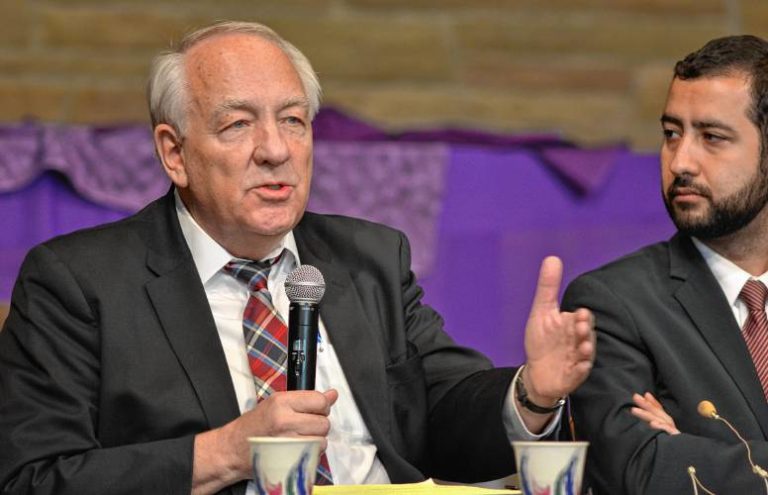
Stephen Rapp with Moaz Moustafa in New Hampshire. (Photo: New Hampshire Gazette)
Rapp’s core ambition is not focused exclusively on President Assad. He advocates in more general terms a principle of ‘no peace without justice’, which he interprets as implying a ‘responsibility to prosecute’ whose ultimate implications would be to enhance the legitimacy of externally imposed regime change operations on any nation – not just Syria – whose leadership is deemed to be oppressing its people and standing in the way of democracy and freedom.
It may be noted that Rapp has been part of on-going high level US deliberations about how to finesse that nation’s awkward situation of wanting to see other countries’ leaders prosecuted while not itself even signing up to the existing procedures that are provided by the International Criminal Court (ICC).
This conundrum has exercised the American elite for some years, and Rapp appears committed to a solution that lies in promoting innovative jurisprudence and hybrid courts. It would be facilitated by the emergence of a principle of ‘universal jurisdiction’, a principle that has gained particular traction in Germany, and some in other European countries too, like Spain, France and Sweden,[43] where the Caesar materials have apparently been deployed in courts.
In short, there is a discernible aim here of redefining the rules of the ‘rules-based international order’, with particular relevance to who shall be permitted to govern a country.[44] This is to press for global rules that override the powers of nation-states – a development whose effects are akin to what is already being accomplished through trade and investment agreements like TTP and TTIP by imposing rules of corporate globalism on nations with compliant governments.
Thus, from the standpoint of concern to serve US-based corporate interests, there is more at stake than the matter of who should be president of Syria.
The purpose of Caesar
Viewed from that perspective, Operation Caesar appears as a particular expedient in relation to a particular recalcitrant nation-state. The Caesar materials are likely to have little or no direct legal effect to that end, however, according to Wiley, and will not make a case against Assad in courts.
What the images do is harness powerful human emotion to the case. And it is entirely fitting that great human emotion should be stirred by images of human atrocities, as it may also be fitting that justice and accountability should be sought. If war crimes are committed, justice arguably requires accountability for them,[45] and so the value of evidence has to be assessed on its merits, and that means creating opportunities for such an assessment – even, conceivably, by deploying innovative judicial means.
I would just add that there are also other important considerations to keep in mind.
First, justice has to be assiduously sought by means that are rigorously directed to the pursuit of truth. This would be a sine qua non for just retribution. The pursuit of justice requires great scrupulousness of method and honesty of intent; it entails respecting the presumption of innocence, ensuring procedures are impartial and consistent, with due transparency and openness. These are qualities that need ensuring and cannot be assumed to follow from initiatives of ‘innovation’ that are pursued by special interest groups as is a concern about Operation Caesar.
Second is the need in due process to reserve judgement as to the honesty and intentions of witnesses to any alleged crime, pending their evidence being put to the test in a properly constituted hearing.
For the purposes of justice it is never to be assumed that all people at all times act honestly and in good faith, for it is precisely because they do not that institutions of justice are required to provide a remedy.
Thus a requisite degree of realism in retributive justice has always to attend to motivations, including thoughts about deterrents and incentives. As well as this general concern there is in the present context also a more specific kind of concern. It is a fact that deceptive events are sometimes staged, including by way of what are referred to as false flag operations.
Regarding many of the various accusations of atrocity crimes levelled against the Syrian government there are reasonable grounds for doubt, and justice certainly requires that no blanket presumption be made about the dependability of testimony from witnesses like the White Helmets or Caesar.
Third, although the Caesar evidence, like that of the White Helmets, has never been tested in a properly constituted court of law, it has sounded very loudly in the media and has thus exercised a determinate influence on the ‘court of public opinion’.
The media reports that shape public opinion, however, often appear to have scant regard for truth or accuracy, let alone justice. Insofar as promoters of prosecutions against state leaders are also seeking to use ‘innovative’ forms of justice effectively to lower the barrier to effective prosecutions, it could be perceived as extremely prejudicial that they are able to make their case so unrestrainedly to the wider public ahead of any properly constituted hearing.
Fourth, there is the distinct possibility that under circumstances where not only is public opinion manipulated but also political agendas are promoted, the communications can even provide incentives to stage harmful acts as false flag operations.
Specifically, the pronouncement of red lines can favour this effect. There are strong grounds for suspicion that in practice this effect has operated from time to time in Syria, as elsewhere, and a simple logic of incentives does nothing to assuage such suspicions.
It is therefore a matter of serious concern that the informal penumbra of ‘justice and accountability’ talk that goes to support the imposition of ‘red lines’ could be not only prejudicial to the trying of crimes that have occurred but potentially be used to support incentives for crimes to be committed.
The fifth point is the most important of all. Concerns about justice and accountability for war crimes are ultimately about acting on behalf of the moral conscience of humanity.
If any given war crime shocks the human conscience, then so much more ought the very occurrence of war itself do so, especially when it is not clearly just or necessary.
If war crimes have been committed in Syria it is because there has been a war in Syria – a war that need never have been but for the provocations and facilitations of external actors.
If we truly want to hold people responsible for war crimes, then should we not attribute great responsibility to those whose actions are among the root causes of them?
Let us bear in mind, for instance, that Qatar was the biggest supplier of funds and arms to the enemies of Syria’s government, and that the United States has been a major orchestrator of international collaboration to delegitimise that government. With such facts in mind, it can be argued that for agents of those states to be producing evidence to accuse Syria of war crimes is to add moral insult to injury.
Had these states not promoted an armed insurgency in the first place, there would have been no war and thus no war crimes in Syria. They certainly have earned no benefit of the doubt regarding the anonymous, secretive and unverifiable testimony their agents jointly presented in Operation Caesar.
On this last point, it is further interesting to note that we in the West do not receive much unfiltered communication from the side of the defence to these attempted prosecutions. We hear that Syria, Russia, China and various non-aligned countries have forceful reservations but this is always attributed to pure political calculation on their part. ‘They’, it seems, are always subject to conflicts of interest whereas ‘we’, in the West, are concerned only with the pure pursuit of humanitarian justice.
Just how far this might be from the truth is glimpsed in the reflections of former international criminal defence lawyer Christopher Black. His considerations of the modus operandi of prominent prosecutors like those pressing the ‘responsibility to prosecute’ as part of an ‘innovative justice’ agenda are sobering, to put it mildly.[46] For present purposes, however, it suffices to have indicated the much bigger game that the Caesar testimony has played a small part in.[47]
In conclusion, I would emphasise that it behoves us to try and be clear about the effects of Operation Caesar and learn lessons from the study of it. Having noted that even vocal critics of Assad and his government avoid appeals to Caesar, and given the serious criticisms made by others, we have good reason to reserve judgement as to its credibility.
This means that those who have committed to accrediting it as wholly true have quite possibly disseminated a falsehood. With NGOs, journalists and even academics embedding in it lessons of that possible falsehood, the historical record may already have been distorted in ways that may not be undone. But a still greater concern is that further harms may be generated in the future not only as a result of misinformation but also as a result specifically of what the West’s legal innovators are seeking, which is nothing less than a change in the rules of the ‘rules-based international order’.
We already find some scholars of international law viewing such changes as positive steps towards ‘global justice’. This is a matter about which more critical concern should be in evidence than has been to date.
To put bluntly this contextualised concern about Operation Caesar: not only may it already have altered the historical record, and not only may its effects have served to alter somewhat the course of history to date, but in serving to influence decision makers, it may contribute more indelibly to shifting the baseline of normative consensus in a direction favourable to ousting non-compliant leaders of sovereign states.
That is effectively to bestow legitimacy on imperialist regime change projects.
What justice meanwhile requires with regard to the ‘Caesar’ evidence is genuine and impartial investigation into the truth about who died and at whose hands. The instrumentalisation of those terrible deaths for the purposes of further destabilizing a country ripped apart by violent forces that are aided and abetted by foreign states – including so-called liberal democracies – is itself an affront to the conscience of humankind.
***
[1] For an overview of the story at the time see Ian Black in The Guardian https://www.theguardian.com/world/2014/jan/20/evidence-industrial-scale-killing-syria-war-crimes. For a later and fuller reconstruction see Adam Ciralsky in Vanity Fair: https://www.vanityfair.com/news/2015/06/assad-war-crimes-syria-torture-caesar-hospital.
[2] See the Human Rights Watch study of the Caesar evidence: https://www.hrw.org/report/2015/12/16/if-dead-could-speak/mass-deaths-and-torture-syrias-detention-facilities. For a more detailed and critical study of the evidence see the website of Adam Larson: http://libyancivilwar.blogspot.com/search?q=caesar.
Drawing on Larson’s study, Paul McKeigue has summarised what is not in dispute and what other factors should be borne in mind (personal communication) and I follow his advice in the summary that follows.
Not disputed:- The photos show the bodies of at least 5000 adult men at the Damascus military hospital, many of whom have been starved, over a period of about 8 months up to August 2013. Their identities are unknown, and the bodies have been labelled with numbers.
Other factors:- Some of them may be battlefield casualties, although most have no obvious external injuries. Some of them appear to have been gassed while hung upside down. From this, and the signs of prolonged starvation it is clear that most of them were captives. What is not known for certain regarding most of them is whether they were captured and/or killed by the government or by rebel forces (since the fact of being gathered for delivery to the mortuary could apply in either event. Some victims have tattoos indicating they are Christian, Shia or Assad supporters. The picture is further complicated by the fact that there were prisoner swaps between the Syrian Arab Army (SAA) and JAI in 2013.
Adam Larson (personal communication) adds that there is no semblance of a prison uniform evident in the photos, the men being mainly naked or in underwear, in street clothes or, in a few cases, still in their camouflage military uniforms.
For my part, I do not have the knowledge or expertise to offer an opinion as to the relative likelihoods of the two hypotheses. Nor does my argument depend on the likelihood of the JAI hypothesis being much greater than the official Western hypothesis, as Larson and McKeigue suggest it is. (Nor can some combination of those or other possibilities be definitively ruled out.) My argument relies only on the consideration that a self-consistent and materially possible explanation has not been ruled out while the accepted Western narrative has not been sufficiently established.
[3] https://www.youtube.com/watch?v=PgGqwAwJL5M&feature=youtu.be
[4] https://www.carter-ruck.com/images/uploads/documents/Syria_Report-January_2014.pdf
[5] This is a point made particularly effectively by Dan Murphy in an early response to the Caesar evidence: for he declares himself convinced on the basis of reports from other sources that the Syrian security apparatus is in fact responsible for large scale and egregious violation of human rights, and yet he vigorously challenges the credibility of the Caesar Report. https://www.csmonitor.com/World/Security-Watch/Backchannels/2014/0121/Syria-smoking-gun-report-warrants-a-careful-read
[6] These include, most recently, creation of the International Impartial and Independent Mechanism (IIIM).
[7] https://www.carter-ruck.com/images/uploads/documents/Syria_Report-January_2014.pdf
[8] Rapp in a 2016 interview with Ben Taub in the The New Yorker: https://www.newyorker.com/magazine/2016/04/18/bashar-al-assads-war-crimes-exposed
[9] These include ECCHR https://www.ecchr.eu/en/case/caesar-photos-document-systematic-torture/ and the Guernica teams https://www.guernicagroup.org/syria, and German Public Prosecutors in Karlsruhe https://en.qantara.de/content/assads-crimes-tried-in-german-courts-hoping-for-justice.
[10] Before setting up the Guernica teams, Cadman had been an associate at Cherie Blair’s law firm Omnia and was at the centre of a scandal: https://www.independent.co.uk/news/uk/politics/cherie-blairs-right-hand-man-previously-pitched-to-represent-the-other-side-in-maldives-case-a6779321.html. This is relevant to mention insofar as much of the drive for judicial innovation is based on arguments about humanitarianism and morality that sit uneasily alongside motivations of making business profits.
[11] Wolfgang Kaleck founded the European Center for Constitutional and Human Rights (ECCHR) together with other internationally renowned lawyers in Berlin in 2007. He has promoted prosecuting on the basis of Caesar evidence https://www.ecchr.eu/nc/en/press-release/torture-in-syria-investigations-in-austria-are-a-first-step-now-arrest-warrants-must-follow/
[12] Patrick Kroker is responsible for ECCHR’s work on Syria. He sets out his perspective in this interview: https://www.youtube.com/watch?v=qyi3jkDCRlE&feature=youtu.be
[13] https://www.hrw.org/report/2015/12/16/if-dead-could-speak/mass-deaths-and-torture-syrias-detention-facilities.
[14] Susie Linfield in The New York Review of Books: https://www.nybooks.com/daily/2019/02/09/syrias-torture-photos-witness-to-atrocity/)
[15] https://www.huffingtonpost.co.uk/2015/03/28/syria-war-crimes_n_6950660.html
[16] Adam Ciralsky in Vanity Fair: https://www.vanityfair.com/news/2015/06/assad-war-crimes-syria-torture-caesar-hospital.
[17] Jim Muir for the BBC: https://www.bbc.co.uk/news/world-middle-east-25822571
[18] http://www.spiegel.de/international/world/spiegel-reporting-supports-accounts-of-torture-and-execution-in-syria-a-945760.html
[19] https://www.dailymail.co.uk/news/article-2544711/Starved-tortured-throttled-The-true-horror-Assads-soldiers-execute-rebel-prisoners-revealed-new-images-released-today.html
[20] https://edition.cnn.com/2014/01/20/world/syria-torture-photos-amanpour/index.html t.
[21] Noha Aboueldahab, Writing Atrocities (2018)
[22] Jamie Allinson, ‘Disaster Islamism’ (http://salvage.zone/in-print/disaster-islamism/
[23] Adam Bazco, Gilles Dorronsoro and Arthur Quesnay Civil War in Syria, Cambridge UP 2017.
[24] Nader Hashemi, ‘The ISIS Crisis and the Broken Politics of the Middle East’ http://www.bu.edu/cura/files/2016/12/hashemi-paper1.pdf
[25] Bessma Momani and Tanzeel Hazak, ‘Syria’, in The Oxford Handbook of the Responsibility to Protect Edited by: Alex Bellamy, Tim Dunne 2016 Oxford University Press.
[26] Chris Tenove (2019), ‘Networking justice: digitally-enabled engagement in transitional justice by the Syrian diaspora, Ethnic and Racial Studies’, DOI: 10.1080/01419870.2019.1569702
[27] Thomas G. Weiss (2014) ‘Military Humanitarianism: Syria Hasn’t Killed It’, The Washington Quarterly, 37:1.
[28] Beth Van Schaack (2019) ‘Innovations in International Criminal Law Documentation Methodologies and Institutions’ https://papers.ssrn.com/sol3/papers.cfm?abstract_id=3329102
[29] Tim Anderson has commented that ‘we have no way of verifying in which year, circumstance or even which country the photos were taken. Those who finance and arm the sectarian groups have slaughtered hundreds of thousands in recent years, in the wars in Afghanistan, Iraq and Syria. There is no shortage of photos of dead bodies…’ (Tim Anderson ‘The Dirty War on Syria: Barrel Bombs, Partisan Sources and War Propaganda’ Global Research 7 October 2015). However, after a very close study of the photographs, Adam Larson believes that the photos were taken in the Damascus area and that the deaths occurred within that area, mostly in the period from mid-late 2012 to August 2013. This fact, nonetheless, does not make the Syrian government a more likely suspect for their murder than Jaish al-Islam. (Adam Larson, personal communication)
[30] Rick Sterling, ‘The Caesar Photo Fraud that Undermined Syrian Negotiations’ https://dissidentvoice.org/2016/03/the-caesar-photo-fraud-that-undermined-syrian-negotiations/
[31] Adam Larson, ‘Fail Caesar’, in 10 parts: http://libyancivilwar.blogspot.com/search?q=caesar
[32] Wiley interviewed in the Al Jazeera documentary Syria: Witnesses for the Prosecution https://www.youtube.com/watch?v=9GGK4zrl7P0 ). Speaking at a conference organised by his friend David Crane at Syracuse University, Wiley is clear that for advocacy groups like Amnesty and HRW ‘the burden of proof for the sort of evidence they need for their reports, it is very, very low. … Oftentimes they do allege crimes, in my opinion, incorrectly, but they are just drawing attention to the suffering.’ (19.55) (https://www.youtube.com/watch?v=enJvVvN8thU (Running for Cover conference, Syracuse, 2016)
[33] Mohammad al-Abdallah quoted in Enab Baladi’s Investigation Team (2018) ‘Al-Assad’s crimes in millions of documents: When will accountability start?’ https://english.enabbaladi.net/archives/2018/10/al-assads-crimes-in-millions-of-documents-when-will-accountability-start/
[34] For readers not familiar with these debates, but who know Monbiot for his interesting work on environmental issues, his inclusion in this list may be surprising. I for one was very surprised to discover the company he keeps in this matter, and after some rather disagreeable interactions with him on the subject, I did an extended study attempting to understand it: https://timhayward.wordpress.com/2018/04/11/how-we-were-misled-about-syria-george-monbiot-of-the-guardian/
[35] I stand to be corrected on this, of course, and I do note that Caesar has been referred to by Higgins, for instance, in the context of geolocating one of the photos, but without direct comment as to its significance.
[36] Beth Van Schaack (2019) ‘Innovations in International Criminal Law Documentation Methodologies and Institutions’, p.40.
[37] This information comes from an address delivered by Le Mesurier at The Performance Theatre in 2015 [links to the video recording of which appear to have been taken down].
[38] See the discussion in Lissa Johnson, ‘The Psychology of Getting Julian Assange’ Pt 5 https://newmatilda.com/2019/03/25/the-psychology-of-getting-julian-assange-part-5-war-propaganda-101/.
[39] As shown by Simone Rudolphi (2018), ‘Analysis of White Helmets’ Visual Strategy’, Masters Thesis, University of Sunderland.
[40] Already in 2013, before Caesar’s defection, Crane was ‘working with a team of lawyers and civil-society advocates to set up an archive of war crimes and atrocities committed in Syria that could be used as a basis for prosecution.’ As Crane put it, “We former chief prosecutors are like racehorses – you can put us out to pasture but we still want to run.” (https://www.newsweek.com/2013/09/27/david-cranes-prosecution-former-liberian-president-charles-taylor-238008.html)
[41] http://www.iamsyria.org/uploads/1/3/0/2/13025755/syria-sap_general_overview.pdf
[42] http://www.rscsl.org/prosecution.html
[43] Thierry Cruvellier (2019) ‘European Justice Strikes on Crimes in Syria’ https://www.justiceinfo.net/en/tribunals/national-tribunals/40383-european-justice-strikes-on-crimes-in-syria.html
[44] Ultimately, however, what is at stake affects the United States as a nation of people too, since what is driving it is a form of association that knows no national loyalties to any body politic but only to the interests of those with control of the world’s mega-corporations.
[45] I say ‘arguably’, since another view would take justice to have a more complex relationship with peace such as may find some place for the principle of amnesty – forgetting – but the present paper does not call into question the principle of punishing war crimes through due process.
[46] See Christopher Black (2014), ‘Rwanda and the Criminalisation of International Justice: Anatomy of War Crimes Trials’, Global Researchhttps://www.globalresearch.ca/rwanda-and-the-criminalisation-of-international-justice-anatomy-of-war-crimes-trials/5408604 and ‘Rwanda Confronting the 1994 Apocalypse’ https://christopher-black.com/rwanda-confronting-the-1994-apocalypse/
[47] See also the perspective offered by the historian John Laughland on the notion of International Justice, as in this video interview: https://www.youtube.com/watch?v=q4_J-ZxYnMw
Report: Egypt plan to lift siege requires disarmament of Gaza
MEMO | March 22, 2019
An Israeli report said that Egypt has put forward a plan for a settlement between Israel and Palestinian factions in the Gaza Strip, led by Hamas, which controls the Gaza Strip. Israel Hayom newspaper reported on Thursday that “according to security sources in Egypt and Palestinian officials in Gaza and Ramallah, Israel and Egypt have become convinced that Hamas’s control in Gaza is a self-evident fact.”
Israel Hayom quoted Egyptian security sources and Palestinian officials in the West Bank and Gaza Strip. It explained that the Egyptian proposal stated that they would disarm the factions – except for light weapons – in exchange for lifting the siege on the Gaza Strip.
According to this plan, all internal affairs will remain in the hands of Palestinian organisations headed by Hamas or a unified political entity for all organisations in the Strip. The internal security of the Gaza Strip will be based on “Hamas National Security Forces, which are currently operating.” The arms that will be in possession of the Internal Security Forces will be light weapons, in small quantities and subject to a strict control system.
In turn, the Israeli and Egyptian siege on the Gaza Strip will be lifted, according to the newspaper. Also, projects in the areas of infrastructure, employment, economy, health and education, financed by the United Nations, the European Union and Arab countries, “led by Saudi Arabia, Qatar and the UAE,” will be implemented. The plan calls for the opening of a maritime route to the Gaza port, which will allow in the first stage the export and import of goods directly to the Gaza Strip.
The newspaper asserted that “these parties have succumbed to the fact that the Palestinian Authority will have difficulty in regaining control in the Gaza Strip, whether after an internal Palestinian reconciliation, or because of the collapse of Hamas rule against the backdrop of the grave humanitarian situation, or because of the continued military confrontation with Israel.”
According to the newspaper, Egyptian sources stated that the Israeli policy towards the Strip is “soft,” and that this stems from Israel’s unwillingness to allow the “Hamas regime” to collapse and in anticipation that in the event of Hamas’s collapse, “extremist groups loyal to Iran or Salafist groups similar to Daesh will enter” to fill the vacuum.
The newspaper further said that estimates in Israel and Egypt indicate that “such a settlement can be implemented within three to five years, but the main obstacle is that Hamas and other Palestinian armed factions will oppose disarmament.”
Quoting sources it described as officials in Ramallah, the newspaper added that Palestinian Authority President Mahmoud Abbas and the PLO leadership would agree to “overthrow” Hamas and the factions in Gaza “only in case it led such a process when the control of Gaza is in the hands of the Palestinian Authority.”
The newspaper asserted that US security bodies obtained a draft of the plan which was formulated by Israeli and Egyptian crews. It quoted an Egyptian security official saying: “We are currently waiting for the new government to be elected in Israel to speed up the process; while the goal after the Israeli elections is the entry of other influential Arab countries, such as Qatar, Saudi Arabia, Jordan and the UAE.”
The Egyptian security official added that “if Abu Mazen and the leadership in Ramallah do not put obstacles, the plan can be put into effect with the full cooperation of all the regional actors and through providing guarantees and assistance by the international community. But, it is estimated that there will be strong opposition to the disarmament plan of the Gaza Strip by the PLO and mainly by the armed factions in Gaza.”
Turkey and Russia Push Towards a Resolution in Syria
By Tom LUONGO | Strategic Culture Foundation | 19.12.2018
Turkish-US relations are terrible and deteriorating by the day despite bromides to the contrary. Actions speak louder than words. And that has been all President Trump seems capable of anymore, words not actions.
Since the beginning of l’affair Khashoggi Turkey has been extracting concession after concession from the US as the Trump administration tries to salvage its soon-to-be-unveiled Middle East peace plan.
The latest concession may be the biggest. There’s a report out now that the Trump administration is readying the extradition of cleric Fethulah Gulen, who President Erdogan believes was behind the coup attempt against him in July of 2016.
The US has protected Gulen well beyond any reasonable measure for someone not in their pay so Erdogan’s claims ring true enough. I’ve always thought he was a US intelligence asset and that the US were the ones truly behind the coup attempt.
And since the Trump administration has been desperate to get the Turks to stop leaking details of the Khashoggi murder, Erdogan has pretty much had a free hand to conduct business as he’s seen fit for the past two-plus months.
Whether the US ever returns Gulen to Ankara or not is actually irrelevant; keeping it a sore spot open is its biggest value while Turkey prepares an assault against US-backed YPG forces in Manbij, Syria.
It helps raise Turkey’s position with the other countries involved in the Astana peace process for Syria while keeping Trump, his foreign policy mental midgets and Saudi Arabia on their collective back foot.
Turkey has grown increasingly restless about the US’s lack of movement in turning Manbij over to them. And have now unleashed attacks on Kurdish forces in Northern Iraq to hamper them further.
All of this is making the US presence in eastern Syria more untenable over time while the Saudis struggle with falling oil prices and no longer want to pay the bill for the US’s proxy war.
Don’t kid yourself, the US is struggling to keep its financial pressure up on Iran.
If these things weren’t enough Turkish Prime Minister Mevlut Cavusoglu said recently that Ankara was now willing to work with Syrian President Bashar al-Assad if he survives “democratic and credible” elections. This is rich coming from Turkey, but whatever.
The importance of this statement, however, cannot be overstated. Turkey was one of the major partners in the mission to destroy Syria. And now they have joined with Russia, Iran and China in negotiating the peace process.
They have gone from “Assad must go!” to “Assad can stay.” It is an admission that the US plan for balkanization of Syria will eventually fail and that their best bet is putting maximum pressure on the US to give up its regional plans.
Russia, of course, stands behind Turkey in this and they themselves are now upping the costs on the US and the Israelis. Because, it is now Russian policy to assist Syrian Arab Army forces in proportional retaliation against Israeli aggression in Syrian territory, according to Elijah Magnier.
No longer will the Russians stand aside and allow Israel a free hand over bombing what it says are Hezbollah and Iranian targets within Syria. The SAA will now strike back with a proportional response.
An airport for an airport, as it were.
What started as a State Department operation to install a puppet government and sow chaos in Syria under Hillary Clinton then became one to drain Russian and Iranian resources by wasting their time under John Kerry.
Today, that US/Israeli/Saudi strategy has been turned on its head.
It is now the US and the Saudis that are feeling the pinch of yet another quagmire without end. Moreover, the Israeli security situation is now worse than it was before all of this started in the first place. This necessitates an even more unhinged response from Washington which it cannot defend to the American people as to why we need to stay in Syria forever.
None of this is what President Trump campaigned on. None of this is what candidate and citizen Trump argued for.
The real war of attrition was never about physical resources and money. It was always about time. The Iranians and Russians have played for time. Time brought out the truth about the Syrian invasion. It exposed the real causes of the conflict.
The hope now for the US is that financial pressure will get Iran to knuckle under. But, look at what is happening. Oil prices are in freefall as the global economy slows down thanks to debt saturation, a rising dollar and increasing opposition in the West to neoliberalism and globalism.
Trump whines about this because it upsets his mercantilist plans to corner the energy markets while weaponizing the use of the dollar.
EU technocrats who fancy themselves the inheritors of a waning US empire, bristle under Trump’s plans. They will build an alternative payment vehicle to buy goods and services from sanctioned entities. This is about much more than Iranian oil.
So, while Trump, Bolton, Mnuchin and Pompeo, the Four Horsemen of the Foreign Policy Apocalypse, think they are winning this war on commerce, all they are doing is falling into the very trap Putin, Xi and Rouhani have set for them.
Again, they playing for time. The dollar is the US’s strength and also its Achilles’ heel. And if you are playing for time it is to build alternative channels for trade, oil, gas and whatever else the US deems against its interests without need for dollars.
Trump’s energy dominance plan is as transparent as his narcissism. More likely the sanctions exemptions for buying Iranian oil will be extended in May because he can’t have a global crisis be his fault as he prepares for re-election in 2020.
But, that’s exactly what he’s setting up.
So, now back to Syria.
Those who were set up to be scapegoats – namely Qatar and Turkey – washed their hands of the operation quickly, made deals with Russian President Vladimir Putin and charted their own independent paths. By the time the truth about US involvement in Syria was exposed they were long gone and only the real perpetrators left holding onto poor positions and worse arguments.
All Trump can do now is openly admit that we’re there on behalf of Israel and Saudi Arabia to get Iran. That’s it. He can sell that to part of his base. But, not enough of them to win re-election.
His peace plan is DOA. It died along with the 15 Russian airmen on that IL-20 back in August. I’ll be surprised if it is ever actually announced. That one event set us on this path. It permanently poisoned Russian/Israeli relations as Netanyahu overplayed his hand assisting NATO in a needless provocation which nearly sparked a wider war.
Reports are that Putin doesn’t return his phone calls and now dictates to Bibi what happens next. This also tells me Putin now has control over his Israeli fifth columnists within the Kremlin otherwise this order would never have been issued and made public.
Now Netanyahu is hemmed in on all sides and the Saudis are political pawns between the warring factions of the US government – Trump who wants an Arab NATO and the Deep State that wants him on a platter. Their benefactor, Trump, is in an increasingly untenable position who will soon be forced to choose between hot war and impeachment.
Meanwhile, Iran, Turkey and Russia will continue to bleed out the US forces in Syria while sanctions prove to be increasingly less effective. Simultaneously, the Astana process moves forward with all groups trying to reach out to each other around the sclerotic reach of the US and put an end to this shameful period of US foreign policy insanity.
The gulf within GCC is only widening
By M. K. BHADRAKUMAR | Indian Punchline | December 10, 2018
The annual summit meeting of the Gulf Cooperation Council (GCC) in Riyadh on Sunday was particularly important for Saudi Arabia as a display of its regional leadership. But the short meeting of the GCC leaders behind closed doors, lasting for less than an hour, ended highlighting the huge erosion of Saudi prestige lately.
The litmus test was the participation by Qatari Emir Sheikh Tamim bin Hamad al-Thani. King Salman’s letter of invitation to the emir was perceived as some sort of an olive branch for reconciliation. But Qatar’s Minister of State for Foreign Affairs Sultan bin Saad Al Muraikhi represented the country at the summit.
The calculation by the hot headed crown princes of Saudi Arabia and the UAE that Qatar would pack up is turning out to be a historic blunder. Qatar had some trying times but it has successfully weathered the harsh embargo by Saudi Arabia and the UAE, and the boycott is now hurting its enforcers. Qatar “celebrated” the anniversary of the boycott in June by banning the import of goods from the UAE, Saudi Arabia, Bahrain and Egypt (which had cut diplomatic and transport ties on June 5, 2017.) Ironically, Iran has been a beneficiary as Qatar established diplomatic relations with Tehran and began importing Iranian products.
Qatar also strengthened its alliance with Turkey, which stepped in as provider of security for Doha. And Turkey checkmated any plans that Saudis and Emiratis might have had to use force to bring the Qatari emir down on his knees.
The emir’s absence from the summit in Riyadh yesterday underscores that he is not in a mood to forget and forgive. Equally, Kuwait and Oman also have issues to settle with Saudi Arabia and the UAE. There is tension between Kuwait and Saudi Arabia over two oil fields – Khafji and Wafra – that are jointly owned by the two states, which have a capacity to produce more than half a million barrels per day, but have been closed since 2014 and 2015, respectively. The dispute is over the sovereignty over the so-called Neutral Zone on their border, which has been undefined for almost a century.
The Saudis are not relenting. “We’re trying to convince the Kuwaitis to talk about the sovereignty issues, while continuing to produce until we solve that issue,” Saudi Crown Prince Mohammed bin Salman told Bloomberg in an interview in October. Similarly, Saudis and Emiratis have stationed troops in Yemen’s southern province of al-Mahra that borders Oman although the region has no presence of Houthi rebels. Oman considers the move an infringement on its national security. Interestingly, instead of the Sultan of Oman, Deputy Prime Minister for the Council of Ministers Sayyid Fahd bin Mahmood Al Said represented the country at the GCC summit.
To be sure, like Banquo’s ghost at Macbeth’s banquet in Shakespeare’s play, the killing of Jamal Khashoggi provided the backdrop to the GCC summit. The GCC states (including Qatar) have not criticized the Saudi Crown Prince Mohammed bin Salman (MBS) but they would know this is a developing story and it has dented Saudi prestige irreparably, especially with the US Senate is at loggerheads with the Trump administration. The big question for the Gulf region would be as to where Saudi Arabia is heading. (See the blog by Thomas Lippman What Now For U.S. Policy And The Crown Prince?)
Of course, if the GCC disintegrates due to these contradictions, Saudi Arabia will be the big loser, because it will be a reflection on its regional leadership. But do the Saudis understand it? The remarks by the Saudi Foreign Minister Adel Al-Jubeir at the end of the GCC summit showed no sign of remorse.
He said, “The members of the Gulf Cooperation Council are keen that the crisis with Qatar will have no impact on the Council (GCC). But this does not mean relinquishing the conditions imposed on Qatar.” Doha should stop supporting terrorism and extremism and avoid interfering in other countries’ affairs and needed to fulfill the Arab countries’ conditions to open the way for its return to the full-fledged work in the GCC. “The stance towards Qatar came to push it to change its policies,” he added.
The leading Saudi establishment writer Abdulrehman al-Rashed fired away at Qatar on the day of the GCC summit. In a column entitled Is it Time to end the GCC? in the Saudi daily Asharq Al-Awsat (owned by royal family members) he wrote:
“Qatar… has been putting obstacles in the GCC path and it has succeeded where Saddam and Iran have failed: It managed to destroy and rip it [GCC] apart… It organized an internal and external opposition against the United Arab Emirates. It is now the primary financier of the greatest attack against Saudi Arabia and it stands behind the politicization of Khashoggi’s murder… Today’s [GCC] summit could not conceal the dark political cloud hanging over its head. It also strongly poses a question over the future of the GCC as doubts rise over the value of this union… A wedge has been driven in the GCC.”
The disarray within the GCC undoubtedly calls attention to the decline of US influence in the Middle East region. At the end of the day, the Gulf states have not paid heed to repeated US entreaties for GCC unity. Ideally, GCC should have provided today for the US strategy a strong platform for launching the regime change project against Iran. On the contrary, GCC is split down the middle, with Qatar, Oman and Kuwait getting along just fine with Tehran. While addressing the summit in Riyadh on Sunday, the Emir of Kuwait, Sheikh Sabah Al Ahmad hit the nail on the head when he said, “The most dangerous obstacle we face is the struggle within the GCC.”
Riding on Qatari wings, multipolarity arrives in the Middle East
The unscheduled arrival of Sheikh Tamim bin Hamad al-Thani, Qatar’s emir, in the Turkish capital Ankara throws a new light on regional links
By M.K. Bhadrakumar | Asia Times | August 16, 2018
Trust Turkey’s Recep Erdogan to have had a game plan when he challenged the Trump administration and promised that the latter will regret its “unilateralist” policies.
Some pundits thought Russia and China have been inciting him and are lurking in the shadows to escort Erdogan to a brave new world.
Others fancied that the Eurasian integration processes would now take a great leap forward as Turkey embraced Russia, while a few forecast that Turkey would now sell itself cheap for Chinese money.
And then, there is the ubiquitous prediction in such situations that whoever defied the lone super power would come a cropper and Turkey’s fate is going to be miserable.
All these apocalyptic predictions overlooked the fact that Turkey may have a ‘third way’ forward – by strengthening even further its strategic autonomy and optimally exploiting its foreign policy options.
This path opened dramatically on Wednesday with the unscheduled arrival of Sheikh Tamim bin Hamad al-Thani, Qatar’s emir, in the Turkish capital Ankara.
Economic projects, investments, deposits
Qatar’s royal court has announced in a statement that Al-Thani “issued directives that will see the State of Qatar to provide a host of economic projects, investments and deposits” worth $15 billion to support the Turkish economy.
A government source in Ankara told Reuters that the investments would be channeled into Turkish banks and financial markets. Al-Thani confirmed the direct investment plans in Turkey, which he described as having a “productive, strong and solid economy.” He tweeted: “We are together with Turkey and our brothers there, who stand by Qatar and problems of the Ummah.”
Erdogan responded, saying his meeting with al-Thani was “very productive and positive.” Erdogan thanked the emir and Qatari people for standing with Turkey. “Our relations with friendly and brotherly country Qatar will continue to strengthen in many areas,” he tweeted.
At its most obvious level, we may locate the historic Qatari gesture toward Turkey in the matrix of the strong convergence that has accrued in their relationship in recent years in the backdrop of the emergent power dynamic in the Middle East. The axis works on many planes.
On the ideological plane, importantly, the ruling elites in both countries share a unique affinity toward Islamism and in visualizing the Muslim Brotherhood as the vehicle for the democratic transformation of the region. As a result, both have been targeted by Saudi Arabia and the UAE – and Egypt.
Joint military exercises
Until the retreat of Qatar from the Syrian killing fields in recent years, it was collaborating closely with Turkey in the failed project to overthrow the Assad regime. Of course, both countries are strong supporters of Hamas, too.
Turkey keeps a military base in Qatar, which may seem symbolic in comparison with the Western bases, but turned out to be an important lifeline for Doha for pushing back at Saudi Arabia and the UAE in the past couple of years. Turkey and Qatar are also planning to hold joint military exercises this year.
Riyadh and Abu Dhabi resent Erdogan’s projection of power through Qatar into the GCC territory, which they regard as their playpen. The Turks in turn suspect that Emiratis had a hand in the failed coup attempt against Erdogan in July 2016.
Meanwhile, there is great complementarity in the economic sphere between Turkey and Qatar. Turkey has a dynamic export industry and an economy that has registered impressive growth in the last decade, while Qatar has a huge surplus of capital for investment.
One consideration for Doha will be that the Turkish construction industry, which is affected by the present financial crisis in Turkey, is involved in preparing the infrastructure for the FIFA World Cup 2022, which Qatar is hosting.
Fundamentally, therefore, the planned Qatari investment in the Turkish economy holds big resonance for the geopolitics of the Middle East. No doubt, it proclaims the adulthood of the Turkish-Qatari axis. Regional states ranging from Iran to Israel will carefully take note that Al-Thani has come to Erdogan’s help at a critical moment.
Some spice in a heady brew
Yet, the Qatar-Turkey axis will not project itself as a strategic defiance of the United States – although the Qatari emir is well aware of Erdogan’s face-off with the Trump administration. Nonetheless, what adds some spice to this heady brew is that the Trump administration has been unabashedly partial toward the Saudi-Emirati line-up in the Gulf region.
A recent American report even claimed that former US Secretary of State Rex Tillerson lost his job because he stood in the way of a Saudi-Emirati plan to attack Qatar.
At any rate, the apt description for the Turkish-Qatari axis is that it is a manifestation of the arrival of multipolarity in the politics of the Middle East. Both Turkey and Qatar have good relations with Iran.
Although US Central Command is headquartered in Doha, Al-Thani also has a warm relationship Russian President Vladimir Putin.
In the power dynamic of the Middle East, the trend toward multipolarity is poised to accelerate. As time passes, conceivably, even Saudi Arabia and the UAE will see the attraction in strengthening their strategic autonomy.
It will be a fallacy, therefore, to continue viewing the Middle East through the Cold War prism, as most US analysts do, as an area of contestation between the big powers – as if the regional states don’t have a mind of their own or multiple options in developing their policies.
Simply put, Turkey or Iran may lean toward Russia, but can never forge a strategic alliance with Moscow. With a view to pushing back at US pressure, they may lean decidedly toward Moscow from time to time, but they have no intentions of surrendering their strategic autonomy.
But to caricature these countries as passive participants in Russia’s Eurasian integration processes will be delusional.
Russia understands this complicated reality, which is not surprising, given Moscow’s historical memory of its highly problematic relationships with Turkey and Iran through centuries in its imperial history. Thus, the Russian policy is not unduly demanding and is willing to accept their nationalist mindset.
On the other hand, the failure of the US policies lies in Washington’s inability to accept equal relationships and its obsession, ‘You’re either with us, or are against us.’
Make no mistake, the European capitals watch with exasperation the Trump administration’s handling of Erdogan – although he is by no means an easy customer to handle. The point is, European countries are closer to Russia in their appreciation of the complexities of the Middle East. Nor are European countries inclined to view Turkey through the Israeli prism.
Therefore, a concerted Western strategy toward Erdogan under US leadership will remain elusive. Germany’s decision to lift its sanctions against Turkey can be seen in this light. Equally, Erdogan is due to pay a state visit to Germany in September.
Qatar pledges $15bn of direct investments in Turkey – Ankara
RT | August 15, 2018
Qatar has pledged $15 billion of direct investment in Turkey’s financial markets and banks. The news comes in a statement released on Turkey’s President’s website following his meeting with Qatar’s Emir Tamim bin Hamad Al Thani.
“The Turkish President and Emir of Qatar met today [Wednesday] in the presidential complex in Ankara. They have exchanged views on bilateral relations and regional issues, Al-Thani said that Qatar intends to directly invest $15 billion in Turkey,” said a press release after the meeting.
The Turkish lira firmed to 5.8699, from 6.04 to the US dollar after the news. The record low level of 7.2 against the greenback happened on Monday.
The Turkish officials did not provide any further information on the nature of the investments, according to AP. Erdogan’s office said the pledge was made by Qatar’s head, Al Thani.
The investment will be channeled into Turkish financial markets and banks, a government source told Reuters.
The Turkish economy has recently been hit by a record depreciation in the national currency lira. On Friday, US President Donald Trump doubled tariffs on aluminium and steel from Turkey in response to the detention of a US citizen. American pastor Andrew Brunson is being held on terrorism charges in Turkey, facing up to 35 years in prison for his alleged role in a failed coup in 2016.
In response, Erdogan announced boycott of US electronic devices, including Apple iPhones. Turkey has also hiked tariffs on US goods such as tobacco, alcohol, cars, cosmetics and others.
Dubai firm commissioned Qatar-smearing film from American who made fake news for Iraq war
RT | April 28, 2018
When Gulf states cut ties with Doha in 2017 over its alleged support of terrorism, tensions were aided by a Dubai firm that hired a man to create an anti-Qatar video. That same man also led a US propaganda project in Iraq.
Charles Andreae is the owner of the firm Andreae & Associates, which was contracted in August 2017 to produce a six-part film linking Qatar with global terrorism, the Bureau of Investigative Journalism has revealed. The Dubai-based strategic communications firm Lapis Communications, which is owned by an Afghan-Australian entrepreneur, gave Andreae more than $500,000 to produce the video.
The brief given to Andreae’s firm was to produce “six multimedia products focused on an investigation into the role of the state of Qatar and the state’s connection to global terrorism.” It was commissioned as Saudi Arabia and the United Arab Emirates were intensifying an international campaign against Qatar over its alleged links to terrorism.
News of the contract emerged in a recently filed lobbying declaration with the US Department of Justice. American companies such as Andreae & Associates are required by law to disclose information on lobbying and PR work for foreign clients.
The film, titled ‘Qatar: A Dangerous Alliance,’ included conservative pundits discussing Qatar’s links to Islamist groups, as well as bits of news and archive footage. Copies of the video were distributed at an event at the Hudson Institute think tank in October. Among the keynote speakers at that event were US President Donald Trump’s former chief strategist Steve Bannon, former defense secretary Leon Panetta, and former CIA director David Petraeus. So far, the documentary has been viewed more than 700,000 times on YouTube and is also available on Amazon.
In addition to Andreae’s involvement in making the film, he also registered as a lobbyist with the US Senate on Qatar-US relations on behalf of Lapis in January. But Andreae’s questionable actions didn’t begin with Qatar.
Andreae was also responsible for running the Washington end of a Pentagon propaganda contract in Iraq, which he did when he was working for the British public relations firm Bell Pottinger. Although the campaign details were known in 2016, Andreae’s involvement was only confirmed to the Bureau by Bell Pottinger co-founder Tim Bell last week.
That project, which has a $500 million contract with the Pentagon, consisted of running secret operations during the Iraq War. Bell Pottinger answered to the US commander in Iraq and created fake local news reports and smeared Iran. It also put together Al-Qaeda propaganda videos, planted them in people’s homes, and tracked who viewed them.
Neither Andreae & Associates nor Lapis Communications has responded to RT’s request for comment.
Read more:
Qatari FM Denounces Saudi Calls to Send Troops to Syria
Sputnik – 27.04.2018
The Saudi Foreign Minister had announced that Riyadh was willing to send troops to Syria as part of a wider international coalition if it receives an invitation to do so. He also expressed his opinion that Qatar must do the same.
Hamad bin Abdullah Al-Thani has branded Saudi Arabia’s demands for Qatar to pay for US troops to remain in Syria and the sending of its troops before the US withdraws an attempt to influence public opinion in the Arab world, according to France 24 TV channel.
“This statement [by the Saudi Foreign Ministry] is not worthy of an answer. Qatar refutes the brainwashing of the public opinion in the Arab world in such a way,” Qatar’s Foreign and Prime Minister said.
He also admitted that Qatar’s delegation was informed during its visit to the US about the idea of sending troops to Syria. Al-Thani believes that any decisions on Syria must be made as a part of the comprehensive solution to the Syrian problem.
“[Qatar insists] on developing a political solution to the Syrian problem, which would embed the political transition of power, punishment of war criminals and return stability to Syria,” Al-Thani said.
Saudi Foreign Minister Adel Jubeir stated on April 25 that Qatar must send its troops to Syria prior to the US withdrawal from its base in the country. Earlier US President Donald Trump claimed that Middle Eastern countries must pay for everything that happens in their region as well as deploy their soldiers on the ground, possibly referring to the situations in Syria, Iraq and Afghanistan. He also added that without US protection, “wealthy” Arab states “wouldn’t last a week.”
The Saudi Foreign Minister said on April 23 that Riyadh is ready to send its troops to Syria, but is waiting for an official invitation.
The Iranian Foreign Minister’s advisor Hussein Sheikholeslam has expressed his opinion in an interview with Sputnik that the deployment any additional troops to Syria will not bring about peace, but instead will only complicate the crisis.
Featured Video
Racist Seinfeld Dances for Joy as Bibi Unveils His New Map
or go to
Aletho News Archives – Video-Images
TV Drama Review
Japanese drama projects Japan’s wartime atrocities onto Chinese characters

Global Times | October 25, 2026
By portraying Chinese characters as perpetrators of ruthless violence while casting Japanese Self-Defense Forces (SDF) intelligence operatives as defenders, the season 2 of the Japanese drama Vivant has recently drawn criticism from Chinese netizens, who argue that its depiction turns historical reality on its head while ignoring Japan’s wartime atrocities.
The TBS drama series – a spy suspense story in which an alleged unofficial intelligence unit of the SDF operates across the globe — has attracted a passionate fanbase. Its currently airing season 2 opened with a household rating of 18.8 percent, the highest for a TV drama this year, according toa commentary article by Japanese media Toyo Keizai.
What draws attention is the portrayal of the enemies in the series, the article noted. Scenes in which the Chinese organization subjects kidnapped members of the SDF unit to brutal torture are repeated with unrelenting intensity.
It is rare for Japanese TV dramas to explicitly portray a real-life country as the enemy, the article noted.
Japanese Prime Minister Sanae Takaichi also made a reference to the drama, saying that she has been recording Vivant and hopes to binge-watch it over the year-end and New Year holidays, according to Japanese media outlets.
China’s CCTV News report on Sunday revealed that the drama features scenes in which Chinese personnel cut off the fingers of and stab Japanese intelligence operatives in the abdomen. Such acts bear striking similarities to the torture inflicted on Chinese nationals by invading Japanese troops during the World War II.
The drama distorts the truth by attributing these atrocities to modern Chinese characters. Beneath the surface, it subtly glorifies Japan’s cross-border overseas operations, blurs the functional boundaries of the SDF and implicitly promotes an expansionist narrative, per CCTV News. … continue
Blog Roll
 Aletho News
- EU facing trillion-euro debt hole while seeking more cash for Kiev
- How US, Europe, Persian Gulf states exhausted missile stockpiles, splurged billions to defend Israel
- Up in arms… Koreans reject U.S. empire’s plan to make South Korea the next Ukraine
- Iran, Turkey, Pakistan, Saudi Arabia could advance region-led security framework in Tehran: FM spox
- Netizens condemn Japanese drama for projecting Japan’s wartime atrocities onto Chinese characters
- Racist Seinfeld Dances for Joy as Bibi Unveils His New Map
- A West Bank War for Netanyahu’s Election Campaign, Could It Backfire?
- Yemen denounces European Parliament’s ‘hypocritical’ push to blacklist Ansarullah
- Qalibaf: UAE’s UN bid aims to ‘clear the runway’ for ‘Greater Israel’, whitewash genocide
- Pakistan reopens Iran border after boosting security: Report
- If Americans Knew
- An error has occurred; the feed is probably down. Try again later.
- No Tricks Zone
- Sudden Stratospheric Warming, Powerful El Niño Combination May Lead To Extreme Europe Cold, Energy Crisis!
- Two New Studies Find Thwaites Glacier Melt Cannot Be Driven By Human Activity Or A Warming Ocean
- E-Cars Reduce CO2 Emissions By Only 41% Compared To Internal Combustion Engine Vehicles
- Predictions Made By Renowned Climate Professor Over Past Decades Have Been Proven To Be Poor
- New Study Suggests Large Regions Of The Pacific Ocean Have Been Cooling For The Last 80 Years
- Germany’s Green Energy Debacle: High Energy Costs Force Kahla Porzellan to Close After 182 Years!
- New Study: 50 Years Of The Most Aggressive ‘Net Zero’ Policies Can Only Affect The Global Climate By 0.03°C
- US September “Heat” Was No Record…Many Records Set Decades Ago
- Latest European Green Energy Debacle; Portugal’s Largest Flagship Solar Park Insolvent!
- Green Energy Debacle: German Expert Professor Fritz Vahrenholt Warns Of Severe Economic And Social Consequences

