Is the Violent Dismemberment of Russia Official US Policy?
By Erik D’AMATO | Ron Paul Institute | January 18, 2019
If there’s one thing everyone in today’s Washington can agree on, it’s that whenever an official or someone being paid by the government says something truly outrageous or dangerous, there should be consequences, if only a fleeting moment of media fury. With one notable exception: Arguing that the US should be quietly working to promote the violent disintegration and carving up of the largest country on Earth.
Because so much of the discussion around US-Russian affairs is marked by hysteria and hyperbole, you are forgiven for assuming this is an exaggeration. Unfortunately it isn’t. Published in the Hill under the dispassionate title “Managing Russia’s dissolution,” author Janusz Bugajski makes the case that the West should not only seek to contain “Moscow’s imperial ambitions” but to actively seek the dismemberment of Russia as a whole.
Engagement, criticism and limited sanctions have simply reinforced Kremlin perceptions that the West is weak and predictable. To curtail Moscow’s neo-imperialism a new strategy is needed, one that nourishes Russia’s decline and manages the international consequences of its dissolution.
Like many contemporary cold warriors, Bugajski toggles back and forth between over-hyping Russia’s might and its weaknesses, notably a lack of economic dynamism and a rise in ethnic and regional fragmentation. But his primary argument is unambiguous: That the West should actively stoke longstanding regional and ethnic tensions with the ultimate aim of a dissolution of the Russian Federation, which Bugajski dismisses as an “imperial construct.”
The rationale for dissolution should be logically framed: In order to survive, Russia needs a federal democracy and a robust economy; with no democratization on the horizon and economic conditions deteriorating, the federal structure will become increasingly ungovernable… To manage the process of dissolution and lessen the likelihood of conflict that spills over state borders, the West needs to establish links with Russia’s diverse regions and promote their peaceful transition toward statehood.
Even more alarming is Bugajski’s argument that the goal should not be self-determination for breakaway Russian territories, but the annexing of these lands to other countries. “Some regions could join countries such as Finland, Ukraine, China and Japan, from whom Moscow has forcefully appropriated territories in the past.”
It is, needless to say, impossible to imagine anything like this happening without sparking a series of conflicts that could mirror the Yugoslav Wars. Except in this version the US would be directly culpable in the ignition of the hostilities, and in range of 6,800 Serbian nuclear warheads.
So who is Janusz Bugajski, and who is he speaking for?
The author bio on the Hill’s piece identifies him as a senior fellow at the Center for European Policy Analysis, a Washington, D.C. think-tank. But CEPA is no ordinary talk shop: Instead of the usual foundations and well-heeled individuals, its financial backers seem to be mostly arms of the US government, including the Department of State, the Department of Defense, the US Mission to NATO, the US-government-sponsored National Endowment for Democracy, as well as as veritable who’s who of defense contractors, including Raytheon, Bell Helicopter, BAE Systems, Lockheed Martin and Textron. Meanwhile, Bugajski chairs the South-Central Europe area studies program at the Foreign Service Institute of the US Department of State.
To put it in perspective, it is akin to a Russian with deep ties to the Kremlin and arms-makers arguing that the Kremlin needed to find ways to break up the United States and, if possible, have these breakaway regions absorbed by Mexico and Canada. (A scenario which alas is not as far-fetched as it might have been a few years ago; many thousands in California now openly talk of a “Calexit,” and many more in Mexico of a reconquista.)
Meanwhile, it’s hard to imagine a quasi-official voice like Bugajski’s coming out in favor of a similar policy vis-a-vis China, which has its own restive regions, and which in geopolitical terms is no more or less of a threat to the US than Russia. One reason may be that China would consider an American call for secession by the Tibetans or Uyghurs to be a serious intrusion into their internal affairs, unlike Russia, which doesn’t appear to have noticed or been ruffled by Bugajski’s immodest proposal.
Indeed, just as the real scandal in Washington is what’s legal rather than illegal, the real outrage in this case is that few or none in DC finds Bugajski’s virtual declaration of war notable.
But it is. It is the sort of provocation that international incidents are made of, and if you are a US taxpayer, it is being made in your name, and it should be among your outrages of the month.
US lawmakers urge Pentagon to buy Israel’s Iron Dome missile system
Press TV – April 22, 2018
A bipartisan group of lawmakers in the US Congress have called on the US military to immediately purchase the Iron Dome, a short-range rocket interception system developed by Israel.
Congressional representatives Grace Meng and Peter Roskam authored this week a letter that was signed by 40 other lawmakers asking the Pentagon to invest $500 in Israeli missile and rocket systems in the upcoming 2019 fiscal year.
“US-Israel missile defense cooperation is a critical investment in the safety and security of Israel and stability in the Middle East,” Roskam said in a press release on Saturday, claiming that Israel’s test launches of the missile system indicated its reliability.
The letter was addressed to the House of Representative Appropriations Subcommittee and stated that the purchase and the investment would help US forces abroad protect themselves from “aggressive” countries like Russia and North Korea.
“Today, our forces face challenges from an emboldened, aggressive, and increasingly militarized Russia, North Korea, and other adversaries heightening our immediate need for advanced missile defense systems to protect our forward-based forces and key fixed installations,” Roskam noted.
“Adoption by the [US] Army of Iron Dome could provide an important near-term capability to US forces as well as a surge production capacity if we or Israel required the system in a time of crisis,” he argued.
The system passed its first ever trials in the US in September last year at the White Sands Missile Range in New Mexico.
In real combat situations, however, the system has had difficulty intercepting and targeting simple, unguided Palestinian rockets.
The Iron Dome, designed by Israel’s Rafael weapons manufacturer, uses Tamir interceptor missiles, largely produced by Raytheon, a major US arms company.
The US had previously considered deploying Tamir batteries across Europe as a deterrence against Russia.
The $500 million asked by the lawmakers is separate from Washington’s annual military and economic aid to Israel.
Under the latest aid package, Tel Aviv will receive $3.8 billion annually for the next 10 years, consisting of $3.3 billion in military aid and $500 million for the regime’s missile and rocket programs.
The US will pay Israel a total of $705 million for missile development in 2018, far more than the $147 million that Trump had initially requested. Congress increased the amount upon Israel’s request.
From 2019 onwards, however, Israel will no longer be able to ask Congress to raise US military aid beyond the amount stipulated in the memorandum of understanding that the two allies signed in 2016 under Trump’s predecessor, Barack Obama.
Your guide to top anti-Russia think tanks in US & who funds them
By Bryan MacDonald | RT | February 6, 2018
Countering Russia has become a lucrative industry in Washington. In recent years, the think tank business has exploded. But who funds these organizations, who works for them and what are the real agendas at play?
From the start, let’s be clear, the term ‘think tank’ essentially amounts to a more polite way of saying ‘lobby group.’ Bar a few exceptions, they exist to serve – and promote – the agendas of their funders.
However, particularly in the United States, the field has become increasingly shady and disingenuous, with lobbyists being given faux academic titles like ‘Senior Non-Resident Fellow’ and ‘Junior Adjunct Fellow’ and the like. And this smokescreen usually serves to cloud the real goals of these operations.
Think tanks actually originate from the Europe of the Dark Ages. That’s 9th-century France, to be precise. But the modern American movement is modeled on British organizations from around a millennium later, many of which, such as ‘RUSI (1831)’, still exist today. The concept was possibly brought to America by the Scottish-born Andrew Carnegie. And his ‘Carnegie Endowment for International Peace’ (1910) is still going strong.
Yet, the real boom in the ‘think tank’ industry came with the era of globalization. With a 200-percent rise in numbers since 1970. And in recent years, they’ve become more transnational, with foreign states and individuals sponsoring them in order to gain curry favor in Washington.
One country that largely hasn’t bothered playing this game is Russia. Instead, mostly in the foreign policy and defense sectors, Moscow frequently serves as Enemy Number One for many advocacy groups. Here are some prominent outfits in the think tank racket, which focus on hyping up threats from Russia.
- The Atlantic Council
Founded: 1961
What is it? Essentially the academic wing of NATO. The Atlantic Council serves to link people useful to the organization’s agenda across Europe and North America. However, in recent years, its recruitment has increasingly focused on employees who directly attack Russia, especially on social media. Presumably, this is to give them a guaranteed income so they can continue their activities, without needing to worry about paying the bills.
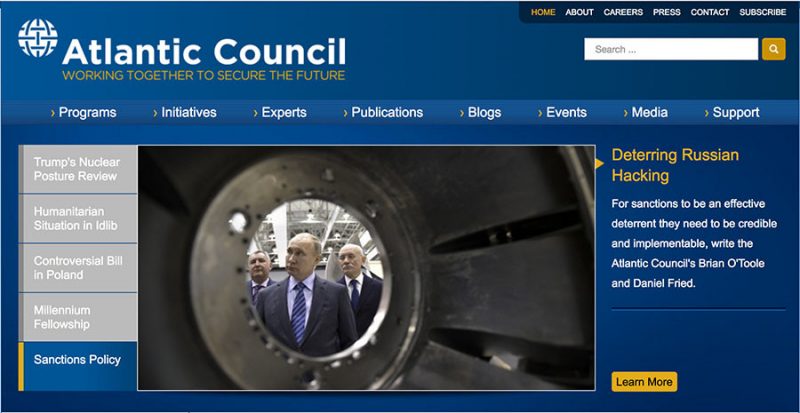
What does it do? Promotes the idea of Russia being an existential threat to Europe and the US, in order to justify NATO’s reason for being.
Who are its people? The Atlantic Council’s list of lobbyists (sorry, ‘Fellows’!) reads like a telephone directory of the Russia bashing world. For instance, Dmitri Alperovitch (of Crowdstrike, which conveniently alleges how Russia hacked the Democratic National Congress) is joined by the perennially- wrong Anders Aslund, who has predicted Russia’s impending collapse on a number of occasions and has, obviously, been off the mark. Then there’s Joe Biden’s “Russia hand,” Michael Carpenter and their recent co-authored Foreign Affairs piece suggests he actually knows very little about the country). Meanwhile, Evelyn Farkas, a fanatical Russophobe who served in Barack Obama’s administration has also found a home here. Another interesting Atlantic Council lobbyist is Eliot Higgins, a “geolocation expert” who has made a career out of spinning tales from the Ukraine and Syrian wars but is, naturally, mostly disinterested in covering Iraq and Yemen, where the US and its allies are involved, but Russia has no particular stake. Lastly, we can’t forget CNN’s Michael Weiss, the self-declared “Russia analyst” who, by all accounts, has never been to Russia and can’t speak Russian.
Who pays for it? The Atlantic Council has quite an eclectic bunch of patrons to serve. NATO itself is a big backer, along with military contractors Saab, Lockheed Martin and the Raytheon Company, all of which naturally benefit from increased tensions with Moscow. The UK Foreign Office also splashes the cash and is joined by the Ukrainian World Congress and the US Department of State. Other sugar daddies include the US military (via separate contributions from the Air Force, Navy, Army and Marine Corps), Northrop Grumman and Boeing.
- The Center for European Policy Analysis (CEPA)
Founded: 2005
What is it? Despite the name, CEPA is based in Washington, not the ‘old continent’, but it does have an outpost in Warsaw. This club specifically focusses on Central and Eastern Europe and promoting the US Army and foreign policy establishment’s agenda there. Or, in its own words, creating a “Central and Eastern Europe with close and enduring ties to the United States.”

screenshot from cepa.org
What does it do? CEPA amounts to a home for media figures who devote their careers to opposing Russia. It whips up tensions, even when they don’t really exist, presumably in order to drum up business for its sponsors, who are heavily drawn from the military industry. For example, it spent last year hyping up the ‘threat’ from Russia’s and Belarus’ joint ‘Zapad’ exercises, even running a sinister-looking countdown clock before the long-planned training commenced.
CEPA grossly overestimated the size of the event, saying it “could be the largest military exercise since the end of the Cold War” and dismissing basically all Moscow’s statements on its actual nature as “disinformation.”
Who are its people? Times of London columnist Edward Lucas has been part of CEPA for years.
Poland chooses Raytheon. Even if the missiles don’t work, America will defend its customers http://t.co/QwqrkCiosD
— Edward Lucas (@edwardlucas) April 21, 2015
The dedicated ‘Cold Warrior’ doesn’t appear to have spent much time in Russia for a long while and still seems to view the country through a prism which is very much rooted in the past. Thus, he’s more-or-less an out-of-touch dinosaur when it comes to Russia expertise. He will soon be joined by Brian Whitmore, who comes on board from RFE/RL and appears to be even more ill-informed than Lucas. His broadcasts for the US state broadcaster led to him being described as the “Lord Haw Haw of Prague,” where has been based for some years. CEPA is a pretty fluid organization and, until recently, Anne Applebaum and Peter Pomerantsev were also on its list of lobbyists. The former is a Polish-American Washington Post columnist who obsessively denigrates Russia and the latter has previously worked with the Atlantic Council’s Michael Weiss, which shows you how small and incestuous the Russia-bashing world is.
Who pays for it? While other think tanks at least try to make their funding look semi-organic, CEPA looks to have zero hang-ups about its role as a mouthpiece for defence contractors. Which is, at least, honest. FireEye, Lockheed Martin, Raytheon, Bell Helicopters and BAE systems pump funds in and they are joined by the US State Department and the Department of Defence. Another notable paymaster is the National Endowment for Democracy – ‘regime change’ experts who are surely interested in CEPA’s remit to also cover Belarus. The US Mission to NATO and NATO’s own Public Diplomacy Division also provide cash.
- German Marshall Fund of the United States
Founded: 1972
What is it? Don’t be fooled by the name, the German Marshall Fund (GMF) is a very American body these days with little input from Berlin. It was founded by a donation from Willy Brandt’s Bonn-government to celebrate the 25th anniversary of the Marshall Plan. Ironically, Brandt is today best remembered as the father of ‘Ostpolitik’, which sought a rapprochement between Germany and Russia.

What does it do? After the fall of the Soviet Union, the GMF transformed into a vehicle promoting US influence in Eastern Europe, with outreaches in Warsaw, Belgrade and Bucharest. However, in the past 12 months, it’s taken a very strange turn. Following the election of US President Donald Trump (ironically a German-American), the lobby group launched the Alliance for Securing Democracy (ASD) project. Its centerpiece is the ‘Hamilton 68 Dashboard’, which seems to classify social media users which reject the US liberal elite’s consensus as “Russian trolls.” The reaction has been highly critical, with even the secretly-funded Russian opposition website Meduza asking “how do you identify ‘pro-Russian amplifiers’ if… themes dovetail with alternative American political views?”
Who are its people? The GMF, especially through its new ASD plaything, has a high-profile bunch of lobbyists. They include Toomas Ilves, an American-raised son of Estonian emigrants who once headed the Estonian desk at erstwhile CIA cut-out Radio Free Europe and eventually became president of Estonia. Also on board is Bill Kristol, known as the ‘architect of the Iraq War’ and former CIA Director Michael Morrell. Former US Ambassador to Russia Michael McFaul, who recently announced he was partially abandoning his Russian scholarship and has “lost interest in maintaining my (sic) ability to speak/write Russian” is another team member.
And sorry that I am not responding in Russian. After being on the travel ban list to your country for 3 years, I have lost interest in maintaining my ability to speak/write Russian. You government seems to really fear me these days. странно и жалько https://t.co/8SRdSEvg5r
— Michael McFaul (@McFaul) January 20, 2018
After serving on Obama’s team, McFaul has re-invented himself as a network TV personality since 2016 with 280,000 Twitter followers, 106,000 of which are fake, according to Twitter audit.
Who pays for it? USAID are big backers, throwing in a seven-figure annual sum. This, of course, raises some questions about US taxpayers essentially funding the Hamilton 68 dashboard, which may be smearing Americans who don’t agree with their government’s policies as Russian agents. The State Department also ponies up capital, as does NATO and Latvia’s Defense Ministry. Other interesting paymasters are George Soros, Airbus and Google. While Boeing and the ubiquitous Raytheon are also involved.
- Institute for the Study of War
Founded: 2007
What is it? This lobby group could as easily be titled ‘The Institute for the Promotion of War’. Unlike the others, it doesn’t consider Russia its primary target, instead preferring to push for more conflict in the Middle East. However, Moscow’s increased influence in that region has brought the Kremlin into its crosshairs.
What does it do? The IFTSOW agitates for more and more American aggression. It supported the Iraq ‘surge’ and has encouraged more involvement in Afghanistan. IFTSOW also focuses on Syria, Libya and Iran. Just last week, one of its lobbyists, Jennifer Cafarella, called for the US military to take Damascus, which would bring Washington into direct conflict with Russia and Iran.
US occupation of Damascus – @TheStudyofWar seems to be calling for the US military to take Damascus and rebuild Syria. This seems the only “realistic” policy that could produce its demand to rid Syria of Assad’s government as well as Iranian and Russian influence. pic.twitter.com/nmSTkSzb5G
— Joshua Landis (@joshua_landis) February 3, 2018
Who are its people? Kimberly Kagan is the brains behind this operation. She’s married to Frederick Kagan, who was involved in the neocon ‘Project for the New American Century’ group along with his brother, Robert Kagan. Which makes Kimberly the sister-in-law of Victoria “f**k the EU” Nuland.
Another lobbyist is Ukrainian Natalia Bugayova, who was involved in Kiev’s 2014 EuroMaidan coup. She previously worked for the Kiev Post, a resolutely anti-Russian newspaper which promotes US interests in Ukraine. However, IFTSOW’s most notorious lobbyist was Elizabeth O’Bagy, who emerged as a ‘Syria expert’ in 2013 and called for American political leaders to send heavy weaponry to Syrian insurgent groups. She claimed to have a PhD from Georgetown University in Washington, DC, but this was fictional and once the media twigged to it, she was dismissed by the IFTSOW. Two weeks later, she was rewarded for her deception by falling up to a job with fanatical Russophobe Senator John McCain. O’Bagy has also collaborated with the Atlantic Council’s Michael Weiss, which is further evidence of how tight-knit the world of US neoconservative advocacy really is.
Who pays for it? Predictably, Raytheon has opened its wallet. Meanwhile, other US military contractors like General Dynamics and DynCorp are also involved. L3, which provides services to the US Department of Defense, Department of Homeland Security, and government intelligence agencies is another backer along with Vencore, CACI and Mantech.
US Missile Interceptor Test in Hawaii Fails
Sputnik – 31.01.2018
A US military SM-3 missile launched from an Aegis test site on Wednesday off the Hawaiian cost failed to intercept a mock incoming missile, according to US officials.
The Missile Defense Agency and US Navy “sailors manning the Aegis Ashore Missile Defense Test Complex conducted a live-fire missile flight test using a Standard Missile-3 (SM-3) Block IIA missile launched from the Pacific Missile Range Facility, Kauai, Hawaii, Wednesday morning,” the Missile Defense Agency confirmed, without specifying the result of the test.
The Raytheon missile is being developed in conjunction with Japanese counterparts as the threat of a North Korean missile strike hangs overhead.
In July, the SM-3 Block IIA failed to intercept an intermediate range ballistic missile as well. At the time, the Missile Defense Agency blamed the failed mission on human error and not the missile itself. Wednesday’s unsuccessful interception marks the second time the SM-3 Block IIA was unable to hit its target.
Last week, the Defense Department released a report stating that it was confident in its ability to protect the US mainland and Hawaii from “a small number” of North Korean intermediate range or intercontinental ballistic missiles, an improvement on the Government Accountability Office’s previous suggestions that the Ground-based Missile Defense component of the ballistic missile defenses had a “limited capability” to take out incoming missiles.
Iran announces sanctions on 15 US companies

Press TV – March 26, 2017
Iran has announced retaliatory sanctions on 15 American companies over their support for Israeli crimes and terrorism two days after Washington imposed bans on nearly a dozen foreign companies or individuals for aiding the Islamic Republic.
The Iranian Foreign Ministry said in a statement that these companies have directly and/or indirectly collaborated with the Israeli regime in committing its savage crimes in occupied Palestine, thrown their weight behind the regime’s terrorist acts or contributed to the expansion of illegal Israeli settlements in Palestinian territories in flagrant violation of UN Security Council Resolution 2334.
Therefore, any transactions with these companies and businesses shall be prohibited, their assets shall be subject to freezing, and no visas shall be issued for individuals holding positions in or associated with these corporations, the statement further noted.
The ministry also said Washington’s unilateral bans were imposed on Tehran “under fabricated pretexts,” censuring the restrictive measures as a violation of “international law” as well as the spirit and text of the 2015 nuclear deal, known as the Joint Comprehensive Plan of Action (JCPOA).
On Friday, the US State Department said Washington had sanctioned 30 foreign companies or individuals for transferring sensitive technology to Iran for its missile program or violating export controls on Iran, North Korea and Syria.
The statement further emphasized Iran’s resolve to develop its peaceful missile power as part of the nation’s “inalienable” right to enhance its deterrence and defense might in the face of threats.
The US sanctions targeted 11 companies or individuals from China, North Korea or the United Arab Emirates for transferring technology to Iran that it claimed could boost the country’s ballistic missile program.
Here is the list of the sanctioned US corporations:
– Beni Tal security company has collaborated with the Israeli military in the suppression of Palestinian people.
– United Technologies has sold Black Hawk military helicopters to the Israeli regime which have been used to bomb occupied territories and Palestinian refugee camps.
– Raytheon has supplied Israel with technologically advanced military weapons that have been used against Palestinian people during the Gaza war.
– ITT Corporation has provided the Israeli military with equipment it has used to stage nightly raids in Palestinian villages and refugee camps.
– Re/Max has been involved in illegal real estate transactions in Israeli settlements across occupied Palestinian territories.
– Oshkosh Corporation has been supplying the Israeli military with parts for armored vehicles used to restrain the Palestinian population.
– Magnum Research Inc. has collaborated with Israeli military industries in the manufacturing of firearms and military equipment.
– Kahr Arms has provided spare parts and developed light weapons used by the Israeli army in cooperation with the regime’s military industry.
– M7 Aerospace LP, purchased by US subsidiary of the Israeli military contractor Elbit Systems, has been active in the production and development of Israeli radar and missile systems.
– Military Armament Corporation has provided services and equipment linked to the weapons used by Israeli police.
– Lewis Machine and Tool Company has provided weapons spare parts and services to the Israeli military’s arms industry.
– Daniel Defense has provided the Israeli military’s arms industry with spare parts and services for weapons manufacturing.
– Bushmaster Firearms International has provided the Israeli military’s arms industry with spare parts and services for weapons manufacturing.
– O.F. Mossberg & Sons has supplied Israel with weapons, which are used by the regime’s military and police forces in the crackdown on Palestinian civilians.
– H-S Precision, Inc. has provided the Israeli regime with weapons manufacturing technology.
The Iranian Foreign Ministry stated that the list could expand to include more entities.
US Navy orders 214 Tomahawk cruise missiles worth $303 million
Press TV – December 29, 2016
The US Navy has put in a $303 million order for 214 Tomahawk cruise missiles and spares, a major contract that is likely to draw more fire over the force’s extravagant policies over the past years.
The contract for the long-range nuclear-capable Tomahawk Block IV missiles was granted to Raytheon, a major Pentagon contractor, UPI reported Thursday.
While the missiles will be chiefly used by the Navy, some of them would be sent to the UK as a foreign military sale.
The project is expected to finish by August 2018, according to the Pentagon, and the production work will be carried out in a variety of factories in Arizona, Michigan, Arkansas and other states.
Block IV is Tomahawk’s latest iteration and packs a two-way satellite data-link, which allows operators to reprogram the missile and change its target midflight.
Raytheon is also working with the Navy to enhance the missile’s capabilities by fitting in more powerful warheads, a targeting system for moving objects and better communication systems.
The order came at a time when the Navy was under heavy criticism for the failure of USS Zumwalt, one the most expensive American warships.
The $4.4 billion guided missile destroyer broke down while it was crossing the Panama Canal in late November.
Debuted in May, the futuristic-looking ship introduced a new class of warships that the Pentagon boasted were going to be the most advanced vessels ever built.
According to the General Accounting Office (GAO), the program is expected to cost more than $22 billion.
The force has also faced backlash over its other extravagant projects such as the USS Gerald Ford aircraft carrier, which is projected to cost around $13 billion.
This is while, according to Under Secretary of Defense Frank Kendall, the new technologies fitted into the aircraft carrier are likely to fail to perform as promised.
The Tomahawk deal with the UK cements Washington’s standing as the top weapons merchant in the world. The US raked in around $40 billion from arms sales in 2015.
Back to ‘Star Wars’: Obama Signs FY2017 Defense Bill
By Peter KORZUN | Strategic Culture Foundation | 29.12.2016
As the entire system of arms control is eroding, a war in the orbit appears to be a not so distant future. The US has just taken a big step forward to unleash an arms race in space.
On December 23, President Obama signed the National Defense Authorization Act – the legislation to re-launch the «Star Wars». The national ballistic missile defense (BMD) is to enter a new phase as the commander-in-chief struck the word «limited» from the description of the concept and the mission. The BMD has become «unlimited» now to greatly complicate the international security agenda and heighten tensions with Russia and China. The new law calls for the Defense Department to start «research, development, test and evaluation» of space-based systems for missile defense.
The efforts are to focus on the acquisition of technology to defeat both small-scale and large-scale nuclear attacks and unsettle the strategic balance in US favor.
According to Los Angeles Times, «the provisions signal that the US will seek to use advanced technology to defeat both small-scale and large-scale nuclear attacks. That could unsettle the decades-old balance of power among the major nuclear states». Rep. Trent Franks (R-Ariz.), who introduced and shepherded the policy changes in the House, said, «I hope that the day will come when we could have solid-state lasers in space that can defeat any missile attack». Welcome back to «Star Wars» of the eighties!
Philip E. Coyle III, a former assistant secretary of Defense who headed the Pentagon office responsible for testing and evaluating weapon systems, described the idea of a space-based nuclear shield as «a sham». «To do this would cost just gazillions and gazillions», Coyle said. «The technology isn’t at hand — nor is the money. It’s unfortunate from my point of view that the Congress doesn’t see that».
It should be noted that as a candidate, Barack Obama called ballistic missile defense plans «unproven» and vowed to cut them! The decision to re-launch the «Star Wars» is at odds with the opinion of many experts in the field. For instance, the 2016 report by the Union of Concerned Scientists (UCS), says the US missile defense program is costly, unreliable, and exempt from oversight. «Despite more than a decade of development and a bill of $40 billion, the GMD system is simply unable to protect the U.S. public», the authors wrote.
«The missile defense system is one of the most expensive and complex military systems in history, yet it is the only major defense program not subject to standard ‘fly before you buy’ performance standards», said UCS Senior Scientist Laura Grego, the report’s lead author. «Fifteen years of this misguided, hands-off approach has resulted in a costly system that won’t protect the homeland».
But defense contractors will get great profits. Three of them — Boeing Co., Raytheon Co. and Northrop Grumman — donated a total of $40.5 million to congressional campaign funds from 2003 through October of this year, according to federal election records.
The BMD efforts have never stopped. The US deploys powerful sea and shore-based Aegis air-defense systems that, with accurate guidance, could reach into orbit to destroy enemy spacecraft. The US Missile Defense Agency (MDA) is to reboot the concept of Airborne Laser by building a laser-armed aircraft that can shoot down ballistic missiles after launch – the time they are the most vulnerable.
The United States continues to invest in programs that could provide anti-satellite and space-based weapons capabilities. The US Air Force’s unmanned X-37B space plane has flown secret missions to Earth orbit, carrying a mystery payload. The spacecraft is a maneuverable, reusable, space test platform which boosts into low orbit – around 250 miles high – atop a rocket but lands back on Earth like an airplane. According to Dave Webb, chairman of the Global Network Against Weapons Nuclear Power in Space, the X-37B «is part of the Pentagon’s effort to develop the capability to strike anywhere in the world with a conventional warhead in less than an hour», known as the Prompt Global Strike.
America is funding the development of the Spaceborne Payload Assist Rocket-Kauai (SPARK) launch system, designed to send miniaturized satellites into low-Earth and sun-synchronous orbits. Speedy replacement of disabled satellites in the event of attack is to secure the US military’s use of space constellations in support of operations during a conflict. In its efforts to rapidly launch swarms of miniaturized satellites on the cheap, the US military is also looking to leverage the private sector.
The reusable recovery of a SpaceX’s Falcon 9 has fundamentally changed the military balance of power and, perhaps inadvertently, launched the era of space militarization. According to Stratfor Global Intelligence (SGI), «the battle to militarize space has begun». The think tank believes that «as existing technologies proliferate and new developments provide greater access to space, Cold War frameworks for the peaceful sharing of Earth’s near orbit will erode».
Weapons of mass destruction are banned from space under the 1967 Outer Space Treaty. But the Treaty does not ban the placement of conventional weapons in orbit.
The potential arms race in space in an issue of major concern for the United Nations. In 2008, Russia and China proposed the first ever draft Treaty on the Prevention of the Placement of Weapons in Outer Space, the Threat or Use of Force against Outer Space Objects (PPWT). The initiative led nowhere being torpedoed by the United States.
In December 2015, The United Nations General Assembly adopted a Russia-led resolution calling for a nonbinding restriction against the first placement of weapons in outer space (also known as «no first placement initiative»). 129 nations, including China voted to adopt the measure. The only government objecting to the substance of our initiative was the United States. The EU abstained. According to Russian officials, the United States rejects the idea of holding talks with Russia on the problem.
By signing the bill into law, President Obama has ushered the world into an unfettered arms race, unsettling the balance of power among the major nuclear states. The implementation of the law will result in wasting a lot of money while the national debt is heading to $20 trillion.
The landmark change to the BMD policy, especially the plans to base weapons in space, will inevitably complicate the relationship with Russia at the time the entire system of arms control and non-proliferation is about to unravel. From now on, the US will always be perceived as a warmonger who launched an armed race in space and did away with the restrictions on BMD plans – the unsolved problem that obstructs any efforts to address the security agenda and gain positive results.
‘Make More War’: The Corporate Engine Behind US Foreign Policy
Sputnik – 14.05.2016
As the US Senate Armed Services Committee considers the 2017 Pentagon budget, political analyst Eric Draitser joins Radio Sputnik to discuss the ever-growing military-industrial complex.
“[President Dwight Eisenhower] was suggesting… that the danger for the United States was that these massive military contractors, these military-industrial firms, would eventually be able to control both sides of the government, both major parties, and be able to effectively create policy to their own liking,” Draitser told Loud & Clear’s Brian Becker, paraphrasing the former World War II five-star general and US President’s 1961 warning.
“And here we are in 2016 and that is, of course, exactly what’s happened…”
While President Barack Obama ran on a platform of reigning in US military endeavors, he has proven unable – or unwilling – to do so.
“Obama has raised spending on the military to historic levels. He has, obviously, waged countless wars; at least seven by the conservative count. Obama is, of course, upping aid to Israel… expanding [the] US military footprint in Asia with the Asia pivot strategy, expanding [the] US military in Africa…” Draitser says.
“If you look at it in its totality, Obama really works hand-in-glove with the military-industrial complex.”
The new draft bill of National Defense Authorization Act highlights this.
“[The bill shows] increased spending. I believe $1.5 billion for new aircraft. $1.5 billion for F-35s manufactured by Lockheed Martin. Army helicopters, Apache strike teams. We could go on and on down the list of all of these increases in spending.
“The consensus is ‘make more war.'”
Even presidential hopeful Bernie Sanders, one of the most progressive members of the US Congress, isn’t guilt-free.
“Bernie Sanders lobbied for F-35 production in Vermont,” Draitser says. “He has a vested interest in making sure that this military program…took place in Vermont. He lobbied for it, he was in favor of it, and he’s gone down, at least in Vermont history, as a major supporter of that program.
“So even when you go to the left-progressive end of the political spectrum, they have a vested interested in making sure that programs such as the F-35 continue.”
The problem also relates to the Obama Administration’s inability to close the detention center at Guantanamo Bay.
“The story continues to be the same tired narrative that Obama desperately wants to close Guantanamo. It’s just this political gridlock, it’s the legislation, it’s the language that’s in place, it’s the Republicans, it’s the boogeyman, it’s Putin, it’s everybody preventing Obama from closing Guantanamo,” Draitser says.
“When in fact it is a consensus that Guantanamo stay open.”
The military-industrial complex is also the driving factor behind the military buildup in Eastern Europe, despite claims about defending against “Russian aggression.”
“The beneficiaries of these types of policies are Lockheed Martin and Raytheon and Boeing and all of these massive multinational military corporations that make hundreds of billions of dollars off of precisely these kinds of policies,” he says.
“When [NATO] talks about spending money in Eastern Europe to ‘reassure our partners,’ what they really mean is bolstering US military power along Russia’s western flank.
“There could not be a more dangerous policy.”
Big money in politics doesn’t just drive inequality — it also fuels war
By Rebecca Green | OtherWords | April 20, 2016
The 2016 presidential elections are proving historic, and not just because of the surprising success of self-proclaimed socialist Bernie Sanders, the lively debate among feminists over whether to support Hillary Clinton, or Donald Trump’s unorthodox candidacy.
The elections are also groundbreaking because they’re revealing more dramatically than ever the corrosive effect of big money on our decaying democracy.
Following the 2010 Citizens United Supreme Court decision and related rulings, corporations and the wealthiest Americans gained the legal right to raise and spend as much money as they want on political candidates.
The 2012 elections were consequently the most expensive in U.S. history. And this year’s races are predicted to cost even more. With the general election still six months away, donors have already sunk $1 billion into the presidential race — with $619 million raised by candidates and another $412 million by super PACs.
Big money in politics drives grave inequality in our country. It also drives war.
After all, war is a profitable industry. While millions of people all over the world are being killed and traumatized by violence, a small few make a killing from the never-ending war machine.
During the Iraq War, for example, weapons manufacturers and a cadre of other corporations made billions on federal contracts.
Most notoriously this included Halliburton, a military contractor previously led by Dick Cheney. The company made huge profits from George W. Bush’s decision to wage a costly, unjustified, and illegal war while Cheney served as his vice president.
Military-industrial corporations spend heavily on political campaigns. They’ve given over $1 million to this year’s presidential candidates so far — over $200,000 of which went to Hillary Clinton, who leads the pack in industry backing.
These corporations target House and Senate members who sit on the Armed Forces and Appropriations Committees, who control the purse strings for key defense line items. And cleverly, they’ve planted factories in most congressional districts. Even if they provide just a few dozen constituent jobs per district, that helps curry favor with each member of Congress.
Thanks to aggressive lobbying efforts, weapons manufacturers have secured the five largest contracts made by the federal government over the last seven years. In 2014, the U.S. government awarded over $90 billion worth of contracts to Lockheed Martin, Boeing, General Dynamics, Raytheon, and Northrop Grumman.
Military spending has been one of the top three biggest federal programs every year since 2000, and it’s far and away the largest discretionary portion. Year after year, elected officials spend several times more on the military than on education, energy, and the environment combined.
Lockheed Martin’s problematic F-35 jet illustrates this disturbingly disproportionate use of funds. The same $1.5 trillion Washington will spend on the jet, journalist Tom Cahill calculates, could have provided tuition-free public higher education for every student in the U.S. for the next 23 years. Instead, the Pentagon ordered a fighter plane that can’t even fire its own gun yet.
Given all of this, how can anyone justify war spending?
Some folks will say it’s to make us safer. Yet the aggressive U.S. military response following the 9/11 attacks — the invasions of Iraq and Afghanistan, the NATO bombing of Libya, and drone strikes in Pakistan and Yemen — has only destabilized the region. “Regime change” foreign policies have collapsed governments and opened the doors to Islamist terrorist groups like ISIS.
Others may say they support a robust Pentagon budget because of the jobs the military creates. But dollar for dollar, education spending creates nearly three times more jobs than military spending.
We need to stop letting politicians and corporations treat violence and death as “business opportunities.” Until politics become about people instead of profits, we’ll remain crushed in the death grip of the war machine.
And that is the real national security threat facing the United States today.
Pentagon OKs $683 Million Smart Bomb Deal for Turkey
Sputnik – 01.03.2016
As the Turkish government escalates tensions across the Middle East, the Pentagon has authorized a multimillion dollar deal to sell smart bombs to Ankara.
Last December, the Turkish government deployed a battalion of 25 tanks and roughly 1560 troops into northern Iraq. Acting without Baghdad’s permission, the move was roundly condemned as a breach of sovereignty. Ankara has also been engaged its own internal war against Kurdish communities in the country’s southeast, with the death toll reaching some 5,000 people.
Now, with all parties honoring the Syrian ceasefire, Turkey is threatening to plunge its neighbor back into the five-year civil war.
“[The Turkish government] view themselves as victims and losing parties in the Syrian war,” Germany’s Telepolis magazine noted. “For this reason they will resort to provocations until the ceasefire is shattered.”
Despite Turkey’s destabilizing influence in the region, Washington has chosen to award a $682.9 million contract which will provide Ankara with an undisclosed number of smart bombs.
“The deal came timely as we are deeply engaged in asymmetrical warfare and need smart bombs,” one Turkish military official said, according to Defense News.
The contract was granted to Ellwood National Forge and General Dynamics Ordnance and Tactical Systems, and includes the sale of of an unnamed number of BLU-109 bunker busters. These bombs contain roughly 550 pounds of a high explosive compound known as tritonal, and thanks to tail fuse delays, the bomb’s detonation is stalled until it reaches its intended underground target.
This is the first such sale to Turkey by US defense contractors, and Ankara expects the transaction to be completed by 2020.
Despite its continuing aggression, Turkey is a key NATO ally, so Washington’s complicity in Ankara’s actions do not come as a surprise.
The US has also played an active role in Saudi Arabia’s Yemen campaign, providing the bombs used during Riyadh’s air campaigns.
“Saudi Arabia has engaged in war crimes, and the United States is aiding and abetting them by providing the Saudis with military assistance,” Marjorie Cohn writes for teleSUR.
“In November 2015, the US sold $1.29 billion worth of arms to Saudi Arabia. It included more than 10,000 bombs, munitions, and weapons parts manufactured by Raytheon and Boeing, as well as bunker busters, and laser-guided and ‘general purpose’ bombs.”
Featured Video

No Threat Can Force Iran’s Surrender /Trita Parsi & Lt Cl Daniel Davis
or go to
Aletho News Archives – Video-Images
From the Archives
An Expert Military Analysis of War with China
Actually, None is Necessary
By Fred Reed • Unz Review • December 13, 2020
The Correlation of Armed Forces: U.S. goods and services trade with China totaled an estimated $634.8 billion in 2019. Exports were $163.0 billion; imports were $471.8 billion. The U.S. goods and services trade deficit with China was $308.8 billion in 2019. Trade in services with China (exports and imports) totaled an estimated $76.7 billion in 2019. Services exports were $56.5 billion; services imports were $20.1 billion. The U.S. services trade surplus with China was $36.4 billion in 2019.
There is talk within the Washingtoniat of a possible war with China. Steve Bannon, who apparently was dropped on his head as a child, actually favors such a war. We hear the usual shoo-the-boobs alarm about how the Chinese are doing something terrible and we must gird our loins and American values and show them what for, bow wow, woof. The danger is that the current game of who-blinks-first in Asian waters might actually provoke a shooting war. You know the kind of thing: One warship refuses to get out of the way of another, a collision ensues, some retard lieutenant who signed up on waivers opens fire, and we’re off and running. It is not a good idea to let children play with matches.
The said war is discussed either in emotional terms by idiots or in purely naval terms by those familiar with such things, so we hear of the First Island Chain and the Second Island Chain and whose missiles against the other’s missiles and so on. This would be appropriate if we were fighting World War Two again. Which we aren’t. Let’s take a quick-and-dirty look at how such a war might go.
To begin the war, America would overestimate itself and underestimate China. This is doctrine in the Pentagon. … continue
Blog Roll
 Aletho News
- Theodore Postol: Iran’s Missiles & Drones Were Underestimated
- Iran To Target Military Industrial-Tech Complex That Facilitated Gaza Genocide
- Collapsing Empire: The Resistance Disarms ‘Israel’
- Suicide Should Not Be a Government Service
- Rethinking America’s greatest threat: Iran vs. Israel-Firsters
- Iran accuses adversaries of false flags to strain Turkey ties
- Poland rules out sending Patriot missiles to US/Israel amid war on Iran
- Tehran approves new Hormuz plan with major restrictions
- No Threat Can Force Iran’s Surrender /Trita Parsi & Lt Cl Daniel Davis
- UK’s New Pandemic Plan Would Turn Big Tech Into a Mass Location Tracking Network
- If Americans Knew
- Ann Coulter Rips Into Fox News for Iran War Coverage, Compares to False Rigged 2020 Election Reporting
- Joe Kent Urges Americans To Call White House and Congress To Object To Sending Troops Into Iran
- DNC Resolution to Reject AIPAC Funding Puts Democratic Leaders in the Hot Seat
- Swedish foundation to build 400 schools as over 650,000 Gaza children remain without education for 2 years
- Israeli army admits photshopping image of slain Lebanese journalist
- This is how Israel is systematically killing health workers under the cover of war in Lebanon
- Carrying life under fire: Israeli invasion of Lebanon leaves pregnant women facing deadly risks
- Champagne all around for the new death penalty (for Palestinians) law – Not a ceasefire Day 172
- Why are Palestinian books struggling to be seen on Amazon?
- The Line Between Affinity and Conspiracy
- No Tricks Zone
- New Study Finds Warming Saves Lives…Cold Temperatures 12 Times More Deadly Than Excess Heat
- German Science Blog Accuses PIK Climate Institute Of Hallucinating Climate Tipping Points
- Devastating Assessment Of Comirnaty Vaccine By Former Senior Pfizer Europe Toxicologist
- New Study: CO2 Is ‘Effectively Negligible’ As An Explanatory Climate Change Factor Since 2000
- Former Pfizer Toxicologist Dr. Helmut Sterz Tells Bundestag Hearing Pfizer Vaccine Should Have Never Been Approved
- Energy Expert: Germany’s Nuclear Phaseout Was A “500 Billion Euro Mistake”
- New Research: South Australia’s Mid-Holocene Sea Surface Temperatures Were 4°C Warmer Than Today
- Storing Green Energy To Last Germany 10 Days Would Require A 60-Million Tonne Battery
- New Studies: UK Sea Levels Were 4 Meters Higher Than Today During The Mid-Holocene
- Destructive Green New Deal: German Energy And Metal Group Warns Of Drastic Crisis
 Aletho News