Encircling Russia? RAF Typhoon fighters will deploy to Romania in May
RT | March 28, 2017
Royal Air Force (RAF) fighter aircraft will deploy to Romania in May as part of NATO’s continued militarization of Eastern Europe.
The initiative will see four Typhoons from RAF Coningsby, Lincolnshire, deploy to Mihail Kogalniceanu Airbase in Romania until September.
They will carry out patrols of the Black Sea area as part of the Southern Air Policing mission conducted under NATO command. The UK is the first ally to provide aircraft for the task.
“The UK is stepping up its support for NATO’s collective defense from the north to the south of the alliance,” said Defense Secretary Michael Fallon.
“With this deployment, RAF planes will be ready to secure NATO airspace and provide reassurance to our allies in the Black Sea region,” he added.
The announcement follows the deployment of hundreds of British troops to Estonia to function as a ‘tripwire’ against what UK commanders have called Russian aggression.
The NATO battle group in Estonia will be stationed at Tapa.
The UK will contribute the bulk of multinational force in Estonia, sending in a total of 800 soldiers.
France will post 300 soldiers to Estonia – to be replaced by the Danes in 2018.
All troops will act in conjunction with Estonia’s 1st Infantry Brigade.The deployment is designed to counter an “increasingly assertive Russia,” Fallon said on the first 130 troops’ departure.
“NATO is stepping up its commitment to collective defense,” Fallon said, according to Sky News.
“British troops will play a leading role in Estonia and support our US allies in Poland, as part of wider efforts to defend NATO.”
Europe’s United Market is a ‘Project for the Business Establishment’
Sputnik – February 11, 2017
The euro currency is a major factor accelerating the process of economic and political disintegration within the European Union, according to Belgian left politician Peter Mertens.
The European Union is now “disintegrating,” Paul Magnette, Minister-President of the Belgian French-speaking region of Wallonia, said in a recent interview with L’Echo.
“We are nearing a process of political disintegration, with some countries becoming ungovernable,” the politician said.
Magnette also criticized the euro currency as poorly thought-out, which accelerated “social and financial deregulation.”
Magnette has been known as a vocal critic of the Comprehensive Economic and Trade Agreement (CETA), a free trade deal between the EU and Canada. In the interview, he also spoke out for withdrawal from the bloc of such countries as Romania, Bulgaria, Poland and Hungary, following the Brexit example.
Magnette’s remarks are especially surprising, taking into account the fact that such criticism came from a left-wing and pro-European politician.
Peter Mertens, the leader of the Workers’ Party of Belgium, underscored that in Belgium criticism of the current state of European integration comes from left-wing political forces, not from the right, like in France or in the Netherlands.
“From the very beginning, the euro has been a problem. The currency was designed to serve the interests of Germany, Europe’s strongest economy. It was clear that the European united market was not people’s will. It was a project for the business establishment,” Mertens said in an interview with Sputnik French.
The politician shared Magnette’s suggestion that the eastward expansion of the European Union was not conducted properly.
“In 2007-2008, several Eastern European countries joined the EU. The main reason was that German companies were looking for a cheap labor force. At the same time, it was clear that such countries as Bulgaria and Romania were not as economically developed as Central Europe. As a result, now there are two polarities in the EU, between the north and the south and between the west and the east,” Mertens pointed out.
He also agreed with Magnette that the introduction of the euro only deepened the social and economic divisions within the EU.
“In my opinion, the euro currency system was built under Germany’s surveillance. And I think that to a certain extent the current EU is autocratic and authoritarian,” he said.
Nevertheless, Mertens warned that a withdrawal of Eastern European countries from the EU would not resolve the crisis.
“We should not forget that we need to protect those countries. Now, some political forces call for cooperation only with economically developed countries. But we should continue our cooperation with Poland and other Eastern European countries,” he said.
Mertens also said that criticism of the European Union should not be monopolized by right-wing political movements.
“These concerns [about the crisis in the EU] can be expressed in many ways. For example, criticism can be expressed by the nationalists or the far-rights, like in France and the Netherlands. But it can also come from the left, like in Spain or Wallonia. The common idea is that the current political elites do not represent their people anymore,” Mertens concluded.
Exercise Sea Shield-2017: NATO Provokes Russia in Black Sea Before Defense Ministers’ Meeting
By Alex GORKA | Strategic Culture Foundation | 10.02.2017
Russian President Vladimir Putin has ordered snap drills to be held by the Aerospace Forces and other branches to evaluate its preparedness against potential aggression. The exercise started on February 7.
Some Western media have accused Moscow of preparing to start an aggression. In reality, the action is taken in response to NATO and Ukraine’s provocative activities in the Black Sea. 16 warships, a submarine and 10 warplanes along with some 2,800 troops from Ukraine, Romania, Turkey, Bulgaria, Greece, Spain, Canada, and the US are taking part in exercise ‘Sea Shield 2017’ scheduled to run between February 1 and 11 in the proximity of Russian borders.
HMS Diamond of the UK Royal Navy is sent to participate in the event. It’s a rather symbolic move. This is the first time since the Cold War that a British naval vessel entered the waters of the Black Sea. According to British Defense Minister Michael Fallon, this is the way that the British government confirms its support of Ukraine – a hostile act towards Russia. After the NATO exercise, the ship will visit Odessa to hold bilateral drills with Ukraine. The destroyer has 60 Special Boat Service and Royal Marine commandos on board. It’s logical to expect amphibious landing to be part of the exercise.
According to the Daily Mail, HMS Diamond will lead a NATO task force and help protect 650 British troops who are involved in secret exercises in Ukraine. There is ground to believe that something is cooking up.
NATO defense ministers will meet February 15-16 in Brussels to discuss a package of measures aimed at bolstering military presence in the Black Sea. The proposals on two basic elements for the maritime component – a strengthened training framework and a coordination body for the Black Sea that reports to the specialized NATO command – are expected to be submitted for consideration.
The organization plans to build NATO’s Black Sea presence on land around a Romanian-led multinational framework brigade in the process of formation. Nations who have pledged to contribute include Canada, Germany, the Netherlands, Poland, Turkey and the United States. The unit is intended to facilitate the deployment of reinforcements. Georgia and Ukraine will be fully involved in the plans.
Romania calls for a regular trilateral format of joint naval exercises in the Black Sea, along with Turkey and Bulgaria, with the eventual participation of non-littoral NATO members.
The UK, Canada and Poland will send aircraft to be based in the Romanian southeastern Mihail Kogalniceanu air base. Romania, Bulgaria and Turkey are also expected to come forward with a plan to increase naval and air patrols. Romania and Bulgaria will host aircraft designed to carry out surveillance missions.
Last September, US and Bulgarian aircraft launched joint regular patrols in the Black Sea. The patrolling mission greatly increases the risk of an accident, especially with the Russian S-400 long range systems stationed in Crimea. Russian aircraft deployed in the Northern Caucasus and Rostov region are capable of controlling the whole Black Sea. President Putin has already warned NATO about the consequences such policy would lead to.
There has been a surge in airspace violations and instances where aircraft are scrambled to intercept foreign jets amid a sharp rise in tensions in the region. For instance, Sea Shield-2017 exercise started with an incident. Ukraine accused Russia of firing at its An-26 cargo aircraft on a training flight. The plane flew provocatively low over an oil rig. A security guard gave flash signals from a signal pistol to prevent the plane from crashing into the drilling tower.
Non-Black Sea NATO members cannot stay in the Black Sea more than 21 days, according to the Montreux Convention. NATO has three members with Black Sea ports in Romania, Bulgaria and Turkey, as well as two more aspiring members in Ukraine and Georgia.
Bulgarian, Romanian, Ukrainian and Georgian navies have limited capabilities. It brings to the fore the possibility of major NATO sea powers handing over some of their own warships to them. The ships could be reflagged to beef up permanent naval capabilities in the theater. US warships frequent the Black Sea to provide NATO with long-range first strike capability.
Romania hosts a ballistic missile defense (BMD) site believed to be capable of launching long-range surface-to-surface cruise missiles in what constitutes a violation of INF Treaty. Aegis Ashore uses the naval Mk-41 launching system capable of firing such weapons. Located near Caracal in south central Romania, Aegis Ashore is part of the second phase of the so-called «European Phased Adaptive Approach» (EPAA) to an overall NATO missile defense architecture.
Bulgaria also plays a prominent role in NATO’s plans to bolster the bloc’s military presence in the region. This year, Novo Selo, a US military base in Bulgaria, is expected to host more American and NATO troops. The first of three six-month rotations of about 150 US Marines, part of the Black Sea Rotational Force, is due at Novo Selo in September. US Army soldiers come to Bulgaria for training on a rotational basis. Under the 2006 defense cooperation agreement, the United States has access to three Bulgarian military bases.
The US plans to deploy up to 2,500 troops at Novo Selo; the base can hold as many as 5,000 during joint-nation exercises with NATO allies. The facility’s construction is almost finished; the plans are on the way to upgrade the training ranges this year. The upgrade includes adding a helicopter landing zone and an air operations building. The base is expected to host US heavy tanks. A NATO maintenance support area is to be built in Sliven or Plovdiv.
For the US, the Black Sea is a remote region where it has no interest. It’s different for Bulgaria as 80 percent of Bulgarian exports and imports transit the Black Sea and tourism contributes heavily to the country’s economy, increased maritime militarization could have a widespread negative economic impact in case of accidents or clashes.
Nothing justifies the whipping up of tensions by NATO in the Black Sea region. Too provocative and too dangerous. An incident may spark a fire. The INCSEA agreement appears to be dead as the events in the Baltic Sea demonstrate.
While the Islamic State poses a threat to the very existence of NATO members, the alliance is engaged in provocations to intimidate Russia – its natural ally in the fight against the common enemy. Does it meet the interests of the alliance members? It would stand NATO defense chiefs in good stead if they asked themselves this question at the February 15-16 meeting.
15 European leaders call for new arms deal with Russia
RT | November 26, 2016
Fifteen European countries, headed by Germany, have issued a statement pushing for the reopening of “a new structured dialogue” with Russia aimed at preventing a possible arms race in Europe, according to the German foreign minister.
The countries, all belonging to the Organization for Security and Cooperation in Europe (OSCE), have expressed their deep concern over the current situation in Europe and support the relaunch of a conventional arms treaty with Russia, German Foreign Minister Frank-Walter Steinmeier told Die Welt newspaper in an interview published on Friday.
“Europe’s security is in danger. As difficult as ties to Russia may currently be, we need more dialogue, not less,” Steinmeier said.
The ongoing conflict in the Eastern Ukraine and the fact that Crimea joined Russia in 2014, a move most often dubbed as “annexation” by western officials, have put the question of war in Europe back on the table, Steinmeier continued. Fragile trust between Russia and European countries has suffered a significant setback and a “new armament spiral” is hanging over the continent, the foreign minister warned.
The statement contains strong anti-Russian rhetoric, blaming Moscow for violating arms deals as far back as 1990.
“The Conventional Forces in Europe treaty, which led to the destruction of tens of thousands of heavy weapon systems in Europe in the years following 1990, is no longer being implemented by the Russian Federation,” the statement said.
Russia put its participation in the treaty on hold in 2007 and then fully walked out of it last year.
Russian President Vladimir Putin called for the suspension of the treaty following a US decision to locate missile defense facilitates in the neighbouring Czech Republic and Poland. On top of that, President Putin noted that some of the NATO members did not join or ratify the treaty and there was no point in Russia abiding by the agreement.
Later Putin signed a decree suspending the treaty due to “extraordinary circumstances … which affect the security of the Russian Federation and require immediate measures,” having notified NATO and its members of the decision.
Since then NATO has taken no steps to upgrade the treaty, the Russian Foreign Ministry said in September, 2016, adding that Moscow is ready for dialogue on the subject. However, it is not planning to be the one to initiate it.
The statement names a number of other documents that need to be overviewed, including the OSCE’s Vienna document, stipulating the exchange of information on military movements, and the Open Skies treaty, enabling the monitoring of other countries’ ground forces. The documents are either neglected or in need of modernization.
The countries that spoke in favor of Steinmeier’s initiative include France, Italy, Austria, Belgium, Switzerland, the Czech Republic, Spain, Finland, the Netherlands, Norway, Romania, Sweden, Slovakia, Bulgaria and Portugal.
The group of the European foreign ministers is planning to meet again on the sidelines of a OSCE meeting in Hamburg on December, 8-9.
Russia Pushes Back on NATO Expansion
By Natylie Baldwin | Consortium News | July 9, 2016
Can Russian President Vladimir Putin turn the tables on NATO and the European Union in the Balkan states that are not yet members of the Atlanticist project? According to Filip Kovacevic, a political science professor who specializes in Russia and Eastern Europe, Putin has a plan. Some details were provided in an exclusive report in May on the nascent project by Russia to counter NATO expansion into the remaining Balkan countries that have not yet been swept into the Western alliance.
The plan has its origins in the grassroots movement that arose in the aftermath of the first Cold War, which called for non-alignment and cooperation with both East and West. Kovacevic describes the movement as follows:
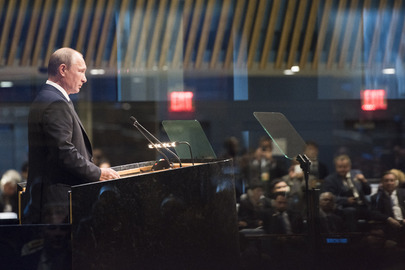
Putin addresses the UN, 09-28-15. (UN Photo)
Their members were generally young people who were enthusiastic, honest and genuinely committed to the public good, but were plagued by the lack of funding and faced with frequent media blackout and open discrimination. Nonetheless, their programs articulated the most promising and humane geopolitical vision for the Balkans. They conceptualized the Balkans as a territorial bridge between the West and the East rather than as the place of persistent confrontation, or the ‘line of fire’ as formulated by the U.S. Secretary of State John Kerry in 2015. They wanted the Balkans to become a force for peace and human dignity in the world. Their vision still remains the best option for the Balkans people.
This desire for non-alignment is understandable as a continuation of the policy of Tito’s Yugoslavia during the Cold War – the nation that several of the modern day Balkan states were a constituent part of. However, according to Kovacevic, these groups were easily overwhelmed, in terms of both financial and propaganda resources, in the 1990s by pro-NATO forces in the West.
In addition to providing resources to build up pro-NATO sentiment in the media and NGO sectors of these countries, financial resources and pressure was used to sway a large number of politicians to favor NATO membership, often in opposition to the general population’s views. Some of the unsavory forms of incentive or pressure include what amounts to blackmail and bribery, Kovacevic told me in an email interview:
This is a long-term process. In the U.S. intelligence community it is called ‘seeding.’ The intelligence scholar Roy Godson defines it as ‘identifying potential agents of influence’ at an early stage and then acting to advance their careers. This is typically done covertly, but there have been the historical examples of overt support. …
In the Balkans, the key role in the process of ‘seeding’ was accomplished by various institutes, conferences, retreats, grants, etc. For instance, I was told by a confidential source who participated in the same U.S.-NATO program, the long-time foreign minister and one-time prime minister of Montenegro, Igor Luksic, was a product of such a process. Luksic was chosen as a very young man to attend various conferences and retreats in Brussels and Washington and, after that, his political career really took off. All the while, he promoted the NATO agenda in Montenegro, even though this went against the will of the majority of the population.
Another example is Ranko Krivokapic who was the speaker of the Montenegrin Parliament for over a decade. He traveled on official business to the U.S. a few times every year and boasted to others that he had a lot of friends in the State Department and other institutions of the U.S. government. There are examples like these in Serbia, Macedonia, Croatia, etc. All over the Balkans.
There is also the fact the European Union has dovetailed its security arrangements to such an extent with NATO that new members are now virtually brought into the NATO structures by default. For example, Mahdi D. Nazemroaya, author of The Globalization of NATO, reports that the E.U.’s Security Strategy was absorbed into NATO during its annual summit in 2006. The emphasis of the summit was on securing energy resources with the goal of ‘co-managing the resources of the EU’s periphery from North Africa to the Caucuses.’ Also implied was the goal of redefining the E.U.’s security borders in synch with both Franco-German and Anglo-American economic and geopolitical interests.
Moreover, British Russia scholar Richard Sakwa, has pointed out that the security integration of the E.U. with NATO was further intensified with the ratification of the Treaty of Lisbon in 2007:
As for the comprehensive character, this is something that has been gaining in intensity in recent years as the foreign and security dimension of the E.U. has effectively merged with the Atlantic security community. The E.U.’s Common Foreign and Security Policy (CFSP) since the Treaty of Lisbon (the “Reform Treaty”) of 13 December 2007, which came into effect in 2009, is now in substance part of an Atlantic system. Acceding countries are now required to align their defense and security policy with that of NATO, resulting in the effective ‘militarization’ of the E.U.
At this point, the forces seeking a non-aligned bridge role for the Balkan states are still very much around, but have suffered marginalization due to lack of resources to take on the powerful and now entrenched pro-NATO political forces. However, with increasing discontent with the weak economic prospects in certain Balkan states, combined with increasing instability in the E.U., it is believed that there is an opening for growth of the movement.
Economic Conditions in the Balkans
The Balkan states comprise Romania, Bulgaria, Albania, Macedonia, Serbia, Kosovo, Montenegro, Bosnia-Herzegovina and Greece.
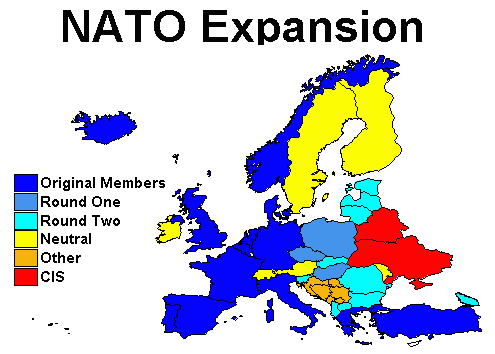
A map showing stages of NATO’s expansion. Dark blue showing original members; lighter blue the “round one” members; aqua the “round two” members; yellow represents neutral states; and brown and red otherwise aligned (including Ukraine, although that has changed since the 2014 U.S.-backed coup).
In 2007, Romania and Bulgaria became E.U. members (three years after joining NATO). Romania’s GDP has barely kept up with its 2008 rate and has a general unemployment rate of 6.4 percent, which sounds reasonable until you look at the youth unemployment rate of 21 percent, which doesn’t bode well.
Bulgaria, on the other hand, is not part of the Eurozone and has not adopted the euro as its currency. Its economic prospects since joining the E.U. have not been impressive either. In the midst of the financial crisis of 2009, its GDP contracted by 5.5 percent, with a current unemployment rate of 7 percent and youth unemployment at 17 percent. Bulgaria is also recognized as one of the union’s most corrupt countries.
Macedonia, Montenegro, Serbia, Kosovo, Bosnia-Herzegovina and Albania are all in the process of E.U. integration, with a supposed approval rate of 80-90 percent among the respective populations of these countries (except for Serbia), despite the virtual rape of Greece and the lackluster performance of Romania and Bulgaria.
It should be noted that all three Balkan nations that are actual E.U. members have higher emigration than immigration rates, another indication that accession to the E.U. doesn’t necessarily translate into a prosperous future for the average person, particularly the young.
There is also the instability highlighted by the British people’s vote to leave the E.U., spurred by disgust with austerity measures imposed by unaccountable bureaucrats in Brussels along with an influx of immigrants – one-third from these poorer E.U. nations – which adversely affect lower-wage natives.
Even if the E.U. had a better track record of effectiveness in terms of improving economic conditions for the masses, it would have a very tall order with some of the prospective Balkan states. Macedonia, for example, has an unemployment rate between 24 and 25 percent as of January 2016, although it has improved from the 2005 high of 37 percent. Despite this improvement, Macedonia still has one of the lowest GDPs in Europe and 72 percent of its citizens claimed they manage their household income only with “difficulty” or “great difficulty” in 2012.
Bosnia-Herzegovina is still feeling the effects of the war of 1992 to 1995 that included major physical destruction of infrastructure and the bottoming out of its GDP. It currently suffers an unemployment rate of 42-43 percent.
Kosovo, a state that owes its existence to a NATO intervention, has 33 percent unemployment, a high crime rate and increasing political violence due to ethnic tensions and a growing ultra-nationalist movement. The Council of Europe compared the government of Kosovo to a mafia state in a 2010 report which revealed trafficking in human organs as well as drugs and weapons throughout Eastern Europe, even implicating the then-prime minister in the operation.
Russia’s Opening
Kovacevic states that the Atlanticist project of E.U. austerity economics and the enabling of Washington’s destabilizing wars via NATO is starting to chip away at its popularity among Balkan populations. He also says Putin is prepared to take advantage of this opening and, since the outbreak of the Ukraine crisis, has turned his attention “to the Balkans with political force and funding not seen since the days of tsar Nicholas II.”
This attention has manifested in the Lovcen Declaration, which was signed on May 6, by members of Russia’s largest political party, United Russia, and the opposition Democratic People’s Party in Montenegro in the village of Njegusi. Kovacevic explains:
One of the most powerful political figures in Montenegro, the metropolitan Amfilohije, the chief bishop of the Serbian Orthodox Church in Montenegro, was present at the signing and gave his blessing. Though in the past Amfilohije has been known to support the authoritarian and pro-NATO prime minister Milo Djukanovic around the election time, he has always publicly opposed NATO membership and has given fiery speeches on its ‘evil nature’ to the point of accusing NATO for continuing Hitler’s anti-Slavic project.
Even more importantly, Amfilohije’s involvement with the Lovcen Declaration reveals one of the fundamental components of Putin’s overall geopolitical plan – the nurturing and intensification of the religious Christian Orthodox connection between the Russians and the Orthodox peoples of the Balkans. This includes not [only] the Serbs, Montenegrins and Macedonians, but also the Greeks and Bulgarians whose states are in NATO and whose religious ‘awakening’ can easily subvert NATO from the inside.
Criticism and minimization of the project have set the tone in Western media, to the extent that it has been covered at all, particularly in relation to utilizing an opposition party for significant influence. But Kovacevic argues that such a dismissive attitude is disingenuous:
[T]he very same method has been used by the U.S. and NATO intelligence services to control the governments of East-Central European states since the collapse of communism. Countless small parties with just a handful of parliamentary deputies were formed with the money coming from the various ‘black budgets’ with the task of entering the governing coalition and then steering the entire government in the direction charted by their foreign founders and mentors.
These parties have had minimal public legitimacy, but have made a great political impact with their ‘blackmail’ potential. As they also don’t cost very much, the CIA, the MI6, and the BND regularly create them for every new election cycle.
Now the Russians (primarily, the SVR and the GRU) are using the same rulebook for their own geopolitical interests. In addition, however, Putin’s grand design for the Balkans embodied in the ANS is also likely to prove durable not only because it builds on the traditional cultural and religious ties linking Russia and the Balkans, but also because it rides on the wave of the enormous present popular dissatisfaction with the neoliberal Atlanticist political and economic status quo.
The fact that this declaration was signed in Montenegro is most relevant due to the fact that the country has been officially invited to join NATO, whose subsequent membership is treated in the West as a fait accompli. However, accession requires consensus approval by all current NATO members – one member could veto the move before completion of the process as happened with Macedonia when Greece vetoed their membership aspirations in 2008 when an invitation was to be offered at the Bucharest Summit – as well as approval by the population of Montenegro.
Joining any alliance treaty is arguably something that affects national sovereignty, which requires a referendum as Kovacevic, who is Montenegrin, explains:
The corrupt government of Milo Djukanovic is trying to avoid a national referendum because it knows that it does not have a majority support for NATO. If given a choice, the people of Montenegro would reject the protocol. The Constitution requires a referendum for all matters that affect national sovereignty, but Djukanovic is arguing falsely that NATO membership leaves Montenegrin sovereignty intact.
Kovacevic predicts that a show-down over NATO membership could create instability in the country: “[I]f he [Djukanovic] tries to push this decision through the Parliament (which he no doubt will), wide-scale strikes and demonstrations may take place all over the country. Whoever is pushing Montenegro in NATO is dangerously destabilizing the country in mid-to-long term.
If that happens, Washington may find for the first time in recent memory that forcing instability on a smaller country may ultimately accrue benefits to another great power, helping to facilitate a shift in geopolitics that it didn’t bargain on. As Nazemroaya comments in his book:
The [NATO] alliance is increasingly being viewed as a geopolitical extension of America, an arm of the Pentagon, and a synonym for an evolving American Empire. … Ultimately, NATO is slated to become an institutionalized military force. … Nevertheless, for every action there is a reaction and NATO’s actions have given rise to opposing trends. The Atlantic Alliance is increasingly coming into contact with the zone of Eurasia that is in the process of emerging with its own ideas and alliance. What this will lead to next is the question of the century.
Natylie Baldwin is co-author of Ukraine: Zbig’s Grand Chessboard & How the West Was Checkmated, available from Tayen Lane Publishing. In October of 2015, she traveled to 6 cities in the Russian Federation and has written several articles based on her conversations and interviews with a cross-section of Russians.
NATO to deploy troops to Romania as part of eastward expansion
Press TV – June 14, 2016
The North Atlantic Treaty Organization (NATO) says it will send units to Romania as part of plans to expand its presence in Eastern Europe, a source of controversy with Russia.
NATO Secretary General Jens Stoltenberg announced the decision on the sidelines of a two-day meeting of the Western military alliance’s defense ministers in the Belgian capital, Brussels, on Tuesday.
Stoltenberg told reporters that NATO would take up an offer by Romania to deploy forces in the eastern European country, without elaborating on the number of troops.
The development comes a month after the alliance formally opened a missile shield base in Romania, prompting Russia to say that it will take counter-measures against what it denounced as a threat to its security.
Elsewhere in his remarks, the NATO chief noted that despite the build-up of troops, the military bloc avoids tensions with Russia.
“We convey a very strong message about that we don’t seek confrontation with Russia. We don’t want a new cold war and we will continue to strive for a more constructive and cooperative relationship with Russia,” he said.
Stoltenberg further emphasized that the alliance will formally approve the deployment of four “robust” multinational battalions in Poland as well as the Baltic states of Lithuania, Estonia, and Latvia.
“We will take decisions on a tailored presence for the southeast region, with a land element built around a multinational framework brigade in Romania,” he said.
This unit will “organize and facilitate NATO activities in the region related to exercises and also assurance measures,” he added.
The four battalions, which would tour through Eastern Europe and conduct drills with national troops, are likely to number 2,500-3,000 troops combined with the small force designed to act as a tripwire, according to diplomatic sources.
NATO has stepped up its military build-up near Russia’s borders since it suspended all ties with Moscow in April 2014 after the Black Sea Crimean Peninsula re-integrated into the Russian Federation following a referendum.
Moscow has repeatedly repudiated NATO’s expansion near its borders, saying such a move poses a threat to both regional and international peace.
Last month, NATO formally invited Montenegro to become its 29th member, forcing the Kremlin to warn that the decision risked fueling geopolitical tensions across Europe.
US Claims Anti-Missile Site in Poland There to Prevent Middle East Threats
Sputnik — 11.05.2016
The US anti-missile base due to be built in the Polish town of Redzikowo does not threaten Russia’s security, as the base is aimed at preventing missile threats from the Middle East, US Ambassador to Poland Paul Jones said Wednesday.
The start of construction of the military base in Poland, which is part of an US-designed ballistic missile defense system in Europe, is scheduled for May 13. The construction of the base is expected to be completed by 2018.
Speaking with the Polish Radio broadcaster, Jones assured that this defensive facility was designed to prevent the threats from the Middle East and not to threaten Russia’s security and that Moscow was aware of that. However, the United States is fully ready for different scenarios, the ambassador noted.
Russia has repeatedly expressed concern over the creation of the ballistic missile defense system in Europe, approved in 2010 during a NATO summit in Lisbon. A group of European countries, including Poland, Romania, Spain and Turkey, agreed to deploy elements of the system on their territories.
The United States and NATO continue to claim that the ballistic missile defense system is aimed primarily at countering threats from Iran and North Korea.
NATO to Form Allied Fleet in the Black Sea: Plans Fraught with Great Risks
By Dmitriy SEDOV | Strategic Culture Foundation | 04.05.2016
Finally, it has become clear what the world has been set to expect from the NATO summit to be held in Warsaw on July 8-9. Summing things up, it is clear that the Alliance is moving to the east. It plans to create a Black Sea «allied fleet». It should be done quickly – the standing force should be formed by July.
The idea has been put forward by Romanian President Klaus Iohannis who probably wants to leave a historic legacy. The «allied fleet» is to comprise the warships from Germany, Italy, Turkey and the United States. At present, non-Black Sea NATO vessels visit the Black Sea only during exercises. The ships from Romania, Bulgaria, Ukraine and Georgia may join the force on permanent basis.
The 1936 Montreux Convention regulates the transit of naval warships. The document restricts outside navies’ access to the Turkish Straits and the Black Sea to 21 straight days per warship, and a maximum aggregate tonnage of 45,000 tons, with any one vessel no heavier than 15,000 tons.
Non-Black Sea states must also give Turkey a 15-day notice before sending warships through the straits.
International law is not strictly observed nowadays, so this problem could be solved. But what mission the new NATO standing force in the Black Sea is destined for?
A bit more than a couple of years ago Washington and Brussels had plans to make Sevastopol a NATO naval base. For many centuries the city has served as an outpost to protect the peninsula. After Crimea was reunited with Russia, Sevastopol became a fortified area with integrated command and control, intelligence and reconnaissance, anti-air, anti-surface ship and anti-submarine warfare capabilities.
Sevastopol’s reunification with Russia was a great frustration for NATO planners. Now they start to mull retaliatory measures. The «allied fleet» is an element of broader strategic plans. A few ships cannot tip the balance of forces in the Black Sea. Neither US, nor Romanian surface ships, nor the Ukrainian frigate Hetman Sahaydachniy escorted by rubber boats, or German conventional submarines pose any threat to Sevastopol. But it may change in the future. The Montreux convention can be changed (or violated), public opinion can be influenced and democratic parliaments can be convinced to approve allocations for creating a really strong maritime force in the Black Sea with Odessa as its home base. The port could be upgraded to host a large naval force.
Then the situation will be escalated to the days of the Cold War. The status of Ukraine led by Petro Poroshenko will change, if the president still remains in power and the Hetman Sahaydachniy still keeps afloat. Poroshenko is happy. He is impatiently waiting for the July NATO summit. The event can ultimately do away with whatever is left of «détente», «reset» etc. and bring the world back to the days of uncompromised mutual assured destruction.
Romania arrests Israeli firm workers for spying on top prosecutor
Press TV – April 6, 2016
Romania has arrested two employees of an Israeli intelligence company on charges of spying on and trying to intimidate the country’s chief anti-corruption prosecutor, officials say.
“An investigation has been launched and two people have been arrested,” Mihaela Porime, a spokeswoman for the anti-crime and terrorist prosecutors’ office, said on Wednesday, adding that the suspects work for the Israeli private intelligence agency, Black Cube.
The firm reportedly has several former operatives of Israel’s Mossad spy agency on its payroll.
The pair were identified as Belgian David Geclowitz and Israeli-born Ron Weiner, who holds a French passport.
They are suspected of hacking the emails of people close to Laura Codruta Kovesi, the chief prosecutor of Romania’s National Anti-corruption Directorate (DNA), and of threatening and harassing her family members.
The arrest warrant said the two had in March set up a “criminal group … aimed at sullying Kovesi’s image.”
According to Romanian judicial sources, the two are believed to have been employed by a client being investigated by the DNA.
Meanwhile, Kovesi confirmed that the detentions were “linked to a failed intimidation bid.”
Kovesi, who was appointed last month for a second term as Romania’s chief anti-corruption prosecutor, is known for her tough approach to high-level graft.
Her agency prosecuted some 1,250 cases only in 2015, with targets including a former premier and five ex-ministers.
Phantom Russian Sub Hunts Gave Birth To NATO’s Viking Bloc
By Andrew KORYBKO | Oriental Review | May 5, 2015
The largely unobservant public had previously been under the impression that the Baltic Sea was a zone of peace and stability, thinking that all the region’s states lived in harmony with one another. This may have been the case prior to 1991, but immediately afterwards, NATO’s expansion into the Baltic basin seriously upset the balance of power, as the incorporation of Poland and the former Soviet Baltic States in 1999 and 2004 attests. Through this manner, NATO was able to surround Kaliningrad and directly push up against part of Russia’s western border.
The military tension remained just below the surface (literally), until Shadow NATO states Sweden and Finland started initiating highly publicized ‘Russian sub’ scares, designed with the sole intent of scaring their publics into formal NATO membership and opening up an additional front in the New Cold War. Taking it further, this is all part of NATO’s new policy of regional blocs, as Brussels hopes to see the formation of a ‘Viking Bloc’ that would apply pressure against Russia in the Arctic. The most dangerous development, however, is with Finland, which is capitalizing off of the sea scare to call up nearly one million reservists (1/5 of the total population) in the event of a “crisis situation”, thereby presenting a dangerous test run in conflict escalation that might be applied all over Europe in the future.
Regional Hysteria
To put everything into focus, it’s best to begin by documenting the latest hysteria stemming from supposed ‘Russian sub’ sightings. Sweden started the trend when it claimed to be hunting a believed-to-be Russian sub back in October, and when nothing came out of the stunt except for a scared public and a couple million dollars spent, Stockholm continued to insist that it had evidence that a foreign sub did trespass through its waters, but curiously kept the details to itself. Be that as it may, it didn’t stop legislators from increasing the defense budget by a whopping $1.18 billion for the period 2016-2020, earmarking an additional $945 million for the future purchase of two subs, and announcing plans to reopen a military base on the Baltic island of Gottland. The ultimate irony is that there was never a ‘Russian sub’ to begin with, and that it was eventually revealed that the whole scandal started over a simple workboat, thus making it seem like Sweden exaggerated the situation simply to push through more defense funding and militarize its society against Russia.
 Being the regional leader that it is, it appears as though Sweden’s spectacle of the phantom Russian sub rubbed off on Finland, which soon after its latest elections began detonating underwater charges against its own suspected ‘Russian sub’. Finnish political analyst Jon Hellevig assessed that this was simply Helsinki’s application of Stockholm’s decades-long tactic of using phantom Russian subs to increase the population’s acceptance of future NATO membership. While Finland isn’t a de-jure member of the alliance, both it and Scandinavian military hegemon Sweden signed a NATO host nation agreement last fall to intensify their relations with the bloc, essentially making them Shadow NATO members in an even deeper capacity than Ukraine has become (the latter of which has been the bone of contention sparking the New Cold War in the first place).
Given such a relationship, it may not even be needed for either state to formally join NATO at this point, since the alliance can already reap the resultant military advantages of their territory in any possible anti-Russian crisis scenario. However, putting the provocative issue up for a referendum vote or making a unilateral government decision in this regard might be a forthcoming tactic towards creating the aforementioned crisis needed to ‘justify’ the indefinite hosting of NATO troops in those countries. It’s quite clear that Sweden is already de-facto participating in NATO, since they just partook in the group’s “Dynamic Mongoose” anti-submarine drills off the Norwegian coast. This would have obviously raised eyebrows among its domestic citizenry had it not been for the earlier ‘Russian sub’ scare that created the social pretext for its acceptance, showing how such false crises can be manipulated by the media for predetermined military gain.
The Viking Bloc
Everything going on in Scandinavia right now, from the phantom ‘Russian sub’ scares to the de-facto NATO-ization of the region’s last formal holdouts, is designed to create the northern component of NATO’s regional bloc strategy. In sum, the alliance is reverting to history and using Polish interwar leader Josef Pilsudski’s Intermarum concept to establish a Baltic-to-Black-Sea coalition of anti-Russian states to which it can more efficiently outsource its military prerogatives, all per the Lead From Behind strategy. The ‘Viking Bloc’ which consists of the Greater Scandinavian states of Sweden, Norway, Denmark, Iceland, and Finland (centered on Sweden, possibly incorporating Estonia and Latvia as well) is envisioned to complement the emerging Commonwealth Bloc of Poland, Lithuania, and Ukraine (centered on Poland), and the forthcoming Black Sea Bloc of Romania, Bulgaria, and Moldova (centered on Romania, possibly even expanded to Georgia).
Focusing more specifically on the characteristics of the Viking Bloc, its members have a maritime identity, so it’s predicted that they’ll focus their activity on the Baltic Sea, North Sea, and Arctic Ocean, accordingly making them all one large naval base. Sweden’s demographic and economic strength makes it the obvious leader amongst the identified members and the control node of its activity, while wealthy Norway can provide the natural resources needed to keep it running. Denmark controls the entrance to and from the Baltic Sea, and together with its colony country of Greenland, Iceland, and Norway, the three can patrol the North Sea and Arctic Ocean in hunting ‘Russian subs’. It’s also not a coincidence that all of these states are members of the Arctic Council, meaning that this dialogue configuration has essentially become one of confrontation between North America & the Viking Bloc on one side and Russia on the other. The odd member out of this naval configuration is Finland (also a member of the Arctic Council), which has recklessly adapted a land-based anti-Russian policy that’s bound to ratchet up tension with its neighbor. One should also note that the Viking Bloc’s members signed a multilateral defense cooperation agreement in April that basically institutionalized the organization as an official regional bloc.
The Finnish Amphibian
The most dangerous sub-bloc strategy being adopted by NATO is its Finnish affiliate’s advance preparation of 900,000 reservists in the event of a “crisis situation”, which obviously could only refer to a military conflict with Russia. The Finnish government is trying to account for all of its former reservists aged 20-60 in order to inform them of what their “crisis situation” role would be, as well as to collect updated information about them. This dramatic movement of anti-Russian initiatives from sea onto land represents an amphibious strategy that’s likely only in its initial test-run phase. NATO wants to gauge Russia’s reaction and monitor its response in order to fine-tune this template for eventually export throughout the bloc as a whole.
The Finnish Amphibian is a very simple strategy. All that the practicing states or regional blocs have to do is report on a phantom ‘Russian sub’ sighting, preferably with as much media paranoia as possible but providing no proof whatsoever, and then use the subsequent buzz to justify the potential mobilization of a massive land-based reservist force. This leads to the militarization of society within the targeted state and initiates a siege mentality that makes its citizens feel as though they’re constantly under some type of Russian attack. None of the accusations have to be proven, let alone even seen by the citizens themselves, so long as the media and supportive political figures repeat the chorus of conflict enough to make it believable. An added touch would be to implement Sweden’s strategy of publicly accusing 1/3 of all Russian diplomats there as being spies, which when coupled with the existing paranoia about phantom ‘Russian subs’, sends the populace’s paranoia into overdrive and all but assures that they’ll support whichever military or surveillance solutions their government or NATO suggests.
Concluding Thoughts
NATO’s northernmost regional fighting group, the Viking Bloc, owes its speedy creation to the utilization of phantom ‘Russian sub’ scare tactics to galvanize support for this new initiative. Greater Scandinavia is rapidly being transformed into one giant NATO naval base that’s meant to confront Russia on the neighboring high seas. As destabilizing as that is, it moves into the realm of flashpoint danger with the fact that Finland is preparing to mobilize 1/5 of its population against Russia, thus presenting an amphibious land-based component to the majority sea-focused strategy. Even worse, the template of using false sea-based scares to ‘justify’ massive land-based mobilizations could likely be applied elsewhere in Europe, thereby serving as an ideal model of militarization all throughout NATO. It’s this hybrid of media-military strategic collaboration that may eventually prove to be more destabilizing than the unveiling of the Viking Bloc itself.
All-Out War in Ukraine: NATO’s ‘Final Offensive’
By James Petras :: 11.20.2014
Introduction
There are clear signs that a major war is about to break out in Ukraine: A war actively promoted by the NATO regimes and supported by their allies and clients in Asia (Japan) and the Middle East (Saudi Arabia).
The war over Ukraine will essentially run along the lines of a full-scale military offensive against the southeast Donbas region, targeting the breakaway ethnic Ukraine- Russian Peoples Republic of Donetsk and Lugansk, with the intention of deposing the democratically elected government, disarming the popular militias, killing the guerrilla resistance partisans and their mass base, dismantling the popular representative organizations and engaging in ethnic cleansing of millions of bilingual Ukraino-Russian citizens. NATO’s forthcoming military seizure of the Donbas region is a continuation and extension of its original violent putsch in Kiev, which overthrew an elected Ukrainian government in February 2014.
The Kiev junta and its newly ‘elected’ client rulers, and its NATO sponsors are intent on a major purge to consolidate the puppet Poroshenko’s dictatorial rule. The recent NATO-sponsored elections excluded several major political parties that had traditionally supported the country’s large ethnic minority populations, and was boycotted in the Donbas region. This sham election in Kiev set the tone for NATO’s next move toward converting Ukraine into one gigantic US multi-purpose military base aimed at the Russian heartland and into a neo-colony for German capital, supplying Berlin with grain and raw materials while serving as a captive market for German manufactured goods.
An intensifying war fever is sweeping the West; the consequences of this madness appear graver by the hour.
War Signs: The Propaganda and Sanctions Campaign, the G20 Summit and the Military Build Up
The official drum- beat for a widening conflict in Ukraine, spearheaded by the Kiev junta and its fascist militias, echoes in every Western mass media outlet, every day. Major mass media propaganda mills and government ‘spokesmen and women’ publish or announce new trumped-up accounts of growing Russian military threats to its neighbors and cross-border invasions into Ukraine. New Russian incursions are ‘reported’ from the Nordic borders and Baltic states to the Caucusus. The Swedish regime creates a new level of hysteria over a mysterious “Russian” submarine off the coast of Stockholm, which it never identifies or locates – let alone confirms the ‘sighting’ of. Estonia and Latvia claim Russian warplanes violated their air space without confirmation. Poland expels Russian “spies” without proof or witnesses. Provocative full-scale joint NATO-client state military exercises are taking place along Russia’s frontiers in the Baltic States, Poland, Romania and Ukraine.
NATO is sending vast arms shipments to the Kiev junta, along with “Special Forces” advisers and counter-insurgency experts in anticipation of a full-scale attack against the rebels in the Donbas.
The Kiev regime has never abided by the Minsk cease fire. According to the UN Human Rights office 13 people on average –mostly civilians –have been killed each day since the September cease fire. In eight weeks, the UN reports that 957 people have been killed –overwhelmingly by Kiev’s armed forces.
The Kiev regime, in turn, has cut all basic social and public services to the Peoples’ Republics’, including electricity, fuel, civil service salaries, pensions, medical supplies, salaries for teachers and medical workers, municipal workers wages; banking and transport have been blockaded.
The strategy is to further strangle the economy, destroy the infrastructure, force an even greater mass exodus of destitute refugees from the densely populated cities across the border into Russia and then to launch massive air, missile, artillery and ground assaults on urban centers as well as rebel bases.
The Kiev junta has launched an all-out military mobilization in the Western regions, accompanied by rabid anti-Russian, anti-Eastern Orthodox indoctrination campaigns designed to attract the most violent far right chauvinist thugs and to incorporate the Nazi-style military brigades into the frontline shock troops. The cynical use of irregular fascist militias will ‘free’ NATO and Germany from any responsibility for the inevitable terror and atrocities in their campaign. This system of ‘plausible deniability’ mirrors the tactics of the German Nazis whose hordes of fascist Ukrainians and Ustashi Croats were notorious in their epoch of ethnic cleansing.
G20-plus-NATO: Support of the Kiev Blitz
To isolate and weaken resistance in the Donbas and guarantee the victory of the impending Kiev blitz, the EU and the US are intensifying their economic, military and diplomatic pressure on Russia to abandon the nascent peoples’ democracy in the south-east region of Ukraine, their principle ally.
Each and every escalation of economic sanctions against Russia is designed to weaken the capacity of the Donbas resistance fighters to defend their homes, towns and cities. Each and every Russian shipment of essential medical supplies and food to the besieged population evokes a new and more hysterical outburst – because it counters the Kiev-NATO strategy of starving the partisans and their mass base into submission or provoking their flight to safety across the Russian border.
After suffering a series of defeats, the Kiev regime and its NATO strategists decided to sign a ‘peace protocol’, the so-called Minsk agreement, to halt the advance of the Donbas resistance into the southern regions and to protect Kiev’s soldiers and militias holed-up in isolated pockets in the East. The Minsk agreement was designed to allow the Kiev junta to build up its military, re-organize its command and incorporate the disparate Nazi militias into its overall military forces in preparation for a ‘final offensive’. Kiev’s military build-up on the inside and NATO’s escalation of sanctions against Russia on the outside would be two sides of the same strategy: the success of a frontal attack on the democratic resistance of the Donbas basin depends on minimizing Russian military support through international sanctions.
NATO’s virulent hostility to Russian President Putin was on full display at the G20 meeting in Australia: NATO-linked presidents and prime ministers, especially Merkel, Obama, Cameron, Abbott, and Harper’s political threats and overt personal insults paralleled Kiev’s growing starvation blockade of the besieged rebels and population centers in the south-east. Both the G20’s economic threats against Russia and the diplomatic isolation of Putin and Kiev’s economic blockade are preludes to NATO’s Final Solution – the physical annihilation of all vestiges of Donbas resistance, popular democracy and cultural-economic ties with Russia.
Kiev depends on its NATO mentors to impose a new round of severe sanctions against Russia, especially if its planned invasion encounters a well armed and robust mass resistance bolstered by Russian support. NATO is counting on Kiev’s restored and newly supplied military capacity to effectively destroy the southeast centers of resistance.
NATO has decided on an ‘all-or-nothing campaign’: to seize all of Ukraine or, failing that, destroy the restive southeast, obliterate its population and productive capacity and engage in an all-out economic (and possibly shooting) war with Russia. Chancellor Angela Merkel is on board with this plan despite the complaints of German industrialists over their huge loss of export sales to Russia. President Hollande of France has signed on dismissing the complaints of trade unionists over the loss of thousands French jobs in the shipyards. Prime Minister David Cameron is eager for an economic war against Moscow, suggesting the bankers of the City of London find new channels to launder the illicit earnings of Russian oligarchs.
The Russian Response
Russian diplomats are desperate to find a compromise, which allows Ukraine’s ethnic Ukraine- Russian population in the southeast to retain some autonomy under a federation plan and regain influence within the ‘new’ post-putsch Ukraine. Russian military strategists have provided logistical and military aid to the resistance in order to avoid a repeat of the Odessa massacre of ethnic Russians by Ukrainian fascists on a massive scale. Above all, Russia cannot afford to have NATO-Nazi-Kiev military bases along its southern ‘underbelly’, imposing a blockade of the Crimea and forcing a mass exodus of ethnic Russians from the Donbas. Under Putin, the Russian government has tried to propose compromises allowing Western economic supremacy over Ukraine but without NATO military expansion and absorption by Kiev.
That policy of conciliation has repeatedly failed.
The democratically elected ‘compromise regime’ in Kiev was overthrown in February 2014 in a violent putsch, which installed a pro-NATO junta.
Kiev violated the Minsk agreement with impunity and encouragement from the NATO powers and Germany.
The recent G20 meeting in Australia featured a rabble-rousing chorus against President Putin. The crucial four-hour private meeting between Putin and Merkel turned into a fiasco when Germany parroted the NATO chorus.
Putin finally responded by expanding Russia’s air and ground troop preparedness along its borders while accelerating Moscow’s economic pivot to Asia.
Most important, President Putin has announced that Russia cannot stand by and allow the massacre of a whole people in the Donbas region.
Is Poroshenko’s forthcoming blitz against the people of southeast Ukraine designed to provoke a Russian response – to the humanitarian crisis? Will Russia confront the NATO-directed Kiev offensive and risk a total break with the West?
James Petras latest book is THE POLITICS OF IMPERIALISM:THE US,ISRAEL AND THE MIDDLE EAST (CLARITY PRESS:ATLANTA)
Here’s Why Moldova Could be the Next Ukraine
By Andrew Korybko | Russia Insider | September 29, 2014
Lost among the talk of Ukraine’s Civil War and the ISIL threat is the coming Russia vs. West clash in Moldova.
The country is sandwiched between Romania and Ukraine, and the region of Transnistria has been de-facto independent for about two decades already.
As Moldova leaps towards the EU (it signed the Association Agreement at the end of June), it is also running towards NATO, and the US has pondered whether or not to grant it major non-NATO ally status via the tentative ‘Russian Aggression Prevention Act of 2014’ floating around Congress.
The problem is that Transnistria does not want to go along with Moldova’s vision of the future.
Instead, it has expressed its desire to politically and economically integrate with Russia, and over 1000 Russian peacekeepers are currently stationed there.
Its Russian-speaking and Russian-friendly population fears cultural and ethnic cleansing if Moldova moves closer to the West, since nationalists have been agitating for supposed ‘reunification’ with cultural cousin Romania.
After observing events in the run-up to and during Ukraine’s Civil War, Transnistria’s population surely has reason to worry about its fate. Unlike the people of Donbass, however, they will have no friendly, neighborly state to seek refuge in.
Worse still, tensions are already beginning to heat up. The Russian Foreign Ministry has accused Moldova and Ukraine of organizing a de-facto blockade over Transnistria, thereby placing its citizens in an uncomfortable economic position.
Also, Deputy Prime Minister Dmitry Rogozin’s plane was forced to turn around in May after visiting the region when Ukraine denied it air transit rights, in a previously unheard of application of diplomatic aggression that would be unthinkable if Rogozin was American.
As it stands, Transnistria is now surrounded by NATO-member Romania and vehemently pro-NATO Moldova and Ukraine, and each of these neighbors is conspiring against it to their own (and Washington’s) advantage.
Placed under such circumstances, the future looks dim for Transnistria, but Russian peacekeepers (and Moscow’s track record in protecting them) present a tangible guarantee for its security.
Featured Video

Meet The Ellisons: Zionists, Technocrats, Moguls
or go to
Aletho News Archives – Video-Images
Frlom the Archives
The Doctrine of ‘Superior People’: The Bond between Israel and World Zionism
By James Petras :: 09.04.2015
Introduction
The single greatest feat of Israel and its overseas missions has not been material success, or the military conquest of millions of unarmed Palestinians, it has been ideological – the widespread acceptance in the US of a doctrine that claims ‘Jews are a superior people.’
Apart from small extremist rightwing sects who exhibit visceral anti-Semitism and denigrate everything Jewish, there are very few academics and politicians willing to question this supremacist doctrine. On the contrary, there is an incurable tendency to advance oneself by accepting and embellishing on it.
For example, in August 2015, US Vice-President Joseph Biden attributed ‘special genius’ to Jews, slavish flattery that embarrassed even New York’s liberal Jewish intellectuals.
Israel’s dominant role in formulating US Middle East policy is largely a product of its success at recruiting, socializing and motivating overseas Jews to act as an organized force to intervene in US politics and push Israel’s agenda.
What motivates American Jews, who have been raised and educated in the US to serve Israel? After all, these are individuals who have prospered, achieved high status and occupy the highest positions of prestige and responsibility. Why would they parrot the policies of Israel and follow the dictates of Israeli leaders (a foreign regime), serving its violent colonial, racist agenda?
What binds a majority of highly educated and privileged Jews to the most rabidly rightwing Israeli regime in history – a relationship they actually celebrate?
What turns comfortable, prosperous American Jews into vindictive bullies, willing and able to blackmail, threaten and punish any dissident voices among their Gentile and Jewish compatriots who have dared to criticize Israel?
What prevents many intelligent, liberal and progressive Jews from openly questioning Israel’s agenda, and especially confronting the role of Zionist zealots who serve as Tel Aviv’s fifth column against the interest of the United States?
There are numerous historical and personal factors that can and should be taken into account to understand this phenomenon.
In this essay I am going to focus on one – the ideology that ‘Jews are a superior people’. The notion that Jews, either through some genetic, biologic, cultural, historical, familial and/or upbringing, have special qualities allowing them to achieve at a uniquely higher level than the ‘inferior’ non-Jews.
We will proceed by sketching the main outline of the Jewish supremacist ideology and then advance our critique.
We will conclude by evaluating the negative consequences of this ideology and propose a democratic alternative. … continue
Blog Roll
 Aletho News
- Meet The Ellisons: Zionists, Technocrats, Moguls
- US failures in Iran reveal Russia is key to South Korea’s strategic security
- ‘All ports in Persian Gulf will be legitimate targets if Iranian ports are attacked’
- 40 Years of Endless War, Data Point by Data Point
- Department of War Using Palantir AI to Pick Targets in Iran
- American bases do not protect – they attack the peoples of the Persian Gulf
- ‘We’ve Obliterated Their Missiles’
- Syrian president vows ‘absolute support’ to disarm Hezbollah
- Ukraine attacking Russian gas pipeline to stop deliveries to Europe – Defense Ministry
- ‘Heinous crime’: Iran denounces Israeli assassination of 4 Iranian diplomats in Lebanon
- If Americans Knew
- Israeli strategic plans to “remake the Middle East” from the 1950s and since
- Honoring Gaza’s women who refused to let the world look away
- 97% of victims of war on Iran are Iranian, 98% of victims in war on Gaza are Gazans – Not a ceasefire Day 152
- Early Iran strikes cost $5.6 billion in munitions, Pentagon estimates
- Israel Decided the War, But Trump’s America Fights and Pays the Bill
- Conscientious Objector Group: Phone ‘Ringing Off Hook’ As Huge Mobilization Underway
- U.S. support for Israel continues to plummet, despite media’s best efforts
- Threats and missiles fly, death tolls soar in Iran, Lebanon, Gaza – Not a ceasefire Day 151
- Lebanon: Israel’s White Phosphorous Use Risks Civilian Harm
- Corporate Media Go All Out To Support The US-Israeli War On Iran
- No Tricks Zone
- Destructive Green New Deal: German Energy And Metal Group Warns Of Drastic Crisis
- New Study Documents A 20-Year Pause In Arctic Sea Ice Decline – Driven By Internal Variability
- Wake-up Call: Survey Shows Majority Of Germans Now Favor Postponing Climate Targets!
- Televised! Leading German Political Candidate Tells Schoolchildren CO2 Makes Sun Hotter!
- New Study: A Century Warming Of 1.1°C Is ‘Commonplace’ And ‘Not Unusual’ During This Interglacial
- New Study: ‘Internal Noise’ And Volcanic Forcing Can Trigger 10-15°C Warming Within Decades
- Glaciers Worldwide Are Suddendly Surging, Experts Blame Warming!
- Surprising Discovery: Sahara Is Greening…Billions Of Trees Where Once Thought To Be Barren
- New Research Reaffirms Clouds, Aerosols, And Surface Solar Radiation Are ‘Driving The Climate System’
- Germany: Electric Car Catches Fire At Charging Station, Sets Off Local “Inferno”, Widespread Damage
 Aletho News