Ukraine’s Botched Counteroffensive Ignites New ‘Mantras’ in US – Lavrov
Sputnik – 13.12.2023
With Ukraine’s counteroffensive obviously failing, the United States has taken up a new rallying cry, which is to prevent Russian President Vladimir Putin from winning in Ukraine so that “NATO is not conquered,” Russian Foreign Minister Sergey Lavrov said.
“After the collapse of the so-called counteroffensive, [people] in Washington stopped talking about Russia’s strategic defeat on the battlefield and, during Zelensky’s latest visit, activated a new mantra: ‘don’t let Putin win in Ukraine’, otherwise all of NATO will be conquered and then America won’t sit through it,” Lavrov said during the “government hour” in the Federation Council, upper house of the Russian parliament.
“We are ready for such a challenge and will continue to firmly defend our truth,” Lavrov emphasized.
The top Russian diplomat also noted that “it is not easy for our ill-wishers to come to grips with the fact that the bet on the sanctions blitzkrieg against the Russian economy has completely failed.”
“Therefore, those who launched the hybrid war against us won’t admit their mistakes, they are trying to use more and more illegitimate tools to wear down Russia, as they say, relishing the dream of eliminating our country as an independent geopolitical value,” the Russian diplomacy chief explained.
Mainstream propaganda machine doubles down on ‘Russia losing’ fantasies
By Drago Bosnic | December 13, 2023
Even before the start of the special military operation (SMO), the mainstream media had been running several propaganda narratives, almost simultaneously. Shortly before the SMO and in the first few days, there was the claim that Russia would take Kiev in three days and most of Ukraine in a week. However, as this didn’t happen (nor was it ever planned to unfold this way in the Kremlin), the mainstream propaganda machine went full afterburner in the opposite direction. Now, Moscow was suddenly losing, the Kiev regime forces are unbeatable, the Russians are suffering from extremely low morale due to massive losses, they’re running out of missiles, shells, fuel and so on, and so forth.
These ludicrous myths never stopped and continued until the failure of the much-touted counteroffensive. That was when many in the political West adopted a somewhat less propagandistic tone and tried mixing in some “realism”. However, this didn’t have the desired effect on the populace in Western Europe and North America. Thus, there’s a slow return to the most ridiculous propaganda one could possibly imagine. For instance, the Wall Street Journal claims that the Neo-Nazi junta will be “able to seize the initiative on the battlefield in 2025 if it can hold out against Russia until the end of next year”. This narrative is being pushed despite the fact that the United States, its primary backer, is about to stop the money flow.
The report initially doesn’t come off as propagandistic as one would expect, but towards the end, the authors still tried pushing debunked propaganda narratives. There are several instances of somewhat unexpected admissions, such as the obvious failure of the Kiev regime’s counteroffensive, as well as the dwindling financial support from the political West. The report also touched upon the growing divisions within the Neo-Nazi junta and the fact that its battered military will need time to recover. However, in a response to the WSJ, its Foreign Minister Dmytro Kuleba challenged this with a claim that “any pause in the fighting now would allow Russia to regroup and prepare for large-scale offensive operations”.
Kuleba even stated that the Kiev regime forces are preparing fresh brigades for “new counteroffensive and defensive operations”. The WSJ supported the idea and even went as far as to claim that “2024 will be the year of the recovery [for the Neo-Nazi junta troops]”. However, the authors admit that this comes with an important caveat, as the Kiev regime and its NATO overlords will need to “work through their current adversities and continue delivering supplies to troops, an emerging best-case scenario among Western strategists is that next year becomes a year of rebuilding for Kiev’s military“, adding that “the hope would be that a limited number of Ukrainian soldiers can hold Russian forces at bay”.
This would supposedly “allow NATO countries time to train fresh Ukrainian troops, expand armament production and restock Ukraine’s arsenals”. As indicated during a recent NATO meeting, the political West hopes that Russia’s incremental offensive operations will fail, “resulting in a depletion of its manpower and munitions, potentially offering Ukraine better prospects to retake the battlefield initiative in the spring of 2025, if it gets through next year”. However, the WSJ concluded the report with a not-so-optimistic remark of a Ukrainian infantry sergeant who said that when he talks to people at home he tells them that “everything is going well” and doesn’t describe what he sees or feels, which isn’t so upbeat.
“What is the point?”, the WSJ quoted the Ukrainian sergeant.
While the WSJ certainly is part of the mainstream, it’s still a bit more reputable than many other outlets of America’s massive propaganda machine. For instance, the infamous CNN is beating its own records in laughable claims by publishing that “Russia has lost a staggering 87% of the total number of active-duty ground troops it had prior to launching its invasion of Ukraine and two-thirds of its pre-invasion tanks”. Of course, this information came from “a source familiar with a declassified US intelligence assessment provided to Congress”. The assessment was sent on December 11, as the Republican-dominated Congress was in the middle of effectively canceling the “Ukraine aid”.
The “intelligence” assessment supposedly found that “the war has sharply set back 15 years of Russian effort to modernize its ground force”. Then came the numbers game, where CNN claims that “of the 360,000 troops that entered Ukraine, including contract and conscript personnel, Russia has lost 315,000 on the battlefield, 2,200 of 3,500 tanks and 4,400 of 13,600 infantry fighting vehicles and armored personnel carriers have also been destroyed, a 32% loss rate”. CNN says it reached out to the Russian Embassy for comment, which is yet to respond. The most likely scenario is that His Excellency Ambassador Anatoly Antonov is still laughing uncontrollably after reading all this. And he certainly isn’t the only one.
“The idea that Ukraine was going to throw Russia back to the 1991 borders was preposterous,” Sen. J.D. Vance, a Republican from Ohio, said on CNN’s State of the Union on December 10, adding: “So what we’re saying to the president and really to the entire world is, you need to articulate what the ambition is. What is $61 billion going to accomplish that $100 billion hasn’t?”
Even CNN had to admit that “Ukraine remains deeply vulnerable”, as its “highly anticipated counteroffensive stagnated through the fall”, and that “US officials believe that Kiev is unlikely to make any major gains over the coming months”. As for the alleged “staggering losses” of the Russian military, the truth is that Moscow hasn’t been this strong militarily since at least the 1980s. In addition, the Kremlin is effectively returning to a Soviet superpower level with its latest military strategy shift. The very idea that Russia lost well over 300,000 soldiers is beyond ludicrous, as the country would be littered with new military cemeteries in virtually every major settlement. On the contrary, it’s precisely Ukraine that looks like that thanks to the NATO-backed Neo-Nazi junta.
Drago Bosnic is an independent geopolitical and military analyst.
Russia’s goal “conquering Ukraine”, say Western media. Not so, say experts
By Uriel Araujo | December 12, 2023
The Ukrainian former defense minister Oleksii Reznikov recently stated that the Kremlin’s goal is to “destroy” Ukraine completely, “assimilating” its citizens into the Russian Federation. Such wild claims have not been much challenged by journalists and opinion-makers in the West. After all, according to Western media Russian President Vladimir Putin’s “plan” is and has always been “to conquer” Ukraine all along. This pervasive Western narrative, also pushed by Kyiv, far from being a kind of self-evident truth, is challenged by voices within the US Establishment such as Jeffrey Sachs and by many respected scholars in the West, including some who are very critical of Moscow. Such a one-sized narrative in fact removes any context regarding the current crisis and completely ignores Russian perspective, goals, and security concerns.
Although a harsh critic of Russia’s ongoing military campaign in Ukraine, Wolfgang Richter (a Senior Associate in the International Security Division at the Stiftung Wissenschaft und Politik – SWP) acknowledged, for example, in a 2022 article that in December 2021, Moscow had “made clear in two draft treaties” what it was after: “preventing a further expansion of NATO to the east and obtaining binding assurances to this end.” The Alliance and Washington, however, according to Richter, “were not prepared to revise the principles of the European security order” and thus Moscow obviously “did not accept this and resorted to the use of force.”
According to this expert, although the US is “far from the theater of conflict in Europe”, French and British nuclear weapons and “the deployment of US sub-strategic nuclear weapons in Europe and NATO’s conventional forces on Russia’s borders” are indeed a security risk in the European continent from Moscow’s perspective. This is so, he argues, quite convincingly, because Russia understands that a future threat could arise from the new American intermediate-range weapons in the continent, which could even reach Russian strategic targets (in the European part of the country) “should Washington and NATO partners decide to deploy them.” Moreover, NATO’s enlargement “has created more potential deployment areas in Central and Eastern Europe.” The Kremlin sees the Atlantic Alliance today, after all, as merely an American tool to advance its geopolitical interests (to the detriment of Russian security).
Sometimes, critics claim that the fact that Moscow cooperated in varying degrees with NATO from the nineties to around 2010 “proves” that Russian claims about NATO’s enlargement should not be taken seriously. This fact, if anything, corroborates Moscow’s arguments.
In his 2018 associated professorship habilitation thesis, Sao Paulo University History Professor Angelo de Oliveira Segrillo describes Putin as a moderate (albeit ambiguously) “Westernist”, rather than an Eurasianist, citing as evidence for it the Russian President’s well know admiration for Peter the Great. Segrillo argues that Putin was never a radical Westernist such as Boris Yeltsin, but rather a pragmatic and moderate one, while also being a gosudarstvennik, that is, someone who advocates for a strong State, in line with Russia’s political tradition. The Brazilian professor thus compares Putin to the French leader Charles de Gaulle, who often opposed Washington and NATO not simply out of an “anti-Western stance” but as someone who is in a position of defending the national interests of one’s own country.
Alas, whether the aforementioned thesis is fully accurate or not, that being something which interests mostly historians and biographers anyway, one can in any case argue that far from being staunchly “anti-Western” due to the supposed personal inclinations of the President (as Western propaganda would have it), the Kremlin in fact has had to take a defensive and counter-offensive approach towards the US-led West over the latter’s many provocations and developments which, from a Russian perspective, constituted crossing red lines.
In the NATO-Russia Founding Act of May 1997, NATO in fact pledged to limit the number of stationed troops, promising not to bring about any “additional permanent stationing of substantial combat forces”, while claiming it had no plan to deploy nuclear weapons in the accession countries. Such agreements eroded over several episodes, as Richter demonstrates. Countries that did not belong to the CFE started joining the Alliance in 2004 and, to make matters worse, Washington in 2007 established a permanent military presence on the Black Sea. The US had withdrawn from the Anti-Ballistic Missile Treaty in 2002 which for the Kremlin was a threat to strategic stability, a perception enhanced by Washington’s 2007 bilateral agreements with the Czech and Poland to deploy missile defense systems in these countries (allegedly to counter an Iranian “threat”).
NATO’s war against Serbia in 1999 (denounced by Russia) had of course already violated the ban on the use of force, and the 1997 and 1999 agreements. Moreover, the brutal invasion and occupation of Iraq in 2003 demonstrated America’s capacity and willingness to break international law, by relying on a “coalition of the willing” of new Eastern European partners and allies (even without NATO consensus). One could also cite Western recognition of Kosovo’s (unilateral) declaration of independence and the 2008 offer of the prospect of joining NATO to Ukraine and Georgia which, according to Richter, was “the breaking point in NATO’s relations with Russia.”
The 2014 Crimea referendum and the Donbass War might have been the culmination of the erosion of an already declining European security order, argues Richter but such erosion “had already begun in 2002 with the growing potential for conflict between Washington and Moscow”, George W. Bush having played an important role in this.
Which brings us to the current situation. For American political scientist John Mearsheimer, if Kyiv and Moscow had reached a deal, which could have happened if it were not for Western interference, Ukraine today would control a greater share of territory. As he writes, “Russia and Ukraine were involved in serious negotiations to end the war in Ukraine right after it started on 24 February 2022”. Regarding that, he adds: “everyone involved in the negotiations understood that Ukraine’s relationship with NATO was Russia’s core concern… if Putin was bent on conquering all of Ukraine, he would not have agreed to these talks.” The main issue was NATO.
To sum it up, although at times Russia considered the possibility of engaging in further dialogue and cooperation with NATO, there have always been tensions about the Atlantic Alliance’s expansion, and Moscow security concerns pertaining to it, far from being a mere excuse, are in fact well-founded.
Putin’s Middle East Trip Deals a Blow to Washington
By Salman Rafi Sheikh – New Eastern Outlook – 11.12.2023
Russian President Vladimir Putin’s recent visit to the Middle East – and the 21-gun salute welcome he received there – shows the failure of Washington’s consistent attempts to ‘isolate’ and defeat Russia. The visit also points to the Middle East’s increasing shift away from, and sole reliance on, Washington. Ever since the beginning of the Gaza War on October 7, the Middle East has been keeping contact with China, rather than the US, its first priority. The reason for this is not simply the fact that the US is supporting, militarily and diplomatically, Israel against Palestine, but also because the Middle East is strategically realigning itself with the realities of what is increasingly – and undeniably – a multipolar world. To the extent that the Middle East, a region where the US remained the most dominant extra-regional force for many decades, has made this shift also reflects the ongoing demise of US dominance more generally in the world. To the extent that China and Russia are two major proponents of multipolarity, connect the dots of this anti-US but pro-China and pro-Russia shift.
Putin’s trip to the UAE and Saudi Arabia has many dimensions. One of these dimensions is bilateral. Between 2017-2022, the trade turnover between Russia and the UAE has grown by almost six times. In 2022, the overall trade increased by almost 68% amounting to US$9 billion. The UAE is Russia’s largest trading partner in the Gulf Region, accounting for 55% of Russia’s total trade with the Persian Gulf.
It, therefore, makes sense for Washington to pressure the UAE government to drastically limit their trade ties with Moscow. Earlier in September, several Western officials from the United Kingdom, EU and US visited the UAE to persuade the UAE to review its trade ties with Russia. Western officials have been assuming that, in the wake of the threats of the Israel-Gaza war spreading to other parts of the Middle East, the UAE would go back to its ultimate security guarantor: the US. This would, however, happen only if the UAE has good ties with the US. Good ties, under the present context of the Russia-Ukraine conflict, mean the UAE ending its trade ties with Russia, especially the ones that may have military implications.
The UAE has been resisting these pressures. In fact, its decision to welcome Putin himself means that the UAE is considering an alternative means of protecting itself in the wake of a wider war in the region. It is ensuring Russian (and Chinese support), and it is using this (possible) source of support to send a message to Washington, i.e., multiple options are possible in a multipolar world. The message is quite similar to the message that the Saudis have been giving to the Americans since the beginning of the Russia-Ukraine military conflict.
If the Americans have been doing their best to convince the Saudis to break out of the OPEC+ deal and increase the production of oil to help reduce its prices and consequently help control the inflation in the West, the Saudis have not submitted. In this context, Putin’s visit to Saudi Arabia sought to reinforce the ‘oil alliance’ – which is also a major dimension of Russia-Saudi bilateral ties – at a time when the burden of wars (supporting Ukraine plus Israel) on the West is increasing manifold. For Putin, an appropriate message to the Middle East in particular and the Global South in general is this: the West supports aggression against all states, regardless of whether it is Russia or Palestine, and it expects other states (e.g., the Middle East) to support that aggression.
Russia understands that the West is fighting two wars, and it does not have any narrative to justify them both simultaneously. As even the US-based Carnegie Endowment said in one of its recent reports, “Washington’s pro-Israel stance undermines the legitimacy of the West’s broader reasons for supporting Ukraine in the eyes of many in the Global South. The moral argument against Russia’s invasion of Ukraine now looks like empty words, particularly in Middle East nations”. In this sense, the timing of Putin’s visit was far from coincidental. It aimed to tap into the opportunity to wean powerful states in the Middle East, who are also keen to expand ties with the non-Western world via BRICS, away from the US as much as possible.
Therefore, the purpose of Putin’s visit, as some Western media analysed and sought to trivialise, was not simply to “discuss” the Gaza war. It was part of Moscow’s wider outreach to the Middle East at an appropriate time to reorient the Middle East’s strategic priorities. Soon after coming back, Putin hosted Iran’s president in Moscow to build on the success of his visit and deepen Russia’s foothold in the region, a region that allows Russia to fight the West in the economic field by, for instance, coordinating the production of oil.
Still, the Gaza war was discussed. But that discussion was underpinned by the strategic failure of Washington’s plans to create a new Middle East. The failure of the US in the Middle East becomes yet another opportunity for Moscow to present itself as a potential peace broker rather than, and unlike the US, a troublemaker. If it was simply a war of narratives, Russia (and China) are clearly winning it in the Middle East.
Putin and Steinmeier, different treatment in the Middle East indicates shifting geopolitical paradigm
By Drago Bosnic | December 9, 2023
Ever since Russia started its full-scale strategic counteroffensive against NATO aggression in Europe, the political West has been insisting on the idea that the Eurasian giant is supposedly “isolated” and an “international pariah.” However, time and again, Moscow keeps debunking this laughable notion. Recent events have not only confirmed this, but are showing that the opposite is happening.
The Qatar trip of German President Frank-Walter Steinmeier has been mired in controversy as he was left waiting at least 30 minutes for someone to greet him during his visit on November 29. This could be partially explained by the fact that Berlin’s position is decidedly pro-Israeli, while Doha is firmly on the Palestinian side, formally at least.
However, this doesn’t explain why Russian President Vladimir Putin got virtually a hero’s welcome in the United Arab Emirates (UAE) during a visit to the Middle Eastern country exactly a week after Steinmeier’s trip to Qatar. These sharply differing, albeit seemingly unrelated events demonstrate an enormous paradigm shift in the geopolitics of the Middle East, arguably the most strategically important region on the planet. After the start of the special military operation (SMO), the political West has been trying to isolate Russia and limit its (geo)political maneuverability. However, ever since, this has only backfired, becoming a sort of litmus test for sovereignty and actual independence from the political West’s diktat.
After the sanctions warfare proved to be a spectacular failure, resulting in Russia even becoming the largest economy in Europe and fifth largest in the world, the United States and its numerous vassals and satellite states tried to find other ways to isolate Moscow and its leadership. That was when the so-called “International Criminal Court” (ICC), effectively a glorified NGO under the full control of the political West, issued an arrest warrant for Putin for allegedly “kidnapping Ukrainian children”, despite the fact that their parents, including enemy combatants, were able to reach them and even take them out of Russia. In contrast, the Neo-Nazi junta’s blatant child trafficking (aided by Washington DC) is completely unreported in the US and European Union.
Worse yet, any information about this horrendous practice is being actively suppressed, along with the fact that pregnant women are being forcibly conscripted by the Kiev regime, as evidenced by the recent attempt by NewsGuard to censor such information. It seems that this blatant hypocrisy is so obvious to the rest of the world which simply decided that Western demands for isolating Russia are unacceptable and should simply be ignored. The UAE could’ve easily chosen to follow basic protocol and greet Putin without any pomp. However, the fact that he was welcomed by Emirati jets painting the colors of the Russian flag in the sky signals something completely different from basic diplomatic protocol.
It should be noted that this in and of itself isn’t only about Putin, but Russia as a whole. Frank-Walter Steinmeier’s role as the German President is largely ceremonial, as most of the political power is officially held by the Chancellor. However, he is the foremost representative of his country and the fact that he was not welcomed as expected shows the increasing isolation of the political West in the actual world, where truly sovereign countries aren’t compelled to follow every foreign demand. Obviously, Putin’s balanced position in regard to the Israel-Gaza conflict certainly contributes to his popularity in the Arab world, but so does his firm stand in the face of NATO aggression, demonstrating time and again that Moscow has a geopolitical backbone.
Putin’s follow-up visit to Saudi Arabia was no less important in this regard, while the mainstream propaganda machine is trying to denigrate both trips. In reality, alarm bells are going off in the US, as having nations that are effectively the cornerstones of the highly exploitative petrodollar system welcome the political West’s archenemy so warmly is certainly a bad omen (for the neocolonialists, obviously). The process of dedollarization is a long-term one and will certainly not be completed overnight, but it’s virtually unstoppable at this point. The blatant theft of hundreds of billions in Russia’s forex (foreign exchange) reserves has left numerous countries worried that their assets are simply not safe, prompting them to find alternatives to the USD.
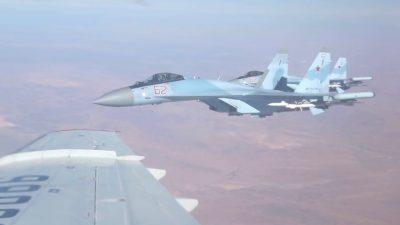
Another interesting aspect of Putin’s trip was the fact that his Ilyushin Il-96-300PU or “Russian Air Force One” was flanked by four Sukhoi Su-35S fighter jets all the way from Russia to the UAE, flying up to 2500 km nonstop, with no aerial refueling and no drop tanks. As if this technologically unprecedented accomplishment wasn’t brilliant enough, the Russian air superiority fighters did so while armed. They flew over the Caspian Sea, parts of Azerbaijan, the entirety of Iran and the Persian Gulf, touching down in Abu Dhabi. Now, it should be noted that countries rarely allow such escorts (much less armed) for state visits, but Moscow secured their free passage over three countries, including the temporary basing in the UAE. This has clear geopolitical implications.
Drago Bosnic is an independent geopolitical and military analyst.
How Russia Strategically Counters Western Economic Pressure
Sputnik – 08.12.2023
Russia has confounded the West’s sanctions strategy to outstrip Europe in economic growth, pundits say.
Speaking at the plenary session of VTB Bank’s investment forum “Russia Calling!”, Putin highlighted that Russia’s gross domestic product (GDP) had grown by 3.2% in the first 10 months of this year and is expected to reach 3.5% by the end of the year.
“Despite Western sanctions against Moscow over the conflict in Ukraine, the Russian economy manages to stay afloat due to various factors, including the restrictive economic policy of the EU and strategic alliances Russia has formed around the world,” Imelda Ibanez, a specialist in the history of Russian diplomacy and foreign policy at St. Petersburg State University, told Sputnik.
When the United States and its European allies decided to impose sanctions on Moscow, commodity prices rose significantly, resulting in an increased trade deficit for those countries.
“One factor [influencing the strengthening of the Russian economy] is the monetary policy of the European Union and the United States, as well as high commodity prices,” Ibanez said.
However, she emphasized that “Russia is one of the world’s leading producers of raw materials, including hydrocarbons, coal and even diamonds.”
“Russia has been able to strategically resist sanctions because it has relied on a geopolitical strategy that is aligned with its allies,” she added.
Isela Valdez, a lecturer in economics at the National Autonomous University of Mexico (UNAM), also speaking to Sputnik, noted that although European countries were strong partners for Moscow before the Ukrainian crisis, they were not the only ones.
“They are not Russia’s only trading partners; yes, they are obviously among the strongest, but there are also the Middle East, Asia, Latin America, and even parts of Africa, which are alternative markets with which [Moscow] can develop trade relations,” she noted.
According to Ibanez, Russia’s strategic, commercial and economic link is China, a country with which it shares a common space in BRICS, the group of developing nations founded in 2009 that currently represents more than 31.5 percent of the world’s GDP and 42 percent of its population.
What will happen if the conflict in Ukraine drags on for even longer?
Western countries will find themselves in an even more difficult position in 2024, as another conflict between Israel and Palestine has burst onto the geopolitical chessboard, Valdez warned.
“It is more of an economic containment mechanism that we are beginning to see [in the West]. Next year, the situation for Europe will be very complex because it is on the central axis of the conflicts, almost acting as a mediator, and this will affect its production levels,” the expert noted.
Ibanez noted that Russia has managed to build bridges and alliances with the Global South through BRICS and the Shanghai Cooperation Organization — and these are platforms where Moscow could stand out.
Biden regime touts ‘year of suffering’ for Russian troops
RT | December 8, 2023
The White House wants to keep funding Ukraine in its conflict with Russia because it believes that in a year Moscow may be willing to concede to Kiev’s demands, an aide to Jake Sullivan, the US national security adviser, said in an interview on Tuesday.
Jon Finer, Sullivan’s principal deputy, discussed the White House Ukraine strategy at an event hosted by the Aspen Institute, an influential US think-tank. On Wednesday, President Joe Biden’s request to allocate over $110 billion in foreign security aid, including for Ukraine, was blocked from a vote in the Senate.
Finer made a case for releasing the funds despite Kiev’s inability to secure any major successes on the battlefield during its summer counteroffensive. He said he disagreed with the notion that the operation “not going as far as people wanted reflects some degree of Ukrainian failure.” If Washington keeps bankrolling Kiev’s war effort for the next year, the Ukrainian government will maintain “a degree of parity” with Russia, he promised.
“Another year of funding and another year in which Russia will have to suffer on the battlefield is fundamentally a better position than we are in today without that funding,” Finer said. “I think there is no way to dispute that.”
By the end of 2024, Western nations will have ramped up arms production and be helping Ukraine do the same, the White House expects. Then Russia will have to either “come to the negotiating table on terms that would be acceptable to Ukraine” or face a stronger opponent, according to Finer’s expectations.
Kiev’s demands for peace include full control over pre-2014 Ukrainian territory, war reparations and a tribunal for the Russian leadership, as detailed last year by President Vladimir Zelensky. Moscow has dismissed it from the start as detached from reality.
Moscow has cited NATO expansion in Europe and the promised inclusion of Ukraine into the US-led military bloc as a threat to its national security. Preventing that outcome is imperative, senior Russian officials have said.
In the first weeks of hostilities, Ukraine and Russia came to a preliminary agreement on a truce, which would have seen Kiev drop its NATO aspirations and pledge neutrality. Then UK Prime Minister Boris Johnson told Kiev to “make war instead,” David Arakhamia, who led the Ukrainian delegation at the talks in Istanbul, confirmed in a recent interview.
USA and Israel Should be Worried: The Muslim Middle East is Moving Its Own Way
By Karsten Riise | Covert Geopolitics | December 7, 2023
Less than a month before Russia takes over the chairmanship of BRICS-11 where both UAE and Saudi Arabia will be full members, Russia makes a big move to bring cooperation with UAE and Saudi Arabia to an unprecedented level.
Russia ties everything together in this meeting: Head of States relations, Foreign Policy, Non-Dollar currency and Financial Policy, Industrial Policy, Nuclear Cooperation, Artificial Intelligence (AI), Space Development, International Direct Investments – and the whole private Business sector.
 Note also that Putin travels safely in person to both the UAE and Saudi Arabia.
Both UAE and Saudi Arabia are visited by President Putin, Foreign Minister Lavrov, First Deputy Prime Minister of the Russian Federation Andrei Belousov, head of the Ministry of Industry and Trade Denis Manturov, Deputy Prime Minister Alexander Novak, head of the Central Bank Elvira Nabiullina, head of Roscosmos Yuri Borisov, head Rosatom Alexey Likhachev, and head of Russian Direct Investment Fund (RDIF) Kirill Dmitriev.
The RDIF recently published a Russian international platform for AI services. The delegation also includes representatives of the business community. See this.
In cooperation with Russia and China, the UAE and Saudi Arabia are becoming not only oil powers, but powers in the modern AI, hi-tech knowledge and Space economy – and military powers.
The central Middle Eastern powers, UAE, Saudi Arabia, Iran, and even Türkiye, are emerging as pillars in the international policies of Russia and China – in all dimensions.
Algeria builds deeper relations with its biggest arms supplier Russia, and Algeria opens defense cooperation China. Russia and Egypt have also for years been reinforcing cooperation, including defense cooperation, nuclear cooperation (a Russian nuclear powerplant is being built) and trade-logistics (a Russian trade zone near the Suez Canal).
In Syria, Russia has already long ago stabilized the government in Damascus, and even in Iraq, Russia just a few days ago took over Iraq’s biggest oil field and kicked out the biggest western player in Iraq’s oil sector.
Recently, Russia as the Chairman of BRICS-11 after 1 January 2024 even gave its nod of approval for the admission of China’s best friend Pakistan into BRICS in spite of Indian hesitations.
The Muslim Middle East is moving its own way – independently of the West. At a time when all the non-Western world including the Muslim world is outraged by Israel’s Nakba pressing out Palestinians with genocide on over 16,000 civilians in Gaza, Israel and its US backer should be worried.
Karsten Riise is a Master of Science (Econ) from Copenhagen Business School and has a university degree in Spanish Culture and Languages from Copenhagen University. He is the former Senior Vice President and Chief Financial Officer (CFO) of Mercedes-Benz in Denmark and Sweden.
Middle East royal calls for end to Western ‘dominance’
RT | December 7, 2023
The current unfair world order dominated by the West needs to end, Omani Crown Prince Prince Theyazin bin Haitham Al Said said on Thursday, speaking with President Vladimir Putin.
Prince Theyazin was in Moscow for the ‘Russia Calling’ Forum hosted by VTB Bank. He met with the Russian leader on the sidelines of the investment conference.
“I listened very carefully to your opening speech,” said the prince, according to translated remarks published by the Kremlin. “I share all your assessments of the current international situation, primarily with regard to the need to end the current unfair world order and the dominance of the West, as well as to build a new fair world order and economic relations without double standards.”
In his opening remarks, Putin had described globalization as a phenomenon used by the US and the collective West to exploit both its allies and the “global periphery” instead of giving every nation an opportunity to develop and thrive.
That system is currently undergoing “radical and irreversible” changes into a more democratic and multipolar order, the Russian leader said.
Prince Theyazin said it was necessary to create new mechanisms for trade and international relations that would not “impose any ideologies,” and develop new economic centers in Africa and Asia. The Middle East was strategically positioned to play a promising role in strategic infrastructure projects, he added.
Oman is located on the southeastern tip of the Arabian peninsula, across the mouth of the Persian Gulf from Iran. Its longtime ruler, Sultan Qaboos bin Said Al Said, died in 2020 without any children – leaving the kingdom to his cousin Haitham bin Tariq. His son Prince Theyazin currently serves as Oman’s minister of youth, culture and sports.
What Would Happen If the US Stopped Supporting Ukraine?
By Connor O’Keeffe – Mises Wire – 12/06/2023
Over the weekend, border-policy negotiations between Senate Democrats and Republicans fell apart. The talks were meant to firm up Republican support for the president’s massive $105 billion military support proposal ahead of Wednesday’s vote by including additional funds for border security in the spending package. Now, with no imminent approval of further aid to Ukraine, hawks in government and the media are trying to stoke panic about what will happen if Kyiv is cut off from US support.
In a letter to Congress Monday, White House budget director Shalanda Young told Congress the funds will dry up by the end of the year:
I want to be clear: without congressional action, by the end of the year we will run out of resources to procure more weapons and equipment for Ukraine and to provide equipment from U.S. military stocks. There is no magical pot of funding available to meet this moment. We are out of money—and nearly out of time.
Young goes on to forecast disaster for Ukraine if more money isn’t allocated. But is that really accurate? Are the Ukrainian people doomed if Washington stops funding the war?
If we’re going to understand what might happen in the absence of US involvement in Ukraine, we must first understand Washington’s actual effect on the war, the true nature of which has been laid out brilliantly in a series of recent columns by Ted Snider.
Russia’s invasion of Ukraine began with a bombardment of cruise missiles on February 24, 2022. Later that day, infantry and armored divisions rolled in from Russia, Belarus, and Crimea while paratroopers dropped in around the capital city of Kyiv.
Days later, as the shock and confusion of the initial offensive began to dissipate, Ukrainian president Volodymyr Zelensky attempted to set up indirect talks with Russian president Vladimir Putin. Zelensky called then–Israeli prime minister Naftali Bennett and asked him to contact Putin and to serve as a mediator. Bennett agreed.
Over the next week, Bennett had a series of phone calls with Putin before traveling to Moscow and Berlin to help organize diplomatic communication channels. His effort culminated in a March 10 meeting between the Russian and Ukrainian foreign ministers in Turkey.
In the series of talks that followed, Bennett described both sides as making “huge concessions” in pursuit of a ceasefire.
But Kyiv’s Western backers were resistant to the truce. At a special summit on March 24, NATO decided not to support or approve the peace negotiations. Still, Zelensky and Putin kept at it. And on March 29, the two sides reached an agreement.
According to a draft unsealed this past June, Russia had agreed to pull its forces back to prewar boundaries. In exchange, Ukraine had agreed it would not seek NATO membership.
So why didn’t it happen? Well, it may have started to. In early April, Russia withdrew its forces from northern Ukraine, around Kyiv—an action Putin later said was related to the Istanbul agreement.
But then, according to Bennett, former German chancellor Gerhard Schröder, Turkish foreign minister Mevlüt Çavuşoğlu, and the leader of the Ukrainian delegation to the talks, David Arakhamia, the West pressured Zelensky to abandon negotiations and fight.
Assuming the best intentions, it’s possible officials in Washington and Brussels believed the Ukrainians could win enough battles to improve their leverage in future negotiations. But that is not what happened.
Instead, Washington bankrolled a horrifying twenty-one-month war of attrition that has cost the people of Ukraine greatly in land, lives, and limbs. After talks broke down, Russia laid permanent claim to tens of thousands of square miles of Ukrainian territory that it had earlier agreed to relinquish.
Last summer, Ukrainian forces began attempting to retake this land by force in the so-called counteroffensive. But they have since lost more territory than they have gained. Ukraine keeps its casualty count classified, but by the end of August US estimates had put it north of two hundred thousand. And it has likely climbed substantially with the ongoing struggle to break through heavy Russian minefields.
As their supply of military-aged men has dwindled, the average age of a Ukrainian soldier has climbed to forty-three. And now there is a push within the Ukrainian government to lower the draft age to begin conscripting those who have so far been too young to be eligible.
The Ukrainian people are being put through hell. And now even senior Ukrainian military officials admit there is no military path out.
If the purpose of stifling the Istanbul agreement was to help the Ukrainians gain more leverage, the West must admit failure before Ukraine loses even more.
And if Washington’s intentions were more nefarious—as comments from officials like Mitch McConnell, who have framed the war as an easy way to burden Russia without spilling American blood, suggest—that’s all the more reason to call off this horrific project.
That brings us back to the original question. What would happen if the United States stopped supporting Ukraine? We already know. Ukraine and Russia would work toward a deal. It won’t go as well for Ukraine as it did almost two years ago when they were stronger. But it’s not a path to fear. Because the alternative is that the White House gets its way and this brutal, unnecessary war carries on. And that’s so much worse.
Moscow rejects US narrative on aid for Kiev
RT | December 7, 2023
Claims in Washington that Russian President Vladimir Putin may attack NATO, unless Congress allocates tens of billions of dollars in additional Ukraine funding are “bogeyman stories,” Moscow’s ambassador in the US capital Anatoly Antonov said on Wednesday.
White House officials, including President Joe Biden, have claimed that by withholding aid from Kiev, American lawmakers were increasing the risk of a direct US-Russia war.
“If Putin takes Ukraine, he won’t stop there,” Biden said in an address on Wednesday, in which he made a last-ditch appeal to lawmakers to appropriate over $110 billion in assistance to Ukraine, Israel and Taiwan.
Touting the scenario of a Russian attack on NATO, Biden stressed that then American troops will have to get involved directly. The Russian leadership has not expressed an intention to “take Ukraine,” let alone invade any NATO member.
Antonov dismissed the narrative, accusing those who repeat it of “myth-making and [the] propagation of dangerous lies” about his nation.
“In an attempt to ‘add fuel’ to the fire of the Ukrainian proxy war, [US] authorities have finally lost touch with reality,” he claimed in remarks posted by the embassy.
“Washington and [the] insatiable US military-industrial complex are direct beneficiaries of the bloodshed in Ukraine,” Antonov added.
In his pitch to Congress, Biden claimed that the Russian leader’s ambition was to “dominate Ukraine” and warned that “the entire world is watching” Washington’s actions. America is “the reason Putin has not totally overrun Ukraine and moved beyond that,” he claimed.
Moscow has cited NATO’s expansion in Europe and the pledge that Ukraine will eventually join the US-led military bloc among the causes of the crisis. It was willing to seal a truce with Kiev in the early phase of the conflict in exchange for Ukrainian neutrality.
However, Russia’s opponent ditched a proposed peace agreement and opted for continued hostilities, after then-UK Prime Minister Boris Johnson told the country to “just make war,” according to David Arakhamia, who headed the Ukrainian delegation at the Türkiye-mediated negotiations.
Biden accused Republican opponents of his request of being willing to “literally kneecap Ukraine on the battlefield” and “give Putin the greatest gift he could hope for and abandon our global leadership not just to Ukraine.”
Nevertheless, Republican senators voted unanimously against the aid, which was bundled in a spending package, later in the day. The GOP legislators insisted that the White House and Democratic lawmakers make concessions on immigration reform and border security before they were willing to approve additional tens of billions of aid to Kiev.
Featured Video

Trita Parsi: Middle East Unraveling — Are We on the Path to World War?
or go to
Aletho News Archives – Video-Images
New Book
Trans agenda is ‘normalization of sadism’ – US author

RT | September 23, 2026
The US Democratic Party has embraced a transgender agenda that amounts to “the normalization of sadism,” author A.J. Rice has said, warning that radical trans policies would return if the party is allowed to regain power.
Speaking to RT’s America First host Scotty Nell Hughes about his new book, ‘The Curse of the Bearded Lady: How the Trans Mafia Whacked American Sanity’, Rice argued that activists have gained significant influence in schools, medicine, and corporate America while people who questioned the agenda have faced pressure to stay silent.
The author described the “trans mafia” as the sprawling network of people and institutions that have helped the movement gain influence. He singled out parts of academia, wealthy backers, and corporations, and stated that providers of transition-related treatment also have a financial incentive to keep young people in their care indefinitely.
Rice argued that the consequences of these policies ultimately fall on children who are being drawn toward gender-affirming medical treatments and on girls who are expected to share locker rooms or compete in sports with biological males.
He noted that while voters rejected the Democrats’ approach to gender in 2024, the party, which has been “captured by madness,” has since only doubled down and is seeking what is effectively “the normalization of sadism.” … Full report
Blog Roll
 Aletho News
- Integrity Initiative: UK-funded network framed dissent as Russian disinformation for years
- ‘We don’t seek permission to defend our country’: Snippets from President Pezeshkian’s UNGA address
- NATO chief wants Europeans to fight American wars [for Israel]
- German chemicals giant reveals details of downsizing
- Refaat Al-Areer Was The Canary In The Coal Mine In Israel’s War On The Truth
- Israeli election committee bars candidate from Knesset race over Gaza war opposition
- French-Lebanese man files war crimes complaint over Israeli attacks
- Mahan Air Flight Lands in China Despite US Threat against Iranian Airlines
- US eyes $10bn fund to rebuild war-battered Gulf infrastructure
- Trump meets Rodríguez near Maduro’s prison as Venezuela’s oil flows to US
- If Americans Knew
- Caught on Tape: AIPAC CEO Boasted of Controlling Trump’s National Security Officials
- Why Hamas Attacked Israel in October 2023 – Israeli professor Ilan Pappé
- They see them, then kill them: Israeli quadcopters track, deliberately target civilians in Gaza
- Winter could turn Gaza’s treacherous, war-damaged buildings into deathtraps
- Majority of Democratic Voters Want to Prosecute Both Biden and Trump Administration Officials Over Gaza
- As Gaza languishes, world leaders gather at the UN – Daily Update
- Sanctions are collective punishment: immoral and self-defeating
- Phosphorus Munitions Fired by Israel Burn Groves, Orchards in Southern Lebanon
- Israel Carries Out New Ceasefire Violations Across Gaza
- AI – Emphasis on the ‘I’: Israel Is Funding AI Chatbot Propaganda
- No Tricks Zone
- New Study: Earth And Venus Surface Warmth Largely Explained By Convection And Lapse Rate, Not CO2 Or Radiation
- 2025 Nature Paper Claiming Worsening Global Drought Gets RETRACTED …Heavily Flawed
- New Study: ‘Global Drought Shows No Detectable Recent Acceleration Under Climate Warming’
- Economic Masterminds: German Socialists Suggest Taxing Productivity Gains Stemming From Using AI
- The South China Sea Has Not Been Cooperating With The Climate Change Narrative
- Energy Crisis: Germany Enters Heating Season With Historically Low Gas Reserve Fill Levels
- New Study: The Antarctic Ice Sheet Gained Mass From 2020-2024 Due To Staggering Snow And Ice Accumulation
- Study: Ocean Heating Rates From Thousands Of Years Ago ‘Dwarf’ Modern Ocean Heating Rates
- Climate Extremists Target, Attack Large-Scale Power Grid Infrastructure In Germany!
- New Study: Antarctic Ice Melt Has Contributed Less Than 1 Centimeter To Sea Level Rise In The Last 30 Years

