No Russia at Davos – ambassador
RT | December 19, 2023
Russia will again be absent from the annual meeting of the World Economic Forum (WEF) in Davos early next year, Russian Ambassador to Switzerland Sergey Garmonin has confirmed.
The high-profile gathering of international business and political figures is scheduled to take place at the Swiss Alpine resort between January 15 and 19.
“Russia will not be represented at the World Economic Forum in Davos, since the organizers didn’t send invitations to the Russians last year and this year,” Garmonin told TASS news agency on Tuesday.
Russia skipped Davos 2023 after the organizers said its participation at the event would be “unwelcome” due to Moscow’s military operation in Ukraine. According to the WEF, its relations with Russian firms sanctioned due to conflict were frozen.
The ambassador said he didn’t think Russia would lose anything by missing out on the WEF again in 2024. “In my opinion, only the forum itself loses from such a decision,” he said. According to Garmonin, Moscow “will continue to solve… problems in other formats and on other platforms.”
The diplomat also criticized plans by the Swiss organizers to hold a meeting dedicated to discussions about Ukrainian President Vladimir Zelensky’s ten-point peace plan to settle the conflict with Russia. Meetings like this “are divorced from reality and lack any added value. They will not bring peace any closer,” he argued.
Zelensky’s “peace formula” calls for Russia’s withdrawal from all territories claimed by Kiev, reparations from Moscow, and a war crimes tribunal.
Ukraine “is in no position to put forward any ultimatums to Russia, and everyone understands this perfectly well,” Garmonin insisted. “The Kiev regime, which has no hopes of achieving even the slightest success on the battlefield, is denying the obvious and feeding the West with unfeasible projects in its attempts to solicit yet another military assistance package.”
Russia’s Deputy UN Ambassador Dmitry Polyanskiy said last week that Kiev had squandered its chances of a “favorable” agreement with Moscow. “Any possible deal now will be reflecting its capitulation,” he wrote on X.
During his Q&A session on Thursday, Russian President Vladimir Putin insisted that “there will be peace [in Ukraine] when we achieve our goals.” The aims of the Russian military operation “are not changing,” and include the “denazification and demilitarization of Ukraine, its neutral status,” Putin reiterated.
Finland’s new ‘defense’ deal with US eerily reminds of similar one with Nazi Germany
By Drago Bosnic | December 18, 2023
Ever since NATO formally (re)started the (New) Cold War, it has been expanding its military presence all across Europe, effectively escalating its crawling aggression on the continent. The obvious target – Russia. The belligerent alliance is determined to create a new “frontline” on Moscow’s western borders, this time by drastically increasing American military presence in Finland. Namely, last week, Helsinki announced that it will sign a bilateral “defense” cooperation agreement with the United States, allowing the latter to station troops and store weapons in Finland. During a news conference in Helsinki on December 14, the Nordic country’s Foreign Minister Elina Valtonen stated that Defense Minister Antti Häkkänen will sign the so-called Defense Cooperation Agreement (DCA) on December 18 (today).
“The pact is very significant for Finland’s defense and security,” Häkkänen was quoted by Euronews, adding: “It bears a very strong message in this time. The United States is committed to our defense.”
The DCA will allow American troops to access 15 military areas and facilities in the entirety of Finland, ranging from a key southern naval base and inland air bases to a vast remote army training area in Lapland in the north. Interestingly, Finnish officials admitted that American troops are allowed a permanent presence and regular exercises in the country, but they insist that “there are no plans to establish permanent US military bases in Finland”. These two claims are extremely contradictory, not to mention the fact that such deployments contribute nothing to Finnish security. On the contrary, this can only attract the attention of Russia, which otherwise would’ve never considered Finland a threat. The Nordic country of 5,6 million shares a 1,340-kilometer border with Russia, nearly tripling the line of direct NATO-Russia contact.
Along with the Baltic states, it’s also the European Union’s external border with Russia. The troubled bloc itself is militarizing and effectively unifying with NATO, cementing Europe’s position as a mere pendant of America’s geopolitical strategy of so-called “containment”. Other countries on the continent have similar bilateral agreements with the US, including the neighboring Sweden, while Denmark (already a NATO member) is very likely to do the same. The obvious question arises, why are Finland and Sweden doing this? Will they feel safer with American and other NATO troops stationed in their military facilities? It’s quite obvious that the belligerent alliance has always been an auxiliary extension of the Pentagon and this has been the case since NATO’s unfortunate inception 74 years ago, as well as its subsequent expansion.
Thus, an increase in American military presence in Finland should always be observed from the perspective of US expansionism, as the world’s most aggressive country keeps moving its “defense” infrastructure ever closer to the borders of its geopolitical adversaries. This has been the case in the (First) Cold War and it’s no different nowadays when Washington DC is pushing one European country after another into a broader anti-Russian coalition that now includes the entire EU. The US is also trying to do the same by constituting a near carbon copy of NATO in the Pacific in a virtually identical step, only aimed against China. The formal admission of Finland back in April and the current military expansion are just steps toward the so-called “globalization” of NATO, a terrifying prospect for the security of the world.
It could be argued that Finland was never truly neutral, not even during the (First) Cold War and particularly not since it entered the EU. It has always been packed with US/NATO intelligence assets, although this has escalated significantly in the last several decades. Since then, the country has essentially become a NATO member in all but name. Helsinki directly broke from its formal neutrality when it decided to acquire F-35 fighter jets from the US in late 2021. The Pentagon has direct access to everything the F-35’s sensors can detect, meaning that Finland would be sharing key military data with the US regardless of whether it was a NATO member or not. On the other hand, as I argued back in early April, being a direct member means that the Nordic country is virtually guaranteed to see the deployment of American offensive weapons.
The details of the latest “defense” deal are yet to be revealed, but it can only be expected that it will involve much more than simple infantry deployments. For Russia, this is particularly concerning, as Finland and Estonia, now both NATO members, are in close proximity to St. Petersburg, its second most important city. The stationing of any US offensive weapons such as cruise missiles and nuclear-capable fighter jets would deeply destabilize the otherwise largely stable region. There’s also a quite eerie historical dimension in all this. Namely, Helsinki is essentially repeating the same mistake it made over 80 years ago when it joined the Axis led by Nazi Germany. Now when it’s among “old friends” once again, maybe the Nordic country should dust off the history books and pay very close attention to how this ended the last time.
Drago Bosnic is an independent geopolitical and military analyst.
UK contemplating sending troops to Ukraine – ex-ambassador
RT | December 17, 2023
British military leaders are making contingency plans for sending troops to Ukraine in case a disastrous turn of events on the battlefield necessitates their deployment to help fight Russian forces, Kiev’s former ambassador to the UK has claimed.
Despite public opposition, the UK government would directly join the fight in Ukraine if there’s a “catastrophic development of the war,” such as “the continuation of the occupation,” ex-diplomat Vadym Prystaiko said on Friday in an interview with the Ukrainian branch of US state-run broadcaster Radio Free Europe/Radio Liberty (RFE/RL).
The possibility of military deployments to Ukraine is a well-kept secret among Kiev’s Western allies, Prystaiko said. “No one will ever admit it, especially politicians. Every time they are asked, they will say, ‘no, no no way, come on, we’d rather give them everything they need.”
However, Prystaiko added, British officers are making plans “for the worst” – circumstances dire enough to prompt elected leaders to order a direct military intervention in the former Soviet republic. “In reality, the military is making calculations that, God forbid, they will have to use armed forces. That’s why the military and diplomats are there, to plan for the future.”
Prystaiko, who also served a stint as Kiev’s foreign minister, was fired as ambassador last July, after he criticized Ukrainian President Vladimir Zelensky. His career downfall began when Zelensky responded sarcastically to a suggestion by the UK’s then-defense chief, Ben Wallace, that Ukraine should show more gratitude to its Western benefactors. Asked by Sky News about the tone of Zelensky’s remarks, he said, “I don’t believe that this sarcasm is healthy.”
Wallace’s successor as UK defense chief, Grant Shapps, hinted in September at deeper British involvement in the Ukraine crisis, including protection of commercial shipping traffic in the Black Sea. UK Prime Minister Rishi Sunak later said there had been “misreporting” when Shapps also seemed to suggest that London might send military instructors to Ukraine.
Russian officials have repeatedly described the conflict as a battle between Moscow and the “entire Western military machine.” British special forces have reportedly operated covertly in Ukraine, and Russian President Vladimir Putin claimed last year that there were entire military units in the country “under the de-facto command of Western advisers.”
Polls have shown consistently strong UK public opposition to deploying troops to Ukraine. Prystaiko said that given the mood of voters, none of Kiev’s backers is ready to fight the Russians directly. “It’s very difficult for democratic states that depend on the reelection cycle, that depend on their voters, that have to explain themselves a hundred times to make the first step.”
Putin: “Odessa is a Russian city”
BY M. K. BHADRAKUMAR | INDIAN PUNCHLINE |DECEMBER 17, 2023
At the year-end news conference on Thursday lasting four hours, Russian President Vladimir Putin made some key remarks on the conflict in Ukraine which throw light on the likely trajectory of the war through 2024. To be sure, Russia will not accept a “frozen conflict” that falls short of realising the objectives Putin had laid out at the commencement of the special military operations in February last year.
Putin stated: “There will be peace when we achieve our goals… Now let’s return to these goals – they have not changed. I would like to remind you how we formulated them: denazification, demilitarisation, and a neutral status for Ukraine.”
He spelt out denazification and demilitarisation as work in progress while leaving out the crucial question of a neutral status for Ukraine, a notion which the collective West outright rejects while pressing ahead with its intervention in newer forms despite the failure of Kiev’s months-long counteroffensive. Ironically, the accent in the revised western narrative is to create a strong resilient defence industry in Ukraine eventually with western technology and capital to ward off any Russian military threats in future.
On denazification specifically, Putin said that during the negotiations in Istanbul last year in March, Kiev showed receptiveness towards the idea of legislating against the spread of extremist ideology, but that lies buried in the past. As for demilitarisation, that idea also never caught on as Ukraine began receiving weaponry “even more than what was promised by the West.”
Therefore, Russia is left with no other option but to keep destroying the Ukrainian military capability as the core of the demilitarisation process. But Putin believed that certain parameters can still be negotiated, and, in fact, “We actually agreed on them [with Ukrainian negotiators] during the Istanbul talks; although these were thrown out later, we managed to reach agreement.” The alternative to reaching an agreement on demilitarisation is to “resolve the conflict by force. This is what we will strive for.” However, to this end, Putin ruled out another mobilisation as already “there will be about half a million people [in the war zone] by the end of this year.”
These remarks bear the hallmark of a statesman speaking from a position of strength who is conscious of it, too. Putin asserted that Russian forces are “improving their position almost along the entire line of contact. Almost all of them are engaged in active combat. And the position of our troops is improving along [the entire line of contact.]” Putin conveyed no willingness to compromise with the US and EU.
Significantly, Putin said that the southern part of Ukraine has “always been Russian territory… Neither Crimea nor the Black Sea has any connection to Ukraine. Odessa is a Russian city.” This is an ominous statement implying that the Russian operation may after all extend to Odessa which is on the western side of the Dnieper and even further westward along the Black Sea coast to Moldova that renders Ukraine a land-locked country. A prolonged conflict is in the cards.
On the contrary, the reports from the US media quoting American officials convey the impression that there is no willingness to throw in the towel at the present stage. That is of course predicated on the belief that Russia will be hard put to realise its objectives and by the end of 2024, the tide of war can change and Russia may be compelled to compromise. Thus, a new strategy is being worked out between the US and Ukrainian military that can be executed by the early part of 2024 with the American accent on holding the territory that Ukraine controls as of now and digging in.
The New York Times reported that the Ukrainian military subscribes to a “forward policy.” The Pentagon is stationing a three-star general in Kiev with a view to “stepping up the face-to-face military advice it provides to Ukraine.” This could be the beginning of deployment of American military advisors to Ukraine to oversee the war, which will put the Pentagon in a direct role in the management of the operations from both the tactical as well as strategic perspectives.
Meanwhile, the final word is not yet spoken by the US Senate on the Administration’s demand of $61 billion as additional funds for Ukraine. The likelihood is that the senate will eventually pass the bill since there is a big groundswell of support among Republican lawmakers for the war effort. The Administration is driving home that Russia has an “imperial” agenda toward NATO countries and vital US interests are at stake in preventing Russia from winning the war.
Interestingly, in a related development two days ago, Congress approved legislation that would prevent any president from withdrawing the US from NATO without approval from the Senate or an Act of Congress. Equally, Europe is also circling the wagons and taking a long-term view that Russia’s scale-up of arms production to sustain its operations in Ukraine poses a real threat to Europe, especially to the Baltic states, Georgia and Moldova. NATO Secretary-General Jens Stoltenberg last week warned that “If Putin wins in Ukraine, there is real risk that his aggression will not end there.”
The German Defence Minister Boris Pistorius echoed that sentiment when he said on Saturday that Europe must ramp up its security and defence capabilities to respond to the threat Russia poses, as the US will likely reduce its involvement on the Continent in the coming years and increasingly turn its attention to the Pacific region in the next decade. As he put it, “This isn’t just sabre-rattling. Dangers could lie ahead at the end of this decade.”
The message from the European Council meeting in Brussels last Friday is also that in circumventing Hungary’s opposition, EU leaders are navigating a pathway to ensure Ukraine will still get its €50 billion aid package to help prop up its hollowed out economy — if necessary, by taking the radical step of sacrificing EU unity and providing the money on a bilateral basis. The EU leaders are expected to reconvene at the end of January or early February to unlock the issue.
On Friday, Ukraine’s foreign ministry released a statement lauding the opening of EU membership negotiations and voicing optimism about the €50 billion aid package from Brussels. The tough talk notwithstanding, Russia too must be sensing that the EU will ultimately find a way somehow to solve the financial question. For the present, though, the deadlock in Brussels and Washington on aid has generated an air of uncertainty, which is bad optics for Kiev and plays into the Russian narrative.
All in all, Putin’s tough remarks on Thursday factor in that the US isn’t going anywhere but stays put in Ukraine and the Biden administration’s game plan is to revamp the war strategy to put it on a stronger footing and make it sustainable through the period ahead till the November 2024 election.
Kremlin’s hope that US support for Ukraine is on the wane seems misplaced. Curiously, spokesman Dmitry Peskov added in good measure in an interview on Friday with broadcaster NBC News that Putin would prefer an American president who is “more constructive” toward Russia and understands the “importance of the dialogue” between the two countries. Peskov added that Putin would be ready to work with “anyone who will understand that from now on, you have to be more careful with Russia and you have to take into account its concerns.”
Between now and the presidential election in March in Russia, domestic politics will be hotting up. After Putin’s re-election for a fresh 6-year term as president, which is widely expected, by the time the new government is formed, the campaign for the US election will have accelerated and it is a safe bet that the Ukraine war will be on auto-pilot with the priority almost entirely lying on averting any serious embarrassment to Biden’s reelection bid.
Suffice to say, staving off a military defeat in Ukraine and keeping the stalemate on track will be the Biden administration’s singular aim through 2024. The big question is whether Putin would “cooperate” or have some surprises in store. Peskov has begun looking beyond the Biden presidency.
Fresh anti-Russia sanctions to cause more damage to EU: Moscow
Press TV – December 17, 2023
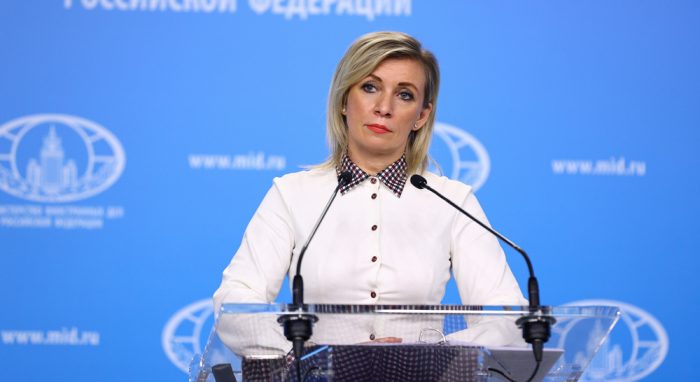
Russian Foreign Ministry spokesperson Maria Zakharova said on Saturday that the latest European Union sanctions against Russia will cause more harm to the EU than Russia.
Zakharova added that the EU’s “dictatorial” behavior reveals how Brussels is “denying” member states of their right to “protect their interests.”
She also warned the EU of the “heavy price” the Europeans must pay for the accession of Ukraine and Moldova to the bloc.
“It goes as far as absurdity, when through some unscrupulous manipulations – when certain heads of state and government are not present at the table, – some legally questionable and obviously politicized decisions are made, which are as follows: on the start of pre-accession negotiations with Ukraine and Moldova, which not only fail to meet the EU’s elementary criteria but directly run counter to them, as well as on another ‘package’ of unilateral restrictive measures against Russia, which, like all the previous ones, will cause bigger harm to the European Union itself,” the diplomat said.
“This dictatorial behavior of Brussels reveals in all its magnitude that the member states are denied their democratic right to a dissenting opinion and the protection of their own interests.”
She went on to add that the EU’s confrontational “policy and the consequences of its opportunistic decisions regarding Ukraine and Moldova will have to be paid by the population of European countries.”
EU members agreed on a 12th package of sanctions against Russia, the European Council said on Thursday, meaning that a phased ban on Russian diamond imports among other measures will come into effect from January 1, 2024.
Moreover, after the summit, European Council President Charles Michel also announced that the EU members had decided to open accession negotiations with Ukraine and Moldova, which may start in March 2024 or later.
The accession talks regarding Ukraine and Moldova started after Hungarian Prime Minister Viktor Orban left the summit in protest to the move. Budapest had earlier threatened to veto the accession of Ukraine into the European Union. “Hungary does not want to be part of this bad decision!” Orban said in a statement on Facebook.
Russia started the “special military operation” in its eastern neighbor in late February 2022 to defend the pro-Russian population in the eastern Ukrainian regions of Luhansk and Donetsk against persecution by Kiev.
Ever since the beginning of the war, Kiev’s Western allies, led by the United States, have been pumping Ukraine with advanced weapons and slapping Russia with a slew of sanctions, steps that Moscow says would only prolong the hostilities.
Zakharova also said that the EU is continuing to “swiftly lose both political and economic weight around the world” under the pressure of the United States’ missteps.
“The EU’s resources, so much needed for its domestic growth, are not funneled into resolving multiple problems and asserting its own place in the emerging multipolar world order, but into serving the US interests, including into the enrichment of the US military-industrial complex,” she said.
Zakharova added that it looks quite natural that against this backdrop, “the most responsible politicians in European countries are more and more frequently prioritizing national interests over some mantras of ‘European solidarity,’ which are out of touch with real needs.”
Joe Biden’s World War III Fantasy
By Scott Ritter – Sputnik – 16.12.2023
On July 13, 2023, US President Joe Biden confidently announced to the world that “[Russian President Vladimir] Putin has already lost the war.”
The “war” Biden spoke of was Russia’s Special Military Operation against Ukraine, which began on February 24, 2022.
Biden’s bold statement was made during a press conference with Finland’s President Sauli Niinisto, following a meeting with Nordic leaders that came on the heels of the NATO Summit in Vilnius, Lithuania.
Biden declared that the US and its NATO allies had, through their decision to commit to the military victory of Ukraine over Russia, reached “an inflection point in history,” adding that “This fight is not only a fight for the future of Ukraine, it is about sovereignty, security and freedom itself.”
The American president’s pronouncements followed similarly themed rhetoric spoken in Vilnius a day prior, where he announced to his NATO colleagues, “Our commitment to Ukraine will not weaken,” adding that “We will stand for liberty and freedom today, tomorrow, and for as long as it takes.”
“As long as it takes,” it turns out, isn’t the same as “long as needed.”
Confronted with a trifecta of bad news—the calamitous defeat of the NATO-trained and equipped Ukrainian military in the much-hyped summer counteroffensive, a Russian Army that is growing stronger by the day, and the collapse of political will and fiscal ability on the part of Ukraine’s erstwhile allies in the US and Europe to continue funding Ukraine’s flagging war effort—Joe Biden was compelled to alter his pledge to the cause of Ukrainian and European liberty and freedom to “as long as we can,” with the modifier contingent upon the US Congress’ willingness to throw another $60 billion into the $120 billion in aid the US has provided Ukraine since May 2022.
To intimidate Congress into yielding to his demands regarding money for Ukraine, Biden undertook a campaign of terror. “Frankly,” Biden said in a statement delivered at the White House in early December, “I think it’s stunning we have gotten to this point in the first place. Republicans in Congress are willing to give Putin the greatest gift he could hope for and abandon our global leadership.”
While many Republicans support continued funding of the Ukraine war effort, the issue has become politicized in the lead up to the 2024 presidential election, where domestic issues tend to trump foreign affairs. And, currently, there is no more high-profile domestic policy issue than border security and immigration reform. Senator Lindsey Graham, a Republican from South Carolina who has been a vociferous supporter of Ukraine, noted that while he would support continued funding of Ukraine’s war effort, he could not return to his home state of South Carolina to “try to explain why I helped Ukraine, Taiwan and Israel and did nothing to secure our own border. I will help all of our allies, but we have got to help ourselves first.”
Mike Johnson, the new Republican speaker of the House and a hardline conservative, indicated that the objection to continued funding for Ukraine went beyond simply funding issues. “What is the objective?” Johnson said to reporters after meeting with Ukrainian President Zelensky earlier this month. “What is the endgame in Ukraine? How are we going to have proper oversight of the funds?”
Russian servicemen fire a BM-21 Grad multiple rocket launcher towards Ukrainian positions in the course of Russia’s military operation in Ukraine, at the unknown location in the
Both Graham and Johnson had been subjected to a full-court press by Joe Biden and the White House in an effort for the recalcitrant Republicans to reverse course on their objections. “We can’t let Putin win,” Biden pleaded. “If Putin takes Ukraine,” Biden noted, “he won’t stop there.” The US president said an emboldened Putin would move on to threaten his NATO neighbors. And then, Biden stated, “We’ll have something that we don’t seek and that we don’t have today: American troops fighting Russian troops.”
If the threat of a Third World War in the face of Congressional inaction wasn’t enough, Biden authorized the Pentagon to declassify and release to CNN an intelligence report that claimed that Russia had suffered enormous casualties in its war with Ukraine, with some 315,000 of an estimated 360,000 troops that made up Russia’s pre-conflict ground force, having been killed or wounded. The declassified intelligence report also claimed that 2,200 of Russia’s 3,500 tanks have been lost, along with 4,400 of 13,600 infantry fighting vehicles and armored personnel carriers.
The release of the declassified report was clearly timed to influence the US Congress by emphasizing the very talking points that have been repeatedly made by Senator Graham and others that the US aid was “Best money we’ve ever spent” because “the Russians are dying.”
Given the history of the US intelligence community of declassifying intelligence reports for the specific purpose of releasing the information to mainstream media outlets to shape public opinion—even if the intelligence community knows the information contained in the report is wrong—one must take the report regarding Russian casualties with a heavy grain of salt. According to Russian President Vladimir Putin, Russia currently has some 617,000 troops deployed in the Special Military Operation zone. These forces are on the offensive, actively advancing on several fronts against a Ukrainian Army which is rapidly losing its ability to sustain large-scale ground combat operations. This doesn’t sound like the performance of an organization that suffered some 87% casualties, a figure which would make the survivors combat ineffective.
The fact is, US and European support for Ukraine is flagging, and Ukraine is facing an existential crisis in the coming weeks and months that it most likely will not be able to resolve in its favor.
While Russian troops are taking casualties, it is far more likely than not that the real Russian casualty figures are significantly less than the number reported in the declassified US intelligence report, spread out over the original force and the hundreds of thousands of mobilized reservists and volunteers who have entered the fighting since. These losses pale in comparison to the more than 400,000 dead and nearly one million wounded Ukraine has suffered.
Russia’s combat power grows every day, with fresh troops and equipment being made available for the war effort. Ukraine, on the other hand, has exhausted its reserves, and is left scraping the bottom of its human resources barrel to man whatever units it is able to organize from what is left of Ukraine’s diminished, and diminishing, arsenal.
While the Russian Army is indeed large, and growing, and its capabilities expanding as it becomes more combat experienced, it is an army with a very specific mission—the defeat of the Ukrainian Armed Forces. The Russian force structure is currently more than sufficient to defeat the Ukrainians on a frontage that stretches some 2,000 kilometers in length. It is even large enough to secure some additional Ukrainian territory, in addition to liberating the newly absorbed Russian territories of the Kherson, Zaporozhye, Donetsk, and Lugansk regions still held by Ukraine. But there are physical limitations as to what one can accomplish with 617,000 troops and occupying all of Ukraine before invading Poland and/or the Baltics is well beyond the capacity of the Russian forces currently deployed in the Special Military Operation.
Moreover, Russian President Vladimir Putin has never intimated that Russia had any intention to either occupy all of Ukraine or seek to attack NATO — just the opposite. The Russian goals and objectives of the Special Military Operation are spelled out very clearly — demilitarization (the destruction of the Ukrainian Armed Forces), de-Nazification (the elimination of the regime of Ukrainian President Volodymyr Zelensky and the pro-Nazi political element inside Ukraine), and permanent neutrality for Ukraine (i.e., Ukraine will never join NATO). There is no intent to take the war to NATO. Such thinking is a fear-based construct of the Biden administration that is inaccurate and far removed from reality, little more than a fantasy which the sober-minded Russian government, ever mindful of the need to carefully manage escalation because of the Special Military Operation, will pay scant attention to.
Joe Biden and his national security team are scrambling to manage the consequences of policy failure. Putin, it seems, has not lost the war with Ukraine. Russia is winning, something no amount of funding by either the US, the Europeans, or both, can reverse. The best thing that could happen to Ukraine is for the congressional Republicans to hold steadfast to their objections and allow Ukraine to be taken off the life support that US funding provides. Ukraine is a terminal case. Continuing to underwrite its failed war effort simply prolongs the agony of its people.
US F-35 Still Underperforms Rival Jets as Taxpayer Bill Hits $1.7 Trillion – Experts
Sputnik – 16.12.2023
WASHINGTON – The F-35 fighter jet continues to lag Chinese and Russian counterparts in terms of effectiveness despite costs soaring to exorbitant levels, forcing the US to seek more war to justify the investment, experts told Sputnik.
Earlier this week, the US Government Accountability Office (GAO) in an audit sponsored by Congress said the $1.7 trillion F-35 program’s costs continued to soar out of control, rising another $44 billion 17 years after it first flew and eight years after it entered service. The aircraft continues to be plagued by issues with technology upgrades including cockpit electronics software, the Pentagon has said.
“The cost of this aircraft, continually rising and hard to justify financially, is a stunning example of what the corporate defense industry has wrought in its domination of Congress and of the Executive Branch,” former Pentagon analyst and retired US Air Force Lieutenant Colonel Karen Kwiatkowski told Sputnik. “A new war anywhere in the world means new and long-term contracts, and provides high paying jobs for a small sector of the country.”
As a result, the former Pentagon analyst said the US political establishment is seeking to foment conflicts regardless of the best interests of the United States.
Kwiatkowski said the F-35 was designed to deliver “a continuous and growing paycheck” to the defense contractors who conduct a lifetime of extensive repairs on the aircraft.
“One plane, all missions, and guaranteed profits. As older and more battle hardened US air combat capabilities are retired and shifted to the F-35, the rest of the world may in fact be chuckling instead of shaking in their boots,” she said.
REMAINS OUTGUNNED BY CHINA, RUSSIA
Kwiatkowski said the US Air Force recognizes the shortfalls of the program such as inability to operate far from logistics support, lessons that would be applied if the F-35 was deployed to defend Taiwan or in a war in the Pacific theater.
“In a battlespace where the F-35 is part of an offensive combined arms campaign, far from home… F-35 would not remain in the fight for long,” the former Pentagon analyst said.
F-35 availability rates, she added, would be far below the current 55% due to both inherent reliability and durability issues. Plus, it is still unknown whether the aircraft has the ability to successfully operate in an active hostile environment, Kwiatkowski said.
Retired US Army Lieutenant Colonel Earl Rasmussen, former vice president of the Eurasia Foundation, said the F-35 is impressive when it is operational but it will likely face problems when facing Russia’s Sukhoi Su-57 or China’s J-20.
“While the F-35 may have an advantage in a perfect environment, war is not a perfect environment. Operational effectiveness may cause challenges and a degradation of sensor and network communication capabilities will likely put the F-35 at a disadvantage in a one-to-one engagement with both the SU-57 and J-20,” Rasmussen said.
The Russian Su-57 and the Chinese J-20 and J-31 have advantages with respect to speed, range, agility and lethality, he added.
“The Chinese J-20 is faster, has longer range, and carries more weapon systems,” Rasmussen said. “The Russian Su-57 while lacking in stealth capabilities is faster, has a longer range, and is more agile with significantly more maneuverability than the F-35. The SU-57 carries a wide variety of armaments to include cruise missiles giving it a great stand-off capability and the ability to engage targets from a range of 300 km [180 miles].”
Russian Airborne Forces Ex-Commander: NATO Counteroffensive Plan Bad, New Ukraine Strategy Worse
By Ekaterina Blinova – Sputnik – 14.12.2023
The Russian Armed Forces have shifted to the offensive in the special military operation zone and are making progress along the entire contact line, President Vladimir Putin said during his annual press conference.
Russia’s 617,000-strong military contingent is presently improving its positions along the almost 2,000 kilometer-long contact line, President Putin told attendees at his annual press conference. What’s behind the development?
The failure of the Ukrainian counteroffensive has exposed the ineffectiveness of NATO’s strategic planning and outdated doctrines, says retired Colonel General Georgy Shpak, ex-commander of the Russian Airborne Forces.
“[NATO] placed its bet on Ukraine making it carry out a counteroffensive,” Shpak told Sputnik. “They organized and planned it. But the counteroffensive failed, because the [Russian military] foresaw [their steps], built good defenses worthy of the Russian army and withstood numerous attacks.”
“Now we have moved on to the second stage of this operation: to disable as much [Ukrainian] equipment and personnel as possible. This second stage is essentially coming to an end, because the Ukrainian army is exhausted, they lack manpower, their reserves are depleted, their money has run out, almost all of their equipment has been knocked out. This is the result of the work of American and British [military] advisers,” the retired colonel general continued.
NATO war planners failed to calculate the effects of many key factors, according to the military expert.
“They did not take into account current modern conditions, the huge number of [Russian] aerial vehicles that are designed for reconnaissance, observation, adjustment, and strikes. They didn’t take this into account. They hoped that if they struck in several directions, our defenses would crack, but we held the line.”
Shpak was also highly sceptical of NATO’s 2024 strategy for Ukraine, which envisages digging in and building up forces for a possible new offensive.
“I would say that it is even worse than their counter-offensive,” the general said. “Not a single defensive structure can withstand strikes of modern powerful weapons. Furthermore, it’s impossible to build reinforced concrete fortifications which are over 1,000 kilometers long and 20-30 meters deep, with enormous coverage. This is all nonsense. It’s impossible to build something like that. There will still be gaps here and there, failures here and there.”
“This is all theory. For me, as a military man, it’s just like a children’s fairy tale, not a thought-out plan. They have abruptly shifted from a counteroffensive to an all-out defense. I believe this will lead to their defeat,” Shpak added.
Ukraine’s Botched Counteroffensive Ignites New ‘Mantras’ in US – Lavrov
Sputnik – 13.12.2023
With Ukraine’s counteroffensive obviously failing, the United States has taken up a new rallying cry, which is to prevent Russian President Vladimir Putin from winning in Ukraine so that “NATO is not conquered,” Russian Foreign Minister Sergey Lavrov said.
“After the collapse of the so-called counteroffensive, [people] in Washington stopped talking about Russia’s strategic defeat on the battlefield and, during Zelensky’s latest visit, activated a new mantra: ‘don’t let Putin win in Ukraine’, otherwise all of NATO will be conquered and then America won’t sit through it,” Lavrov said during the “government hour” in the Federation Council, upper house of the Russian parliament.
“We are ready for such a challenge and will continue to firmly defend our truth,” Lavrov emphasized.
The top Russian diplomat also noted that “it is not easy for our ill-wishers to come to grips with the fact that the bet on the sanctions blitzkrieg against the Russian economy has completely failed.”
“Therefore, those who launched the hybrid war against us won’t admit their mistakes, they are trying to use more and more illegitimate tools to wear down Russia, as they say, relishing the dream of eliminating our country as an independent geopolitical value,” the Russian diplomacy chief explained.
Featured Video

Russia Helping Build a New Middle East /Trita Parsi
or go to
Aletho News Archives – Video-Images
From the Archives
Sam Husseini: The entire US establishment helped lie their way into the Iraq war
By Slava Zilber | American Herald Tribune | October 14, 2019
Sam Husseini is a senior analyst with the Institute for Public Accuracy, independent journalist and contributor to The Nation and FAIR.
Slava Zilber: Sam, three years ago, you appeared on Talk Nation Radio with David Swanson and spoke about the case of the GCHQ whistleblower Katharine Gun. You pointed out that the people involved in the spying on the UN and the people authorizing the Iraq War were not held accountable:
“Virtually everybody who went along with the war, whether it is Kerry or Clinton, of course, the Bush administration themselves has falsified their own records in terms of why, what they did, when they did, why they did it, to the extent that they’ve been scrutinised at all.”
You also address it in a recent article. And recently, Joe Biden has been lying about his position on the Iraq War. How can such an important issue escape meaningful scrutiny? … continue
Blog Roll
 Aletho News
- Russia Helping Build a New Middle East /Trita Parsi
- Barghouti: ‘Netanyahu has fallen,’ era of Smotrich, Ben-Gvir over
- China slams US policy on Iran as Russia rejects legality of nuclear meeting at UN
- The Mecca Pact Courts Iran: Containment Comes Full Circle
- Oman FM: Persian Gulf states, Iran, Iraq should form security pact excluding US
- Trump peddles fresh falsehoods, claims Iran ‘started the war’ as US aggression drags on
- Ukraine quagmire? Yes, but it’s for NATO, not Russia
- US intelligence hypes Chinese, Russian space threats while accelerating its own military buildup in orbit
- Iran FM Araghchi: “Hormuz Will No Longer Be the Same”
- EU facing trillion-euro debt hole while seeking more cash for Kiev
- If Americans Knew
- An error has occurred; the feed is probably down. Try again later.
- No Tricks Zone
- Sudden Stratospheric Warming, Powerful El Niño Combination May Lead To Extreme Europe Cold, Energy Crisis!
- Two New Studies Find Thwaites Glacier Melt Cannot Be Driven By Human Activity Or A Warming Ocean
- E-Cars Reduce CO2 Emissions By Only 41% Compared To Internal Combustion Engine Vehicles
- Predictions Made By Renowned Climate Professor Over Past Decades Have Been Proven To Be Poor
- New Study Suggests Large Regions Of The Pacific Ocean Have Been Cooling For The Last 80 Years
- Germany’s Green Energy Debacle: High Energy Costs Force Kahla Porzellan to Close After 182 Years!
- New Study: 50 Years Of The Most Aggressive ‘Net Zero’ Policies Can Only Affect The Global Climate By 0.03°C
- US September “Heat” Was No Record…Many Records Set Decades Ago
- Latest European Green Energy Debacle; Portugal’s Largest Flagship Solar Park Insolvent!
- Green Energy Debacle: German Expert Professor Fritz Vahrenholt Warns Of Severe Economic And Social Consequences

