What Is Happening In Syria?
Washington’s interventionism and its disregard for its own highly promoted “rules based international order” is outrageous
BY PHILIP GIRALDI • UNZ REVIEW • AUGUST 15, 2023
Which are the governments generally regarded as “rogue” by an overwhelming majority of the world’s nations? If you answered either Russia or China you would be wrong, even though many countries have condemned Russia’s attack on Ukraine on grounds that no government has an intrinsic right to invade another unless there is an imminent serious threat that would excuse such an intervention. I would however expect that most readers of this review would have made the right choice, which is that the United States is probably number one based on its ability to destabilize whole regions with a military reach that spans the globe. And indeed, it is important to note that the Russian “special military operation” directed against Ukraine would not have happened at all if the Joe Biden Administration had simply indicated clearly and non-ambiguously to the Russian government that there was no intention of allowing Ukraine to join the North Atlantic Treaty Organization (NATO) alliance. Ironically, the White House knew very well that inviting Kiev to enter into the alliance was a legitimate red-line, existential issue for the Kremlin, but opted to push hard on the issue instead. Instead of opting for a negotiated peaceful settlement, Biden and his clown show foreign and national security policy team opted to kill possibly hundreds of thousands of Ukrainians and Russians to somehow “weaken” Russia, an intention that has borne no fruit even after more than a year and a half of fighting.
So yes, by the world’s reckoning the United States of American is both “exceptional” and “number one,” which a series of White House inhabitants have aspired to, though perhaps not in the same way as buffoons like Senators Tom Cotton and Ted Cruz refer to it. Most non-Americans see the US as the greatest threat to world peace. And then there is America’s “closest ally and best friend in the whole world” Israel in second place, a government which commits crimes against humanity and even war crimes on a nearly daily basis with absolute impunity as it is protected and defended by the very same United States, where the Jewish state runs the foremost and most powerful foreign policy lobby. It is a lobby that has inserted itself in all levels of government and which has corrupted huge majorities of politicians and both major political parties while also controlling the “message” on the Middle East promoted by the media.
Even as I write this, 41 Democratic Party politicians are spending their recess on a Lobby sponsored trip to Israel. Their leaders include the inimitable traitor 80 year old Congressman Steny Hoyer of Maryland, who is on his twenty-third trip to the country that he loves and admires beyond all others, and House Democratic Leader Hakeem Jeffries. Jeffries is on his second trip to Israel this year. He should be ashamed but, of course, isn’t. It is the largest-ever delegation of Democratic lawmakers on a tour of Israel, sponsored in this case by the American Israel Education Foundation, an affiliate of the American Israel Public Affairs Committee (AIPAC). Not to be outdone House Speaker Kevin McCarthy is leading 31 Republican Congressmen on the same mission though the groups will not mingle and the speaker will be careful to render his own obeisance separately to the Israeli leadership.
The Democrats and Republicans, will as always be unable to enunciate any good reasons for American bondage to Israel beyond bromides like “Israel has a right to defend itself,” which will be repeated over and over before the Solons head back to Washington to send billions more of US taxpayer dollars to the Jewish state. While in Israel they will be fed a special diet of “all Arabs are terrorists” and good old Steny will be nodding his head in time with the song. That is before he and his colleagues engage in crawling on their bellies before Israeli Prime Minister Benjamin Netanyahu as a sign of their total submission to his will.
If one is seeking a single example of the failure of the United States and its ally Israel to abide by the clearly mythical “rules based international order” one might well examine what is going on in Syria, where both the US and the Jewish state have been punishing the country through lethal sanctions and direct military intervention for many years with no sign that the interaction will be ending any time soon. The activity is rarely reported in the US and European media, which somehow has decided that Syrian President Bashar al-Assad is some kind of tyrant who deserves whatever he gets, even if it is dished out by “apartheid” Israel and the clueless US, which has been illegally militarily occupying roughly one third of Syria since 2015, including the areas that have producing oil facilities and good agricultural land, both of which are being exploited or stolen. Israel meanwhile has annexed the Syrian Golan Heights, which it occupied in 1967. Donald Trump gave his blessing to the illegal annexation and also gave his consent to whatever the Jewish state decides to do both with the Syrians and the Palestinians while also conniving at the nearly daily air attacks carried out by Israel against targets in both Palestine-Gaza and Syria, killing scores of local soldiers and civilians.
The US military occupation has been supplemented by an increasingly harsh series of sanctions that have effectively cut off food, medicines and other basic commodities to the Syrian people while also denying access to international banking services. Russia, which is assisting Syria at the invitation of the country’s government, has made up for some of the shortages but there is considerable suffering among the ordinary people, not the country’s leaders. The claim by Washington is that Syria has to be protected from its own “totalitarian” government and the US is there to fight terrorists, most particularly ISIS. Ironically perhaps, but Tel Aviv and Washington actually support some of the groups that many would consider to be themselves terrorists, including providing direct US aid to al-Qaeda clone Hayat Tahrir al Sham and Israeli support for ISIS to include treating wounded terrorists in Israel’s hospitals. The US air base at Al-Tanf, near the border with Iraq and Jordan, has, in fact, become a support hub for terrorist groups opposing the al-Assad government.
Sanctions on energy imports were temporarily lifted by the US and EU after the disastrous earthquakes the shook the region in February, but in June, US lawmakers introduced the Assad Regime Anti-Normalization Act of 2023 which would use secondary sanctions to penalize those countries that might be tempted to help restore services to the areas of Syria affected by both war and the impact of the quakes. Israel reportedly has exploited the opportunity provided by the natural disaster to increase its air attacks on Syrian infrastructure.
Indeed, recent history tells us that both Israel and the United States are particularly fond of occupying someone else’s land and are capable of coming up with excuses for doing so at the drop of a hat. The reasons generally sound like saying “Hey! We are the good guys who support democracy!” Repeat as necessary until the audience either goes to sleep or wanders off. The western media reporting on what is taking place in Syria can be regarded as being in the “wanders off” category.
I certainly am not the only one who has noted that the United States tends to do everything ass-backwards in its conduct of foreign policy since the time of the Clintons. That has certainly been the case in dealing with nations like Syria and Russia, where ambassadors Robert Ford and Michael McFaul were openly hostile to the respective local governments and openly sought to empower declared opponents of the countries’ leaders. Syria presumably was demonized to please Israel, beginning with the seeking to destabilize Syria through the passage of the Syria Accountability Act in 2003, even though Damascus posed no threat whatsoever to American interests. The current sanctions come at a time when Syria is continuing to struggle to rebuild after a still active twelve year civil war that destroyed much of the country’s infrastructure. US sanctions are making more difficult ongoing reconstruction efforts and are de facto largely punishing the Syrian people, with only minor impact on its government.
And sanctioning to punish Syria is bipartisan, perhaps reflecting a desire to satisfy Israeli demands. Donald Trump, who ran for president pledging to end America’s pointless wars overseas, on June 17th 2020 nevertheless initiated new sanctions against Syria and its government. US Ambassador to the United Nations Kelly Craft informed the Security Council that the Trump Administration would implement the measures to “prevent the Assad regime from securing a military victory. Our aim is to deprive the Assad regime of the revenue and the support it has used to commit the large-scale atrocities and human rights violations that prevent a political resolution and severely diminish the prospects for peace.”
Subsequently, the most recent block of sanctions was imposed through the Caesar Syria Civilian Protection Act, signed by President Trump in December 2020 after he was due to leave office, with the objective of stopping “bad actors who continue to aid and finance the Assad regime’s atrocities against the Syrian people while simply enriching themselves.” At that time, the existing US sanctions on Syria had already frozen all government assets and had also targeted companies and even individuals. The new sanctions gave the White House and Treasury the power to apply so-called “secondary sanctions” to freeze the assets of any entity or even individual, regardless of nationality, for doing any business in Syria. The threat of secondary sanctions have in fact had a major negative impact on Damascus’s remaining trading partners, to include Lebanon and Iran. Russia might also be impacted as it is involved in Syrian reconstruction.
The United States and Israel clearly hope that punitive sanctions will eventually force the starving Syrian people to rise up against the government, as some sought to do during the so-called Arab Spring in 2011. That means that a sanctions routine, much favored by both the Trump and Biden Administrations, never succeeds in compelling rogue governments to behave better because the way it works it is always really about regime change no matter how it is packaged. In the case of Syria, and contrary to the claims made by Ambassador Craft at the United Nations, the Bashar al-Assad government has already won the war in spite of US and Turkish intervention on behalf of the largely terrorist group supported insurgency. And the evidence for Syria’s having carried out “large scale atrocities and human rights violations” has mostly been manufactured by enemies of the government, to include the Hollywood and Washington think tank favorite, the White Helmets, a terrorist front group funded at least in part by western intelligence agencies, which was featured in a self-generated documentary that won a Hollywood Motion Pictures Academy Award in 2017. The film was effusively praised by the usual celebrity brain-deads including Hillary Clinton and George Clooney. It is indeed overall a very impressive piece of propaganda. The National Holocaust Museum even gave the coveted 2019 Elie Wiesel Award to the group. The White Helmets are still active in Syria in areas that are still held by the so-called rebels and they featured in a film clip just last week. They are still being funded by western governments and Israel to destabilize the government of Bashar al-Assad.
One might well ask what the US objective in continuing to promote the carnage and suffering in a Syria that poses no threat to Americans or to any vital security interests. It is similar to a question that might well be raised regarding Ukraine, which is confronting an unneeded escalation of 3,000 US military reservists to reinforce the 20,000 American soldiers that have arrived in theater since February 2022. And then there is Iran, which responded to its oil tankers being hijacked in international waters under the unilaterally imposed authority granted by US sanctions. Iran has sought to respond in kind and now the US will dispatch Marines to the Persian Gulf to ride shotgun on foreign tankers and other commercial vessels traversing the Straits of Hormuz. If Iranian vessels come too close, they will shoot to kill. It is another escalation that is asking for trouble. Why can’t the United States leave the rest of the world alone? That is perhaps the fundamental question for our times.
Philip M. Giraldi, Ph.D., is Executive Director of the Council for the National Interest, a 501(c)3 tax deductible educational foundation (Federal ID Number #52-1739023) that seeks a more interests-based U.S. foreign policy in the Middle East. Website is councilforthenationalinterest.org, address is P.O. Box 2157, Purcellville VA 20134 and its email is inform@cnionline.org.
Pakistan’s Reported Suspension Of Russian Crude Oil Imports Was The Regime’s “Parting Gift”
BY ANDREW KORYBKO | AUGUST 15, 2023
The News International cited unnamed sources on Sunday to report that Pakistan suspended its import of Russian crude oil on the pretext that it’s not affordable to refine despite its lower price due to the lesser amount of petroleum that’s produced when compared to competitors’ crude. The problem with this explanation is that these refining differences were known ahead of time but the whole point in importing Russian crude was to get it at a lower price and reduce dependence on the Gulf Kingdoms.
Former Petroleum Minister Musadik Malik, who the abovementioned report claimed had insisted in vain on his country’s companies importing more Russian crude, earlier envisaged Moscow providing over one-third of his country’s needs. Nevertheless, it also deserves mentioning that he was reported to have told the National Assembly last week that Pakistan planned to officially pull out of its decade-old gas pipeline deal with Iran under pressure from US sanctions in spite of this project’s promising potential.
The precedent is therefore established for suspecting that US sanctions might also have played a role in Pakistan’s reported decision shortly thereafter to suspend its Russian crude oil imports too. Taken together, the impression is that the fascist post-modern coup regime that was installed after former Prime Minister Imran Khan’s (IK) scandalous ouster in April 2022 decided to destroy any hopes of energy security and the sovereignty it entails as their “parting gift” around the time of parliament’s dissolution.
This development is supposed to precede the next elections by 90 days, but there might be a delay since the latest census results require redrawing constituencies, which might not be completed within the next three months. In any case, the point is that IK’s replacements left a legacy of energy insecurity and lost sovereignty, not to mention economic collapse and the de facto imposition of martial law. The first two consequences are the most relevant to this analysis and will therefore be elaborated further.
The Intercept published a leaked copy of the Pakistani cable from March 2022 sent by its former Ambassador to the US warning about American pressure over Russia. His interlocutor, Assistant Secretary of State for South and Central Asia Donald Lu, made no secret of the fact that the US considered IK’s energy-driven ties with Russia to be a threat to its national security. For that reason, Washington signaled that it wanted him gone otherwise there’d be severe consequences for Pakistan.
IK’s subsequent removal a little over one month later predictably led to his replacements dillydallying on the strategic energy deal that he sought to advance during his trip to Moscow in late February 2022. Although they eventually imported a test shipment of Russian oil earlier this summer, the over year-long delay between his meeting with President Putin and their purchase was suspicious. It now appears in hindsight that the only purpose of going through with this was to push a domestic political agenda.
The regime probably never intended to implement Musadik’s ambitious plans but instead sought American permission for the previously mentioned purchase solely to claim that it supposedly proves that they weren’t installed by the US as punishment for IK’s Russia policy. Following this first-ever import and the superficial fulfilment of their soft power objective, they then spent the rest of the summer sending false signals to Russia that they were on the brink of finally reaching that strategic energy deal.
It can only be speculated whether the former Petroleum Minister was in on this plot or if he sincerely came along to realizing the wisdom of IK’s plans in this respect and truly wanted them to succeed, but that doesn’t change the ultimate outcome either way. At the end of the day, Pakistan strung Russian experts and negotiators along for over a year despite nothing coming of the latter’s efforts, which they continued in good faith with the intent of strengthening their partner’s energy security and sovereignty.
Pakistan’s reported suspension of Russian crude oil imports probably also dooms their plans for the Pakistan Stream gas pipeline, which was supposed to become the flagship Russian project in Pakistan and an anchor for more future investments. The Kremlin might not want to waste any more time negotiating with Islamabad after feeling like it was just fooled for over a full year, and the bad blood between them over these two failed deals could prevent their ties from ever becoming strategic.
Private businessmen will still try to scale real-sector trade between their countries, and ties will remain cordial at the official level, including at multilateral fora on Afghanistan and other issues of shared interests. What’s expected to change, however, is that Russia will no longer continue to treat Pakistan like a potential strategic partner after this debacle. In practice, it won’t consider that country worth the opportunity cost of investing its time in at the expense of expanding ties with more serious partners.
Its finite human resources are better invested in Africa nowadays, whose countries are sincere in their desire for strategic relations with Russia, unlike Pakistan which just wasted over a year dillydallying on a strategic energy deal only to ignominiously abandon it on a misleading pretext. The fascist post-modern coup regime’s “parting gift” to the Pakistani people around the time of parliament’s dissolution ahead of likely rigged elections was that they killed the chance for strategic relations with Russia once and for all.
Kyrgyzstan Is The US’ Next Regime Change Target
BY ANDREW KORYBKO | AUGUST 13, 2023
Chairman of the Senate Foreign Relations Committee Bob Menendez conveyed his country’s intentions to overthrow the Kyrgyz government in the letter that he sent to President Sadyr Japarov last week. It’s even more damning than the newly leaked Pakistani cable from March 2022 regarding US pressure over Russia that implicated a leading diplomat in that country’s post-modern coup one month later. The present piece will point out the threats in Menendez’s letter and place them in the geostrategic context.
Right off the bat, he declared that “I write to you with deep concern regarding allegations of the Government of the Kyrgyz Republic’s assistance to the Russian Federation, or its proxies, in evading international sanctions, imposed with respect to Russia’s unlawful invasion of Ukraine.” This follows Kyrgyzstan’s foiled coup attempt in early June that was analyzed here and the Washington Post’s (WaPo) report last month on its role in facilitating Russia’s purchase of Western-sanctioned tech from China.
The way that events have thus far unfolded strongly suggests that the failed effort to overthrow the Kyrgyz government just two months ago was intended to punish it for allegedly violating the West’s anti-Russian sanctions regime. Afterwards, WaPo published their report to precondition the public to think that Kyrgyzstan is turning into a “rogue state”, which was meant to make the target audience more likely to accept Menendez’s threatening letter and the US-orchestrated destabilization campaign that’ll follow.
The Senator continued by writing that “I urge the Kyrgyz government to swiftly investigate these allegations and to establish more reliable processes to prevent the illicit flow of goods through your territory bound for Russia. I am also concerned that the Kyrgyz Republic’s failure to uphold international sanctions reflects the alarming erosion in democratic governance and extensive human rights violations occurring in the country.”
Kyrgyzstan doesn’t have to initiate any investigation on any country’s demand, but even if it was driven to do so by the desire to de-escalate rapidly worsening political tensions with the US, this would be futile unless it went along with the narrative that it allegedly violated the West’s anti-Russian sanctions. Anything less would be dismissed as a “sham” and exploited as the pretext to impose even more pressure upon it, which brings the analysis around to the next part of Menendez’s statement.
His unsolicited commentary on Kyrgyzstan’s domestic affairs takes WaPo’s preconditioning even further by making explicit what was previously only implied about that country becoming a “rogue state”. After once again lambasting it for allegedly violating the West’s unilateral restrictions, he then defends them on the grounds that they’re “a vital tool in holding Vladimir Putin to account and reducing threats to the sovereignty, independence, and territorial integrity of other nations, including those in Central Asia.
All of this built up to the threat that he then conveyed in his letter when writing that “In the face of potential threats from Russia, the United States remains steadfast in our support of upholding the sovereignty and independence of nations like the Kyrgyz Republic. However, assisting or permitting systemic sanctions evasion by Russia weakens their effectiveness, which could put at risk the security and economic interests of the Kyrgyz people.”
Menendez’s twisted logic is that the US imposed its anti-Russian sanctions on the partial pretext of supposedly defending Kyrgyzstan’s “sovereignty and independence” from Moscow without ever having asked Bishkek ahead of time and now it claims that the latter’s alleged violation of them will endanger it. Objectively speaking, “the security and economic interests of the Kyrgyz people” are “put at risk” by capitulating to American pressure dump their Russian ally, not strengthening ties with it.
The only realistic way in which Kyrgyzstan’s aforesaid interests “could be put at risk” by defying the US’ demands is if Washington ramps up its support for Color Revolution agents and rebels/militants/terrorists in parallel with imposing crushing secondary sanctions in response. These scenarios would have remained speculative and the Mainstream Media could have gaslit that they’re “conspiracy theories” had Menendez not threatened that these same interests might soon be harmed.
He then went for the kill shot:
“Furthermore, I fear that Kyrgyzstan’s failure to uphold international sanctions on Russia is simply a symptom of its continued democratic backsliding and widespread human rights violations. Your government has weakened institutions, repeatedly violated the rights of journalists and independent media, harassed human rights defenders, and placed restrictions on civil society actors.
A once shining beacon of democracy in Central Asia, the Kyrgyz Republic is headed down a dangerous path toward autocracy. I urge you to lift all restrictions on independent media and journalists, release imprisoned human rights defenders, and repeal measures restricting fundamental freedoms such as the freedom of association.”
This is a de facto declaration of Hybrid War.
What Menendez demands is nothing short of a soft coup brought about by voluntarily reversing Kyrgyzstan’s recent “Democratic Security” successes under the Damocles’ sword of “security and economic” consequences if it dares to refuse. The preceding concept refers to the wide range of counter-Hybrid Warfare tactics and strategies that President Japarov employed to safeguard his country’s national model of democracy from associated threats.
If Menendez has his way, however, then suspected Color Revolutionaries will be released from prison, Western “NGO” intel fronts will be allowed to meddle with impunity, and their allied propaganda outlets will once again incessantly spew anti-state disinformation for provoking riots. He then ended his letter on an ominous note by writing that “Your government’s commitment to these matters is critical for the security and prosperity of the Kyrgyz people. We look forward to receiving your prompt response.”
Neighboring Kazakhstan has already capitulated to American pressure to informally take its side over Russia’s in the New Cold War as proven by its partial compliance with the West’s sanctions regime. It also refuses to close its over $100 million biosecurity laboratory that’s funded by the US. Furthermore, the latest news that it’ll host Microsoft’s regional hub was met with harsh criticism from Moscow after Deputy Foreign Minister Mikhail Galuzin described these plans as serving the US’ intelligence interests.
By contrast, Kyrgyzstan refuses to follow in Kazakhstan’s footsteps and remains committed to maximizing the mutual benefits from its strategic partnership with Russia, which is all the more impressive when remembering that it’s smaller, less developed, and historically more unstable than its northern neighbor. Moscow appreciates this display of sovereignty and is actively implementing workarounds to retain trade with Bishkek in the event that Astana’s compliance with Western sanctions ends up impeding this.
The Governor of Astrakhan Region announced the creation last month of the “Southern Transport Corridor” across the Caspian Sea, which is more expensive and time-consuming than trading with the Central Asian Republics across Kazakhstan but makes up for these costs by being outside of US influence. As this analysis already explained, Kyrgyzstan is a stalwart Russian ally, just like the rest of the region remains apart from newly wayward and increasingly treacherous Kazakhstan.
For these reasons, Russia is expected to help those four countries withstand the “security and economic” punishments that the US might soon inflict on them for their brave defiance of its sanctions pressure, beginning with Kyrgyzstan. Its potential descent into Hybrid War havoc could have far-reaching consequences for all of Central Asia due to the very high risk of overspill, which is why it’s imperative for Russia to thwart the US’ impending destabilization plans lest a “second containment front” emerge.
Fresh missile attacks on Crimean Bridge foiled, local reports say
RT | August 12, 2023
Russian air defenses have shot down two incoming missiles in the vicinity of the Crimean Bridge, the region’s head, Sergey Aksenov, reported on his Telegram channel on Saturday. Photos and videos have been circulating on social media depicting what appears to be several columns of smoke coming from the transport infrastructure.
In his post, Aksenov wrote: “Air defenses have shot down two enemy rockets in the Kerch Strait area.” He added that the “Crimean Bridge has not been damaged,” and called on local residents to remain calm.
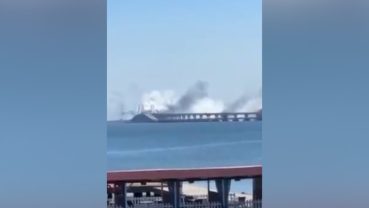 Meanwhile, Aksenov’s aide Oleg Kryuchkov, revealed on his Telegram channel that a “smoke screen has been set off by the special services.” He also wrote that the Crimean Bridge would be reopened to vehicles “very soon.”
Later in the day Aksenov issued another message, saying that one more missile had been downed over the Kerch Strait. The official also expressed gratitude to the Russian air defenses for their “professionalism.”
According to the Russian Defense Ministry, Ukraine “attempted to conduct a terrorist strike on the Crimean Bridge using a guided air-defense S-200 missile converted into a strike version” around 1pm Moscow time on August 12.
It said Russian air defenses had “detected the Ukrainian rocket in a timely manner and intercepted it in mid-air.”
The statement added that the foiled missile attack had not caused any casualties or destruction.
Commenting on the latest attempted missile strikes on the Crimean bridge as well as a separate thwarted drone attack on the peninsula early on Saturday, Russian Foreign Ministry spokeswoman Maria Zakharova strongly condemned these “terrorist attacks.”
She went on to stress that despite the bridge being a “purely civilian infrastructure,” it has been attacked repeatedly since last fall.
According to the Russian diplomat, Kiev is targeting the transport artery in retaliation for its faltering counteroffensive, which has so far failed to live up to high expectations.
Zakharova concluded that by engaging in such “barbaric actions,” Ukraine is showing its true face to the international community. The official also warned that Russia would retaliate.
On July 17, two seaborne explosive-laden drones rammed into the Crimean Bridge, causing one of its inner segments to collapse. The attack claimed the lives of two adults, leaving their teenage daughter seriously injured, and orphaned.
President Vladimir Putin described that incident as “yet another terrorist attack by the Kiev regime,” adding that the bridge was not being used for the transport of military supplies.
Late last month, the head of Ukraine’s intelligence service SBU, Vasiliy Malyuk, confirmed that it was behind the deadly truck bomb blast last October. The explosion killed several civilians and seriously damaged the bridge’s structure.
The bridge was built in 2018 to connect Crimea to the Russian mainland.
Ex-Pentagon Analyst: US Got Rude Awakening in Ukraine After Downplaying Russian Air Power
By Ilya Tsukanov – Sputnik – 12.08.2023
August 12 is Russian Aerospace Forces Day. In light of the critical role played by Russian air power in the military operations in Ukraine, Sputnik decided to reach out to retired US Air Force Lieutenant Colonel Karen Kwiatkowski for her take on the conflict, and what the Pentagon got dead wrong in its assessment of Russian capabilities.
Saturday marks the 111th anniversary of the August 12, 1912 order establishing the Imperial Russian Air Service as a separate branch of the armed forces. In the century-plus since, Russia’s air forces have faced multiple reorganizations, and been known by multiple names, from the Soviet Air Forces (1918-1991) to the Russian Air Force (1992) and finally the Russian Aerospace Forces (2015 on). But throughout, its mission remained the same – to defend the nation’s airspace and provide ground support for the Army.
From the very beginning of the escalation of the Donbass crisis into a full-blown Russia-NATO proxy war in Ukraine in February 2022, the Aerospace Forces have played a key role in Russian offensive and defensive operations.
Its role has become especially noticeable amid Ukraine’s two-month old counteroffensive attempt, which US and NATO officials and generals now openly agree seems “extremely unlikely” to succeed, as Ukrainian forces have failed to break through even a single major Russian defensive line while taking staggering losses in troops and equipment.
Russia’s overwhelming superiority in the air has played a decisive role in halting Ukraine’s offensive operations, striking whenever they attempt a major armored maneuver, and keeping an eye out for movements in coordination with satellite intelligence and reconnaissance drones. So intense has the devastation of Ukrainian forces been that panicky NATO and Ukrainian officials have begun to blame one another over “tactics” or the lack of equipment and ammo instead of asking questions about the reasonableness of pushing Ukrainian troops to attack entrenched Russian positions without air cover or artillery superiority.
Rude Awakening
The Russian Aerospace Forces’ performance in Ukraine “has probably surprised many in the West,” says retired US Air Force veteran, former Pentagon analyst, anti-war whistleblower and activist Karen Kwiatkowski, “in part because of Western assumptions.”
“I think that the level of advanced technology in… the current Russian Air Force, and the relative newness of many of these systems compared to what we have in the West, has been a surprise, in part because Western analysis of intelligence is geared to downplay Russia and Russian capability in all ways. The Russophobia, and also a certain contempt for Russia, in DC and inside the Pentagon is a factor,” Kwiatkowski told Sputnik.
“I suspect also that how the Russian Air Force uses these systems in battle is also a surprise for the West, and particularly the US. Obviously, the Ukraine battlefield has been a testing ground for high-tech and rapidly adapting drone warfare, even as in some ways it reminds of a slogging land war in Europe faced in World War I,” she said.
Characterizing the Russian Aerospace Forces as a true “national defense air force,” as opposed to the “offensive, forward-operating Air Force” which the US has, Kwiatkowski said that Russian air power seems geared toward supporting land and sea operations “in a tightly integrated way” with “focus and exceptional skill set for ground support.” This is as opposed to the US and NATO powers, “where air forces seek to ‘dominate the skies’ in a somewhat competitive way with the separate Army and Navy missions,” she said.
“For us in the West, it remains difficult to get accurate assessments of battlefield performance in Ukraine, and that deficiency of hard data impacts not just commentators and technicians, but our top Pentagon and national political leadership,” Kwiatkowski stressed, after being asked to assess the performance of Russian Aerospace Force assets in Ukraine. “That said, it seems to me that the US media is somewhat hysterical over Russian drones, attack helicopters like the modern and capable Ka-52, and the Su-27 fighters in their various battlefield and defensive roles,” indicating their effectiveness.
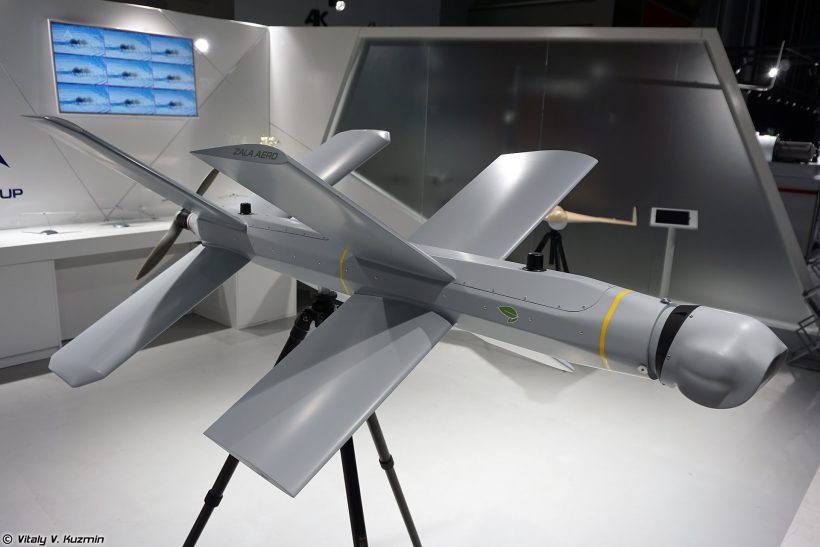
Kwiatkowski highlighted the Lancet drone in particular, which is used by the Ground Forces, as a major “game changer” in Ukraine, given its success in devastating even the latest NATO ground-to-air weapons and Leopard tanks.
“The Lancet represents the evolution of Russian drone technology and design. It can carry different munitions, and serve different purposes on and above the battlefield, and appears to be cost effective to produce. It really represents what rapid evolution and development in a weapon, using real world data and learning, can produce,” the former Pentagon analyst said.
Unconventional Times Call for Unconventional Tactics
Along with strategy and weapons, Kwiatkowski also pointed to the surprising and “non-traditional, almost experimental” aerial disruption tactics employed by Russian military pilots in recent months, including against US-operated reconnaissance drones over the Black Sea and in Syria, by making close approaches and dumping fuel on them, or conducting other unpredictable aerial maneuvers.
“This kind of creativity, that functionally serves both Russian political as well as practical interests of air defense and air superiority, is impressive. It speaks to training, and competence of Russian pilots, but also that they are well-led and well-supported by their military and political leadership. I cannot say if this is the case, but this is the conclusion I draw,” Kwiatkowski summed up.
WHY IS THE WEST SO WEAK (AND RUSSIA SO STRONG)?
THE ROLE OF HUMAN CAPITAL AND WESTERN EDUCATION

BY GAIUS BALTAR | AUGUST 2, 2023
It is becoming increasingly clear to more and more people in the West that something has gone terribly wrong with the Ukraine project. Predictions and projections didn’t pan out and the West doesn’t seem to know what to do. The Russian economy wasn’t a house of cards as predicted, Russian weapons weren’t inferior as predicted, Russian soldiers and commanders weren’t incompetent as predicted, and Russian technology wasn’t inferior as predicted.
In some respects the Russians even seem to be superior to the West. Their weapons are effective and in many cases outright technologically superior, as clearly demonstrated by their hypersonic missiles, SAM systems and electronic warfare systems. Their economy appears to be surprisingly advanced and diversified and based on real wealth creation rather than financialization and debt like the West’s. Their strategic and tactical thinking also seems to work, while the West‘s clearly doesn‘t.
The whole mess is often explained as a result of a miscalculation by the western elites – they underestimated Russia and overestimated the West. The situation, however, is far worse than that. Every day that passes reveals the impotence of the West more and more and the situation is becoming outright humiliating. At this point the rest of the world either shakes their heads or simply laughs at the West and its politicians and diplomats – not to mention its crazed populations.
The dysfunction of the West is far deeper than just the situation around the Ukraine project. It’s absolutely everywhere. The West can’t do diplomacy in general, it can’t run its cities or countries except into the ground, its high-tech projects fail almost as a rule, its infrastructure is crumbling, its economies are crumbling, and all public policies seem to have a civilizational suicide as a final goal. The West’s control mechanisms over the rest of the world are also crumbling, including the dollar, sanctions, color revolutions, military interventions and threats. Nothing seems to work and everything the West does seems to make things worse.
Any rational person upon hearing a western leader, diplomat or “expert” speak, asks himself this question: “Are they just lying or are they really this incompetent and delusional?” The answer is “both” but the incompetence factor is far greater than most people can imagine.
Why has this happened? It’s clear that the cause is far deeper than the deindustrialization of the West or economic problems in general. The economy doesn’t explain the incredible incompetence shown by the West before and during the war in Ukraine.
I suggest that the cause of this unfolding disaster is a serious structural problem in the West – which Russia seems to have largely avoided. This structural problem is a necessary condition for the current western system and has been purposely created to bring it about and maintain it. This problem is the subject of this article – as well as the “mechanism” behind it. This is unfortunately a long article, but the subject matter demands it.
The current ideologically-based power structure of the West outright requires that certain types of people be in positions of influence and certain types of people be sidelined. This applies to all steps of the social ladder; from kindergarten teachers to university teachers and corporate executives, and all the way up to the leaders of society itself. This has been progressing steadily for the last five decades or so, and has resulted in a major structural problem for the West. That problem is the obvious and massive degradation and misallocation of human capital in the West.
Human capital can be described as the quality of a company’s or nation’s workforce, or more specifically how competent the employee pool is – how well they are trained, how quickly they can be trained, how they are educated in general, and how they make decisions. In order to understand what competence really means, let’s define it further.
Competence can be described as specific or general. This distinction is extremely important and must be understood by anyone who attempts to manage human capital on a small or large scale.
Specific competence is the ability to do a certain type of work. This can be carpentry, coding, chemistry, medicine, piloting an airliner, and so on and so forth. Some of these types of jobs may require a lot of competence, training and intelligence, but what they have in common is that their scope is limited and clearly defined. They exist within clear boundaries, separate from the complexities and vagueness of the world in general. Each type of work requires certain abilities innate in the person, as well as varying degrees of training. People, of course, differ a lot in their level of specific competence within each field.
General or high-level competence is the ability to do work that is beyond clearly defined boundaries. The subject matter of those types of work exists in a complex “variable universe” and can be exceedingly vague and confusing. It requires the ability to be adaptive and be able to transfer skills between different types of work. This also applies to expertise in one field being applied to a completely different field – such as applying psychology to economics or astrophysics to climate science.
Examples of positions requiring general or high-level competence people are corporate executives, all kinds of planners and administrators, product developers, inventors, high-level consultants and analysts, military leaders and planners, diplomats, judges, political leaders, and high-level scientists and theoreticians, to name a few.
Specific and general competence types of work are not two separate things. Types of work or “jobs” can be said to range from almost completely specific up to almost completely general. Almost all types of work have elements of both but in varying proportions. To illustrate this I will take an example from a company I’m personally familiar with. This is a software company with several owners, most of whom work at the company. One of the owners is an exceptionally competent database specialist. However, when he contributes to decision making for the company as a whole, he becomes an outright problem. The management structure of the company had to be “modified” to neutralize him in that role, as well as a few others. This employee has exceptional specific competence but very poor general competence. He cannot “transfer” his specific database competence over to competence in moving the company into the future. He simply cannot operate objectively or sensibly outside his database job.
So what makes this employee have such poor general competence – or more specifically – what is general competence? General competence requires three necessary conditions: a) High general intelligence or IQ, b) the ability to be objective, even in situations where the result of your conclusions may not be to your liking, and c) the ability to reach conclusions without being influenced by others (i.e. independent thinking). The latter two conditions are a direct result of how the human brain interacts with the environment. The mechanism behind it is too complicated to describe here, but in simplistic terms it can be said that humans range in their relationship with reality from the emotional-outward/subjective to the introspective/objective. This variable, like all evolutionary traits, including IQ, is normally distributed. This has rather disturbing implications which may be difficult for some people to understand.
Let’s first look at IQ, or general intelligence. In order to be able to deal with seriously complicated work or get through a real university program, an IQ of about 125 is necessary. Only about 5% of the population in the West has this IQ or higher. This means that the pool of potentially high-level competence people is very small to begin with. Even if we use a cut-off of an IQ of 115, which is sufficient for most semi-complicated work, the potential pool only goes up to 16% of the population.
Now let’s take a look at the other variables, i.e. objectivity and independent thinking. Those two are correlated and we will, for the sake of convenience, handle them as the same variable or trait, even though they aren’t. They are normally distributed, much like IQ, with most in the middle and fewer toward the extremes in both directions. On one side of the distribution are people who, to state it bluntly, are incapable of thinking objectively about any issues that may interact with their personal views about anything at all. They can be competent in a limited field which is “neutral” to them (such as databases), but not involving anything else. They can’t run a company in a competitive environment, except into the ground. They can’t run a city, a country, a military campaign, an economy, or anything requiring general competence, except into the ground, regardless of their intelligence. These people are clearly not suitable for general/high-level competence jobs.
So, what is the proportion of the population that is objective enough and independent thinkers enough to be suitable for those jobs? That’s difficult to determine but it’s clear that it is maximum 50% of the population. In reality it’s far less but let’s be generous and say it’s 30%. What does that mean?
IQ and objectivity/independent thinking are somewhat correlated but let’s assume they are not. Let’s say that we have a pool of potentially objective and rational people that is 30% and a pool of people with IQ of 125 that is 5%. That means that the pool of high-level general competence people is 5% of 30%, or 1.5% of the population.
If we are really generous and assume that 50% of the population is objective and rational and an IQ of 115 is sufficient for those jobs, then we have 16% of 50%, which is a pool of 8% of the population.
The importance of this cannot be overstated. This group, whether we define it as 1.5% of the population or 8% of the population, is extremely valuable. This is essentially the only group in society that can reliably evaluate complex situations and make subsequent rational decisions. Without it, modern technological society simply cannot be built or maintained – let alone advanced. Let me rephrase this – if we do not identify and utilize this group, we cannot run our complicated societies except into the ground.
Modern western society is from a governance standpoint ideologically motivated and ideologically controlled. It is being pushed in a very clearly defined ideological direction, led by the European Union and the current US administration. This ideology is not the subject matter of this article, but it can be seen everywhere by any rational and independent-thinking person. For the uninformed-curious a good place to start is the website of the EU’s policy-making body; the World Economic Forum.
In order to achieve these ideological goals for the West, two things must happen: a) The right people must be put into power at all levels of society and b) any disruptive elements must be eliminated or suppressed. Since all ideological goals tend to be more or less in conflict with reality, there is no group more disruptive to them than the one who operates objectively and independently. People like that simply cannot be allowed into positions of power, and if they must be, they must be kept quiet and/or forced to toe the line.
The objective/rational/general competence group, whether it is 1.5% or 8% of the population, therefore becomes a problem rather than a resource. This is exactly the situation in the West today.
Many people have noticed that meritocracy has been systematically abandoned in the West and the relationship between competence and reward severed in giant swaths of the economy – and almost completely in government. What few people seem to realize is that this is a necessity for the West’s ideological goals to be reached. High-level competence cannot be promoted because it is a threat. It cannot therefore be rewarded.
In order to illustrate this, let’s take a look at what happens when a member of the 1.5% is allowed to gain significant power. Elon Musk is a smart man, probably with an IQ of 150 or more. He is also quite objective and realistic in his assessments, and an independent thinker. His ownership and governance of Twitter/X is a major problem for western ideological goals. Free speech is an obvious threat to any ideology and, to rub salt in the wounds, Musk belittled the guardians of the Ideology at Twitter by making fun of them, then by firing them all and only keeping the competent ones. This cannot be allowed to stand and we can already see the response. The EU is planning to use force to stop this affront to the Ideology and may actually block Twitter in Europe. Ideological champion (and suspected lizard robot) Mark Zuckerberg was even instructed to cook up an ideologically pure Twitter copy in response – but seems to have failed. We eagerly await further responses, which may range from lawfare up to more “direct” actions, and will most likely be directed at Musk personally.
As previously noted, two things must happen for the ideological goals to become reality: The right people must be promoted and the wrong people must be suppressed. This process of elevation/suppression has become the main goal of the western education system – all the way from kindergarten up to university. If we look at what the education system has been doing, this becomes extremely obvious. Here are a few examples:
- Evaluation of competence is being systematically degraded to avoid comparison between the competent and the incompetent. Exams are being discarded in favor of constant “projects” and students work in groups so the incompetent may hide. Schools avoid testing the individual directly as much as they can – and thereby comparing him to others. The competent ones must not be encouraged, and if at all possible, they themselves must not realize that they are above others.
- Universities are increasingly basing admittance on other criteria than competence, including quotas based on non-competence variables. The most insidious selection method is the “personal essay” which applicants must submit – and is sometimes even more important than grades. All applicants know that the more they signal virtue in the essay, the more likely they are to be admitted. On the basis of the essay, the universities can pick the ideologically pure – which is the only purpose of the essay requirement to begin with.
- Almost every academic subject is being turned from the objective to the subjective to assist the irrational-incompetent student. This even applies to hard subjects such as mathematics – where nowadays 2+2 doesn’t necessarily equal 4. Even intelligence is now subjective and the stupid can be as smart as the intelligent – it’s just a question of perspective, the right measuring tools, and idiotic inventions such as “emotional intelligence.”
- Almost every subject has been made easier than before to help the incompetent students and even critical fields such as medicine are now graduating people who are utterly incompetent and clueless – on a large scale. This systematic lowering of standards also has the added benefit of creating disinterest in smart and rational students. A smart student performs better and better relative to others as the subject gets harder. If the subject is easy or made uninteresting, he will sink down to mediocracy – which is a part of the purpose of lowering the standards to begin with.
- Disciplines which may be a threat to the irrationality of the Ideology have been massively subverted and corrupted. This applies to several fields, but particularly to psychology and history, which in their proper forms would be a massive threat to western ideological goals. Psychology has been twisted into an almost unrecognizable abomination, and history is mostly just lies these days.
- Fake disciplines have been invented from the ground up for the purpose of training the ideologically pure without the need for competence or intelligence or any connection to reality. These disciplines can be found in lists of “most useless university degrees” all over the internet, but that is a misunderstanding. Those degrees are not useless at all – they elevate the ideologically pure in society by awarding them university “certification.” This certification justifies giving them important positions in society.
I could go on but you get the picture. What we are looking at here is not the failure of the western education system, but a very carefully planned “pivoting” toward new objectives. The primary purpose of the education system is no longer education. The entire education system of the West has been reconfigured to carry out a “filtration” process. The purpose of this process is to identify, instruct and elevate the ideologically pure while suppressing the dangerous 1.5/8 group. The education system, particularly the universities, has largely abandoned real education and is almost solely focused on this mission. This mission is not just carried out by the education system, but by all institutions of governments and a large part of the corporate sector. A side-result of this filtration process is the degradation of all education in the West, and subsequently, degradation of its human capital in general.
Western society, in general, has abandoned rationality and replaced it with subjectivism (formally designated as “post-modernism”). The purpose of that is not just to train and advance the ideologically pure, but to use subjectivism as an oppression tool against the 1.5/8 group and the rational part of the population outside of it. The best way to suppress a rational person is to subject him to an existence of total and constant irrationality. It is essentially gaslighting on a civilizational scale, directed at the dangerous rational group.
While the dangerous rational group is being suppressed and subverted, the ideologically pure “leaders of tomorrow” are indoctrinated rather than educated, given university certifications rather than real degrees, and finally provided with an unending amount of fake and well paid jobs in both the private and public sector. This well-paid ideologically pure group then becomes the power base of the new ideological system.
The goal of this deliberate intervention into the educational system is to create what you might call a “migration pattern” in society based on (lack of) competence and ideological purity. The right people need to be put into the right positions and the right jobs, and since they are incompetent, this needs to be managed for them. After they leave school with their certifications, government and the private sector take over and actively push them upward, while pushing the dreaded 1.5/8 group away from influence and well-paid jobs.
Two developments in the West have been godsends for these efforts: the outsourcing of western manufacturing to Asia and the virtual abolition of competition in the corporate sector. This massively decreased the complexity level of the western economy and subsequently the need for the 1.5/8 group. When most companies operate services in a protected environment, there is far less need for high-level/rational people – while in a “real economy” these people simply cannot be sidelined. Also, when you can get away with operating a fake economy based on the dollar reserve status, you can also operate a fake society run by incompetents.
Let’s take a closer look at how this upward migration of the ideologically pure is managed after they receive their university certifications – and how the 1.5/8 group is systematically blocked. There are five main methods being employed – which together form a long-term takeover process of society. These methods are the following:
- Public sector filtering
- Public sector stuffing
- Job-creation by decree
- Private sector filtering
- Private sector stuffing
Public sector filtering – This describes the job selection process in the public sector. Initially the “foot-in-the-door” method is used. A few ideologically pure politicians and bureaucrats position themselves within the system and start controlling who is hired. This increases exponentially over the decades as more and more purists gain access to the levers of power. Currently the process is so overt that it is starting to become expressed in recruitment policy papers – such as the recent example of the British government excluding “white men” from becoming fighter pilots. The West has almost completely been able to exclude the 1.5/8 group from public-sector positions using this method – including its armed forces.
Public sector stuffing – As the public sector filtering process advances, the purists inside the system start creating more and more positions for their purist brethren. New departments are created, work groups and committees appear, and the public sector expands. Publicly owned companies, such utility companies, hospitals and schools are also often used as storage units for large numbers of the ideologically pure. This is extremely obvious in the West. Every unnecessary law or initiative requires more and more people – and these people are all carefully selected.
Job-creation by decree – This method is directed at the private sector, as well as the semi-public sector. Government purists start creating new laws and standards which all companies must fulfill. Those are justified on the basis of “goodness” and usually involve the environment, equality, safety and such things. This creates a large number of positions within private companies which are tailored for the ideologically pure – particularly in support functions such as human resources, compliance functions and others. This enables a “foot-in-the-door” situation in the private sector and gives the purists access to the levers of powers there – much like they already have in the public sector.
Private sector filtering – As the purists have gained access to the private sector – particularly human resources (which is the standard purist Trojan horse in private companies) – they start filtering new recruits exactly the same way the public sector does. As in the public sector, this filtering process is becoming more obvious. A significant number of companies are now specifying which groups will not be hired in their job advertisements. Since they can’t overtly say “we don’t hire smart, independent thinkers” they usually use “white men” as a proxy for that group for some reason. That group is considered to be a particular threat, although you can be sure that anyone who doesn’t follow the program will be fired, regardless of their gender or the color of their skin.
Private sector stuffing – Shortly after Elon Musk bought Twitter he fired something like 80% of its employees. That 80% was the company’s private sector stuffing ratio – quite high. Companies, particularly in sectors which can influence public opinion – but not solely, are increasingly creating a large number of positions which are either totally superfluous or intended for influence operations against the public.
Those filtering and stuffing methods are the primary mechanisms that have been used for the takeover of western societies by the ideologically pure. There are other mechanisms, such as ESG, filtering by certain banks and investment funds regarding who gets financing and who doesn’t – and the uncontrolled immigration engineered by the ideologically pure which is seen by them as a continuation of the internal migration process. However, all that is beyond the scope of this article.
The ideologically pure have systematically been moved into almost all positions of power in the public sector and a large part of the private sector – and the situation in the private sector is increasingly mirroring the public sector in hiring practices and employee stuffing. The dangerous 1.5/8 group is being kept away by all means, and with great success. The power base of the Ideology is firmly in place.
This job migration program hasn’t been cheap. Millions of unnecessary jobs cost money and it is clear that a significant part of western public debt can be attributed to this program, a fact which doesn’t seem to have been noticed by many people.
The consequences
The main thing to understand is that western societies and economies have been put on an ideological footing. Productivity, competitiveness, technology and science are simply not priorities anymore in the West. Explaining the consequences of this process for the West would take many articles, or a book of several hundred pages. Still, let’s mention a few examples.
The inverse competence crisis – The goal of this entire project has been to place the ideologically pure in all positions of power at all levels of society. These positions are, in a normal and competitive society, occupied by the highly competent 1.5/8 group. The process has now reached near-completion with most positions of power occupied by the ideologically pure. Some of those people have high IQs but they are neither objective nor independent thinkers. The Ideology they must subscribe to is simply incompatible with those qualities. This has some serious consequences.
Remember that positions of power and influence are more likely to demand general competence than other positions (as opposed to specific competence). The greater the power, the more the position demands general competence. The people in these positions now are selected by ideological fervor and reliability – so the higher you go, the more ideologically enthusiastic the people who hold them. This means that the least objective and independent thinking people hold the positions which require the greatest objectivity and independent thinking. Therefore, in the West incompetence becomes greater and more common the higher you go. As someone said – “a general is an incompetent colonel.” This can be seen absolutely everywhere except in some holdout private companies. Those exceptions are of course being addressed as we speak.
The second problem is that many of the irrational/subjective people holding all the power have reasonably high IQs. That may seem to be a positive thing but it has a major disadvantage. Moderate to high IQ irrational/subjective people are the easiest to brainwash of all people. The reasons for that are complicated and need to be addressed in another article – but what this means is that the top tier in the West is not only the most incompetent it can possibly be in comparison to what their jobs require – but are also the most malleable and delusional.
The cost and debt crisis – The migration of the ideologically pure into the ideological power base and positions of influence has created millions of jobs in western societies which create no value. These jobs are much more numerous and more widespread than most people realize, and I wouldn’t be surprised if something like 20%-30% of the entire labor force of the West could be fired without any adverse effect. In fact, the effect would be positive, especially if those people could be made to work the (mostly menial) real-economy jobs they are suitable for.
Deindustrialization has been blamed for the extreme debt levels and tax burdens of the West. That is, as far as it goes, true – but maintaining this giant group of incompetents in their fake jobs is also placing an extreme burden on the West. Western societies are now completely unsustainable and cannot be run without constant debt increase.
The competition crisis – This crisis can be explained by the following example: Let’s say there are three companies with combined 100% market share in some sector. There is no real competition between them and everybody can just relax because the customers can’t go anywhere else. These companies can get away with absolute incompetence on most levels, including in management. They don’t need to think about efficiency, safety, productivity or costs, except on their websites and in annual reports. However, if a competitor with competent employees manages to infiltrate the sector, those three companies will hit a wall. There will be an enormous crisis and one or more of them will most likely go under.
This is exactly the situation in the western economies now. Monopoly and oligopoly is the rule and the main objective of most large western companies is to prevent anyone from infiltrating their sector – usually by bribing regulators or by buying the competition. This is a necessity because a huge number of western companies are now run by incompetent management and staffed by incompetent people, particularly in support and management functions. The immortal words of the nameless Boeing employee about the 737 MAX apply to most large western companies; “this airplane is designed by clowns who in turn are supervised by monkeys.” Western companies are no longer competitive. They cannot compete with Chinese companies now and soon they won’t be able to compete with companies in general outside the West. They simply can’t function except inside an economic safe-space. In fact, the situation is such that the Chinese already do the real work for many of them and reshoring the work is problematic because of (surprise!) the human capital degradation in the West caused by the repurposing of its education system.
This also applies to western societies as a whole. The entire leadership and diplomatic classes of the West are no longer competitive against the rest of the world for exactly these reasons. They are being outmaneuvered by the Chinese, the Russians, the Indians, and everybody else at every turn. Even African leaders are now more competent than western leaders. They have consistently made decisions that are better for their people than leaders in the West – for the last few years anyway.
The complexity crisis – Earlier in this article I stated that the 1.5/8 group is extremely valuable for modern societies and without it complicated modern societies cannot be managed. In the West this group has been successfully sidelined to a great degree and a good part of it doesn’t even bother with university education anymore. The situation, however, is even worse than that. The reconfiguration of the education system and the break between competence and reward in the job market has fundamentally changed the decision making process behind the selection of university education. Why study engineering (which is hard) when you can get an even better paying job with a degree in psychology (which is easy nowadays)? The reconfiguration of the western education system has changed the reward structure, encouraging young people to pursue easy and useless education – simply because the “system” will provide them with jobs.
This has already caused a major crisis in western societies, particularly in the US. The “maintenance” of complex aspects of US society needs a large group of engineers and people with related education. This maintenance is faltering now, and significantly relies on foreign engineers educated in US universities. You see, why would Americans study engineering in a system which doesn’t reward it? If China and India could somehow recall their engineers and others with hard education from the US, the US system could probably not be maintained, let alone advanced. This will get progressively worse and we will soon reach a point where complex systems which underpin society cannot be kept running. That will require some kind of “reset” to a less complex society, with less prosperity of course.
There are far more crises than those four, but I wouldn’t want to sound like a doomsayer by listing more.
So, what about Russia? Firstly, there are clear signs that the Russians have figured out what is happening in the West and are learning from it. Recently they left the “Bologna process” which is a European education standardization system. The Bologna system has the express purpose of diluting education in member states, implementing certifications rather than real degrees, and filling European societies with badly educated and generally incompetent “experts” who follow the consensus, no matter what. The Russians saw this system as a threat to their country, which it is, and have, at least partly, reverted to the older and more hardcore Soviet system.
Secondly, the Russians seem to be carrying out purges of the incompetent and corrupt within state structures, including the military. Meritocracy seems to be on the agenda, a radical concept these days. The Russians most likely see these efforts as critical to the continuation of their state and nation – and they would be right.
The situation in China is much the same and there are indications that the rest of the non-western world is catching on. Remember that one of the results of the recent Russia-Africa summit was a Russian-organized education effort in Africa. I doubt that women’s studies will be a part of that curriculum.
The current clash between the West and Russia – and increasingly between the West and the rest of the world – is becoming a clash between the incompetent and irrational and the competent and rational. The result is obvious – but what happens when an irrational person who is backed into a corner has access to nuclear weapons? That’s anybody’s guess.
By putting its societies on an ideological footing the western elite has backed itself into a corner. They can’t compete; they can’t develop their economies or societies; and they can’t go back. Fixing the problems of the West will require an economic revival, where a real economy will replace the current fake financialized service economy. This cannot be done without putting the hated 1.5/8 group into positions of power. Therefore, it will not be done as long as the current western ruling class is in power. Western societies will not survive an economic revival in their current ideological configuration. Conflict is therefore the only remaining option for the ruling class to hang on to power.
Russian energy revenues higher than last year – Handelsblatt
RT | August 11, 2023
Russia saw revenues from energy exports surge last month despite Western sanctions that include embargos and price caps on the country’s oil, German news outlet Handelsblatt reported on Thursday.
According to the publication, Moscow’s revenues from oil and gas sales grew 5.3% year-on-year in July and amounted to $8.66 billion. Profits were said to be the largest in gas exports, while those from crude sales rose by 2.6%. The outlet noted it was the first time this year that Russia had increased state revenues from energy exports in comparison with 2022.
Russia is earning more from energy exports and “thus is in a better position than a few months ago,” Giovanni Staunovo, a commodity analyst at Swiss bank UBS, told the news outlet. He claimed that as a result, many have started to doubt the effectiveness of sanctions on Russia.
Robin Brooks from the Institute of International Finance (IIF) noted that sanctions “can be very effective when used against countries with current account deficits,” which depend on loans from foreign investors on the global capital market to finance imports. He noted, however, that Russia is not among that group and argued that the restrictions imposed on it are becoming increasingly ineffective.
An EU embargo on seaborne exports of Russian crude was introduced last year along with G7 price caps on oil and petroleum products originating from Russia, in response to Moscow’s military operation in Ukraine. The measures were presented as an effort to deprive Moscow of funds to finance its military effort.
While the restrictions have barred Russia from accessing its traditional Western markets, they have triggered a large-scale reshuffle in global oil supply, with Moscow successfully redirecting exports to Asia. According to the latest OPEC calculations, Russia has been the largest exporter of oil to India for the past year, accounting for 45% of India’s crude purchases in June. It has also been China’s top supplier since January.
The Sino-Russo Naval Patrol Near Alaska’s Aleutian Islands Flipped The Tables On The US
BY ANDREW KORYBKO | AUGUST 10, 2023
Alaskan Senators were apoplectic after Russia and China just carried out a previously unreported joint naval patrol near their state’s Aleutian Islands last week. Those officials condemned what they claimed was an “incursion”, though the US Northern Command confirmed that the patrol “remained in international waters and was not considered a threat.” In any case, this was an interesting turn of events since it’s usually the US that conducts such exercises near those two’s borders.
The Sino-Russo Entente isn’t an alliance, but rather an unprecedentedly close strategic partnership focused on coordinating efforts to accelerate the global systemic transition to multipolarity. To that end and in the context of last week’s joint naval patrols, these Great Powers decided to signal to the world that they’ll reciprocally respond to similar such exercises by the US. Up until now, each reacted separately and largely restricted this to rhetoric, but now they’re reacting jointly in a tangible way.
Several of their interests were served in this way. First, the US now knows that the Sino-Russo Entente isn’t reluctant to sail flotillas as close to American shores as is legally possible. Second, they voluntarily complied with the terms laid out in the UN Convention on the Law of the Sea (UNCLOS) regarding where foreign warships are allowed to sail despite the US not recognizing that framework. Third, this example demonstrated the sharp contrast between them and the US on the issue of international maritime law.
The fourth interest that was advanced through their joint naval patrol near the Aleutian Islands is that it made locals in that state, and likely also Americans elsewhere, experience how it feels when their geopolitical rivals conduct such exercises near their borders. Those drills won’t influence the formulation of US policy, but they can help shape some voters’ opinions about the wisdom of their leaders’ policies towards Russia and China considering that those two are merely responding to the US’ own such moves.
And finally, these drills importantly remained below the threshold of triggering an escalation, thus proving that it’s indeed possible to reciprocally respond to American provocations after both Great Powers were hitherto reluctant to do so. About that last-mentioned observation, they previously reacted separately and largely restricted this to rhetoric except on those rare occasions that they were accused by the US of flying or sailing their respective units too close to the latter’s.
Even so, those incidents took place near their own borders and not the US’, but this time they jointly sailed their warships near the Aleutian Islands in order to give America a taste of its own medicine. These plans were likely agreed to long ago but weren’t implemented until now since they each wanted to give the US the opportunity to stop making them feel uncomfortable by operating so closely to their shores. Russia and China’s patience has clearly run out, however, hence why they’re now jointly reacting.
This wasn’t their first joint naval exercise, but it’s the largest one near American shores thus far, which makes it a milestone. The Mainstream Media will predictably try to spin it as so-called “unprovoked illegal aggression” despite those two strictly abiding by international law per UNCLOS and carrying out their drills in response to the US’ earlier countless ones near their borders. By finally turning the tables on the US, the Sino-Russo Entente wants to show the world that the era of military unipolarity is over.
Last Stop Before Willoughby

By William Schryver – imetatronink – August 9, 2023
“What the West has, and has had for some time now, is a single-shot military. One serious campaign, whether finally won or lost, would disarm the West for a decade.” — “Aurelien“
This, folks, is the simple truth of the matter.
The US simply could not, at this moment — nor at any time in even the medium-term future — mount and sustain a campaign the size, intensity, and duration of what we have seen in Ukraine for the past 18 months.
US logistical chains would have long-since broken down; losses in men and equipment — including LOTS of cargo ships and their warship escorts — would have been calamitous.
Oh, sure, there’s the huge chorus of people who are gung-ho convinced that US air and naval power would overcome all obstacles in a matter of days, bringing the presumptuous Russians to their knees.
That’s not what would happen, you dopes.
What would happen is that, despite a few spectacular successes to stuff the first 24-hour news cycle, the “full-spectrum dominance” everyone believes the US wields would suffer severe immediate losses across the entire military spectrum.
Dozens of US aircraft of all types would be shot down in the first 100 hours of war. Several US ships would be damaged or sunk. US bases in both Europe and around the globe would be struck. US airborne ISR assets would be aggressively targeted; military and communications satellite arrays would be disabled.
Within literally just a few days, the US would start to experience severe stand-off strike munitions shortages, greatly exacerbated by the high interception rate Russian air defenses would achieve.
The Russians have already demonstrated, over the past 18 months, that they can shoot down ANY manner of strike missile the US can field against them — not all of them all the time, but most of them most of the time.
No other military on the planet has previously attested this level of capability. The US does not have it, and is almost certainly at least a decade away from developing it.
And, make no mistake, if the US were to strike at targets on Russian soil, the Russians would strike back at targets on US soil. I do not believe they would launch a nuclear “first-strike” against the US, but I can guarantee they would use their submarine fleet and conventional long-range airstrike capability to hit strategic targets on US soil.
It would be a shocking exhibition of 21st century great power warfare.
Both sides would be hurt badly, but the Russians would not be even severely depleted, let alone defeated, whereas the US would be hurt in a fashion it has never experienced in its history, only to then look around and discover itself in a state of acute logistical crisis after only a fortnight of high-intensity combat operations.
That will be the moment of decision; the last stop before Willoughby, as it were.
And, if the scenario I have sketched were to actually develop, there will come a moment, fairly early on, when saner heads within the halls of empire — those who have, hitherto, acquiesced as this catastrophe unfolded — well, they will have to choose to finally act to stop the madness, or stand idly by as they and all the rest of us are acted upon by events that spiral out of control.
US lying about Russia’s position on Ukraine peace talks – Moscow
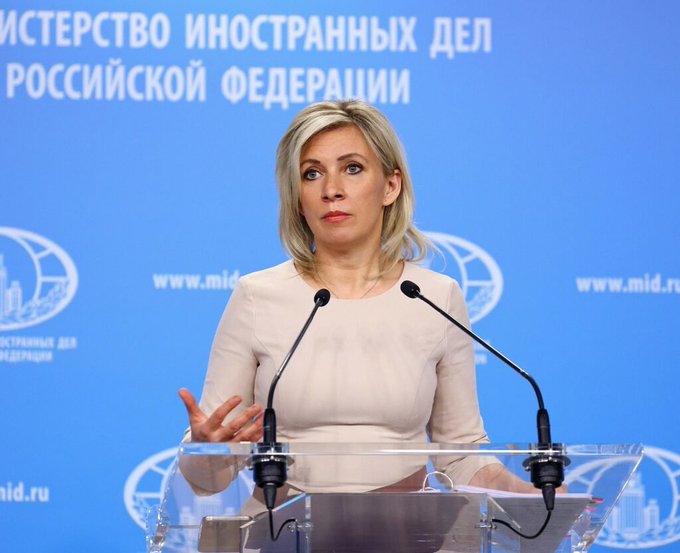
RT | August 8, 2023
Russian Foreign Ministry spokeswoman Maria Zakharova lashed out at Washington over claims that Moscow has rejected peace negotiations with Kiev.
On Monday, US State Department spokesperson Matthew Miller said at a press briefing that “There are no peace negotiations going on with Russia right now, because Russia has refused to engage in meaningful peace negotiations.”
Later that day, Zakharova wrote on Telegram: “They know perfectly well that they told [Ukrainian President Vladimir] Zelensky to withdraw from peace talks in April 2022, they caused Kiev’s ban on talks with Russia, adopted in September 2022, they have been declaring all year that it’s not the right time for talks, but they still blame Russia anyway.”
Zakharova also advised Miller to read an interview of US Secretary of State Antony Blinken that he gave in April. She was apparently referring to comments Blinken gave to the Funke Media Group, in which he said he did not support the idea of beginning negotiations, while hailing Kiev’s counteroffensive.
Last week, senior officials from more than 40 countries took part in a summit in Saudi Arabia regarding the situation in Ukraine. Russia was not invited to attend, and called any negotiations without its participation “pointless.”
After the talks, Kiev said it had rejected all points of compromise and had not given up on its ‘peace formula’ – a set of ten demands amounting to unconditional surrender on the part of Russia, which Moscow sees as “a useless ultimatum” that only serves to prolong the conflict.
The Russian Defense Ministry estimated that during June and July, Ukraine sustained losses of more than 43,000 troops in its counteroffensive against Russian positions. According to the ministry’s data, over 4,900 pieces of heavy weaponry were destroyed during this period of time.
NATO aggression against Russia becomes total war
By Drago Bosnic | August 8, 2023
On the night of August 4, the Kiev regime launched a sea drone attack against a Russian tanker. Luckily, the resulting damage was insufficient to sink the ship or cause any casualties among the 11 crew members, but it did hinder its operation. The attack happened at about 23:20 just south of the Kerch Strait, according to a statement by Russia’s Federal Agency for Sea and Inland Water Transport. The vessel was later identified as the chemical tanker SIG. The Russian maritime agency detailed that there is a hole “near the waterline on the starboard side, presumably as a result of a sea drone attack” and confirmed there were no casualties.
It’s important to note that the SIG is sanctioned by the United States for transporting jet fuel to the Russian military in Syria, making American involvement in the attack almost a certainty, particularly at a time when Washington DC’s aggression against Damascus is escalating. The targeting information was most likely provided by US ISR (intelligence, surveillance, reconnaissance) platforms which then relayed this to the SBU or the Neo-Nazi junta forces. The move aims to hamper vital Russian logistics in Syria, particularly operations by the VKS (Russian Aerospace Forces) which is regularly intercepting US/NATO aircraft illegally entering Syrian airspace.
To further conceal direct US involvement, the Kiev regime openly boasted about the attack, which is highly unusual given the fact that it normally maintains plausible deniability in the aftermath of such actions. According to NBC, “the tanker was transporting fuel for the Russian troops,” citing sources and adding that “it was well loaded” and that “the ‘fireworks’ could be seen from afar”. They said that a surface drone and TNT had been used to carry out the attack. A video was also released and shared by several Neo-Nazi junta officials, showing a sea drone moving towards the tanker, although it cuts just before reaching the ship, suggesting the explosion followed immediately after.
“Any explosions that happen with the ships of the Russian Federation or the Crimean Bridge is an absolutely logical and effective step in relation to the enemy,” the head of the SBU Vasyl Malyuk posted on Telegram, adding: “If the Russians want the explosions to stop, they should use the only option for this — to leave the territorial waters of Ukraine.”
Several hours before the attack on SIG, another sea drone damaged the “Olenogorsky Gornyak” landing ship, just off the port of Novorossiysk, one of Russia’s major export hubs. Coupled with attacks on tankers, such actions are obviously designed to hinder Moscow’s oil sales as the so-called “price cap” turned out to be a miserable failure, with even US vassals such as Japan ignoring it. By targeting Russian tankers and major ports, the US is hoping to stop or at least hamper oil sales. This is also connected to the issue of insurance for Russian vessels, meaning there would be no compensation in case of such attacks, possibly prompting other tankers to halt transporting Russian oil.
On the other hand, drone strikes on Russian cities aim to disrupt normal economic activity and discredit Russian authorities, probably in hopes of causing unrest of some kind. On August 6, Moscow’s Vnukovo airport was forced to temporarily halt all flights due to a failed drone attack. The Russian military’s electronic warfare (EW) assets downed the drone in the Podolsk region of the Moscow suburbs. The attack could have caused untold damage had it reached the airport, jeopardizing the lives of thousands of civilians. Since major drone attacks on buildings in Moscow (including the Kremlin itself), the Russian military strengthened its air defenses in and around Moscow, including by placing “Pantsir” SAM (surface-to-air missile) systems on rooftops.
Moscow Mayor Sergey Sobyanin wrote on Telegram: “Today at around 11:00 AM, a drone attempted to break through to Moscow. It was destroyed on the approach by air defenses. Well done, military.”
Drone attacks on civilian infrastructure are absolutely irrelevant to Russian military operations in Ukraine, meaning they are either an act of desperation (as the Kiev regime’s much-touted counteroffensive has been an absolute debacle) or the United States is simply trying to launch a total war against Russia, as its economy has proved to be virtually impervious to the political West’s unrelenting sanctions warfare. Another proof that the economic siege of Russia has failed spectacularly is the fact that the Eurasian giant’s economy will grow 1.5% this year, according to an assessment by the IMF. This “unpleasant surprise” most likely prompted the political West to take “concrete action” in order to prevent such a scenario, as its own economic prospects are not looking so good.
Namely, although President Joe Biden vowed to “turn the ruble into rubble” just last year, this has proven to be nothing more than a fantasy, as the Russian economy is now outperforming those of its adversaries, the same ones enforcing the sanctions. Unable to face Moscow in a fair fight, be it militarily, economically or otherwise, the political West is left with underhanded tactics such as biological warfare, evident terrorist attacks and even covert nuclear proliferation. As previously mentioned, all this can only be described by two words – total war. And while it inevitably results in damage for Moscow on a tactical level, strategically and historically, Russia has never lost such confrontations, as evidenced by the last attempt by a certain failed painter with a peculiar mustache.
Drago Bosnic is an independent geopolitical and military analyst.
US response to Russia-China naval patrol exposes glaring hypocrisy
By Timur Fomenko | RT | August 8, 2023
Last week, the US sent a group of warships and a reconnaissance plane to waters off the coast of Alaska after Chinese and Russian vessels conducted a joint naval patrol in the area.
A former US Navy captain and analyst for right-wing think tank the Heritage Foundation described the patrol as “highly provocative.” Because the US and its allies would never, ever do something like that, right?
The US is engaged in the full-blown militarisation of the peripheries of both China and Russia in a manner that implies it has an unconditional right to do so. This behaviour has not only provoked one war, in Ukraine, but risks triggering a second one, over the Taiwan Strait, too. The reality, of course, is that neither Russia nor China poses any threat to Alaska whatsoever, because the conflict, or risk thereof, is at their own front doors, not America’s.
The US is the most militaristic and aggressive country in modern history. It has established a global military presence that spans every single continent with hundreds of military bases. In doing so, it claims it supports the freedom and self-determination of others. In reality, it provocatively encircles states that it deems rivals to its own global dominance, escalates tensions, and then when these states respond to the situation, subsequently brands them as the “aggressors,” thus affirming and even expanding its military footprint in these given regions.
With Russia, the US has pursued a relentless expansion of NATO eastwards since the Cold War, absorbing former members of the Soviet Union’s alliance system even when Russia had no will to compete with it. NATO has evolved from a unit of collective self-defence in a specific geographic region into an increasingly global ideological crusade which serves the goals of the US. The words “North Atlantic” in its name are increasingly redundant as Washington even endeavours to broaden its reach to Asia and the Pacific.
Which leads to the next point, China. The US is pushing for a full-scale military and naval encirclement around China’s eastern periphery, deliberately using the Taiwan independence issue as a wedge to ramp up tensions despite the One China Policy and giving the island region more and more arms. While doing this, it is forcing more and more countries to accept a greater American military presence. This recently included the Philippines, where the US gained access to a number of bases, as well as Papua New Guinea, where a defence cooperation agreement was recently signed. At the same time, the US constantly sails warships through the South China Sea and the Taiwan Strait, citing so-called “freedom of navigation” from a law which it does not even ratify. China’s retaliatory actions are then branded “aggressive” and threatening the peace of the region.
If this constitutes normal behaviour and a sovereign right of the US, why can China and Russia not sail patrols up to Alaskan waters? Why is one behaviour described as “freedom of navigation” but the other is labelled “highly provocative”? The reality is that because both countries are concerned about the US on their doorsteps, they have little interest in ever waging war as far afield in Alaska. The same cannot be said about US actions on their doorsteps, whereby the threat of war is very, very real and is being cranked up even higher by Washington. The US deems it has rights which other countries do not, which leads to the double standards voiced in the media regarding these seemingly equal actions.
China-Russia military cooperation is a product of the US antagonising them both, rather than so-called “provocative behaviour.” In the geographic sphere of Northeast Asia, the two countries have shared strategic interests which concern checking the expansion of US military power in Japan and the Korean Peninsula. This extends to the Northern Pacific. Neither country has any specific ambitions regarding Alaska. Neither China nor Russia is attempting to foster an independence or separatist movement there, unlike what the US is doing with Taiwan, and then groom it into a military partner hostile to Washington. Therein lies the difference between the two sets of military behaviour. China and Russia may cooperate for common strategic objectives, but they are not exerting aggression in the process. On the other hand, the US’ military presence and patrols are designed to upend a region and turn countries against other, provoke strife, and of course advance its economic goals. The irony is that media discourse presents this as entirely normal and justified, but then depicts Russia-China cooperation as a potential threat to Alaska.
Featured Video

EUROPE FEARS RUSSIA’S NEXT MOVE / Ian Proud
or go to
Aletho News Archives – Video-Images
New Book
New Book: No Autoimmunity The Body Doesn’t Attack Itself
Lies are Unbekoming | September 24, 2026
 The label for Humira, once the best-selling drug in the world, lists its risks in plain print. One of them, in the label’s own words, is new “autoimmune” disease.
A drug prescribed for a condition labelled autoimmune carries a warning that it can cause a condition labelled autoimmune. That contradiction sits in every box, on a folded paper almost nobody reads.
My new book starts there.
No Autoimmunity: The Body Doesn’t Attack Itself
For seventy years, “your body is attacking itself, and we don’t know why” has ended the conversation for people diagnosed with multiple sclerosis, lupus, rheumatoid arthritis, Hashimoto’s, Type 1 diabetes, Crohn’s and psoriasis. More than eighty conditions now carry the autoimmune label. The diagnosis comes with a prescription for life. It almost never comes with a question about cause.
This book asks the question and answers it from the framework’s own records: its drug labels, its journals, its regulatory filings, and its own experiments. … continue
Blog Roll
 Aletho News
- Europe was part of the infrastructure of US aggression against Iran: Deputy FM
- New evidence on the Bucha Massacre
- Italy and France debunk reports CIA issued ‘Russian drone threat’ warning
- How Russia is Rewiring the Global South
- Britain’s elites want you ready to die for a war they keep imagining
- Inside Ukraine’s propaganda operation targeting Americans
- Hackers From US, France, Singapore Tried to Disrupt Russian Elections – Internet Provider
- New Book: No Autoimmunity The Body Doesn’t Attack Itself
- EUROPE FEARS RUSSIA’S NEXT MOVE / Ian Proud
- Big tech hands in its DSA censorship reports to the EU
- If Americans Knew
- ‘Protecting U.S. Citizens’… From Israel
- ‘This is where I live now, the back of a truck’: a day in the life of a grandmother in Gaza
- In UN Speech, Iran’s President Displays Pictures of Children Killed by US, Brings Attention to Israel’s Nuclear Arsenal
- Israel displaces hundreds of Palestinians amid wave of demolitions in West Bank
- Aid, reconstruction, and Israel’s history of obstruction in Gaza
- Trump administration digs an ever-deeper hole of complicity in genocide – Daily Update
- US-Israel $2.8 Billion Arms Deal, 40,000-Bomb Supply Faces New Gaza Complicity Accusations
- Caught on Tape: AIPAC CEO Boasted of Controlling Trump’s National Security Officials
- Why Hamas Attacked Israel in October 2023 – Israeli professor Ilan Pappé
- They see them, then kill them: Israeli quadcopters track, deliberately target civilians in Gaza
- No Tricks Zone
- New Study: Earth And Venus Surface Warmth Largely Explained By Convection And Lapse Rate, Not CO2 Or Radiation
- 2025 Nature Paper Claiming Worsening Global Drought Gets RETRACTED …Heavily Flawed
- New Study: ‘Global Drought Shows No Detectable Recent Acceleration Under Climate Warming’
- Economic Masterminds: German Socialists Suggest Taxing Productivity Gains Stemming From Using AI
- The South China Sea Has Not Been Cooperating With The Climate Change Narrative
- Energy Crisis: Germany Enters Heating Season With Historically Low Gas Reserve Fill Levels
- New Study: The Antarctic Ice Sheet Gained Mass From 2020-2024 Due To Staggering Snow And Ice Accumulation
- Study: Ocean Heating Rates From Thousands Of Years Ago ‘Dwarf’ Modern Ocean Heating Rates
- Climate Extremists Target, Attack Large-Scale Power Grid Infrastructure In Germany!
- New Study: Antarctic Ice Melt Has Contributed Less Than 1 Centimeter To Sea Level Rise In The Last 30 Years

