Lost Cause Is in the Air
By William Schryver – imetatronink – August 18, 2023
Back in February, I wrote what was and will likely remain the longest blog post I have authored. (I solemnly promise not to do such a thing again.)
Among other things, I observed:
“… the milieu of the past several weeks, during which time we have observed a pronounced rhetorical revolution in the popular western narratives regarding the NATO/Russia war in Ukraine.
“Lost cause is in the air. Many who have privately known this to be the case for some time have finally been sufficiently emboldened to publicly embrace the obvious — albeit reluctantly, and often with a good measure of rationalization and lingering misinformation in tow.”
Of course, at that point in time, the pivotal Battle of Bakhmut had not reached its inevitable conclusion, and the dream of a decisively triumphant Ukrainian march to Crimea was still cherished fondly by those partial to that cause.
As per usual, my sense of the trajectory of events anticipated something that would still take some time to be realized in full.
In any case, lost cause is now acrid in the late summer air of August 2023 — cordite, sulphur, and putrefied flesh.
Chagrined accounts of Ukrainian slaughter and woe are now rippling through the mainstream western media, and spilling off the lips of the “credentialed commentariat”.
It has become the pitiless massacre many of us predicted all those months ago.
And, of course, it never had a chance to be anything else.
What were they thinking?!
How did the Imperial Masters of War ever persuade themselves that their money, weapons, several thousand mercenaries, and a large fraction of the male population of Ukraine could defeat Russia in a high-intensity industrial land war on its borders?!
Did they really believe NATO armaments, training, intelligence, surveillance, planning, command, and impotent economic sanctions would be sufficient to defeat a resurgent Russia in 2022 and beyond?
I think they almost certainly did. Hubris and its attendant delusions are staples of end-of-empire epochs.
Of course, they’re going to try to spin this major geostrategic defeat such that its true realities, causes, and consequences are obscured. Already they’ve been working overtime to subtly dismiss the obvious conclusion that Russia is simply too strong and capable to defeat militarily.
I’ve noted the recurring talking point that the repulse of Ukraine’s offensive is being attributed to Russia’s supposedly archaic employment of “minefields and trenches” in a complex array of static defense lines.
Somehow they neglect to mention the overwhelming dominance of Russian artillery, its dizzying array of battlefield attack drones, its air superiority, its first-rate motorized infantry maneuver, and its relentless long-range precision missile strikes on rear-area logistical targets.
The simple fact of the matter is that, not only was defeating Russia beyond the capacity of the Mother of All Proxy Armies NATO built in Ukraine, it would likewise defy the never-yet-demonstrated and effectively fictitious American “mastery” of what the Pentagon has fancifully termed “combined-arms operations”.
Of course, that doesn’t mean the damn fools aren’t still stupid enough to try.
Either way, as I wrote in my previous post:
Matters have reached the point where the imperial masters will be forced to choose between a humiliating disengagement and abandonment of Ukraine to its fate — or otherwise blunder into a calamitous direct military intervention.
I continue to be convinced they won’t go there. And for the sake of the bereaved mothers, widowed wives, and fatherless children of the young American men who would be compelled to act out the catastrophe, I sure hope I’m right.
West has shown its ‘true Russophobic face’ – Lavrov
RT | August 18, 2023
Washington and Brussels have openly unleashed a hybrid war against everything Russian, dropping their masks after decades of pretending to be civilized and adequate international partners, Foreign Minister Sergey Lavrov said in an interview with International Affairs, published on Saturday.
“Many of our former partners have been concealing their Russophobic nature under the veil of hypocrisy, but have now shown their true face in all its glory,” he said. “However, there is also the flip side of the coin here, since the Global Majority saw the true face of those who went as far as [to] aspire to a monopoly in defining the so-called universal values.”
“Today’s West is steered by people like Josep Borrell who divide the world into a blooming ‘garden’ and ‘the jungle,’ where the latter clearly applies to most of humanity,” Lavrov added.
The West has spent decades cynically transforming neighboring Ukraine into a “hostile military bulwark against Russia by nurturing an entire generation of politicians ready to declare war on our shared past, culture and everything Russian,” according to Lavrov.
Western capitals even openly admitted that reaching a peaceful settlement in Ukraine was never part of their plan, and that the Minsk agreements were originally designed to “buy some time to prepare a military scenario and deliver weapons to Kiev.”
“I think that the essential thing we must understand in this regard is that the West wants to do away with our country as a serious geopolitical rival,” the top Russian diplomat said “They have not hesitated to use subversive methods and perform acts of sabotage, as was the case with the explosion of the Nord Stream pipelines under the Baltic Sea.”
Lavrov also accused Washington and its allies of using all possible coercive means to prevent Russia’s partners from engaging in economic and other kinds of cooperation, while also “making outrageous efforts to disconnect Russia from international cooperation mechanisms in culture, education, research, and sports.”
One thing that the West fails to understand, according to Lavrov, is that “Russia will use all means to defend its people and its vital interests,” and thus would be better for the opponents to realize that “confrontation with Russia is futile and switch to more civilized” means for achieving a balance of interests.
The Anglo-American War on Russia – Part Nine (Preparing a Nuclear Attack)
Tales of the American Empire | August 17, 2023
The United States spent over a trillion dollars the past two decades to prepare for a surprise nuclear strike on Russia. The United States withdrew from major arms control treaties and built newer and more accurate nuclear missiles. It built missile bases in Poland and Romania and hundreds of new submarines and destroyers to launch cruise missiles or long-range anti-missile missiles.The United States Army and Navy developed, tested, and deployed mobile missile launchers to Europe while Generals insist they have the right to deploy such systems on Russia’s borders, to include inside Ukraine and Finland. This was barely reported in America’s corporate media, which spews constant propaganda about Russian threats to prepare the public for nuclear war.
_________________________________
Related Tale: “All Nuclear Weapons Are Illegal”;  • All Nuclear Weapons Are Illegal
“America’s Secret Planned Conquest of Russia”; Washington’s Blog; December 29, 2016; https://archive.ph/TR1qG
“Navy Unveils Truck-Mounted SM-6 Missile Launcher in European Test”; Joseph Trevithick; The War Zone; September 14, 2022; https://www.thedrive.com/the-war-zone…
“Army Fires Tomahawk Missile From Its New Typhon Battery In Major Milestone”; Joseph Trevithick; The War Zone; July 3, 2023; https://www.thedrive.com/the-war-zone…
“Dr. Strangelove”; movie clip of a psychopathic American General advocating a massive nuclear attack on Russia; • Dr. Strangelove (1964) – General Turg…
“Putin’s Warning”; plea to reporters at the 2016 International Economic Forum to tell the truth; • Putin’s Warning: FULL SPEECH
Related Tales: “The Anglo-American War on Russia”; • The Anglo-American War on Russia
Unexploded device detonates in Donetsk killing three
RT | August 18, 2023
Three utility workers were killed in the Russian city of Donetsk on Friday when a faulty Ukrainian cluster shell exploded, according to local officials. Another worker was injured in the blast.
The workers, who had been repairing water pipes in central Donetsk, were caught in the blast during their lunch break. They were killed on the spot in a “detonation of an explosive device,” Donetsk Mayor Aleksey Kulemzin said. Two others were hospitalized following the blast.
According to media reports and local officials, the explosion was caused by a Ukrainian cluster artillery shell. The unexploded device may have been hanging from a tree or in a trash can, local residents told the media. The shell suddenly detonated and released its sub munitions, which exploded, hitting the civilians.
In recent weeks, the Ukrainian military has ramped up its use of cluster munitions, repeatedly firing them at Donetsk and other locations near the front line. The shells have already caused multiple deaths and injuries among civilians.
The uptick in the use of cluster munitions comes after last month the US sent so-called dual-purpose improved conventional munitions (DPICM) for NATO-caliber 155mm howitzers. The controversial delivery, which was criticized even by some of the US’ closest allies, came as a stop-gap measure to compensate for a shortage of conventional artillery shells, as admitted by President Joe Biden.
Over the course of the ongoing conflict, Russia has accused the Ukrainian military of repeatedly using cluster munitions from its domestic stockpiles to target civilian areas. In particular, Kiev’s forces have on many occasions shelled Donetsk and its surroundings with unguided multiple rocket artillery projectiles containing the controversial anti-personnel PFM-1 petal mines.
Iran and Russia Senior Defense Officials Discuss Military Coop
Mehr News Agency | August 17, 2023
Deputy Chief of the General Staff of the Iranian Armed Forces Aziz Brigadier General Aziz Nasirzadeh and Russian Deputy Defense Minister Alexander Fomin held talks on military-technical cooperation.
According to TASS news agency, the meeting took place on the sidelines of the 11th Moscow Conference on International Security.
“The sides discussed current issues of bilateral military and military-technical cooperation. They exchanged views on issues of regional security and the international situation,” the Russian defense ministry said on Tuesday, adding that the sides reiterated their commitment to close dialogue and development of cooperation in the military sphere.
The 11th Moscow Conference on International Security was held on Tuesday at the Patriot Congress and Exhibition Center. In total, according to the Russian Defense Ministry, more than 800 delegates from 76 countries took part in the conference. Interestingly, this list did not include any Western states.
According to the program, China, India, South Africa, Israel, Turkey, Mexico, the United Arab Emirates, Saudi Arabia and North Korea were invited. Representatives of eight international organizations, including the UN, the Collective Security Treaty Organization (CSTO), the Shanghai Cooperation Organization (SCO), the Association of Southeast Asian Nations (ASEAN), the Arab League and the African Union, took part in the conference.
Russians gained wealth amid war in Ukraine while Western countries lost trillions of dollars: Report
Press TV – August 18, 2023
Russia got richer last year amid the war in Ukraine, while the Western countries that provided funds and weapons to Kiev to fight against Moscow lost trillions of dollars of their wealth.
Russia added $600 billion of total wealth in 2022, the Business Insider (BI) reported this week, citing the latest annual Global Wealth Report of the Union Bank of Switzerland (UBS) published on Tuesday.
According to the BI, the number of Russian millionaires rose from around 350,000 to about 408,000 last year. However, in 2022, about 1 million of an estimated 23.7 million lost their millionaire status in the United States.
It said 4,500 Russians joined the super-rich people’s club of ultra-high-net-worth individuals (UHNW) — people with more than $50,000,000 — last year.
In the meantime, the collective West, North America and Europe together, lost $10.9 trillion, UBS said, noting that the US alone shed $5.9 trillion of its wealth.
The Swiss bank suggested that Russia’s gains might be attributed to the rising price of oil, a major export commodity and a key economic engine for Russia.
Russia’s added wealth came amid the West’s unprecedented anti-Moscow economic sanctions.
Western officials have admitted that the West’s sanctions on Russia had backfired, hurting Europeans instead.
Amid the West’s planning for anti-Moscow sanctions shortly after the start of war in Ukraine, President Vladimir Putin warned European buyers of Russian oil and natural gas that punitive measures imposed by the West would backfire, and those Western countries would be hit worse by the bans.
After Western countries banned Russia’s oil, Moscow turned to the East and increased its sales of crude to other countries which in turn re-exported oil to the European countries.
As a result, Mexico, India, and Brazil also gained significant amounts of wealth in 2022, while the US, Japan, Canada, and Australia lost the most, the UBS report suggested.
Diplomacy with Russia necessary for Europe – former French President
By Lucas Leiroz | August 18, 2023
Showing realism and willingness for dialogue, former French President Nicolas Sarkozy strongly criticized the West’s stance on the Ukrainian crisis and demanded more diplomatic efforts. For the former politician, it is necessary for Europeans to live peacefully with Russia, as it is not possible to continue a policy of confrontation and aggression in the long term.
Sarkozy’s criticisms were made during an interview with the French newspaper “Le Figaro”. He spoke with journalists about possible solutions to the current conflict in Ukraine and endorsed the need to pursue peace through diplomacy. Sarkozy condemned the policy of prolonging the war through unlimited military assistance to Kiev, which has been one of the main points of Emmanuel Macron’s foreign policy.
For Sarkozy, Macron failed to continue to deal with the reality of the conflict mainly “due to pressure from [some] eastern Europeans”. Last year, Macron was severely slammed by Polish leader Mateusz Morawiecki because he was trying to negotiate with Moscow in the early weeks of the special military operation. In May 2022, Morawiecki compared Macron’s stance to an “attempt to negotiate with Hitler”. Sarkozy sees this event as an important point of international pressure, boosting Macron’s decision to adhere to the policy of unlimited support to Kiev.
The former president also negatively assessed the project of Ukrainian membership in the European Union. For him, these plans are merely “fallacious promises that will not be held”. Sarkozy compared the Ukrainian access to the Turkish one, making it clear that in both cases the projects are unlikely to succeed.
Also, Sarkozy emphasized the importance of maintaining good relations with Russia due to the geographical factor. Considering the proximity between the EU and Russia, it is necessary that both sides are diplomatically close, without friction and conflicts. Sarkozy admits that the confrontation with Russia is only of American interest, not European, and therefore there must be a reformulation of Europe’s Ukraine policy.
“Russia is a neighbor of Europe and will remain so (…) In this regard, European interests are not aligned with American interests. We cannot stick to the strange idea of ’fighting a war without fighting”, he said.
Another subject commented by Sarkozy was the territorial issue. For him, peace negotiations will have to deal rationally with the possibility of recognizing Crimea and Russian historic territories. Sarkozy states that with Ukraine’s impossibility to win the war, there are only two alternatives: freeze the conflict or recognize the territorial loss. The first option seems inadequate because a new war situation would arise in the future, while on the other hand the recognition of territories can be legitimate, if done by referendum with international observers.
“When it comes to this territory (Crimea), which was Russian until 1954 and where a majority of the population has always felt Russian, I think any step back is illusory (…) If the Ukrainians do not completely manage to win them back, then the choice will be between a frozen conflict – which we know will inevitably lead tomorrow to a new hot conflict – or we can come out on top by resorting, again, to referendums strictly supervised by the international community to settle these territorial questions in a definitive way”, he added.
It is necessary to note that Sarkozy does not adopt a “pro-Russian” opinion. He echoes the Western “consensus” of criticizing Russia’s decision to intervene militarily in Ukraine, even referring to the special military operation by the biased word “invasion”. The very proposal to redo the referendums in Crimea and other regions shows Sarkozy’s distrust of Russia, since Moscow has already held referendums that have been widely verified by invited international observers, having no need to redo them. So, the former president’s opinion is undoubtedly aligned only with European interests, with no pro-Russian bias.
The problem is that Europe is now conditioned to believe that American interests are its own. And this is precisely what Sarkozy is criticizing. He reminds how geography is a basic principle of international politics. Neighboring regions must strive to maintain friendship and respect so that there are no conflicts, as they will always be close and have to deal with each other, rationally overcoming disagreements. And this is what Sarkozy advocates for EU-Ukraine-Russia relations – that, despite disagreements, a peaceful [and realistic] solution is found as soon as possible.
Obviously, the Ukrainian neo-Nazi regime rejected Sarkozy’s proposal. Zelensky’s aide Mikhail Podoliak accused the former French leader of “deliberately participating” in “genocide and war” by simply advocating diplomacy. For the Ukrainian official, Sarkozy’s ideas are “fantastic” and “criminal”, as Crimea and Donbass are supposedly “unconditional territories of Ukraine”. In fact, this type of position on the part of Kiev is not surprising, since in addition to being one of the sides directly involved in the conflict, the regime works as a proxy for Washington, completely adhering to American anti-Russian narratives.
What really matters is whether French and European politicians will be attentive to Sarkozy. The former president is denouncing an obvious reality: to satisfy American interests, Europe is destroying itself and harming its relations with a neighboring power. Current politicians need to be aware of this scenario and reverse it. However, unfortunately, it seems the current generation of heads of state does not have the same strategic understanding as Sarkozy.
Lucas Leiroz, journalist, researcher at the Center for Geostrategic Studies, geopolitical consultant.
A Vicious Blame Game Is Breaking Out After The Counteroffensive Predictably Failed
BY ANDREW KORYBKO | AUGUST 17, 2023
Two back-to-back pieces published by Newsweek and Politico confirm that a vicious blame is breaking out after the counteroffensive predictably failed. The first was released on Wednesday and reported how “Zelensky’s Pivotal Counteroffensive Call Threatens to Divide Leadership” between the presidential administration that wants to prepare for a potential Russian offensive and the armed forces that want to continue pushing ahead. An unnamed source also alleged that politicians felt misled by the military.
As for the second, which came out the day later on Thursday, its author observed that “As Ukraine counteroffensive gets bogged down, it’s back to the drawing board”. The problem is that nobody knows what to do next, however, since they can’t agree on what went wrong to begin with. According to their report, everyone is pointing fingers at who’s to blame for getting hopes unrealistically high about this failed campaign.
Here are some analyses of the relevant events leading up to this vicious blame game:
* 24 January: “Deciphering Ukraine’s Destabilizing ‘Deep State’ Dynamics”
* 14 February: “NATO’s Self-Declared ‘Race Of Logistics’ Confirms The Bloc’s Military-Industrial Crisis”
* 14 March: “The Washington Post Finally Told The Full Truth About How Poorly Kiev’s Forces Are Faring”
* 24 April: “US Propaganda Is Responsible For Unrealistically High Hopes About Kiev’s Counteroffensive”
* 29 April: “Poland’s Top Military Official Shared Some Unpopular Truths About The NATO-Russian Proxy War”
* 3 May: “Garry Kasparov’s Cognitive Dissonance Is Typical Of Kiev’s Average Supporters Right Now”
* 13 May: “Ten Critical Observations At The Onset Of Kiev’s NATO-Backed Counteroffensive”
* 21 May: “What Comes Next After Russia’s Victory In The Battle Of Artyomovsk?”
* 1 June: “Kiev Faces Seven Key Challenges Ahead Of Its Counteroffensive”
* 2 June: “Viktor Orban Is Right: The Counteroffensive Will Be A Bloodbath For Ukraine”
* 11 June: “Kiev’s NATO-Backed Counteroffensive Is The West’s Most Important Military Campaign Since WWII”
* 12 June: “CNN Admitted That Kiev Lost Around 15% Of Its Bradley Infantry Fighting Vehicles In A Week”
* 14 June: “How Will The US Respond After The Failure Of Kiev’s NATO-Backed Counteroffensive?”
* 20 June: “Putin Strongly Suggested That A Political Solution To The Proxy War Is Still Possible”
* 21 June: “Lavrov Sent The Clearest Signal Yet That Russia Is Interested In Freezing The Proxy War”
* 5 July: “Will Zelensky Become The New Saakashvili?”
* 7 July: “Pay Attention To What NATO Chief Stoltenberg Conspicuously Omitted From His Latest Speech”
* 8 July: “Cluster Munitions Are The Latest Wunderwaffe That’s Doomed To Disappoint The West”
* 10 July: “Removing Ukraine’s MAP Requirement For Joining NATO Isn’t As Important As It Seems”
* 17 July: “Kiev’s Latest Attack Against The Crimean Bridge Was A Desperate Distraction”
* 24 July: “The New York Times Finally Told The Truth About The Failure Of Kiev’s Counteroffensive”
* 6 August: “The Jeddah Talks Backfired On Zelensky”
* 11 August: “The Polish President Said Kiev Isn’t Doing The West Any Favors & Its Counteroffensive Failed”
* 16 August: “Bolton’s Criticism Of Biden’s Ukraine Policy Doesn’t Stand Up To Scrutiny”
Simply skimming the headlines reveals that the counteroffensive’s failure was predictable due to Russia’s growing edge in the “race of logistics”/“war of attrition”, yet it still went ahead anyhow for ulterior military and political reasons. Regarding the first, these concerned the West’s interest in obtaining invaluable battlefield data for its weapons, while the second involved Kiev’s inability to walk back its maximalist demands for ending the NATO-Russian proxy war in Ukraine.
This disaster was therefore entirely avoidable, which the Western public is quickly realizing as it begins to dawn on them that their over $165 billion in taxpayer-provided aid to Kiev failed to break the stalemate that set in last winter. The wisest among them might soon start wondering why a ceasefire wasn’t agreed to back then in order to focus on war-torn Ukraine’s reconstruction, which is why their leaders are now desperately trying to shift the blame to redirect rising public anger away from themselves.
Tens of thousands of Kiev’s troops have been killed since January and tens of billions of dollars spent just for the sake of gaining less than 100 square miles, which wasn’t worth it from the perspective of average Ukrainians or Westerners. The only party that profited was the military-industrial complex that obtained invaluable battlefield data for its weapons, though this was at the expense of further depleting the West’s stockpiles, which makes it more difficult for this New Cold War bloc to respond to sudden crises.
On the Ukrainian front, military-political divisions are reportedly widening per Newsweek’s report, which also claims that Russia is gearing up for its own offensive that’s slated to begin sometime this fall before scaling into a full-fledge one by next spring. Meanwhile, the Western front is less dramatic per Politico’s report as officials mostly try to pin the blame on the expert and media communities, though opposition parties like the Republicans are also of course trying to capitalize on this ahead of coming elections.
These latest observations about how counterproductive the counteroffensive has been for Ukrainian-Western unity, solidarity within their respective ranks, and Ukraine’s human and military resources mean that Russia’s prior interest in a ceasefire can no longer be taken for granted. Russia arguably has more to gain by continuing to fight than freezing the conflict since its enemies’ recent weaknesses raise the chances that all the entirety of those former Ukrainian territories that it claims can finally be liberated.
That’s not to say that there’s no possibility of Russia agreeing to a ceasefire in the unlikely event that the US complies with President Putin’s demand from late June to cut off arms shipments to Ukraine as the prerequisite for resuming related talks, but just that it would be his most surprising “goodwill gesture” yet.
China to strengthen military cooperation with Iran
MEMO | August 16, 2023
China is looking to enhance military cooperation with recent fully-fledged member of the Shanghai Cooperation Organisation (SCO), Iran.
Speaking at the 11th Moscow Conference on International Security yesterday, China’s Defence Minister Li Shangfu said that Beijing was keen to bolster military ties with Tehran and other SCO members and observer states.
“We will continue to strengthen the mechanism of security cooperation within the SCO, actively deepen defense collaboration with the organisation’s newest member Iran, as well as Belarus, which will soon become a SCO member,” Russia’s official TASS news agency quoted Li as saying.
The defence minister also emphasised that China is prepared to hold joint drills with other countries and to enhance international cooperation on arms control: “Beijing is ready to hold joint military drills and exercises with all countries, as well as find a larger space to hold drills and strengthen international cooperation in the field of arms control and non-proliferation [of nuclear weapons].”
Last month Iran became the newest member of the SCO, joining China, Russia, India, Pakistan, Uzbekistan, Kyrgyzstan, Kazakhstan and Tajikistan. The SCO Charter outlines the intergovernmental organisation’s commitment to the collective security of member states, especially in regards to” joint counteraction to terrorism, separatism and extremism in all of them manifestations.”
The Jerusalem Post noted that it was the first time the Islamic Republic has joined a regional pact since its founding in 1979. “This will grant Iran a freer hand to openly trade arms with Russia and China, and other SCO countries, which results in Iran’s expanding its influence and aggression in the region. The West needs to carefully consider the repercussions of this significant strategic development,” the article warned.
Iranian Ambassador to Russia, Kazem Jalali, praised the Moscow conference, saying: “It is a weighty exhibition in which the Islamic Republic of Iran has a good presence in this exhibition with its many companies. Very good topics were raised in the international security conference.”
Russia’s asymmetric response
Russia’s asymmetric response to latest announced plans of U.S. and NATO for sending more devastating military hardware to Ukraine
By Gilbert Doctorow | August 15, 2023
Each time over the past 18 months that it appeared the Ukraine war was approaching a finale amounting to Kiev’s defeat and capitulation we have been surprised by yet another U.S. initiated escalation that changes the nature of the conflict and promises a new and drawn-out stage of fighting.
Did the Ukrainian counter-offensive which began on 4 June fail? An increasing number of Western mainstream media including CNN have published reports acknowledging it is a failure. In Washington, the finger pointing game over who ‘lost Ukraine’ has begun among the country’s most determined backers.
Europe is a backwater in more than one dimension. Not everyone here has gotten the word about Ukraine’s losses in two months of desperate attacks on Russian defensive positions across the entire 1,000 km front. Last night I watched a round-table discussion of the war on French television in which not a single panelist had been told that the game is up in Ukraine. These smirky amateurs, mostly garden variety journalists, were discussing the fighting around one or another Ukrainian town on the front line whose name they could barely pronounce, all convinced that the Ukrainian forces had the upper hand and were on their way to breaching the Russian defenses, about to reach the less awesome second line of defense, and were surely to make it through to the Sea of Azov, thereby achieving the basic objective of the entire operation – cutting the Russian supply lines and breaking the back of Russian resistance. The whole time these commentators smiled broadly as if the war were just a video game.
But to hell with the French propagandists. In the German media, mainstream journalists have been seeding the discussion of the war with news about Ukraine’s setbacks and the improbability of their accomplishing anything other than self-destruction as the fighting continues. Simultaneously with the announcement that Germany is about to supply long range reconnaissance drones to Kiev, Chancellor Olaf Scholz called for “continuation” of peace negotiations. It is curious that no one told him there are no peace negotiations going on today. But the main point is that victory on the battlefield seems to have vanished from the Berlin discourse.
Nonetheless, the United States and Britain announce day after day new appropriations for delivery of military hardware of the most devastating sort to Ukraine. Abrams tanks are on the way. Longer range strike missiles with a range up to 500 km may soon be shipped. Biden in the past week inserted authorization for another 14 billion dollars in military supplies into a bill for provision of aid to victims of natural disasters, meaning the present disaster in Hawaii and elsewhere in the States. The tactic was meant to overcome rising Republican opposition to giving Ukraine one more cent of aid should the aid have been in a separate bill dedicated to the war effort. The drumbeats for provision of F16s to Ukraine continue and there is talk of preparing new Ukrainian troops for a renewed counter-offensive in 2024.
So what are the Russians doing about the new arms on the way to Ukraine?
An article posted in Russian social media and carried by the number one news portal, Dzen, formerly a subsidiary of Yandex, gives us a good insight into Russian countermeasures that otherwise are buried in general daily Western reporting on the war. We hear about air raid alerts across Ukraine which took place a day ago but there is no explanation. We hear about a Russian missile strike that killed a young Ukrainian family but are told it is just part of the Russian attacks on civilians.
The article posted on “Интересная жизнь с Vera Star” makes sense of it all.
First, those air raid sirens across the whole of Ukraine were related to the systematic Russian bombardment of all still functional Ukrainian airports from which their air force’s SU-24 and SU-27 can operate. These are the aircraft that are capable of carrying and firing the Storm Shadow and other long range missiles that have been supplied by Britain and France, and which may carry German missiles, if Berlin decides to proceed with its previous offer of such materiel.
Second, we are told that the Russians have just used Kinzhal hypersonic missiles to destroy the railway tunnels passing under the Carpathians which have been the main supply route of Western military hardware arriving from Poland and Romania. For a long time, there was discussion in the Russian senior military command over whether it was permissible to attack this ostensibly civilian infrastructure. However, the decision was taken to do so in light of the latest U.S. and NATO plans to raise the bar in what attack equipment they are providing to Ukraine. As the Russians argue, civilian infrastructure that is being used to serve military objectives automatically becomes a legal target for them.
By Russian calculations, they have now nullified the latest Western plans to prolong the war.
©Gilbert Doctorow, 2023
Western military dominance ‘has ended’ – Moscow
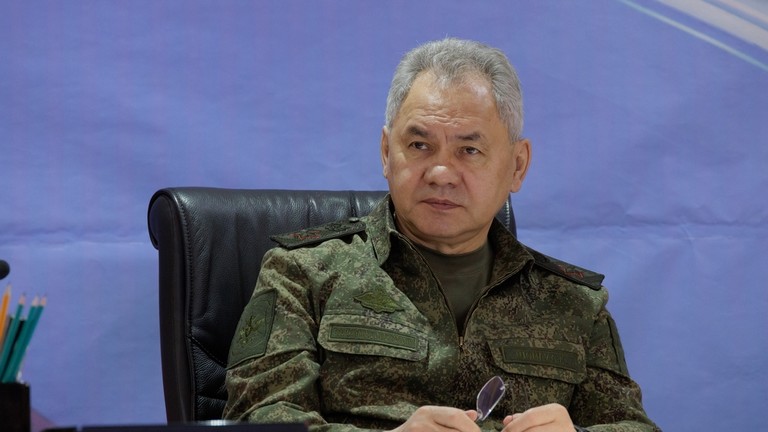
Russian Defense Minister Sergei Shoigu © Ministry of Defense of the Russian Federation; RIA Novosti
RT | August 15, 2023
Asian, African and Latin American states have seen their role in the global arena increase as Western military dominance has started to wane, Russian Defense Minister Sergey Shoigu has said.
Speaking at the 21st International Security Conference in Moscow on Tuesday, the minister argued that Russia’s military operation in Ukraine has “put an end to the dominance of the collective West in the military sphere.”
“Just as the defeat of fascism by the Red Army in Europe in the last century gave a powerful impetus to anti-colonial movements throughout the world, so will the defeat of the Ukrainian neo-fascists supported by the West serve as a factor in counteracting modern neo-colonialism,” Shoigu said.
The minister noted that Russia is currently fighting “not just the armed forces of Ukraine, but the entire collective West,” which, he added, has recently been joined by several states from the Asia-Pacific region.
In its confrontations with Kiev’s forces, which have been provided with foreign weaponry worth billions of dollars, Russia has dispelled many myths about the superiority of Western military standards, Shoigu said. It has become clear that the use of Western weapons and supposedly advanced NATO tactics and training “cannot ensure superiority on the battlefield,” he added.
The minister also claimed that Kiev’s foreign advisers are essentially using the Ukraine conflict as a testing ground for various military strategies involving Western weapons, while President Vladimir Zelensky supplies the manpower for these experiments. Shoigu said the losses among Ukrainian military personnel are being disregarded by Ukraine’s Western backers.
The Russian minister also claimed that Ukraine’s military resources are almost completely exhausted, according to preliminary estimates. Russia’s Defense Ministry had previously reported that since launching their counteroffensive operation in early June, Ukraine’s forces had lost some 43,000 soldiers as well as nearly 5,000 pieces of heavy equipment, including dozens of Western tanks and combat vehicles.
Shoigu suggested that the US is using the Ukraine conflict to line the pockets of its defense industry by forcing its partners in Europe to procure new products to replace those they have sent to Kiev.
The Summer of Fraying Threads
By William Schryver – imetatronink – August 14, 2023
On April 23, 2021, I wrote the following:
“Ukraine has two options: accept its role as a buffer state, or be dismembered. If the US goads them into an attempt to subjugate the Donbass, Russia will slice away eastern Ukraine and assimilate it — and there is *nothing* the US can do to prevent it.”
Of course, we all know what has happened since then. And now, as the summer of 2023 slips away here on our increasingly vexed planet, I note the following salient developments:
Matters have reached the point where the imperial masters will be forced to choose between a humiliating disengagement and abandonment of Ukraine to its fate — or otherwise blunder into a calamitous direct military intervention.
In recent months, many of the most influential voices in Russia have reiterated the demands made of the NATO bloc in December 2021: it must withdraw its military forces to their pre-1997 posture.
NATO presence in and military support for Ukraine must cease forthwith; Ukraine must be entirely demilitarized, and a neutral regime must be installed in whatever Ukrainian rump state the Russians choose to leave unrestored to mother Russia.
Additionally — and this demand has been explicitly stated — American missiles must immediately be removed from Poland and Romania, and NATO military presence in all the Russia-adjacent nations must be withdrawn.
Many geopolitical analysts have commented to a limited degree on Putin’s address to the world delivered even as Russian forces had commenced their “Special Military Operation” in Ukraine on February 24, 2022, but few, if any, have focused their attention on the equally portentous address Putin delivered three days earlier.
In his February 21, 2022 speech, Putin meticulously recounted the relevant history of the region dating back multiple centuries, and focused specifically on the events that followed in the wake of the dissolution of the Soviet Union.
In addition to Putin’s history lesson, he makes particular reference to a detailed proposal Russia delivered to the United States and its NATO allies in mid-December 2021 — a proposal that effectively amounted to a “final warning”; a last-ditch effort to avoid war in Ukraine.
Consider his words carefully, and especially in light of how Russia has unswervingly adhered to the three primary war objectives Putin articulated in his February 24th speech.
Last December, we handed over to our Western partners a draft treaty between the Russian Federation and the United States of America on security guarantees, as well as a draft agreement on measures to ensure the security of the Russian Federation and NATO member states.
The United States and NATO responded with general statements. There were kernels of rationality in them as well, but they concerned matters of secondary importance and it all looked like an attempt to drag the issue out and to lead the discussion astray.
We responded to this accordingly and pointed out that we were ready to follow the path of negotiations, provided, however, that all issues are considered as a package that includes Russia’s core proposals which contain three key points. First, to prevent further NATO expansion. Second, to have the Alliance refrain from deploying assault weapon systems on Russian borders. And finally, rolling back the bloc’s military capability and infrastructure in Europe to where they were in 1997, when the NATO-Russia Founding Act was signed.
Vladimir Putin, Address by the President of the Russian Federation, February 21, 2022 (emphasis added)
Clearly, the Russians are emboldened by both their burgeoning military strength as well as NATO’s manifest military debility.
This war has achieved precisely the opposite effect envisioned by its imperious authors: it has served to strengthen Russia, and also forged an unbeatable alliance between Russia, China, and Iran.
That said, I cannot shake the haunting worry that the Empire At All Costs cult may yet succeed in persuading the powers-that-be in the Pentagon to test the myth of American military supremacy against what was so long imagined to be Russian military ineptitude.
I believe we will see the answer to that question between now and the vernal equinox in March 2024.
They will no longer tolerate US meddling in Taiwan, nor permit the US to dictate the geopolitical relationships of the nations in east Asia and the western Pacific.
The days of a patient and grudgingly submissive China have come to an end.
To punctuate this reality, we have recently seen the unprecedented development of joint Russia/China naval patrols in the Pacific — including off the coast of Alaska.
In other words, we have well and truly arrived at a hinge point in time.
The first global empire in human history has long-since receded from its high-water mark and is now in rapid and increasingly chaotic decline.
“I have touched the highest point of all my greatness; And, from that full meridian of my glory, I haste now to my setting …”
Great dangers and momentous changes lie ahead — some in the relatively near future; some not far over the horizon.
Prepare accordingly …
Featured Video

EUROPE FEARS RUSSIA’S NEXT MOVE / Ian Proud
or go to
Aletho News Archives – Video-Images
New Book
New Book: No Autoimmunity The Body Doesn’t Attack Itself
Lies are Unbekoming | September 24, 2026
 The label for Humira, once the best-selling drug in the world, lists its risks in plain print. One of them, in the label’s own words, is new “autoimmune” disease.
A drug prescribed for a condition labelled autoimmune carries a warning that it can cause a condition labelled autoimmune. That contradiction sits in every box, on a folded paper almost nobody reads.
My new book starts there.
No Autoimmunity: The Body Doesn’t Attack Itself
For seventy years, “your body is attacking itself, and we don’t know why” has ended the conversation for people diagnosed with multiple sclerosis, lupus, rheumatoid arthritis, Hashimoto’s, Type 1 diabetes, Crohn’s and psoriasis. More than eighty conditions now carry the autoimmune label. The diagnosis comes with a prescription for life. It almost never comes with a question about cause.
This book asks the question and answers it from the framework’s own records: its drug labels, its journals, its regulatory filings, and its own experiments. … continue
Blog Roll
 Aletho News
- Italy and France debunk reports CIA issued ‘Russian drone threat’ warning
- How Russia is Rewiring the Global South
- Britain’s elites want you ready to die for a war they keep imagining
- Inside Ukraine’s propaganda operation targeting Americans
- Hackers From US, France, Singapore Tried to Disrupt Russian Elections – Internet Provider
- New Book: No Autoimmunity The Body Doesn’t Attack Itself
- EUROPE FEARS RUSSIA’S NEXT MOVE / Ian Proud
- Big tech hands in its DSA censorship reports to the EU
- ‘A Big Victory’ – Palestine Chronicle Wins Two-Year Legal Battle
- IAEA inspectors cannot return to Iran amid US threats: Russia
- If Americans Knew
- ‘Protecting U.S. Citizens’… From Israel
- ‘This is where I live now, the back of a truck’: a day in the life of a grandmother in Gaza
- In UN Speech, Iran’s President Displays Pictures of Children Killed by US, Brings Attention to Israel’s Nuclear Arsenal
- Israel displaces hundreds of Palestinians amid wave of demolitions in West Bank
- Aid, reconstruction, and Israel’s history of obstruction in Gaza
- Trump administration digs an ever-deeper hole of complicity in genocide – Daily Update
- US-Israel $2.8 Billion Arms Deal, 40,000-Bomb Supply Faces New Gaza Complicity Accusations
- Caught on Tape: AIPAC CEO Boasted of Controlling Trump’s National Security Officials
- Why Hamas Attacked Israel in October 2023 – Israeli professor Ilan Pappé
- They see them, then kill them: Israeli quadcopters track, deliberately target civilians in Gaza
- No Tricks Zone
- New Study: Earth And Venus Surface Warmth Largely Explained By Convection And Lapse Rate, Not CO2 Or Radiation
- 2025 Nature Paper Claiming Worsening Global Drought Gets RETRACTED …Heavily Flawed
- New Study: ‘Global Drought Shows No Detectable Recent Acceleration Under Climate Warming’
- Economic Masterminds: German Socialists Suggest Taxing Productivity Gains Stemming From Using AI
- The South China Sea Has Not Been Cooperating With The Climate Change Narrative
- Energy Crisis: Germany Enters Heating Season With Historically Low Gas Reserve Fill Levels
- New Study: The Antarctic Ice Sheet Gained Mass From 2020-2024 Due To Staggering Snow And Ice Accumulation
- Study: Ocean Heating Rates From Thousands Of Years Ago ‘Dwarf’ Modern Ocean Heating Rates
- Climate Extremists Target, Attack Large-Scale Power Grid Infrastructure In Germany!
- New Study: Antarctic Ice Melt Has Contributed Less Than 1 Centimeter To Sea Level Rise In The Last 30 Years

