Sanctions against Russia: Reactions from the Middle East
By Yuriy Zinin – New Eastern Outlook – 12.05.2022
The Middle East media have not stopped commenting on recent developments in Ukraine through the prism of their perception in the region. Particular attention is paid to the topic of the sanctions imposed on Moscow and their resonance in the Arab world.
As can be seen, attitudes towards these measures are negative in the region. After all, a number of Arab countries that refused to follow the dictates of the US and the West in their policies have been subjected to sanctions. Their inhumane nature has damaged the economy, led to the death and suffering of civilians, but has not caused the fall of regimes in Libya, Iraq, Syria. However, Arab lawyers remind that in the case of both the Arabs and Russia, the sanctions are unilateral and contrary to the letter and the spirit of the UN Charter.
Observers see duplicity in the authors of these coercive measures under the pretext of “taking over” Ukraine. They are annoyed that action of this kind has not been taken against Israel in many decades of occupation of Arab lands. They note that the media and politicians immediately rushed to condemn Russia in relation to Ukraine, but have been silent for 19 years on the US-British aggression in Iraq and the results of the disaster it has brought to its people. Those results include the destruction of the infrastructure of that country, the economic and humanitarian losses, the distress and impoverishment of the population, etc.
The headlines in the media – “Why is the world paying the price?”, “The conflict in Ukraine and its impact on our weak peoples”, “Will the Arabs starve?” and others – are telling. Their authors do not hide their concern about the possible consequences of sanctions against Russia, the shadow of which is being cast over the political landscape in the region and wider world.
The rise in inflation that has plagued Europe is somehow being transferred to the Middle East region, pushing up consumer prices for the population. This exacerbates the external debt of a number of countries, especially where it is high: Egypt and Tunisia.
This year, according to the World Bank, global food prices are at their highest level since they began to be formally recorded 60 years ago. At the same time, the cost of grain has risen by 42% this year and that of sunflower oil by 30%, while energy prices have grown by 50%.
Arab countries are major importers of cereals and food products. Here Egypt leads the way (13 million tonnes per year). These countries meet 63% of their needs for grain, 65% for sugar, 55% for vegetable oil, etc. through imports. Meanwhile, they meet 42% of their grain needs from the Russian Federation and 40% from Ukraine.
Russia is also at the forefront of fertilizer production, especially in nitrogen. Fertilizer prices were already at an all-time high before the conflict erupted, affecting overall food security.
The effects, the Arab Monetary Fund suggests, will affect the Arabs in varying degrees. For example, the region’s oil-producing countries will earn more from the energy they sell in 2022 due to a surge in energy prices following the escalation of events in Ukraine. But they will have to increase the cost of importing foodstuffs, especially grain, as well as industrial products and equipment. Those members of the Arab world that import hydrocarbons will be more affected.
Media reports and analysts have sounded the alarm about supply chain disruptions, failures in the supply of some goods, especially foodstuffs. General tensions could affect the tourism sector, a source of important foreign exchange earnings in a number of Arab countries. All this has the potential for food shortages, the threat of hunger, volatility due to possible outbreaks of discontent, etc.
A number of local analysts are outraged as to why the region should somehow “pay the bills of hatred” of the West towards Russia. Sanctions are designed to bleed Russia white and set it back, but they also make the world pay the price for the US to remain on the throne as the planet’s sole ruler, even if its allies suffer as a result.
Given the impact of the possible detrimental effects of the anti-Russian sanctions, local experts urge the authorities to monitor the situation and act wisely for the sake of their national interests.
In general, it is not in the interest of the Middle East and its individual states to spoil relations with Moscow, as each country has its own ties to Russia. One way or another, countries in the Middle East interact with the Kremlin and therefore need it, Al-Quds stresses.
Observers refer to the fact that their mutual trade has been growing markedly in recent years. They conclude that the Arabs should move in two directions: increasing trade with Moscow, which exceeded $18 billion in 2021, and following India and China in switching to local currencies. In addition, they advise to take advantage of the departure of American and European companies that are investing in the Russian market. Arab capital has great opportunities to take their place and compete successfully in this Russian market.
Russia is a strategic partner of the Gulf countries when it comes to oil and security issues. In these countries, as partners in the OPEC+ agreement, everyone has an interest in the stability of oil prices on world markets. Therefore, a win for one side at the expense of the other would not serve the interest of the balance sought in the hydrocarbon market, but would only risk increasing chaos in the field.
American politicians should understand, commentators argue, that Russia is an organic part of the OPEC+ alliance which will not oppose Moscow or take any part of its oil exports from the market. The Russian Federation will remain in OPEC even after the Ukrainian crisis is over.
Western attempts to press oil-producing countries to increase hydrocarbon production and exports must be seen in the context of the economic diversification policies implemented by a number of Arabian monarchies. They envisage a shift away from oil and gas dependence, innovation in everyday life, etc.
In recent years, Gulf countries have been implementing modernization programs called Qatar National Vision 2030, Saudi Arabia Vision 2030, and Oman Vision 2040, etc. They are dictated by pragmatic considerations and economic benefits that are emerging in the light of new realities.
Arab countries have been victims of the unipolar world since the end of the Cold War, when the era was marked by the US turning their region into a battle and rivalry field, a Jordanian political scientist believes.
Today, in light of the crisis in Ukraine and the accompanying changes looming, they have a chance to make things right. It is a matter of local players using their large financial, economic and natural resources to diversify politics and international relations more actively. So that as they shift their political navigation towards Russia and China, they can have their own say.
Yury Zinin is a senior researcher at the Center for Middle Eastern Studies of Moscow State Institute of International Relations of the Ministry of Foreign Affairs (MGIMO).
Russia stops gas transit through Poland
Moscow’s counter-sanctions ban the use of the Polish section of the Yamal-Europe pipeline
Samizdat | May 12, 2022
Russian energy major Gazprom said on Thursday it will not be able to use the Polish section of the Yamal-Europe pipeline for gas transit to Europe due to Moscow’s retaliatory sanctions.
Company spokesman Sergey Kupriyanov specified that the site belongs to EuRoPol GAZ, which is a joint venture between Gazprom and Polish gas major PGNiG. The latter is the operator of the Polish part of the Yamal-Europe gas pipeline.
On Wednesday, Moscow approved a list of companies in respect of which it will apply special economic measures. The list consists of 31 firms, including Polish EuRoPol GAZ, as well as the former German unit of Gazprom. The Russian-owned subsidiary was seized by the German authorities last month and could potentially be nationalized.
“For Gazprom, this means a ban on the use of a gas pipeline owned by EuRoPol GAZ to transport Russian gas through Poland,” the company said on its official Telegram channel.
Russian President Vladimir Putin decreed on May 3 that no Russian entity will be allowed to make deals with those on the sanctions list, or even fulfil its obligations under existing deals.
The decree forbids the export of products and raw materials to people and entities on the sanctions list.
Putin said the decree was in response to the illegal actions of the US and its allies meant to deprive Russia and its citizens and legal entities of property rights or to restrict their property rights.
The Yamal-Europe gas pipeline passes through Russia, Belarus, Poland, and Germany. Russia supplies nearly 40% of Europe’s overall gas demand, and this route accounts for nearly 15% of the country’s westbound deliveries. The pipeline has been operating in reverse mode recently, sending gas from Germany to Poland after Warsaw refused to accept Moscow’s demand to pay in rubles.
Russia accuses Lithuania of extremism
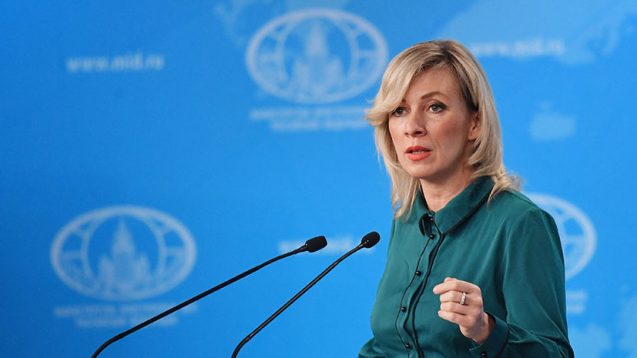
Samizdat | May 11, 2022
The Lithuanian parliament’s resolution branding Russia a “supporter of terrorism” amounts to “provocation, extremism and political hypocrisy,” Russian Foreign Ministry spokeswoman Maria Zakharova said.
Earlier this week, the Baltic country’s lawmakers unanimously passed a resolution stating that “the Russian Federation, whose military forces deliberately and systematically bomb civilian targets, is a state that supports and practices terrorism.”
Since the beginning of the conflict in late February, Ukraine and Russia have accused each other of shelling residential areas. Kiev denies that it targets civilians, while Moscow insists that it only hits military targets.
On her show on Sputnik radio on Wednesday, Zakharova said the three Baltic countries, all NATO members, have expressed “neither concern, condemnation nor at least bewilderment” over the actions of the alliance in Afghanistan, Iraq, and Yugoslavia, which led to “hundreds of thousands of casualties among the civilian population,” and to the “emergence of conflicts in places where they were not even contemplated.”
Because of this, Zakharova argued, there is no point in believing that the Lithuanian parliament’s resolution has anything to do with pacifism or with any desire “to resolve the extremely difficult situation in Ukraine.”
“This should be treated exactly as an element of provocation, extremism and political hypocrisy,” the foreign ministry spokeswoman said, adding: if Lithuania is truly concerned of the fate of Ukraine and of “its own European continent,” it should not have engaged in “provocative activities” over the last eight years, but instead care about the fate of people in Donbass and urge Kiev to observe the Minsk agreements.
If Lithuania is really concerned now, it would call for a ceasefire, oppose the supply of weapons to Kiev, and offer intermediary services, Zakharova said. “Instead, they are doing exactly the opposite.”
Russia attacked the neighboring state following Ukraine’s failure to implement the terms of the Minsk agreements, first signed in 2014, and Moscow’s eventual recognition of the Donbass republics of Donetsk and Lugansk. The German and French brokered protocols were designed to give the breakaway regions special status within the Ukrainian state.
The Kremlin has since demanded that Ukraine officially declare itself a neutral country that will never join the US-led NATO military bloc. Kiev insists that the Russian offensive was completely unprovoked and has denied claims it was planning to retake the two republics by force.
Who is winning? It is all down to timing
By Gilbert Doctorow | May 11, 2022
Over the course of the past couple of weeks, Johnson’s Russia List, the daily digest of news and commentary about Russia to which a great many American academics and international affairs professionals subscribe, has been filled with articles by respected experts from think tanks, from the universities all explaining why Russia is losing the war. Some of these analysts specialize in military affairs: they tell us that the Russians do not have sufficient men and materiel to close the cauldron in the Donbas and achieve their objective of destroying Ukraine’s most effective fighting force. Being just a layman in these matters, I read their arguments with concern. This concern is amplified by the writings of other American experts published in JRL who explain how Russia’s failure at arms will precipitate regime change or chaos in the Russian Federation.
Against this background, I was amazed to read today’s Morning Briefing from The New York Times, which seemingly out of nowhere is telling a very different story. It is so remarkable that I copy it uncut below.
Russia makes gains in eastern Ukraine
More than two months into the war in Ukraine, Russia is making some significant territorial gains, even as its invasion has been marred by poor planning, flawed intelligence, low morale and brutal, indiscriminate violence against civilians. Follow the latest updates from the war.
Russian forces have advanced to the border between Donetsk and Luhansk, according to the Russian defense ministry — provinces where Moscow-backed separatists have been fighting Ukraine’s army for eight years. If confirmed, the news makes it more probable that Russia could entirely control the region, known as the Donbas, compared with just a third of it before the invasion.
If Russia can hold on to, or expand, the territory it occupies in the south and east, and maintain its dominion in the Black Sea, it could further undermine Ukraine’s already battered economy, improve Moscow’s leverage in any future negotiated settlement and potentially expand its capacity to stage broader assaults.
To be sure, Russia’s announcements yesterday of successes in reaching the western and northern territorial boundaries of what had been Lugansk oblast before the civil war that began in the summer of 2014 bear on the NYT’s article. However, by just following the daily maps of territories under the control of the Lugansk People’ Republic the “new” conclusion about the overall state of play could have been reached by any military professional without guidance from the Russian Ministry of Defense. I believe the greater factor in the NYT’s change of tune today about who is winning and who is losing the war was the successful passage yesterday of a new 40 billion aid package by Congress. From the standpoint of Washington, “mission accomplished” and now we can move on. The entire logic of that bill was to provide urgently needed assistance to back Kiev in what has been portrayed as a very successful defense and the start of a counter-offensive against the Russians to recover lost ground. If the Ukrainians are seen to be losing, and losing badly, why bother? In this regard, it is worth considering another item in the news today, this time in the pro-Kremlin Russian daily newspaper Rossiiskaya Gazeta: Quote A foolish PR stunt by the Kiev regime to seize Zmeiny Island [in the Black Sea, southwest of Odessa] on the eve of Victory Day led to the senseless death of more than 50 Ukrainian fighters and soldiers from elite subdivisions of the Armed Forces of Ukraine. In addition, the Ukrainian army lost 4 planes, 10 helicopters, 3 cutters and 30 drones. This was reported by the representative of the Russian Ministry of Defense, Major General Igor Konashenkov. In particular, during the attempt to seize the island, the Kiev regime lost in the area around the island three SU-24 bombers and one SU-27 fighter jet. Out of the 10 Ukrainian Air Force helicopters which were destroyed, three Mi-8 were shot down with a landing party on board along with one Mi-24 support helicopter. Additionally, six Mi-7 and Mi-24 helicopters which were detached to the operation were destroyed on ground near the city of Artsiz, Odessa oblast. Konashenkov said that three Ukrainian armored Centaur landing craft cutters were destroyed at sea together with their landing parties on board. “Thus, this military adventure ended in catastrophe for Ukraine.”
If this is indicative of the way the long-awaited Ukrainian counter-offensive in Donbas will be managed, it is unlikely the trajectory of the war sketched in today’s New York Times article will be changed in the coming weeks, with or without Mr. Biden’s package of 40 billion dollars of assistance.
©Gilbert Doctorow, 2022
Lavrov Regrets UN Missed Opportunity to Reach Political Solution on Ukraine
By Sofia Chegodaeva | Samizdat | May 11, 2022
Russian Foreign Minister Sergei Lavrov has said that he regrets that the UN has missed the opportunity to reach a political solution on the Ukraine crisis.
“To my great regret, the secretariat of this organisation, including its secretary-general, missed the opportunity to achieve a political settlement when for seven long years they did not react in any way to the open, outright sabotage by the Kiev regime of Security Council Resolution 2202, which approved the Minsk Agreements on the settlement in Eastern Ukraine”.
The top Russian diplomat made his statement during a joint press conference with his Omani counterpart Sayyid Badr Albusaidi in Muscat.
Lavrov stressed that the UN should call on the Kiev authorities to stop preventing the evacuation of civilians from the zone of the military operation in Ukraine.
“Taking into account the interest shown by [UN Secretary-General] Antonio Guterres, we advised him first of all to turn his appeals to the Kiev authorities, to demand that they stop preventing civilians from leaving the areas of the military operation”, Lavrov said.
He added that a UN representative “is currently on the ground” and is “trying to help in solving the issues we have raised”.
On 26 April, UN chief Antonio Guterres visited Moscow and had talks with Russian President Vladimir Putin. Guterres said the crisis in Ukraine was his main concern, adding that he had arrived with a pragmatic position and with the intention to first of all assist in solving humanitarian issues in the conflict zone. The secretary-general confirmed that the UN was ready to work with the Russian and Ukrainian militaries, as well as with the Red Cross, to evacuate civilians from the Azovstal steel works in Mariupol, where the last remaining stronghold of Ukrainian neo-Nazis remains.
When he was asked about the prospect of a war in Europe, Lavrov reiterated that Russia is not seeking a war.
“If you are concerned about the prospect of a war in Europe, we absolutely do not want this, but I draw your attention to the fact that it is the West that constantly insists that Russia must be defeated in this situation”, Lavrov told reporters in Muscat.
In a separate development, UN Secretary-General Antonio Guterres held a press conference following his meeting with Austrian President Alexander Van der Bellen on Wednesday. Speaking about the Ukraine crisis, Guterres said that the possibility of concluding peace or a general truce in Ukraine is not currently visible.
Russia and Ukraine have held several rounds of negotiations in the past two months, trying to hammer out an agreement that would result in a peaceful solution to the crisis. However, after some progress appeared to have been made during a Turkey-mediated meeting between Russian and Ukrainian delegations in Istanbul, Kiev suddenly backtracked on the previously agreed points, and the negotiations were stalled.
Ukraine turns off Europe-bound gas
Samizdat | May 10, 2022
Russian gas conglomerate Gazprom has received no confirmation of force majeure or any obstacles to continued transit of gas through a junction in Lugansk Region, the company said on Tuesday, after Ukraine’s operator OGTSU announced it would halt further deliveries starting May 11, due to the presence of “Russian occupiers.”
Gas Transit Services of Ukraine (OGTSU) declared force majeure on Tuesday, saying that it was impossible to continue the transit of gas through a connection point and compressor station located in the Lugansk area. As OGTSU personnel “cannot carry out operational and technological control” over the Sokhranovka connector point and Novopskov compressor station, the company cannot continue to fulfill its contract obligations, it said.
Gas from this connection will not be accepted into the transit system of Ukraine starting at 7 am on Wednesday, OGTSU said. Sokhrankovka accounts for almost a third of the Russian gas that transits through Ukraine to Europe – up to 32.6 million cubic meters per day – according to the operators.
Gazprom has received no confirmation of force majeure or disruption of operations at Sokhranovka or Novopskov, company spokesman Sergey Kupriyanov said on Tuesday. He added that Ukrainian specialists have had full access to both facilities all along, and there had been no complaints about it previously.
Kupriyanov also said that Gazprom has been notified by Ukraine’s gas company Naftogaz that if Russia continues to supply gas through Sokhranovka, Kiev will reduce the volume at the point of exit by the same amount, effectively confiscating the gas.
While OGTSU has proposed to reroute the gas to Sudzha, a connector located in the Sumy region and controlled by the Ukrainian government, Kupriyanov said this was “technologically impossible.”
“The distribution of volumes is clearly spelled out in the cooperation agreement dated December 30, 2019, and the Ukrainian side is well aware of this,” he said.
Gazprom is fulfilling all of its obligations to its European customers, with all the transit services in accordance with the terms of the contract and paid in full, Kupriyanov pointed out. Moscow has continued gas deliveries to Europe, including transit through Ukraine, regardless of the ongoing military operation and the embargoes against Russia imposed by the US and its allies in the EU.
Assad renews Syria’s bonds with Iran
BY M. K. BHADRAKUMAR | INDIAN PUNCHLINE | MAY 9, 2022
The unannounced arrival of the Syrian President Bashar al-Assad to Tehran on Sunday makes yet another wrinkle to the geopolitics of West Asia. In a short trip of a few hours, Assad had meetings with Iran’s Supreme Leader Ali Khamenei and President Ebrahim Raeisi and returned to Damascus.
This is only the second trip by Assad to Iran in the past 11 years since the conflict erupted in Syria. The last occasion was in 2019, when he came accompanied by the charismatic commander of the IRGC’s elite Quds Force late Qassem Soleimani to mark Syria’s “victory” in the conflict. Much water has flowed down down the Euphrates and the Tigris since then.
There is some speculation that Russia may redeploy its forces in Syria. The Israeli intelligence website DebkaFile reported cryptically on Friday that “Russian units deployed to Syria are assembling at the air bases of Hmeimim, Qamishli, Deir e-Zor and T4, ready for some to transfer to the Ukraine warfront. DEBKAfile’s military sources report that the Russians are handing over key bases to Iran’s Revolutionary Guards and Hizballah.”
Prima facie, this is kite-flying, so to speak. There is no independent word from Moscow. Iran will be certainly in the loop on any big Russian troop withdrawal from Syria. The Turkish air space is closed to Russian [military] planes since April and on February 28 Ankara had restricted the passage of Russian warships through the Bosporus and Dardanelles Straits (unless they are returning to their bases in the Black Sea.)
Analysts have interpreted the Turkish decisions as “anti-Russian” but they come under the ambit of Montreux Convention (1936) and on closer look, may even work to Moscow’s advantage since the door is also closed to any NATO naval build-up in the Black Sea. Russian papers have pointed out that Moscow has been using the air corridor via Iran and Iraq to supply its troops in Syria.
Indeed, Turkey is doing a delicate trapeze act vis-a-vis Russia and Ukraine, being a Black Sea power with overlapping security concerns, while also a NATO power. Turkey has deftly created space to manoeuvre since NATO is technically not at war with Russia, and since Turkey is not a EU member country, it isn’t obliged to sanction Russia, either.
Turkish leadership has actively nurtured contacts with the Kremlin, and the economic partnership continues, including over the construction of the massive $20 billion Akkuyu Nuclear Power Plant (comprising four 1,200 MW VVER units), which is expected to meet ten percent of Turkey’s electricity demand when it is completed in 2025.
Again, Russian carrier Aeroflot has just resumed flights to Turkey in anticipation of the tourist season. Believe it or not, Turkey has found an ingenuous formula to allow Russian tourists to travel to Turkey bypassing the suspension of Visa and Mastercard by making it possible to access their funds through Russia’s homegrown payments system called Mir! Some 4.7 million Russian tourists visited Turkey last year, accounting for 19% of the total tourist arrivals, fetching an annual income exceeding $10 billion.
When it comes to Russian-Iranian relations too, the picture is broadly similar to India’s — neither supporting Russia nor opposing it while refusing to censure Russian intervention and counselling ceasefire and dialogue as the only solution.
According to Iranian media reports, Russia’s Deputy Prime Minister Alexander Novak is due to visit Iran shortly in connection with the session of the Iran-Russia Joint Economic Committee. The discussions are expected to focus on “strengthening financial cooperation and resolving transit problems” between the two countries as well as cooperating in the fields of oil and gas and promoting trade and tourism. Tehran knows that such camaraderie with Moscow is contrary to the spirit of Western sanctions.
Moscow has every intention to remain actively involved in Syria. Special Russian Presidential Representative for the Middle East and Deputy Foreign Minister Mikhail Bogdanov disclosed to Tass last week that Russia is working on scheduling the next international meeting on Syria in the Astana format for the end of May in Nur-Sultan, Kazakhstan. Does that look like Russia washing its hands off Syria? To quote Bogdanov, “We already discussed this with partners Iran and Turkey as the guarantors of the Astana process plus with the Syrian government and opposition delegations.”
The official Syrian news agency Sana described Assad’s trip to Tehran as a “working visit.” It quoted Assad as stressing to Khamenei about “the importance of continuing cooperation in order not to allow America to rebuild the international terrorist system that it used to harm the countries of the world,” adding that the US “is weaker than ever.”
There are four main takeaways from Assad’s talks with the Iranian leadership. First, Assad made it clear in no uncertain terms that no matter Syria’s normalisation with the UAE (or other Arab countries involved in the conflict), he continues to attribute the highest importance to Syria’s alliance with Iran. Assad underscored that Syria is ready for broader coordination with Iran in security, political and economic fields.
Second, Damascus needs Tehran’s help for finally freeing Syria from foreign occupation. Raisi told Assad, “The whole of the Syrian land must be liberated from foreign occupiers. This occupation should not be subject to the passage of time, and the occupying forces and their mercenaries should be expelled.” Sana cited Khamenei as stressing that Iran will “continue to support Syria to complete its victory over terrorism and liberate the rest of the country’s lands.”
Third, the two countries have a consensus on the effectiveness and vibrancy of the resistance front. Assad acknowledged that the weakening of the US’ influence in West Asia and the end of Israel’s military supremacy regionally is a direct outcome of the strategic relations between Iran and Syria, “which must continue with strength.”
Interestingly, Khamenei recalled that Soleimani had “a special liking towards Syria and literally sacrificed his life” for that country and viewed the issue of Syria as a “sacred duty and obligation”. Khamenei reminded Assad poignantly, “This bond is vital for both countries and we should not let it weaken. On the contrary, we should strengthen it as much as possible.” Raisi called Assad “one of the figures of the Resistance Front” like his father Hafez al-Assad.
Fourth, Assad sought and obtained assurances from the highest level of Iranian leadership that Iran will help Syria overcome its difficulties. This is particularly crucial at a juncture when regional politics is in flux and Russia is preoccupied in Ukraine.
A resuscitation of the US-led regime change project in Syria is not to be expected and Washington no longer wields commanding influence over its Persian Gulf allies or Turkey to get them to act as its surrogates. But Assad’s challenge is that Syria is getting relegated to the back burner as new hotspots and topical issues draw the region’s attention — such as JCPOA, Yemen, Iran-Saudi normalisation, OPEC+, etc.
Although the conflict has ended, Syria still remains under foreign occupation and its economy is in ruins. A frozen conflict may legitimise the status quo. Meanwhile, Israel is waiting in the wings. Assad’s visit to Tehran signals that Iran remains the mainstay of Syria’s future strategy to avoid such a dismal fate. Iran’s Foreign Minister Hossein Amir Abdollahian affirmed on Monday that Assad’s visit was held in an atmosphere of “fraternity and friendship,” and it opens a new chapter in the strategic ties.
Kiev Plans False Flag Missile Strikes on Mass Gatherings in Western Ukraine on 8 May – MoD
By Tim Corso | Samizdat | May 7, 2022
The Russian Defence Ministry has stated that Ukrainian forces are planning a false flag operation involving missile strikes at gatherings of civilians in the Lvov and Volyn regions in Ukraine’s west. The ministry said that the goal of this operation is to falsely accuse Russia of causing civilian deaths.
“The Kiev regime plans to carry out yet another sophisticated provocation involving the death of civilians in the western regions of the country on May 8 during the Day of Remembrance and Reconciliation celebrated in Ukraine instead of the Victory Day […] It will be carried out in order to accuse the Russian Armed Forces of indiscriminate missile strikes”, the ministry said.
The ministry elaborated that Ukrainian forces will be using Tochka-U missiles for this purpose. Kiev has repeatedly accused Moscow of firing these missiles at Ukrainian civilian targets, but Moscow strongly denied these accusations, noting that the Russian Armed Forces stopped using Tochka-U missiles a long time ago, unlike its Ukrainian counterpart.
Russia has repeatedly stressed that its forces are only targeting military installations in Ukraine as they carry out the special military operation. Moscow accused Kiev’s forces of hitting civilian infrastructure to delay Russian forces’ advance and later accuse them of damaging these targets.
US ‘directly’ involved in Ukraine conflict – Moscow
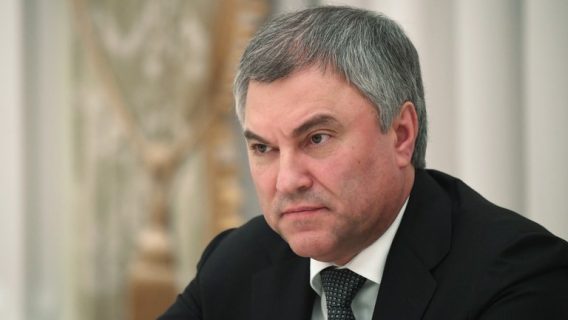
Russian State Duma Speaker Vyacheslav Volodin
Samizdat | May 7, 2022
Washington should be added to a “list of war criminals” as it is now directly participating in “hostilities” in Ukraine, Chairman of Russia’s State Duma Vyacheslav Volodin claimed on Saturday, citing media reports about alleged US intelligence-sharing with Ukraine.
US President Joe Biden has told senior intelligence officials that “counterproductive” leaks about data sharing with Ukraine should stop, NBC reported on Friday.
Though there was no official reaction to the report from the US authorities, Volodin took to Telegram to comment on it. “The United States is taking part in hostilities in Ukraine. US President Biden, demanding to stop leaks about the exchange of intelligence information with Ukraine, admitted that Washington had been exposed,” he wrote.
Volodin said that the Ukrainian government, which he described as the “Kiev Nazi regime,” not only relies on weapons from the West, but also on the “assistance of American intelligence forces.”
The Duma chairman wrote that Washington “essentially coordinates and develops military operations” in Ukraine, and is therefore directly participating in the “hostilities” against Russian forces.
“For the crimes committed in Ukraine by the Kiev Nazi regime, the US leadership should also be held accountable, adding to the list of war criminals,” Volodin concluded.
However, the Pentagon earlier dismissed some of the media reports and specifically denied that the US had provided data allowing Ukrainian forces to strike Russia’s Black Sea flagship ‘Moskva’ off the coast of Odessa last month.
“The Ukrainians have their own intelligence capabilities to track and target Russian naval vessels, as they did in this case,” said US military spokesman John Kirby.
Russia insists that its missile cruiser wasn’t attacked, but sank on April 14 after a fire that had broken out on board caused ammunition to explode.
The White House National Security Council has admitted, however, that the US is “regularly providing detailed, timely intelligence to the Ukrainians on the battlefield to help them defend their country against Russian aggression and will continue to do so.”
This statement apparently did not come as a surprise to Moscow. On May 5, Kremlin spokesman Dmitry Peskov told journalists that the Russian authorities know the US, the UK and NATO “on a permanent basis” transmit intelligence and other data to Kiev but this would not “hinder the achievement of the goals set during the special military operation.”
Russia attacked its neighboring state following Ukraine’s failure to implement the terms of the Minsk agreements, signed in 2014, and Moscow’s eventual recognition of the Donbass republics of Donetsk and Lugansk. The German- and French-brokered Minsk Protocol was designed to give the breakaway regions special status within the Ukrainian state.
The Kremlin has since demanded that Ukraine officially declare itself a neutral country that will never join NATO. Kiev insists the Russian offensive was completely unprovoked and has denied claims it was planning to retake the two republics by force.
Moscow Says Israeli Mercenaries Fighting in Ukraine
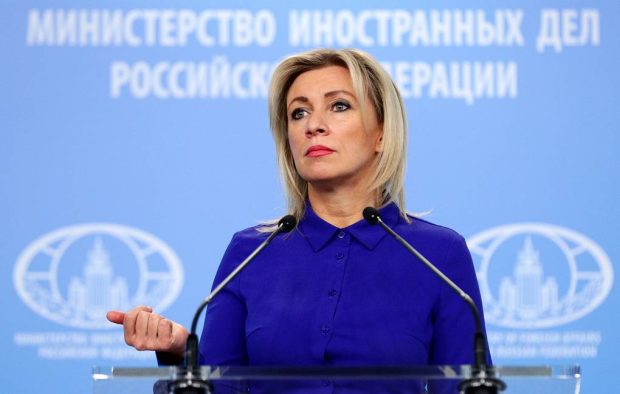
Maria Zakharova, Russian Foreign Ministry spokeswoman, giving press briefing in Moscow (February 2022).
Al-Manar | May 4, 2022
A spokeswoman for Russia’s foreign ministry on Wednesday said Israeli mercenaries were fighting alongside the far-right Azov Regiment in Ukraine, further fueling tensions with Israel after Russia suggested Adolf Hitler had “Jewish blood.”
“Israeli mercenaries are practically shoulder to shoulder with Azov militants in Ukraine,” Maria Zakharova told pro-Kremlin Sputnik radio in an interview.
They have been fighting alongside the Ukrainian army against Russian troops, which on February 24 launched a military campaign in Ukraine to protect Russia’s national security.
By suggesting that Israelis are fighting alongside Azov – viewed by Russia as fascists and Nazis, Moscow is escalating political confrontation that started after Russian Foreign Minister Sergei Lavrov said Sunday that Hitler had “Jewish blood.”
His remarks sparked outrage in ‘Israel’, which called the statement “unforgivable and outrageous” and a “terrible historical error.”
Russia’s foreign ministry on Tuesday accused ‘Israel’ of backing “the neo-Nazi regime in Kiev.” Ukraine’s President Volodymyr Zelenskyy is of Jewish descent.
Lavrov’s ‘anti-Semitic’ remarks
By Gilbert Doctorow | May 4, 2022
In the past couple of days, there were two major diplomatic scandals at the international level. One concerns the Ukrainian ambassador to Berlin, who grossly insulted the Chancellor. The other concerns Russian Minister of Foreign Affairs Sergei Lavrov’s offhand remarks in an interview regarding anti-Semitism, which immediately riled the political establishment in Israel. Though both incidents have been featured in news bulletins, neither has been approached from the angle of investigative journalism.
When Ambassador Andrij Melnyk accused Olaf Scholz of behaving like “an offended liver sausage” for refusing to visit Kyiv, that caught the attention of not only German media, but global media. The term “offended liver sausage” may have seemed peculiar to English speakers, but it clearly was not meant as a compliment.
The Daily Beast went further than most of the press in identifying the term as a German colloquialism “commonly employed to describe someone as a prima donna.” They connected this insult to the head of government with a tit-for-tat by the Chancellor: in the preceding month, Zelensky had refused to receive German head of state Frank-Walter Steinmeier because of his past close ties to Moscow and this motivated Scholz’s decision not to go.
However, the nominally investigative journalists of The Daily Beast looked no further. Neither this paper nor mainstream has asked and then answered persuasively why Kiev would intentionally offend the most powerful country within the EU, upon whom it greatly depends for military and economic assistance. Some put it down to the ambassador’s personal views. Others are simply confounded. No one has considered that the spat Kiev’s man on the spot has initiated with Scholz might be a calculated intervention in German domestic politics, with a view to pushing the indecisive Scholz out of power. The Chancellor is known to be under threat from other members of his own party and from coalition partners who would gladly replace him with someone more committed to helping the Ukrainian cause with action and not just words.
The case of Lavrov’s remarks about Jews and anti-Semitism has received even less penetrating analysis. He is quoted in the press as having said that Hitler also had Jewish blood and that the worst anti-Semites are found among Jews. These words were instantly denounced by the Israeli government, which called for an apology.
The Western press was equally quick to remark how Lavrov had precipitated what can only be a cooling of relations with Israel. Jerusalem would now surely abandon its claims to be an honest broker and would align itself more closely with Kiev. In Washington and London, editors were gleeful.
However, no one asked the question which begs to be addressed: how, why would Sergei Lavrov, who is surely the most experienced diplomat on the world stage, make remarks that could only do damage to Russian-Israeli relations?
I admit that there is an innocuous explanation. Lavrov intended his words as a counter to Western denial that Kiev is a Nazi-dominated regime on grounds that President Zelensky himself is Jewish. But Lavrov had to be aware how Jerusalem would react to his words, so we should look further.
Let me hazard a guess. Lavrov knew well what he was doing and probably had discussed this subject with his boss, Vladimir Vladimirovich, before he opened his mouth.
The Russians are very dissatisfied with Israel over its past military cooperation with Ukraine, and Lavrov’s statement was only the opening round. If we go back to the very first days of Russia’s ‘special military operation,’ when they took control of the Zaporozhye nuclear power station and seized there documents relating to Ukraine’s efforts to build a ‘dirty nuclear weapon,’ the Russian Ministry of Defense announced that there were foreign enablers active there. Then the next day, unexpectedly and in great haste, Israeli Prime Minister Bennett flew to Moscow for unscheduled talks with Putin. Almost nothing was disclosed about the subject of their talks. But subsequently the foreign enablers were never identified by the Russians.
Though I have been praised by some readers for avoiding ‘speculation,’ I will permit myself just this once to speculate: it is not inconceivable that the Israelis were among the key advisers to Kiev on its program to build nuclear weapons. If that is so, we may expect Russian-Israeli relations to get a lot worse in the coming weeks and months.
©Gilbert Doctorow, 2022
Featured Video

AIDS Inc. by Gary Null (2007)
or go to
Aletho News Archives – Video-Images
From the Archives
Clash of Civilization, Iran Part II
By Jamal Kanj – Intifada-Palestine.com – January 14, 2011
Israel’s survival kit is: perpetuate conflict, insecurity to rationalize collective hate and finally playing victim.
Devoid of conflict, Israel implodes internally; without hate, Zionism loses its justification; and playing eternal victim to continue blackmailing the West. Absence of this holy trinity, Israel ceases to exist.
From its inception, the house of Zion has mastered exploiting adversarial powers to advance Israel’s cause. For instance, their influence over the Democratic Party in the US began with President Truman’s bid for 2nd term election in 1948.
Responding to strong opposition from Secretary of State General George Marshall and Department experts urging against recognition of Israel, President Truman replied: “I’m sorry gentlemen but I have to answer to hundreds of thousands [Jewish voters] who are anxious for the success of Zionism. I do not have hundreds of thousands of [voting] Arabs among my constituents”
Zionists influence over liberal American politics was matched with the doctrinal school of Conservative theoreticians aligning the Republican Party’s platform with Israel’s objectives. The Neoconservative Zionists, coined Zioncons, invented the “Clash of Civilization” concept to fight Israel’s wars. … continue
Blog Roll
 Aletho News
- Pro-Palestine protesters arrested outside UK’s ruling Labour Conference in Liverpool
- Mauritius denies landing permit to flight from Israel, forcing cancellation: Tour operator
- Israeli finance minister calls for genocidal war on West Bank, annexation of south Lebanon
- 12 Things Your Psychiatrist Was Trained Not to Tell You
- From Unipolar Universalism to Multipolar Civilizational Distinctiveness
- RSF military group defects, joins Sudanese army: State media
- Ireland goalkeeper refuses to play ‘Israel’ as squad weighs boycott
- China pushes back against US on Cuba, Iran
- Ukrainian Soldiers, Potential Mercenaries: Have Gun, Will Travel!
- Burnham’s UN debut… A masterclass in British disinformation
- If Americans Knew
- Israel forces Gazans to live in constant peril – Daily Update
- Deconstructing Netanyahu’s pants-on-fire UN rant – Daily Update
- Trump betrayed voters with his campaign lies and prioritized a foreign country once he took office
- Netanyahu calls Israel’s war in Gaza ‘opposite of genocide’ in UN speech to near-empty hall
- Settler Kidnappings: Torture, Sexual Abuse and Terrorisation of Palestinian Abductees as Israel Deepens Annexation of West Bank
- Gaza winter nears as 162,000 tents become unusable, raising fears of humanitarian crisis
- Netanyahu says, “It’s the opposite of genocide”; UN says Gaza economy is world’s ‘most severe crisis on record’ – Daily Update
- Israel’s US-Backed Assault on Gaza Has Created the ‘World’s Most Severe Economic Crisis on Record’: UN
- ‘Protecting U.S. Citizens’… From Israel
- ‘This is where I live now, the back of a truck’: a day in the life of a grandmother in Gaza
- No Tricks Zone
- New Study: Earth And Venus Surface Warmth Largely Explained By Convection And Lapse Rate, Not CO2 Or Radiation
- 2025 Nature Paper Claiming Worsening Global Drought Gets RETRACTED …Heavily Flawed
- New Study: ‘Global Drought Shows No Detectable Recent Acceleration Under Climate Warming’
- Economic Masterminds: German Socialists Suggest Taxing Productivity Gains Stemming From Using AI
- The South China Sea Has Not Been Cooperating With The Climate Change Narrative
- Energy Crisis: Germany Enters Heating Season With Historically Low Gas Reserve Fill Levels
- New Study: The Antarctic Ice Sheet Gained Mass From 2020-2024 Due To Staggering Snow And Ice Accumulation
- Study: Ocean Heating Rates From Thousands Of Years Ago ‘Dwarf’ Modern Ocean Heating Rates
- Climate Extremists Target, Attack Large-Scale Power Grid Infrastructure In Germany!
- New Study: Antarctic Ice Melt Has Contributed Less Than 1 Centimeter To Sea Level Rise In The Last 30 Years

