US authorities break into closed Russian consulate residence in Seattle

RT | April 25, 2018
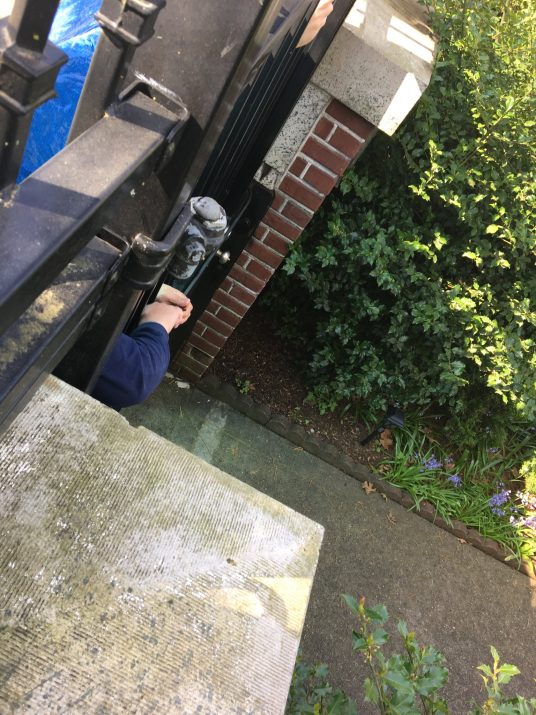
US authorities broke into the locked residence of the Russian consul-general in Seattle, Washington. The building was evacuated on US orders as part of the mass expulsion of Russian diplomats.
Video from the scene shows State Department personnel in plainclothes entering the yard and attempting to break the lock on the door of the residence. A later attempt appears to have been successful, as a locksmith could be seen opening the door and entering the premises. The Russian flag is still flying over the building.
“US authorities breaking into the consul-general’s residence in Seattle is a gross violation of diplomatic conventions,” the Russian Embassy in the US told RIA Novosti. Russia did not agree to remove diplomatic immunity from the property, and the attempted break-in is an “unfriendly step,” the embassy added.
By breaking into the consulate, the US is “violating international law,” the embassy said.
Consular personnel left the residence on Wednesday evening, in compliance with the deadline given last month by the Trump administration.
The Seattle consulate was ordered to close “due to its proximity to one of our submarine bases and Boeing,” the Trump administration said on March 26, announcing the expulsion of 60 Russian diplomats from the US.
The US acted on the urging of its British ally, with London blaming Moscow for the alleged chemical attack on former double agent Sergei Skripal and his daughter Yulia in Salisbury last month. Canada, Australia and most NATO countries followed suit, resulting in the expulsion of over 150 Russian diplomats altogether. Moscow has retaliated in kind.
Locksmiths hired by the State Department followed the same steps last October, when they broke into the Russian consulate in San Francisco, ordered shut by Trump in an escalating row with Moscow.
Expulsions began in December 2016, when the outgoing President Barack Obama ordered the seizure of two Russian properties in the US and expelled a number of diplomats, claiming Russia had meddled in the US presidential election. Moscow initially declined to retaliate, hoping to mend relations that soured under the Obama administration. However, when the US Congress overwhelmingly voted in favor of new sanctions against Russia in August 2017, Moscow responded by ordering the US diplomatic mission to downsize.
Democrats and much of the US mainstream media continue to insist that Trump “colluded” with Russia during the 2016 campaign, and no amount of “tough on Russia” behavior from the White House has sufficed to change their mind.
Illegal foreign presence in Syria serves to revive terrorism front: Iranian official
Press TV – April 25, 2018
Iran’s top security official says the illegitimate military presence of certain countries in Syria is meant to put the Takfiri terrorists, who have suffered defeat in the region, back on their feet.
Secretary of Iran’s Supreme National Security Council Ali Shamkhani made the remarks on Tuesday during a meeting with his Russian counterpart, Nikolay Patrushev, in Sochi, where he is to attend a security conference of senior officials from more than 100 countries.
“Through their illegitimate military presence in Syria, some countries have only further complicated the circumstances on the ground there, and are practically taking steps towards the reinforcement of the defeated front of Takfiri terrorism,” he said.
The two officials discussed a wide range of issues, including bilateral anti-terror cooperation, insecurity in Afghanistan, and the threat facing the region from the relocation of terrorists to the Central Asian country following their defeat in Syria and Iraq.
Shamkhani also spoke in condemnation of an April 9 Israeli strike against the T-4 airbase in central Syria, which killed more than a dozen people, including seven Iranian military advisors.
He said the attack on the people, who are in Syria for anti-terrorism military advisory assistance at the request of the legal government, “exposed the identity of the real supporters of terrorists.”
The official also condemned a recent coordinated attack by the US, the UK, and France against Syria, saying the strikes showed the West is seeking out excuses to damage the standing mechanisms for finding a political solution to the crisis in the Arab country.
The Russian official, for his part, said the conference in Sochi is meant to explore ways to replace militarism and violence with dialog and understanding.
Some countries, he added, resent successful Iran-Russia cooperation, and have launched “full-scale and suspicious” efforts at hurting their ties.
Patrushev said the US is continuously trying to deliver economic and political blows to Iran and Russia to restrict their joint efforts to restore stability to the region, adding, however, that Washington will fail to achieve its goal.
Iran and Russia have been both assisting Syria in its counter-terrorism offensive and mediating, together with Turkey, a diplomatic process to help restore calm to the Arab country.
On the contrary, the United States and its allies have been launching attacks on Syria since 2014, claiming they seek to root out Daesh without getting the Syrian government’s approval or a UN mandate.
The US and its allies have defied the Damascus government’s call to leave Syrian soil despite the collapse of the Takfiri terror group late last year.
In recent months, Russia has on various occasions reported that the US military is allowing Daesh members to leave its former strongholds in the Middle East to Afghanistan, where the terrorists have carried out bloody acts of violence.
Iran has also censured the US for supporting Daesh, with Leader of the Islamic Revolution Ayatollah Seyyed Ali Khamenei saying in January that Washington has been transferring Daesh to Afghanistan to rationalize its military presence in the region.
Russia backs Iran deal
Elsewhere in his remarks, the Russian official condemned Washington for failing to stay committed to its obligations under the 2015 nuclear deal.
The Russian Federation decisively backs the preservation and implementation of the deal and believes that Iran should be able to enjoy the benefits of the accord, officially called the Joint Comprehensive Plan of Action (JCPOA).
A Furtive Glance at the US’s Ongoing War Preparations Against Russia
By Arkady SAVITSKY | Strategic Culture Foundation | 24.04.2018
While the world’s attention is riveted on Syria, the US is significantly boosting its forces in Europe. And these are not just divisions streaming in to take part in some exercises that will leave once those are over. This is a serious buildup to create a potentially offensive posture. The beefing up of the US forces is taking place amid preparations for a Russia-US summit. That’s a rather peculiar background for the event, to put it mildly!
The 4th Combat Aviation Brigade and the 4th Infantry Division will deploy to Europe as part of its Operation Atlantic Resolve. Based in Germany, the forces will participate in multiple exercises, most of which will be held very near the Russian border in Poland, Hungary, Romania, and the Baltic States. The Army is considering deploying an entire division in a Reforger type of exercise, with troops coming over to use the pre-positioned hardware. Those forces could potentially see a surge, with a division-level deployment in late 2018 or 2019.
The plans include the creation of a rear-area operations command to be hosted by Germany. Another command is planned that will ensure mobility in the North Atlantic shipping lanes. A “military Schengen” to allow easy movement across borders is under consideration. NATO is rotating four battalion-size, combat-ready, air-power-supported battle groups throughout Poland — which is hosting 800 American troops — and the Baltic States.
In February, the US Army held the largest artillery exercise in Europe since the Cold War. The event was dubbed Dynamic Front 18 and involved seven rocket-launching systems, 94 artillery pieces, including eight German Panzerhaubitze 2000 armored howitzers, 14 British L118 light guns, and 18 US M777 155 mm howitzers.
The US military command is weighing the option of keeping the USS Harry S. Truman carrier strike group in the Mediterranean, the European command’s area of responsibility, instead of deploying it to the Middle East, which is under the control of Central Command. The group left Norfolk on April 11. This move would be intended to “check Russia,” freeing other American naval assets to carry out missions in the Baltic and the Black Sea. Defense Secretary Jim Mattis told the House Armed Services Committee on April 12 that he was studying the possibility of shaking up his department’s employment of carrier groups. The rotational deployments have been increased from the traditional six to ten months. A large number of US ships are concentrated in the vicinity of Syria.
Poland will host Anakonda 2018, the largest ever NATO military exercise, the scale of which is truly exceptional this year. It will involve about 100,000 troops, 5,000 vehicles, 150 aircraft, and 45 warships. The event was much smaller two years ago. The scenario is based on the premise of a surprise attack against Russia. Obviously this huge force will be assembled for offensive, not defensive operations. One hundred thousand troops, just imagine! This is the most flagrant violation of the NATO-Russia Founding Act, signed between NATO and Russia in 1997, which contains a passage about NATO refraining from the “stationing of substantial combat forces.”
Meanwhile, around 3,600 American soldiers have landed in Jordan. They are participating in the two-week US-Jordanian exercise, Eager Lion, which kicked off on April 15. The training event is a drill for AV-8B Harriers, MV-22 Ospreys, and attack helicopters. It follows the US, UK, and French air strikes on Syria. The situation in southern Syria is fraught with conflict, which might easily pull in US and Russian armed forces.
In his remarks about a possible Russia-US summit, Russian Foreign Minister Sergei Lavrov stated that he is confident Russian and American military leaders will prevent an armed conflict. US officials have said many times they are ready to do anything to keep hostilities from erupting. Well, that’s what they say, but actions speak louder than words. Forces are amassing that are poised for attack. The US deployments cannot be seen as anything other than war preparations that are already well underway, and Moscow has to be doubly vigilant.
The two nations’ leaders will have a host of urgent issues to discuss, but moving to tame the heightened tensions would be a step in the right direction. Some things could be done without delay, reviving some existing agreements that have been undeservedly forgotten for instance, such as the 1989 Prevention of Dangerous Military Activities Agreement or the Incidents at Sea (INCSEA) agreement of 1972. The INCSEA stood both parties in good stead, preventing a military clash between the Soviet and US navies during the 1973 Yom Kippur War. It can do so again in the same region.
Provocative military deployments in Europe are hardly the way to create a propitious environment for a summit. Nor do they enhance the security of the United States. But they are taking place, poisoning the atmosphere and creating a big problem.
‘Another Russophobic Campaign’ Adds to UK Government’s New ‘Project Fear’
Sputnik – April 23, 2018
A new cross-party group that reportedly will help defend Britain from Russia set up by UK lawmakers “may lead to a further deterioration” of bilateral relationships between the two countries, the Russian diplomats in London revealed with regret.
In its statement, the Russian embassy in London responded to the creation of the new Russia Coordination Group in the UK Parliament, pointing to its anti-Russian basis.
“Instead of looking for ways to restore the Russo-British relationship or at least keeping channels of communications open, Parliament is letting itself to be drawn into another Russophobic campaign launched by the Conservative government,” the embassy said.
The decision to set up the group was made following the initiative by Tom Tugendhat MP, Chair of the Foreign Affairs Committee. The MPs are meant to coordinate “Committee work relating to the scrutiny of Russian-related activity.”
According to Mr. Tugendhat, it is essential that “we understand the extent of Putin’s activity” and “Parliament is well-placed to do this.”
The initiative adds to the list of statements on Russia by the representatives of the UK government, such as the recent remark by the British Foreign Minister Boris Johnson, who said in a televised statement:
“You have to take every possible precaution, and when you look at what Russia has done, not just in this country, in Salisbury, attacks on TV stations, on the democratic processes, on critical national infrastructure — of course we have to be very, very cautious indeed.”
During a press conference on April 20, Russian ambassador to the UK Alexander Yakovenko said that presenting allegations of cybersecurity threats posed by Russia in the UK publicly and without any proof is “reckless, provocative and unfounded policy.”
“Our bilateral relations have reached a new low after the British government accused Russia of poisoning Sergei and Yulia Skripal. Political contacts have been frozen by the British side. Russia is threatened by a new wave of sanctions. Alleged “Cyber threats from Russia” have again been exploited for political purposes,” the embassy said in response to the establishment of The Russia Co-ordination Group.
The effort by British politicians to keep tabs on Russia and the “growing threat” it poses via the new inter-committee group won’t help changing tense relations between the two nations — quite to the contrary, the embassy added. That is despite many Brits actually opposing the government’s policy on Russia.
Ties between Moscow and Britain have been strained, following the poisoning of the former Russian intelligence officer Sergey Skripal and his daughter Yulia in the English city of Salisbury. London was quick to accuse Moscow of being behind the poisoning with the use of the A234 nerve agent. Russia has refuted all allegations and pointed at the complete lack of evidence provided to support such claims.
See Also:
British Government May Be Preparing Public for Cyberattack on Russia – Ambassador
Russia-Iran ties soar high under US pressure
By M K Bhadrakumar | Indian Punchline | April 22, 2018
A commentary entitled Tehran, Moscow boosting strategic relations, appearing last week in the Iran Daily newspaper, which is close to Supreme Leader Ali Khamenei – and subsequently circulated by IRNA – noted as follows:
“Policies adopted by Tehran and Moscow are becoming more harmonious on a daily basis as their bilateral as well as multilateral moves and measures are becoming more consistent with each other.”
The general expectation was that in the downstream of the 2015 Iran nuclear pact opening the door to Iran’s integration with the international community, Russia-Iran ties might get atrophied. But the exact opposite is happening. A senior Iranian official told Alexander Lavrentiev, Russian President Vladimir Putin’s special envoy to Syria, at a meeting in Tehran last week that the two countries are having their relations at the highest level in recent times.
If any single factor is to be held accountable for this, it must be American policies. The US’ containment policies toward Russia pursued under President Barack Obama have continued during the Trump presidency – and, arguably, even intensified. For Iran, on the other hand, the expected scale of integration with the international community has not materialized following the implementation of the 2015 nuclear pact due to the US’ negative attitude. The inertia of the Obama period has given way to hostile US policies under President Trump.
Meanwhile, the conflict in Syria has found Russia and Iran on the same side as staunch supporters of President Bashar Al-Assad. The Russian-Iranian cooperation deepened progressively during the period since the deployment of Russian forces to Syria in September 2015 and proved effective in stemming the tide of the war in favor of the Syrian government.
In the process, the overall Russian-Iranian relations began acquiring a strategic character, which they had lacked previously. Today, the spectre of US sanctions haunts both countries. The quasi-alliance with Iran provides much-needed strategic depth to the Russian policies in the Middle East. Whereas, Russia’s robust support on the vexed nuclear issue is invaluable help to Tehran at the present juncture. If Iran’s relations with the West run into difficulty under US pressure, Tehran’s dependence on Russia will only increase. Suffice to say, the more these countries face hostility from the US, the stronger their quasi-alliance is becoming. Shades of the “new type of relations” between Russia and China!
Two developments this week highlight that Middle Eastern politics has to reckon with a new geopolitical reality in the developing Russian-Iranian quasi-alliance. First, in a major statement two days ago, Russian Foreign Minister Sergey Lavrov hinted that following the recent western missile strike on Syria, Moscow may consider supplying the advanced S-300 missile defence system to Damascus.
If Russia upgrades the Syrian air defence system, the military balance will shift in favor of Damascus and thereby Iran will also be a beneficiary, since Syrian capability to deter any further Israeli adventures in its air space will help the consolidation of long-term Iranian presence in the Levant as well. (Following the killing of several Iranian personnel in a recent Israeli missile attack on a Syrian base near Damascus, the Chief of the Iranian Army Abdolrahim Mousavi said on Saturday that “destroying the Zionist regime is one of the major tasks of the Islamic Revolutionary Guards.”)
In a second development this week, Russian energy minister Alexander Novak was quoted as saying that Russia has received the first shipment of oil under the oil-for-goods deal agreed upon in 2014 (and ratified by the two countries last year) with a view to eschew the use of the US dollar in their bilateral trade transactions. Under the deal, Russia would initially buy 100,000 barrels a day from Iran and sell the country $45 billion worth of goods.
Indeed, the implications are profound when Russia and Iran, two energy superpowers, collaborate on oil trade. The two countries have also signed six provisional agreements to collaborate on “strategic” energy deals worth up to $30 billion. The Russian Presidential aide Yuri Ushakov recently disclosed that Russian investment in developing Iran’s oil and gas fields could total more than $50 billion.
According to Ushakov, Iran’s formal entry into the Russia-led Eurasian Economic Union is now only a matter of months. The free-trade deal between the EEU and Iran will be a game changer for Russian-Iranian economic cooperation on the whole. Meanwhile, with Russia’s support, Iran has also applied for membership of the Shanghai Cooperation Organization.
Russia Urges US Military to Scale Back in Korean Peninsula
teleSUR | April 21, 2018
Russia is welcoming North Korea’s decision to suspend nuclear and missile tests, while simultaneously urging the United States and South Korea to scale back on their own military activities in the peninsula.
In a statement released Saturday, Russia’s Foreign Ministry said: “We consider this decision to be an important step toward further easing of tensions on the Korean peninsula and the strengthening of positive trends on settlement of the Northeast Asian situation.
“We are urging the United States and the Republic of Korea to take adequate accommodating steps aimed at slowing down military activities in the region and reaching mutually acceptable agreements with the Democratic People’s Republic of Korea at the upcoming intra-Korean and U.S.-North Korean summits.”
According to Russian state press agency TASS, Moscow is hoping the situation proceeds along the path originally suggested by Russia and China.
North Korea announced early Saturday that it was suspending all nuclear and missile tests, and focusing its development instead on socialist economic development and peace.
North Korean leader Kim Jong Un said his country no longer needs to conduct tests because it has completed its goal of developing nuclear weapons.
“The northern nuclear test ground of the DPRK will be dismantled to transparently guarantee the discontinuance of the nuclear test,” North Korean state news agency KCNA said.
Kim is scheduled to hold talks with U.S. President Donald Trump in May, and South Korean President Moon Jae-in next week.
He has recently held meetings with Chinese President Xi Jinping, and the CIA’s head and Secretary of State appointee, Mike Pompeo.
British govt must explain its behavior in Skripal case, Syria strikes – UKIP MEP
RT | April 21, 2018
Although the UK has deemed Russia responsible for the poisoning of Sergei Skripal, the public needs proof, a UKIP MEP told RT, adding that London should also justify its role in the Syria airstrikes.
Speaking to RT at the Yalta International Economic Forum in Crimea, West Midlands Member of European Parliament (MEP) Bill Etheridge said there is a lot of “murky water” in the Skripal case. “A lot of things that are unexplained, a lot of behavior that does not ring true.”
He went on to explain that “the British course of public opinion doesn’t believe it, so the behavior of our government and security services, they need to explain to us why they are so convinced that the great nation of Russia would wish to attack anyone in our country.”
Etheridge added that no one has provided any “solid proof” that Russia was behind the poisoning. “The current British government position is one where they are taking too strong a position with Russia. They should be having dialogue, they should be having conversation.”
Skripal, a former Russian double agent, and his daughter Yulia were poisoned in the UK town of Salisbury on March 4. Russia has offered its full cooperation and urged London to provide evidence, including nerve agent samples. However, it has not received any.
The Russian Foreign Ministry says the incident is “highly likely” to have been staged by British intelligence, while Russia’s envoy to the UK has expressed concern that the investigation by the Office for the Prohibition of Chemical Weapons (OPCW) lacked transparency.
Etheridge also addressed the topic of Western intervention in Syria, one week after the UK, US, and France launched airstrikes over an alleged chemical attack that the three allies have blamed on the government of Bashar Assad.
“My belief is… the Syrian civil war is one where Western intervention is not helpful… my position is that there should be no intervention and frankly by intervening in that part of the world in the past, the UK and US have made things worse. As far as I’m concerned, we should stand back from this and allow the Syrian people self-determination.”
“I expect that London will get pressure from the British people to justify themselves and if they cannot justify themselves, there will be protests from British people saying, ‘no war in our name, no conflict in our name.'”
The UK, US, and France refused to wait for the results of an official OPCW investigation into the alleged chemical attack before deciding on military action. This also came despite the Russian military traveling to the scene of the alleged attack and finding no evidence of a toxic agent.
Russia has also stated that it has indisputable evidence that the attack did not take place, with Russia’s Ambassador to the OPCW, Aleksandr Shulgin, stating that it was a “pre-planned false-flag attack by the British security services, which could have also been aided by their allies in Washington.”
Last chance for Russiagate? Democrats file lawsuit against Trump campaign, Russia and WikiLeaks
RT | April 20, 2018
In a last-ditch effort to keep the Trump/Russia collusion story alive, the Democratic National Committee filed a multimillion-dollar lawsuit on Friday against the Trump campaign, the Russian government, and WikiLeaks.
The suit alleges that the Trump campaign conspired with the Russian government to hack the DNC’s computer network and publish the committee’s emails via WikiLeaks, reported the Washington Post.
“During the 2016 presidential campaign, Russia launched an all-out assault on our democracy, and it found a willing and active partner in Donald Trump’s campaign,” DNC Chairman Tom Perez said in a statement.
The DNC is seeking financial reparations for the alleged collusion, which the committee says amounted to an illegal conspiracy to interfere in the 2016 election.
While heavy on blame, the suit is conspicuously light on evidence. White House Special Counsel Robert Mueller has found no evidence of collusion between the Trump campaign and the Russian government, despite looking for almost a year.
Claims that Trump attempted to interfere with the FBI’s investigation were also dashed this Thursday, with the release of former FBI Director James Comey’s memos of his meetings with the president. The memos showed that Trump was cooperative and wanted all allegations of collusion properly investigated. Likewise, Russian responsibility for the DNC data breach has never been established.
Trump is not named as a defendant in the suit. Rather, the Democrats are targeting key figures in the Trump team “who met with people believed to be affiliated with Russia” during the campaign.
Donald Trump Jr. is named, as is President Trump’s son-in-law Jared Kushner, his campaign chairman Paul Manafort and his deputy Rick Gates. Manafort and Gates were charged by Special Counsel Mueller with money laundering, fraud, and tax evasion earlier this year, but not with any kind of collusion with Russia.
Republican strategist Roger Stone is named for allegedly meeting with WikiLeaks founder Julian Assange during the campaign, a claim he denies.
Foreign policy adviser George Papadopoulos and London professor Joseph Mifsud are mentioned, as are Aras and Emin Agalarov, Russian businessmen who once held a Miss Universe beauty pageant in Moscow. As owner of the pageant, Trump attended.
The Agalarovs helped arrange a meeting between Donald Trump Jr. and a Russian lawyer at Trump Tower in 2016. The suit also cites Trump traveling to the Soviet Union in 1987.
Even if the lawsuit was built on solid evidence, the DNC might find it difficult to actually sue Russia, as other nations enjoy immunity from US lawsuits.
Russian diplomat says Britain deserves title of world’s worst genocide perpetrator
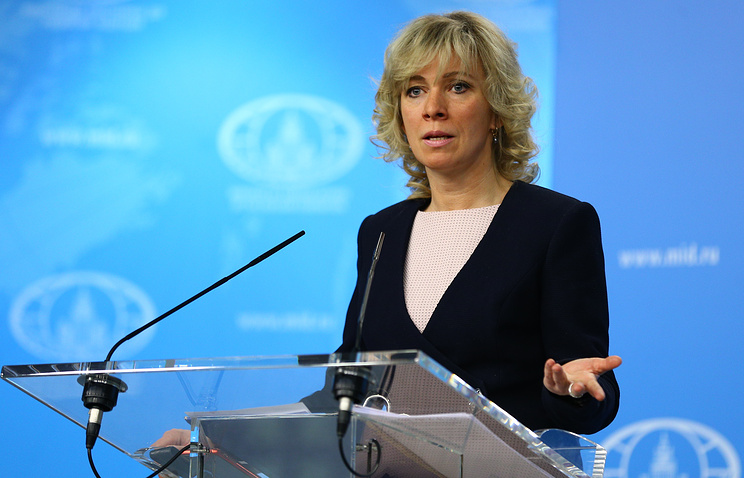
Russian Foreign Ministry spokeswoman Maria Zakharova
TASS | April 19, 2018
MOSCOW – Britain may well be described as the holder of the world’s genocide record, Russian Foreign Ministry spokeswoman Maria Zakharova told a news briefing on Thursday in response to claims by UK ambassador in Moscow Laurie Bristow to the effect Russia was allegedly behind a number of contract killings.
“Britain is the world’s worst genocider,” she said. “The thought of how many millions of innocent people were put to death in the British colonies is terrifying.”
Zakharova recalled that according to various estimates, British colonists exterminated up to 90%-95% of the aborigines in the process of colonizing Australia.
In the 1870s, Britain conducted genocide against the Zulus in Cape Colony, and in 1954-1961, against the Kikuyu people in Kenya, she recalled.
“In retaliation for the killing of 32 white colonists the British authorities exterminated 300,000 members of the Kikuyu people and drove another 1.5 million into concentration camps,” she said.
In all, Zakharova made public 17 pages of archive information describing Britain’s unseemly actions in the world scene over many years.
Skripals poisoning ‘highly likely’ staged by British intelligence – Russian Foreign Ministry
RT | April 19, 2018
The UK’s behavior after the Skripal incident suggests that the attack was organized by the British spy agencies or was at least beneficial for them, Russian Foreign Ministry spokeswoman Maria Zakharova has said.
“It was highly likely that the false-flag incident with the poisoning of the Russian citizens in Salisbury was beneficial for, or perhaps organized by, the British intelligence services in order to mar Russia and its political leadership,” Zakharova told a news conference in Moscow on Thursday, markedly using the same phrase regarding probability as London officials and their allies.
Such a false-flag operation would perfectly fit into the “general Russophobe course of the [UK] Conservative government to demonize our country,” the spokeswoman stated, adding that the UK has “frequently committed such acts in the past.”
The “National Defense Strategy of the UK and the banquet speech of PM Theresa May at the end of last year,” also contribute to such version of events, according to Zakharova. The document and May’s speech have clearly envisioned “countering Russia” as one of the main priorities for the UK.
London’s actions in the aftermath of the attack on former double agent Sergei Skripal and his daughter Yulia on March 4 in the town of Sailsbury have raised many questions in Moscow. Russia says the UK did everything possible to disrupt the investigation and conceal facts, while squarely pinning the blame on Moscow. Russia has vehemently denied the allegations and repeatedly urged the UK to show some proof, or at least make information on the incident publicly available.
“The firm refusal to cooperate with Russia on the Salisbury poisoning investigation, London’s violations of the consular convention, reluctance to cooperate with the OPCW and concealment of the basic data to conduct a transparent investigation are the shining proofs of that,” Zakharova concluded.
Featured Video
No Vote, No Representation, No State: Democracy, Israeli Style
or go to
Aletho News Archives – Video-Images
From the Archives
Sanctions, War and the Policy of Dual Containment
By SASAN FAYAZMANESH | March 17, 2008
It is now nearly three decades since the Unites States adopted the policy of dual containment of Iran and Iraq. While much has been written about the containment of Iraq, there has been very little in-depth analysis of this policy when it comes to Iran. In a book that is going to be released on March 31, 2008, entitled The United States and Iran: Sanctions, Wars and the Policy of Dual Containment (Routledge), I attempt to address this shortcoming by investigating when and why the US policy of containment of Iran came about, how it evolved, and where it stands today.[1] To the extent that Israel has been involved in US policy making, the study will also include the role that Israel has played in the containment of Iran. Also, since the fate of Iran has been inextricably linked to that of Iraq, occasionally the investigation will overlap with the containment of Iraq.
The policy of dual containment of Iran and Iraq originated during the Carter Administration, but it was not until the Clinton Administration that the expression “dual containment” became popular. … continue
Blog Roll
 Aletho News
- No Vote, No Representation, No State: Democracy, Israeli Style
- Zionist Bought Senate Blocks Information About American Citizens Killed By Israel
- While Gaza dominates the UN, these are the people keeping it alive
- New Report: “Scholasticide and Genocide in Gaza: Assessment, Testimonies and Legal Analysis”
- ‘THAAD Delusion’: Iran war exposes US missile shield limits – The Atlantic
- Moscow issues warning to NATO over Russian exclave
- Yes, the Iran war has destroyed Trump’s presidency
- The fallacy of US delusions about Iran’s economic collapse
- Hezbollah denies Syria cell link, warns of Israeli plan to sow discord
- The legacy of US sanctions, war, and occupation in Iraq
- If Americans Knew
- Mamdani releases plan to combat antisemitism and hate crimes in New York City
- Iran’s Revolutionary Guards Publish Letter to the American People
- DMFI launches $1 million ad campaign supporting Virginia’s Elaine Luria
- US Senate blocks resolution seeking report on Americans killed by Israel
- Israeli Attacks Kill Ten Palestinians in Gaza
- Massacre at Minab: The School That Became a Grave
- Israeli media: The IDF Shows It Doesn’t Turn a Blind Eye; It Actively Emboldens Settler Havoc
- As settlers ravage West Bank, Israeli forces kill 10 in Gaza – Daily Update
- New Report: “Scholasticide and Genocide in Gaza: Assessment, Testimonies and Legal Analysis”
- Ex-Biden officials are desperate for a Gaza scapegoat
- No Tricks Zone
- Green Energy Debacle: German Expert Professor Fritz Vahrenholt Warns Of Severe Economic And Social Consequences
- Two More Paleo Reconstructions Affirm Meters-Higher Sea Levels Across Ireland, Brazil 7000-6000 Years Ago
- New Study: Earth And Venus Surface Warmth Largely Explained By Convection And Lapse Rate, Not CO2 Or Radiation
- 2025 Nature Paper Claiming Worsening Global Drought Gets RETRACTED …Heavily Flawed
- New Study: ‘Global Drought Shows No Detectable Recent Acceleration Under Climate Warming’
- Economic Masterminds: German Socialists Suggest Taxing Productivity Gains Stemming From Using AI
- The South China Sea Has Not Been Cooperating With The Climate Change Narrative
- Energy Crisis: Germany Enters Heating Season With Historically Low Gas Reserve Fill Levels
- New Study: The Antarctic Ice Sheet Gained Mass From 2020-2024 Due To Staggering Snow And Ice Accumulation
- Study: Ocean Heating Rates From Thousands Of Years Ago ‘Dwarf’ Modern Ocean Heating Rates

