Russia’s OPCW envoy exposes ‘eight UK lies’ in Skripal case
RT | April 19, 2018
The UK’s narrative in the Skripal case is a “story woven with lies,” with London continuously trying to “deceive” the international community, Russia’s OPCW envoy said, highlighting eight examples of such misinformation.
“We’ve tried to show that everything our British colleagues produce is a story woven with lies,” Russia’s permanent representative to the Organization for the Prohibition of Chemical Weapons (OPCW) Aleksandr Shulgin told reporters on Wednesday, following the organization’s meeting on the Skripal case.
“And, unlike the British, who aren’t used to taking responsibility for their words and unfounded accusations, we showed specific facts why we believe our British partners, to put it mildly, are ‘deceiving’ everyone.” The official provided eight examples of UK-pushed misinformation, surrounding the March 4 events, when the former double agent Sergei Skripal and his daughter Yulia were poisoned in the town of Salisbury.
#1. Russia refuses to answer UK ‘questions’
“In reality, they’ve asked us only two ‘questions’… And both were worded in such way that the existence of an undocumented arsenal of chemical weaponry at Russia’s disposal was presented as an established fact, beyond any doubt.”
It was effectively an ultimatum, pressing Moscow to either confess that it “attacked the UK with chemical weapons,” or to admit that it had “lost control over the chemical warfare arsenal.”
Moscow answered both of these ‘questions’ immediately, stating that it had nothing to do with the Salisbury incident. Apart from that, the official emphasized, it is an established fact that Russia destroyed all its chemical weaponry stockpile ahead of schedule last year.
#2. UK abides by Chemical Weapons Convention rulebook
The OPCW procedures clearly state that if one member state has issues with another, it should send an official request, and thus the other party would be obliged to respond within 10 days, Shulgin said. However, instead, the UK allegedly “instigated by their colleagues from across the pond,” disregarded the established mechanism and came up with a dubious “independent verification” scheme, which violates those very OPCW rules.
#3. Russia refuses to cooperate
While the UK and a number of its allies accuse Russia of “refusing to cooperate to establish the truth,” the situation is exactly the opposite, Shulgin insists. Moscow is interested in a thorough investigation of the incident – especially since the victims are Russian citizens. Moscow repeatedly insisted on a joint probe and urged London to release data on the Skripal case, but all efforts were in vain. Many requests went unanswered by the UK, while others received only a formal reply.
#4. Russia invents versions to distract attention
Despite numerous speculations and allegations by questionable sources, cited by the UK’s own domestic media, it was Moscow that was eventually accused of coming up with some “30 versions” of the Salisbury events, allegedly to “disrupt the investigation,” Shulgin said.
“In reality, the picture is different. In fact, it’s the British tabloids, the so-called independent media, which is multiplying those versions,” the official stated, recalling some of the narratives, most of which entirely contradict each other.
#5. Exterminating traitors is Russia’s official state policy
“They claim that the Russian leadership has, on multiple occasions, stated that extermination of traitors abroad is a state policy of Russia,” Shulgin said. “This is slander, of course. The British cannot produce a single example of such statements, since the Russian leadership has never said anything of the kind.”
#6. Experts pin the blame on Russia
The head of the OPCW mission has clearly said that it was impossible to determine in which country the toxic substance used in Salisbury had originated. Yet the OPCW findings were once again used by the UK officials to claim Moscow was “highly likely” responsible. “Look, the head said it was impossible and they, abandoning all common sense, said ‘They’ve confirmed our evaluations that it was Russia.’ How else can you evaluate this but as a lie?” Shulgin wondered.
#7. ‘Novichok’ is a Soviet invention, so it has to be Russia
The development of the so-called Novichok family of toxic agents more than 30 years ago in the Soviet Union was one of the main cornerstones in the UK narrative, pinning blame for the Skripal incident on Russia. Publicly available sources, however, indicate that “the West has been and still is conducting research and development into such substances,” Shulgin said, giving a fresh example of such activities.
“Not long ago, namely on 1 December 2015, the US Patent and Trademark Office filed a request to its Russian colleagues asking to check patentability … of a chemical weaponry-filled bullet, which could be equipped with Tabun, Sarin or the Novichok family of agents,” the official stated.
#8. Yulia Skripal avoids contact with relatives & refuses Russian consular support
While such a statement was indeed produced by the UK authorities “on behalf” of Yulia, Moscow believes it to be false. According to Shulgin, the situation with Yulia is starting to look like a Russian citizen is effectively being “held hostage” by the UK authorities.
London systematically destroying evidence in Skripal case – Russia’s UN envoy
RT | April 19, 2018
The UK continues to conceal and destroy evidence relating to the Salisbury incident and have crossed all boundaries in their rhetoric by alleging President Putin’s personal involvement, Russia’s UN envoy Vassily Nebenzia has said.
“The British authorities are engaged in the systematic destruction of evidence,” Nebenzia told the United Nations Security Council, which held a session, called by UK on Wednesday, to discuss the OPCW report and other developments in the Skripal case.
“Skripal’s pets were killed. No samples were obviously taken. The places attended by the Skripals – a bar, a restaurant, a bench, park ground, etc – are all being cleared,” the diplomat said, pointing out that, despite some loud statements about the alleged contamination of the area, “people continue to live in Salisbury as if nothing happened.”
The envoy also reminded the council members that Sergei and Yulia Skripal, who, according to London, are now both recovering from the poisoning by a deadly military grade nerve agent A-234 (‘Novichok’), are kept hidden from the public eye ever since the March 4 incident. In the meantime, London categorically refuses to provide Russia any access to the investigation, and so far has left 45 out of 47 questions addressed to British authorities about the case unanswered.
In a summary of its report, the OPCW didn’t not independently identify the nerve agent used in the Salisbury case nor its origin, but instead only confirmed “the findings of the United Kingdom relating to the identity of the toxic chemical that was used in Salisbury.”
The conclusions made by OPCW were based on samples provided by the UK investigators and do not prove London’s claim of Russia’s involvement in the poisoning, Nebenzia noted. “The main thing that the report lacks, and what the British side was so eager to see, is the conclusion that the substance used in Salisbury was produced in Russia,” he said.
The UK Ambassador to the United Nations, Karen Pierce, however, downplayed the lack of technical evidence and urged the council members to look at “the wider picture which has led the United Kingdom to assess that there’s no plausible alternative explanation than Russian State responsibility for what happened in Salisbury.”
Extensively using the ‘highly likely’ argument, the UK envoy once again claimed in her address to the UNSC that only Russia had the “technical means, operational experience and the motive to target the Skripals.” At one point she even claimed that “President Putin himself was closely involved in the Russian chemical weapons programme.”
“London apparently thinks the Russian President has a hobby of running chemical weapons programs in his free time. I don’t know whether you appreciate that you’ve crossed all possible boundaries,” Nebenzia replied.
While the UK is yet to produce clear evidence of Russian involvement in the alleged poisoning of the former double agent and his daughter, US Ambassador to the UN Nikki Haley once again attacked Moscow during the council meeting, parroting its ally’s narrative.
“As we have stated previously, the United States agrees with the UK’s assessment that Russia is responsible for the chemical weapons in Salisbury,” Haley said. “Whether that is in their direct act, or irresponsibly losing control of the agent, which could be worse, our support for our British friends and colleagues is unwavering.”
Read more:
Russia exposes British lies on Skripal, but trail leads to US
By M.K. Bhadrakumar | Asia Times | April 19, 2018
The sensational case of the poisoning of the ex-MI6 agent and former Russian military intelligence colonel Sergei Skripal on March 4 in Salisbury, in the UK, is becoming more and more curious. Under a blinding spotlight from Moscow, the British allegation regarding a Russian hand in the poisoning of Skripal is getting exposed. An engrossing plot in big-power politics is also unfolding. There is stuff here for a Le Carre novel.
Are we witnessing a replay of the false flag Gulf of Tonkin attack of August 1964, the imaginary “incident” concocted by the US military to provide legal and political justification for deploying American forces in South Vietnam and for commencing open warfare against North Vietnam?
To recap, Britain alleged without any empirical evidence that a military grade nerve agent of a type known as Novichok was used in Salisbury, saying it was originally developed in the former Soviet Union, and therefore, Moscow’s hand – possibly, even President Vladimir Putin’s hand – was “highly likely”.
Moscow has maintained, on the other hand, that it had destroyed all its chemical weapons and an Organization for the Prohibition of Chemical Weapons (OPCW) investigation verified and testified to that.
The British allegation quickly morphed into a large-scale expulsion of Russian diplomats (over 100 of them) by western capitals, under heavy pressure from Washington and London. The US alone expelled 60 Russian diplomats, while Britain expelled 23.
Egg on May’s face
Britain is studiously ignoring the Russian requests for samples of the chemical agent used in the Salisbury attack and for consular access to be granted to the former spy’s daughter Yulia. Meanwhile, Britain instead approached the OPCW to investigate.
The OPCW has now responded that it cannot identify the country of origin of the chemical agent used in the Salisbury attack.
There is egg on PM Theresa May’s face.
However, Russians managed to get their hands on the report prepared for the OPCW by its reputed laboratory in Spiez, the Swiss Center for Radiology and Bacteriological Analysis. According to the Swiss lab’s report, the chemical formula used in the Salisbury attack has been in service in the US, the UK and other NATO countries. Furthermore, neither the Soviet Union nor Russia “ever developed or stockpiled similar chemical weapons.”
That’s more egg on May’s face.
Now comes the bombshell. On April 18, Moscow disclosed that it has formally handed over to the OPCW proof to the effect that the Novichok agent purportedly used in the Salisbury attack actually happens to be patented as a chemical weapon in 2015 in the US and produced in that country. (By the way, unlike Russia, the US is yet to destroy its chemical weapon stockpiles, as required under the Chemical Weapons Convention of 1997.)
Now, not only the British government but Washington too has some explaining to do.
Was Skripal attack a covert op by the West?
Simply put, the Salisbury attack might even have been an Anglo-American joint covert operation undertaken with the ulterior motive to ratchet up tensions between the West and Russia. (The Washington Post reported on Monday that the former National Security Advisor HR McMaster might have hoodwinked President Donald Trump into approving the expulsion under the wrong notion that similar numbers of expulsions by European allies was in the pipeline. In the event though, the Europeans made only token expulsions.)
Britain is steadily edging away from the Skripal case, hoping, perhaps, that the matter will die down. But will Moscow let Britain off the hook?
On their part, the Russians seem to be holding back on some explosive information pointing toward the US’s direct complicity in this affair.
Indeed, if this was McMaster’s swan song, the indefatigable Russophobe probably hoped to kill two birds with one shot – push Russia’s relations with the West to a crisis point and second, scotch the prospects of an early US-Russia presidential summit (which Trump wanted.)
McMaster reportedly tried to stop Trump from congratulating Putin on his big victory in the Russian election on March 18 in a phone conversation where they discussed a possible summit meeting in a near future.
How far all this is linked to Trump’s decision on March 22, finally, to sack McMaster as his National Security Advisor is yet another template. By the standards of military people, McMaster probably has the reputation of being an “intellectual” but the man proved to be an unvarnished Cold Warrior fit for a museum.
From all accounts, Trump never trusted McMaster and the two had an acrimonious relationship. The one-star general who was overlooked for promotion by the Pentagon was Trump’s default choice following the abrupt departure of Michael Flynn.
Michael Wolff narrates a hilarious episode in his book ‘Fire and Fury’ that during the job interview for the NSA post, McMaster tried to impress Trump when he showed up in military uniform with his silver star and launched into a wide-ranging lecture on global strategy. After, Trump reportedly remarked, “That guy bores the shit out of me.”
Dirty money or dirty politics? UK hypocrisy over ‘Russian oligarchs’
By Neil Clark | RT | April 18, 2018
According to Russia’s Prosecutor General, 61 criminals who stole up to $10 billion in Russia are enjoying life in the UK. Britain claims to be concerned about ‘dirty money,’ but has rejected requests from Moscow for extradition.
It was the financial heist of the century. The looting of Soviet Russia’s wealth by a group of well-connected oligarchs in the 1990s enriched a tiny few, but impoverished vast swathes of the country’s population. The foundations for this massive, reverse-Robin-Hood redistribution of wealth were laid with Gorbachev’s ‘restructuring’ economic reforms of the late 80s. However, the process reached its peak under Boris Yeltsin.
State assets were handed out like confetti to members of Yeltsin’s inner circle. By 1996 the Russian people, who had seen their living standards plummet following the end of communism, had had enough. Yeltsin’s popularity was down to single-figure ratings – with the Communists riding high in the polls. So the President’s oligarch friends – and their Western allies – worked together to make sure the election went the ‘right’ way.
The US got the IMF to give Russia a $10.2-billion loan so that state salaries, which had been unpaid for months, could finally be paid. With the media under government or oligarch control, a massive propaganda offensive was launched. When the vote came in the second round, Yeltsin was declared the winner with 54 percent of the vote. There were widespread accusations of election fraud, but the West didn’t care. “Yanks to the rescue; The Secret story of how US advisers helped Yeltsin win,” proclaimed Time magazine on its front cover. “Bill (Clinton) would pick up the hotline and talk to Yeltsin. He would tell him what commercials to run, where to campaign, what positions to take, he (the US president), basically became Yeltsin‘s political consultant,” admitted Dick Morris, a Clinton campaign manager.
The events of 1996 are well worth remembering when we hear unproven allegations about how Russia ‘fixed’ the 2016 US presidential election for Trump. With Yeltsin back in power, the oligarchs popped the champagne corks and prepared to make even more money on the backs of the Russian people.
“We hired First Deputy Chubais. We invested huge sums of money. We guaranteed Yeltsin’s re-election. Now we have the right to occupy government posts and use the fruits of our victory,” boasted Boris Berezovsky, the so-called ‘Godfather of the Kremlin’ to the Financial Times in 1997.
The 90s were a decade ordinary Russians would prefer to forget. Things only started to improve for them when the first moves were made to re-introduce some law and order into the system. The process started under Prime Minister Yevgeny Primakov, but accelerated under Vladimir Putin.
A seminal moment came with the arrest, in 2003, of Mikhail Khodorkovsky, who was believed to be the richest man in Russia. In fact, the current ‘Cold War 2.0’ against Russia, waged by Western neocons, can be traced back to this event. At the time of his arrest, Khodorkovsky had been holding talks with US oil companies over a merger with his conglomerate Yukos. The West, as I explained in the New Statesman, had seen the oligarchs as a way they could gain control over Russia. “Now with their man in Moscow behind bars, it is time for the neoconservative propaganda war against Putin to go into overdrive. Richard Perle was first out of the blocks, calling for Russia’s expulsion from the G8 and its exclusion from any postwar Iraq oil contracts, and accusing it of collusion with Iran’s nuclear-power program,” I noted.
The Khodorkovsky case became a cause celebre, while Boris Berezovsky was also lionized by the sections of the establishment when he failed to return to Russia – where he was facing criminal charges – and was granted political asylum in Britain.
An Interpol Red Warrant for his arrest was ignored. The controversial oligarch, now rebranded as a ‘pro-democracy campaigner’ wined and dined UK media figures and was even invited on to the BBC television program Question Time to give his thoughts on ‘democracy.’
There was no, or little, concern about ‘dirty’ Russian money in London at this time. The more rich Russians who flocked to London, the better. But all that has hanged in recent months. The deliberate ramping up of Cold War 2.0 tensions, because of frustration with Russia’s role in thwarting ‘regime change’ plans for Syria, has meant that wealthy Russians living in Britain are now in the line of fire.
“Russians in Britain told to reveal their riches,” declared a headline of the neocon Times newspaper.
Security Minister Ben Wallace, as quoted by ITV, said that the “full force of government” would be brought to bear on foreign criminals and corrupt politicians who use Britain as a haven. His reference to the TV series McMafia – about Russian oligarchs – made it clear which ‘foreign criminals‘ he had in mind.
Unexplained Wealth Orders will be used to ask people with lots of money where they got their fortunes from. But only certain people.
Clearly, the system is open to abuse. Rich Russians who hate Putin and say the right things about the Russian government probably have no reason to be afraid. But those who aren’t personae non grata in Moscow will find things more difficult.
In January, the Daily Telegraph reported that Chelsea Football Club owner Roman Abramovich, who hasn’t fallen out with the Russian government, was for the first time included on “a list of officials and oligarchs” which could serve as “a basis for future Russian sanctions.”
Abramovich was also included in a Times ‘hit-list’ on March 18 on “Putin’s oligarch pals with billions in British assets,” when we were told that the UK government could draw on the list published by the US in January.
I think we can all see the way things are going. Wealthy Russians living in Britain will have to disassociate themselves from the Kremlin, if they’re to be left in peace. The key issue will not be ‘Where did you get your money?’ but ‘Who do you support?’
Some are already getting cold feet.
In March, in the aftermath of the Salisbury case, Sergei Kapchuk, a Russian businessman living in Britain, fled the country saying he was in fear of the British security services – having been pressured to make an appeal to Putin by an ‘intelligence-officer-looking’ man before a television interview.
The anti-Russian witch-hunt has even led to the absurd spectacle of ‘rights activist’ Peter Tatchell calling for the children of Russian “regime officials and families” to be expelled from schools.
In The Independent last week, a Russian woman living in Britain wrote: “I quickly realized that acknowledging you’re a Russian in the UK is like admitting that you have a deadly disease and you only have a few weeks to live.”
The fact that she felt obliged to write the piece under the pseudonym “Valerie Stark” shows us how bad the situation has become.
It’s clear what’s underpinning the UK government’s so-called ‘fight’ against ‘dirty money‘ is not morality (how can it be, from a government that has imposed harsh austerity measures on the British public), but geopolitics. It has to be seen in its wider context as part of the warmongering elite’s Russophobic campaign. “They were not concerned before because they approved of the wholesale theft of Russia‘s wealth back then, and the Yeltsin regime which facilitated it,” George Galloway recently told RT.
Now though, with Russia getting in the way of neocon hegemonic aspirations in the Middle East, it’s a very different story.
Russia: Chemical weapons inspection delayed due to West’s airstrikes
Press TV – April 16, 2018
Russia says a visit by inspectors from the United Nations chemical watchdog to the site of an alleged gas attack in Syria’s Douma has been delayed due to recent Western airstrikes on the Arab country.
“This is the latest conjecture of our British colleagues,” Deputy Foreign Minister Sergei Ryabkov was quoted as saying by Russia’s RIA news agency on Monday, in reaction to accusations that Moscow and Damascus have blocked the inspection team’s access to the area.
The British delegation to the Organization for the Prohibition of Chemical Weapons (OPCW) claimed that the fact-finding mission was in the Syrian capital Damascus but still unable to visit Douma, where dozens of people reportedly lost their lives in the aftermath of a suspected chemical attack on April 7.
Kremlin spokesman Dmitry Peskov denounced as “groundless” the British accusation, adding that Russia had consistently supported an investigation into the suspected gas attack.
“We called for an objective investigation. This was at the very beginning after this information [of the attack] appeared. Therefore allegations of this towards Russia are groundless,” Peskov said.
The Russian embassy in the Netherlands, where the OPCW is based, also dismissed the British claims and said Moscow would not “interfere in its work.”
Meanwhile, the Syrian government announced that it was “fully ready” to cooperate with any OPCW investigation.
Syrian Deputy Foreign Minister Faisal al-Mekdad said that government officials had held meetings with the inspection team in Damascus a number of times to discuss cooperation.
Inspectors for the Hague-based OPCW met Mekdad in the presence of Russian officers and a senior Syrian security official in Damascus for about three hours on Sunday.
Russia has ‘not tampered’ with Douma site
Also on Monday, Russian Foreign Minister Sergei Lavrov rejected accusations leveled by the US envoy to the OPCW that Moscow may have tampered with the site of last week’s incident in Douma.
“I can guarantee that Russia has not tampered with the site,” Lavrov said in an interview with the BBC.
The top Russian diplomat said that evidence of a chemical attack cited by Britain, France and the United States was a “staged thing,” and based “on media reports and social media.”
The Syrian government surrendered its chemical weapons stockpile during a process monitored by the OPCW in 2014.
In the early hours of Saturday, the US, Britain and France launched a barrage of missile attacks against Syria in response to what they claim to have been a chemical attack by the Syrian government in Douma.
Syria rejected the accusations as “chemical fabrications” made by the foreign-backed terrorists in the country in a bid to halt advances by pro-government forces.
Syrian air defenses responded firmly to the Western powers’ attacks, shooting down most of the missiles fired at the country.
The Pentagon, however, has claimed that the airstrikes “successfully hit every target.”
US officials said that Tomahawk cruise missiles and other types of bombs were used in the attack.
On the Reaction to the U.S. Strike in Syria
By Gilbert Doctorow | Consortium News | April 15, 2018
The arguments between Secretary of Defense James Mattis and Chairman of the Joint Chiefs of Staff General Joseph Dunford before the Syrian air strikes, and between them and President Donald Trump and his ultra-hawk national security adviser, John Bolton, ended with “precision strikes” early Saturday morning in Damascus and near the city of Homs.
Some 103 tomahawks and other cruise missiles were launched from US navy vessels and British and American warplanes. Seventy-one of these were claimed by the Russian Ministry of Defense to have been shot down by Syrian air defense batteries. The more modern and effective Russian-manned S400 systems at their Tartus naval base and Khmeimim air base were not brought into play.
There was material damage to some Syrian military storage facilities and particularly to a research center, which the US-led coalition claimed was used for fabrication of chemical weapons. Employees at the site said they were producing antidotes to snake venom, not chemical weapons. No deaths were reported and only six people were injured. The targets were all well clear of known positions of Russian and Iranian personnel in Syria. And while the Pentagon denied Russia had been told the targets, there’s speculation that the missiles’ flight paths had been made known to Moscow.
‘Mission Accomplished?’
Mattis said the mission was over but the U.S. stood ready to strike again if Assad once more used chemical weapons, though whether he did last weekend in Duma, a Damascus suburb, has yet to be proven. The U.S.-led air strikes took place hours before a team of specialists from the Organization for the Prohibition of Chemical Weapons were to begin its investigation at the site to determine if chemicals were used, and which chemicals they may been.
In his address to the nation when launching the attack, Trump used the same unproven allegations and maudlin, propagandistic evocation of the horrors of chemical weapons that his ambassador to the United Nations, Nikki Haley, had used earlier in the day Friday when responding to specific charges of violating international law and a possibly non-existent chemical attack, which the Russian ambassador, Vasily Nebenzya, had leveled against the U.S. in the UN Security Council chamber.
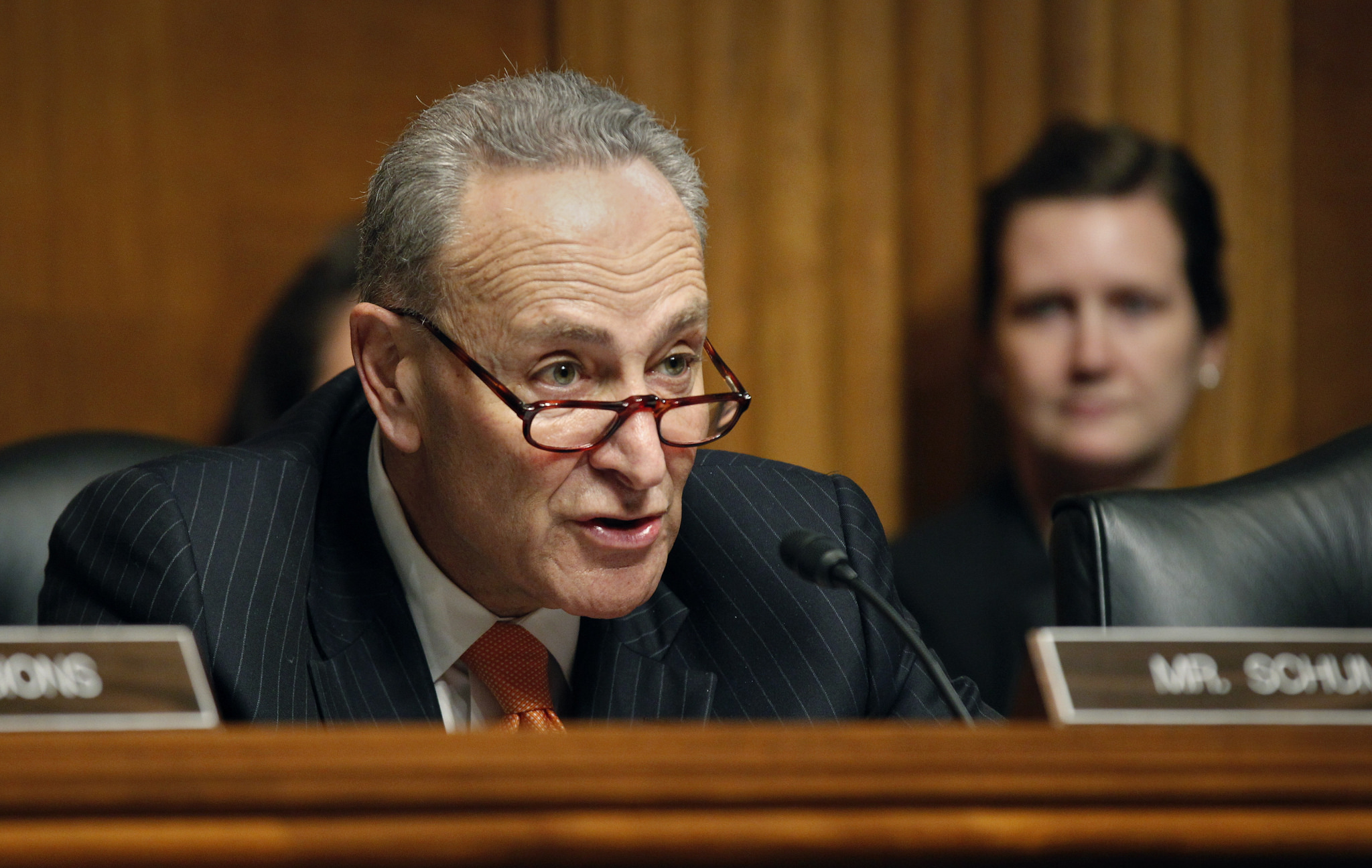
Schumer: ‘No end game.’
The narrowly focused and seemingly ineffectual nature of the strikes is unlikely to satisfy anyone in the U.S. political classes. Even those who have been encouraging Trump to stand tall in Syria and punish Damascus for the alleged, but unproven, use of chemical weapons, like New York Senator Chuck Schumer (D), gave him only tepid support for the action taken, complaining of no overall administration strategy for Syria or an end game.
Others posit that the timing of the attack was driven solely by Trump’s urgent need to deflect public attention from personal and political scandals, especially after the F.B.I. seizure earlier in the week of the papers and possibly his taped conversations in the offices of his lawyer, Michael Cohen.
For the Russians there could only be outrage. They were on the receiving end of what was a publicly administered slap in the face to President Vladimir Putin, who was named and supposedly shamed in Trump’s speech for providing support to the “animal” Assad. Putin had been calling upon the U.S. and its allies to show restraint and wait for the conclusion of the OPCW investigation in Duma.
Russia’s ambassador to Washington, Anatoly Antonov, repeated after the attacks Moscow’s prior warning that there would be “grave consequences” for the U.S. and its allies. These were not spelled out. But given Putin’s record of caution, it would be surprising if Moscow did anything to exacerbate the situation.
What comes next?
That caution left the U.S. exposed as an aggressor and violator of international law. Since we are in a New Cold War, habits from the first Cold War are resurfacing. But the roles are reversed today. Whereas in the past, it was Washington that complained to high heaven about the Soviet military intervention in Hungary and Czechoslovakia, today it is Russia that will go on the offensive to sound off about US aggression.
But is that all we may expect? I think not. Putin has a well-earned reputation as a master strategist who takes his time with every move. He also knows the old saying that revenge is a dish best served cold. He has frequently advocated “asymmetric” responses to Western moves against Russian interests. The question of counter moves had already been on his mind since the U.S. Treasury introduced new and potentially harsh economic sanctions on Russia with effect from April 6.
In fact, Russian legislators were busy preparing to introduce in the Duma on Monday a bill empowering the Russian president to issue counter-sanctions. These include an embargo on the sale of critical components to the U.S. aircraft industry which is 40 percent dependent on Russian-sourced titanium for production of both military and civilian planes. There is also the proposed cancellation of bilateral cooperation in space where the Russians supply rocket engines used for U.S. commercial and other satellite launches, as well as a total embargo on sales of U.S. wines, spirits and tobacco in the Russian Federation.
Aside from the withdrawal of titanium sales, these and other enumerated measures pale in significance to the damage done by the U.S. sanctions on the Rusal corporation, the world’s second largest producer and marketer of aluminum, which lost $12 billion in share value on the first day of sanctions. But that is to be expected, given that the United States is the world’s largest economy, measuring more than 10 times Russia’s. Accordingly its ability to cause economic damage to Russia far exceeds the ability of Russia to inflict damage in return.
The only logical outcome of further escalations of U.S. economic measures would be for Russia to respond in the one area where it has something approaching full equality with the United States: its force of arms. That is to say, at a certain point in time purely economic warfare could well become kinetic. This is a danger the U.S. political leadership should not underestimate.
Considering the just inflicted U.S. insult to Russia by its attack in Syria, Moscow may well choose to respond by hitting U.S. interests in a very different location, where it enjoys logistical superiority and also where the counter-strike may be less likely to escalate to direct crossing of swords and the unthinkable—possible nuclear war.
A number of places come to mind, starting in Ukraine where, in an extreme reaction, Russia has the option of removing the regime in Kiev within a 3-day campaign, putting in place a caretaker government until new elections were held. That would likely lead to armed resistance, however, and a Russian occupation, which Moscow neither wants nor can afford.
The Media Reacts
The media reaction to the air strikes has been distinct in the U.S. from Europe, and even more so, naturally, in Russia.
U.S. mainstream reaction, in particular in The New York Times, The Washington Post and the cable TV networks, has been an uncritical platform for the Pentagon view of what it achieved. Both papers barely made mention that the missiles rained down as the OPCW team was about to begin its work. Parading out their retired generals, often with unmentioned contracts as lobbyists for the military industry, the cable networks resumed their cheerleading for American war and materiel.
In France, Le Monde largely followed the Pentagon line in declaring the mission a success, while in Germany leading newspapers attempted a more independent line. Die Welt discussed how the U.S. and Europe used the mission to test the battleground effectiveness of some of their latest weaponry. The Frankfurter Allgemeine called the Pentagon “the last bastion of sense” in the Trump administration and reported that the Russians want to open a strategic dialogue with the U.S. over arms control.
A commentary in the British Guardian claimed that Mattis, and not Trump, “is calling the shots.” Another piece reported on Labour leader Jeremy Corbyn’s call for a “check on military intervention” by insisting that Parliament vote on a War Powers act.
The Times of London ran fewer articles on the Syria strike and instead led with a piece predicting that to punish the United Kingdom for its role in the Skripal case and in Syria, Moscow will unleash a barrage of hacked, damaging confidential materials relating to government ministers, members of Parliament and other elite British personalities. In response, May’s cabinet is said to be considering a cyber-attack against Russia.
The TV station Euronews, whose motto is “Euronews. All Views,” unusually for Western media, gave Russians equal time to set out their totally diametrically opposed positions: on whether any chemical attacks at all occurred in Duma, and on the U.S. violation of international law.
On Saturday Euronews exceptionally gave nearly complete live coverage to Russian Foreign Minister Sergey Lavrov as he spoke in Moscow to the 26th Assembly of the Council of Foreign and Defense Policy. During this talk, Lavrov divulged the findings of the Swiss laboratory which had examined samples of the chemicals gathered in Salisbury in relation to the Skripal poisonings, findings which he said pointed not to Novichok, as was claimed by Boris Johnson, but to a nerve agent developed by the United States and produced also in Britain. Lavrov likened the faked attack in Salisbury to the faked chemical attack in Duma.
Letting the Russians deliver extensively their views on what happened in Syria without commentary by their own journalists might be considered extraordinary by Euronews or any other European broadcaster’s standards.
In Russia, the news channel Rossiya-1 on Saturday broadcast a special edition of the country’s leading political talk show hosted by Vladimir Solovyov. His panelists said that in Damascus, where the most modern air defenses are installed, including the latest BUK series, the Syrians shot down 100 percent of incoming missiles. This contradicts, however, the fact that a research facility in the center of Damascus was bombed. Elsewhere in the country, where there are older systems in place, fewer missiles were hit.
In the wake of the U.S.-led air strikes, Moscow has apparently now decided to supply the Syrian army their next to latest generation of air defense, the S300. It was reported earlier that because of the war, there was a great shortage of trained technicians on the Syrian side so that shipment of such equipment previously would have made no sense. However, now that the military situation of the Assad government has stabilized, the personnel problems are no longer so acute and the Russians can proceed with delivering materiel and training the Syrians to defend themselves. This will substantially change the equation with respect to Syrian defense capability should the U.S. and its allies think of returning.
Protests in the West
One must ask why there have been no anti-war protests in the West in reaction to the strike on Syria. That it lasted less than an hour may have something to do with it. But the U.S. is at war in about seven nations and there is no sustained, anti-war movement. Part of the reason is the virtual collapse the anti-war Left in the West that fueled protests in America and Europe in the 1960s anti-Vietnam war movement and the 1980s protests against the deployment of cruise missiles in Europe to counter Soviet intermediate range SS20 missiles.
From the 1990s leftist political parties both in the U.S. and Europe have suffered terrible losses of voter support. What charismatic leaders emerge to challenge the centrist, global hegemony politicians have been almost uniformly categorized as extreme Right or populists. The peace movements have been nearly extinguished. So-called progressives are today notoriously anti-Russian and in step with the Neocons on what the legitimate world order should look like.
For these reasons, it is quite remarkable that early reactions to the US-led bombing in Syria have come from social media and internet portals that may be loosely categorized as establishment left or progressive. Dislike for Trump, for Bolton and for the crew of madmen who constitute the administration has finally outweighed hatred for Putin, “the authoritarian,” the Alpha male, the promoter of family and Orthodox Christian values and the so-called thief who stole the U.S. election. On-line petitions now being circulated, even by the Democratic Party-friendly MoveOn.org, reveal some comprehension that the world has moved closer to utter destruction due to the U.S.-Russia confrontation.
Another sign that the antiwar movement may be stirring out of its slumber and going beyond virtual protests, is that the Massachusetts Peace Action chapter, heirs to the SANE franchise, the country’s largest anti-nuclear weapons organization from the middle of the first Cold War, called on its members to rally in Cambridge (home to Harvard University and MIT) to protest the U.S. strikes in Syria. It also calls on Congress to reclaim its War Powers.
These are admittedly small steps with little political weight. But they are encouraging sparks of light in the darkness.
Gilbert Doctorow is an independent political analyst based in Brussels. His latest book, Does the United States Have a Future? was published on 12 October 2017.
Strike on Syria legitimate as 3 UNSC members acted – Macron
RT | April 15, 2018
French President Emmanuel Macron said that the US-led strike on Syria was legitimate, but “history will judge” whether the operation was justified. He added that neither France nor its allies are at war with the country.
Macron was giving a live interview following the Saturday strike on Syria that was carried out without any resolution from the UN security council. The US-led attack, that hit three targets in Syria, a research center and military bases, was launched in response to an alleged chemical attack in Douma on April 7.
The French president defended the lack of a UN resolution before conducting the strikes against Syria, saying that it was “the international community” that intervened.
“We have complete international legitimacy to act within this framework,” Macron said in the interview broadcast by BFMTV, RMC radio and Mediapart. “Three members of the Security Council have intervened.”
Macron also alleged that he was the one who convinced US President Donald Trump to remain in Syria and that the coalition should limit their strikes to chemical weapons facilities.
“Ten days ago, President Trump was saying ‘the United States should withdraw from Syria’. We convinced him it was necessary to stay,” Macron said. “We convinced him it was necessary to stay for the long term.”
He also asserted that Assad has lied “from the beginning” about the alleged use of chemical weapons by forces under his control. Macron also reaffirmed that the French government has proof that chemical weapons, notably chlorine gas, were used in Syria, adding that the “the priority for France’s military intervention remains in the fight against ISIS” and that the “precision strikes” did not inflict any collateral damage on Russian forces.
He also accused Russia of being complicit in the alleged chemical weapons attacks carried out by pro-Assad forces by disrupting the work of the international community and the Organization for Prohibition of Chemical Weapons (OPCW) using “diplomatic channels.” He didn’t mention, however, that the strike took place hours before the inspectors of the OPCW were to start their mission at the place of the alleged attack and were guaranteed full access by the Syrian government who took control over the area this week.
Moscow questions French report claiming Syrian govt ‘retained chemical weapons since 2013’
RT | April 14, 2018
The Russian Foreign Ministry slammed a French intelligence report claiming that the Syrian government retained a chemical weapons program since 2013, asking why Paris decided “to remain silent on its findings” till now.
On Saturday, the French Ministry of Defense published a report compiled by the intelligence services regarding the possible use of chemical weapons in the Syrian city of Douma last week.
“French intelligence services estimate that Syria did not declare all of its chemical weapon stockpiles and capabilities with the Organization for the Prohibition of Chemical Weapons in October 2013.”
Russian Foreign Ministry Spokesperson Maria Zakharova asked why France did not come forward with it before the US-led strikes early Saturday.
“It [France] says that it is supposedly a secret report, according to which Damascus has been carrying out certain secret programs for the production of chemical weapons since 2013,” Zakharova said on the 60 Minutes program aired on Rossiya-1.
“So where was France? Where were the official representatives of the French Foreign Ministry, the Ministry of Defense, the president? Where was France’s permanent representative to the UN Security Council? Why did they all remain silent all this time?” Zakharova said.
The report says the “French [intelligence] services began to analyze testimonies, photos and videos that appeared spontaneously on special websites, in the media and on social networks in the hours and days that followed the attack. The testimonies obtained by the services were also analyzed.”
The “spontaneous nature of the release” of the alleged chemical attack victims’ images on social media “confirmed that the data was not fabricated or reused.” After studying the photos, French experts determined that the victims of the attack had “identifiable symptoms,” as “some of the entities that published this information are recognized as usually reliable,” the report stated.
On Friday, the Russian Defense Ministry presented what it says is proof that the reported chemical weapon attack in Douma was staged. During a briefing, the ministry showed interviews with two people, who, it said, are medical professionals working in the only hospital operating in Douma, near the Syrian capital. In the interviews released to the media, the two men reported how footage was shot of people dousing each other with water and treating children, which was claimed to show the aftermath of the April 7 chemical weapon attack.
According to the ministry, the patients shown in the video suffered from smoke poisoning and the water was poured on them by their relatives after a false claim that chemical weapons were used. “Please, notice. These people do not hide their names. These are not some faceless claims on social media by anonymous activists. They took part in taking that footage,” the ministry spokesman noted.
Moscow also accused the British government of pressuring the perpetrators to speed up the “provocation.”
“The Russian Defense Ministry also has evidence that Britain had direct involvement in arranging this provocation in Eastern Ghouta,” Major-General Igor Konashenkov added, referring to the neighborhood of which Douma is a part. “We know for certain that between April 3 and April 6 the so-called White Helmets were seriously pressured from London to speed up the provocation that they were preparing.”
The UK rejected the accusations. The reported chemical weapons attack escalated tensions over Syria, just as Damascus was about to seize full control of Eastern Ghouta. Last week, rebel-linked activists, including the White Helmets group (which has been plagued by allegations of ties to terrorist organizations), accused the Syrian government of carrying out a chemical attack that allegedly affected dozens of civilians in Douma. Damascus, which regards the White Helmets as a foreign-funded terrorist propaganda mouthpiece, rejected these allegations as “fabrications.”
Read more:
Featured Video
No Vote, No Representation, No State: Democracy, Israeli Style
or go to
Aletho News Archives – Video-Images
From the Archives
Sanctions, War and the Policy of Dual Containment
By SASAN FAYAZMANESH | March 17, 2008
It is now nearly three decades since the Unites States adopted the policy of dual containment of Iran and Iraq. While much has been written about the containment of Iraq, there has been very little in-depth analysis of this policy when it comes to Iran. In a book that is going to be released on March 31, 2008, entitled The United States and Iran: Sanctions, Wars and the Policy of Dual Containment (Routledge), I attempt to address this shortcoming by investigating when and why the US policy of containment of Iran came about, how it evolved, and where it stands today.[1] To the extent that Israel has been involved in US policy making, the study will also include the role that Israel has played in the containment of Iran. Also, since the fate of Iran has been inextricably linked to that of Iraq, occasionally the investigation will overlap with the containment of Iraq.
The policy of dual containment of Iran and Iraq originated during the Carter Administration, but it was not until the Clinton Administration that the expression “dual containment” became popular. … continue
Blog Roll
 Aletho News
- No Vote, No Representation, No State: Democracy, Israeli Style
- Zionist Bought Senate Blocks Information About American Citizens Killed By Israel
- While Gaza dominates the UN, these are the people keeping it alive
- New Report: “Scholasticide and Genocide in Gaza: Assessment, Testimonies and Legal Analysis”
- ‘THAAD Delusion’: Iran war exposes US missile shield limits – The Atlantic
- Moscow issues warning to NATO over Russian exclave
- Yes, the Iran war has destroyed Trump’s presidency
- The fallacy of US delusions about Iran’s economic collapse
- Hezbollah denies Syria cell link, warns of Israeli plan to sow discord
- The legacy of US sanctions, war, and occupation in Iraq
- If Americans Knew
- Mamdani releases plan to combat antisemitism and hate crimes in New York City
- Iran’s Revolutionary Guards Publish Letter to the American People
- DMFI launches $1 million ad campaign supporting Virginia’s Elaine Luria
- US Senate blocks resolution seeking report on Americans killed by Israel
- Israeli Attacks Kill Ten Palestinians in Gaza
- Massacre at Minab: The School That Became a Grave
- Israeli media: The IDF Shows It Doesn’t Turn a Blind Eye; It Actively Emboldens Settler Havoc
- As settlers ravage West Bank, Israeli forces kill 10 in Gaza – Daily Update
- New Report: “Scholasticide and Genocide in Gaza: Assessment, Testimonies and Legal Analysis”
- Ex-Biden officials are desperate for a Gaza scapegoat
- No Tricks Zone
- Green Energy Debacle: German Expert Professor Fritz Vahrenholt Warns Of Severe Economic And Social Consequences
- Two More Paleo Reconstructions Affirm Meters-Higher Sea Levels Across Ireland, Brazil 7000-6000 Years Ago
- New Study: Earth And Venus Surface Warmth Largely Explained By Convection And Lapse Rate, Not CO2 Or Radiation
- 2025 Nature Paper Claiming Worsening Global Drought Gets RETRACTED …Heavily Flawed
- New Study: ‘Global Drought Shows No Detectable Recent Acceleration Under Climate Warming’
- Economic Masterminds: German Socialists Suggest Taxing Productivity Gains Stemming From Using AI
- The South China Sea Has Not Been Cooperating With The Climate Change Narrative
- Energy Crisis: Germany Enters Heating Season With Historically Low Gas Reserve Fill Levels
- New Study: The Antarctic Ice Sheet Gained Mass From 2020-2024 Due To Staggering Snow And Ice Accumulation
- Study: Ocean Heating Rates From Thousands Of Years Ago ‘Dwarf’ Modern Ocean Heating Rates

