Russia & Syria call for on-the-ground probe in Douma, pledge to provide security to OPCW experts
RT | April 10, 2018
Moscow has proposed to create an independent investigative mechanism into the alleged chemical attack in the Damascus suburb of Douma, promising, along with the Syrian army, to guarantee prompt access for experts to the site.
Russia’s envoy to the UN, Vassily Nebenzia, has reiterated that Russia will support a thorough investigation into the alleged use of chemical weapons in the rebel-held town of Douma over the weekend.
“Let us recall that our draft resolution to set up such a mechanism is in blue. And we stand ready to adopt it today if necessary,” Nebenzia said, referring to the Russia-sponsored UNSC resolution to establish an independent investigative mechanism under the auspices of the Organization for the Prohibition of Chemical Weapons (OPCW).
Moscow is ready to serve as a guarantor of security for those OPCW experts who would inspect the site of the incident, Nebenzia added, stressing the need for the probe to be carried out without delay. The experts may “immediately, tomorrow, fly to Damascus,” the diplomat said.
“There, the Syrian authorities and Russian troops will provide conditions to travel to the area of the alleged incident for them to familiarize themselves with the situation,” Nebenzia said, reminding the UNSC member-states’ representatives that “that is what President Trump and other western leaders called upon us to undertake.”
The Syrian Permanent Representative to the United Nations Bashar Jaafari said his country is also ready to welcome the OPCW team as soon as possible and to provide them with everything necessary for a comprehensive investigation.
“My country, Syria, stresses its unlimited cooperation with the OPCW to fulfill the commitments stated in the convention of the prohibition of the development, production, stockpiling and use of chemical weapons,” he said.
Highlighting the importance of a swift investigation, Nebenzia noted that it should be conducted on the ground, and not through third parties. Moscow has repeatedly criticized the OPCW investigation into last April’s Khan Sheikhoun incident as “unprofessional.” One of the major flaws of the Joint Investigative Mechanism (JIM), as pointed out by Moscow, was that the whole investigation was conducted remotely. As a result, the findings of the OPCW report, that blamed the attack on the Syrian government, were mostly based on speculation by analysts, accounts by unidentified witnesses and material evidence submitted by third parties with no chain of custody being implemented.
In November, the mechanism’s mandate expired and Moscow vetoed a resolution to extend its authority, arguing that it was effectively “dead” and couldn’t be revived, stressing a need for a new, “professional, objective and unbiased” mechanism to replace its discredited predecessor. Moscow at the time proposed a resolution to create one but it was not passed by the UNSC.
Speaking to the media on Monday, Nebenzia did not specify if Russia would put the resolution to a vote on Tuesday. Meanwhile, US Ambassador to the UN Nikki Haley said she is looking forward to the Security Council voting on the resolution proposed by the US.
The US draft, leaked to the media, implies that Syria might be found in violation of UNSC Resolution 2118 as a result of the investigation by a proposed “Independent Mechanism of Investigation.” The resolution, adopted in 2013, provided for the destruction of Syria’s chemical weapons stockpiles. Damascus has repeatedly stressed its compliance, denying allegations of the use of toxic agents in the offensives on rebel-held regions.
“The Syrian Arab Republic stresses once again it does not possess any chemical weapons of any type, including chlorine,” Jaafari said at Monday’s UNSC meeting.
The US-sponsored draft “condemns in the strongest terms the continued use of chemical weapons” and also stipulates that measures might be taken against Syria under the UN Charter Chapter 7, which paves the way for the use of force.
Nebenzia denounced the draft, saying that it contains “some unacceptable elements.” “There is nothing there that would meet the high standards of the United Nations Chemical Weapons Convention,” he said.
The UNSC President, Gustavo Meza-Cuadra, Permanent Representative of Peru to the United Nations, said that he expects the countries’ delegations to continue to work on the draft for the rest of Monday and on Tuesday, describing the situation as “very difficult.”
Syria chemical attack: Theresa May says Assad’s allies should be held to account
RT | April 9, 2018
Prime Minister Theresa May said all supporters of Syria’s leader Bashar Assad should be held to account over an alleged chemical attack on a formerly rebel-held town. Russia says there is currently no evidence of the attack.
Speaking in Copenhagen, Denmark, the Tory leader said that if allegations of a chemical attack against the town of Douma, Eastern Ghouta are confirmed, Assad – along with his allies, which include Iran and Russia – should pay the price.
“Yes, this is about the actions, the brutal actions of Assad and his regime, but it’s also about the backers of that regime. And, of course, Russia is one of those backers,” May said during a news conference in Denmark.
“This is a brutal regime that is attacking its own people, and we are very clear that it must be held to account, and its backers must be held to account too,” she told reporters as she stood beside her Danish counterpart, Lars Lokke Rasmussen, a close ally.
Allegations of the attack in Eastern Ghouta on Saturday, which is thought to have killed 70 people, were reported by the humanitarian aid group, the White Helmets. The group, however, has itself been repeatedly accused of having ties to terrorists.
Syria and Russia have rejected the claims as “fabrication,” while Russia’s Foreign Minister Sergei Lavrov said no evidence has been found of chemical weapons being deployed in Douma.
Theresa May’s comments come after the US and France threatened a “joint, strong response,” with US President Donald Trump tweeting that there will be a “big price to pay” for the attack.
Douma Chemical Attack: Another Link in the Chain of Staged Provocations
By Peter KORZUN | Strategic Culture Foundation | 09.04.2018
What happened in Syria on April 7 had been expected. While raising hue and cry over the alleged chemical attack in Douma, a rebel-held suburb of the capital, Western officials and media wasted no time to put the blame on the Assad government.
The US State Department issued a statement saying that by shielding Damascus Moscow has breached its international commitments. The administration immediately called on Russia to cease its support of Syria’s government. President Trump wants an international action. As usual, few people in the West raised their voices to emphasize the need to investigate first and make conclusions afterwards.
It strikes the eye that Moscow’s warnings about a CW provocation being prepared to dash the rising hopes for peaceful settlement in Syria appear to be forgotten! The Defense Ministry shared the information that the ringleaders of Jabhat al-Nusra and the Free Syrian Army were plotting false flag chemical attacks in areas under their control. Moscow warned but the West did not listen.
It’s the same old song and dance. Last year, the Syrian government was blamed for a sarin gas attack on Khan Sheikhun that prompted a US cruise missile strike on a Syrian air base. The American president’s approval ratings went up as a result. This time, the alleged attack occurred right after the Russia-Turkey-Iran summit that took place in Ankara on April 4 to promote the Syria conflict settlement.
As before, all “evidence” boils down to White Helmets’ report and a video going viral that does not look or sound very convincing. There was no independent verification. The White Helmets have iffy reputation, to put it mildly. The organization is known to pursue political interests of outside actors.
No explanation was given to a simple question: what does Syria’s government need this attack for? It is victorious everywhere and the operation in Eastern Ghouta has been a success. Douma is the last remaining stronghold still controlled by rebels in the area and will be liberated soon. It’s a matter of a few days. The army’s combat actions are supported by Russian aviation. What does Syria’s government stand to gain by using CW? Nothing.
Syria army units are operating in Douma. By launching an attack, the Syrian government would hit its own troops, This argument appears to be largely missing in Western media reports. President Trump has recently promised to withdraw American forces from Syria. Why would President Assad give him a pretext to renege on his word?
But the world “indignation” against Russia-supported President Assad benefits the extremists a lot. They are cornered and need time to take a breath and receive support. Actually, the ballyhoo raised in the West is their only chance to at least slow down the offensive. A government forces’ victory in Douma would deal a heavy blow to terrorist groups, sounding the death knell for the rebellion. Sounds simple but that’s what it is. There is each and every reason to believe the incident was staged by terrorists.
Right after the alleged attack, they asked for talks. The ringleaders believe that this is their chance for a negotiated truce. The militants keep their fingers crossed hoping that NATO member states which clandestinely support them will get involved one way or another. Just last February, Secretary of Defense James Mattis warned Syria of “dire consequences” if it executed chemical strikes. French President Macron said he would order strikes if CW were used. It’s worth noting that today the US president’s National Security Team is led by a person known as a trigger happy hawk advocating the use of force as a foreign policy tool.
The US and France have been harboring plans to launch a joint operation in Syria for some time. Only a few days ago, a contingent of French forces arrived in Manbij to join American allies there. Actually, a NATO operation has been launched leaving Turkey, a bloc’s member, out in the cold. It’s an open secret that the US-led coalition pursues the goal of partitioning Syria to “contain” Russia, roll back Iran, win the support of rich Persian Gulf Arab states to boost lucrative arms trade and bolster the US and France’s clout in the Middle East.
It would be naïve to think that the chemical attack in Syria and the Skripal scandal are two separate events. They are links in the same chain. With the spy poisoning case leading nowhere, the anti-Russia campaign needs a new impetus. The alleged CW attack is a good pretext to spur the efforts. But any strike in Syria would pose a risk to the lives of Russian servicemen. It could make Moscow respond. The US-led coalition is playing with fire. And as in the Skripal case, the reaction is the same – blame first, wait for the results of investigation second. It just shows that the West is not interested in the truth. It’s looking for new pretexts to damage Russia’s reputation and thus reduce its global clout.
Moscow warns Trump against attack on Syria
By M K Bhadrakumar | Indian Punchline | April 9, 2018
The US President Donald Trump has appeared himself at the barricades facing Russia, finally. He has done everything possible so far not to get entangled in the New Cold War. And the Kremlin gave him the benefit of doubt so far. But no more.
How far Trump is seeking a confrontation with Vladimir Putin is hard to say but he is an intelligent man who would know that there is nothing personal about Russian policies. This is the first time Trump has directly criticized Vladimir Putin by name. Trump’s tweet on Sunday is provocative:
- Many dead, including women and children, in mindless CHEMICAL attack in Syria. Area of atrocity is in lockdown and encircled by Syrian Army, making it completely inaccessible to outside world. President Putin, Russia and Iran are responsible for backing Animal Assad. Big price to pay. Open area immediately for medical help and verification. Another humanitarian disaster for no reason whatsoever. SICK! If President Obama had crossed his stated Red Line In The Sand, the Syrian disaster would have ended long ago! Animal Assad would have been history!
Moscow lost no time to point out that the so-called chemical attack is fake news. In fact, Moscow has been alerting its allies in Syria that precisely this sort of a false flag operation by the Saudi and US-backed terrorist group Jeish al-Islam (which is staring at defeat by the Syrian government forces in Eastern Ghouta) could be expected.
History is repeating. A similar false-flag was staged in Eastern Ghouta in 2013 and it almost prompted then US President Barack Obama to move naval fleets to the Mediterranean for war on Syria, but a prompt Russian initiative on chemical disarmament of Syria under the auspices of the UN defused the US-Saudi plot. Subsequently, investigations by western journalists, including from Associated Press, found that the then Saudi Intelligence Chief, Prince Bandar Bin Sultan only had supplied a chemically armed warhead to the terrorist group in Eastern Ghouta.
The Russian Foreign Minister Sergey Lavrov disclosed today in Moscow that the Syrian government had transferred to the UN Security Council and the OPCW the intelligence reports to the effect that a provocation was being prepared with the use of chlorine in East Ghouta. Lavrov added: “The US is taking steps not to leave (Syria) as President [Donald] Trump said, and leave Syria for others, but to establish a foothold there for a very long time – experts believe so.”
So, the big question is what Trump could be up to. Trump mentioned Obama in his tweet. For sure, Moscow is on alert. The Russian Foreign Ministry issued another warning to Washington on Sunday that any US interference in Syria will be “absolutely unacceptable and can lead to very grave consequences.” The text of the statement is reproduced below:
- The Syrian government army is conducting an operation to free civilians in Eastern Ghouta, a suburb of Damascus, from the control of militants and terrorists. The greater part of this suburb has been liberated. Irreconcilable radicals have mounted fierce resistance in the town of Douma, where they use the remaining civilians as a human shield.
- In this situation, the Russian Centre for Reconciliation in Syria and the Syrian government forces have created humanitarian corridors for the evacuation of civilians. They will continue with this effort. However, those who are not interested in the early elimination of one of the last seats of terrorism in Syria and in a genuine political settlement are doing their best to hinder the evacuation of civilians.
- False information is being planted about the alleged use of chlorine and other toxic agents by the Syrian government forces. The latest fake news about a chemical attack on Douma was reported yesterday. These reports are again referenced to the notorious White Helmets, which have been proved more than once to be working hand in glove with the terrorists, as well as to other pseudo-humanitarian organisations headquartered in the UK and the US.
- We recently warned of the possibility of such dangerous provocations. The goal of these absolutely unsubstantiated lies is to protect the terrorists and the irreconcilable radical opposition that has rejected a political settlement, as well as to justify the possible use of force by external actors.
- We have to say once again that military interference in Syria, where Russian forces have been deployed at the request of the legitimate government, under contrived and false pretexts is absolutely unacceptable and can lead to very grave consequences.
The detailed Russian explanation suggests that a criticality has arisen. Two Israeli jets fired missiles at a Syrian airbase in Homs province today early morning from Lebanese air space inflicting heavy casualties. Israeli drones have been reported over Lebanon. This could be a dry run for US operations.
Syrian Air Defenses respond to ‘missile attack’ on airbase in Homs – state media
RT | April 9, 2018
A military airport in Homs province has been targeted in a “missile attack,” SANA reports. Although Syrian air defense systems allegedly intercepted at least eight projectiles, several people were reportedly injured and killed.
Several missiles were launched at Syria’s T-4 air base in the east of Homs province, SANA reports, citing a military source. According to the agency, the attack has “probably” been carried out by the United States.
There are several “martyrs and wounded” as a result of the strike, SANA added, without specifying the number of casualties.
While the US Defense Department is “aware” of reports of an alleged missile strike, it has dismissed reports of any US involvement.
“At this time, the Department of Defense is not conducting air strikes in Syria,” the Pentagon told Reuters in a statement. “However, we continue to closely watch the situation and support the ongoing diplomatic efforts to hold those who use chemical weapons, in Syria and otherwise, accountable.”
According to Lebanon’s Al Mayadeen broadcaster, the missiles were coming from the Mediterranean Sea, through Lebanese airspace. Meanwhile, Al Masdar News is reporting that “unknown jets” have entered Syrian airspace from Lebanon, and is speculating that the jets could be Israeli. In response, the Syrian Air Defense system at Mezzeh Air Base was activated, the report added.
Almost precisely a year ago, on April 7, 2017, the US carried out a strike against Syria’s Shayrat Airbase, launching a volley of 59 Tomahawk cruise missiles from the Mediterranean Sea. Back then, Washington justified the attack as a necessary response in the wake of reports of a deadly chemical attack in Idlib province, without waiting any on any investigation into the incident.
The latest news comes as Damascus faces fresh accusations of allegedly targeting civilians in a chlorine attack, which were put forward by the controversial White Helmets group, which is always to the fore in Western media coverage of the Syrian conflict.
Damascus, meanwhile, has denied the accusations, while the Russian Foreign Ministry denounced the latest reports as another example of a “continuous series of fake news about the use of chlorine and other chemical agents by the government forces.”
Amid escalating tensions, the Joint Chiefs of Staff and the US Central Command (CENTCOM), have allegedly been compiling lists of potential targets and attack options to present to Trump and his national security team, senior US military officials told Israel’s i24NEWS.
Israeli officials had, throughout Sunday, advocated striking targets in Syria, calling on Washington to retaliate against Damascus in response to the alleged Douma chemical attack. The charge was led by the Israeli Strategic Affairs and Public Security Minister Gilad Erdan, who told the Army Radio on Sunday that he personally hopes that the US would take military action against the Syrian government. Among an array of politicians, Israeli opposition leader Isaac Herzog also called on the US to take “decisive military action” against Syria. The idea of Israel’s intervention in Syria was also supported by the Israeli Chief Rabbi Yitzhak Yosef, who urged his followers “to try and stop this massacre.”
Donald Trump’s fury, meanwhile, focused on Damascus and the Syrian president Bashar Assad, whom the US president called an “animal.” The US leader also lashed out against Iran and Russia for supporting Assad, saying there is a “big price” to pay for the latest chemical attack.
Trump has already held talks with his French counterpart Emmanuel Macron, after which both leaders decided to form a united front against Russia at the upcoming United Nations Security Council meetings, planned for Monday. Macron previously indicated that France might consider unilateral actions, including a military strike if chemical weapons were ever used in Syria again.
US lowering threshold for using nukes causes deepest concern – Lavrov
RT | April 5, 2018
Russia is worried the US could respond with nuclear weapons to a wider range of circumstances and that its priorities lie in establishing “military supremacy and upsetting parity” when it comes to “strategic stability.”
“The US policy of lowering the threshold of using nuclear weapons causes the deepest concern,” Russian Foreign Minister Sergey Lavrov said at the Moscow Conference on International Security. Washington’s latest Nuclear Posture Review expands a number of scenarios in which a nuclear response would be considered.
The US is also planning to replace outdated ballistic missiles with new, less powerful nuclear warheads to have them available and ready to give a “flexible response.”
NATO’s growing military activity near the borders of Russia and further efforts to deploy missile defense systems there is another worrisome factor for Moscow. “In the sphere of strategic stability, Washington attaches priority to gaining military supremacy and upsetting parity,” he said.
The Russian foreign minister also expressed concern over “speculations about spreading within NATO’s framework Article 5 of the Washington Treaty to the problems emerging in cyberspace.” The article states that an attack against one ally is considered an attack against all allies. NATO is working on expanding its guidelines on what could trigger its collective response to cyberattacks. Russia often called for “starting a professional discussion on confidence building measures and resistance to threats in that field ” but there were no response either from Washington or from Brussels.
Lavrov said the West should finally realize that they will no longer be able to play the “one goal game.”
“There are no prospects for them to seek to achieve unilateral advantages at our expense and that security in the Euro-Atlantics, in the Asia-Pacific region and in the world as a whole should be equal and indivisible.”
Although US President Donald Trump criticized his predecessors for being too involved with other countries rather than focusing on the US, the current administration has been embracing more and more war hawks recently.
Trump, however, says he is open for dialogue with Russia and the leaders of both countries agreed there should not be another arms race.
“[We] are not interested either in confrontation or in setting off an arms race. But Russia will safeguard purposefully and effectively its interests, its sovereignty and independence, using the entire arsenal of tools available to us,” Lavrov said.
France Joins Syria Fight: Goals and Consequences
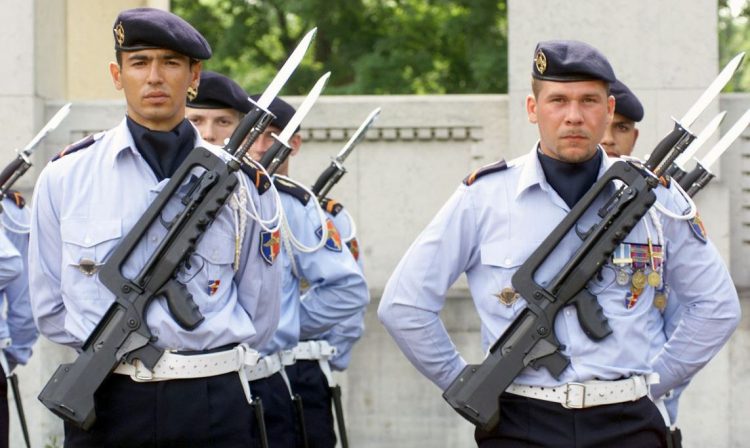
French Armed Forces, armed with FAMAS F1 assault rifles, participate in the Memorial Day ceremony at the LaFayette Escadrille Monument in Paris, France.
By Peter KORZUN | Strategic Culture Foundation | 05.04.2018
French President Emmanuel Macron kept his word. On April 1-2, French troops moved into northern Syria. This is the first time France deployed substantial forces there to turn Paris into a new actor actively involved in the war. The troops advanced toward Manbij and Remelin to join American allies and did it hastily.
The move was made at the time Ankara warned about the plans to control this territory with Russia, Turkey and Iran working together to define Syria’s future. It significantly changes the situation and makes one ask questions about the goals pursued by the US and France and the prospects for war and peace in the conflict-torn country. Summing up the recent events leads to the conclusion that the US and France have a hidden agenda to expand the conflict, wreak havoc and stymie the Russia-led peace efforts.
The news about French deployment came just before the April 4 Russia-Turkey-Iran summit in Ankara stated the goal to “speed up their efforts to ensure calm on the ground” in Syria. On April 3, US President Donald Trump said he would “decide very quickly” to remove forces from that country. The statement was made right after about 300 US Marines accompanied by armored vehicles and engineering equipment were moving toward Manbij as reinforcements to repel possible Turkish inroads. The construction of two bases in Syria’s northern Manbij region is underway.
The Marines have already launched daily patrols along the Sajur River, a tributary that feeds the Euphrates River from sources in Turkey, with observation posts built to monitor the area. This is unheard of – two leading states of the North Atlantic Alliance blocked the other NATO member’s land access to Manbij! On April 3, CNN reported that plans to send reinforcements have been discussed for several days before Trump’s remarks on leaving Syria soon.
The US also wasted no time to press Iraq into sending its 5th Army Division to Sinjar province and line the forces on the Iraqi-Syrian border to obstruct the possible advance of Turkish army from Syria into Iraq.
Obviously, the US is trying to partition Syria while creating a quasi-state on the eastern bank of the Euphrates and up to the Iraqi border. In Deir-ez-Zor, the US-led coalition resists the restoration of Syrian government institutions. It makes one think that the words about “leaving soon” may be nothing more than wishful thinking or an attempt to baffle those who are trying to predict further steps America will take.
The list of goals includes controlling the oil fields and chunks of the territory. Donald Trump wants Saudi Arabia to pay for US operations in Syria and it probably will. If the decision to leave were taken, he wouldn’t raise the question. According to the president, Saudi Arabia is interested in America staying in Syria.
That’s what the US “rocking from side to side” foreign policy is like. Rex Tillerson is fired to make the world know about it from tweets. The US wants to leave Syria but will stay if Saudi Arabia pays. Donald Trump invited the Russian leader to visit him in Washington against the background of Russia diplomats expelled and the consulate office in Seattle closed. Is it being short-sighted or far-sighted? Is this swinging back and forth a well-thought over policy or no policy at all? Is it done on purpose to keep everyone guessing with no predictions possible? You never know. Donald Trump once denounced Saudi Arabia as extremist and then sold a huge package of weapons while calling the kingdom a great friend and close ally against Iran.
The Syrian forces are preparing an offensive in the Daraa – Quneira – Suweida area in the south while denuding other fronts. The territory is huge and the terrain is hard to cross. There are at least 25 heights to fire at advancing forces from. The Free Syrian Army and other rebel groups are much more numerous than the ones being defeated in Eastern Ghuta. Their defenses are strong. Unlike in other places, the rebel forces can easily get logistical support from Jordan. That’s where the US and Saudi Arabia can contribute greatly. Israel has been involved in such activities since 2015. It took roughly six months to liberate Eastern Ghuta, with an active phase to dislodge rebel fighters launched in mid-March. It’s easy to surmise that it will take at least a year, may be much more, to liberate the area in question.
A conflict is easy to provoke. The operations of Syria’s government forces aimed at cutting off supplies coming from Jordan could be presented as an act of aggression against the Hashemite Kingdom. Chemical substances could be transported from Jordan to stage another provocation used as a pretext to attack Syria.
The operation could become a war of attrition to make Syria concentrate more and more of its forces in one place at the expense of other battlefields. They will be stuck there for a considerable period of time. That’s when the US-coalition will be in good position to attack anywhere it wants using the base of Al-Tanf as a springboard. Manbij as well as the Al-Tabka air base located to the south of Raqqa are perfect places for launching an offensive to drive Syria out from Aleppo. Then the country will plunge again into an “all-against-all” fight.
The efforts applied so far by Russia, Turkey and Syria will go down the drain. This time the US will not be alone to have substantial presence on the ground. It’s hard to imagine that the French forces arrived in Syria could be anything but the start of broader NATO presence with other members of the bloc to follow the French example. Russian military personnel and NATO soldiers will be looking at each other through the sights of guns. This scenario will be fraught with a great risk of international military conflict and a real tragedy for Syrian people but those who are provoking it don’t care.
Trump challenges the Russian-Turkish-Iranian alliance
By M.K. Bhadrakumar | Asia Times | April 5, 2018
Three is company. But if the trilateral dialogue format in international diplomacy seldom produces concrete results, that is because it cannot be sequestered from external influences. Besides, the three participants are bound to have specific interests and priorities. The long-awaited Turkey-Russia-Iran trilateral summit in Ankara on April 4 has been no exception.
The summit didn’t end as a damp squib but its outcome has been measly. Three reasons can be attributed to this. First and foremost, the US President Donald Trump might have been responsible.
The Ankara summit’s main agenda was Syria, but Trump’s “very-soon” remark in Ohio last Thursday introduced a strategic ambiguity into the Syrian situation. And he deepened the ambiguity further on the eve of the summit by stating on Tuesday at a meeting at the White House that he wanted to immediately withdraw US forces from the war-torn country, arguing that the US had already won the battle against the Islamic State.
Trump said, “I want to get out — I want to bring our troops back home. It’s time. We were very successful against ISIS.” Trump literally barged into the Istanbul tent and hijacked the mind of the three presidents.
What is the Syria that Erdogan, Putin and Rouhani would discuss – a Syria with open-ended US military presence or a Syria denuded of the Americans? That is now the big question.
Pentagon and White House split on what to do?
Even then, it is very unclear whether Trump himself is free to make up his mind. A former British ambassador to Syria Peter Ford framed the paradigm this way: “I have a feeling that there are divided counsels within the Pentagon, definitely in the White House (regarding US troop removal from Syria). Trump sincerely wants to get out since it’s what he campaigned on, but whether he’ll be allowed to by elements of the ‘deep state’ is the question.”
The good thing is that there could be elements within the Pentagon who too aren’t necessarily happy about an open-ended military presence in Syria without a clear-cut objective. The military mind cannot focus well when there are gnawing doubts.
Second, the disclosure (by the Kremlin first) that Trump has invited Putin to the White House has opened a vista of new possibilities. What if a joint Russian-American peace initiative in Syria gets revived? Trump now becomes a “stakeholder” in a Syrian settlement.
On the contrary, if the trilateral Russian-Turkish-Iranian dialogue on Syria (known as the Astana process) has gravitas today, it is mainly due to the Trump administration’s retrenchment from the Syrian peace process. The dalliance that the Obama administration (secretary of state John Kelly) kept going with the Kremlin (foreign minister Sergey Lavrov) has petered out and what remains today is the military-to-military “deconfliction” mechanism between the US and Russia to ensure that they don’t shoot at each other in Syria.
But, if Trump and Putin breathe new life into a Russian-American joint enterprise to choreograph a Syrian settlement, the Astana process gets relegated to the backburner. Participants at the Ankara summit agreed to hold the next meeting in Astana in mid-May, but much water might flow under the bridge by then.
Decision on Iran deal due by May 12
Third and finally, the fate of the Joint Comprehensive Plan of Action (JCPOA) remains the “known unknown.” Trump is due to make a decision on the Iran nuclear deal by May 12. And the geopolitics of the Middle East could change dramatically, depending on what he decides to do – especially if Trump were to pull the US out of the JCPOA.
The conventional wisdom is that changes at the US State Department and the National Security Council presage a more hawkish US foreign policy toward Iran. But there are weighty arguments too as to why Trump may not sound the death knell of the JCPOA and opt instead to simply give the nuclear deal a fresh lease of life, as he has done twice already.
To be sure, depending on the state of play in US-Iranian relations, the geopolitics of the Middle East could change and Syria is the theatre where this could see visible impacts in the near-term. So it was notable that Iranian President Hassan Rouhani didn’t go for Trump’s jugular at the Ankara summit. Iran also refrained from pushing any fresh initiatives and seemed more or less happy with a passive role – biding its time and brooding, as it were.
Given the above, what did the summit actually achieve? For a start, trilateral dialogue is always primarily a statement. What emerges from yesterday’s summit on the Bosporus is that the western influence in Syria (and the Levant) is inexorably on the wane. The summit underscored that the three countries intend to reinforce their influence in Syria.
Having said that, while the summit flagged the intention of the three countries to deepen cooperation, they also have divergent goals. For instance, the Turkish priority was that Russia and Iran continued to acquiesce with its military operation. Erdogan stated at the joint press conference, “Turkey will not stop until all regions under PYD/PKK (Kurdish militia) control, including Manbij, are secured… Turkey values Russia and Iran’s solidarity with its Afrin operation, we will establish grounds for peace in Afrin.” Rouhani and Russian President Vladimir Putin neither nodded agreement nor dissented.
The single most important outcome of the summit where all three countries have shared interest is in their forceful affirmation of the unity and territorial integrity of Syria and their rejection of “all attempts to create new realities on the ground under the pretext of combatting terrorism.”
The bottom line is that Russia, Turkey and Iran have a strong convergence of interests in the termination of the US military presence in Syria. Paradoxically, here again the Trump factor comes in. Their brittle alliance faces an existential threat if Trump somehow realizes his dream of bringing the US troops in Syria back home “where they belong.”
Newly Revealed Docs Shed Light on UK’s Intervention in Russia During WWI
Sputnik | April 4, 2018
British military intervention in Russia in 1918-1919 was unlawful and indefensible, British government papers held by the National Archives reveal. It turned Russian public attitudes towards Britain from friendly to hostile.
In March 1918 the Bolshevik government signed a peace treaty with Germany, as they had promised to the nation exhausted by four years of the devastating and senseless WWI. The Russian Revolution was triggered by the overwhelming public desire for peace. The war-weary Russian army simply could not carry on fighting. Britain and France immediately accused Russia of betraying the Allied cause and sent in their troops. In a show of “solidarity” reminiscent of today, a dozen Anglo-French allies took part in the armed intervention in Russia. The official excuse was to keep the Eastern front against Germany and protect the Russian war materiel from falling into German hands.
The map of foreign military intervention in Russia in 1918-1919.
In reality, the British, the French, the Americans, the Japanese and many others fought the locals, engaging in “frolics” and “high handed behaviour,” according to British government papers.
The legality of their action under international law was not considered until 1972 when the British government, locked in a dispute with Moscow over mutual debts, sought advice from a Foreign Office legal counselor, Eileen Denza. The advice was damning of London’s actions and was kept under wraps for a long time.
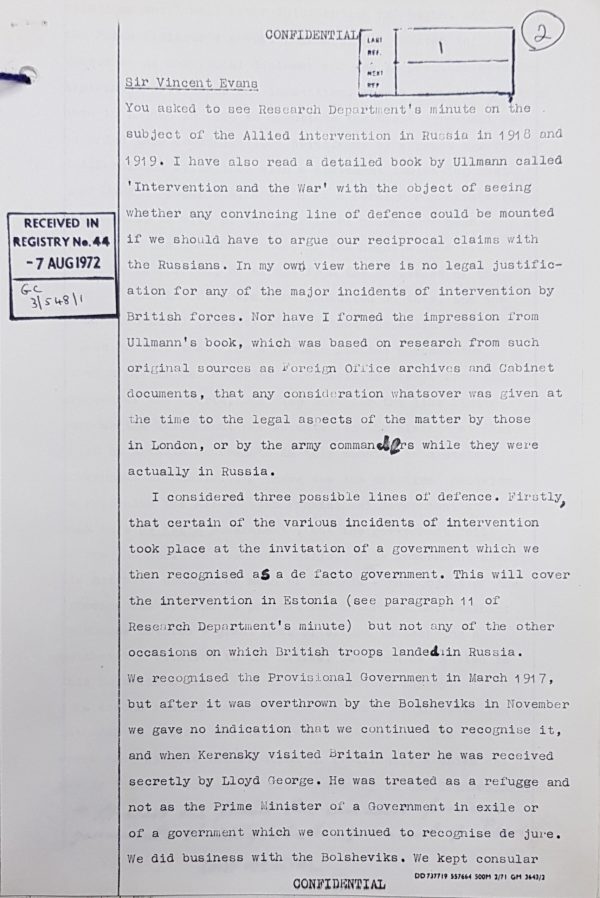
“In my own view there is no legal justification for any of the major incidents of intervention by British forces,” Ms. Denza wrote in her paper. “Nor have I formed an impression from … research from such original sources as Foreign Office archives and Cabinet documents that any consideration whatsoever was given at the time to the legal aspects of the matter by those in London, or by the army commanders while they were actually in Russia.”
© Photo: Crown copyright National Archives, UK
FCO Legal Councellor paper on legality of British intervention in Russia
Ms. Denza had explored possible avenues for defending the British intervention but failed to find any convincing arguments.
Argument 1. Certain incidents of intervention took place at the invitation of a Russian government which Britain then recognized as a de facto government.
This, Ms. Denza said, would cover the intervention in Estonia [which Britain helped break away from Russia — NG] but not any of the other occasions on which British troops landed in Russia. Britain did recognize the Russian Provisional government after the overthrow of the Tsar in March 1917, but after it was overthrown by the Bolsheviks in November Britain gave no indication that she continued to recognize it. Indeed, when its premier Kerensky visited Britain later he was treated as a refugee, and not as a prime minister of a government in exile or of a government which London continued to recognize de jure.
“We did business with the Bolsheviks,” Ms. Denza reminded the British government. “We kept consular relations until well after intervention had begun, and the Prime Minister’s envoy, Bruce Lockhart, was … accorded diplomatic privileges and immunities [which he abused — NG]”.
Initially Lockhart devoted a great deal of effort to securing a Bolshevik invitation to the Allies to intervene, but when he failed in this he advised the British government to intervene anyway. He started plotting for the overthrow of the Bolsheviks, and channeled his energy into persuading the reluctant US President Woodrow Wilson to support the British and Japanese intervention in the North and Far East of Russia.
Argument 2. The intervention was intended to protect British lives and property.
There was no British community in Russia to speak of.
“The question of defence of British property was never raised or put forward at any stage,” wrote the FCO legal counselor, “and it had always been clearly understood that it was intervention which led the Bolsheviks (who began by being friendly to Britain) to take much more extremist measures against property generally and to adopt the position that no compensation would ever be paid to the Allies in respect of their expropriated property, since it was the necessity caused by external pressures and Allied intervention which had made it necessary to seize foreign property on such a scale.”
Argument 3. The intervention was justifiable as an act of military necessity, or self-defense, in order to protect the Allied military position in the east after Russia’s withdrawal from the war following the peace treaty of Brest-Litovsk signed with Germany in March 1918.
Britain at the time made a great deal in public that the motive for intervention was related entirely to the conduct of the war, and that there was no intention to intervene in the domestic affairs of Russia. However, once they arrived in Russia, the British and other Allied forces “did not limit their actions to cutting off supplies to the Germans,” wrote Ms. Denza. “They did not confine themselves to supporting factions which had clearly stated that once in power they would bring Russia back into the war.”
“In the main the commanders in the field seem to have gone off on frolics of their own with very little clear political coordination.” [Those “frolics” included bayoneting the locals to death, and forcing captured Russian gunners to turn their cannons on their compatriots, according to British commanders’ combat logs held by the National Archives — NG]


© Photo: Crown copyright National Archives UK
Excerpt from a British Dvina (North Russia) Force battle instructions issued on 5 August 1919
When large-scale intervention began in the summer of 1918 Britain withdrew its embryonic diplomatic and consular mission from Russia [thereby implying it was an invasion rather than intervention — NG].
Most important of all, Ms. Denza wrote, the intervention did not cease with the surrender of Germany in November 1918. Indeed the military justification for intervention, which could have existed during the many months when plans for intervention were being made and discussed “virtually ceased to exist very soon after our troops first went in [Russia — NG] in substantial numbers [shortly before Armistice — NG].”
Overall, the FCO legal counselor said, the British and Allied intervention in Russia painted “such a damning picture.”
“The immediate effect of the intervention was to prolong a bloody civil war,” wrote American historian James W Loewen, “thereby costing thousands of additional lives and wreaking enormous destruction on an already battered society.”
During the Anglo-Soviet debt negotiations in 1972-1973 this destruction was estimated to be between two and four billion pounds.
British government papers of the time record a flurry of Whitehall discussions on how to avoid admitting any liability for the damages caused by the unlawful intervention. As one note put it:
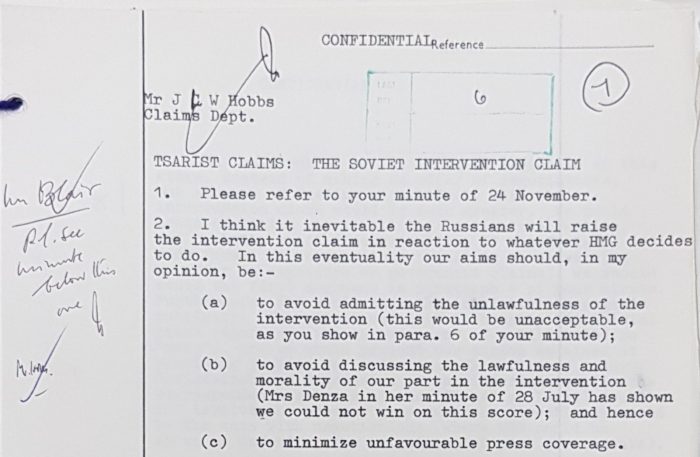
“I think it inevitable the Russians will raise the intervention claim in reaction to whatever HMG decides to do” [e.g., expropriate Russian gold held by Britain in payment for Russian debt — NG].
In this eventuality our aims should be:
(a) To avoid admitting the unlawfulness of the intervention (this would be unacceptable)
(b) To avoid discussing the lawfulness and morality of our part in the intervention (Mrs. Denza in her minute of 28 July has shown we could not win on this score); and hence
(c) To minimize unfavourable press coverage.
© Photo: Crown copyright National Archives UK
FCO claims department note on avoiding liability for military intervention in Russia
Whatever the press coverage, the intervention did create very unfavorable attitudes towards Britain in Soviet Russia.
In 1921 a British Parliamentary Committee produced a report which included the following perceptive passage:
“There is evidence to show that, up to the time of military intervention the majority of the Russian intellectuals were well disposed towards the Allies, and more especially to Great Britain, but that later the attitude of the Russian people towards the Allies became characterised by indifference, distrust and antipathy.” [Report (Political and Economic) of the Committee to Collect Information on Russia; (Russia (No.1), 1921, Cmd. 1240]
American Historian William Henry Chamberlin, who was the Moscow correspondent of The Christian Science Monitor in the 1920-30s, wrote that the consequences of the intervention “were to poison East-West relations forever after, to contribute significantly to the origins of World War II and the later Cold War, and to fix patterns of suspicion and hatred on both sides which even today threaten worse catastrophes in time to come.”
God forbid his prophecy comes true…
A Trump-Putin summit is just what’s needed
By M K Bhadrakumar | Indian Punchline | April 2, 2018
The Chinese commentators consistently paint a pessimistic outlook for the troubled relations between Russia and the West, which no doubt form a crucial template of Beijing’s foreign policy. China is a “stakeholder” in the tensions between Russia and the West. Beijing must be acutely conscious that there has always been a significant (albeit not influential currently) school of opinion in the West, including in the United States, that a rapprochement with Russia will make sound long-term strategy to effectively contain China’s rise, which must be the West’s top priority.
Nonetheless, a news analysis by Xinhua with a Moscow dateline has simply gone overboard in making some hasty conclusions about the state of play in the backdrop of the Skripal spy case that has suddenly invaded the centre stage of Russia’s ties with the West:
· With the inertia of the sanctions spiral going on, Russia and the West are expected to continue the hostility in the diplomatic sphere and even expand it to other areas that are more painful for both sides in the foreseeable future.
· Although the question hanging over the spy-poisoning attack remains unanswered, one thing is for sure: Russia’s reputation has been damaged in the eyes of the international community while the alliance between the United States and Europe has been consolidated… It is widely expected that the tensions between Russia and the West will not ease off anytime soon.
Is the state of play so hopeless? Xinhua has exaggerated. Things look gloomy but are not beyond salvation. Russia’s tensions with the West are actually not so serious as China’s own tensions with the West. But then, China is much smarter than Russia in its diplomacy in finessing these tensions. China also has the advantage that it was not a Cold-War adversary of the West in the sense in which the former Soviet Union got pitted in the “bipolar” world. China did splendidly well to exploit the rivalry between the US and USSR.
Russia is the main target today, because it is also the only power that has the capability to maintain global strategic balance and it has an ideological position with regard to the US’ hegemony, which it is determined to uphold no matter the costs involved — although Russia is not a communist country any more. Besides, Russia is not like any other country. It is a European power historically, culturally, economically and politically. And Russia’s habitation and name in a common European home profoundly impacts the US’ transatlantic leadership role.
China being an Asiatic country can run with the hare and hunt with the hound – making the best of both worlds by keeping a quasi-alliance with Russia while also on parallel track going in top gear to tap into the western markets to get fatter and richer. China’s supreme advantage is that it lacks any ideology (other than nationalism and self-interests). Russia takes a principled stance but China keeps its head under the parapet if its interests are not affected. If the tensions run high in Russia’s relations with the West, China is its beneficiary.
However, Russia’s tensions with the West over the Skripal case are more complex than what Xinhua has reported. It is discernible that European countries have been reluctantly dragged into the Skripal case. (Blood is thicker than water, after all.) The big question is how far the US collaborated with Britain. In my assessment, the jury is still out.
There are unanswered, unanswerable questions. The most important thing is that the Skripal case might have got dovetailed with the “anti-Trump” project of the Washington establishment. In particular, was this the swan song of Lt. Gen. HR McMaster (who was expecting dismissal for the past several weeks)? Is it a counterattack by the “Deep State” to keep Trump off balance just when he began making moves to put together a new team in his cabinet with a view to force his will on foreign policies?
Has there been an orchestrated (Anglo-American) attempt involving the intelligence agencies to force Trump’s hands? How much is the Skripal case entangled with the campaign over Trump’s “collusion” with Russia? Most important, where exactly does Trump himself stand in all this?
To my mind, Trump is not seeking confrontation with Russia, and if anything, his phone call to British PM Theresa May might have had a salutary effect on London, which has since noticeably piped down on the Skripal file. Read the White House readout of the phone call, here. There is no trace whatsoever here that Trump is traveling on a path of confrontation with the Kremlin.
In fact, neither Trump nor Vladimir Putin wants this “to be going beyond hysteria over diplomacy” – to borrow words from Xinhua. Trump has always had great conceptual clarity in his mind that it is China – and not Russia – that is the US’ real adversary.
Any longtime observer of Russian-American relations would know that most of the time things are never really what they’ve appeared to be on surface. The two big powers are greatly experienced in navigating through choppy waters. Therefore, it comes as no surprise to me that TASS has just at this juncture highlighted the prospect of a summit between Trump and Vladimir Putin.
Given the longstanding media culture in Moscow, it is inconceivable that the state news agency would have carried such a report on its own volition reflecting on the Kremlin leader. There is, for sure, some very serious “signaling” going on.
Trump is the most peace-loving US president Putin will ever know
By M K Bhadrakumar | Indian Punchline | April 1, 2018
A fortnight after sacking Rex Tillerson as Secretary of State and a week after kicking out Lt. General HR McMaster from the National Security Council in the White House, President Donald Trump has made his first major foreign policy move. He announced on Thursday in front of cheering supporters at a rally in Richfield, Ohio,
- “We’ll be coming out of Syria, like, very soon. Let the other people take care of it now. By the way, we’re knocking the hell out of ISIS. We’re going to be coming out of there real soon. We’re going to get back to our country, where we belong, where we want to be.”
In sheer power play, Trump has shattered the coalition between the US foreign and defence establishments, which Tillerson and Defence Secretary James Mattis assiduously built to usurp policymaking. (Read my column in Asia Times dated March 15, Deconstructing the sacking of Rex Tillerson.)
Trump made his announcement on Thursday without consulting the state department or Pentagon. The state department spokesperson admitted ignorance. The Pentagon spokesperson mumbled that “important work remains to guarantee the lasting defeat of these violent extremists” in Syria. But, on Friday, the White House chief of staff John Kelly in a phone call to Deputy Secretary of State John Sullivan conveyed Trump’s decision ordering a hold on more than $200 million in recovery funds earmarked for infrastructure projects in northeastern Syria in territories under US military control. This freezes a pledge made by Tillerson in support of Pentagon’s plans for an open-ended military presence in Syria.
Trump’s move may gain traction with 2 American soldiers reportedly killed and four injured in an IED explosion near Manjib on Thursday. Mattis won’t undermine Trump’s decision. That is simply not the military man’s style, which is always to use “front men” (like Tillerson.)
John Bolton, McMaster’s replacement, isn’t a military man. Bolton has a terrible reputation in the Beltway, which will sap his effectiveness. But Bolton is a rank opportunist who’ll know what is good for him under a Boss who is moody and volatile in turns. Also, Mike Pompeo, the incoming secretary of state, is a close pal of Trump’s and there is no daylight possible between the two.
Thus, Trump’s foreign policy agenda is becoming “kinetic”, finally. The speech in Ohio is vintage Trump. He has returned to his golden theme of mending America’s decaying infrastructure “with American heart, and American hands, and American grit.” (White House readout) This is also Trump’s campaign plank in the 2020 election: No more wars abroad unless US interests are directly threatened.
My gut instinct says that an overall easing of tensions with Russia is also to be expected. Trump is not seeking a fight with Russia. Arguably, he is the most peace-loving American president Vladimir Putin will ever know.
The exact circumstances of the Skripal spy case will never be known but following a phone call Trump made to British PM Theresa May on March 28, some sort of a cooling off period may have begun. The White House readout said,
- Both leaders agreed on the importance of dismantling Russia’s spy networks in the United Kingdom and the United States to curtail Russian clandestine activities and prevent future chemical weapons attacks on either country’s soil.
The above formulation by no means constitutes an “anti-Russian” articulation. Rather, it is a statement on national security priorities.
Hasn’t Britain begun “soft-pedaling” already? Contrary to the gloomy news Wednesday that the chances of Yulia Skripal, the ex-spy’s daughter, surviving was only 1 percent, London announced on Friday that she is “out of danger”, is eating and drinking. And Skripal himself, though “critical”, is “stable”.
Equally, the British FO said on Saturday, “We are considering requests for consular access in line with our obligations under international and domestic law, including the rights and wishes of Yulia Skripal.” The Russian embassy has sought consular access. (Yulia is a Russian citizen.)
Moscow must be sensing new stirrings in the air. The latest remarks by the Russian ambassador to the US Anatoly Antonov were spoken more in sorrow than in anger. Antonov said on Saturday,
- “We want everybody to understand that we (US and Russia) are destined to become friends again. Only close interaction between our countries can help maintain international strategic stability and find mutually beneficial solutions to global and regional challenges.”
- “Relations between ordinary people shouldn’t suffer. We’ll do everything in our capacity to make sure that Americans have zero problems with trips to Russia.”
Winston Churchill once compared Russian politics to a “dogfight under a carpet”. That is an apt description of Trump-era Russian-American spats as well.
Featured Video
No Vote, No Representation, No State: Democracy, Israeli Style
or go to
Aletho News Archives – Video-Images
From the Archives
Sanctions, War and the Policy of Dual Containment
By SASAN FAYAZMANESH | March 17, 2008
It is now nearly three decades since the Unites States adopted the policy of dual containment of Iran and Iraq. While much has been written about the containment of Iraq, there has been very little in-depth analysis of this policy when it comes to Iran. In a book that is going to be released on March 31, 2008, entitled The United States and Iran: Sanctions, Wars and the Policy of Dual Containment (Routledge), I attempt to address this shortcoming by investigating when and why the US policy of containment of Iran came about, how it evolved, and where it stands today.[1] To the extent that Israel has been involved in US policy making, the study will also include the role that Israel has played in the containment of Iran. Also, since the fate of Iran has been inextricably linked to that of Iraq, occasionally the investigation will overlap with the containment of Iraq.
The policy of dual containment of Iran and Iraq originated during the Carter Administration, but it was not until the Clinton Administration that the expression “dual containment” became popular. … continue
Blog Roll
 Aletho News
- No Vote, No Representation, No State: Democracy, Israeli Style
- Zionist Bought Senate Blocks Information About American Citizens Killed By Israel
- While Gaza dominates the UN, these are the people keeping it alive
- New Report: “Scholasticide and Genocide in Gaza: Assessment, Testimonies and Legal Analysis”
- ‘THAAD Delusion’: Iran war exposes US missile shield limits – The Atlantic
- Moscow issues warning to NATO over Russian exclave
- Yes, the Iran war has destroyed Trump’s presidency
- The fallacy of US delusions about Iran’s economic collapse
- Hezbollah denies Syria cell link, warns of Israeli plan to sow discord
- The legacy of US sanctions, war, and occupation in Iraq
- If Americans Knew
- Mamdani releases plan to combat antisemitism and hate crimes in New York City
- Iran’s Revolutionary Guards Publish Letter to the American People
- DMFI launches $1 million ad campaign supporting Virginia’s Elaine Luria
- US Senate blocks resolution seeking report on Americans killed by Israel
- Israeli Attacks Kill Ten Palestinians in Gaza
- Massacre at Minab: The School That Became a Grave
- Israeli media: The IDF Shows It Doesn’t Turn a Blind Eye; It Actively Emboldens Settler Havoc
- As settlers ravage West Bank, Israeli forces kill 10 in Gaza – Daily Update
- New Report: “Scholasticide and Genocide in Gaza: Assessment, Testimonies and Legal Analysis”
- Ex-Biden officials are desperate for a Gaza scapegoat
- No Tricks Zone
- Green Energy Debacle: German Expert Professor Fritz Vahrenholt Warns Of Severe Economic And Social Consequences
- Two More Paleo Reconstructions Affirm Meters-Higher Sea Levels Across Ireland, Brazil 7000-6000 Years Ago
- New Study: Earth And Venus Surface Warmth Largely Explained By Convection And Lapse Rate, Not CO2 Or Radiation
- 2025 Nature Paper Claiming Worsening Global Drought Gets RETRACTED …Heavily Flawed
- New Study: ‘Global Drought Shows No Detectable Recent Acceleration Under Climate Warming’
- Economic Masterminds: German Socialists Suggest Taxing Productivity Gains Stemming From Using AI
- The South China Sea Has Not Been Cooperating With The Climate Change Narrative
- Energy Crisis: Germany Enters Heating Season With Historically Low Gas Reserve Fill Levels
- New Study: The Antarctic Ice Sheet Gained Mass From 2020-2024 Due To Staggering Snow And Ice Accumulation
- Study: Ocean Heating Rates From Thousands Of Years Ago ‘Dwarf’ Modern Ocean Heating Rates

