Russia-US Security Dialogue Looming: Time to Address a Broader Security Agenda
By Alex GORKA | Strategic Culture Foundation | 25.03.2018
A lot of people close to the US president wanted to prevent it at any cost but Donald Trump congratulated President Putin anyway and had a phone conversation with him. The US president said that the two would meet “in the not too distant future.” Preventing an arms race is one issue on the agenda. Donald Trump knew the move would bring forth a tempest but he did it anyway. The president considered the relationship with Moscow to be important enough to defy his numerous opponents. Serbia has already offered to host a summit.
Right after the two presidents’ conversation, the Russian and American chiefs of staff discussed Syria. What’s even more important is that they have agreed to more military-to-military contacts in the future. Why has it suddenly become so important for Washington to launch a dialog on defense issues? The answer was provided by General John E. Hyten, the Commander of US Strategic Command, who admitted in the Senate that the US is defenseless in the face of the threat from hypersonic weapons. This realization came right after Russian President Vladimir Putin revealed his recent information about the new systems capable of hypervelocity flight that are currently being tested and are soon to be operational.
The US is a great military power but it’s not strong enough to force everyone to dance to its tune. Its defense programs suffer from serious shortcomings. The current arms-control system is in crisis. New challenges keep cropping up. They should be incorporated into the international security agenda but that’s not happening.
The looming hypersonic race is a burning issue that still needs to be addressed. It’s a domain in which the US is lagging behind Russia. When the Russian president announced those breakthroughs in military technology, his revelations were met with some skepticism in the West. But the ensuing events proved him right. Vladimir Putin pulled it off, making hotheads come to their senses and realize the need for talks to address the security challenges. Washington needs this dialog more than Moscow does.
So, the Americans’ coveted leadership in military technology has turned out to be a pipe dream. But their furtive steps to bring NATO right to Russia’s doorstep are not. The most interesting things often fall off the radar.
Moldova is planning to phase out its draft in order to have a professional military. This month, Moldova, Georgia, and Ukraine formed an anti-Russia alliance. Moving to an all-volunteer force is in keeping with the political goals of this group and is seen as an important step on the path to NATO membership. That reform is scheduled to begin this fall. This is a very costly endeavor, especially when one is talking about the poorest country in Europe. Chisinau cannot afford it. It will be fully dependent on assistance from Romania and other NATO states.
Moldova’s process of embracing the bloc has accelerated recently. A joint Romanian-Moldovan task force equipped and trained in accordance with NATO standards is on its way. That step was agreed on in February. According to the military cooperation agreement signed by Chisinau and Bucharest in 2012 and ratified by the Moldovan parliament in 2013, Romanian troops and police forces enjoy freedom of movement on Moldovan territory. In other words, a NATO member has a free hand in Moldova, although the region of Transnistria, where Russian peacekeepers are stationed, is part of that country. This is a real hornet’s nest and the problem remains unaddressed.
The fact that Poland has shifted its best military forces, including its most modern tanks, eastward has not gone unnoticed in Russia. The country will receive 70 AGM-158B JASSM-ER long-range air-to-surface missiles from the US by 2020 or a bit earlier. With an operational range of roughly 1,000 km, this stealth weapon boasting a penetrating warhead can hit infrastructure deep inside Russia. One does not have to be a military expert to realize that the JASSM-ER’s prime mission is to knock out Russian Iskander short-range missiles deployed in the Kaliningrad region in a first strike.
The small Polish town of Powidz is to become a NATO hub for the Baltics and Northern Europe. Construction is underway to build a storage facility for a brigade’s worth of military hardware and personnel. The US Aegis Ashore BMD system will be operational in Poland this year. This is a highly destabilizing weapon that will become a target for a first strike by the Russian military.
Nor has Russia forgotten about the 300 US Marines stationed in Norway, or the construction of a sophisticated new radar system known as Globus 3 in the Norwegian Arctic archipelago of Svalbard. This is a violation of international law, as Svalbard was supposed to be demilitarized under a 1925 treaty. The facility there is an element of NATO’s ballistic missile defense (BMD) system. The joint US-Norwegian radar station is viewed by Moscow as a clear provocation. Norway is to be provided with over 50 US F-35 stealth fighters in 2019, enabling it to strike Russian territory. The F-35 is a nuclear-capable plane.
All these moves are being closely watched by the Russian military. Even if new weapons are incorporated into the bilateral arms-control agenda, the efforts to create the potential for a first strike near Russia’s borders are certainly not something Moscow can turn a blind eye toward. This does not create the right environment for a security dialog between Moscow and Washington. Everything is connected.
What Russia and the US really need is not just talks about curbing super weapons, but also negotiations addressing a much broader security agenda.
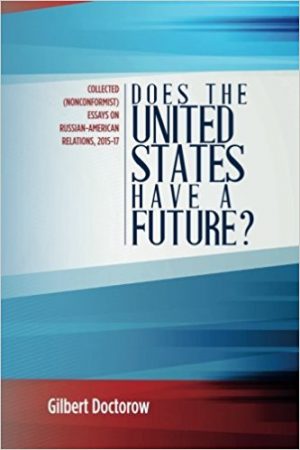
A collection of essays on Russian-American relations 2015 – 2017 by one of the US’s top Russia experts
Review by Alexander Mercouris | The Duran | November 19, 2017
 One of the most deeply frustrating things for anyone with any knowledge of Russia who has been following the Russiagate saga is the staggering ignorance of basic facts about Russia which is so prevalent amongst elites in the US.
What makes this especially frustrating is that there is actually no shortage of knowledgeable and erudite experts about Russia who could be called upon if any true desire for knowledge about Russia actually existed.
Of those one who who stands out is Gilbert Doctorow, who has been a professional Russia watcher since 1965.
Gilbert Doctorow has now offered us a new book – “Does the United States have a Future” – which brings together his splendid collection of essays about Russia and about Russian-American relations which he has been writing since 2015.
This is of course the same period when in the aftermath of the Ukrainian crisis and because of Russia’s intervention in Syria Russian-American relations entered upon their present catastrophic downward spiral, with the US rolling out successive sanctions against Russia, and deploying ever greater numbers of its troops ever closer to Russia’s border.
In this heavy atmosphere of heightened Russian-US tensions, and amidst a shrill media campaign, the Russian side of the story rarely gets told. What we get instead is an exaggerated focus on the largely misunderstood doings of one man – Vladimir Putin – who is not just routinely blamed for everything that goes wrong – be it Trump’s election, the Brexit vote, the 2015 European refugee crisis, the secessionist outbreak in Catalonia and the rise in Germany of the AfD – but who has become dangerously conflated with Russia itself.
The huge achievement of Gilbert Doctorow’s essays is that they put entirely behind them this disastrous paradigm.
For someone fixated on psychoanalysing Putin’s personality and on learning the gossip about the internal squabbles of the Kremlin this collection of essays has little to offer. Doctorow has as little patience for this sort of thing as do I. Suffice to say that one of the essays, which goes by the dismissive title “Kremlinology is alive and well in Russia”, turns out to be focused not on mythical Kremlin power struggles but on the impact on the people of St. Petersburg of a visit by Putin to their city.
For anyone interested in Putin what anyone reading these essays will get instead is detailed and erudite analyses of his speeches, of his massive and truly astonishing Q&A sessions, of his media interviews, and of the effect of all these doings on Russian public opinion and what they tell us about Russian policy.
Not by chance, the only reference to me in the whole collection is when Doctorow disagrees with me about an interview Putin gave to the German newspaper Bild-Zeitung. I gave the German interviewers high marks for their conduct of the interview. Doctorow politely expresses his incredulity.
Ultimately far more interesting to anyone genuinely interested in understanding the rapidly recovering Great Power which is Russia, and who wants to get a genuine grasp of the sort of things that move its people, are those essays which touch on topics other Western reporters of Russia tend to ignore.
Here Doctorow’s immense knowledge of Russia and of Russian history is essential, and it shines through every essay.
Thus we find masterful discussions of works about tsarist history by the historian Dominic Lieven, and an outstanding discussion – the best I have come across – of Henry Kissinger’s insights and limitations as they concern Russia. There is even a remarkable essay which takes Tolstoy’s novel Anna Karenina as a starting point to discuss war.
However the single thing which sets the essays which are specifically about Russia apart is the extraordinary rapport Gilbert Doctorow has with Russia’s ‘everyman’. Take a comment like this one from the very first page of the very first essay in the book, which is dated 30th May 2015. Against a background of a deepening recession Gilbert Doctorow tells us this
I say assuredly that the mood across the social spectrum of my “sources” is uniformly patriotic and uncomplaining. These sources range from the usually outspoken taxi drivers; through the traditionally critical journalists, academics, artists and other intelligentsia who are family friends going back many years, to former business contacts and other elites.
How many of those who report from Russia are able to speak to a wide range of contacts like this? How many of them pay heed to the opinions of Russia’s “usually outspoken taxi drivers”, reliable purveyors of the public mood though those people are? How many of those who report from Russia even know how to talk to such people? (confession here: I don’t).
Or take Gilbert Doctorow’s deeply moving account from 10th May 2016 of the March of the Immortal Regiment, held now every year on 9th May to commemorate Russia’s sacrifice in the Second World War. What other Western reporter of Russia has both the erudition and the common touch necessary to write a passage like this?
Given the manifestly patriotic nature of Victory in Europe Day celebrations, which open in Moscow and cities across Russia with military parades, precise marching columns, displays of military hardware on the ground and in the air, I was uncertain how possibly strident the Immortal Regiment component might be. As it turned out, the crowd was uniformly good humoured and focused on its private obligations to be met: the celebration of parents, grandparents, even great grandparents’ role in the war and reconfirmation of their status as family heroes whatever their military or civil defence rank, whether they survived or were among the countless fatalities.
Elsewhere Gilbert Doctorow is able to talk knowledgeably in two different essays about the state of the Russian shopping basket – a matter of fundamental importance to Russians and therefore given Russia’s power and importance to everyone – of Russian responses to the Trump-Clinton debate, of the Russian public’s response to one of Putin’s mammoth annual Q&A sessions, and of the steely response – utterly free of sentimentality and hysteria – of the people of St. Petersburg and of Russia generally to a terrorist attack on the city.
Of the essays specifically about Russia it is however what Doctorow writes about the Russian media which Western readers may find most surprising.
It is now generally conceded even in the West that Russia does have a public opinion, something which tended not to be admitted in Soviet times, though there still seems to be little genuine interest in finding out what it is.
The lazy assumption is anyway that in Russia public opinion is effectively manipulated by the government through its supposedly all-encompassing control of the news media.
Though it is sometimes grudgingly admitted that the print media does have some independent voices, and that the Russian media now has a degree of sophistication unknown in Soviet times, the prevailing opinion in the West is that it remains every bit as propagandistic and mendacious as it was in Soviet times. The classic statement of this view is Peter Pomorantsev’s “Nothing is True and Everything is Possible: Adventures in Modern Russia”.
Doctorow’s essays are an important corrective to this bleak and distorted picture.
Doctorow does not sugarcoat the reality. He concedes that the television media has a bias favouring the Kremlin and that ‘non-system’ politicians whose parties are not represented in the Duma like Kasyanov and Navalny have difficulty gaining access to it.
I would say in passing that Russia’s television media is not exceptional in this. In my opinion Russian television today is much less controlled by the government than was French television during Charles De Gaulle’s and Georges Pompidou’s time in France, when I was in Paris as a child.
In any event, as a regular participant in Russia’s extraordinarily extended and elaborate political talk-shows – a vital and massively popular information tool for the Russian population – Doctorow shows that the common Western view that Russian television viewers get no exposure to the Western view-point and hear only the Kremlin’s view is simply wrong. Here is one passage where Doctorow describes them
The regulars of these talk shows are a mix of Russians and foreigners, pro-Kremlin and anti-Kremlin voices. There inevitably is at least one American who can be counted on to purvey the Washington Narrative. A reliable regular in this category has been Michael Bohm, who was for a long-time op-ed manager at The Moscow Times and now is said to be teaching journalism in Moscow….
From among Russians, the talk show hosts bring in one or more representative of opposition parties. On the 11th it happened to be a personality from the Yabloko Party (Liberals). But at other times there will be the leader of the Communist Party, Gennady Zyuganov, the founder of the right nationalist LDPR, Vladimir Zhirinovsky, or the leader of the social democratic party, Just Russia, Sergei Mironov. They all get their time on air in these shows.
Elsewhere Doctorow gives vivid accounts of these sprawling and at times chaotic talk shows, which have no precise analogue anywhere else that I know of.
Doctorow’s book, as its title shows, is not only about Russia. Rather it is about the collapse of any sort of dialogue based on mutual respect and understanding between the US and Russia.
In essay after essay Doctorow pinpoints the cause: at a time when the Russian mind is becoming increasingly open, the American mind is becoming increasingly closed.
The title of the book – “Does the United States have a future?” – is in fact an intentional exercise in reverse imaging.
At its simplest it refers back to Doctorow’s previous book: “Does Russia have a future?” published in 2015.
However the title of both books must also be seen as a comment on the ‘disaster literature’ about Russia which has become so prevalent in the West, and which continues unabated to this day even as it is repeatedly proved wrong.
Basically what Doctorow is saying is that it is in the US not Russia that the suppression of debate and independent voices is putting the future in jeopardy.
It is in these essays that look at the situation in the US where Doctorow dissects the evolution or rather regression of US policy towards an increasingly strident Russophobia, and where one senses Doctorow’s growing exasperation and alarm.
Take for example what Doctorow has to say about one of the most outspoken Americans calling for ever more confrontation with Russia: NATO’s former military chief General Breedlove
Most everything is wrong with what Breedlove tells us in his article. It is a perfect illustration of the consequences of the monopoly control of our media and both Houses of Congress by the ideologists of the Neoconservative and Liberal Interventionist school: we see a stunning lack of rigour in argumentation in Breedlove’s article coming from the absence of debate and his talking only to yes men.
Perhaps the biggest mistakes are conceptual: urging military means to resolve what are fundamentally political issues over the proper place of Russia in the European and global security architecture. Whereas for Clausewitz war was ‘a continuation of politics by other means’, for Breedlove politics, or diplomacy, do not exist, only war.
The alarm in the last paragraph finds still greater emphasis in the essay which immediately precedes it. This has the ominous title “The Nuclear Clock is at Two Minutes to Midnight”.
It is however in the closing of the American mind where Doctorow pinpoints the danger
My point is not to ridicule the very earnest and well-intentioned anti-war campaigners whose ranks I joined that day. It is to demonstrate how and why the highly tendentious reporting of what we are doing in the world and what others are doing to us, combined with the selective news blackouts altogether by major media has left even activists unaware of real threats to peace and to our very survival that American foreign policy has created over the past 20 years and is projected to create into the indefinite future if the public does not awaken from its slumber and demand to be informed by experts of countervailing views. We are living through a situation unparalleled in our history as a nation where the issues of war and peace are not being debated in public.
Along with the alarm and frustration there is also very real disappointment.
Like most people who lived through the later stages of the Cold War Doctorow remembers a world where the US’s European allies acted as a force of restraint on the US.
Based now in Brussels at the very epicentre of the European Union Doctorow is shocked at the extent to which this is no longer the case, and at the degree to which the same attitudes of hubris, belligerence and hysteria which have gained such a hold in the US have now also managed to gain a hold in Europe.
Like many others Doctorow is totally unimpressed by the current crop of European politicians, and as someone able to remember the likes of Charles De Gaulle and Helmut Schmidt Doctorow does not balk from expressing his scorn in withering terms. A good example is to be found in the title of one of his essays: “News flash: Europe is brain dead and on the drip”.
It is in his discussions of Europe that Doctorow allows himself his brief flashes of anger. Take these comments he makes about Elmar Brok, the truly dreadful chairman of the European Parliament’s Committee on Foreign Affairs
I remember with a shudder an exchange I had with Elmar Brok on 5 March 2015 on The Network, a debate program of Euronews. Brok, a German, is the chairman of the European Parliament’s Committee on Foreign Affairs. He comes from Angela Merkel’s CDU party and within the Parliament is in the European People’s Party bloc, on the center right, the bloc which really calls the shots in the EP.
Brok is big, brash and does not hesitate to throw his weight around, especially when talking with someone outside the Establishment whom he has no reason to fear. We were discussing the shooting of Boris Nemtsov, which occurred just days before. Brok insisted the murder was the responsibility of Vladimir Putin. Not that Putin pulled the trigger, but he created the atmosphere where such things could happen, etc., etc. One way or another the talk shifted to the allegedly autocratic nature of the Putin ‘regime,’ with its crackdown on freedoms, and in particular ever tightening control of media.
At that point, I objected that the Russia media were very diverse editorially, with many different points of view expressed freely. Brok shot back that this was patently untrue, and he did not hesitate to cross all red lines and indulge in libel on air by asking how much the Kremlin paid me to say that.
Apart from the obvious truth that an authoritarian like MEP Brok would not know freedom of speech if he tripped on it, I think back to that exchange every week whenever I turn on Russian state television and watch one or another of the main political talk shows.
Doctorow’s strongest feelings of disappointment however remain firmly focused on the US.
Doctorow’s essays show that like many people he entertained very cautiously worded hopes about Donald Trump.
Hillary Clinton after all was the self-styled ‘war candidate’ and the preferred choice of the Neocons, whilst Trump at least spoke of the need for better relations with Russia.
Not for nothing is one of Doctorow’s essays entitled “War or Peace: the essential question before American voters on November 8th”.
Doctorow’s hopes were never very high and like many others he was appalled by the conduct of the 2016 election, which he calls disgraceful. His essays which follow Trump’s election victory show the speed of his disillusionment. Not only has Trump proved completely incapable of fulfilling any of Doctorow’s hopes; he seems to have no idea of how to conduct foreign relations, and is rapidly reverting to the aggressive belligerence which is now the default position of all US Presidents.
In the meantime his election has heightened partisan tensions within the US to unheard of levels.
In his final chapter, which has the same title – “Does the United States have a future?” – as the whole book, Doctorow sets out the consequences.
A US which twenty years ago bestrode the world is now incapable of governing itself, whilst its increasingly reckless conduct is spreading conflict and alarm around the world.
Not only has trust in “American leadership” as a result all but collapsed but the two other Great Powers – Russia and China – have been completely alienated, and are busy forging an alliance whose combined resources will soon dwarf those of the US.
About all that the US however remains in denial, as it is about the world crisis its actions are generating. In a political system where all dissenting opinions are excluded it cannot by definition be otherwise. Thus the US looks set to continue on its present ruinous course, with no ability to change direction
…. a still greater threat to our democracy and to the sustainability of our great power status has come from the inverse phenomenon, namely the truly bipartisan management of foreign policy in Congress. The Republican and Democratic Party leaderships have maintained strict discipline in promotion of what are Neoconservative and Liberal Interventionist positions on every issue placed before Congress. Committees on security and foreign affairs invite to testify before them only those experts who can be counted upon to support the official Washington narrative. Debate on the floor of the houses is nonexistent. And the votes are so lopsided as to be shocking, none more so than the votes in August on the “Countering America’s Adversaries through Sanctions Act”….
It would be comforting if the problems of our political culture began and ended with the elites operating in Washington DC. However that is patently not the case. The problem exists across the country in the form of a stifling conformism, or groupthink that is destroying the open marketplace for ideas essential for any vital democracy.
I recognise the accuracy of this picture and am prey to no illusion. However in my opinion it is still too early to give up hope.
Trump’s victory, if it shows nothing else, shows that there is more resistance to the ‘groupthink’ in the US than Doctorow in these passages perhaps allows. What is the Russiagate hysteria after all if not the expression of a collective nervous breakdown on the part of the US elite at the discovery that the American people as a whole do not share their obsessions?
A state of hysteria of the sort we are going through now cannot be sustained indefinitely. Eventually a reaction will set in, at which point those at the forefront in spreading the hysteria will be exposed as the charlatans that they are, whilst many of those they fooled will feel ashamed.
When that point comes it is good to know from this outstanding collection of essays that there are still genuine experts available that the US can call upon to guide its policies like Gilbert Doctorow.
What I Saw As an Official Observer to the Russian Elections
By Gilbert Doctorow | Russia – Insider | March 23, 2018
In this piece, I will share impressions from my mission as an international observer to the Russian presidential election. The event was of historic importance given Russia’s rising standing in the world under the leadership of its front-runner candidate in the election, Vladimir Putin, and it has been covered widely in world media.
What will set this account apart from the rest is firstly the focus on one location, the Crimea, which I visited as monitor within a varied delegation of 43. The Crimea, for its part, had unusually high importance to the Russians and to the world at large, because the election there was rightly viewed as a second referendum on the reunification of Crimea with Russia in 2014, and that reunification or annexation, depending on your point of view, underlies much of the acrimonious confrontation today between Russia and the US-led “international community.”
The author interviewed by RT on election day.
A little remarked fact underscores my argument for the key importance of the Crimean vote: the precise date selected to hold the presidential election across the Russian Federation, 18 March. That is the anniversary of the formal unification, the culmination of the Crimean Spring of 2014, which followed by several days the original referendum approving unification. It will be recalled that the validity of that first referendum has been denied by Russia’s Western detractors, who insist the result was forced by the presence of Russian troops in the streets and an atmosphere of intimidation coming from pro- and anti-Russian demonstrations. The vote in 2018 has taken place in a totally calm situation, which removes all possibility of reservations about validity unless violations at polling stations could be identified. At a minimum, the task of a monitoring group such as mine should have been to watch that issue very closely. How that functioned in practice, what I/we actually saw and did will make up the first part of this essay.
The entire force of international observers who spread out across Russia was quite heterogeneous and I will spend some time in the second half of this essay describing us: who we are, why we and not others were present in Russia for election monitoring work. In this second half, I will also discuss something highly important that other commentators have avoided entirely: the fact that the elections come within the context of an intense political, economic and information war between Russia and the West that has in the past couple of years reached the level of the worst days of the Cold War. Consequently, once we look past the technical aspects of the vote, where there is, among serious professionals, a consensus that these elections were well administered and transparent, we find ourselves back in the midst of tendentious interpretation by both sides to the issue, if not outright propaganda. I will not dodge this question, and I do not expect to receive bouquets from anyone. The task before us will be very simple: to try as best I can to give details about the circumstances of the balloting so that the reader can arrive at an independent conclusion. Without naming names, I will produce my evidence from personal experience on the ground that is missing from media accounts till now given their broad brush approach.
What we saw
The bare facts are that voter turn-out in Crimea was similar to turn-out in Russia at large, coming to about 67% while ballots for Putin exceeded by far the Russian average: about 92% for Putin versus the national average of approximately 77% for Putin.
What I am about to say to flesh out these bare bones comes from our group visits to 10 polling stations over the course of as many hours. The first two were in the city of Yalta. The next two were in small villages situated along the main highway running from Yalta north and west to the provincial capital of Simferopol. And the last six were in the city limits of Simferopol. The distance we covered was 80 kilometers. Given the poor state of repair of even roads of regional importance in Crimea, the time in transit, had we not stopped along the way, would have been nearly two hours.
Our group of about 20 traveling together was split between two mini-buses, one predominantly French speaking and the other predominantly German and English speaking. Each bus had local chaperones who, together with those of us monitors fluent in Russian could assist our linguistically handicapped colleagues.
Except for the very last polling station which was close to where we had lunch and was chosen spontaneously by our group without objection from our chaperones, all the polling places had been selected by our hosts in advance, which obviously is not the random selection you would like ideally to have in such an exercise. In several stations we were met by television film crews who were expecting us.
However, we were let loose in the polling stations and could speak directly not only with the senior administrator but also with voters, with the volunteers manning the registration desks, with the monitors from the local social chambers and representatives of the candidates, if any happened to be where we were, given that they moved around all day. That is to say we had every opportunity to hear complaints, to remark any peculiar goings-on, such as organized groups of voters showing up together. There were none. We heard of no scandals, and we saw no demonstrations or protesters of any kind around the polling stations. Instead what we witnessed was an intermittent flow of voters arriving, being processed efficiently, casting their ballots and departing.
In this connection, I want to stress that our group seemed to take its responsibilities rather seriously. To be sure, when we started out in the morning we descended on our first polling booths like a group of aliens – everyone attached to their mobile gadgets and texting, arranging travel on line for their next destinations and not paying much attention to where we were. However, that phase passed quickly and my colleagues took an interest in the here and now throughout the rest of our rather long work day. We had the usual group photos outside a number of polling stations taken not only for official record but using our own mobile phones to create personal souvenirs. And we gave interviews to the waiting television crews, though that was only a minor diversion.
The polling stations we visited were for the most part secondary schools. Some were in buildings of the local civil administration. All were serviceable and well prepared to receive the public. Many of the buildings had several stairs at their entrances. Among them some had permanent ramps, as is becoming very widespread in Russia to accommodate those in wheelchairs, parents pushing baby carriages and the elderly or infirm. Where no permanent ramp existed, temporary wooden ramps were installed, obviously at considerable expense and effort in what are otherwise quite poor districts. The Crimea obviously received no infrastructure investments during the 23 years when it was ruled by post-independence Ukraine, and is simply a poor region, however promising its future development may be.
This effort to facilitate voting also had another dimension, what I will call ambulatory ballot collection. Each station had a small sealed plexiglass ballot box which was taken out by volunteers on visits to voters who were too frail or too ill to come down to the polling station. The numbers of such voters were not big, something like 50 or 60 out of polling districts numbering between 1800 and 2500 registered voters. But the symbolic message was clear: that each citizen, each vote counts.
A special welcome was being offered at all polling stations to young people, specifically to those who had just turned 18 and were voting for the first time. They were each given a paper diploma issued by the city elders. Again, the numbers of such cases were tiny, running from 5 to 10 in the districts we visited, but the welcoming hand was visible.
I have mentioned measures taken by local volunteers to raise voter participation. The biggest effort to ensure eligible voters registered and easily found a voting station convenient to them was done at the federal level via the internet resources of the Central Election Committee using online registration and sms communications. In this regard, the Crimea was no different from any other region of the Russian Federation.
The single biggest impression from visiting polling stations was their sophisticated equipment to guaranty transparency, to empower the broad public to do citizen monitoring over the internet and to efficiently record the votes.
One of the first things we would see on entering the polling stations was the row of voting booths, with simple standardized assemble-disassemble frames and light cloth draw curtains for privacy. That was the only holdover from the simple past. Each polling station now had two sets of “eyes”: CCTV cameras positioned to oversee the voter registration tables and the ballot boxes. These cameras fed live images to the internet and could be viewed by anyone in Russia online. Still more important for guarantying fair elections were the new electronic ballot boxes that were installed in about half the polling stations we visited, the rest being manual count boxes. The automated ballot boxes are autonomous, meaning they are not connected to the web and so are not subject to hacking. They are topped in effect by self-feeding scanners which automatically record each vote. Unlike purely electronic systems, the new Russian boxes receive and store paper ballots, meaning that if any dispute over the automated count arises, a manual count can always be done later.
A peek into some of the plexiglass ballot boxes on our visits showed up only check marks next to Putin’s name. That was about the only indication, wholly unscientific to be sure, of how sentiment was running.
Otherwise the polling stations were notable for being inviting to the public through their engagement of DJs operating simple loudspeakers blaring pop music at the entrances. One of the tunes that came up in various places was telling: “Crimea and Russia Together Forever!” One polling station had costumed teenage entertainers out in front of the building to amuse and babysit smaller kids while their parents were voting. At another polling station, girls and boys aged 8 – 10 wearing military cadet uniforms greeted each arriving voter and sent off the departing voters with a hearty “goodbye.” In that same station, retro patriotism also came up in another form, which possibly was spontaneous, possibly organized in advance: an eight year old girl reciting quite loudly and with good histrionic training a patriotic poem with the repeated refrain “Russia is Rising!”
Voting day ended in Simferopol on a pronounced patriotic note. There was a free pop concert in the main city square which drew a good-natured crowd of several thousand of all ages and ended in a magnificent fireworks display. During the 10 minutes or so of the fireworks, the orchestra and showmen sang the Russian national anthem, which was lustily supported by the entire audience.
To anyone with a recollection of the Soviet Union, all of this collective jollity and distinctly Russian pop music, which was always rather tame, seems all too familiar. However, it was well-intentioned, and it may be that a substantial part of what was promoted as Soviet models and tradition was always just a variation on Russian national culture.
Our work day ended in a municipal administration building of Simferopol where we held a press conference. Five of us with the best command of Russian, myself included, were assigned places on the dais. There were only a handful of journalists in the room, but questions were pitched to us by a moderator and the proceedings were broadcast live by several television crews. This was in lieu of a group report.
* * * *
International Election Observers: who were we?
Russia’s Central Election Commission reportedly issued accreditation to 1,500 international observers whose nominations were put forward by a variety of sponsors, including Russian NGOs, the State Duma and international organizations. Some monitoring was done by diplomats from foreign embassies who requested accreditation, allowing them to visit polling stations and gather information. These monitors would later report only to their respective governments.
I was invited to Russia by a Moscow-based NGO called the Russian Peace Foundation, which entrusted administration of its allotment to a Warsaw based NGO called the European Council for Democracy and Human Rights. The original intention was to invite and accredit 150 individuals from all over the world. In the end, only about 80 monitors arrived in Moscow via this channel, myself included. On the ground, in our Moscow hotel, I saw about half this number, and I never learned where the others may have been lodged. Out of that number only a couple of us were sent to Crimea, where we joined accredited monitors from other pools. We never discussed among ourselves who came from which sponsor group.
In the Crimea-bound contingent, I was the only American, and, one of the handful of fluent Russian speakers. This put me under the spotlight but also heightened my ability to engage the local electoral officials and voters.
The monitors with whom I came into contact, both in my own pool from the Peace Foundation with whom I associated in Moscow and coming from other pools with whom I associated in the small contingent sent to Crimea were all of mixed backgrounds. Some were academics with think tank affiliation, or professional political analysts like myself. Some were elected legislators in their home countries or members of the European Parliament.
The politics of the elected deputies appeared to be mainly from what is called “far Right.” Specifically, I met with a Bundestag deputy from the Alternativ fuer Deutschland, with a French MEP formerly in the Front National and now in a group cooperating with Brexit campaigner and EU skeptic Nigel Farage. There were also a couple of Italian deputies from the Veneto Region said to be members of the Northern League. Though I did not meet with him on the mission, I was aware of the presence in Moscow of one observer coming from the “far Left” party Die Linke. Centrist parties seemed to be absent. Within the contingent sent to Crimea there were also several who fit none of the descriptions above. I have in mind the representative of the President of Pakistan and the representative of the President of Malaysia.
The politic al convictions of those monitors with whom I spent some time could be characterized as ranging from mildly to extremely pro-Russian. Those who were in the latter category constituted perhaps 10% of the total. From our table talk over lunch, I understood that the several very pro-Russian monitors had a latent conflict of interest : they each made some of their professional income in Russia, or, as was the case with one of the Italians, they are developing businesses in Crimea with local partners. From among this sub-group, two were particularly fluent in Russian and presented their propagandistic observations to the local journalists with whom we met in the polling stations and at the press conference. This is how one Crimean newspaper received the choice quotation which it duly published: that “today Crimea is the most democratic place in the world.” An over-the-top assessment that is frankly embarrassing to read.
I would call this case a distortion of the observer mission that was preconditioned by the general background of political, informational and economic warfare being waged between the West and Russia for the past several years. To my knowledge, the Russian Duma had extended invitations to all Members of the European Parliament, but the major centrist parties there opposed sending any representatives to observe elections which they knew in advance would be a sham because of their own ideological anti-Putin prejudices. Thus, who actually came and took part in the monitoring was the result of a self-sorting process. The MEPs and parliamentarians from national legislatures who came did so in the face of moral pressure from the majority of their peers, and they received strict prohibitions in particular against going to Crimea. I saw how one of the French MEPs initially in our Crimea contingent backed out at the very last minute and remained in Moscow to avoid scandals back home.
Propaganda and information warfare on all sides
The fierce political winds in the West against Putin, against Russia directed mainstream US and European media reports on the Russian election campaign for weeks in advance of the vote. The media denounced the process as fake because of the near certainty of the outcome, the re-election of Vladimir Putin. This mind-set even exerted a discernable influence on the most authoritative foreign observation body to come to the elections, the Organization for Security and Cooperation in Europe (OSCE).
The OSCE contingent was the single largest group of international election observers, receiving 580 accreditations. Within that overall number there was a core group of 60 who were deployed in Russia six weeks before the elections. They met with local election boards, candidates’ representatives and others to build an information base on the elections. Then there were 420 additional short-term observers sent by the OSCE Office for Democratic Institutions and Human Rights. And about 100 accreditations for the election-day mission were issued to the OSCE Parliamentary Assembly, who were nearly all European MPs in their respective countries.
I wish to stress that the OSCE did not send any election observers to the Crimea. In a statement issued by the United States Mission to the OSCE on 22 March, the reasons that evidently also guided the OSCE in its entirety are set out with the crystal clarity of a Cold War blast denouncing Russia’s “invasion and occupation of Crimea,” its staging of “illegitimate elections… [with] frequent and severe abuses, specifically targeting the Crimean Tatar community and others opposed to Russia’s occupation.” Russia is charged with coercing Ukrainian citizens in Crimea to vote in illegitimate elections. The 18 March elections are, per the US Mission, “another attempt by Russia to give its purported annexation of Crimea a semblance of legitimacy.”
Without further ado, I condemn this official US statement as an ignorant, willfully blind rejection of the realities on the ground in Crimea that I and other members of our monitoring team unreservedly established.
As for the OSCE monitoring mission to the rest of the Russian Federation, the various constituent groups mentioned above issued two pages of Press Releases on their findings at a press conference held in downtown Moscow the day after the elections. Given the institution’s credibility, that report has received a good deal of attention in global media.
The general conclusions were summarized at the top of the Releases:
“Russian presidential election well administered, but characterized by restrictions on fundamental freedoms, lack of genuine competition, international observers say.”
On the one hand, the OSCE report gave the Russians, and in particular the Central Election Commission, high marks for the professional administration of the elections as witnessed by their teams in the field on election-day. In particular, the press handout mentions as welcome the accuracy of voter lists and the legal changes that enabled voting in polling stations away from the permanent place of residence, a facility which was used by 5.6 million Russians. Tabulation was also assessed positively.
These bland-sounding compliments have to be put in an historical context to be fully savored.
The background is the 2011 Duma elections which were shown by Russian activists at the time to have been fraudulent due to ballot box stuffing, “carousel voting,” i.e. multiple voting and the shepherding of company employees and civil servants to the polling stations by their superiors. Incidents were reported of voter turnout in some districts exceeding 100% of registered voters. These outrages sparked mass street demonstrations that were fanned by encouragement from Western governments and media at the time. The Kremlin took note and instituted several procedural reforms and widespread implementation of CCTV cameras already the next year for the presidential election, which passed without incident and prepared the way for the extensive measures supporting transparency and fair voting that we saw on 18 March 2018. The government also took measures to protect itself and society from the would-be actors of regime change though mass demonstrations: the rules on foreign-sponsored pro-democracy NGOs were tightened, as were rules on public assembly.
On the other hand, the OSCE Press Releases go far beyond the voting mechanisms, far beyond the specifics of this electoral campaign to challenge the entire Russian political culture.
“Elections are a critical part of democracy, but democracy is not only about elections. …. [I]mproving the real state of democracy in Russia requires full respect for people’s rights between elections as well,” Marietta Tidei, head of the delegation from the OSCE Parliamentary Assembly” is quoted as saying on page one of the handout.
The OSCE spokespersons direct attention in particular to limitations on rights of assembly, on free speech in Russia and to media control by the state, with unequal allocation of air time going to the president that short-changed his challengers
Perhaps the most condemnatory remarks in the OSCE Press Release relate to registration of candidates for the presidential race.
“After intense efforts to promote turnout, citizens voted in significant numbers, yet restrictions on the fundamental freedoms, as well as on candidate registration, have limited the space for political engagement and resulted in a lack of genuine competition…”
This was a thinly veiled reference to the rejection of the candidacy application of the famous blogger and corruption-fighter Alexei Navalny, who from the beginning to end was held up in Western media as the only real opponent to Vladimir Putin. This characterization of who was real opposition and who was a “Kremlin project” was itself a highly politicized issue that outside observers would have done better to side-step entirely.
There are several serious problems with the overarching negative analysis by the OSCE, which slotted very nicely into the predisposition of the Western media to trash the Russian elections. Whether by intent or by ignorance, the OSCE authors of the critique of the electoral campaign circumstances acted as the mouthpieces of the opposition candidates, most particularly the Liberal party candidates among whom Ksenia Sobchak was the most visible and vocal. They did not give any thought to counterarguments, which I will present here.
First, there is the issue of applying double standards and expecting the ideal of fair competition for all candidates to the nation’s highest office, when that standard is very rarely if ever met in the West itself. I would name little, neutral Switzerland as one country with credible civic freedoms, campaign and voting procedures. I was about to name here Finland, another small and relatively homogeneous country which always gets high marks on democratic institutions, but then I recalled that a couple of years ago there was a great scandal over abuse of the newly introduced remote voting facility via the internet. That noisy scandal ended in one parliamentary deputy, a party leader and former Minister of Foreign Affairs, being stripped of her mandate for violations. So there can be problems even in Eden.
Then, at the risk of being accused of “what-aboutism,” I am obliged to mention an egregious and relatively recent case of suppression of mass opposition movements in the United States. I have in mind the case of Occupy Wall Street, which broke out in the midst of the Crash of 2008 and was on the point of achieving political traction when it was brutally crushed by police and court actions that blatantly violated constitutional protection of freedom of assembly and speech. No one has ever paid a price for those abridgements of civil liberties which are still enshrined in law and regulations at the local level.
Let me now address the question of Vladimir Putin’s dominance in air time coming from his status and activities as president, not as candidate or debater, which he did not use at all. The OSCE observers ignore that Putin has this dominance 365 days on 365 because he is one of the most widely traveled, most consequential heads of state in the world against whom most any human being in opposition would have a very difficult time. This is precisely why he had the support of 80% of the population in polls held repeatedly in the year leading to the elections.
His popularity after 18 years in power is explained not only by being hyper active but by being hyper-productive for the vast majority of the population. In that time in office national GDP multiplied several times and take home pay of the broad population rose 10 times. Under Putin the poverty rate was cut in half. And in the past 4 years his government restored the nation’s self-confidence over its place as a global leader thanks to the bloodless takeover of the Crimea in March 2014 through perfectly executed psychological warfare in which 20,000 Russian troops from the Sevastopol naval base overcame an equal number of Ukrainian forces on the peninsula with hardly a shot fired and no fatalities. Then came the successful air war against the Islamic State in Syria from 2015 to 2017 that also had negligible cost in Russian military personnel. And finally in the midst of the election, on 1 March President Putin unveiled Russia’s new, state of the art strategic weapons systems which he claimed restored the country’s nuclear parity with the United States. All of these achievements would leave any opposition candidates, however clever, tongue-tied.
Finally, no criticism of restrictions on freedom of assembly or speech can be made in the abstract. They were introduced by the Kremlin in the context of the political war on the country being conducted by the West with especial intensity since the 2014 reunification with/annexation of Crimea. It is indecent to fault the Russians for imperfect democratic institutions when the result of outside pressure has always been to rally the broad public around its leader and to make life very difficult for any opposition.
For anyone with a few gray hairs and recollection of Soviet days going back to the 1960s, the present situation in Russia and the criticism of authoritarianism brings to mind the issues that surrounded the introduction of the détente policy: hard pressure on the Soviet Union under Leonid Brezhnev was known to result in crackdowns on dissent and the rise in the numbers of political prisoners.
Today’s Russia is a far more humane society than the old Soviet Union, but it is a disservice to opponents of United Russia and Vladimir Putin to impose personal and sectoral sanctions as the US-led West has done since 2012, when it introduced the Magnitsky List or accelerated from 2014 to present under the pretext of Russia’s intervention in Ukraine. What is surprising is that the country has virtually no political prisoners (Ksenia Sobchak could list only 16 dubious cases when she and other candidates met with Putin in the Kremlin on 19 March). During the campaign the candidates were able to express the most outrageous attacks on the government and its policies using false accusations, on live national television without any hint of retribution.
Why was the Russian political landscape devoid of serious challengers? The achievements of the incumbent are only part of the story. Another big factor has been the “vertical of control” that Vladimir Putin implemented at the start of his rule 18 years ago to reestablish state power in the face of disintegration and chaos, in the face of local satrapies run by thieves bearing the title of oligarchs. Without broad reinstatement of self-rule at the regional level through direct election of mayors and governors, there is scant possibility of experienced candidates enjoying popular backing rising to challenge a president. There will be more of the same top-down “parties” and rootless power seekers who ran against Putin in 2018. This question of preparing for democratic succession is the single biggest challenge facing Vladimir Putin in his fourth and last mandate.
My conclusion is that in the discussion about the Russian elections of 18 March everybody is using everybody else to score propaganda points. Nonetheless, even in this reality the monitoring missions served the worthy purpose of keeping the local Russian officials on their toes and encouraging transparency, in the Crimea and surely everywhere else. That is a very good thing in itself.
And I end this report with one more encouraging sign that I heard at our press conference in Simferopol that capped our election monitoring mission. We on the dais were interrupted for a short announcement by the head of the Simferopol government who gave tabulation of voter turnout as of 18.00 o’clock. He ended his recitation with this statement to the audience: “these elections are by and for us, Russians, not for anyone else.” Now that is a tremendous leap forward in Russian self-awareness and national pride. They have stopped looking abroad for validation. They have grown up…
For a brief overview of my findings as election observer in Crimea, see my 19 March interview with RT on Red Square.
Gilbert Doctorow is an independent political analyst based in Brussels. His latest book, Does the United States Have a Future? was published on 12 October 2017.
European Union Wages Cold War Against Russia – Marine Le Pen

© Sputnik/ Ramil Sitdikov
Sputnik – 23.03.2018
President of the National Front French political party Marine Le Pen has commented on the development of the situation around the poisoning of ex-Russia spy Sergei Skripal during a speech on the Franceinfo radio station.
“I think that something bigger is behind these actions — a strategy aimed at building a wall between the EU and Russia. Judging by my experience of working in the European Parliament, I know that the EU is waging a cold war against Russia, Le Pen, president of the National Front party, said.
Le Pen’s statement comes after a source told Sputnik that a number of European countries were considering expelling Russian diplomats or recalling their ambassadors from Moscow.
The move was prompted by UK Prime Minister Theresa May’s accusations against Russia of poisoning former intelligence officer Sergei Skripal and the expulsion of 23 Russian diplomats as a punitive measure.
Russia has strongly rejected the accusations and offered assistance in the investigation. However, Moscow’s request for samples of the chemical substance used to poison Skripal was denied. Moscow has also expelled UK diplomats and ordered the British Council to stop its activities in Russia in response to the UK expulsion of Russian diplomats.
Skripal and his daughter have been in hospital in a critical condition since March 4 and are being treated for exposure to what the UK experts believe to be the A234 nerve agent. The UK side claimed that this substance was related to the Novichok class nerve agents developed in the Soviet Union.
Has Russia Had Enough?
By Paul Craig Roberts | Institute For Political Economy | March 21, 2018
This morning I watched a briefing the Russian Foreign Ministry provided for the diplomatic community where international toxic substances experts presented information concerning the alleged nerve agent used in the alleged attack on Skripal and his daughter. This information has been known for some time, and none of it has been reported in the Western presstitute media.
In the briefing the Russians once again relied on facts and existing agreements that govern the investigation of such events and asked why the British were demanding explanations from Russia when the British refuse to comply with established procedures and refuse to produce any evidence of what the British allege to have occurred.
The response from the US and French embassy representatives was simply to state that they needed no evidence to stand in solidarity with their British friends, that Russia was guilty by accusation alone, and that they would hold Russia accountable.
The benefit of this absurd response, which the Russians declared to be shameful, is to make clear to the Russian government that it is a waste of time to try, yet again, to confront unsupported accusations from the West with facts and appeals to follow the specified legal processes. The West simply does not care. The issue is not the facts of the case. The agenda is to add another layer to the ongoing demonization of Russia.
Sooner or later the Russian government will realize that its dream of “working with its Western partners” is not to be and that the hostile actions and false accusations from the West indicate that the West is set on a course of conflict with Russia and is preparing the insouciant Western peoples to accept the consequences.
The Russian official hosting the briefing compared the Skirpal accusation with the Malaysian Airliner accusation and the many others that resulted in instant accusations against Russia and refusal to cooperate in investigations.
The Russian official also drew the parallel of the accusations against Russia with the US and UK false accusations against Serbia, which led to the bombing of Serbia, and to the false accusations against Iraq, for which Colin Powell and Tony Blair had to apologize, that resulted in the destruction of Iraq and the death and displacement of millions of Iraqis.
The Russian official also said, pointedly, that the days were gone when no one challenged statements by the US government. The world, he said, is no longer unipolar. Russia, he said, does not respond to unsupported allegations. He also said that the way the Americans, British, and French are proceeding suggests that the Skirpal affair is an orchestration created for the purpose of accusing Russia.
This conclusion is supported by the history of US and UK interventions. In recent times we have seen the West’s orchestrated interventions based on obvious and blatant lies in Serbia, Iraq, Libya, Somalia, Syria, Ukraine, Yemen, and the attempts to destabilize Iran and Venezuela. History provides almost endless examples of the lies used by the US and UK to implement their agendas.
Nothing Washington and London say can ever be believed. Is it possible for Russia or any country to work with “partners” who are shameless, short on integrity and honesty, and have proven themselves unworthy of trust?
Moscow: UK is Either Unable to Protect From Attack or Staged Skripal Attack
Sputnik – 21.03.2018
The Russian Foreign Ministry and Russian Defense Ministry jointly delivered a statement after a meeting with foreign envoys amid the scandal surrounding the poisoning of ex-spy Sergei Skripal.
According to the official, “either the British authorities are unable to protect from a terrorist attack on its territory or staged the attack themselves.”
“Russia owes nothing and can bear no responsibility for the actions or lack of actions on the British soil,” Ermakov added.
Moscow is surprised that UK authorities deny consular access to Skripal’s daughter in violation of international norms, Vladimir Ermakov stressed.
The attack on the Skripals is a “gross folly,” which is not beneficial to Russia, he stated.
“Moscow’s list of questions for London regarding the Skripal case is growing,” Vladimir Ermakov added.
Russia isn’t satisfied by the UK’s answers about the Skripal case, and the British have left the most important questions unanswered.
“If the subject of the investigation has not been determined reliably, and all facts are being intentionally hidden, and real evidence may have already disappeared, which has happened in the United Kingdom many times, then it is not clear what issue the UK side has,” Ermakov told a briefing.
“We took one more step forward. We suggested that the British conduct a joint investigation to identify the perpetrators of the Salisbury incident. For this, naturally, we requested access to all the case materials being investigated by Scotland Yard. Without this, it is simply impossible to get a clear picture of what is really happening,” Vladimir Ermakov said.
Earlier, OPCW confirmed that Russia had preliminarily destroyed all chemical weapons in its arsenal, the official said.
“The West is ready to use any means it can to discredit Russia, incidents in Khan Sheikhoun show that,” Vladimir Ermakov said.
The closest UK ally is the only state having the biggest chemical weapons’ arsenal in the world, he added.
Russia is interested that there are no questions between Moscow and the West regarding Skripal; from the British side there is no such approach, Ermakov said, adding that Russia is “shocked by statements made by UK politicians.”
According to a British Embassy’s representative, London wants explanations whether Russia produced a substance dubbed ‘Novichok.’
In his turn, the Russian Foreign Ministry’s official has emphasized that Moscow had repeatedly asked for a joint probe into the Skripal case and access to its materials, including the poisonous substance.
“In conclusion I would like to stress that we are closely following the developments of the Skripal case… I am sure that in time the authors and the participants of this provocation will be punished… I would like to additionally stress that Russia does not accuse anyone of anything,” Ermakov told a briefing.
As Russia did not produce any unrepresented chemical substances under the OPCW convention, there are no such reserves in Russia.
Russia gave the Czech Republic evidence proving statements on the country’s possibility to develop poisoning substances.
When asked by deputy Slovak Ambassador to Moscow about the statement made by Russian Foreign Ministry spokeswoman Maria Zakharova, the ministry’s official stated that “Slovakia was mentioned as [former] part Czechoslovakia.”
Russian MoD Comments on Skripal Case
The Russian Defense Ministry has commented on allegations of Damascus’ use of chemical weapons.
According to a ministry’s official, the Syrian Foreign Ministry had informed Moscow that tons of poisonous substances had been found after liberation of territories from militants.
Busted chemical provocations in Syria ‘destroyed coalition’s plans to launch strike’ against Damascus, according to Russian Defense Ministry.
“It seems that Britain is afraid to conduct an unbiased investigation” into the Skripal case, Russian Defense Ministry representative added.
The UK presented no proof that gas allegedly used to poison Skripal was made in Russia, he added.
The United Kingdom first synthesized the VX nerve agent in 1962, according to the Russian Defense Ministry.
The formula of the substance dubbed ‘Novichok’ was published by the scientist Mirzayanov, who is working under the US government, according to Russian Defense Ministry.
The ministry has suggested that Mirzayanov under US influence could have written in his book the formula of the poisonous substance, allegedly used to poison Skripal.
“It is a gross violation of the Convention on the Prohibition of Chemical Weapons,” Russian official said.
According to the ministry, Britain “was and is one of the states that have been implementing a program on the development of new chemical weapons since 1970s.”
He added that the Porton Down lab in Britain is used to conduct experiments, involving use of chemical weapons.
The patent for the British-developed toxic substance was later sold the US, the Russian Defense Ministry representative stressed.
Russia has questions about the UK sending about 50mln pounds to Porton Down laboratory, and whether they are trying to destroy Novichok there, Russian Defense Ministry representative added.
Russian Foreign Ministry spokeswoman Maria Zakharova said that all foreign ambassadors to Russia have been invited to attend a meeting on Wednesday. While EU ambassadors, except Britain, have agreed to attend the meeting, the US envoy hasn’t taken part in the talks.
Earlier, UK Prime Minister Theresa May said that it was “highly likely” that Russia was responsible for the Salisbury incident.
Yesterday, Russian diplomats had to leave the UK as British Prime Minister Theresa May announced a batch of anti-Russia measures in the wake of the poisoning of the ex-Russian intelligence officer Sergei Skripal, the incident which was blamed on Moscow.
The Russian Foreign Ministry denied all the allegations and requested the UK to allow a joint investigation into the case.
Attack Against Nord Stream 2 Renewed with Vigor: Whose Interests Does It Meet?
By Alex GORKA | Strategic Culture Foundation | 20.03.2018
Economics dictate national interests. Foreign policy is the tool used to advance it. Moscow has to fight back on all fronts, but the truth is that Washington does not care much about chemical attacks in Eastern Ghouta, the Salisbury poisoning, election meddling, or so many other fairy tales used to justify its anti-Russia policy. These are just pretexts to promote US economic interests abroad.
Gas exports to Europe present exciting opportunities but supplies from Russia are cheaper and more reliable. So the US needs to get rid of the obstacle in its way — the Nord Stream 2 (NS2) pipeline, which will carry natural gas from Russia to Germany. Washington will do anything to achieve this cherished goal.
On March 15, a bipartisan group of 39 senators led by John Barrasso (R-WY) sent a letter to the Treasury Department. They oppose NS2 and are calling on the administration to bury it. Why? They don’t want Russia to be in a position to influence Europe, which would be “detrimental,” as they put it. Their preferred tool to implement this obstructionist policy is the use of sanctions. Thirty-nine out of 100 is a number no president can ignore. Powerful pressure is being put on the administration. Even before the senators wrote their letter, Kurt Volker, the US envoy to Ukraine, had claimed that NS2 was a purely political, not commercial, project. No doubt other steps to ratchet up the pressure will follow.
Their loyal friends in Europe chimed in almost simultaneously with the US lawmakers. Polish Foreign Minister Mateusz Morawiecki has proven himself to be a master at telling horror stories about the scariest things that might happen once the pipeline is up and running. On March 2, the speakers of parliament in Ukraine and Moldova signed a letter addressed to the chairs of the parliaments of the EU countries, warning about the repercussions. This is “a destabilizing factor” that will weaken Europe, they exclaim. Of course it is. Paying more for gas brought in on ships that can change course to head for a new destination if the price of gas elsewhere becomes more alluring will naturally make Europe stronger. Good reasoning!
On March 11, the leaders of the parliaments of Poland, Latvia, and Lithuania signed another open letter to the parliaments of the EU states to warn them against the construction of NS2. It’s not a commercial project, they say, it’ll make you dependent on Russia. “Gazprom … is not a gas company but a platform for Russian coercion“, affirms Anders Fogh Rasmussen, a former head of NATO who now works as a consultant for Ukraine. Estonia has also joined the choir as one of the strongest critics of Nord Stream. The European Commission opposes the project too, but lacks the legal grounds to prevent private investment from flowing in.
Europe needs this commodity and Russia sells it. What makes this “not a commercial deal”? Dependence? From this perspective, any customer who makes a choice then becomes “dependent” on the vendor. Who is keeping them from getting gas from other sources? The sea lanes are all open, if they need to use them. Poland and Lithuania have already built terminals for liquefied gas. But it’s more expensive and the prices in the Asia Pacific region make that market more attractive. To woo US shale-gas exporters Europeans will have to pay more. Don’t they have the right to choose what suits them best?
As practice shows, writing letters is not enough. There are “stubborn” leaders at the helms of some European states who dare to put their national interests first. Just think about it! If “America First” is fine as a slogan, then what’s wrong with an “Austria First” policy? One daring young man who is protecting the interests of his country is Austrian Chancellor Sebastian Kurz. He openly supports the Nord Stream 2 project. And he is not alone. Germany continues to back it despite the pressure. Chancellor Angela Merkel believes that the NS2 project “poses no danger to diversification.” The German-based think tank ewi Energy Research & Scenarios has estimated that the project “has a price decreasing and welfare enhancing effect in the EU-28 overall.”
But Washington could not care less about its allies, which is clear from its opposition to this project. Its interests are self-centered. The US is not only promoting its liquefied gas supplies in Europe but is also trying to make it easier to pay for its plan to keep Ukraine in its orbit to use as a springboard right on the Russian border. Nord Stream 2 will make the gas-transit route via Ukraine redundant, depriving that country of much of the €1.8 billion (nearly 2% of its GDP) it earns annually in transit fees. The blow to the Ukrainian economy would undercut the US and EU’s financial support for Kiev. In addition, the revenue from NS2 would mean profits for Russia, thus softening the impact of the West’s sanctions. The European countries that vehemently oppose NS2 also want the US military based on their soil. And even if that presence is already there, they want more of it.
Europe is split over a lot of issues, but in the EU, NATO, and the Council of Europe there is a pro-American camp ready to dance to the US tune. And Poland and the Baltic States are happy campers. Whatever happens, they’ll snap to attention, click their heels, salute, and do as they’re told by Washington. As a result, their taxpayers will pay for US weapons although less costly and more efficient systems could be acquired elsewhere. And it is the ordinary people who’ll have to shell out for US shale gas shipped by sea instead of the much cheaper supplies coming from Russia. It’s just as simple as that. European taxpayers will have to pay for this “America First” policy unless the governments of such European states as Germany and Austria stand tall and refuse to bow to pressure.
Scramble for Syria opens up disturbing scenarios
By M K Bhadrakumar | Indian Punchline | March 20, 2018
The US State Department issued a strong statement on March 19 following the fall of Afrin, the Kurdish city in northwestern Syria to the Turkish forces. The statement is highly critical of Turkey’s military operation in Afrin. It expresses concern over the humanitarian situation and of looting in Afrin by the occupation forces. Importantly, it alleges once again that the Turkish operation “has distracted from the ‘Defeat ISIS’ campaign and provided opportunity for ISIS to begin reconstituting in some areas. This is a serious and growing concern.”
The statement can be seen as an expression of sympathy toward the Kurds who suffered a crushing defeat in Afrin. This is the least that Washington could do to salvage its reputation among the Kurds. The US claims that it “does not operate in the area of northwest Syria, where Afrin is located. We remain committed to our NATO ally Turkey, to include their legitimate security concerns.” But Turkish President Recep Erdogan has contradicted the US stance of non-involvement in Afrin. He now alleges that the US tried to “deceive” Turkey. Erdogan said today in Ankara at a meeting of the ruling party,
- “If we are strategic partners, you (US) will have to respect us and move along with us. You tried to deceive us. You sent 5,000 trucks of weapons there. You sent more than 2,000 trucks of ammunition there. We wanted weapons from you to buy with our money, but you did not give any to us. What kind of a strategic partnership or solidarity is this?”
- “The U.S. spokesperson makes a comment and says, ‘We are concerned about the situation in Afrin.’ Where were you when we transmitted our concerns to you? Where were you when we said ‘let’s clean the terrorist organization from there?”
It is apparent that Washington is indulging in doublespeak. At any rate, Washington’s priority at the moment will be to pile pressure on Turkey over the chaotic situation in Afrin (which was captured by Turkish forces on March 18) and, in reality, to somehow dissuade Erdogan from extending the military operation to the northeastern region (east of Afrin), which are under the control of the Kurdish militia and the US forces.
Erdogan is keeping the Americans on tenterhooks as regards his next move. He asserted on Monday that Turkish troops would indeed press eastward, targeting territory where US forces are stationed, all the way into Iraq’s Sinjar Mountains. There is no reason to disbelieve him. The point is, there is massive popular support in Turkey for Erdogan’s muscular policy towards the Kurds – and for standing up to the US. In political terms, Erdogan can hope to exploit the wave of nationalism sweeping Turkey. The parliamentary and presidential elections are due next year in Turkey.
Unsurprisingly, Moscow and Tehran have kept quiet and left the field to Turkey and the US to throw brickbats at each other. They have reason to be pleased that the US is unable to protect the Kurdish militia, its key ally in Syria, from the Turkish assault. Besides, they are able to press ahead with their own operations against the extremist forces (that used to be previously aligned with the US and Turkey) in Ghouta in eastern Damascus and Idlib province in the extreme northwest.
Evidently, from the Russian and Iranian perspective, Erdogan is doing a magnificent job by undermining the US strategy in Syria to maintain an open-ended military presence. The Kurdish militia who are having an existential fight on their hands with the Turkish military are not going to be in a position to be the US’ proxies for very long.
On the other hand, Russia and Iran also remain wary of Turkey’s intentions, especially a Turkish attempt to create a ‘buffer zone’ in northern Syria. As it is, the US has carved out a huge swathe of land in northern Syria east of Euphrates, which comprises some of Syria’s best agricultural lands and water resources and over half of Syria’s entire oil and gas fields. (A trilateral Turkish-Russian-Iranian presidential summit is due to take place in Istanbul on April 4.)
Another complicating factor is that Russia has its own interests to pursue vis-à-vis Turkey and the Kurds. Then, there is also the overarching US-Russia competition to placate Turkey. All in all, the Syrian war is not ending as many observers had earlier envisaged, but is actually mutating into new forms. Read an insightful interview, here, with a leading expert on Syria, Professor Joshua Landis, Director of the Centre for Middle East Studies at the University of Oklahoma.
Featured Video
No Vote, No Representation, No State: Democracy, Israeli Style
or go to
Aletho News Archives – Video-Images
From the Archives
Sanctions, War and the Policy of Dual Containment
By SASAN FAYAZMANESH | March 17, 2008
It is now nearly three decades since the Unites States adopted the policy of dual containment of Iran and Iraq. While much has been written about the containment of Iraq, there has been very little in-depth analysis of this policy when it comes to Iran. In a book that is going to be released on March 31, 2008, entitled The United States and Iran: Sanctions, Wars and the Policy of Dual Containment (Routledge), I attempt to address this shortcoming by investigating when and why the US policy of containment of Iran came about, how it evolved, and where it stands today.[1] To the extent that Israel has been involved in US policy making, the study will also include the role that Israel has played in the containment of Iran. Also, since the fate of Iran has been inextricably linked to that of Iraq, occasionally the investigation will overlap with the containment of Iraq.
The policy of dual containment of Iran and Iraq originated during the Carter Administration, but it was not until the Clinton Administration that the expression “dual containment” became popular. … continue
Blog Roll
 Aletho News
- No Vote, No Representation, No State: Democracy, Israeli Style
- Zionist Bought Senate Blocks Information About American Citizens Killed By Israel
- While Gaza dominates the UN, these are the people keeping it alive
- New Report: “Scholasticide and Genocide in Gaza: Assessment, Testimonies and Legal Analysis”
- ‘THAAD Delusion’: Iran war exposes US missile shield limits – The Atlantic
- Moscow issues warning to NATO over Russian exclave
- Yes, the Iran war has destroyed Trump’s presidency
- The fallacy of US delusions about Iran’s economic collapse
- Hezbollah denies Syria cell link, warns of Israeli plan to sow discord
- The legacy of US sanctions, war, and occupation in Iraq
- If Americans Knew
- Mamdani releases plan to combat antisemitism and hate crimes in New York City
- Iran’s Revolutionary Guards Publish Letter to the American People
- DMFI launches $1 million ad campaign supporting Virginia’s Elaine Luria
- US Senate blocks resolution seeking report on Americans killed by Israel
- Israeli Attacks Kill Ten Palestinians in Gaza
- Massacre at Minab: The School That Became a Grave
- Israeli media: The IDF Shows It Doesn’t Turn a Blind Eye; It Actively Emboldens Settler Havoc
- As settlers ravage West Bank, Israeli forces kill 10 in Gaza – Daily Update
- New Report: “Scholasticide and Genocide in Gaza: Assessment, Testimonies and Legal Analysis”
- Ex-Biden officials are desperate for a Gaza scapegoat
- No Tricks Zone
- Green Energy Debacle: German Expert Professor Fritz Vahrenholt Warns Of Severe Economic And Social Consequences
- Two More Paleo Reconstructions Affirm Meters-Higher Sea Levels Across Ireland, Brazil 7000-6000 Years Ago
- New Study: Earth And Venus Surface Warmth Largely Explained By Convection And Lapse Rate, Not CO2 Or Radiation
- 2025 Nature Paper Claiming Worsening Global Drought Gets RETRACTED …Heavily Flawed
- New Study: ‘Global Drought Shows No Detectable Recent Acceleration Under Climate Warming’
- Economic Masterminds: German Socialists Suggest Taxing Productivity Gains Stemming From Using AI
- The South China Sea Has Not Been Cooperating With The Climate Change Narrative
- Energy Crisis: Germany Enters Heating Season With Historically Low Gas Reserve Fill Levels
- New Study: The Antarctic Ice Sheet Gained Mass From 2020-2024 Due To Staggering Snow And Ice Accumulation
- Study: Ocean Heating Rates From Thousands Of Years Ago ‘Dwarf’ Modern Ocean Heating Rates

