Putin says Russia will decrease military spending
Press TV – March 19, 2018
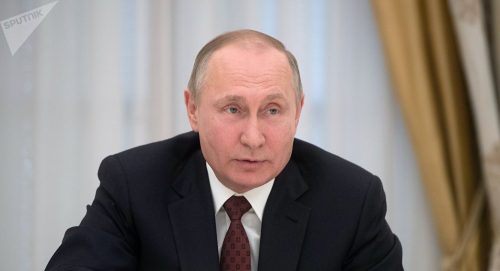
Russian President Vladimir Putin says he will reduce its military spending during his new term as the leader of the country, a day after he was re-elected in a presidential election with a landslide.
“We have plans to decrease our defense spending both this year and next. But this will not lead to any decline in the country’s defense capacity,” said Putin during a meeting with other presidential candidates in capital Moscow on Monday.
He added that “We will not allow for any sort of arms race.”
Putin’s comments come as ties between Moscow and Washington have plummeted to levels not seen since the Cold War due to the two countries’ disputes over the crises in Ukraine and Syria and after US officials accused Russia of meddling in the 2016 US presidential election.
Since September 2015, Russia has been carrying out airstrikes in support of Syria’s ground troops and has helped them recapture swathes of territory from Takfiri terrorists.
In his best election performance ever, Putin, 65, secured nearly 77 percent of the ballots cast in Sunday’s presidential election, according to the official results released earlier today.
Putin, whose new election win will extend his total time in office to nearly a quarter of a century, until 2024, said elsewhere in his remarks that he aims to focus his new term on “domestic policy issues” and strengthening the country’s “defense capabilities.”
“The main thing that we are going to do is of course, first of all the internal agenda, it is first of all ensuring the growth of the Russian Federation economy, and making it innovative, this is development in the sphere of healthcare, education, industrial output and as I’ve said before of infrastructure and other areas crucial for moving the country forward and lifting the standard of living for our citizens” the Russian leader further said.
UK will either have to offer facts on ‘Russian traces’ in Skripal poisoning or apologize – Kremlin
RT | March 19, 2018
The UK will either back up its claims of Moscow’s involvement in the poisoning of ex-double agent Sergei Skripal and his daughter, or it will have to apologize, the Kremlin spokesman has said.
Foreign Secretary Boris Johnson said on Monday that Russia is wrong to deny responsibility for the nerve agent poisoning of Skripal. “The Russian denial is increasingly absurd,” Johnson told reporters in Brussels. “This is a classic Russian strategy… they’re not fooling anybody anymore,” he added.
Peskov pulled no punches in fighting back, accusing the UK of “incomprehensible, unreasonable slander” against Moscow.
“Sooner or later, it will have to account for these baseless allegations, either by backing them up with evidence or by offering its apologies,” the Russian president’s spokesman said.
Last Monday, British Prime Minister Theresa May confronted Moscow with an ultimatum to reveal the details of the alleged Skripal plot. After her demand was rejected, the UK announced sanctions on Moscow, which included expelling 23 diplomats, limiting diplomatic ties and freezing Russian state assets in the UK.
In response, the Russian Foreign Ministry said on Saturday that 23 UK diplomats must leave Russia and that the British Council will be shut in retaliation for “provocative actions and groundless accusations” over the poisoning of Skripal and his daughter Yulia.
On Monday, the UK is set to hand samples of the nerve agent used in Skripal’s poisoning to a UN watchdog, the Organization for the Prohibition of Chemical Weapons (OPCW).
Johnson accused Russia on Sunday of creating and storing the so-called ‘Novichok’ nerve agent, which London says was used in the attack on Skripal. The UK official claimed that the UK has “evidence… collected over the past 10 years” that Moscow has been developing nerve agents “for the purpose of committing murder.”
Russian Foreign Ministry spokeswoman Maria Zakharova dismissed the allegation that the substance, thought to be a Soviet-era invention, was a Russian “project.” She said that in post-Soviet times, countries such as the UK, Slovakia, the Czech Republic, Sweden, and even the US studied the substance with keen interest and could have been the origin for the toxin used in the incident with Skripal and his daughter.
US training Syria militants for false flag chemical attack as basis for airstrikes – Russian MoD
RT | March 17, 2018
Russia’s Defense Ministry says “US instructors” are training militants to stage false flag chemical attacks in south Syria. The incidents are said to be a pretext for airstrikes on Syrian government troops and infrastructure.
“We have reliable information at our disposal that US instructors have trained a number of militant groups in the vicinity of the town of At-Tanf, to stage provocations involving chemical warfare agents in southern Syria,” Russian General Staff spokesman General Sergey Rudskoy said at a news briefing on Saturday.
“Early in March, the saboteur groups were deployed to the southern de-escalation zone to the city of Deraa, where the units of the so-called Free Syrian Army are stationed.”
“They are preparing a series of chemical munitions explosions. This fact will be used to blame the government forces. The components to produce chemical munitions have been already delivered to the southern de-escalation zone under the guise of humanitarian convoys of a number of NGOs.”
The planned provocations will be widely covered in the Western media and will ultimately be used as a pretext by the US-led coalition to launch strikes on Syria, Rudskoy warned.
“The provocations will be used as a pretext by the United States and its allies to launch strikes on military and government infrastructure in Syria,” the official stated.
“We’re registering the signs of the preparations for the possible strikes. Strike groups of the cruise missile carriers have been formed in the east of the Mediterranean Sea, Persian Gulf and Red Sea.”
Another false flag chemical attack is being prepared in the province of Idlib by the “Al-Nusra Front terrorist group, in coordination with the White Helmets,” Rudskoy warned. The militants have already received 20 containers of chlorine to stage the incident, he said.
Acceptable Bigotry and Scapegoating of Russia
By Natylie Baldwin | Consortium News | March 15, 2018
Over the last year and a half, Americans have been bombarded with the Gish Gallop claims of Russiagate. In that time, the most reckless comments have been made against the Russians in service of using that country as a scapegoat for problems in the United States that were coming to a head, which were the real reasons for Donald Trump’s upset victory in 2016. It has even gotten to the point where irrational hatred against Russia is becoming normalized, with the usual organizations that like to warn of the pernicious consequences of bigotry silent.
 The first time I realized how low things would likely get was when Ruth Marcus, deputy editor of the Washington Post, sent out the following tweet in March of 2017, squealing with delight at the thought of a new Cold War with the world’s other nuclear superpower: “So excited to be watching The Americans, throwback to a simpler time when everyone considered Russia the enemy. Even the president.”
Not only did Marcus’s comment imply that it was great for the U.S. to have an enemy, but it specifically implied that there was something particularly great about that enemy being Russia.
Since then, the public discourse has only gotten nastier. Former Director of National Intelligence James Clapper – who notoriously perjured himself before Congress about warrantless spying on Americans – stated on Meet the Press last May that Russians were uniquely and “genetically” predisposed toward manipulative political activities. If Clapper or anyone else in the public eye had made such a statement about Muslims, Arabs, Iranians, Jews, Israelis, Chinese or just about any other group, there would have been some push-back about the prejudice that it reflected and how it didn’t correspond with enlightened liberal values. But Clapper’s comment passed with hardly a peep of protest.
More recently, John Sipher, a retired CIA station chief who reportedly spent years in Russia – although at what point in time is unclear – was interviewed in Jane Mayer’s recent New Yorker piece trying to spin the Steele Dossier as somehow legitimate. On March 6, Sipher took to Twitter with the following comment: “How can one not be a Russophobe? Russia soft power is political warfare. Hard power is invading neighbors, hiding the death of civilians with chemical weapons and threatening with doomsday nuclear weapons. And they kill the opposition at home. Name something positive.”
In fairness to Sipher, he did backpedal somewhat after being challenged; however, the fact that his unfiltered blabbering reveals such a deep antipathy toward Russians (“How can one not be a Russophobe?”) and an initial assumption that he could get away with saying it publicly is troubling.
Glenn Greenwald re-tweeted with a comment asking if Russians would soon acceptably be referred to as “rats and roaches.” Another person replied with: “Because they are rats and roaches. What’s the problem?”
This is just a small sampling of the anti-Russian comments and attitudes that pass, largely unremarked upon, in our media landscape.
There are, of course, the larger institutional influencers of culture doing their part to push anti-Russian bigotry in this already contentious atmosphere. Red Sparrow, both the book and the movie, detail the escapades of a female Russian spy. The story propagates the continued fetishization of Russian women based on the stereotype that they’re all hot and frisky. Furthermore, all those who work in Russian intelligence are evil and backwards rather than possibly being motivated by some kind of patriotism, while all the American intel agents are paragons of virtue and seem like they just stepped out of an ad for Nick at Nite’s How to be Swell.
The recent Academy Awards continued their politically motivated trend of awarding Oscars for best documentary to films on topics that just happen to coalesce nicely with Washington’s latest adversarial policy. Last year it was the White Helmets film to support the regime change meme in Syria. This year it’s Icarus about the doping scandal in Russia.
Similarly, Loveless, the new film by Russian director Andrey Zvyagintsev (director of Leviathan) is being reviewed – as Catherine Brown points out – by writers from the mainstream American media in a predictably biased fashion. The film focuses on the disintegration of a married Moscow couple’s relationship and the complicated web of factors involved which have tragic ramifications for the couple’s 12-year old son.
American reviewers manage to paint the factors detailed in the film that are prevalent in most modern capitalist cities (e.g. being self-centered, materialistic and preoccupied with technological gadgets) as somehow uniquely Russian sins. They also ignore a prominent character in the film that defies their negativity about modern Russia – a character that represents altruism and the growth of civil society in the country.
A common theme in all this is that Russia is a bad country and Russians can’t help but be a bunch of good-for-nothings at best and dangerous deviants at worst. Indeed, according to media depictions, sometimes they manage to be both at the same time. But what they don’t manage to be is positive, constructive or even complicated. Sipher knows that the average American has been deluged with this anti-Russian prejudice, as reflected in his challenge at the end of his initial tweet about the largest country, geographically at least, in the world: Name something positive.
Countering the Negative
Most people know, at least in the abstract, that few individuals or groups are purely good or bad. Most are a complex combination of both. But many – including those who normally consider themselves to be open-minded liberals – have allowed their lizard brains to be triggered by the constant demonization of Russia in the hopes of taking down Trump whom they deem to be a disproportionate threat to everything they hold dear. So as a counterweight to all the negative constantly pumped out about Russia and to take Sipher up on his challenge, I will list some positive things about Russia and the contribution of the country and its people to the world.
Contemporary Russia’s Domestic Policy
Russia has one of the most educated populations in the world, universal health care for its people, a home ownership rate of 84%, strong gun control laws, no death penalty, 140 days of guaranteed maternity leave for women at 100% salary, and Moscow was just voted the 4th safest megacity in the world for women.
And, despite claims that are often repeated in corporate media and even by many in the alternative press, Russia has independent and critical voices in the print media. Even on television, which is heavily influenced by the Kremlin, the Western position is often given airtime by either pro-Western Russian critics or Westerners themselves. During both of my visits to Russia (in 2015 and 2017) I interviewed a cross-section of Russians who all confirmed that they had access to Western media through both satellite and the internet. Furthermore, while violence against journalists is a concern, according to the Committee to Protect Journalists, journalist murders have decreased significantly under Putin compared to the era of Boris Yeltsin in the 1990s.
Am I saying that Russia is a utopia without any problems? No. Like most countries, it has plenty. Most Russians, including Putin, admit this. These problems include still significant poverty rates, comparatively low productivity and life expectancy, and corruption. But it is important to note the direction of trends, which are mostly positive since Putin took over. Under his leadership, poverty rates have been cut in half, life expectancy has increased by several years – especially among men who had suffered the worst mortality crisis since WWII, crime has dropped, pensions have increased and are paid regularly, the unemployment rate has been around 5% for years, great investments in infrastructure and agriculture have been seen along with development throughout the country.
And that development has not just been seen in Moscow and St. Petersburg – the latter city which, by the way, culturally and architecturally rivals those in France and Italy.
There are plenty of medium-sized cities throughout Russia that are becoming well-developed and culturally engaging. As one example, during my 2015 trip, I visited Krasnodar, located in the Black Sea region. The rate of civic construction in the city during 2014 surpassed even Moscow. As a consequence of the challenges of this rapid development, the public felt that decisions were not being made with sufficient feedback from residents, several of whom got together and created a group called the Public Council which eventually found ways to get city authorities to listen to their concerns.
The group had received significant media attention, networked with youth groups and infrastructure specialists, and received foreign experts in urban planning, public arts, transportation and city marketing. They have also organized periodic clean-up and renovation days, which are sponsored by local businesses that donate use of equipment. Currently, they are working on the creation of protected green zones, including one that connects all of the city’s hiking paths and another to connect its 16 lakes. They have received no opposition from the Russian government and have elicited the interest of other cities who want to model their approach to local issues.
While in Krasnodar I met a dozen or more professionals, from lawyers to engineers and doctors, who lived in the city and were part of another civic group engaged in charitable, conservation and youth programs. At one point, I took a walking tour of the city. In terms of architecture, I saw the old and the new side by side, including a large shopping center that was built around a large tower that had been there for generations that local residents saved from destruction by the mall planners, a square with controversial fountains, and a main thoroughfare that was closed to auto traffic, allowing pedestrians free reign. Couples – including some of mixed race, parents pushing baby strollers, and bicyclists – all wound their way through the streets as both Russian and American music was piped in and building walls on one side of the street for a stretch displayed delicate illustrations of Russian history.
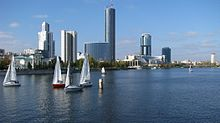
Fifteen hundred miles away in the Ural mountain region, the city of Yekaterinburg – named after Catherine I – has the infamous distinction of being the place where Czar Nicholas II and his family were massacred by the Bolsheviks in 1918. On the site where the family’s bodies were exhumed, a magnificent Russian Orthodox Church has been erected and dedicated to the last royal family. Nearby is the Yeltsin Library, denoting the Russian Federation’s first President, although his legacy is not popular in Russia today.
Yekaterinburg
The city is also home to a wide variety of precious metals and gems, along with a thriving economy. According to Sharon Tennison, an independent program coordinator who has traveled there numerous times over the past 15 years, hundreds of new apartment blocks can be seen on the outskirts of the city to accommodate the recent economic and population growth.
Yekaterinburg has a bustling cultural life that includes an opera house, a ballet, numerous theaters and museums, as well as dozens of libraries. In this respect, the city has continued its preoccupation with the classical arts as in Catherine’s period. At the same time, many modern Russian rock bands with a distinctive sound have formed there (known as Ural rock).
The city also has a low rate of violence and crime.
As the New York Times and NPR like to point out and generalize out from, there are some rural and industrial areas in Russia that still need attention and investment. However, there are other towns in the countryside that are doing well.
Russia’s Contributions to the World
Russia has made many cultural and humanitarian contributions to the world. In the 18th and 19th centuries, imperial Russia produced some of the most renowned figures in the world of arts. These include writers, such as Tolstoy and Dostoevsky, whose works are often cited by American readers as among the greatest of all time; great composers include Tchaikovsky, Stravinsky and Rachmaninoff.
The country also has a rich history of pre-Soviet philosophers who debated questions of politics, history, spirituality and meaning. One of the most famous is Vladimir Solovyev, classified as belonging to the Slavophile school but distinguished from his fellow Slavophiles by his openness to and integration of several lines of thought.
He acknowledged the intuitive as well as the rational. He was friends with Dostoyevsky but had disagreements over Orthodoxy since Solovyev was an advocate of ecumenism and healing the schism between Orthodoxy and Catholicism. Furthermore, he is credited with influencing Nicolai Berdyaev, Rudolf Steiner and the Russian Symbolists, among others. He admired the Greek goddess Sophia who he characterized as the “merciful unifying feminine wisdom of God.” Solovyev was adept at integrating several spiritual strands, such as Greek philosophy, Buddhism, Kabbalah, and Christian Gnosticism.
Solovyev was famous for his debates with Slavophile contemporary, Nicolai Fedorov. In these and other writings, questions about morality and technological progress, how much humans should control nature, and prioritizing which problems to invest man’s resources in solving were all given great consideration by Solovyev and are still relevant today, in both Russian society and the larger world.
It is interesting to note that, of all the early Slavophile philosophers, Putin chose Solovyev, the one who was the least strident and most open to the synthesis of differing values and viewpoints, as part of his assignment of books for Russia’s regional governors to read a few years back. Of course, that didn’t stop several western pundits – who showed they knew virtually nothing of Solovyev but perhaps some cherry-picked and out-of-context tidbits they’d found online – from distorting his writings, which naturally had to be horrible because Putin recommended them.
Moving on to the 20th century, it should not be forgotten that the Soviet Union bore the brunt of defeating the Nazis during WWII, losing 27 million people, and saw a third of their country destroyed in the process.
In the 21st century, Russia provided significant aid to Americans in the aftermath of Hurricane Katrina and Hurricane Sandy. They also provided safe transport to Yemeni-Americans out of that devastated country after the U.S. State Department effectively abandoned them in 2015. Russia provided medical aid to 60,000 people affected by the Ebola epidemic in West Africa in 2014. Last September, Russia provided 35 tons of aid to earthquake victims in Mexico.
For someone who spent years in Russia as a professional expert working for the U.S. intelligence community, John Sipher is either not well-informed on his subject or is intentionally being disingenuous when it comes to the suggestion that Russia has done nothing positive, whether under Putin’s governance or before.
The Purpose of Scapegoating Russia
In early 2017, journalists Jonathan Allen and Amie Parnes published a book called Shattered: Inside Hillary Clinton’s Doomed Campaign. Largely based on interviews with insiders from Hillary Clinton’s failed 2016 presidential campaign, the book was an attempt to analyze why she lost. The insiders agreed that Clinton had trouble providing a plausible explanation to voters as to why she was running other than that she simply wanted to be president. They also noted her trouble connecting with average Americans and her failure to campaign in certain rust belt areas that Trump ultimately got support in. The book also states that within 24 hours of Clinton’s loss, members of her campaign had decided to home in on the excuse of “Russian interference” to explain away her humiliating defeat.
In addition to a bloc of Clinton’s supporters continuing to push this excuse for her loss and the ratings motive that channels like CNN and MSNBC have in continuing to milk the scandal, there is also Robert Mueller’s investigation which has dragged on for over a year.
The most notable thing about the Mueller investigation to anyone who takes a sober look at it is its constantly evolving purpose. First, the purpose of the investigation was to find any evidence to support the allegation that Russia had hacked into the DNC’s emails. When no substantial evidence could be found to support that allegation, the purpose evolved into collusion between Trump and Russia to steal the election on behalf of Trump.
When no substantial evidence could be found to support that allegation, the purpose evolved yet again into Russia influencing the election on behalf of Trump, possibly without his knowledge or participation. When no substantial evidence could be found to support that allegation and all that could be found was a paltry number of social media ad buys – many of which were purchased after the election or advocated conflicting positions or didn’t even have anything to do with the election, the purpose became “sowing discord.”
After all of this, we have an indictment against 13 private individuals who worked for a “troll farm” that had been exposed several years ago and is run by a caterer with no proven orchestration by Putin or the Kremlin. Mueller also knows that this indictment will never be legally tested because the 13 individuals will never be extradited and stand trial.
After all the shrieking and howling 24/7 for close to a year and a half that Trump was an illegitimate president installed by the Kremlin, this is the best Mueller and the mainstream Democrats can come up with. It’s pretty obvious by now that this investigation has simply been feeding into the media and Democratic Party circus mentioned above rather than uncovering anything substantive with which to impeach Trump.
The 2016 election showed that the Democrats faced a sleeping giant that had been awakened – one that the Democratic Party had helped to create for decades by enabling lower living standards, outsourcing of good-paying jobs, the proliferation of low-wage jobs, unaffordable education, lack of health care coverage, public health problems, and decrepit infrastructure.
Consequently, there was a demand for meaningful policies that would help average Americans, policies that polls show they want. But mainstream Democrats will not deliver on such policies, like $15/hour minimum wage, Medicare for All, and pulling out of our wars and investing the money saved in jobs and infrastructure. They won’t deliver on these things for the same reason that Republicans won’t deliver on them: because their donors don’t want them to. But they are not going to admit that to the American people who were going to keep demanding, so they needed a scapegoat and a diversion.
It’s a cheap trick that the political elite is using to appeal to the basest instincts of their fellow Americans while shoring up support for their most reckless tendencies in the area of foreign policy.
Natylie Baldwin is co-author of Ukraine: Zbig’s Grand Chessboard & How the West Was Checkmated, available from Tayen Lane Publishing. Since October of 2015, she has traveled to six cities in the Russian Federation and has written several articles based on her conversations and interviews with a cross-section of Russians. Her fiction and nonfiction have appeared in various publications including Consortium News, The New York Journal of Books, The Common Line, and the Lakeshore. She is currently submitting her first novel to agents and finishing a second. She blogs at natyliesbaldwin.com.
May blatantly misleads Parliament about Russian “terrorist” law
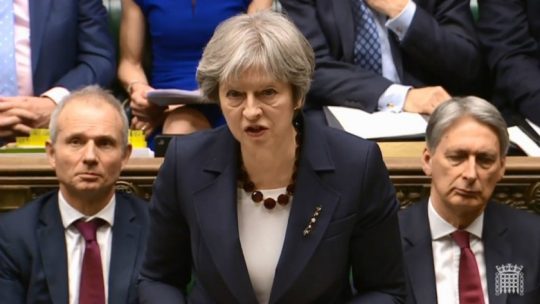
Theresa May following a tradition of being less than exact in Parliament about a casus belli
OffGuardian | March 14, 2018
When Theresa May said this in the House of Commons today:
While the extra-judicial killing of terrorists and dissidents outside Russia were given legal sanction by the Russian Parliament in 2006.
she was either disgracefully uninformed or was intentionally misleading Parliament on the nature of the Russian laws in question.
Her words completely misrepresent the known and understood facts of the case.
Not only have two experts in Russian law given their view that the laws do not permit the extra-judicial killing of “dissidents” in the manner described, but a British judge ruled in agreement with this conclusion during the Litvinenko Inquiry.
These are the judge’s own words:
The only legal route to extra-territorial action against Mr Litvinenko was therefore under the Terrorism Law. However, action could only have been taken against Mr Litvinenko under this law had he been involved in, or no doubt suspected of involvement in, some form of terrorist activity. Article 3 of the Terrorism Law contains definitions of terrorism and terrorist acts that are broadly conventional, and certainly not as expansive as the definition of ‘extremism’ in the second of the 2006 laws. Mr Batmanov’s letter (above) states that, “Alexander Litvinenko did not make part of a terrorist organization and was not accused by Russian law enforcement bodies of having committed a terrorist crime.” That accords with my understanding of the evidence
On the basis of the evidence currently before me, and in light of the considerations set out above, I am therefore not persuaded that any action could have been taken by the FSB against Mr Litvinenko in 2006 under the terms of either of the 2006 laws.
Put simply, this means the two laws would not have legalised the killing of Litvinenko on foreign soil. And, by extension would not legalise the poisoning of Skripal either.
Alexander Mercouris, a former UK barrister and author of a lengthy study of the Litvinenko Inquiry (published by OffG here and cited above) had this to say to us about May’s words in Parliament today:
Theresa May…was the Home Secretary who – somewhat unwillingly – set up the Litvinenko inquiry, and to whom the inquiry report was formally addressed. It is difficult to believe therefore that she is unaware that there is a British judicial finding that the two Russian laws which were passed in 2006 do not authorise extra judicial assassination attempts such as the one the British say was carried out in 2006 against Litvinenko, or the one which the British say was recently carried out against Skripal – who had of course been previously pardoned for his crimes by the Russian state.
The question arises – if this part of May’s statement contained such a blatant inaccuracy, how much weight can be given to her other as yet unsubstantiated claims of Russian guilt?
Those currently excoriating Jeremy Corbyn for asking for evidence before endorsing what amounts to indirect declarations of war on a nuclear power, might want to consider this fact before continuing on their chosen path.
US in Afghanistan to Influence Russia, Iran, China – Russian Foreign Ministry
Sputnik – March 14, 2108
The United States retains its presence in Afghanistan to exert influence on neighboring countries and regional rivals – namely, Russia, Iran and China, Russian Foreign Ministry’s Second Asian Department Director Zamir Kabulov told Sputnik in an interview.
“In our opinion, the United States is in Afghanistan primarily with the aim of controlling and influencing the political processes in its neighboring countries, and also demonstrating its power to its regional competitors, primarily China, Russia and Iran. The United States is clearly trying to achieve destabilization of Central Asia and later transfer it to Russia in order to subsequently present itself as the only defender against potential and emerging threats in the region,” Kabulov said.
According to the diplomat, Russia and other countries neighboring with Afghanistan have questions about the true goals and time frame of the US military presence in the Central Asian country.
“If the United States and its NATO allies intend to continue their destructive policy in Afghanistan, this will mean that the West is heading toward the revival of the Cold War era in this part of the world. We closely monitor the developments and are ready to respond in cooperation with our partners and other like-minded people,” Kabulov noted.
The diplomat pointed out that Washington still failed to understand that the Afghan conflict could not be resolved solely by military means, stressing that it was impossible to defeat the Taliban by force.
Moscow is puzzled by the attempts of the United States and NATO to persuade Afghanistan to replace Russian weapons and military equipment, such move leads to reduction of Afghan’s military potential, Zamir Kabulov told Sputnik in an interview.
“The course taken by the United States and NATO to persuade Kabul to replace Russia-made small arms and aircraft is surprising, as it will inevitably lead to a decrease in the combat capabilities of the Afghan armed forces and further deterioration of the situation,” Kabulov said.
The diplomat reminded that a bilateral intergovernmental agreement on Russia’s defense industry assistance to Afghanistan had entered into force in November 2016, adding that the document created the legal framework for Russian assistance in arming and equipping the Afghan security forces.
“At the moment, negotiations are underway on repairs and supplies of spare parts for the Afghan Air Force’s helicopters for various purposes, produced in Russia (the Soviet Union),” Kabulov added.
Afghanistan Parliamentary Election
The parliamentary election in Afghanistan is unlikely to take place in July in the current circumstances, Kabulov said.
“I do not think that the parliamentary elections in Afghanistan will be held in July this year as scheduled. The Taliban continue to control about half of the country’s territory, engage in hostilities, organize and carry out terrorist attacks in large cities, and, apparently, are not going to make compromises and reconciliation with the Afghan government,” Kabulov said.
Afghanistan’s Independent Election Commission (IEC) is also unlikely to accomplish all the necessary procedures before the date set for the vote, given that the commission has announced earlier that the registration of voters will complete only by early August, the diplomat noted.
Furthermore, disagreements between the presidential administration and its political opposition regarding the parameters of the upcoming elections still remain unresolved, the official noted.
“In my opinion, if elections are conducted in the current circumstances, their results will not improve the political situation in the country and confidence in the current government, will not force the armed opposition to cooperate with the government,” Kabulov added.
The diplomat also noted that the Daesh terror group posed a serious threat to holding the election.
“The Daesh jihadists pose a serious threat to the security of the conduct of elections, especially in the north and a number of eastern provinces of Afghanistan. Some polling stations in the provinces of Helmand, Uruzgan, Kunduz, Badakhshan, Faryab and Ghazni are the most problematic in terms of security, according to the IEC data. I think that, in fact, the list of problematic areas in terms of organization of voting is much longer,” Kabulov said.
Afghanistan Reconciliation Talks
Russia considers the so-called Moscow format of talks an optimal platform for the promotion of national reconciliation in Afghanistan, Zamir Kabulov noted.
“Unfortunately, the existence of a large number of international formats on the Afghan issue has not significantly contributed to the involvement of the Taliban in peace negotiations. In this regard, we consider the Moscow format of consultations launched by us in early 2017 as the optimal platform for substantive negotiations to promote national reconciliation and establish a constructive dialogue between the government of Afghanistan and the Taliban movement,” Kabulov said.
Kabulov also noted that Moscow considered the format of talks in the Afghan capital as one approach toward achieving a collective solution to the problems surrounding Afghan settlement.
“A signal of international support for the resolution of the intra-Afghan conflict through political dialogue with the government of Afghanistan has been sent to the Taliban. The Taliban ignored the recent meeting of the ‘Kabul process’ in the Afghan capital, insisting on direct talks with the United States,” the diplomat added.
In February 2017, Russia, China, Pakistan, Iran, India and Afghanistan came together in Moscow for talks to promote the national reconciliation process in Afghanistan through regional cooperation with Kabul in the leading role. Apart from the aforementioned states, the latest round in April gathered five Central Asian countries: Kazakhstan, Kyrgyzstan, Tajikistan, Turkmenistan and Uzbekistan. The United States refused to take part in the meeting.
Afghanistan has long suffered political, social and security-related instability because of the simmering insurgency, including that of the Taliban, but also because of the actions of the Daesh terror group.
The United States has been in Afghanistan for almost 17 years following the 9/11 attacks. Before his election, Trump slammed sending US troops and resources to the Central Asian country.
Moscow on Expulsion of 23 Diplomats From UK: ‘Unacceptable, Unjustified’ Move
Sputnik – March 14, 2018
Prime Minister Theresa May has announced the largest expulsion of Russian diplomats from the UK since the Cold War over the alleged attack on a former spy. Moscow has denounced May’s claims as baseless.
The Russian Embassy in London called the expulsion of 23 Russian diplomats announced by UK Prime Minister Theresa May over the poisoning of former intelligence officer Sergei Skripal “unacceptable, short-sighted and unjustified.”
In a statement, the Embassy confirmed that the diplomats had been declared persona non grata, adding that London was to blame for the harm caused to Russian-UK relations by this “hostile step.”
The Russian Embassy’s reaction followed UK Prime Minister Theresa May’s address to the House of Commons, where she announced a response to the alleged attack on Skripal.
Biggest Expulsion of Russian Diplomats Since Cold War
Reiterating a claim she made Monday about Russia’s alleged culpability in the Skripal case, the prime minister accused Russia of an “unlawful use of force against the United Kingdom,” saying this crime was part of a well established pattern of “Russian state aggression” in Europe, and accused Moscow of “sarcasm, contempt and defiance” in its response to London’s ultimatum to provide further information.
May announced that 23 Russian diplomats “identified as undeclared intelligence officers” will be expelled and given one week to leave.
Second, she vowed the creation of new legislative powers against “hostile state activity,” as well as possible new counter-espionage powers.
May promised the freeze of Russian assets in cases where they threaten UK citizens, adding there was no place for those seeking to do harm to the UK.
The prime minister also said that “criminals” and “corrupt elites” from Russia were not “welcome” in the UK. She informed lawmakers that “led by the National Crime Agency, we will continue to bring all the capabilities of UK law enforcement to bear against serious criminals and corrupt elites. There is no place for these people – or their money — in our country.”
May also confirmed that her government will be looking to strengthen Magnitsky Act-type, human rights-based amendments to existing sanctoins.
Suspension of High Level Contacts
London will suspend all high level contacts with diplomatic officials from Moscow, including during the upcoming FIFA World Cup in Russia, which British ministers and members of the royal family will skip.
May accused Russia of “flagrantly” breaching its international obligations, and said it was “tragic” that Russian President Putin “has chosen to act in this way.”
The prime minister stressed that the London and its allies will coordinate its actions, and welcomed support received from NATO and the EU. A NATO Council meeting will be held to discuss the matter on Thursday. The UK is also pushing for a debate at the UN on the Skripal case, and has asked the Organization for the Prohibition of Chemical Weapons to to help verify its claims against Russia.
Skripal’s attempted murder was not just an act of aggression against the UK, but an affront to the prohibition of chemical weapons, May said.
Opposition Responds
Opposition leader Jeremy Corbyn called the events in Salisbury “abominable,” adding that the Labour Party supports the prime minister in taking firm, multilateral action to ensure chemical weapons are never again used in the UK. He asked whether May agrees on the need to maintain dialog with Russia.
Responding to a lawmaker’s question about whether she will respond to any Russian response with an even firmer response, May said there were “other measures” that London stands ready to deploy should it face “further provocations” from Moscow.
May accused Russia of having a “pattern” of aggression, from Syria to Crimea and Eastern Ukraine, to meddling in elections in other parts of the world to “propaganda” and “misinformation campaigns.”
Asked about whether the UK will seek to further diversify away from the delivery of Russian gas, May confirmed that “we are indeed looking” to other countries for supplies.
Asked whether Russian English language media including RT would be targetted, May said that this was not a matter for the government, but for media regulator Ofcom. She added that the UK would continue to support the efforts of BBC’s Russian language service. Moscow had previously warned that UK media would be expelled from Russia if Russian media was expelled from the UK.
What Happened
Moscow has dismissed all accusations of involvment in the Skripal incident and requested access to the case. Russian Foreign Minister Sergei Lavrov has characterized London’s accusations as “propaganda,” and complained that Russia wasn’t provided with any evidence regarding the crime, in spite of the accusation of Russian involvement, and the fact that Russia had made a request for information regarding a crime which affected Yulia Skripal, who is a Russian citizen.
Ex-GRU officer and MI6 double agent Sergei Skripal and his daughter were hospitalized on March 4 following what London claims to have been an attempted poisoning.
Russia won’t respond to UK ultimatum until samples of alleged chemical weapon received – Lavrov
RT | March 13, 2018
Moscow will not respond to the British request about a clandestine Soviet chemical weapon allegedly used in an ex-double agent’s poisoning until a sample of the agent is provided, the Russian foreign minister said.
On Monday, British Prime Minister Theresa May said a chemical weapon developed under a secret Soviet program dubbed Novichok was used in the poisoning of Sergei Skripal. May demanded that Russia provide details of the program, saying otherwise London would consider the poisoning an attack directed by the Russian government.
The Russian Foreign Ministry said on Tuesday that it had summoned British Ambassador to Moscow Laurie Bristow. No further details were provided.
“We have certainly heard the ultimatum voiced in London,” Lavrov said on Tuesday. “The spokesperson for the Foreign Ministry has commented on our attitude to this,” he added referring to Maria Zakharova branding of May’s appearance in Parliament as a “circus.”
He added that a case of alleged use of chemical weapons should be handled through the proper channel, being the Organization for the Prohibition of Chemical Weapons (OPCW) – of which both Russia and Britain are members.
“As soon as the rumors came up that the poisoning of Skripal involved a Russia-produced agent, which almost the entire English leadership has been fanning up, we sent an official request for access to this compound so that our experts could test it in accordance with the Chemical Weapons Convention [CWC],” Lavrov said. So far the request has been ignored by the British side, he added.
The minister affirmed that Russia has nothing to do with the poisoning of Skripal and would assist Britain in the investigation, provided that London meets its own obligations as to how such probes are to be handled.
The OPCW rules allow Britain in this case to send a request to Russia on the suspected Russian-made chemical weapon and expect a response within 10 days, Lavrov explained. If the response is not satisfactory, Britain would have to file a complaint with the organization’s executive council and the conference of CWC member-states, he said.
For its part, Russia expects Britain to share evidence on the Skripal case, Lavrov stated. The former double agent and his daughter Yulia, who was also poisoned, hold Russian citizenship, so Russia has a right to know how the apparent attempt on their lives is being investigated, the foreign minister said.
The British theory is that Russia was either directly responsible for the poisoning, or had lost possession of the chemical weapon that was used. London gave Moscow until Tuesday to explain what had happened.
We’ll respond if lives of our military, incl. from strikes on Damascus, are endangered – Russian MoD
RT | March 13, 2018
Moscow is ready to respond if lives of the Russian servicemen are endangered, including by strikes on Damascus, head of Russia’s General Staff Valery Gerasimov said.
“There are many Russian advisers, representatives of the Russian Center for Reconciliation of Opposing Sides and [Russian] servicemen in Damascus and at Syrian defense facilities,” Gerasimov stated.
In case lives of Russian military personnel are put in danger, the Russian Armed Forces will respond with certain measure to both “missiles” and “lauchers” which are delivering these projectiles.
Russian MoD also says it has information that militants in Syria are planning to stage chemical attacks against civilians under the guise of the Syrian government. According to Gerasimov, they have already sent ‘civilians’ in Eastern Ghouta who will ‘play victims’ of chemical attacks. Members of the White Helmets and film crews are already there, he pointed out.
“Following the provocation, the United States are planning to accuse Syrian government forces of using chemical weapons,” according to Gerasimov. In the aftermath it would “present the international community the so-called ‘evidence’ of the apparent mass deaths of civilians at the hands of the Syrian government and “supporting it, the Russian leadership.”
In response, Washington will strike the government quarters of Damascus, the general has alleged.
On Monday, US Ambassador to the UN Nikki Haley warned that Washington will take action in Syria on its own if the UN Security Council fails to do so. When the UNSC “failed to act” after the Khan Sheikhoun chemical incident in 2017, the US “successfully struck the airbase from which Assad had launched his chemical attack,” Haley stated.
The US diplomat once again claimed that Russia and Damascus continue to bomb “innocent civilians” under a pretext of fighting terrorism. However, Russia’s envoy to the UN, Vassily Nebenzia dismissed the allegations, saying that Western countries use the situation in Eastern Ghouta only as a pretext to put pressure on Russia and blindly put the blame on Damascus for any incidents in the country.
Also on Monday, Nebenzia accused militant groups in the city of using chlorine gas. He added that the Syrian operation in the Damascus suburbs does not violate resolution 2401, as it exempts terrorists.
“They [militants] are constantly striking humanitarian corridors and checkpoints, including during the humanitarian pauses,” Nebenzia stated. “They intensified the use of tunnels in order to provoke the Syrian military and the exits of those tunnels are in the areas of public buildings, first and foremost mosques, hospitals and markets.”
‘Circus’ at the British Parliament – Russian Foreign Ministry reacts to May’s words on Skripal case
RT | March 12, 2018
A spokesperson for the Russian Foreign Ministry called the hearing at the British parliament on the Skripal case a “circus show.”
“The conclusion is obvious: this is another information and political campaign, based on provocation,” said Maria Zakharova, commenting on the words of Theresa May.
Zakharova’s comments come after May said earlier on Monday that the “attempted murder” of Skripal was either “a direct act by the Russian State against our country, or the Russian government lost control of this potentially catastrophically damaging nerve agent and allowed it to get into the hands of others.”
May said that the Russian ambassador to the UK has been summoned to the Foreign Office, and that he must explain which explanation is the correct one. The ambassador has until the end of Tuesday to respond, according to May.
If he does not give a “credible response,” the UK will conclude that the attack involved “unlawful use of force by the Russian state against the United Kingdom.” In that case, May said she will return to the House of Commons to outline retaliatory proposals.
“Before creating new fairy tales, let somebody in the kingdom tell us what was the result of the previous investigations into the Litvinenko, Berezovsky and Perepilichny cases,” Zakharova suggested.
Zakharova’s comments referenced three high-profile deaths which occurred in the UK and were blamed on Russia – despite zero evidence to this day.
Russian Foreign Minister Sergey Lavrov specifically addressed the case of Litvinenko on Friday, noting that the UK’s finger-pointing at Moscow runs parallel to what happened in that case.
“I want to remind people that Litvinenko’s death was also attributed to Russia, but hasn’t been investigated, because court proceedings, which were called ‘public,’ were, in fact, closed. They were carried out in a very strange way, and numerous facts, which emerged throughout the investigation, haven’t come into the public domain,” the minister said.
Litvinenko died in November 2006, after assassins allegedly slipped radioactive polonium 21 into his cup of tea at a London hotel. However, his own brother Maksim stated in 2016 that Britain had more reason to kill Litvinenko than Russia.
In the case of Boris Berezovsky, Putin’s critics have long speculated that the billionaire was murdered by pro-Putin hitmen in 2013. However, British police said in 2013 that there was no evidence of foul play relating to this death.
In addition, no evidence has ever been provided that Russia was behind the death of businessman Aleksandr Perepilichny, who collapsed and died in Surrey, UK, in 2012.
Skripal, 66, and his 33-year-old daughter have been in critical condition in hospital since March 4, when they were found unconscious on a bench outside a shopping center in Salisbury.
Al-Nusra terrorists used chlorine chemicals in Eastern Ghouta – Russian envoy to UN
RT | March 12, 2018
Russia’s envoy to the UN Vassily Nebenzia has accused militant groups in Eastern Ghouta of using chlorine gas, while stressing that the Syrian government has every right to eradicate the “terrorism hotbed” near its capital.
Nebenzia has defended Syria’s government and the ongoing anti-terrorism operation in Eastern Ghouta, asserting that it has “every right to try and remove the threat to the safety of its citizens.”
“According to information at our disposal, on March 5, Al-Nusra militants used chlorine substance in Eastern Ghouta, which injured 30 civilians. All this is done to prepare the grounds for unilateral military actions against sovereign Syria,” Nebenzia stated.
“The suburbs of Damascus cannot remain a hotbed of terrorism. And it is being used for continued attempts by terrorists to undermine the cessation of hostilities.”
The ongoing operation in the Damascus suburbs does not violate resolution 2401, which allows the continuation of the battle against terrorists, the diplomat stressed. The terrorists, unlike Moscow and Damascus, do, in fact, frequently attack hospitals and other civilian facilities, and the attacks are well-documented, he added.
“Since the resolution was passed, more than 100 people died from this and a considerably higher number were wounded. More than one hospital… was shelled,” Nebenzia said. “These were true hospitals, genuine hospitals, not headquarters of fighters which they very frequently claim to be hospitals.”
The militants also are preventing the civilians from leaving the combat zone, raining mortar and sniper fire on them.
“They [militants] are constantly striking humanitarian corridors and checkpoints, including during the humanitarian pauses,” Nebenzia stated. “They intensified the use of tunnels in order to provoke the Syrian military and the exits of those tunnels are in the areas of public buildings, first and foremost mosques, hospitals and markets.”
Featured Video
No Vote, No Representation, No State: Democracy, Israeli Style
or go to
Aletho News Archives – Video-Images
From the Archives
Sanctions, War and the Policy of Dual Containment
By SASAN FAYAZMANESH | March 17, 2008
It is now nearly three decades since the Unites States adopted the policy of dual containment of Iran and Iraq. While much has been written about the containment of Iraq, there has been very little in-depth analysis of this policy when it comes to Iran. In a book that is going to be released on March 31, 2008, entitled The United States and Iran: Sanctions, Wars and the Policy of Dual Containment (Routledge), I attempt to address this shortcoming by investigating when and why the US policy of containment of Iran came about, how it evolved, and where it stands today.[1] To the extent that Israel has been involved in US policy making, the study will also include the role that Israel has played in the containment of Iran. Also, since the fate of Iran has been inextricably linked to that of Iraq, occasionally the investigation will overlap with the containment of Iraq.
The policy of dual containment of Iran and Iraq originated during the Carter Administration, but it was not until the Clinton Administration that the expression “dual containment” became popular. … continue
Blog Roll
 Aletho News
- No Vote, No Representation, No State: Democracy, Israeli Style
- Zionist Bought Senate Blocks Information About American Citizens Killed By Israel
- While Gaza dominates the UN, these are the people keeping it alive
- New Report: “Scholasticide and Genocide in Gaza: Assessment, Testimonies and Legal Analysis”
- ‘THAAD Delusion’: Iran war exposes US missile shield limits – The Atlantic
- Moscow issues warning to NATO over Russian exclave
- Yes, the Iran war has destroyed Trump’s presidency
- The fallacy of US delusions about Iran’s economic collapse
- Hezbollah denies Syria cell link, warns of Israeli plan to sow discord
- The legacy of US sanctions, war, and occupation in Iraq
- If Americans Knew
- Mamdani releases plan to combat antisemitism and hate crimes in New York City
- Iran’s Revolutionary Guards Publish Letter to the American People
- DMFI launches $1 million ad campaign supporting Virginia’s Elaine Luria
- US Senate blocks resolution seeking report on Americans killed by Israel
- Israeli Attacks Kill Ten Palestinians in Gaza
- Massacre at Minab: The School That Became a Grave
- Israeli media: The IDF Shows It Doesn’t Turn a Blind Eye; It Actively Emboldens Settler Havoc
- As settlers ravage West Bank, Israeli forces kill 10 in Gaza – Daily Update
- New Report: “Scholasticide and Genocide in Gaza: Assessment, Testimonies and Legal Analysis”
- Ex-Biden officials are desperate for a Gaza scapegoat
- No Tricks Zone
- Green Energy Debacle: German Expert Professor Fritz Vahrenholt Warns Of Severe Economic And Social Consequences
- Two More Paleo Reconstructions Affirm Meters-Higher Sea Levels Across Ireland, Brazil 7000-6000 Years Ago
- New Study: Earth And Venus Surface Warmth Largely Explained By Convection And Lapse Rate, Not CO2 Or Radiation
- 2025 Nature Paper Claiming Worsening Global Drought Gets RETRACTED …Heavily Flawed
- New Study: ‘Global Drought Shows No Detectable Recent Acceleration Under Climate Warming’
- Economic Masterminds: German Socialists Suggest Taxing Productivity Gains Stemming From Using AI
- The South China Sea Has Not Been Cooperating With The Climate Change Narrative
- Energy Crisis: Germany Enters Heating Season With Historically Low Gas Reserve Fill Levels
- New Study: The Antarctic Ice Sheet Gained Mass From 2020-2024 Due To Staggering Snow And Ice Accumulation
- Study: Ocean Heating Rates From Thousands Of Years Ago ‘Dwarf’ Modern Ocean Heating Rates

