Speaking at the UN Geneva Disarmament Conference, Russian Foreign Minister Sergey Lavrov said that Russia is threatened by American tactical nuclear weapons (TNW) stationed in Europe and the destabilizing effect of joint nuclear missions (JNM) that NATO forces are being trained for.
The statement is more than propitious. No progress on European security is conceivable without an agreement on what to do with tactical nukes. US TNW are deployed while Russian tactical nukes are all stored. Unlike the US, Russia does not keep them abroad. Its non-strategic delivery means cannot strike the continental US. It makes American TNW in Europe an addition to the strategic potential able to tilt the existing strategic balance.
US instructors train European personnel, the Belgian, German, Italian and Dutch, to use TNW. An example is the yearly exercise Steadfast Noon, a low-profile training event conducted in semi-secrecy. The exercise testifies to the fact that European non-nuclear states (NNS) are involved in nuclear planning. The US trains their military personnel to fight a nuclear war.
It all constitutes a flagrant violation of the Treaty on the Non-Proliferation of Nuclear Weapons (NPT). It prohibits nuclear states from transferring nukes to other recipients (Article I). It also prohibits NNS from receiving TNW (Article II). About half of US air-delivered bombs in Europe to be modernized are earmarked for delivery by aircraft of Europe’s NNS, which are parties to the NPT. In the early 2020s, modernized B61-12 guided nuclear bombs will be delivered by stealth F-35 bombers that many European NATO members are going to acquire thus achieving first strike nuclear capability.
Italy, the Netherlands, and Turkey take part in the F-35 program. Belgium will probably purchase the F-35 as a replacement for its aging F-16. Poland, Finland (not a NATO member but a privileged partner) and Germany appear to be on the way to acquire the aircraft. There will probably be others – all of them becoming nations with nukes deployed on their territories and crews trained to use TNW in violation of the NPT.
The nukes are hard to get rid of. In 2010, NATO adopted the Tallinn formula, which stipulates that no member of the alliance can unilaterally withdraw American TNW.
The US 2018 Nuclear Posture Review eulogizes low-yield nuclear weapons (with strength of less than 20 kilotons). It identifies the need for nuclear sea-launched cruise missiles and lower-yield warheads for sea-launched strategic missiles.
If the idea is implemented, the RF won’t be able to distinguish an incoming low-yield munition from a full-blown weapon to trigger a nuclear exchange at strategic level. From Russia’s perspective, the concept presupposes another addition to the strategic arsenal. Very provocative, isn’t it?
NATO’s superiority in conventional weapons also should not be forgotten as well as the nuclear capability possessed by France and the United Kingdom.
Here is another aspect so rarely remembered nowadays. Sea-based TNW are excluded from the US-Russia TNW balance. The undeservedly forgotten Presidential Nuclear Initiatives (PNIs) signed in 1991 have so far been complied with. Unlike the INF Treaty, the compliance with the PNIs has never been doubted. Emergence of sea-based TNW means an end to the PNIs that have served both nations so effectively and for so long. The US, in effect, is adding European nuclear arsenals to the Russia-US strategic equation. Moscow will respond. It will also demand that these weapons are taken into consideration in potential arms control talks. It has every reason and right to do it. The problem of TNW will arise in negotiating the future the New START.
As one can see, the US plans undermine European security. They bring to naught the chances of reaching new strategic or non-strategic nuclear US-Russia accords. And it makes the US and European NATO members less secure upping the nuclear threshold. Moscow will not stand idle watching all these war preparations take place. It will respond. And other NPT participants will question the validity of the agreement breached in broad daylight. So may negative things with no silver lining visible. Is it worth it? Evidently not, but that’s what the US is doing. It will be responsible for the consequences. Russia has done its best to avoid the worst. On Feb.28, Sergey Lavrov said something really important. Hopefully, there are enough reasonable people not to make his stern and timely warning fall on deaf ears.
Russian President Vladimir Putin has denied accusations he revived an arms race by unveiling Russia’s new nuclear deterrent. That was done by US President George W. Bush killing a 30-year-old missile treaty in 2002, he told NBC.
In an interview with NBC’s “Megyn Kelly Today” on Thursday, the Russian leader brushed off claims in the Western media that by introducing new nuclear-powered missiles, including the hypersonic Sarmat, he has signaled a new arms race. The alarmist rhetoric that fills Western news outlets is just another form of propaganda, Putin said.
“My point of view is that the individuals saying that a new Cold War has started are not really analysts; they do propaganda,” he said, as translated by NBC. Putin blamed Washington’s 2002 withdrawal from the 1972 Anti-Ballistic Missile Treaty (ABM Treaty) for escalating the confrontation. “If we are to speak of an arms race, then an arms race started precisely at that point”.
It was US President George W. Bush who withdrew from the ABM Treaty, which had been one of the main pillars of the détente and held for nearly 30 years. Bush argued that the treaty hindered the US’ ability to protect itself from “future terrorist or rogue state attacks.”
In the years following, the US has encircled Russia with its missile defense installations, extending its anti-missile shield to Romania and Poland, deploying for the first time a battery of Patriot long-range anti-aircraft system to Lithuania for war games.
The US nuclear build-up on Russia’s doorstep triggered a response from Moscow, which deployed its newest Iskander systems to its Kaliningrad exclave, citing the threat posed by US missile launchers deployed in Poland and Romania.
The path that led towards confrontation could have been avoided had the US agreed to cooperate on the development of anti-missile defenses with Russia – an offer repeatedly extended by Moscow. After Washington refused, Putin said he could not sit idle.
The Russian president went on that he still believes the two countries should focus on what they can do together. He mentioned the fight against common challenges to security such as terrorism.
“Instead of creating threats to one another, great powers should pool their efforts in protecting against terrorists,” he told Kelly.
Kelly raised the topic of speculation that the new weapon systems have not yet undergone any successful tests. Putin, who had used Thursday’s state of the nation address to unveil the weapons, dismissed the rumors.
“Every single weapon system that I have discussed today easily surpasses and avoids anti-missile defense systems,” Putin said, adding that while “some of them still have to be fine-tuned and worked on,” others are combat-ready. “One of them is already on combat duty. It’s available to the troops,” the Russian leader said.
Moscow’s Ambassador to the United States Anatoly Antonov has refuted the US State Department’s accusations of violating the Intermediate-Range Nuclear Forces (INF) treaty by possessing the new strategic weapons announced in Russian President Vladimir Putin’s address.
“Apparently, the US State Department is poorly proficient on the subject. Putin spoke about strategic armaments that are not subject to the limitations of the INF treaty…. We would like to recall that we consider the accusations against us regarding the ‘violation’ of this treaty groundless,” Antonov said in a statement.
The accusations are backed up neither by technical specifications of the launcher, which are allegedly not in accordance with the treaty, nor by flight telemetry data, Antonov noted.
“I would like to stress once again that Russia, while developing its nuclear potential, has not violated any agreement in the sphere of disarmament and arms control. Everything that is done by the Russian Defense Ministry and Russian defense industry is in strict accordance with our international obligations,” the ambassador stressed.
The diplomat recalled that Moscow has repeatedly urged Washington to discuss the issue professionally.
“We have warned more than once and warn again that the destruction of the INF treaty would be a heavy blow to the arms control and non-proliferation regime…. At the same time, we have serious concerns about the fulfillment of the treaty terms by the United States,” he stressed.
Putin’s address to the parliament on Thursday broke a record in terms of duration, having lasted for one hour and 57 minutes. It was for the first time accompanied by a multimedia presentation which showed the tests of Russia’s most modern weapons.
In his speech, Putin said that Russia had begun developing special strategic weapons invulnerable to missile defense systems, including nuclear capable cruise missiles and the new hypersonic aviation and missile system dubbed Kinzhal (“Dagger”).
Earlier, US State Department Spokesperson Heather Nauert had claimed that Putin’s address to the parliament confirmed that Moscow had been developing weapons in violation of its treaty obligations, including under the INF treaty.
The 1987 INF Treaty envisages the destruction of ground-launched ballistic and cruise missiles with ranges of between 500 and 5,500 kilometers (from 311 to 3,317 miles), their launchers and associated support structures and support equipment. The United States and Russia have repeatedly accused each other of violating the treaty.
Antonov was Russia’s Deputy Foreign Affairs Minister in 2016-2017 and Deputy Defense Minister in 2011-2016.
Russia has developed a number of advanced weapons systems, including a nuclear-powered cruise missile, which make all US capabilities aimed at undermining the Russian nuclear deterrent obsolete, President Vladimir Putin announced.
The latest advances in Russian strategic deterrence have made America’s anti-missile systems obsolete, so Washington should stop trying to diminish Russia’s security and start talking to Moscow as an equal partner, not the dominant military power it seeks to be, Putin said.
The Russian leader made the comments during his state of the nation address on Wednesday. While the first part of the address was a straightforward description of domestic goals and achievements, the second became a defiant challenge to the US. Putin announced that Russia has successfully developed several new weapons systems, which basically negate American anti-ballistic missile capabilities.
The Russian president accused the US of arrogance, saying that it thought that Russia would not be able to recover anytime soon after the collapse of the Soviet Union and that its interests can simply be ignored. One particular move – the withdrawal by George W Bush from the Anti-ballistic Missile Treaty (ABM) in 2002 – resulted in Russia being increasingly surrounded by American assets, which undermined the country’s nuclear deterrence.
“In the end, if we did nothing, this would render the Russian nuclear potential worthless,” Putin said. “They could simply intercept all of it.”
Without a nuclear deterrent, Russia would be exposed to US military pressure and would not be able to pursue a sovereign policy, Putin said. The president warned as early as in 2004 that Russia would not sit idle and that it would respond to this threat by developing new weapons systems.
Russia’s new ‘big stick’
Russia has now done this, according to Putin, who went on to present a number of new systems, some of which don’t yet have names, and which are all meant to counter current and future ABM systems. His speech was accompanied by a series of video clips showing those new systems, partially as footage of tests and partially as computer-generated images showing their capabilities.
One system is the new Intercontinental Ballistic Missile (ICBM) called Sarmat, or RS-28. It’s already well-known, but Putin stressed that its increased range allows the missile to reach US territory from Russia via a South Pole route. The US has dozens of interceptor missiles deployed in Alaska on the presumption that Russia’s ICBMs would approach from that direction, which would not be the case with Sarmat.
In fact, the Soviet Union had a missile that could approach the US from any direction. It was not a regular ballistic missile but rather one that put the warhead into low-earth orbit. The warhead would then deorbit when close to its target, thanks to its own engines. However, the R-36orb missiles were scrapped as part of nuclear reduction process.
Putin then went on to weapons systems that were not previously known to the public. One is a yet-to-be-named cruise missile with an almost unlimited range.
This is achieved thanks to a highly-efficient on-board miniaturized nuclear reactor, which powers the flight. Such a missile can fly low enough to avoid early detection, can change course to avoid enemy anti-missile assets along its path, and maneuver to pierce the anti-missile systems protecting its target.
According to Putin, Russia successfully tested a nuclear-propelled cruise missile at the end of 2017. It is now developing a new class of strategic weapons, he added.
The idea of a nuclear-powered projectile is hardly new. The US tried to develop one as part of Project Pluto in the early 1960s, but abandoned it since strategic missiles with chemical propellants proved to be a more viable alternative. Russia has reportedly made a breakthrough in this technology, becoming the first nation to bring it to maturity.
Putin also said that miniaturization of a nuclear reactor gave Russia another advanced weapons system in the form of a high-endurance underwater drone. The drone can dive “really very deep” and travel between continents at a speed that is several times higher than that of a submarine, a modern torpedo or even a surface ship, he said.
According to the president, such drones can attack enemy aircraft carrier groups, shoreline defenses or infrastructure, and cannot be countered by any defense system in the world. Both conventional and nuclear-tipped versions can be made, he said.
In December 2017, Russia completed the trials of a nuclear reactor which gives the drones such capabilities. The reactor is “100 times smaller” than those used by nuclear-propelled submarines and generates more power, Putin said. It can also reach its peak power 200 times faster than a conventional nuclear power plant.
The video shown for this weapon system didn’t include any actual test, but presumably the claimed miniaturization of a nuclear reactor, which was used for the cruise missile, can also work for a watercraft.
Putin then showcased two variants of a hypersonic weapons system already developed by Russia. One is an air-launched vehicle that is already deployed in southern Russia for test combat duty. The projectile travels at a speed of Mach-10 and has a range of 2,000km (1,240 miles). The weapon, which is called Kinzhal (“dagger” in Russian) is available in conventional and nuclear forms, Putin said. A video shown to the audience included the moment the weapon was deployed by a fighter jet and the fire from its engine.
Another weapon that is being developed, but which was not shown being tested because its appearance is classified, according to Putin, is a hypersonic glider warhead deployed from space. Russia first tested one back in 2004 and has made significant progress since, the president said. The glider can fly in the atmosphere at speeds of over Mach-20 and can withstand a heat of up to 2,000C (3,632F) generated by air fiction. The system is in series production and is called Avangard (“advance guard” in Russian).
The last weapon system showcased by Putin during his speech was a combat laser, which he said Russia had started to deploy last year. A small video clip showed what presumably is an anti-aircraft laser system, but no test footage was shown.
‘Speaking softly’: Russia wants negotiations, not confrontation
Putin stressed that Russia would not need all these new weapons if its legitimate concerns had not been ignored by the US and its allies. “Nobody wanted to talk with us on the core of the problem. Nobody listened to us. Now you listen!” he said.
He suggested that the US abandon its costly and inefficient hostile plans towards Russia and start negotiating a security arrangement which would take Moscow’s interests into account.
“To those who for the last 15 years have been trying to fan an arms race, achieve unilateral advantage against Russia, impose sanctions, which are illegal from the standpoint of international law and are aimed at holding back the development of our country, including in the military area, I have this to say: All the things you were trying to prevent through your policies have already happened. You have failed to hold Russia back,” Putin said.
“You now have to acknowledge this reality, confirm that everything I said is no bluff – which it isn’t – think for some time, send into retirement the people stuck in the past and incapable of looking into the future, [and] stop rocking the boat that we all ride in and which is called planet Earth,” he said. Russia would be responsive if talked to as an equal partner, Putin added.
The US Navy has five cruisers and 30 destroyers near the Russian border for anti-missile defense, Russian President Vladimir Putin has said. These are in addition to systems stationed in neighboring states, the president added.
US missile defense is growing in reach and amassing near Russian territory, Putin said. The naval group complements the anti-ballistic missile systems stationed in California and Alaska, as well as the systems being delivered to Poland and Romania.
“The global US anti-ballistic missile system includes a naval group. These are five cruisers and 30 destroyers, as far as we know, deployed in areas in the immediate vicinity of the territory of Russia,” Putin said in an address to Russian parliamentarians on Thursday.
The president also warned that the range of missiles will only increase, while further deployment is planned in Japan and South Korea. Tokyo has recently accepted Lockheed Martin Aegis Ashore systems to “fundamentally improve” its anti-missile capabilities against potential “surprise attacks,” while Seoul has already installed the US Terminally High Altitude Area Defense (THAAD) system.
In response to the challenges caused by the US withdrawal from the Anti-Ballistic Missile Treaty, Russia started developing advanced strategic arms, Putin stated. The ABM Treaty had insured against a pre-emptive nuclear strike by either side, but the US undermined it and it was terminated in 2002.
“We have started the development of new types of strategic weapons, which do not use ballistic trajectories at all when moving towards the target,” the Russian leader said.
The Russian veto in the United Nations Security Council on Monday to block a Western-backed resolution to condemn Iran for its alleged violations of international sanctions and its fueling of the conflict in Yemen was a landmark event.
This is the first time Russia has shot down a US-led move in the Security Council regarding a regional conflict in which it is not directly involved. Moscow did not block the Western moves over Iraq in 2003 or over Libya in 2011, although Russian interests were involved. Nor did Moscow block Kosovo’s admission to the UN as a sovereign state, piloted by the West, in 2008, although it was a bitter pill to swallow in every sense.
In Syria, of course, Russia has exercised its veto power repeatedly both in self-interest and in the interests of its ally. But in the Yemen conflict, Russia is neither a participant nor a protagonist, nor has it any legitimate reason to take sides.
Suffice to say the Russian veto on Monday falls into a category by itself as a manifestation of the Russian-American standoff for global influence. It therefore becomes a turning point in the post-Cold War era of big-power politics.
On its broadest plane, Russia has signaled that the US and its Western allies can no longer dominate the international system and Russia will oppose US hegemony as a matter of principle. This has serious implications for regional and international security.
Indeed, what Russia has done is shoot down an unprincipled Western attempt to isolate Iran from a geopolitical perspective. The West has adopted a cynical position over the conflict in Yemen. The US has been a virtual participant in the conflict by providing military assistance to the Saudi forces and identifying for them targets for their brutal air attacks on Yemen.
The administration of US President Donald Trump has not cared to provide any empirical evidence that the Houthis are dependent on Iran’s support. UN and other experts refuse to accept the US allegation that Iran supplied the Houthis with the missiles that targeted Saudi Arabia. The Barack Obama administration was frank enough to admit that while the Houthis could be “pro-Iran,” there was no alliance as such between the two.
In reality, Zaidi Shiite Muslims are more closely aligned to Sunni Islam than to the Shiism practiced in Iran.
The Russian stance took exception to the British-drafted text (supported by the US and France) containing a condemnation of Iran predicated on “unconfirmed conclusions and reports that should be double-checked and discussed by the sanctions committee,” as Russia’s permanent representative to the UN, Vasily Nebenzya, put it.
Nebenzya noted that the Russian side offered “more than one compromising formulation” but those ideas had been dismissed. He said Russia “is fundamentally against a technical extension of sanctions committees’ export groups being politicized and used for solving not technical and expert tasks, but geopolitical ones.”
Significantly, the aborted British text not only contained condemnations against Tehran on illegal supplies of weapons to Houthis but also stated an intention to assume further measures in response to those violations. Conceivably, Moscow suspected the US intentions in the downstream, given the Trump administration’s hostile strategy toward Iran – scrapping the nuclear deal, imposing more sanctions, rolling back Iran’s missile capability and pushing back at Iran’s surge as a regional power.
In a clear rebuff to Washington, Russian Foreign Minister Sergey Lavrov said on Tuesday in Moscow that “it is necessary to fully implement the Joint Comprehensive Plan of Action [Iran nuclear deal]. If there is a desire to discuss some other issues concerning Iran in this format or in another format, this should be done with Iran’s voluntary participation and on the basis of consensus rather than through ultimatums.”
Interestingly, Saudi Foreign Minister Adel al-Jubeir telephoned Lavrov on Monday just hours before the Security Council vote. According to the Russian readout, they “exchanged views on a number of issues on the bilateral and Middle East agendas, including in the context of the drafting of a new UN Security Council resolution on Yemen.”
Evidently, if the Trump administration had sought to leverage Saudi-Russian relations, it didn’t work. Moscow has in effect “de-hyphenated” its relations with Saudi Arabia and Iran. Russia has displayed its unique credentials to play an influential role in ending the conflict in Yemen and in facilitating a Saudi-Iranian rapprochement. Interestingly, Riyadh did not criticize Moscow’s veto on Monday and it was left to the US, Britain, France and Germany to issue a joint statement.
Of course, what emerges, in the final analysis, is the resilience of the Russian-Iranian alliance in Middle East politics. The Western thesis that an “assertive” Iran inevitably grates against Russian “expansionism” in the Middle East stands exposed as an overblown notion.
Ironically, Monday’s event will have a salutary effect on Russian-Iranian coordination in Syria, especially as the two powers prepare for a trilateral summit with Turkey in Istanbul in April.
Iraq is interested in getting the Russian S-400 air defenses. Earlier this week an Iraqi delegation traveled to Moscow to discuss buying it. The Russian defense industry has confirmed Iraqi interest and the Russian ambassador to Baghdad confirms Russia would be happy to sell.
So albeit nothing concrete has happened yet the US is already warning Iraq not to go through with the purchase (27min, 52s):
During a press briefing State Department’s Heather Nauert has explained the US has informed Baghdad getting Russian air defenses would go against America’s Countering America’s Adversaries Through Sanctions Act of 2017 which imposed sanctions on Iran, North Korea and Russia — which would mean Iraq would be facing US sanctions for doing business with Russia.
QUESTION: Okay. Let me ask you about Iraq. It’s getting – you’ve described the terrible things that Russia is doing in Syria, whether Russia’s activity in Iraq would be deny – benign. Iraq recently received Russian tanks, T-90 tanks, and it’s reportedly considering the purchase of the S-400 air defense system. What is your comment on that and would those transactions make Iraq susceptible to CAATSA sanctions?
MS NAUERT: Well, first of all, we are communicating with governments all around the world, such as Iraq and others, about the CAATSA law, and making those governments aware of how they could run afoul of the CAATSA law and the potential repercussions as a result. So we made it clear to all of those – all of – many of the countries that we work with – information about our new law. So let me – I just want to be clear about that.
Secondly, I don’t know if this deal that you speak of is a done deal or not, so I’m not going to get ahead of what that may be, but I can just tell you that we make it clear with our partners and allies.
QUESTION: So it sounds like, from what you’re saying, if this S-400 deal were to go ahead and be concluded, they could be in violation of CAATSA?MS NAUERT: Look, that’s a hypothetical, but we have made it clear to countries around the world this is our law, this is what will cause your country, your government to run afoul of the law, and countries then need to make a choice.
Iraq has traditionally got its arms imports from Moscow and has recently concluded a $4.7 billion weapons deal with Russia that included purchases of T-90 tanks and BMP-3 vehicles. Before the unexpected rise of ISIS in 2014 Baghdad was in talks to purchase the Russian S-300 air defenses.
China and India, as well as traditional US clients Turkey, Saudi Arabia, Egypt and Qatar have already ordered the missiles or are interested in doing so.
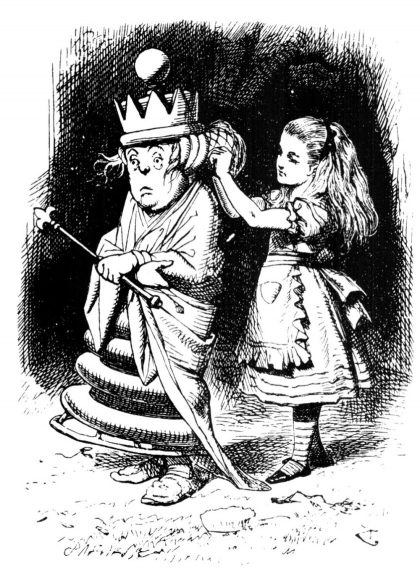
“Can’t you?” the Queen said in a pitying tone. “Try again: draw a long breath, and shut your eyes.”
Alice laughed. “There’s no use trying,” she said: “one can’t believe impossible things.”
“I daresay you haven’t had much practice,” said the Queen. “When I was your age, I always did it for half-an-hour a day. Why, sometimes I’ve believed as many as six impossible things before breakfast.”
Lewis Carroll – Alice Through the Looking-Glass
Lewis Carroll invented the White Queen as an absurdist emblem of a refusal to deal. But now that deluded lady would slot right in at the BBC, CNN, Guardian et al. In fact to live in the mainstream western culture of today we need to be able to believe a lot more than six impossible things before breakfast. We need to plug into an entire matrix of the unreal, never happened, never could happen and purely ridiculous.
There is now almost no point of contact between the world described in daily mainstream news and social commentary and the actual veridical experiential world in which real people really live. The most basic “facts” upon which they operate are almost completely false. They produce hours and hours of comment and analysis based on events that never occurred, words that were never said, a history that doesn’t exist. It’s not about explaining reality any more, it’s about making it up.
In this world Russia is an “outlaw” for helping to defend an elected government in Syria, and the US is an emblem of law-abiding decency while it has spent 70 years carving up the world and murdering people it doesn’t like – and moreover is currently enabling terrorists and illegally occupying a swathe of Syrian territory.
In this world Putin, having cleaned up a good deal of the lawless mafia-rule that characterised the Yeltsin years, is a “kleptocrat” and a “gangster” while Yeltsin was a “democrat.” Facing an election with 60-80% popular support, Putin is a “tyrant” who needs to fix the vote in order to win. With reckless disregard for even the basics of narrative consistency he is portrayed by turns as an ignorant “thug” and a political mastermind. So brilliant he swung the US election using 13 lowlife trolls and a restaurateur, and so mindbogglingly stupid he had Boris Nemstov, the political nobody, gunned down for no reason right outside the Kremlin so that even more stupid western analysts could say “Putin must have done it because it was right outside the Kremlin!”
In this world Navalny, another political nobody, polling 2% popular vote is “the opposition”, cruelly silenced by being ruthlessly convicted of the fraud he almost certainly actually committed, and sent to the Gulag given a suspended sentence and the freedom to bullhorn his remedial-level “anti-corruption” narrative (designed primarily for western consumption and TV soundbites btw) to all twelve of his regular followers.
In this world even mass-shootings are starting to look like movie versions of themselves, and the victims interview each other, exchanging cliché mass media talking points, and improbable personal narratives that sound like Facebook statuses, while waiting to die.
Because reality is something even those living it in its rawest form can no longer process or recognise for what it is.
So, we have to salute Mr Pozner for his refusal to partake in this increasingly macabre farce. Maybe we should all follow his example, be like Alice, just walk away from the Mad Hatter’s tea table and let the lunatics continue to sit there, babbling empty memes at one another. They probably won’t even notice we’ve gone.
(and yes I know the White Queen and the Mad Hatter are not in the same chapter or even in the same book)
A UK-drafted resolution aimed at pressuring Iran over alleged weapons supplies to Yemeni fighters has failed at the UN Security Council.
On Monday, the resolution gained 11 favorable votes at the 15-member Security Council but was halted by Russia’s veto.
“We cannot concur with uncorroborated conclusions and evidence which requires verification and discussions within the sanctions committee,” Russian Ambassador Vassily Nebenzia told the council.
Earlier in the month, Britain circulated a draft resolution that would renew sanctions on Yemen for another year and also “condemns” Iran for allegedly breaching the 2015 arms embargo on the country by “failing to take the necessary measures to prevent the direct or indirect supply, sale or transfer” of short-range ballistic missiles, UAVs and other military equipment to Yemen’s Houthi Ansarullah movement.
The Houthi movement has been defending Yemen against a bloody Saudi-led military campaign, which was launched in 2015 with the help of the US and the UK to reinstall the country’s former Riyadh-friendly government.
The draft resolution, backed by France and the US, called for unspecified measures in response to the UN report about Iran’s alleged role in Yemen, stressing that the UNSC will take “additional measures to address these violations,” and that “any activity related to the use of ballistic missiles in Yemen” is a criteria for sanctions.
A group of UN experts monitoring the sanctions on Yemen reported to the Security Council in January that it had “identified missile remnants, related military equipment and military unmanned aerial vehicles that are of Iranian origin and were brought into Yemen after the imposition of the targeted arms embargo.”
The UN experts, however, said they were unable to identify the supplier.
Both Tehran and Sana’a have repeatedly rejected the allegations as a fabricated scenario, and said the armed forces of Yemen have strengthened their missile power on their own.
After the veto, the UNSC unanimously adopted a Russian-drafted measure to extend for one year the sanctions regime against Yemen.
One of the enduring legacies of my two diplomatic assignments in Moscow in the seventies and eighties has been my passion for ice hockey. Of course, ice hockey is not played in India and it was the thought of experiencing something startlingly new that one evening took me to the famous Dynamo Stadium in Moscow with some course mates in the Moscow University, friends who lured me with the promise of a spectacle unlike anything I’d have known before. Actually, I didn’t need to be encouraged, having watched on television that epic “3-3 game” on New Year’s Eve in 1975, which became the stuff of legends in the world of ice hockey, when the Montreal Canadians played CSKA Moscow (Soviet Red Army team).
The North Americans and the Russians played radically different systems of play. The Canadian (and the American) style was marked by ‘individualism’ even as the players aggressively moved the puck to the goal and fired it on net the moment they got a chance. Whereas, the Soviets weren’t so cavalier or aggressive – they circled like eagles and would keep passing the puck to one another to incessantly disorient the enemy while tightening the noose around him – and then in a sudden swoop would close in on the net like a tornado, but even then, only when he was confident of a reasonable scoring chance would the player take the shot lest his team lost possession of the puck wastefully.
Arguably, it was a metaphor for the Soviet DNA – be it in politics or in sports. No adventurism, no swagger or boastfulness — for god’s sake. Yet, by the way, the Soviet Red Army team was a top dog in world ice hockey. It was the European Champion not less than 20 times. Some of the CSKA players became iconic figures – Vladislav Tretiak as the unbeatable goalkeeper, peerless in ice hockey. Up front, my own favorites were Valerie Vasiliev and Alexander Maltsev (who previously played for Dynamo Moscow club before joining CSKA.)
The CSKA would be in full war cry when it played an NHL team (from Canada or the United States) – something like an Indian cricket team encountering its Pakistani adversary. More than four decades later, ice hockey in Russia still remains the ultimate national sport. Cold War has ended, but an ice hockey match between Russia and the West is still invested with the halo of an inchoate power struggle, unspoken but deeply felt. National prestige comes into play.
So, when Russia won the men’s ice hockey title yesterday at the PyeongChang Winter Olympics, it became for the victorious players a moment dripping with patriotism and national honor. They were forced to play under the rubric Olympic Athlete from Russia (OAR) – thanks to shenanigans of the US from behind the scenes to humiliate Russia. As per the agreed formula, Russian national anthem wouldn’t be allowed during the ceremonies and the victorious OAR athletes had to accept their medal with the Olympic song being played in the background.
However, when the actual moment came yesterday, the victorious Russian ice hockey team disregarded the understanding and sang their national anthem. A Russian player was quoted as saying, “We’re prohibited from having the flag so we had to do something at least. We sang because we’re Russian people and when you win, the anthem is played. It was in our souls and heart.”
Back home, the event had huge resonance. While reading President Vladimir Putin’s message congratulating the Russian ice hockey team, one could sense that he probably had a lump in the throat as he wrote it. The Russian people’s love for sports (or reading books or going to the theatre) can be seen as a legacy of Soviet culture. With the great social mobility that the October Revolution opened up, culture ceased to be the prerogative of the nobility or the leisurely class. Indeed, culture became ‘accessible’ to the ‘proletariat’ and the Soviet state encouraged the citizen to enrich himself from childhood. Seamless opportunities were provided to imbibe culture. It explains the staggering heights unparalleled in human history that the social formation scaled in the Soviet era.
Politics, inevitably, crept in. The Russian’s excellence in sports became an eyesore for the Americans who somehow took it as a slur on the capitalist world. The triumphalism in humiliating Russia is obvious even today in the western media reports when its athletes must perform under the Olympic flag and Russian national anthem will not be played even when they won medals.
The United States has warned Iraq, among a number of other countries, of the consequences of extending military cooperation with Russia, and striking deals to purchase advanced weaponry, particularly the S-400 surface-to-air missile defense systems.
US State Department spokeswoman Heather Neuert said on Thursday that Washington has contacted many countries, including Iraq, to explain the significance of the Countering America’s Adversaries Through Sanctions Act (CAATSA), and possible consequences that would arise in the wake of defense agreements with Moscow.
On August 2, 2017, US President Donald Trump signed into law the CAATSA that imposed sanctions on Iran, North Korea, and Russia.
Neuert said she did not know whether Iraq and Russia have finalized an accord on the S-400 missile systems.
The remarks came only a few days after Saudi Arabia’s Arabic-language al-Watan newspaper reported that Baghdad is planning to buy Russian-made S-400 surface-to-air missile system from Moscow.
There are also reports that Iraqi Prime Minister Haider al-Abadi has tasked a team of advisers from the Iraqi Ministry of Defense and National Security Council to negotiate the purchase of the missile systems with Russian officials.
Earlier this month, Chairman of the Defense Committee of the Russian Federation Council, Colonel General Viktor Bondarev, named Syria, Iraq, Sudan and Egypt as the potential buyers of the defense systems.
Last week, Chief Executive Officer of Rostec, Russia’s state-owned corporation for promoting the development, production and export of high-tech industrial products, stated that Moscow is ready to sell its air defense systems to any country with security concerns.
The real goal of the West-brokered UN Security Council resolution on Syria is to put the blame on Damascus for everything and provide cover for militants, Russian Foreign Minister Sergey Lavrov has said.
The authors of the resolution on humanitarian issues in Syria, which is to be discussed at the UNSC meeting on Thursday evening, want to “shift the focus” from the peace process “to blaming the Syrian government in order to promote ‘plan B,’ namely overthrowing the regime in violation of resolution 2257,” Lavrov said at a news conference in Belgrade.
If the US continues to ignore Russia’s position, Moscow will have no other choice than to infer that the authors of the initiative “again want to put the blame on Damascus and provide cover for militant groups,” the minister added.
Russia is also preparing a resolution on humanitarian issues in Syria, amid concerns over the escalating violence in the country. Eastern Ghouta, a suburb of Damascus, has seen a new wave of clashes between Syrian government forces and both rebel and Islamist factions operating in the area.
Together with Iran and Turkey, Russia is tasked with enforcing the ceasefire in Eastern Ghouta, one of the de-escalation zones established as a result of the Astana talks in May 2017. The Russian Center for Reconciliation in Syria earlier suggested the militants leaving the area, but the proposal was rejected, according to Lavrov.
“The Al-Nusra Front [currently known as Jabhat Fateh Al-Sham] and those who interact with it have firmly rejected the proposal and continue to shell the city from their positions, using the civilian population of Eastern Ghouta as a human shield,” the diplomat stressed.
It is now nearly three decades since the Unites States adopted the policy of dual containment of Iran and Iraq. While much has been written about the containment of Iraq, there has been very little in-depth analysis of this policy when it comes to Iran. In a book that is going to be released on March 31, 2008, entitled The United States and Iran: Sanctions, Wars and the Policy of Dual Containment (Routledge), I attempt to address this shortcoming by investigating when and why the US policy of containment of Iran came about, how it evolved, and where it stands today.[1] To the extent that Israel has been involved in US policy making, the study will also include the role that Israel has played in the containment of Iran. Also, since the fate of Iran has been inextricably linked to that of Iraq, occasionally the investigation will overlap with the containment of Iraq.
The policy of dual containment of Iran and Iraq originated during the Carter Administration, but it was not until the Clinton Administration that the expression “dual containment” became popular. … continue
This site is provided as a research and reference tool. Although we make every reasonable effort to ensure that the information and data provided at this site are useful, accurate, and current, we cannot guarantee that the information and data provided here will be error-free. By using this site, you assume all responsibility for and risk arising from your use of and reliance upon the contents of this site.
This site and the information available through it do not, and are not intended to constitute legal advice. Should you require legal advice, you should consult your own attorney.
Nothing within this site or linked to by this site constitutes investment advice or medical advice.
Materials accessible from or added to this site by third parties, such as comments posted, are strictly the responsibility of the third party who added such materials or made them accessible and we neither endorse nor undertake to control, monitor, edit or assume responsibility for any such third-party material.
The posting of stories, commentaries, reports, documents and links (embedded or otherwise) on this site does not in any way, shape or form, implied or otherwise, necessarily express or suggest endorsement or support of any of such posted material or parts therein.
The word “alleged” is deemed to occur before the word “fraud.” Since the rule of law still applies. To peasants, at least.
Fair Use
This site contains copyrighted material the use of which has not always been specifically authorized by the copyright owner. We are making such material available in our efforts to advance understanding of environmental, political, human rights, economic, democracy, scientific, and social justice issues, etc. We believe this constitutes a ‘fair use’ of any such copyrighted material as provided for in section 107 of the US Copyright Law. In accordance with Title 17 U.S.C. Section 107, the material on this site is distributed without profit to those who have expressed a prior interest in receiving the included information for research and educational purposes. For more info go to: http://www.law.cornell.edu/uscode/17/107.shtml. If you wish to use copyrighted material from this site for purposes of your own that go beyond ‘fair use’, you must obtain permission from the copyright owner.
DMCA Contact
This is information for anyone that wishes to challenge our “fair use” of copyrighted material.
If you are a legal copyright holder or a designated agent for such and you believe that content residing on or accessible through our website infringes a copyright and falls outside the boundaries of “Fair Use”, please send a notice of infringement by contacting atheonews@gmail.com.
We will respond and take necessary action immediately.
If notice is given of an alleged copyright violation we will act expeditiously to remove or disable access to the material(s) in question.
All 3rd party material posted on this website is copyright the respective owners / authors. Aletho News makes no claim of copyright on such material.
 Aletho News
