Russian Embassy Slams US for Denying Access to Diplomatic Archives
Sputnik – October 24, 2017
The Embassy of the Russian Federation in the United States slammed the US officials on Monday for packing and transferring the diplomatic archives from the closed Consulate General in San Francisco without the oversight of the Russian diplomats.
“By taking these actions, the United States has once again violated the key provisions of the Vienna Convention on Consular Relations and the bilateral consular convention,” the Russian Embassy said in a statement on Monday.
The Embassy stressed that all consular archives and documents should not be dishonored regardless of the circumstances and irrespective of their location.
Washington has transferred the archive to the Embassy on October 23, but did not permit Russian diplomats to enter the building and pack the documents.
Moscow perceived this step as disregard to the international law and Russian diplomatic mission, which enables Moscow to take retaliatory measures, the Embassy noted.
“Washington’s disregard of the international law, our diplomatic and consular facilities and property enables the Russian government to prepare similar actions against US missions in Russia based on the principle of reciprocity,” the Embassy said on Monday.
According to the US officials, the decision to close the Russian missions came as a response to Russia deciding in July to reduce the number of US diplomatic staff in the country to 455 people, which is the same number as that of the Russian diplomatic personnel in the United States.
After Russian diplomats left the diplomatic compounds, US security agents entered the premises to conduct searches. Moscow condemned the actions as a violation of international law, including the Vienna Conventions on Diplomatic and Consular Relations.
SEE ALSO:
Russian Embassy Issues Footage of US Intrusion in Diplomatic Facility (VIDEO)
Russia-China Tandem Changes the World
By Gilbert Doctorow | Consortium News | October 23, 2017
Much of what Western “experts” assert about Russia – especially its supposed economic and political fragility and its allegedly unsustainable partnership with China – is wrong, resulting not only from the limited knowledge of the real situation on the ground but from a prejudicial mindset that does not want to get at the facts, i.e. from wishful thinking.
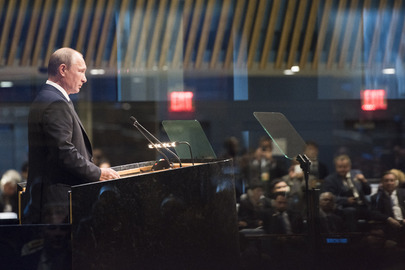
Russian President Vladimir Putin (UN Photo)
Russia may not be experiencing dynamic growth, but over the past two years it has survived a crisis of circumstance in depressed oil prices and economic warfare against it by the West that would have felled less competently managed governments enjoying less robust popularity than is the case in Vladimir Putin’s Russia. Moreover, as stagnant as Russia’s GNP has been, the numbers have been on a par with Western Europe’s very slow growth.
Meanwhile, Russian agriculture is booming, with the 2017 grain harvest the best in 100 years despite very adverse climatic conditions from early spring. In parallel, domestically produced farm machinery has been going from strength to strength. Other major Industrial sectors like civil aircraft production have revived with the launch of new and credible models for both domestic and export markets.
Major infrastructure projects representing phenomenal engineering feats like the bridge across the Kerch straits to Crimea are proceeding on schedule to successful termination in the full glare of regular television broadcasts. So where is this decrepit Russia that our Western commentators describe daily?
The chief reason for the many wrongheaded observations is not so hard to discover. The ongoing rampant conformism in American and Western thinking about Russia has taken control not only of our journalists and commentators but also of our academic specialists who serve up to their students and to the general public what is expected and demanded: proof of the viciousness of the “Putin regime” and celebration of the brave souls in Russia who go up against this regime, such as the blogger-turned-politician Alexander Navalny or Russia’s own Paris Hilton, the socialite-turned-political-activist Ksenia Sochak.
Although vast amounts of information are available about Russia in open sources, meaning the Russian press and commercial as well as state television, these are largely ignored. The sour grapes Russian opposition personalities who have settled in the United States are instead given the microphone to sound off about their former homeland. Meanwhile, anyone taking care to read, hear and analyze the words of Vladimir Putin becomes in these circles a “stooge.” All of this limits greatly the accuracy and usefulness of what passes for expertise about Russia.
In short, the field of Russia studies suffers, as it also did during the heyday of the Cold War, from a narrow ideological perspective and from the failure to put information about Russia in some factually anchored framework of how Russia fits in a comparative international setting.
Just what this means was brought into perspective last week by a rare moment of erudition regarding Russia when professor emeritus of the London School of Economics Dominic Lieven delivered a lecture in Sochi at the latest Valdai Club annual meeting summarizing his take on the Russian Revolution of 1917.
Lieven, arguably the greatest living historian of imperial Russia, is one of the very rare birds who brought to his Russian studies a profound knowledge of the rest of the world and in particular of the other imperial powers of the Nineteenth Century with which Russia was competing. This knowledge takes in both hard and soft power, meaning on the one hand, military and diplomatic prowess and, on the other, the intellectual processes which are used to justify imperial domination and constitute a world view if not a full-fledged ideology.
Self-blinded ‘Experts’
By contrast, today’s international relations “experts” lack the in-depth knowledge of Russia to say something serious and valuable for policy formulation. The whole field of area studies has atrophied in the United States over the past 20 years, with actual knowledge of history, languages, cultures being largely scuttled in favor of numerical skills that will provide sure employment in banks and NGOs upon graduation. The diplomas have been systematically depreciated.
The result of the foregoing is that there are very few academics who can put the emerging Russian-Chinese alliance into a comparative context. And those who do exist are systematically excluded from establishment publications and roundtable public discussions in the United States for not being sufficiently hostile to Russia.
If that were not the case, one could look at the Russian-Chinese partnership as it compares firstly with the American-Chinese partnership created by Richard Nixon and Henry Kissinger, which is now being replaced by the emerging Russian-Chinese relationship. Kissinger was fully capable of doing this when he wrote his book On China in 2011, but Kissinger chose to ignore the Russian-Chinese partnership though its existence was perfectly clear when he was writing his text. Perhaps he did not want to face the reality of how his legacy from the 1970s had been squandered.
What we find in Kissinger’s description of his accomplishments in the 1970s is that the American-Chinese partnership was all done at arm’s length. There was no alliance properly speaking, no treaty, in keeping with China’s firm commitment not to accept entanglement in mutual obligations with other powers. The relationship was two sovereign states conferring regularly on international developments of mutual interest and pursuing policies that in practice proceeded in parallel to influence global affairs in a coherent manner.
This bare minimum of a relationship was overtaken and surpassed by Russia and China some time ago. The relationship has moved on to ever larger joint investments in major infrastructure projects having great importance to both parties, none more so than the gas pipelines that will bring very large volumes of Siberian gas to Chinese markets in a deal valued at $400 billion.
Meanwhile, in parallel, Russia has displaced Saudi Arabia as China’s biggest supplier of crude oil, and trading is now being done in yuan rather than petrodollars. There is also a good deal of joint investment in high technology civilian and military projects. And there are joint military exercises in areas ever farther from the home bases of both countries.
I think it is helpful to look at this partnership as resembling the French-German partnership that steered the creation and development of what is now the European Union. From the very beginning, Germany was the stronger partner economically with France’s economy experiencing relative stagnation. Indeed, one might well have wondered why the two countries remained in this partnership as nominal equals.
The answer was never hard to find: with its historical burden from the Nazi epoch, Germany was, and to this day remains, incapable of taking responsibility in its own name for the European Union. The French served as the smokescreen for German power. Since the 1990s, that role has largely been transferred to the E.U. central bodies in Brussels, where key decision-making positions are in fact appointed by Berlin. Yet, France remains an important junior partner in the German-driven process.
The Russian-Chinese Tandem
One may say much the same about the Russian-Chinese tandem. Russia is essential to China because of Moscow’s long experience managing global relations going back to the period of the Cold War and because of its willingness and ability today to stand up directly to the American hegemon, whereas China, with its heavy dependence on its vast exports to the U.S., cannot do so without endangering vital interests. Moreover, since the Western establishment sees China as the long-term challenge to its supremacy, it is best for Beijing to exercise its influence through another power, which today is Russia.
Of course, in light of the E.U.’s Brexit troubles and Trump’s abandonment of world leadership, it is undeniably possible that China will step out of the shadows and seek to assume direction of global governance. But that would be problematic. China faces major domestic challenges including the transition of its economy from being led by exports to relying more on domestic consumption. That will absorb the attention of its political leadership for some time.
Kissinger, who has been an adviser to Trump, whispers in Trump’s ear about the importance of separating Russia from China, but Kissinger’s limited and outdated knowledge of Russia has caused him to underestimate the powerful motives behind the Russian-Chinese relationship. America’s less gifted and informed pundits are even more clueless.
For one thing, given the sustained hostility directed at Russia from the West in general and from Washington in particular, it is inconceivable that Putin would be wooed away from Beijing by some flirtatious “come hither” gestures from the Trump administration even if that were politically possible for Trump to do. One of Putin’s outstanding features is his loyalty to his friends and his principles as well as to his nation’s interests.
As Putin revealed during his address and Q&A at the Valdai Club gathering this past week, he now bears a deep distrust of the West in light of its having taken crude advantage of Russia’s weakness in the 1990s and by its expansion of NATO to Russian borders and other threatening actions. Whatever hopes Putin once may have held for warmer relations with the West, those hopes have been dashed over the past several years.
Putting personalities aside, Russian foreign policy has a commonality that is rare to see on the world stage: actions first, diplomatic charters later. Russia’s political relations with China come on top of massive mutual investments that have taken many years to agree on and execute.
In the same way, Russia is proceeding with Japan to work towards a formal peace treaty by first putting in place massive trade and investment projects. It is entirely foreseeable that the first step to the treaty will be the start of construction in 2018 of a railway bridge in the Far East linking the Russian island of Sakhalin with the mainland. The general contractor and engineering team is also in place: Arkady Rotenberg and his SGM Group. That bridge is the prerequisite for Japan and Russia signing a $50 billion deal to build a railway bridge linking Sakhalin and Hokkaido. This bridge will draw the attention of the whole region to Russian-Japanese cooperation. It could be the foundation for a durable and not merely paper peace treaty resolving the territorial dispute over the Kurile Islands.
Lost Opportunities
In light of these realities, it is puerile to speak of detaching Russia from China with the promise of normalized relations with the West. The opportunity to do that existed in the 1990s, when President Boris Yeltsin and his “Mr. Yes” Foreign Minister Andrei Kozyrev did everything possible to win U.S. agreement to Russian accession to NATO immediately following accession by Poland. To no avail.
Then again early in Putin’s presidency, the Russians made a determined effort to win admission to the Western alliance. Again to no avail. Russia was excluded, and measures were taken to contain it, to place it in a small box as just another European regional power.
Finally, following the confrontation with the United States and Europe over their backing of the 2014 coup in Ukraine, followed by the Russian annexation/merger with Crimea, and Russian support for the insurgency in Ukraine’s Donbas region, Russia openly was cast as the enemy. It was compelled to mobilize all of its friendships internationally to stay afloat. No state was more helpful in this regard than China. Such moments are not forgotten or betrayed.
The Kremlin understands full well that the West has nothing substantial to offer Russia as long as the U.S. elites insist on maintaining global hegemony at all costs. The only thing that could get the Kremlin’s attention would be consultations to revise the security architecture of Europe with a view to bringing Russia in from the cold. This was the proposal of then President Dmitry Medvedev in 2010, but his initiative was met by stony silence from the West. Bringing in Russia would mean according it influence proportionate to its military weight, and that is something NATO has opposed tooth and nail to this day.
It is for this reason, the failure to seek solutions to the big issue of Russia’s place in overall security, that the re-set initiative under Barack Obama failed. It is for this reason that Henry Kissinger’s advice to Donald Trump at the start of his presidency to offer relief from sanctions in return for progress on disarmament rather than implementation of the Minsk accords regarding the Ukraine crisis also failed, with Vladimir Putin giving a firm “nyet.”
Implicit in the few American “carrots” being extended to Russia these days is its acceptance of the anti-Russian regime in Ukraine and its authority over the heavily ethnic Russian areas of the Donbas and Crimea, concessions that would be politically devastating to Putin inside Russia. Yet, that “normalization” would still leave the much milder but still nasty “human rights” sanctions that the U.S. imposed in 2012 through the Magnitsky Act, driven by what the Kremlin regards as false propaganda surrounding the criminal case and death of accountant Sergei Magnitsky.
The sting of the Magnitsky Act was to discredit Russia and prepare the way for it being designated a pariah state. It came amidst an already longstanding campaign of demonization of the Russian president in the U.S. media. In fact, to begin to find a halfway normal period of bilateral relations, you would have to go back to before George W. Bush’s invasion of Iraq, which Russia denounced along with Germany and France. The latter two powers got a tap on the wrist from Washington. For Russia, it was the start of a period of reckoning for its uncooperativeness with American global domination.
Demonizing Russia
As for Europe and Russia, the question is very similar. To find mention of a strategic relationship, firstly from the German Foreign Ministry, you have to go back to before 2012. And what constituted normality then? At the time, renewal of the E.U.-Russia cooperation agreement was already being held up for years, nominally over a difference of views on the provisions of E.U. law governing gas deliveries through Russian-owned pipelines. Behind this difference was the total opposition of the Baltic States and Poland to anything resembling normal relations with Russia, for which they received full encouragement from the U.S.
The rallying cry was to put a stop to Russia’s status as “monopoly supplier” to Europe as regards gas, but also oil. Of course, no monopoly ever existed, nor does it exist today, but determined geopolitical actors never let such details stand in the way of policy formulation.
This hostility also played out in the contest of wills between the E.U. and Russia over introduction of a visa-free regime for travel by their respective citizens. Here the opposition of Germany’s Angela Merkel, justified by her vicious characterization of Russia as a mafia state, doomed the visa-free regime and by the same token doomed normal relations.
All of this unfinished business has to be addressed and put right for there to be any possibility of the U.S. and the E.U. ending their hostility toward Russia and for the Kremlin to regain any trust toward the West. Even then, however, Russia would not surrender its valued relationship with China.
In my view, the de facto Russian-Chinese alliance matches the de jure US-West European alliance. The net result of both is the partition of the world into two camps. We now have, in effect, a bipolar world that broadly resembles that of the Cold War, though still in a formative stage since many countries have not signed on definitively to one side or another.
Of course, more-or-less neutral states were also a feature of the Cold War, creating what was called the group of Nonaligned Nations, led back then by India and Yugoslavia. Yugoslavia no longer exists, but India has continued its tradition of let both poles court it, trying to eke out the greatest benefit to itself.
To be sure, a great many political scientists in the U.S., in Europe and in Russia as well, insist that we already have a multipolar world, saying that power is too diffuse in the world today, especially considering the rise of non-state actors after 1991. But the reality is that very few states or non-states can project power outside their own region. Only the two big blocs can do that.
The theoreticians defending multipolarity speak of a return to the balance of power of the Nineteenth Century, invoking the Congress of Vienna as a possible model for today’s world governance. This is an approach that Henry Kissinger laid out in 1994 in his book Diplomacy.
Within Russia, this concept has found support in some influential think tanks and is most notably associated with Sergei Karaganov, head of the Council of Foreign and Defense Policy. Nonetheless, I maintain that everyday realities of power will decide this question. And is there anything inherently wrong with this de facto bipolar world, assuming the tensions can be managed and a major war averted?
In my view, two large blocs are more likely to keep global order because the scope of activities by proxies can be reined in – as often happened during the Cold War – by big powers not wanting their various clients to disrupt a functioning world order. The tails are less likely to wag the dog.
Moreover, as regards the Russia-China strategic partnership or alliance, Western observers should take comfort and not take alarm. The rise of China is a given whatever the constellation of great powers may wish. The close embrace of Russia and China also can serve as a moderating influence on China, given Russia’s greater experience in world leadership.
For all of the above positive and negative reasons, the Russia-China relationship should be viewed with equanimity in Western capitals.
Gilbert Doctorow is an independent political analyst based in Brussels. His latest book, Does the United States Have a Future? was just published.
US Targets Russian Nord Stream-2 Gas Project: Déjà Vu Story
By Peter KORZUN | Strategic Culture Foundation | 23.10.2017
The US Countering Iran’s Destabilizing Activities Act of 2017 contains a separate section called the Countering Russian Influence in Europe and Eurasia Act (“CRIEEA”). CRIEEA authorizes – and at times requires – the President to impose significant new sanctions on the Russian energy, financial, and defense sectors, imperiling the completion of the Russian Nord Stream 2 gas pipeline. It also hits European businesses involved in the project. The legislation can impact a potentially large number of European companies doing legitimate business under EU measures with Russian entities in the railways, financial, shipping or mining sectors, among others. Now the US punitive measures could include the pipelines crossing the territory of Ukraine, as well as pipeline projects in the Caspian region and the development of the Zohr gas field off the coast of Egypt. The law negatively affected the US relationship with European allies.
Russian President Vladimir Putin believes that the world is witnessing an increasing number of examples of politics crudely interfering with economic, market relations. In his address to the final plenary session of the 14th annual meeting of the Valdai Discussion Club on October 19, Putin said “Some do not even conceal that they are using political pretexts to promote their strictly commercial interests. For instance, the recent package of sanctions adopted by the US Congress is openly aimed at ousting Russia from European energy markets and compelling Europe to buy more expensive US-produced LNG although the scale of its production is still too small.”
The US is striving to control the EU decision-making process. According to Washington’s logic, building a pipeline to reduce costs and raise reliability and efficiency proves that Russia is politically motivated, unlike the US with its new law adopted to pave the way for American LNG exports to Europe using coercive measures! The US staunch allies ready to cede economic profits for Washington’s friendship – Poland, the Baltic States, and, since recently, Denmark – are mobilized to hinder Nord Stream-2. Not an EU member, but a member of Energy Community, Ukraine also goes to any length to obstruct the project.
Poland tried to reverse the EU decision through courts but to no avail. In July, a court in Duesseldorf, Germany, lifted restrictions on Russian gas company Gazprom’s access to the German Opal gas pipeline, online documentation by the court showed, echoing a ruling on July 21 by the European Union General Court.
Defying the US pressure, the EU exempted OPAL gas pipeline (delivering gas from Russian Nord Stream to Europe) from the Third Energy Package after 6 years of debates. The decision opened the way for Russian plans to expand Nord Stream’s capacity and bypass both Ukraine and Poland as a gas transit route. The Western companies have immediate interests in Nord Stream 2, which is a joint venture between Gazprom (50% share) and five of the largest European energy companies: E.ON, OMV, Shell, BASF/Wintershall and Engie (each 10% share).
Actually, this is a déjà vu story. Washington has a long history of meddling into European energy policy. The Yamal and Nord Stream 2 gas projects present several striking similarities. In 1980-81, the Yamal pipeline (Urengoy-Pomary-Uzhgorod) project was presented to be negotiated between the Soviet Union (Soyuzgazexport) and Western Europeans (Ruhrgas and Gaz de France). Back then, West Germany’s Chancellor Helmut Schmidt was willing to preserve the achievements of Willy Brandt’s Ostpolitik. The USSR and West Germany concluded an agreement on the deal in November 1981.
The joint project was fiercely fought by President Ronald Reagan. He saw Yamal through a geopolitical lens and considered it one of the Soviet Union’s significant tools aimed at spreading Moscow’s influence over the Europeans, and in particularly over NATO. The US launched a coordinated diplomatic offensive aimed at convincing European allies to abandon their participation in the Yamal project. It offered to supply West Germany with energy in the form of coal, but his proposal was turned down as not viable economically.
Those were the days of great tensions between the West and the East marked by NATO’s deployment of intermediate range ground-based missiles in Italy, the UK, West Germany, the Netherlands and Belgium. In 1979, the USSR launched an operation in Afghanistan.
The US insisted the Yamal project threatened NATO security just like nowadays Nord Stream-2 does amid the Russia-West divisions over Ukraine and a host of other issues. President Reagan used the geopolitical tensions as a pretext to deprive the Soviet Union of profits. With Germany refusing to bow, the US administration used the Polish crisis in 1980-1981 to impose sanctions banning sales of equipment to the USSR.
In December, 1981, President Reagan banned all the gas and oil equipment and technology exports produced in the United States to the Soviet Union. In June, 1982, the US administration announced the extension of the sanctions on all foreign companies exporting equipment involving American technologies. The US sanctions drove a wedge between the United States and its Western European allies, as the latter refused to follow the lead. The landmark deal went through to be joined by France, Austria and Italy. West German, French, Italian and British companies won multi-million contracts for pipes and various equipment orders. The America embargo was lifted in 1982. In 1984, the Yamal pipeline became operational to benefit all.
Today, the US uses Ukraine instead of Poland but the goal and the methods to achieve it remain the same.
If Germany had not had the advantage of stable gas supplies from Russia, it would not have become the locomotive driving the European economy and the EU leader defining the decision making process. Other European countries have also gained a lot. Today, the demand for Russian gas keeps on growing to make Moscow increase supplies via the pipeline going through Ukraine and Nord Stream. Europe badly needs the stable supplies, if it wants to achieve economic progress. To protect its vital interests it has to defy the United States. The history appears to repeat itself.
Washington’s economic war against Russian gas supplies to Europe unacceptable – Gerhard Schroeder
RT | October 20, 2017
The United States would like to weaken Russia’s energy cooperation with the European Union, said former German Chancellor Gerhard Schroeder, adding it’s unacceptable to create barriers to Russian gas deliveries to the German market.
“It’s wrong if the Americans and the European Union somehow resist each other on this issue. And still there are attempts to create some difficulties for this project [Nord Stream 2 gas pipeline – Ed.],” he told Rossiya 24 news channel.
According to Schroeder, “the fact the Americans will try entering the German market with the help of sanctions and to dominate with its liquefied shale gas is nothing but the signs of an economic war, and such war is unacceptable.”
Germany is interested in gas which it “will receive for sure and which will be cheaper than shale gas,” said Schroeder.
The ex-chancellor said German authorities were right to call the Nord Stream 2 gas pipeline purely an economic project which should not be politicized.
Last week, European Commissioner for Competition Margrethe Vestager said the EU has no legal means to stop the pipeline that will deliver natural gas from Russia to Germany.
The Nord Stream 2 pipeline will double the capacity of the existing Nord Stream pipeline, which goes under the Baltic Sea to Germany. The Gazprom-led project is opposed by the Baltic States and Poland.
During the EU summit on Friday, Polish Prime Minister Beata Szydlo described the Nord Stream 2 pipeline as a threat to European energy security.
Russian President Vladimir Putin said this week Moscow faces obstacles constructing the new route despite the fact that diversification of gas supplies is cost-effective, beneficial to Europe and serves to enhance the security of supplies.
The Kremlin has repeatedly said the pipeline is strictly about business, accusing the United States of trying to thwart the project, as it wants to export its own liquefied natural gas to Europe.
Boycott Movement: Arab Delegations Withdraw from International Festival
IMEMC News & Agencies | October 19, 2017
The Boycott, Divestment, Sanctions (BDS) movement has welcomed the Palestinian student delegation and other Arab delegations’ withdrawal from the World Festival of Youths and Students, held in the Russian city of Sochi, due to the participation of Israeli delegations.
“We appreciated the principled stand taken by the Arab youths rejecting normalization, especially that the festival alleged to be anti-imperialism, however, Israeli delegations having colonial thoughts and supporting imperialism are invited to take part in it,” the movement said is a press release on Wednesday, according to Al Ray.
The movement praised all students and free voices that had withdrawn from the opening session of the festival.
Canada passes US-style sanctions bill targeting ‘corrupt’ Russian officials
RT | October 18, 2017
The Canadian Senate has passed Bill S-226, known as the Sergei Magnitsky Law, mirroring similar US legislation. Moscow has repeatedly slammed the bill as a violation of international law and vowed to respond.
Although the bill, titled “Justice for Victims of Corrupt Foreign Officials Act (Sergei Magnitsky Law),” envisions imposing sanctions on any foreign national, not only on Russians, it mentions exclusively the high-profile cases linked to Russia in its preamble.
Among them is the death of Sergei Magnitsky in a pre-trial detention facility in 2009. Magnitsky was a tax accountant employed by the US-British investor Bill Browder, who was accused by the Russian authorities of orchestrating large-scale tax evasion and embezzling hundreds of millions of rubles from the Russian budget. The lawyer was a prime suspect in the investigation. Browder, however, insisted that Magnitsky fell victim to persecution and torture by the Russian penitentiary system after he allegedly uncovered corruption crimes by Russian tax officials. As result of a three-year lobbying campaign, spearheaded by Browder, in 2012 the US Senate approved the so-called Magnitsky Act, allowing the US to freeze the assets of, and bar entry to, Russians accused of human rights violations. The bill has soured relations between Washington and Moscow.
The other cases listed in the Canadian bill’s preamble refer to the death of Alexander Litvinenko in 2006 In London, which was blamed by British investigators on Russian secret services, the assassination of Russian opposition politician Boris Nemtsov in central Moscow in 2015 and the detention of former Ukrainian pilot turned MP, Nadezhda Savchenko, who was tried in a Russian court and found guilty of murdering Russian journalists in Eastern Ukraine. She was subsequently freed in a prisoner swap for two Russian nationals jailed by Kiev.
A foreign national is subject to the restrictions under the Canadian version of the Magnitsky Law if he or she is found to be complicit in torture or other human right violations against “individuals in any foreign country” who wants to shed light on the illegal activity by the government or to “obtain, exercise, defend or promote” human rights. The bill also targets foreign nationals involved in corruption.
Speaking on the bill after it was unanimously approved by the Canadian House of Commons in early October, Canada’s Foreign Minister Chrystia Freeland said that the legislation was designed to enable Canadian authorities to impose sanctions and travel bans on foreigners found to be complicit in these offenses.
The bill’s final reading was passed by the Senate on Tuesday. To become law, it now requires royal assent to be given by Canada’s Governor General, which is usually a mere formality.
The legislation’s apparent focus on the alleged misdeeds by Russian officials was slammed by Moscow as aggression that would not be left unanswered.
Russian Foreign Ministry spokesperson Maria Zakharova described the bill as a copy of the “odious American Magnitsky Act,” saying that it will deal a blow to already strained Russia-Canada relations.
“We warn again that in case the pressure of the sanctions put on us increases … we will widen likewise the list of Canadian officials banned from entering Russia,” Zakharova said in early October.
Konstantin Kosachyov, the head of the Upper House Committee for International Relations, dubbed the bill “yet another confirmation of the existence of the dangerous tendency when national legislation is applied to international relations.” The lawmaker argued that neither Canada, nor any other single country, has the right to play the role of a “global ombudsman.”
“Who has empowered Canada with the right to do such things in the international arena, to decide who is corrupt in other nations and who is not, to apply repressive measures to foreign citizens?” he said.
The spokesman for the Russian Embassy in Ottawa, Kirill Kalinin, said that while the bill is “disguised as a pro-human rights and anti-corruption measure” it goes against Canada’s national interests, as it will alienate “one of the key world powers,” in times when diplomacy is of crucial importance.
“Unfortunately, we are witnessing the continuation of failed policies, pressed by Russophobic elements,” he said in a statement, noting that Russia would respond “with resolve and reciprocal countermeasures.”
Syrian endgame is nigh as rival factions look to cut deals
Three cities – Deir ez-Zour, al-Raqqa, and Idlib – will define how the country shapes up post-ISIS, as key players edge towards under-the-table agreements
By Sami Moubayed | Asia Times | October 17, 2017
Over the weekend, Moscow hosted Sipan Hamo, commander of the powerful all-Kurdish Syrian Democratic Forces (SDF), the last standing US-backed militia on the Syrian battlefield. It was the most senior visit by a Kurdish military official to Moscow since the Russian Army joined the Syrian War in 2015.
Hamo met with Russian Defense Minister Sergey Shoygu and Chief-of-Staff Valeria Gerasimov to discuss the future of Deir ez-Zour and al-Raqqa, two cities along the Euphrates River which – at time of writing – appear to be in their final hours of control by Islamic State (ISIS).
At the same time, Turkish troops crossed the border into Syria, with the blessing of Russia and Iran, deploying in the northwest city of Idlib, which remains, for now, in the hands of Hayat Tahrir al-Sham (HTS), an al-Qaeda-linked terrorist organization previously known as Jabhat Fateh al-Sham, or Jabhat al-Nusra.
These three cities –Deir ez-Zour, al-Raqqa, and Idlib – will define what the Syrian endgame looks like. Invisible borders are being created around them, outlining each stakeholder’s share of the Syrian patchwork. Contrary to what many presume, very little fighting is now taking place on the streets of Syria, as under-the-table deals are being cut between traditional enemies who, until very recently, were at daggers drawn with each other.
Deir ez-Zour, the largest of these three contested cities, has been under brutal ISIS control since 2014. Government troops have been advancing on the oil-rich city, which lies east of the Euphrates, marching deep into territory once believed to be part of the country’s US/Kurdish fiefdom.
Opposition sources say government troops, with Russian air cover, will only be taking Deir ez-Zour City and not the entire province, arguing that everything around it, including farmland and oil wells, has been earmarked for the SDF. The exact parameters of these borders is what Hamo wanted to discuss in Moscow.
Reportedly, he pressed for a commitment from the Russians not to confront his troops in the Deir ez-Zour countryside, while promising to stop short of al-Sukhna, the last ISIS stronghold in the Homs Governorate, and leave the honors of its liberation to the Syrian and Russian Armies. On October 7, he and his men had stood by and watched government troops overrun ISIS strongholds in the city of al-Mayadeen, in the countryside of Deir ez-Zour — a job that until recently, would have been left to the SDF.
In exchange for such cooperation, the SDF is seeking Russian guarantees that the Turkish Army will not march on the Kurdish city of Afrin, west of the Euphrates River. Kurdish leaders are panicking after Turkish troops plunged into Idlib over the weekend, seemingly to implement part of the de-conflict zone agreement reached at the Astana ceasefire talks in May. Afrin lies within the Russian pocket of influence in Syria, and the Turks are trying to win control of the summit of Sheikh Mount Barakat, which overlooks it. A former radar post for the Syrian Army, it would give Erdogan’s forces a birds-eye view of Afrin. Moscow agreed to give Hamo the specific guarantee he asked for.
Meanwhile, the Turks are cutting their own deals in Idlib – with the militant jihadist group Hayat Tahrir al-Sham. Instead of bankrolling a new proxy army of Syrian recruits, or sending its own troops to battle, Ankara is trying to reach a political understanding with HTS, calling for its silent evacuation from Idlib and safe passage to the countryside of Deir ez-Zour.
On October 8, HTS militants escorted a Turkish reconnaissance unit into Idlib. This was followed by no fewer than three meetings between Turkish officials and HTS commanders, raising eyebrows among the Syrian Opposition. This is the very same group that the Turks have been mandated to crush, but which many believe they helped to create early in the Syrian conflict five years ago.
In exchange for safe exodus, Turkey wants HTS to withdraw quietly from Atme, north of Idlib and east of the Turkish border, through Darat Izzat (30 km northwest of Aleppo), all the way to Anadan, on the Aleppo-Gazientap International Highway. This would further secure the Turkish border from any Kurdish advancements, and create a new buffer zone in which to relocate Syrian refugees living in Turkey since 2011. It would also enlarge Turkey’s zone of influence in Syria, which already includes the two border cities of Jarablus and Azaz, and that of al-Bab, 40km northeast of Aleppo.
Similar secret deals are also being cut between the SDF and ISIS in al-Raqqa, where the jihadists have been on the defensive since the Kurdish campaign started last June.
The city has been subjected to a horrific aerial bombardment by the US-led Coalition, believed to be one of the worst in modern history. Within days, however, al-Raqqa will be liberated fully from ISIS control, bringing an end, once and for all, to the myth of the “capital” of the Islamic State.
Only 120 fighters are left in al-Raqqa, stranded in a pass of just 1.5 km, and all of them are foreign fighters. All local Syrian ISIS fighters were evacuated through secret agreement with the SDF on the night of October 6-7, disguised as ordinary civilians. The agreement with ISIS basically allows local Syrians to jump ship, distancing themselves from the terror group that captured their hearts and minds back in 2014. In exchange for handing back al-Raqqa, these Syrian fighters might even get a free pass to return to ordinary life, if they help eliminate what remains of foreign fighters inside still inside the city.
Russia ready to mediate talks between Saudi Arabia & Iran – deputy FM
RT | October 11, 2017
Russia is ready and willing to mediate in establishing relations between Saudi Arabia and Iran, Russian Deputy Foreign Minister Mikhail Bogdanov has stated.
“We tried several times and offered [to help Iran and Saudi Arabia sit down at the negotiating table], but we do not impose our intermediary role,” Bogdanov told reporters.
“But we have always told our partners in both Saudi Arabia and Iran that we are ready to provide both a platform for contacts and friendly services.”
Bogdanov added that Moscow has always highlighted the need to resolve the issues between the two countries.
“Many problems would have been much easier to resolve had there been mutual understanding and trust between Tehran and Riyadh,” Bogdanov said.
He added that the situation in the entire region, especially regarding antiterrorism efforts, depends on mutual understanding and cooperation between Iran and Saudi Arabia.
Bogdanov stressed that Russia always tells Saudi Arabia and Iran that it is ready to report something from one side to another or to organize their bilateral contacts. “These proposals remain on the table both with our Saudi and Iranian partners,” he said.
In May, an Iranian Foreign Ministry spokesman accused Saudi Arabia of supporting terrorism and seeking confrontational policies in the region. He was responding to comments by the Saudi deputy crown prince, who earlier ruled out dialogue with Tehran. Saudi Deputy Crown Prince Mohammed bin Salman al-Saud, the kingdom’s defense minister, said it was impossible to mend relations between his country and Iran due to Tehran’s “extremist ideology” and ambitions to “control the Islamic world.”
Diplomatic ties between the two countries were severed in 2016 after Iranian protesters attacked the Saudi embassy in Tehran, following the execution of prominent Shiite cleric Sheikh Nimr al-Nimr in Riyadh. Saudi Arabia’s foreign minister responded by accusing Iran of setting up “terrorist cells” inside the kingdom. Iran then issued a warning that “divine vengeance” would come to Saudi Arabia as a punishment for Nimr’s execution as well as for Riyadh’s bombings in Yemen and support for the Bahraini government.
In February of this year, Iranian President Hassan Rouhani, while on a visit to Saudi ally Kuwait, said that Tehran would like to restore relations and improve ties with all its Gulf Arab neighbors.
One area where Moscow and Riyadh disagree is Iran’s involvement in Syria.
Riyadh, a main backer of the Syrian opposition, is against the actions of Iran’s Islamic Revolutionary Guard Corps (IRGC) and the Hezbollah group in Syria. According to Saudi Foreign Minister Adel Jubeir, these groups influence the situations in Iraq, Syria, Lebanon, the Gulf countries, and Yemen, and have no place in Syria or any other part of the world. Riyadh’s primary objective has been to put an end to Iran’s involvement in the region.
Meanwhile, Russia has argued that Iran and Hezbollah are operating in Syria at the official request of President Bashar Assad.
“We don’t see Hezbollah as a terrorist organization. We believe that both of them [Iran and Hezbollah] – like Russia’s air forces – came to Syria following the request of the legitimate government,” Russian Foreign Minister Sergey Lavrov stressed in April.
Featured Video
No Vote, No Representation, No State: Democracy, Israeli Style
or go to
Aletho News Archives – Video-Images
From the Archives
Sanctions, War and the Policy of Dual Containment
By SASAN FAYAZMANESH | March 17, 2008
It is now nearly three decades since the Unites States adopted the policy of dual containment of Iran and Iraq. While much has been written about the containment of Iraq, there has been very little in-depth analysis of this policy when it comes to Iran. In a book that is going to be released on March 31, 2008, entitled The United States and Iran: Sanctions, Wars and the Policy of Dual Containment (Routledge), I attempt to address this shortcoming by investigating when and why the US policy of containment of Iran came about, how it evolved, and where it stands today.[1] To the extent that Israel has been involved in US policy making, the study will also include the role that Israel has played in the containment of Iran. Also, since the fate of Iran has been inextricably linked to that of Iraq, occasionally the investigation will overlap with the containment of Iraq.
The policy of dual containment of Iran and Iraq originated during the Carter Administration, but it was not until the Clinton Administration that the expression “dual containment” became popular. … continue
Blog Roll
 Aletho News
- Europe’s Establishment Is Embracing War – and Losing Voters
- NATO chief advocates war of aggression
- No Vote, No Representation, No State: Democracy, Israeli Style
- Zionist Bought Senate Blocks Information About American Citizens Killed By Israel
- While Gaza dominates the UN, these are the people keeping it alive
- New Report: “Scholasticide and Genocide in Gaza: Assessment, Testimonies and Legal Analysis”
- ‘THAAD Delusion’: Iran war exposes US missile shield limits – The Atlantic
- Moscow issues warning to NATO over Russian exclave
- Yes, the Iran war has destroyed Trump’s presidency
- The fallacy of US delusions about Iran’s economic collapse
- If Americans Knew
- Inside Lebanon’s 200-page dossier on Israeli war crimes
- Flydubai, genocide, settler violence, Trump abuse of power to deport – Daily Update
- Counting Antisemitic Incidents: What the ADL Audit Reveals — and Obscures
- Mamdani releases plan to combat antisemitism and hate crimes in New York City
- Iran’s Revolutionary Guards Publish Letter to the American People
- DMFI launches $1 million ad campaign supporting Virginia’s Elaine Luria
- US Senate blocks resolution seeking report on Americans killed by Israel
- Israeli Attacks Kill Ten Palestinians in Gaza
- Massacre at Minab: The School That Became a Grave
- Israeli media: The IDF Shows It Doesn’t Turn a Blind Eye; It Actively Emboldens Settler Havoc
- No Tricks Zone
- Green Energy Debacle: German Expert Professor Fritz Vahrenholt Warns Of Severe Economic And Social Consequences
- Two More Paleo Reconstructions Affirm Meters-Higher Sea Levels Across Ireland, Brazil 7000-6000 Years Ago
- New Study: Earth And Venus Surface Warmth Largely Explained By Convection And Lapse Rate, Not CO2 Or Radiation
- 2025 Nature Paper Claiming Worsening Global Drought Gets RETRACTED …Heavily Flawed
- New Study: ‘Global Drought Shows No Detectable Recent Acceleration Under Climate Warming’
- Economic Masterminds: German Socialists Suggest Taxing Productivity Gains Stemming From Using AI
- The South China Sea Has Not Been Cooperating With The Climate Change Narrative
- Energy Crisis: Germany Enters Heating Season With Historically Low Gas Reserve Fill Levels
- New Study: The Antarctic Ice Sheet Gained Mass From 2020-2024 Due To Staggering Snow And Ice Accumulation
- Study: Ocean Heating Rates From Thousands Of Years Ago ‘Dwarf’ Modern Ocean Heating Rates

